Markets
News
Analysis
User
24/7
Economic Calendar
Education
Data
- Names
- Latest
- Prev


Signal Accounts for Members
All Signal Accounts
All Contests


U.K. Trade Balance Non-EU (SA) (Oct)A:--
F: --
P: --
U.K. Trade Balance (Oct)A:--
F: --
P: --
U.K. Services Index MoMA:--
F: --
P: --
U.K. Construction Output MoM (SA) (Oct)A:--
F: --
P: --
U.K. Industrial Output YoY (Oct)A:--
F: --
P: --
U.K. Trade Balance (SA) (Oct)A:--
F: --
P: --
U.K. Trade Balance EU (SA) (Oct)A:--
F: --
P: --
U.K. Manufacturing Output YoY (Oct)A:--
F: --
P: --
U.K. GDP MoM (Oct)A:--
F: --
P: --
U.K. GDP YoY (SA) (Oct)A:--
F: --
P: --
U.K. Industrial Output MoM (Oct)A:--
F: --
P: --
U.K. Construction Output YoY (Oct)A:--
F: --
P: --
France HICP Final MoM (Nov)A:--
F: --
P: --
China, Mainland Outstanding Loans Growth YoY (Nov)A:--
F: --
P: --
China, Mainland M2 Money Supply YoY (Nov)A:--
F: --
P: --
China, Mainland M0 Money Supply YoY (Nov)A:--
F: --
P: --
China, Mainland M1 Money Supply YoY (Nov)A:--
F: --
P: --
India CPI YoY (Nov)A:--
F: --
P: --
India Deposit Gowth YoYA:--
F: --
P: --
Brazil Services Growth YoY (Oct)A:--
F: --
P: --
Mexico Industrial Output YoY (Oct)A:--
F: --
P: --
Russia Trade Balance (Oct)A:--
F: --
P: --
Philadelphia Fed President Henry Paulson delivers a speech
Canada Building Permits MoM (SA) (Oct)A:--
F: --
P: --
Canada Wholesale Sales YoY (Oct)A:--
F: --
P: --
Canada Wholesale Inventory MoM (Oct)A:--
F: --
P: --
Canada Wholesale Inventory YoY (Oct)A:--
F: --
P: --
Canada Wholesale Sales MoM (SA) (Oct)A:--
F: --
P: --
Germany Current Account (Not SA) (Oct)A:--
F: --
P: --
U.S. Weekly Total Rig CountA:--
F: --
P: --
U.S. Weekly Total Oil Rig CountA:--
F: --
P: --
Japan Tankan Large Non-Manufacturing Diffusion Index (Q4)--
F: --
P: --
Japan Tankan Small Manufacturing Outlook Index (Q4)--
F: --
P: --
Japan Tankan Large Non-Manufacturing Outlook Index (Q4)--
F: --
P: --
Japan Tankan Large Manufacturing Outlook Index (Q4)--
F: --
P: --
Japan Tankan Small Manufacturing Diffusion Index (Q4)--
F: --
P: --
Japan Tankan Large Manufacturing Diffusion Index (Q4)--
F: --
P: --
Japan Tankan Large-Enterprise Capital Expenditure YoY (Q4)--
F: --
P: --
U.K. Rightmove House Price Index YoY (Dec)--
F: --
P: --
China, Mainland Industrial Output YoY (YTD) (Nov)--
F: --
P: --
China, Mainland Urban Area Unemployment Rate (Nov)--
F: --
P: --
Saudi Arabia CPI YoY (Nov)--
F: --
P: --
Euro Zone Industrial Output YoY (Oct)--
F: --
P: --
Euro Zone Industrial Output MoM (Oct)--
F: --
P: --
Canada Existing Home Sales MoM (Nov)--
F: --
P: --
Euro Zone Total Reserve Assets (Nov)--
F: --
P: --
U.K. Inflation Rate Expectations--
F: --
P: --
Canada National Economic Confidence Index--
F: --
P: --
Canada New Housing Starts (Nov)--
F: --
P: --
U.S. NY Fed Manufacturing Employment Index (Dec)--
F: --
P: --
U.S. NY Fed Manufacturing Index (Dec)--
F: --
P: --
Canada Core CPI YoY (Nov)--
F: --
P: --
Canada Manufacturing Unfilled Orders MoM (Oct)--
F: --
P: --
Canada Manufacturing New Orders MoM (Oct)--
F: --
P: --
Canada Core CPI MoM (Nov)--
F: --
P: --
Canada Manufacturing Inventory MoM (Oct)--
F: --
P: --
Canada CPI YoY (Nov)--
F: --
P: --
Canada CPI MoM (Nov)--
F: --
P: --
Canada CPI YoY (SA) (Nov)--
F: --
P: --
Canada Core CPI MoM (SA) (Nov)--
F: --
P: --


No matching data
Latest Views
Latest Views
Trending Topics
Top Columnists
Latest Update
White Label
Data API
Web Plug-ins
Affiliate Program
View All

No data
The belief that Trump rarely follows through on tariff threats—known as the “TACO” trade—has fueled recent stock market gains, but legal challenges, intensifying rhetoric...
Gold finished the month of May flat as a pancake, but don’t take that as a sign of weakness. Investors have been piling into the yellow precious metals in the preceding months quite significantly as the trade war uncertainty added to years of high inflation eroding the value of fiat currencies, while rising debt levels among major developed economies, not least the US and Japan, have fuelled fears of a major economic shock.
In May, optimism about trade deals prevented the precious metal from breaking out to new highs despite further weakness for the US dollar. But trade uncertainty has now come back to the forefront, and so we could potentially see fresh gains for the yellow metal soon, with potential for sharp gains this week, especially if the US and Japan bond market selling continues.
The S&P 500 ended Friday going nowhere fast, flat, in fact. But just as investors were exhaling after a strong May, late Friday saw Donald Trump drop a fresh dose of market stress. Post-close on Friday, the US President announced plans to double tariffs on steel and aluminium—from 25% to 50%.
Now, let’s not forget: May was no slouch. Global equities had their best month since November 2023, with markets rallying on the belief that the worst of the US tariff threats had passed. Risk assets were back in favour. But that relief rally may be short-lived, and June is already setting up to be a tricky month.
The return of trade war chatter is one thing, but there’s also the spectre of bond market turbulence as US lawmakers enter the ring to hash out a massive tax and spending package.
All this while the debt ceiling deadline looms and concerns about runaway government debt grow louder.
Put simply, volatility could easily make a comeback, and this puts gold in pole position to outshine everything else again.
It’s shaping up to be a big week on both sides of the Atlantic. The European Central Bank is widely expected to cut rates by 25 basis points on Thursday, June 5—a move that’s been telegraphed for weeks amid cooling inflation. But it’s not just about the rate cut anymore. Markets will be hanging onto every word of Christine Lagarde’s press conference for hints about what’s next.
Will the ECB ease further this summer, or take a breather and watch how the data evolves? A cautious, wait-and-see tone wouldn’t be surprising.
Over in the US, the macro calendar is packed. The spotlight is on Friday’s non-farm payrolls report for April, dropping June 6. With Fed policy still very much data-dependent, this jobs report could tip the scales. Traders will also be watching to see if trade war jitters are starting to seep into the labour market. We’ve already seen softer consumer sentiment and weaker GDP consumption components lately, so this will be another critical piece of the puzzle.
Before that, we’ll also get JOLTS job openings and both ISM PMIs—more breadcrumbs for the market to follow. All in all, it’s a pivotal week for both euro and dollar watchers, but one that could also impact gold prices.
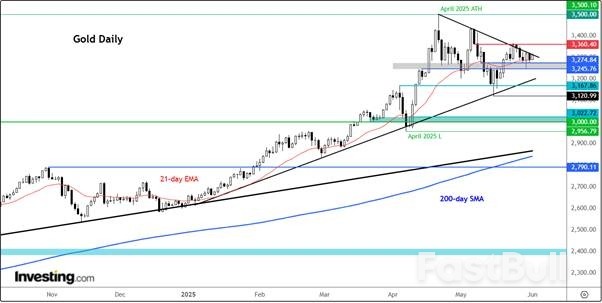
Now, from my political point of view, gold’s consolidation in the last several weeks has allowed the momentum indicators to unwind from severely overbought conditions on multiple timeframes, including the daily chart. Overall, gold has managed to hold above most of its support levels, including the bullish trendline that has been in place since the start of this year, as well as the key moving averages and support levels you can see on the chart.
With price testing the resistance trend of the consolidation pattern on multiple occasions recently, a potential breakout could be on the cards, possibly as early as today, or later on this week.

If the break does happen, and we move decisively above the $3,320 resistance level, then that could potentially pave the way for a test of the next resistance at $3,360, above which there’s not much significant resistance seen until $3,400. Thereafter, the next bullish target is around $3,435, followed by the all-time high at $3,500.
Short-term support is seen between $3,245 and $3,275. This area is shaded in grey on the chart. Below that, we have the bullish trend line coming in at $3200, followed by the previous high that was made in early April at $3,167.
The line in the sand for me is at $3,120, marking the most recent law. Should gold prices break below that level, it will have taken out the bullish trend line and created another lower low – and therefore, a clear bearish signal. If that were to happen, then we could potentially see gold dip down to key support at around the $3,000 mark. The long-term trend line comes in at around $2,870, below which we have the 200-day moving average, some $40 lower.
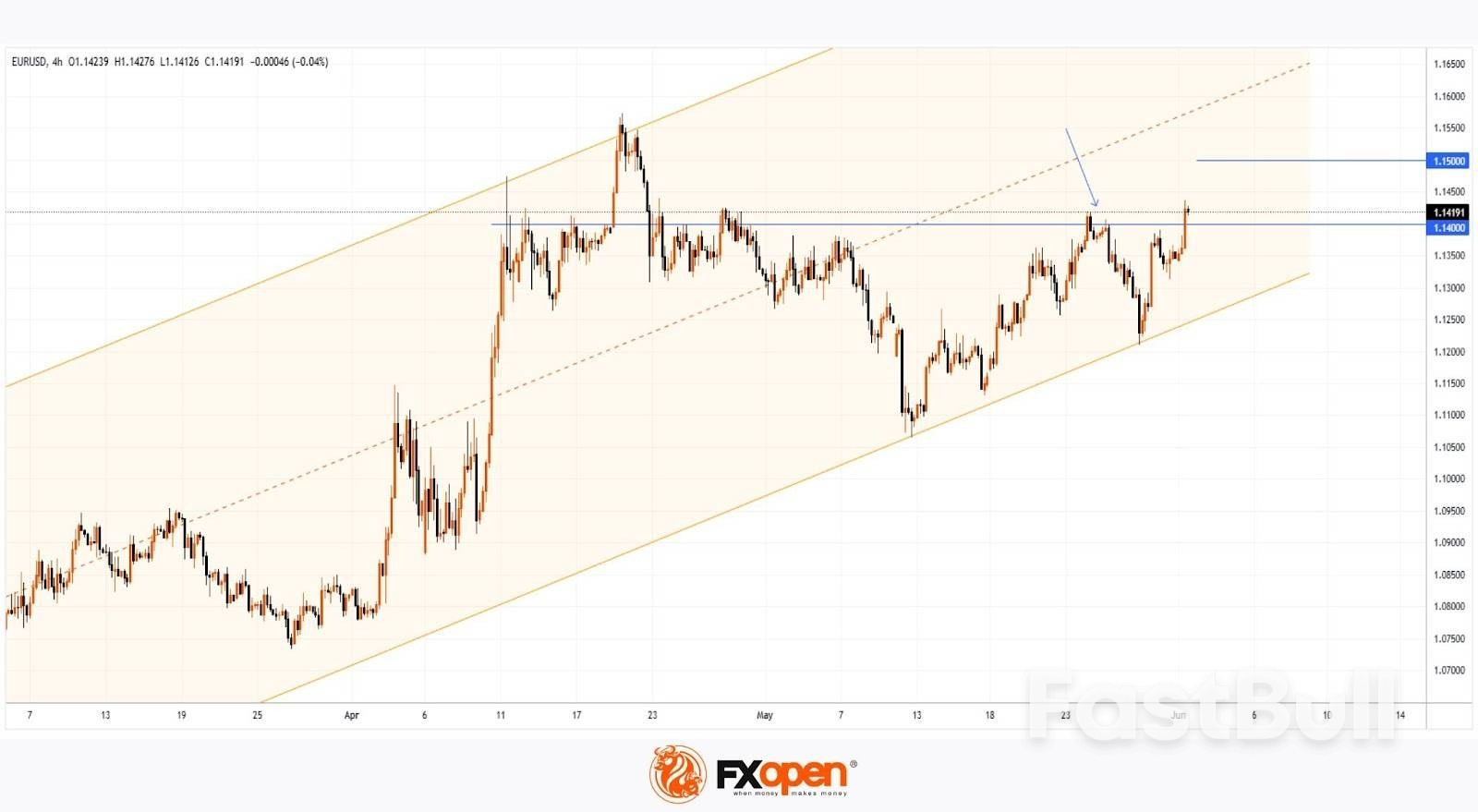
As shown on the EUR/USD chart today, the euro rose to a 4-week high against the US dollar this morning.
The euro's strength relative to the US dollar is supported by traders’ expectations ahead of the ECB's interest rate decision, scheduled for Thursday at 15:15 GMT+3.
This upcoming event is notable not only because the ECB is expected to cut rates from 2.40% to 2.15% (for the seventh consecutive time), but also due to the broader context shaped by ECB President Christine Lagarde’s recent remarks on the euro’s status as a reserve currency.
At the same time, the US dollar is weakening amid growing trade concerns—on Friday, the US President Donald Trump announced plans to double tariffs on steel and aluminum to 50%. He also accused China of breaching the recent trade truce.

Seven days ago, when analysing the EUR/USD chart, we:
observed bullish sentiment;
highlighted the importance of the 1.1400 resistance level;
suggested that bears might attempt to strike back.
Since then, the price has pulled back from the mentioned level (as indicated by the arrow), but found support at the lower boundary of the ascending channel. The current bullish momentum could push EUR/USD towards the psychological level of 1.1500 during the week ahead.
The downturn in euro zone manufacturing eased further in May, coming close to stabilisation as production increased for the third consecutive month and supported by a near-stabilisation in demand, a survey showed on Monday.
The HCOB Eurozone Manufacturing Purchasing Managers' Index rose to 49.4 in May from 49.0 in April, marking a 33-month high and in line with a preliminary estimate but remaining below the 50.0 threshold separating growth from contraction.
"The upward trend in the headline PMI is still continuing, pointing towards a recovery that is progressing," said Cyrus de la Rubia, chief economist at Hamburg Commercial Bank.
Manufacturing output increased for the third straight month, with the output index holding steady at 51.5, its joint-highest level since March 2022. New orders approached stabilisation after nearly two years of contraction, while export orders reached a 38-month high.
Companies scaled back job cuts with employment declining at the shallowest rate since September 2023 while purchasing activity shrank at its slowest pace in almost three years.
Among the region's economies, Greece topped the rankings with its PMI at 53.2, unchanged from April, while Spain returned to expansion with a reading of 50.5. France approached stabilisation at 49.8, a 28-month high.
"Production has picked up across all four major euro zone economies which really highlights how broad-based this recovery is," de la Rubia added.
Germany remained the weakest performer among the major economies with a PMI of 48.3, though its manufacturing sector recorded one of the softest deteriorations in three years.
Manufacturers' confidence about the year ahead rebounded to its highest level since February 2022 despite concerns about potential U.S. tariff increases on European imports. The future output index bounced to 61.6 from 58.0.
Input costs declined for the second consecutive month with the reduction accelerating to the fastest pace in 14 months. In response, factories cut their selling prices for the first time since February.
"The ECB is getting some tailwinds for its expected interest rate cuts. The industrial sector has started cutting its sales prices again after two months of increases, giving the central bank some extra room to move forward with its interest rate cuts," de la Rubia said.
All 81 economists polled by Reuters expected the ECB to cut its deposit rate again on Thursday with a majority predicting at least one more cut after June.
Italy’s manufacturing sector displayed initial signs of stabilization in May, as production slightly increased for the first time in over a year, despite ongoing weakness in new orders, according to a survey released on Monday.
The HCOB Italy Manufacturing Purchasing Managers’ Index (PMI), which gauges the health of the manufacturing sector, showed a minor decrease to 49.2 in May from 49.3 in April.
The survey indicated a modest rise in output, with the relevant sub-index registering at 50.3, a slight increase from 49.9 the previous month.
This article was generated with the support of AI and reviewed by an editor. For more information see our T&C.
White Label
Data API
Web Plug-ins
Poster Maker
Affiliate Program
The risk of loss in trading financial instruments such as stocks, FX, commodities, futures, bonds, ETFs and crypto can be substantial. You may sustain a total loss of the funds that you deposit with your broker. Therefore, you should carefully consider whether such trading is suitable for you in light of your circumstances and financial resources.
No decision to invest should be made without thoroughly conducting due diligence by yourself or consulting with your financial advisors. Our web content might not suit you since we don't know your financial conditions and investment needs. Our financial information might have latency or contain inaccuracy, so you should be fully responsible for any of your trading and investment decisions. The company will not be responsible for your capital loss.
Without getting permission from the website, you are not allowed to copy the website's graphics, texts, or trademarks. Intellectual property rights in the content or data incorporated into this website belong to its providers and exchange merchants.
Not Logged In
Log in to access more features

FastBull Membership
Not yet
Purchase
Log In
Sign Up