• Trade
  • Markets
  • Copy
  • Contests
  • News
  • 24/7
  • Calendar
  • Q&A
  • Chats
Trending
Screeners
SYMBOL
LAST
BID
ASK
HIGH
LOW
NET CHG.
%CHG.
SPREAD
SPX
S&P 500 Index
6827.42
6827.42
6827.42
6899.86
6801.80
-73.58
-1.07%
--
DJI
Dow Jones Industrial Average
48458.04
48458.04
48458.04
48886.86
48334.10
-245.98
-0.51%
--
IXIC
NASDAQ Composite Index
23195.16
23195.16
23195.16
23554.89
23094.51
-398.69
-1.69%
--
USDX
US Dollar Index
97.950
98.030
97.950
98.500
97.950
-0.370
-0.38%
--
EURUSD
Euro / US Dollar
1.17394
1.17409
1.17394
1.17496
1.17192
+0.00011
+ 0.01%
--
GBPUSD
Pound Sterling / US Dollar
1.33707
1.33732
1.33707
1.33997
1.33419
-0.00148
-0.11%
--
XAUUSD
Gold / US Dollar
4299.39
4299.39
4299.39
4353.41
4257.10
+20.10
+ 0.47%
--
WTI
Light Sweet Crude Oil
57.233
57.485
57.233
58.011
56.969
-0.408
-0.71%
--

Community Accounts

Signal Accounts
--
Profit Accounts
--
Loss Accounts
--
View More

Become a signal provider

Sell trading signals to earn additional income

View More

Guide to Copy Trading

Get started with ease and confidence

View More

Signal Accounts for Members

All Signal Accounts

Best Return
  • Best Return
  • Best P/L
  • Best MDD
Past 1W
  • Past 1W
  • Past 1M
  • Past 1Y

All Contests

  • All
  • Trump Updates
  • Recommend
  • Stocks
  • Cryptocurrencies
  • Central Banks
  • Featured News
Top News Only
Share

Ukraine's Navy Says Russian Drone Attack Hit Civilian Turkish Vessel Carrying Sunflower Oil To Egypt On Saturday

Share

Israeli Military Says It Put Planned Strike On South Lebanon Site On Hold After Lebanese Army Requested Access

Share

Norwegian Nobel Committee: Calls On The Belarusian Authorities To Release All Political Prisoners

Share

Norwegian Nobel Committee: His Freedom Is A Deeply Welcome And Long-Awaited Moment

Share

Ukraine Says It Received 114 Prisoners From Belarus

Share

USA Embassy In Lithuania: Maria Kalesnikava Is Not Going To Vilnius

Share

USA Embassy In Lithuania: Other Prisoners Are Being Sent From Belarus To Ukraine

Share

Ukraine President Zelenskiy: Five Ukrainians Released By Belarus In US-Brokered Deal

Share

USA Vilnius Embassy: USA Stands Ready For "Additional Engagement With Belarus That Advances USA Interests"

Share

USA Vilnius Embassy: Belarus, USA, Other Citizens Among The Prisoners Released Into Lithuania

Share

USA Vilnius Embassy: USA Will Continue Diplomatic Efforts To Free The Remaining Political Prisoners In Belarus

Share

USA Vilnius Embassy: Belarus Releases 123 Prisoners Following Meeting Of President Trump's Envoy Coale And Belarus President Lukashenko

Share

USA Vilnius Embassy: Masatoshi Nakanishi, Aliaksandr Syrytsa Are Among The Prisoners Released By Belarus

Share

USA Vilnius Embassy: Maria Kalesnikava And Viktor Babaryka Are Among The Prisoners Released By Belarus

Share

USA Vilnius Embassy: Nobel Peace Prize Laureate Ales Bialiatski Is Among The Prisoners Released By Belarus

Share

Belarusian Presidential Administration Telegram Channel: Lukashenko Has Pardoned 123 Prisoners As Part Of Deal With US

Share

Two Local Syrian Officials: Joint US-Syrian Military Patrol In Central Syria Came Under Fire From Unknown Assailants

Share

Israeli Military Says It Targeted 'Key Hamas Terrorist' In Gaza City

Share

Rwanda's Actions In Eastern Drc Are A Clear Violation Of Washington Accords Signed By President Trump - Secretary Of State Rubio

Share

Israeli Military Issues Evacuation Warning In Southern Lebanon Village Ahead Of Strike - Spokesperson On X

TIME
ACT
FCST
PREV
U.K. Trade Balance Non-EU (SA) (Oct)

A:--

F: --

P: --

U.K. Trade Balance (Oct)

A:--

F: --

P: --

U.K. Services Index MoM

A:--

F: --

P: --

U.K. Construction Output MoM (SA) (Oct)

A:--

F: --

P: --

U.K. Industrial Output YoY (Oct)

A:--

F: --

P: --

U.K. Trade Balance (SA) (Oct)

A:--

F: --

P: --

U.K. Trade Balance EU (SA) (Oct)

A:--

F: --

P: --

U.K. Manufacturing Output YoY (Oct)

A:--

F: --

P: --

U.K. GDP MoM (Oct)

A:--

F: --

P: --

U.K. GDP YoY (SA) (Oct)

A:--

F: --

P: --

U.K. Industrial Output MoM (Oct)

A:--

F: --

P: --

U.K. Construction Output YoY (Oct)

A:--

F: --

P: --

France HICP Final MoM (Nov)

A:--

F: --

P: --

China, Mainland Outstanding Loans Growth YoY (Nov)

A:--

F: --

P: --

China, Mainland M2 Money Supply YoY (Nov)

A:--

F: --

P: --

China, Mainland M0 Money Supply YoY (Nov)

A:--

F: --

P: --

China, Mainland M1 Money Supply YoY (Nov)

A:--

F: --

P: --

India CPI YoY (Nov)

A:--

F: --

P: --

India Deposit Gowth YoY

A:--

F: --

P: --

Brazil Services Growth YoY (Oct)

A:--

F: --

P: --

Mexico Industrial Output YoY (Oct)

A:--

F: --

P: --

Russia Trade Balance (Oct)

A:--

F: --

P: --

Philadelphia Fed President Henry Paulson delivers a speech
Canada Building Permits MoM (SA) (Oct)

A:--

F: --

P: --

Canada Wholesale Sales YoY (Oct)

A:--

F: --

P: --

Canada Wholesale Inventory MoM (Oct)

A:--

F: --

P: --

Canada Wholesale Inventory YoY (Oct)

A:--

F: --

P: --

Canada Wholesale Sales MoM (SA) (Oct)

A:--

F: --

P: --

Germany Current Account (Not SA) (Oct)

A:--

F: --

P: --

U.S. Weekly Total Rig Count

A:--

F: --

P: --

U.S. Weekly Total Oil Rig Count

A:--

F: --

P: --

Japan Tankan Large Non-Manufacturing Diffusion Index (Q4)

--

F: --

P: --

Japan Tankan Small Manufacturing Outlook Index (Q4)

--

F: --

P: --

Japan Tankan Large Non-Manufacturing Outlook Index (Q4)

--

F: --

P: --

Japan Tankan Large Manufacturing Outlook Index (Q4)

--

F: --

P: --

Japan Tankan Small Manufacturing Diffusion Index (Q4)

--

F: --

P: --

Japan Tankan Large Manufacturing Diffusion Index (Q4)

--

F: --

P: --

Japan Tankan Large-Enterprise Capital Expenditure YoY (Q4)

--

F: --

P: --

U.K. Rightmove House Price Index YoY (Dec)

--

F: --

P: --

China, Mainland Industrial Output YoY (YTD) (Nov)

--

F: --

P: --

China, Mainland Urban Area Unemployment Rate (Nov)

--

F: --

P: --

Saudi Arabia CPI YoY (Nov)

--

F: --

P: --

Euro Zone Industrial Output YoY (Oct)

--

F: --

P: --

Euro Zone Industrial Output MoM (Oct)

--

F: --

P: --

Canada Existing Home Sales MoM (Nov)

--

F: --

P: --

Euro Zone Total Reserve Assets (Nov)

--

F: --

P: --

U.K. Inflation Rate Expectations

--

F: --

P: --

Canada National Economic Confidence Index

--

F: --

P: --

Canada New Housing Starts (Nov)

--

F: --

P: --

U.S. NY Fed Manufacturing Employment Index (Dec)

--

F: --

P: --

U.S. NY Fed Manufacturing Index (Dec)

--

F: --

P: --

Canada Core CPI YoY (Nov)

--

F: --

P: --

Canada Manufacturing Unfilled Orders MoM (Oct)

--

F: --

P: --

Canada Manufacturing New Orders MoM (Oct)

--

F: --

P: --

Canada Core CPI MoM (Nov)

--

F: --

P: --

Canada Manufacturing Inventory MoM (Oct)

--

F: --

P: --

Canada CPI YoY (Nov)

--

F: --

P: --

Canada CPI MoM (Nov)

--

F: --

P: --

Canada CPI YoY (SA) (Nov)

--

F: --

P: --

Canada Core CPI MoM (SA) (Nov)

--

F: --

P: --

Q&A with Experts
    • All
    • Chatrooms
    • Groups
    • Friends
    Connecting
    .
    .
    .
    Type here...
    Add Symbol or Code

      No matching data

      All
      Trump Updates
      Recommend
      Stocks
      Cryptocurrencies
      Central Banks
      Featured News
      • All
      • Russia-Ukraine Conflict
      • Middle East Flashpoint
      • All
      • Russia-Ukraine Conflict
      • Middle East Flashpoint
      Search
      Products

      Charts Free Forever

      Chats Q&A with Experts
      Screeners Economic Calendar Data Tools
      Membership Features
      Data Warehouse Market Trends Institutional Data Policy Rates Macro

      Market Trends

      Market Sentiment Order Book Forex Correlations

      Top Indicators

      Charts Free Forever
      Markets

      News

      News Analysis 24/7 Columns Education
      From Institutions From Analysts
      Topics Columnists

      Latest Views

      Latest Views

      Trending Topics

      Top Columnists

      Latest Update

      Signals

      Copy Rankings Latest Signals Become a signal provider AI Rating
      Contests
      Brokers

      Overview Brokers Assessment Rankings Regulators News Claims
      Broker listing Forex Brokers Comparison Tool Live Spread Comparison Scam
      Q&A Complaint Scam Alert Videos Tips to Detect Scam
      More

      Business
      Events
      Careers About Us Advertising Help Center

      White Label

      Data API

      Web Plug-ins

      Affiliate Program

      Awards Institution Evaluation IB Seminar Salon Event Exhibition
      Vietnam Thailand Singapore Dubai
      Fans Party Investment Sharing Session
      FastBull Summit BrokersView Expo
      Recent Searches
        Top Searches
          Markets
          News
          Analysis
          User
          24/7
          Economic Calendar
          Education
          Data
          • Names
          • Latest
          • Prev

          View All

          No data

          Scan to Download

          Faster Charts, Chat Faster!

          Download App
          English
          • English
          • Español
          • العربية
          • Bahasa Indonesia
          • Bahasa Melayu
          • Tiếng Việt
          • ภาษาไทย
          • Français
          • Italiano
          • Türkçe
          • Русский язык
          • 简中
          • 繁中
          Open Account
          Search
          Products
          Charts Free Forever
          Markets
          News
          Signals

          Copy Rankings Latest Signals Become a signal provider AI Rating
          Contests
          Brokers

          Overview Brokers Assessment Rankings Regulators News Claims
          Broker listing Forex Brokers Comparison Tool Live Spread Comparison Scam
          Q&A Complaint Scam Alert Videos Tips to Detect Scam
          More

          Business
          Events
          Careers About Us Advertising Help Center

          White Label

          Data API

          Web Plug-ins

          Affiliate Program

          Awards Institution Evaluation IB Seminar Salon Event Exhibition
          Vietnam Thailand Singapore Dubai
          Fans Party Investment Sharing Session
          FastBull Summit BrokersView Expo

          Southeast Asia’s Logistics Sector Caught in a ‘Race to the Bottom’

          Gerik

          Economic

          Summary:

          J&T Express has secured regional dominance through aggressive price-cutting, prompting growing concerns of destructive competition and potential regulatory intervention in Indonesia....

          J&T’s Price War Strategy Pressures Southeast Asia’s Logistics Industry

          Southeast Asia’s logistics sector is entering turbulent waters as J&T Express, the region’s market leader, continues to expand its dominance through deep price cuts. According to its 2024 financial report, J&T retained the top spot for the fifth consecutive year, growing its market share from 25.4% in 2023 to 28.6%. This gain is particularly notable given the rapid rise of SPX Express, Shopee’s in-house logistics arm.
          However, J&T’s victory is stirring anxiety across the industry. Experts warn that its "price-to-win" model is pushing competitors into a downward spiral. This aggressive cost-cutting threatens to collapse smaller players who lack the financial cushion to absorb sustained losses.
          “This is a race to the bottom. Survival now depends on who can slash prices the most,” said Lai Chang Wen, CEO and co-founder of Ninja Van, in an interview with Tech in Asia. He argued that such short-term profit maximization comes at the expense of long-term investment in technology and innovation—foundational elements of a resilient logistics ecosystem.

          Regulatory Backlash Brewing in Indonesia

          Indonesia, one of J&T’s most critical markets, is already showing signs of market strain. The country’s Digital Economy Logistics Association (ALDEI) has raised alarms about widespread below-cost pricing practices that are destabilizing the logistics landscape.
          “We’re seeing a surge in below-cost selling that is collapsing smaller logistics firms,” warned Jimmi Krismiardhi, Vice Chairman of ALDEI. In response, the Indonesian government is seriously considering implementing a pricing floor to prevent what it calls “destructive competition.” ALDEI confirms that the proposal has received support from both industry associations and government officials.

          Sustainability of J&T’s Strategy in Question

          Industry insiders note that J&T has managed to keep prices low even amid rising fuel costs, while many third-party logistics (3PL) companies have been forced to adjust rates to protect profit margins. According to a logistics executive in Indonesia who spoke anonymously, this pricing strategy is “unsustainable for most players.”
          In defense of J&T’s approach, CFO Dylan Tey emphasized the role of economies of scale. By handling massive parcel volumes, J&T significantly reduces per-unit costs, enabling the company to maintain low prices without resorting to loss-leading.

          Implications for the Future

          While J&T’s scale may provide temporary resilience, its strategy risks triggering a broader industry crisis if smaller firms are driven out, reducing competition and weakening service quality. Indonesia’s proposed price floor may serve as a test case for regional regulators grappling with how to maintain a healthy, competitive logistics market in the face of price wars.
          The core dilemma now facing Southeast Asia’s logistics sector is whether growth at any cost is worth the long-term price—and how regulators and firms alike will respond before the floor truly falls out from beneath the industry.
          Source:
          To stay updated on all economic events of today, please check out our Economic calendar
          Risk Warnings and Disclaimers
          You understand and acknowledge that there is a high degree of risk involved in trading. Following any strategies or investment methods may lead to potential losses. The content on the site is provided by our contributors and analysts for information purposes only. You are solely responsible for determining whether any trading assets, securities, strategy, or any other product is suitable for investing based on your own investment objectives and financial situation.
          Add to Favorites
          Share

          US Dollar Roars Back in A Blaze of Glory As Market Shrugs Off Recession Fears

          Blue River

          Economic

          Forex

          Technical Analysis

          EUR/USD dropped to 1.1110 on Tuesday, with the US dollar surging by over 1% in the previous trading session. The rally was driven by market reactions to news of a provisional agreement between China and the US to reduce tariffs, which helped alleviate global recession fears.

          Key factors driving EUR/USD movement

          Washington and Beijing have agreed to cut tariffs to 30% and 10%, respectively, for 90 days.

          Meanwhile, US Treasury Secretary Scott Bessent confirmed plans to meet with Chinese representatives again in the coming weeks to begin negotiations on a broader trade deal.

          The tariff reductions boosted market sentiment towards the dollar, which had previously faced pressure over concerns that President Donald Trump’s trade policies were diminishing the appeal of US assets. However, market nervousness is likely to persist until the White House establishes stable trade terms with all key partners.

          Attention now turns to the latest US inflation report, which may show how the new tariff policy affects prices.

          Technical analysis: EUR/USD

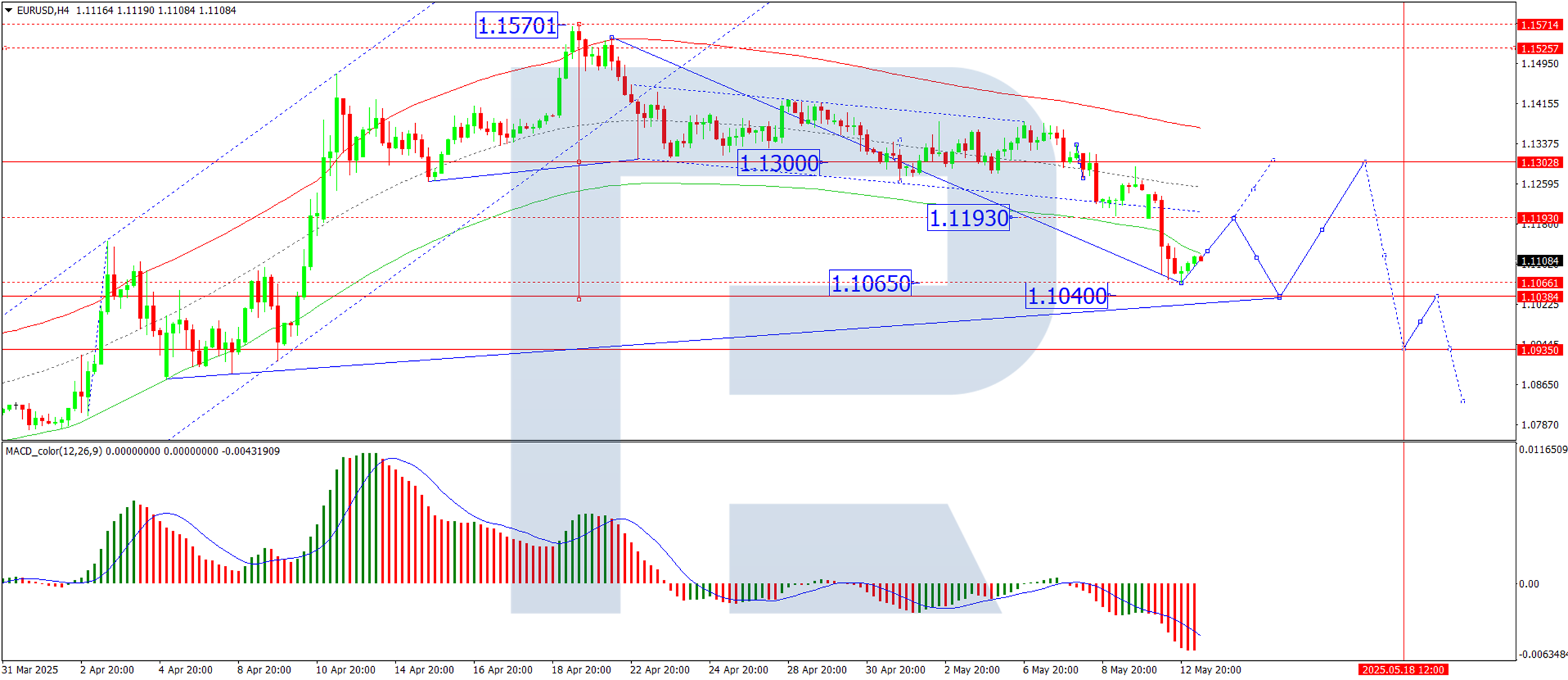
          On the H4 chart, EUR/USD broke below 1.1190, completing the third wave of decline towards 1.1065. Today, we anticipate a corrective wave retesting 1.1190 (from below). Once this correction concludes, a new downward wave towards 1.1040 is expected. This scenario is technically confirmed by the MACD indicator, with its signal line below zero and pointing decisively downward.

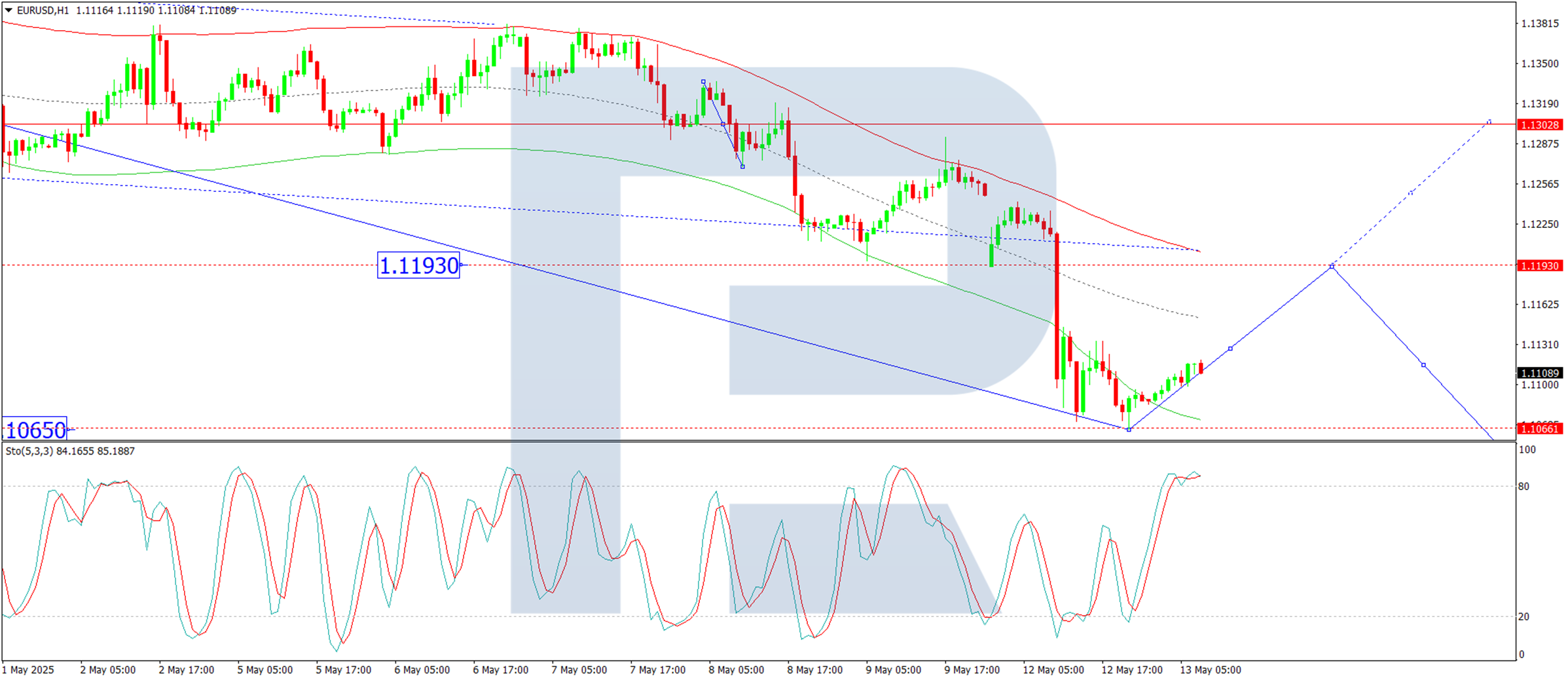
          On the H1 chart, the market has achieved the local downside target at 1.1065. Today, a potential rebound to 1.1126 is in focus. If this level is breached upwards, a further correction towards 1.1190 may follow. Subsequently, the downward trend could resume, targeting 1.1040. This outlook is supported by the Stochastic oscillator, whose signal line is above 80 but poised to decline towards 20.

          Conclusion

          The US dollar’s resurgence reflects improved risk sentiment following the US-China tariff truce, though uncertainty lingers over long-term trade relations. Technically, EUR/USD remains under pressure, with further downside likely after a brief correction.

          Source: ACTIONFOREX

          To stay updated on all economic events of today, please check out our Economic calendar
          Risk Warnings and Disclaimers
          You understand and acknowledge that there is a high degree of risk involved in trading. Following any strategies or investment methods may lead to potential losses. The content on the site is provided by our contributors and analysts for information purposes only. You are solely responsible for determining whether any trading assets, securities, strategy, or any other product is suitable for investing based on your own investment objectives and financial situation.
          Add to Favorites
          Share

          Tariffs May Have Pushed Up Inflation a Bit in April, Government Report to Show

          Warren Takunda

          Economic

          China–U.S. Trade War

          Inflation may have picked up slightly last month as President Donald Trump’s widespread tariffs kicked in, a trend economists expect will become more visible in the coming months.
          Consumer prices are forecast to have risen 2.4% in April compared with a year earlier, according to data provider FactSet, the same as in March and down from 3% at the start of the year. Still, on a monthly basis, economists expect that the consumer price index rose 0.3% from March to April, a pace that would worsen inflation if it continued, after it fell for the first time in nearly five years the previous month.
          Tuesday’s report could provide an early read on how Trump’s duties will affect the prices Americans pay for necessities and other goods such as clothing, shoes, furniture and even groceries. Duties on many goods from Mexico and Canada took effect in February and could have impacted prices last month. Still, economists forecast the impact from duties to be modest.
          “Firms have indicated ... that they are unsure how much of the tariff cost increase they can pass through to consumers without denting demand, and we expect some testing of the waters and a staggered pattern of price increases,” Laura Rosner-Warburton, cofounder of Macro Policy Perspectives, wrote in note to clients.
          The Trump administration said early Monday that it had reached a deal with China to sharply reduce its tariffs on imports from that country. But even taking that agreement into account, U.S. average import taxes remain at 90-year highs, economists said, which could worsen inflation in the coming months.
          Tariffs on furniture, agricultural goods from Mexico, and on clothes and shoes may have boosted prices last month. Auto prices may have risen because car sales surged as Americans sought to get ahead of duties on new cars and car parts, reducing the need for dealers to offer discounts.
          Excluding the volatile food and energy categories, core prices are forecast to have risen 2.8% last month compared to a year earlier, the same as in March. On a monthly basis, they are expected to rise 0.3%, up from just 0.1% the previous month.
          It will likely take more time for the full impact of the duties to be reflected in prices across U.S. businesses, economists say. Items that were already in transit when the tariffs were imposed won’t have to pay the duties, while many companies have built a stockpile of goods and could hold off on price hikes in hopes that tariffs will ultimately be reduced.
          Consumers, at least those outside the top one-fifth in incomes, are also more stretched financially than a few years ago and are more likely to resist price hikes, which could push firms to delay raising prices as long as possible.
          Consumer prices cooled noticeably in February and March, prompting Trump to claim repeatedly on social media that there is “NO INFLATION.” Inflation has fallen to nearly the 2% target set by the Federal Reserve, the agency charged with fighting higher prices.
          Yet grocery prices have jumped in two out of the past three months, despite Trump’s claims. He has also said gas has fallen to $1.98 a gallon, which is below the measured average in any state. AAA said Monday that gas costs an average $3.14 a gallon nationwide.
          On Monday, the White House said it has cut the tariff it imposed on Chinese goods from 145% to 30%, while China also sharply reduced its duties on U.S. goods. Both sides could add 24% tariffs after 90 days if they don’t reach a broader agreement.
          The smaller import taxes will limit the damage to the U.S. economy, but combined with a 10% universal tariff already in place, plus larger import taxes on autos, steel, and aluminum, economists forecast they will still slow growth this year and worsen inflation.
          The Yale Budget Lab, for example, estimates that the average U.S. tariff will be nearly 18% even including the deal reached Monday between the U.S. and China. At that level, U.S. duties will be the highest since 1934. The Budget Lab calculates the tariffs will lift prices 1.7% and cost the average household about $2,800.
          And while Trump may tout his trade deals — such as the one with the United Kingdom reached last week — he has also said “tariffs is the most beautiful word” in the dictionary, and is counting on revenue from duties to narrow the budget deficit, suggesting tariffs will likely remain high.
          The tariffs have also put the Federal Reserve in an exceedingly difficult spot, as Chair Jerome Powell acknowledged in a news conference last week. Powell said the duties have raised the risk of both higher inflation and higher unemployment, two challenges that rarely occur simultaneously. If unemployment rose, the Fed would typically cut rates to boost the economy, while if inflation worsened, the central bank would usually raise rates or leave them elevated.

          Source: AP

          To stay updated on all economic events of today, please check out our Economic calendar
          Risk Warnings and Disclaimers
          You understand and acknowledge that there is a high degree of risk involved in trading. Following any strategies or investment methods may lead to potential losses. The content on the site is provided by our contributors and analysts for information purposes only. You are solely responsible for determining whether any trading assets, securities, strategy, or any other product is suitable for investing based on your own investment objectives and financial situation.
          Add to Favorites
          Share

          Oil Traders Scan for Signals From Trump’s Middle East Tour

          Glendon

          Economic

          Commodity

          It’s been almost three years since former US President Joe Biden journeyed to Saudi Arabia pleading for more oil, only to return empty-handed.

          His successor, Donald Trump, is having more luck — even before he started this week’s Middle East tour.

          Riyadh has led two supersized production increases from the OPEC+ cartel in recent weeks in apparent deference to the president’s calls for cheaper crude. Prices have crashed to a four-year low.

          The fate of that strategy could become clearer when Trump meets the kingdom’s rulers today.

          At $65 per barrel, oil prices remain significantly below the levels the Saudis need, according to the International Monetary Fund. The nation’s budget deficit has soared.

          That poses a particular challenge for the $600 billion in investments Crown Prince Mohammed bin Salman has promised the US as well as the big-ticket deals that top the American president’s agenda.

          What the prince will tell Trump remains unknown, but if ever there was a moment to explain that the drive for lower oil prices has unintended consequences, this is it.

          On June 1, the Organization of the Petroleum Exporting Countries and its partners will consider another output increase.

          Officials maintain that the alliance’s supply push is aimed at punishing cheating members and not meant as a concession to Washington. Nonetheless, it’s impossible to ignore the geopolitical backdrop.

          If Trump’s visit yields any indications that Riyadh has latitude to tighten supplies, crude futures could rally. But if it appears the president is piling on pressure for more barrels, the market could sink back toward $60 a barrel.

          Of course, OPEC+ strategy isn’t the only oil-related element of Trump’s trip, which includes stops in the United Arab Emirates and Qatar.

          Trump is laboring on a nuclear pact with Iran, which could eventually relieve sanctions on the Islamic Republic’s oil exports. A ceasefire with its Yemeni proxies, the Houthis, hints at progress.

          While the Gulf states once pushed a hawkish stance on Tehran, recently they’ve grown more pragmatic, steering Washington away from the military measures advocated by Israel.

          If negotiations gather momentum, Iran could add to the tide of Middle East barrels: a win for Trump but another blow for prices.

          --Grant Smith, Bloomberg News

          A drop in naphtha sales has weighed on Russia’s refined-fuel exports so far this month. Seaborne shipments of petroleum products totaled 2.07 million barrels a day through May 10, according to data compiled by Bloomberg from analytics firm Vortexa Ltd. That’s 7% lower than April’s daily average. Market participants look to these numbers as a gauge of Russian oil production in the absence of official information.

          Trump arrived in Riyadh today with a contingent of business leaders as he tries to secure $1 trillion in investment from the Saudis. Follow our live blog on his visit.

          Phillips 66 shareholders should vote for all four board candidates nominated by activist investor Elliott Investment Management in its upcoming annual meeting, proxy advisory firm Institutional Shareholder Services Inc. said.

          Chinese rare-earth exporters are asking the government to clarify whether they’re allowed to sell to the US now that Beijing and Washington have called a ceasefire in their trade war.

          Clean-tech companies eligible for federal support under Biden’s policies are considering leaving the US as the Trump administration pulls the plug on financing, says the former head of the program that vetted the firms.

          US shale oil output has probably peaked, just don’t expect a rapid decline like the downturns of 2015 and 2020, Bloomberg Opinion’s Javier Blas writes.

          Ten US cargoes of liquefied natural gas plied key routes from May 5 to 11, three more than a week earlier and the most since November, according to BloombergNEF. Two tankers traversed the Suez Canal for deliveries to Egypt. One carrier crossed the Panama Canal, and the rest sailed around the Cape of Good Hope. Global LNG imports recovered 2% week-on-week to almost 7.5 million metric tons.

          Source: Bloomberg Europe

          To stay updated on all economic events of today, please check out our Economic calendar
          Risk Warnings and Disclaimers
          You understand and acknowledge that there is a high degree of risk involved in trading. Following any strategies or investment methods may lead to potential losses. The content on the site is provided by our contributors and analysts for information purposes only. You are solely responsible for determining whether any trading assets, securities, strategy, or any other product is suitable for investing based on your own investment objectives and financial situation.
          Add to Favorites
          Share

          India Considers Retaliatory Tariffs Against the U.S. Amid Steel Dispute

          Gerik

          Economic

          China–U.S. Trade War

          India Responds to U.S. Tariffs with Consideration of Its Own Measures

          In a newly submitted document to the World Trade Organization (WTO), India signaled its intent to impose retaliatory tariffs on select U.S. imports. This move is seen as a direct response to Washington’s recent decision to reintroduce a 25% tariff on imported steel and aluminum, a policy expansion echoing the trade protectionism seen during former President Donald Trump's first term starting in 2018. Although the document does not yet specify the U.S. goods to be targeted, the scope of impact may be significant.
          India, the world’s second-largest crude steel producer, has stated that the U.S. tariff measures affect an estimated $7.6 billion worth of Indian exports annually. In light of this, Indian authorities are exploring options to offset the impact through reciprocal duties. The backdrop of this decision is particularly delicate: New Delhi and Washington are currently engaged in talks aiming for a comprehensive bilateral trade agreement.

          Potential Setback for U.S.–India Free Trade Talks

          According to Ajay Srivastava, founder of the Global Trade Research Initiative, India’s latest stance introduces new friction into what were already complex negotiations. He warns that such retaliatory actions, though within WTO rights, could undermine progress toward a Free Trade Agreement (FTA) that both nations have long sought.
          Further complicating matters, the U.S. under President Trump has floated the idea of imposing additional tariffs—up to 26%—on various imports from India. In return, Indian negotiators have proposed a reduction in tariff disparities to one-third of current levels, suggesting a willingness to make compromises if Washington responds in kind.

          Domestic Trade Policy and Strategic Steel Protection

          Beyond the U.S.-specific conflict, India has taken proactive steps to defend its domestic steel industry against cheap imports. In April, New Delhi implemented a provisional 12% tariff on foreign steel products, largely aimed at curbing rising shipments from China. This aligns with the government’s broader industrial policy of import substitution and domestic value chain protection.
          India’s decision to consider retaliatory tariffs arrives at a time when global trade relations are increasingly defined by strategic competition and shifting alliances. With Washington and Beijing locked in their own tariff détente, and India positioning itself as an alternative manufacturing and strategic partner, the outcome of this bilateral trade dispute will have implications far beyond tariff schedules.
          If India proceeds with new duties on U.S. goods, it would represent not just a trade reaction, but also a geopolitical statement: that New Delhi is prepared to defend its industrial interests assertively, even while continuing dialogue with Washington. As negotiations continue, the world watches to see whether pragmatism will prevail—or if trade politics once again derail economic cooperation between two of the world’s largest democracies.

          Source: Reuters

          To stay updated on all economic events of today, please check out our Economic calendar
          Risk Warnings and Disclaimers
          You understand and acknowledge that there is a high degree of risk involved in trading. Following any strategies or investment methods may lead to potential losses. The content on the site is provided by our contributors and analysts for information purposes only. You are solely responsible for determining whether any trading assets, securities, strategy, or any other product is suitable for investing based on your own investment objectives and financial situation.
          Add to Favorites
          Share

          U.S. Revises Tariffs on Low-Value Shipments from China Amid Trade Truce

          Gerik

          Economic

          China–U.S. Trade War

          Policy Shift Reflects Thawing U.S.-China Trade Tensions

          In a move signaling de-escalation in the ongoing trade tensions, the Biden administration has announced an adjustment to tariffs on low-value Chinese shipments under the "de minimis" rule. According to a White House executive order cited by CNBC on May 13, effective May 14, the U.S. will lower the imposed tariff rate on low-value shipments from China from 120% to 54%, alongside a reduced fixed processing fee of $100—down from the originally proposed $200.
          This change comes shortly after Washington and Beijing agreed to a 90-day tariff truce, during which both countries committed to roll back the majority of tariffs implemented since April 2025. The announcement reflects a strategic pivot by the U.S. to moderate protectionist measures that have sharply increased import costs for e-commerce products and strained consumer supply chains.

          The Rise and Controversy of “De Minimis” Shipments

          Under U.S. law, “de minimis” shipments—packages valued below $800—can enter the country duty-free and with minimal customs checks. Initially designed to facilitate small-scale imports, the rule has been heavily exploited by fast-growing e-commerce players such as Temu and Shein. These platforms rely on direct-to-consumer shipping models, routing millions of parcels through the de minimis channel each month.
          Statistics reveal that over 90% of packages entering the U.S. now use the de minimis exception, with Chinese shipments accounting for about 60% of that volume. As a result, concerns have surged among both Democratic and Republican lawmakers that the rule has created a loophole allowing an unchecked influx of cheap Chinese goods—undermining domestic industries and increasing vulnerability to illicit trade, particularly in the case of drug precursors.

          Trump-Era Hardline Approach Faces Revision

          Back in February, former President Donald Trump reinstated a punitive interpretation of the de minimis rule by imposing a 120% tariff or a flat $200 fee—whichever was higher—on low-value shipments, set to take effect in June 2025. The measures were widely seen as targeting Chinese e-commerce giants that had begun dominating the U.S. consumer goods market with aggressive pricing.
          However, the latest executive order walks back some of these harsher conditions. The flat fee has been revised down to $100, and the tariff rate halved to 54%. The implementation timeline has also been accelerated, now going into effect at 12:01 a.m. on May 14, 2025.

          Broader Strategic Implications

          This adjustment in trade policy aligns with the broader diplomatic tone shift between the U.S. and China, emphasizing mutual restraint and economic recalibration rather than confrontation. Yet, skepticism remains high within Washington’s policymaking circles. Critics argue that unless more structural reforms are introduced to regulate low-value imports, the U.S. risks continued dependency on low-cost Chinese supply chains and further erosion of domestic manufacturing competitiveness.
          While the softened tariff terms may provide immediate relief for U.S. consumers and retailers relying on affordable Chinese imports, they also underscore the complexity of balancing trade enforcement with economic pragmatism. The upcoming months will be a key test of whether this temporary détente can evolve into a more sustainable trade framework—or if protectionist pressures will once again take precedence in the lead-up to the 2026 U.S. elections.

          Source: CNBC

          To stay updated on all economic events of today, please check out our Economic calendar
          Risk Warnings and Disclaimers
          You understand and acknowledge that there is a high degree of risk involved in trading. Following any strategies or investment methods may lead to potential losses. The content on the site is provided by our contributors and analysts for information purposes only. You are solely responsible for determining whether any trading assets, securities, strategy, or any other product is suitable for investing based on your own investment objectives and financial situation.
          Add to Favorites
          Share

          Is the Euro Ready for Reserve Currency Supremacy? Europe’s Chance in a Shifting Financial Order

          Gerik

          Economic

          Forex

          China–U.S. Trade War

          A Renewed Bid for Global Financial Leadership

          For decades, the euro has lingered in the shadow of the U.S. dollar, fulfilling only part of its original promise as a global reserve currency. Today, as the international system confronts a more fragmented and multipolar reality, the euro is quietly but steadily positioning itself as a contender in the global currency arena. With the return of Donald Trump to the White House and a renewed wave of American protectionism, the case for diversification away from the dollar is gaining traction.
          While the euro still holds just around 20% of global foreign exchange reserves—far behind the dollar’s 60%—recent structural reforms, combined with geopolitical realignments, are nudging Europe closer to a pivotal moment.

          From Vulnerable to Viable: Europe’s Evolving Financial Foundations

          The European financial architecture has matured significantly since the eurozone debt crisis. The European Central Bank (ECB) now possesses powerful tools to intervene in markets, having launched a €1.8 trillion bond-buying program during COVID-19 and mechanisms to prevent bond yield divergence. In parallel, the EU has for the first time issued large-scale joint debt—€807 billion in recovery bonds—introducing a long-missing asset class of safe euro-denominated securities.
          Additionally, the ECB directly supervises 114 major banks covering 82% of eurozone banking assets, significantly strengthening systemic stability. These advancements suggest the euro’s fundamental vulnerabilities have been partly resolved.

          Attractive Investment Environment and Relative Monetary Tightness

          Europe is also becoming a more attractive investment destination. Germany’s €1 trillion defense and infrastructure package, along with similar fiscal expansions in France, Italy, and Spain, promises to generate growth and additional euro-denominated financial instruments. Goldman Sachs forecasts that this stimulus will raise Germany’s GDP by 1% and the eurozone’s by 0.2% by 2026.
          Furthermore, diverging monetary paths between the U.S. and Europe are favoring the euro. As the Federal Reserve begins to ease rates, the ECB remains cautious due to inflationary concerns, enhancing the euro’s relative yield and attractiveness.

          Governance Stability and Geopolitical Neutrality

          In an era of increasing politicization of currencies, the euro benefits from institutional independence and legal predictability. Unlike the U.S. dollar, which may be weaponized under aggressive U.S. administrations, the euro’s use in foreign policy remains constrained by the EU’s complex consensus mechanisms. This makes the euro more appealing to central banks seeking a politically neutral reserve asset.
          The ECB’s independence and the EU’s commitment to legal stability provide confidence to global investors and policymakers considering alternatives to the dollar.

          Trade Dynamics Shift Toward Europe

          With the U.S. retreating from multilateral trade leadership, Europe could emerge as a central node in global trade flows. A rise in euro-denominated transactions would naturally increase demand for euro liquidity, financial hedging instruments, and reserves.
          As euro usage in international contracts grows, particularly in sectors like green energy, industrial automation, and pharmaceuticals, central banks may increasingly opt to hold euros to stabilize exchange rates and settle trade balances.

          Barriers to Overcome: Fragmentation, Fiscal Unity, and Market Depth

          Despite these tailwinds, the euro’s path to reserve dominance is far from assured. The EU still suffers from a fragmented fiscal landscape. Countries like France and Italy are heavily indebted, while Germany and the Netherlands run fiscal surpluses—creating inconsistent policy responses and limiting joint investment in euro-denominated safe assets.
          To rival the dollar, the EU must advance toward a harmonized fiscal union. This includes coordinated public investment, a robust unified bond market, and further consolidation of capital markets. Reforms in bankruptcy laws, accounting standards, and regulatory frameworks will also be necessary to build trust and increase liquidity in euro-based assets.

          Digital Euro: A Strategic Leap Forward

          One of the euro’s most ambitious initiatives is the development of a digital euro. As most of Europe’s digital payments currently rely on U.S.-based platforms like Visa, Mastercard, and PayPal, the EU remains vulnerable to external disruptions. A digital euro could reduce this dependence, bolster payment sovereignty, and modernize cross-border transactions.
          It would also enhance financial resilience in crises—providing offline functionality and anonymous cash-like features while adhering to strict EU data protection laws. For consumers and SMEs, it promises lower transaction costs and seamless usage across the eurozone.
          If successful, the digital euro could significantly boost the euro’s appeal in international trade and central bank reserves—especially for countries seeking alternatives to the dollar.

          A Moment of Opportunity, Not Destiny

          While the euro may not dethrone the dollar in the short term, the global financial order is clearly shifting. The foundations for a multipolar reserve system—where the euro, dollar, renminbi, and yen coexist—are becoming more apparent. For Europe, seizing this moment will require decisive institutional reforms, deeper fiscal unity, and a bold vision for financial integration.
          The “Iron Throne” of reserve currency status may still belong to the dollar, but the euro is no longer a passive observer. With strategic commitment, political will, and financial innovation, the euro could rise as a credible co-ruler in the evolving global monetary landscape.

          Source: FT

          To stay updated on all economic events of today, please check out our Economic calendar
          Risk Warnings and Disclaimers
          You understand and acknowledge that there is a high degree of risk involved in trading. Following any strategies or investment methods may lead to potential losses. The content on the site is provided by our contributors and analysts for information purposes only. You are solely responsible for determining whether any trading assets, securities, strategy, or any other product is suitable for investing based on your own investment objectives and financial situation.
          Add to Favorites
          Share
          FastBull
          Copyright © 2025 FastBull Ltd

          728 RM B 7/F GEE LOK IND BLDG NO 34 HUNG TO RD KWUN TONG KLN HONG KONG

          TelegramInstagramTwitterfacebooklinkedin
          App Store Google Play Google Play
          Products
          Charts

          Chats

          Q&A with Experts
          Screeners
          Economic Calendar
          Data
          Tools
          Membership
          Features
          Function
          Markets
          Copy Trading
          Latest Signals
          Contests
          News
          Analysis
          24/7
          Columns
          Education
          Company
          Careers
          About Us
          Contact Us
          Advertising
          Help Center
          Feedback
          User Agreement
          Privacy Policy
          Business

          White Label

          Data API

          Web Plug-ins

          Poster Maker

          Affiliate Program

          Risk Disclosure

          The risk of loss in trading financial instruments such as stocks, FX, commodities, futures, bonds, ETFs and crypto can be substantial. You may sustain a total loss of the funds that you deposit with your broker. Therefore, you should carefully consider whether such trading is suitable for you in light of your circumstances and financial resources.

          No decision to invest should be made without thoroughly conducting due diligence by yourself or consulting with your financial advisors. Our web content might not suit you since we don't know your financial conditions and investment needs. Our financial information might have latency or contain inaccuracy, so you should be fully responsible for any of your trading and investment decisions. The company will not be responsible for your capital loss.

          Without getting permission from the website, you are not allowed to copy the website's graphics, texts, or trademarks. Intellectual property rights in the content or data incorporated into this website belong to its providers and exchange merchants.

          Not Logged In

          Log in to access more features

          FastBull Membership

          Not yet

          Purchase

          Become a signal provider
          Help Center
          Customer Service
          Dark Mode
          Price Up/Down Colors

          Log In

          Sign Up

          Position
          Layout
          Fullscreen
          Default to Chart
          The chart page opens by default when you visit fastbull.com