• Trade
  • Markets
  • Copy
  • Contests
  • News
  • 24/7
  • Calendar
  • Q&A
  • Chats
Trending
Screeners
SYMBOL
LAST
BID
ASK
HIGH
LOW
NET CHG.
%CHG.
SPREAD
SPX
S&P 500 Index
6870.39
6870.39
6870.39
6895.79
6858.28
+13.27
+ 0.19%
--
DJI
Dow Jones Industrial Average
47954.98
47954.98
47954.98
48133.54
47871.51
+104.05
+ 0.22%
--
IXIC
NASDAQ Composite Index
23578.12
23578.12
23578.12
23680.03
23506.00
+72.99
+ 0.31%
--
USDX
US Dollar Index
98.800
98.880
98.800
98.960
98.730
-0.150
-0.15%
--
EURUSD
Euro / US Dollar
1.16646
1.16653
1.16646
1.16717
1.16341
+0.00220
+ 0.19%
--
GBPUSD
Pound Sterling / US Dollar
1.33284
1.33296
1.33284
1.33462
1.33151
-0.00028
-0.02%
--
XAUUSD
Gold / US Dollar
4213.63
4213.97
4213.63
4218.85
4190.61
+15.72
+ 0.37%
--
WTI
Light Sweet Crude Oil
59.982
60.019
59.982
60.063
59.752
+0.173
+ 0.29%
--

Community Accounts

Signal Accounts
--
Profit Accounts
--
Loss Accounts
--
View More

Become a signal provider

Sell trading signals to earn additional income

View More

Guide to Copy Trading

Get started with ease and confidence

View More

Signal Accounts for Members

All Signal Accounts

Best Return
  • Best Return
  • Best P/L
  • Best MDD
Past 1W
  • Past 1W
  • Past 1M
  • Past 1Y

All Contests

  • All
  • Trump Updates
  • Recommend
  • Stocks
  • Cryptocurrencies
  • Central Banks
  • Featured News
Top News Only
Share

Parliamentary Source: Bank Of Japan Governor Ueda To Attend Tuesday's Lower House Budget Committee For 0530-0605Gmt

Share

China's Foreign Ministry, On New US Defence Strategy: China Believes Both Countries Win From Cooperation

Share

Ukraine's Senior Negotiator: Zelenskiy To Receive Peace Plan Documents On Monday

Share

Eurostoxx 50 Futures Down 0.16%, DAX Futures Down 0.1%, FTSE Futures Down 0.15%

Share

Finnish Oct Trade Balance 0.16 Billion Euros

Share

German Stats Office: Oct Industry Output +1.8 Percent Month-On-Month (Forecast +0.4 Percent)

Share

Ukraine's Top Negotiator Says Main Task Of Talks In USA Was To Get Full Information, All Drafts Of Peace Plan Proposals

Share

Angola November Inflation At 0.85% Month-On-Month

Share

Indonesia Finance Minister: Potential Revenues From Planned Gold And Coal Export Taxes At 23 Trillion Rupiah

Share

Angola November Inflation At 16.56% Year-On-Year

Share

United Arab Central Bank: Emirates Oct Bank Lending +15.65% Year-On-Year

Share

United Arab Central Bank: Emirates Oct M3 Money Supply +14.98% Year-On-Year

Share

Bayer Seen Up 1.8% In Pre-Mkt Indications After Jp Morgan Raises To Overweight From Neutral

Share

Most Active China Coking Coal Contract Falls 7.1% To 1082.5 Yuan/Metric Ton

Share

German Foreign Minister Says A Lot Of Work Is Still Needed To Persuade China To Issue General Export Licences For Rare Earths

Share

European Central Bank's Schnabel 'Rather Comfortable' On Investor Bets Next Move To Be Interest Rate Hike

Share

Agriculture Ministry: Uganda October Coffee Shipments Up 38% From Last Year

Share

Russia's Nornickel: Cobalt Production Capacity To Be At Up To 3000 Tons Per Year

Share

Russia's Nornickel: Fully Restarts Cobalt Production In Murmansk Region

Share

India's Nifty Realty Index Down 2.7%

TIME
ACT
FCST
PREV
U.S. Personal Income MoM (Sept)

A:--

F: --

P: --

U.S. PCE Price Index YoY (SA) (Sept)

A:--

F: --

P: --

U.S. PCE Price Index MoM (Sept)

A:--

F: --

P: --

U.S. Personal Outlays MoM (SA) (Sept)

A:--

F: --

P: --

U.S. Core PCE Price Index MoM (Sept)

A:--

F: --

P: --

U.S. Core PCE Price Index YoY (Sept)

A:--

F: --

P: --

U.S. UMich 5-Year-Ahead Inflation Expectations Prelim YoY (Dec)

A:--

F: --

P: --

U.S. Real Personal Consumption Expenditures MoM (Sept)

A:--

F: --

P: --

U.S. UMich Current Economic Conditions Index Prelim (Dec)

A:--

F: --

P: --

U.S. UMich 1-Year-Ahead Inflation Expectations Prelim (Dec)

A:--

F: --

P: --

U.S. UMich Consumer Expectations Index Prelim (Dec)

A:--

F: --

P: --

U.S. Weekly Total Rig Count

A:--

F: --

P: --

U.S. Weekly Total Oil Rig Count

A:--

F: --

P: --

U.S. Unit Labor Cost Prelim (SA) (Q3)

--

F: --

P: --

U.S. Consumer Credit (SA) (Oct)

A:--

F: --

P: --

China, Mainland Foreign Exchange Reserves (Nov)

A:--

F: --

P: --

Japan Wages MoM (Oct)

A:--

F: --

P: --

Japan Trade Balance (Oct)

A:--

F: --

P: --

Japan Nominal GDP Revised QoQ (Q3)

A:--

F: --

P: --

Japan Trade Balance (Customs Data) (SA) (Oct)

A:--

F: --

P: --

Japan GDP Annualized QoQ Revised (Q3)

A:--

F: --

P: --
China, Mainland Exports YoY (CNH) (Nov)

A:--

F: --

P: --

China, Mainland Trade Balance (USD) (Nov)

A:--

F: --

P: --

China, Mainland Imports YoY (CNH) (Nov)

A:--

F: --

P: --

China, Mainland Exports (Nov)

A:--

F: --

P: --

China, Mainland Imports (CNH) (Nov)

A:--

F: --

P: --

China, Mainland Trade Balance (CNH) (Nov)

A:--

F: --

P: --

China, Mainland Imports YoY (USD) (Nov)

A:--

F: --

P: --

China, Mainland Exports YoY (USD) (Nov)

A:--

F: --

P: --

Germany Industrial Output MoM (SA) (Oct)

A:--

F: --

P: --

Euro Zone Sentix Investor Confidence Index (Dec)

--

F: --

P: --

Canada Leading Index MoM (Nov)

--

F: --

P: --

Canada National Economic Confidence Index

--

F: --

P: --

China, Mainland Trade Balance (USD) (Nov)

--

F: --

P: --

U.S. 3-Year Note Auction Yield

--

F: --

P: --

U.K. BRC Overall Retail Sales YoY (Nov)

--

F: --

P: --

U.K. BRC Like-For-Like Retail Sales YoY (Nov)

--

F: --

P: --

Australia Overnight (Borrowing) Key Rate

--

F: --

P: --

RBA Rate Statement
RBA Press Conference
Germany Exports MoM (SA) (Oct)

--

F: --

P: --

U.S. NFIB Small Business Optimism Index (SA) (Nov)

--

F: --

P: --

Mexico Core CPI YoY (Nov)

--

F: --

P: --

Mexico 12-Month Inflation (CPI) (Nov)

--

F: --

P: --

Mexico PPI YoY (Nov)

--

F: --

P: --

Mexico CPI YoY (Nov)

--

F: --

P: --

U.S. Weekly Redbook Index YoY

--

F: --

P: --

U.S. JOLTS Job Openings (SA) (Oct)

--

F: --

P: --

China, Mainland M2 Money Supply YoY (Nov)

--

F: --

P: --

China, Mainland M0 Money Supply YoY (Nov)

--

F: --

P: --

China, Mainland M1 Money Supply YoY (Nov)

--

F: --

P: --

U.S. EIA Short-Term Crude Production Forecast For The Next Year (Dec)

--

F: --

P: --

U.S. EIA Short-Term Crude Production Forecast For The Year (Dec)

--

F: --

P: --

U.S. EIA Natural Gas Production Forecast For The Next Year (Dec)

--

F: --

P: --

EIA Monthly Short-Term Energy Outlook
U.S. 10-Year Note Auction Avg. Yield

--

F: --

P: --

U.S. API Weekly Cushing Crude Oil Stocks

--

F: --

P: --

U.S. API Weekly Crude Oil Stocks

--

F: --

P: --

U.S. API Weekly Refined Oil Stocks

--

F: --

P: --

U.S. API Weekly Gasoline Stocks

--

F: --

P: --

Q&A with Experts
    • All
    • Chatrooms
    • Groups
    • Friends
    Connecting
    .
    .
    .
    Type here...
    Add Symbol or Code

      No matching data

      All
      Trump Updates
      Recommend
      Stocks
      Cryptocurrencies
      Central Banks
      Featured News
      • All
      • Russia-Ukraine Conflict
      • Middle East Flashpoint
      • All
      • Russia-Ukraine Conflict
      • Middle East Flashpoint
      Search
      Products

      Charts Free Forever

      Chats Q&A with Experts
      Screeners Economic Calendar Data Tools
      Membership Features
      Data Warehouse Market Trends Institutional Data Policy Rates Macro

      Market Trends

      Market Sentiment Order Book Forex Correlations

      Top Indicators

      Charts Free Forever
      Markets

      News

      News Analysis 24/7 Columns Education
      From Institutions From Analysts
      Topics Columnists

      Latest Views

      Latest Views

      Trending Topics

      Top Columnists

      Latest Update

      Signals

      Copy Rankings Latest Signals Become a signal provider AI Rating
      Contests
      Brokers

      Overview Brokers Assessment Rankings Regulators News Claims
      Broker listing Forex Brokers Comparison Tool Live Spread Comparison Scam
      Q&A Complaint Scam Alert Videos Tips to Detect Scam
      More

      Business
      Events
      Careers About Us Advertising Help Center

      White Label

      Data API

      Web Plug-ins

      Affiliate Program

      Awards Institution Evaluation IB Seminar Salon Event Exhibition
      Vietnam Thailand Singapore Dubai
      Fans Party Investment Sharing Session
      FastBull Summit BrokersView Expo
      Recent Searches
        Top Searches
          Markets
          News
          Analysis
          User
          24/7
          Economic Calendar
          Education
          Data
          • Names
          • Latest
          • Prev

          View All

          No data

          Scan to Download

          Faster Charts, Chat Faster!

          Download App
          English
          • English
          • Español
          • العربية
          • Bahasa Indonesia
          • Bahasa Melayu
          • Tiếng Việt
          • ภาษาไทย
          • Français
          • Italiano
          • Türkçe
          • Русский язык
          • 简中
          • 繁中
          Open Account
          Search
          Products
          Charts Free Forever
          Markets
          News
          Signals

          Copy Rankings Latest Signals Become a signal provider AI Rating
          Contests
          Brokers

          Overview Brokers Assessment Rankings Regulators News Claims
          Broker listing Forex Brokers Comparison Tool Live Spread Comparison Scam
          Q&A Complaint Scam Alert Videos Tips to Detect Scam
          More

          Business
          Events
          Careers About Us Advertising Help Center

          White Label

          Data API

          Web Plug-ins

          Affiliate Program

          Awards Institution Evaluation IB Seminar Salon Event Exhibition
          Vietnam Thailand Singapore Dubai
          Fans Party Investment Sharing Session
          FastBull Summit BrokersView Expo

          Powell Reiterates Fed Will Wait for More Data Before Cutting Rates

          Michelle

          Economic

          Forex

          Summary:

          U.S. Federal Reserve chair Jerome Powell reiterated the U.S. central bank plans to "wait and learn more" about the impact of tariffs on inflation before lowering interest rates, again setting aside President Donald Trump's demands for immediate and deep rate cuts.
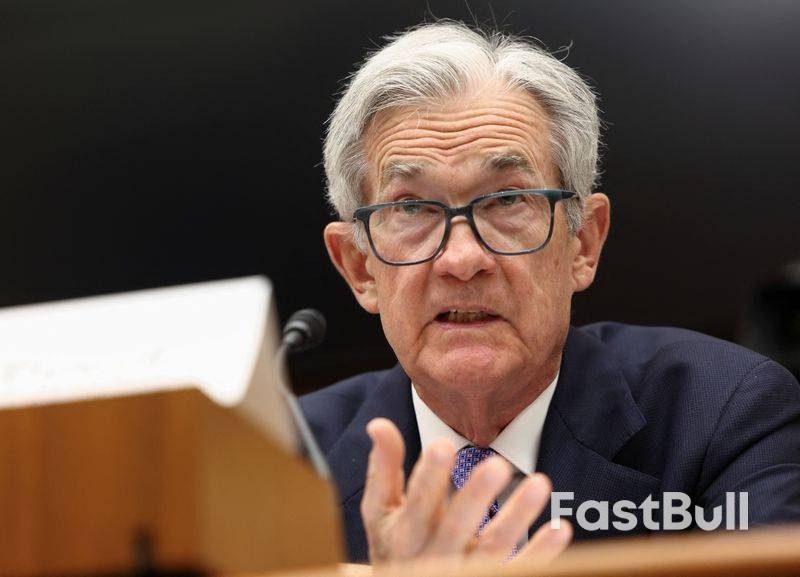
          U.S. Federal Reserve chair Jerome Powell reiterated the U.S. central bank plans to "wait and learn more" about the impact of tariffs on inflation before lowering interest rates, again setting aside President Donald Trump's demands for immediate and deep rate cuts.

          "We're simply taking some time," Powell said at a central bank gathering in Portugal, a day after Trump sent him a handwritten missive noting how low other central banks had cut rates and suggesting the U.S. needed to move. "As long as the U.S. economy is in solid shape, we think that the prudent thing to do is to wait and learn more and see what those effects might be."
          Source: Yahoo Finance

          To stay updated on all economic events of today, please check out our Economic calendar
          Risk Warnings and Disclaimers
          You understand and acknowledge that there is a high degree of risk involved in trading. Following any strategies or investment methods may lead to potential losses. The content on the site is provided by our contributors and analysts for information purposes only. You are solely responsible for determining whether any trading assets, securities, strategy, or any other product is suitable for investing based on your own investment objectives and financial situation.
          Add to Favorites
          Share

          For Pound Sterling, Bad Politics is Back

          Warren Takunda

          Economic

          The governing party doesn't have the mandate from its parliamentarians to bring spending under control.
          This is the message markets are receiving as they parse headlines that warn Prime Minister Keir Starmer is on the cusp of a major rebellion from his own parliamentarians over his attempts to get a grip on the country's balooning welfare spending.
          Labour Party MPs are unhappy about his plans to reform elements of the welfare system, and warn they could vote against Starmer's key legislation later today unless he makes fresh concessions.
          The rebellion comes despite the significant retreat Starmer has already made to MPs. Debbie Abrahams, one of three senior Labour MPs who negotiated last week's partial u-turn on benefits cuts, said the final details of the Bill did not tally with what had been agreed.
          The Bill's defeat would be a major blow to the government's authority and could lead to doubts about Chancellor Rachel Reeves' spending and tax plans, raising the odds of economy-hurting tax hikes in the Autumn.
          Bigger picture, Starmer's weakening grip on his own party and inability to direct the fiscal journey will come as a shock to markets that had begun to price in a lengthy spell of settled UK politics.
          Now, political uncertainty and the prospect of deteriorating economic fundamentals are squarely in the frame again.
          For Pound exchange rates, this is never a good thing.
          "The relative attractiveness of the pound will be diluted if the UK economy can not shake off its association with weak growth, struggling public finances, low business confidence and soft productivity growth," says Jane Foley, Senior FX Strategist at Rabobank.
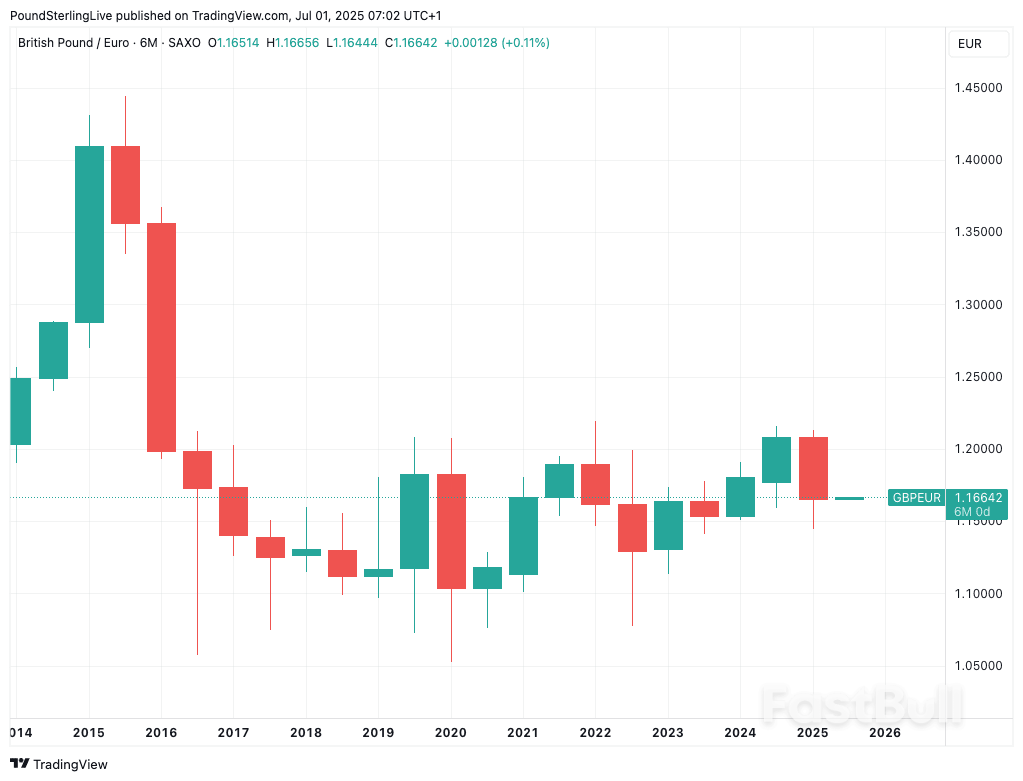
          Already, we see signs of suspicion in the market: the GBP/EUR exchange rate - which is considered the barometer of the UK economy - fell 3.5% in the first half of the year, weighed down by a flush of poor economic data releases in recent months.
          For Pound Sterling, Bad Politics is Back_1

          Above: GBP/EUR still hasn't recovered half of its post-Brexit fall.

          Pound Sterling meanwhile lost ground against half of its G10 peers in H1, suggesting that the two-year spell of outperformance has finally been snapped.
          The UK's benefits bill is growing at a staggering pace: the government says over 1,000 people a day were signing on for Personal Independence Payments (PIP), the benefit that is paid to people unable to work due to issues ranging from ill health and disabilities to stress and anxiety.
          PIP payments had been projected to almost double to £41BN by 2030, and the Office for Budget Responsibility says overall spending on disability and incapacity benefits is set to rise to £100BN from £65 billion last year.
          "The welfare budget's spiralling, from £40bn pre-Covid to £100bn by 2030. We challenged Labour to cut spending, get people into work & rule out tax rises. Starmer has failed on all counts, and the welfare bill is still set to rise," says Kemi Badenoch, leader of the official UK opposition.
          For Pound Sterling, Bad Politics is Back_2
          The open rebellion by ruling party MPs means the government risks losing control of spending and missing its fiscal rules that say it must start bringing down the debt spent on day-to-day spending by the end of the parliament.
          At the very least, the government won't have the authority and mandate to pursue any meaningful attempts to bring down welfare spending or drive reforms in the current parliamentary cycle, which has at least another four years to run.
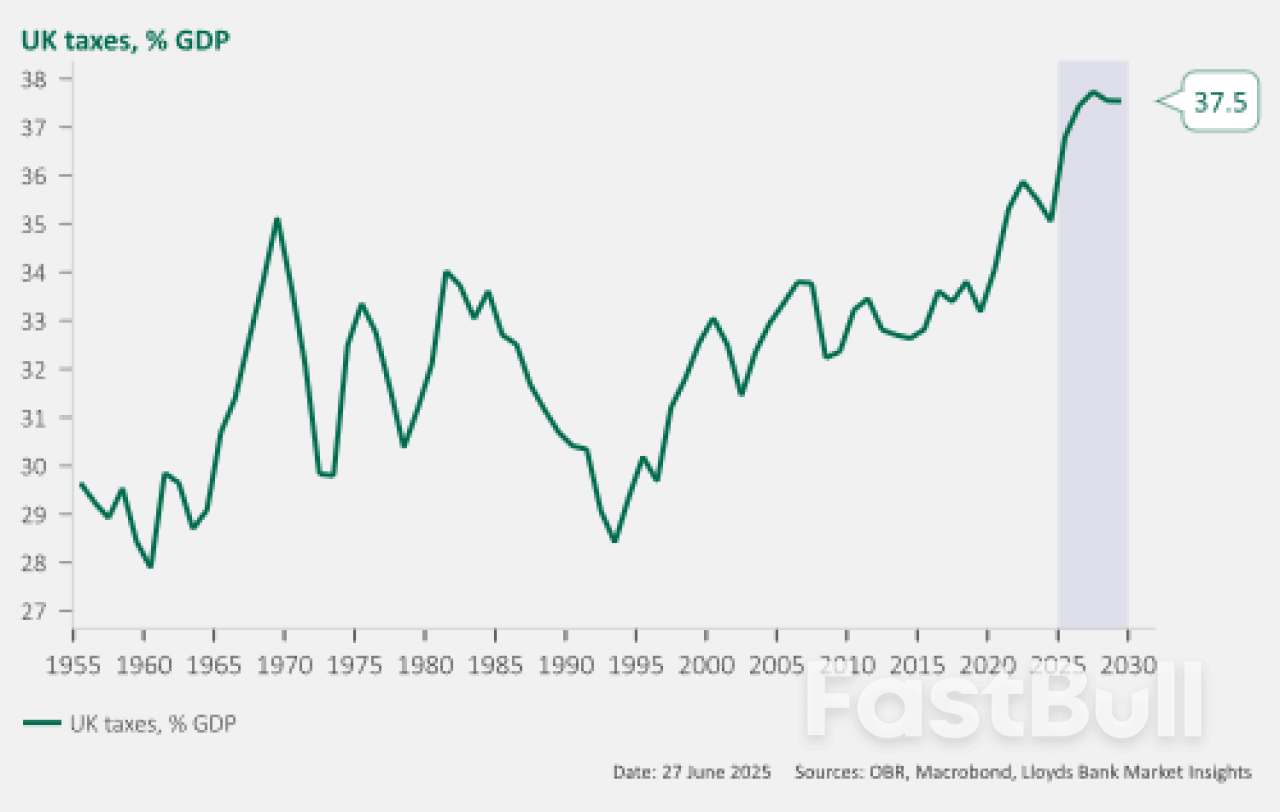
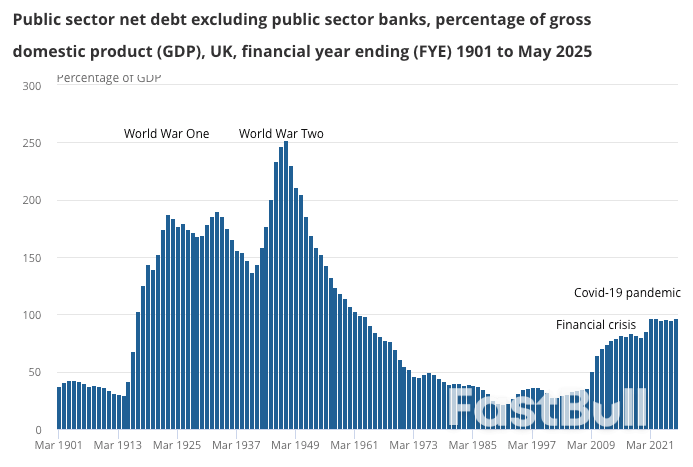
          This means a potentially unbroken cycle of tax hikes from an already high starting point: taxes are already at their highest level since the Second World War.For Pound Sterling, Bad Politics is Back_3

          Image courtesy of Lloyds Bank.

          Starmer's waning authority and inability to get a grasp on UK debt dynamics will raise concerns on global financial markets about Britain's fiscal health and whether or not it will be able to meet its debt repayment obligations over the long term.
          The global context is important as the UK will need to borrow more from international markets as other countries also ask to borrow more:
          President Donald Trump's One Big Beautiful Bill significantly expands America's debt requirements by nearly $4 trillion through 2034.Germany, Europe's largest economy, will ask to borrow substanitally more as it changes its own debt rules to spend on infrastructure and defenceFrance is en route to potentially hit a debt-to-GDP ratio of 10%But Europe and the U.S. have substantially bigger economies than the UK, with bigger central banks that can defend their currencies and test the market for longer.
          The U.S. in particular can keep going far longer than the UK can.
          This means it will be the UK that will be questioned by markets first, and meaningful spending cuts will become inevitable.
          These reforms will be painful, requiring a big adjustment lower by the Pound.

          Source: Poundsterlinglive

          To stay updated on all economic events of today, please check out our Economic calendar
          Risk Warnings and Disclaimers
          You understand and acknowledge that there is a high degree of risk involved in trading. Following any strategies or investment methods may lead to potential losses. The content on the site is provided by our contributors and analysts for information purposes only. You are solely responsible for determining whether any trading assets, securities, strategy, or any other product is suitable for investing based on your own investment objectives and financial situation.
          Add to Favorites
          Share

          Meta’s AI Surge and Nuclear Energy Tailwinds: What Traders Need to Know for Q3-Q4 202

          Adam

          Stocks

          Can Markets Extend Gains Without Apple and Tesla?

          Traders are assessing whether markets can sustain gains as traditional leaders like Apple and Tesla lose momentum while AI-focused names and nuclear energy beneficiaries gain traction. This evolving setup, driven by sector rotation and political energy policy shifts, is building a new backbone for the S&P 500 into year-end 2025.

          Meta Platforms Emerges as the AI Leader

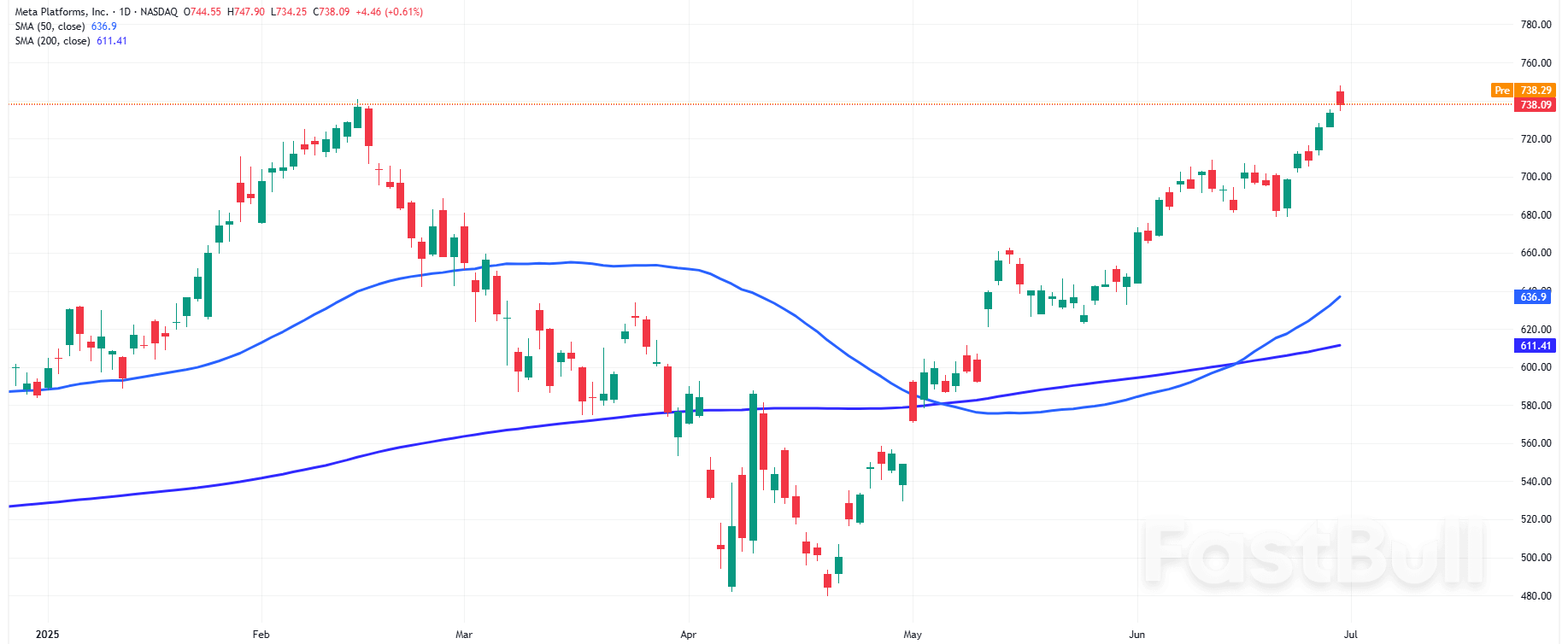
          Meta’s AI Surge and Nuclear Energy Tailwinds: What Traders Need to Know for Q3-Q4 202_1Daily Meta Platforms, Inc

          Meta Platforms has stepped up as a top AI beneficiary, outpacing Apple’s belated pivot to external AI solutions. Meta shares have rallied 75% this year, with Q1 revenue rising 16% and net income surging 35% to a record $16.6 billion, reflecting effective AI monetization in its ad business.
          Meta’s AI Surge and Nuclear Energy Tailwinds: What Traders Need to Know for Q3-Q4 202_2

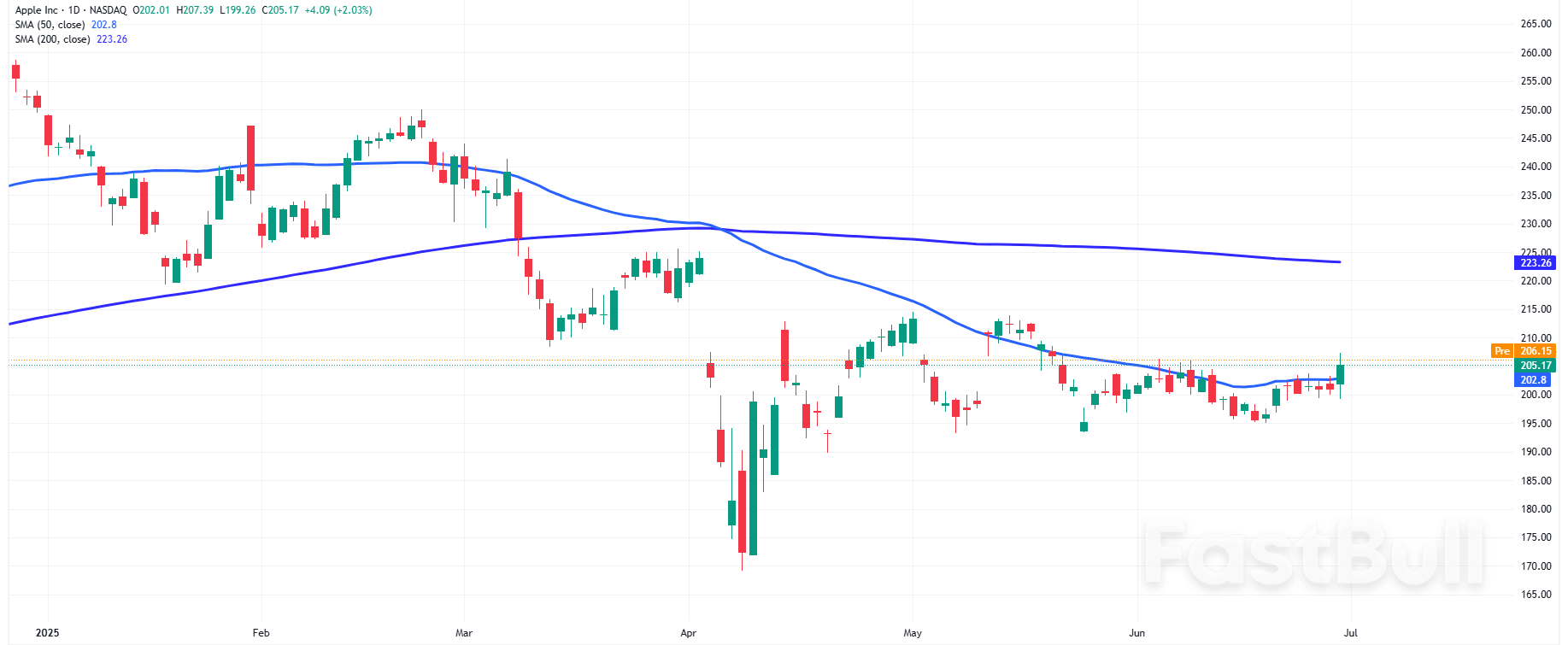
          Daily Apple Inc

          In contrast, Apple is scrambling to integrate outside AI into Siri, signaling its internal AI efforts have fallen behind. For traders, this divergence is critical: Meta’s operational momentum and aggressive AI hiring spree make it a top watch for continued strength in the AI theme.

          Sector Rotation Reduces Dependence on Mega-Cap Tech

          Markets are showing resilience as participation broadens beyond mega-cap tech.
          While tech stocks delivered over 36% returns in 2024, they are down nearly 5% this year, with money rotating into value sectors like healthcare, financials, and consumer defensives. Industrials, despite holding the top spot for only one period, are leading year-to-date, reflecting this broadening base.
          This rotation reduces reliance on Apple and Tesla, providing traders multiple engines for gains into Q4 2025.

          Trump Policies Fuel Nuclear Stocks While Solar Falters

          The Trump administration’s energy policy shift is creating clear winners and losers. A new Senate bill stripping tax incentives from renewables while boosting nuclear capacity to 400 GW by 2050 is already pressuring solar and wind stocks while supporting nuclear plays.
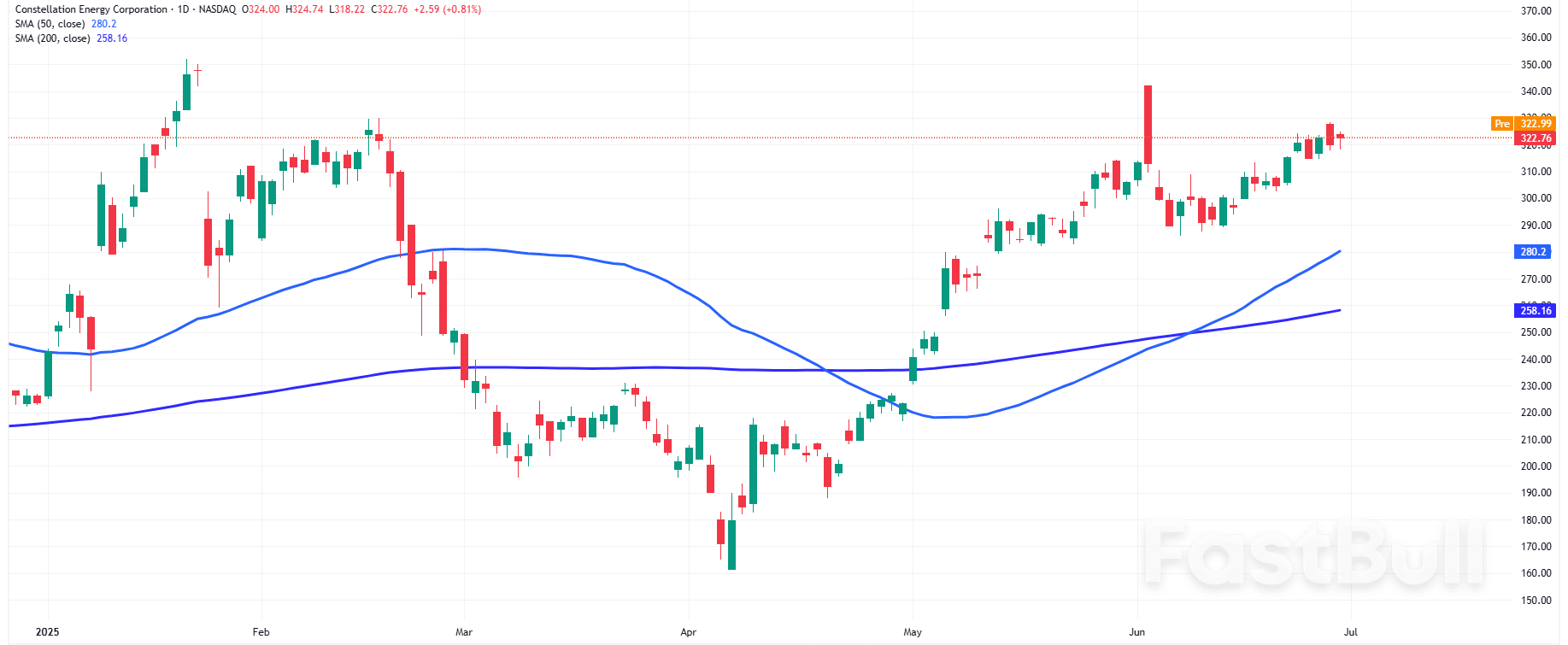
          Meta’s AI Surge and Nuclear Energy Tailwinds: What Traders Need to Know for Q3-Q4 202_3

          Daily Constellation Energy Corporation

          Clean energy stocks have dropped sharply on policy uncertainty, while nuclear-linked names like Constellation Energy and NRG Energy are rallying, fueled by both policy tailwinds and AI-driven energy demand.

          Nuclear Power and AI Demand Create a Strong Tailwind

          Nuclear energy is emerging as a critical investment theme, with tech giants like Meta striking 20-year nuclear power deals to secure reliable AI data center energy.
          This is not speculative positioning; it reflects supply-demand imbalances traders can act on, as nuclear provides consistent baseload power needed for AI operations. The energy sector’s evolution, combined with AI monetization, is reshaping capital flows, favoring companies that can deliver tangible returns.

          Market Forecast: Bullish but Selective

          The market outlook for Q3-Q4 2025 is cautiously bullish. Continued AI adoption by companies like Meta, policy-driven nuclear sector momentum, and sector rotation away from overvalued tech leaders suggest further gains, though volatility will remain elevated.
          Traders should focus on AI leaders with clear monetization paths and energy sectors aligned with structural demand and favorable policies, using dips to build positions for year-end strength.

          Source: fxempire

          Risk Warnings and Disclaimers
          You understand and acknowledge that there is a high degree of risk involved in trading. Following any strategies or investment methods may lead to potential losses. The content on the site is provided by our contributors and analysts for information purposes only. You are solely responsible for determining whether any trading assets, securities, strategy, or any other product is suitable for investing based on your own investment objectives and financial situation.
          Add to Favorites
          Share

          GLOBAL ECONOMY Tariff Risks Muddy Global Outlook for Factories

          Glendon

          Economic

          Forex

          Worries over future U.S. tariffs are clouding the outlook for factories across much of Asia and Europe, according to surveys released on Tuesday which nonetheless showed some were able to shrug off the uncertainty and keep growing.

          Among the bright spots, Japan's manufacturing read-out showed growth for the first time in 13 months, South Korea's activity contracted at a milder pace and China's Caixin PMI index also expanded in June - confounding an official survey that showed activity shrinking for a third straight month.

          In Europe, Ireland, Spain and the Netherlands were among the star performers even as the wider euro zone read-out was broadly flat and Britain continued to contract, albeit more slowly.

          Analysts said the underlying softness in surveys highlights the challenges facing businesses and policymakers as they try to navigate U.S. President Donald Trump's moves to shake up the global trade order with sweeping tariffs.

          "We must recognise that the external environment remains severe and complex, with increasing uncertainties," said Wang Zhe, economist at Caixin Insight Group. The Caixin/S&P Global survey showed Chinese manufacturing PMI rose to 50.4, surpassing expectations in a Reuters poll.

          Japan's final au Jibun Bank PMI rose to 50.1 due to an upswing in output, but overall demand remained weak as new orders shrank on concern over U.S. tariffs.

          Factory activity in South Korea contracted for the fifth straight month though the pace of decline eased on relief over a snap presidential election on June 3 that ended six months of uncertainty.

          In manufacturing, India was a significant outlier in the region last month, as activity accelerated to a 14-month high, driven by a substantial rise in international sales that helped spark a record-breaking spurt in hiring.

          DEADLINE

          Negotiators from major U.S. trading partners are rushing to reach deals with Trump's administration by a July 9 deadline to avoid import tariffs jumping to higher levels.

          While China is continuing its negotiations for a broader trade deal with the U.S., Japan and South Korea have so far failed to win concessions on the tariffs imposed on their mainstay export items like automobiles. The 27-member European Union is embarking on new talks in Washington later this week.

          The euro zone HCOB manufacturing Purchasing Managers' Index, compiled by S&P Global, edged up to 49.5 in June from 49.4 in May, its highest level since August 2022 - but still remaining below the 50 mark denoting growth in activity.

          Moreover, national surveys revealed stark differences across the currency bloc. Ireland recorded the highest PMI at a 37-month peak of 53.7, while Greece, Spain, and the Netherlands also posted readings above 50.

          "We seem to be in a sweet spot at the moment where it's domestic activity that's driving the index," John Fahey, senior economist at AIB, said of the Irish read-out.

          "There may be some level of activity and investment that was postponed for two or three years, and you're just at the point now where that has to happen, even though there's a more uncertain global backdrop."

          While Germany's manufacturing PMI reached its highest in nearly three years, it still indicated contraction. France, Italy and Austria on the other hand registered faster declines in manufacturing conditions.

          In Britain, outside the European Union, the manufacturing sector showed some signs of turning a corner in its long slump.

          "That said, any hoped for stabilisation remains fragile and subject to potential headwinds that could severely impact demand, supply chain reliability and future growth prospects," said Rob Dobson, director at S&P Global Market Intelligence.

          Speaking at the start of a central bankers' annual get-together in Sintra, Portugal, European Central Bank President Christine Lagarde said the global environment had changed fundamentally since the inflation spurt of the pandemic years.

          "The world ahead is more uncertain – and that uncertainty is likely to make inflation more volatile," Lagarde said.

          Data on Tuesday showed euro zone inflation last month stood at the ECB's 2% target, confirming that the era of runaway prices is over.

          Source: Reuters

          To stay updated on all economic events of today, please check out our Economic calendar
          Risk Warnings and Disclaimers
          You understand and acknowledge that there is a high degree of risk involved in trading. Following any strategies or investment methods may lead to potential losses. The content on the site is provided by our contributors and analysts for information purposes only. You are solely responsible for determining whether any trading assets, securities, strategy, or any other product is suitable for investing based on your own investment objectives and financial situation.
          Add to Favorites
          Share

          The Euro Is Approaching A Critical Level Above $1.20 - ECB’s Guindos Warns

          Michelle

          Economic

          Forex

          European Central Bank Vice President Luis de Guindos has stated that a rise in the euro beyond $1.20 could create challenges for policymakers, though he sees current levels as no cause for concern.

          In unusual comments from an ECB official on the exchange rate of the common currency, Guindos said the pace of the euro’s appreciation was a bigger concern than where it is now.

          During the ECB’s yearly meeting in Sintra, Portugal, the Spanish official expressed that $1.17, or even $1.20, is not a big deal. According to Guindos, they can let it slide a bit. He added that $1.20 is fine, but anything above that would be much more complicated.

          Luis de Guindos reveals impact of Trump’s tariff policies on the euro

          The ECB typically avoids commenting on the euro’s value, maintaining that while the exchange rate factors into policy decisions, it doesn’t target any specific level — a stance Guindos reaffirmed.

          Guindos said they focus on how the exchange rate changes and include its current level in their forecasts. The ECB’s vice president also clarified that they keep an eye on this, but their focus is not on a specific exchange rate.

          Notably, the euro has benefited from a weakening dollar, driven by President Donald Trump’s tariff measures that have undermined market confidence, resulting in a nearly 14% rise this year. In response, Guindos emphasized the importance of preventing the euro from overshooting.

          Meanwhile, reports on June 16 revealed that tariffs would weigh on eurozone economic growth and prices for years. However, Luis de Guindos noted there is little risk of inflation falling significantly, and the euro’s sharp rise against the dollar is not a major concern for now.

          The ECB signaled a break in policy easing that month, even though it expects price growth to dip below its 2% target temporarily on the strong euro and low oil prices. This indicates that raising concerns about the ultra-low inflation marks that the pre-pandemic decade could return.

          Nonetheless, Guindos dismissed those fears, saying that the ECB is finally close to reaching its goal after many years of missing it above and below.

          In an interview, the ECB’s vice president speculated that the chance of falling short is quite small. Based on his argument, they believe the inflation risks are balanced.

          The ECB signals a break in policy easing amid risks of inflation

          One of the main reasons why inflation will rebound to target after falling to 1.4% in the first quarter of 2026 is that the labor market is tight and unions will continue to push for significant wage hikes, maintaining compensation growth at 3%, Guindos countered.

          Although he did not directly call for a halt in easing policies, he mentioned that financial investors, who have bet on just one more interest rate cut, possibly towards the end of the year, correctly heard ECB President Christine Lagarde’s message.

          Guindos elaborated by saying that markets clearly grasped what the President meant when referring to a strong stance. He added that he expects markets to believe and factor in that the ECB is very close to achieving its medium-term target of sustainable 2% inflation.

          According to June reports, the euro is up 11% against the dollar in the past three months, reaching its highest level in nearly four years at $1.1632.

          Interestingly, along with hitting exporters hard because of US tariffs, a stronger euro might also reduce the prices of imports even more.

          However, Guindo, who was a former Spanish economy minister on the ECB board for the longest, said the exchange rate had not been volatile or appreciated quickly, which were two key measures in his estimation.

          Source: CryptoSlate

          To stay updated on all economic events of today, please check out our Economic calendar
          Risk Warnings and Disclaimers
          You understand and acknowledge that there is a high degree of risk involved in trading. Following any strategies or investment methods may lead to potential losses. The content on the site is provided by our contributors and analysts for information purposes only. You are solely responsible for determining whether any trading assets, securities, strategy, or any other product is suitable for investing based on your own investment objectives and financial situation.
          Add to Favorites
          Share

          European Central Bank Head: Frequent Shocks to Economy Make Inflation More Unpredictable

          Warren Takunda

          Economic

          The head of the European Central Bank said inflation has become more unpredictable due to shocks like the COVID-19 pandemic and Russia’s invasion of Ukraine — and that policymakers need to take the possibility of such extreme scenarios into account and communicate them to the public as well.
          “The world ahead is more uncertain, and that uncertainty is likely to make inflation more volatile,” ECB President Christine Lagarde said Monday in a speech opening the central bank’s annual conference in Sintra, Portugal. “It’s pretty basic but that’s the reality.”
          One reason, she said, was that increasingly regular supply disruptions were leading companies to change their prices more frequently, a habit that goes beyond the recent burst of inflation in the U.S. and Europe and “reflects a structural shift in how firms operate under conditions of permanently higher uncertainty.”
          The bank’s assessment of the economy needs to rely on taking extreme possible scenarios into account as well as the more likely baseline predictions, and it should let the public in on those possible outcomes as well, she said. Lagarde in particular cited the inflation spike that followed Russia’s invasion of Ukraine, where a baseline scenario based on higher energy prices suggest inflation for 2022 of 5.5% - but a worst-case scenario indicated more than 7% inflation, much closer to the final figure of 8%.
          Another example was the pandemic, where spending by homebound consumers shifted from services like restaurants to goods such as home exercise equipment.
          “Scenario analysis could have helped in illustrating that the range of possible inflation outcomes was unusually wide – and would have reduced the risk of projecting false certainty to the public,” Lagarde said.
          The bank’s strategy review announced Monday reaffirmed its target of 2% for inflation, a goal it has met for the time being as annual price increases were 1.9% in May. The drop in inflation has let the bank cut its benchmark interest rate from a peak of 4% to 2%.
          Threats of higher tariffs from U.S. President Donald Trump have added to uncertainty about the outlook for growth and inflation. The European Commission and US negotiators are trying to reach agreement on a trade deal ahead of a July 9 deadline.
          The conference in Sintra is the ECB’s equivalent of the U.S. Federal Reserve gathering in Jackson Hole, Wyoming, and gathers top central bankers and economists from around the world. Fed Chair Jerome Powell is to take part in a panel on Tuesday with Lagarde, Bank of England Government Andrew Bailey, Bank of Korea Governor Chang Yong Rhee and Kazuo Ueda, the governor of the Bank of Japan.

          Source: AP

          To stay updated on all economic events of today, please check out our Economic calendar
          Risk Warnings and Disclaimers
          You understand and acknowledge that there is a high degree of risk involved in trading. Following any strategies or investment methods may lead to potential losses. The content on the site is provided by our contributors and analysts for information purposes only. You are solely responsible for determining whether any trading assets, securities, strategy, or any other product is suitable for investing based on your own investment objectives and financial situation.
          Add to Favorites
          Share

          EU Aiming for Upfront Tariff Relief for Key Sectors In U.S. Trade Deal

          Glendon

          Economic

          Forex

          The European Union is demanding immediate relief from tariffs in some key sectors as part of a trade deal with the United States, Reuters has reported.

          However, citing EU diplomats, the news agency said Brussels still anticipates potential unfavorable imbalances in an agreement with Washington.

          Tuesday’s report comes as negotiators are facing the looming expiration to a pause to U.S. President Donald Trump’s sweeping "reciprocal" tariffs on July 9. It remains unclear what how Trump will approach the end of the delay to the punishing levies, with White House officials saying that any extensions to the deadline would only be decided by the president.

          Against this backdrop, the European Commission, which is negotiating on behalf of the EU, is reportedly set to put forward a range of demands during meetings with the Trump administration this week.

          Along with specifically lower tariffs on items like alcohol and medical technology, which currently face a 10% U.S. tariff, the EU is also looking for a deal to cover commercial aircraft, pharmaceuticals and semiconductors, Reuters said. The U.S. has launched a probe into these industries, but has yet to place additional tariffs on them.

          Meanwhile, the EU is aiming for U.S. concessions on 25% tariffs slapped on autos and auto parts, as well as a cut to duties on steel and aluminum, Reuters reported. The car levies, in particular, are a "red line" for EU negotiators, the report said.

          Finally, the EU would reportedly like to see tariff relief once an initial agreement is reached, rather than having to wait for weeks or months before a final deal is signed.

          For its part, the Trump administration has presented a list of their own demands to the EU, but did not include any concessions of its own, Reuters reported, adding that both camps are working to first achieve an agreement in principle and will then clarify the details later.

          The EU has become a major target of Trump’s trade-related ire since his return to power earlier this year, with the president arguing that it has ripped off the U.S. through perceived unfair trade practices. Brussels has rebuffed the claims, and vowed to react "firmly" to "unjustified barriers to free and fair trade."

          Source: Reuters

          To stay updated on all economic events of today, please check out our Economic calendar
          Risk Warnings and Disclaimers
          You understand and acknowledge that there is a high degree of risk involved in trading. Following any strategies or investment methods may lead to potential losses. The content on the site is provided by our contributors and analysts for information purposes only. You are solely responsible for determining whether any trading assets, securities, strategy, or any other product is suitable for investing based on your own investment objectives and financial situation.
          Add to Favorites
          Share
          FastBull
          Copyright © 2025 FastBull Ltd

          728 RM B 7/F GEE LOK IND BLDG NO 34 HUNG TO RD KWUN TONG KLN HONG KONG

          TelegramInstagramTwitterfacebooklinkedin
          App Store Google Play Google Play
          Products
          Charts

          Chats

          Q&A with Experts
          Screeners
          Economic Calendar
          Data
          Tools
          Membership
          Features
          Function
          Markets
          Copy Trading
          Latest Signals
          Contests
          News
          Analysis
          24/7
          Columns
          Education
          Company
          Careers
          About Us
          Contact Us
          Advertising
          Help Center
          Feedback
          User Agreement
          Privacy Policy
          Business

          White Label

          Data API

          Web Plug-ins

          Poster Maker

          Affiliate Program

          Risk Disclosure

          The risk of loss in trading financial instruments such as stocks, FX, commodities, futures, bonds, ETFs and crypto can be substantial. You may sustain a total loss of the funds that you deposit with your broker. Therefore, you should carefully consider whether such trading is suitable for you in light of your circumstances and financial resources.

          No decision to invest should be made without thoroughly conducting due diligence by yourself or consulting with your financial advisors. Our web content might not suit you since we don't know your financial conditions and investment needs. Our financial information might have latency or contain inaccuracy, so you should be fully responsible for any of your trading and investment decisions. The company will not be responsible for your capital loss.

          Without getting permission from the website, you are not allowed to copy the website's graphics, texts, or trademarks. Intellectual property rights in the content or data incorporated into this website belong to its providers and exchange merchants.

          Not Logged In

          Log in to access more features

          FastBull Membership

          Not yet

          Purchase

          Become a signal provider
          Help Center
          Customer Service
          Dark Mode
          Price Up/Down Colors

          Log In

          Sign Up

          Position
          Layout
          Fullscreen
          Default to Chart
          The chart page opens by default when you visit fastbull.com