
• Trade
  • Markets
  • Copy
  • Contests
  • News
  • 24/7
  • Calendar
  • Q&A
  • Chats
Trending
Screeners
SYMBOL
LAST
BID
ASK
HIGH
LOW
NET CHG.
%CHG.
SPREAD
SPX
S&P 500 Index
6827.42
6827.42
6827.42
6899.86
6801.80
-73.58
-1.07%
--
DJI
Dow Jones Industrial Average
48458.04
48458.04
48458.04
48886.86
48334.10
-245.98
-0.51%
--
IXIC
NASDAQ Composite Index
23195.16
23195.16
23195.16
23554.89
23094.51
-398.69
-1.69%
--
USDX
US Dollar Index
97.950
98.030
97.950
98.500
97.950
-0.370
-0.38%
--
EURUSD
Euro / US Dollar
1.17394
1.17409
1.17394
1.17496
1.17192
+0.00011
+ 0.01%
--
GBPUSD
Pound Sterling / US Dollar
1.33707
1.33732
1.33707
1.33997
1.33419
-0.00148
-0.11%
--
XAUUSD
Gold / US Dollar
4299.39
4299.39
4299.39
4353.41
4257.10
+20.10
+ 0.47%
--
WTI
Light Sweet Crude Oil
57.233
57.485
57.233
58.011
56.969
-0.408
-0.71%
--

Community Accounts

Signal Accounts
--
Profit Accounts
--
Loss Accounts
--
View More

Become a signal provider

Sell trading signals to earn additional income

View More

Guide to Copy Trading

Get started with ease and confidence

View More

Signal Accounts for Members

All Signal Accounts

Best Return
  • Best Return
  • Best P/L
  • Best MDD
Past 1W
  • Past 1W
  • Past 1M
  • Past 1Y

All Contests

  • All
  • Trump Updates
  • Recommend
  • Stocks
  • Cryptocurrencies
  • Central Banks
  • Featured News
Top News Only
Share

Pentagon Says Two USA Army Soldiers And One Civilian USA Interpreter Were Killed, And Three Were Wounded In Syria

Share

Israel Says It Kills Senior Hamas Commander Raed Saed In Gaza

Share

Ukraine's Navy Says Russian Drone Attack Hit Civilian Turkish Vessel Carrying Sunflower Oil To Egypt On Saturday

Share

Israeli Military Says It Put Planned Strike On South Lebanon Site On Hold After Lebanese Army Requested Access

Share

Norwegian Nobel Committee: Calls On The Belarusian Authorities To Release All Political Prisoners

Share

Norwegian Nobel Committee: His Freedom Is A Deeply Welcome And Long-Awaited Moment

Share

Ukraine Says It Received 114 Prisoners From Belarus

Share

USA Embassy In Lithuania: Maria Kalesnikava Is Not Going To Vilnius

Share

USA Embassy In Lithuania: Other Prisoners Are Being Sent From Belarus To Ukraine

Share

Ukraine President Zelenskiy: Five Ukrainians Released By Belarus In US-Brokered Deal

Share

USA Vilnius Embassy: USA Stands Ready For "Additional Engagement With Belarus That Advances USA Interests"

Share

USA Vilnius Embassy: Belarus, USA, Other Citizens Among The Prisoners Released Into Lithuania

Share

USA Vilnius Embassy: USA Will Continue Diplomatic Efforts To Free The Remaining Political Prisoners In Belarus

Share

USA Vilnius Embassy: Belarus Releases 123 Prisoners Following Meeting Of President Trump's Envoy Coale And Belarus President Lukashenko

Share

USA Vilnius Embassy: Masatoshi Nakanishi, Aliaksandr Syrytsa Are Among The Prisoners Released By Belarus

Share

USA Vilnius Embassy: Maria Kalesnikava And Viktor Babaryka Are Among The Prisoners Released By Belarus

Share

USA Vilnius Embassy: Nobel Peace Prize Laureate Ales Bialiatski Is Among The Prisoners Released By Belarus

Share

Belarusian Presidential Administration Telegram Channel: Lukashenko Has Pardoned 123 Prisoners As Part Of Deal With US

Share

Two Local Syrian Officials: Joint US-Syrian Military Patrol In Central Syria Came Under Fire From Unknown Assailants

Share

Israeli Military Says It Targeted 'Key Hamas Terrorist' In Gaza City

TIME
ACT
FCST
PREV
U.K. Trade Balance Non-EU (SA) (Oct)

A:--

F: --

P: --

U.K. Trade Balance (Oct)

A:--

F: --

P: --

U.K. Services Index MoM

A:--

F: --

P: --

U.K. Construction Output MoM (SA) (Oct)

A:--

F: --

P: --

U.K. Industrial Output YoY (Oct)

A:--

F: --

P: --

U.K. Trade Balance (SA) (Oct)

A:--

F: --

P: --

U.K. Trade Balance EU (SA) (Oct)

A:--

F: --

P: --

U.K. Manufacturing Output YoY (Oct)

A:--

F: --

P: --

U.K. GDP MoM (Oct)

A:--

F: --

P: --

U.K. GDP YoY (SA) (Oct)

A:--

F: --

P: --

U.K. Industrial Output MoM (Oct)

A:--

F: --

P: --

U.K. Construction Output YoY (Oct)

A:--

F: --

P: --

France HICP Final MoM (Nov)

A:--

F: --

P: --

China, Mainland Outstanding Loans Growth YoY (Nov)

A:--

F: --

P: --

China, Mainland M2 Money Supply YoY (Nov)

A:--

F: --

P: --

China, Mainland M0 Money Supply YoY (Nov)

A:--

F: --

P: --

China, Mainland M1 Money Supply YoY (Nov)

A:--

F: --

P: --

India CPI YoY (Nov)

A:--

F: --

P: --

India Deposit Gowth YoY

A:--

F: --

P: --

Brazil Services Growth YoY (Oct)

A:--

F: --

P: --

Mexico Industrial Output YoY (Oct)

A:--

F: --

P: --

Russia Trade Balance (Oct)

A:--

F: --

P: --

Philadelphia Fed President Henry Paulson delivers a speech
Canada Building Permits MoM (SA) (Oct)

A:--

F: --

P: --

Canada Wholesale Sales YoY (Oct)

A:--

F: --

P: --

Canada Wholesale Inventory MoM (Oct)

A:--

F: --

P: --

Canada Wholesale Inventory YoY (Oct)

A:--

F: --

P: --

Canada Wholesale Sales MoM (SA) (Oct)

A:--

F: --

P: --

Germany Current Account (Not SA) (Oct)

A:--

F: --

P: --

U.S. Weekly Total Rig Count

A:--

F: --

P: --

U.S. Weekly Total Oil Rig Count

A:--

F: --

P: --

Japan Tankan Large Non-Manufacturing Diffusion Index (Q4)

--

F: --

P: --

Japan Tankan Small Manufacturing Outlook Index (Q4)

--

F: --

P: --

Japan Tankan Large Non-Manufacturing Outlook Index (Q4)

--

F: --

P: --

Japan Tankan Large Manufacturing Outlook Index (Q4)

--

F: --

P: --

Japan Tankan Small Manufacturing Diffusion Index (Q4)

--

F: --

P: --

Japan Tankan Large Manufacturing Diffusion Index (Q4)

--

F: --

P: --

Japan Tankan Large-Enterprise Capital Expenditure YoY (Q4)

--

F: --

P: --

U.K. Rightmove House Price Index YoY (Dec)

--

F: --

P: --

China, Mainland Industrial Output YoY (YTD) (Nov)

--

F: --

P: --

China, Mainland Urban Area Unemployment Rate (Nov)

--

F: --

P: --

Saudi Arabia CPI YoY (Nov)

--

F: --

P: --

Euro Zone Industrial Output YoY (Oct)

--

F: --

P: --

Euro Zone Industrial Output MoM (Oct)

--

F: --

P: --

Canada Existing Home Sales MoM (Nov)

--

F: --

P: --

Euro Zone Total Reserve Assets (Nov)

--

F: --

P: --

U.K. Inflation Rate Expectations

--

F: --

P: --

Canada National Economic Confidence Index

--

F: --

P: --

Canada New Housing Starts (Nov)

--

F: --

P: --

U.S. NY Fed Manufacturing Employment Index (Dec)

--

F: --

P: --

U.S. NY Fed Manufacturing Index (Dec)

--

F: --

P: --

Canada Core CPI YoY (Nov)

--

F: --

P: --

Canada Manufacturing Unfilled Orders MoM (Oct)

--

F: --

P: --

Canada Manufacturing New Orders MoM (Oct)

--

F: --

P: --

Canada Core CPI MoM (Nov)

--

F: --

P: --

Canada Manufacturing Inventory MoM (Oct)

--

F: --

P: --

Canada CPI YoY (Nov)

--

F: --

P: --

Canada CPI MoM (Nov)

--

F: --

P: --

Canada CPI YoY (SA) (Nov)

--

F: --

P: --

Canada Core CPI MoM (SA) (Nov)

--

F: --

P: --

Q&A with Experts
    • All
    • Chatrooms
    • Groups
    • Friends
    Connecting
    .
    .
    .
    Type here...
    Add Symbol or Code

      No matching data

      All
      Trump Updates
      Recommend
      Stocks
      Cryptocurrencies
      Central Banks
      Featured News
      • All
      • Russia-Ukraine Conflict
      • Middle East Flashpoint
      • All
      • Russia-Ukraine Conflict
      • Middle East Flashpoint
      Search
      Products

      Charts Free Forever

      Chats Q&A with Experts
      Screeners Economic Calendar Data Tools
      Membership Features
      Data Warehouse Market Trends Institutional Data Policy Rates Macro

      Market Trends

      Market Sentiment Order Book Forex Correlations

      Top Indicators

      Charts Free Forever
      Markets

      News

      News Analysis 24/7 Columns Education
      From Institutions From Analysts
      Topics Columnists

      Latest Views

      Latest Views

      Trending Topics

      Top Columnists

      Latest Update

      Signals

      Copy Rankings Latest Signals Become a signal provider AI Rating
      Contests
      Brokers

      Overview Brokers Assessment Rankings Regulators News Claims
      Broker listing Forex Brokers Comparison Tool Live Spread Comparison Scam
      Q&A Complaint Scam Alert Videos Tips to Detect Scam
      More

      Business
      Events
      Careers About Us Advertising Help Center

      White Label

      Data API

      Web Plug-ins

      Affiliate Program

      Awards Institution Evaluation IB Seminar Salon Event Exhibition
      Vietnam Thailand Singapore Dubai
      Fans Party Investment Sharing Session
      FastBull Summit BrokersView Expo
      Recent Searches
        Top Searches
          Markets
          News
          Analysis
          User
          24/7
          Economic Calendar
          Education
          Data
          • Names
          • Latest
          • Prev

          View All

          No data

          Scan to Download

          Faster Charts, Chat Faster!

          Download App
          English
          • English
          • Español
          • العربية
          • Bahasa Indonesia
          • Bahasa Melayu
          • Tiếng Việt
          • ภาษาไทย
          • Français
          • Italiano
          • Türkçe
          • Русский язык
          • 简中
          • 繁中
          Open Account
          Search
          Products
          Charts Free Forever
          Markets
          News
          Signals

          Copy Rankings Latest Signals Become a signal provider AI Rating
          Contests
          Brokers

          Overview Brokers Assessment Rankings Regulators News Claims
          Broker listing Forex Brokers Comparison Tool Live Spread Comparison Scam
          Q&A Complaint Scam Alert Videos Tips to Detect Scam
          More

          Business
          Events
          Careers About Us Advertising Help Center

          White Label

          Data API

          Web Plug-ins

          Affiliate Program

          Awards Institution Evaluation IB Seminar Salon Event Exhibition
          Vietnam Thailand Singapore Dubai
          Fans Party Investment Sharing Session
          FastBull Summit BrokersView Expo

          Pound-to-Euro Through 1.19 After Trump Lashes Out at EU

          Warren Takunda

          Economic

          Summary:

          Euro weakens against Pound Sterling after Trump tariff threat.
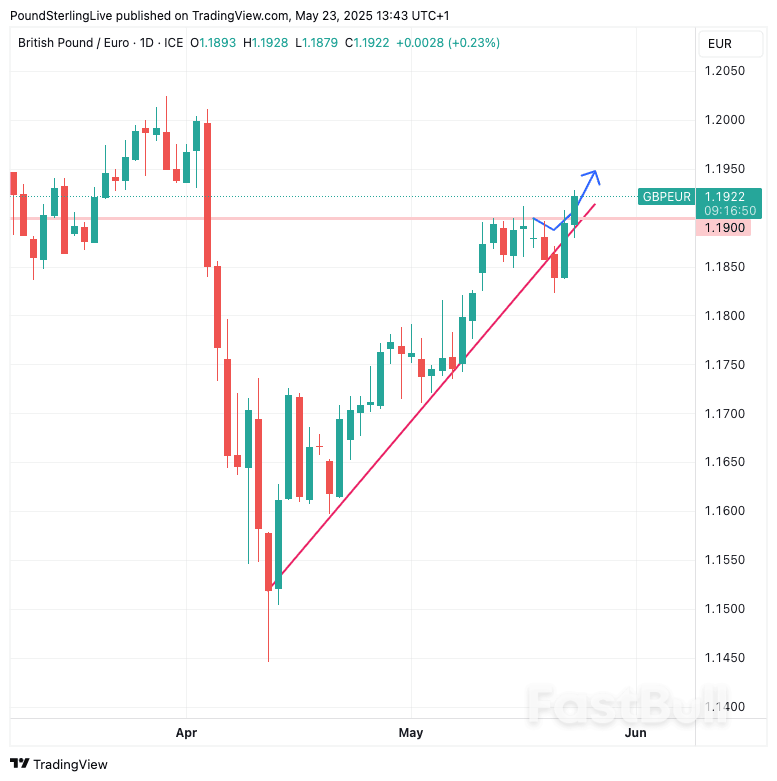
          The Pound to Euro exchange rate (GBP/EUR) rose through the key 1.19 barrier in Friday trade after U.S. President Donald Trump threatened to impose a 50% tariff on all European Union imports starting June 1, accusing the bloc of unfair trade practices.
          In a Truth Social post, Trump claimed the EU was “formed for the primary purpose of taking advantage of the United States on trade,” citing “powerful trade barriers” and “unjustified lawsuits against American companies.”
          Derek Halpenny, Head of Research for Global Markets EMEA at MUFG Bank Ltd, says the Euro "has dropped sharply" in reaction to the news, as investors bet a tariff hit will force the European Central Bank into cutting interest rates more than currently anticipated.
          "A 50% tariff could result in a big hit on euro-zone GDP and would likely prompt the ECB to cut the policy rate more aggressively," he says.
          The developments sent a jolt through markets, where investors were getting used to the idea that the worst had passed on the trade war front.
          GBP/EUR was higher 0.20% at 1.1918, ensuring our Week Ahead Forecast published on Monday is playing out beautifully:Pound-to-Euro Through 1.19 After Trump Lashes Out at EU_1

          Above: GBP/EUR at daily intervals with annotations sketched in Monday's Week Ahead Forecast.

          U.S. equity markets reacted swiftly, with S&P 500 and Nasdaq 100 futures falling 1.1% and 1.3%, respectively. Trump also warned he would apply a 25% tariff on Apple Inc. products if the company failed to manufacture iPhones in the U.S., sending Apple shares lower.
          The move came just days after the EU offered a new trade proposal that included tariff reductions and cooperation on issues like energy and AI. However, U.S. Commerce Secretary Howard Lutnick dismissed the EU effort, calling negotiations “impossible.”
          In response, the EU is preparing retaliatory tariffs targeting €95 billion ($107 billion) of U.S. exports, even as it temporarily delayed a separate set of duties on U.S. steel and aluminium.
          Dr. Christoph Swonke at Germany's DZ Bank says:
          "Should the now threatened US tariffs of 50% actually come to pass, the EU will certainly respond with counter-tariffs. In this case, it is unlikely that the tariffs will be limited to selected products such as motorcycles, jeans, peanut butter, or bourbon whiskey.
          "More far-reaching measures are conceivable. For example, the service businesses of major US tech giants in Europe could come under greater scrutiny. An escalation of the tariff disputes would likely result in significant growth losses and, at the same time, higher inflation rates for both the US and the EU."

          Source: Poundsterlinglive

          To stay updated on all economic events of today, please check out our Economic calendar
          Risk Warnings and Disclaimers
          You understand and acknowledge that there is a high degree of risk involved in trading. Following any strategies or investment methods may lead to potential losses. The content on the site is provided by our contributors and analysts for information purposes only. You are solely responsible for determining whether any trading assets, securities, strategy, or any other product is suitable for investing based on your own investment objectives and financial situation.
          Add to Favorites
          Share

          European Stock Markets Rebound as Trump Delays 50% Tariffs on the EU to 9 July

          Warren Takunda

          Economic

          US President Donald Trump announced on Sunday that he had agreed to delay the implementation of a 50% tariff on EU imports to 9 July, following a phone call with European Commission President Ursula von der Leyen.
          The announcement sparked a sharp rebound in US stock futures and boosted European equities on Monday.
          “I agreed to the extension — July 9, 2025 — It was my privilege to do so,” Trump posted on Truth Social, quoting von der Leyen’s statement on X, in which she wrote:
          “The EU and US share the world’s most consequential and close trade relationship. Europe is ready to advance talks swiftly and decisively. To reach a good deal, we would need the time until July 9.”
          Trump had originally announced 20% “reciprocal tariffs” on the EU on 2 April before reducing them to 10% for 90 days.
          However, he threatened to impose a 50% tariff from 1 June, citing a lack of progress in negotiations due to disagreements among EU member states. According to the bloc’s trade chief, Maroš Šefčovič, the EU submitted a revised trade proposal to the US last week.
          In a social media post on Friday, Trump criticised the EU’s non-tariff barriers, including VAT regimes, “ridiculous corporate penalties,” non-monetary trade restrictions, and “unjustified lawsuits against American companies,” which he claimed contributed to an annual trade deficit of over $250 billion (€219 billion). “Our discussions with them are going nowhere!” he wrote, justifying his move to raise import levies.
          Trump’s tariff threats triggered broad market sell-offs in both the US and Europe on Friday, representing a renewed escalation in global trade tensions, just two weeks after the latest round of US-China trade talks.

          European stock markets open higher

          Major stock benchmarks in Europe opened higher on Monday following Trump’s reversal. The Euro Stoxx 600 jumped 1.00%, and the DAX surged 1.67% as of 9:25 am CEST.
          “It's obviously a derivation of the Trump put. But it's prompting traders to place their bets that any new tariff threat is bluster and any existing tariff will eventually be lowered,” said Kyle Rodda, a senior market analyst at Capital.com Australia.
          The US stock futures also rebounded significantly, with the Dow Jones Industrial Average rising 0.85%, the S&P 500 up 1%, and the Nasdaq 100 climbing 1.19%.
          Asian markets were mixed in the early trading on Thursday, with Japan’s Nikkei 225 and South Korea’s Kospi rising, while Australia's ASX 200 and China’s Hang Seng Index fell.

          The euro hits a one-month high as dollar weakens

          The euro extended gains against the US dollar during Monday’s Asian session. As of 3:35 am CEST, the EUR/USD pair rose above 1.40, its highest level since 29 April.
          The dollar remained under pressure after Trump’s tariff threats on Friday, with the US dollar index falling below 99 for the first time in May.
          “While part of the dynamic is the market pricing in policy convergence between the US and the rest of the world, I think the major driver of dollar depreciation is the marginal loss of confidence in US assets,” Rodda said.
          Recently, Moody’s downgraded the US credit rating, citing concerns over rising government debt and the widening budget deficit. Trump’s proposed tax cuts and spending plans are also facing stiff opposition in Congress.
          These compounding factors have renewed sell-offs in US assets, including equities, the dollar, and government bonds, in the past week.

          Source: Euronews

          To stay updated on all economic events of today, please check out our Economic calendar
          Risk Warnings and Disclaimers
          You understand and acknowledge that there is a high degree of risk involved in trading. Following any strategies or investment methods may lead to potential losses. The content on the site is provided by our contributors and analysts for information purposes only. You are solely responsible for determining whether any trading assets, securities, strategy, or any other product is suitable for investing based on your own investment objectives and financial situation.
          Add to Favorites
          Share

          STOXX 600 Rallies as Trump’s EU Tariff Delay Reignites Market Optimism

          Gerik

          Economic

          Stocks

          Markets Rebound on Tariff Reprieve

          European stock markets opened the week on a high note, with the pan-European STOXX 600 index rising 1% by early Monday trading, recouping Friday’s 0.9% loss. The recovery followed U.S. President Donald Trump’s decision to postpone the implementation of a proposed 50% tariff on EU goods, extending the deadline from June 1 to July 9 after discussions with European Commission President Ursula von der Leyen.
          This extension provided immediate relief to investors concerned about a sharp escalation in trade tensions, prompting a widespread rebound across sensitive sectors.

          Autos and Luxury Lead the Charge

          Industries most vulnerable to transatlantic tariff shocks—such as automobiles and luxury goods—saw some of the largest gains. The STOXX automobiles and parts index rose 1.4%, with Mercedes-Benz climbing 2.1%, BMW up 2%, and Volkswagen advancing 1.9%. These companies are highly exposed to U.S. demand and global supply chains, and any tariff reduction or delay directly improves their earnings outlook.
          Luxury brands with significant U.S. customer bases also surged. Kering, LVMH, and Richemont each posted gains ranging from 1.5% to 2.4%, reflecting improved investor confidence in cross-border consumer resilience.

          Broader Sector Gains Reflect Eased Risk Perception

          Banking stocks, which are closely tied to economic sentiment and interest rate dynamics, jumped 1.5%, while technology led all sectors with a 1.9% gain. The tech rally reflects broader global optimism, fueled in part by anticipation of strong earnings from industry leaders like Nvidia, whose upcoming quarterly report is expected to influence sentiment far beyond U.S. borders.
          Although trading volumes were relatively subdued due to public holidays in the U.S. and UK, the market reaction underscored how critical trade policy clarity is for European investors. U.S. futures also climbed more than 1%, hinting at a risk-on mood returning globally.

          Upcoming Economic Data Could Shape Market Trajectory

          While the tariff delay delivered short-term support, European markets are also bracing for a data-heavy week. Key indicators include euro zone economic sentiment readings, as well as German unemployment and inflation figures for May. These will help clarify the state of the regional economy and shape expectations for European Central Bank policy moving into the second half of the year.
          Trump’s decision to delay EU tariffs provided European markets with a temporary reprieve, but the underlying uncertainty in trade negotiations continues to loom. For now, investors have welcomed the breathing space, but the July 9 deadline ensures that volatility could resurface quickly if talks falter. In the meantime, equity markets appear poised to capitalize on earnings momentum and easing short-term geopolitical risk.

          Source: Reuters

          To stay updated on all economic events of today, please check out our Economic calendar
          Risk Warnings and Disclaimers
          You understand and acknowledge that there is a high degree of risk involved in trading. Following any strategies or investment methods may lead to potential losses. The content on the site is provided by our contributors and analysts for information purposes only. You are solely responsible for determining whether any trading assets, securities, strategy, or any other product is suitable for investing based on your own investment objectives and financial situation.
          Add to Favorites
          Share

          Rupee Strengthens Beyond 85/USD as Weaker Dollar and Yuan Gains Buoy Asian Currencies

          Gerik

          Economic

          Forex

          Rupee Rises as Dollar Sentiment Sours

          The Indian rupee appreciated sharply on Monday, crossing the 85/USD threshold for the first time since early May and settling at 84.82, up 0.4% intraday. The gain extends Friday’s 0.9% surge and aligns with a broader rally in Asian currencies, driven by shifting expectations surrounding U.S. economic policy and foreign exchange dynamics.
          This renewed strength came as the dollar index dropped to a one-month low of 98.8, down 0.3% for the day. The decline was sparked by U.S. President Donald Trump’s unexpected decision to delay the imposition of 50% tariffs on European Union goods until July 9—an abrupt turn that revived concerns about trade policy volatility and U.S. fiscal discipline.

          Stronger Yuan Adds Momentum to Asian FX Rally

          The Indian rupee was not alone in its ascent. The Chinese yuan reached a seven-month high, further supporting regional currency gains. While many Asian currencies have rallied by up to 7% this quarter, the rupee had been an underperformer—still down 0.3% month-to-date before Monday’s recovery. The yuan’s momentum served as a tailwind for the rupee, strengthening investor confidence across emerging market assets.
          MUFG Bank noted that financial markets are beginning to interpret U.S. trade policy shifts as indirectly signaling support for a weaker dollar, particularly against Asian currencies. The perception that the Trump administration may welcome local currency appreciation in Asia to rebalance trade relationships is fueling further FX positioning.

          Forward Premiums Decline Amid Rally and Yield Dynamics

          In the derivatives space, dollar-rupee forward premiums fell in response to the rupee’s strength. The 1-year implied yield dropped below 2%—to 1.99%—for the first time in two months. This suggests a combination of bullish rupee sentiment and rising short-tenor U.S. bond yields, which have narrowed interest rate differentials.
          Uncertainty over the Federal Reserve’s next moves continues to suppress dollar demand, especially as markets digest the implications of a massive U.S. spending and tax bill that could add $3.8 trillion to federal debt over the next decade. In contrast, domestic expectations in India remain anchored to a potential easing cycle by the Reserve Bank of India (RBI), a divergence that could further compress forward premiums.

          Temporary Tailwinds May Face Structural Headwinds

          The rupee’s recent rebound reflects broader regional optimism tied to a softening dollar, trade policy reprieves, and the yuan’s strength. However, structural headwinds remain, including India’s relatively slower currency performance over the quarter and potential challenges in sustaining foreign inflows amid global monetary policy divergence.
          For now, the sentiment is positive, but the rupee’s medium-term trajectory will likely hinge on whether the RBI initiates rate cuts, how the Fed responds to inflation data, and if the Trump administration’s trade threats materialize into longer-term structural shifts—or remain politically driven flashpoints.

          Source: Reuters

          To stay updated on all economic events of today, please check out our Economic calendar
          Risk Warnings and Disclaimers
          You understand and acknowledge that there is a high degree of risk involved in trading. Following any strategies or investment methods may lead to potential losses. The content on the site is provided by our contributors and analysts for information purposes only. You are solely responsible for determining whether any trading assets, securities, strategy, or any other product is suitable for investing based on your own investment objectives and financial situation.
          Add to Favorites
          Share

          Euro Surges to One-Month High as Trump Retreats on EU Tariffs, Dollar Slips Amid Fiscal Uncertainty

          Gerik

          Economic

          Forex

          Trump’s Tariff Reversal Fuels Euro Rally, Dampens Dollar Outlook

          The euro surged to its highest level in a month on Monday after U.S. President Donald Trump unexpectedly postponed a sweeping 50% tariff package on European Union exports. Markets reacted swiftly, pushing the euro up by 0.55% intraday to $1.1418 before settling at $1.1394. The reversal came just two days after Trump’s aggressive announcement, underscoring the volatile nature of U.S. trade policy and its impact on global currency markets.
          Trump’s decision followed a call with European Commission President Ursula von der Leyen, who requested more time to finalize a deal. The new deadline—July 9—marks the conclusion of a 90-day suspension period initially triggered by Trump's "Liberation Day" tariff proclamation on April 2. While the delay calmed immediate concerns, analysts warned that the structural tensions behind the tariff threats remain unresolved.

          Dollar Weakens Across the Board Amid Policy Uncertainty

          The greenback broadly declined against major currencies, with the U.S. Dollar Index falling 0.15% to 98.93, extending last week’s 1.9% drop. The dollar lost ground even against traditional safe-haven currencies like the yen and Swiss franc. It dipped to 142.23 yen and reached a two-and-a-half-week low of 0.8193 against the franc.
          Market participants cited increasing discomfort with the erratic trajectory of U.S. trade policy as well as the fiscal implications of Trump’s new economic agenda. The president’s proposed tax and spending bill, currently being debated in Congress, would add an estimated $3.8 trillion to the federal debt over the next decade, according to the Congressional Budget Office. Trump acknowledged on Sunday that the bill is likely to undergo "significant" revisions in the Senate.

          “Sell America” Narrative Returns as Growth Risks Shift

          Traders revived the “Sell America” theme that dominated markets in April, reflecting concerns that the U.S. may be shifting toward a less disciplined fiscal stance. Ray Attrill, head of FX research at National Australia Bank, commented that investors are now bracing for a weaker dollar trajectory in the medium term, driven by trade tensions, rising debt levels, and policy inconsistency.
          Chris Weston, head of research at Pepperstone, echoed this sentiment, noting that the current strategy marks a pivot from fiscal conservatism to an overtly expansionary agenda. “It is fast becoming a consensus view that the USD is on the path to a multi-year decline,” he stated.

          Optimism Returns to Risk-Sensitive Assets

          Improved market sentiment also lifted other risk-sensitive currencies. The British pound gained 0.39%, reaching its highest level since February 2022, while the Swiss franc and Japanese yen appreciated modestly against the dollar despite an overall risk-on environment.
          Currency strategist Michael Pfister of Commerzbank cautioned against over-interpreting Trump’s tariff pause as a lasting solution. “The brief respite from tariffs that we enjoyed was only temporary,” he said. “It is questionable what has changed fundamentally from just one phone call.”
          Still, the broader market response suggests that investors are clinging to hopes that diplomacy can prevent further trade fragmentation and global economic disruption. Equities had fallen late last week amid uncertainty, but the tariff delay and anticipation of upcoming earnings and economic data—particularly the Fed’s preferred inflation gauge, the PCE Index—could provide a new focal point for direction.
          Trump’s abrupt pivot on EU tariffs offered immediate relief to currency markets, lifting the euro and restoring confidence in risk assets. However, the episode highlights deeper structural anxieties surrounding U.S. policy direction—both on trade and fiscal discipline. As Washington leans toward expansionary spending and unpredictable tariffs, investors are recalibrating expectations, with the dollar’s relative strength increasingly in question. The path forward may hinge not only on trade outcomes but on how global markets interpret America’s evolving macroeconomic narrative.

          Source: Reuters

          To stay updated on all economic events of today, please check out our Economic calendar
          Risk Warnings and Disclaimers
          You understand and acknowledge that there is a high degree of risk involved in trading. Following any strategies or investment methods may lead to potential losses. The content on the site is provided by our contributors and analysts for information purposes only. You are solely responsible for determining whether any trading assets, securities, strategy, or any other product is suitable for investing based on your own investment objectives and financial situation.
          Add to Favorites
          Share

          Trump Blasts Putin’s Escalation in Ukraine as “Crazy,” Hints at More Sanctions While Criticizing Zelenskiy

          Gerik

          Russia-Ukraine Conflict

          Putin’s Escalation Sparks Sharp Rebuke from Trump

          In a dramatic response to Russia’s most intense aerial offensive since the beginning of the war in Ukraine, U.S. President Donald Trump sharply criticized Russian President Vladimir Putin, calling him “absolutely CRAZY” in a social media post on Truth Social. Trump’s reaction comes after Russia launched a massive overnight barrage involving at least 367 drones and missiles, resulting in at least 12 deaths, including three children, according to Ukrainian authorities.
          The scale of the attack marked a grim milestone—it was the largest in terms of weapons fired, even though earlier strikes caused more casualties. The assault, which targeted multiple Ukrainian cities, has escalated the conflict to one of its most violent phases in over three years.
          Trump’s condemnation was blunt and personal: “Something has happened to him. He has gone absolutely CRAZY,” he said, referencing Putin’s apparent determination to seize the entirety of Ukraine. Trump warned that such ambitions could lead to Russia’s collapse, stating, “If he does, it will lead to the downfall of Russia!”

          More Sanctions Under Consideration, But Tone Remains Divided

          Speaking from Morristown, New Jersey, Trump did not rule out the imposition of additional sanctions on Moscow, citing the continuing violence and loss of life. “He’s killing a lot of people. I’m not happy about that,” Trump told reporters. While sanctions are a familiar policy tool, their effectiveness in halting Russian advances remains uncertain amid ongoing offensives and geopolitical gridlock.
          Despite his denunciation of Putin, Trump’s message was not uniformly sympathetic toward Ukraine. He publicly criticized Ukrainian President Volodymyr Zelenskiy, saying the leader “is doing his country no favours by talking the way he does,” and warned that Zelenskiy’s remarks “better stop.” This dual criticism highlights Trump’s complex stance—positioning himself as both a peace-seeking intermediary and a vocal critic of both warring leaders.

          Russia’s Airstrike: Tactical Shift or Symbolic Message?

          Sunday’s attack was not only notable for its size but also for the level of coordination and technological integration, with hundreds of drones and missiles overwhelming Ukrainian defenses. The strike may indicate a strategic pivot by Moscow or a deliberate display of force ahead of upcoming diplomatic events, including potential peace discussions.
          While the Kremlin has not commented on Trump’s remarks, it continues to frame the conflict as a “special military operation” designed to prevent NATO expansion. Ukraine, on the other hand, maintains that Russia is waging an unprovoked war of aggression—one that has cost tens of thousands of lives and reshaped the security architecture of Eastern Europe.

          Stalemate Persists as Diplomacy Falters

          Trump has repeatedly called for a negotiated settlement to the war, yet the positions of Kyiv and Moscow remain fundamentally opposed. With Russia intensifying its eastern campaign and Ukraine under continuous bombardment, prospects for ceasefire or peace talks remain remote.
          The U.S. president’s latest rhetoric underscores the increasing frustration among global powers as the war drags on, even while they remain divided on policy approaches. Washington’s strategic posture is being closely watched, particularly in light of Trump’s past statements advocating a realignment of U.S. global commitments.
          As the Russia-Ukraine conflict enters a more violent and uncertain stage, Trump’s combative comments signal renewed pressure from Washington—but also introduce mixed messaging. While condemning Russian aggression, he has continued to criticize Ukraine’s leadership, highlighting ongoing tension within Western diplomatic strategy. Whether additional sanctions will shift the war’s trajectory remains unclear, but the scale of the latest attack and the rhetoric surrounding it affirm one reality: peace remains a distant and increasingly complex goal.

          Source: Reuters

          Risk Warnings and Disclaimers
          You understand and acknowledge that there is a high degree of risk involved in trading. Following any strategies or investment methods may lead to potential losses. The content on the site is provided by our contributors and analysts for information purposes only. You are solely responsible for determining whether any trading assets, securities, strategy, or any other product is suitable for investing based on your own investment objectives and financial situation.
          Add to Favorites
          Share

          The Legal Loophole: How U.S. Businesses Are Quietly Reducing Tariff Costs with the "First Sale Rule"

          Gerik

          Economic

          Tariffs Return, and So Does a Strategic Loophole

          As U.S. trade tensions rise again under the Trump administration’s renewed tariff regime, companies are turning to an old, legal strategy in customs law known as the “first sale rule” to reduce import costs. Though the rule has existed since 1988, it is now receiving revived interest across sectors as firms scramble to protect profit margins amid escalating import duties.
          The rule allows U.S. importers to declare customs duties based on the price of the first sale in a chain of international transactions—typically the manufacturer’s price—rather than the price paid to a middleman or distributor. For example, if a Chinese manufacturer sells a product to a Hong Kong distributor for $5, who in turn sells it to a U.S. importer for $10, duties can be calculated on the original $5 sale rather than the higher intermediary price. The final retail price, say $40, becomes irrelevant for duty purposes.

          Revived Usage Amid Rising Tariff Risks

          Lawyers and consultants confirm that interest in the first sale rule is surging in lockstep with new tariff threats. Brian Gleicher, senior attorney at Miller & Chevalier, emphasized that while the rule has always been legal, the spike in 25% tariffs on Chinese imports back in 2018 marked the first major wave of corporate interest. With the Trump administration once again signaling tough import measures—most recently threatening 50% duties on EU goods and 25% on Apple products not made in the U.S.—businesses are urgently re-evaluating their customs strategies.
          Sid Paruthi, partner at Moss Adams, noted that “calls started coming in” during the 2018 tariffs and have picked up again this year. This resurgence is not limited to traditional manufacturing or consumer goods, but also includes biotech, electronics, and even BBQ equipment producers.

          Strict Conditions, High Rewards

          To qualify for the rule, importers must meet several legal criteria: there must be multiple arms-length sales in the supply chain, involving unrelated parties; documentation must prove the goods were destined for the U.S. from the beginning; and clear records of the original transaction price must be maintained. While these requirements introduce complexity, especially when vendors are reluctant to disclose pricing structures, the cost savings often outweigh the administrative burden.
          Corporate consultant Rich Taylor, based in Ningbo, China, emphasized the importance of trust and transparency among suppliers, intermediaries, and importers. “If you don’t use it, your competitor might—and you’ll lose that cost advantage,” he warned. He has been advising Fortune 500 firms on this rule since the original Trump-era tariffs began.

          Who’s Using It—and Why It Matters

          Luxury and high-value goods producers stand to gain the most. Italian fashion house Moncler recently told investors that applying the first sale rule has had a “significant benefit” for its cost structure, noting that its industrial price is often just half the intercompany transfer price. Similarly, Swiss biotech firm Kuros Biosciences announced operational changes that will enable it to adopt the method by shifting wholesale functions to Zurich.
          Other adopters include Traeger, a U.S. BBQ equipment brand, and Fictiv, a manufacturing technology firm, both of which acknowledged the rule during their recent earnings calls as part of broader strategies to offset escalating trade costs.
          Implications for U.S. Trade Policy
          While entirely legal, the growing reliance on the first sale rule raises strategic questions. It directly challenges the effectiveness of the Trump administration’s goal to boost domestic production and tariff revenue by making imports more expensive. By circumventing higher intermediary prices, importers effectively reduce duty obligations, weakening the intended financial pressure behind tariff policy.
          U.S. Customs and Border Protection has not released recent usage data for the first sale rule, and the White House has yet to comment on its broader implications. However, the growing interest across industries—from biotech to apparel—signals a systemic shift in how companies navigate global trade regulations without technically violating them.
          As the U.S. navigates a more protectionist trade landscape, the first sale rule has emerged as a vital, legal countermeasure for cost-conscious importers. While it does not violate trade law, its use could blunt the intended impact of tariff hikes and delay shifts toward onshoring. For now, companies that can manage the documentation and build trust across their supply chains are poised to gain a significant competitive advantage—proving that in global trade, agility and compliance can go hand in hand.

          Source: CNBC

          To stay updated on all economic events of today, please check out our Economic calendar
          Risk Warnings and Disclaimers
          You understand and acknowledge that there is a high degree of risk involved in trading. Following any strategies or investment methods may lead to potential losses. The content on the site is provided by our contributors and analysts for information purposes only. You are solely responsible for determining whether any trading assets, securities, strategy, or any other product is suitable for investing based on your own investment objectives and financial situation.
          Add to Favorites
          Share
          FastBull
          Copyright © 2025 FastBull Ltd

          728 RM B 7/F GEE LOK IND BLDG NO 34 HUNG TO RD KWUN TONG KLN HONG KONG

          TelegramInstagramTwitterfacebooklinkedin
          App Store Google Play Google Play
          Products
          Charts

          Chats

          Q&A with Experts
          Screeners
          Economic Calendar
          Data
          Tools
          Membership
          Features
          Function
          Markets
          Copy Trading
          Latest Signals
          Contests
          News
          Analysis
          24/7
          Columns
          Education
          Company
          Careers
          About Us
          Contact Us
          Advertising
          Help Center
          Feedback
          User Agreement
          Privacy Policy
          Business

          White Label

          Data API

          Web Plug-ins

          Poster Maker

          Affiliate Program

          Risk Disclosure

          The risk of loss in trading financial instruments such as stocks, FX, commodities, futures, bonds, ETFs and crypto can be substantial. You may sustain a total loss of the funds that you deposit with your broker. Therefore, you should carefully consider whether such trading is suitable for you in light of your circumstances and financial resources.

          No decision to invest should be made without thoroughly conducting due diligence by yourself or consulting with your financial advisors. Our web content might not suit you since we don't know your financial conditions and investment needs. Our financial information might have latency or contain inaccuracy, so you should be fully responsible for any of your trading and investment decisions. The company will not be responsible for your capital loss.

          Without getting permission from the website, you are not allowed to copy the website's graphics, texts, or trademarks. Intellectual property rights in the content or data incorporated into this website belong to its providers and exchange merchants.

          Not Logged In

          Log in to access more features

          FastBull Membership

          Not yet

          Purchase

          Become a signal provider
          Help Center
          Customer Service
          Dark Mode
          Price Up/Down Colors

          Log In

          Sign Up

          Position
          Layout
          Fullscreen
          Default to Chart
          The chart page opens by default when you visit fastbull.com