• Trade
  • Markets
  • Copy
  • Contests
  • News
  • 24/7
  • Calendar
  • Q&A
  • Chats
Trending
Screeners
SYMBOL
LAST
BID
ASK
HIGH
LOW
NET CHG.
%CHG.
SPREAD
SPX
S&P 500 Index
6846.50
6846.50
6846.50
6878.28
6827.18
-23.90
-0.35%
--
DJI
Dow Jones Industrial Average
47739.31
47739.31
47739.31
47971.51
47611.93
-215.67
-0.45%
--
IXIC
NASDAQ Composite Index
23545.89
23545.89
23545.89
23698.93
23455.05
-32.22
-0.14%
--
USDX
US Dollar Index
99.000
99.080
99.000
99.000
99.000
+0.050
+ 0.05%
--
EURUSD
Euro / US Dollar
1.16350
1.16380
1.16350
1.16365
1.16322
-0.00014
-0.01%
--
GBPUSD
Pound Sterling / US Dollar
1.33194
1.33240
1.33194
1.33217
1.33140
-0.00011
-0.01%
--
XAUUSD
Gold / US Dollar
4189.70
4190.14
4189.70
4218.85
4175.92
-8.21
-0.20%
--
WTI
Light Sweet Crude Oil
58.555
58.807
58.555
60.084
58.495
-1.254
-2.10%
--

Community Accounts

Signal Accounts
--
Profit Accounts
--
Loss Accounts
--
View More

Become a signal provider

Sell trading signals to earn additional income

View More

Guide to Copy Trading

Get started with ease and confidence

View More

Signal Accounts for Members

All Signal Accounts

Best Return
  • Best Return
  • Best P/L
  • Best MDD
Past 1W
  • Past 1W
  • Past 1M
  • Past 1Y

All Contests

  • All
  • Trump Updates
  • Recommend
  • Stocks
  • Cryptocurrencies
  • Central Banks
  • Featured News
Top News Only
Share

Ukraine's Security Must Be Guaranteed, In The Long Term, As A First Line Of Defence For Our Union, Says European Commission President

Share

Ukraine's Sovereignty Must Be Respected, Says European Commission President

Share

The Goal Is A Strong Ukraine, On The Battlefield And At The Negotiating Table, Says European Commission President

Share

As Peace Talks Are Ongoing, The EU Remains Ironclad In Its Support For Ukraine, Says European Commission President

Share

Pepsico: Asking USA-Based Pepna Employees As Well As Pbus Division Offices And Pfus Region Offices To Work Remotely This Week

Share

A U.S. Judge Ruled That President Trump’s Ban On Several Wind Power Projects Was Illegal

Share

Senior USA Administration Official: We Continue To Monitor Drc-Rwanda Situation Closely, Continue To Work With All Sides To Ensure Commitments Are Honored

Share

Israeli Military Says It Has Struck Infrastructure Belonging To Hezbollah In Several Areas In Southern Lebanon

Share

SPDR Gold Holdings Down 0.11%, Or 1.14 Tonnes

Share

On Monday (December 8), In Late New York Trading, S&P 500 Futures Fell 0.21%, Dow Jones Futures Fell 0.43%, NASDAQ 100 Futures Fell 0.08%, And Russell 2000 Futures Fell 0.04%

Share

Morgan Stanley: Data Center ABS Spreads Are Expected To Widen In 2026

Share

(US Stocks) The Philadelphia Gold And Silver Index Closed Down 2.34% At 311.01 Points. (Global Session) The NYSE Arca Gold Miners Index Closed Down 2.17%, Hitting A Daily Low Of 2235.45 Points; US Stocks Remained Slightly Down Before The Opening Bell—holding Steady Around 2280 Points—before Briefly Rising Slightly

Share

IMF: IMF Executive Board Approves Extension Of The Extended Credit Facility Arrangement With Nepal

Share

Trump: Same Approach Will Apply To Amd, Intel, And Other Great American Companies

Share

Trump: Department Of Commerce Is Finalizing Details

Share

Trump: $25% Will Be Paid To United States Of America

Share

Trump: President Xi Responded Positively

Share

[Consumer Discretionary ETFs Fell Over 1.4%, Leading The Decline Among US Sector ETFs; Semiconductor ETFs Rose Over 1.1%] On Monday (December 8), The Consumer Discretionary ETF Fell 1.45%, The Energy ETF Fell 1.09%, The Internet ETF Fell 0.18%, The Regional Banks ETF Rose 0.34%, The Technology ETF Rose 0.70%, The Global Technology ETF Rose 0.93%, And The Semiconductor ETF Rose 1.13%

Share

Trump: I Have Informed President Xi, Of China, That United States Will Allow Nvidia To Ship Its H200 Products To Approved Customers In China

Share

Argentina's Merval Index Closed Up 0.02% At 3.047 Million Points. It Rose To A New Daily High Of 3.165 Million Points In Early Trading In Buenos Aires Before Gradually Giving Back Its Gains

TIME
ACT
FCST
PREV
France Trade Balance (SA) (Oct)

A:--

F: --

P: --
Euro Zone Employment YoY (SA) (Q3)

A:--

F: --

P: --
Canada Part-Time Employment (SA) (Nov)

A:--

F: --

P: --

Canada Unemployment Rate (SA) (Nov)

A:--

F: --

P: --

Canada Full-time Employment (SA) (Nov)

A:--

F: --

P: --

Canada Labor Force Participation Rate (SA) (Nov)

A:--

F: --

P: --

Canada Employment (SA) (Nov)

A:--

F: --

P: --

U.S. PCE Price Index MoM (Sept)

A:--

F: --

P: --

U.S. Personal Income MoM (Sept)

A:--

F: --

P: --

U.S. Core PCE Price Index MoM (Sept)

A:--

F: --

P: --

U.S. PCE Price Index YoY (SA) (Sept)

A:--

F: --

P: --

U.S. Core PCE Price Index YoY (Sept)

A:--

F: --

P: --

U.S. Personal Outlays MoM (SA) (Sept)

A:--

F: --

P: --
U.S. 5-10 Year-Ahead Inflation Expectations (Dec)

A:--

F: --

P: --

U.S. Real Personal Consumption Expenditures MoM (Sept)

A:--

F: --

P: --
U.S. Weekly Total Rig Count

A:--

F: --

P: --

U.S. Weekly Total Oil Rig Count

A:--

F: --

P: --

U.S. Consumer Credit (SA) (Oct)

A:--

F: --

P: --
China, Mainland Foreign Exchange Reserves (Nov)

A:--

F: --

P: --

Japan Trade Balance (Oct)

A:--

F: --

P: --

Japan Nominal GDP Revised QoQ (Q3)

A:--

F: --

P: --

China, Mainland Imports YoY (CNH) (Nov)

A:--

F: --

P: --

China, Mainland Exports (Nov)

A:--

F: --

P: --

China, Mainland Imports (CNH) (Nov)

A:--

F: --

P: --

China, Mainland Trade Balance (CNH) (Nov)

A:--

F: --

P: --

China, Mainland Exports YoY (USD) (Nov)

A:--

F: --

P: --

China, Mainland Imports YoY (USD) (Nov)

A:--

F: --

P: --

Germany Industrial Output MoM (SA) (Oct)

A:--

F: --

P: --
Euro Zone Sentix Investor Confidence Index (Dec)

A:--

F: --

P: --

Canada National Economic Confidence Index

A:--

F: --

P: --

U.K. BRC Like-For-Like Retail Sales YoY (Nov)

--

F: --

P: --

U.K. BRC Overall Retail Sales YoY (Nov)

--

F: --

P: --

Australia Overnight (Borrowing) Key Rate

--

F: --

P: --

RBA Rate Statement
RBA Press Conference
Germany Exports MoM (SA) (Oct)

--

F: --

P: --

U.S. NFIB Small Business Optimism Index (SA) (Nov)

--

F: --

P: --

Mexico 12-Month Inflation (CPI) (Nov)

--

F: --

P: --

Mexico Core CPI YoY (Nov)

--

F: --

P: --

Mexico PPI YoY (Nov)

--

F: --

P: --

U.S. Weekly Redbook Index YoY

--

F: --

P: --

U.S. JOLTS Job Openings (SA) (Oct)

--

F: --

P: --

China, Mainland M1 Money Supply YoY (Nov)

--

F: --

P: --

China, Mainland M0 Money Supply YoY (Nov)

--

F: --

P: --

China, Mainland M2 Money Supply YoY (Nov)

--

F: --

P: --

U.S. EIA Short-Term Crude Production Forecast For The Year (Dec)

--

F: --

P: --

U.S. EIA Natural Gas Production Forecast For The Next Year (Dec)

--

F: --

P: --

U.S. EIA Short-Term Crude Production Forecast For The Next Year (Dec)

--

F: --

P: --

EIA Monthly Short-Term Energy Outlook
U.S. API Weekly Gasoline Stocks

--

F: --

P: --

U.S. API Weekly Cushing Crude Oil Stocks

--

F: --

P: --

U.S. API Weekly Crude Oil Stocks

--

F: --

P: --

U.S. API Weekly Refined Oil Stocks

--

F: --

P: --

South Korea Unemployment Rate (SA) (Nov)

--

F: --

P: --

Japan Reuters Tankan Non-Manufacturers Index (Dec)

--

F: --

P: --

Japan Reuters Tankan Manufacturers Index (Dec)

--

F: --

P: --

Japan Domestic Enterprise Commodity Price Index MoM (Nov)

--

F: --

P: --

Japan Domestic Enterprise Commodity Price Index YoY (Nov)

--

F: --

P: --

China, Mainland PPI YoY (Nov)

--

F: --

P: --

China, Mainland CPI MoM (Nov)

--

F: --

P: --

Italy Industrial Output YoY (SA) (Oct)

--

F: --

P: --

Q&A with Experts
    • All
    • Chatrooms
    • Groups
    • Friends
    Connecting
    .
    .
    .
    Type here...
    Add Symbol or Code

      No matching data

      All
      Trump Updates
      Recommend
      Stocks
      Cryptocurrencies
      Central Banks
      Featured News
      • All
      • Russia-Ukraine Conflict
      • Middle East Flashpoint
      • All
      • Russia-Ukraine Conflict
      • Middle East Flashpoint
      Search
      Products

      Charts Free Forever

      Chats Q&A with Experts
      Screeners Economic Calendar Data Tools
      Membership Features
      Data Warehouse Market Trends Institutional Data Policy Rates Macro

      Market Trends

      Market Sentiment Order Book Forex Correlations

      Top Indicators

      Charts Free Forever
      Markets

      News

      News Analysis 24/7 Columns Education
      From Institutions From Analysts
      Topics Columnists

      Latest Views

      Latest Views

      Trending Topics

      Top Columnists

      Latest Update

      Signals

      Copy Rankings Latest Signals Become a signal provider AI Rating
      Contests
      Brokers

      Overview Brokers Assessment Rankings Regulators News Claims
      Broker listing Forex Brokers Comparison Tool Live Spread Comparison Scam
      Q&A Complaint Scam Alert Videos Tips to Detect Scam
      More

      Business
      Events
      Careers About Us Advertising Help Center

      White Label

      Data API

      Web Plug-ins

      Affiliate Program

      Awards Institution Evaluation IB Seminar Salon Event Exhibition
      Vietnam Thailand Singapore Dubai
      Fans Party Investment Sharing Session
      FastBull Summit BrokersView Expo
      Recent Searches
        Top Searches
          Markets
          News
          Analysis
          User
          24/7
          Economic Calendar
          Education
          Data
          • Names
          • Latest
          • Prev

          View All

          No data

          Scan to Download

          Faster Charts, Chat Faster!

          Download App
          English
          • English
          • Español
          • العربية
          • Bahasa Indonesia
          • Bahasa Melayu
          • Tiếng Việt
          • ภาษาไทย
          • Français
          • Italiano
          • Türkçe
          • Русский язык
          • 简中
          • 繁中
          Open Account
          Search
          Products
          Charts Free Forever
          Markets
          News
          Signals

          Copy Rankings Latest Signals Become a signal provider AI Rating
          Contests
          Brokers

          Overview Brokers Assessment Rankings Regulators News Claims
          Broker listing Forex Brokers Comparison Tool Live Spread Comparison Scam
          Q&A Complaint Scam Alert Videos Tips to Detect Scam
          More

          Business
          Events
          Careers About Us Advertising Help Center

          White Label

          Data API

          Web Plug-ins

          Affiliate Program

          Awards Institution Evaluation IB Seminar Salon Event Exhibition
          Vietnam Thailand Singapore Dubai
          Fans Party Investment Sharing Session
          FastBull Summit BrokersView Expo

          New U.S. Stablecoin Law Spurs Corporate Ambitions, but Regulatory and Strategic Barriers Loom

          Gerik

          Economic

          Summary:

          The GENIUS Act marks the first federal framework for U.S. dollar-backed stablecoins, igniting interest from major banks, payment processors, and retailers...

          A Regulatory Milestone for Digital Payments

          On July 18, 2025, U.S. President Donald Trump signed the GENIUS Act, the first comprehensive federal law designed to regulate stablecoins cryptocurrency tokens pegged to the U.S. dollar. This marks a historic step toward integrating crypto assets into the U.S. financial system, setting national standards for issuance, anti-money laundering (AML) compliance, and know-your-customer (KYC) obligations. The legislation aims to transform stablecoins from niche trading instruments into viable, everyday payment mechanisms.
          The law’s passage has prompted a wave of interest from financial institutions and corporates eager to harness the promise of faster, cheaper, and more transparent transactions. Banks including Bank of America, Citigroup, and JPMorgan Chase have publicly confirmed their interest in issuing stablecoins, while retail giants like Walmart and Amazon have explored the possibility of launching their own tokens. Payments giant Fiserv and infrastructure providers like Bastion are also positioning themselves to serve this emerging market.
          The potential appeal is clear: stablecoins could enable instant settlement, reducing payment processing times from several days to seconds, especially in cross-border transactions where current systems remain slow and costly. For retailers, proprietary stablecoins could also deepen customer engagement and create new loyalty ecosystems.

          Strategic Decisions: Build vs. Integrate

          Before launching, companies must decide whether to develop their own blockchain-based stablecoins or integrate existing ones like Circle’s USDC. The choice depends heavily on the intended use case whether for public customer transactions, internal treasury operations, or cross-border settlement. As Stephen Aschettino of Steptoe notes, the strategic motivation either to boost brand engagement or create a broadly used token will shape the technology, governance, and compliance approach.
          The GENIUS Act’s compliance obligations may create a competitive edge for banks and large financial institutions already adept at KYC, sanctions screening, and regulatory reporting. In contrast, nonbank issuers face steep operational and cost hurdles to meet these standards. Jill DeWitt of Moody’s notes that firms with mature compliance programs will be better positioned to move quickly once the law takes effect.
          However, banks are not without their own regulatory concerns. Julia Demidova of FIS points out that holding stablecoins on a bank’s balance sheet may trigger higher capital reserve requirements under prudential rules, impacting liquidity management and profitability.

          Technology Choices: Public vs. Private Blockchains

          Issuers must also determine whether to launch stablecoins on public, “permissionless” blockchains like Ethereum or Solana valued for their scalability and security track records or opt for private, “permissioned” blockchains with stricter governance controls. While banks may prefer private systems for compliance and operational oversight, infrastructure providers argue that public blockchains offer proven resilience during high-volume activity spikes.
          Although the GENIUS Act is now law, its practical implementation could take years. Key regulatory agencies, including the Office of the Comptroller of the Currency and the Treasury Department, must still issue detailed rules on compliance, foreign issuer recognition, and risk management frameworks. This phased approach means that widespread corporate stablecoin issuance may not occur until the late 2020s.
          The GENIUS Act provides the legal certainty that many large companies have been waiting for, but the real challenge lies ahead. Strategic clarity, compliance readiness, and technology decisions will separate early movers from laggards. If these hurdles are navigated successfully, the U.S. stablecoin market could evolve into a major force in payments, remittances, and corporate treasury management. However, the window for advantage may be narrow, as regulation, market adoption, and technological infrastructure converge at different speeds.

          Source: Reuters

          To stay updated on all economic events of today, please check out our Economic calendar
          Risk Warnings and Disclaimers
          You understand and acknowledge that there is a high degree of risk involved in trading. Following any strategies or investment methods may lead to potential losses. The content on the site is provided by our contributors and analysts for information purposes only. You are solely responsible for determining whether any trading assets, securities, strategy, or any other product is suitable for investing based on your own investment objectives and financial situation.
          Add to Favorites
          Share

          German Investor Confidence Sinks As Costs of Trade Deal Hit Home

          Michelle

          Economic

          Forex

          Investor confidence in Germany’s economic prospects slumped in August after the risk of a costly European Union-US trade deal became a reality.

          An expectations index by the ZEW institute dropped to 34.7 from 52.7 the previous month, less than the 39.5 that analysts in a Bloomberg survey had estimated. A measure of current conditions also retreated.

          Europe’s largest economy is struggling after hopes for a quick recovery from two years of contraction were quashed when President Donald Trump slapped tariffs of 15% on nearly all of Germany’s exports to the US. The friction over trade is adding to a fragile political backdrop at home, where support for Chancellor Friedrich Merz is falling.

          “Financial market experts are disappointed with the announced EU–US trade deal,” ZEW President Achim Wambach said in a statement, adding that “the poor performance of the German economy in the second quarter” also contributed.

          He said that the outlook had especially worsened for the chemical and pharmaceutical industries, with mechanical engineering, metals and automotive “also severely affected.”

          Merz, who’s viewed by most Germans as incapable of guiding the nation through a crisis, faces a daunting list of challenges. The likelihood of output shrinking for another year has risen after major industrial firms trimmed their outlooks. Carmakers in particular are downbeat as they grapple with tepid demand for electric models, collapsing sales in China and Trump’s tariffs.

          In addition, wars in Ukraine and Gaza are testing long-held political convictions, while there are doubts over the viability of Germany’s social-security system and disagreements over migration.

          While hundreds of billions of euros of spending should bolster the economy down the line, the Bundesbank anticipates no growth at all this year. Underscoring the malaise, factory orders unexpectedly dropped for a second month in July, with industrial production suffering its biggest decline in almost a year.

          Source: Bloomberg Europe

          To stay updated on all economic events of today, please check out our Economic calendar
          Risk Warnings and Disclaimers
          You understand and acknowledge that there is a high degree of risk involved in trading. Following any strategies or investment methods may lead to potential losses. The content on the site is provided by our contributors and analysts for information purposes only. You are solely responsible for determining whether any trading assets, securities, strategy, or any other product is suitable for investing based on your own investment objectives and financial situation.
          Add to Favorites
          Share

          U.S. Small Business Optimism Ticks Higher, but Rising Uncertainty Signals a Fragile Outlook

          Gerik

          Economic

          Sentiment Improvement Masks Underlying Fragility

          The National Federation of Independent Business reported a 1.7-point rise in its Small Business Optimism Index to 100.3 in July, suggesting that more owners view current business conditions positively and see opportunities for expansion. However, this rebound comes against a backdrop of rising caution, with the survey’s uncertainty index climbing eight points to 97 its highest in months signaling hesitation in making forward-looking business decisions.
          According to the NFIB, the surge in uncertainty is rooted in ongoing trade frictions, notably President Donald Trump’s protectionist tariff policies, which have raised import costs and disrupted supply chains. Inflationary pressures further strain margins, while international conflicts, including the ongoing Gaza crisis, add a layer of geopolitical instability that complicates market forecasting. These combined factors are leading many owners to delay or scale back investments in plant, equipment, and hiring.

          Sector-Specific Strains

          Survey responses highlight the uneven effects across industries. In manufacturing, especially fabricated metal products, higher input costs are squeezing profitability, prompting one business owner to predict recovery only after six to twelve months assuming small firms can endure the current squeeze. In agriculture, persistently low corn and soybean prices are eroding income prospects, with one farmer admitting to contracting “next to nothing” ahead because prices remain below profitable levels.
          While sales concerns are rising with the share of owners citing poor sales as their top problem hitting its highest point since February 2021 the most pressing issue remains labor quality. Twenty-one percent of respondents flagged it as their single greatest challenge, up five points from June. The problem is exacerbated by the Trump administration’s stepped-up deportation of undocumented workers, which is shrinking the available labor pool, particularly in industries reliant on lower-skilled labor such as agriculture, hospitality, and construction.
          The data points to a delicate balance: while overall optimism has improved, the surge in uncertainty suggests that sentiment could reverse quickly if trade tensions deepen, input costs rise further, or labor market constraints worsen. For policymakers, this dynamic poses a challenge stimulating growth without fueling inflation while for small business owners, it reinforces the need for cautious capital planning and diversified sourcing strategies in the months ahead.

          Source: Reuters

          To stay updated on all economic events of today, please check out our Economic calendar
          Risk Warnings and Disclaimers
          You understand and acknowledge that there is a high degree of risk involved in trading. Following any strategies or investment methods may lead to potential losses. The content on the site is provided by our contributors and analysts for information purposes only. You are solely responsible for determining whether any trading assets, securities, strategy, or any other product is suitable for investing based on your own investment objectives and financial situation.
          Add to Favorites
          Share

          Brazil and China Strengthen Economic Coordination After U.S. Slaps 50% Tariffs on Brazilian Exports

          Gerik

          Economic

          A Strategic Call Amid Escalating Trade Tensions

          The call between Lula and Xi came just days after the United States, under President Donald Trump, raised tariffs on Brazilian imports to 50% starting August 7. Lula has described the tariff hike as an “insult” and indicated there is no room for direct negotiations with Washington under current conditions. Instead, he is seeking a coordinated BRICS response, signaling a strategic shift toward multilateral countermeasures rather than bilateral bargaining.
          According to the Brazilian presidency’s statement, both leaders reaffirmed the importance of G20 and BRICS as platforms for safeguarding multilateral trade norms. They agreed to continue exploring new economic and trade opportunities between the two economies, which are already key partners in sectors such as commodities, energy, and infrastructure. The timing of the call underscores Beijing’s position as a crucial economic ally for Brazil, especially as U.S. protectionism intensifies.

          U.S.–China Trade Pause Adds a Layer of Complexity

          Interestingly, the Lula–Xi conversation took place on the same day that Washington and Beijing agreed to extend a 90-day suspension of planned tariff hikes on each other’s goods, temporarily avoiding triple-digit duty rates. Trump confirmed via Truth Social that he had signed an executive order postponing higher tariffs until November 10. Meanwhile, China’s Ministry of Commerce announced a delay in imposing additional tariffs on U.S. products and in adding American firms to its restricted trade and investment list.
          Lula’s outreach to Xi aligns with his broader vision of strengthening BRICS as a counterweight to Western economic dominance. The group’s agenda rooted in promoting multipolarity in global trade could be accelerated by the shared perception of U.S. tariffs as an attack on emerging economies. Brazil’s coordination with China could lead to joint measures such as tariff retaliation, enhanced intra-BRICS trade, or the expansion of alternative financial mechanisms outside the U.S.-led system.
          This episode illustrates how U.S. tariff policies under Trump are pushing targeted countries toward deeper alignment with alternative economic blocs. While the U.S. has temporarily paused its tariff escalation against China, its hardline stance on Brazil may reinforce South–South partnerships that bypass traditional Western markets. The outcome of Lula’s BRICS coordination efforts could influence not only Brazil–U.S. relations but also the trajectory of global trade governance in the coming years.

          Source: Reuters

          To stay updated on all economic events of today, please check out our Economic calendar
          Risk Warnings and Disclaimers
          You understand and acknowledge that there is a high degree of risk involved in trading. Following any strategies or investment methods may lead to potential losses. The content on the site is provided by our contributors and analysts for information purposes only. You are solely responsible for determining whether any trading assets, securities, strategy, or any other product is suitable for investing based on your own investment objectives and financial situation.
          Add to Favorites
          Share

          South Korea Pledges Deeper Partnership with Vietnam to Foster a “Red River Miracle”

          Gerik

          Economic

          A Symbolic and Strategic Partnership

          Speaking alongside General Secretary Tô Lâm of Vietnam, Prime Minister Kim Min Seok underscored the enduring trust and close ties between the two countries since establishing diplomatic relations in 1992. Over three decades, South Korea has become Vietnam’s largest foreign investor and a key economic partner, with cooperation spanning manufacturing, infrastructure, and technology. By evoking the “Miracle on the Han River,” Kim sought to inspire a shared vision for Vietnam’s rapid transformation into a high-income nation, positioning South Korea as a “steadfast companion” in this journey.
          The Vietnam–Korea Economic Forum, themed “Cooperation in Developing Production Chains in the New Era,” gathered over 500 delegates and 400 leading companies from both nations. Discussions centered on diversifying supply chains, ensuring energy security, and building robust trade networks. Kim stressed that newly signed memoranda of understanding would serve as a foundation for expanding cooperation, particularly in sectors like clean energy, advanced manufacturing, and digital infrastructure.

          Vietnam’s Development Priorities

          General Secretary To Lam outlined Vietnam’s economic progress in 2024 and early 2025, noting that 2025 marks a pivotal “acceleration year” for achieving the 2021–2025 development targets. He emphasized structural reforms, including improving the business climate, dismantling investment bottlenecks, and transitioning from extensive to selective foreign investment. Priority will be given to high-tech, clean technology, modern management practices, and projects with strong value-added and supply chain integration potential.
          Both leaders identified science, technology, and innovation as core drivers of bilateral cooperation. Vietnam aims to develop infrastructure, skilled labor, renewable energy capacity, and clean industrial parks to attract high-quality investment. The country is also encouraging foreign partners to collaborate in strategic sectors such as semiconductors, AI, green energy, shipbuilding, automotive manufacturing, and smart urban development.

          Targeting Ambitious Trade Goals

          The two governments reaffirmed their commitment to reaching $100 billion in trade by 2025 and $150 billion by 2030. Beyond trade volume, the cooperation framework seeks to deepen integration in strategic value chains and increase official development assistance (ODA) for infrastructure projects, including transportation, digital systems, and climate-resilient facilities.
          Vietnam called for more open dialogue to resolve challenges faced by Korean investors, including streamlining administrative procedures, reducing compliance costs, and expanding intergovernmental working groups to address investment concerns. In turn, South Korea pledged to facilitate Vietnamese businesses’ access to its market, encourage mutual investment, and expand collaboration in both traditional industries and emerging technologies.
          The “Red River Miracle” vision symbolizes more than an economic goal; it represents a strategic partnership where South Korea’s industrial development experience complements Vietnam’s demographic advantages and investment-friendly environment. If successfully implemented, this cooperation could transform the bilateral relationship into one of Asia’s most dynamic economic alliances, while also reinforcing both nations’ positions in global supply chains.
          To stay updated on all economic events of today, please check out our Economic calendar
          Risk Warnings and Disclaimers
          You understand and acknowledge that there is a high degree of risk involved in trading. Following any strategies or investment methods may lead to potential losses. The content on the site is provided by our contributors and analysts for information purposes only. You are solely responsible for determining whether any trading assets, securities, strategy, or any other product is suitable for investing based on your own investment objectives and financial situation.
          Add to Favorites
          Share

          Ethereum Trades Surge As Prices Skyrocket

          Glendon

          Cryptocurrency

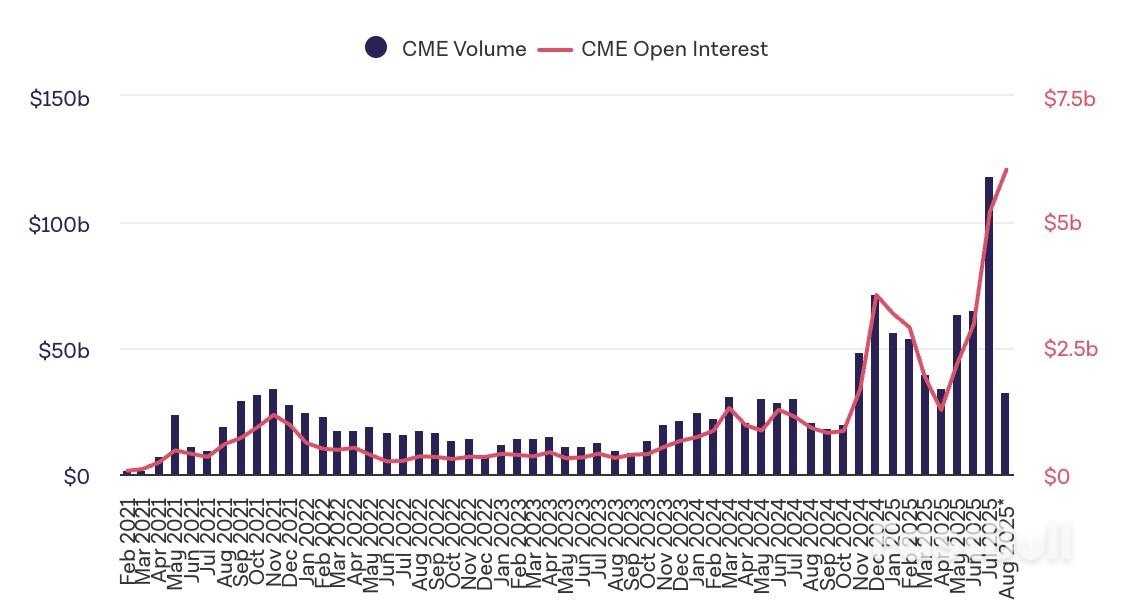
          In July, Ethereum’s futures monthly trading volume at CME reached an unprecedented level of $118 billion, marking an 82% increase from the previous month. Data from CoinGlass highlights a dramatic 75% surge in open interest, rising from $2.97 billion in June to $5.21 billion, boosting ETH coin’s price to over $4,300 by the weekend.

          CME and Global Market Record Levels

          The record-breaking trends at CME are mirrored globally as Ethereum futures trading volume across all exchanges hit $2.12 trillion in July. This reflects a 38% monthly increase, surpassing the previous May 2021 record of $1.87 trillion by 13%. By August 9, the total open interest was nearing an all-time high of $36.3 billion.

          CoinGlass CME Ethereum

          Ethereum’s price exceeded $4,300 on a Saturday for the first time since December 2021. By Monday, it climbed to $4,350 but pulled back slightly later that day. Despite the fluctuation, current levels are only 14% below the all-time high of $4,878 set in November 2021.

          Rising Investor Interest Coupled with Funding Rates

          Another significant factor in the markets is that funding rates are not at the extreme levels seen in December 2024, indicating that despite increased trading volumes, there’s no excessive leverage usage. Additionally, Google search data shows rising interest in Ethereum. By mid-month, “Ethereum” search volumes reached their peak since June 2022.

          Data from CryptoAppsy reveals that ETH coin was trading at $4,303, up by 0.78% within the last 24 hours. The data shows significant growth, with prices rising 18.64% in the last week and 45.5% over the past 30 days.

          Source: CryptoSlate

          Risk Warnings and Disclaimers
          You understand and acknowledge that there is a high degree of risk involved in trading. Following any strategies or investment methods may lead to potential losses. The content on the site is provided by our contributors and analysts for information purposes only. You are solely responsible for determining whether any trading assets, securities, strategy, or any other product is suitable for investing based on your own investment objectives and financial situation.
          Add to Favorites
          Share

          US–China Tariff Truce: 90 Days of Breathing Space and a High-Stakes Bargaining Game

          Gerik

          Economic

          Extension as a Tactical Pause

          The decision to extend the truce until mid-November, announced just hours before higher tariffs were due to take effect, reflects both sides’ desire to avoid another shock to trade flows while talks continue. This “pause” not only prevents an escalation but also creates a window to prepare for the anticipated Trump–Xi summit. As Xinbo Wu of Fudan University notes, this is likely to be a “long and contentious bargaining process” given how far apart the two sides’ core priorities remain.
          Donald Trump’s top priority remains narrowing the trade deficit and reshoring manufacturing. This requires Beijing to significantly increase purchases of US goods, especially agricultural products, which carry substantial political weight in farm states. Trump’s public push for China to quadruple soybean orders is both an economic and electoral play. Although China’s soybean imports from the US have risen sharply in recent months, the scale still falls short of fully meeting US demands particularly since China failed to deliver on the $200 billion annual purchase pledge in the 2020 “Phase One” deal, citing COVID-19 disruptions.

          China’s Objective: Full Tariff Removal and Technology Access

          Beijing aims to see all additional tariffs removed and restrictions on technology and certain companies lifted. The 90-day suspension of measures against “unreliable entities” and export control list targets reflects China’s willingness to offer conditional concessions. Technology export controls are a critical battleground: China wants looser restrictions on AI-related semiconductors, while US national security hawks warn that such technology could strengthen China’s military capabilities. Any US concessions here must balance economic benefits with strategic risk.
          China’s dominance in rare earth mining and processing gives it a potent leverage point. In June, Beijing eased its export ban on rare earths and magnets to the US, triggering a surge in shipments rare earth exports rose 60% year-on-year that month, while rare earth magnet exports to the US jumped more than sevenfold. However, the subsequent drop in July exports shows China is keeping supply tight enough to retain its bargaining power. This resource advantage could be used to extract US concessions in other areas, notably technology.

          Risk of a Half-Measured Agreement

          Experts like Jeff Moon caution that even if a new deal is signed, it will likely sidestep core structural issues such as China’s state-subsidized industrial overcapacity. This raises the possibility of an indefinite “low-intensity” trade conflict marked by recurring truce extensions. Such a scenario would maintain a degree of instability in global trade, as companies and investors would remain exposed to the risk of sudden tariff or export control changes.
          With average tariffs still extremely high 54.9% on Chinese goods entering the US and 32.6% on US goods entering China the cost burden on both economies remains heavy. The extension may provide short-term relief for equity markets and some support for currency stability, but without a genuine breakthrough, the threat of renewed trade escalation will continue to cast a shadow over global markets. For investors, the real risk lies not in the current 90-day reprieve but in the uncertainty that will follow if the summit fails to deliver concrete progress.

          Source: CNBC

          To stay updated on all economic events of today, please check out our Economic calendar
          Risk Warnings and Disclaimers
          You understand and acknowledge that there is a high degree of risk involved in trading. Following any strategies or investment methods may lead to potential losses. The content on the site is provided by our contributors and analysts for information purposes only. You are solely responsible for determining whether any trading assets, securities, strategy, or any other product is suitable for investing based on your own investment objectives and financial situation.
          Add to Favorites
          Share
          FastBull
          Copyright © 2025 FastBull Ltd

          728 RM B 7/F GEE LOK IND BLDG NO 34 HUNG TO RD KWUN TONG KLN HONG KONG

          TelegramInstagramTwitterfacebooklinkedin
          App Store Google Play Google Play
          Products
          Charts

          Chats

          Q&A with Experts
          Screeners
          Economic Calendar
          Data
          Tools
          Membership
          Features
          Function
          Markets
          Copy Trading
          Latest Signals
          Contests
          News
          Analysis
          24/7
          Columns
          Education
          Company
          Careers
          About Us
          Contact Us
          Advertising
          Help Center
          Feedback
          User Agreement
          Privacy Policy
          Business

          White Label

          Data API

          Web Plug-ins

          Poster Maker

          Affiliate Program

          Risk Disclosure

          The risk of loss in trading financial instruments such as stocks, FX, commodities, futures, bonds, ETFs and crypto can be substantial. You may sustain a total loss of the funds that you deposit with your broker. Therefore, you should carefully consider whether such trading is suitable for you in light of your circumstances and financial resources.

          No decision to invest should be made without thoroughly conducting due diligence by yourself or consulting with your financial advisors. Our web content might not suit you since we don't know your financial conditions and investment needs. Our financial information might have latency or contain inaccuracy, so you should be fully responsible for any of your trading and investment decisions. The company will not be responsible for your capital loss.

          Without getting permission from the website, you are not allowed to copy the website's graphics, texts, or trademarks. Intellectual property rights in the content or data incorporated into this website belong to its providers and exchange merchants.

          Not Logged In

          Log in to access more features

          FastBull Membership

          Not yet

          Purchase

          Become a signal provider
          Help Center
          Customer Service
          Dark Mode
          Price Up/Down Colors

          Log In

          Sign Up

          Position
          Layout
          Fullscreen
          Default to Chart
          The chart page opens by default when you visit fastbull.com