• Trade
  • Markets
  • Copy
  • Contests
  • News
  • 24/7
  • Calendar
  • Q&A
  • Chats
Trending
Screeners
SYMBOL
LAST
BID
ASK
HIGH
LOW
NET CHG.
%CHG.
SPREAD
SPX
S&P 500 Index
6827.42
6827.42
6827.42
6899.86
6801.80
-73.58
-1.07%
--
DJI
Dow Jones Industrial Average
48458.04
48458.04
48458.04
48886.86
48334.10
-245.98
-0.51%
--
IXIC
NASDAQ Composite Index
23195.16
23195.16
23195.16
23554.89
23094.51
-398.69
-1.69%
--
USDX
US Dollar Index
97.950
98.030
97.950
98.500
97.950
-0.370
-0.38%
--
EURUSD
Euro / US Dollar
1.17394
1.17409
1.17394
1.17496
1.17192
+0.00011
+ 0.01%
--
GBPUSD
Pound Sterling / US Dollar
1.33707
1.33732
1.33707
1.33997
1.33419
-0.00148
-0.11%
--
XAUUSD
Gold / US Dollar
4299.39
4299.39
4299.39
4353.41
4257.10
+20.10
+ 0.47%
--
WTI
Light Sweet Crude Oil
57.233
57.485
57.233
58.011
56.969
-0.408
-0.71%
--

Community Accounts

Signal Accounts
--
Profit Accounts
--
Loss Accounts
--
View More

Become a signal provider

Sell trading signals to earn additional income

View More

Guide to Copy Trading

Get started with ease and confidence

View More

Signal Accounts for Members

All Signal Accounts

Best Return
  • Best Return
  • Best P/L
  • Best MDD
Past 1W
  • Past 1W
  • Past 1M
  • Past 1Y

All Contests

  • All
  • Trump Updates
  • Recommend
  • Stocks
  • Cryptocurrencies
  • Central Banks
  • Featured News
Top News Only
Share

China's Central Financial And Economic Affairs Commission Deputy Director: Will Expand Export And Increase Import In 2026

Share

Thai Leader Anutin: Landmine Blast That Killed Thai Soldiers 'Not A Roadside Accident'

Share

Thai Leader Anutin: Thailand To Continue Military Action Until 'We Feel No More Harm'

Share

Cambodian Prime Minister Hun Manet Says He Had Phone Calls With Trump And Malaysian Leader Anwar About Ceasefire

Share

Cambodia's Hun Manet Says USA, Malaysia Should Verify 'Which Side Fired First' In Latest Conflict

Share

Cambodia's Hun Manet: Cambodia Maintains Its Stance In Seeking Peaceful Resolution Of Disputes

Share

Nasdaq Companies: Allergan, Ferrovia, Insmed, Monolithic Power Systems, Seagate Technology, And Western Digital Will Be Added To The NASDAQ 100 Index. Biogen, CdW, GlobalFoundries, Lululemon, ON Semiconductor, And Tradedesk Will Be Removed From The NASDAQ 100 Index

Share

Witkoff Headed To Berlin This Weekend To Meet With Zelenskiy, European Leaders -Wsj Reporter On X

Share

Russia Attacks Two Ukrainian Ports, Damaging Three Turkish-Owned Vessels

Share

[Historic Flooding Occurs In At Least Four Rivers In Washington State Due To Days Of Torrential Rains] Multiple Areas In Washington State Have Been Hit By Severe Flooding Due To Days Of Torrential Rains, With At Least Four Rivers Experiencing Historic Flooding. Reporters Learned On The 12th That The Floods Caused By The Torrential Rains In Washington State Have Destroyed Homes And Closed Several Highways. Experts Warn That Even More Severe Flooding May Occur In The Future. A State Of Emergency Has Been Declared In Washington State

Share

Trump Says Proposed Free Economic Zone In Donbas Would Work

Share

Trump: I Think My Voice Should Be Heard

Share

Trump Says Will Be Choosing New Fed Chair In Near Future

Share

Trump Says Proposed Free Economic Zone In Donbas Complex But Would Work

Share

Trump Says Land Strikes In Venezuela Will Start Happening

Share

US President Trump: Thailand And Cambodia Are In A Good Situation

Share

State Media: North Korean Leader Kim Hails Troops Returning From Russia Mission

Share

The 10-year Treasury Yield Rose About 5 Basis Points During The "Fed Rate Cut Week," And The 2/10-year Yield Spread Widened By About 9 Basis Points. On Friday (December 12), In Late New York Trading, The Yield On The Benchmark 10-year US Treasury Note Rose 2.75 Basis Points To 4.1841%, A Cumulative Increase Of 4.90 Basis Points For The Week, Trading Within A Range Of 4.1002%-4.2074%. It Rose Steadily From Monday To Wednesday (before The Fed Announced Its Rate Cut And Treasury Bill Purchase Program), Subsequently Exhibiting A V-shaped Recovery. The 2-year Treasury Yield Fell 1.82 Basis Points To 3.5222%, A Cumulative Decrease Of 3.81 Basis Points For The Week, Trading Within A Range Of 3.6253%-3.4989%

Share

Trump: Lots Of Progress Being Made On Russia-Ukraine

Share

NOPA November US Soybean Crush Estimated At 220.285 Million Bushels

TIME
ACT
FCST
PREV
U.K. Trade Balance Non-EU (SA) (Oct)

A:--

F: --

P: --

U.K. Trade Balance (Oct)

A:--

F: --

P: --

U.K. Services Index MoM

A:--

F: --

P: --

U.K. Construction Output MoM (SA) (Oct)

A:--

F: --

P: --

U.K. Industrial Output YoY (Oct)

A:--

F: --

P: --

U.K. Trade Balance (SA) (Oct)

A:--

F: --

P: --

U.K. Trade Balance EU (SA) (Oct)

A:--

F: --

P: --

U.K. Manufacturing Output YoY (Oct)

A:--

F: --

P: --

U.K. GDP MoM (Oct)

A:--

F: --

P: --

U.K. GDP YoY (SA) (Oct)

A:--

F: --

P: --

U.K. Industrial Output MoM (Oct)

A:--

F: --

P: --

U.K. Construction Output YoY (Oct)

A:--

F: --

P: --

France HICP Final MoM (Nov)

A:--

F: --

P: --

China, Mainland Outstanding Loans Growth YoY (Nov)

A:--

F: --

P: --

China, Mainland M2 Money Supply YoY (Nov)

A:--

F: --

P: --

China, Mainland M0 Money Supply YoY (Nov)

A:--

F: --

P: --

China, Mainland M1 Money Supply YoY (Nov)

A:--

F: --

P: --

India CPI YoY (Nov)

A:--

F: --

P: --

India Deposit Gowth YoY

A:--

F: --

P: --

Brazil Services Growth YoY (Oct)

A:--

F: --

P: --

Mexico Industrial Output YoY (Oct)

A:--

F: --

P: --

Russia Trade Balance (Oct)

A:--

F: --

P: --

Philadelphia Fed President Henry Paulson delivers a speech
Canada Building Permits MoM (SA) (Oct)

A:--

F: --

P: --

Canada Wholesale Sales YoY (Oct)

A:--

F: --

P: --

Canada Wholesale Inventory MoM (Oct)

A:--

F: --

P: --

Canada Wholesale Inventory YoY (Oct)

A:--

F: --

P: --

Canada Wholesale Sales MoM (SA) (Oct)

A:--

F: --

P: --

Germany Current Account (Not SA) (Oct)

A:--

F: --

P: --

U.S. Weekly Total Rig Count

A:--

F: --

P: --

U.S. Weekly Total Oil Rig Count

A:--

F: --

P: --

Japan Tankan Large Non-Manufacturing Diffusion Index (Q4)

--

F: --

P: --

Japan Tankan Small Manufacturing Outlook Index (Q4)

--

F: --

P: --

Japan Tankan Large Non-Manufacturing Outlook Index (Q4)

--

F: --

P: --

Japan Tankan Large Manufacturing Outlook Index (Q4)

--

F: --

P: --

Japan Tankan Small Manufacturing Diffusion Index (Q4)

--

F: --

P: --

Japan Tankan Large Manufacturing Diffusion Index (Q4)

--

F: --

P: --

Japan Tankan Large-Enterprise Capital Expenditure YoY (Q4)

--

F: --

P: --

U.K. Rightmove House Price Index YoY (Dec)

--

F: --

P: --

China, Mainland Industrial Output YoY (YTD) (Nov)

--

F: --

P: --

China, Mainland Urban Area Unemployment Rate (Nov)

--

F: --

P: --

Saudi Arabia CPI YoY (Nov)

--

F: --

P: --

Euro Zone Industrial Output YoY (Oct)

--

F: --

P: --

Euro Zone Industrial Output MoM (Oct)

--

F: --

P: --

Canada Existing Home Sales MoM (Nov)

--

F: --

P: --

Euro Zone Total Reserve Assets (Nov)

--

F: --

P: --

U.K. Inflation Rate Expectations

--

F: --

P: --

Canada National Economic Confidence Index

--

F: --

P: --

Canada New Housing Starts (Nov)

--

F: --

P: --

U.S. NY Fed Manufacturing Employment Index (Dec)

--

F: --

P: --

U.S. NY Fed Manufacturing Index (Dec)

--

F: --

P: --

Canada Core CPI YoY (Nov)

--

F: --

P: --

Canada Manufacturing Unfilled Orders MoM (Oct)

--

F: --

P: --

Canada Manufacturing New Orders MoM (Oct)

--

F: --

P: --

Canada Core CPI MoM (Nov)

--

F: --

P: --

Canada Manufacturing Inventory MoM (Oct)

--

F: --

P: --

Canada CPI YoY (Nov)

--

F: --

P: --

Canada CPI MoM (Nov)

--

F: --

P: --

Canada CPI YoY (SA) (Nov)

--

F: --

P: --

Canada Core CPI MoM (SA) (Nov)

--

F: --

P: --

Q&A with Experts
    • All
    • Chatrooms
    • Groups
    • Friends
    Connecting
    .
    .
    .
    Type here...
    Add Symbol or Code

      No matching data

      All
      Trump Updates
      Recommend
      Stocks
      Cryptocurrencies
      Central Banks
      Featured News
      • All
      • Russia-Ukraine Conflict
      • Middle East Flashpoint
      • All
      • Russia-Ukraine Conflict
      • Middle East Flashpoint
      Search
      Products

      Charts Free Forever

      Chats Q&A with Experts
      Screeners Economic Calendar Data Tools
      Membership Features
      Data Warehouse Market Trends Institutional Data Policy Rates Macro

      Market Trends

      Market Sentiment Order Book Forex Correlations

      Top Indicators

      Charts Free Forever
      Markets

      News

      News Analysis 24/7 Columns Education
      From Institutions From Analysts
      Topics Columnists

      Latest Views

      Latest Views

      Trending Topics

      Top Columnists

      Latest Update

      Signals

      Copy Rankings Latest Signals Become a signal provider AI Rating
      Contests
      Brokers

      Overview Brokers Assessment Rankings Regulators News Claims
      Broker listing Forex Brokers Comparison Tool Live Spread Comparison Scam
      Q&A Complaint Scam Alert Videos Tips to Detect Scam
      More

      Business
      Events
      Careers About Us Advertising Help Center

      White Label

      Data API

      Web Plug-ins

      Affiliate Program

      Awards Institution Evaluation IB Seminar Salon Event Exhibition
      Vietnam Thailand Singapore Dubai
      Fans Party Investment Sharing Session
      FastBull Summit BrokersView Expo
      Recent Searches
        Top Searches
          Markets
          News
          Analysis
          User
          24/7
          Economic Calendar
          Education
          Data
          • Names
          • Latest
          • Prev

          View All

          No data

          Scan to Download

          Faster Charts, Chat Faster!

          Download App
          English
          • English
          • Español
          • العربية
          • Bahasa Indonesia
          • Bahasa Melayu
          • Tiếng Việt
          • ภาษาไทย
          • Français
          • Italiano
          • Türkçe
          • Русский язык
          • 简中
          • 繁中
          Open Account
          Search
          Products
          Charts Free Forever
          Markets
          News
          Signals

          Copy Rankings Latest Signals Become a signal provider AI Rating
          Contests
          Brokers

          Overview Brokers Assessment Rankings Regulators News Claims
          Broker listing Forex Brokers Comparison Tool Live Spread Comparison Scam
          Q&A Complaint Scam Alert Videos Tips to Detect Scam
          More

          Business
          Events
          Careers About Us Advertising Help Center

          White Label

          Data API

          Web Plug-ins

          Affiliate Program

          Awards Institution Evaluation IB Seminar Salon Event Exhibition
          Vietnam Thailand Singapore Dubai
          Fans Party Investment Sharing Session
          FastBull Summit BrokersView Expo

          Misfiring Models Leave Wall Street Currency Traders Flying Blind

          Adam

          Forex

          Summary:

          Wall Street currency traders are struggling as traditional models misfire amid Trump’s tariff threats and de-dollarization trends. Volatile markets and broken correlations leave experts cautious and flying blind on FX moves.

          Some of Wall Street’s tried-and-true currency strategies aren’t working anymore, and it’s baffling even the most seasoned traders.
          Before President Donald Trump’s policies sent the dollar plunging, investors could reliably use a number of indicators to figure out how to trade. Europe cuts interest rates? Sell euros. Markets look jittery? Buy dollars. Oil prices spike? Time to snap up currencies from commodity exporters.
          But now, those signals are misfiring more frequently. Traders at UBS Group AG and Mizuho International Plc, say the models they used to count on getting it right are instead getting it wrong. And the new forces driving currency markets, like the broad shift of money out of the US and foreign investors buying dollar hedges, are hard to track because the data is sparse, making it tough for professionals to adjust their systems. As a result, they’re running smaller and simpler trades.
          “Rules of thumb have kind of gone out of the window,” said Lu Xin, a currency derivatives trader at UBS. “Everyone has come to accept that more uncertainty is the new norm.”
          Xin says he’s being cautious when it comes to risk and that his trading strategies are stricter. “People are more afraid to be short options going into weekends,” he added.
          At Mizuho, the confusion has become something of a running joke on the desk. Jordan Rochester says his colleague, options trader Nikhil Kochhar, was shouting “Why!?” to puzzling market swings so often that he gifted him a custom baseball cap with that tagline.
          “What will happen in one or two months time is someone will tap us on the shoulder and say, ‘Why weren’t you short more dollars? It was obvious,’” said Rochester. “It wasn’t obvious.”
          It all shows how experts have been blindsided by the dollar’s selloff and are now questioning whether the past few months will go down as a chaotic but short-lived adjustment or the start of a harder-to-navigate era.
          With Trump’s threatening to start imposing tariffs on dozens of countries in the coming days, a fresh round of volatility could be in store for markets this week.
          Plenty of investors are already paying the price for ill-timed bets. A BarclayHedge index of 25 currency programs that trade futures and cash forwards has returned just 0.6% this year. If that sticks on an annual basis, it would be the most dismal performance since 2017.
          With the benefit of hindsight, there have been clear reasons behind currency moves. The biggest driver being Trump’s aggressive agenda of tax cuts and tariffs that sent the dollar down more than 10% against the euro and Swiss franc this year. Plus, it’s not unusual for markets to shift from one focus to another.
          But traders say that the speed and severity with which it all unfolded this year surprised them, and it’s increasingly expensive to hedge swings in a market that’s the most volatile that they’ve seen in years.
          Idanna Appio at First Eagle Investments is one of those investors wary of trusting her models. It’s currently sending a signal that she should be neutral on the dollar, partly because the US has higher interest rates than many other countries. But her instincts tell her that’s the wrong call, so she’s choosing to stay short the greenback versus the euro and the yen.
          “Interest-rate differentials worked well for an extended period of time,” she said. “Now there’s something else going on.”
          What Bloomberg Strategists Say
          “When big structural shifts hit FX, old correlations don’t just break — they mutate. The market is leaning hard into the de-dollarization narrative, underpinned by the belief that the US administration wants a weaker currency. In this environment, when flows talk, everything else walks.”
          —Vassilis Karamanis, FX strategist, Athens
          Take the dollar and euro. In June, the European Central Bank cut borrowing costs for the eighth time in this cycle, bringing the deposit rate to 2%. While in the US, the Federal Reserve last chose to hold in a range of 4.25% to 4.5%.
          All else being equal, that would argue for a strong dollar and weak euro. The opposite has happened, with the euro surging 13% this year to a four-year high.
          That’s starting to ring alarm bells for Brad Bechtel, global head of FX sales and trading at Jefferies LLC. He warns there will eventually be a snap back in the dollar to bring it in line with interest-rate trends.
          “Whatever the driver, it’s pushing things to the extreme because it’s not impacting central bank policy or growth expectations,” he said. “Something’s off.”
          Part of the difficulty is that the link between asset prices has shifted in some unusual ways. In the case of the dollar, it has a tendency to move in the opposite direction to the VIX Index, meaning it may fall when investors are fearful, instead of rising alongside other safe havens.
          That played out to some extent in how the dollar has responded to the conflict in the Middle East. While previously, traders could count on a spike in oil and the dollar when tensions rose in the region, it’s not as easy to predict as it used to be.
          For instance, on June 23, oil prices swung wildly in the aftermath of Iran’s attack at a US air base in Qatar. Brent surged past $81 a barrel and touched the highest level since January, before sharply retreating as the strikes were viewed to be largely symbolic. In contrast, the moves in the dollar on that day were smaller than might be expected.
          “When the correlations break down, it makes it very, very hard,” said Kochhar, the currency trader at Mizuho. “In an event like when the Israel-Iran war started, now you wonder whether that’s going to lead to a dollar bid or a dollar selloff.”

          Source: Bloomberg

          Risk Warnings and Disclaimers
          You understand and acknowledge that there is a high degree of risk involved in trading. Following any strategies or investment methods may lead to potential losses. The content on the site is provided by our contributors and analysts for information purposes only. You are solely responsible for determining whether any trading assets, securities, strategy, or any other product is suitable for investing based on your own investment objectives and financial situation.
          Add to Favorites
          Share

          South African Rand Slumps After Trump's Tariff Threat on BRICS-aligned Countries

          Glendon

          Forex

          Economic

          South Africa's rand fell on Monday as markets reacted to U.S. President Donald Trump's threat to impose additional tariffs on BRICS-aligned countries, while also awaiting updates on country-specific levies ahead of Washington's looming July 9 deadline.

          Trump said on Sunday in a post on Truth Social that countries aligning themselves with what he called the "anti-American policies" of BRICS will be charged an extra 10% tariff, adding that there will be no exceptions to this policy.

          At 1144 GMT, the rand traded at 17.7450 against the dollar , down about 1% from Friday's close and paring some of its recent gains.

          South Africa, which is part of the BRICS group, said on Monday that it is not anti-american and that the group of developing countries should be seen as a push for "reformed multilateralism, nothing more".

          "The additional 10% BRICS tariffs would add further drag to South Africa’s export competitiveness," said Annabel Bishop, Investec's chief economist. As a result, she said, the rand is expected to remain volatile for the rest of the month and early August.

          Trump said the U.S. is close to finalising several trade pacts in the coming days and will notify other countries of higher tariff rates by July 9, set to take effect on August 1.

          Trump imposed a 31% tax on U.S. imports from South Africa in April as part of his global tariff policy and Pretoria has been trying to negotiate a trade deal since May, when the U.S. leader hosted President Cyril Ramaphosa for talks in the White House.

          South Africa aims for a deal that would exempt some of its key exports from the tariffs, including autos, auto parts, steel, and aluminium in exchange for buying liquefied natural gas from the United States over a 10-year period.

          "SA still has a significant bargaining position if one focuses on the mining industry and some of the rare earth minerals that the country can provide over and above its position as the world’s largest platinum producer," ETM Analytics said in a research note.

          The Johannesburg Stock Exchange's Top-40 index (.JTOPI), opens new tab was last down 0.1%.

          South Africa's benchmark 2035 government bond was weaker, with the yield up 9.5 basis points at 9.835%.

          Source: Reuters

          To stay updated on all economic events of today, please check out our Economic calendar
          Risk Warnings and Disclaimers
          You understand and acknowledge that there is a high degree of risk involved in trading. Following any strategies or investment methods may lead to potential losses. The content on the site is provided by our contributors and analysts for information purposes only. You are solely responsible for determining whether any trading assets, securities, strategy, or any other product is suitable for investing based on your own investment objectives and financial situation.
          Add to Favorites
          Share

          The Week Ahead

          Adam

          Economic

          It’s a relatively light week for economic data releases, which means that the focus will be on Wednesday, which is the end of the 90-day reprieve for US reciprocal tariffs. The market remains sanguine about the prospect of tariffs. US stock indices reached record highs last week, and although European stocks faltered on Friday, the weekly losses were only minor for the Eurostoxx 50, and the FTSE 100 managed to eke out a gain. European indices are mostly higher as we start a new week.
          This raises the risk of a deeper sell off, as we are moving closer to Wednesday’s deadline. This is a crucial week for the dozens of countries who are trying to reach trade agreements with the US. Headline risk is already rising, after the President used his Truth Social platform to say that tariff letters, and/ or tariff deals will be announced from 12.00 EST later on Monday. As news of the letters and deals trickle out, we could see a big market reaction late on Monday.
          Reports suggest that the President is unwilling to budge on key tariffs for sectors like metals and cars. This is important, as we hear more about US tariff rates in the coming days, the impact on financial markets could be sector specific and region specific, with risk aversion hitting those countries who are not in a good position to reach a deal with the US.

          Why tariffs might not be the biggest story for markets

          The tariff story could be a micro story, impacting the markets of those countries and sectors most deeply affected by Trump’s tariffs. The macro story remains strong, especially after last week’s US non-farm payrolls report, which showed that the US labour market remains strong. The background story is positive a resilient US economy, that could protect global growth even during this period of tariff drama. Thus, we do not expect the same level of risk aversion across financial markets that we saw in April. The Vix volatility index remains subdued and is below the average level for the past year, although US futures markets are pointing to a weaker open for US stocks later today.
          The markets have adapted to Trump’s style of government, and the twists and turns in his quest for fairer trade deals for America. Traders and investors no longer take the President at his word, for example, few expect him to reapply the crippling tariff rates that he proposed back in April, which is why risk sentiment, especially in stock markets, has been sanguine in recent weeks and volatility has remained subdued.

          Bond yields in focus

          Global bonds are also in focus this week, after the UK bond market sell off last week and the passage of President Trump’s ‘Big Beautiful Bill’, which the President signed into law late on Friday. The main details of the tax bill includes an extension of the 2017 tax cuts, an increase in defense spending, steep cuts to Medicaid health coverage, and a large increase in spending for immigration and customs enforcement. The budget is expected to add more than $3 trillion to the US national debt over the next decade. So far, stock markets have not worried about the debt impact of this bill, so we will watch the Treasury market to see if a ballooning US deficit hits borrowing costs this week.

          Why the markets are not reacting to the ‘Big, beautiful bill’

          European bond markets have weakened at the start of this week, and yields are up slightly, however, 2 and 10-year Treasury yields are down slightly at the start of this week. Japan’s bond market is in focus. 30-year yields have surged 10 basis points, as the market weighs up the prospect of more government spending later this year. Japan is a highly indebted nation, and the market is willing to punish profligate governments who spend beyond their means. However, the question is, why is the market not focusing on the US budget and its impact on the national debt? The reason is twofold, firstly, because the US economy looks in good shape, even with tariff uncertainty, and secondly, the bond market prefers tax cuts to public spending growth, because the latter tends to weigh on economic output, while the former tends to boost it. Thus, Treasuries may not come under the same level of scrutiny as UK and Japanese bond markets in the coming months.

          Opec production boost weighs on the energy sector

          The oil price has dipped slightly on Monday, after Opec + agreed to increase oil production by more than 500,000 barrels per day, on top of previous increases, and the prospect of another increase in production that is scheduled for September. Opec’s production pivot, after years of cutting output, is a sign that they remain confident over demand and it could boost relations between the US and Saudi Arabia, after President Trump called for lower energy costs. This is good news for inflation across the world, and it suggests that oil prices will struggle to get back above $70 per barrel, Brent crude is currently trading around $68 per barrel. In the last month, the Brent crude price has risen by 2.6%, however, prices remain 8% lower YTD. Opec + will meet on August 3rd to decide if they will boost production further in September. Overall, Opec + are making it easier for global central banks to cut rates.
          The production boost is having a big impact on energy stocks on Monday. Shell is the weakest performer on the FTSE 100 on Monday, and the energy sector is down more than 2% at the start of this week. The European energy sector is also weak, and is down 1%, with hefty losses for TotalEnergies and ENI.
          There isn’t too much in the way of economic data this week, however, UK GDP and the start of earnings season are both worth watching.
          UK GDP preview
          At the end of this week, there will be some key economic data releases for the UK, after a quiet start. May’s monthly GDP reading will be watched closely, to see if the UK bounced back from a 0.3% decline in growth in April. The May data is expected to show a 0.1% increase in GDP, with the 3 month on month rate expected to growth by 0.4%, down from 0.7% in April. Industrial and manufacturing production are expected to act as a mild drag on growth for May, while the service sector and construction are both expected to have boosted growth in May. Output is expect to ‘bounce’ back after a number of factors weighed on growth in April, including a sharp drop in exports to the US, and an increase in stamp duty. An upside surprise to growth would be very welcome to the UK Treasury and the government, who have staked their reputation on a stable economy. So far, this has not materialized. A welcome upside surprise could stabilize UK bond yields, which surged last week on the back of the welfare rebellion. The 10-year UK Gilt yield is still more than 10bps higher than it was a year ago. With public sector spending unlikely to be cut anytime soon, stronger than expected growth is the only way to boost the UK bond market in the current environment.
          Earnings season
          Q2 earnings season will get into full swing next week, however, Delta Airlines will report on Thursday, and this is worth watching as a gauge of consumer demand. After reaching a record high during the tariff turmoil, US stocks may need a strong earnings season to keep up the momentum. However, analysts have been cutting EPS estimates for Q2, according to FactSet. The EPS estimates for S&P 500 companies have been cut by 4.2% on aggregate, which is a larger decline than average. Ten of the eleven sectors have seen a decrease in EPS estimates, led by the energy sector. In contrast, communications is the only sector to see an increase in EPS estimates.
          Thus, the bar has been lowered for S&P 500 companies this earnings season, the question is, will this lead to better-than-expected earnings reports in the coming weeks?
          Musk’s political ambitions tanks Tesla, again
          On an individual company basis, Shell and Tesla are in focus on Monday. Tesla shares are lower by more than 7% in the pre-market, after Elon Musk announced that he was forming a new political party to challenge the Democrats and Republicans, which drew immediate backlash from President Trump. This has hit Tesla shares hard. Investors were hoping that when Musk stepped back from the White House he would dedicate more of his time to Tesla, since the share price is down more than a fifth this year, EV sales are falling sharply, and Tesla is also facing increased competition. Although Tesla’s AI future and the launch of its Robotaxi are seen as positive developments for Tesla, in the short term, Musk’s political ambitions could be a major overhang for this stock.
          Shell preps the market for a weak Q2 earnings report
          Shell is also in focus, after the company said that Q2 results could be negatively impacted by weaker contributions from its oil and gas trading operation. Refining is also expected to report a loss, while its LNG business could see flat growth in Q2. Weaknesses in its trading division is bad news for Shell, since this is usually a major profit centre for the company. Questions will now be asked about how these losses came about, since there was decent volatility in the market. Was it an errant trade? The earnings call on July 31st will be very interesting, especially after it ruled out making an offer for rival BP. The share price is down more than 2.8% on Monday.
          source :xtb
          To stay updated on all economic events of today, please check out our Economic calendar
          Risk Warnings and Disclaimers
          You understand and acknowledge that there is a high degree of risk involved in trading. Following any strategies or investment methods may lead to potential losses. The content on the site is provided by our contributors and analysts for information purposes only. You are solely responsible for determining whether any trading assets, securities, strategy, or any other product is suitable for investing based on your own investment objectives and financial situation.
          Add to Favorites
          Share

          EU Leaders Race to Secure a Deal as Deadline Looms in Trump Trade Talks

          Warren Takunda

          Economic

          China–U.S. Trade War

          The EU is entering a crunch week with only two days of talks left to secure a trade deal with Washinton to avert Donald Trump’s threatened 50% tariff on its imports into the US.
          According to the US treasury secretary, Scott Bessent, on Friday, the negotiations – which continued over the weekend – are focussed on 15 to 18 agreements with important partners, while Trump warned of import tax rates of up to 70% on others.
          The uncertainty created by Washington has sent shock waves through the global economy. Businesses have paused investment and the dollar posted its worst performance in 50 years in the first half of the year.
          With the clock ticking down to Trump’s 9 July deadline, the European Commission remains uncertain how he will treat the bloc, threatening €1.6tn of transatlantic trade.
          “Among member states, the big question will be whether we should reach a deal at all costs to avoid a trade war, or show muscle if the deal is not good enough,” one EU diplomat said.
          The German chancellor, , has said he wants a quick UK-style deal to avert a full-scale trade war, while the French president, Emmanuel Macron, favours holding out for a better deal if a rushed deal is “imbalanced”.
          Giving a flavour of the aggression shown towards the EU, which Trump once called “nastier than China”, Brussels’ trade commissioner, Maroš Šefčovič, was threatened last week with 17% tariffs on food imports during talks with senior members of the Trump administration including Bessent.
          After announcing punitive “liberation day” tariffs on nearly all countries on 2 April, Trump paused them for 90 days a week later.
          The US is now on the brink of launching a trade assault on dozens of countries as the 90-day period expires on Wednesday with only two deals in the bag – the UK and Vietnam.
          This has raised questions about the EU’s ability to strike anything other than a political framework agreement to extend talks while a baseline 10% tariff and other levies on cars, steel and aluminium remain in place.
          As talks move into the final and most sensitive stage, industries across Europe are bracing themselves for fresh challenges, deal or no deal. They expect the cost of Trump’s presidency will be the minimum 10% on exports to the US, five times higher than the 2% average before he was elected last year.
          That is because after months of threats of retaliatory tariffs on everything from Bourbon to Boeing aircraft, the EU conceded last week that a comprehensive trade deal was unattainable.
          Instead they are aiming for an agreement in principle, or “framework deal” which will look more like the UK deal struck in May, which came into force at the end of last month.
          Many EU diplomats initially dismissed the UK deal as thin and legally dubious under World Trade Organization rules, and held out hope that the bloc’s greater economic clout with €1.6tn of transatlantic trade compared with the UK’s £314bn (€363bn) would help it secure a better deal. But now they realise a bare-bones deal may be the best they can get.

          Source: Theguardian

          To stay updated on all economic events of today, please check out our Economic calendar
          Risk Warnings and Disclaimers
          You understand and acknowledge that there is a high degree of risk involved in trading. Following any strategies or investment methods may lead to potential losses. The content on the site is provided by our contributors and analysts for information purposes only. You are solely responsible for determining whether any trading assets, securities, strategy, or any other product is suitable for investing based on your own investment objectives and financial situation.
          Add to Favorites
          Share

          Oil News: Tight Oil Demand Offsets OPEC Output Surge, Futures Hold Above Key Support

          Adam

          Commodity

          Crude Oil Pares Losses as Tight Market Counters OPEC+ Production Hike

          Light crude oil futures are lower early Monday as traders assess the larger-than-expected OPEC+ production hike for August, while tight physical market conditions limit downside momentum.
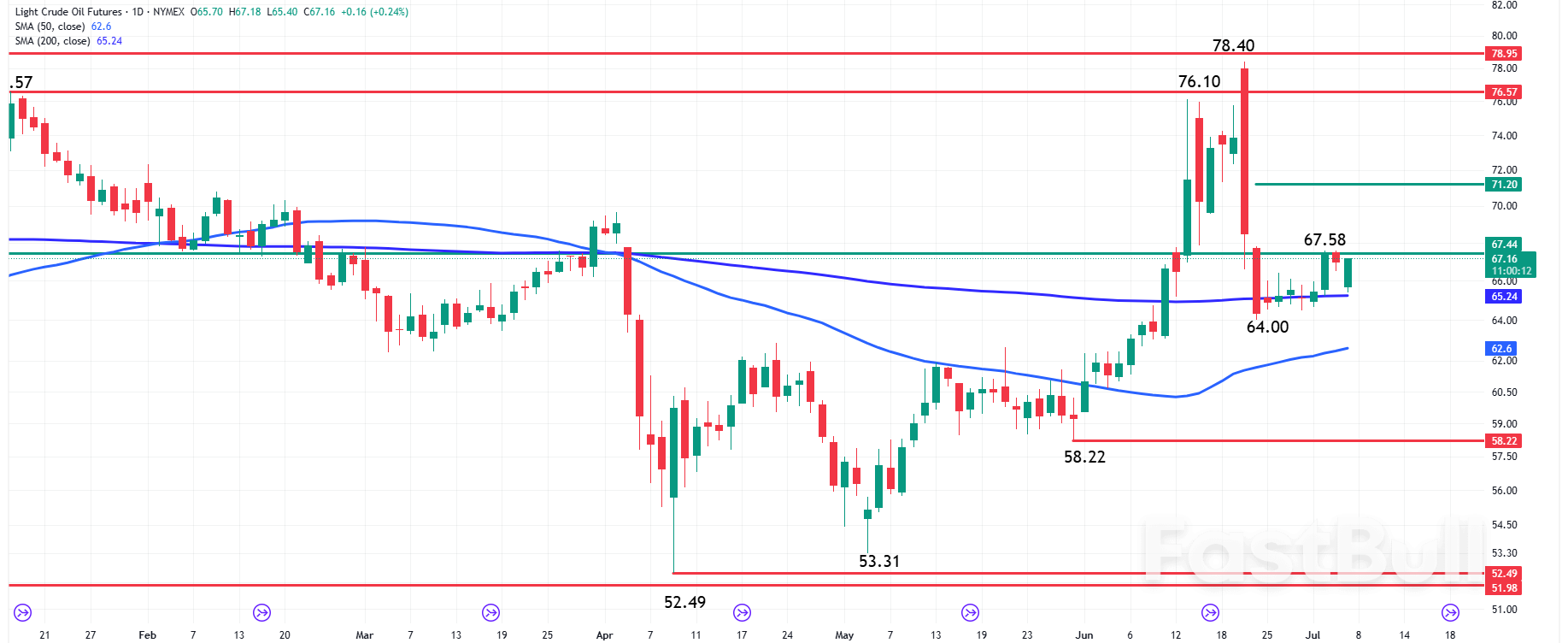
          Prices dropped sharply to $65.40 post-open but recovered to $66.83, finding buyers near the 200-day moving average at $65.24.

          OPEC+ Adds 548,000 Bpd, Market Sees Absorption Capacity

          OPEC+ announced Saturday it will raise output by 548,000 barrels per day in August, exceeding the prior 411,000 bpd pace. This move will unwind nearly 80% of the 2.2 million bpd voluntary cuts from eight members, including Saudi Arabia, Russia, and the UAE.
          RBC Capital analysts led by Helima Croft highlighted, “The actual output increases have consistently been smaller than planned, with Saudi Arabia providing most of the barrels, effectively limiting the real supply shock.”
          Despite the headline increase, market tightness persists due to low inventories and seasonal demand growth.
          UBS analyst Giovanni Staunovo noted, “The oil market remains tight, indicating it can absorb additional barrels, especially as the effective increase will be smaller due to overproduction offsets.”
          Reinforcing this, Peter Boockvar of Bleakley Financial stated, “We’re in the process of seeing low prices cure low prices. Oil at $60 is dirt cheap, and the inflection point to the upside is coming.”

          Technical Levels and Trader Focus

          Oil News: Tight Oil Demand Offsets OPEC Output Surge, Futures Hold Above Key Support_1Daily Light Crude Oil Futures

          Technical positioning is clear for traders monitoring breakout potential.
          If prices fail to hold the 200-day moving average at $65.24, the next downside target sits at the June 24 bottom of $64.00, followed by the 50-day moving average at $62.60.
          On the upside, the long-term pivot at $67.44 is immediate resistance, with last week’s high at $67.58 a key breakout point toward a short-term 50% retracement target at $71.20.

          Tariff Uncertainty Adds Headwinds

          Oil also faces external pressure from U.S. tariff concerns.
          While officials flagged delays on implementation, uncertainty remains over rate changes, raising concerns about potential economic slowdowns.
          Phillip Nova’s Priyanka Sachdeva remarked, “Concerns over Trump’s tariffs continue to dominate, with dollar weakness the only meaningful support for oil in the near term.”

          Outlook

          Oil prices are set to stabilize with a bullish tilt as low inventories, seasonal demand, and less impactful effective supply growth support the market against OPEC+’s larger headline hike.
          Harry Tchilinguirian of Onyx Capital Group summarized, “Market share is on top of the agenda now. If price won’t get revenues, volume will.”
          A confirmed break above $67.58 may trigger momentum toward $71.20, while failure to hold $65.24 risks testing lower supports.
          Traders should monitor compliance data, tariff headlines, and seasonal demand strength closely to align positioning for the next directional move.

          Source: fxempire

          Risk Warnings and Disclaimers
          You understand and acknowledge that there is a high degree of risk involved in trading. Following any strategies or investment methods may lead to potential losses. The content on the site is provided by our contributors and analysts for information purposes only. You are solely responsible for determining whether any trading assets, securities, strategy, or any other product is suitable for investing based on your own investment objectives and financial situation.
          Add to Favorites
          Share

          AUDUSD Rebounds After Early Dip But Upside Hurdles Remain

          Blue River

          Technical Analysis

          AUDUSD technicals

          The AUDUSD is trading modestly higher in the early U.S. session after sliding in overnight Asia-Pacific trading. Last week, buyers pushed the pair to new 2024 highs and briefly broke above a topside trend line. However, that breakout failed to hold, and the pair closed the week back inside a key swing area between 0.65357 and 0.65537 (marked by green circles).

          Sellers took control early Monday, driving the pair below both the 100-bar (0.65174) and 200-bar (0.64975) MAs on the 4-hour chart, adding to downside pressure. But that momentum faded, and the price has since rebounded back above both moving averages — a potentially bullish signal in the short term.

          As long as the price holds above the 200-bar MA, the buyers are back in play but they still need to take the price back above the 100 bar MA on the 4-hour chart at 0.65174. Get above that, and it weakens the sellers momentum. Conversely, staying below and the focus returns to the 200 bar MA on the 4-hour chart at 0.6497.

          Key technical levels:

          • Resistance: 0.6517 (100 bar MA on the 4-hour chart), 0.65357 to 0.65537 (swing area)

          • Support: 0.65974 (200-bar MA on 4-hour chart), 0.6479 (50% of the move up from the June low)

          Source: ForexLive

          Risk Warnings and Disclaimers
          You understand and acknowledge that there is a high degree of risk involved in trading. Following any strategies or investment methods may lead to potential losses. The content on the site is provided by our contributors and analysts for information purposes only. You are solely responsible for determining whether any trading assets, securities, strategy, or any other product is suitable for investing based on your own investment objectives and financial situation.
          Add to Favorites
          Share

          Euro-to-Dollar Week Ahead Forecast: Pulling Back

          Warren Takunda

          Economic

          The Week Ahead Forecast model looks for some consolidation at lower levels for the Euro to Dollar exchange rate (EUR/USD).
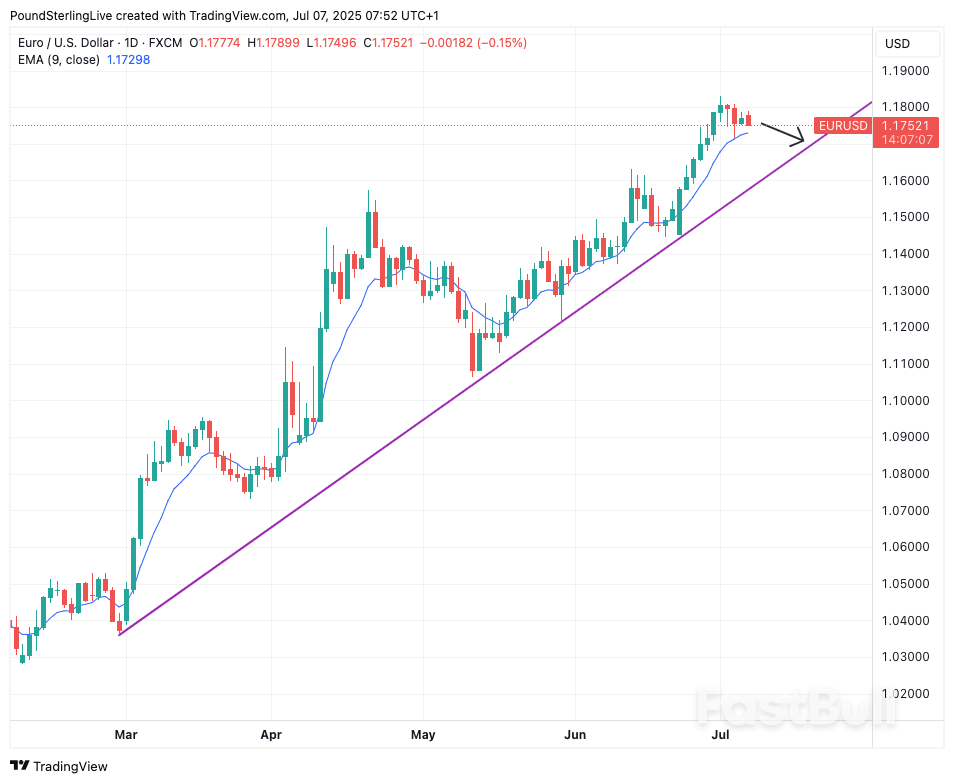
          Having risen to 1.1829 last week, the pair is well due a pullback to consolidate what has been an impressive rally that has started to look a little extended.
          A return to the rising trend line, which is indicated in the below chart, is therefore a possibility for the short-term:
          Euro-to-Dollar Week Ahead Forecast: Pulling Back_1

          Above: Euro-Dollar at daily intervals.

          We would target 1.17 in the coming week, based on the view that the rally needs to retrace. One-week-ahead risk reversals, which are used to gauge directional bias in the exchange rate, have been scaled back to 0, which suggests traders are turning more cautious on the rally near-term.
          Bullishness on Euro-Dollar upside also slipped across the longer-term timeframes, suggesting less conviction in the rally relative to the past two months, raising questions as to whether 1.20 will be tested anytime soon.
          Global stock markets are lower and the Dollar is higher on Monday, with investors showing some unease about the increase in negative trade tariff headlines that have come through over recent days.
          "I am pleased to announce that the UNITED STATES TARIFF Letters, and/or Deals, with various Countries from around the World, will be delivered starting 12:00 P.M., Monday, July 7th," said U.S. Donald Trump on his Truth Social platform on Sunday.
          Those partners lucky enough to be at the negotiating table will be told that "if you don’t move things along, then on August 1 you will boomerang back to your April 2 tariff level," said U.S. Treasury Secretary Scott Bessent.
          Trump meanwhile also threatened additional tariffs on nations aligning themselves to the BRIC bloc, which is lead by China. "The latest interesting development in these negotiations is Trump saying that those aligning with the BRICS group of nations will face an additional 10% levy. This sees the CNY, INR and the rand trade softer to start the week," says Susan Correia, an analyst at South Africa's Nedbank.
          This all suggests that the final settlement on tariffs that some investors had been hoping for might never arrive.
          Recall that tariff uncertainty is supposed to be good for the Euro at the expense of the Dollar; this has been the playbook all year.
          However, that this isn't holding true on Monday might signal that this trade is losing its strength, and that the Dollar's traditional safe-haven characteristics are starting to reassert.
          A big reason for this is that incoming U.S. data increasingly shows little economic damage from tariffs and associated uncertainty.
          The coming week will be short on economic drivers, leaving markets free to obsess over tariff headlines and query whether they are that bad for the U.S. This opens the door to further Dollar recoveries.

          Source: Poundsterlinglive

          To stay updated on all economic events of today, please check out our Economic calendar
          Risk Warnings and Disclaimers
          You understand and acknowledge that there is a high degree of risk involved in trading. Following any strategies or investment methods may lead to potential losses. The content on the site is provided by our contributors and analysts for information purposes only. You are solely responsible for determining whether any trading assets, securities, strategy, or any other product is suitable for investing based on your own investment objectives and financial situation.
          Add to Favorites
          Share
          FastBull
          Copyright © 2025 FastBull Ltd

          728 RM B 7/F GEE LOK IND BLDG NO 34 HUNG TO RD KWUN TONG KLN HONG KONG

          TelegramInstagramTwitterfacebooklinkedin
          App Store Google Play Google Play
          Products
          Charts

          Chats

          Q&A with Experts
          Screeners
          Economic Calendar
          Data
          Tools
          Membership
          Features
          Function
          Markets
          Copy Trading
          Latest Signals
          Contests
          News
          Analysis
          24/7
          Columns
          Education
          Company
          Careers
          About Us
          Contact Us
          Advertising
          Help Center
          Feedback
          User Agreement
          Privacy Policy
          Business

          White Label

          Data API

          Web Plug-ins

          Poster Maker

          Affiliate Program

          Risk Disclosure

          The risk of loss in trading financial instruments such as stocks, FX, commodities, futures, bonds, ETFs and crypto can be substantial. You may sustain a total loss of the funds that you deposit with your broker. Therefore, you should carefully consider whether such trading is suitable for you in light of your circumstances and financial resources.

          No decision to invest should be made without thoroughly conducting due diligence by yourself or consulting with your financial advisors. Our web content might not suit you since we don't know your financial conditions and investment needs. Our financial information might have latency or contain inaccuracy, so you should be fully responsible for any of your trading and investment decisions. The company will not be responsible for your capital loss.

          Without getting permission from the website, you are not allowed to copy the website's graphics, texts, or trademarks. Intellectual property rights in the content or data incorporated into this website belong to its providers and exchange merchants.

          Not Logged In

          Log in to access more features

          FastBull Membership

          Not yet

          Purchase

          Become a signal provider
          Help Center
          Customer Service
          Dark Mode
          Price Up/Down Colors

          Log In

          Sign Up

          Position
          Layout
          Fullscreen
          Default to Chart
          The chart page opens by default when you visit fastbull.com