• Trade
  • Markets
  • Copy
  • Contests
  • News
  • 24/7
  • Calendar
  • Q&A
  • Chats
Trending
Screeners
SYMBOL
LAST
BID
ASK
HIGH
LOW
NET CHG.
%CHG.
SPREAD
SPX
S&P 500 Index
6827.42
6827.42
6827.42
6899.86
6801.80
-73.58
-1.07%
--
DJI
Dow Jones Industrial Average
48458.04
48458.04
48458.04
48886.86
48334.10
-245.98
-0.51%
--
IXIC
NASDAQ Composite Index
23195.16
23195.16
23195.16
23554.89
23094.51
-398.69
-1.69%
--
USDX
US Dollar Index
97.950
98.030
97.950
98.500
97.950
-0.370
-0.38%
--
EURUSD
Euro / US Dollar
1.17394
1.17409
1.17394
1.17496
1.17192
+0.00011
+ 0.01%
--
GBPUSD
Pound Sterling / US Dollar
1.33707
1.33732
1.33707
1.33997
1.33419
-0.00148
-0.11%
--
XAUUSD
Gold / US Dollar
4299.39
4299.39
4299.39
4353.41
4257.10
+20.10
+ 0.47%
--
WTI
Light Sweet Crude Oil
57.233
57.485
57.233
58.011
56.969
-0.408
-0.71%
--

Community Accounts

Signal Accounts
--
Profit Accounts
--
Loss Accounts
--
View More

Become a signal provider

Sell trading signals to earn additional income

View More

Guide to Copy Trading

Get started with ease and confidence

View More

Signal Accounts for Members

All Signal Accounts

Best Return
  • Best Return
  • Best P/L
  • Best MDD
Past 1W
  • Past 1W
  • Past 1M
  • Past 1Y

All Contests

  • All
  • Trump Updates
  • Recommend
  • Stocks
  • Cryptocurrencies
  • Central Banks
  • Featured News
Top News Only
Share

Iranian Media Says 18 Crew Members Of Foreign Tanker Seized In Gulf Of Oman Over Carrying 'Smuggled Fuel' Detained

Share

Regional Governor: Two Killed In Ukrainian Drone Strike On Russia's Saratov

Share

Chinese Foreign Ministry - China Foreign Minister Met With United Arab Emirates Counterpart On Dec 12

Share

China's Central Financial And Economic Affairs Commission Deputy Director: Will Expand Export And Increase Import In 2026

Share

Thai Leader Anutin: Landmine Blast That Killed Thai Soldiers 'Not A Roadside Accident'

Share

Thai Leader Anutin: Thailand To Continue Military Action Until 'We Feel No More Harm'

Share

Cambodian Prime Minister Hun Manet Says He Had Phone Calls With Trump And Malaysian Leader Anwar About Ceasefire

Share

Cambodia's Hun Manet Says USA, Malaysia Should Verify 'Which Side Fired First' In Latest Conflict

Share

Cambodia's Hun Manet: Cambodia Maintains Its Stance In Seeking Peaceful Resolution Of Disputes

Share

Nasdaq Companies: Allergan, Ferrovia, Insmed, Monolithic Power Systems, Seagate Technology, And Western Digital Will Be Added To The NASDAQ 100 Index. Biogen, CdW, GlobalFoundries, Lululemon, ON Semiconductor, And Tradedesk Will Be Removed From The NASDAQ 100 Index

Share

Witkoff Headed To Berlin This Weekend To Meet With Zelenskiy, European Leaders -Wsj Reporter On X

Share

Russia Attacks Two Ukrainian Ports, Damaging Three Turkish-Owned Vessels

Share

[Historic Flooding Occurs In At Least Four Rivers In Washington State Due To Days Of Torrential Rains] Multiple Areas In Washington State Have Been Hit By Severe Flooding Due To Days Of Torrential Rains, With At Least Four Rivers Experiencing Historic Flooding. Reporters Learned On The 12th That The Floods Caused By The Torrential Rains In Washington State Have Destroyed Homes And Closed Several Highways. Experts Warn That Even More Severe Flooding May Occur In The Future. A State Of Emergency Has Been Declared In Washington State

Share

Trump Says Proposed Free Economic Zone In Donbas Would Work

Share

Trump: I Think My Voice Should Be Heard

Share

Trump Says Will Be Choosing New Fed Chair In Near Future

Share

Trump Says Proposed Free Economic Zone In Donbas Complex But Would Work

Share

Trump Says Land Strikes In Venezuela Will Start Happening

Share

US President Trump: Thailand And Cambodia Are In A Good Situation

Share

State Media: North Korean Leader Kim Hails Troops Returning From Russia Mission

TIME
ACT
FCST
PREV
U.K. Trade Balance Non-EU (SA) (Oct)

A:--

F: --

P: --

U.K. Trade Balance (Oct)

A:--

F: --

P: --

U.K. Services Index MoM

A:--

F: --

P: --

U.K. Construction Output MoM (SA) (Oct)

A:--

F: --

P: --

U.K. Industrial Output YoY (Oct)

A:--

F: --

P: --

U.K. Trade Balance (SA) (Oct)

A:--

F: --

P: --

U.K. Trade Balance EU (SA) (Oct)

A:--

F: --

P: --

U.K. Manufacturing Output YoY (Oct)

A:--

F: --

P: --

U.K. GDP MoM (Oct)

A:--

F: --

P: --

U.K. GDP YoY (SA) (Oct)

A:--

F: --

P: --

U.K. Industrial Output MoM (Oct)

A:--

F: --

P: --

U.K. Construction Output YoY (Oct)

A:--

F: --

P: --

France HICP Final MoM (Nov)

A:--

F: --

P: --

China, Mainland Outstanding Loans Growth YoY (Nov)

A:--

F: --

P: --

China, Mainland M2 Money Supply YoY (Nov)

A:--

F: --

P: --

China, Mainland M0 Money Supply YoY (Nov)

A:--

F: --

P: --

China, Mainland M1 Money Supply YoY (Nov)

A:--

F: --

P: --

India CPI YoY (Nov)

A:--

F: --

P: --

India Deposit Gowth YoY

A:--

F: --

P: --

Brazil Services Growth YoY (Oct)

A:--

F: --

P: --

Mexico Industrial Output YoY (Oct)

A:--

F: --

P: --

Russia Trade Balance (Oct)

A:--

F: --

P: --

Philadelphia Fed President Henry Paulson delivers a speech
Canada Building Permits MoM (SA) (Oct)

A:--

F: --

P: --

Canada Wholesale Sales YoY (Oct)

A:--

F: --

P: --

Canada Wholesale Inventory MoM (Oct)

A:--

F: --

P: --

Canada Wholesale Inventory YoY (Oct)

A:--

F: --

P: --

Canada Wholesale Sales MoM (SA) (Oct)

A:--

F: --

P: --

Germany Current Account (Not SA) (Oct)

A:--

F: --

P: --

U.S. Weekly Total Rig Count

A:--

F: --

P: --

U.S. Weekly Total Oil Rig Count

A:--

F: --

P: --

Japan Tankan Large Non-Manufacturing Diffusion Index (Q4)

--

F: --

P: --

Japan Tankan Small Manufacturing Outlook Index (Q4)

--

F: --

P: --

Japan Tankan Large Non-Manufacturing Outlook Index (Q4)

--

F: --

P: --

Japan Tankan Large Manufacturing Outlook Index (Q4)

--

F: --

P: --

Japan Tankan Small Manufacturing Diffusion Index (Q4)

--

F: --

P: --

Japan Tankan Large Manufacturing Diffusion Index (Q4)

--

F: --

P: --

Japan Tankan Large-Enterprise Capital Expenditure YoY (Q4)

--

F: --

P: --

U.K. Rightmove House Price Index YoY (Dec)

--

F: --

P: --

China, Mainland Industrial Output YoY (YTD) (Nov)

--

F: --

P: --

China, Mainland Urban Area Unemployment Rate (Nov)

--

F: --

P: --

Saudi Arabia CPI YoY (Nov)

--

F: --

P: --

Euro Zone Industrial Output YoY (Oct)

--

F: --

P: --

Euro Zone Industrial Output MoM (Oct)

--

F: --

P: --

Canada Existing Home Sales MoM (Nov)

--

F: --

P: --

Euro Zone Total Reserve Assets (Nov)

--

F: --

P: --

U.K. Inflation Rate Expectations

--

F: --

P: --

Canada National Economic Confidence Index

--

F: --

P: --

Canada New Housing Starts (Nov)

--

F: --

P: --

U.S. NY Fed Manufacturing Employment Index (Dec)

--

F: --

P: --

U.S. NY Fed Manufacturing Index (Dec)

--

F: --

P: --

Canada Core CPI YoY (Nov)

--

F: --

P: --

Canada Manufacturing Unfilled Orders MoM (Oct)

--

F: --

P: --

Canada Manufacturing New Orders MoM (Oct)

--

F: --

P: --

Canada Core CPI MoM (Nov)

--

F: --

P: --

Canada Manufacturing Inventory MoM (Oct)

--

F: --

P: --

Canada CPI YoY (Nov)

--

F: --

P: --

Canada CPI MoM (Nov)

--

F: --

P: --

Canada CPI YoY (SA) (Nov)

--

F: --

P: --

Canada Core CPI MoM (SA) (Nov)

--

F: --

P: --

Q&A with Experts
    • All
    • Chatrooms
    • Groups
    • Friends
    Connecting
    .
    .
    .
    Type here...
    Add Symbol or Code

      No matching data

      All
      Trump Updates
      Recommend
      Stocks
      Cryptocurrencies
      Central Banks
      Featured News
      • All
      • Russia-Ukraine Conflict
      • Middle East Flashpoint
      • All
      • Russia-Ukraine Conflict
      • Middle East Flashpoint
      Search
      Products

      Charts Free Forever

      Chats Q&A with Experts
      Screeners Economic Calendar Data Tools
      Membership Features
      Data Warehouse Market Trends Institutional Data Policy Rates Macro

      Market Trends

      Market Sentiment Order Book Forex Correlations

      Top Indicators

      Charts Free Forever
      Markets

      News

      News Analysis 24/7 Columns Education
      From Institutions From Analysts
      Topics Columnists

      Latest Views

      Latest Views

      Trending Topics

      Top Columnists

      Latest Update

      Signals

      Copy Rankings Latest Signals Become a signal provider AI Rating
      Contests
      Brokers

      Overview Brokers Assessment Rankings Regulators News Claims
      Broker listing Forex Brokers Comparison Tool Live Spread Comparison Scam
      Q&A Complaint Scam Alert Videos Tips to Detect Scam
      More

      Business
      Events
      Careers About Us Advertising Help Center

      White Label

      Data API

      Web Plug-ins

      Affiliate Program

      Awards Institution Evaluation IB Seminar Salon Event Exhibition
      Vietnam Thailand Singapore Dubai
      Fans Party Investment Sharing Session
      FastBull Summit BrokersView Expo
      Recent Searches
        Top Searches
          Markets
          News
          Analysis
          User
          24/7
          Economic Calendar
          Education
          Data
          • Names
          • Latest
          • Prev

          View All

          No data

          Scan to Download

          Faster Charts, Chat Faster!

          Download App
          English
          • English
          • Español
          • العربية
          • Bahasa Indonesia
          • Bahasa Melayu
          • Tiếng Việt
          • ภาษาไทย
          • Français
          • Italiano
          • Türkçe
          • Русский язык
          • 简中
          • 繁中
          Open Account
          Search
          Products
          Charts Free Forever
          Markets
          News
          Signals

          Copy Rankings Latest Signals Become a signal provider AI Rating
          Contests
          Brokers

          Overview Brokers Assessment Rankings Regulators News Claims
          Broker listing Forex Brokers Comparison Tool Live Spread Comparison Scam
          Q&A Complaint Scam Alert Videos Tips to Detect Scam
          More

          Business
          Events
          Careers About Us Advertising Help Center

          White Label

          Data API

          Web Plug-ins

          Affiliate Program

          Awards Institution Evaluation IB Seminar Salon Event Exhibition
          Vietnam Thailand Singapore Dubai
          Fans Party Investment Sharing Session
          FastBull Summit BrokersView Expo

          Japan Economic Outlook 2022

          Summary:

          2022 will mark the third year of the COVID-19 pandemic. With the recent emergence of new variants, uncertainty will likely linger. But with advances in vaccines and drags, the situation is expected to move in the direction of improvement and the global economy will likely continue its recovery.How will Japan's economy recover in 2022?
          Japanese Economy: Overview

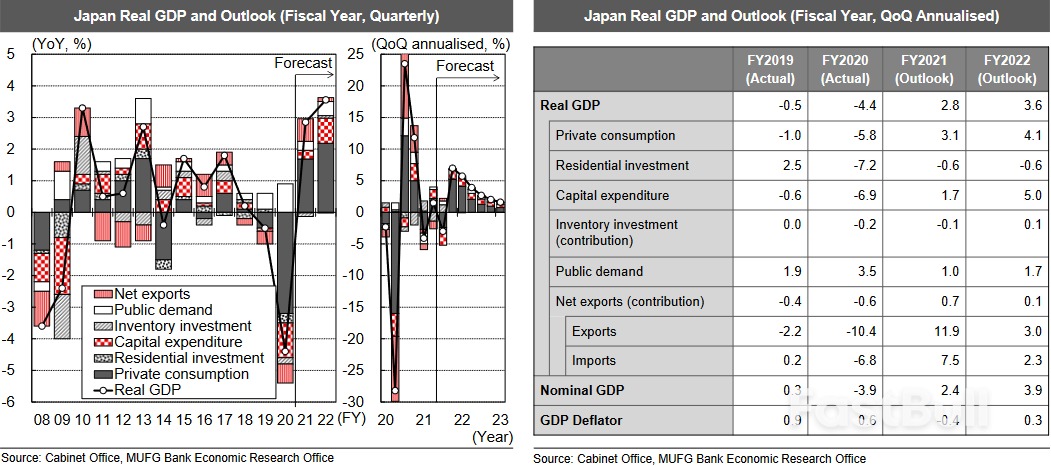
          The real GDP growth rate for the July-September quarter (first preliminary estimate) was -3.0% QoQ annualised: the first negative growth in two quarters. This was due to a decrease in domestic and foreign demand as a result of the fifth wave of COVID-19 infections and a supply shortage of some goods. Private consumption was affected by the fourth state of emergency and a huge slump in the number of automobile sales due to the constrained supply of semiconductors and other components. Capital expenditure also appears to have been affected by supply restraints, particularly investment in transport equipment.
          From the October-December quarter onwards, the economy will probably start to follow a general trend of recovery on the premise that “vaccines retain their efficiency, social and economic policies to live with COVID-19 are successful and become well-established, the number of COVID-19 cases and pressure on medical resources is reduced to a certain extent and that various restrictions are eased in stages”. Large-scale economic policies from the Kishida administration are also forecast to give support to the economy.
          The economy will pick up and grow 2.8% YoY in FY2021, after which it will continue to recover at a gradual pace into FY2022 and record strong growth (3.6% YoY) due to rebounds from weak growth. Throughout FY2022, real GDP is forecast to be at the level it was at in FY2019 before the pandemic.
          Japan Economic Outlook 2022_1

          Japanese Economy: Domestic Private Consumption

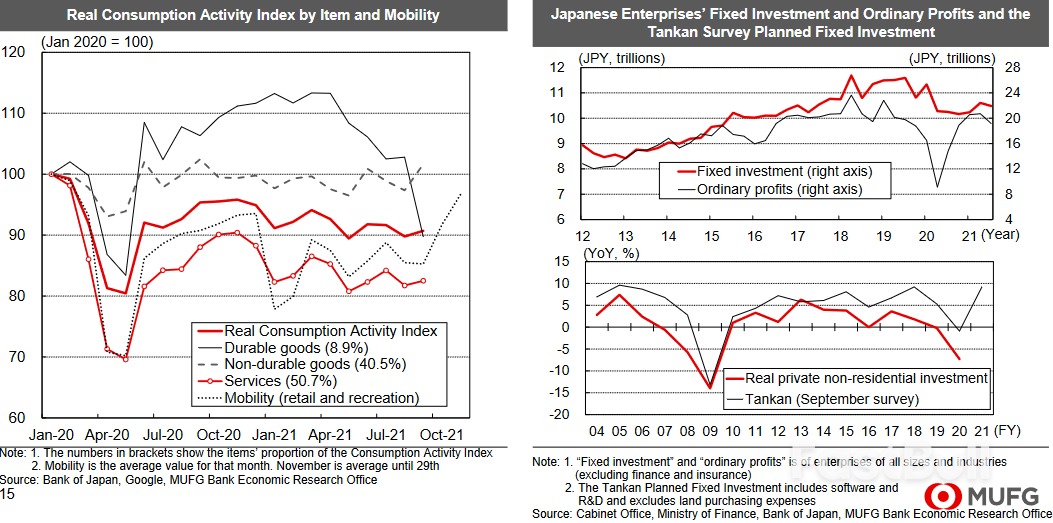
          Growth of private consumption remained slow as services stagnated due to the impact of the fourth state of emergency and there was a slump in spending on durable goods, particularly automobiles, which were affected by a shortage in the supply of parts. As the number of cases falls and restrictions on movement are eased, consumption will start to recover in the future, especially that of services. Nevertheless, a sense of caution about the spread of infection will remain for the time being, which means the pace of recovery is likely to be gradual. It will also be important to keep an eye on the risks posed by a deterioration of the COVID-19 situation, including the spread of the omicron variant.
          Although it is showing some weakness due to supply constraints and slow growth of profits, fixed investment is forecast to remain firm.
          Downward pressure is likely to continue, especially on some non-manufacturing industries, yet fixed investment is expected to pick up in the future on the back of a recovery of both the economy and corporate profits, as well as the need to invest in streamlining and information.
          The Bank of Japan’s September Tankan Survey shows a clear increase in planned fixed investment for this fiscal year of 10.1% YoY.
          Japan Economic Outlook 2022_2

          Japanese Economy: Monetary and Government Policy

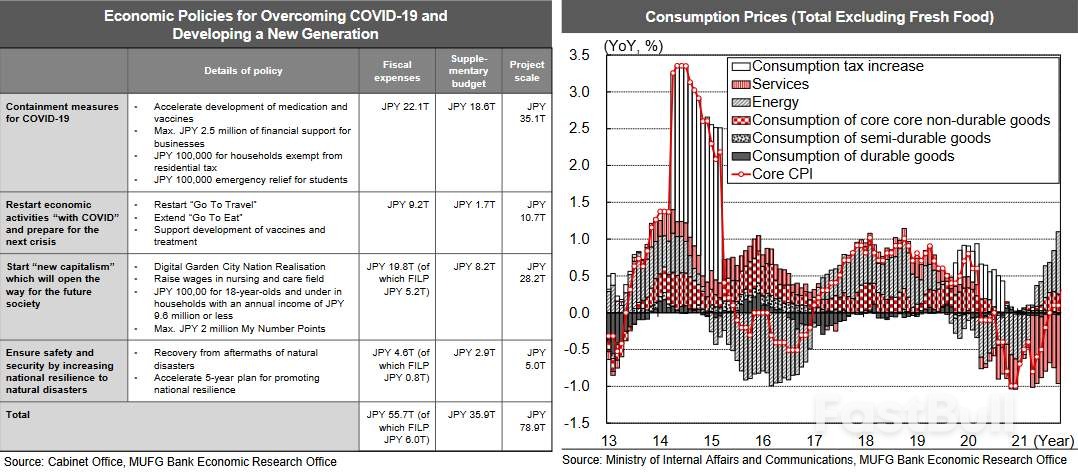
          Prime Minister Kishida’s cabinet approved the Economic Policies for Overcoming COVID-19 and Developing a New Generation on 19th November. The policies focus on financial aid for households and strengthening support for businesses, resulting in fiscal expenses of JPY 55.7 trillion – a new historical high. That being said, many of the policies that provide financial aid are aimed a households, which means the upward pressure on the economy from these policies is unlikely to be large. The boost to real GDP is forecast to equate to around 0.6% points in FY2022.
          The Bank of Japan will continue with its large-scale monetary easy, such as maintaining the yield curve at low levels with active purchases of government bonds. In March, the Bank carried out adjustments to its policy to improve the stability of its monetary easing. Although there has been a marked increase in energy prices, consumer prices on the whole have only increased by a small amount. It is unlikely that the Bank of Japan will achieve its CPI target of 2% YoY, even after the temporary impact of the lowering of mobile phone charges has worn off, and it is forecast to maintain its current accommodative monetary policy.
          Japan Economic Outlook 2022_3

          Source:MUFG

          Risk Warnings and Disclaimers
          You understand and acknowledge that there is a high degree of risk involved in trading. Following any strategies or investment methods may lead to potential losses. The content on the site is provided by our contributors and analysts for information purposes only. You are solely responsible for determining whether any trading assets, securities, strategy, or any other product is suitable for investing based on your own investment objectives and financial situation.
          Comments
          Add to Favorites
          Share

          US Inflation Report to Decide Fate of Dollar in Week Ahead

          Is U.S. Inflation About to Top Out? 

          The U.S. economy is in pretty good shape. The labor market is likely to return to full employment this year; consumption is booming, the Atlanta Fed GDPNow model shows 6.7% growth last quarter, and of course, inflation is hot.
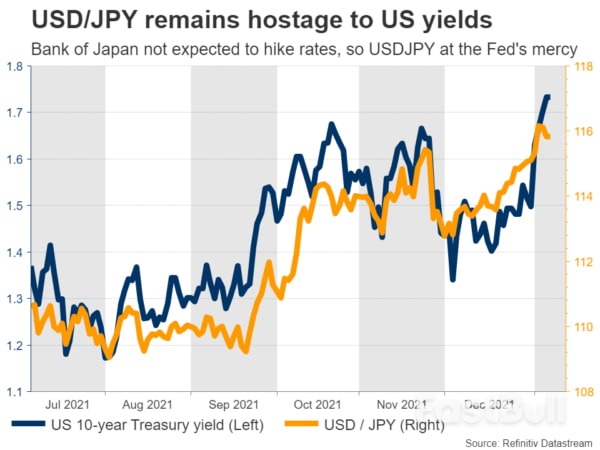
          As a result, markets have begun to accept the idea that the Fed could raise rates as early as March to fight inflation, with an 85% probability of such action now expected. This would be a boon for the dollar, but a curse for the yen, as the Bank of Japan is not likely to follow suit anytime soon.
          With this in mind, Wednesday's upcoming CPI inflation data and Friday's retail sales report could be crucial. Forecasts show the annual CPI rate steady at 6.8% in December, but the core figure, excluding energy and food prices, is expected to jump to 5.4% from the previous 4.9%.
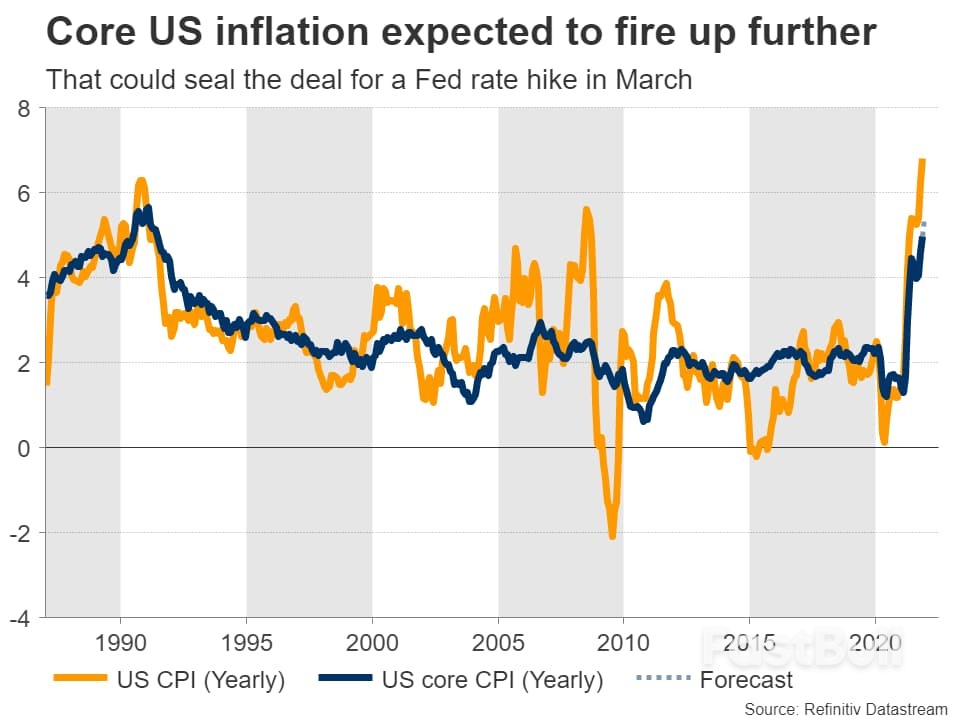
          Markit's latest PMI survey supports these forecasts. Business sales prices rose "sharply," but at the slowest rate in three months, which is fully consistent with the expected monthly CPI data.
          As for the dollar, a big spike in core CPI, coupled with a solid retail sales report, may be enough to solidify expectations that the Fed will begin implementation in March. This could keep the reserve currency in support in the coming months.
          However, looking ahead, the biggest risk to the dollar is any sign of an "inflationary spike." Stable energy prices, supply chains coming back online, reduced fiscal spending, and tighter year-over-year comparison data from April appear to be a factor in inflation peaking later this year.
          At that point, traders may reduce their bets on strong Fed tightening, and U.S. yields could pull back lower, especially if Republicans take control of Congress in the midterm and block new spending. Rest assured, the dollar could trade like a roller coaster this year.
          Finally, please note that Fed Chairman Jerome Powell will appear at congressional hearings on Tuesday and Thursday to confirm his second term in office.

          UK GDP Rising

          Another big winner in the recent spike in yields is the British Pound. Investors seem to have concluded that Omicron is not dangerous enough to stop the Bank of England from raising interest rates or even slowing down its plans.
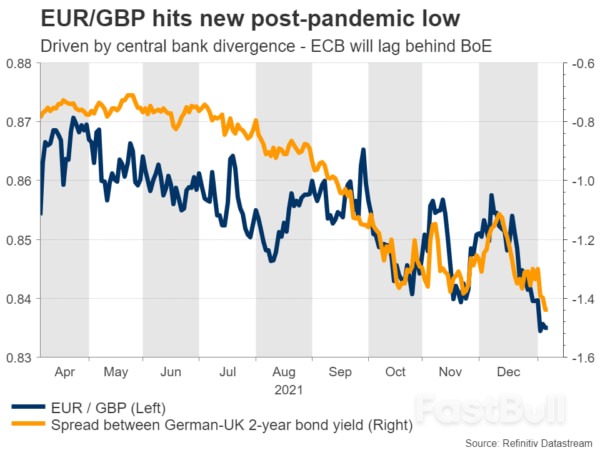
          Currency markets now see a 70% chance that the Bank of England will raise rates again next month, for a total of four rate hikes this year. This helped push EUR/GBP to new post-pandemic lows this week, while Prime Minister Johnson made some comments indicating that new pandemic restrictions are unlikely to be implemented.
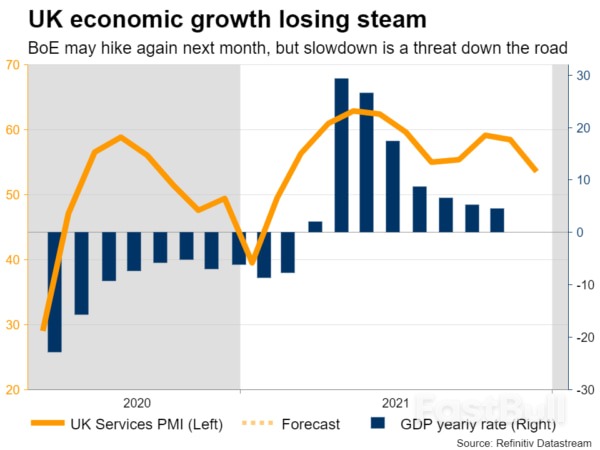
          Next week the GDP data for November will be released on Tuesday, but these data are unlikely to change this optimistic narrative. For now, there is still room for the pound to extend its recent gains, at least against the euro and the yen, as markets become more confident of a February rate hike.
          However, there are some risks from a broader perspective. Despite a strong job market and high inflation in the UK, the latest PMI survey shows that economic growth is losing momentum. If this trend continues, the Bank of England may only raise interest rates twice or three times this year, rather than the four expected by the market.
          Inflation In China Is Also A Concern

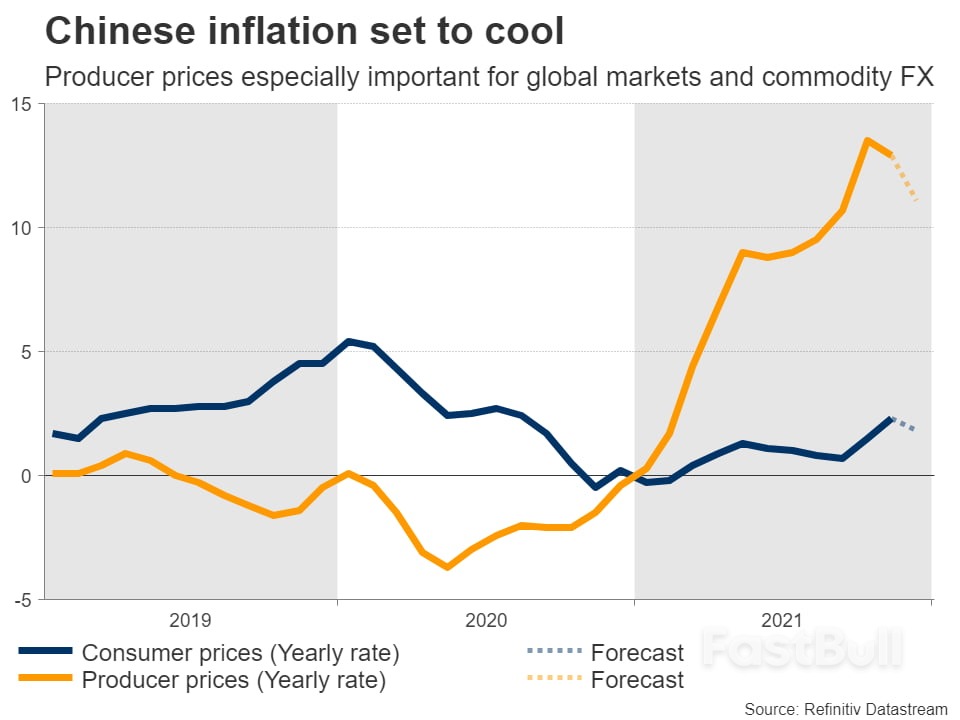
          Elsewhere, the most significant release will be China's inflation report on Wednesday. Consumer and producer prices are expected to cool in December, partly due to the receding power crisis. Trade data for the same month will be released on Friday.
          The slowdown in producer prices may be particularly important for markets. It suggests that China is exporting less inflation abroad, thus fueling the notion that global inflation may be nearing a peak.
          Of course, the risk in all of this is China's zero outbreak policy. The government has imposed a severe lockdown on any cities reporting new cases of crown pneumonia, which has the potential to put the global supply chain under pressure for longer. However, the disruptions so far have not been severe.
          The deteriorating growth outlook for China, coupled with subdued stock market sentiment, may also explain why the commodity-linked Australian and New Zealand dollars have performed so poorly this week.
          Next week's trade data from China could be crucial for these currencies, and the Aussie is also focused on Australia's final retail sales data for November, which will be released on Tuesday.

          Article source: XM Brokers

          Risk Warnings and Disclaimers
          You understand and acknowledge that there is a high degree of risk involved in trading. Following any strategies or investment methods may lead to potential losses. The content on the site is provided by our contributors and analysts for information purposes only. You are solely responsible for determining whether any trading assets, securities, strategy, or any other product is suitable for investing based on your own investment objectives and financial situation.
          Comments
          Add to Favorites
          Share

          U.S. December Non-Farm Payrolls Report

          Eva Chen

          U.S. December Non-Farm Payrolls Report_1U.S. December Non-Farm Payrolls Report_2Instant Snapshot - U.S. December Non-Farm Payrolls Data

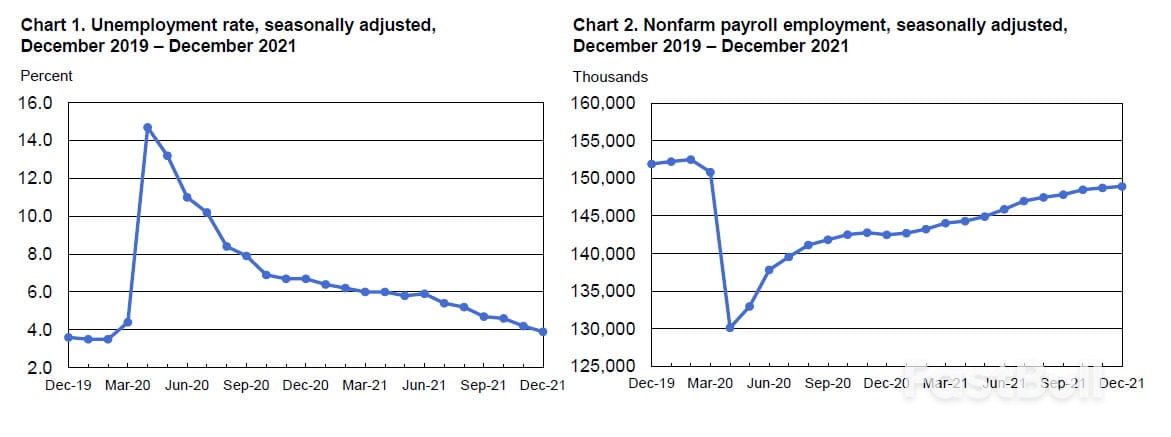
          The US Department of Labor announced that non-farm payrolls rose by just 199,000 in December 2021, significantly missing expectations and marking the lowest increase in a year, while the unemployment rate fell to a new low of 3.9% since the outbreak. In addition to the seasonal effects of a slow winter hiring season, the weak non-farm payrolls data also hit the service sector due to a large number of cases of Omicron mutant strain infections in the US.
          Notably, average hourly earnings increased by 4.7% year-on-year and 0.6% year-on-year in December, with strong pay growth reflecting a continued labour shortage and a tendency for employers to retain employees with higher pay as the U.S. turnover rate continues to reach record highs.
          While employment growth in December was lower than expected, indicators of economic easing such as the unemployment rate, the U6 underemployment rate and the participation rate all showed further improvement. That said, the existing labour supply appears to be at or near full utilization as the current epidemic has prevented workers from re-entering the labour market. This jobs report could meet the criteria set by the Fed in the minutes for a rate hike. Dollar bulls are waiting to see if this will reignite some upside for the greenback.
          With the job market recovering at a slow pace and the labour force participation rate still gaping compared to the pre-pandemic period, the Fed may still need to wait quite some time before starting to raise interest rates. But if inflationary pressures continue to increase amidst high wage growth, it cannot rule out advancing the timing of the rate hike to March this year as suggested by the market.
          Finally, the disappointing employment numbers are likely to be replaced by weaker figures in the coming months as the pandemic worsens and containment measures intensify. The need for financial support will only become more pressing.

          U.S. December Non-Farm Payrolls Report_3Instant Observation - U.S. Workforce Still Scarce
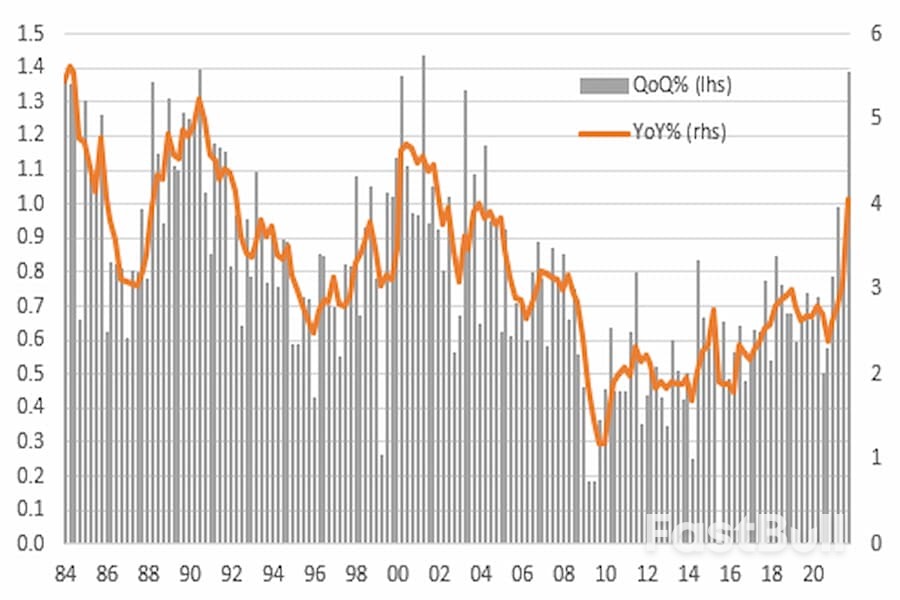
          The U.S. economy added fewer jobs than expected in December. According to the non-farm payrolls figures, only 199,000 people found work, compared to an upwardly revised 141,000 in the past few months. Combined with these figures, the U.S. would have added 340,000 jobs, well below the 450,000 widely expected by the market.
          In fact, this was an even bigger miss as many of the forecasts were submitted ahead of this week's data flow which showed excellent readings from the ADP employment data, ISM employment index, household basis data and the Job Openings and Labour Turnover Survey (JOLTS) reports suggesting a greater upward revision to the historical employment data.
          Given the timing of the survey (week of 12 December), the Omicron wave should not have much impact, so most of the weakness will be attributed to supply constraints (labour force participation remains low at 61.9%) given how strong all labour demand surveys are. In this context, the unemployment rate falling below 3.9% and wages rising 0.6% quarter-on-quarter may be more important to the Fed.

          U.S. December Non-Farm Payrolls Report_4Pay Pressures Are Intensifying

          Despite the economy growing by 1.4% at the end of 3Q 2021 compared to the pre-pandemic period, companies are still employing 3.6 million fewer people. Given that this week's JOLTS data shows 10.5 million job openings, this reinforces the message that this is a labour supply issue rather than any demand issue.
          As we saw in today's report, this difficulty in finding the right workers is pushing up wage rates, with the National Federation of Independent Business (NFIB) reporting yesterday that a record 48% of small businesses have increased worker pay, while a record 32% are expected to raise wages further in the coming months.

          NFIB Survey Reveals Urgent Need For Companies To Recruit And Pay More To Attract Staff

          Despite the higher wages on offer, there is little evidence of workers returning to the labour market with a participation rate of 61.9% and an employment rate of 59.5% of the working age population. As a result, companies are having to recruit from competitors, which is why resignation rates are at a series of record highs, with 3.4% of all private sector employees changing jobs in November. This has created wider pay pressures as companies look to retain existing staff by paying higher salaries.
          Given that the U.S. is primarily a service economy, the cost of employment is usually the biggest cost that adds to inflationary pressures - especially in an environment where companies appear to have pricing power and can pass these costs on to their customers.

          U.S. December Non-Farm Payrolls Report_5The Fed Wants To Take Back Control

          The minutes of the Fed's December FOMC meeting show that officials do want to push for a normalisation of monetary policy. They actually admitted that their forecasts for inflation were wrong and now recognise that labour market conditions are much tighter than they previously thought, as evidenced by the 3.9% unemployment rate. As a result, the Fed, which nine months ago hinted at a rate hike as early as 2024 before the first one, is now indicating that they may raise rates three times this year and three times next year.
          The upward pressure on interest rate expectations is not likely to ease any time soon. Next week we expect headline inflation to top 7% year-on-year and core inflation to top 5% year-on-year, while later in the month all eyes should be on the employment cost index in the fourth quarter. With the NFIB and the Fed's own Brown Book reporting widening wage pressures, another 1% year-on-year rise in the index could really balance out the case in favour of a March rate hike and open the door to the possibility of four rate hikes this year.
          For now we are more cautious and believe that May will mark the starting point for higher policy rates as the Omicron wave overshadows the near-term economic outlook, but this is a rapidly changing situation and the Fed has indicated that they want to take back control.
          Risk Warnings and Disclaimers
          You understand and acknowledge that there is a high degree of risk involved in trading. Following any strategies or investment methods may lead to potential losses. The content on the site is provided by our contributors and analysts for information purposes only. You are solely responsible for determining whether any trading assets, securities, strategy, or any other product is suitable for investing based on your own investment objectives and financial situation.
          Comments
          Add to Favorites
          Share

          Is Afghanistan Isolated After the Fall of the Former Government?

          In mid-August 2021, after the hasty withdrawal of U.S. forces from Afghanistan, the U.S.-founded Afghan government quickly collapsed, and the Taliban soon took over the country. At the same time, many international agencies and Western diplomats fled Afghanistan after the Taliban moved into Kabul, ending their diplomatic presence in the country and bringing economic aid to Afghanistan to a halt.
          In the wake of this, fear of the Afghan Taliban has led many Afghans to seek safety from conflict and other threats everywhere. Afghanistan has been in extreme fear for some time, with Afghans displaced by war and many people in need of humanitarian assistance. The winter has arrived, and the humanitarian crisis in Afghanistan may become even more severe.
          It is reported that the country's economy has been shattered by war for a long time, and during the previous government, nearly 80% of the budget came from international aid funds. But since the Taliban came to power, that aid has been disrupted, and public services, hospitals, schools, and other operations have become unsustainable. Although the Taliban regime has not shown the same signs of massive corruption as the previous government, the United Nations, the United States, and many other countries or organizations interested in lending a hand are still struggling with how to get around the Taliban and are hesitant to do so.

          No " Premature " Recognition of Taliban?

          Since the Afghan Taliban gained control of Afghanistan, no country has officially recognized the regime. Governments are still holding a wait-and-see attitude to see if the Taliban can run Afghanistan. Some analysts say that many terrorist groups are still parasitic in Afghanistan and even dissatisfied with the Taliban's ruling regime, making it challenging to achieve regional peace.
          In addition, the Afghan Taliban is inextricably linked to extremist groups, and the line between the Afghan Taliban and terrorism is unclear. The Taliban's rise to power may once again turn Afghanistan into a place where terrorism originates, and terrorists are dispersed, which will seriously harm the interests of the Afghan people and pose a great risk to regional security.
          While the humanitarian community, including the UN and NGOs, remains committed to helping the Afghan people, the international community has yet to fully restart humanitarian and development assistance in Afghanistan due to continued concerns about the Afghan Taliban.

          Overdependence On International Aid

          Since 2001, Afghanistan has been a priority aid recipient for Western countries. The U.S. alone is known to have invested close to $150 billion in non-military aid to Afghanistan, with the EU's figure for the same period being 4 billion euros and billions more from other international organizations. In recent years, the U.S. has prepared to withdraw its troops and significantly reduce its aid to Afghanistan, but aid in 2019 still amounts to more than $4 billion.
          However, Afghanistan has long received vast international aid, is not a sustainable economic system or even a functioning independent state. While corruption in the previous government was an essential factor in this outcome, it is perhaps the continued volatility of the security situation in Afghanistan that is the most critical concern. Achieving economic independence in Afghanistan will depend on an internally peaceful and stable socio-economic environment.
          Obviously, the resumption of large-scale international aid to Afghanistan at this stage will not only be detrimental to the country's peaceful development. Still, it will also likely lead Afghanistan into a longer-term economic dependency.

          China's Humanitarian Aid

          Currently, Western countries have stopped aid to Afghanistan. The United States has frozen tens of billions of dollars in deposits from the former Afghan government and imposed economic sanctions on Afghanistan. China, however, has made a discreet gesture of goodwill - active humanitarian assistance - to Afghanistan. After the U.S. withdrew its troops from Afghanistan, China pledged to provide about 200 million yuan worth of relief supplies to Afghanistan. In addition, China has imported large quantities of Afghan pine nuts to free Afghan farmers from dependence on poppy cultivation for economic development.
          China has significant economic and security concerns regarding Afghanistan and counts on the Afghan Taliban to cut ties with extremist groups and work for internal peace and stability. As a central hub linking the Middle East, Central Asia, and Europe, Afghanistan will be conducive to strategic connectivity between China and Central Asian countries if it remains peaceful and stable. Under the premise of peace and stability in Afghanistan, China intends to extend the China-Pakistan Economic Corridor to Afghanistan. However, the current terrorist attacks in Afghanistan are still frequent, with casualties, and the security situation is still complicated and severe.
          At this stage, China's aid to Afghanistan is limited to humanitarian supplies and is relatively limited in quantity. China is trying to influence the Afghan Taliban through aid to make the Afghan Taliban cut ties with extremist groups and work against extremist groups to restore peace and stability in Afghanistan.

          Summary

          Considering the complexity of the situation in Afghanistan, the Afghan people may face a more serious humanitarian crisis in the cold winter. At present, due to the suspension of international aid, Afghanistan's socio-economic situation is unsustainable. Despite China's active humanitarian assistance, Afghanistan's economy has not functioned, and Afghanistan's security situation does not seem to be precise.
          Risk Warnings and Disclaimers
          You understand and acknowledge that there is a high degree of risk involved in trading. Following any strategies or investment methods may lead to potential losses. The content on the site is provided by our contributors and analysts for information purposes only. You are solely responsible for determining whether any trading assets, securities, strategy, or any other product is suitable for investing based on your own investment objectives and financial situation.
          Comments
          Add to Favorites
          Share

          Growth Is Everywhere In The Age Of Digital Finance

          Growth Is Everywhere In The Age Of Digital Finance_1
          Digital finance is the quintessential response of an economy to new technologies that open up opportunities, missing markets and new ways of "exploiting" the unsuspecting.
          As these efforts succeed, more and more traditional institutions are drawn into the process, as are legislators and regulators. At this stage of the process, it is impossible to see clearly where the system will end up, so everyone must continue to participate in the evolutionary process, both physically and intellectually.
          Money is information, and as information technology changes, what really counts as money changes. And, as change happens, people find new ways to use and exploit the ever-changing format of information. This is how economics works.
          The new digital currency world is going through this process. Digital currency and finance are the future. However, what it will eventually become is a question. For example, "in dollar terms, fraud, extortion software and theft increased by 79% last year, but the overall market (cryptocurrency) increased by 550%, and the value of cryptocurrency traded in 2021 was $15.9 trillion".
          This means that the relative share of illegal activity has fallen to historically low levels and that crime is becoming a smaller part of the cryptocurrency ecosystem.

          Market Maturity

          The increasing maturity of the market is its way and the innovation that underpins it. In capital markets, people are looking for missing markets. Missing markets are areas that have not previously generated sufficient demand or supply, or both, to make it feasible to establish a market for a new product or service.
          It's a new innovation, an exciting thing. All these opportunities are surfacing and facing the same world. A world where hundreds, if not thousands, of people are waiting to find a place where they can make a lot of money.
          Of course, as we have seen, not all creative innovators or entrepreneurs are looking for a “legitimate” missing market. But that's the way the world works. As the market develops and matures, it has to work itself out. This is one of the reasons why regulations and regulators eventually emerge.

          Decentralised Finance

          With the development of new markets, such as those related to decentralised finance or DeFi. This is where law enforcement and regulators find themselves behind the curve. Over $100 billion of funds make up the DeFi market, and scams like "rugpulls", where "scammers convince investors to put money into new tokens before they disappear", cost investors $2.8 billion last year. In addition, theft from these sources also amounted to $2.2 billion last year. Elliptic, a specialist cryptocurrency data company, estimates that investors lost $12 billion in the DeFi market last year.

          Positive Aspects

          However, there are more positive developments in this digital space, which are indicative of the growing influence of cryptocurrencies on financial markets and the economy. How can cryptocurrency trading expand as more traditional financial asset players begin to challenge the position that "digital asset specialists" have already established in the sector?
          Last year, the business of trading digital assets totalled nearly $3 trillion. This has led to soaring valuations and has caught the attention of more traditional trading companies. The number of companies trading cryptocurrencies worth between $2 billion and $5 billion per day is at a new record high. More traditional financial firms are taking advantage of this open opportunity more quickly.
          But the movement of traditional firms is also pushing “newbies” into more and more things to stay competitive. For example, companies that initially offered only cryptocurrency trading are now moving into areas such as lending, over-the-counter trading and new areas such as decentralised finance.
          By 3Q 2021, crypto company Genesis’ lending arm grew to over $35 billion in crypto loans. This is a 586% increase from what they produced a year ago. Furthermore, the derivatives market has grown dramatically as these newer companies expand into other areas that were not initially created. Some of the newer members of the community are raising their horizons in the hope of one day becoming a fully digital investment bank.

          Uncertain Future

          This is the world of the future. How it will all shake out remains to be seen. Here again, we are in a world of uncertainty. As mentioned above, we are seeing more and more traditional organisations not only considering, but also moving into the digital space.
          In this respect, financial institutions in the US and other developed countries appear to be lagging behind the world in entering the digital space. However, these efforts are accelerating as an increasingly digital future becomes more apparent.
          At the same time, discussions about legislation and regulation are heating up. Again, the US is lagging behind much of the world in this regard, but we are now seeing more and more discussion taking place. Where legislation and regulation are going is another major issue. Many politicians and policy makers seem to be opposed to cryptocurrencies and crypto-currencies. The idea that money is just information does not seem to resonate with them at all.
          Some countries want to ban cryptocurrencies altogether and continue to use other digital currencies that central banks and politicians can control. The "true believers" in cryptocurrencies believe that it is possible to create a world without central oversight and control. This is, of course, one of the main features of cryptocurrencies that proponents are concerned about.
          And the ultimate goal is to get people, or investors, to trust the monetary system. In the past, it seemed that a monetary system without some form of central control would eventually collapse through theft, dishonesty or other misuse. The system would adjust to some form of regulation and oversight.
          This is still a test for cryptocurrencies. There are many financial types who are sceptical about the "staying power" of cryptocurrencies. They see it as a bubble or a scam. Others believe that the technology allows cryptosystems to be completely independent. This is an issue that must be addressed. There seems to be enough belief that the activity around the idea will continue to grow as investors, financial institutions and governments lay the foundations for a new era.

          Risk Warnings and Disclaimers
          You understand and acknowledge that there is a high degree of risk involved in trading. Following any strategies or investment methods may lead to potential losses. The content on the site is provided by our contributors and analysts for information purposes only. You are solely responsible for determining whether any trading assets, securities, strategy, or any other product is suitable for investing based on your own investment objectives and financial situation.
          Comments
          Add to Favorites
          Share

          The Fed's " Hawkish Change " Aftershock: Global Central Banks Hike Rates Ahead Only Days After the New Year

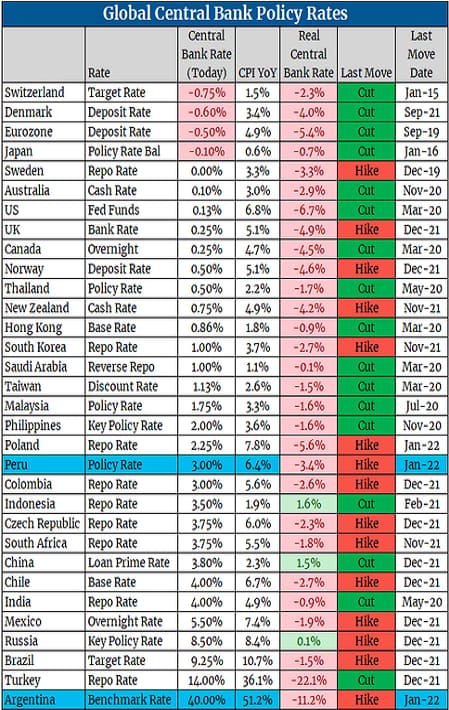
          From the perspective of many industry insiders, with the world economy struggling to recover amidst imbalances and the Fed leading the developed economies to turn around, it is clear that the global central banks will usher in a "year of interest rate hikes" in 2022, which is already the trend. The actual situation seems to be the same: Although it is only a few trading days into the New Year, there are already several central banks in this week to hold back, one after another, to take action to raise interest rates.
          Poland's central bank was the first emerging economy central bank to raise interest rates this year, announcing an early 50 basis point increase in its key rate to 2.25% on January 4. And after the Fed's minutes released on Wednesday revealed a tendency to taper and raise rates early, several South American central banks - Uruguay, Peru, and Argentina - have also announced rate hikes in the past two days.
          One of the most notable is undoubtedly the "most vulnerable" emerging economy, Argentina, which has been slow to take any monetary policy action for the past year. Turkey experienced a storm of lira devaluation at the end of last year, which at one point made all market participants turn their heads. But even if the turmoil in the Turkish market deepens, the country's domestic inflation rate of about 36% is still " minor " compared to Argentina - the latter's inflation rate has continued to be as high as about 51%.
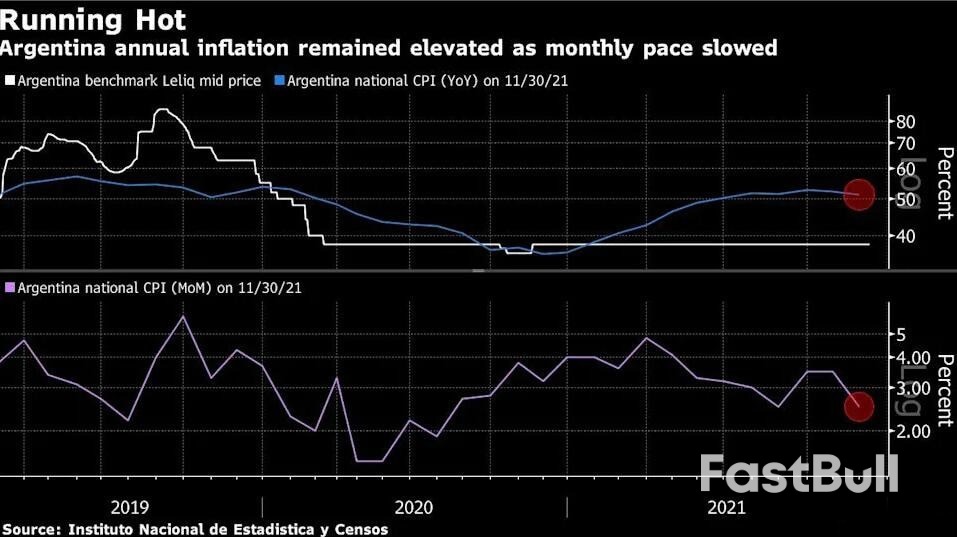
          And with Argentina finally "disarmed" reluctant to raise interest rates, emerging markets' tightening trend of the year seems to have been unstoppable.
          Piotr Matys, the senior currency strategy analyst at InTouch Capital Markets, said, "Rapidly higher U.S. bond yields in the near term are making emerging-market assets consistently less attractive. Against this backdrop, emerging market currencies whose central banks have not yet started raising interest rates or whose real rates remain negative may be particularly vulnerable."
          According to a set of data from the foreign exchange market, the turmoil in emerging market currencies increased significantly on the day of the "hawkish change" in the Fed minutes on Wednesday, with the MSCI Emerging Markets Currency Index falling more than 0.4% at one point, the biggest drop in three weeks.
          Kamakshya Trivedi, Co-Head of Global FX, Rates and Emerging Markets Strategy at Goldman Sachs, said, "The current macro environment looks extremely challenging for emerging market assets, with growth rates slowing from their peaks as the boost from the reboot fades globally, monetary policy is tightening, and some familiar traditional emerging market issues have re-emerged, such as inflation, fiscal excesses, and political instability."
          The following is an overview of the background of several major central banks that raised rates this week:

          Central Bank of Argentina

          Faced with calls from the International Monetary Fund (IMF) to tighten monetary policy, Argentina's central bank finally announced its first rate hike in more than a year on Thursday local time: raising the benchmark Leliq rate by 200 basis points from 38% to 40%.
          Previously, Argentina's central bank kept interest rates at 38 percent for a year, despite a domestic inflation rate of 51.2 percent, due to attempts to print money to fund government spending during the epidemic. However, the bank's approach contrasts with a wave of tightening by central banks worldwide, with IMF officials calling on Argentina's central bank last December to adjust monetary policy as part of a new program negotiated by the government to reschedule some $40 billion in payments. They specifically called for Argentina's interest rates to exceed the inflation rate.
          In its latest statement, Argentina's central bank said the new benchmark interest rate would be in line with the central bank's plans and objectives for 2022 and that the Argentine government hopes to make real returns on local currency investments through interest rate policy, maintain currency as well as foreign exchange market stability, and thus promote economic recovery.
          Central Bank of Peru

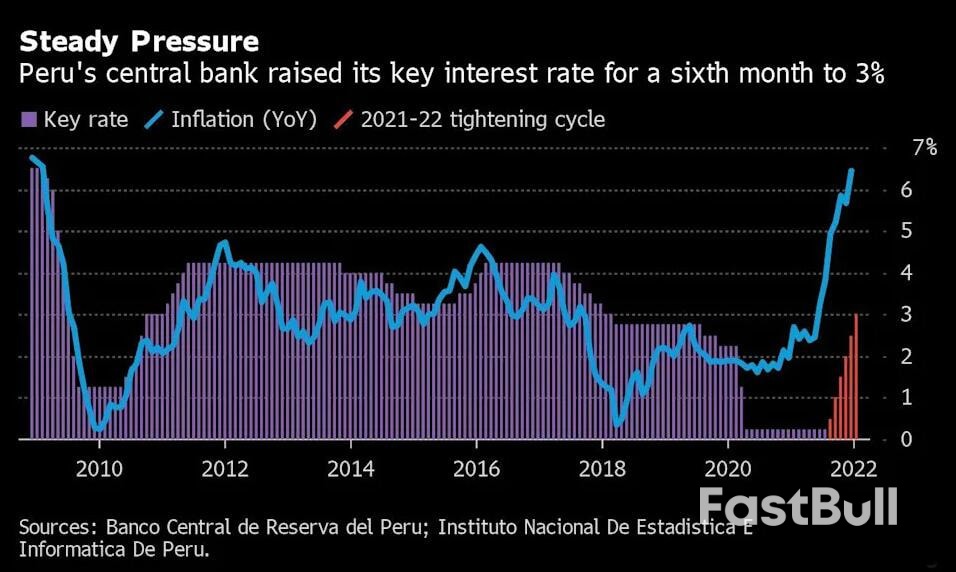
          On the same day that Argentina's central bank raised interest rates, Peru's central bank also announced Thursday that it would raise its policy rate by 50 basis points to 3%, the sixth consecutive month of interest rate hikes. In a Bloomberg prior survey, five out of seven analysts predicted the Peruvian central bank would raise rates by 50 basis points this time, and two predicted a 75 basis point hike.
          Peru's central bank said, "Given the information available, we believe it is appropriate to continue with the normalization of monetary policy in the coming months."
          Policymakers from the Peruvian central bank also noted that they closely monitor the evolution of inflation expectations and economic activity to decide on the appropriate monetary stance.
          Peru's CPI has reached a 13-year record high of 6.4% in December due to rising food and energy prices, while the country's central bank's inflation target is only 2%, up or down by one percentage point. Now, with inflation indicators generally exceeding target levels across Latin America, almost all major Latin American central banks are aggressively withdrawing their stimulus programs and moving to raise interest rates.
          Central Bank of Poland

          Poland's central bank's Monetary Policy Committee (MPC) announced on Tuesday that it raised the country's main interest rate by 50 basis points to 2.25%, making it the first central bank in the world to announce a rate hike during the year.
          Poland's CPI growth rate has reached 7.8% in November, the highest in 20 years. Market analysts said that factors such as labor shortage, rapid salary growth, and supply chain disruptions have significantly pushed up domestic price levels in Poland, which is the main reason why the Polish central bank finally chose to raise interest rates at the beginning of the New Year. 
          Poland's Monetary Policy Committee said in a statement that the committee's decisions in the coming months would continue to be aimed at bringing inflation down to a level consistent with the central bank's medium-term inflation target to ensure medium-term price stability and support sustainable economic growth in the wake of the epidemic shock.

          Article Source: Caixin

          Risk Warnings and Disclaimers
          You understand and acknowledge that there is a high degree of risk involved in trading. Following any strategies or investment methods may lead to potential losses. The content on the site is provided by our contributors and analysts for information purposes only. You are solely responsible for determining whether any trading assets, securities, strategy, or any other product is suitable for investing based on your own investment objectives and financial situation.
          Comments
          Add to Favorites
          Share

          A Farewell to Tough 2021, Can Hong Kong Stocks Return to Glory in 2022? (II)

          Related Article: A Farewell to Tough 2021, Can Hong Kong Stocks Return to Glory in 2022? (I)

          3. New Cold Wave

          Hong Kong stocks's sluggish status is not only reflected in the listed companies level, but the fact that the secondary market is also dismal, resulting in a cold wave on companies' listing in Hong Kong. According to Yongan data:
          1) 2021 annual clearing IPO fundraising is expected to be about HK$3,237
          Down 19% year-on-year: 94 IPOs are expected to be listed for the year, down 35% year-on-year, which will leave HKEx in fourth place on the global exchange's IPO list in 2021. The year 2012 was the latest year HKEx fell to this position, and since then it inhabited in the top three for years, among which four times on top.
          2) Obvious reflection was seen in the second half of 2021
          Throughout the second half of the year, the amount of new equity capital raised by Hong Kong stocks accounted for only 35%. According to public statistics, from 2016 to 2020, the second half of Hong Kong stock capital raising accounted for generally between 70% and 80% of the year, with the lowest being close to 60% in 2017.
          3) Only 17 new shares were listed on the Hong Kong stock market between August and November 2021, raising a total of HK$43 billion
          The number of new shares and the size of the capital raised are at a seven-year low, the second and fourth quarters, which have been the window for IPOs in Hong Kong in recent years, were also reversed in 2021.
          4) From 2020 to 2021, the average first-day return of new stocks on the Main Board of Hong Kong stocks fell from 25% to 15%
          The GEM board (i.e. GEM) has gradually lost its capital-raising function since 2018 after tightening the threshold for listing, and only 1 company was listed in 2021: the situation of foreign companies listing in Hong Kong was also deteriorating, and only 1 Singaporean company, which had already submitted its listing application in 2020, landed in Hong Kong in 2021. In 2021, though there were 9 mega IPOs with the financing of over $1 billion, the second largest in the past six years, the overall HK$181.2 billion capital raised only ranks third in six years.

          4. Some Chinese stocks transferred to Hong Kong and encountered policy reform

          A Farewell to Tough 2021, Can Hong Kong Stocks Return to Glory in 2022? (II)_1
          In 2021, among the top 10 new stocks in Hong Kong in terms of capital raised, Chinese stocks and biotechnology companies are Chinese stocks returning to Hong Kong from the U.S. stock market, ranking third to seventh in that order, raising a combined total of about HK$86.376 billion, accounting for nearly 27% of the total amount of new stock financing in Hong Kong for the year; a total of seven Chinese stocks went public in Hong Kong for the year, raising 32% of the total amount of new stock financing in Hong Kong. In 2021, there were also 19 Non-profit biotechnology and health care companies landed in Hong Kong stocks, accounting for 20% of the annual number of new shares.
          However, the number of IPOs listed in Hong Kong each year has gradually decreased from over 200 in the past, although there are policy factors, such as the crackdown on shell listings in Hong Kong and the tightening of a series of industrial regulatory policies in the Mainland, but this phenomenon is not expected to be the norm, and the number of IPOs listed in Hong Kong each year is expected to remain at 100 to 120 after future policy adjustments are completed.
          It is expected that Chinese stocks will continue to make balanced considerations regarding their IPOs in terms of regulation, transaction risk and longer-term financing strategies in the future, while geopolitical wrangling has led to frequent negative market factors though.

          4.1 Willingness to head to Hong Kong remains, yet investment enthusiasm is seen low

          The number and willingness of mainland companies to list in Hong Kong has not diminished significantly in the long run, but the downturn in the secondary market, geopolitics, the tightening of industrial regulation in the mainland and restrictions on offshore listings in specific industries have indeed dampened the fervor of the Hong Kong IPO market in the short term, and Hong Kong stocks may face a decline in the number of mega new economy companies listed, valuations and capital raised in the next two years.
          There are also warm currents amidst the cold wave. New economy companies such as Internet technology and biopharmaceuticals, as well as Chinese stocks returning from the U.S., have become the backbone of the Hong Kong IPO market in 2021. According to HKEx statistics, as of December 17, 2021, there were 54 new economy companies, including 32 healthcare and biomedical companies, among the 92 IPOs in Hong Kong. These 54 IPOs raised nearly 87% of the total IPO capital raised by Hong Kong stocks in the year.

          4.2 Hong Kong Stocks Seeking Change

          The market chill is the short-term significance and value inheritance of the Hong Kong stock market's "quest for change" four years ago.
          In 2017, the HKEx proposed the biggest listing system reform in nearly 20 years, allowing companies with same-share-variable-rights (WVR) structures, as well as non-revenue biotech companies, to IPO in Hong Kong, and non-revenue generating biotechnology companies to IPO in Hong Kong, while taking steps to gradually liberalize secondary listings in Hong Kong for overseas-listed Greater China companies.
          In 2021, a total of eight Chinese WVR companies landed in Hong Kong in the form of IPOs and secondary listings, with the combined financing size accounting for 44% of the total annual IPO capital raised in Hong Kong. Alibaba (09988.HK), Jingdong (09618.HK), Meituan (03690.HK), Xiaomi (01810.HK), and Crypto (01024.HK), five mainland new economy giants with WVR structures, also ranked among the top ten most active stocks traded in Hong Kong in 2021 for a long time; Hong Kong stock market capitalization list, Ali and Meituan ranked third and fourth, and Jingdong ranked ninth, Xiaomi, Baidu (09888.HK) and Kwai were ranked 11th, 13th and 18th.
          Among these, Kwai is the epitome of the IPO market in 2021. Taking advantage of the new economy sector and Hong Kong stocks as a whole still exist at the beginning of the year, Kwai received 1.423 million subscriptions from retail investors in Hong Kong during the IPO stage, freezing about HK$1.277 trillion in retail "new" funds, both of which are records for Hong Kong IPOs. The company priced its IPO at the upper end of the proposed offer price range and eventually raised HK$48.3 billion, making it the "King of Capital Raising" for Hong Kong IPOs in 2021.
          Risk Warnings and Disclaimers
          You understand and acknowledge that there is a high degree of risk involved in trading. Following any strategies or investment methods may lead to potential losses. The content on the site is provided by our contributors and analysts for information purposes only. You are solely responsible for determining whether any trading assets, securities, strategy, or any other product is suitable for investing based on your own investment objectives and financial situation.
          Comments
          Add to Favorites
          Share
          FastBull
          Copyright © 2025 FastBull Ltd

          728 RM B 7/F GEE LOK IND BLDG NO 34 HUNG TO RD KWUN TONG KLN HONG KONG

          TelegramInstagramTwitterfacebooklinkedin
          App Store Google Play Google Play
          Products
          Charts

          Chats

          Q&A with Experts
          Screeners
          Economic Calendar
          Data
          Tools
          Membership
          Features
          Function
          Markets
          Copy Trading
          Latest Signals
          Contests
          News
          Analysis
          24/7
          Columns
          Education
          Company
          Careers
          About Us
          Contact Us
          Advertising
          Help Center
          Feedback
          User Agreement
          Privacy Policy
          Business

          White Label

          Data API

          Web Plug-ins

          Poster Maker

          Affiliate Program

          Risk Disclosure

          The risk of loss in trading financial instruments such as stocks, FX, commodities, futures, bonds, ETFs and crypto can be substantial. You may sustain a total loss of the funds that you deposit with your broker. Therefore, you should carefully consider whether such trading is suitable for you in light of your circumstances and financial resources.

          No decision to invest should be made without thoroughly conducting due diligence by yourself or consulting with your financial advisors. Our web content might not suit you since we don't know your financial conditions and investment needs. Our financial information might have latency or contain inaccuracy, so you should be fully responsible for any of your trading and investment decisions. The company will not be responsible for your capital loss.

          Without getting permission from the website, you are not allowed to copy the website's graphics, texts, or trademarks. Intellectual property rights in the content or data incorporated into this website belong to its providers and exchange merchants.

          Not Logged In

          Log in to access more features

          FastBull Membership

          Not yet

          Purchase

          Become a signal provider
          Help Center
          Customer Service
          Dark Mode
          Price Up/Down Colors

          Log In

          Sign Up

          Position
          Layout
          Fullscreen
          Default to Chart
          The chart page opens by default when you visit fastbull.com