• Trade
  • Markets
  • Copy
  • Contests
  • News
  • 24/7
  • Calendar
  • Q&A
  • Chats
Trending
Screeners
SYMBOL
LAST
BID
ASK
HIGH
LOW
NET CHG.
%CHG.
SPREAD
SPX
S&P 500 Index
6819.32
6819.32
6819.32
6861.30
6801.50
-8.09
-0.12%
--
DJI
Dow Jones Industrial Average
48389.87
48389.87
48389.87
48679.14
48285.67
-68.17
-0.14%
--
IXIC
NASDAQ Composite Index
23110.70
23110.70
23110.70
23345.56
23012.00
-84.46
-0.36%
--
USDX
US Dollar Index
97.960
98.040
97.960
98.070
97.740
+0.010
+ 0.01%
--
EURUSD
Euro / US Dollar
1.17440
1.17448
1.17440
1.17686
1.17262
+0.00046
+ 0.04%
--
GBPUSD
Pound Sterling / US Dollar
1.33699
1.33708
1.33699
1.34014
1.33546
-0.00008
-0.01%
--
XAUUSD
Gold / US Dollar
4303.36
4303.70
4303.36
4350.16
4285.08
+3.97
+ 0.09%
--
WTI
Light Sweet Crude Oil
56.359
56.389
56.359
57.601
56.233
-0.874
-1.53%
--

Community Accounts

Signal Accounts
--
Profit Accounts
--
Loss Accounts
--
View More

Become a signal provider

Sell trading signals to earn additional income

View More

Guide to Copy Trading

Get started with ease and confidence

View More

Signal Accounts for Members

All Signal Accounts

Best Return
  • Best Return
  • Best P/L
  • Best MDD
Past 1W
  • Past 1W
  • Past 1M
  • Past 1Y

All Contests

  • All
  • Trump Updates
  • Recommend
  • Stocks
  • Cryptocurrencies
  • Central Banks
  • Featured News
Top News Only
Share

New York Fed Accepts $2.601 Billion Of $2.601 Billion Submitted To Reverse Repo Facility On Dec 15

Share

Turkey: Shoots Down A Drone In The Black Sea Using F-16 Fighter Jets

Share

Goldman Sachs Says They Believe That The Copper Price Is Vulnerable To An Ai-Linked Price Correction

Share

Goldman Sachs Upgrades 2026 Copper Price Forecast To $11400 From $10,650

Share

Attempts By Ukrainian Troops To Advance From The South-West To Outskirts Of Kupiansk Are Being Thwarted

Share

Russian Troops Control All Of Kupiansk - IFX Cites Russian Military

Share

On Monday (December 15), The South Korean Won Ultimately Rose 0.60% Against The US Dollar, Closing At 1468.91 Won. The Won Was On An Upward Trend Throughout The Day, Rising Significantly At 17:00 Beijing Time And Reaching A Daily High Of 1463.04 Won At 17:36

Share

Health Ministry: Israeli Forces Kill Palestinian Teen In West Bank

Share

New York Federal Reserve President Williams: Over Time, The Size Of Reserves Could Grow From $2.9 Trillion

Share

New York Fed President Williams: AI Valuations Are High, But There Is A Real Driving Factor

Share

New York Federal Reserve President Williams: The Job Market Is In Very Good Shape

Share

New York Fed President Williams: 'Very Supportive' Of USA Central Bank's Decision To Cut Interest Rates Last Week

Share

New York Fed President Williams: 'Too Early To Say' What Central Bank Should Do At January Meeting

Share

New York Fed President Williams: Strong Markets Part Of Reason Why Economy Will Grow Robustly In 2026

Share

New York Fed President Williams: What Constitutes Ample Reserves Will Change Over Time

Share

New York Fed President Williams: Market Valuations 'Elevated,' But There Are Reasons For Pricing

Share

New York Fed President Williams: Ample Reserves System Working Very Well

Share

New York Fed President Williams: Some Signs That Parts Of Underlying Economy Not As Strong As GDP Data Suggests

Share

New York Fed President Williams: Expects Coming Job Data Will Show Gradual Cooling

Share

Ukraine President Zelenskiy: Monitoring Of Ceasefire Should Be Part Of Security Guarantees

TIME
ACT
FCST
PREV
Japan Tankan Small Manufacturing Outlook Index (Q4)

A:--

F: --

P: --

Japan Tankan Large Non-Manufacturing Outlook Index (Q4)

A:--

F: --

P: --

Japan Tankan Large Manufacturing Outlook Index (Q4)

A:--

F: --

P: --

Japan Tankan Small Manufacturing Diffusion Index (Q4)

A:--

F: --

P: --

Japan Tankan Large-Enterprise Capital Expenditure YoY (Q4)

A:--

F: --

P: --

U.K. Rightmove House Price Index YoY (Dec)

A:--

F: --

P: --

China, Mainland Industrial Output YoY (YTD) (Nov)

A:--

F: --

P: --

China, Mainland Urban Area Unemployment Rate (Nov)

A:--

F: --

P: --

Saudi Arabia CPI YoY (Nov)

A:--

F: --

P: --

Euro Zone Industrial Output YoY (Oct)

A:--

F: --

P: --

Euro Zone Industrial Output MoM (Oct)

A:--

F: --

P: --

Canada Existing Home Sales MoM (Nov)

A:--

F: --

P: --

Canada National Economic Confidence Index

A:--

F: --

P: --

Canada New Housing Starts (Nov)

A:--

F: --

P: --
U.S. NY Fed Manufacturing Employment Index (Dec)

A:--

F: --

P: --

U.S. NY Fed Manufacturing Index (Dec)

A:--

F: --

P: --

Canada Core CPI YoY (Nov)

A:--

F: --

P: --

Canada Manufacturing Unfilled Orders MoM (Oct)

A:--

F: --

P: --

U.S. NY Fed Manufacturing Prices Received Index (Dec)

A:--

F: --

P: --

U.S. NY Fed Manufacturing New Orders Index (Dec)

A:--

F: --

P: --

Canada Manufacturing New Orders MoM (Oct)

A:--

F: --

P: --

Canada Core CPI MoM (Nov)

A:--

F: --

P: --

Canada Trimmed CPI YoY (SA) (Nov)

A:--

F: --

P: --

Canada Manufacturing Inventory MoM (Oct)

A:--

F: --

P: --

Canada CPI YoY (Nov)

A:--

F: --

P: --

Canada CPI MoM (Nov)

A:--

F: --

P: --

Canada CPI YoY (SA) (Nov)

A:--

F: --

P: --

Canada Core CPI MoM (SA) (Nov)

A:--

F: --

P: --

Canada CPI MoM (SA) (Nov)

A:--

F: --

P: --

Federal Reserve Board Governor Milan delivered a speech
U.S. NAHB Housing Market Index (Dec)

A:--

F: --

P: --

Australia Composite PMI Prelim (Dec)

--

F: --

P: --

Australia Services PMI Prelim (Dec)

--

F: --

P: --

Australia Manufacturing PMI Prelim (Dec)

--

F: --

P: --

Japan Manufacturing PMI Prelim (SA) (Dec)

--

F: --

P: --

U.K. 3-Month ILO Employment Change (Oct)

--

F: --

P: --

U.K. Unemployment Claimant Count (Nov)

--

F: --

P: --

U.K. Unemployment Rate (Nov)

--

F: --

P: --

U.K. 3-Month ILO Unemployment Rate (Oct)

--

F: --

P: --

U.K. Average Weekly Earnings (3-Month Average, Including Bonuses) YoY (Oct)

--

F: --

P: --

U.K. Average Weekly Earnings (3-Month Average, Excluding Bonuses) YoY (Oct)

--

F: --

P: --

France Services PMI Prelim (Dec)

--

F: --

P: --

France Composite PMI Prelim (SA) (Dec)

--

F: --

P: --

France Manufacturing PMI Prelim (Dec)

--

F: --

P: --

Germany Services PMI Prelim (SA) (Dec)

--

F: --

P: --

Germany Manufacturing PMI Prelim (SA) (Dec)

--

F: --

P: --

Germany Composite PMI Prelim (SA) (Dec)

--

F: --

P: --

Euro Zone Composite PMI Prelim (SA) (Dec)

--

F: --

P: --

Euro Zone Services PMI Prelim (SA) (Dec)

--

F: --

P: --

Euro Zone Manufacturing PMI Prelim (SA) (Dec)

--

F: --

P: --

U.K. Services PMI Prelim (Dec)

--

F: --

P: --

U.K. Manufacturing PMI Prelim (Dec)

--

F: --

P: --

U.K. Composite PMI Prelim (Dec)

--

F: --

P: --

Euro Zone ZEW Economic Sentiment Index (Dec)

--

F: --

P: --

Germany ZEW Current Conditions Index (Dec)

--

F: --

P: --

Germany ZEW Economic Sentiment Index (Dec)

--

F: --

P: --

Euro Zone Trade Balance (Not SA) (Oct)

--

F: --

P: --

Euro Zone ZEW Current Conditions Index (Dec)

--

F: --

P: --

Euro Zone Trade Balance (SA) (Oct)

--

F: --

P: --

Euro Zone Total Reserve Assets (Nov)

--

F: --

P: --

U.K. Inflation Rate Expectations

--

F: --

P: --

Q&A with Experts
    • All
    • Chatrooms
    • Groups
    • Friends
    Connecting
    .
    .
    .
    Type here...
    Add Symbol or Code

      No matching data

      All
      Trump Updates
      Recommend
      Stocks
      Cryptocurrencies
      Central Banks
      Featured News
      • All
      • Russia-Ukraine Conflict
      • Middle East Flashpoint
      • All
      • Russia-Ukraine Conflict
      • Middle East Flashpoint
      Search
      Products

      Charts Free Forever

      Chats Q&A with Experts
      Screeners Economic Calendar Data Tools
      Membership Features
      Data Warehouse Market Trends Institutional Data Policy Rates Macro

      Market Trends

      Market Sentiment Order Book Forex Correlations

      Top Indicators

      Charts Free Forever
      Markets

      News

      News Analysis 24/7 Columns Education
      From Institutions From Analysts
      Topics Columnists

      Latest Views

      Latest Views

      Trending Topics

      Top Columnists

      Latest Update

      Signals

      Copy Rankings Latest Signals Become a signal provider AI Rating
      Contests
      Brokers

      Overview Brokers Assessment Rankings Regulators News Claims
      Broker listing Forex Brokers Comparison Tool Live Spread Comparison Scam
      Q&A Complaint Scam Alert Videos Tips to Detect Scam
      More

      Business
      Events
      Careers About Us Advertising Help Center

      White Label

      Data API

      Web Plug-ins

      Affiliate Program

      Awards Institution Evaluation IB Seminar Salon Event Exhibition
      Vietnam Thailand Singapore Dubai
      Fans Party Investment Sharing Session
      FastBull Summit BrokersView Expo
      Recent Searches
        Top Searches
          Markets
          News
          Analysis
          User
          24/7
          Economic Calendar
          Education
          Data
          • Names
          • Latest
          • Prev

          View All

          No data

          Scan to Download

          Faster Charts, Chat Faster!

          Download App
          English
          • English
          • Español
          • العربية
          • Bahasa Indonesia
          • Bahasa Melayu
          • Tiếng Việt
          • ภาษาไทย
          • Français
          • Italiano
          • Türkçe
          • Русский язык
          • 简中
          • 繁中
          Open Account
          Search
          Products
          Charts Free Forever
          Markets
          News
          Signals

          Copy Rankings Latest Signals Become a signal provider AI Rating
          Contests
          Brokers

          Overview Brokers Assessment Rankings Regulators News Claims
          Broker listing Forex Brokers Comparison Tool Live Spread Comparison Scam
          Q&A Complaint Scam Alert Videos Tips to Detect Scam
          More

          Business
          Events
          Careers About Us Advertising Help Center

          White Label

          Data API

          Web Plug-ins

          Affiliate Program

          Awards Institution Evaluation IB Seminar Salon Event Exhibition
          Vietnam Thailand Singapore Dubai
          Fans Party Investment Sharing Session
          FastBull Summit BrokersView Expo

          Investors set for first US earnings quarter under Trump tariff war

          Adam

          Economic

          Summary:

          As U.S. companies report Q2 earnings, investors weigh Trump’s tariff impact. While growth slows, a weaker dollar and tech strength may offset pressures. Tariffs remain a key concern on earnings calls.

          U.S. companies are getting ready to open their books on the second quarter, with investors looking for signs of an impact from President Donald Trump's trade war launched on April 2.
          While earnings growth is expected to decelerate from the first three months of the year, a sharp decline in the dollar could help to offset possible tariff effects.
          Analysts are forecasting second-quarter growth of 5.8% year-over-year compared with 13.7% in the first quarter, LSEG data show. JPMorgan Chase and other big banks are due to report results on July 15, unofficially kicking off the reporting period.
          The S&P 500 index has returned to all-time highs, raising questions again on whether profit growth will be enough to support stocks at higher prices.
          The index is trading at a multiple of about 22 times forward earnings, compared with a 10-year average price-to-earnings ratio of roughly 18, based on LSEG data.
          Trump broadened his global trade war on Tuesday, announcing plans to impose a 50% tariff on imported copper, and said long-threatened levies on semiconductors and pharmaceuticals were coming soon.
          On Monday, Trump told 14 nations including Japan and South Korea that they now face sharply higher tariffs from a new deadline of August 1.
          Countries have been under pressure to conclude deals with the U.S. since Trump unleashed the trade war, causing a sharp selloff in stocks. Only two deals have been struck so far, with Britain and Vietnam. In June, Washington and Beijing agreed on a framework covering tariff rates.
          With the first-quarter earnings season, "it was kind of like, we really don't know what to expect. There were a lot less companies pulling guidance than anticipated, and it showed companies were still relatively resilient," said Keith Lerner, chief market strategist at Truist Advisory Services in Atlanta.
          "The question was, maybe they're resilient because we haven't really seen the impact."
          Tariffs are expected to increase prices and slow down growth, though uncertainty over the ultimate policies has also been a drag since it leads businesses to postpone decisions.
          While trade negotiations are still under way, tariffs will likely again be a topic on many company conference calls, said Peter Tuz, president of Chase Investment Counsel in Charlottesville, Virginia.
          Higher tariffs have yet to weigh on sales forecasts or corporate spending plans at the aggregate index level, David Kostin, Goldman Sachs' chief U.S. equity strategist and his team wrote.
          However, they cited risks to some corporate margins, if companies are forced to absorb tariff costs. Goldman Sachs economists expect consumers to absorb 70% of the direct cost.
          Second-quarter earnings growth forecasts have stabilized in recent weeks after falling sharply in early April.
          The initial negative earnings revisions followed Trump's "Liberation Day" tariff announcements in April, while expectations for tariff-exposed sectors such as autos, transportation and consumer durables remain steeply below April levels, Sean Simonds and other equity strategists at UBS wrote in a note.
          Over the last three months, the estimated second-quarter earnings growth rate declined 4.4 percentage points, compared with the prior three-year average drop of 3.5 points, according to Tajinder Dhillon, senior research analyst at LSEG Data & Analytics.
          Strategists say that is not necessarily a negative, since most S&P 500 companies typically beat analysts' earnings estimates and lower expectations can mean a lower bar to beat.
          "Expectations are sufficiently low for many S&P 500 companies to show much better-than-expected Q2 earnings growth," Nicholas Colas, co-founder of DataTrek wrote in a recent note.
          That the S&P 500 has recently hit a record high "says that the market sees things the same way," he wrote.
          He and others see a possible benefit to earnings from the U.S. dollar's weakness, which makes U.S. goods less expensive overseas.
          The dollar index , which measures the greenback against a basket of currencies, fell about 7% in the second quarter. It is down about 10% year to date and had the biggest drop over the first six months of any year since 1973.
          "A lot of the big Fortune 500 companies do half their business overseas, so it might be a source of positive surprises for some companies, and maybe enough to offset what they might say about the tariffs going forward," Tuz said.
          Technology shares rebounded sharply in the second quarter, rising 23.5% after falling in the first quarter. Communication services also rebounded in the second quarter.
          The two sectors are expected to have had the biggest earnings growth from a year ago in the second quarter, with technology earnings seen up 17.7% from a year ago and communication services up 31.8%, based on LSEG data.
          Optimism about artificial intelligence remains high. Last week, the market value of Nvidia, the leading designer of high-end AI chips, neared $4 trillion, briefly putting it on track to become the most valuable company in history.
          "You need the big names, the megacaps to not disappoint in a big way," said Robert Pavlik, senior portfolio manager at Dakota Wealth in Fairfield, Connecticut.

          source : reuters

          To stay updated on all economic events of today, please check out our Economic calendar
          Risk Warnings and Disclaimers
          You understand and acknowledge that there is a high degree of risk involved in trading. Following any strategies or investment methods may lead to potential losses. The content on the site is provided by our contributors and analysts for information purposes only. You are solely responsible for determining whether any trading assets, securities, strategy, or any other product is suitable for investing based on your own investment objectives and financial situation.
          Add to Favorites
          Share

          Trump Signals More Tariff Letters Coming Wednesday

          Michelle

          Economic

          Forex

          President Donald Trump signaled he would send more letters Wednesday dictating new U.S. tariff rates on a slew of countries' imports, leaning into his aggressive approach to resetting America's global trade relationships.

          The Trump administration "will be releasing a minimum of 7 Countries having to do with trade, tomorrow morning," Trump wrote in a Truth Social post on Tuesday evening.

          An "additional number of Countries" will be "released" Wednesday afternoon, he wrote.

          While the wording of Trump's post was unclear, he appeared to be suggesting that he will repeat his actions from Monday, when he shared screenshots of letters telling 14 countries' leaders that their exports to the U.S. would face steep new tariffs starting Aug. 1.

          The nearly identical two-page letters signed by Trump were sent to Japan, South Korea, Malaysia, Kazakhstan, South Africa, Laos, Myanmar, Bosnia and Herzegovina, Tunisia, Indonesia, Bangladesh, Serbia, Cambodia and Thailand.

          The rates for each country range from 25% to 40%. The letters note that the U.S. will "perhaps" consider adjusting the new tariff levels, "depending on our relationship with your Country."

          Many of those rates are close to what Trump had imposed as part of his "liberation day" tariff rollout on April 2, which set a 10% baseline levy for nearly all countries on earth and slapped much higher duties on dozens of individual nations.

          That announcement sparked a week of turmoil in global trading markets, which only ended when Trump abruptly said he would pause those higher rates for 90 days.

          That reprieve was set to expire Wednesday. But on Monday, Trump signed an executive order delaying the tariff deadline until Aug. 1.

          In another post earlier Tuesday, Trump asserted that "there will be no change" to the August start date.

          "No extensions will be granted," he said.

          Source: CNBC

          To stay updated on all economic events of today, please check out our Economic calendar
          Risk Warnings and Disclaimers
          You understand and acknowledge that there is a high degree of risk involved in trading. Following any strategies or investment methods may lead to potential losses. The content on the site is provided by our contributors and analysts for information purposes only. You are solely responsible for determining whether any trading assets, securities, strategy, or any other product is suitable for investing based on your own investment objectives and financial situation.
          Add to Favorites
          Share

          Trump’s tariffs on cars, copper, drugs, aluminum could hit harder than other levies

          Adam

          Economic

          As President Donald Trump’s tariffs against more than a dozen countries spark fresh concerns about looming country-specific trade measures, often overlooked are the levies on specific products and commodities that are already in place or could soon be coming.
          These so-called “Section 232” tariffs — already announced on cars, steel and aluminum, and floated for copper and other items — further constrain businesses and U.S. trading partners trying to navigate a constantly evolving trade environment.
          Trump said Tuesday that he would impose 50% tariffs on copper imports, double what he had previously floated for the valuable commodity. He also said he would soon announce tariffs “at a very high rate” on pharmaceuticals.
          Trump’s announcement sent copper prices soaring, and the metal posted its highest single-day gain since 1989. The copper futures contract for September closed Tuesday up 13%, at $5.6855 per pound.
          The threats were the latest sign of the president’s willingness to use sector-specific tariffs to gain leverage over trading partners and try to reshape the U.S. economy.
          The announcement came a day after Trump rolled out stiff tariff rates on imports from 14 countries, all effective Aug. 1: Japan, South Korea, Malaysia, Kazakhstan, South Africa, Laos, Myanmar, Bosnia and Herzegovina, Tunisia, Indonesia, Bangladesh, Serbia, Cambodia and Thailand.
          The letters are intended to ratchet up the pressure on U.S. trade partners to come to the table before the Aug. 1 deadline.
          But as countries’ negotiations are still in limbo — and some nations are still pushing for carve-outs, with varying degrees of receptiveness from the White House — sector-specific tariff rates are already squeezing trading partners and U.S. consumers.
          South Africa and Kazakhstan, two countries that Trump hit with tariff rates on Monday, are both major producers of aluminum, while Japan and South Korea, also on the list, are both major steel producers.
          “Reciprocal tariffs are making headlines, but the product-specific tariffs will still have a significant impact on the domestic market,” Mike Lowell, a partner at law firm ReedSmith, told CNBC.

          High rates and no delays

          Last month, Trump announced that he was doubling tariffs on steel and aluminum imports to 50% for most countries, effective the following day.
          Steel and aluminum are essential materials for durable goods like refrigerators and cars. But they are also the chief components of smaller items Americans use every day, like zippers and kitchenware.
          The steel and aluminum tariffs are a continuation of Trump’s first-term trade agenda, when he implemented a 25% tariff on steel and 10% tariff on aluminum imports in 2018, causing near-immediate price spikes, Reuters reports.
          But they are also different from his first term tariffs in important ways. Firstly, the rates are much higher — in some cases double their previous levels. Secondly, the tariff rates today are being layered on top of other customs duties.
          “The use of section 232 together with other instruments is adding further complexity to the tariff landscape and elevates the importance of country negotiations to get exemption,” Iacob Koch-Weser, an associate director of global trade and investment at BCG wrote last month.
          Trump has repeatedly cited Section 232 of the massive 1962 Trade Expansion Act to justify his sector-specific tariffs. That measure permits the president to unilaterally adjust tariff rates when America’s national security is under threat.
          A different law, Section 301, is being used to impose tariffs on specific products from China. Some of these were imposed during Trump’s first term, and remained largely in place during the tenure of his successor, President Joe Biden.
          Another sector that has been hit hard with specific tariffs is cars and auto parts. That 25% rate disproportionally impacts Japan and South Korea, two leading automotive exporters to the United States.
          The White House is still considering whether to grant exemptions on the auto tariffs to some companies, partly in response to intense lobbying by industry groups, CNBC reported.
          The White House in April did sign an executive order preventing the auto tariffs from being stacked with other levies, such as on aluminum and steel, bringing some relief to the auto industry.
          But given that supply chains often have delayed reactions to tariffs, Trump’s levy on auto parts may not be fully felt for years.

          Broad presidential authority

          Experts have also noted that Trump’s legal authority to set and adjust tariffs is more firmly established when it comes to sector-specific imports than it is for his country-specific “reciprocal” rates.
          “Section 232 tariffs are central to President Trump’s tariff strategy,” said Lowell, of ReedSmith.
          “They aren’t the target of the pending litigation, and they’re more likely to survive a legal challenge and continue into the next presidential administration, which is what we saw with the aluminum and steel tariffs originally imposed under the first Trump administration,” he added.
          To justify imposing country-by-country tariffs earlier this year, Trump invoked emergency powers that are currently being challenged in federal court. If the president loses that case, he may decide to fall back on sector tariffs as a different way of leveraging U.S. economic power.
          Trump has also already floated the possibility of imposing additional sector-specific tariffs on agricultural products, iPhones, trucks and other items, though no action has been reported yet.
          Trump had previously ordered the Commerce Department to institute a Section 232 national security investigation into both copper and lumber imports, with results due in November.
          But his Tuesday comments suggest that the steep levies could be coming much sooner.
          “Today, we’re doing copper,” Trump said of the commodity that makes up most of the electrical wiring in American homes.

          Source : cnbc

          To stay updated on all economic events of today, please check out our Economic calendar
          Risk Warnings and Disclaimers
          You understand and acknowledge that there is a high degree of risk involved in trading. Following any strategies or investment methods may lead to potential losses. The content on the site is provided by our contributors and analysts for information purposes only. You are solely responsible for determining whether any trading assets, securities, strategy, or any other product is suitable for investing based on your own investment objectives and financial situation.
          Add to Favorites
          Share

          Nvidia Leaps to $4 Trillion As Wall Street Shakes Off Tariff Concerns

          Glendon

          Economic

          Stocks

          Wall Street's main indexes climbed higher on Wednesday, with Nvidia soaring to a $4 trillion valuation, while investors shrugged off President Donald Trump's latest tariff salvo.

          Nvidia (NVDA.O), opens new tab rose 2.2% to become the first company to ever hit $4 trillion in market value, solidifying its position as one of Wall Street's most-favored stocks to tap in the ongoing surge in demand for artificial intelligence technologies.

          At 9:47 a.m. ET, the Dow Jones Industrial Average (.DJI), opens new tab rose 286.20 points, or 0.65%, to 44,526.96, the S&P 500 (.SPX), opens new tab gained 39.70 points, or 0.64%, to 6,265.22 and the Nasdaq Composite (.IXIC), opens new tab gained 195.72 points, or 0.95%, to 20,614.19.

          Seven of 11 S&P sectors clocked gains, with the technology index (.SPLRCT), opens new tab leading the pack with a 1.2% rise.

          Trump ramped up his trade offensive on Tuesday, announcing a 50% tariff on copper and vowing to slap long-threatened levies on semiconductors and pharmaceuticals.

          This came just a day after he jolted 14 trading partners with a fresh wave of tariff warnings, and said that at least seven new notices would drop later in the day.

          The market's reaction to the latest salvo was in contrast with Monday's selloff - triggered by the White House's new tariff threats against Japan and South Korea.

          With tariff deadlines now pushed to August 1, investors are pinning their hopes on negotiations to avert a full-blown trade war.

          "The tariff issue continues to be this sort of seesaw and because of that back-and-forth, it obviously has given investors a bit of a calm," said Philip Blancato, chief market strategist at Osaic Wealth.

          "Markets will react if they see an impact of tariffs in second-quarter earnings next week. But if earnings continue to improve, that just gives them an even longer wait for the tariff negotiations to get finalized," said Ross Bramwell, investment strategist at Homrich Berg.

          Meanwhile, after last week's record closes for the S&P 500 and the Nasdaq - buoyed by a surprisingly robust jobs report -investors are turning their attention to Thursday's initial jobless claims for the next pulse check on the labor market.

          Traders will also parse through the minutes from the Federal Reserve's June meeting, due at 2:00 p.m. ET, for any hints about when policymakers might resume easing rates.

          While a July rate reduction is almost fully ruled out, the odds of a September cut stand at about 66%, according to CME Group's FedWatch tool.

          Trump's erratic tariff actions have sparked concerns about global growth and inflation, while also complicating the work of the Fed, which has adopted a wait-and-see approach on monetary policy.

          Among stocks, AES Corp (AES.N), opens new tab rose 14.3% after Bloomberg reported that the power provider was exploring options, including a sale.

          Health insurer UnitedHealth Group (UNH.N), opens new tab slipped 2% after the Wall Street Journal reported that the U.S. Department of Justice was investigating how the company deployed doctors and nurses to gather diagnoses that increased its Medicare payments.

          Shares of U.S. advertising firms Interpublic (IPG.N), opens new tab and Omnicom (OMC.N), opens new tab fell over 1.5% each, after peer WPP (WPP.L), opens new tab slashed its annual profit guidance.

          Advancing issues outnumbered decliners by a 2.34-to-1 ratio on the NYSE. There were 70 new highs and 12 new lows on the NYSE and by a 2.23-to-1 ratio on the Nasdaq.

          The S&P 500 posted 10 new 52-week highs and three new lows while the Nasdaq Composite recorded 31 new highs and 21 new lows.

          Source: Reuters

          To stay updated on all economic events of today, please check out our Economic calendar
          Risk Warnings and Disclaimers
          You understand and acknowledge that there is a high degree of risk involved in trading. Following any strategies or investment methods may lead to potential losses. The content on the site is provided by our contributors and analysts for information purposes only. You are solely responsible for determining whether any trading assets, securities, strategy, or any other product is suitable for investing based on your own investment objectives and financial situation.
          Add to Favorites
          Share

          3 takeaways as investors survey another tariff delay

          Adam

          Economic

          This time it's real, probably.
          The reciprocal tariff deadline that was originally set for April and then pushed to July is now delayed until August. But the latest deferral is the final one, the president said, leaving the door open for a few more weeks of negotiations laced with a sense of finality.
          The first and most obvious takeaway from this week's bout of tariff extensions and threatening letters is that Wall Street appears to be giving Trump the benefit of the doubt, banking on the possibility of deals with India and the European Union.
          Stocks were little changed on Tuesday, halting the losses of the prior session, but tepid enough not to push forward. What a contrast from the shock of early April, when traders were caught by surprise by the size and scope of the reciprocal tariff announcements.
          Just a few months ago, the market failed to price in the president's campaign trail promises. This time around, uncertainty is still in the air, but it's far more measured. And so is the market response.
          The second big takeaway to note is that the new Aug. 1 deadline, paired with the letters to 14 nations, offers both another reprieve and more aggression. There's something for everyone here.
          Administration officials committed to ushering in a new trade regime have given themselves a little more time to show results while at the same time, the flurry of letters to two dozen US trading partners has amped up the stakes.
          On the flip side, investors buying into the "TACO" trade, the idea that "Trump always chickens out," have been emboldened by the latest delay, believing that the president will eventually dial back his trade threats. We are, after all, back to surfing record highs in part for that very reason.
          But whether you believe the administration is sticking to the spirit of its plan or implicitly conceding to the difficulties of transforming global trade, the new deadline will bring its own knock-on effects.
          That's because, as any business trying to plan would say, a delay is a double-edged sword.
          That no new tariffs will be slapped on trading partners, at least for a little while, surely comes as a relief to exporters from countries like Malaysia, South Africa, and Indonesia. But as so many analysts and executives have warned over the past several months, the uncertainty surrounding US trade policy is its own kind of financial hindrance. Similar to the prior extension, the August postponement doesn't resolve that uncertainty but merely prolongs it. At least, one might say, it's not another 90-day pause.
          That has ramifications for businesses as well as central bank policymakers. Fed Chair Jerome Powell and his colleagues are weighing mixed economic signals — from a downward revision to first quarter GDP growth to a slight uptick in PCE inflation and continuing jobless claims reaching their highest level since 2021.
          For the Fed, at least, a delay dovetails nicely with its reiterated wait-and-see approach, balancing lukewarm economic readings alongside the need to assess the true impacts of tariffs that have yet to be implemented. But for everyone else, it may mean further reluctance to change interest rate policy until the deals firm up.
          The economy hasn't buckled despite new levies. But the full suite of tariffs hasn't landed yet. Pushing out the tariffs also means another delay in fully understanding them.

          Source: finance.yahoo

          To stay updated on all economic events of today, please check out our Economic calendar
          Risk Warnings and Disclaimers
          You understand and acknowledge that there is a high degree of risk involved in trading. Following any strategies or investment methods may lead to potential losses. The content on the site is provided by our contributors and analysts for information purposes only. You are solely responsible for determining whether any trading assets, securities, strategy, or any other product is suitable for investing based on your own investment objectives and financial situation.
          Add to Favorites
          Share

          Here's Why a Strong Euro Could Be Bad News for European Companies

          Warren Takunda

          Economic

          The sharp strengthening of the euro seen so far in 2025 could begin to weigh on European corporate profits, with the impact likely to surface as the second-quarter earnings season gets underway.
          According to a recent analysis by Bank of America, a firmer euro — alongside softening sales — may depress earnings for the STOXX 600 index, potentially marking the weakest performance in five quarters.
          The euro-dollar exchange rate has risen by 9% over the last quarter, reaching a four-year high and marking the strongest quarterly performance since late 2022.
          Meanwhile, the value of the euro against a basket of foreign currencies, tracked by the ECB, rose by 4.6% in the last quarter, reaching its highest level on record on 1 July.
          As the second-quarter earnings season begins in Europe, the analyst consensus from Wall Street points to a 3% decline in earnings per share (EPS) compared to the same period last year.
          That drop, underpinned by a 3% contraction in sales, reflects both faltering demand and adverse foreign exchange dynamics.
          Energy and consumer discretionary sectors (industries that sell non-essential goods) are expected to be the biggest drags on index earnings, more than offsetting continued resilience from healthcare.
          After two quarters of positive growth, earnings from cyclical sectors excluding financials are projected to return to contraction, with EPS forecasts cut by 2.5% in the past month alone.
          “Q2 earnings growth for cyclicals (ex-financials) is expected to turn negative again after two quarters of positive growth,” said Andreas Bruckner, equity strategist at Bank of America.
          “Positive euro area macro surprises imply solid EPS beats, but euro strength is a risk,” he added.
          While financials had supported earnings in prior quarters, their contribution is expected to be muted this time. Eurozone macroeconomic surprises were slightly positive in the second quarter, typically a sign of decent earnings performance to come.
          Analysts have already slashed European earnings forecasts for 2025, citing currency appreciation and increasing trade barriers as key risks.
          Since early April, consensus EPS growth expectations for both 2025 and 2026 have been cut by around 5%, with 17 of 20 major sectors seeing downgrades — autos being the hardest hit.
          Expectations for 2025 EPS growth have halved, from 6% to 3%, and the 12-month forward EPS for the STOXX 600 now sits 3% below its all-time high recorded in March.
          Bank of America forecasts a 4% year-on-year decline in 2025 EPS, as global trade headwinds, tariff effects and slowing investment in the US weigh on European exporters and multinationals.

          Three key earnings reports to watch

          Nearly two thirds of European corporates are due to report earnings by the end of July.
          Among them, three bellwether companies are likely to dictate much of the market’s tone for the quarter:
          ASML Holding N.V. will report on 16 July. Europe’s largest semiconductor firm, with a market capitalisation of around €264 billion, is expected to post a 32% rise in EPS to €5.30, with revenues forecast at €7.61 billion, up 23% year-on-year. Investors will scrutinise results for evidence that AI-related demand continues to shield the company from broader geopolitical and trade pressures. Despite the AI tailwind, ASML shares have remained flat in 2025.
          SAP SE, Europe’s largest listed company with a €308 billion market cap, reports on 22 July. Analysts forecast EPS of €1.46, up from €1.10 a year ago, with revenues expected to climb to €9.15 billion from €8.29 billion. Shares in the software giant are up around 11.5% so far this year, buoyed by investor optimism around digital transformation and cloud adoption.
          UniCredit SpA will be the first major eurozone bank to report second-quarter results, also on 22 July. Markets will be focused on how banks are navigating the ECB’s rate-cutting cycle. With the central bank having lowered the deposit facility rate to 2% in June, analysts expect UniCredit’s EPS to dip by 3.5% year-over-year to €1.55, with revenue down 3% to €6.16 billion. Shares of UniCredit have surged 56% year-to-date, matching their entire 2024 gain in just over six months.

          Source: Euronews

          To stay updated on all economic events of today, please check out our Economic calendar
          Risk Warnings and Disclaimers
          You understand and acknowledge that there is a high degree of risk involved in trading. Following any strategies or investment methods may lead to potential losses. The content on the site is provided by our contributors and analysts for information purposes only. You are solely responsible for determining whether any trading assets, securities, strategy, or any other product is suitable for investing based on your own investment objectives and financial situation.
          Add to Favorites
          Share

          China's PPI slides, Australian dollar steady

          Adam

          Economic

          Forex

          China's PPI declines 3.6%

          China's producer price index surprised on the downside in June, with a steep 3.6% y/y decline. This was below the May decline of 3.3% and the consensus of -3.2%. China has posted producer deflation for 33 successive months and the June figure marked the steepest slide since July 2023. Monthly, PPI declined by 0.4%, unchanged over the past three months.
          The soft PPI report was driven by weak domestic demand and the continuing uncertainty over US tariffs. The lack of consumer demand was reflected in the weak CPI reading of 0.1% y /y, the first gain in four months. Monthly, CPI declined by 0.1%, following a 0.2% drop in May. There was a silver lining as core CPI rose 0.7% y/y, the fastest pace in 14 months.
          The uncertainty over US President Trump's tariff policy continues to perplex the financial markets. Trump had promised a new round of tariffs against a host of countries on July 9 but he has delayed that deadline until August 1.
          China, the world's second-largest economy after the US, has taken a hit from US tariffs, as China's exports to the US are down 9.7% this year, However, China has mitigated much of the damage as China's exports to the rest of the world are up 6%. There is a trade truce in effect between the two countries but the bruising trade war will continue to dampen US-China trade.

          FOMC minutes - what will be Powell's tone?

          With no tier-1 events out of the US today, the FOMC minutes of the June meeting will be on center stage. The Fed held rates at that meeting and Fed Chair Powell, who has taken a lot of heat from Donald Trump to cut rates, defended his wait-and-see-attitude, citing the uncertainty that Trump's tariffs are having on US growth and inflation forecasts.

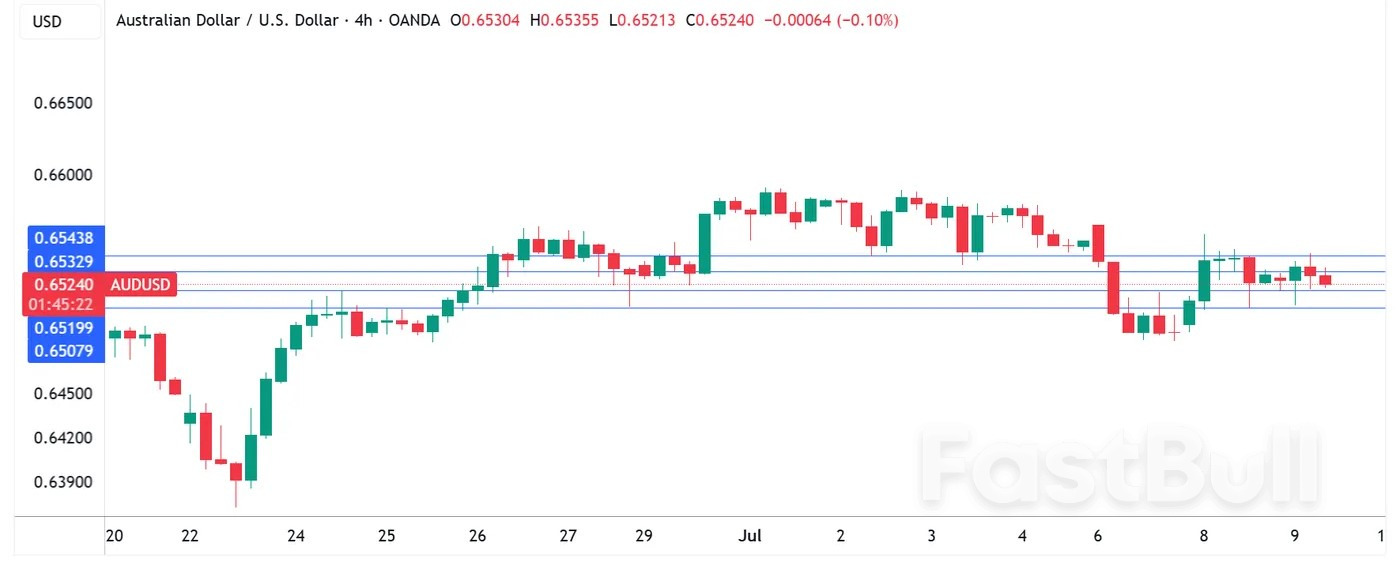
          AUDUSD Technical

          AUD/USD tested resistance at 0.6532 earlier. Above, there is resistance at 0.6543
          0.6519 and 0.6508 are the next support levels
          China's PPI slides, Australian dollar steady_1

          AUDUD 4-Hour Chart, July 9, 2025

          Source: marketpulse

          To stay updated on all economic events of today, please check out our Economic calendar
          Risk Warnings and Disclaimers
          You understand and acknowledge that there is a high degree of risk involved in trading. Following any strategies or investment methods may lead to potential losses. The content on the site is provided by our contributors and analysts for information purposes only. You are solely responsible for determining whether any trading assets, securities, strategy, or any other product is suitable for investing based on your own investment objectives and financial situation.
          Add to Favorites
          Share
          FastBull
          Copyright © 2025 FastBull Ltd

          728 RM B 7/F GEE LOK IND BLDG NO 34 HUNG TO RD KWUN TONG KLN HONG KONG

          TelegramInstagramTwitterfacebooklinkedin
          App Store Google Play Google Play
          Products
          Charts

          Chats

          Q&A with Experts
          Screeners
          Economic Calendar
          Data
          Tools
          Membership
          Features
          Function
          Markets
          Copy Trading
          Latest Signals
          Contests
          News
          Analysis
          24/7
          Columns
          Education
          Company
          Careers
          About Us
          Contact Us
          Advertising
          Help Center
          Feedback
          User Agreement
          Privacy Policy
          Business

          White Label

          Data API

          Web Plug-ins

          Poster Maker

          Affiliate Program

          Risk Disclosure

          The risk of loss in trading financial instruments such as stocks, FX, commodities, futures, bonds, ETFs and crypto can be substantial. You may sustain a total loss of the funds that you deposit with your broker. Therefore, you should carefully consider whether such trading is suitable for you in light of your circumstances and financial resources.

          No decision to invest should be made without thoroughly conducting due diligence by yourself or consulting with your financial advisors. Our web content might not suit you since we don't know your financial conditions and investment needs. Our financial information might have latency or contain inaccuracy, so you should be fully responsible for any of your trading and investment decisions. The company will not be responsible for your capital loss.

          Without getting permission from the website, you are not allowed to copy the website's graphics, texts, or trademarks. Intellectual property rights in the content or data incorporated into this website belong to its providers and exchange merchants.

          Not Logged In

          Log in to access more features

          FastBull Membership

          Not yet

          Purchase

          Become a signal provider
          Help Center
          Customer Service
          Dark Mode
          Price Up/Down Colors

          Log In

          Sign Up

          Position
          Layout
          Fullscreen
          Default to Chart
          The chart page opens by default when you visit fastbull.com