• Trade
  • Markets
  • Copy
  • Contests
  • News
  • 24/7
  • Calendar
  • Q&A
  • Chats
Trending
Screeners
SYMBOL
LAST
BID
ASK
HIGH
LOW
NET CHG.
%CHG.
SPREAD
SPX
S&P 500 Index
6870.39
6870.39
6870.39
6895.79
6858.28
+13.27
+ 0.19%
--
DJI
Dow Jones Industrial Average
47954.98
47954.98
47954.98
48133.54
47871.51
+104.05
+ 0.22%
--
IXIC
NASDAQ Composite Index
23578.12
23578.12
23578.12
23680.03
23506.00
+72.99
+ 0.31%
--
USDX
US Dollar Index
98.830
98.910
98.830
98.960
98.810
-0.120
-0.12%
--
EURUSD
Euro / US Dollar
1.16525
1.16532
1.16525
1.16539
1.16341
+0.00099
+ 0.09%
--
GBPUSD
Pound Sterling / US Dollar
1.33378
1.33387
1.33378
1.33399
1.33151
+0.00066
+ 0.05%
--
XAUUSD
Gold / US Dollar
4199.74
4200.13
4199.74
4211.68
4190.61
+1.83
+ 0.04%
--
WTI
Light Sweet Crude Oil
59.830
59.867
59.830
60.063
59.752
+0.021
+ 0.04%
--

Community Accounts

Signal Accounts
--
Profit Accounts
--
Loss Accounts
--
View More

Become a signal provider

Sell trading signals to earn additional income

View More

Guide to Copy Trading

Get started with ease and confidence

View More

Signal Accounts for Members

All Signal Accounts

Best Return
  • Best Return
  • Best P/L
  • Best MDD
Past 1W
  • Past 1W
  • Past 1M
  • Past 1Y

All Contests

  • All
  • Trump Updates
  • Recommend
  • Stocks
  • Cryptocurrencies
  • Central Banks
  • Featured News
Top News Only
Share

China's CSI Ai Index Up More Than 3%

Share

Australia Treasurer Chalmers: Mid-Year Teview Will Not Be A Mini-Budget, Will Include Savings

Share

Australia Treasurer Chalmers: Will Not Extend Electrictiy Rebates

Share

Most Active China Coke Contract Falls 6.1% To 1532 Yuan/Metric Ton

Share

Most Active China Coking Coal Contract Falls As Much As 6.6% To 1088.5 Yuan/Metric Ton

Share

China's Yuan Opens Trade At 7.0683 Per Dollar Versus Last Close At 7.0720

Share

Most Active China Coke Contract Falls 4.8%

Share

Most Active China Coking Coal Contract Falls More Than 5%

Share

China's Central Bank Sets Yuan Mid-Point At 7.0764 / Dlr Versus Last Close 7.0720

Share

Japan Chief Cabinet Secretary Kihara: Have Seen No Change In China's Export Of Rare Earths To Japan

Share

[Market Update] Spot Silver Fell Below $58/ounce, Down 0.47% On The Day

Share

Japan Chief Cabinet Secretary Kihara: Will Continue To Work Closely With USA With Heightening Regional Tension In Mind

Share

Japan Chief Cabinet Secretary Kihara: Japan Will Decide On Its Own What Is Appropriate For Its Defence Spending

Share

Japan Chief Cabinet Secretary Kihara: Ratio Of Defence Spending Versus GDP Is Not The Important Issue

Share

Taiwan Overnight Interbank Rate Opens At 0.805 Percent (Versus 0.805 Percent At Previous Session Open)

Share

USGS - Magnitude 5.8 Earthquake Strikes Yakutat, Alaska Region

Share

Japan Chief Cabinet Secretary Kihara: Very Important To Get Understanding Of Other Countries, Including USA, Over Japan's Stance

Share

[JPMorgan CEO Jamie Dimon Says Europe Has Big Problems And Internal Divisions Will Be A Major Challenge] JPMorgan Chase CEO Jamie Dimon Stated That European Bureaucracy Is Inefficient And Warned That A Weak European Continent Poses A Significant Economic Risk To The United States. Europe Has Big Problems. They've Done A Very Good Job With Social Security. But They've Also Driven Away Businesses, Investment, And Innovation. This Situation Is Gradually Improving. He Praised Some European Leaders, Saying They Are Aware Of These Problems, But He Also Cautioned That Politics Is "really Difficult."

Share

Thai Army Spokesman Says Military Launched Air Strikes In Disputed Border Area With Cambodia

Share

Bank Of Japan - Japan Nov Outstanding Bank Loans +4.2% Year-On-Year

TIME
ACT
FCST
PREV
Canada Labor Force Participation Rate (SA) (Nov)

A:--

F: --

P: --

U.S. Personal Income MoM (Sept)

A:--

F: --

P: --

U.S. PCE Price Index YoY (SA) (Sept)

A:--

F: --

P: --

U.S. PCE Price Index MoM (Sept)

A:--

F: --

P: --

U.S. Personal Outlays MoM (SA) (Sept)

A:--

F: --

P: --

U.S. Core PCE Price Index MoM (Sept)

A:--

F: --

P: --

U.S. Core PCE Price Index YoY (Sept)

A:--

F: --

P: --

U.S. UMich 5-Year-Ahead Inflation Expectations Prelim YoY (Dec)

A:--

F: --

P: --

U.S. Real Personal Consumption Expenditures MoM (Sept)

A:--

F: --

P: --

U.S. 5-10 Year-Ahead Inflation Expectations (Dec)

A:--

F: --

P: --

U.S. UMich Current Economic Conditions Index Prelim (Dec)

A:--

F: --

P: --

U.S. UMich Consumer Sentiment Index Prelim (Dec)

A:--

F: --

P: --

U.S. UMich 1-Year-Ahead Inflation Expectations Prelim (Dec)

A:--

F: --

P: --

U.S. UMich Consumer Expectations Index Prelim (Dec)

A:--

F: --

P: --

U.S. Weekly Total Rig Count

A:--

F: --

P: --

U.S. Weekly Total Oil Rig Count

A:--

F: --

P: --

U.S. Unit Labor Cost Prelim (SA) (Q3)

--

F: --

P: --

U.S. Consumer Credit (SA) (Oct)

A:--

F: --

P: --

China, Mainland Foreign Exchange Reserves (Nov)

A:--

F: --

P: --

China, Mainland Exports YoY (USD) (Nov)

--

F: --

P: --

China, Mainland Imports YoY (CNH) (Nov)

--

F: --

P: --

China, Mainland Imports YoY (USD) (Nov)

--

F: --

P: --

China, Mainland Imports (CNH) (Nov)

--

F: --

P: --

China, Mainland Trade Balance (CNH) (Nov)

--

F: --

P: --

China, Mainland Exports (Nov)

--

F: --

P: --

Japan Wages MoM (Oct)

A:--

F: --

P: --

Japan Trade Balance (Oct)

A:--

F: --

P: --

Japan Nominal GDP Revised QoQ (Q3)

A:--

F: --

P: --

Japan Trade Balance (Customs Data) (SA) (Oct)

A:--

F: --

P: --

Japan GDP Annualized QoQ Revised (Q3)

A:--

F: --

P: --
China, Mainland Exports YoY (CNH) (Nov)

--

F: --

P: --

China, Mainland Trade Balance (USD) (Nov)

--

F: --

P: --

Germany Industrial Output MoM (SA) (Oct)

--

F: --

P: --

Euro Zone Sentix Investor Confidence Index (Dec)

--

F: --

P: --

Canada Leading Index MoM (Nov)

--

F: --

P: --

Canada National Economic Confidence Index

--

F: --

P: --

U.S. Dallas Fed PCE Price Index YoY (Sept)

--

F: --

P: --

China, Mainland Trade Balance (USD) (Nov)

--

F: --

P: --

U.S. 3-Year Note Auction Yield

--

F: --

P: --

U.K. BRC Overall Retail Sales YoY (Nov)

--

F: --

P: --

U.K. BRC Like-For-Like Retail Sales YoY (Nov)

--

F: --

P: --

Australia Overnight (Borrowing) Key Rate

--

F: --

P: --

RBA Rate Statement
RBA Press Conference
Germany Exports MoM (SA) (Oct)

--

F: --

P: --

U.S. NFIB Small Business Optimism Index (SA) (Nov)

--

F: --

P: --

Mexico Core CPI YoY (Nov)

--

F: --

P: --

Mexico 12-Month Inflation (CPI) (Nov)

--

F: --

P: --

Mexico PPI YoY (Nov)

--

F: --

P: --

Mexico CPI YoY (Nov)

--

F: --

P: --

U.S. Weekly Redbook Index YoY

--

F: --

P: --

U.S. JOLTS Job Openings (SA) (Oct)

--

F: --

P: --

China, Mainland M2 Money Supply YoY (Nov)

--

F: --

P: --

China, Mainland M0 Money Supply YoY (Nov)

--

F: --

P: --

China, Mainland M1 Money Supply YoY (Nov)

--

F: --

P: --

U.S. EIA Short-Term Crude Production Forecast For The Next Year (Dec)

--

F: --

P: --

U.S. EIA Short-Term Crude Production Forecast For The Year (Dec)

--

F: --

P: --

U.S. EIA Natural Gas Production Forecast For The Next Year (Dec)

--

F: --

P: --

EIA Monthly Short-Term Energy Outlook
U.S. 10-Year Note Auction Avg. Yield

--

F: --

P: --

U.S. API Weekly Cushing Crude Oil Stocks

--

F: --

P: --

Q&A with Experts
    • All
    • Chatrooms
    • Groups
    • Friends
    Connecting
    .
    .
    .
    Type here...
    Add Symbol or Code

      No matching data

      All
      Trump Updates
      Recommend
      Stocks
      Cryptocurrencies
      Central Banks
      Featured News
      • All
      • Russia-Ukraine Conflict
      • Middle East Flashpoint
      • All
      • Russia-Ukraine Conflict
      • Middle East Flashpoint
      Search
      Products

      Charts Free Forever

      Chats Q&A with Experts
      Screeners Economic Calendar Data Tools
      Membership Features
      Data Warehouse Market Trends Institutional Data Policy Rates Macro

      Market Trends

      Market Sentiment Order Book Forex Correlations

      Top Indicators

      Charts Free Forever
      Markets

      News

      News Analysis 24/7 Columns Education
      From Institutions From Analysts
      Topics Columnists

      Latest Views

      Latest Views

      Trending Topics

      Top Columnists

      Latest Update

      Signals

      Copy Rankings Latest Signals Become a signal provider AI Rating
      Contests
      Brokers

      Overview Brokers Assessment Rankings Regulators News Claims
      Broker listing Forex Brokers Comparison Tool Live Spread Comparison Scam
      Q&A Complaint Scam Alert Videos Tips to Detect Scam
      More

      Business
      Events
      Careers About Us Advertising Help Center

      White Label

      Data API

      Web Plug-ins

      Affiliate Program

      Awards Institution Evaluation IB Seminar Salon Event Exhibition
      Vietnam Thailand Singapore Dubai
      Fans Party Investment Sharing Session
      FastBull Summit BrokersView Expo
      Recent Searches
        Top Searches
          Markets
          News
          Analysis
          User
          24/7
          Economic Calendar
          Education
          Data
          • Names
          • Latest
          • Prev

          View All

          No data

          Scan to Download

          Faster Charts, Chat Faster!

          Download App
          English
          • English
          • Español
          • العربية
          • Bahasa Indonesia
          • Bahasa Melayu
          • Tiếng Việt
          • ภาษาไทย
          • Français
          • Italiano
          • Türkçe
          • Русский язык
          • 简中
          • 繁中
          Open Account
          Search
          Products
          Charts Free Forever
          Markets
          News
          Signals

          Copy Rankings Latest Signals Become a signal provider AI Rating
          Contests
          Brokers

          Overview Brokers Assessment Rankings Regulators News Claims
          Broker listing Forex Brokers Comparison Tool Live Spread Comparison Scam
          Q&A Complaint Scam Alert Videos Tips to Detect Scam
          More

          Business
          Events
          Careers About Us Advertising Help Center

          White Label

          Data API

          Web Plug-ins

          Affiliate Program

          Awards Institution Evaluation IB Seminar Salon Event Exhibition
          Vietnam Thailand Singapore Dubai
          Fans Party Investment Sharing Session
          FastBull Summit BrokersView Expo

          Integrating Robotics and Timber: A Technological and Sustainable Shift in UK Housing Construction

          Gerik

          Economic

          Commodity

          Summary:

          Britain’s housing sector is exploring a transformative path using robotics and timber to address labor shortages, reduce costs, and meet sustainability goals...

          Addressing Britain's Construction Bottlenecks
          The UK government’s pledge to build 300,000 new homes per year has put immense pressure on an industry already struggling with labor shortages, aging workforce demographics, and environmental responsibilities. In response, companies are increasingly looking to robotics and timber a pairing of modern automation with one of the oldest building materials as a solution that balances speed, cost-efficiency, and sustainability. While this approach has gained traction among several major developers, widespread adoption remains hindered by institutional, financial, and structural obstacles.
          Inside the Donaldson Timber Systems (DTS) factory in Oxfordshire, robot arms guided by artificial intelligence construct housing frames with minimal human intervention. The factory can produce timber panels for approximately 100 homes per week. The digital integration of AI streamlines design processes, eliminating traditional paper-based methods and boosting speed and precision.
          DTS reports that using robotics for off-site manufacturing reduces home construction time by up to 10 weeks compared to traditional masonry. This improvement reflects a cause-effect relationship between robotic automation and time efficiency: automated cutting and pre-assembly eliminate many on-site tasks that typically delay project timelines.
          Moreover, a cost analysis by Rider Levett Bucknall demonstrates that timber construction is 2.8% cheaper than masonry, indicating not just speed gains but also economic incentives. Here, cost savings correlate with the substitution of heavier, labor-intensive materials with prefabricated timber sections.

          The Timber Paradox: Low Usage Despite High Potential

          Despite its advantages, timber-frame homes account for a small share of the UK housing market. England trails behind comparable economies in timber construction, primarily due to concerns over durability, rot, and fire safety issues rooted more in historical perception than in current standards. Past failures, such as Barratt Homes’ timber initiative in the 1980s, created long-standing hesitation among consumers and insurers.
          Nonetheless, the Structural Timber Association argues that updated safety protocols and building regulations have addressed many of these concerns. The STA also estimates that off-site timber construction could contribute up to one-third of the government’s housing target, suggesting a strong positive relationship between timber adoption and housing output if trust and regulatory alignment are improved.

          Environmental and Material Considerations

          From a sustainability perspective, timber has clear advantages. According to Bellway’s head of sustainability, timber stores more carbon than it releases, offering a more climate-friendly profile compared to concrete blocks, which rank highest in carbon emissions among commonly used materials.
          However, this environmental benefit is somewhat offset by the fact that 80% of the UK’s timber is imported, compared to 20% of its brick supply. This inverse sourcing pattern raises questions about whether the embodied emissions from timber transport could undermine its green credentials. Therefore, the sustainability benefits of timber construction depend heavily on future efforts to increase local timber production or improve the carbon efficiency of import logistics.

          Labor Dynamics and the Role of Robotics

          The UK's construction sector faces a demographic challenge, with 20% of workers over the age of 50 and 25% of those expected to retire within the next decade. Robotics is positioned as a strategic response to this labor drain. While automation directly compensates for workforce shortages, it also indirectly attracts younger, tech-savvy talent an observed trend at DTS, where the introduction of robotics has generated greater interest in manufacturing careers.
          This represents a causal link: the implementation of new technology leads not only to operational improvements but also to a shift in workforce composition, potentially easing recruitment challenges in a traditionally aging industry.

          Policy Support and Institutional Lag

          Despite isolated progress, the UK lags in robotic deployment compared to international peers. According to ING, the UK had only 0.5 robots per 10,000 construction workers in 2023, compared to 1.5 in Europe and 0.6 in the US. This indicates a significant opportunity for growth if national policy can better support automation investment.
          In June 2025, the British government allocated £40 million to support robotics hubs, but the structural inertia in construction may limit short-term impact. Moreover, market hesitation persists regarding mortgages for timber-frame properties, which are perceived as riskier. Financial advisors argue that clear governmental endorsement of timber could shift this sentiment and unlock greater private financing.

          A Fragile but Promising Transition

          The convergence of robotics and timber in the UK housing sector represents a promising but incomplete solution to long-standing industry challenges. The synergy between prefabrication and automation can reduce costs, accelerate timelines, and mitigate labor shortages. Additionally, the environmental credentials of timber align with broader sustainability mandates.
          Yet the realization of this potential depends on addressing regulatory, financial, and supply chain barriers. The relationship between technology adoption and construction outcomes is not merely correlative it reveals causal dynamics that could reshape housing development if institutional support aligns with industry innovation. As more firms like Vistry, Taylor Wimpey, and Bellway embrace this dual model, the trajectory of British homebuilding could be on the brink of a significant transformation.

          Source: Reuters

          To stay updated on all economic events of today, please check out our Economic calendar
          Risk Warnings and Disclaimers
          You understand and acknowledge that there is a high degree of risk involved in trading. Following any strategies or investment methods may lead to potential losses. The content on the site is provided by our contributors and analysts for information purposes only. You are solely responsible for determining whether any trading assets, securities, strategy, or any other product is suitable for investing based on your own investment objectives and financial situation.
          Add to Favorites
          Share

          Tariff Pressures Cast a Shadow Over Cooling CPI as Wall Street Warns of Higher Inflation

          Gerik

          Economic

          Inflation Outlook and Tariff Impact

          The key economic debate centers on whether tariff-driven price increases will meaningfully disrupt the disinflationary trend that had been emerging in mid-2025. Goldman Sachs economist David Mericle reiterated that if April’s tariff package follows the same cost-pass-through pattern observed after February’s hikes, U.S. consumers could bear roughly two-thirds of the burden by fall. This transmission mechanism where importers and domestic retailers pass on costs to end buyers is already showing up in select retail categories, suggesting the tariff effect is more than just theoretical.
          Other leading economists share this outlook. UBS’s Brian Rose noted that the “downward trend in core inflation has been broken” as tariffs filter into store shelves. JPMorgan’s Michael Feroli went further, estimating that tariff measures could add between 1% and 1.5% to headline inflation, with part of that impact already realized. This alignment among major banks is notable, particularly after the profession’s misfire in predicting a 2023 recession a reminder that even strong consensus can be wrong, but also that political pushback doesn’t change underlying price pressures.

          Political Counterpoint and Market Psychology

          President Trump’s sharp rebuke of Goldman Sachs even mocking CEO David Solomon’s DJ persona underscores how politically sensitive the inflation narrative has become. For the White House, acknowledging a tariff-driven inflation spike risks undermining the strategic framing of tariffs as a tool for economic leverage rather than a tax on consumers. This tension between political messaging and market analysis creates an additional layer of uncertainty for investors, particularly with Trump weighing 11 candidates for the next Fed chair, some of whom may align more closely with his trade and monetary policy views.
          Despite the inflation warnings, U.S. equity benchmarks have continued to push into record territory, with the S&P 500 and Nasdaq Composite both closing at fresh highs. The rally reflects a combination of strong corporate earnings, optimism in certain tech sectors, and perhaps investor confidence that the Federal Reserve will manage any inflation uptick without triggering a deep slowdown. However, the underlying risk is that sustained tariff inflation could pressure margins and consumer spending, especially if wage growth fails to keep pace.

          Tech Industry’s Strategic Response

          The inflation debate also ties into a broader story: the unprecedented wave of deals between Big Tech and the Trump administration. Nvidia, AMD, and Apple have all recently negotiated arrangements to secure tariff relief or lighter trade restrictions. Analysts such as Paolo Pescatore suggest these moves are designed to avoid multi-million-dollar tariff bills that could erode profitability, especially given recent earnings warnings in the sector. While these deals may mitigate individual corporate exposure, they also reinforce the perception that trade policy is increasingly transactional, with access and exemptions negotiated on a case-by-case basis.
          If Wall Street’s tariff-inflation thesis proves correct, the implications for monetary policy could be significant. The Fed potentially under new leadership aligned with Trump’s economic strategy would face the challenge of balancing higher import-driven prices against broader growth objectives. The risk is that inflation expectations, once anchored, could drift upward, complicating rate policy and eroding real wage gains. Conversely, if the political gamble pays off and inflation remains contained, the administration could claim a rare win in combining protectionist trade measures with price stability a scenario markets would greet with relief.

          Source: CNBC

          To stay updated on all economic events of today, please check out our Economic calendar
          Risk Warnings and Disclaimers
          You understand and acknowledge that there is a high degree of risk involved in trading. Following any strategies or investment methods may lead to potential losses. The content on the site is provided by our contributors and analysts for information purposes only. You are solely responsible for determining whether any trading assets, securities, strategy, or any other product is suitable for investing based on your own investment objectives and financial situation.
          Add to Favorites
          Share

          Chart Art: Is AUD/JPY Extending Its Downtrend?

          Blue River

          Economic

          Forex

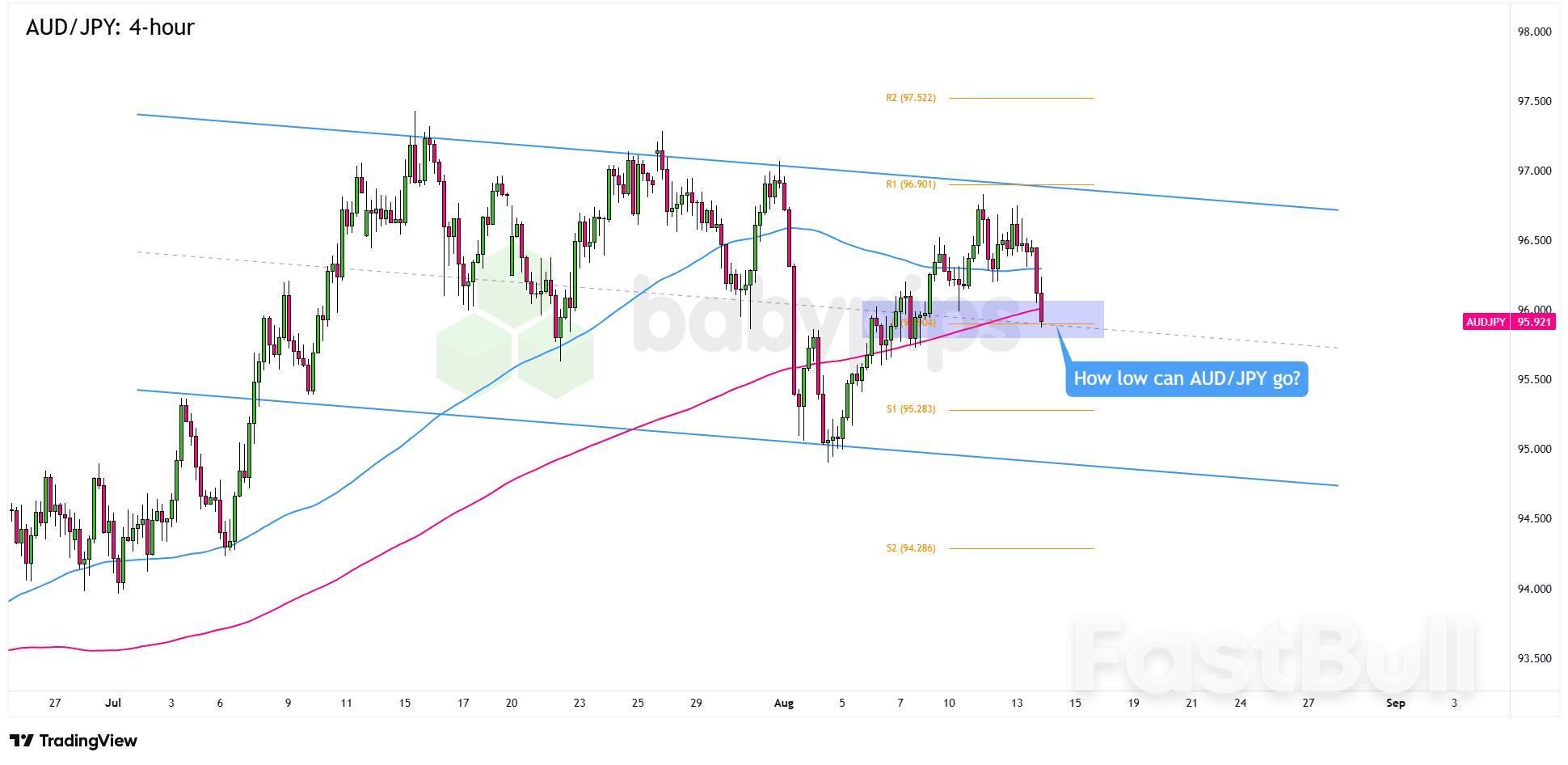
          AUD/JPY is falling sharply after hitting resistance at the 96.50 area!

          How low can AUD/JPY go before the buyers step in again?

          Here’s what we’re seeing on the 4-hour time frame:

          AUD/JPY: 4-hour

          AUD/JPY 4-hour Forex Chart

          The Aussie is finding steady(ish) demand after a not-so-dovish RBA rate cut earlier this week, a little thaw in U.S.-China trade tensions, and a surprisingly solid July jobs report a few hours ago.

          But the Japanese yen’s got the upper hand right now, riding a wave of dollar weakness, safe haven flows, and a boost from U.S. Treasury Secretary Bessent urging the BOJ to hike interest rates.

          AUD/JPY started the month on a tear but ran into a wall near 96.75 before sliding sharply lower this week.

          It’s now hanging out around 96.00, right on the Pivot Point at 95.90, and mid-channel support.

          If it slips under that support and stays there, we could see it drop back toward the 95.00 lows or even set fresh August lows.

          But if buyers step in and we get a clean bounce, the pair could be eyeing another push toward the 96.75 highs or even the 97.00 mark near the R1 at 96.90.

          Whichever bias you end up trading, don’t forget to practice proper risk management and keep up with the potential top-tier catalysts that could influence overall market sentiment!

          Source: BabyPips

          To stay updated on all economic events of today, please check out our Economic calendar
          Risk Warnings and Disclaimers
          You understand and acknowledge that there is a high degree of risk involved in trading. Following any strategies or investment methods may lead to potential losses. The content on the site is provided by our contributors and analysts for information purposes only. You are solely responsible for determining whether any trading assets, securities, strategy, or any other product is suitable for investing based on your own investment objectives and financial situation.
          Add to Favorites
          Share

          Trump’s Revenue-Sharing Chip Deal Sparks Global Debate Over Trade, Security, and Market Access

          Gerik

          Economic

          Policy Shift and Market Implications

          The deal offers Nvidia and AMD a route back into the Chinese market despite stringent U.S. export controls, tariffs, and political tensions. In exchange for a 15% revenue share, companies can sell downgraded chips like Nvidia’s H20, which Treasury Secretary Scott Bessent characterized as several rungs below top-tier AI processors. The administration insists no cutting-edge technology will be sold, but the move raises questions about the integrity of national security safeguards and the consistency of U.S. export policy.
          The policy bypassed normal consultation channels, including the Commerce Department’s Bureau of Industry and Security, fueling speculation that trade policy decision-making is becoming more centralized and unpredictable. Analysts and business leaders are now weighing the risk-reward equation of operating under a system where access to restricted markets might hinge on revenue-sharing agreements with Washington.

          Potential for Expansion Across Industries

          While the current arrangement targets the semiconductor sector, senior officials including Bessent have hinted it could be extended to other strategic industries. This aligns with Trump’s broader economic strategy of leveraging U.S. market access to extract direct financial benefits, whether via “golden shares” in corporations, high-value residency permits, or enhanced tariffs. The approach could open new revenue streams for the federal government, but also risks escalating tensions with trade partners and introducing uncertainty into corporate strategic planning.
          The deal has unsettled China hawks in Congress, with lawmakers like Rep. John Moolenaar warning it could erode the export control regime designed to block adversaries from acquiring AI-enabling technologies. Critics argue the agreement incentivizes U.S. authorities to trade away security restrictions in exchange for revenue, potentially strengthening China’s AI capabilities over time. This tension underscores a broader debate over whether short-term commercial gains justify long-term strategic risks.

          Strategic and Economic Outlook

          From a market perspective, the deal could support Nvidia and AMD’s top-line growth by reopening a massive sales channel, though at the cost of a significant revenue cut. Investors may see this as a partial resolution to China sales losses, but it also introduces political risk future policy changes or retaliatory measures could disrupt these arrangements.
          At the macro level, the move fits within Trump’s transactional approach to trade and foreign policy, where market access, tariffs, and regulatory approvals become tools for direct fiscal gain. Whether this strengthens America’s AI leadership, as administration officials claim, or dilutes its innovation edge will depend on how the policy evolves and whether it sparks copycat arrangements in other sectors or countries.

          Source: Reuters

          To stay updated on all economic events of today, please check out our Economic calendar
          Risk Warnings and Disclaimers
          You understand and acknowledge that there is a high degree of risk involved in trading. Following any strategies or investment methods may lead to potential losses. The content on the site is provided by our contributors and analysts for information purposes only. You are solely responsible for determining whether any trading assets, securities, strategy, or any other product is suitable for investing based on your own investment objectives and financial situation.
          Add to Favorites
          Share

          U.S. Treasury’s Bessent Urges Faster BOJ Tightening as Inflation Risks Persist

          Gerik

          Economic

          Market Overview

          Speaking to Bloomberg Television, Bessent argued that elevated food and raw material costs have kept Japan’s core inflation above the 2% target for more than three years, increasing the risk of second-round effects. While Ueda acknowledges the need to raise rates, he maintains that “underlying inflation” tied to domestic demand and wages is still short of target, justifying a gradual pace of normalization.
          The BOJ’s slow tightening has been blamed for prolonged yen weakness, which has inflated import costs and contributed to broader price growth. This has also created spillover effects into global fixed income markets, with Bessent noting that rising Japanese long-term yields have helped push up U.S. 30-year Treasury yields.

          Policy Implications and Outlook

          Bessent’s stance aligns with the U.S. Treasury’s June exchange-rate report, which urged the BOJ to keep tightening to support a more balanced yen valuation. He refrained from specifying timing for the next rate move but stressed that the yen “will take care of itself” if Japan focuses on fundamentals, growth, and inflation.
          Market expectations for further hikes remain intact. A Reuters poll in July found most economists anticipate a rate increase before year-end. The BOJ’s next meetings in September and October will be closely watched, especially as the October session includes updated growth and inflation forecasts.
          The yen’s trajectory will depend heavily on whether BOJ action aligns with Bessent’s more aggressive timeline or Ueda’s cautious approach. A faster pace of hikes could provide near-term yen support and ease imported inflation pressures, but could also unsettle equity markets if perceived as too abrupt. Conversely, continued gradualism risks prolonging yen weakness and fuelling inflation concerns conditions that may attract further criticism from U.S. policymakers.

          Source: Bloomberg

          To stay updated on all economic events of today, please check out our Economic calendar
          Risk Warnings and Disclaimers
          You understand and acknowledge that there is a high degree of risk involved in trading. Following any strategies or investment methods may lead to potential losses. The content on the site is provided by our contributors and analysts for information purposes only. You are solely responsible for determining whether any trading assets, securities, strategy, or any other product is suitable for investing based on your own investment objectives and financial situation.
          Add to Favorites
          Share

          IC Markets Asia Fundamental Forecast | 14 August 2025

          IC Markets

          Economic

          Commodity

          Forex

          What happened in the U.S session?

          The U.S. session overnight was dominated by the July CPI release and rapidly building expectations for a Fed rate cut in September, with strong equity rallies (especially mega-cap and tech), falling Treasury yields, and a weaker dollar. Commodities and cryptocurrencies reacted to the risk-on environment. Short-term interest rates and housing/mortgage markets moved notably in response.The mild inflation reading increased market expectations for a Fed interest rate cut next month (currently about 98% probability, CME’s FedWatch Tool) . Treasury Secretary Scott Bessent advocated for an aggressive 50 basis-point cut and possibly a series of reductions, intensifying political and market pressure on the Fed.

          What does it mean for the Asia sessions?

          Asian traders should prepare for potentially positive market openings and sectoral opportunities driven by global macro tailwinds and company-specific news. Continued impact of the U.S. rate cut outlook and Fed communications. Corporate earnings from major Asian names.Shifts in retail investor behavior and demat account growth. The sector moves following recent successful IPOs.Developments around China Evergrande and broader property sector implications.Key macro data releases (employment, inflation, trade figures) across Australia, Germany, and the U.S.

          The Dollar Index (DXY)

          The US dollar faces mild weakness going into Thursday, shaped by expectations of a September Fed rate cut and softer US inflation. Key economic releases—especially PPI figures and unemployment claims could spark volatility and influence the dollar’s immediate trajectory. Traders should remain alert to Fed communications and broader market sentiment shifts. The US Dollar continues to underperform, falling sharply against major currencies. The Dollar Index (DXY) dropped to around 97.60, with declines ranging from -0.34% to -0.61% versus other major currencies today.Central Bank Notes:

          ● The Board of Governors of the Federal Reserve System voted unanimously to maintain the Federal Funds Rate in a target range of 4.25% to 4.50% at its meeting on July 29–30, 2025, keeping policy unchanged for the fifth consecutive meeting.
          ● The Committee reiterated its objective of achieving maximum employment and inflation at the rate of 2% over the longer run. While uncertainty around the economic outlook has diminished since earlier in the year, the Committee notes that challenges remain and continued vigilance is warranted.
          ● Policymakers remain highly attentive to risks on both sides of their dual mandate. The unemployment rate remains low, near 4.2%–4.5%, and labor market conditions are described as solid. However, inflation is still somewhat elevated, with the PCE price index at 2.6% and core inflation forecast at 3.1% for year-end 2025, up from earlier projections; tariff-related pressures are cited as a contributing factor.
          ● The Committee acknowledged that recent economic activity has expanded at a solid pace, with second-quarter annualized growth estimates near 2.4%. However, GDP growth for 2025 has been revised downward to 1.4% (from 1.7% projected in March), reflecting expectations of a slowdown in the coming quarters.
          ● In the revised Summary of Economic Projections, the unemployment rate is expected to average 4.5% in 2025, and headline PCE inflation is forecast at 3.0% for the year, with core PCE at 3.1%. Policymakers continue to anticipate that inflation will moderate gradually, with ongoing risks from tariffs and global conditions.
          ● The Committee reaffirmed its data-dependent and risk-aware approach to future policy decisions. Officials stated they are prepared to adjust the stance of monetary policy as appropriate if risks emerge that could impede progress toward the Fed’s goals.
          ● As previously outlined, the Committee continues the measured run-off of its securities holdings. The pace of balance sheet reduction, which slowed since April (monthly redemption cap on Treasury securities reduced from $25B to $5B, while holding agency MBS cap steady at $35B), was left unchanged this month to support orderly market functioning and financial conditions.
          ● The next meeting is scheduled for 16 to 17 September 2025.

          Next 24 Hours Bias

          Medium Bearish

          Gold (XAU)

          Gold prices on August 14, 2025, remain buoyed by expectations for lower U.S. interest rates, steady inflation, and continued global uncertainty. The current market environment supports consolidation with potential bullish breakouts if dovish monetary policies and favorable geopolitical outcomes materialize. The July Consumer Price Index (CPI) increased 2.7% year-over-year, matching June’s rate. The persistence of elevated inflation signals an increased likelihood of a Federal Reserve rate cut in September, benefiting gold and other risk assets.

          Next 24 Hours Bias

          Medium Bullish

          The Australian Dollar (AUD)

          The Australian Dollar is trading strongly heading into Thursday’s jobs data release, with markets watching for confirmation that job growth rebounded and unemployment eased, potentially supporting further AUD strength. The Australian Dollar surged to near two-week highs around 0.6560 ahead of critical July employment data. This upward momentum was helped by the weaker performance of the US Dollar, driven by expectations of extra Federal Reserve easing and US political uncertainty.

          Central Bank Notes:

          ● The RBA held its cash rate steady at 3.85% at the July meeting on 8 July 2025, following a 25bps reduction in May and in line with widespread market expectations after recent data showed inflation tracking within the target band.
          ● Inflation continues to ease from its peak, with higher interest rates helping to rebalance demand and supply across the Australian economy. Data for the June quarter signaled ongoing progress, though underlying pressures persist in certain sectors.
          ● Trimmed mean inflation for the June quarter likely remained near 2.9% and headline CPI around 2.4%, both within the RBA’s 2–3% target range. The Board noted further evidence of inflation convergence, but flagged that not all price categories are moving in tandem.
          ● Financial markets have shown increased volatility in the wake of global tariff and trade policy developments—especially as a result of recent U.S. and EU announcements. This has pushed asset prices higher but contributed to an uncertain outlook for domestic growth and employment.
          ● Private domestic demand showed a tentative recovery. Real household incomes improved, and signs of easing household financial stress emerged, but some business sectors continued to face subdued demand, limiting their ability to pass on cost increases.
          ● Labour market conditions remained tight overall. Employment continued to expand, with low rates of underutilization. Business surveys suggest labour availability remains a constraint, though there are signs of a gradual easing compared to earlier in 2025.
          ● Underlying wage growth softened modestly, though unit labour cost growth remains elevated due to below-trend productivity gains. The Board remains attentive to developments in wage and productivity dynamics as cost pressures continue to evolve.
          ● Uncertainties persist for both domestic activity and inflation. Consumption growth has risen, but more slowly than anticipated three months ago, with global and domestic factors both contributing to the cautious outlook.
          ● There remains a risk that household spending picks up more slowly than forecast, which could result in ongoing subdued aggregate demand and a sharper deterioration in employment conditions.
          ● Given that inflation is expected to remain around the target band, the Board judged that it was appropriate to keep policy settings unchanged in July, maintaining a position that is still mildly restrictive.
          ● The Board continues to monitor all incoming data and assesses risks carefully, with a focus on global trends, domestic demand indicators, inflation outcomes, and the labour market outlook.
          ● The RBA remains committed to its mandate of price stability and full employment and stands ready to adjust policy as needed to achieve these objectives.
          ● The next meeting is on 11 to 12 August 2025.
          Next 24 Hours Bias

          Weak Bullish

          The Kiwi Dollar (NZD)

          On Thursday, August 14, 2025, the New Zealand dollar is trading higher amid US dollar weakness and rising expectations of a Fed rate cut. Domestic factors softer inflation and employment, are building consensus for a near-term RBNZ rate cut. External risks such as US tariffs and correlation with Australian and Chinese data remain influential, making for a cautious short-term outlook for the NZD.NZD/USD is trading around 0.598, up 0.5% over the recent session and at its highest level this week. The Kiwi dollar has strengthened due to a broadly weaker US dollar following softer US inflation data and increasing expectations of a US Federal Reserve rate cut in September.

          Central Bank Notes:

          ● The Monetary Policy Committee (MPC) agreed to hold the Official Cash Rate (OCR) at 3.25% on 9 July, marking the first pause following six consecutive rate cuts.
          ● The MPC cited heightened uncertainty and near-term inflation risks as reasons to wait until August for further action.
          ● Although the annual consumer price index inflation increased to 2.5% in the first quarter of 2025, it remained within the MPC’s target range of 1 to 3%, noting that the outlook for medium-term inflation pressures has evolved broadly in line with the May MPS projections.
          ● While it is expected to be near the upper end of the band in the second and third quarters of this year, easing core inflation and spare capacity in the economy should help return it toward the 2% midpoint over time.
          ● The MPC noted that, despite global factors, domestic financial conditions are evolving broadly as expected, as mortgage and deposit interest rates have continued to decline, reflecting a lower OCR, strong bank liquidity, and soft credit growth.
          ● In aggregate, GDP growth over the December and March quarters was stronger than expected, reflecting a pickup in household consumption and business investment. However, higher-frequency indicators suggest weaker-than-expected growth in April and May.
          ● Large economic policy shifts overseas and concerns about sovereign risk could result in additional financial market volatility and increased bond yields, while prolonged economic uncertainty might induce further precautionary behaviour by households and firms, slowing the domestic economic recovery.
          ● Subject to medium-term inflation pressures continuing to ease in line with the Committee’s central projections, the Committee expects to lower the OCR further, broadly consistent with the projection outlined in May.
          ● The next meeting is on 20 August 2025.

          Next 24 Hours Bias

          Weak Bearish

          The Japanese Yen (JPY)

          The Japanese Yen is trading in a tight range ahead of key economic releases, with investors focused on Japan’s GDP data and the expected trajectory of both the Bank of Japan and the Federal Reserve policies. The outlook is mixed, with near-term volatility likely depending on global risk sentiment and domestic political developments. Modest appreciation this week, but faces headwinds from the global risk-on environment and domestic policy uncertainty. Today’s GDP report is the most important scheduled event. Weak GDP could fuel expectations of more dovish BoJ policy and a weaker yen. A strong print may see the yen rally.

          Central Bank Notes:

          ● The Policy Board of the Bank of Japan decided on 31 July, by a unanimous vote, to set the following guidelines for money market operations for the inter-meeting period:
          ● The Bank will encourage the uncollateralized overnight call rate to remain at around 0.5%.
          ● The BOJ will maintain its gradual reduction of monthly outright purchases of Japanese Government Bonds (JGBs). The scheduled amount of long-term government bond purchases will, in principle, continue to decrease by about ¥400 billion each quarter from January to March 2026, and by about ¥200 billion each quarter from April to June 2026 onward, targeting a purchase level near ¥2 trillion in January to March 2027.
          ● Japan’s economy is experiencing a moderate recovery overall, though some sectors remain sluggish. Overseas economies are generally growing moderately, but recent trade policies in major economies have introduced pockets of weakness. Exports and industrial production in Japan are essentially flat, with any uptick largely driven by front-loaded demand ahead of U.S. tariff increases.
          ● On the price front, the year-on-year rate of change in consumer prices (excluding fresh food) remains in the mid-3% range. This reflects continued wage pass-through, previous import cost surges, and further increases in food prices, particularly rice. Expectations for future inflation have begun to rise moderately.
          ● The effects of the earlier import price and food cost increases are expected to fade during the outlook period. There may be a temporary stagnation in core inflation as overall growth momentum softens.
          ● Looking forward, the economy is likely to see a slower growth pace in the near term as overseas economies feel the pinch of ongoing global trade policies, putting downward pressure on Japanese corporate profits. Accommodative financial conditions are expected to buffer these headwinds somewhat. In the medium term, as global growth recovers, Japan’s growth rate is also expected to improve.
          ● With renewed economic expansion, intensifying labor shortages, and a steady rise in medium- to long-term expected inflation rates, core inflation is projected to gradually pick up. By the latter half of the BOJ’s projection period, inflation is forecast to move in line with the 2% price stability target.
          ● There are multiple risks to the outlook, with especially elevated uncertainty regarding the future path of global trade policies and overseas price trends. The BOJ will continue to closely monitor their impact on financial and foreign exchange markets, as well as on Japan’s economy and inflation.
          ● The next meeting is scheduled for 17 to 18 September 2025.

          Next 24 Hours BiasMedium Bearish

          Oil

          Oil prices remain under pressure amid oversupply, subdued demand, cautious trade optimism, and looming geopolitical events. The outcome of the Trump-Putin meeting on Friday may be pivotal for the short-term direction. Markets currently see downward bias with supply persistently outstripping demand, reinforced by global inventory builds and technical chart breakdowns.Prices rebounded slightly following U.S. Treasury Secretary Scott Bessent’s remarks that additional sanctions on Russia or secondary tariffs may be introduced if Friday’s high-profile meeting between President Trump and President Putin does not yield positive outcomes regarding the Ukraine conflict. This meeting is viewed as a potential catalyst for oil price volatility, with markets bracing for either escalation or détente.Next 24 Hours Bias

          Strong Bearish

          Source: IC Markets

          To stay updated on all economic events of today, please check out our Economic calendar
          Risk Warnings and Disclaimers
          You understand and acknowledge that there is a high degree of risk involved in trading. Following any strategies or investment methods may lead to potential losses. The content on the site is provided by our contributors and analysts for information purposes only. You are solely responsible for determining whether any trading assets, securities, strategy, or any other product is suitable for investing based on your own investment objectives and financial situation.
          Add to Favorites
          Share

          Bitcoin Surges to Fresh Record as Fed Easing Bets and U.S. Regulatory Shift Drive Rally

          Gerik

          Economic

          Market Overview

          In early Asia trading, Bitcoin touched $124,002.49, surpassing its previous peak from July, while ether reached $4,780.04, its highest level since late 2021. The rally reflects a confluence of macro and policy tailwinds: traders are pricing in near-certainty of Fed rate cuts in September, lowering the cost of capital and boosting appetite for risk assets, while Trump administration measures have made the U.S. regulatory climate markedly more crypto-friendly.
          IG market analyst Tony Sycamore noted that a sustained breakout above $125,000 could open the path to $150,000, highlighting the role of technical positioning alongside fundamentals. Institutional demand remains a key driver, amplified by new allowances for crypto assets in 401(k) retirement plans and the recent passage of stablecoin regulations.

          Policy and Structural Drivers

          Trump’s self-styled image as the “crypto president” has been underscored by sweeping policy changes. The latest executive order, signed last week, enables the inclusion of crypto in tax-advantaged retirement accounts—a move that could channel long-term capital into the asset class. This builds on earlier 2025 regulatory wins, including the SEC’s overhaul of securities rules to accommodate crypto products and legislative clarity on stablecoins.
          The policy shift is expected to benefit asset managers such as BlackRock and Fidelity, which have already launched crypto ETFs. This could accelerate mainstream integration of digital assets into diversified portfolios, though it also raises questions about volatility management within traditionally conservative retirement vehicles.

          Broader Market Sentiment

          The cryptocurrency market’s total capitalization has surged to $4.18 trillion from around $2.5 trillion in November 2024, when Trump’s election victory first catalyzed a policy reorientation. The sector has managed to sustain its upward momentum despite broader macro uncertainty, including Trump’s tariff policies, which have unsettled traditional markets but had little dampening effect on crypto demand.
          With the macro backdrop tilting toward monetary easing and U.S. regulatory positioning increasingly supportive, the structural case for crypto adoption is strengthening. However, the combination of parabolic price action and the inherent volatility of digital assets keeps risk management front and center for institutional allocators.

          Source: Reuters

          To stay updated on all economic events of today, please check out our Economic calendar
          Risk Warnings and Disclaimers
          You understand and acknowledge that there is a high degree of risk involved in trading. Following any strategies or investment methods may lead to potential losses. The content on the site is provided by our contributors and analysts for information purposes only. You are solely responsible for determining whether any trading assets, securities, strategy, or any other product is suitable for investing based on your own investment objectives and financial situation.
          Add to Favorites
          Share
          FastBull
          Copyright © 2025 FastBull Ltd

          728 RM B 7/F GEE LOK IND BLDG NO 34 HUNG TO RD KWUN TONG KLN HONG KONG

          TelegramInstagramTwitterfacebooklinkedin
          App Store Google Play Google Play
          Products
          Charts

          Chats

          Q&A with Experts
          Screeners
          Economic Calendar
          Data
          Tools
          Membership
          Features
          Function
          Markets
          Copy Trading
          Latest Signals
          Contests
          News
          Analysis
          24/7
          Columns
          Education
          Company
          Careers
          About Us
          Contact Us
          Advertising
          Help Center
          Feedback
          User Agreement
          Privacy Policy
          Business

          White Label

          Data API

          Web Plug-ins

          Poster Maker

          Affiliate Program

          Risk Disclosure

          The risk of loss in trading financial instruments such as stocks, FX, commodities, futures, bonds, ETFs and crypto can be substantial. You may sustain a total loss of the funds that you deposit with your broker. Therefore, you should carefully consider whether such trading is suitable for you in light of your circumstances and financial resources.

          No decision to invest should be made without thoroughly conducting due diligence by yourself or consulting with your financial advisors. Our web content might not suit you since we don't know your financial conditions and investment needs. Our financial information might have latency or contain inaccuracy, so you should be fully responsible for any of your trading and investment decisions. The company will not be responsible for your capital loss.

          Without getting permission from the website, you are not allowed to copy the website's graphics, texts, or trademarks. Intellectual property rights in the content or data incorporated into this website belong to its providers and exchange merchants.

          Not Logged In

          Log in to access more features

          FastBull Membership

          Not yet

          Purchase

          Become a signal provider
          Help Center
          Customer Service
          Dark Mode
          Price Up/Down Colors

          Log In

          Sign Up

          Position
          Layout
          Fullscreen
          Default to Chart
          The chart page opens by default when you visit fastbull.com