• Trade
  • Markets
  • Copy
  • Contests
  • News
  • 24/7
  • Calendar
  • Q&A
  • Chats
Trending
Screeners
SYMBOL
LAST
BID
ASK
HIGH
LOW
NET CHG.
%CHG.
SPREAD
SPX
S&P 500 Index
6846.50
6846.50
6846.50
6878.28
6827.18
-23.90
-0.35%
--
DJI
Dow Jones Industrial Average
47739.31
47739.31
47739.31
47971.51
47611.93
-215.67
-0.45%
--
IXIC
NASDAQ Composite Index
23545.89
23545.89
23545.89
23698.93
23455.05
-32.22
-0.14%
--
USDX
US Dollar Index
99.000
99.080
99.000
99.000
99.000
+0.050
+ 0.05%
--
EURUSD
Euro / US Dollar
1.16334
1.16389
1.16334
1.16365
1.16322
-0.00030
-0.03%
--
GBPUSD
Pound Sterling / US Dollar
1.33180
1.33281
1.33180
1.33213
1.33140
-0.00025
-0.02%
--
XAUUSD
Gold / US Dollar
4189.70
4190.14
4189.70
4218.85
4175.92
-8.21
-0.20%
--
WTI
Light Sweet Crude Oil
58.555
58.807
58.555
60.084
58.495
-1.254
-2.10%
--

Community Accounts

Signal Accounts
--
Profit Accounts
--
Loss Accounts
--
View More

Become a signal provider

Sell trading signals to earn additional income

View More

Guide to Copy Trading

Get started with ease and confidence

View More

Signal Accounts for Members

All Signal Accounts

Best Return
  • Best Return
  • Best P/L
  • Best MDD
Past 1W
  • Past 1W
  • Past 1M
  • Past 1Y

All Contests

  • All
  • Trump Updates
  • Recommend
  • Stocks
  • Cryptocurrencies
  • Central Banks
  • Featured News
Top News Only
Share

Senior USA Administration Official: We Continue To Monitor Drc-Rwanda Situation Closely, Continue To Work With All Sides To Ensure Commitments Are Honored

Share

Israeli Military Says It Has Struck Infrastructure Belonging To Hezbollah In Several Areas In Southern Lebanon

Share

SPDR Gold Holdings Down 0.11%, Or 1.14 Tonnes

Share

On Monday (December 8), In Late New York Trading, S&P 500 Futures Fell 0.21%, Dow Jones Futures Fell 0.43%, NASDAQ 100 Futures Fell 0.08%, And Russell 2000 Futures Fell 0.04%

Share

Morgan Stanley: Data Center ABS Spreads Are Expected To Widen In 2026

Share

(US Stocks) The Philadelphia Gold And Silver Index Closed Down 2.34% At 311.01 Points. (Global Session) The NYSE Arca Gold Miners Index Closed Down 2.17%, Hitting A Daily Low Of 2235.45 Points; US Stocks Remained Slightly Down Before The Opening Bell—holding Steady Around 2280 Points—before Briefly Rising Slightly

Share

IMF: IMF Executive Board Approves Extension Of The Extended Credit Facility Arrangement With Nepal

Share

Trump: Same Approach Will Apply To Amd, Intel, And Other Great American Companies

Share

Trump: Department Of Commerce Is Finalizing Details

Share

Trump: $25% Will Be Paid To United States Of America

Share

Trump: President Xi Responded Positively

Share

[Consumer Discretionary ETFs Fell Over 1.4%, Leading The Decline Among US Sector ETFs; Semiconductor ETFs Rose Over 1.1%] On Monday (December 8), The Consumer Discretionary ETF Fell 1.45%, The Energy ETF Fell 1.09%, The Internet ETF Fell 0.18%, The Regional Banks ETF Rose 0.34%, The Technology ETF Rose 0.70%, The Global Technology ETF Rose 0.93%, And The Semiconductor ETF Rose 1.13%

Share

Trump: I Have Informed President Xi, Of China, That United States Will Allow Nvidia To Ship Its H200 Products To Approved Customers In China

Share

Argentina's Merval Index Closed Up 0.02% At 3.047 Million Points. It Rose To A New Daily High Of 3.165 Million Points In Early Trading In Buenos Aires Before Gradually Giving Back Its Gains

Share

US Stock Market Closing Report | On Monday (December 8), The Magnificent 7 Index Fell 0.20% To 208.33 Points. The "mega-cap" Tech Stock Index Fell 0.33% To 405.00 Points

Share

Pentagon - USA State Dept Approves Potential Sale Of Hellfire Missiles To Belgium For An Estimated $79 Million

Share

Toronto Stock Index .GSPTSE Unofficially Closes Down 141.44 Points, Or 0.45 Percent, At 31169.97

Share

The Nasdaq Golden Dragon China Index Closed Up Less Than 0.1%. Nxtt Rose 21%, Microalgo Rose 7%, Daqo New Energy Rose 4.3%, And 21Vianet, Baidu, And Miniso All Rose More Than 3%

Share

The S&P 500 Initially Closed Down More Than 0.4%, With The Telecom Sector Down 1.9%, And Materials, Consumer Discretionary, Utilities, Healthcare, And Energy Sectors Down By As Much As 1.6%, While The Technology Sector Rose 0.7%. The NASDAQ 100 Initially Closed Down 0.3%, With Marvell Technology Down 7%, Fortinet Down 4%, And Netflix And Tesla Down 3.4%

Share

IMF: Review Pakistan Authorities To Draw The Equivalent Of About US$1 Billion

TIME
ACT
FCST
PREV
France Trade Balance (SA) (Oct)

A:--

F: --

P: --
Euro Zone Employment YoY (SA) (Q3)

A:--

F: --

P: --
Canada Part-Time Employment (SA) (Nov)

A:--

F: --

P: --

Canada Unemployment Rate (SA) (Nov)

A:--

F: --

P: --

Canada Full-time Employment (SA) (Nov)

A:--

F: --

P: --

Canada Labor Force Participation Rate (SA) (Nov)

A:--

F: --

P: --

Canada Employment (SA) (Nov)

A:--

F: --

P: --

U.S. PCE Price Index MoM (Sept)

A:--

F: --

P: --

U.S. Personal Income MoM (Sept)

A:--

F: --

P: --

U.S. Core PCE Price Index MoM (Sept)

A:--

F: --

P: --

U.S. PCE Price Index YoY (SA) (Sept)

A:--

F: --

P: --

U.S. Core PCE Price Index YoY (Sept)

A:--

F: --

P: --

U.S. Personal Outlays MoM (SA) (Sept)

A:--

F: --

P: --
U.S. 5-10 Year-Ahead Inflation Expectations (Dec)

A:--

F: --

P: --

U.S. Real Personal Consumption Expenditures MoM (Sept)

A:--

F: --

P: --
U.S. Weekly Total Rig Count

A:--

F: --

P: --

U.S. Weekly Total Oil Rig Count

A:--

F: --

P: --

U.S. Consumer Credit (SA) (Oct)

A:--

F: --

P: --
China, Mainland Foreign Exchange Reserves (Nov)

A:--

F: --

P: --

Japan Trade Balance (Oct)

A:--

F: --

P: --

Japan Nominal GDP Revised QoQ (Q3)

A:--

F: --

P: --

China, Mainland Imports YoY (CNH) (Nov)

A:--

F: --

P: --

China, Mainland Exports (Nov)

A:--

F: --

P: --

China, Mainland Imports (CNH) (Nov)

A:--

F: --

P: --

China, Mainland Trade Balance (CNH) (Nov)

A:--

F: --

P: --

China, Mainland Exports YoY (USD) (Nov)

A:--

F: --

P: --

China, Mainland Imports YoY (USD) (Nov)

A:--

F: --

P: --

Germany Industrial Output MoM (SA) (Oct)

A:--

F: --

P: --
Euro Zone Sentix Investor Confidence Index (Dec)

A:--

F: --

P: --

Canada National Economic Confidence Index

A:--

F: --

P: --

U.K. BRC Like-For-Like Retail Sales YoY (Nov)

--

F: --

P: --

U.K. BRC Overall Retail Sales YoY (Nov)

--

F: --

P: --

Australia Overnight (Borrowing) Key Rate

--

F: --

P: --

RBA Rate Statement
RBA Press Conference
Germany Exports MoM (SA) (Oct)

--

F: --

P: --

U.S. NFIB Small Business Optimism Index (SA) (Nov)

--

F: --

P: --

Mexico 12-Month Inflation (CPI) (Nov)

--

F: --

P: --

Mexico Core CPI YoY (Nov)

--

F: --

P: --

Mexico PPI YoY (Nov)

--

F: --

P: --

U.S. Weekly Redbook Index YoY

--

F: --

P: --

U.S. JOLTS Job Openings (SA) (Oct)

--

F: --

P: --

China, Mainland M1 Money Supply YoY (Nov)

--

F: --

P: --

China, Mainland M0 Money Supply YoY (Nov)

--

F: --

P: --

China, Mainland M2 Money Supply YoY (Nov)

--

F: --

P: --

U.S. EIA Short-Term Crude Production Forecast For The Year (Dec)

--

F: --

P: --

U.S. EIA Natural Gas Production Forecast For The Next Year (Dec)

--

F: --

P: --

U.S. EIA Short-Term Crude Production Forecast For The Next Year (Dec)

--

F: --

P: --

EIA Monthly Short-Term Energy Outlook
U.S. API Weekly Gasoline Stocks

--

F: --

P: --

U.S. API Weekly Cushing Crude Oil Stocks

--

F: --

P: --

U.S. API Weekly Crude Oil Stocks

--

F: --

P: --

U.S. API Weekly Refined Oil Stocks

--

F: --

P: --

South Korea Unemployment Rate (SA) (Nov)

--

F: --

P: --

Japan Reuters Tankan Non-Manufacturers Index (Dec)

--

F: --

P: --

Japan Reuters Tankan Manufacturers Index (Dec)

--

F: --

P: --

Japan Domestic Enterprise Commodity Price Index MoM (Nov)

--

F: --

P: --

Japan Domestic Enterprise Commodity Price Index YoY (Nov)

--

F: --

P: --

China, Mainland PPI YoY (Nov)

--

F: --

P: --

China, Mainland CPI MoM (Nov)

--

F: --

P: --

Italy Industrial Output YoY (SA) (Oct)

--

F: --

P: --

Q&A with Experts
    • All
    • Chatrooms
    • Groups
    • Friends
    Connecting
    .
    .
    .
    Type here...
    Add Symbol or Code

      No matching data

      All
      Trump Updates
      Recommend
      Stocks
      Cryptocurrencies
      Central Banks
      Featured News
      • All
      • Russia-Ukraine Conflict
      • Middle East Flashpoint
      • All
      • Russia-Ukraine Conflict
      • Middle East Flashpoint
      Search
      Products

      Charts Free Forever

      Chats Q&A with Experts
      Screeners Economic Calendar Data Tools
      Membership Features
      Data Warehouse Market Trends Institutional Data Policy Rates Macro

      Market Trends

      Market Sentiment Order Book Forex Correlations

      Top Indicators

      Charts Free Forever
      Markets

      News

      News Analysis 24/7 Columns Education
      From Institutions From Analysts
      Topics Columnists

      Latest Views

      Latest Views

      Trending Topics

      Top Columnists

      Latest Update

      Signals

      Copy Rankings Latest Signals Become a signal provider AI Rating
      Contests
      Brokers

      Overview Brokers Assessment Rankings Regulators News Claims
      Broker listing Forex Brokers Comparison Tool Live Spread Comparison Scam
      Q&A Complaint Scam Alert Videos Tips to Detect Scam
      More

      Business
      Events
      Careers About Us Advertising Help Center

      White Label

      Data API

      Web Plug-ins

      Affiliate Program

      Awards Institution Evaluation IB Seminar Salon Event Exhibition
      Vietnam Thailand Singapore Dubai
      Fans Party Investment Sharing Session
      FastBull Summit BrokersView Expo
      Recent Searches
        Top Searches
          Markets
          News
          Analysis
          User
          24/7
          Economic Calendar
          Education
          Data
          • Names
          • Latest
          • Prev

          View All

          No data

          Scan to Download

          Faster Charts, Chat Faster!

          Download App
          English
          • English
          • Español
          • العربية
          • Bahasa Indonesia
          • Bahasa Melayu
          • Tiếng Việt
          • ภาษาไทย
          • Français
          • Italiano
          • Türkçe
          • Русский язык
          • 简中
          • 繁中
          Open Account
          Search
          Products
          Charts Free Forever
          Markets
          News
          Signals

          Copy Rankings Latest Signals Become a signal provider AI Rating
          Contests
          Brokers

          Overview Brokers Assessment Rankings Regulators News Claims
          Broker listing Forex Brokers Comparison Tool Live Spread Comparison Scam
          Q&A Complaint Scam Alert Videos Tips to Detect Scam
          More

          Business
          Events
          Careers About Us Advertising Help Center

          White Label

          Data API

          Web Plug-ins

          Affiliate Program

          Awards Institution Evaluation IB Seminar Salon Event Exhibition
          Vietnam Thailand Singapore Dubai
          Fans Party Investment Sharing Session
          FastBull Summit BrokersView Expo

          Goldman Expects BOJ to Slowly Unwind $252 Billion ETF Holdings via Market Sales

          Gerik

          Economic

          Summary:

          Goldman Sachs predicts that the Bank of Japan will gradually sell its massive ETF portfolio through open market operations instead of transferring it to public or government entities...

          BOJ Expected to Pursue Cautious ETF Exit Strategy Through Gradual Market Sales

          Goldman Sachs analysts forecast that the Bank of Japan (BOJ) will opt for a measured, long-term plan to reduce its 37-trillion-yen ETF holdings valued at approximately 70 trillion yen on the market through small-scale sales in the open market, rather than pursuing more disruptive alternatives like transferring assets to public or government-controlled entities.
          The BOJ has remained vague about the timeline and mechanism of offloading the ETFs it amassed during 13 years of aggressive asset purchases as part of its ultra-loose monetary policy. While ETF buying officially halted in 2024, the central bank continues to face mounting pressure over the exit strategy for what now amounts to $252 billion in book value assets, with market value nearly double that amount.

          Key Objectives: No Losses, Minimal Market Distortion, Price Stability

          Goldman’s report, authored in part by Akira Otani, a former BOJ official and financial markets department head, emphasizes that any exit plan must meet three critical conditions outlined by the BOJ: avoid realizing losses, minimize market volatility, and maintain appropriate selling prices. According to Goldman, a gradual divestment strategy in the open market is the only practical method that aligns with all three objectives.
          While some experts have suggested more aggressive or centralized options such as transferring the ETFs to government-backed institutions or redistributing them to the public Goldman views such alternatives as either politically complex or potentially destabilizing for markets.

          Proposed Timeline: Fiscal 2026–2027 Onward

          The report proposes that the BOJ could begin its divestment around fiscal 2026 or 2027, at an annual pace of approximately 600 billion to 1 trillion yen in book value. This slow, steady rhythm would reduce risks of flooding the equity market and provide time for investors to absorb the sales.
          BOJ Governor Kazuo Ueda has maintained a cautious stance, stating that the bank needs further time to study the most appropriate strategy. The prolonged silence suggests that internal debate is ongoing and that any hasty action could undermine financial stability, especially given the BOJ’s influential presence in Japan’s equity markets.

          Market Implications: Delicate Balance Between Exit and Stability

          If the BOJ proceeds with Goldman’s forecasted strategy, Japanese equities could avoid short-term shocks, though the overhang of future ETF sales may weigh on sentiment. Conversely, a transparent and pre-communicated schedule could ease investor concerns and reduce volatility, much like the Fed's balance sheet runoff strategy in the U.S.
          The BOJ’s handling of this delicate unwind will be a litmus test for post-QE central bank normalization, especially for institutions with large-scale equity exposures. As global central banks retreat from pandemic-era stimulus measures, Japan’s unique challenge will be executing a market-sensitive exit without igniting instability.
          In short, while the BOJ’s ETF exit remains on the horizon, the favored path forward appears to be one of patience, gradualism, and precision a reflection of Japan’s signature central banking style.

          Source: Reuters

          To stay updated on all economic events of today, please check out our Economic calendar
          Risk Warnings and Disclaimers
          You understand and acknowledge that there is a high degree of risk involved in trading. Following any strategies or investment methods may lead to potential losses. The content on the site is provided by our contributors and analysts for information purposes only. You are solely responsible for determining whether any trading assets, securities, strategy, or any other product is suitable for investing based on your own investment objectives and financial situation.
          Add to Favorites
          Share

          USD/JPY Climbs As Yen Struggles Amid Trade Tensions

          Blue River

          Economic

          Forex

          On Friday, the USD/JPY pair advanced to 146.93, marking a three-week high as the US dollar continued to strengthen against a backdrop of escalating global trade tensions.

          Recent developments in US trade policy have further unsettled markets. US President Donald Trump announced additional tariffs, including a 35% levy on Canadian imports, alongside plans for sweeping 15-20% duties on most other trading partners.

          Of particular concern are US-Japan relations, following Trump’s imposition of a 25% tariff on Japanese goods this week, set to take effect on 1 August. The move has intensified bilateral strains, with Japanese Prime Minister Shigeru Ishiba warning of the need to reduce Japan’s reliance on the US in defence, food security, and energy.

          Ishiba described the ongoing negotiations as a “battle for national interests”. At the same time, a leading Japanese think tank projected that the tariffs could shave 0.8% off Japan’s GDP in 2025, with a cumulative decline of 1.9% by 2029.

          Technical Analysis: USD/JPY

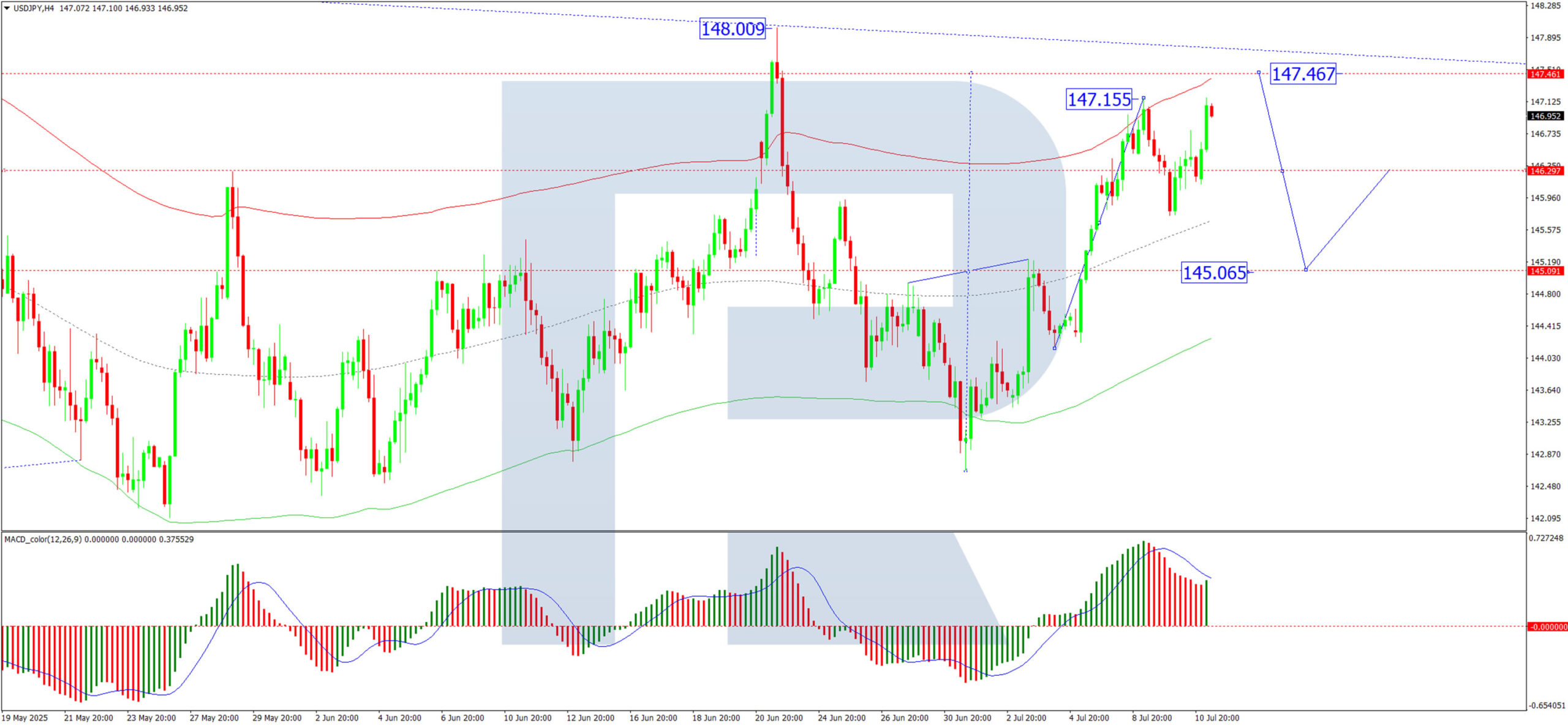
          H4 Chart:

          The USD/JPY has established a consolidation range around 145.65, now extending to 147.17. A short-term pullback to 145.65 (testing from above) is anticipated, followed by a potential upward wave targeting 147.47 at minimum. This outlook is supported by the MACD indicator, with its signal line firmly above zero and trending upward.

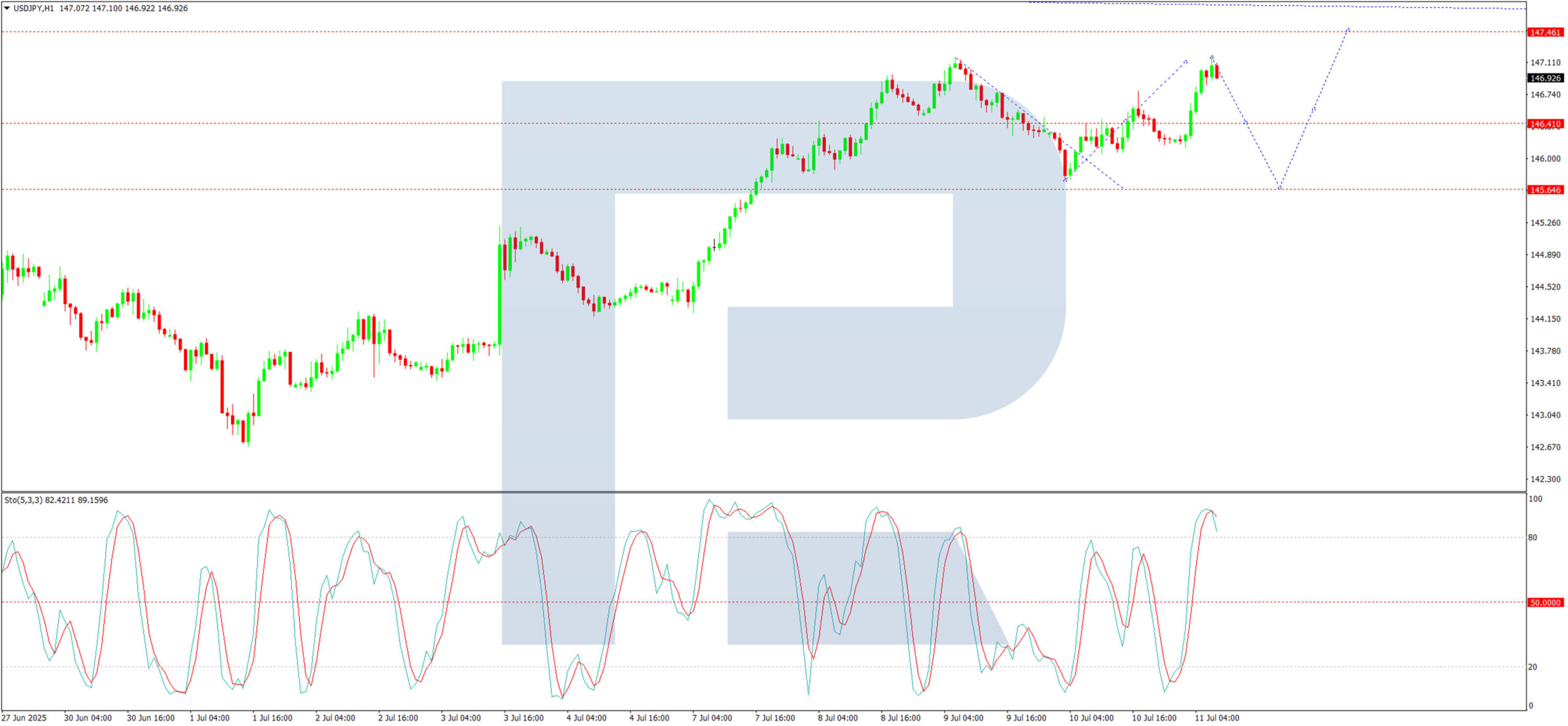
          H1 Chart:

          A consolidation phase near 146.41 preceded an upward breakout, completing a wave structure at 147.17. A downward correction towards 145.65 is now in view, corroborated by the Stochastic oscillator, where the signal line sits at 80 and points sharply downward.

          Conclusion

          The yen’s weakness persists amid dollar strength and trade uncertainties, with technical indicators suggesting near-term volatility. Traders should monitor 145.65 as a key support level, while further upside towards 147.47 remains plausible.

          Source: ACTIONFOREX

          To stay updated on all economic events of today, please check out our Economic calendar
          Risk Warnings and Disclaimers
          You understand and acknowledge that there is a high degree of risk involved in trading. Following any strategies or investment methods may lead to potential losses. The content on the site is provided by our contributors and analysts for information purposes only. You are solely responsible for determining whether any trading assets, securities, strategy, or any other product is suitable for investing based on your own investment objectives and financial situation.
          Add to Favorites
          Share

          IEA Boosts 2025 Oil Supply Forecast After Latest Opec+ Hike

          Daniel Carter

          Commodity

          Economic

          The International Energy Agency on Friday raised its forecast for supply growth this year after Opec+'s latest decision to pump more oil, while it trimmed its outlook for demand, saying that in recent months, oil use has slowed down significantly.
          The IEA expects global supply to rise by 2.1 million barrels per day this year, up 300,000 bpd from the previous forecast, the agency, which advises industrialised countries, said in a monthly report.
          Opec+ is adding more crude to the market after the group decided to unwind its most recent layer of output cuts in April and accelerate the hikes from May, June, July and August.
          Even so, the IEA said that rising refinery processing rates to meet summer travel and power-generation demand were tightening the market.
          "Price indicators also point to a tighter physical oil market than suggested by the hefty surplus in our balances," the agency said.

          Source: Theedgemarkets

          To stay updated on all economic events of today, please check out our Economic calendar
          Risk Warnings and Disclaimers
          You understand and acknowledge that there is a high degree of risk involved in trading. Following any strategies or investment methods may lead to potential losses. The content on the site is provided by our contributors and analysts for information purposes only. You are solely responsible for determining whether any trading assets, securities, strategy, or any other product is suitable for investing based on your own investment objectives and financial situation.
          Add to Favorites
          Share

          Gold Steadies Above $3,330 as Traders Weigh Tariff Risks and Fed Rate Path

          Gerik

          Economic

          Commodity

          Gold Holds Ground Amid Trump Tariff Threats and Fed Policy Uncertainty

          The gold market maintained its upward momentum into Friday, as traders absorbed two key forces: escalating trade tensions initiated by President Donald Trump and an increasingly divided U.S. Federal Reserve over the timing of potential interest rate cuts. The metal traded at $3,334.27 an ounce by 8:15 a.m. London time, extending gains from Wednesday and Thursday but still recovering from an earlier weekly drop.
          The rise in gold’s value reflects its traditional role as a safe-haven asset during periods of global uncertainty. President Trump this week proposed sweeping new tariffs targeting countries such as Canada and Brazil, and notably slapped a substantial tariff on copper imports set to take effect August 1. These policy shifts sparked fresh investor concerns about the fragility of global trade and industrial demand, driving money back into gold.

          Interest Rate Outlook Remains Divided as Fed Officials Signal Uncertainty

          On the monetary policy front, the Federal Reserve has so far maintained steady interest rates in 2025, but internal disagreements have started to surface. Mary Daly, President of the San Francisco Fed, reiterated her view that two rate cuts are still possible this year, citing confidence that the inflationary effects of tariffs might be milder than markets fear.
          Lower interest rates tend to favor non-yielding assets like gold by reducing the opportunity cost of holding them. This prospect, combined with Trump's aggressive stance on trade, has led to continued speculation that the Fed may have to ease policy in response to a cooling global economy or deteriorating sentiment.

          Gold’s Rally Fueled by Multiple Drivers

          The latest uptick in gold comes after a sharp rally earlier this year, when prices breached $3,500 an ounce in April, fueled by central-bank purchases, geopolitical instability, and dovish expectations from global monetary authorities. So far in 2025, gold has gained over 25%, making it one of the best-performing assets in a volatile macroeconomic environment.
          Traders now eye both macroeconomic data releases and any signals from upcoming Fed meetings to refine their expectations. At the same time, the Trump administration's unpredictable trade policies continue to act as a source of volatility, strengthening gold's appeal as a risk hedge.

          Broader Precious Metals Market Mixed

          In other metals markets, silver prices edged higher, benefiting from both industrial and haven demand, while platinum and palladium slipped, reflecting lingering concerns over global auto production and industrial consumption. The Bloomberg Dollar Spot Index, a key gauge of dollar strength, rose 0.2%, capping further upside for dollar-denominated commodities like gold.
          Gold's continued resilience underscores a fragile risk sentiment across global markets. As long as Trump's tariff strategy injects uncertainty into trade flows and the Federal Reserve remains ambiguous about its policy path, gold is likely to maintain a strong floor, with traders watching closely for signs of renewed upside toward April’s highs.

          Source: Bloomberg

          To stay updated on all economic events of today, please check out our Economic calendar
          Risk Warnings and Disclaimers
          You understand and acknowledge that there is a high degree of risk involved in trading. Following any strategies or investment methods may lead to potential losses. The content on the site is provided by our contributors and analysts for information purposes only. You are solely responsible for determining whether any trading assets, securities, strategy, or any other product is suitable for investing based on your own investment objectives and financial situation.
          Add to Favorites
          Share

          Trump Allies Intensify Pressure on Fed Chair Powell Amid Renovation Controversy and Rate Disputes

          Gerik

          Economic

          White House Pressure Mounts on Powell as Fed Independence Faces New Test

          Federal Reserve Chair Jerome Powell is facing intensified political pressure as top officials in the Trump administration, including Office of Management and Budget (OMB) Director Russell Vought, openly criticize his leadership. The latest flashpoint revolves around a costly and controversial renovation project of the Fed’s Washington, D.C. headquarters, now projected at $2.5 billion a 30% increase from earlier estimates.
          Vought, a close Trump ally, publicly posted a letter addressed to Powell in which he denounced the renovation as “ostentatious” and financially irresponsible, citing features like rooftop gardens, VIP dining rooms, and luxury elevators. He questioned Powell’s Senate testimony denying the presence of such features and implied the Fed was non-compliant with the National Capital Planning Act, raising the possibility of a legal breach requiring construction to halt.
          The accusations come at a moment of escalating friction between Powell and the Trump White House. President Trump has repeatedly demanded sharp interest rate cuts, claiming they are essential to reflect U.S. economic strength. He has gone so far as to publicly call for Powell’s resignation and has encouraged Congress to investigate the Fed Chair for alleged misconduct.

          Legal Debate: Can the President Fire Powell?

          Despite growing calls from Trump officials to remove Powell “for cause,” legal experts note that the Federal Reserve Chair enjoys strong statutory protections. Section 10 of the Federal Reserve Act allows board members to be removed only “for cause,” a vague term traditionally interpreted to mean “inefficiency, neglect of duty, or malfeasance.”
          Powell has previously asserted that “not permitted under the law” is the correct interpretation regarding presidential power to fire a sitting Fed Chair, unless a serious breach is legally proven.
          Nonetheless, the administration is actively planning for the post-Powell era. With Governor Adriana Kugler stepping down in January, a 14-year board seat will open, and discussions are already underway regarding her replacement. Another opportunity arises when Powell’s chairmanship ends in May 2026, potentially giving Trump a second seat to reshape Fed policy.

          Fed Renovation: A Political Lightning Rod

          The $2.5 billion renovation of the Fed's headquarters has emerged as a major point of contention. Media reports heavily cited by Republican lawmakers claimed extravagant elements such as marble décor, rooftop terraces, private art installations, and direct elevators to VIP dining areas.
          Powell flatly denied these claims during June Senate testimony, describing them as “misleading and inaccurate.” He asserted that the controversial features were never included or had been removed from the current plans.
          Still, Vought’s letter argues that Powell’s testimony raised red flags, warranting oversight by the National Capital Planning Commission (NCPC) a body whose leadership now includes Trump loyalists like James Blair, who immediately called for an independent review and site inspection of the renovation project.

          What’s at Stake for Monetary Policy and Market Stability

          The broader context for this political battle is the administration’s frustration with Powell’s cautious rate-cut strategy. Despite U.S. inflation recently stabilizing just above 3%, Trump has repeatedly asserted that rates must be slashed to reflect economic momentum. He believes the Fed’s current 4.25% rate is impeding growth and has openly urged Powell to “rapidly lower” it.
          Yet, Powell has maintained a data-dependent approach. With uncertainty over inflation persistence and global economic volatility including a sluggish European economy and renewed tariffs the Fed has resisted politically motivated rate moves.
          The controversy underscores a profound test for central bank independence in the United States. Trump’s growing influence over key appointments, his public threats against Powell, and the politicization of internal Fed matters like building renovations all raise concerns over whether the Fed can maintain its policy neutrality.
          With the 2026 chair succession on the horizon and multiple vacancies opening on the Board of Governors, the Trump administration appears poised to reshape the Fed’s leadership, potentially tilting it toward a more aggressive pro-growth, low-rate stance at the possible expense of credibility and long-term price stability.

          Source: Yahoo Finance

          To stay updated on all economic events of today, please check out our Economic calendar
          Risk Warnings and Disclaimers
          You understand and acknowledge that there is a high degree of risk involved in trading. Following any strategies or investment methods may lead to potential losses. The content on the site is provided by our contributors and analysts for information purposes only. You are solely responsible for determining whether any trading assets, securities, strategy, or any other product is suitable for investing based on your own investment objectives and financial situation.
          Add to Favorites
          Share

          The Inevitable Transformation of the Global Shipping Industry Toward Decarbonization

          Gerik

          Economic

          Global Maritime Industry Faces Inevitable Green Transition

          The global shipping industry is undergoing a profound transformation aimed at achieving net-zero carbon emissions, according to the International Maritime Organization (IMO). This transition encompasses not just vessels, but the entire supply chain, including business models, ports, and the maritime workforce.
          As of April 2025, the IMO has approved a new set of regulations focusing on low-carbon fuels and emissions control, slated to come into force by October 2025. However, IMO Secretary-General Arsenio Dominguez emphasized during the Green Finance Forum in Monaco that regulations alone are insufficient. He stressed the need for major investments in clean fuel technologies and alternative energy sources, without which the industry’s decarbonization efforts cannot advance.

          Massive Capital Shift into Green Technologies

          At the United Nations Ocean Conference held in Nice from June 9 to 13, global calls intensified for public-private investment in clean maritime solutions. One key priority is the development and scaling of carbon-neutral fuels to replace the 350 million tons of heavy fuel oil (mazut) currently used annually in global shipping.
          Modernizing port infrastructure and establishing global clean fuel supply chains are also critical. Ports must be equipped to deliver safe and clean energy for ships docking worldwide, aligning maritime transport with broader environmental and climate goals.
          Remarkably, the container shipping industry has already begun adapting, with at least 200 vessels capable of operating on near-zero-emission fuels, according to the World Shipping Council. Over 80% of new container and car carrier ship orders now feature advanced hybrid propulsion systems, reflecting a market-wide pivot toward green shipping.
          Total investment in decarbonizing container shipping alone has reached $150 billion, a historic milestone for the sector. Dominguez underscored the urgency: “We have spent money polluting the planet now it’s time to invest in cleaning it up and securing a sustainable future.”

          Beyond Emissions: Navigating a New Safety Landscape

          While environmental concerns dominate the current agenda, the IMO is also focused on maritime safety and cybersecurity, recognizing the evolving complexity of the shipping industry. From June 18 to 27, 176 member states of the IMO’s Maritime Safety Committee met in London to address key challenges such as greenhouse gas regulations, cyber risk management, autonomous vessel governance, and anti-piracy measures.
          A particularly notable discussion was the potential expansion of nuclear-powered commercial vessels, prompting a review of safety protocols first adopted in 1981. As nuclear technology becomes more viable in commercial shipping, it introduces cross-border safety and regulatory complexities, underscoring the need for robust governance in this emerging field.

          A Turning Point with Shared Responsibility

          Experts warn that the rapid pace of technological progress in maritime transport will have a deep impact on the global economy, reshaping trade flows, industrial investment, and regulatory landscapes. The IMO concluded that governments, industries, and civil society all share the duty of protecting the marine environment, not only for today but for generations to come.
          “This isn’t just our ocean it’s our shared responsibility and opportunity,” Dominguez declared. As the shipping industry moves into a new era, the choices made today will define the sustainability of maritime trade tomorrow.
          To stay updated on all economic events of today, please check out our Economic calendar
          Risk Warnings and Disclaimers
          You understand and acknowledge that there is a high degree of risk involved in trading. Following any strategies or investment methods may lead to potential losses. The content on the site is provided by our contributors and analysts for information purposes only. You are solely responsible for determining whether any trading assets, securities, strategy, or any other product is suitable for investing based on your own investment objectives and financial situation.
          Add to Favorites
          Share

          South Korea’s Public Debt Hits Record High Amid Slowing Revenue and Rising Spending

          Gerik

          Economic

          South Korea’s National Debt Surpasses 1,200 Trillion Won for the First Time

          According to the Ministry of Economy and Finance, South Korea’s central government debt stood at 1,217.8 trillion won (approximately USD 886.6 billion) in May 2025, marking the first time it has crossed the 1,200 trillion won threshold. This represents a monthly increase of 19.9 trillion won and a year-to-date surge of 61.7 trillion won.
          This ballooning debt comes amid slowing revenue growth and aggressive government spending to stimulate the economy. The current debt level is now just 28.3 trillion won shy of the government’s full-year forecast of 1,246.1 trillion won, made after the first supplementary budget. With a second budget already passed in July, the finance ministry now expects the debt to reach 1,267.2 trillion won by year-end. Including local government debt, the total national debt is projected to hit 1,301.9 trillion won.

          Revenue Growth Stalls While Expenditures Surge

          From January to May, government revenue totaled 279.8 trillion won, up 21.6 trillion won from the same period in 2024. However, the collection rate slowed slightly, with only 42.9% of annual targets achieved, compared to 43.4% last year.
          Meanwhile, government expenditure reached 315.3 trillion won, an increase of 4.9 trillion won year-on-year. Of the 241.1 trillion won allocated to fast-tracked projects, 139 trillion won (57.7%) was already disbursed by May, signaling a continued focus on economic stimulus.

          Rising Fiscal Risk Amid Political and Economic Uncertainty

          This record-high debt also coincides with heightened political tension, following the second arrest of former President Yoon Suk Yeol, and growing global concerns over public debt burdens. With the global interest rate cycle potentially reversing, South Korea may face higher borrowing costs, further pressuring fiscal sustainability.
          The situation underscores the mounting risk that government spending, if left unchecked, could deepen the budget deficit and crowd out investment in long-term development.

          A Delicate Balancing Act

          With the debt already nearing its full-year forecast just five months into 2025, the government is walking a fine line. If revenue continues to slow and borrowing remains high, the risk of fiscal imbalance will grow, threatening economic stability.
          In the second half of the year, policymakers must weigh their choices carefully whether to continue stimulating growth at the cost of ballooning debt or begin tightening fiscal policy amid uncertain global conditions. Either path will shape South Korea’s economic resilience in the years ahead.

          Source: Chosun Daily

          To stay updated on all economic events of today, please check out our Economic calendar
          Risk Warnings and Disclaimers
          You understand and acknowledge that there is a high degree of risk involved in trading. Following any strategies or investment methods may lead to potential losses. The content on the site is provided by our contributors and analysts for information purposes only. You are solely responsible for determining whether any trading assets, securities, strategy, or any other product is suitable for investing based on your own investment objectives and financial situation.
          Add to Favorites
          Share
          FastBull
          Copyright © 2025 FastBull Ltd

          728 RM B 7/F GEE LOK IND BLDG NO 34 HUNG TO RD KWUN TONG KLN HONG KONG

          TelegramInstagramTwitterfacebooklinkedin
          App Store Google Play Google Play
          Products
          Charts

          Chats

          Q&A with Experts
          Screeners
          Economic Calendar
          Data
          Tools
          Membership
          Features
          Function
          Markets
          Copy Trading
          Latest Signals
          Contests
          News
          Analysis
          24/7
          Columns
          Education
          Company
          Careers
          About Us
          Contact Us
          Advertising
          Help Center
          Feedback
          User Agreement
          Privacy Policy
          Business

          White Label

          Data API

          Web Plug-ins

          Poster Maker

          Affiliate Program

          Risk Disclosure

          The risk of loss in trading financial instruments such as stocks, FX, commodities, futures, bonds, ETFs and crypto can be substantial. You may sustain a total loss of the funds that you deposit with your broker. Therefore, you should carefully consider whether such trading is suitable for you in light of your circumstances and financial resources.

          No decision to invest should be made without thoroughly conducting due diligence by yourself or consulting with your financial advisors. Our web content might not suit you since we don't know your financial conditions and investment needs. Our financial information might have latency or contain inaccuracy, so you should be fully responsible for any of your trading and investment decisions. The company will not be responsible for your capital loss.

          Without getting permission from the website, you are not allowed to copy the website's graphics, texts, or trademarks. Intellectual property rights in the content or data incorporated into this website belong to its providers and exchange merchants.

          Not Logged In

          Log in to access more features

          FastBull Membership

          Not yet

          Purchase

          Become a signal provider
          Help Center
          Customer Service
          Dark Mode
          Price Up/Down Colors

          Log In

          Sign Up

          Position
          Layout
          Fullscreen
          Default to Chart
          The chart page opens by default when you visit fastbull.com