Markets
News
Analysis
User
24/7
Economic Calendar
Education
Data
- Names
- Latest
- Prev


Signal Accounts for Members
All Signal Accounts
All Contests


France Trade Balance (SA) (Oct)A:--
F: --
Euro Zone Employment YoY (SA) (Q3)A:--
F: --
Canada Part-Time Employment (SA) (Nov)A:--
F: --
P: --
Canada Unemployment Rate (SA) (Nov)A:--
F: --
P: --
Canada Full-time Employment (SA) (Nov)A:--
F: --
P: --
Canada Labor Force Participation Rate (SA) (Nov)A:--
F: --
P: --
Canada Employment (SA) (Nov)A:--
F: --
P: --
U.S. PCE Price Index MoM (Sept)A:--
F: --
P: --
U.S. Personal Income MoM (Sept)A:--
F: --
P: --
U.S. Core PCE Price Index MoM (Sept)A:--
F: --
P: --
U.S. PCE Price Index YoY (SA) (Sept)A:--
F: --
P: --
U.S. Core PCE Price Index YoY (Sept)A:--
F: --
P: --
U.S. Personal Outlays MoM (SA) (Sept)A:--
F: --
U.S. 5-10 Year-Ahead Inflation Expectations (Dec)A:--
F: --
P: --
U.S. Real Personal Consumption Expenditures MoM (Sept)A:--
F: --
U.S. Weekly Total Rig CountA:--
F: --
P: --
U.S. Weekly Total Oil Rig CountA:--
F: --
P: --
U.S. Consumer Credit (SA) (Oct)A:--
F: --
China, Mainland Foreign Exchange Reserves (Nov)A:--
F: --
P: --
Japan Trade Balance (Oct)A:--
F: --
P: --
Japan Nominal GDP Revised QoQ (Q3)A:--
F: --
P: --
China, Mainland Imports YoY (CNH) (Nov)A:--
F: --
P: --
China, Mainland Exports (Nov)A:--
F: --
P: --
China, Mainland Imports (CNH) (Nov)A:--
F: --
P: --
China, Mainland Trade Balance (CNH) (Nov)A:--
F: --
P: --
China, Mainland Exports YoY (USD) (Nov)A:--
F: --
P: --
China, Mainland Imports YoY (USD) (Nov)A:--
F: --
P: --
Germany Industrial Output MoM (SA) (Oct)A:--
F: --
Euro Zone Sentix Investor Confidence Index (Dec)A:--
F: --
P: --
Canada National Economic Confidence IndexA:--
F: --
P: --
U.K. BRC Like-For-Like Retail Sales YoY (Nov)--
F: --
P: --
U.K. BRC Overall Retail Sales YoY (Nov)--
F: --
P: --
Australia Overnight (Borrowing) Key Rate--
F: --
P: --
RBA Rate Statement
RBA Press Conference
Germany Exports MoM (SA) (Oct)--
F: --
P: --
U.S. NFIB Small Business Optimism Index (SA) (Nov)--
F: --
P: --
Mexico 12-Month Inflation (CPI) (Nov)--
F: --
P: --
Mexico Core CPI YoY (Nov)--
F: --
P: --
Mexico PPI YoY (Nov)--
F: --
P: --
U.S. Weekly Redbook Index YoY--
F: --
P: --
U.S. JOLTS Job Openings (SA) (Oct)--
F: --
P: --
China, Mainland M1 Money Supply YoY (Nov)--
F: --
P: --
China, Mainland M0 Money Supply YoY (Nov)--
F: --
P: --
China, Mainland M2 Money Supply YoY (Nov)--
F: --
P: --
U.S. EIA Short-Term Crude Production Forecast For The Year (Dec)--
F: --
P: --
U.S. EIA Natural Gas Production Forecast For The Next Year (Dec)--
F: --
P: --
U.S. EIA Short-Term Crude Production Forecast For The Next Year (Dec)--
F: --
P: --
EIA Monthly Short-Term Energy Outlook
U.S. API Weekly Gasoline Stocks--
F: --
P: --
U.S. API Weekly Cushing Crude Oil Stocks--
F: --
P: --
U.S. API Weekly Crude Oil Stocks--
F: --
P: --
U.S. API Weekly Refined Oil Stocks--
F: --
P: --
South Korea Unemployment Rate (SA) (Nov)--
F: --
P: --
Japan Reuters Tankan Non-Manufacturers Index (Dec)--
F: --
P: --
Japan Reuters Tankan Manufacturers Index (Dec)--
F: --
P: --
Japan Domestic Enterprise Commodity Price Index MoM (Nov)--
F: --
P: --
Japan Domestic Enterprise Commodity Price Index YoY (Nov)--
F: --
P: --
China, Mainland PPI YoY (Nov)--
F: --
P: --
China, Mainland CPI MoM (Nov)--
F: --
P: --
Italy Industrial Output YoY (SA) (Oct)--
F: --
P: --


No matching data
Latest Views
Latest Views
Trending Topics
Top Columnists
Latest Update
White Label
Data API
Web Plug-ins
Affiliate Program
View All

No data
Gold holds above $3318.50 pivot as traders weigh a potential breakout above $3351 or a slide into deeper support. A lower high at $3435.06 signals a possible pattern shift from “buy the dip” to a more cautious “sell the rally” strategy. A close below $3318.50 may open the door to $3228–$3164 zone, with deeper support at the 50-day MA near $3130.40.
Gold prices moved higher Friday, holding just above the short-term pivot at $3318.50, a level that could determine whether XAU/USD reclaims the $3351.08 threshold or retreats toward deeper support levels. The week has seen choppy trading, with sentiment split between geopolitical risk and profit-taking after last month’s record high at $3,500.20.
At 11:31 GMT, XAU/USD is trading $3325.27, up $19.29 or +0.58%.
Daily US Dollar Index (DXY)A softer U.S. dollar provided a modest lift to gold, with the Dollar Index (DXY) slipping 0.3% on Friday. While the greenback is still up on the week—thanks in part to optimism around a limited U.S.-UK trade agreement and fading Fed rate cut bets—the short-term dip made gold more appealing to foreign currency holders. Despite the minor pullback, stronger dollar trends have weighed on gold for most of the week, acting as a headwind and capping rallies.
Investor focus is shifting to the U.S.-China trade discussions set for the weekend in Switzerland. The possibility of reduced tariffs on Chinese imports has buoyed some optimism, but broader tensions—especially fresh military activity between India and Pakistan—are keeping gold supported as a geopolitical hedge. Central bank demand, tariff concerns, and financial uncertainty remain key undercurrents in the market, although strong rallies are being met with increased profit-taking.
Daily Gold (XAU/USD)Technically, the May 1 low at $3201.95 tagged the major retracement zone of $3228.38 to $3164.23, satisfying a typical “buy the dip” setup. However, with a lower top now in place at $3435.06, gold appears to be transitioning into a “sell the rally” mode. If bulls fail to clear $3351.08, price risks sliding back into the retracement zone, with deeper support eyed at the 50-day moving average of $3130.40. This zone could become the next value area for longer-term buyers.
With the market trading below a lower high and failure to decisively reclaim $3351.00, the near-term outlook for gold leans bearish. A close below $3318.50 would expose the $3228.38–$3164.23 retracement zone, with a further test of the 50-day MA at $3130.40 likely if sellers stay in control.
While safe-haven flows and trade risks support the broader bid, the technical setup now favors rallies being sold until a fresh breakout is confirmed. Traders should brace for a deeper pullback before renewed upside is considered.
U.S. tariffs are not likely to have a "dramatic" effect on Britain's economy and the Bank of England should not neglect longer-term domestic pressures that might push up on inflation, BoE Chief Economist Huw Pill said on Friday.
Pill, who voted against Thursday's quarter-point BoE rate cut, said he understood the BoE's "gradual and careful" approach to future rate cuts as requiring it to be agile and alert to changes in the economy that might require a different approach.
"The analysis in the baseline forecast does not suggest that there's a dramatic shift in the behaviour of the UK economy on the back of these trade announcements and trade uncertainties," Pill said in a presentation to businesses.
On Thursday, the BoE said the impact of tariffs "should not be overstated" and was likely to lead to a 0.3% hit to the size of Britain's economy over three years and reduce inflation by 0.2 percentage points in two years' time.
That was based on U.S. tariffs in effect on April 29, before a deal was announced on Thursday which should see a reduction in high tariffs on U.S. imports of British cars and steel, though a lower 10% tariff on most other goods will stay.
Governor Andrew Bailey said earlier on Friday that this deal was "good news" , relatively speaking, but still left tariffs higher than they had been previously.
Pill said the central bank would not allow the uncertainty over tariffs to distract it from returning inflation - set to rise to 3.5% later this year - back to its 2% target.
"There are other forces - and maybe more long-lasting and underlying forces in the UK economy itself. Fergal (Shortall, BoE director of monetary analysis) emphasised the dynamics in pay and wages, and I think correctly so (which) certainly we should not neglect," he said.
British wages are growing at an annual rate of around 6%, roughly double what most BoE policymakers think is a sustainable pace. On Thursday the BoE forecast private-sector wage growth would slow to 3.75% by the end of the year.
U.S. President Donald Trump’s tariff agenda is likely to push up inflation, weigh on employment, and dent growth later this year, according to Federal Reserve Governor Michael Barr.
Should prices and unemployment begin to rise, the rate-setting Federal Open Market Committee may be in a more difficult position as it assesses its next policy moves, Barr added in prepared remarks to the Central Bank of Iceland on Friday.
"The size and scope of the recent tariff increases are without modern precedent, we don’t know their final form, and it is too soon to know how they will affect the economy," Barr said.
The statement was the first Barr, who stepped from his prior role as Fed Vice Chair for supervision in February but stayed on as a Fed Governor, has delivered on monetary policy in roughly a year.
However, Barr argued that, given progress in corralling inflation back down to its 2% target level and the overall economy’s "strong starting point", the Fed’s monetary policy is in a "good position to adjust as conditions unfold". In the first quarter, U.S. gross domestic product contracted due largely to the spike in imports, although consumer spending and labor market indicators remained resilient.
Earlier this week, the central bank left interest rates on hold at a range of 4.25% to 4.5%, but flagged that risks to inflation and the job market are increasing. Fed Chair Jerome Powell later suggested that these risks were likely linked to Trump’s sweeping tariffs, adding that it was "not at all clear" what the appropriate response for interest rates should be in response to the tariff uncertainty.
In early April, Trump unveiled punishing levies on dozens of U.S. trading partners, saying the moves were necessary to reshore lost manufacturing jobs and bolster government revenues. However, he later instituted a 90-day pause to the duties on most of these countries, claiming it would give officials more time to negotiate a slew of individual trade agreements.
On Thursday, Trump and U.K. Prime Minister Keir Starmer announced a trade deal between the U.S. and Britain, bolstering hopes that the White House could secure aggrements with other nations. Talks are due to take place in Switzerland this weekend between U.S. and Chinese officials, with Trump suggesting that heightened levies of at least 145% on Beijing will eventually be lowered.
US President Donald Trump floated an 80% tariff on China ahead of negotiations due to begin Saturday as he urged Beijing to do more to open their markets to US goods.
“80% Tariff on China seems right! Up to Scott B,” Trump said in a social-media post Friday morning, referring to Treasury Secretary Scott Bessent.
“CHINA SHOULD OPEN UP ITS MARKET TO USA — WOULD BE SO GOOD FOR THEM!!! CLOSED MARKETS DON’T WORK ANYMORE!!!,” he said in a separate post.
Bessent and US Trade Representative Jamieson Greer are set to begin talks with Chinese Vice Premier He Lifeng in Switzerland this weekend, the first public discussions between the world’s two largest economies on defusing a trade war that has seen Trump impose 145% levies on China and Beijing retaliate with 125% duties on many American goods.
Trump’s comments provided a stark dose of reality to investors who have been anticipating the start of negotiations between the two countries and eager for any sign that the US president will seek an off-ramp to ease a trade war that has roiled equity and bond markets and raised risks of a global downturn.
S&P 500 futures briefly turned negative and, while positive again, are well off session highs. European stocks trimmed gains and the Mexican peso reversed gains. Two-year US yields fell.
Trump levied high tariffs on dozens of nations in April only to quickly pause those import taxes to allow trading partners a 90-day window to negotiate deals with his administration. On Thursday, Trump touted the first of those agreements with the United Kingdom, though that deal appeared to fall well short of the “full and comprehensive” compact he had promised with many of the critical details being left to further negotiations.
Talks with China offer to be even more complicated. Trump earlier this week ruled out preemptively lowering taxes on China in order to help juice the negotiations.
While Trump has said in that he is willing to lower the tariffs on China at some point, the president and his advisers have said US consumers are willing to bear disruptions from the trade war in the form of higher prices and fewer choices to allow his bid to bring more manufacturing jobs to the country to succeed.
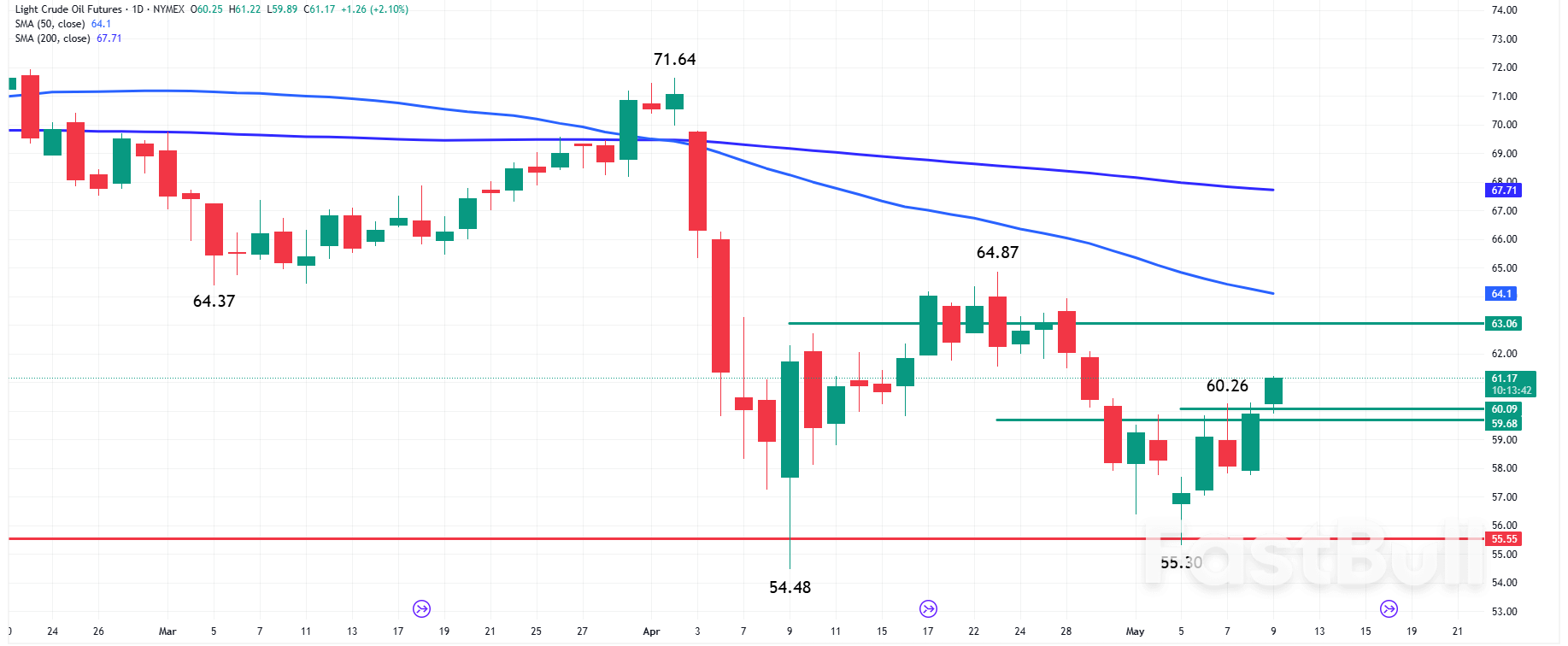
Daily Light Crude Oil FuturesWhite Label
Data API
Web Plug-ins
Poster Maker
Affiliate Program
The risk of loss in trading financial instruments such as stocks, FX, commodities, futures, bonds, ETFs and crypto can be substantial. You may sustain a total loss of the funds that you deposit with your broker. Therefore, you should carefully consider whether such trading is suitable for you in light of your circumstances and financial resources.
No decision to invest should be made without thoroughly conducting due diligence by yourself or consulting with your financial advisors. Our web content might not suit you since we don't know your financial conditions and investment needs. Our financial information might have latency or contain inaccuracy, so you should be fully responsible for any of your trading and investment decisions. The company will not be responsible for your capital loss.
Without getting permission from the website, you are not allowed to copy the website's graphics, texts, or trademarks. Intellectual property rights in the content or data incorporated into this website belong to its providers and exchange merchants.
Not Logged In
Log in to access more features

FastBull Membership
Not yet
Purchase
Log In
Sign Up