• Trade
  • Markets
  • Copy
  • Contests
  • News
  • 24/7
  • Calendar
  • Q&A
  • Chats
Trending
Screeners
SYMBOL
LAST
BID
ASK
HIGH
LOW
NET CHG.
%CHG.
SPREAD
SPX
S&P 500 Index
6827.42
6827.42
6827.42
6899.86
6801.80
-73.58
-1.07%
--
DJI
Dow Jones Industrial Average
48458.04
48458.04
48458.04
48886.86
48334.10
-245.98
-0.51%
--
IXIC
NASDAQ Composite Index
23195.16
23195.16
23195.16
23554.89
23094.51
-398.69
-1.69%
--
USDX
US Dollar Index
97.950
98.030
97.950
98.500
97.950
-0.370
-0.38%
--
EURUSD
Euro / US Dollar
1.17394
1.17409
1.17394
1.17496
1.17192
+0.00011
+ 0.01%
--
GBPUSD
Pound Sterling / US Dollar
1.33707
1.33732
1.33707
1.33997
1.33419
-0.00148
-0.11%
--
XAUUSD
Gold / US Dollar
4299.39
4299.39
4299.39
4353.41
4257.10
+20.10
+ 0.47%
--
WTI
Light Sweet Crude Oil
57.233
57.485
57.233
58.011
56.969
-0.408
-0.71%
--

Community Accounts

Signal Accounts
--
Profit Accounts
--
Loss Accounts
--
View More

Become a signal provider

Sell trading signals to earn additional income

View More

Guide to Copy Trading

Get started with ease and confidence

View More

Signal Accounts for Members

All Signal Accounts

Best Return
  • Best Return
  • Best P/L
  • Best MDD
Past 1W
  • Past 1W
  • Past 1M
  • Past 1Y

All Contests

  • All
  • Trump Updates
  • Recommend
  • Stocks
  • Cryptocurrencies
  • Central Banks
  • Featured News
Top News Only
Share

Iranian Media Says 18 Crew Members Of Foreign Tanker Seized In Gulf Of Oman Over Carrying 'Smuggled Fuel' Detained

Share

Regional Governor: Two Killed In Ukrainian Drone Strike On Russia's Saratov

Share

Chinese Foreign Ministry - China Foreign Minister Met With United Arab Emirates Counterpart On Dec 12

Share

China's Central Financial And Economic Affairs Commission Deputy Director: Will Expand Export And Increase Import In 2026

Share

Thai Leader Anutin: Landmine Blast That Killed Thai Soldiers 'Not A Roadside Accident'

Share

Thai Leader Anutin: Thailand To Continue Military Action Until 'We Feel No More Harm'

Share

Cambodian Prime Minister Hun Manet Says He Had Phone Calls With Trump And Malaysian Leader Anwar About Ceasefire

Share

Cambodia's Hun Manet Says USA, Malaysia Should Verify 'Which Side Fired First' In Latest Conflict

Share

Cambodia's Hun Manet: Cambodia Maintains Its Stance In Seeking Peaceful Resolution Of Disputes

Share

Nasdaq Companies: Allergan, Ferrovia, Insmed, Monolithic Power Systems, Seagate Technology, And Western Digital Will Be Added To The NASDAQ 100 Index. Biogen, CdW, GlobalFoundries, Lululemon, ON Semiconductor, And Tradedesk Will Be Removed From The NASDAQ 100 Index

Share

Witkoff Headed To Berlin This Weekend To Meet With Zelenskiy, European Leaders -Wsj Reporter On X

Share

Russia Attacks Two Ukrainian Ports, Damaging Three Turkish-Owned Vessels

Share

[Historic Flooding Occurs In At Least Four Rivers In Washington State Due To Days Of Torrential Rains] Multiple Areas In Washington State Have Been Hit By Severe Flooding Due To Days Of Torrential Rains, With At Least Four Rivers Experiencing Historic Flooding. Reporters Learned On The 12th That The Floods Caused By The Torrential Rains In Washington State Have Destroyed Homes And Closed Several Highways. Experts Warn That Even More Severe Flooding May Occur In The Future. A State Of Emergency Has Been Declared In Washington State

Share

Trump Says Proposed Free Economic Zone In Donbas Would Work

Share

Trump: I Think My Voice Should Be Heard

Share

Trump Says Will Be Choosing New Fed Chair In Near Future

Share

Trump Says Proposed Free Economic Zone In Donbas Complex But Would Work

Share

Trump Says Land Strikes In Venezuela Will Start Happening

Share

US President Trump: Thailand And Cambodia Are In A Good Situation

Share

State Media: North Korean Leader Kim Hails Troops Returning From Russia Mission

TIME
ACT
FCST
PREV
U.K. Trade Balance Non-EU (SA) (Oct)

A:--

F: --

P: --

U.K. Trade Balance (Oct)

A:--

F: --

P: --

U.K. Services Index MoM

A:--

F: --

P: --

U.K. Construction Output MoM (SA) (Oct)

A:--

F: --

P: --

U.K. Industrial Output YoY (Oct)

A:--

F: --

P: --

U.K. Trade Balance (SA) (Oct)

A:--

F: --

P: --

U.K. Trade Balance EU (SA) (Oct)

A:--

F: --

P: --

U.K. Manufacturing Output YoY (Oct)

A:--

F: --

P: --

U.K. GDP MoM (Oct)

A:--

F: --

P: --

U.K. GDP YoY (SA) (Oct)

A:--

F: --

P: --

U.K. Industrial Output MoM (Oct)

A:--

F: --

P: --

U.K. Construction Output YoY (Oct)

A:--

F: --

P: --

France HICP Final MoM (Nov)

A:--

F: --

P: --

China, Mainland Outstanding Loans Growth YoY (Nov)

A:--

F: --

P: --

China, Mainland M2 Money Supply YoY (Nov)

A:--

F: --

P: --

China, Mainland M0 Money Supply YoY (Nov)

A:--

F: --

P: --

China, Mainland M1 Money Supply YoY (Nov)

A:--

F: --

P: --

India CPI YoY (Nov)

A:--

F: --

P: --

India Deposit Gowth YoY

A:--

F: --

P: --

Brazil Services Growth YoY (Oct)

A:--

F: --

P: --

Mexico Industrial Output YoY (Oct)

A:--

F: --

P: --

Russia Trade Balance (Oct)

A:--

F: --

P: --

Philadelphia Fed President Henry Paulson delivers a speech
Canada Building Permits MoM (SA) (Oct)

A:--

F: --

P: --

Canada Wholesale Sales YoY (Oct)

A:--

F: --

P: --

Canada Wholesale Inventory MoM (Oct)

A:--

F: --

P: --

Canada Wholesale Inventory YoY (Oct)

A:--

F: --

P: --

Canada Wholesale Sales MoM (SA) (Oct)

A:--

F: --

P: --

Germany Current Account (Not SA) (Oct)

A:--

F: --

P: --

U.S. Weekly Total Rig Count

A:--

F: --

P: --

U.S. Weekly Total Oil Rig Count

A:--

F: --

P: --

Japan Tankan Large Non-Manufacturing Diffusion Index (Q4)

--

F: --

P: --

Japan Tankan Small Manufacturing Outlook Index (Q4)

--

F: --

P: --

Japan Tankan Large Non-Manufacturing Outlook Index (Q4)

--

F: --

P: --

Japan Tankan Large Manufacturing Outlook Index (Q4)

--

F: --

P: --

Japan Tankan Small Manufacturing Diffusion Index (Q4)

--

F: --

P: --

Japan Tankan Large Manufacturing Diffusion Index (Q4)

--

F: --

P: --

Japan Tankan Large-Enterprise Capital Expenditure YoY (Q4)

--

F: --

P: --

U.K. Rightmove House Price Index YoY (Dec)

--

F: --

P: --

China, Mainland Industrial Output YoY (YTD) (Nov)

--

F: --

P: --

China, Mainland Urban Area Unemployment Rate (Nov)

--

F: --

P: --

Saudi Arabia CPI YoY (Nov)

--

F: --

P: --

Euro Zone Industrial Output YoY (Oct)

--

F: --

P: --

Euro Zone Industrial Output MoM (Oct)

--

F: --

P: --

Canada Existing Home Sales MoM (Nov)

--

F: --

P: --

Euro Zone Total Reserve Assets (Nov)

--

F: --

P: --

U.K. Inflation Rate Expectations

--

F: --

P: --

Canada National Economic Confidence Index

--

F: --

P: --

Canada New Housing Starts (Nov)

--

F: --

P: --

U.S. NY Fed Manufacturing Employment Index (Dec)

--

F: --

P: --

U.S. NY Fed Manufacturing Index (Dec)

--

F: --

P: --

Canada Core CPI YoY (Nov)

--

F: --

P: --

Canada Manufacturing Unfilled Orders MoM (Oct)

--

F: --

P: --

Canada Manufacturing New Orders MoM (Oct)

--

F: --

P: --

Canada Core CPI MoM (Nov)

--

F: --

P: --

Canada Manufacturing Inventory MoM (Oct)

--

F: --

P: --

Canada CPI YoY (Nov)

--

F: --

P: --

Canada CPI MoM (Nov)

--

F: --

P: --

Canada CPI YoY (SA) (Nov)

--

F: --

P: --

Canada Core CPI MoM (SA) (Nov)

--

F: --

P: --

Q&A with Experts
    • All
    • Chatrooms
    • Groups
    • Friends
    Connecting
    .
    .
    .
    Type here...
    Add Symbol or Code

      No matching data

      All
      Trump Updates
      Recommend
      Stocks
      Cryptocurrencies
      Central Banks
      Featured News
      • All
      • Russia-Ukraine Conflict
      • Middle East Flashpoint
      • All
      • Russia-Ukraine Conflict
      • Middle East Flashpoint
      Search
      Products

      Charts Free Forever

      Chats Q&A with Experts
      Screeners Economic Calendar Data Tools
      Membership Features
      Data Warehouse Market Trends Institutional Data Policy Rates Macro

      Market Trends

      Market Sentiment Order Book Forex Correlations

      Top Indicators

      Charts Free Forever
      Markets

      News

      News Analysis 24/7 Columns Education
      From Institutions From Analysts
      Topics Columnists

      Latest Views

      Latest Views

      Trending Topics

      Top Columnists

      Latest Update

      Signals

      Copy Rankings Latest Signals Become a signal provider AI Rating
      Contests
      Brokers

      Overview Brokers Assessment Rankings Regulators News Claims
      Broker listing Forex Brokers Comparison Tool Live Spread Comparison Scam
      Q&A Complaint Scam Alert Videos Tips to Detect Scam
      More

      Business
      Events
      Careers About Us Advertising Help Center

      White Label

      Data API

      Web Plug-ins

      Affiliate Program

      Awards Institution Evaluation IB Seminar Salon Event Exhibition
      Vietnam Thailand Singapore Dubai
      Fans Party Investment Sharing Session
      FastBull Summit BrokersView Expo
      Recent Searches
        Top Searches
          Markets
          News
          Analysis
          User
          24/7
          Economic Calendar
          Education
          Data
          • Names
          • Latest
          • Prev

          View All

          No data

          Scan to Download

          Faster Charts, Chat Faster!

          Download App
          English
          • English
          • Español
          • العربية
          • Bahasa Indonesia
          • Bahasa Melayu
          • Tiếng Việt
          • ภาษาไทย
          • Français
          • Italiano
          • Türkçe
          • Русский язык
          • 简中
          • 繁中
          Open Account
          Search
          Products
          Charts Free Forever
          Markets
          News
          Signals

          Copy Rankings Latest Signals Become a signal provider AI Rating
          Contests
          Brokers

          Overview Brokers Assessment Rankings Regulators News Claims
          Broker listing Forex Brokers Comparison Tool Live Spread Comparison Scam
          Q&A Complaint Scam Alert Videos Tips to Detect Scam
          More

          Business
          Events
          Careers About Us Advertising Help Center

          White Label

          Data API

          Web Plug-ins

          Affiliate Program

          Awards Institution Evaluation IB Seminar Salon Event Exhibition
          Vietnam Thailand Singapore Dubai
          Fans Party Investment Sharing Session
          FastBull Summit BrokersView Expo

          German Industrial Orders Surprise with April Gain Driven by Domestic Demand

          Gerik

          Economic

          Summary:

          Germany’s industrial orders rose 0.6% in April 2025, defying expectations of a 1.0% drop, as robust domestic demand offset weakening foreign orders...

          Resilient Demand at Home Counters Global Weakness

          According to fresh data from Germany’s federal statistics office, industrial orders increased by 0.6% month-over-month in April, defying market forecasts that predicted a 1.0% contraction. This unexpected rise, driven primarily by a 2.2% surge in domestic orders, highlights Germany’s internal economic stability even as external demand wavers.
          Foreign orders, on the other hand, declined by 0.3% overall. This was split between a modest 0.5% rise in eurozone demand and a sharper 0.9% fall in orders from outside the bloc. These figures reinforce the narrative that global trade uncertainties—ranging from tariff disputes to geopolitical tensions—are still weighing on German exporters.

          Short-Term Momentum Remains Positive

          The less volatile three-month comparison from February to April showed a 0.5% increase in new orders relative to the previous three-month period. While this figure suggests modest growth momentum, it also indicates a fragile recovery, dependent more on domestic resilience than on sustained international demand.
          Moreover, the March data was revised downward slightly from a 3.6% to a 3.4% gain, but the trend still indicates a rebound after the industrial sector’s earlier stagnation. This back-to-back monthly growth provides tentative optimism for the manufacturing-heavy economy, especially as it navigates structural transformations toward greener production, as highlighted by CO₂-reduced steel production in recent industrial headlines.

          Broader Outlook and Implications

          While the April data offers a welcome surprise, the broader picture remains mixed. Germany continues to face challenges such as high energy costs, slowing Chinese demand, and evolving supply chain strategies in response to shifting global trade dynamics. However, the strength of domestic consumption and public investment appears to be a stabilizing force.
          For policymakers and the European Central Bank, these figures may complicate efforts to balance industrial policy with monetary decisions. The modest recovery in industrial orders, if sustained, could alleviate some recessionary fears, but reliance on domestic demand alone may not be sufficient for long-term industrial revival without stronger external tailwinds.
          April’s industrial order data underscores the duality of Germany’s current economic condition—solid internal demand contrasted against weakening international trade flows. While the resilience at home is encouraging, the durability of this momentum will hinge on improvements in the global economic environment and successful structural adaptations within Germany’s manufacturing sector.

          Source: Reuters

          To stay updated on all economic events of today, please check out our Economic calendar
          Risk Warnings and Disclaimers
          You understand and acknowledge that there is a high degree of risk involved in trading. Following any strategies or investment methods may lead to potential losses. The content on the site is provided by our contributors and analysts for information purposes only. You are solely responsible for determining whether any trading assets, securities, strategy, or any other product is suitable for investing based on your own investment objectives and financial situation.
          Add to Favorites
          Share

          Gold Holds Ground As Investors Eye US Payrolls Report

          Glendon

          Economic

          Commodity

          Gold prices held steady on Thursday as investors awaited U.S. non-farm payrolls data due on Friday to assess the Federal Reserve's interest rate path, while global trade tensions continued to simmer.

          Spot goldwas steady at $3,373.69 an ounce, as of 0843 GMT. U.S. gold futureswere down 0.1% to $3,397.20.

          "I would say that the path of least resistance remains to the upside, despite today's sort of flat mode for gold trading. But I think this is more due to traders being in wait-and-see mode ahead of non-farm payrolls," said Ricardo Evangelista, senior analyst at brokerage firm ActivTrades.

          Wednesday's ADP National Employment Report revealed U.S. private payrolls increased far less than expected in May. The more comprehensive non-farm payrolls report on Friday is expected to show that non-farm payrolls increased by 130,000 jobs in May after advancing by 177,000 in April, according to a Reuters survey of economists.

          U.S. President Donald Trump on Wednesday called for Fed Chair Jerome Powell to lower interest rates.

          "I think that a weakening in the US labor market will increase bets on a dovish Fed, so on the Fed cutting interest rates, (which) would be positive for gold," Evangelista added.

          Gold, a safe-haven asset during times of political and economic uncertainty, tends to thrive in a low-interest-rate environment.

          Trump described China's Xi Jinping as "tough" and "extremely hard to make a deal with" in a social media post, dampening hopes for a swift end to trade tensions. Meanwhile, his doubling of tariffs on steel and aluminium imports took effect on Wednesday.

          "We stick to our price targets of USD 3,350 and USD 3,500 in 3 and 12 months time, reflecting first and foremost continued central bank buying as well as sound demand from safe-haven seekers," said Carsten Menke, analyst at Julius Baer.

          Elsewhere, spot silverfell 0.6% to $34.74 an ounce, but hit its highest level since October 2012. Platinumrose 3.6% to $1,123.15, its highest level since April 2023, and palladiumwas up 1.7% at $1,017.37.

          Source: TradingView

          To stay updated on all economic events of today, please check out our Economic calendar
          Risk Warnings and Disclaimers
          You understand and acknowledge that there is a high degree of risk involved in trading. Following any strategies or investment methods may lead to potential losses. The content on the site is provided by our contributors and analysts for information purposes only. You are solely responsible for determining whether any trading assets, securities, strategy, or any other product is suitable for investing based on your own investment objectives and financial situation.
          Add to Favorites
          Share

          UK Car Tax Error Inflates April Inflation Data by 0.1% – ONS Acknowledges Misstep

          Gerik

          Economic

          Inflation Metrics Distorted by Data Entry Mistake

          In a development that further strains public confidence in the UK's statistical reporting, the ONS revealed that April’s official consumer inflation rate was overstated by 0.1 percentage points due to incorrect Vehicle Excise Duty data. This technical error originated from external government data which exaggerated the number of cars subjected to first-year tax rates, thereby artificially inflating price indices.
          While the official Consumer Price Index (CPI) for April was reported at 3.5%—a notable rise from March’s 2.6%—the actual figure should have been 3.4%, according to today’s correction. This discrepancy also extended to the CPIH, which includes housing costs, and the Retail Price Index (RPI), which affects payouts on index-linked government bonds (gilts).

          ONS Under Fire Amid Broader Data Scrutiny

          This incident compounds existing concerns about the reliability of the ONS’s data. The agency is already facing criticism for erratic labor market reports, prompting the UK government in April to launch an independent review of the statistical agency’s operations and data integrity. This latest miscalculation—albeit small in absolute terms—has symbolic weight, as it highlights procedural lapses in quality control over externally sourced datasets.
          The ONS has stated that it will not revise the previously published inflation figures despite the acknowledged error. However, it confirmed that data corrections have been applied starting from the May series, thereby ensuring future accuracy. A comprehensive review of quality assurance protocols is now underway.

          Financial Market and Policy Implications

          Though a 10 basis point difference may seem modest, it carries meaningful implications in financial markets and monetary policy. The Retail Price Index (RPI), which was also overstated, influences interest payments on index-linked gilts. Misreported inflation could affect investor confidence in UK government securities, especially in an environment of tight fiscal conditions and persistent scrutiny of inflation dynamics.
          Additionally, the Bank of England may need to consider this error when interpreting recent inflation trends. Given that inflation metrics guide interest rate decisions, even small inaccuracies risk altering the perception of price stability or overheating.
          The inflation misstatement, while quantitatively minor, adds to the ONS’s reputational challenges at a critical time. With inflation still a central issue for British households and policymakers alike, confidence in the precision and transparency of official economic data is essential. The correction emphasizes the need for robust verification systems—particularly when third-party data is involved—and highlights the broader risks of governance lapses in public economic reporting.

          Source: Reuters

          To stay updated on all economic events of today, please check out our Economic calendar
          Risk Warnings and Disclaimers
          You understand and acknowledge that there is a high degree of risk involved in trading. Following any strategies or investment methods may lead to potential losses. The content on the site is provided by our contributors and analysts for information purposes only. You are solely responsible for determining whether any trading assets, securities, strategy, or any other product is suitable for investing based on your own investment objectives and financial situation.
          Add to Favorites
          Share

          Japan Seeks Rare Earths Alliance Amid Tariff Talks with U.S.

          Gerik

          Commodity

          China–U.S. Trade War

          Strategic Resource Diplomacy Meets Trade Tensions

          As the fifth round of U.S.-Japan tariff negotiations commences, Japan plans to put rare earth cooperation at the forefront of its agenda. According to the Nikkei, Tokyo aims to propose a strategic partnership with Washington to secure rare earth supplies—critical materials for electronics, defense, and green technologies—amid rising concerns over Chinese export controls. This proposal reflects growing anxiety in Tokyo and Washington about supply chain vulnerability in the face of Beijing’s geopolitical leverage over critical minerals.
          Rare earths, though not scarce, are predominantly mined and processed in China, which gives the country a dominant role in the global market. By aligning with the U.S., Japan hopes to diversify sourcing and reduce dependency, particularly after China’s recent export curbs on gallium and germanium rattled supply chains across high-tech sectors.

          Tariff Flexibility from Washington?

          At the same time, Japan is pushing for relief from steep reciprocal tariffs imposed under Trump’s ongoing trade reset. While a universal 10% tariff remains in place on Japanese exports to the U.S., an additional 14%—part of a broader 24% package—has been suspended until July to allow time for negotiation. Reports from Jiji Press suggest the U.S. has shown signs of flexibility in reducing or lifting the suspended portion, providing some hope for Japanese exporters.
          Chief negotiator Ryosei Akazawa is currently in Washington to lead the Japanese delegation. His talks with U.S. Treasury Secretary Scott Bessent and Commerce Secretary Howard Lutnick are critical, especially as Tokyo continues to protest the 25% levy on Japanese-made vehicles—an industry that remains the cornerstone of Japan’s economy.

          Auto Industry at the Center of Japan’s Concerns

          While rare earths signal long-term strategic alignment, the more immediate concern for Japan is the preservation of its automotive exports. The 25% tariff on Japanese vehicles, though temporarily paused, poses a significant threat to one of Japan’s largest economic sectors. Japanese officials argue that such tariffs are not only economically damaging but also run counter to the spirit of alliance and shared values between the two nations.
          Japan’s auto sector has already faced headwinds from global EV competition, currency volatility, and supply chain restructuring. The additional tariffs risk further complicating their U.S. market access, just as automakers are ramping up investments in battery-electric models for American consumers.

          Outlook and Implications

          The convergence of resource security and tariff negotiations signals a new phase in U.S.-Japan economic diplomacy, where shared geopolitical interests—particularly regarding China—may help break the impasse. If Japan can secure concessions on tariffs in exchange for rare earth supply cooperation, both nations stand to benefit strategically: the U.S. would reduce its dependence on Chinese critical minerals, while Japan would secure market access for its vehicles and manufactured goods.
          However, with the Trump administration pushing for aggressive trade realignment and tighter control over industrial inputs, any outcome will hinge on a delicate balancing act between domestic economic priorities and international strategic alliances.

          Source: Reuters

          Risk Warnings and Disclaimers
          You understand and acknowledge that there is a high degree of risk involved in trading. Following any strategies or investment methods may lead to potential losses. The content on the site is provided by our contributors and analysts for information purposes only. You are solely responsible for determining whether any trading assets, securities, strategy, or any other product is suitable for investing based on your own investment objectives and financial situation.
          Add to Favorites
          Share

          Trade War Poses Greater Threat to Emerging Market Central Banks than COVID-19

          Gerik

          Economic

          Unpredictable Trade Shocks Disrupt Policy Tools

          In an interview with the Financial Times, Gita Gopinath emphasized that emerging markets now face greater difficulty than during the pandemic because of the “differential effects” caused by trade wars. While COVID-19 was a global demand shock that could be countered with monetary easing and stimulus, trade tensions are creating fragmented, asymmetric shocks across developing economies. The fallout from tariffs is not only unpredictable but also prolonged, affecting inflation, investment sentiment, exchange rate stability, and export competitiveness differently across regions.
          Emerging market central banks, which often rely on flexible monetary tools to counter external volatility, are now confronted with constraints. Aggressive easing could risk capital outflows, currency depreciation, and inflationary pressure—particularly if their economies are heavily reliant on exports or foreign direct investment from the U.S. or China.

          Greater Complexity, Less Room for Maneuver

          Gopinath’s remarks highlight how today’s geopolitical trade landscape complicates macroeconomic management for emerging economies. During COVID-19, the synchronized global downturn gave central banks across both advanced and developing economies a shared rationale to slash interest rates and inject liquidity. In contrast, the tariff-driven trade war is asynchronous and more selective, requiring nuanced responses to sector-specific and bilateral disruptions.
          Many emerging markets are now facing inflation that stems not from overheating domestic demand, but from supply-side disruptions and higher import costs—particularly for intermediate goods, food, and energy. This limits the effectiveness of traditional monetary easing, while also making inflation targeting more fragile in the face of volatile global prices.

          Implications for Global Financial Stability

          The IMF's warning underlines broader systemic concerns. As Gopinath notes, central banks in the developing world must now balance between stabilizing their economies and defending their currencies, all while dealing with capital flow volatility triggered by policy swings in major economies. For countries with high external debt or commodity-dependence, the risks are amplified.
          If left unmitigated, these pressures could deepen inequality across the global South, stall investment, and lead to divergent recoveries. The IMF may need to ramp up tailored financial support or policy coordination to help stabilize vulnerable economies caught in the crossfire of the U.S.-China tariff escalation.
          The IMF’s assessment serves as a stark reminder that while pandemics shock economies through health and supply channels, trade wars erode the very foundation of international economic integration. For central banks in emerging markets, the stakes are now higher, the policy space narrower, and the consequences more unequal. As the trade war unfolds, the resilience of developing economies will depend not just on monetary tools, but also on targeted fiscal support, structural reforms, and global cooperation.

          Source: Reuters

          To stay updated on all economic events of today, please check out our Economic calendar
          Risk Warnings and Disclaimers
          You understand and acknowledge that there is a high degree of risk involved in trading. Following any strategies or investment methods may lead to potential losses. The content on the site is provided by our contributors and analysts for information purposes only. You are solely responsible for determining whether any trading assets, securities, strategy, or any other product is suitable for investing based on your own investment objectives and financial situation.
          Add to Favorites
          Share

          Trump Reinstates and Expands Travel Ban, Targeting 12 Nations Amid Border Crackdown

          Gerik

          Economic

          Expanded Travel Ban Follows Boulder Attack and Border Concerns

          In a move echoing his 2017 "Muslim ban," President Trump announced a new travel ban affecting nationals from 12 countries, including Afghanistan, Iran, Libya, Somalia, and Yemen. The proclamation came shortly after a terror attack in Boulder, Colorado, which Trump used to reinforce concerns about inadequate visa screening and overstays. Although the suspect in the attack—a man from Egypt who overstayed a visa—was not from one of the banned countries, Trump cited the incident as justification for broader entry restrictions.
          The administration emphasized the need to protect the U.S. from what it called “unvetted foreign nationals,” with Trump declaring in a video, “We don’t want them.” While those with existing visas, permanent residents, and individuals traveling for events like the Olympics are exempt, the proclamation signals a return to Trump's earlier restrictive immigration policies.

          Harvard University Targeted in Separate Proclamation

          In a surprising extension of the travel policy, Trump also issued a separate order targeting foreign exchange students at Harvard University. The administration accused the university of lax enforcement of disciplinary conduct, especially among foreign students, and of withholding critical records from federal authorities. The proclamation suspends new visas for Harvard’s exchange programs, escalating Trump’s campaign against perceived liberal academic institutions.
          Trump specifically cited “antisemitic conduct” and “failure to discipline violations” as justification, although the university has not publicly responded to the accusations.

          Legal and Political Implications

          The expanded travel ban is expected to face immediate legal challenges, just as Trump’s original executive order did in 2017. That policy—widely referred to as a “Muslim ban”—sparked global outrage and was ultimately upheld by the U.S. Supreme Court in 2018 after multiple revisions. Trump’s latest version aims to preempt legal criticism by including non-Muslim-majority countries like Haiti and Venezuela and by outlining specific exemptions.
          Legal experts suggest the courts will again be called to determine whether the ban violates constitutional protections or immigration statutes. Nonetheless, Trump appears undeterred, framing his actions as part of a broader national security campaign and asserting broad executive authority over border control.

          Broader Immigration Agenda and Election Pledge Fulfillment

          This proclamation marks another cornerstone of Trump’s revived immigration strategy in his second term. Since returning to office, he has declared a national emergency at the southern border, deployed military resources, increased deportations, and attempted to challenge birthright citizenship—moves that have drawn both legal pushback and praise from conservative voters.
          Trump's use of executive orders to reinstate his signature travel ban fulfills a major 2024 campaign promise. He had pledged not only to reinstate but also to expand the original ban, particularly warning about refugees from conflict zones such as Gaza. His administration has also employed trade tools—namely tariffs—to pressure Mexico and Canada to enforce stricter immigration controls on their own borders.
          Trump’s reinstatement and expansion of the travel ban underscore a strategic pivot back to the combative immigration stance that defined his first presidency. With global tensions rising and migration again a politically charged issue, this latest move is likely to energize his base while provoking fierce opposition from immigrant advocacy groups, legal watchdogs, and civil liberties organizations. Whether the new ban will withstand judicial scrutiny remains to be seen, but its political impact is already being felt.

          Source: Bloomberg

          To stay updated on all economic events of today, please check out our Economic calendar
          Risk Warnings and Disclaimers
          You understand and acknowledge that there is a high degree of risk involved in trading. Following any strategies or investment methods may lead to potential losses. The content on the site is provided by our contributors and analysts for information purposes only. You are solely responsible for determining whether any trading assets, securities, strategy, or any other product is suitable for investing based on your own investment objectives and financial situation.
          Add to Favorites
          Share

          EURUSD On The Verge Of Correction, Buyers Losing Momentum

          Blue River

          Forex

          Technical Analysis

          Economic

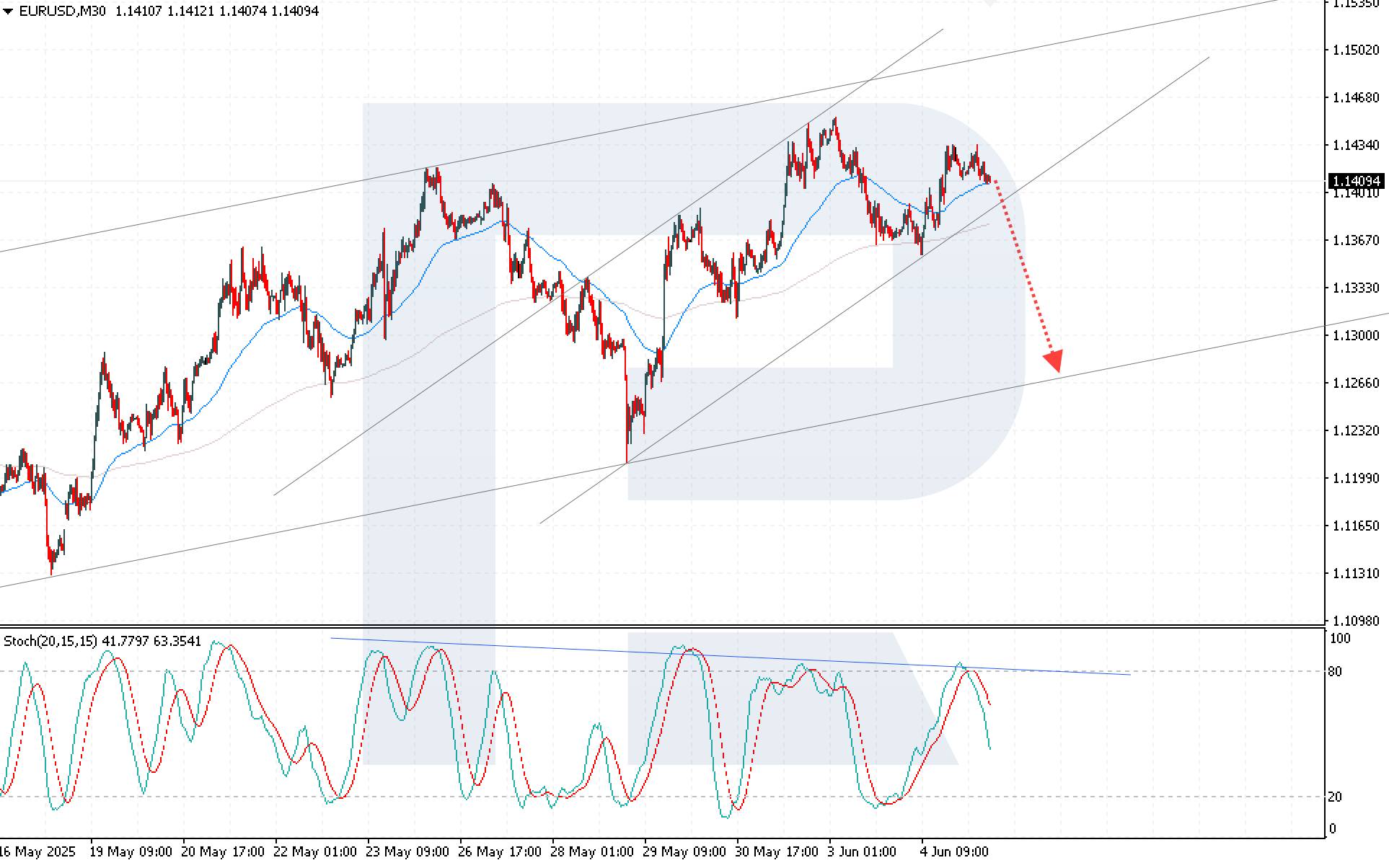
          Despite weak US macroeconomic data, the EURUSD pair still struggles to break above the 1.1425 resistance level, indicating persistent seller pressure. EURUSD technical analysis points to waning upward momentum and an increased risk of a correction towards 1.1270.

          The EURUSD pair is correcting despite persistent pressure on the US dollar from weak macroeconomic data. Find out more in our analysis for 5 June 2025.

          EURUSD forecast: key trading points

          ●The ADP report showed the US private sector added only 37 thousand jobs in May
          ●The US ISM services PMI fell to 49.9 points in May
          ●The drop in ISM reflects a decline in business activity
          ●EURUSD forecast for 5 June 2025: 1.1270

          Fundamental analysis

          The EURUSD rate is showing a slight decline. Sellers continue to defend the key resistance level at 1.1425, holding back further upward attempts.

          The US dollar came under pressure after disappointing macroeconomic figures. According to the ADP report, the private sector created just 37 thousand jobs in May, well below the forecast of 80 thousand, marking the weakest performance in two years.

          Further downside came from the ISM services PMI, which fell to 49.9 in May, dipping below the 50 mark for the first time in a year, indicating contraction. This reading missed the 52.6 forecast and points to a sharp decline in new business amid rising resource costs.

          EURUSD technical analysis

          While the EURUSD rate maintains its upward trajectory, the failure to reach a new local high suggests weakening bullish momentum. Today's EURUSD forecast anticipates a potential breakout below the support level and a corrective move towards 1.1270. The Stochastic Oscillator signals a likely bearish turn, with its values rebounding from the resistance level, forming a downward reversal. A breakout below the lower boundary of the bullish channel will confirm the bearish scenario, with the price consolidating below 1.1355.

          Source: RoboForex

          To stay updated on all economic events of today, please check out our Economic calendar
          Risk Warnings and Disclaimers
          You understand and acknowledge that there is a high degree of risk involved in trading. Following any strategies or investment methods may lead to potential losses. The content on the site is provided by our contributors and analysts for information purposes only. You are solely responsible for determining whether any trading assets, securities, strategy, or any other product is suitable for investing based on your own investment objectives and financial situation.
          Add to Favorites
          Share
          FastBull
          Copyright © 2025 FastBull Ltd

          728 RM B 7/F GEE LOK IND BLDG NO 34 HUNG TO RD KWUN TONG KLN HONG KONG

          TelegramInstagramTwitterfacebooklinkedin
          App Store Google Play Google Play
          Products
          Charts

          Chats

          Q&A with Experts
          Screeners
          Economic Calendar
          Data
          Tools
          Membership
          Features
          Function
          Markets
          Copy Trading
          Latest Signals
          Contests
          News
          Analysis
          24/7
          Columns
          Education
          Company
          Careers
          About Us
          Contact Us
          Advertising
          Help Center
          Feedback
          User Agreement
          Privacy Policy
          Business

          White Label

          Data API

          Web Plug-ins

          Poster Maker

          Affiliate Program

          Risk Disclosure

          The risk of loss in trading financial instruments such as stocks, FX, commodities, futures, bonds, ETFs and crypto can be substantial. You may sustain a total loss of the funds that you deposit with your broker. Therefore, you should carefully consider whether such trading is suitable for you in light of your circumstances and financial resources.

          No decision to invest should be made without thoroughly conducting due diligence by yourself or consulting with your financial advisors. Our web content might not suit you since we don't know your financial conditions and investment needs. Our financial information might have latency or contain inaccuracy, so you should be fully responsible for any of your trading and investment decisions. The company will not be responsible for your capital loss.

          Without getting permission from the website, you are not allowed to copy the website's graphics, texts, or trademarks. Intellectual property rights in the content or data incorporated into this website belong to its providers and exchange merchants.

          Not Logged In

          Log in to access more features

          FastBull Membership

          Not yet

          Purchase

          Become a signal provider
          Help Center
          Customer Service
          Dark Mode
          Price Up/Down Colors

          Log In

          Sign Up

          Position
          Layout
          Fullscreen
          Default to Chart
          The chart page opens by default when you visit fastbull.com