• Trade
  • Markets
  • Copy
  • Contests
  • News
  • 24/7
  • Calendar
  • Q&A
  • Chats
Trending
Screeners
SYMBOL
LAST
BID
ASK
HIGH
LOW
NET CHG.
%CHG.
SPREAD
SPX
S&P 500 Index
6827.42
6827.42
6827.42
6899.86
6801.80
-73.58
-1.07%
--
DJI
Dow Jones Industrial Average
48458.04
48458.04
48458.04
48886.86
48334.10
-245.98
-0.51%
--
IXIC
NASDAQ Composite Index
23195.16
23195.16
23195.16
23554.89
23094.51
-398.69
-1.69%
--
USDX
US Dollar Index
97.970
98.050
97.970
98.070
97.920
+0.020
+ 0.02%
--
EURUSD
Euro / US Dollar
1.17329
1.17336
1.17329
1.17447
1.17262
-0.00065
-0.06%
--
GBPUSD
Pound Sterling / US Dollar
1.33693
1.33700
1.33693
1.33740
1.33546
-0.00014
-0.01%
--
XAUUSD
Gold / US Dollar
4345.58
4345.99
4345.58
4348.78
4294.68
+46.19
+ 1.07%
--
WTI
Light Sweet Crude Oil
57.521
57.551
57.521
57.601
57.194
+0.288
+ 0.50%
--

Community Accounts

Signal Accounts
--
Profit Accounts
--
Loss Accounts
--
View More

Become a signal provider

Sell trading signals to earn additional income

View More

Guide to Copy Trading

Get started with ease and confidence

View More

Signal Accounts for Members

All Signal Accounts

Best Return
  • Best Return
  • Best P/L
  • Best MDD
Past 1W
  • Past 1W
  • Past 1M
  • Past 1Y

All Contests

  • All
  • Trump Updates
  • Recommend
  • Stocks
  • Cryptocurrencies
  • Central Banks
  • Featured News
Top News Only
Share

Poland's CPI At 0.1% Month-On-Month In November Versus 0.1% Released Earlier

Share

London Metal Exchange: Stocks Of Copper Down 25

Share

Polish Inflation At 2.5% Year-On-Year In November

Share

Poland's January-October Import Up 5.4% To 309.3 Billion Euros

Share

Poland's January-October Trade Balance At -5.1 Billion Euros

Share

Poland's January-October Export Up 2.8% To 304.3 Billion Euros

Share

Ceasefire Negotiations Between Ukraine And US Representatives In Berlin To Continue Monday Morning - German Source Familiar With The Schedule

Share

Spain's IBEX Hits Fresh Record High, Up Over 1%

Share

Spot Silver Rises Nearly 3% To $63.82/Oz

Share

Philippine Maritime Council: Expresses Alarm Over Recent Harassment Of Filipino Fishermen In South China Sea Shoal

Share

France's Foreign Minister Says He Suggesd To EU's Kallas That US Representatives Brief EU Foreign Ministers On Gaza Peace Plan During Their Meeting

Share

India Trade Secretary: Prime Facie Don't See A Case Of Rice Dumping To USA And There Is No Active Investigation On That

Share

India Trade Secretary: India's Rice Exported To USA Largely Limited To Basmati And At Price Higher Than General Price Of Rice

Share

India Trade Secretary: India Can Raise Shipments To Russia In Sectors Like Automobiles And Pharmaceuticals

Share

India Trade Secretary:India-Oman Trade Deal Completed And Will Be Signed Soon

Share

Burberry Shares Top FTSE Gainer, Up 3.5% In Positive European Luxury Sector

Share

India Trade Secretary: India-US Close To A “Framework” Deal But Won't Give A Timeline

Share

Yemen's Southern Transitional Council (Stc) Launches Military Operation In Abyan

Share

India Trade Official: As Mexico Has Raised Tariffs On Mfn Basis, We Don't See A Recourse In WTO

Share

India Trade Official: India Has Proposed A “Preferential Trade Agreement” With Mexico

TIME
ACT
FCST
PREV
France HICP Final MoM (Nov)

A:--

F: --

P: --

China, Mainland Outstanding Loans Growth YoY (Nov)

A:--

F: --

P: --

China, Mainland M2 Money Supply YoY (Nov)

A:--

F: --

P: --

China, Mainland M0 Money Supply YoY (Nov)

A:--

F: --

P: --

China, Mainland M1 Money Supply YoY (Nov)

A:--

F: --

P: --

India CPI YoY (Nov)

A:--

F: --

P: --

India Deposit Gowth YoY

A:--

F: --

P: --

Brazil Services Growth YoY (Oct)

A:--

F: --

P: --

Mexico Industrial Output YoY (Oct)

A:--

F: --

P: --

Russia Trade Balance (Oct)

A:--

F: --

P: --

Philadelphia Fed President Henry Paulson delivers a speech
Canada Building Permits MoM (SA) (Oct)

A:--

F: --

P: --

Canada Wholesale Sales YoY (Oct)

A:--

F: --

P: --

Canada Wholesale Inventory MoM (Oct)

A:--

F: --

P: --

Canada Wholesale Inventory YoY (Oct)

A:--

F: --

P: --

Canada Wholesale Sales MoM (SA) (Oct)

A:--

F: --

P: --

Germany Current Account (Not SA) (Oct)

A:--

F: --

P: --

U.S. Weekly Total Rig Count

A:--

F: --

P: --

U.S. Weekly Total Oil Rig Count

A:--

F: --

P: --

Japan Tankan Small Manufacturing Outlook Index (Q4)

A:--

F: --

P: --

Japan Tankan Large Non-Manufacturing Diffusion Index (Q4)

A:--

F: --

P: --

Japan Tankan Large Non-Manufacturing Outlook Index (Q4)

A:--

F: --

P: --

Japan Tankan Large Manufacturing Outlook Index (Q4)

A:--

F: --

P: --

Japan Tankan Small Manufacturing Diffusion Index (Q4)

A:--

F: --

P: --

Japan Tankan Large Manufacturing Diffusion Index (Q4)

A:--

F: --

P: --

Japan Tankan Large-Enterprise Capital Expenditure YoY (Q4)

A:--

F: --

P: --

U.K. Rightmove House Price Index YoY (Dec)

A:--

F: --

P: --

China, Mainland Industrial Output YoY (YTD) (Nov)

A:--

F: --

P: --

China, Mainland Urban Area Unemployment Rate (Nov)

A:--

F: --

P: --

Saudi Arabia CPI YoY (Nov)

A:--

F: --

P: --

Euro Zone Industrial Output YoY (Oct)

--

F: --

P: --

Euro Zone Industrial Output MoM (Oct)

--

F: --

P: --

Canada Existing Home Sales MoM (Nov)

--

F: --

P: --

Euro Zone Total Reserve Assets (Nov)

--

F: --

P: --

U.K. Inflation Rate Expectations

--

F: --

P: --

Canada National Economic Confidence Index

--

F: --

P: --

Canada New Housing Starts (Nov)

--

F: --

P: --

U.S. NY Fed Manufacturing Employment Index (Dec)

--

F: --

P: --

U.S. NY Fed Manufacturing Index (Dec)

--

F: --

P: --

Canada Core CPI YoY (Nov)

--

F: --

P: --

Canada Manufacturing Unfilled Orders MoM (Oct)

--

F: --

P: --

U.S. NY Fed Manufacturing Prices Received Index (Dec)

--

F: --

P: --

U.S. NY Fed Manufacturing New Orders Index (Dec)

--

F: --

P: --

Canada Manufacturing New Orders MoM (Oct)

--

F: --

P: --

Canada Core CPI MoM (Nov)

--

F: --

P: --

Canada Trimmed CPI YoY (SA) (Nov)

--

F: --

P: --

Canada Manufacturing Inventory MoM (Oct)

--

F: --

P: --

Canada CPI YoY (Nov)

--

F: --

P: --

Canada CPI MoM (Nov)

--

F: --

P: --

Canada CPI YoY (SA) (Nov)

--

F: --

P: --

Canada Core CPI MoM (SA) (Nov)

--

F: --

P: --

Canada CPI MoM (SA) (Nov)

--

F: --

P: --

Federal Reserve Board Governor Milan delivered a speech
U.S. NAHB Housing Market Index (Dec)

--

F: --

P: --

Australia Composite PMI Prelim (Dec)

--

F: --

P: --

Australia Services PMI Prelim (Dec)

--

F: --

P: --

Australia Manufacturing PMI Prelim (Dec)

--

F: --

P: --

Japan Manufacturing PMI Prelim (SA) (Dec)

--

F: --

P: --

U.K. Unemployment Claimant Count (Nov)

--

F: --

P: --

U.K. Unemployment Rate (Nov)

--

F: --

P: --

U.K. 3-Month ILO Unemployment Rate (Oct)

--

F: --

P: --

Q&A with Experts
    • All
    • Chatrooms
    • Groups
    • Friends
    Connecting
    .
    .
    .
    Type here...
    Add Symbol or Code

      No matching data

      All
      Trump Updates
      Recommend
      Stocks
      Cryptocurrencies
      Central Banks
      Featured News
      • All
      • Russia-Ukraine Conflict
      • Middle East Flashpoint
      • All
      • Russia-Ukraine Conflict
      • Middle East Flashpoint
      Search
      Products

      Charts Free Forever

      Chats Q&A with Experts
      Screeners Economic Calendar Data Tools
      Membership Features
      Data Warehouse Market Trends Institutional Data Policy Rates Macro

      Market Trends

      Market Sentiment Order Book Forex Correlations

      Top Indicators

      Charts Free Forever
      Markets

      News

      News Analysis 24/7 Columns Education
      From Institutions From Analysts
      Topics Columnists

      Latest Views

      Latest Views

      Trending Topics

      Top Columnists

      Latest Update

      Signals

      Copy Rankings Latest Signals Become a signal provider AI Rating
      Contests
      Brokers

      Overview Brokers Assessment Rankings Regulators News Claims
      Broker listing Forex Brokers Comparison Tool Live Spread Comparison Scam
      Q&A Complaint Scam Alert Videos Tips to Detect Scam
      More

      Business
      Events
      Careers About Us Advertising Help Center

      White Label

      Data API

      Web Plug-ins

      Affiliate Program

      Awards Institution Evaluation IB Seminar Salon Event Exhibition
      Vietnam Thailand Singapore Dubai
      Fans Party Investment Sharing Session
      FastBull Summit BrokersView Expo
      Recent Searches
        Top Searches
          Markets
          News
          Analysis
          User
          24/7
          Economic Calendar
          Education
          Data
          • Names
          • Latest
          • Prev

          View All

          No data

          Scan to Download

          Faster Charts, Chat Faster!

          Download App
          English
          • English
          • Español
          • العربية
          • Bahasa Indonesia
          • Bahasa Melayu
          • Tiếng Việt
          • ภาษาไทย
          • Français
          • Italiano
          • Türkçe
          • Русский язык
          • 简中
          • 繁中
          Open Account
          Search
          Products
          Charts Free Forever
          Markets
          News
          Signals

          Copy Rankings Latest Signals Become a signal provider AI Rating
          Contests
          Brokers

          Overview Brokers Assessment Rankings Regulators News Claims
          Broker listing Forex Brokers Comparison Tool Live Spread Comparison Scam
          Q&A Complaint Scam Alert Videos Tips to Detect Scam
          More

          Business
          Events
          Careers About Us Advertising Help Center

          White Label

          Data API

          Web Plug-ins

          Affiliate Program

          Awards Institution Evaluation IB Seminar Salon Event Exhibition
          Vietnam Thailand Singapore Dubai
          Fans Party Investment Sharing Session
          FastBull Summit BrokersView Expo

          Fed’s Cautious Cut Sparks Market Uncertainty as Stagflation Concerns Persist

          Gerik

          Economic

          Summary:

          The Federal Reserve's first rate cut of 2025, accompanied by cautious messaging on inflation and economic risks, has left investors unconvinced about a clear easing path...

          Rate Cut Fails to Deliver Clarity Amid Mixed Signals

          The Federal Reserve’s decision to cut interest rates by 25 basis points to a range of 4.00% to 4.25% its first since December was met with a muted market response. While the move was seen as the start of a potential easing cycle, the Fed’s cautious tone and warnings about persistent inflation sowed uncertainty over whether further reductions will follow. This ambiguity was reinforced by the Fed’s own dot plot, which revealed diverging forecasts among policymakers and no unified trajectory for rates in the months ahead.
          Investors had hoped for a more dovish pivot, especially after recent signs of labor market softening, including an uptick in unemployment to 4.3% and downward revisions to job growth figures. However, Fed Chair Jerome Powell’s remarks emphasized that inflation risks remain elevated, complicating the outlook for sustained monetary easing. His statement that policymakers are dealing with “a challenging situation” captured the dual threat: weakening employment on one hand, and sticky inflation on the other.

          Markets React Tepidly Amid Policy Ambiguity

          Financial markets, which had been rallying ahead of the Fed decision, responded with hesitation. The S&P 500 and Nasdaq both dipped slightly following the announcement, retreating from near-record highs in choppy trading. Investors seemed disappointed that the Fed did not commit to a longer or faster series of cuts, instead reiterating a meeting-by-meeting, data-dependent strategy.
          Treasury yields, in contrast, moved higher an unusual reaction for a rate cut environment. The two-year yield rose by four basis points to 3.55%, and the benchmark 10-year yield climbed by seven basis points to 4.09%. The increase suggests that bond investors are reevaluating the likelihood and pace of further cuts, especially given the Fed’s reluctance to declare a clear policy path. The flattening of the yield curve in recent weeks, largely based on anticipated easing, now faces reversal if the Fed slows its pace.

          Divergent Forecasts Reveal Deep Policy Divisions

          The updated dot plot exposed a wide spectrum of expectations within the Federal Open Market Committee (FOMC). One member projected a year-end rate of 4.4%, while another anticipated 2.9%, reflecting sharp internal disagreements. This variation confirms that policymakers remain split on how to respond to the current economic crosswinds, and it reinforces the uncertainty investors now face in anticipating rate policy.
          Stephen Miran, recently appointed to the Fed board by President Trump, dissented from the quarter-point cut, advocating instead for a larger 50 basis point move. His stance underscores the political pressure the central bank is under, as Trump has consistently pushed for deeper cuts to spur economic growth ahead of the election season. While Powell stressed the Fed’s commitment to independence, the overlapping political and monetary narratives are increasingly difficult to separate.

          Stagflation Fears Gain Ground as Inflation and Labor Data Diverge

          The Fed’s cautious stance is partly rooted in the risk of stagflation an economic condition characterized by sluggish growth, rising unemployment, and persistent inflation. August’s consumer price data showed the sharpest increase in seven months, driven by housing and food costs, keeping inflation well above the Fed’s 2% target. The labor market, meanwhile, is showing signs of cooling, with payroll growth slowing significantly.
          This dual pressure puts the Fed in a difficult position. Aggressively cutting rates to support jobs could reignite inflation, while holding back risks worsening employment conditions. Michael Rosen of Angeles Investments warned that the current situation “argues for a more conservative outlook” on asset returns, signaling investor caution in both equity and bond markets.

          Investor Confidence Wavers as Policy Path Remains Opaque

          The combination of policy disagreement, persistent inflation, and political tension has created a market environment fraught with uncertainty. As Josh Hirt of Vanguard noted, the sheer range of opinions among Fed members has led to heightened confusion and potential volatility. Without a unified message, investors are left to interpret a mix of inflationary warnings and tentative support for growth, creating a landscape in which even a rate cut provides little reassurance.
          While the Fed’s decision to cut rates reflects a growing concern about the weakening labor market, its cautious rhetoric and internal disagreements have left investors with more questions than answers. With inflation still elevated and political dynamics complicating the central bank’s narrative, the market’s response has been lukewarm. The path forward will depend heavily on upcoming inflation and jobs data, which will either justify additional easing or force the Fed to hold back in a precarious stagflationary environment. Until then, volatility and investor hesitation are likely to dominate.

          Source: Reuters

          To stay updated on all economic events of today, please check out our Economic calendar
          Risk Warnings and Disclaimers
          You understand and acknowledge that there is a high degree of risk involved in trading. Following any strategies or investment methods may lead to potential losses. The content on the site is provided by our contributors and analysts for information purposes only. You are solely responsible for determining whether any trading assets, securities, strategy, or any other product is suitable for investing based on your own investment objectives and financial situation.
          Add to Favorites
          Share

          Oil Shipping Rates Soar on Higher Mideast Exports, Tighter Vessel Availability

          Michelle

          Commodity

          Freight rates for Very Large Crude Carriers soared to their highest in more than two years, according to industry sources and LSEG data, as tanker supply tightens with a rise in Middle East exports and more arbitrage supplies to Asia.

          The key VLCC spot rate on the Middle East to China route, known as TD3C (DFRT-ME-CN), jumped to W108 on the Worldscale industry measure, the highest level since November 2022, based on data compiled by LSEG. That is equivalent to at least $6.6 million, according to calculations by industry sources.

          The rate has increased by nearly 150% since the start of this year.

          "We are seeing continuous cargoes from ex-MEG (Middle East loading) and ex-Atlantic while the vessel tonnage list is balanced to tight," a shipbroker told Reuters on Thursday.

          Robust VLCC freight rates are yielding attractive earnings for shipowners this year, shipping industry sources said on the sidelines of the Asia Pacific Petroleum Conference in Singapore last week.

          Crude exports from the Middle East are set to exceed 18 million barrels per day in September for the first time since April 2023, data from analytics firm Kpler showed, after the Organization of the Petroleum Exporting Countries (OPEC) and their allies, a group known as OPEC+, agreed to raise oil production.

          Asia's robust demand is also pulling arbitrage supplies from the Atlantic Basin, which will require tankers to travel longer distances. For example, Indian refiners boosted U.S. crude purchases for delivery in October and November while Chinese independent refiners are buying oil from Brazil and West Africa.

          "The main drivers behind the surge in September has been the open arbitrage for U.S. Gulf to East Asia flows and the subsequent tightness created by vessels committing to these very long-haul voyages," Sentosa Shipbrokers told Reuters, adding that this tightened vessel availability in the mainstream market.

          Anoop Singh, global head of shipping research at Oil Brokerage, said Saudi Arabia is exporting more oil as demand for crude burn for power generation during summer ends while the arbitrage is wide open on strong Dubai crude prices.

          "The short-term outlook is for the momentum to carry through till the end of the year and into Q1 next year," he said, adding that the strength in Dubai prices could be further amplified if there is a loss in medium-quality crude supply, such as those from Russia under geopolitical pressure.

          U.S. President Donald Trump said on Saturday that the U.S. was prepared to impose fresh energy sanctions on Russia, but only if all NATO nations ceased purchasing Russian oil and implemented similar measures.

          Source: Reuters

          Risk Warnings and Disclaimers
          You understand and acknowledge that there is a high degree of risk involved in trading. Following any strategies or investment methods may lead to potential losses. The content on the site is provided by our contributors and analysts for information purposes only. You are solely responsible for determining whether any trading assets, securities, strategy, or any other product is suitable for investing based on your own investment objectives and financial situation.
          Add to Favorites
          Share

          Japan Eyes Oil Diversification but Canadian Heavy Crude Presents Refining Hurdles

          Gerik

          Economic

          Japan’s Oil Dependence on the Middle East Spurs Diversification Debate

          As Japan continues to import 95% of its crude oil from the Middle East, industry leaders are calling for greater diversification in supply sources. Shunichi Kito, president of the Petroleum Association of Japan (PAJ) and head of Idemitsu Kosan Japan’s second-largest refiner underscored this strategic need during a news conference on Thursday.
          However, while acknowledging the importance of reducing overreliance on Middle Eastern suppliers, Kito expressed caution about shifting to Canadian sources, citing the technical limitations of Japanese refineries when dealing with Canada’s heavy crude oil.

          Canada Explores Refining Partnerships in Asia to Expand Market Access

          The Government of Alberta, Canada’s largest oil-producing province, is reportedly in preliminary discussions with Japanese refiners to form a joint venture that would involve financial support for new infrastructure. According to sources familiar with the matter, Alberta is considering investment in building a coker unit in Japan, which is essential for processing bitumen-rich oil from Canada’s oil sands. This move is driven by Canada’s desire to reduce its near-total dependence on the United States for crude oil exports and open new long-term markets in Asia.
          However, no formal proposals have yet been submitted to Japanese refiners. “There is no specific request being made to us at this time,” Kito clarified when asked about Alberta’s intentions. Nonetheless, the notion of such a joint venture represents a strategic shift in North American oil diplomacy and could realign Japan’s import strategy if technical barriers are overcome.

          Heavy Oil Characteristics Complicate Refining Viability in Japan

          Kito emphasized that the physical properties of Canadian heavy oil make it difficult to refine within Japan’s existing infrastructure. Unlike the light and sweet crude oil varieties sourced from the Middle East, Canadian bitumen requires advanced conversion equipment such as coker units to handle its dense, sulfur-rich composition. Japanese refineries are largely optimized for lighter grades, and adapting them for heavy oil would require substantial capital investment, operational adjustments, and ongoing cost increases in processing.
          These technical complications create a causal relationship between oil quality and Japan’s import preferences. Without compatible refining technology in place, Canadian crude remains economically unattractive unless subsidized or accompanied by long-term offtake guarantees.

          Demand Decline Undermines Incentive for New Refining Infrastructure

          Japan's structural decline in domestic oil demand estimated at roughly 2% annually further weakens the case for investing in new refining infrastructure tailored to Canadian oil. Kito noted that with consumption on a downward trajectory, it is difficult to justify long-term capital expenditures on equipment such as cokers.
          While the decision to invest ultimately rests with individual companies, the macroeconomic environment discourages such moves. This signals that unless external financing or strong government policy incentives are introduced, refiner-led diversification away from Middle Eastern supply may remain limited in scope.
          While Japan recognizes the strategic importance of diversifying its oil import sources, including potential collaboration with Canada, practical and economic barriers continue to limit immediate progress. The mismatch between Japan’s current refining capabilities and the physical characteristics of Canadian heavy crude, combined with structural declines in demand, make such ventures challenging. Unless Alberta offers compelling investment terms or Japan embarks on a broader restructuring of its refining sector, diversification efforts may remain focused on lighter crude sources in other regions or alternative energy strategies altogether.

          Source: Reuters

          To stay updated on all economic events of today, please check out our Economic calendar
          Risk Warnings and Disclaimers
          You understand and acknowledge that there is a high degree of risk involved in trading. Following any strategies or investment methods may lead to potential losses. The content on the site is provided by our contributors and analysts for information purposes only. You are solely responsible for determining whether any trading assets, securities, strategy, or any other product is suitable for investing based on your own investment objectives and financial situation.
          Add to Favorites
          Share

          Treasury Yields Slip as Markets Digest Fed’s Gradual Rate Cut Strategy

          Gerik

          Economic

          Yields Decline After Measured Fed Rate Cut

          Yields across U.S. Treasury maturities edged lower on Thursday morning, reflecting investor reassessment of the Federal Reserve’s latest policy move and its implications for future monetary easing.
          The 10-year Treasury yield declined by over 3 basis points to 4.045%, while the 2-year yield dropped by more than 2 basis points to 3.524%. The 30-year bond yield also slipped by 3 basis points to 4.643%. These movements, though modest, highlight a cautious shift in sentiment following the Fed’s announcement of its first interest rate cut in 2025.

          Fed’s Cut Reflects Risk Management, Not Full Pivot

          In an 11-to-1 decision, the Federal Open Market Committee (FOMC) voted to lower its benchmark federal funds rate to a range of 4.00% to 4.25%. Fed Chair Jerome Powell emphasized during his post-decision press conference that the move was guided by risk management considerations, particularly the dual pressures of elevated inflation and signs of labor market weakening. This framing suggests a careful and responsive policy stance rather than a sweeping reversal. The Fed’s current projection includes two additional cuts in 2025 and just one more in 2026.
          Gina Bolvin, president of Bolvin Wealth Management Group, interpreted the decision as a “measured step” rather than a policy pivot, stating that “modest rate relief, not fireworks,” should be the investor takeaway. Her remarks underscore the Fed’s attempt to balance monetary easing with inflation containment a theme increasingly central to current bond market pricing.

          Market Sentiment Turns to Data Dependency

          The bond market’s subdued reaction indicates that investors are not anticipating an aggressive easing cycle. Instead, sentiment has aligned with the Fed’s message of data-dependent decision-making. Yields, which move inversely to bond prices, reflect growing expectations that any future rate adjustments will hinge on upcoming labor and inflation indicators. The Fed’s caution is reinforced by its projection that inflation will remain above target at 3.1% this year, and unemployment will tick up slightly to 4.5%.
          Short-term yields, such as the 1-month and 3-month Treasuries, showed little movement, reinforcing the idea that markets are more concerned with the medium-term path of policy than with immediate changes. The 1-month yield held at 4.087%, while the 3-month yield rose slightly to 3.991%, signaling limited short-term rate volatility.

          Awaiting Labor Market Signals for Confirmation

          With the Fed setting a tentative path, attention now turns to Thursday’s release of initial jobless claims a key near-term indicator that could influence bond market sentiment and reinforce or challenge the Fed’s strategy. If jobless claims show accelerating weakness, market expectations for additional easing could strengthen. Conversely, resilience in labor data may bolster the case for a slower and more measured rate path.
          The post-rate-cut dip in Treasury yields reflects investor acceptance of the Fed’s cautious, non-committal easing path. Rather than responding with significant shifts in pricing, markets are choosing to wait for additional confirmation from economic data. As Powell noted, the Fed is navigating “two-sided risks,” and the bond market’s current behavior suggests that investors are prepared to adjust in either direction but only once the data provides a clearer signal. The coming weeks, particularly job market and inflation updates, will likely determine whether yields hold steady or adjust to a more dovish or hawkish reality.

          Source: CNBC

          To stay updated on all economic events of today, please check out our Economic calendar
          Risk Warnings and Disclaimers
          You understand and acknowledge that there is a high degree of risk involved in trading. Following any strategies or investment methods may lead to potential losses. The content on the site is provided by our contributors and analysts for information purposes only. You are solely responsible for determining whether any trading assets, securities, strategy, or any other product is suitable for investing based on your own investment objectives and financial situation.
          Add to Favorites
          Share

          GBP Holds Near Highs As Market Awaits BoE Decision

          Blue River

          Technical Analysis

          The GBP/USD pair stabilised around 1.3626 USD on Thursday, following a highly volatile session on Wednesday. The pair remains close to its highest level in over ten weeks, as markets await the Bank of England’s policy decision later today.

          The BoE is widely expected to maintain rates at 5.25% (note: corrected from 4% based on current BoE rate) and may signal a reduction in its £100 billion annual bond-purchase program.

          Recent data showed UK inflation held steady at 3.8% in August, matching both forecasts and July’s 18-month high. Labour market figures were broadly in line with expectations: unemployment remained at 4.7%, wage growth (ex-bonuses) came in at 4.8% (4.7% including bonuses), and payrolls declined by 8,000.

          Market expectations for a BoE rate cut remain subdued, with only a one-in-three chance priced in for a reduction by December.

          Meanwhile, the US Federal Reserve delivered a widely anticipated 25-basis-point cut yesterday, with traders now expecting at least two additional cuts by the end of 2025.

          Technical Analysis: GBP/USD

          H4 Chart:

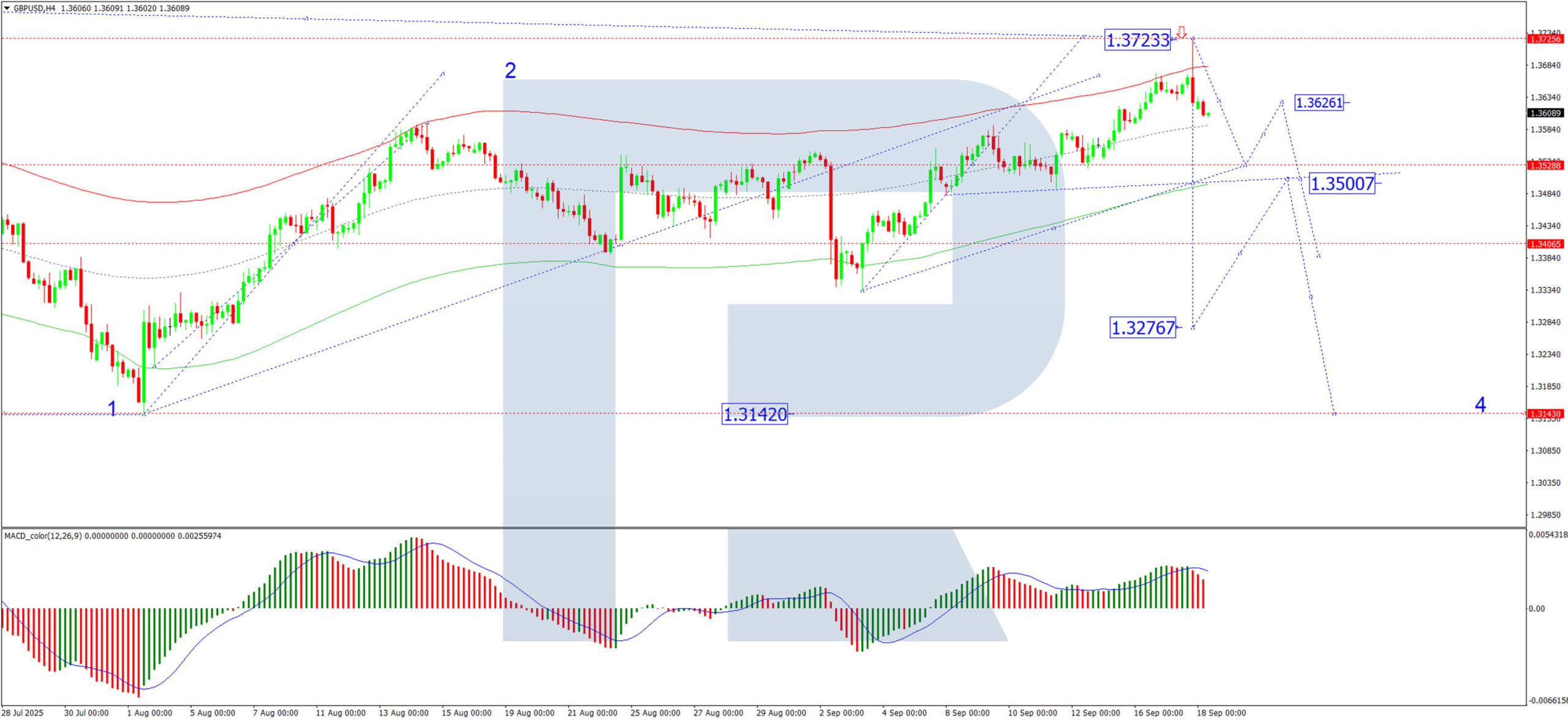
          On the H4 chart, GBP/USD completed an upward move to 1.3723 USD, followed by a downward impulse to 1.3620 USD. The pair is now likely to form a consolidation range around this level. A break below 1.3620 USD could initiate a decline towards 1.3528 USD. A corrective rebound towards 1.3620 USD may then follow. Renewed selling pressure could subsequently drive the pair towards 1.3500 USD, with further downside potential to 1.3277 USD. The MACD indicator supports this outlook, with its signal line positioned above zero but turning decisively downward.

          H1 Chart:

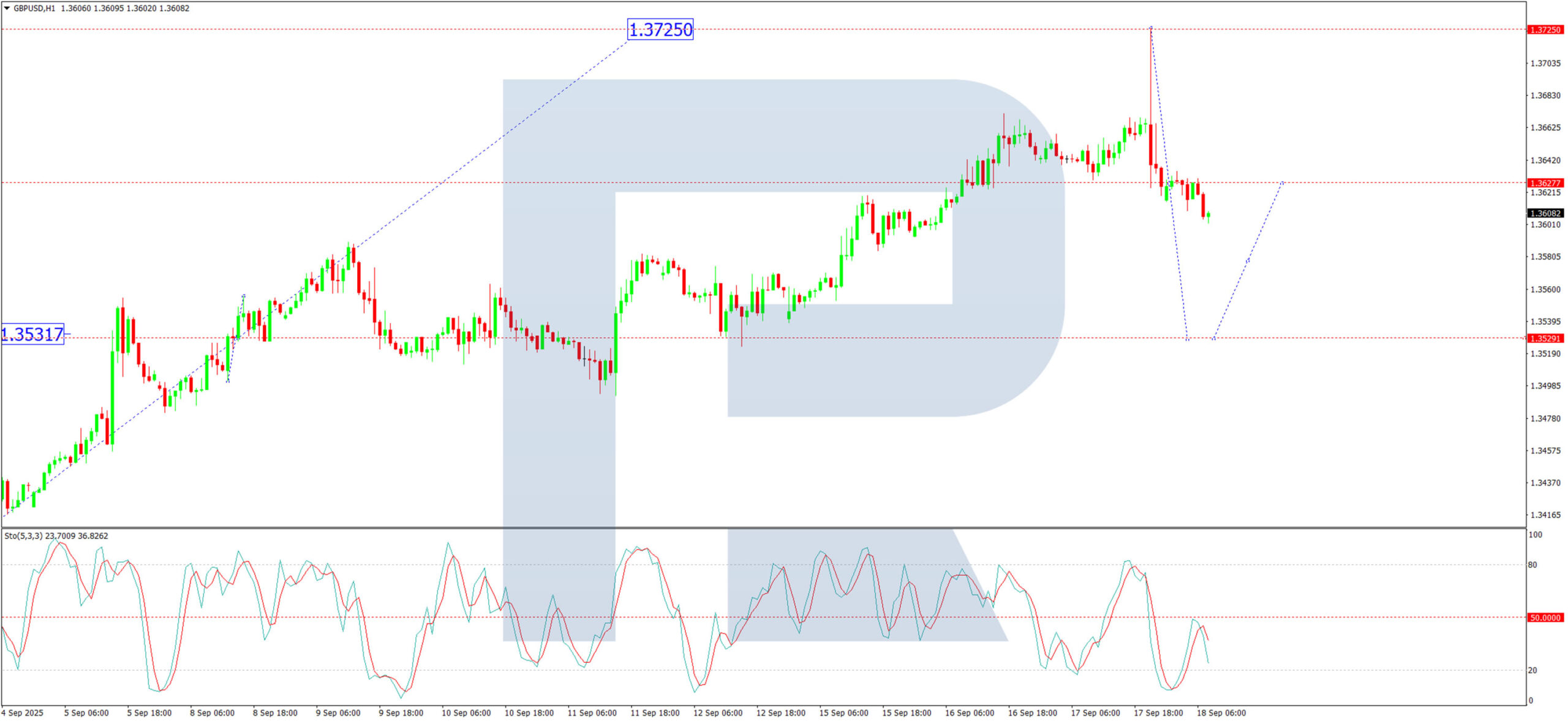
          On the H1 chart, the pair has completed a downward impulse to 1.3620 USD. A consolidation phase is expected around this level. A break lower would likely trigger the first wave of a new downtrend towards 1.3530 USD. The Stochastic oscillator aligns with this near-term bearish view, as its signal line lies below 50 and is trending downward towards 20.

          Conclusion

          The pound is trading near multi-week highs as markets await guidance from the BoE. While UK inflation remains elevated, softening labour data and a dovish Fed have limited the GBP’s upside. Technically, the pair appears vulnerable to a near-term correction, particularly if the BoE maintains a cautious tone. Today’s decision and accompanying communications will be critical in determining whether cable extends its rally or enters a deeper corrective phase.

          Source: ACTIONFOREX

          Risk Warnings and Disclaimers
          You understand and acknowledge that there is a high degree of risk involved in trading. Following any strategies or investment methods may lead to potential losses. The content on the site is provided by our contributors and analysts for information purposes only. You are solely responsible for determining whether any trading assets, securities, strategy, or any other product is suitable for investing based on your own investment objectives and financial situation.
          Add to Favorites
          Share

          Swiss Exports to U.S. Plunge After Tariff Shock, but Europe and Mercosur Offer Lifeline

          Gerik

          Economic

          Tariff Shock Delivers Immediate Blow to Swiss-U.S. Trade

          The United States' imposition of a 39% tariff on Swiss goods, one of the highest such levies among developed economies, led to a sharp contraction in bilateral trade within its first month. Adjusted for seasonal factors and excluding gold, Swiss exports to the U.S. fell by 22% in August compared to July, according to newly released Swiss customs data. This rapid decline confirms a strong causal relationship between the tariff’s implementation and the sudden drop in trade volumes.
          Luxury exports, particularly watches one of Switzerland's hallmark industries were among the most affected. Watch exports alone declined by 8.6% month-over-month. Even more dramatic was the collapse in gold shipments, which plunged 99% to just 0.3 tons. These figures suggest a direct and immediate behavioral response from exporters, who likely reallocated shipments away from the U.S. in anticipation of reduced demand due to higher prices.

          U.S. Trade Deficit With Switzerland Narrows Sharply

          The disruption in Swiss outbound trade led to a notable narrowing of the U.S. trade deficit with Switzerland, falling from 2.93 billion francs in July to 2.06 billion francs in August. This was the second-lowest reading since 2020 and reflects a short-term outcome aligned with the Trump administration’s stated objective for imposing the tariff: to reduce the perceived trade imbalance.
          While effective in this specific metric, the long-term implications for bilateral economic ties remain uncertain, especially if retaliatory or compensatory adjustments are introduced by Switzerland or other trading partners.

          Swiss Economy Shows Flexibility Through Diversification

          Despite the steep decline in U.S.-bound exports, Switzerland’s overall trade remained resilient. Total exports fell by only 1% month-over-month, as increased shipments to France, Austria, Poland, Canada, and Mexico helped offset the American shortfall. This outcome suggests a partial substitution effect, where export flows are redirected toward alternative markets when bilateral costs become prohibitive. This correlation between lost U.S. demand and gains in other markets demonstrates Switzerland’s capacity for short-term export reallocation and highlights the importance of trade diversification.
          In a longer-term move to mitigate dependence on U.S. demand, Switzerland signed a new free trade agreement with the South American Mercosur bloc during the same week. While this deal will take time to generate measurable trade flow, it reflects a strategic pivot toward emerging economies and underlines the government’s intent to shield its economy from abrupt trade policy shifts by dominant partners.

          Trade Negotiations Continue Amid Domestic Sensitivities

          Talks between Switzerland and the U.S. are still underway, with Commerce Secretary Howard Lutnick suggesting that a revised agreement may be within reach. However, the substance of these negotiations remains politically sensitive. U.S. negotiators are pushing for broader agricultural access, particularly in beef and poultry, but Swiss agricultural groups have firmly resisted such concessions. The Swiss government, bound by domestic political commitments to food self-sufficiency and rural protectionism, faces a narrow window for negotiation.
          This tension illustrates a classic policy trade-off: lowering tariffs to protect export-heavy industries like watchmaking and pharmaceuticals could require sacrificing domestic protections in agriculture an industry with strong symbolic and political weight in Swiss society. The government must now balance these internal and external pressures to preserve both its industrial competitiveness and domestic political stability.

          Pharmaceuticals Hold Up, but Long-Term Growth Outlook Weakens

          Not all sectors were equally affected. Pharmaceutical exports, which currently remain exempt from the new tariffs, experienced only a modest 1.3% decline. However, the overall slowdown in trade with the U.S. has led Swiss authorities to revise their growth projections downward for 2025. This suggests that even limited sectoral impacts, when concentrated in key industries or partner markets, can influence broader macroeconomic expectations.
          The link between trade volatility and national growth forecasts highlights the Swiss economy’s sensitivity to geopolitical and trade policy shifts. Although temporarily buffered by strong European demand, sustained or escalating trade tensions with the U.S. could undermine confidence in Switzerland’s export-led model over time.

          Tariff Fallout Accelerates Swiss Diversification Push

          The dramatic contraction in Swiss exports to the U.S. following the 39% tariff underscores the immediate disruptive power of trade protectionism, particularly when directed at high-value sectors like luxury goods and gold. While Switzerland has so far managed to reorient its export flows, the longer-term cost of disrupted U.S. trade is reflected in revised growth forecasts and urgent trade diplomacy efforts.
          With negotiations ongoing and geopolitical friction unresolved, Switzerland's economic strategy now appears increasingly geared toward diversification, not just in export markets but also in strategic partnerships highlighted by its recent Mercosur agreement. How quickly these moves can offset lost trade with the U.S. remains to be seen, but for now, Switzerland is navigating the fallout with measured resilience and quiet urgency.

          Source: Bloomberg

          To stay updated on all economic events of today, please check out our Economic calendar
          Risk Warnings and Disclaimers
          You understand and acknowledge that there is a high degree of risk involved in trading. Following any strategies or investment methods may lead to potential losses. The content on the site is provided by our contributors and analysts for information purposes only. You are solely responsible for determining whether any trading assets, securities, strategy, or any other product is suitable for investing based on your own investment objectives and financial situation.
          Add to Favorites
          Share

          Fed Confirms Dovish Turn with Two More Rate Cuts Projected in 2025 and Upgraded GDP Outlook

          Gerik

          Economic

          Fed Initiates 2025 Easing Cycle Amid Two-Sided Economic Risks

          The U.S. Federal Reserve began its 2025 easing cycle with a quarter-point rate cut, bringing the federal funds target range to 4.00%–4.25%. This marks the first rate reduction since late 2024 and reflects increasing concern over the labor market's gradual deterioration.
          Alongside this move, the latest Summary of Economic Projections (SEP) revealed that Fed officials now expect two more cuts before year-end, targeting a year-end range of 3.50%–3.75%. This shift comes amid a notable change in tone, with policymakers increasingly prioritizing downside risks to employment despite inflation remaining above target.

          Labor Market Weakness Shifts Policy Focus

          Chair Jerome Powell emphasized the complex macroeconomic environment during his post-meeting press conference, describing the current setup as “an unusual situation.” He explained that the conventional inverse relationship between labor market strength and inflation has broken down.
          Normally, strong labor conditions warn of inflation risks, but Powell pointed out that current data present a rare convergence of slowing employment and elevated prices. With job creation weakening only 22,000 positions added in August and previous months revised downward the Fed has signaled that labor market fragility may now outweigh inflation concerns in shaping near-term policy.

          Inflation Steady but Still Above Target

          Despite the policy pivot, inflation projections remain elevated. Core inflation is forecast to remain at 3.1% for 2025, unchanged from June estimates. It is expected to cool to 2.6% by 2026 and 2.1% in 2027, slowly approaching the 2% target over time.
          This persistence indicates that while disinflation is anticipated, it is expected to unfold gradually, requiring careful calibration of rate reductions. The Fed’s willingness to proceed with cuts despite unrelenting inflation highlights a shift in priority toward sustaining economic growth and employment, rather than accelerating the path to price stability.

          GDP Outlook Raised as Fed Eyes Economic Resilience

          In a sign of confidence in underlying economic resilience, the Fed raised its GDP forecast to 1.6% for 2025, up from 1.4% projected in June. Growth is expected to continue modestly, reaching 1.8% in 2026 and 1.9% in 2027. This upward revision suggests that policymakers believe the economy can endure moderate rate cuts without overheating.
          It also supports the argument that rate reductions could bolster demand without severely compromising inflation control. The relationship here reflects a calculated bet: that easing policy will stimulate growth without igniting a new inflationary spiral.

          Widening Dispersion in Policy Views Reflects Elevated Uncertainty

          The new dot plot confirmed deep divisions among policymakers. Eighteen Federal Open Market Committee (FOMC) members forecast at least one more rate cut in 2025, while a lone member anticipates no change. One projection even calls for six total cuts. This range mirrors the unpredictable macroeconomic environment, with Powell noting that such diversity of opinion is “natural” given current uncertainties. Nonetheless, the median projection two more cuts in 2025 and one in 2026 illustrates a consensus trend toward a gently easing policy stance, despite inflation not yet reaching target.
          Unemployment Projected to Rise as Job Market Slackens
          Unemployment is projected to rise slightly to 4.5% in 2025, holding steady with the June forecast. It is then expected to decline to 4.4% in 2026 and 4.3% in 2027. The expected rise reflects continued labor market softening, which played a key role in the decision to begin rate cuts.
          While modest, the projected uptick in joblessness supports the Fed’s rationale that intervention is needed to prevent broader economic weakening, establishing a causal relationship between projected employment deterioration and easing monetary policy.

          Markets Embrace Dovish Pivot as Wall Street Sentiment Improves

          Financial markets responded positively to the Fed’s updated projections, with major investment firms revising S&P 500 targets higher. Analysts from Wells Fargo, Barclays, and Deutsche Bank cited resilient corporate earnings, growing investment in artificial intelligence, and expectations of lower borrowing costs as key drivers for continued equity market momentum.
          The optimism reflects a belief that lower rates will help cushion macroeconomic softness without reigniting inflation a belief that aligns with the Fed’s balancing act between growth and price stability.

          Stagflation Concerns Linger as Inflation and Unemployment Remain Elevated

          Despite the dovish shift, stagflation risks remain on the horizon. The combination of sticky inflation and rising unemployment presents an uneasy backdrop for further monetary easing. Powell acknowledged the challenge of managing “two-sided risks” and admitted that the current environment offers “no risk-free path.” This underscores the delicate tradeoff the Fed must navigate supporting employment without compromising its inflation mandate. The parallel movement of inflation and joblessness illustrates the interdependence of Fed objectives, complicating efforts to pursue one without affecting the other.
          The Federal Reserve’s decision to cut rates and project further easing in 2025 marks a strategic shift toward prioritizing labor market support while cautiously navigating persistent inflation. The raised GDP forecast reflects optimism in the economy’s capacity to withstand rate reductions, but the presence of divergent views among Fed officials and lingering stagflation concerns make it clear that policy uncertainty remains elevated. The coming months will test the Fed’s ability to manage these dual pressures without losing credibility on inflation or falling behind in sustaining employment. Investors, households, and policymakers alike will be watching closely as the next chapters of this easing cycle unfold.

          Source: Reuters

          To stay updated on all economic events of today, please check out our Economic calendar
          Risk Warnings and Disclaimers
          You understand and acknowledge that there is a high degree of risk involved in trading. Following any strategies or investment methods may lead to potential losses. The content on the site is provided by our contributors and analysts for information purposes only. You are solely responsible for determining whether any trading assets, securities, strategy, or any other product is suitable for investing based on your own investment objectives and financial situation.
          Add to Favorites
          Share
          FastBull
          Copyright © 2025 FastBull Ltd

          728 RM B 7/F GEE LOK IND BLDG NO 34 HUNG TO RD KWUN TONG KLN HONG KONG

          TelegramInstagramTwitterfacebooklinkedin
          App Store Google Play Google Play
          Products
          Charts

          Chats

          Q&A with Experts
          Screeners
          Economic Calendar
          Data
          Tools
          Membership
          Features
          Function
          Markets
          Copy Trading
          Latest Signals
          Contests
          News
          Analysis
          24/7
          Columns
          Education
          Company
          Careers
          About Us
          Contact Us
          Advertising
          Help Center
          Feedback
          User Agreement
          Privacy Policy
          Business

          White Label

          Data API

          Web Plug-ins

          Poster Maker

          Affiliate Program

          Risk Disclosure

          The risk of loss in trading financial instruments such as stocks, FX, commodities, futures, bonds, ETFs and crypto can be substantial. You may sustain a total loss of the funds that you deposit with your broker. Therefore, you should carefully consider whether such trading is suitable for you in light of your circumstances and financial resources.

          No decision to invest should be made without thoroughly conducting due diligence by yourself or consulting with your financial advisors. Our web content might not suit you since we don't know your financial conditions and investment needs. Our financial information might have latency or contain inaccuracy, so you should be fully responsible for any of your trading and investment decisions. The company will not be responsible for your capital loss.

          Without getting permission from the website, you are not allowed to copy the website's graphics, texts, or trademarks. Intellectual property rights in the content or data incorporated into this website belong to its providers and exchange merchants.

          Not Logged In

          Log in to access more features

          FastBull Membership

          Not yet

          Purchase

          Become a signal provider
          Help Center
          Customer Service
          Dark Mode
          Price Up/Down Colors

          Log In

          Sign Up

          Position
          Layout
          Fullscreen
          Default to Chart
          The chart page opens by default when you visit fastbull.com