• Trade
  • Markets
  • Copy
  • Contests
  • News
  • 24/7
  • Calendar
  • Q&A
  • Chats
Trending
Screeners
SYMBOL
LAST
BID
ASK
HIGH
LOW
NET CHG.
%CHG.
SPREAD
SPX
S&P 500 Index
6860.22
6860.22
6860.22
6878.28
6858.25
-10.18
-0.15%
--
DJI
Dow Jones Industrial Average
47871.00
47871.00
47871.00
47971.51
47771.72
-83.98
-0.18%
--
IXIC
NASDAQ Composite Index
23574.91
23574.91
23574.91
23698.93
23574.91
-3.21
-0.01%
--
USDX
US Dollar Index
99.070
99.150
99.070
99.110
98.730
+0.120
+ 0.12%
--
EURUSD
Euro / US Dollar
1.16291
1.16298
1.16291
1.16717
1.16245
-0.00135
-0.12%
--
GBPUSD
Pound Sterling / US Dollar
1.33166
1.33173
1.33166
1.33462
1.33087
-0.00146
-0.11%
--
XAUUSD
Gold / US Dollar
4191.01
4191.42
4191.01
4218.85
4175.92
-6.90
-0.16%
--
WTI
Light Sweet Crude Oil
59.036
59.066
59.036
60.084
58.892
-0.773
-1.29%
--

Community Accounts

Signal Accounts
--
Profit Accounts
--
Loss Accounts
--
View More

Become a signal provider

Sell trading signals to earn additional income

View More

Guide to Copy Trading

Get started with ease and confidence

View More

Signal Accounts for Members

All Signal Accounts

Best Return
  • Best Return
  • Best P/L
  • Best MDD
Past 1W
  • Past 1W
  • Past 1M
  • Past 1Y

All Contests

  • All
  • Trump Updates
  • Recommend
  • Stocks
  • Cryptocurrencies
  • Central Banks
  • Featured News
Top News Only
Share

German Spy Chief: No Need To 'Break' With US Over Security Policy

Share

United Arab Emirates Official To Reuters: The United Arab Emirates Asserts That The Governance And Territorial Integrity Of Yemen Must Be Determined By Yemenis

Share

United Arab Emirates Official To Reuters: The United Arab Emirates's Position On The Yemen Crisis Is In Line With Saudi Arabia In Supporting A Political Process Based On An Initiative Backed By Gulf States

Share

French Presidential Residence Elysee: Work Will Be Intensified To Provide Ukraine With Robust Security Guarantees And To Plan Measures For The Reconstruction Of Ukraine

Share

French Presidential Residence Elysee: Meeting Of Leaders In The E3 Format And President Zelensky Allowed For The Continuation Of Joint Work On The US Plan

Share

US Dollar Extends Gains Versus Yen After Japan Earthquake, Last Up 0.2% At 155.64 Yen

Share

US Natural Gas Futures Drop 6% On Less Cold Forecasts, Near-Record Output

Share

Russian Central Bank: Sets Official Rouble Rate For December 9 At 77.2733 Roubles Per USA Dollar (Previous Rate - 76.0937)

Share

Russian Deputy Prime Minister Novak: Russia Will Restrict Gold Exports Starting In 2026

Share

US Dollar Touches Session High Versus Yen On Earthquake News, Last Up 0.5% At 155.81%

Share

NHK: A 40-centimeter-high Tsunami Has Reached Mutsuki Port In Aomori, Japan

Share

ICE Cotton Stocks Totalled To 13971 - December 08, 2025

Share

Japan Prime Minister Takaichi: Trying To Gather Information After Quake

Share

UK Trade Minister To Visit US This Week For Talks On Tariffs

Share

Head Of Yemen's Anti-Houthi Presidential Council Says Actions Of Southern Transitional Council Across South Yemen Undermines Legitimacy Of Internationally-Recognised Government

Share

Carvana Rose 9.1% And Crh Rose 6.8% As Both Companies Were Added To The S&P 500 Index

Share

Japanese Regulators Say No Problems Have Been Found At The Onagawa Nuclear Power Plant

Share

KYODO News: Some Tohoku Shinkansen Services Have Been Suspended Following The Earthquake In Japan

Share

The Japan Meteorological Agency Has Issued Tsunami Warnings For The Central Pacific Coast Of Hokkaido, The Pacific Coast Of Aomori Prefecture, And Iwate Prefecture

Share

Euro Hits Session High Versus Yen Following Strong Japan Quake, Last Up 0.3% At 181.36 Yen

TIME
ACT
FCST
PREV
France Trade Balance (SA) (Oct)

A:--

F: --

P: --
Euro Zone Employment YoY (SA) (Q3)

A:--

F: --

P: --
Canada Part-Time Employment (SA) (Nov)

A:--

F: --

P: --

Canada Unemployment Rate (SA) (Nov)

A:--

F: --

P: --

Canada Full-time Employment (SA) (Nov)

A:--

F: --

P: --

Canada Labor Force Participation Rate (SA) (Nov)

A:--

F: --

P: --

Canada Employment (SA) (Nov)

A:--

F: --

P: --

U.S. PCE Price Index MoM (Sept)

A:--

F: --

P: --

U.S. Personal Income MoM (Sept)

A:--

F: --

P: --

U.S. Core PCE Price Index MoM (Sept)

A:--

F: --

P: --

U.S. PCE Price Index YoY (SA) (Sept)

A:--

F: --

P: --

U.S. Core PCE Price Index YoY (Sept)

A:--

F: --

P: --

U.S. Personal Outlays MoM (SA) (Sept)

A:--

F: --

P: --
U.S. 5-10 Year-Ahead Inflation Expectations (Dec)

A:--

F: --

P: --

U.S. Real Personal Consumption Expenditures MoM (Sept)

A:--

F: --

P: --
U.S. Weekly Total Rig Count

A:--

F: --

P: --

U.S. Weekly Total Oil Rig Count

A:--

F: --

P: --

U.S. Consumer Credit (SA) (Oct)

A:--

F: --

P: --
China, Mainland Foreign Exchange Reserves (Nov)

A:--

F: --

P: --

Japan Trade Balance (Oct)

A:--

F: --

P: --

Japan Nominal GDP Revised QoQ (Q3)

A:--

F: --

P: --

China, Mainland Imports YoY (CNH) (Nov)

A:--

F: --

P: --

China, Mainland Exports (Nov)

A:--

F: --

P: --

China, Mainland Imports (CNH) (Nov)

A:--

F: --

P: --

China, Mainland Trade Balance (CNH) (Nov)

A:--

F: --

P: --

China, Mainland Exports YoY (USD) (Nov)

A:--

F: --

P: --

China, Mainland Imports YoY (USD) (Nov)

A:--

F: --

P: --

Germany Industrial Output MoM (SA) (Oct)

A:--

F: --

P: --
Euro Zone Sentix Investor Confidence Index (Dec)

A:--

F: --

P: --

Canada National Economic Confidence Index

A:--

F: --

P: --

U.K. BRC Like-For-Like Retail Sales YoY (Nov)

--

F: --

P: --

U.K. BRC Overall Retail Sales YoY (Nov)

--

F: --

P: --

Australia Overnight (Borrowing) Key Rate

--

F: --

P: --

RBA Rate Statement
RBA Press Conference
Germany Exports MoM (SA) (Oct)

--

F: --

P: --

U.S. NFIB Small Business Optimism Index (SA) (Nov)

--

F: --

P: --

Mexico 12-Month Inflation (CPI) (Nov)

--

F: --

P: --

Mexico Core CPI YoY (Nov)

--

F: --

P: --

Mexico PPI YoY (Nov)

--

F: --

P: --

U.S. Weekly Redbook Index YoY

--

F: --

P: --

U.S. JOLTS Job Openings (SA) (Oct)

--

F: --

P: --

China, Mainland M1 Money Supply YoY (Nov)

--

F: --

P: --

China, Mainland M0 Money Supply YoY (Nov)

--

F: --

P: --

China, Mainland M2 Money Supply YoY (Nov)

--

F: --

P: --

U.S. EIA Short-Term Crude Production Forecast For The Year (Dec)

--

F: --

P: --

U.S. EIA Natural Gas Production Forecast For The Next Year (Dec)

--

F: --

P: --

U.S. EIA Short-Term Crude Production Forecast For The Next Year (Dec)

--

F: --

P: --

EIA Monthly Short-Term Energy Outlook
U.S. API Weekly Gasoline Stocks

--

F: --

P: --

U.S. API Weekly Cushing Crude Oil Stocks

--

F: --

P: --

U.S. API Weekly Crude Oil Stocks

--

F: --

P: --

U.S. API Weekly Refined Oil Stocks

--

F: --

P: --

South Korea Unemployment Rate (SA) (Nov)

--

F: --

P: --

Japan Reuters Tankan Non-Manufacturers Index (Dec)

--

F: --

P: --

Japan Reuters Tankan Manufacturers Index (Dec)

--

F: --

P: --

Japan Domestic Enterprise Commodity Price Index MoM (Nov)

--

F: --

P: --

Japan Domestic Enterprise Commodity Price Index YoY (Nov)

--

F: --

P: --

China, Mainland PPI YoY (Nov)

--

F: --

P: --

China, Mainland CPI MoM (Nov)

--

F: --

P: --

Q&A with Experts
    • All
    • Chatrooms
    • Groups
    • Friends
    Connecting
    .
    .
    .
    Type here...
    Add Symbol or Code

      No matching data

      All
      Trump Updates
      Recommend
      Stocks
      Cryptocurrencies
      Central Banks
      Featured News
      • All
      • Russia-Ukraine Conflict
      • Middle East Flashpoint
      • All
      • Russia-Ukraine Conflict
      • Middle East Flashpoint
      Search
      Products

      Charts Free Forever

      Chats Q&A with Experts
      Screeners Economic Calendar Data Tools
      Membership Features
      Data Warehouse Market Trends Institutional Data Policy Rates Macro

      Market Trends

      Market Sentiment Order Book Forex Correlations

      Top Indicators

      Charts Free Forever
      Markets

      News

      News Analysis 24/7 Columns Education
      From Institutions From Analysts
      Topics Columnists

      Latest Views

      Latest Views

      Trending Topics

      Top Columnists

      Latest Update

      Signals

      Copy Rankings Latest Signals Become a signal provider AI Rating
      Contests
      Brokers

      Overview Brokers Assessment Rankings Regulators News Claims
      Broker listing Forex Brokers Comparison Tool Live Spread Comparison Scam
      Q&A Complaint Scam Alert Videos Tips to Detect Scam
      More

      Business
      Events
      Careers About Us Advertising Help Center

      White Label

      Data API

      Web Plug-ins

      Affiliate Program

      Awards Institution Evaluation IB Seminar Salon Event Exhibition
      Vietnam Thailand Singapore Dubai
      Fans Party Investment Sharing Session
      FastBull Summit BrokersView Expo
      Recent Searches
        Top Searches
          Markets
          News
          Analysis
          User
          24/7
          Economic Calendar
          Education
          Data
          • Names
          • Latest
          • Prev

          View All

          No data

          Scan to Download

          Faster Charts, Chat Faster!

          Download App
          English
          • English
          • Español
          • العربية
          • Bahasa Indonesia
          • Bahasa Melayu
          • Tiếng Việt
          • ภาษาไทย
          • Français
          • Italiano
          • Türkçe
          • Русский язык
          • 简中
          • 繁中
          Open Account
          Search
          Products
          Charts Free Forever
          Markets
          News
          Signals

          Copy Rankings Latest Signals Become a signal provider AI Rating
          Contests
          Brokers

          Overview Brokers Assessment Rankings Regulators News Claims
          Broker listing Forex Brokers Comparison Tool Live Spread Comparison Scam
          Q&A Complaint Scam Alert Videos Tips to Detect Scam
          More

          Business
          Events
          Careers About Us Advertising Help Center

          White Label

          Data API

          Web Plug-ins

          Affiliate Program

          Awards Institution Evaluation IB Seminar Salon Event Exhibition
          Vietnam Thailand Singapore Dubai
          Fans Party Investment Sharing Session
          FastBull Summit BrokersView Expo

          European Bourses Open Mixed

          Gerik

          Economic

          Summary:

          European equities began the week on divergent paths as Erste Group Bank shares jumped nearly 7 percent following its purchase of stakes in Santander’s Polish operations...

          Market Performance Reflects Divergent Sentiment

          On Monday, Germany’s DAX rose 0.39 percent while Italy’s FTSE MIB traded largely flat and France’s CAC 40 fell 0.55 percent. The mixed opening illustrates how localized corporate developments can drive individual indices even as broader macro factors create a more muted overall trend. With U.K. markets closed for a bank holiday, investors awaited fresh economic releases and corporate earnings, resulting in a correlation between reduced trading volumes and increased sensitivity to isolated news events.
          Erste Group Bank’s shares surged around 6.5 percent after Santander announced that Austria’s lender had acquired approximately 49 percent of Santander Bank Polska and half of Santander TFI, the group’s Polish asset manager. This acquisition created a direct cause-and-effect dynamic, as investors increasingly view the deal as a catalyst for Erste’s earnings growth and regional market expansion. The transaction’s expected synergies in Poland’s banking sector have spurred buying interest, demonstrating how targeted M&A activity can ignite outsized stock moves.

          Shell Shares Weaken on Possible BP Bid

          Amsterdam-listed Royal Dutch Shell shares fell about 1.7 percent after Bloomberg reported that the energy giant is evaluating a potential takeover of competitor BP. Although neither Shell nor BP confirmed the report, the share decline reveals a correlational relationship between takeover speculation and market sentiment: the mere prospect of a large-scale transaction introduced uncertainty about financing and integration risks, prompting investors to trim positions.
          Data released Monday showed Switzerland’s consumer prices remained flat in April compared with a year earlier, undershooting forecasts and suggesting that Swiss monetary policy may remain on hold longer. By contrast, Turkey’s monthly inflation accelerated by 3 percent in April, pushing the annual rate to 37.86 percent and underscoring the causal impact of loose fiscal and monetary settings on sustained price pressures. These contrasting outcomes highlight how domestic policy choices directly shape inflation trajectories across different economies.

          Upcoming Corporate Earnings and Central Bank Decisions

          Although corporate news was subdued at the start of the week, major earnings reports are slated from Novo Nordisk, BMW, Maersk and Commerzbank in the coming days. Investors will also focus on interest rate announcements from Sweden’s Riksbank, Norway’s Norges Bank and the Bank of England. Market participants will seek correlational clues from these policy meetings to gauge regional central banks’ tolerance for current inflation readings and the potential for diverging rate paths.
          In the United States, stock futures edged lower after the S&P 500 notched its longest positive streak in two decades last week. Ongoing trade negotiations with key partners and the Federal Reserve’s widely anticipated decision to hold rates steady later this week continue to anchor investor attention. Meanwhile, many Asian exchanges remained closed for holidays, dampening global liquidity and reinforcing the correlational link between regional closures and subdued market activity elsewhere.
          In sum, European bourses opened on a mixed footing as Erste Group’s Polish acquisition provided a clear cause for its share surge, even as broader indices reacted to inflation contrasts, M&A rumors and the prospect of imminent central bank guidance.

          Source: CNBC

          To stay updated on all economic events of today, please check out our Economic calendar
          Risk Warnings and Disclaimers
          You understand and acknowledge that there is a high degree of risk involved in trading. Following any strategies or investment methods may lead to potential losses. The content on the site is provided by our contributors and analysts for information purposes only. You are solely responsible for determining whether any trading assets, securities, strategy, or any other product is suitable for investing based on your own investment objectives and financial situation.
          Add to Favorites
          Share

          Oil Prices Fall and World Share Prices Are Mixed in Thin Holiday Trading

          Warren Takunda

          Economic

          Commodity

          Global shares were mixed in holiday-thinned trading Monday, while oil prices fell after the OPEC+ group of oil producing nations said it plans to boost output.
          Markets were closed in Britain and much of Asia.
          The future for the S&P 500 slid 0.6% while that for the Dow Jones Industrial Average lost 0.5%.
          Germany’s DAX gained 0.4% to 23,181.61 and the CAC 40 in Paris slipped 0.4% to 7,737.21.
          U.S. benchmark crude oil fell as much as 4% early in the day. By late Monday in Asia it had shed $1.15 or 2% to $57.14 per barrel. Brent crude, the international standard, lost $1.14 to $60.15 per barrel.
          During the weekend, the OPEC+ group of eight nations announced it will raise its output by 411,000 barrels per day as of June 1, stepping up production increases.
          The group said strong fundamentals were behind the decision, though analysts also speculated that it might reflect a desire to curry favor with U.S. President Donald Trump before he makes a visit to the Middle East later this month.
          Prices have fallen nearly 20% in the past three months as traders have factored in the likely impact of Trump’s trade policies on the global economy. Trump has made delivering lower gas prices one of his talking points.
          “Washington wants cheap energy, and Gulf producers still lean on U.S. security guarantees; the White House bears down, they listen,” Stephen Innes of SPI Asset Management said in a commentary.
          “In that sense the U.S. president has become an unofficial swing vote inside OPEC+,” he said.
          U.S. crude oil is down about 17% for the year. According to AAA, gasoline is selling for an average of about $3.17 per gallon, down from $3.66 per gallon a year ago.
          But prices are falling to a point where many producers can no longer turn a profit.
          Most markets in Asia were closed. Australia’s S&P/ASX 200 lost 1% to 8,157.80 while Taiwan’s Taiex declined 1.2%.
          The U.S. dollar slipped to 144.15 Japanese yen from 144.71 yen.
          The euro climbed to $1.1329 from 1.1306.
          On Friday, Wall Street extended its gains to a ninth straight day, the market’s longest winning streak since 2004. It has reclaiming much of the ground it lost after President Donald Trump escalated his trade war in early April.
          The rally was spurred by a better-than-expected report on the U.S. job market and revived hopes that Washington will tone down its trade tensions with China.
          The S&P 500 climbed 1.5% and the Dow Jones Industrial Average added 1.4%. The Nasdaq composite rose 1.5%.
          The S&P 500 is still down 3.3% so far this year, and 7.4% below the record it reached in February.
          The gains were broad. Roughly 90% of stocks and every sector in the S&P 500 advanced. Technology stocks led the way. Microsoft rose 2.3% and Nvidia rose 2.5%. Apple, however, fell 3.7% after the iPhone maker estimated that Trump’s tariffs will cost it $900 million.
          Banks and other financial companies also made solid gains. JPMorgan Chase rose 2.3% and Visa closed 1.5% higher.
          Employers added 177,000 jobs in April. That marks a slowdown in hiring from March, but it was solidly better than economists anticipated. Jobs are being closely watched for signs of stress amid trade war tensions.
          The economy is already showing signs of strain. The U.S. economy shrank at a 0.3% annual pace during the first quarter of the year. It was slowed by a surge in imports as businesses tried to get ahead of Trump’s tariffs.
          Companies have been cutting and withdrawing financial forecasts because of the uncertainty over how much tariffs will cost them and how much they will squeeze consumers and sap spending.
          Source: AP
          To stay updated on all economic events of today, please check out our Economic calendar
          Risk Warnings and Disclaimers
          You understand and acknowledge that there is a high degree of risk involved in trading. Following any strategies or investment methods may lead to potential losses. The content on the site is provided by our contributors and analysts for information purposes only. You are solely responsible for determining whether any trading assets, securities, strategy, or any other product is suitable for investing based on your own investment objectives and financial situation.
          Add to Favorites
          Share

          Oil Drops As OPEC+ Supply Surge Threatens to Swamp Global Market

          Glendon

          Commodity

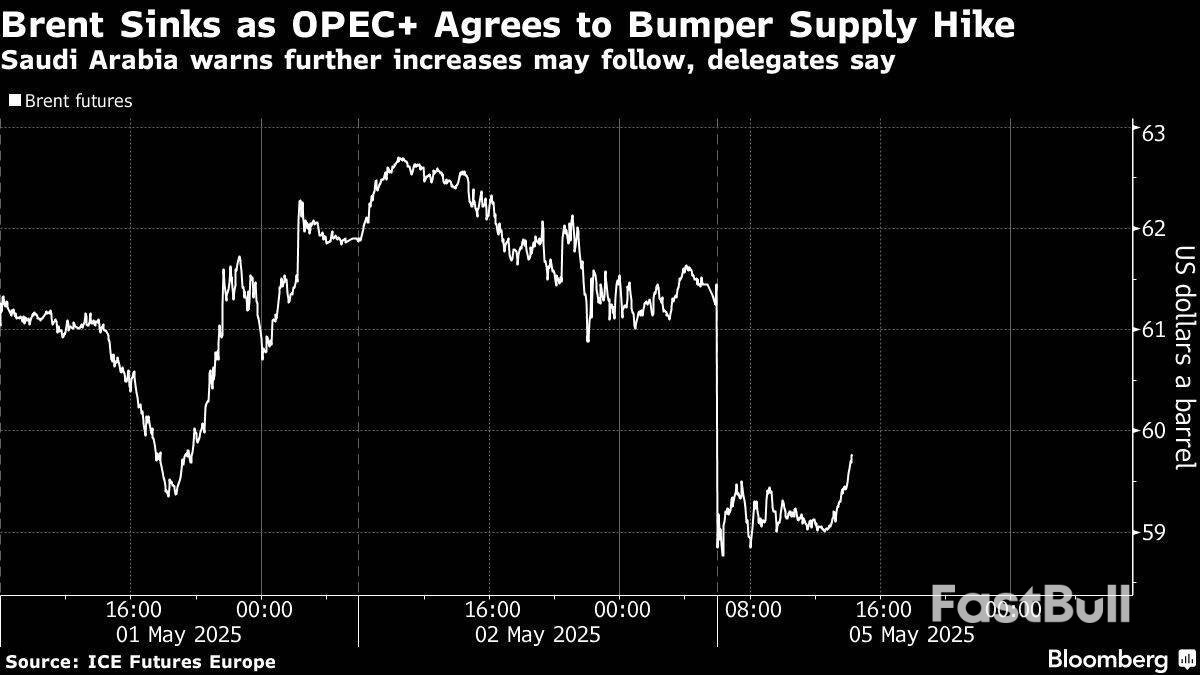
          Oil slipped after OPEC+ agreed to another bumper output increase, raising concern that additional supply could lead to a global glut just as demand looks to be under threat from the trade war.

          Brent futures tumbled as much as 4.6% toward $58 a barrel, before paring losses. OPEC and its allies agreed Saturday to continue loosening supply constraints as the group’s leaders seek to punish overproducing members and win back market share.

          The latest hike of more than 400,000 barrels a day from June matched a similar increase announced last month, when the group made the shock decision to bring back triple the planned volume for May. The alliance — led by Saudi Arabia and Russia — has been unwinding prolonged output curbs meant to support prices but that also cost the group market share. The strategy shift had already sent prices plunging.

          “Projecting larger-than-expected increases marks a reversal in OPEC+ strategy,” Ed Bell head of research at Dubai lender Emirates NBD Pjsc, said in a note. “Providing month-ahead target announcements for producers controlling nearly 30% of global oil production will inject substantial short term volatility to prices” and less cohesion within the group could lead to “a disorderly end” to the alliance’s cooperation, he said.

          In a move that could put additional pressure on prices, Saudi Arabia signaled further similar-sized increases could follow, according to delegates. The threat was widely viewed as being aimed at producers like Kazakhstan and Iraq that have pumped beyond their limits.

          Crude is trading near a four-year low hit in April, as US President Donald Trump’s tariff war threatens to derail growth, erode investor confidence and undercut energy demand. The dramatic policy pivot by OPEC+ has added momentum to the sustained selloff, which has made oil one of the worst performing major commodities of 2025.

          The decline in energy costs — if sustained — may be welcomed by central bankers, including those at the Federal Reserve, who meet this week to assess policy. President Trump — who is scheduled to travel to the Middle East later this month — had called on OPEC+ to bolster production and help bring down energy prices.

          At the same time, Saudi Arabia has been seeking to strengthen ties with Washington, which has also been holding talks on a nuclear pact with Riyadh’s political foe and fellow OPEC member, Iran.

          Source: Yahoo Finance

          Risk Warnings and Disclaimers
          You understand and acknowledge that there is a high degree of risk involved in trading. Following any strategies or investment methods may lead to potential losses. The content on the site is provided by our contributors and analysts for information purposes only. You are solely responsible for determining whether any trading assets, securities, strategy, or any other product is suitable for investing based on your own investment objectives and financial situation.
          Add to Favorites
          Share

          Gold Rises As Demand For Safe-Haven Assets Returns

          Glendon

          Commodity

          Gold prices climbed to 3,260 USD per troy ounce on Monday, as global uncertainty—particularly around US-China trade negotiations—continues to drive demand for safe-haven assets.

          Trade tensions and a weaker dollar support gold

          Market sentiment remains cautious after US President Donald Trump stated that China is ready to make a deal, yet offered no specifics on the content or timing of renewed negotiations.

          Earlier, Beijing confirmed it was reviewing US proposals to restart talks but reiterated that certain conditions must be met before any dialogue can begin. This lingering uncertainty continues to bolster investor interest in gold.

          Adding to the upside pressure, the US dollar weakened, making gold more attractive for holders of other currencies.

          Investors are now turning their attention to the upcoming Federal Reserve meeting, which begins on Tuesday and concludes on Wednesday evening. Markets widely expect the Fed to maintain current interest rates, despite renewed calls from Trump to lower them.

          Technical analysis of XAU/USD

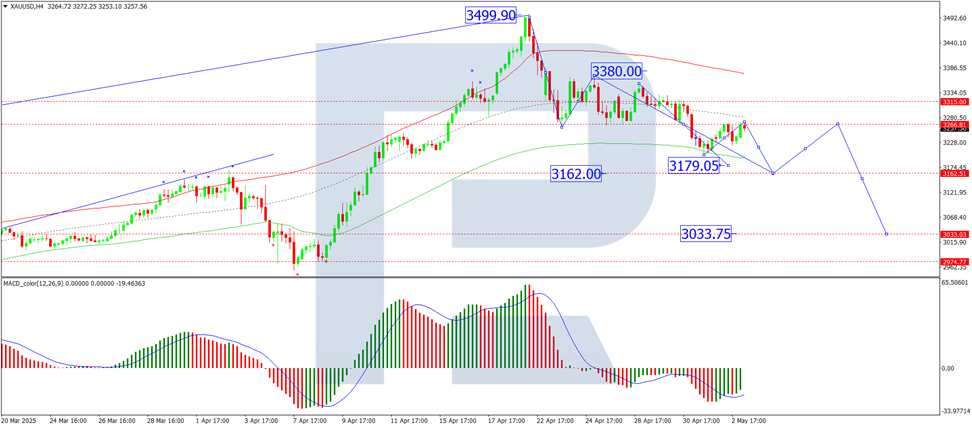
          On the H4 chart, XAU/USD is consolidating around 3,266 USD. A decline to 3,165 USD is possible in the short term. After reaching this level, the market may correct back up to 3,266 USD. If the correction completes, another downward wave could unfold with a target at 3,033 USD. The MACD indicator supports this bearish scenario, with its signal line below zero and pointing sharply downwards.

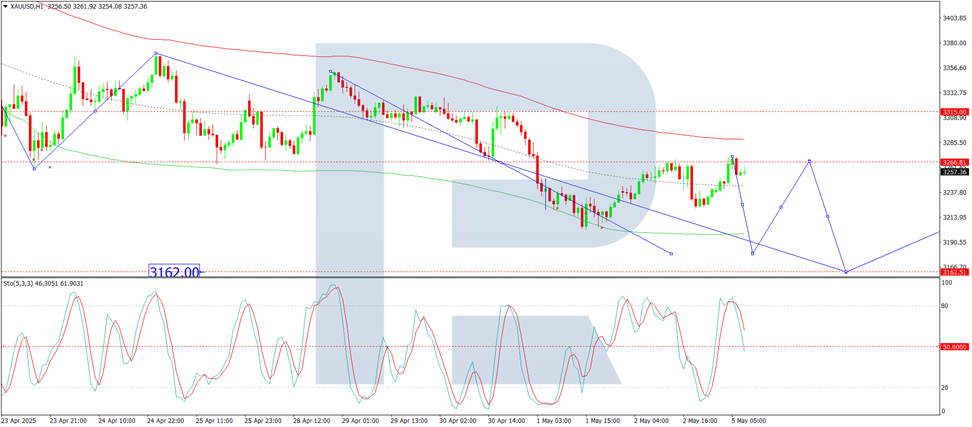
          On the H1 chart, gold broke below 3,266 USD, reached the local target of 3,202 USD, and then corrected back up to test 3,266 USD from below. The formation of another downside wave towards 3,179 USD is relevant today. The Stochastic oscillator confirms this outlook, with its signal line below 80 and heading directly towards 20, indicating continued downward momentum.

          Conclusion

          Gold remains supported by geopolitical uncertainty and a weakening dollar, while technical indicators point to short-term downside potential before another possible corrective rebound. Key levels to watch are 3,179 USD and 3,165 USD as near-term support, with a broader bearish target at 3,033 USD. The Fed’s upcoming meeting may influence price direction depending on its tone regarding interest rates and the broader economic outlook.

          Source: ACTIONFOREX

          Risk Warnings and Disclaimers
          You understand and acknowledge that there is a high degree of risk involved in trading. Following any strategies or investment methods may lead to potential losses. The content on the site is provided by our contributors and analysts for information purposes only. You are solely responsible for determining whether any trading assets, securities, strategy, or any other product is suitable for investing based on your own investment objectives and financial situation.
          Add to Favorites
          Share

          Trump Credits His Policies for Growth While Deflecting Recession Warnings

          Gerik

          Economic

          China–U.S. Trade War

          Economic Outlook and Public Sentiment

          During the “Meet the Press” interview, President Trump asserted that the positive aspects of the current U.S. economy directly derive from measures enacted under his first term, while the negative elements are the consequence of the Biden administration’s actions. His comments come as 66 percent of Americans report feeling pessimistic or fearful about the economy, and a survey by CNN/SSRS finds that 69 percent believe a recession within the next twelve months is at least “relatively likely,” with 32 percent rating the likelihood as “very high.” These figures are correlated with broader uncertainty over trade policy and monetary tightening, underscoring the close relationship between public expectations and economic indicators.
          JPMorgan recently placed the odds of a U.S. recession at 60 percent, with Goldman Sachs at 45 percent. President Trump rebuffed these projections, insisting that his administration’s tariff and tax policies have already lowered consumer costs—a change he says cannot happen overnight but is “coming down.” Yet official data reveal that U.S. food prices rose 2.41 percent year-on-year in March 2025, marking the fastest food inflation since August 2023. By emphasizing his supposed impact on reducing costs, Trump establishes a cause-and-effect link between his policies and consumer price trends, even as the underlying data suggest persistent inflationary pressures.

          Stock Market Performance and Policy Impacts

          Asked about stock market volatility following his recently imposed tariffs, President Trump pointed to streaks of nine, ten, or eleven consecutive sessions of gains since his policies took effect. In reality, the S&P 500 has fallen 6 percent from his inauguration on January 21, though it experienced a dramatic 9.5 percent one-day surge on April 9 after Trump announced a temporary suspension of tariffs on most countries. This episode illustrates a correlation between tariff announcements and investor sentiment, rather than a straightforward causal rebound in equity valuations.
          When pressed on whether high tariff rates might become permanent, President Trump refused to rule it out, arguing that only if business leaders believe duties will be lifted would they choose to build factories outside the U.S. This stance directly links the permanence of trade barriers to domestic manufacturing incentives, framing tariffs as a strategic lever to reshape global supply chains. Although he delayed some auto-parts duties and offered partial refunds to major automakers, he declined support for small businesses, maintaining that they “will not need it.”

          Monetary Policy Tensions

          President Trump renewed his criticism of Federal Reserve Chair Jerome Powell for not cutting interest rates swiftly, calling him “a terrible failure” and suggesting his term should end “sooner rather than later.” He nonetheless acknowledged that he lacks legal authority to dismiss Powell absent egregious misconduct. His remarks highlight a causal claim that Fed inaction is hindering economic recovery, reinforcing the administration’s push for more accommodative policy amid mixed job market signals.
          Despite Trump’s optimism—“our country is getting stronger”—he conceded that “anything can happen,” reflecting an acknowledgment of unavoidable economic volatility. As consumers wrestle with persistent inflation and markets digest the interplay of tariffs, monetary policy and fiscal measures, the U.S. economy faces a delicate balance. Whether Trump’s attribution of gains to his own legacy can withstand data showing modest growth and elevated cost pressures remains to be seen.

          Source: CNN

          To stay updated on all economic events of today, please check out our Economic calendar
          Risk Warnings and Disclaimers
          You understand and acknowledge that there is a high degree of risk involved in trading. Following any strategies or investment methods may lead to potential losses. The content on the site is provided by our contributors and analysts for information purposes only. You are solely responsible for determining whether any trading assets, securities, strategy, or any other product is suitable for investing based on your own investment objectives and financial situation.
          Add to Favorites
          Share

          Asian Economies Leverage Strategic Assets to Counter U.S. Tariff Pressures

          Gerik

          Economic

          China–U.S. Trade War

          Energy Commitments as Negotiation Leverage

          Japan, South Korea and Taiwan have each expanded their pledges to purchase U.S. liquefied natural gas, reflecting a direct response to American calls for new trade concessions. By placing long-term LNG procurement agreements at the negotiation table, these import-dependent economies aim to demonstrate goodwill while meeting America’s need for reliable off-take partners. Industry experts at ICIS observe that Asia’s growing energy demand will hinge on LNG for both economic expansion and coal replacement, making these new commitments an influential factor in shaping tariff outcomes.
          A centerpiece of the talks is the proposed $44 billion Alaska LNG project, touted for cutting shipping times to Asia versus Gulf Coast terminals. Japan, South Korea and Taiwan have all signaled pre-investment interest, seeking equity stakes or offtake guarantees. High development costs and project feasibility concerns remain significant obstacles, yet participation by Asian energy conglomerates would strengthen each country’s negotiating position by aligning U.S. export capacity with regional needs.

          Automotive Trade Concessions Face Structural Limits

          Automobile exports to the United States pose a more entrenched challenge for Japan and South Korea. Tokyo’s $48 billion automotive surplus with the U.S. highlights the imbalance President Trump has targeted, yet Japan’s consideration of relaxed vehicle standards is unlikely to yield meaningful change. American cars often fail to suit narrow Japanese roads, and major Japanese manufacturers have already shifted production into U.S. plants. As a result, any concessions here risk appearing symbolic rather than substantive.
          Washington has urged an expansion of farm product imports, pushing beyond established markets in Japan and South Korea into India and Thailand. Although Japan is weighing increased tariff-free quotas for rice, soybeans and corn, domestic farming lobby resistance—and an upcoming Upper House election—make swift policy shifts improbable. Japan and South Korea collectively account for about 20 percent of U.S. rice exports, and even small additional quotas would require navigating deeply rooted consumer preferences for local staples.

          Shipbuilding Alliances as Defense-Trade Strategy

          South Korea has put its world-class shipbuilding industry to use as a bargaining chip, responding to U.S. security-driven calls to revive domestic yards. Hyundai Heavy Industries’ memorandum of understanding with U.S. defense contractor Huntington Ingalls signals Seoul’s readiness to co-develop commercial and naval vessels on American soil. By linking trade discussions to national security cooperation, Korea seeks to transform tariff negotiations into a broader strategic partnership.
          With over 100 countries and territories now engaged in talks—and delegations from Japan and South Korea currently in Washington for their second negotiating round—the pace and scale of meetings are set to intensify. The decision to pause threatened tariffs for 90 days in April has created a fixed window for compromise, prompting Asian capitals to marshal high-impact offers across multiple sectors. As each proposal reaches the negotiating table, its effectiveness will hinge on Washington’s willingness to balance domestic political priorities with the benefits of deeper economic collaboration.
          Facing a multifaceted tariff strategy from the U.S., Asian economies are deploying their most valuable assets—energy supply agreements, infrastructure investments, industrial know-how and market access offers—to bridge negotiating gaps. The effectiveness of these “trump cards” will depend on how they align with both American policy objectives and the structural realities of each sector, setting the stage for critical decisions before the July 9 deadline.

          Source: Nikkei Asia

          To stay updated on all economic events of today, please check out our Economic calendar
          Risk Warnings and Disclaimers
          You understand and acknowledge that there is a high degree of risk involved in trading. Following any strategies or investment methods may lead to potential losses. The content on the site is provided by our contributors and analysts for information purposes only. You are solely responsible for determining whether any trading assets, securities, strategy, or any other product is suitable for investing based on your own investment objectives and financial situation.
          Add to Favorites
          Share

          Trump Has Opened A Door For The Euro To Rival The Dollar

          Fiona Harper

          Forex

          Economic

          US President Donald Trump's trade and financial policies are supposedly shattering investor confidence in the dollar, creating an opportunity for the euro to challenge its global dominance. The Trump administration has created conditions that could lift the European currency to the status of a global reserve currency.
          Some figures in Trump's team see the dollar's international strength as a burden that inflates its value and hurts American manufacturing. Still, others, including Treasury Secretary Scott Bessent, believe a strong dollar is what's best for the US.
          The EU does not want the greenback to continue being the most used currency in stablecoins, seeing the digital assets as another source of global demand for US Treasury securities.

          Trump's tariff policies erode confidence in the dollar

          The dollar's attractiveness is being undermined by a wave of unconventional and unsettling financial ideas floated by Trump's allies. Countries in the bloc are forcing the conversion of Treasury bonds to impose fees on creditors who lend to the US government.
          The administration's hostility towards trade partners has made global investors unsure about how reliable American financial instruments are.
          Analysts and economists say the moment could be a “Hamiltonian” turning point for the Eurozone, referring to the US founding father Alexander Hamilton's unification of state debts under federal management. Europe is issuing a permanent and sizable pool of joint debt that could help replace the current patchwork of national bonds with a single, liquid Eurozone asset.
          One proposed action is to stop paying down the debt issued for the bloc's “Next Generation EU” recovery fund, originally planned to shrink by 2058. Instead, officials could opt to roll it over indefinitely, preserving a permanent euro-denominated safe asset.
          Another option is consolidating existing EU-backed debt into a single issuance system to streamline borrowing and provide investors with clarity and scale. It could also support proposals like a joint €150 billion defense spending plan.
          The EU could also begin borrowing in advance of its next seven-year budget, which is expected to surpass €1 trillion, to maintain a large, stable euro bond market.

          Expanding the Eurozone safe asset market

          Europe could take advantage of Trump's tariffs and ask partners to reconsider their dependency on the USD, expanding its trade footprint globally. If trading with the US becomes more troubling, then holding its currency becomes less necessary.
          Yet, despite the feasibility of these tools, progress has been stalled by political inertia. Observers argue that what's missing is not technical capacity, but geopolitical will. European leaders must realize America is making strategic blunders that have made the dollar struggle and raised Treasury yields.
          Meanwhile, the euro held above $1.13 last week as inflation data for the Eurozone outperformed expectations. Annual inflation remained steady at 2.2% in April, slightly above forecasts, while services inflation rose to 3.9% and core inflation climbed to 2.7%.

          President Trump to tax foreign-made films

          Elsewhere, President Trump has declared a new 100% tariff on films made in foreign countries. According to the BBC, Trump said the films will be used to spread propaganda against America, and accused foreign governments of luring US-based studios abroad through tax breaks and subsidies.
          “It is, in addition to everything else, messaging and propaganda!” Trump wrote on Truth Social. “WE WANT MOVIES MADE IN AMERICA, AGAIN!”
          Commerce Secretary Howard Lutnick confirmed the administration would implement the new levy soon. Still, it is unclear if the tariffs would apply to American production companies that shoot overseas or how they would affect films on streaming platforms such as Netflix.
          Several blockbusters, including Deadpool & Wolverine, Wicked, and Gladiator II, were all shot outside the US.
          Australia's Home Affairs Minister, Tony Burke, told reporters Monday that the government “will be standing up unequivocally for the rights of the Australian screen industry.”

          Source: CryptoSlate

          To stay updated on all economic events of today, please check out our Economic calendar
          Risk Warnings and Disclaimers
          You understand and acknowledge that there is a high degree of risk involved in trading. Following any strategies or investment methods may lead to potential losses. The content on the site is provided by our contributors and analysts for information purposes only. You are solely responsible for determining whether any trading assets, securities, strategy, or any other product is suitable for investing based on your own investment objectives and financial situation.
          Add to Favorites
          Share
          FastBull
          Copyright © 2025 FastBull Ltd

          728 RM B 7/F GEE LOK IND BLDG NO 34 HUNG TO RD KWUN TONG KLN HONG KONG

          TelegramInstagramTwitterfacebooklinkedin
          App Store Google Play Google Play
          Products
          Charts

          Chats

          Q&A with Experts
          Screeners
          Economic Calendar
          Data
          Tools
          Membership
          Features
          Function
          Markets
          Copy Trading
          Latest Signals
          Contests
          News
          Analysis
          24/7
          Columns
          Education
          Company
          Careers
          About Us
          Contact Us
          Advertising
          Help Center
          Feedback
          User Agreement
          Privacy Policy
          Business

          White Label

          Data API

          Web Plug-ins

          Poster Maker

          Affiliate Program

          Risk Disclosure

          The risk of loss in trading financial instruments such as stocks, FX, commodities, futures, bonds, ETFs and crypto can be substantial. You may sustain a total loss of the funds that you deposit with your broker. Therefore, you should carefully consider whether such trading is suitable for you in light of your circumstances and financial resources.

          No decision to invest should be made without thoroughly conducting due diligence by yourself or consulting with your financial advisors. Our web content might not suit you since we don't know your financial conditions and investment needs. Our financial information might have latency or contain inaccuracy, so you should be fully responsible for any of your trading and investment decisions. The company will not be responsible for your capital loss.

          Without getting permission from the website, you are not allowed to copy the website's graphics, texts, or trademarks. Intellectual property rights in the content or data incorporated into this website belong to its providers and exchange merchants.

          Not Logged In

          Log in to access more features

          FastBull Membership

          Not yet

          Purchase

          Become a signal provider
          Help Center
          Customer Service
          Dark Mode
          Price Up/Down Colors

          Log In

          Sign Up

          Position
          Layout
          Fullscreen
          Default to Chart
          The chart page opens by default when you visit fastbull.com