• Trade
  • Markets
  • Copy
  • Contests
  • News
  • 24/7
  • Calendar
  • Q&A
  • Chats
Trending
Screeners
SYMBOL
LAST
BID
ASK
HIGH
LOW
NET CHG.
%CHG.
SPREAD
SPX
S&P 500 Index
6850.92
6850.92
6850.92
6861.30
6843.84
+23.51
+ 0.34%
--
DJI
Dow Jones Industrial Average
48615.70
48615.70
48615.70
48679.14
48557.21
+157.66
+ 0.33%
--
IXIC
NASDAQ Composite Index
23267.41
23267.41
23267.41
23345.56
23240.37
+72.25
+ 0.31%
--
USDX
US Dollar Index
97.820
97.900
97.820
98.070
97.810
-0.130
-0.13%
--
EURUSD
Euro / US Dollar
1.17567
1.17574
1.17567
1.17596
1.17262
+0.00173
+ 0.15%
--
GBPUSD
Pound Sterling / US Dollar
1.33943
1.33954
1.33943
1.33970
1.33546
+0.00236
+ 0.18%
--
XAUUSD
Gold / US Dollar
4332.78
4333.19
4332.78
4350.16
4294.68
+33.39
+ 0.78%
--
WTI
Light Sweet Crude Oil
56.873
56.903
56.873
57.601
56.789
-0.360
-0.63%
--

Community Accounts

Signal Accounts
--
Profit Accounts
--
Loss Accounts
--
View More

Become a signal provider

Sell trading signals to earn additional income

View More

Guide to Copy Trading

Get started with ease and confidence

View More

Signal Accounts for Members

All Signal Accounts

Best Return
  • Best Return
  • Best P/L
  • Best MDD
Past 1W
  • Past 1W
  • Past 1M
  • Past 1Y

All Contests

  • All
  • Trump Updates
  • Recommend
  • Stocks
  • Cryptocurrencies
  • Central Banks
  • Featured News
Top News Only
Share

The Nasdaq Golden Dragon China Index Fell 0.9% In Early Trading

Share

The S&P 500 Opened 32.78 Points Higher, Or 0.48%, At 6860.19; The Dow Jones Industrial Average Opened 136.31 Points Higher, Or 0.28%, At 48594.36; And The Nasdaq Composite Opened 134.87 Points Higher, Or 0.58%, At 23330.04

Share

Miran: Goods Inflation Could Be Settling In At A Higher Level Than Was Normal Before The Pandemic, But That Will Be More Than Offset By Housing Disinflation

Share

Miran, Who Dissented In Favor Of A Larger Cut At Last Fed Meeting, Repeats Keeping Policy Too Tight Will Lead To Job Losses

Share

Miran: Does Not Think Higher Goods Inflation Is Mostly From Tariffs, But Acknowledges Does Not Have A Full Explanation For It

Share

Toronto Stock Index .GSPTSE Rises 67.16 Points, Or 0.21 Percent, To 31594.55 At Open

Share

Miran: Excluding Housing And Non-Market Based Items, Core Pce Inflation May Be Below 2.3%, “Within Noise” Of The Fed's 2% Target

Share

Polish State Assets Minister Balczun Says Jsw Needs Over USD 830 Million Financing To Keep Liquidity For A Year

Share

Miran: Prices Are “Once Again Stable” And Monetary Policy Should Reflect That

Share

Fed's Miran: Current Excess Inflation Is Not Reflective Of Underlying Supply And Demand In The Economy

Share

Portugal Treasury Puts 2026 Net Financing Needs At 13 Billion Euros, Up From 10.8 Billion In 2025

Share

Portugal Treasury Expects 2026 Net Financing Needs At 29.4 Billion Euros, Up From 25.8 Billion In 2025

Share

Bank Of America Says With Indonesia's Smelter Now Ramping Up, It Expects Aluminium Supply Growth To Accelerate To 2.6% Year On Year In 2026

Share

Bank Of America Expects A Deficit In Aluminium Next Year And Sees Prices Pushing Above $3000/T

Share

Fed Data - USA Effective Federal Funds Rate At 3.64 Percent On 12 December On $102 Billion In Trades Versus 3.64 Percent On $99 Billion On 11 December

Share

Brazil's Petrobras Says No Impact Seen On Oil, Petroleum Products Output As Workers Start Planned Strike

Share

Statement: US Travel Group Warns New Proposed Trump Administration Requirements For Foreign Tourists To Provide Social Media Histories Could Mean Millions Of People Opting Not To Visit

Share

Blackrock: Kerry White Will Become Head Of Citi Investment Management At Citi Wealth

Share

Blackrock: Rob Jasminski, Head Of Citi Investment Management, Has Joined With Team

Share

Blackrock: Effective Dec 15, Citi Investment Management Employees Will Join Blackrock

TIME
ACT
FCST
PREV
Japan Tankan Small Manufacturing Outlook Index (Q4)

A:--

F: --

P: --

Japan Tankan Large Non-Manufacturing Outlook Index (Q4)

A:--

F: --

P: --

Japan Tankan Large Manufacturing Outlook Index (Q4)

A:--

F: --

P: --

Japan Tankan Small Manufacturing Diffusion Index (Q4)

A:--

F: --

P: --

Japan Tankan Large Manufacturing Diffusion Index (Q4)

A:--

F: --

P: --

Japan Tankan Large-Enterprise Capital Expenditure YoY (Q4)

A:--

F: --

P: --

U.K. Rightmove House Price Index YoY (Dec)

A:--

F: --

P: --

China, Mainland Industrial Output YoY (YTD) (Nov)

A:--

F: --

P: --

China, Mainland Urban Area Unemployment Rate (Nov)

A:--

F: --

P: --

Saudi Arabia CPI YoY (Nov)

A:--

F: --

P: --

Euro Zone Industrial Output YoY (Oct)

A:--

F: --

P: --

Euro Zone Industrial Output MoM (Oct)

A:--

F: --

P: --

Canada Existing Home Sales MoM (Nov)

A:--

F: --

P: --

Canada National Economic Confidence Index

A:--

F: --

P: --

Canada New Housing Starts (Nov)

A:--

F: --

P: --
U.S. NY Fed Manufacturing Employment Index (Dec)

A:--

F: --

P: --

U.S. NY Fed Manufacturing Index (Dec)

A:--

F: --

P: --

Canada Core CPI YoY (Nov)

A:--

F: --

P: --

Canada Manufacturing Unfilled Orders MoM (Oct)

A:--

F: --

P: --

U.S. NY Fed Manufacturing Prices Received Index (Dec)

A:--

F: --

P: --

U.S. NY Fed Manufacturing New Orders Index (Dec)

A:--

F: --

P: --

Canada Manufacturing New Orders MoM (Oct)

A:--

F: --

P: --

Canada Core CPI MoM (Nov)

A:--

F: --

P: --

Canada Trimmed CPI YoY (SA) (Nov)

A:--

F: --

P: --

Canada Manufacturing Inventory MoM (Oct)

A:--

F: --

P: --

Canada CPI YoY (Nov)

A:--

F: --

P: --

Canada CPI MoM (Nov)

A:--

F: --

P: --

Canada CPI YoY (SA) (Nov)

A:--

F: --

P: --

Canada Core CPI MoM (SA) (Nov)

A:--

F: --

P: --

Canada CPI MoM (SA) (Nov)

A:--

F: --

P: --

Federal Reserve Board Governor Milan delivered a speech
U.S. NAHB Housing Market Index (Dec)

--

F: --

P: --

Australia Composite PMI Prelim (Dec)

--

F: --

P: --

Australia Services PMI Prelim (Dec)

--

F: --

P: --

Australia Manufacturing PMI Prelim (Dec)

--

F: --

P: --

Japan Manufacturing PMI Prelim (SA) (Dec)

--

F: --

P: --

U.K. 3-Month ILO Employment Change (Oct)

--

F: --

P: --

U.K. Unemployment Claimant Count (Nov)

--

F: --

P: --

U.K. Unemployment Rate (Nov)

--

F: --

P: --

U.K. 3-Month ILO Unemployment Rate (Oct)

--

F: --

P: --

U.K. Average Weekly Earnings (3-Month Average, Including Bonuses) YoY (Oct)

--

F: --

P: --

U.K. Average Weekly Earnings (3-Month Average, Excluding Bonuses) YoY (Oct)

--

F: --

P: --

France Services PMI Prelim (Dec)

--

F: --

P: --

France Composite PMI Prelim (SA) (Dec)

--

F: --

P: --

France Manufacturing PMI Prelim (Dec)

--

F: --

P: --

Germany Services PMI Prelim (SA) (Dec)

--

F: --

P: --

Germany Manufacturing PMI Prelim (SA) (Dec)

--

F: --

P: --

Germany Composite PMI Prelim (SA) (Dec)

--

F: --

P: --

Euro Zone Composite PMI Prelim (SA) (Dec)

--

F: --

P: --

Euro Zone Services PMI Prelim (SA) (Dec)

--

F: --

P: --

Euro Zone Manufacturing PMI Prelim (SA) (Dec)

--

F: --

P: --

U.K. Services PMI Prelim (Dec)

--

F: --

P: --

U.K. Manufacturing PMI Prelim (Dec)

--

F: --

P: --

U.K. Composite PMI Prelim (Dec)

--

F: --

P: --

Euro Zone ZEW Economic Sentiment Index (Dec)

--

F: --

P: --

Germany ZEW Current Conditions Index (Dec)

--

F: --

P: --

Germany ZEW Economic Sentiment Index (Dec)

--

F: --

P: --

Euro Zone Trade Balance (Not SA) (Oct)

--

F: --

P: --

Euro Zone ZEW Current Conditions Index (Dec)

--

F: --

P: --

Euro Zone Trade Balance (SA) (Oct)

--

F: --

P: --

U.S. Retail Sales MoM (Excl. Automobile) (SA) (Oct)

--

F: --

P: --

Q&A with Experts
    • All
    • Chatrooms
    • Groups
    • Friends
    Connecting
    .
    .
    .
    Type here...
    Add Symbol or Code

      No matching data

      All
      Trump Updates
      Recommend
      Stocks
      Cryptocurrencies
      Central Banks
      Featured News
      • All
      • Russia-Ukraine Conflict
      • Middle East Flashpoint
      • All
      • Russia-Ukraine Conflict
      • Middle East Flashpoint
      Search
      Products

      Charts Free Forever

      Chats Q&A with Experts
      Screeners Economic Calendar Data Tools
      Membership Features
      Data Warehouse Market Trends Institutional Data Policy Rates Macro

      Market Trends

      Market Sentiment Order Book Forex Correlations

      Top Indicators

      Charts Free Forever
      Markets

      News

      News Analysis 24/7 Columns Education
      From Institutions From Analysts
      Topics Columnists

      Latest Views

      Latest Views

      Trending Topics

      Top Columnists

      Latest Update

      Signals

      Copy Rankings Latest Signals Become a signal provider AI Rating
      Contests
      Brokers

      Overview Brokers Assessment Rankings Regulators News Claims
      Broker listing Forex Brokers Comparison Tool Live Spread Comparison Scam
      Q&A Complaint Scam Alert Videos Tips to Detect Scam
      More

      Business
      Events
      Careers About Us Advertising Help Center

      White Label

      Data API

      Web Plug-ins

      Affiliate Program

      Awards Institution Evaluation IB Seminar Salon Event Exhibition
      Vietnam Thailand Singapore Dubai
      Fans Party Investment Sharing Session
      FastBull Summit BrokersView Expo
      Recent Searches
        Top Searches
          Markets
          News
          Analysis
          User
          24/7
          Economic Calendar
          Education
          Data
          • Names
          • Latest
          • Prev

          View All

          No data

          Scan to Download

          Faster Charts, Chat Faster!

          Download App
          English
          • English
          • Español
          • العربية
          • Bahasa Indonesia
          • Bahasa Melayu
          • Tiếng Việt
          • ภาษาไทย
          • Français
          • Italiano
          • Türkçe
          • Русский язык
          • 简中
          • 繁中
          Open Account
          Search
          Products
          Charts Free Forever
          Markets
          News
          Signals

          Copy Rankings Latest Signals Become a signal provider AI Rating
          Contests
          Brokers

          Overview Brokers Assessment Rankings Regulators News Claims
          Broker listing Forex Brokers Comparison Tool Live Spread Comparison Scam
          Q&A Complaint Scam Alert Videos Tips to Detect Scam
          More

          Business
          Events
          Careers About Us Advertising Help Center

          White Label

          Data API

          Web Plug-ins

          Affiliate Program

          Awards Institution Evaluation IB Seminar Salon Event Exhibition
          Vietnam Thailand Singapore Dubai
          Fans Party Investment Sharing Session
          FastBull Summit BrokersView Expo

          Euro Rallies Against Dollar After Powell’s Cautious Jackson Hole Speech

          Blue River

          Technical Analysis

          Summary:

          The euro strengthened against the US dollar on Friday following a speech by Federal Reserve Chair Jerome Powell at the Jackson Hole Economic Symposium, closing the week on a positive note.

          The euro strengthened against the US dollar on Friday following a speech by Federal Reserve Chair Jerome Powell at the Jackson Hole Economic Symposium, closing the week on a positive note. While Powell acknowledged the potential for an interest rate cut as soon as September, he refrained from making any explicit commitments.

          The EUR/USD pair rose to 1.1728, reaching its highest level since 28 July.

          Market expectations for a rate cut at the Fed’s September meeting (16–17) now stand at 85%. For the remainder of the year, market pricing points to a more dovish outlook, with an average of 54 basis points of easing anticipated, up from 48 basis points previously.

          Investor attention is now shifting to labour market data. Powell noted that the market is in an unusual balance, with both demand for and supply of workers slowing. The trajectory of employment will be a key determinant for the Fed’s future policy decisions.

          An additional factor weighing on the dollar is the growing scrutiny surrounding the Fed’s independence. Last week, US President Donald Trump called for the resignation of Federal Reserve Governor Lisa Cook and suggested she could be dismissed. This has further fuelled concerns about political pressure being exerted on the central bank.

          Technical Analysis: EUR/USD

          H4 Chart:

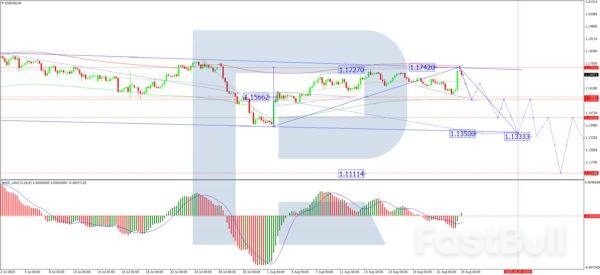
          On the H4 chart, the market has formed a consolidation range around the 1.1566 level. Following an upward breakout, the corrective wave appears to have completed at the 1.1742 high. The primary focus is now on the potential initiation of a new bearish wave targeting the 1.1550 level. This scenario is technically supported by the MACD indicator, whose signal line remains below zero and is pointing decisively lower.
          H1 Chart:

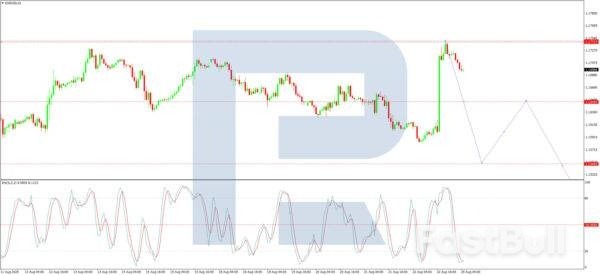
          On the H1 chart, the market completed an ascending wave to the 1.1742 level and subsequently formed a consolidation range below it. The price has now broken downwards out of this range. The immediate outlook suggests a high probability of a further decline towards the 1.1664 support level. Following this, a corrective bounce towards 1.1694 is possible. The broader structure is then expected to resume its downward trajectory, targeting 1.1590, with the ultimate bearish objective for the wave structure seen at 1.1550. This view is corroborated by the Stochastic oscillator, whose signal line is currently below the 50 midline and is trending sharply lower towards the 20 level.
          Conclusion

          While fundamental drivers from the Fed provided a lift, the technical picture suggests the euro’s rally may be limited in the near term.

          Source: ACTIONFOREX

          Risk Warnings and Disclaimers
          You understand and acknowledge that there is a high degree of risk involved in trading. Following any strategies or investment methods may lead to potential losses. The content on the site is provided by our contributors and analysts for information purposes only. You are solely responsible for determining whether any trading assets, securities, strategy, or any other product is suitable for investing based on your own investment objectives and financial situation.
          Add to Favorites
          Share

          Thailand’s Exports Beat July Forecasts but Tariff Risks Loom Large

          Gerik

          Economic

          Solid July Numbers Offer Temporary Boost

          Thailand’s export sector delivered an 11% increase in July compared to a year earlier, outperforming the Reuters poll forecast of 9.6%. This performance, however, marked a slowdown from June’s 15.5% surge, suggesting momentum was already beginning to taper off. The Ministry of Commerce attributed the strong July figures to accelerated shipping activity before new U.S. tariffs on Thai goods were enforced.
          For the January–July period, exports grew by a robust 14.4%, providing a buffer to the full-year forecast. Despite the upbeat seven-month tally, the ministry remains cautious, holding to its annual export growth projection of just 2% to 3%. Officials noted that while the strong early-year performance may boost the yearly outcome, double-digit export growth for 2025 is unlikely.

          Tariffs Disrupt Growth Outlook

          The core challenge facing Thailand’s trade outlook is the new 19% tariff imposed by the U.S. on a broad range of Thai exports. While lower than the initially announced 36%, the tariff still poses significant headwinds. Many importers rushed orders ahead of the new policy, inflating short-term figures but pulling demand forward at the expense of future months.
          Trade Policy and Strategy Office chief Poonpong Naiyanapakorn stressed that the export sector would likely lose steam in the final five months of the year as the artificial bump from front-loaded shipments fades.
          Adding complexity, uncertainties linger regarding U.S. enforcement on transshipments goods exported from third countries via Thailand which could further weigh on trade if restrictions tighten.

          Key Markets Still Active

          Despite looming barriers, Thailand’s exports to the U.S. in July soared by 31.4% year-on-year, reinforcing America’s role as Thailand’s top trade partner, accounting for 18.3% of exports last year. Shipments to China, another critical market, also jumped 23.1%, reflecting resilient regional demand even amid global trade tensions.
          Imports rose 5.1% in July, slightly above expectations, signaling that domestic demand and production-related purchases remain healthy. More notably, the trade balance showed a surplus of $320 million, a sharp contrast to the expected $500 million deficit. This suggests exporters’ pre-tariff activity outpaced import needs, temporarily boosting the trade account.
          Thailand’s stronger-than-expected July exports offer a short-term reprieve, but the broader outlook remains clouded by geopolitical trade shifts and tariff uncertainties. While the annual growth target remains within reach, the possibility of a sharper-than-expected downturn looms, especially if demand from major partners such as the U.S. weakens under the weight of trade restrictions. The second half of 2025 will test Thailand’s export resilience in a more protectionist global environment.

          Source: Reuters

          To stay updated on all economic events of today, please check out our Economic calendar
          Risk Warnings and Disclaimers
          You understand and acknowledge that there is a high degree of risk involved in trading. Following any strategies or investment methods may lead to potential losses. The content on the site is provided by our contributors and analysts for information purposes only. You are solely responsible for determining whether any trading assets, securities, strategy, or any other product is suitable for investing based on your own investment objectives and financial situation.
          Add to Favorites
          Share

          Oil Prices Edge Up As Traders Mull Supply Risks

          Dark Current

          Economic

          Commodity

          Oil prices climbed on Monday as traders weighed concerns that Russian supply could be disrupted by more U.S. sanctions and Ukrainian attacks targeting energy infrastructure in Russia.

          Brent crude futures rose 29 cents, or 0.4%, to $68.02 at 0839 GMT, and West Texas Intermediate (WTI) crude futures gained 36 cents, or 0.6%, to $64.02.

          "The market is somewhat concerned that these peace negotiations are going nowhere," said Ole Hansen, head of commodity strategy at Saxo Bank.

          "The market is looking for supply to exceed demand in the autumn months, but in the short term that's being challenged by a potential geopolitical disruption."

          U.S. President Donald Trump warned again on Friday that he would impose sanctions on Russia if there was no progress toward a peaceful settlement in Ukraine in two weeks. He has also said he may hit India with harsh tariffs over its Russian oil purchases.

          Speaking at the weekend, U.S. Vice President JD Vance said Russia had made "significant concessions" toward a negotiated settlement in the three-and-a-half year war.

          Ukraine has repeatedly targeted Russian energy infrastructure during the war, and on Sunday carried out a drone attack which sparked a huge blaze at the Ust-Luga fuel export terminal, Russian officials said.

          A fire at Russia's Novoshakhtinsk refinery, caused by a Ukrainian drone attack, was burning for the fourth day on Sunday, the region's acting governor said. The refinery sells fuel mainly for export and has an annual capacity of 5 million metric tons of oil, or about 100,000 barrels per day.

          Softening the worries about Russian supply disruptions are OPEC+'s reversal of a series of production cuts, which are adding millions of barrels to the market, Saxo Bank's Hansen said.

          Eight members of the oil exporters' group are scheduled to meet on September 7 where they are set to approve another boost.

          Investors' risk appetite improved following Federal Reserve Chair Jerome Powell's signal on Friday of a possible interest rate cut at the U.S. central bank's meeting in September.

          But despite that, both benchmark oil prices appear to lack momentum, said Priyanka Sachdeva, senior market analyst at brokerage Phillip Nova, adding that markets seem increasingly convinced that Trump's tariffs will hit economic growth.

          Source: Reuters

          To stay updated on all economic events of today, please check out our Economic calendar
          Risk Warnings and Disclaimers
          You understand and acknowledge that there is a high degree of risk involved in trading. Following any strategies or investment methods may lead to potential losses. The content on the site is provided by our contributors and analysts for information purposes only. You are solely responsible for determining whether any trading assets, securities, strategy, or any other product is suitable for investing based on your own investment objectives and financial situation.
          Add to Favorites
          Share

          Treasury Yields Edge Up as Powell’s Words Stir Rate-Cut Speculation Ahead of PCE Data

          Gerik

          Economic

          Yields Tick Up in Anticipation of Inflation Clues

          U.S. Treasury yields inched higher on Monday morning as investors continued to analyze the implications of Federal Reserve Chair Jerome Powell’s speech and looked ahead to this week’s core personal consumption expenditures (PCE) report. The benchmark 10-year Treasury yield rose 1 basis point to 4.269%, while the 2-year yield added over 2 basis points to 3.713%, reflecting modest but clear shifts in market sentiment.
          While yields typically climb when inflation or growth expectations rise, this latest uptick appears to be driven more by strategic positioning ahead of fresh data, rather than any dramatic change in outlook. Shorter-dated instruments like the 1-year and 3-month Treasurys saw slightly larger yield increases (+4.2 bps and +3.1 bps, respectively), suggesting some re-pricing of near-term rate expectations.

          Jackson Hole Recap: Powell’s Balancing Act

          Speaking at the Fed’s Jackson Hole Economic Symposium, Powell maintained a cautious tone. He avoided committing to an immediate policy shift but acknowledged that rising labor market risks may soon warrant adjustments to the Fed’s stance. He cited “sweeping changes” in U.S. tax, trade, and immigration policy as altering the risk landscape, a rare acknowledgement that structural geopolitical factors are weighing more heavily on monetary policy decisions.
          Ronald Temple of Lazard noted that while a September rate cut is far from certain, Powell’s remarks have “increased the likelihood” of a 25-basis-point reduction in the fed funds target rate. This sentiment is increasingly shared among bond investors, who are now watching upcoming inflation data with renewed intensity.

          The Data to Watch: July Core PCE on Friday

          All eyes now turn to the release of July’s core PCE price index this Friday the Fed’s preferred inflation gauge. Forecasts suggest a 2.9% year-over-year rise, up slightly from 2.8% in June. A softer-than-expected print could further strengthen the case for rate cuts, while a hotter number might prompt the Fed to keep rates on hold longer.
          Because PCE measures a broader swath of goods and services than CPI and uses chain-weighted methodology, it often signals inflationary pressure in a more dynamic and consumer-representative way. Therefore, even a 0.1% shift in the year-on-year figure can materially impact the Fed’s next steps and the bond market knows it.
          Though no immediate pivot was announced at Jackson Hole, Powell’s tone subtly shifted acknowledging labor market vulnerabilities and longer-term geopolitical disruptions. That’s all markets needed to begin re-pricing risk. Treasury yields are now moving not on firm policy but on probabilities and this week’s PCE report could either validate or upend that cautious optimism.

          Source: CNBC

          To stay updated on all economic events of today, please check out our Economic calendar
          Risk Warnings and Disclaimers
          You understand and acknowledge that there is a high degree of risk involved in trading. Following any strategies or investment methods may lead to potential losses. The content on the site is provided by our contributors and analysts for information purposes only. You are solely responsible for determining whether any trading assets, securities, strategy, or any other product is suitable for investing based on your own investment objectives and financial situation.
          Add to Favorites
          Share

          German Businesses Accentuate The Positives

          Olivia Brooks

          Economic

          After last week’s disappointing GDP numbers, today’s Ifo index shows that German companies are still in a Bing Crosby and The Andrews Sisters mood, ac-cent-tchu-ating the positives.

          Germany’s most prominent leading indicator, the Ifo index, increased for the eighth consecutive month to 89.0 in August, from 88.6 in July. The Ifo index is now at its highest level in more than two years. While the current assessment component actually dropped to 86.4, from 86.5 in July, expectations increased to the highest level since the start of the Russian invasion of Ukraine.

          It is still unclear where this optimism is coming from. Is it due to fiscal stimulus, a less benign take on US tariffs, or signs that the turning of the inventory cycle that we saw at the start of the year will pick up steam again? Possible, but definitely not a done deal.

          All hopes on fiscal stimulus

          Looking ahead, the German economy and industry will be particularly influenced by trade, the exchange rate, and fiscal stimulus. Following last week’s disappointing GDP data, it is still unclear how much positive momentum remains in the German economy after the back-and-forth of US tariff frontloading and subsequent reversals. In fact, with the latest framework agreement between the US and the EU, German exports will again be impacted. US tariffs of 15% on most European goods and uncertainty over whether (and when) the 27.5% tariffs on automotives will be brought back to 15% don’t bode well for German exports.

          While financial markets seem to have grown numb to tariff announcements, let’s not forget that their adverse effects on economies will gradually unfold over time. The German Mittelstand could become a victim of US tariffs, as these hidden champions will have more trouble relocating production than big corporates. Add to that the stronger euro exchange rate – not only against the US dollar, but many other currencies – and it is hard to see how the export-dependent German economy will be able to get out of seemingly never-ending stagnation in the second half of the year.

          All of this means that all hopes for a sustainable German recovery are on fiscal stimulus. In this regard, however, the current political debate in Germany on possible austerity measures could undermine the – at least psychological – impact of the announced fiscal stimulus for infrastructure and defence. As much as we subscribe to the need for sustainable public finances and structural reforms for the economy and the budget, it is a debate that would benefit from swift decisions. The longer a debate on potential austerity measures lasts, the higher the risk that households and companies will hold back spending and investment decisions – a risk factor that financial markets seem to have missed so far.

          In short, today's Ifo index shows remarkable optimism of German businesses in the healing nature of fiscal stimulus for the economy. While we agree that eventually the government's spending plans for infrastructure and defence will lead to a surge in economic activity, there is still an increasing risk of underachieving. In any case, as much as we sympathise with accentuating the positives, we fear that it could take until the very special season of the year when they play even more popular Bing Crosby songs before the economy really enters a period of substantially stronger growth.

          Source: ING

          To stay updated on all economic events of today, please check out our Economic calendar
          Risk Warnings and Disclaimers
          You understand and acknowledge that there is a high degree of risk involved in trading. Following any strategies or investment methods may lead to potential losses. The content on the site is provided by our contributors and analysts for information purposes only. You are solely responsible for determining whether any trading assets, securities, strategy, or any other product is suitable for investing based on your own investment objectives and financial situation.
          Add to Favorites
          Share

          China’s Rare Earth Giants Surge as Beijing Imposes Stricter Oversight

          Gerik

          Economic

          Commodity

          Beijing's Regulatory Tightening Sparks Rare Earth Rally

          On Monday, shares of Chinese rare earth producers soared following the release of new policy details from China’s Ministry of Industry and Information Technology (MIIT). The move tightens Beijing’s already heavy regulatory control over the rare earths sector, with authorities now requiring producers to submit detailed and frequent output reports to the government.
          This policy, while regulatory in nature, is being interpreted by markets as a bullish signal for large, state-backed producers that are best positioned to meet these compliance demands, thus consolidating their market share.

          Market Response: Sector-wide Gains

          Investors responded swiftly. Hong Kong-listed JL-Mag Rare-Earth Co. jumped as much as 18%, while China Northern Rare Earth Group High-Tech Co., one of the industry’s largest players, gained 10% in mainland trading. China Rare Earth Resources and Technology Co. climbed 8.5%, and Zhejiang Zhongke Magnetic Industry Co. rose 12%.
          These gains reflect renewed confidence in the stability and pricing power of major producers, which are likely to benefit as stricter regulations weed out smaller, less compliant competitors.

          Strategic Trade Weapon

          China’s rare earth industry which dominates global supply of key elements used in electronics, renewable energy, and defense has long been considered a strategic lever in trade negotiations. Since President Donald Trump ramped up tariffs on Chinese goods, Beijing has responded by tightening its grip on critical supply chains like rare earths, using regulatory power both to control exports and combat smuggling.
          The latest policy update builds on a June 2024 proposal and provides clearer definitions regarding the roles of enterprises, local authorities, and ministries in monitoring and enforcing production limits. The stated goal is to improve transparency and output traceability across the entire domestic supply chain.

          Implications for Global Supply Chains

          This move could reduce unregulated or excess production, effectively controlling supply and supporting global prices. It may also heighten concern among foreign buyers particularly in the United States and Europe who are already seeking to diversify their sourcing due to rising geopolitical risk and trade frictions.
          As China doubles down on securing its strategic resource sectors, countries dependent on Chinese rare earths for EVs, wind turbines, and military tech may accelerate efforts to localize supply or seek alternative partnerships, a trend that could shape global trade and tech landscapes well beyond 2025.
          Beijing’s move to strengthen surveillance and formalize output monitoring in the rare earths sector is part of a long-term strategy to consolidate industrial control, bolster pricing power, and use resource dominance as leverage in broader geopolitical dynamics. For investors, this means major state-affiliated producers are poised to benefit from both domestic policy tailwinds and sustained global demand for critical materials.

          Source: Bloomberg

          To stay updated on all economic events of today, please check out our Economic calendar
          Risk Warnings and Disclaimers
          You understand and acknowledge that there is a high degree of risk involved in trading. Following any strategies or investment methods may lead to potential losses. The content on the site is provided by our contributors and analysts for information purposes only. You are solely responsible for determining whether any trading assets, securities, strategy, or any other product is suitable for investing based on your own investment objectives and financial situation.
          Add to Favorites
          Share

          Shanghai Eases Housing Rules as Beijing Expands Property Rescue Efforts

          Gerik

          Economic

          Shanghai's Policy Shift Signals Broader National Strategy

          On Monday, China’s financial capital Shanghai announced a significant loosening of its housing purchase restrictions, signaling another phase in the central government’s broader campaign to arrest the multi-year downturn in the real estate sector. This move forms part of Beijing’s calibrated approach to revive market confidence, especially in suburban zones burdened by oversupply and slow sales turnover.
          Under the new rules, all Shanghai residents including non-locals are now permitted to purchase an unlimited number of homes in the city’s outer suburbs. Moreover, non-residents who have contributed to local pension programs for at least three years are now allowed to buy new homes in urban districts, expanding eligibility beyond the secondary housing market.

          Market Reactions: Developer Stocks Surge

          Investors responded positively. A Bloomberg Intelligence index tracking Chinese property developers jumped up to 3%, its biggest intraday gain in a month. Shares of China Vanke surged as much as 16% despite recently disclosing a wider first-half loss, while Sunac China Holdings gained up to 13%. These gains reflect renewed investor optimism that further easing and stimulus are in the pipeline.
          Shanghai's housing policy pivot is notable due to the city's status as both a bellwether for national real estate sentiment and a strategic economic hub. According to Jeff Zhang from Morningstar, suburban transactions account for more than half of Shanghai’s total property sales. The easing will likely provide an "incremental positive" by unlocking buyer demand in these outer zones, which house approximately 80% of the city’s unsold residential inventory.
          Song Hongwei of Tospur Real Estate Consulting emphasized that this is a "targeted" strategy meant to reduce inventory and lower entry barriers for homebuyers, particularly in underperforming suburban markets.

          Mortgage and Affordability Incentives

          In addition to eligibility expansion, Shanghai’s municipal government also introduced reforms to lower borrowing costs. It removed the distinction between first and second homes in calculating mortgage rates, likely reducing rates by about 40 basis points and incentivizing homeowners to upgrade to newer or larger properties.
          For lower-income buyers, the city has increased the maximum mortgage amount available under the Housing Provident Fund to 2.16 million yuan ($302,000). These loans are about 45 basis points cheaper than standard first-home mortgages. Additionally, Shanghai will now allow residents to withdraw funds from their Provident Fund accounts to help cover down payments.

          National Momentum Building

          Premier Li Qiang recently reaffirmed the government’s commitment to stemming the property sector’s decline during a State Council meeting. This followed similar easing moves by Beijing earlier in August, which allowed unlimited suburban home purchases outside the fifth ring road.
          China’s central planners have signaled since March their readiness to “fully unleash” housing demand, especially from first-time buyers and families seeking better living conditions. Reports from Securities Daily suggest further support measures, including accelerated urban redevelopment projects, could be unveiled in September.
          The cumulative effect of Shanghai’s new policies coupled with prior easing measures in Beijing suggests a coordinated effort to stimulate buyer interest, reduce excess inventory, and restore some degree of stability to China’s long-beleaguered property market. However, the success of these initiatives will depend on their ability to overcome deep-seated demand-side hesitations, including job insecurity, weak household income growth, and broader macroeconomic headwinds such as U.S. tariffs and global supply-chain shifts. For now, the equity markets are responding with optimism but structural challenges remain.

          Source: Reuters

          To stay updated on all economic events of today, please check out our Economic calendar
          Risk Warnings and Disclaimers
          You understand and acknowledge that there is a high degree of risk involved in trading. Following any strategies or investment methods may lead to potential losses. The content on the site is provided by our contributors and analysts for information purposes only. You are solely responsible for determining whether any trading assets, securities, strategy, or any other product is suitable for investing based on your own investment objectives and financial situation.
          Add to Favorites
          Share
          FastBull
          Copyright © 2025 FastBull Ltd

          728 RM B 7/F GEE LOK IND BLDG NO 34 HUNG TO RD KWUN TONG KLN HONG KONG

          TelegramInstagramTwitterfacebooklinkedin
          App Store Google Play Google Play
          Products
          Charts

          Chats

          Q&A with Experts
          Screeners
          Economic Calendar
          Data
          Tools
          Membership
          Features
          Function
          Markets
          Copy Trading
          Latest Signals
          Contests
          News
          Analysis
          24/7
          Columns
          Education
          Company
          Careers
          About Us
          Contact Us
          Advertising
          Help Center
          Feedback
          User Agreement
          Privacy Policy
          Business

          White Label

          Data API

          Web Plug-ins

          Poster Maker

          Affiliate Program

          Risk Disclosure

          The risk of loss in trading financial instruments such as stocks, FX, commodities, futures, bonds, ETFs and crypto can be substantial. You may sustain a total loss of the funds that you deposit with your broker. Therefore, you should carefully consider whether such trading is suitable for you in light of your circumstances and financial resources.

          No decision to invest should be made without thoroughly conducting due diligence by yourself or consulting with your financial advisors. Our web content might not suit you since we don't know your financial conditions and investment needs. Our financial information might have latency or contain inaccuracy, so you should be fully responsible for any of your trading and investment decisions. The company will not be responsible for your capital loss.

          Without getting permission from the website, you are not allowed to copy the website's graphics, texts, or trademarks. Intellectual property rights in the content or data incorporated into this website belong to its providers and exchange merchants.

          Not Logged In

          Log in to access more features

          FastBull Membership

          Not yet

          Purchase

          Become a signal provider
          Help Center
          Customer Service
          Dark Mode
          Price Up/Down Colors

          Log In

          Sign Up

          Position
          Layout
          Fullscreen
          Default to Chart
          The chart page opens by default when you visit fastbull.com