• Trade
  • Markets
  • Copy
  • Contests
  • News
  • 24/7
  • Calendar
  • Q&A
  • Chats
Trending
Screeners
SYMBOL
LAST
BID
ASK
HIGH
LOW
NET CHG.
%CHG.
SPREAD
SPX
S&P 500 Index
6852.69
6852.69
6852.69
6878.28
6852.69
-17.71
-0.26%
--
DJI
Dow Jones Industrial Average
47814.08
47814.08
47814.08
47971.51
47771.72
-140.90
-0.29%
--
IXIC
NASDAQ Composite Index
23543.99
23543.99
23543.99
23698.93
23543.99
-34.12
-0.14%
--
USDX
US Dollar Index
99.060
99.140
99.060
99.110
98.730
+0.110
+ 0.11%
--
EURUSD
Euro / US Dollar
1.16296
1.16303
1.16296
1.16717
1.16245
-0.00130
-0.11%
--
GBPUSD
Pound Sterling / US Dollar
1.33178
1.33186
1.33178
1.33462
1.33087
-0.00134
-0.10%
--
XAUUSD
Gold / US Dollar
4190.40
4190.81
4190.40
4218.85
4175.92
-7.51
-0.18%
--
WTI
Light Sweet Crude Oil
59.002
59.032
59.002
60.084
58.892
-0.807
-1.35%
--

Community Accounts

Signal Accounts
--
Profit Accounts
--
Loss Accounts
--
View More

Become a signal provider

Sell trading signals to earn additional income

View More

Guide to Copy Trading

Get started with ease and confidence

View More

Signal Accounts for Members

All Signal Accounts

Best Return
  • Best Return
  • Best P/L
  • Best MDD
Past 1W
  • Past 1W
  • Past 1M
  • Past 1Y

All Contests

  • All
  • Trump Updates
  • Recommend
  • Stocks
  • Cryptocurrencies
  • Central Banks
  • Featured News
Top News Only
Share

The S&P 500 Opened 4.80 Points Higher, Or 0.07%, At 6875.20; The Dow Jones Industrial Average Opened 16.52 Points Higher, Or 0.03%, At 47971.51; And The Nasdaq Composite Opened 60.09 Points Higher, Or 0.25%, At 23638.22

Share

Reuters Poll - Swiss National Bank Policy Rate To Be 0.00% At End-2026, Said 21 Of 25 Economists, Four Said It Would Be Cut To -0.25%

Share

USGS - Magnitude 7.6 Earthquake Strikes Misawa, Japan

Share

Reuters Poll - Swiss National Bank To Hold Policy Rate At 0.00% On December 11, Said 38 Of 40 Economists, Two Said Cut To -0.25%

Share

Traders Believe There Is A 20% Chance That The European Central Bank Will Raise Interest Rates Before The End Of 2026

Share

Toronto Stock Index .GSPTSE Rises 11.99 Points, Or 0.04 Percent, To 31323.40 At Open

Share

Japan Meteorological Agency: A Tsunami With A Maximum Height Of Three Meters Is Expected Following The Earthquake In Japan

Share

Japan Meteorological Agency: A 7.2-magnitude Earthquake Struck Off The Coast Of Northern Japan, And A Tsunami Warning Has Been Issued

Share

Japan Finance Minister Katayama: G7 Expected To Hold Another Meeting By The End Of This Year

Share

The Japan Meteorological Agency Reported That An Earthquake Occurred In The Sea Near Aomori

Share

Japan Finance Minister Katayama: The G7 Finance Ministers' Meeting Discussed The Critical Mineral Supply Chain And Support For Ukraine

Share

Japan Finance Minister Katayama: Held Onlinemeeting With G7 Finance Ministers

Share

Fed Data - USA Effective Federal Funds Rate At 3.89 Percent On 05 December On $88 Billion In Trades Versus 3.89 Percent On $87 Billion On 04 December

Share

Chinese Foreign Minister Wang Yi: One-China Principle Is An Important Political Foundation For China-Germany Relations, And There Is No Room For Ambiguity

Share

Chinese Foreign Minister Wang Yi: Hopes Germany To Understand, Support China's Position Regarding Japan Prime Minister's Remark On Taiwan

Share

Chinese Foreign Minister Wang Yi: Hopes Germany Will View China More Objectively And Rationally, Adhere To The Positioning Of China-Germany Partnership

Share

China Foreign Ministry: China's Foreign Minister Wang Yi Meets German Counterpart

Share

Israeli Government Spokesperson: Netanyahu Will Meet Trump On December 29

Share

Stc Did Not Ask Internationally-Government To Leave Aden - Senior Stc Official To Reuters

Share

Members Of Internationally-Recognised Government, Opposed To Northern Houthis, Have Left Aden - Senior Stc Official To Reuters

TIME
ACT
FCST
PREV
France Trade Balance (SA) (Oct)

A:--

F: --

P: --
Euro Zone Employment YoY (SA) (Q3)

A:--

F: --

P: --
Canada Part-Time Employment (SA) (Nov)

A:--

F: --

P: --

Canada Unemployment Rate (SA) (Nov)

A:--

F: --

P: --

Canada Full-time Employment (SA) (Nov)

A:--

F: --

P: --

Canada Labor Force Participation Rate (SA) (Nov)

A:--

F: --

P: --

Canada Employment (SA) (Nov)

A:--

F: --

P: --

U.S. PCE Price Index MoM (Sept)

A:--

F: --

P: --

U.S. Personal Income MoM (Sept)

A:--

F: --

P: --

U.S. Core PCE Price Index MoM (Sept)

A:--

F: --

P: --

U.S. PCE Price Index YoY (SA) (Sept)

A:--

F: --

P: --

U.S. Core PCE Price Index YoY (Sept)

A:--

F: --

P: --

U.S. Personal Outlays MoM (SA) (Sept)

A:--

F: --

P: --
U.S. 5-10 Year-Ahead Inflation Expectations (Dec)

A:--

F: --

P: --

U.S. Real Personal Consumption Expenditures MoM (Sept)

A:--

F: --

P: --
U.S. Weekly Total Rig Count

A:--

F: --

P: --

U.S. Weekly Total Oil Rig Count

A:--

F: --

P: --

U.S. Consumer Credit (SA) (Oct)

A:--

F: --

P: --
China, Mainland Foreign Exchange Reserves (Nov)

A:--

F: --

P: --

Japan Trade Balance (Oct)

A:--

F: --

P: --

Japan Nominal GDP Revised QoQ (Q3)

A:--

F: --

P: --

China, Mainland Imports YoY (CNH) (Nov)

A:--

F: --

P: --

China, Mainland Exports (Nov)

A:--

F: --

P: --

China, Mainland Imports (CNH) (Nov)

A:--

F: --

P: --

China, Mainland Trade Balance (CNH) (Nov)

A:--

F: --

P: --

China, Mainland Exports YoY (USD) (Nov)

A:--

F: --

P: --

China, Mainland Imports YoY (USD) (Nov)

A:--

F: --

P: --

Germany Industrial Output MoM (SA) (Oct)

A:--

F: --

P: --
Euro Zone Sentix Investor Confidence Index (Dec)

A:--

F: --

P: --

Canada National Economic Confidence Index

A:--

F: --

P: --

U.K. BRC Like-For-Like Retail Sales YoY (Nov)

--

F: --

P: --

U.K. BRC Overall Retail Sales YoY (Nov)

--

F: --

P: --

Australia Overnight (Borrowing) Key Rate

--

F: --

P: --

RBA Rate Statement
RBA Press Conference
Germany Exports MoM (SA) (Oct)

--

F: --

P: --

U.S. NFIB Small Business Optimism Index (SA) (Nov)

--

F: --

P: --

Mexico 12-Month Inflation (CPI) (Nov)

--

F: --

P: --

Mexico Core CPI YoY (Nov)

--

F: --

P: --

Mexico PPI YoY (Nov)

--

F: --

P: --

U.S. Weekly Redbook Index YoY

--

F: --

P: --

U.S. JOLTS Job Openings (SA) (Oct)

--

F: --

P: --

China, Mainland M1 Money Supply YoY (Nov)

--

F: --

P: --

China, Mainland M0 Money Supply YoY (Nov)

--

F: --

P: --

China, Mainland M2 Money Supply YoY (Nov)

--

F: --

P: --

U.S. EIA Short-Term Crude Production Forecast For The Year (Dec)

--

F: --

P: --

U.S. EIA Natural Gas Production Forecast For The Next Year (Dec)

--

F: --

P: --

U.S. EIA Short-Term Crude Production Forecast For The Next Year (Dec)

--

F: --

P: --

EIA Monthly Short-Term Energy Outlook
U.S. API Weekly Gasoline Stocks

--

F: --

P: --

U.S. API Weekly Cushing Crude Oil Stocks

--

F: --

P: --

U.S. API Weekly Crude Oil Stocks

--

F: --

P: --

U.S. API Weekly Refined Oil Stocks

--

F: --

P: --

South Korea Unemployment Rate (SA) (Nov)

--

F: --

P: --

Japan Reuters Tankan Non-Manufacturers Index (Dec)

--

F: --

P: --

Japan Reuters Tankan Manufacturers Index (Dec)

--

F: --

P: --

Japan Domestic Enterprise Commodity Price Index MoM (Nov)

--

F: --

P: --

Japan Domestic Enterprise Commodity Price Index YoY (Nov)

--

F: --

P: --

China, Mainland PPI YoY (Nov)

--

F: --

P: --

China, Mainland CPI MoM (Nov)

--

F: --

P: --

Q&A with Experts
    • All
    • Chatrooms
    • Groups
    • Friends
    Connecting
    .
    .
    .
    Type here...
    Add Symbol or Code

      No matching data

      All
      Trump Updates
      Recommend
      Stocks
      Cryptocurrencies
      Central Banks
      Featured News
      • All
      • Russia-Ukraine Conflict
      • Middle East Flashpoint
      • All
      • Russia-Ukraine Conflict
      • Middle East Flashpoint
      Search
      Products

      Charts Free Forever

      Chats Q&A with Experts
      Screeners Economic Calendar Data Tools
      Membership Features
      Data Warehouse Market Trends Institutional Data Policy Rates Macro

      Market Trends

      Market Sentiment Order Book Forex Correlations

      Top Indicators

      Charts Free Forever
      Markets

      News

      News Analysis 24/7 Columns Education
      From Institutions From Analysts
      Topics Columnists

      Latest Views

      Latest Views

      Trending Topics

      Top Columnists

      Latest Update

      Signals

      Copy Rankings Latest Signals Become a signal provider AI Rating
      Contests
      Brokers

      Overview Brokers Assessment Rankings Regulators News Claims
      Broker listing Forex Brokers Comparison Tool Live Spread Comparison Scam
      Q&A Complaint Scam Alert Videos Tips to Detect Scam
      More

      Business
      Events
      Careers About Us Advertising Help Center

      White Label

      Data API

      Web Plug-ins

      Affiliate Program

      Awards Institution Evaluation IB Seminar Salon Event Exhibition
      Vietnam Thailand Singapore Dubai
      Fans Party Investment Sharing Session
      FastBull Summit BrokersView Expo
      Recent Searches
        Top Searches
          Markets
          News
          Analysis
          User
          24/7
          Economic Calendar
          Education
          Data
          • Names
          • Latest
          • Prev

          View All

          No data

          Scan to Download

          Faster Charts, Chat Faster!

          Download App
          English
          • English
          • Español
          • العربية
          • Bahasa Indonesia
          • Bahasa Melayu
          • Tiếng Việt
          • ภาษาไทย
          • Français
          • Italiano
          • Türkçe
          • Русский язык
          • 简中
          • 繁中
          Open Account
          Search
          Products
          Charts Free Forever
          Markets
          News
          Signals

          Copy Rankings Latest Signals Become a signal provider AI Rating
          Contests
          Brokers

          Overview Brokers Assessment Rankings Regulators News Claims
          Broker listing Forex Brokers Comparison Tool Live Spread Comparison Scam
          Q&A Complaint Scam Alert Videos Tips to Detect Scam
          More

          Business
          Events
          Careers About Us Advertising Help Center

          White Label

          Data API

          Web Plug-ins

          Affiliate Program

          Awards Institution Evaluation IB Seminar Salon Event Exhibition
          Vietnam Thailand Singapore Dubai
          Fans Party Investment Sharing Session
          FastBull Summit BrokersView Expo

          ECB’s Nagel Urges Calm Amid U.S. Tariff Threats, Supports Holding Rates Steady

          Gerik

          Economic

          Summary:

          European Central Bank (ECB) policymaker Joachim Nagel has called for a “steady hand” in response to rising uncertainty caused by President Trump’s new tariff threats, signaling continued caution ahead of the ECB’s upcoming rate decision....

          Trump’s tariffs inject fresh volatility into ECB calculus

          As U.S. President Donald Trump threatens to impose a 30% tariff on European Union imports, European policymakers are grappling with a resurgence of trade-related uncertainty. Joachim Nagel, a member of the European Central Bank's Governing Council and head of Germany’s Bundesbank, emphasized the need for calm and consistency in monetary policy, advocating a “steady hand” amid heightened geopolitical risks.
          Speaking to Handelsblatt, Nagel stated that the impact of trade conflict and geopolitical tension on inflation remains "extremely uncertain" a comment that underscores how external shocks are increasingly intruding on the ECB's internal deliberations.

          ECB expected to hold rates despite external noise

          Despite these emerging headwinds, the ECB is widely expected to leave interest rates unchanged at its next policy meeting. Following the June meeting, the central bank signaled a pause in its monetary easing campaign, citing fragile but improving inflation dynamics across the euro area.
          Five ECB policymakers told Reuters that while Trump’s tariff threat is disruptive and adds complexity to forecasting inflation, it is unlikely to reverse the central bank’s current strategy in the short term. The decision to stay on hold reflects the ECB’s desire to assess the lasting effects of past rate cuts and evaluate the actual transmission of trade shocks before making further moves.

          Trade uncertainty creates asymmetric inflation risks

          The core dilemma for ECB officials lies in how tariffs might influence inflation. On one hand, tariffs can directly raise prices of imported goods, especially in sectors heavily reliant on U.S. inputs or global supply chains. On the other hand, tariffs can also depress overall demand by reducing trade volumes, slowing growth, and weakening consumer sentiment thus exerting deflationary pressure.
          This duality creates a policy blind spot: inflation may rise or fall, depending on how economic agents businesses and consumers respond. Nagel’s call for steady policy reflects this recognition, urging the ECB to avoid reacting prematurely to uncertain data.

          Strategic patience in the face of external shocks

          Nagel’s comments align with a broader ECB strategy of exercising patience. The ECB prefers to wait for clearer signals before adjusting policy, particularly at a time when the eurozone is navigating a fragile recovery from pandemic-era disruptions and a mixed inflation outlook.
          Moreover, the central bank is mindful of avoiding the perception that it is reacting to political developments particularly from the United States. Maintaining institutional independence is critical for the ECB’s credibility, and sudden shifts in policy based on external political moves could be seen as compromising that stance.
          With inflationary effects from Trump’s tariff threats still unclear, ECB officials are signaling strategic restraint. Joachim Nagel’s remarks reinforce the ECB’s intention to hold interest rates steady while monitoring how trade tensions evolve. In a complex environment shaped by both economic fundamentals and geopolitical maneuvering, the ECB appears committed to gradualism, aiming to preserve stability without overreacting to short-term volatility.

          Source: Reuters

          To stay updated on all economic events of today, please check out our Economic calendar
          Risk Warnings and Disclaimers
          You understand and acknowledge that there is a high degree of risk involved in trading. Following any strategies or investment methods may lead to potential losses. The content on the site is provided by our contributors and analysts for information purposes only. You are solely responsible for determining whether any trading assets, securities, strategy, or any other product is suitable for investing based on your own investment objectives and financial situation.
          Add to Favorites
          Share

          UK Inflation Surprise Dims Hopes For BoE Rate Cut In August; GBP/USD Spikes

          Blue River

          Economic

          Forex

          Central Bank

          Key Points

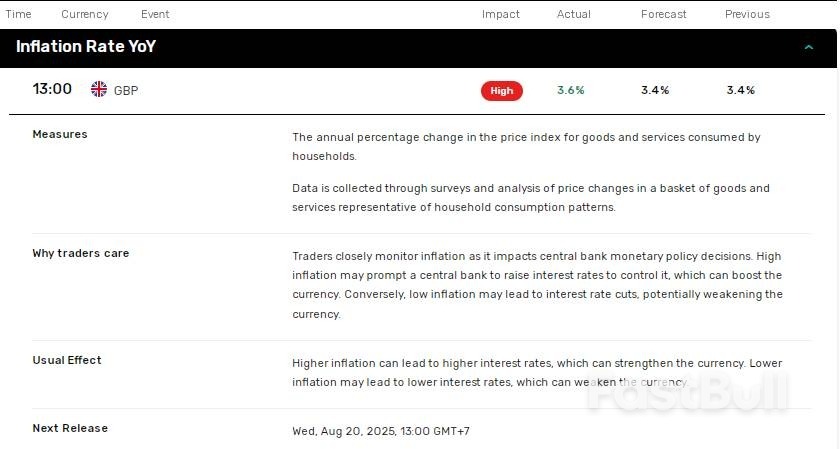
          ●UK headline inflation jumped to 3.6% in June, while core inflation rose to 3.7%, sinking BoE rate cut hopes.
          ●Higher transport costs fueled inflation, offsetting a drag from housing and household services.
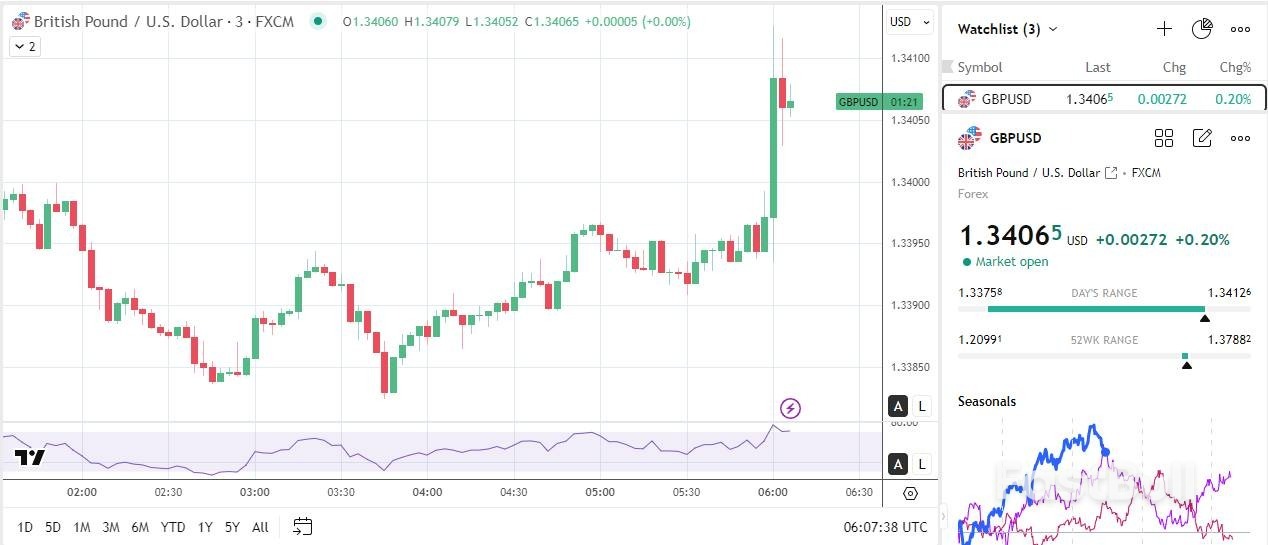
          ●Markets trimmed bets on an August BoE rate cut, sending GBP/USD above $1.34 post-CPI data

          UK Inflation Data Surprises BoE Doves

          Higher-than-expected UK inflation data sank bets on an August BoE rate hike on Wednesday, July 16.

          The UK’s annual inflation rate (headline) rose to 3.6% in June, up from 3.4% in May, with core inflation accelerating to 3.7% versus 3.5% in May.

          Key Data from the Office for National Statistics included:

          ●The Consumer Prices Index, including owner-occupier housing costs (CPIH), rose 4.1% in the 12 months to June after increasing 4% in May.
          ●The largest upward contribution came from transport, particularly motor fuels, offsetting a downward contribution from housing and household services.
          ●The Core CPIH (excluding energy, food, alcohol, and tobacco) increased by 4.3% in the 12 months to June, compared with 4.2% in May.
          ●Core CPI (excluding energy, food, alcohol, and tobacco) rose from 3.5% in the 12 months to May to 3.7% in the 12 months to June.
          ●The CPI services annual rate remained steady at 4.7% in June.

          Hotter Inflation Clouds BoE Rate Cut Outlook

          The inflation report followed weaker-than-expected GDP numbers, which had fueled speculation about a BoE rate cut. Notably, the UK economy expanded 0.5% in the three months to May, down from 0.7% in April. Meanwhile the economy contracted by 0.1% on a monthly basis, supporting a more dovish BoE policy stance.

          Simon Pittaway, Senior Economist at the Resolute Foundation, commented on the GDP report, stating:

          “With negative growth in the last two months of data, the UK’s late 2024/early 2025 growth spurt looks to be losing steam. You can see this more clearly in the 3m-on-3m data, which has fallen in recent months. Expect this to fall further in next month’s Q2 data as March’s upgraded monthly growth figure (0.4%) falls out of the 3m window.”

          Ahead of today’s inflation figures, BoE Monetary Policy Committee member Catherine Mann remarked on inflation levels, stating:

          “We have seen wage rates come down, so people are getting wage increases, but not at the rate in the past. And we’ve seen price inflation come down quite a bit, but it’s still a challenge because it’s still well above our 2% objective.”

          June’s inflation numbers suggest the BoE may keep rates unchanged in August. However, May’s labor market overview report on July 17 could change the narrative.

          Softer wage growth and rising unemployment may signal a pullback in consumer spending, dampening inflationary pressures. A weaker private consumption outlook may also impact the UK economy, further supporting a near-term BoE policy move. On the other hand, steady unemployment and higher wage growth may further temper BoE rate cut expectations.

          GBP/USD Volatility Post-Inflation Data

          Ahead of the inflation report, the GBP/USD dropped to a low of $1.33758 before rising to a high of $1.34005. Following the report, the pair briefly dipped to a low of $1.33935 before surging to a high of $1.34126.

          On Wednesday, July 16, the GBP/USD was up 0.20% to $1.34065. The upswing likely reflected falling bets on an August BoE rate cut.

          Looking Ahead

          Traders now turn to Thursday’s UK labor market data. The Services PMI (July 24) and retail sales data (July 25) will also provide further clues on consumer spending trends and the broader economic outlook.

          Weaker wage growth, slower services sector activity, and a pullback in retail sales could raise bets on further rate cuts. However, strong data may support a less dovish BoE stance, sending GBP/USD higher.

          Stay updated here with real-time insights into BoE policy shifts and GBP forecasts, global macro trends, and central bank moves.

          Source: FX Empire

          To stay updated on all economic events of today, please check out our Economic calendar
          Risk Warnings and Disclaimers
          You understand and acknowledge that there is a high degree of risk involved in trading. Following any strategies or investment methods may lead to potential losses. The content on the site is provided by our contributors and analysts for information purposes only. You are solely responsible for determining whether any trading assets, securities, strategy, or any other product is suitable for investing based on your own investment objectives and financial situation.
          Add to Favorites
          Share

          UK Inflation Rises Unexpectedly to 3.6% As Labour Faces Economic Scrutiny

          Glendon

          Economic

          Forex

          UK inflation unexpectedly rose in June, according to official figures, adding to the pressure on the chancellor, Rachel Reeves.

          The Office for National Statistics (ONS) said the consumer prices index rose by 3.6% last month, up from a reading of 3.4% in May. City economists had forecast an unchanged reading.

          The rise comes as Labour faces intense scrutiny over its economic management after two months of negative growth and with speculation mounting over tax rises.

          Reeves sought on Tuesday to shrug off Britain’s anaemic growth performance at her Mansion House speech, telling City bankers she would slash red tape to help reboot the economy.

          The UK’s annual inflation rate has risen this year after dramatic increases in water bills, energy costs and council tax – complicating the Bank of England’s approach to cutting interest rates.

          However, concerns are growing over the strength of the UK economy amid a slowdown in the jobs market and as Donald Trump’s erratic trade war weighs on the global outlook.

          Threadneedle Street has cut its base interest rate four times in the past year, most recently in May, to 4.25%. This has eased some of the pressure on mortgage holders after borrowing costs were ramped up in response to inflation reaching a peak of 11.1% in late 2022.

          City investors expect at least two further quarter-point cuts this year, with financial markets anticipating the next reduction at the Bank’s August policy meeting.

          Source: GUARDIAN

          To stay updated on all economic events of today, please check out our Economic calendar
          Risk Warnings and Disclaimers
          You understand and acknowledge that there is a high degree of risk involved in trading. Following any strategies or investment methods may lead to potential losses. The content on the site is provided by our contributors and analysts for information purposes only. You are solely responsible for determining whether any trading assets, securities, strategy, or any other product is suitable for investing based on your own investment objectives and financial situation.
          Add to Favorites
          Share

          Tariffs Drive Clear Inflation Signals in U.S. June CPI, Complicating Fed’s Rate Cut Plans

          Gerik

          Economic

          Tariff Impact Emerges Clearly in June CPI, Fed Holds Cautious Stance

          The June Consumer Price Index (CPI) report revealed a 0.3% monthly increase in prices, with annual inflation climbing to 3.5% its highest since February. Analysts point to this acceleration as an early but now undeniable signal that U.S. import tariffs imposed under President Donald Trump are beginning to pass through to end consumers. This follows a 0.1% monthly rise in May and suggests a gradual but building inflationary trend.
          Price increases were concentrated in tariff-exposed sectors such as clothing, furniture, and entertainment electronics. For instance, audiovisual equipment prices surged 1.1% month-on-month and are now up 11.1% annually an unprecedented gain for a category historically characterized by stable or falling prices due to globalized supply chains. These spikes are closely aligned with products that rely heavily on imports, indicating a strong causal relationship between tariff implementation and consumer price escalation.

          Fed response cautious amid policy uncertainty

          Federal Reserve officials have long warned that the inflationary impact of tariffs would appear with a lag, and June's data now validates those concerns. Boston Fed President Susan Collins reaffirmed this expectation, acknowledging that tariffs could slow growth and dampen employment while pushing prices upward. However, she added that strong household and corporate balance sheets could absorb some of the shock.
          Despite Trump’s public pressure on social media for immediate rate cuts, the Fed appears unwilling to act prematurely. The CME Group’s FedWatch tool now shows less than a 5% chance of a cut in the July 29–30 meeting, while expectations for a 25-basis-point cut in September have slipped to 56.5%, reflecting growing skepticism that inflation will ease in time.

          Core inflation and the PCE outlook reinforce policy hesitancy

          Core CPI rose 2.9% year-on-year in June, below the expected 3% but still above May’s 2.8%. This figure excludes volatile energy and food costs and is central to the Fed’s inflation assessment. Meanwhile, the Fed’s preferred inflation gauge Core Personal Consumption Expenditures (PCE) is projected to climb above the 2% target in the second half of 2025. It already stood at 2.7% in May, with internal Fed projections suggesting it could reach 3.1% by year-end.
          JP Morgan economist Michael Feroli estimates that the next round of tariffs, expected to take effect on August 1 and potentially targeting Mexico, Canada, and the EU, could add another 0.2–0.3 percentage points to core PCE inflation. If fully passed through to consumers, the increase could be as high as 0.4 points. This projection strengthens the Fed’s case for restraint in monetary policy easing.

          Divergence among goods categories highlights uneven price transmission

          While inflation is building broadly, price pressures remain more acute in goods sectors than services. Analysts point to significant variation across categories: furniture prices rose 1% in June, reversing previous declines, while outdoor equipment inflation slowed from 0.6% in May to 0.2%. Entertainment products, such as toys and sound systems often imported from China rose 0.8%, double the pace of previous months.
          Gregory Daco of EY-Parthenon highlighted that such uneven price movements reflect the staggered nature of import cost transmission, as supply contracts and sourcing timelines differ across industries. However, the trend is consistent: goods heavily exposed to international trade are experiencing above-average inflation.
          June’s CPI data confirms that the inflationary effects of Trump’s tariff regime are no longer theoretical they are now visibly embedded in consumer price metrics. While core inflation remains modestly below forecast, its composition reveals mounting pressure from import-intensive goods. With additional tariffs on the horizon and PCE projections rising, the Federal Reserve is likely to adopt a more cautious stance, resisting premature rate cuts despite political pressure. As a result, monetary policy is being shaped not only by macroeconomic indicators but also by geopolitical maneuvering, making the inflation outlook and the Fed’s response increasingly complex.
          To stay updated on all economic events of today, please check out our Economic calendar
          Risk Warnings and Disclaimers
          You understand and acknowledge that there is a high degree of risk involved in trading. Following any strategies or investment methods may lead to potential losses. The content on the site is provided by our contributors and analysts for information purposes only. You are solely responsible for determining whether any trading assets, securities, strategy, or any other product is suitable for investing based on your own investment objectives and financial situation.
          Add to Favorites
          Share

          Indonesia's Soaring Foreign Debt Raises Concerns Amid Slower Growth Momentum

          Gerik

          Economic

          Indonesia’s Foreign Debt Reaches New High as Government Borrowing Expands

          Indonesia’s external debt reached $435.6 billion in May 2025, marking a 6.8% year-on-year increase, according to Bank Indonesia. Although the pace of growth has slowed compared to the 8.2% rise in April, the cumulative figure signals a growing reliance on foreign capital amid sluggish domestic revenue growth and expanding expenditure needs. Notably, government debt alone accounted for $209.6 billion an increase of 9.8% from the previous year.
          Bank Indonesia emphasized that the overall debt position remains under control, with long-term obligations comprising the bulk of total debt. As of May, 85% of Indonesia’s external debt portfolio is categorized as long-term, which theoretically lowers rollover risk and minimizes short-term financial shocks. For government debt specifically, an even more favorable structure is observed 99.9% of it is long-term in nature. However, despite this maturity advantage, the size and speed of accumulation pose questions about the sustainability of fiscal policy, particularly if economic growth falters.

          GDP-debt ratio and sectoral allocation offer mixed signals

          The central bank stated that Indonesia’s external debt-to-GDP ratio sits at 30.6%, considered a manageable threshold by international standards. However, the effectiveness of this debt depends heavily on how it is allocated. Government foreign debt is concentrated in health and social services (22.3%), public administration, defense, and social security (18.7%), education (16.5%), infrastructure (12%), and transport (8.7%). These investments are aligned with long-term development goals, but they also reflect the financial burden of maintaining social services and economic infrastructure during a period of uncertain global trade and weakening domestic demand.
          In contrast to government borrowing, Indonesia’s private sector external debt declined 0.9% year-on-year to $196.4 billion in May. This marked a steeper contraction than April’s 0.4% drop. The decline suggests that private enterprises are either reducing exposure to foreign-denominated liabilities or facing tighter access to offshore financing. With 76.5% of this debt classified as long-term, the private sector appears more cautious, likely reflecting subdued investment sentiment and a preference for risk mitigation amid volatile exchange rate dynamics.

          Macroeconomic risks remain despite reassuring tone

          While Bank Indonesia presents a reassuring view of the nation’s debt landscape, several macroeconomic headwinds warrant closer scrutiny. The persistent trade deficit with China, concerns over weakening consumer confidence, and uncertainties around global interest rate trajectories all amplify vulnerability to external shocks. Moreover, Indonesia’s recent overtures to reduce tariffs and purchase U.S. aircraft in exchange for favorable trade terms under Trump’s administration reflect an increasing dependency on geopolitical bargaining to sustain economic momentum.
          Indonesia’s growing external debt driven largely by government borrowing illustrates a complex balancing act between maintaining developmental investment and managing fiscal risk. Although long-term maturities offer some insulation, the country’s rising interest payment burden ($34 billion annually) and shifting global financial conditions may limit policy flexibility in the near term. Without a robust rebound in domestic investment and export competitiveness, Indonesia’s current debt trajectory could become more difficult to defend, especially if global risk sentiment deteriorates or capital outflows accelerate.

          Source: The Jakarta Post

          To stay updated on all economic events of today, please check out our Economic calendar
          Risk Warnings and Disclaimers
          You understand and acknowledge that there is a high degree of risk involved in trading. Following any strategies or investment methods may lead to potential losses. The content on the site is provided by our contributors and analysts for information purposes only. You are solely responsible for determining whether any trading assets, securities, strategy, or any other product is suitable for investing based on your own investment objectives and financial situation.
          Add to Favorites
          Share

          Trump Pressures Fed Chair Powell Over $2.5 Billion Renovation in Possible Path to Dismissal

          Gerik

          Economic

          Trump Targets Powell Through Fed Renovation Dispute Amid Ongoing Rate Tensions

          President Donald Trump’s renewed effort to remove Federal Reserve Chair Jerome Powell has taken an unexpected turn focusing not on interest rates, but on the $2.5 billion renovation of the Fed’s historic headquarters. Trump, long frustrated by Powell’s reluctance to lower interest rates, is now framing the extensive renovation project as wasteful and mismanaged, possibly laying the groundwork to dismiss the central bank chief for cause. Though such a move would be legally questionable, it reflects a deeper battle over the Fed’s independence at a politically charged moment.
          At the heart of the dispute is the Marriner S. Eccles building and its adjacent facility in Washington, D.C., both of which are undergoing major upgrades to replace aging infrastructure and eliminate hazardous materials like asbestos. The project’s costs have ballooned by $600 million beyond its original estimate due to rising labor and material prices, construction constraints, and expanded environmental remediation. Despite these justifications, Trump has labeled the project “disgraceful” and described Powell’s oversight as indulgent, citing alleged features such as VIP dining rooms and rooftop gardens claims Powell has publicly denied.

          Undermining central bank credibility through administrative scrutiny

          White House officials, including Budget Director Russ Vought, have accused the Fed of misrepresenting the project’s scope and violating the terms of its initial 2021 planning approval by altering renovation plans without formal resubmission. James Blair, Trump’s deputy chief of staff and a member of the National Capital Planning Commission, has suggested that Powell’s testimony to Congress may have downplayed these changes. This introduces a secondary line of criticism: that the Fed’s decision to cut project costs by scaling back aesthetic elements was itself a violation of approved plans turning a cost-saving measure into a potential ethical liability.
          While Trump cannot legally fire Powell over policy disagreements, he could attempt to do so “for cause,” such as misconduct or dereliction of duty. However, using the renovation as justification would set a dangerous precedent. The Supreme Court has signaled limits to presidential authority in removing central bank officials, reinforcing the importance of the Fed’s independence from political pressures. If Trump proceeds, it could spark investor uncertainty, weaken the dollar, and lead to higher borrowing costs as markets reprice U.S. political and institutional risk.

          Fed defends integrity, requests independent review

          Powell and the Fed have rejected the administration’s accusations. In testimony before the Senate Banking Committee, Powell categorically denied the existence of the lavish features criticized by the White House and emphasized that the project followed Congressional oversight, not executive direction. The Fed has also invited the independent inspector general to review the project’s expenses and governance, signaling transparency and a desire to maintain institutional credibility.
          This political maneuvering risks damaging more than Powell’s reputation. If the administration succeeds in redefining internal facility management as a means of dismissal, it may erode the institutional foundations that insulate monetary policy from short-term political influence. The potential dismissal could trigger market turmoil, erode investor trust in the central bank’s objectivity, and compromise the Fed’s ability to act decisively during economic turbulence. Moreover, it introduces a causal link between administrative disputes and broader monetary uncertainty, as investors weigh not only inflation and interest rates, but also executive encroachment.
          Trump’s attempt to leverage the Fed’s building renovation as a tool to remove Jerome Powell reveals a deeper conflict between political authority and institutional independence. While the legal basis for dismissal remains tenuous, the political optics and economic implications are substantial. Should this strategy advance, it could shake market confidence and set a precedent where central bankers are held hostage to executive grievances undermining the very foundations of independent monetary governance that have underpinned U.S. economic stability for decades.

          Source: AP

          To stay updated on all economic events of today, please check out our Economic calendar
          Risk Warnings and Disclaimers
          You understand and acknowledge that there is a high degree of risk involved in trading. Following any strategies or investment methods may lead to potential losses. The content on the site is provided by our contributors and analysts for information purposes only. You are solely responsible for determining whether any trading assets, securities, strategy, or any other product is suitable for investing based on your own investment objectives and financial situation.
          Add to Favorites
          Share

          China’s $1 Trillion Foreign Currency Surge Signals Deepening Economic Uncertainty

          Gerik

          Economic

          Forex

          Foreign Currency Hoarding in China Reaches Record Levels Amid Yuan Weakness

          China’s foreign currency deposits surged to $1.02 trillion in June 2025, reaching the highest level since March 2022, as both households and non-financial firms raced to secure dollar holdings. The People’s Bank of China (PBOC) reported that foreign exchange deposits increased by a record $165.5 billion in the first half of 2025 marking the largest net increase since the central bank began releasing this data in 2005. This phenomenon illustrates a growing lack of confidence in the Chinese yuan and broader economic prospects.
          The driving forces behind this trend are closely tied to the persistent interest rate differential between China and the U.S. While the U.S. Federal Reserve has held rates elevated, Chinese rates remain low, discouraging the conversion of dollar deposits back into yuan. Becky Liu, Head of China Macro Strategy at Standard Chartered, noted that the wide interest rate gap is a central factor behind the low conversion rate. The incentive to hold dollars instead of yuan becomes stronger when the return on Chinese assets is comparatively weaker.

          Corporate hesitation amid fragile growth outlook

          Businesses are also pulling back from fixed asset investment, a key indicator of economic momentum, with figures from the first half of the year falling short of forecasts. This suggests a strategic shift toward capital preservation over expansion. According to Liu, firms are increasingly considering diversification abroad due to softening domestic demand and ongoing doubts about the yuan’s ability to recover even in the face of a declining U.S. dollar.
          June’s trade surplus came in at $114.8 billion, the highest in five months, ensuring a steady inflow of foreign currency. Exporters have been a major source of this supply, converting overseas earnings into domestic deposits. Yet instead of strengthening confidence in the yuan, these flows have been parked in dollar deposits, indicating a preference for liquidity and safety over local reinvestment.

          Yuan’s limited recovery underscores structural fragility

          Despite gaining marginally in 2025 thanks in part to an 8% drop in the U.S. dollar the yuan has underperformed relative to other Asian currencies. Its appreciation has been constrained by persistent deflationary pressures, weakening consumer sentiment, and expectations of further rate cuts to stimulate growth. These macroeconomic conditions suggest that the recent stabilization in the yuan may be more temporary than structural.
          Recent swap market data indicates that demand for U.S. dollars may be softening, as reflected in declining swap points. However, analysts caution that this cooling is likely to be gradual rather than decisive. With U.S. rates still materially higher and market expectations for a September Fed rate cut diminishing, the fundamental appeal of holding foreign currency remains strong. Liu warns that the yuan is more likely to depreciate than appreciate in the second half of 2025, driven by sluggish growth, potential capital outflows in equities, and falling exports.
          China’s unprecedented surge in foreign currency deposits is a strong indicator of internal economic fragility and weakening confidence in the yuan’s near-term stability. While some technical signals suggest a modest slowdown in dollar demand, the broader structural trend fueled by interest rate disparities, soft domestic activity, and cautious corporate behavior points to continued accumulation of foreign exchange assets. Unless Beijing can meaningfully revive growth and restore investor confidence, foreign currency hoarding is likely to remain a defining feature of China’s financial landscape through the remainder of 2025.
          To stay updated on all economic events of today, please check out our Economic calendar
          Risk Warnings and Disclaimers
          You understand and acknowledge that there is a high degree of risk involved in trading. Following any strategies or investment methods may lead to potential losses. The content on the site is provided by our contributors and analysts for information purposes only. You are solely responsible for determining whether any trading assets, securities, strategy, or any other product is suitable for investing based on your own investment objectives and financial situation.
          Add to Favorites
          Share
          FastBull
          Copyright © 2025 FastBull Ltd

          728 RM B 7/F GEE LOK IND BLDG NO 34 HUNG TO RD KWUN TONG KLN HONG KONG

          TelegramInstagramTwitterfacebooklinkedin
          App Store Google Play Google Play
          Products
          Charts

          Chats

          Q&A with Experts
          Screeners
          Economic Calendar
          Data
          Tools
          Membership
          Features
          Function
          Markets
          Copy Trading
          Latest Signals
          Contests
          News
          Analysis
          24/7
          Columns
          Education
          Company
          Careers
          About Us
          Contact Us
          Advertising
          Help Center
          Feedback
          User Agreement
          Privacy Policy
          Business

          White Label

          Data API

          Web Plug-ins

          Poster Maker

          Affiliate Program

          Risk Disclosure

          The risk of loss in trading financial instruments such as stocks, FX, commodities, futures, bonds, ETFs and crypto can be substantial. You may sustain a total loss of the funds that you deposit with your broker. Therefore, you should carefully consider whether such trading is suitable for you in light of your circumstances and financial resources.

          No decision to invest should be made without thoroughly conducting due diligence by yourself or consulting with your financial advisors. Our web content might not suit you since we don't know your financial conditions and investment needs. Our financial information might have latency or contain inaccuracy, so you should be fully responsible for any of your trading and investment decisions. The company will not be responsible for your capital loss.

          Without getting permission from the website, you are not allowed to copy the website's graphics, texts, or trademarks. Intellectual property rights in the content or data incorporated into this website belong to its providers and exchange merchants.

          Not Logged In

          Log in to access more features

          FastBull Membership

          Not yet

          Purchase

          Become a signal provider
          Help Center
          Customer Service
          Dark Mode
          Price Up/Down Colors

          Log In

          Sign Up

          Position
          Layout
          Fullscreen
          Default to Chart
          The chart page opens by default when you visit fastbull.com