• Trade
  • Markets
  • Copy
  • Contests
  • News
  • 24/7
  • Calendar
  • Q&A
  • Chats
Trending
Screeners
SYMBOL
LAST
BID
ASK
HIGH
LOW
NET CHG.
%CHG.
SPREAD
SPX
S&P 500 Index
6827.42
6827.42
6827.42
6899.86
6801.80
-73.58
-1.07%
--
DJI
Dow Jones Industrial Average
48458.04
48458.04
48458.04
48886.86
48334.10
-245.98
-0.51%
--
IXIC
NASDAQ Composite Index
23195.16
23195.16
23195.16
23554.89
23094.51
-398.69
-1.69%
--
USDX
US Dollar Index
97.890
97.970
97.890
98.070
97.810
-0.060
-0.06%
--
EURUSD
Euro / US Dollar
1.17496
1.17504
1.17496
1.17596
1.17262
+0.00102
+ 0.09%
--
GBPUSD
Pound Sterling / US Dollar
1.33876
1.33883
1.33876
1.33961
1.33546
+0.00169
+ 0.13%
--
XAUUSD
Gold / US Dollar
4324.18
4324.59
4324.18
4350.16
4294.68
+24.79
+ 0.58%
--
WTI
Light Sweet Crude Oil
56.961
56.991
56.961
57.601
56.789
-0.272
-0.48%
--

Community Accounts

Signal Accounts
--
Profit Accounts
--
Loss Accounts
--
View More

Become a signal provider

Sell trading signals to earn additional income

View More

Guide to Copy Trading

Get started with ease and confidence

View More

Signal Accounts for Members

All Signal Accounts

Best Return
  • Best Return
  • Best P/L
  • Best MDD
Past 1W
  • Past 1W
  • Past 1M
  • Past 1Y

All Contests

  • All
  • Trump Updates
  • Recommend
  • Stocks
  • Cryptocurrencies
  • Central Banks
  • Featured News
Top News Only
Share

Portugal Treasury Puts 2026 Net Financing Needs At 13 Billion Euros, Up From 10.8 Billion In 2025

Share

Portugal Treasury Expects 2026 Net Financing Needs At 29.4 Billion Euros, Up From 25.8 Billion In 2025

Share

Bank Of America Says With Indonesia's Smelter Now Ramping Up, It Expects Aluminium Supply Growth To Accelerate To 2.6% Year On Year In 2026

Share

Bank Of America Expects A Deficit In Aluminium Next Year And Sees Prices Pushing Above $3000/T

Share

Fed Data - USA Effective Federal Funds Rate At 3.64 Percent On 12 December On $102 Billion In Trades Versus 3.64 Percent On $99 Billion On 11 December

Share

Brazil's Petrobras Says No Impact Seen On Oil, Petroleum Products Output As Workers Start Planned Strike

Share

Statement: US Travel Group Warns New Proposed Trump Administration Requirements For Foreign Tourists To Provide Social Media Histories Could Mean Millions Of People Opting Not To Visit

Share

Blackrock: Kerry White Will Become Head Of Citi Investment Management At Citi Wealth

Share

Blackrock: Rob Jasminski, Head Of Citi Investment Management, Has Joined With Team

Share

Blackrock: Effective Dec 15, Citi Investment Management Employees Will Join Blackrock

Share

Blackrock: Formally Launch Citi Portfolio Solutions Powered By Blackrock

Share

According To Data From The Federal Reserve Bank Of New York, The Secured Overnight Funding Rate (Sofr) Was 3.67% On The Previous Trading Day (December 15), Compared To 3.66% The Day Before

Share

Peru Energy And Mines Ministry: Copper Production Up 4.8% Year-On-Year In October To 248192 Metric Tons

Share

Security Source: Ukrainian Drones Hits Russian Oil Infrastructure In Caspian Sea For Third Time

Share

Spot Palladium Extends Gains, Last Up 5% To $1562.7/Oz

Share

Mexico's Economy Ministry Announces Start Of Anti-Dumping Investigation And Anti-Subsidy Investigations Into USA Pork Imports

Share

Canada Nov CPI Common +2.8%, CPI Median +2.8%, CPI Trim +2.8% On Year

Share

NY Fed's Empire State Prices Paid Index +37.6 In December Versus+49.0 In November

Share

Canada Nov Consumer Prices +0.1% On Month, +2.2% On Year

Share

Canada Nov CPI Core -0.1% On Month, +2.9% On Year

TIME
ACT
FCST
PREV
Japan Tankan Small Manufacturing Outlook Index (Q4)

A:--

F: --

P: --

Japan Tankan Large Non-Manufacturing Outlook Index (Q4)

A:--

F: --

P: --

Japan Tankan Large Manufacturing Outlook Index (Q4)

A:--

F: --

P: --

Japan Tankan Small Manufacturing Diffusion Index (Q4)

A:--

F: --

P: --

Japan Tankan Large Manufacturing Diffusion Index (Q4)

A:--

F: --

P: --

Japan Tankan Large-Enterprise Capital Expenditure YoY (Q4)

A:--

F: --

P: --

U.K. Rightmove House Price Index YoY (Dec)

A:--

F: --

P: --

China, Mainland Industrial Output YoY (YTD) (Nov)

A:--

F: --

P: --

China, Mainland Urban Area Unemployment Rate (Nov)

A:--

F: --

P: --

Saudi Arabia CPI YoY (Nov)

A:--

F: --

P: --

Euro Zone Industrial Output YoY (Oct)

A:--

F: --

P: --

Euro Zone Industrial Output MoM (Oct)

A:--

F: --

P: --

Canada Existing Home Sales MoM (Nov)

A:--

F: --

P: --

Canada National Economic Confidence Index

A:--

F: --

P: --

Canada New Housing Starts (Nov)

A:--

F: --

P: --
U.S. NY Fed Manufacturing Employment Index (Dec)

A:--

F: --

P: --

U.S. NY Fed Manufacturing Index (Dec)

A:--

F: --

P: --

Canada Core CPI YoY (Nov)

A:--

F: --

P: --

Canada Manufacturing Unfilled Orders MoM (Oct)

A:--

F: --

P: --

U.S. NY Fed Manufacturing Prices Received Index (Dec)

A:--

F: --

P: --

U.S. NY Fed Manufacturing New Orders Index (Dec)

A:--

F: --

P: --

Canada Manufacturing New Orders MoM (Oct)

A:--

F: --

P: --

Canada Core CPI MoM (Nov)

A:--

F: --

P: --

Canada Trimmed CPI YoY (SA) (Nov)

A:--

F: --

P: --

Canada Manufacturing Inventory MoM (Oct)

A:--

F: --

P: --

Canada CPI YoY (Nov)

A:--

F: --

P: --

Canada CPI MoM (Nov)

A:--

F: --

P: --

Canada CPI YoY (SA) (Nov)

A:--

F: --

P: --

Canada Core CPI MoM (SA) (Nov)

A:--

F: --

P: --

Canada CPI MoM (SA) (Nov)

A:--

F: --

P: --

Federal Reserve Board Governor Milan delivered a speech
U.S. NAHB Housing Market Index (Dec)

--

F: --

P: --

Australia Composite PMI Prelim (Dec)

--

F: --

P: --

Australia Services PMI Prelim (Dec)

--

F: --

P: --

Australia Manufacturing PMI Prelim (Dec)

--

F: --

P: --

Japan Manufacturing PMI Prelim (SA) (Dec)

--

F: --

P: --

U.K. 3-Month ILO Employment Change (Oct)

--

F: --

P: --

U.K. Unemployment Claimant Count (Nov)

--

F: --

P: --

U.K. Unemployment Rate (Nov)

--

F: --

P: --

U.K. 3-Month ILO Unemployment Rate (Oct)

--

F: --

P: --

U.K. Average Weekly Earnings (3-Month Average, Including Bonuses) YoY (Oct)

--

F: --

P: --

U.K. Average Weekly Earnings (3-Month Average, Excluding Bonuses) YoY (Oct)

--

F: --

P: --

France Services PMI Prelim (Dec)

--

F: --

P: --

France Composite PMI Prelim (SA) (Dec)

--

F: --

P: --

France Manufacturing PMI Prelim (Dec)

--

F: --

P: --

Germany Services PMI Prelim (SA) (Dec)

--

F: --

P: --

Germany Manufacturing PMI Prelim (SA) (Dec)

--

F: --

P: --

Germany Composite PMI Prelim (SA) (Dec)

--

F: --

P: --

Euro Zone Composite PMI Prelim (SA) (Dec)

--

F: --

P: --

Euro Zone Services PMI Prelim (SA) (Dec)

--

F: --

P: --

Euro Zone Manufacturing PMI Prelim (SA) (Dec)

--

F: --

P: --

U.K. Services PMI Prelim (Dec)

--

F: --

P: --

U.K. Manufacturing PMI Prelim (Dec)

--

F: --

P: --

U.K. Composite PMI Prelim (Dec)

--

F: --

P: --

Euro Zone ZEW Economic Sentiment Index (Dec)

--

F: --

P: --

Germany ZEW Current Conditions Index (Dec)

--

F: --

P: --

Germany ZEW Economic Sentiment Index (Dec)

--

F: --

P: --

Euro Zone Trade Balance (Not SA) (Oct)

--

F: --

P: --

Euro Zone ZEW Current Conditions Index (Dec)

--

F: --

P: --

Euro Zone Trade Balance (SA) (Oct)

--

F: --

P: --

U.S. Retail Sales MoM (Excl. Automobile) (SA) (Oct)

--

F: --

P: --

Q&A with Experts
    • All
    • Chatrooms
    • Groups
    • Friends
    Connecting
    .
    .
    .
    Type here...
    Add Symbol or Code

      No matching data

      All
      Trump Updates
      Recommend
      Stocks
      Cryptocurrencies
      Central Banks
      Featured News
      • All
      • Russia-Ukraine Conflict
      • Middle East Flashpoint
      • All
      • Russia-Ukraine Conflict
      • Middle East Flashpoint
      Search
      Products

      Charts Free Forever

      Chats Q&A with Experts
      Screeners Economic Calendar Data Tools
      Membership Features
      Data Warehouse Market Trends Institutional Data Policy Rates Macro

      Market Trends

      Market Sentiment Order Book Forex Correlations

      Top Indicators

      Charts Free Forever
      Markets

      News

      News Analysis 24/7 Columns Education
      From Institutions From Analysts
      Topics Columnists

      Latest Views

      Latest Views

      Trending Topics

      Top Columnists

      Latest Update

      Signals

      Copy Rankings Latest Signals Become a signal provider AI Rating
      Contests
      Brokers

      Overview Brokers Assessment Rankings Regulators News Claims
      Broker listing Forex Brokers Comparison Tool Live Spread Comparison Scam
      Q&A Complaint Scam Alert Videos Tips to Detect Scam
      More

      Business
      Events
      Careers About Us Advertising Help Center

      White Label

      Data API

      Web Plug-ins

      Affiliate Program

      Awards Institution Evaluation IB Seminar Salon Event Exhibition
      Vietnam Thailand Singapore Dubai
      Fans Party Investment Sharing Session
      FastBull Summit BrokersView Expo
      Recent Searches
        Top Searches
          Markets
          News
          Analysis
          User
          24/7
          Economic Calendar
          Education
          Data
          • Names
          • Latest
          • Prev

          View All

          No data

          Scan to Download

          Faster Charts, Chat Faster!

          Download App
          English
          • English
          • Español
          • العربية
          • Bahasa Indonesia
          • Bahasa Melayu
          • Tiếng Việt
          • ภาษาไทย
          • Français
          • Italiano
          • Türkçe
          • Русский язык
          • 简中
          • 繁中
          Open Account
          Search
          Products
          Charts Free Forever
          Markets
          News
          Signals

          Copy Rankings Latest Signals Become a signal provider AI Rating
          Contests
          Brokers

          Overview Brokers Assessment Rankings Regulators News Claims
          Broker listing Forex Brokers Comparison Tool Live Spread Comparison Scam
          Q&A Complaint Scam Alert Videos Tips to Detect Scam
          More

          Business
          Events
          Careers About Us Advertising Help Center

          White Label

          Data API

          Web Plug-ins

          Affiliate Program

          Awards Institution Evaluation IB Seminar Salon Event Exhibition
          Vietnam Thailand Singapore Dubai
          Fans Party Investment Sharing Session
          FastBull Summit BrokersView Expo

          China’s Budget Deficit Soars to Record High Amid Spending Surge to Offset U.S. Tariffs

          Gerik

          Economic

          Summary:

          China's fiscal deficit has surged to an unprecedented 5.25 trillion yuan ($733 billion) in the first half of 2025, underscoring Beijing's aggressive front-loading of public spending to counter the drag from U.S. tariffs...

          A Record Deficit as Fiscal Stimulus Takes the Lead

          China’s widening fiscal gap reflects a deliberate and forceful shift toward stimulus-driven growth as exports to the U.S. falter under the weight of elevated tariffs, currently averaging about 30 percentage points higher than last year. The 5.25 trillion yuan budget gap marks a 45% increase from the same period in 2024, according to Bloomberg estimates derived from Finance Ministry data. This is the largest midyear deficit on record and highlights the scale of intervention required to stabilize the economy.
          The surge in the deficit stems from two key dynamics: a rapid increase in government expenditure and a parallel decline in fiscal income. Expenditure rose 9% year-on-year to 18.8 trillion yuan, fueled by both daily operational spending and long-term infrastructure investment through China’s dual budget framework. However, total income from taxation and land sales dropped, with tax revenue down 1.2% and land-related income traditionally a major fiscal support falling by 6.5%, reflecting deep-rooted weakness in the property sector.

          Policy Tools Shift as External Demand Weakens

          Despite a recent truce in tariff escalations, Chinese exports to the U.S. have continued to contract sharply, exposing the country’s vulnerability to external shocks. As a counterbalance, China has ramped up infrastructure spending and local government-led stimulus to sustain economic momentum. The Finance Ministry emphasized that this front-loaded fiscal action played a critical role in helping China post a stronger-than-expected 5.3% GDP growth rate in the first half, already exceeding the annual target of "around 5%."
          Notably, resilient exports to alternative markets beyond the U.S. have provided some cushion, but not enough to offset the broader trade friction. Consequently, Chinese authorities are doubling down on domestic drivers of growth, with additional rounds of stimulus likely under discussion when top policymakers meet at the end of July.

          Fiscal Strain Mounts Ahead of Key Trade Talks

          The ballooning deficit presents a delicate balancing act for Chinese authorities. On one hand, further stimulus may be essential to maintain growth amid deflationary risks and a chronically weak property market. On the other, fiscal sustainability concerns loom larger as tax collections stagnate and land sales fail to recover.
          Next week’s planned trade negotiations between China and the U.S. will be pivotal in determining whether China opts for an even more aggressive fiscal response. While a comprehensive trade resolution appears unlikely in the near term, any relaxation of tariffs would offer temporary relief and reduce the need for further stimulus.
          In the current context, Beijing’s strategy is clear: absorb the short-term fiscal pain to avoid a sharper economic deceleration. Whether this gamble pays off will depend not only on domestic reforms but also on the external trade environment especially the evolving stance of the U.S. ahead of its own presidential election cycle.
          China’s record-high budget deficit is both a reflection of economic vulnerability and a demonstration of Beijing’s determination to preserve growth through stimulus. With exports weakening, property markets stuck in correction, and trade tensions unresolved, fiscal policy is now the central engine of China's economic resilience but not without growing long-term costs.

          Source: Reuters

          To stay updated on all economic events of today, please check out our Economic calendar
          Risk Warnings and Disclaimers
          You understand and acknowledge that there is a high degree of risk involved in trading. Following any strategies or investment methods may lead to potential losses. The content on the site is provided by our contributors and analysts for information purposes only. You are solely responsible for determining whether any trading assets, securities, strategy, or any other product is suitable for investing based on your own investment objectives and financial situation.
          Add to Favorites
          Share

          Euro Zone Firms Sound Alarm on Economic Slowdown and China Competition

          Gerik

          Economic

          Mixed Signals from ECB vs. Corporate Reality

          While the ECB maintained its benchmark interest rate at 2% on Thursday and issued a cautiously optimistic message about euro area stability, its own survey of 72 large firms paints a more sobering picture. Conducted between June 23 and July 2, the report highlights early signs of an economic deceleration particularly in manufacturing and services due to trade friction and geopolitical instability.
          The central message from companies was one of caution. Although the ECB framed recent economic data as indicative of a “good place,” businesses cited real-world conditions such as weaker demand, trade policy uncertainty, and shifting supply chains that are dampening both production and investment.

          U.S. Tariffs and Chinese Trade Diversion Fuel Concerns

          The growing threat of broad-based U.S. tariffs, part of President Trump’s ongoing push to rebalance global trade flows, is already weighing on European business sentiment. Respondents said that these tariffs are forcing Asian, especially Chinese, exporters to redirect goods previously destined for the U.S. to the European market, intensifying competitive pressures in the region.
          So far, this diversion is concentrated in intermediate goods rather than final consumer products, but firms expect the impact to broaden over time, eventually spilling into retail sectors and affecting price dynamics. This supports broader fears about a “China shock 2.0” flooding European markets with low-cost exports amid deflationary conditions in China.

          Sector Divergence: Manufacturing vs. Retail

          The impact of these economic headwinds is not uniform across sectors. While manufacturing and business services are seeing a visible contraction in demand and pricing power, retail and consumer services report relatively minimal disruptions for now. These sectors have yet to feel the full impact of the trade redirection from Asia, although they remain exposed should conditions worsen in coming quarters.
          This divergence underscores a two-speed economy within the euro zone, where consumer-facing segments are holding steady for now, but industrial sectors already burdened by weak global demand are entering a more vulnerable phase.

          Slowing Wage Growth Signals Labour Market Cooling

          In addition to business activity and pricing concerns, the survey also showed softening wage expectations. After peaking at 4.5% in 2024, companies now forecast average wage increases to slow to 3.3% in 2025 and further to 2.8% in 2026. Although still elevated, this deceleration suggests that labor market tightness is easing and that inflationary wage pressures may be dissipating aligning with the ECB’s broader disinflation narrative.
          Despite the ECB’s attempt to project confidence in the euro area’s trajectory, its own corporate outreach reveals deeper concerns beneath the surface. The potential convergence of tighter U.S. trade policy and China’s surplus-driven export strategy is creating an environment of uncertainty and downward pressure on output and prices.
          Markets may be underestimating the fragility of this economic moment. With policy levers constrained and geopolitical volatility high, the euro zone economy could struggle to maintain momentum, especially if retaliatory trade measures or global demand shocks accelerate. The ECB’s balancing act between monetary patience and responsiveness to worsening data will define its credibility in the second half of 2025.

          Source: Reuters

          To stay updated on all economic events of today, please check out our Economic calendar
          Risk Warnings and Disclaimers
          You understand and acknowledge that there is a high degree of risk involved in trading. Following any strategies or investment methods may lead to potential losses. The content on the site is provided by our contributors and analysts for information purposes only. You are solely responsible for determining whether any trading assets, securities, strategy, or any other product is suitable for investing based on your own investment objectives and financial situation.
          Add to Favorites
          Share

          Should You Invest When Markets Are At Record Highs?

          SAXO

          Economic

          Forex

          Stocks

          Key points:

          ● Market highs often create hesitation for investors on the sidelines, but history shows that long-term investing at these levels can still deliver strong returns.
          ● With tools like limit orders, thematic diversification, and dollar cost averaging, there are still smart ways to put money to work—even at elevated levels.
          ● Instead of trying to time the top, focus on building a resilient, well-diversified portfolio that can navigate different economic scenarios.
          ● Long-term success comes from consistency and discipline, not perfect timing.

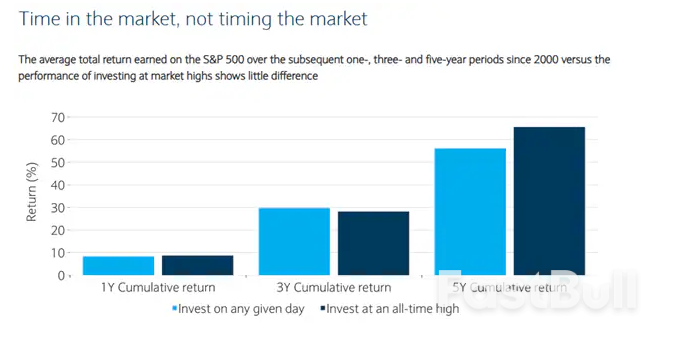
          The myth of waiting for the perfect entryIn theory, “buy low, sell high” sounds perfect. In practice, most investors struggle to do either.In fact, if you only invested on days when the S&P 500 hit an all-time high, your long-term returns would often be higher than if you invested on any random day.

          Source: Bloomberg, Barclays Private Bank, March 2024

          That’s because record highs typically happen during bull markets, and bull markets tend to last longer than expected.The real challenge isn’t timing the market. It’s having a strategy that works when prices feel high, and sticking to it.

          What to do instead: smart moves at market highs

          1. Make pullbacks work for you

          Even when the overall market is rising, individual stocks and sectors often face short-term dips. Those can be opportunities.

          What you can do:

          ● If you’ve got cash on the sidelines, set price alerts for stocks or ETFs you want to own at better value.
          ● Use limit orders to automate discipline. These let you set a specific price you're willing to pay, and the order only executes if the market reaches that level. This helps avoid buying in a rush or at inflated prices.
          ● Keep a watchlist of high-conviction investments and gradually add to them during short-term weakness.
          ● Consider selling a put option(if you're familiar with options), which can let you earn income while waiting to buy at a lower price.

          2. Look for what hasn’t rallied yet

          While technology and AI stocks have led the charge, many parts of the market have lagged, and may offer better value and catch-up potential if the rally broadens out.

          What to consider:

          ● Small-cap stocks and value-oriented sectors (like banks, energy, or healthcare) have underperformed and may benefit from stronger economic growth or a shift in investor focus.
          ● Dividend stocks can provide a steady income stream and may become more appealing if interest rates begin to fall.
          ● Rather than trying to pick individual stocks, consider broad-based ETFs that offer exposure to these less-loved areas of the market, helping you diversify while keeping costs low.

          3. Diversify based on what drives markets

          Market leadership today is shaped less by geography or sector, and more by macro forces like interest rates, trade policies, and geopolitical risk. Traditional diversification alone may not be enough. It’s time to think about how different parts of your portfolio respond to shifting policy and economic drivers.

          How to position:

          ● Tariff-sensitive sectors like autos and semiconductors may benefit if global trade tensions ease, but could struggle in a more protectionist environment. On the other hand, utilities, healthcare, and defense tend to be more insulated from global supply chains and policy swings.
          ● Utilities and real estate often perform well when interest rates fall, as their steady income becomes more attractive relative to bonds and cash.
          ● Defense stocks, commodities, and gold can help cushion your portfolio during periods of geopolitical uncertainty or broad market volatility.
          ● Consider thematic funds that align with long-term structural trends such as clean energy, digital infrastructure, and healthcare innovation. These can offer growth potential across different macro cycles.

          Even if some of these areas have gained attention recently, their relevance over the long term means they may still be underrepresented in many portfolios.

          4. Stay consistent with a plan

          Waiting for the “perfect moment” to invest often leads to missed opportunities. Even when markets dip, fear and uncertainty can prevent action, leaving cash on the sidelines and long-term goals unmet.

          What works better:

          ● Adopt adollar-cost averaging (DCA) approach – invest a fixed amount at regular intervals (monthly or quarterly), regardless of market levels. This helps reduce the impact of short-term volatility and takes the emotion out of decision-making.
          ● Set calendar reminders to review and top up your investments, just like you would with other recurring commitments like bill payments or insurance.
          ● Stay focused on your long-term goals, not the day-to-day headlines. Markets will fluctuate, but a consistent, disciplined approach tends to win over time.
          Final thought

          Buying at market highs can feel uncomfortable, but history shows that long-term investors are often rewarded for staying the course.If you diversify smartly, lean into underappreciated areas, and stay consistent with your investing plan, you won’t need to worry about whether you’re “too late.”Because long-term wealth isn’t built by picking the perfect moment.It’s built by showing up, again and again.

          Source: SAXO

          To stay updated on all economic events of today, please check out our Economic calendar
          Risk Warnings and Disclaimers
          You understand and acknowledge that there is a high degree of risk involved in trading. Following any strategies or investment methods may lead to potential losses. The content on the site is provided by our contributors and analysts for information purposes only. You are solely responsible for determining whether any trading assets, securities, strategy, or any other product is suitable for investing based on your own investment objectives and financial situation.
          Add to Favorites
          Share

          ECB Rate Cuts in Doubt as Goldman and J.P. Morgan Pull Back Forecasts

          Gerik

          Economic

          Central Bank Caution Reflects Economic Stability

          Goldman Sachs and J.P. Morgan have recalibrated their outlooks on ECB monetary policy, signaling a more cautious stance after Thursday’s decision to maintain the main refinancing rate at 2%. The ECB has already implemented eight rate cuts since June 2024, yet the central bank now appears inclined to pause its easing cycle amid improving macroeconomic conditions. Christine Lagarde, the ECB President, emphasized a “wait-and-watch” approach, describing the current state of the economy as being in a “good place.”
          Goldman Sachs no longer anticipates any additional rate cuts in 2025. Meanwhile, J.P. Morgan has delayed its predicted rate move to October, instead of the earlier forecast of September. This change reflects confidence that the eurozone economy has shown greater resilience than expected, reducing the urgency for further monetary easing.

          Trade Tensions and Diplomacy Shape Rate Outlook

          Another key variable influencing the ECB's path is the ongoing negotiation of a trade agreement between the European Union and the United States. Earlier threats from U.S. President Donald Trump to impose 30% tariffs on EU goods by August 1 had heightened fears of trade-driven stagflation. However, diplomats now signal that a more moderate agreement centering on a 15% across-the-board tariff is emerging as the most probable outcome.
          This potential resolution has been factored into Goldman and J.P. Morgan’s updated forecasts. Analysts see a deal as removing one of the largest downside risks to European growth. If finalized, it would also reduce the need for the ECB to respond preemptively to external shocks with additional rate cuts.

          A Divided Wall Street and Uncertain Markets

          In contrast, other major institutions like Bank of America, Barclays, Citigroup, Deutsche Bank, and Morgan Stanley are holding onto their expectations for a September rate cut. However, even among these firms, caution is growing. Morgan Stanley analysts noted that stronger economic data or further easing of trade tensions could delay the next rate cut until December or beyond.
          Market sentiment reflects this divide. Eurozone money markets currently assign only a 30% probability to a rate cut by December. This hesitancy underscores how sensitive ECB projections now are to incoming economic data, especially inflation trends, labor market resilience, and manufacturing output.

          Markets Eye Data and Diplomacy

          The ECB's path forward has become increasingly data-dependent, shaped not only by inflation metrics and growth indicators but also by geopolitical developments like the pending EU-U.S. trade agreement. For now, monetary policy remains in a holding pattern, with financial institutions and traders cautiously rebalancing expectations.
          Unless the eurozone’s economic outlook deteriorates or diplomatic tensions escalate further, the ECB is likely to extend its pause. The next decisive shift may come only if incoming data clearly signal weakening demand or if negotiations with the U.S. collapse, reigniting trade risks.

          Source: Reuters

          To stay updated on all economic events of today, please check out our Economic calendar
          Risk Warnings and Disclaimers
          You understand and acknowledge that there is a high degree of risk involved in trading. Following any strategies or investment methods may lead to potential losses. The content on the site is provided by our contributors and analysts for information purposes only. You are solely responsible for determining whether any trading assets, securities, strategy, or any other product is suitable for investing based on your own investment objectives and financial situation.
          Add to Favorites
          Share

          German Ifo Index Rises Once Again As Country Sees Return Of Germany Inc.

          Michelle

          Economic

          Forex

          German business sentiment is still riding the wave of optimism. Even though we still see a large portion of wishful thinking, the seventh consecutive increase in Germany’s most prominent leading indicator remains remarkable. In July, the Ifo index came in at 88.6, slightly up from 88.4 in June, and stands now at its highest level since last summer. While expectations remained unchanged, the current assessment component finally improved, suggesting that growth in the third quarter could pick up again.

          Wave of optimism

          A wave of optimism seems to have caught the German economy, but it remains unclear whether it is really based on stronger fundamentals or just wishful thinking. It's probably a combination of both. And to be more precise, the wave of optimism has caught corporate life, not households. While the Ifo index looks almost unstoppable, consumer confidence has fallen for two months in a row and remains weak.

          Returning to German businesses, there are several reasons for increasing optimism; after two years of inventory build-up and dropping orders, the inventory cycle started to turn for the better at the start of this year. Energy prices have come down from highly elevated levels, and the prospect of fiscal stimulus has played a role, too. In fact, German businesses seem to be focusing on the bright side of what could happen under the new German government, rather than fearing the downsides from ongoing uncertainty and trade tensions. And at least the optics of the new government are good. German businesses had grown disillusioned with the last government’s ongoing internal controversies. Now, the sheer fact that the new government has avoided big blunders like open controversies or erratic policy announcements and has begun to really implement the announced fiscal stimulus has boosted its popularity.

          The latest episode in the government’s confidence-building was this week’s summit between the government and business leaders. An initiative of large German corporates, self-named ‘Made for Germany’, promised to invest €631bn over the next three years. While the headline figure looks impressive, only €100bn of that sum will actually be ‘new’ investments. The rest is previously planned investments. €100bn over three years equals some 0.7% GDP per year. Whether these investments will really reach the economy and how much crowding out of other investments will emerge remains to be seen, as does the question of whether these investments will materially boost innovation or new technologies.

          What a difference half a year can make

          In any case, just take a step back and remember where the German economy stood at the start of the year: completely in the doldrums with two years of recession, a huge investment gap and an economic business model that was up for a complete overhaul. Seven months later, there is a €500bn infrastructure fiscal stimulus, a ‘whatever it takes’ spending promise for defence, small tax incentives for private investments and a commitment by large corporates to step up investments. What a change!

          Admittedly, there are still few signs of an overhaul of the country’s economic model, either in the government’s coalition agreement or in this week’s announcements by the ‘Made for Germany’ initiative. This increases the risk that all investments will lead to higher productivity. However, Germany had the deep fiscal pockets to avoid the policies it prescribed to many other eurozone countries during the euro crisis: structural reforms and austerity. Still, even with the deep pockets, Germany will have to address the weakness of its economic business model quickly. Investments can only be a first step and not the only step.

          To be clear, the near-term outlook for the German economy will still be highly affected by the ongoing trade tensions, possible US tariffs and the stronger euro. It remains remarkable that German businesses seem to almost completely ignore these risks. This return of optimism could also get a cold shower next week when the first estimate of second-quarter GDP growth is released. Nevertheless, the longer-term outlook continues to improve. The jury is still out on whether money will be able to buy growth, but today's Ifo index once again shows that it can at least buy optimism.

          Source: ING

          To stay updated on all economic events of today, please check out our Economic calendar
          Risk Warnings and Disclaimers
          You understand and acknowledge that there is a high degree of risk involved in trading. Following any strategies or investment methods may lead to potential losses. The content on the site is provided by our contributors and analysts for information purposes only. You are solely responsible for determining whether any trading assets, securities, strategy, or any other product is suitable for investing based on your own investment objectives and financial situation.
          Add to Favorites
          Share

          Europe’s Two-Front Economic War: Trump’s Tariffs Distract from the Real Threat China

          Gerik

          Economic

          A Fragile Alliance Fractures

          Ambrose Evans-Pritchard argues that Donald Trump’s escalating trade war with Europe centered on 15% tariffs and punitive duties on key sectors like steel, aluminum, and pharmaceuticals has dominated headlines but diverted attention from a deeper and more existential threat: China. European leaders, still reeling from Trump’s protectionist posture, have failed to appreciate that Xi Jinping has decisively ended any notion of a collaborative front with the EU against U.S. trade aggression.
          While European leaders like Antonio Costa and Ursula von der Leyen attempt to preserve diplomatic facades, relations with China have reached a post-Cold War low. China’s latest export onslaught, built upon suppressed wages and a heavily manipulated exchange rate, resembles not strategic competitiveness but systemic dumping threatening Europe’s industrial heartland.

          The China Shock 2.0: A Slow Economic Strangulation

          The new wave of Chinese economic coercion termed “China Shock 2.0” is proving more severe than its predecessor from the early 2000s. Back then, Chinese goods spurred global deflation and income inequality; now, as China faces its own post-bubble slump, it offloads vast excess capacity abroad, intensifying its trade surplus with the EU, which soared to €305 billion in 2024 and is still rising.
          This surge is underpinned by a 30% depreciation in China’s real effective exchange rate against the euro since 2022, facilitated through veiled interventions and state-led currency suppression. Such policies amplify the competitiveness of Chinese exports artificially, leaving European industries unable to respond through normal market mechanisms.
          Oxford’s George Magnus warns that this time, the threat is existential. Europe’s core industrial capacity automotive, technology, machinery is at risk. German economic interests, long accused of aligning too closely with China, are now confronting the fallout of their Faustian bargain.

          Trump’s Distraction, Xi’s Opportunity

          Amid this crisis, Donald Trump’s policies exacerbate Europe’s vulnerability. While the EU grapples with calibrated tariffs on Chinese electric vehicles and rare-earth dependence, it simultaneously contends with Trump’s trade deal demands, digital tax disputes, and steel conditionalities. Trump’s unpredictability forces European leaders to divert resources and attention from China to manage their transatlantic relationship.
          Strategically, this creates the worst-case scenario: a Europe distracted, divided, and dependent facing economic offensives from both allies and adversaries. Trump’s refusal to treat the West as a unified bloc, and his transactional approach to diplomacy, inadvertently serves China’s long-term goals.
          As Charles Parton from the Mercator Institute notes, the CCP views global politics as an ideological struggle. China’s leadership is not merely trying to out-compete the West it is committed to undermining democratic values and pluralism. In this context, Trump becomes, in Evans-Pritchard’s words, “Xi Jinping’s useful idiot” his tariff crusade splinters Western solidarity at a time when unity is essential.

          Europe’s Dilemma: Industrial Decline or Strategic Awakening?

          The EU’s attempts to “de-risk” from China through mild tariffs and symbolic diversification have thus far been ineffective. As Beijing weaponizes its grip on rare earths and uses global supply chains to retaliate against any pushback, Europe is discovering the true cost of its economic dependencies.
          Markets may remain optimistic about a European economic rebound, fueled by military-Keynesian spending and NATO defense budgets. Yet unless Europe fundamentally rethinks its trade exposure and industrial policy, that optimism may give way to disappointment. The EU faces the very real prospect of a second “lost decade” a period of economic stagnation, technological erosion, and geopolitical irrelevance.
          Evans-Pritchard’s final indictment is clear: China poses a civilizational challenge, not just a commercial one. And in failing to recognize this distracted by Trump’s drama and seduced by past illusions of global integration Europe risks losing more than economic strength. It risks its strategic autonomy. In this battle, tactical diplomacy will not suffice. Only bold, unified, and forward-looking economic strategy can secure Europe’s future.

          Source: The Telegraph

          To stay updated on all economic events of today, please check out our Economic calendar
          Risk Warnings and Disclaimers
          You understand and acknowledge that there is a high degree of risk involved in trading. Following any strategies or investment methods may lead to potential losses. The content on the site is provided by our contributors and analysts for information purposes only. You are solely responsible for determining whether any trading assets, securities, strategy, or any other product is suitable for investing based on your own investment objectives and financial situation.
          Add to Favorites
          Share

          Trump’s Scotland Visit Aims to Smooth U.S.-U.K. Trade Tensions Amid Looming Deadline

          Gerik

          Economic

          Trade Diplomacy Amid Golf and Ceremony

          President Trump’s visit to Scotland, where he is scheduled to tour his golf resorts in Turnberry and Aberdeen, also doubles as a venue for delicate trade negotiations with the U.K. The informal talks with Prime Minister Starmer are expected to address lingering elements of the new U.S.-U.K. trade framework, which provisionally took effect on June 30.
          While the current deal outlines a 10% baseline tariff on British exports to the U.S., it includes exemptions and quotas for sectors like autos and aerospace. However, some key elements remain provisional. Chief among these is the removal of the 25% tariff on U.K. steel and aluminum, which Washington has tied to ensuring that imported British steel is “melted and poured” domestically a condition aimed at preventing indirect imports of Chinese-origin materials.

          Digital Services Tax: A Sticking Point

          Another unresolved issue is the U.K.’s digital services tax, which applies to revenue generated by large tech firms operating in the country regardless of their physical location. Washington has long criticized this levy, arguing it disproportionately targets American tech giants. The Trump administration views the tax’s repeal as a condition for further tariff relief and has linked it to ongoing trade negotiations.
          According to White House Press Secretary Karoline Leavitt, the leaders will meet “to refine” the current deal and potentially advance these stalled provisions. Though the terms are far from finalized, the meeting may yield headline announcements that symbolize progress, even if the substantive gains are modest.

          A Pragmatic Partnership

          Despite their ideological differences Trump being a Republican and Starmer leading a center-left government both leaders appear to share a pragmatic rapport. At the recent G7 summit in Canada, their friendly demeanor drew attention, especially when Trump assured reporters that the U.K. was "very well protected" from further tariffs “because I like them.”
          This tone of personal diplomacy, coupled with the urgency created by the August 1 trade deadline, gives analysts reason to believe that incremental concessions may be reached. Kallum Pickering, chief economist at Peel Hunt, noted that a compromise could involve the U.S. relaxing tariffs in exchange for U.K. movement on the digital tax a classic “give and take” scenario.

          Strategic Implications and the Road Ahead

          In the broader context of global trade friction and protectionism, the U.S.-U.K. pact though not widely celebrated for its scope offers stability and mutual benefit. The U.K., having already secured a promising deal with India, is eager to demonstrate its global trade agility post-Brexit. Trump, on the other hand, is keen to showcase his ability to protect American interests while maintaining alliances with key partners.
          Following this Scotland visit, the momentum may carry into Trump’s upcoming state visit to the U.K. in mid-September, where further discussions with the monarchy and policymakers are planned. Until then, eyes remain on whether this week’s informal golf-course diplomacy can settle the outstanding issues particularly in steel, aluminum, and digital taxation before the looming August trade adjustment deadline.

          Source: CNBC

          To stay updated on all economic events of today, please check out our Economic calendar
          Risk Warnings and Disclaimers
          You understand and acknowledge that there is a high degree of risk involved in trading. Following any strategies or investment methods may lead to potential losses. The content on the site is provided by our contributors and analysts for information purposes only. You are solely responsible for determining whether any trading assets, securities, strategy, or any other product is suitable for investing based on your own investment objectives and financial situation.
          Add to Favorites
          Share
          FastBull
          Copyright © 2025 FastBull Ltd

          728 RM B 7/F GEE LOK IND BLDG NO 34 HUNG TO RD KWUN TONG KLN HONG KONG

          TelegramInstagramTwitterfacebooklinkedin
          App Store Google Play Google Play
          Products
          Charts

          Chats

          Q&A with Experts
          Screeners
          Economic Calendar
          Data
          Tools
          Membership
          Features
          Function
          Markets
          Copy Trading
          Latest Signals
          Contests
          News
          Analysis
          24/7
          Columns
          Education
          Company
          Careers
          About Us
          Contact Us
          Advertising
          Help Center
          Feedback
          User Agreement
          Privacy Policy
          Business

          White Label

          Data API

          Web Plug-ins

          Poster Maker

          Affiliate Program

          Risk Disclosure

          The risk of loss in trading financial instruments such as stocks, FX, commodities, futures, bonds, ETFs and crypto can be substantial. You may sustain a total loss of the funds that you deposit with your broker. Therefore, you should carefully consider whether such trading is suitable for you in light of your circumstances and financial resources.

          No decision to invest should be made without thoroughly conducting due diligence by yourself or consulting with your financial advisors. Our web content might not suit you since we don't know your financial conditions and investment needs. Our financial information might have latency or contain inaccuracy, so you should be fully responsible for any of your trading and investment decisions. The company will not be responsible for your capital loss.

          Without getting permission from the website, you are not allowed to copy the website's graphics, texts, or trademarks. Intellectual property rights in the content or data incorporated into this website belong to its providers and exchange merchants.

          Not Logged In

          Log in to access more features

          FastBull Membership

          Not yet

          Purchase

          Become a signal provider
          Help Center
          Customer Service
          Dark Mode
          Price Up/Down Colors

          Log In

          Sign Up

          Position
          Layout
          Fullscreen
          Default to Chart
          The chart page opens by default when you visit fastbull.com