• Trade
  • Markets
  • Copy
  • Contests
  • News
  • 24/7
  • Calendar
  • Q&A
  • Chats
Trending
Screeners
SYMBOL
LAST
BID
ASK
HIGH
LOW
NET CHG.
%CHG.
SPREAD
SPX
S&P 500 Index
6896.25
6896.25
6896.25
6913.26
6893.48
-9.49
-0.14%
--
DJI
Dow Jones Industrial Average
48367.05
48367.05
48367.05
48471.70
48297.26
-94.87
-0.20%
--
IXIC
NASDAQ Composite Index
23419.07
23419.07
23419.07
23521.05
23414.83
-55.27
-0.24%
--
USDX
US Dollar Index
97.930
98.010
97.930
98.110
97.870
+0.050
+ 0.05%
--
EURUSD
Euro / US Dollar
1.17482
1.17490
1.17482
1.17509
1.17198
+0.00008
+ 0.01%
--
GBPUSD
Pound Sterling / US Dollar
1.34489
1.34497
1.34489
1.34674
1.34255
-0.00186
-0.14%
--
XAUUSD
Gold / US Dollar
4308.18
4308.52
4308.18
4373.05
4274.29
-30.93
-0.71%
--
WTI
Light Sweet Crude Oil
58.121
58.151
58.121
58.217
57.580
+0.268
+ 0.46%
--

Community Accounts

Signal Accounts
--
Profit Accounts
--
Loss Accounts
--
View More

Become a signal provider

Sell trading signals to earn additional income

View More

Guide to Copy Trading

Get started with ease and confidence

View More

Signal Accounts for Members

All Signal Accounts

Best Return
  • Best Return
  • Best P/L
  • Best MDD
Past 1W
  • Past 1W
  • Past 1M
  • Past 1Y

All Contests

  • All
  • Trump Updates
  • Recommend
  • Stocks
  • Cryptocurrencies
  • Central Banks
  • Featured News
Top News Only
Share

South African Trade Surplus At $2.28 Billion In November

Share

Argentina Agro Export Revenue Totals $31.34 Billion In 2025, Up 25% From Previous Year, Says Ciara-Cec Chamber

Share

Argentina Agro Export Revenue Totals $1.015 Billion In December, Says Ciara-Cec Chamber

Share

Stats Agency - Chile Copper Output -7.18% In November Year-On-Year

Share

Pakistan Econ Report: Inflation Projected To Remain Moderate, In Range Of 5.5 - 6.5% In December, Primarily Reflecting Base Effect

Share

Chinese Automakers Captured A Record 12.8% Share Of The European Electric Vehicle Market In November

Share

Italy's Tajani Calls For Electoral Reform With Majority Bonus Before Next National Vote

Share

Cctv - China Cabinet Meeting: To Promote Green Trade, Cross-Border E-Commerce

Share

Cctv - China Cabinet Meeting: Studied Measures For Facilitating Cross-Border Trade

Share

South African Rand Ends 2025 On High Note, Gains Nearly 13% On The Dollar

Share

Ministry: Poland Has Pre-Financed Around 23% Of 2026 Borrowing Needs

Share

Portugal's 2025 Average Inflation Slows To 2.3%

Share

Finland Police: Finnish Authorities Have Taken Control Of The Vessel As Part Of A Joint Operation

Share

Cctv - Chinese President Xi, In New Year Speech: To Deepen Comprehensive Reform In 2026

Share

Finland Police: The Vessel's Anchor Chain Was Found To Be Lowered Into The Sea

Share

Cctv - Chinese President Xi, In New Year Speech: Trend Of China's 'Reunification' Cannot Be Stopped

Share

Cctv - Chinese President Xi, In New Year Speech: To Support Hong Kong, Macau Better Integration

Share

Finland Police: Telecommunications Service Provider Elisa's Telecommunications Cable Between Helsinki And Tallinn Has Been Damaged

Share

Cctv - Chinese President Xi, In New Year Speech: China Willing To Promote Global Peace Development With Other Countries

Share

Cctv - Chinese President Xi, In New Year Speech:We Achieved New Breakthrough In Chip Self-Development

TIME
ACT
FCST
PREV
South Korea Services Output MoM (Nov)

A:--

F: --

P: --

Russia IHS Markit Services PMI (Dec)

A:--

F: --

P: --

Turkey Economic Sentiment Indicator (Dec)

A:--

F: --

P: --

Brazil Unemployment Rate (Nov)

A:--

F: --

P: --

U.S. Weekly Redbook Index YoY

A:--

F: --

P: --

U.S. S&P/CS 10-City Home Price Index YoY (Oct)

A:--

F: --

P: --

U.S. S&P/CS 10-City Home Price Index MoM (Not SA) (Oct)

A:--

F: --

P: --

U.S. S&P/CS 20-City Home Price Index (Not SA) (Oct)

A:--

F: --

P: --

U.S. S&P/CS 20-City Home Price Index MoM (Not SA) (Oct)

A:--

F: --

P: --

U.S. FHFA House Price Index YoY (Oct)

A:--

F: --

P: --
U.S. S&P/CS 20-City Home Price Index YoY (Not SA) (Oct)

A:--

F: --

P: --

U.S. S&P/CS 20-City Home Price Index MoM (SA) (Oct)

A:--

F: --

P: --
U.S. FHFA House Price Index (Oct)

A:--

F: --

P: --

U.S. FHFA House Price Index MoM (Oct)

A:--

F: --

P: --
U.S. Chicago PMI (Dec)

A:--

F: --

P: --

Brazil CAGED Net Payroll Jobs (Nov)

A:--

F: --

P: --

U.S. Weekly Total Oil Rig Count

A:--

F: --

P: --

U.S. Weekly Total Rig Count

A:--

F: --

P: --

FOMC Meeting Minutes
U.S. API Weekly Refined Oil Stocks

A:--

F: --

P: --

U.S. API Weekly Crude Oil Stocks

A:--

F: --

P: --

U.S. API Weekly Cushing Crude Oil Stocks

A:--

F: --

P: --

U.S. API Weekly Gasoline Stocks

A:--

F: --

P: --

South Korea CPI YoY (Dec)

A:--

F: --

P: --

China, Mainland NBS Manufacturing PMI (Dec)

A:--

F: --

P: --

China, Mainland Composite PMI (Dec)

A:--

F: --

P: --

China, Mainland NBS Non-manufacturing PMI (Dec)

A:--

F: --

P: --

China, Mainland Caixin Manufacturing PMI (SA) (Dec)

A:--

F: --

P: --

Turkey Trade Balance (Nov)

A:--

F: --

P: --

U.S. MBA Mortgage Application Activity Index WoW

--

F: --

P: --

South Africa Trade Balance (Nov)

A:--

F: --

P: --

U.S. Initial Jobless Claims 4-Week Avg. (SA)

--

F: --

P: --

U.S. Weekly Continued Jobless Claims (SA)

--

F: --

P: --

U.S. Weekly Initial Jobless Claims (SA)

--

F: --

P: --

U.S. EIA Weekly Cushing, Oklahoma Crude Oil Stocks Change

--

F: --

P: --

U.S. EIA Weekly Crude Demand Projected by Production

--

F: --

P: --

U.S. EIA Weekly Gasoline Stocks Change

--

F: --

P: --

U.S. EIA Weekly Crude Stocks Change

--

F: --

P: --

U.S. EIA Weekly Heating Oil Stock Changes

--

F: --

P: --

U.S. EIA Weekly Crude Oil Imports Changes

--

F: --

P: --

U.S. EIA Weekly Natural Gas Stocks Change

--

F: --

P: --

South Korea Trade Balance Prelim (Dec)

--

F: --

P: --

Indonesia Core Inflation YoY (Dec)

--

F: --

P: --

Indonesia Inflation Rate YoY (Dec)

--

F: --

P: --

Turkey Manufacturing PMI (Dec)

--

F: --

P: --

Brazil IHS Markit Manufacturing PMI (Dec)

--

F: --

P: --

Mexico Manufacturing PMI (Dec)

--

F: --

P: --

South Korea IHS Markit Manufacturing PMI (SA) (Dec)

--

F: --

P: --

Indonesia IHS Markit Manufacturing PMI (Dec)

--

F: --

P: --

India HSBC Manufacturing PMI Final (Dec)

--

F: --

P: --

Russia IHS Markit Manufacturing PMI (Dec)

--

F: --

P: --

U.K. Nationwide House Price Index MoM (Dec)

--

F: --

P: --

U.K. Nationwide House Price Index YoY (Dec)

--

F: --

P: --

Turkey Manufacturing PMI (Dec)

--

F: --

P: --

Italy Manufacturing PMI (SA) (Dec)

--

F: --

P: --

Euro Zone Manufacturing PMI Final (Dec)

--

F: --

P: --

Euro Zone M3 Money Supply (SA) (Nov)

--

F: --

P: --

Euro Zone 3-Month M3 Money Supply YoY (Nov)

--

F: --

P: --

Euro Zone Private Sector Credit YoY (Nov)

--

F: --

P: --

Euro Zone M3 Money Supply YoY (Nov)

--

F: --

P: --

Q&A with Experts
    • All
    • Chatrooms
    • Groups
    • Friends
    EuroTrader flag
    Slow is Fast
    Silver is the trend in RF and cannot be replaced. Those who suggest replacing silver with copper? I just want to ask if they've ever worked with RF signals.
    @Slow is FastMetals are really dying very well this year. They wanna chase the retail folks from participation
    EuroTrader flag
    Slow is Fast
    @Slow is FastThat's the essence of capitalism they gotta do what would be best for the capitalist
    luigi flag
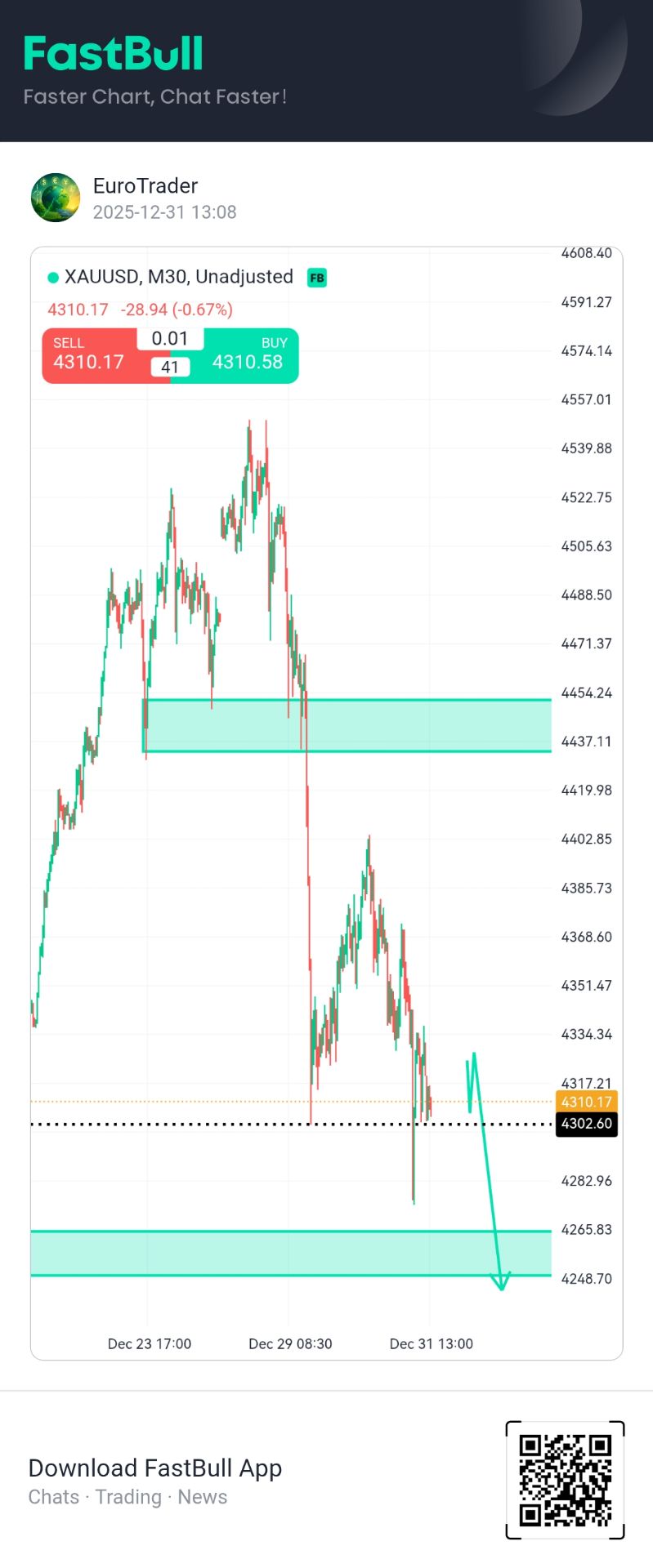
    eurotrader can gold reach today 4250?
    Charizard flag
    Well gold is refusing to break the 4305 for the time being.
    EuroTrader flag
    EuroTrader flag
    EuroTrader
    @luigiyes there is a big chance it could hit those levels but maybe not today
    HOÀNG LÊ flag
    I'm waiting for the gold price to reach 4240.
    EuroTrader flag
    Charizard
    Well gold is refusing to break the 4305 for the time being.
    @CharizardThe holidays are keeping things stalled for the now .the marksts would be closed for the new year
    EuroTrader flag
    HOÀNG LÊ
    I'm waiting for the gold price to reach 4240.
    @HOÀNG LÊWhat's the catalyst that would most likely send price towards these levels
    HOÀNG LÊ flag
    I do not know
    HOÀNG LÊ flag
    But if I go back, I'll buy in that area.
    Joel Mwas flag
    HOÀNG LÊ
    I'm waiting for the gold price to reach 4240.
    @HOÀNG LÊthat's PML
    HOÀNG LÊ flag
    I don't care where the gold goes.
    EuroTrader flag
    HOÀNG LÊ
    I do not know
    @HOÀNG LÊThere is no push at the moment to send price lower so I'll be sitting in my hands
    luigi flag
    EuroTrader
    @EuroTraderthanks
    EuroTrader flag
    HOÀNG LÊ
    I don't care where the gold goes.
    @HOÀNG LÊWhat I am accumulating at the moment is actually crypto currencies
    HOÀNG LÊ flag
    EuroTrader
    Yes, you're a different Day trader than me, but I enter and exit quickly.
    EuroTrader flag
    luigi
    @luigiYou are very much welcome but could we all wait for the new trading year before we start on a fresh slate
    EuroTrader flag
    HOÀNG LÊ
    @HOÀNG LÊYeahh you are more of a scalper than a day trade. Me am more of a day trader
    luigi flag
    EuroTrader
    @EuroTradersure
    Type here...
    Add Symbol or Code

      No matching data

      All
      Trump Updates
      Recommend
      Stocks
      Cryptocurrencies
      Central Banks
      Featured News
      • All
      • Russia-Ukraine Conflict
      • Middle East Flashpoint
      • All
      • Russia-Ukraine Conflict
      • Middle East Flashpoint
      Search
      Products

      Charts Free Forever

      Chats Q&A with Experts
      Screeners Economic Calendar Data Tools
      Membership Features
      Data Warehouse Market Trends Institutional Data Policy Rates Macro

      Market Trends

      Market Sentiment Order Book Forex Correlations

      Top Indicators

      Charts Free Forever
      Markets

      News

      News Analysis 24/7 Columns Education
      From Institutions From Analysts
      Topics Columnists

      Latest Views

      Latest Views

      Trending Topics

      Top Columnists

      Latest Update

      Signals

      Copy Rankings Latest Signals Become a signal provider AI Rating
      Contests
      Brokers

      Overview Brokers Assessment Rankings Regulators News Claims
      Broker listing Forex Brokers Comparison Tool Live Spread Comparison Scam
      Q&A Complaint Scam Alert Videos Tips to Detect Scam
      More

      Business
      Events
      Careers About Us Advertising Help Center

      White Label

      Data API

      Web Plug-ins

      Affiliate Program

      Awards Institution Evaluation IB Seminar Salon Event Exhibition
      Vietnam Thailand Singapore Dubai
      Fans Party Investment Sharing Session
      FastBull Summit BrokersView Expo
      Recent Searches
        Top Searches
          Markets
          News
          Analysis
          User
          24/7
          Economic Calendar
          Education
          Data
          • Names
          • Latest
          • Prev

          View All

          No data

          Scan to Download

          Faster Charts, Chat Faster!

          Download App
          English
          • English
          • Español
          • العربية
          • Bahasa Indonesia
          • Bahasa Melayu
          • Tiếng Việt
          • ภาษาไทย
          • Français
          • Italiano
          • Türkçe
          • Русский язык
          • 简中
          • 繁中
          Open Account
          Search
          Products
          Charts Free Forever
          Markets
          News
          Signals

          Copy Rankings Latest Signals Become a signal provider AI Rating
          Contests
          Brokers

          Overview Brokers Assessment Rankings Regulators News Claims
          Broker listing Forex Brokers Comparison Tool Live Spread Comparison Scam
          Q&A Complaint Scam Alert Videos Tips to Detect Scam
          More

          Business
          Events
          Careers About Us Advertising Help Center

          White Label

          Data API

          Web Plug-ins

          Affiliate Program

          Awards Institution Evaluation IB Seminar Salon Event Exhibition
          Vietnam Thailand Singapore Dubai
          Fans Party Investment Sharing Session
          FastBull Summit BrokersView Expo

          China Unveils $42 Billion in Early 2026 Investment for ‘Two Major’ Projects to Jumpstart Growth

          Gerik

          Economic

          Summary:

          China’s National Development and Reform Commission (NDRC) announced a $42 billion early investment package for 2026 targeting national infrastructure and strategic sectors under the “Two Major” program...

          Beijing Launches Early 2026 Investment Drive Amid Persistent Economic Pressures

          In a bid to counter lingering economic uncertainty and ensure early momentum for the 15th Five-Year Plan, China’s top economic planner, the National Development and Reform Commission (NDRC), has issued an early 2026 funding plan worth 295 billion yuan (approx. $42.2 billion) for “Two Major” projects. These central budget allocations are part of a broader fiscal strategy designed to stimulate domestic demand and reinforce economic resilience.
          The “Two Major” initiative encompasses both major national projects and key security-related capacity building, focusing on upgrading infrastructure, enhancing energy independence, and securing critical resources. The program is not new Beijing allocated 800 billion yuan in 2025 to similar priorities but the early release of the 2026 tranche reflects urgency in sustaining momentum amid weak consumer confidence and an uneven post-COVID recovery.

          Strategic Infrastructure and Security Drive Anchor Investments

          Spokesperson Li Chao of the NDRC emphasized during a Wednesday press conference that the new investments will “provide strong support for a smooth start to the 15th Five-Year Plan.” This statement reflects the government’s intent to front-load public investments to ensure early-year economic traction, a tactic commonly used during periods of macroeconomic stress.
          Among the newly approved infrastructure ventures are major projects such as a new airport in Guangzhou, large-scale water resource facilities, and high-end scientific research platforms. Collectively, these projects represent over 400 billion yuan in total investment and are expected to support both near-term employment and long-term productivity.
          The airport expansion in Guangzhou highlights China's continued commitment to regional development and transportation integration. Meanwhile, water infrastructure reflects increasing concern over climate resilience and environmental stability, and the research platforms indicate a push for technological self-sufficiency especially critical given rising tensions with the U.S. over advanced tech supply chains.

          Causal Link Between Infrastructure and Growth Stabilization

          The causal relationship between infrastructure-led investment and economic stabilization has long been central to China’s fiscal strategy. In the face of a sluggish property sector and weak private-sector investment, public infrastructure spending offers a dependable channel for immediate stimulus while also contributing to long-term capacity building.
          The NDRC’s early action also sends a signal to local governments and state-owned enterprises to prepare for accelerated implementation of shovel-ready projects in early 2026. This anticipatory fiscal coordination is aimed at minimizing the typical Q1 economic slowdown that follows year-end data consolidation.

          Reinforcing Policy Credibility and Strategic Autonomy

          By releasing these plans before the start of 2026, Beijing not only asserts its macroeconomic control but also attempts to boost market confidence. Early-stage fiscal mobilization complements monetary policy stability, especially as the People’s Bank of China (PBOC) has kept rates steady despite calls for further easing.
          The emphasis on security-related infrastructure and research platforms also underlines China’s growing prioritization of strategic autonomy. This is particularly significant amid ongoing global supply chain shifts, export control frictions, and competition over advanced technologies. Investments in these areas are not merely about domestic growth they serve as defensive and proactive mechanisms to fortify China’s long-term competitiveness.

          Early Investments Set the Tone for 2026 but Structural Headwinds Remain

          China’s early rollout of a $42 billion investment package for 2026 marks a proactive step to stabilize the economy and shape the opening trajectory of its new five-year strategy. While the “Two Major” framework remains a core instrument for state-led growth, its effectiveness in reversing broader structural weaknesses such as weak domestic consumption, a fragile property market, and global trade uncertainty will be closely watched.
          If executed efficiently, these early investments may cushion the economy against a soft start in 2026. However, sustaining momentum beyond infrastructure will require deeper reforms to mobilize private capital, boost consumer spending, and enhance productivity across non-state sectors. For now, Beijing’s message is clear: strategic spending remains its frontline defense against economic stagnation.

          Source: Reuters

          To stay updated on all economic events of today, please check out our Economic calendar
          Risk Warnings and Disclaimers
          You understand and acknowledge that there is a high degree of risk involved in trading. Following any strategies or investment methods may lead to potential losses. The content on the site is provided by our contributors and analysts for information purposes only. You are solely responsible for determining whether any trading assets, securities, strategy, or any other product is suitable for investing based on your own investment objectives and financial situation.
          Add to Favorites
          Share

          Oil Edges Up But Brent On Course For Longest Stretch Of Annual Losses In 2025

          Dark Current

          Commodity

          Economic

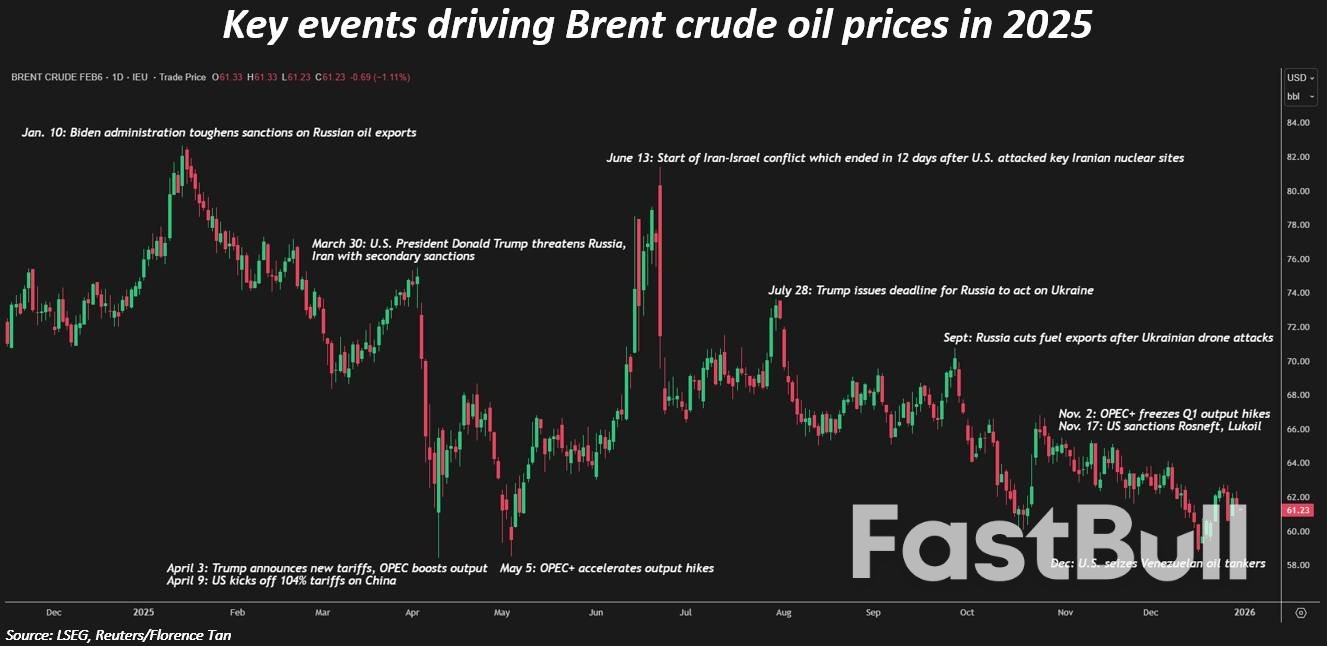
          Oil prices were little changed on Wednesday but are set to fall more than 10% for 2025, as supply outpaced demand in a year marked by wars, higher tariffs and OPEC+ output and sanctions on Russia, Iran and Venezuela.

          Brent crude futures , down nearly 18% - the most substantial annual percentage decline since 2020 - are on track for a third straight year of losses, their longest-ever losing streak. The March contract, which expires on Wednesday, rose 22 cents to $61.55 a barrel at 0437 GMT.

          BNP Paribas commodities analyst Jason Ying expects Brent to dip to $55 a barrel in the first quarter before recovering to $60 a barrel for the rest of 2026 as supply growth is expected to normalise while demand stays flat.

          "The reason why we're more bearish than the market in the near term is that we think that U.S. shale producers were able to hedge at high levels," he said.

          "So the supply from shale producers will be more consistent and insensitive to price movements."

          U.S. West Texas Intermediate crude was at $58.16, up 21 cents, and was headed for a 15% annual decline. The 2025 average prices for both benchmarks are the lowest since 2020, LSEG data showed.

          Oil markets had a strong start to 2025 when former President Joe Biden ended his term by imposing tougher sanctions on Russia, disrupting supplies to top buyers China and India.

          The war in Ukraine intensified when Ukrainian drones damaged Russian energy infrastructure and disrupted Kazakhstan's oil exports and the 12-day Iran-Israel conflict in June threatened shipping in the Strait of Hormuz, a key oil chokepoint, which fanned oil prices.

          Adding to geopolitical tensions, top OPEC producers Saudi Arabia and the United Arab Emirates are engaged in a conflict over Yemen and U.S. President Donald Trump has ordered a blockade on Venezuelan oil exports and threatened another strike on Iran.

          But prices cooled after OPEC+ accelerated its output increases this year and as concerns about the impact of U.S. tariffs weighed on global economic and fuel demand growth.

          Key events driving Brent crude oil prices in 2025

          The Organization of the Petroleum Exporting Countries and its allies have paused oil output hikes for the first quarter of 2026 after releasing some 2.9 million barrels per day into the market since April. The next OPEC+ meeting is on January 4.

          Most analysts expect supply to exceed demand next year, with estimates ranging from the International Energy Agency's 3.84 million barrels per day to Goldman Sachs' 2 million bpd.

          "If the price really has a substantial fall, I would imagine you will see some cuts (from OPEC+)," said Martijn Rats, Morgan Stanley's global oil strategist. "But it probably does need to fall quite a bit further from here on - maybe in the low $50s."

          "If today's price simply prevails, after the pause in Q1, they'll probably continue to unwind these cuts."

          John Driscoll, managing director of consultancy JTD Energy, expects geopolitical risks to support oil prices despite fundamentals pointing to an oversupply.

          "Everybody's saying it'll get weaker into 2026 and even beyond," he said. "But I wouldn't ignore the geopolitics and the Trump factor is going to be playing out because he wants to be involved in everything."

          "We are living in a powder keg and I think that is kind of your ultimate floor," he added.

          Source: Reuters

          To stay updated on all economic events of today, please check out our Economic calendar
          Risk Warnings and Disclaimers
          You understand and acknowledge that there is a high degree of risk involved in trading. Following any strategies or investment methods may lead to potential losses. The content on the site is provided by our contributors and analysts for information purposes only. You are solely responsible for determining whether any trading assets, securities, strategy, or any other product is suitable for investing based on your own investment objectives and financial situation.
          Add to Favorites
          Share

          India’s Steel Stocks Rally as Government Imposes Tariffs to Shield Domestic Industry from Chinese Imports

          Gerik

          Commodity

          Economic

          Tariff Move Sparks Optimism Across Indian Steel Sector

          India’s equity markets closed 2025 on a bullish note for the domestic steel industry, as the government’s latest trade intervention sent steel stocks rallying. Shares of major producers including Tata Steel and JSW Steel climbed 2.4% and 4.3% respectively, leading gains on the benchmark Nifty 50 index, which rose 0.3% overall. Other producers such as SAIL, Jindal Stainless, and Jindal Steel also saw gains between 2.5% and 3.6%.
          The catalyst behind this rally was New Delhi’s imposition of a safeguard duty on select steel imports a tariff designed to counteract the influx of cheaper foreign steel, predominantly from China. The new duty structure will be implemented over a three-year period, starting with a 12% levy in the first year, tapering to 11.5% and 11% in subsequent years. This gradual reduction reflects an intent to provide short-term relief to domestic producers while eventually reintroducing market competitiveness.

          Structural Protection to Prevent Injury to Domestic Industry

          The tariffs were recommended by India’s Directorate General of Trade Remedies (DGTR), which identified a “recent, sudden, sharp and significant increase in imports” that posed a serious threat to local manufacturers. This statement establishes a direct causal relationship between import volumes particularly low-priced steel from China and the erosion of profitability and market share among Indian steel producers.
          The finance ministry’s official order, released Tuesday, formalized these recommendations into a binding trade measure. The government’s swift action demonstrates a strategic use of trade policy to stabilize the domestic steel industry, which has been under pressure from volatile commodity prices and global oversupply.

          Market Reaction Underscores Investor Confidence

          The immediate market reaction reflected investor confidence in the effectiveness of the tariff. The Nifty Metal Index hit a new all-time high of 11,164.40, having risen in 12 of the past 14 trading sessions. This upward momentum has been supported by a global rebound in commodity prices and domestic policy clarity, positioning Indian metal producers for improved margins in 2026.
          Notably, this rally aligns with broader optimism surrounding infrastructure spending, firm global demand, and sustained capital investment in sectors such as construction, automobiles, and defense all of which rely heavily on domestic steel.

          Policy Timing and Broader Trade Implications

          The timing of the tariff, late in the year, reflects strategic coordination with broader economic priorities. As India prepares for a year of expected growth-driven capital expenditure and pre-election fiscal maneuvering, protecting core industrial sectors becomes politically and economically expedient.
          While the government has not explicitly targeted China in its public statement, the implication is clear: curbing Chinese overcapacity and price dumping is a top priority. This mirrors global trade tensions, where several countries including the U.S. and EU have also levied duties on Chinese steel and aluminum exports.

          Short-Term Support with Long-Term Competitive Implications

          The safeguard duty provides immediate relief to Indian producers, improving their price competitiveness in the short term. However, the long-term success of this intervention will depend on whether domestic firms use the protection period to modernize production, improve efficiency, and reduce cost structures.
          A failure to capitalize on this window could leave the sector vulnerable once the tariffs begin to decline. Conversely, if companies respond with strategic capacity upgrades and increased downstream integration, India’s steel industry could emerge stronger and more globally competitive.
          India’s three-year safeguard duty on steel imports marks a decisive step in shielding its domestic industry from the adverse effects of low-cost global competition. While stock market euphoria reflects short-term optimism, the policy’s long-term value will depend on whether Indian steelmakers seize this opportunity to innovate, diversify, and strengthen their resilience ahead of global market re-entry.

          Source: Reuters

          To stay updated on all economic events of today, please check out our Economic calendar
          Risk Warnings and Disclaimers
          You understand and acknowledge that there is a high degree of risk involved in trading. Following any strategies or investment methods may lead to potential losses. The content on the site is provided by our contributors and analysts for information purposes only. You are solely responsible for determining whether any trading assets, securities, strategy, or any other product is suitable for investing based on your own investment objectives and financial situation.
          Add to Favorites
          Share

          Silver Leads 2025 Commodity Surge as Precious and Industrial Metals Outshine Oil and Agriculture

          Gerik

          Economic

          Commodity

          Silver Surges to Historic Highs Amid Supply Constraints and Strategic Demand

          In a year dominated by macroeconomic volatility, geopolitical disruptions, and shifting monetary expectations, silver outshone all other commodities in 2025 with a dramatic 161% surge, breaching the $80-per-ounce mark for the first time. This performance far exceeded major equity indices, currencies, and most other commodities, cementing silver’s role as both a safe haven and an industrial linchpin.
          The underlying drivers behind this performance were both structural and financial. From an industrial perspective, silver benefited from strong end-use demand in electric vehicles, solar panels, and electronics. On the financial side, weakening confidence in the U.S. dollar down nearly 9.5% for the year combined with a low interest rate outlook for 2026, sparked widespread investor rotation into precious metals. These causal forces created a self-reinforcing cycle of rising prices and tightened physical availability.
          Additional momentum came after the U.S. formally designated silver a critical mineral, while China introduced new export restrictions, adding to global scarcity concerns. These policy decisions directly affected market flows, driving up premiums for physical silver and pushing spot prices sharply higher. Traders reported physical offers at prices up to $10 above market rates, highlighting the intensity of the supply squeeze.

          Gold, Platinum, and Palladium Ride Safe-Haven Wave

          Gold also saw a robust year, gaining 66% amid central bank buying and geopolitical risk hedging. While not as explosive as silver, gold's rally to record highs reflected its role as a hedge against both inflation and monetary instability. Other precious metals like platinum and palladium posted strong annual gains, supported by industrial demand and speculative inflows.
          Commodities analysts, including Jason Ying of BNP Paribas, suggest that risks from 2025 ranging from geopolitical tensions to rate uncertainty are unlikely to dissipate quickly in 2026, maintaining upward pressure on precious metals.

          Copper, Tin, and Aluminium Benefit from Energy Transition and AI Infrastructure

          Outside of the precious complex, industrial metals also had a standout year. Copper rose nearly 44%, hitting a record $12,960 per metric ton on the London Metal Exchange. Demand was bolstered by AI-related data infrastructure expansion and global green energy rollouts. Disruptions at major mines compounded the supply deficit, making the rally largely driven by fundamentals rather than short-term speculation.
          Tin and aluminium also gained sharply, up 44% and 17% respectively. Tin’s rally was tied to export restrictions in Myanmar and Indonesia, while aluminium prices were supported by China’s cap on smelting capacity and strong demand from electric grids and battery systems. These cases illustrate clear causal relationships between policy restrictions, industrial application demand, and supply-side tightening.
          Iron ore showed relative resilience despite a decline in China’s crude steel output. Beijing’s move to relax homebuying restrictions in major cities helped maintain demand for construction inputs, showing how stimulus policies in China continue to shape global resource demand.

          Energy Markets Falter Under Weight of Surplus

          Crude oil bucked the trend of hard asset gains, falling around 15% in 2025 despite multiple geopolitical disruptions, including drone strikes on Russian infrastructure and sanctions on Venezuela. Brent crude is now poised for its longest-ever streak of annual losses.
          The primary cause of the decline lies in OPEC+’s output decisions and weak global demand. Since April, the group added nearly 2.9 million barrels per day to the market. Though production increases paused for Q1 2026, the damage was already done: expectations of a 2026 oil glut remain high. Analysts like Martijn Rats of Morgan Stanley expect further cuts only if prices collapse into the $50-per-barrel range, otherwise gradual unwinding is likely to continue.

          Agricultural Commodities Underperform as Supply Outpaces Demand

          Agricultural markets delivered some of the worst performances of the year. Cocoa fell by 48%, reversing its gains from 2024 when poor West African crops led to record prices. Improved harvests and weakened demand pulled prices down sharply, reflecting a direct inverse relationship between supply recovery and price trajectory.
          Sugar and robusta coffee both shed roughly 20%, while rubber and palm oil each lost 9% amid stronger output and sluggish industrial demand. The exception was soybeans, which ended the year flat-to-positive thanks to a late rebound in Chinese imports after earlier trade tensions with the U.S. eased.
          Wheat and corn continued to struggle under ample global supply conditions, reinforcing bearish sentiment across the softs complex. Analysts anticipate some support for palm oil in 2026 from Indonesia’s renewed biodiesel blending mandates, though the upside may be limited by weak global consumption patterns.

          2025 Divides the Commodity Complex Along Strategic Lines

          The commodity space in 2025 became starkly polarized. On one end, precious and industrial metals led by silver and copper surged to multi-decade or all-time highs on strong strategic demand, monetary hedging, and constrained supply. On the other, oil and agricultural commodities stumbled under the weight of oversupply and softening global growth.
          As 2026 begins, the outlook for metals remains bullish, anchored in structural demand from technology and clean energy, alongside expectations of easier monetary policy. In contrast, agricultural and energy commodities face headwinds unless producers implement meaningful output curbs or demand surprises to the upside. The commodity winners of 2026 may again be those aligned with geopolitics, innovation, and infrastructure not traditional consumption cycles.

          Source: Reuters

          To stay updated on all economic events of today, please check out our Economic calendar
          Risk Warnings and Disclaimers
          You understand and acknowledge that there is a high degree of risk involved in trading. Following any strategies or investment methods may lead to potential losses. The content on the site is provided by our contributors and analysts for information purposes only. You are solely responsible for determining whether any trading assets, securities, strategy, or any other product is suitable for investing based on your own investment objectives and financial situation.
          Add to Favorites
          Share

          China's Manufacturing Surprises on the Upside, But Recovery Remains Uneven Across Sectors

          Gerik

          Economic

          Manufacturing Recovery Signals Late-Year Economic Stabilization

          China’s economy showed a surprising uptick in December 2025 as manufacturing activity returned to expansion for the first time since March, according to official data from the National Bureau of Statistics (NBS). The official manufacturing Purchasing Managers' Index (PMI) climbed to 50.1, exceeding both the previous month’s reading of 49.2 and analyst forecasts. A PMI above 50 denotes expansion, indicating that China's industrial sector has found tentative footing after nearly three quarters of decline.
          This improvement, while modest, marks a crucial psychological shift. It suggests that stabilization policies and modest internal demand may have started to reverse the slowdown, offering relief to policymakers heading into 2026. More importantly, the expansion occurred without additional central bank stimulus, as the People's Bank of China opted to keep loan prime rates unchanged earlier in the week an implicit vote of confidence in existing conditions.

          Composite Gains Reflect Broader, Though Fragile, Economic Momentum

          The composite PMI which includes both manufacturing and non-manufacturing sectors also rose to 50.7 from November’s 49.7, indicating a broader improvement beyond just factory output. The non-manufacturing PMI, covering services and construction, reached 50.2, further supporting a cautiously optimistic view that the economy is entering 2026 with some momentum.
          Chief NBS statistician Huo Lihui noted that new orders rose in December, a sign of “significant expansion” in both production and demand. This reflects a causal relationship: increased domestic product launches and business development activity directly contributed to order growth, reinforcing production pipelines.

          Private Sector Data Echoes Official Readings

          Corroborating the government’s report, an independent PMI survey by RatingDog also showed manufacturing rising to 50.1 from 49.9, surpassing expectations. Yao Yu, the firm’s founder, highlighted that new orders had increased for a seventh consecutive month, largely driven by domestic market dynamics rather than export-led recovery.
          Still, Yao cautioned that business optimism remains below historical norms. Confidence for 2026, while present, has softened likely a reflection of persistent concerns over the real estate slump, sluggish consumer spending, and uncertainties in global demand.

          Uneven Gains Point to Structural Weaknesses

          While the headline numbers offer short-term encouragement, the underlying data exposes structural imbalances. Large enterprises were the primary contributors to the December improvement, with their PMI rising to 50.8 up 1.5 percentage points from November. In contrast, medium-sized firms hovered just below the expansion threshold at 49.8, and small enterprises slipped further into contraction territory, with their PMI falling to 48.6.
          This divergence suggests that stimulus and recovery policies are disproportionately benefiting well-capitalized, state-backed, or export-facing firms, while smaller businesses often more sensitive to domestic demand and financing conditions continue to struggle. This is a consequence of policy implementation and sectoral dynamics rather than a simple cyclical lag.

          Markets React Tepidly Amid Caution on Structural Challenges

          Financial markets reflected a mixed response to the data. Hong Kong’s Hang Seng Index dropped 0.83%, indicating skepticism about the broader recovery. Meanwhile, the mainland CSI 300 rose 0.33%, signaling some confidence among domestic investors. This divergence suggests that while markets welcomed the headline PMI, they remain wary of deeper issues like property sector weakness and lackluster consumer sentiment.
          Indeed, November data on retail sales, industrial production, and fixed asset investment all underperformed expectations, reinforcing concerns that the recovery lacks sufficient breadth. The central bank’s decision to hold interest rates steady rather than introduce further easing suggests a preference for policy conservatism amid financial stability concerns.

          Positive Surprise, But Not Yet a Turning Point

          Economists such as Hao Zhou from Guotai Junan International described the data as “a very good, positive surprise,” but also cautioned against reading too much into one month’s figures. While the improvement signals that the economy may be stabilizing, the fundamental drivers of long-term growth consumer demand, private sector confidence, and structural reform remain weak.
          In this context, the December rebound in manufacturing appears more like a tactical bounce than a strategic turnaround. Without deeper rebalancing and sustained policy follow-through, particularly toward supporting small businesses and reenergizing consumption, China’s economic trajectory in 2026 remains uncertain.
          The unexpected expansion in China’s manufacturing sector offers a brief moment of relief for the world’s second-largest economy. However, the recovery remains fragile, unevenly distributed, and heavily reliant on large enterprises. As China enters 2026, policymakers face the dual challenge of maintaining growth momentum while addressing persistent structural weaknesses particularly in the property market, labor outlook, and domestic consumption. The December PMI rebound may be a hopeful signal, but it is not yet a definitive shift in China’s broader economic narrative.

          Source: CNBC

          To stay updated on all economic events of today, please check out our Economic calendar
          Risk Warnings and Disclaimers
          You understand and acknowledge that there is a high degree of risk involved in trading. Following any strategies or investment methods may lead to potential losses. The content on the site is provided by our contributors and analysts for information purposes only. You are solely responsible for determining whether any trading assets, securities, strategy, or any other product is suitable for investing based on your own investment objectives and financial situation.
          Add to Favorites
          Share

          China Tightens Silver Export Controls, Elevating It to Strategic Status Amid Soaring Global Demand

          Gerik

          Economic

          Commodity

          Beijing’s Strategic Pivot: Silver Joins the Ranks of Regulated Critical Materials

          China is set to implement new export controls on silver beginning Thursday, a policy shift that will formally elevate the once-ordinary industrial metal to strategic status, akin to rare earth elements. While the measures were announced in October, their enforcement now comes at a time of heightened sensitivity in global markets both economically and politically.
          Silver’s elevation to “strategic material” status, as reported by China’s state-run Securities Times, places it under the same regulatory framework that has governed rare earths for over a decade. This shift aligns with China's broader ambition to consolidate control over critical supply chains while reinforcing its geopolitical leverage amid ongoing economic tensions with the United States and its allies.

          Export Restrictions Reflect Beijing’s Broader Strategic Calculus

          Although China has not imposed a blanket ban on silver exports, it has significantly tightened access by approving only 44 companies to export the metal under new 2026–2027 quotas. These firms will operate under stricter licensing rules, echoing the system used for rare earth exports. This change is causal in nature China’s decision to regulate silver stems directly from its increasing role in global high-tech supply chains, particularly in energy transition, defense, and healthcare technologies.
          The new export rules are part of a larger framework that includes tightened controls over other strategic materials such as tungsten and antimony both vital for advanced military and technological applications. This indicates Beijing's growing intent to weaponize resource control in response to foreign trade pressure, mirroring strategies seen in previous years with rare earth minerals.

          Elon Musk and Industry Voices Raise Alarm on Supply Risks

          Tesla CEO Elon Musk publicly criticized the move on X, stating, “This is not good. Silver is needed in many industrial processes.” His concern underscores the metal’s broad industrial applications, including electric vehicles, solar cells, semiconductors, and anti-bacterial medical tools. Silver’s strategic value has only expanded as technological ecosystems become increasingly dependent on high-conductivity materials.
          The United States has taken note. In November, silver was officially added to the U.S. list of critical minerals, with government analysis citing China as one of the world’s largest producers and holders of silver reserves. U.S. importers now face a complex sourcing environment as Beijing exerts more control over outbound flows.

          Market Response: Price Surge Signals Fear of Supply Squeeze

          Silver prices have more than doubled in 2025, surging to record highs above $80 per ounce before pulling back to around $73. This rally is driven by both supply-side constraints and macroeconomic trends. China exported over 4,600 tons of silver in the first 11 months of the year far outstripping its 220 tons of imports illustrating its dominance in the global silver trade. Now, with tighter controls looming, market participants are rushing to secure physical supply.
          The supply squeeze is no longer theoretical. Canadian silver producer Kuya Silver confirmed that two Chinese buyers recently offered up to $8 per ounce above market rates for physical silver. Days later, an Indian buyer offered a $10 premium. These real-time signals indicate market expectations of a significant supply-demand imbalance going into 2026, catalyzed directly by Chinese policy intervention.

          Broader Financial Landscape: Dollar Weakness Fuels Flight to Metals

          Silver’s price performance also reflects broader financial currents. The U.S. dollar index has fallen nearly 9.5% in 2025 its worst year since 2017 prompting investors to shift toward hard assets as stores of value. Tyler Cowen, an economics professor at George Mason University, characterized the spike in silver and gold prices as “a flashing warning for the [U.S.] economy.” While correlation rather than direct causation links the falling dollar and surging metal prices, investor behavior confirms the market's growing risk aversion.
          Gold has gained over 60% this year, and silver is on pace for its strongest annual performance since 1979, when it surged 470%. Bitcoin, often cited as a modern hedge, has declined by over 5% for the year reinforcing the return of investor confidence in traditional safe-haven assets.

          Resource Nationalism Redefines Silver’s Role in the Global Economy

          China’s decision to regulate silver exports marks a significant turning point in the geopolitics of critical minerals. No longer just a precious metal, silver now sits at the crossroads of industrial demand, strategic policy, and financial hedging. Beijing’s move reshapes the global supply landscape, threatening to disrupt downstream industries across the U.S., EU, and other manufacturing hubs.
          While the immediate policy impact is regulatory, the broader implications are structural. If current price behavior and trade patterns persist, silver could become a new axis of geopolitical competition mirroring the dynamics seen in rare earths over the past decade. In 2026, supply security may rival price stability as the top concern for governments and industries reliant on this increasingly indispensable metal.

          Source: CNBC

          To stay updated on all economic events of today, please check out our Economic calendar
          Risk Warnings and Disclaimers
          You understand and acknowledge that there is a high degree of risk involved in trading. Following any strategies or investment methods may lead to potential losses. The content on the site is provided by our contributors and analysts for information purposes only. You are solely responsible for determining whether any trading assets, securities, strategy, or any other product is suitable for investing based on your own investment objectives and financial situation.
          Add to Favorites
          Share

          China’s Manufacturing Sector Returns to Expansion, Offering Tentative Relief to Policymakers

          Gerik

          Economic

          Manufacturing Revival Provides Year-End Boost for China’s Growth Outlook

          China’s manufacturing sector showed signs of stabilization in December 2025, marking the first expansion in nine months and providing policymakers with a modest but symbolic victory. According to the National Bureau of Statistics (NBS), the official manufacturing Purchasing Managers’ Index (PMI) rose to 50.1 from 49.2 in November, surpassing expectations and breaking the prolonged trend of contraction that had plagued industrial output throughout the year.
          Crossing the 50-point threshold, which separates expansion from contraction, the PMI reading signals a return to growth in one of China’s most critical economic engines. Analysts surveyed by Reuters had anticipated no change from November’s 49.2, highlighting the element of surprise in the December print.

          Sub-Indices Indicate Improved Demand Dynamics

          The sub-index for new orders rose to 50.8 from November’s 49.2, while new export orders increased to 49.0 from 47.6. This partial recovery suggests a mild revival in both domestic and international demand, likely helped by improved logistics and a stronger-than-expected export performance late in the year.
          While causality is difficult to establish definitively, the increase in orders appears to result from easing supply-side constraints and seasonal year-end manufacturing activity, rather than a broad-based demand recovery. Therefore, the improvement may reflect cyclical factors more than a structural turnaround in export competitiveness or consumption.

          Non-Manufacturing Sector Stabilizes as Construction Rebounds

          In parallel, the non-manufacturing PMI, which captures service-sector and construction activity, edged up to 50.2 from a contractionary 49.3 in November. This modest increase signals stabilization in broader economic activity following November’s dip the first such decline in nearly three years.
          The NBS composite PMI, which combines both manufacturing and non-manufacturing, rose to 50.7 in December from 49.7 in the prior month. This rebound may help Beijing justify its decision to avoid launching large-scale fiscal or monetary stimulus in the final quarter, a strategy aimed at preserving policy room for 2026 while still striving to meet the 5% GDP growth goal.

          Underlying Weaknesses Continue to Challenge Recovery Narrative

          Despite the PMI uptick, underlying economic indicators paint a more complex picture. Industrial profits in November slumped 13.1% year-over-year, the steepest drop in over twelve months, underscoring persistent margin pressure amid weak global demand. This disconnect between headline manufacturing activity and corporate profitability suggests the recovery lacks depth and sustainability.
          More structurally, weak consumer confidence continues to hinder domestic rebalancing efforts. Lingering uncertainty in the labor market, combined with a protracted real estate crisis, has eroded household wealth and limited consumption a dynamic repeatedly cited by policymakers as a central obstacle to long-term growth.
          President Xi Jinping recently acknowledged the issue of "overall capacity excess," a term historically dismissed by Beijing as a Western criticism. In a Qiushi Journal article, Xi emphasized the need for consumption to become the primary driver of growth, signaling a rhetorical pivot toward demand-side solutions. However, similar promises in past years have frequently fallen short of execution.

          Structural Transformation vs. Short-Term Stabilization

          Beijing now faces a dual challenge. On one hand, it must ensure short-term stabilization through targeted policy support to industries and consumers. On the other, it must accelerate its longer-term agenda of economic rebalancing shifting from an investment- and export-heavy model to a more consumption-led framework.
          Recent commitments to address price wars, reduce unproductive industrial competition, and manage sector-specific overproduction reflect a broader recognition of the need to prune excess and foster efficiency. These “anti-involution” efforts aim to restructure production incentives and improve resource allocation. While they may support long-term productivity gains, they could also temporarily dampen output in overexposed sectors.

          Encouraging PMI Data Does Not Eliminate Deeper Risks

          December’s unexpected PMI rebound provides a timely morale boost for Chinese policymakers, offering some support to their year-end growth ambitions. However, the underlying structural imbalances excess industrial capacity, soft consumer demand, and falling corporate profits remain largely unresolved.
          The divergence between activity indicators and profitability metrics signals that recovery momentum is fragile and uneven. Unless followed by tangible improvements in consumption and investment quality, the return to PMI expansion may prove to be a temporary reprieve rather than a sustainable turning point. The path forward for China’s economy in 2026 will depend not only on policy flexibility but also on the country’s willingness to address its longstanding demand-side vulnerabilities.

          Source: Reuters

          To stay updated on all economic events of today, please check out our Economic calendar
          Risk Warnings and Disclaimers
          You understand and acknowledge that there is a high degree of risk involved in trading. Following any strategies or investment methods may lead to potential losses. The content on the site is provided by our contributors and analysts for information purposes only. You are solely responsible for determining whether any trading assets, securities, strategy, or any other product is suitable for investing based on your own investment objectives and financial situation.
          Add to Favorites
          Share
          FastBull
          Copyright © 2025 FastBull Ltd

          728 RM B 7/F GEE LOK IND BLDG NO 34 HUNG TO RD KWUN TONG KLN HONG KONG

          TelegramInstagramTwitterfacebooklinkedin
          App Store Google Play Google Play
          Products
          Charts

          Chats

          Q&A with Experts
          Screeners
          Economic Calendar
          Data
          Tools
          Membership
          Features
          Function
          Markets
          Copy Trading
          Latest Signals
          Contests
          News
          Analysis
          24/7
          Columns
          Education
          Company
          Careers
          About Us
          Contact Us
          Advertising
          Help Center
          Feedback
          User Agreement
          Privacy Policy
          Personal Information Protection Statement
          Business

          White Label

          Data API

          Web Plug-ins

          Poster Maker

          Affiliate Program

          Risk Disclosure

          The risk of loss in trading financial instruments such as stocks, FX, commodities, futures, bonds, ETFs and crypto can be substantial. You may sustain a total loss of the funds that you deposit with your broker. Therefore, you should carefully consider whether such trading is suitable for you in light of your circumstances and financial resources.

          No decision to invest should be made without thoroughly conducting due diligence by yourself or consulting with your financial advisors. Our web content might not suit you since we don't know your financial conditions and investment needs. Our financial information might have latency or contain inaccuracy, so you should be fully responsible for any of your trading and investment decisions. The company will not be responsible for your capital loss.

          Without getting permission from the website, you are not allowed to copy the website's graphics, texts, or trademarks. Intellectual property rights in the content or data incorporated into this website belong to its providers and exchange merchants.

          Not Logged In

          Log in to access more features

          FastBull Membership

          Not yet

          Purchase

          Become a signal provider
          Help Center
          Customer Service
          Dark Mode
          Price Up/Down Colors

          Log In

          Sign Up

          Position
          Layout
          Fullscreen
          Default to Chart
          The chart page opens by default when you visit fastbull.com