• Trade
  • Markets
  • Copy
  • Contests
  • News
  • 24/7
  • Calendar
  • Q&A
  • Chats
Trending
Screeners
SYMBOL
LAST
BID
ASK
HIGH
LOW
NET CHG.
%CHG.
SPREAD
SPX
S&P 500 Index
6827.42
6827.42
6827.42
6899.86
6801.80
-73.58
-1.07%
--
DJI
Dow Jones Industrial Average
48458.04
48458.04
48458.04
48886.86
48334.10
-245.98
-0.51%
--
IXIC
NASDAQ Composite Index
23195.16
23195.16
23195.16
23554.89
23094.51
-398.69
-1.69%
--
USDX
US Dollar Index
97.950
98.030
97.950
98.500
97.950
-0.370
-0.38%
--
EURUSD
Euro / US Dollar
1.17394
1.17409
1.17394
1.17496
1.17192
+0.00011
+ 0.01%
--
GBPUSD
Pound Sterling / US Dollar
1.33707
1.33732
1.33707
1.33997
1.33419
-0.00148
-0.11%
--
XAUUSD
Gold / US Dollar
4299.39
4299.39
4299.39
4353.41
4257.10
+20.10
+ 0.47%
--
WTI
Light Sweet Crude Oil
57.233
57.485
57.233
58.011
56.969
-0.408
-0.71%
--

Community Accounts

Signal Accounts
--
Profit Accounts
--
Loss Accounts
--
View More

Become a signal provider

Sell trading signals to earn additional income

View More

Guide to Copy Trading

Get started with ease and confidence

View More

Signal Accounts for Members

All Signal Accounts

Best Return
  • Best Return
  • Best P/L
  • Best MDD
Past 1W
  • Past 1W
  • Past 1M
  • Past 1Y

All Contests

  • All
  • Trump Updates
  • Recommend
  • Stocks
  • Cryptocurrencies
  • Central Banks
  • Featured News
Top News Only
Share

Ukraine Says It Received 114 Prisoners From Belarus

Share

USA Embassy In Lithuania: Maria Kalesnikava Is Not Going To Vilnius

Share

USA Embassy In Lithuania: Other Prisoners Are Being Sent From Belarus To Ukraine

Share

Ukraine President Zelenskiy: Five Ukrainians Released By Belarus In US-Brokered Deal

Share

USA Vilnius Embassy: USA Stands Ready For "Additional Engagement With Belarus That Advances USA Interests"

Share

USA Vilnius Embassy: Belarus, USA, Other Citizens Among The Prisoners Released Into Lithuania

Share

USA Vilnius Embassy: USA Will Continue Diplomatic Efforts To Free The Remaining Political Prisoners In Belarus

Share

USA Vilnius Embassy: Belarus Releases 123 Prisoners Following Meeting Of President Trump's Envoy Coale And Belarus President Lukashenko

Share

USA Vilnius Embassy: Masatoshi Nakanishi, Aliaksandr Syrytsa Are Among The Prisoners Released By Belarus

Share

USA Vilnius Embassy: Maria Kalesnikava And Viktor Babaryka Are Among The Prisoners Released By Belarus

Share

USA Vilnius Embassy: Nobel Peace Prize Laureate Ales Bialiatski Is Among The Prisoners Released By Belarus

Share

Belarusian Presidential Administration Telegram Channel: Lukashenko Has Pardoned 123 Prisoners As Part Of Deal With US

Share

Two Local Syrian Officials: Joint US-Syrian Military Patrol In Central Syria Came Under Fire From Unknown Assailants

Share

Israeli Military Says It Targeted 'Key Hamas Terrorist' In Gaza City

Share

Rwanda's Actions In Eastern Drc Are A Clear Violation Of Washington Accords Signed By President Trump - Secretary Of State Rubio

Share

Israeli Military Issues Evacuation Warning In Southern Lebanon Village Ahead Of Strike - Spokesperson On X

Share

Belarusian State Media Cites US Envoy Coale As Saying He Discussed Ukraine And Venezuela With Lukashenko

Share

Belarusian State Media Cites US Envoy Coale As Saying That US Removes Sanctions On Belarusian Potassium

Share

Thai Prime Minister: No Ceasefire Agreement With Cambodia

Share

US, Ukraine To Discuss Ceasefire In Berlin Ahead Of European Summit

TIME
ACT
FCST
PREV
U.K. Trade Balance Non-EU (SA) (Oct)

A:--

F: --

P: --

U.K. Trade Balance (Oct)

A:--

F: --

P: --

U.K. Services Index MoM

A:--

F: --

P: --

U.K. Construction Output MoM (SA) (Oct)

A:--

F: --

P: --

U.K. Industrial Output YoY (Oct)

A:--

F: --

P: --

U.K. Trade Balance (SA) (Oct)

A:--

F: --

P: --

U.K. Trade Balance EU (SA) (Oct)

A:--

F: --

P: --

U.K. Manufacturing Output YoY (Oct)

A:--

F: --

P: --

U.K. GDP MoM (Oct)

A:--

F: --

P: --

U.K. GDP YoY (SA) (Oct)

A:--

F: --

P: --

U.K. Industrial Output MoM (Oct)

A:--

F: --

P: --

U.K. Construction Output YoY (Oct)

A:--

F: --

P: --

France HICP Final MoM (Nov)

A:--

F: --

P: --

China, Mainland Outstanding Loans Growth YoY (Nov)

A:--

F: --

P: --

China, Mainland M2 Money Supply YoY (Nov)

A:--

F: --

P: --

China, Mainland M0 Money Supply YoY (Nov)

A:--

F: --

P: --

China, Mainland M1 Money Supply YoY (Nov)

A:--

F: --

P: --

India CPI YoY (Nov)

A:--

F: --

P: --

India Deposit Gowth YoY

A:--

F: --

P: --

Brazil Services Growth YoY (Oct)

A:--

F: --

P: --

Mexico Industrial Output YoY (Oct)

A:--

F: --

P: --

Russia Trade Balance (Oct)

A:--

F: --

P: --

Philadelphia Fed President Henry Paulson delivers a speech
Canada Building Permits MoM (SA) (Oct)

A:--

F: --

P: --

Canada Wholesale Sales YoY (Oct)

A:--

F: --

P: --

Canada Wholesale Inventory MoM (Oct)

A:--

F: --

P: --

Canada Wholesale Inventory YoY (Oct)

A:--

F: --

P: --

Canada Wholesale Sales MoM (SA) (Oct)

A:--

F: --

P: --

Germany Current Account (Not SA) (Oct)

A:--

F: --

P: --

U.S. Weekly Total Rig Count

A:--

F: --

P: --

U.S. Weekly Total Oil Rig Count

A:--

F: --

P: --

Japan Tankan Large Non-Manufacturing Diffusion Index (Q4)

--

F: --

P: --

Japan Tankan Small Manufacturing Outlook Index (Q4)

--

F: --

P: --

Japan Tankan Large Non-Manufacturing Outlook Index (Q4)

--

F: --

P: --

Japan Tankan Large Manufacturing Outlook Index (Q4)

--

F: --

P: --

Japan Tankan Small Manufacturing Diffusion Index (Q4)

--

F: --

P: --

Japan Tankan Large Manufacturing Diffusion Index (Q4)

--

F: --

P: --

Japan Tankan Large-Enterprise Capital Expenditure YoY (Q4)

--

F: --

P: --

U.K. Rightmove House Price Index YoY (Dec)

--

F: --

P: --

China, Mainland Industrial Output YoY (YTD) (Nov)

--

F: --

P: --

China, Mainland Urban Area Unemployment Rate (Nov)

--

F: --

P: --

Saudi Arabia CPI YoY (Nov)

--

F: --

P: --

Euro Zone Industrial Output YoY (Oct)

--

F: --

P: --

Euro Zone Industrial Output MoM (Oct)

--

F: --

P: --

Canada Existing Home Sales MoM (Nov)

--

F: --

P: --

Euro Zone Total Reserve Assets (Nov)

--

F: --

P: --

U.K. Inflation Rate Expectations

--

F: --

P: --

Canada National Economic Confidence Index

--

F: --

P: --

Canada New Housing Starts (Nov)

--

F: --

P: --

U.S. NY Fed Manufacturing Employment Index (Dec)

--

F: --

P: --

U.S. NY Fed Manufacturing Index (Dec)

--

F: --

P: --

Canada Core CPI YoY (Nov)

--

F: --

P: --

Canada Manufacturing Unfilled Orders MoM (Oct)

--

F: --

P: --

Canada Manufacturing New Orders MoM (Oct)

--

F: --

P: --

Canada Core CPI MoM (Nov)

--

F: --

P: --

Canada Manufacturing Inventory MoM (Oct)

--

F: --

P: --

Canada CPI YoY (Nov)

--

F: --

P: --

Canada CPI MoM (Nov)

--

F: --

P: --

Canada CPI YoY (SA) (Nov)

--

F: --

P: --

Canada Core CPI MoM (SA) (Nov)

--

F: --

P: --

Q&A with Experts
    • All
    • Chatrooms
    • Groups
    • Friends
    Connecting
    .
    .
    .
    Type here...
    Add Symbol or Code

      No matching data

      All
      Trump Updates
      Recommend
      Stocks
      Cryptocurrencies
      Central Banks
      Featured News
      • All
      • Russia-Ukraine Conflict
      • Middle East Flashpoint
      • All
      • Russia-Ukraine Conflict
      • Middle East Flashpoint
      Search
      Products

      Charts Free Forever

      Chats Q&A with Experts
      Screeners Economic Calendar Data Tools
      Membership Features
      Data Warehouse Market Trends Institutional Data Policy Rates Macro

      Market Trends

      Market Sentiment Order Book Forex Correlations

      Top Indicators

      Charts Free Forever
      Markets

      News

      News Analysis 24/7 Columns Education
      From Institutions From Analysts
      Topics Columnists

      Latest Views

      Latest Views

      Trending Topics

      Top Columnists

      Latest Update

      Signals

      Copy Rankings Latest Signals Become a signal provider AI Rating
      Contests
      Brokers

      Overview Brokers Assessment Rankings Regulators News Claims
      Broker listing Forex Brokers Comparison Tool Live Spread Comparison Scam
      Q&A Complaint Scam Alert Videos Tips to Detect Scam
      More

      Business
      Events
      Careers About Us Advertising Help Center

      White Label

      Data API

      Web Plug-ins

      Affiliate Program

      Awards Institution Evaluation IB Seminar Salon Event Exhibition
      Vietnam Thailand Singapore Dubai
      Fans Party Investment Sharing Session
      FastBull Summit BrokersView Expo
      Recent Searches
        Top Searches
          Markets
          News
          Analysis
          User
          24/7
          Economic Calendar
          Education
          Data
          • Names
          • Latest
          • Prev

          View All

          No data

          Scan to Download

          Faster Charts, Chat Faster!

          Download App
          English
          • English
          • Español
          • العربية
          • Bahasa Indonesia
          • Bahasa Melayu
          • Tiếng Việt
          • ภาษาไทย
          • Français
          • Italiano
          • Türkçe
          • Русский язык
          • 简中
          • 繁中
          Open Account
          Search
          Products
          Charts Free Forever
          Markets
          News
          Signals

          Copy Rankings Latest Signals Become a signal provider AI Rating
          Contests
          Brokers

          Overview Brokers Assessment Rankings Regulators News Claims
          Broker listing Forex Brokers Comparison Tool Live Spread Comparison Scam
          Q&A Complaint Scam Alert Videos Tips to Detect Scam
          More

          Business
          Events
          Careers About Us Advertising Help Center

          White Label

          Data API

          Web Plug-ins

          Affiliate Program

          Awards Institution Evaluation IB Seminar Salon Event Exhibition
          Vietnam Thailand Singapore Dubai
          Fans Party Investment Sharing Session
          FastBull Summit BrokersView Expo

          China Suspends Rare Earth Export Ban, Opening Door for Tariff Talks with U.S.

          Gerik

          China–U.S. Trade War

          Economic

          Summary:

          China has unexpectedly suspended its export ban on rare earths and other dual-use goods for 28 U.S. companies, paving the way for renewed trade negotiations with the United States after both sides agreed to temporarily reduce tariffs...

          Rare Earths as Strategic Leverage in Trade Diplomacy

          On May 15, China’s Ministry of Commerce announced a 90-day suspension of export restrictions targeting products with both civilian and military applications, including critical rare earth elements. This decision applies to 28 American companies and follows a major breakthrough in Geneva where China and the U.S. agreed to temporarily lower import tariffs—marking a key de-escalation in their prolonged trade conflict.
          China has long dominated the global supply of rare earths and previously used these materials as a strategic tool in response to geopolitical tensions. The suspended restrictions are part of a wider maneuver aimed at reshaping negotiations without immediately disrupting global supply chains.

          Strategic Elements and Global Supply Chain Risks

          The paused restrictions likely include seven rare earths—samarium, gadolinium, terbium, dysprosium, lutetium, scandium, and yttrium—essential for the production of semiconductors, electric vehicles, aerospace technologies, and precision weapon systems. These materials were listed in Beijing’s April export control measures, which had sparked concern across Western industries.
          Under the new arrangement, companies can now apply for export licenses during the 90-day window. While this doesn’t guarantee continued access, it signals China’s willingness to use flexibility in strategic resource control to gain leverage in trade discussions.

          Markets React with Optimism

          Financial markets responded positively to the announcement. The U.S. dollar strengthened, and global stock indices rallied as investors welcomed signs of reduced U.S.-China tension. President Donald Trump described the agreement as “a brand-new beginning” for bilateral relations, emphasizing the potential for further cooperation.
          In addition, the Chinese Ministry of Commerce issued a separate notice temporarily lifting trade and investment restrictions on 17 additional U.S. companies—another gesture seen as conducive to constructive negotiations.

          A Pause, Not a Policy Shift

          While the suspension offers a diplomatic opening, it does not signal a fundamental change in China’s approach to trade or national security. The dual-use nature of the affected goods means Beijing retains the option to reintroduce controls should talks falter.
          At the same time, the U.S. has retained key pressure points—including high tariffs on sensitive imports and demands for Chinese action on fentanyl exports and market access. The current reprieve buys time, but the underlying strategic rivalry remains unresolved.
          China’s move to suspend rare earth export bans is a calculated gesture designed to restart talks without weakening its position. As trade negotiations resume, businesses and governments alike will be watching closely to see whether this shift leads to a durable reduction in tensions—or merely postpones the next round of economic confrontation.

          Source: AP

          To stay updated on all economic events of today, please check out our Economic calendar
          Risk Warnings and Disclaimers
          You understand and acknowledge that there is a high degree of risk involved in trading. Following any strategies or investment methods may lead to potential losses. The content on the site is provided by our contributors and analysts for information purposes only. You are solely responsible for determining whether any trading assets, securities, strategy, or any other product is suitable for investing based on your own investment objectives and financial situation.
          Add to Favorites
          Share

          IEA Sees Slightly Better Oil Demand Outlook

          Michelle

          Economic

          Commodity

          The IEA has nudged up its global oil demand growth forecasts for this year and 2026, citing better macroeconomic forecasts and the effects of lower oil prices.

          In its latest Oil Market Report (OMR), published today, the Paris-based watchdog raised its projected increase in oil consumption by 20,000 b/d to 740,000 b/d in 2025, bringing overall demand to 103.9mn b/d.

          It increased its oil demand growth forecast for 2026 by 70,000 b/d to 760,000 b/d.

          In its previous OMR the IEA cut its oil demand forecasts for 2025 by 310,000 b/d after the US' announcement of an array of import levies in April. But the IEA said today the tariff supply shock appeared less severe than initially implied, pointing to subsequent US trade arrangements with the UK and China. US talks with other countries continue.

          "Subsequent pauses, concessions, exemptions and negotiations are likely to attenuate the levies' permanence and economic impact," the IEA said.

          But it said policy uncertainty continued to weigh on consumer and business sentiment, and it sees oil consumption growth slowing to 650,000 b/d between now until the end of 2025, from 990,000 bd/ in the first quarter of the year.

          Its demand growth forecast for 2025 is 320,000 b/d lower than at the start of the year.

          The IEA increased its global oil supply growth forecast by 380,000 b/d to 1.61mn b/d in 2025, with almost all the rise accounted for by the Saudi-led unwinding of Opec+ cuts. It nudged its oil supply growth forecast for 2026 up by 10,000 b/d to 960,000 b/d.

          Eight Opec+ members earlier this month agreed to continue accelerating the pace of their planned unwinding of 2.2mn b/d of crude production cuts for June.

          The IEA again revised down its supply growth forecasts for the US, mainly because of the effects of lower oil prices on US shale producers. It downgraded US growth by 50,000 b/d to 440,000 b/d for 2025 and by 100,000 b/d to 180,000 b/d for 2026, and said US tight oil production in 2026 would contract on an annual basis for the first time since 2020.

          The IEA said sanctions on Russia, Iran and Venezuela are a key uncertainty in its forecasts. It noted that Russian crude supply grew by 170,000 b/d in April as crude prices fell below the G7 $60/bl price cap.

          The IEA's balances show supply exceeding demand by 730,000 b/d in 2025 and by 930,000 b/d in 2026. It said global observed stocks rose by 25.1mn bl in March, with preliminary data showing a further rise in April.

          Source: Argus Media

          To stay updated on all economic events of today, please check out our Economic calendar
          Risk Warnings and Disclaimers
          You understand and acknowledge that there is a high degree of risk involved in trading. Following any strategies or investment methods may lead to potential losses. The content on the site is provided by our contributors and analysts for information purposes only. You are solely responsible for determining whether any trading assets, securities, strategy, or any other product is suitable for investing based on your own investment objectives and financial situation.
          Add to Favorites
          Share

          Putin’s Peace Team: Who’s Representing Russia in Ukraine Talks?

          Gerik

          Russia-Ukraine Conflict

          A Strategic Blend of Authority: Russia’s Delegation Unpacked

          Late on May 14, the Kremlin named the officials set to represent Russia in proposed peace talks with Ukraine in Istanbul. Though President Vladimir Putin will not attend in person, the composition of his delegation sends a clear message: Moscow is approaching negotiations with a calculated mix of propaganda control, intelligence expertise, military influence, and diplomatic maneuvering. The appointment of key figures from past talks and strategic operations reflects both continuity and escalation in Russia’s approach to war diplomacy.
          Heading the delegation is Kremlin aide Vladimir Medinsky, a former culture minister and a central figure in the failed 2022 peace negotiations. Born in Soviet Ukraine and a graduate of MGIMO—Russia’s elite foreign affairs university—Medinsky is also the architect of Russia’s revamped history education agenda. He chairs the Russian Military Historical Society, known for promoting nationalist interpretations of Russian history. His role signals an ideological component to the talks, in which Russia may seek to justify its war aims through cultural and historical framing.
          Mikhail Galuzin – The Regional Diplomat
          Deputy Foreign Minister Mikhail Galuzin brings extensive experience in post-Soviet regional diplomacy, overseeing relations with the Commonwealth of Independent States (CIS). Fluent in Japanese and English, Galuzin adds diplomatic breadth to the delegation. His presence reflects Russia’s intent to position the war within a broader geopolitical struggle involving former Soviet republics.
          Igor Kostyukov – The Intelligence Operator
          The appointment of Igor Kostyukov, head of the GRU (now GU), underscores the intelligence dimension of the talks. As the first naval officer to lead the powerful agency, his inclusion suggests a strong emphasis on strategic and military intelligence. Kostyukov’s role also likely includes internal risk monitoring and coordination of security narratives presented during negotiations.
          Alexander Fomin – Military Liaison with Negotiating Experience
          Deputy Defence Minister Alexander Fomin previously participated in 2022 negotiations and will reprise his role. A seasoned intermediary between military operations and diplomatic channels, Fomin provides a bridge between battlefield developments and policy objectives. His familiarity with past negotiation dynamics may help ensure continuity in Russia’s tactical messaging.

          Expert Team: Tactical Minds and Humanitarian Covers

          Alongside the high-profile officials, Putin has approved a team of technical and advisory experts:
          Alexander Zorin, a military reconciliation specialist and deputy chief of information in the General Staff, brings expertise from Syria, indicating Russia's desire to position itself as a broker capable of managing both conflict and diplomacy.
          Yelena Podobreyevskaya, a key figure in the Kremlin’s humanitarian policy directorate, is likely included to present a softer façade—emphasizing non-military elements of Russia’s war narrative.
          Alexei Polishchuk, director of the Foreign Ministry’s CIS department, manages portfolios involving Ukraine, Belarus, and Moldova. His experience will be critical for managing post-conflict territorial and political arrangements.
          V. Shevtsov, deputy head of international military cooperation, represents Russia’s interest in framing the talks within a global military strategic context, likely aimed at countering NATO narratives.
          Though absent from the table himself, Putin’s delegation reflects a hybrid strategy: part ideological assertion, part military posturing, and part regional bargaining. The inclusion of intelligence chiefs and military officials suggests that the Kremlin does not view the Istanbul talks as merely symbolic. Instead, it seeks to shape the peace process with hard power and controlled messaging. The broader implication is that Russia’s tactical presence at the talks may serve less to compromise and more to reinforce its long-term positioning in Ukraine and beyond.

          Source: Reuters

          Risk Warnings and Disclaimers
          You understand and acknowledge that there is a high degree of risk involved in trading. Following any strategies or investment methods may lead to potential losses. The content on the site is provided by our contributors and analysts for information purposes only. You are solely responsible for determining whether any trading assets, securities, strategy, or any other product is suitable for investing based on your own investment objectives and financial situation.
          Add to Favorites
          Share

          Trump Says India Offered to Remove All Tariffs on US Goods

          Glendon

          Economic

          President Donald Trump said India has made an offer to drop tariffs on US goods, as the Asian nation seeks an agreement on import taxes.

          Speaking Thursday at an event with business leaders in Qatar, Trump said the Indian government has “offered us a deal where basically they are willing to literally charge us no tariff.”

          Trump did not offer further details of New Delhi’s apparent offer and the Indian government did not immediately respond to a request for comment.

          The US president also said he spoke with Apple Inc. Chief Executive Officer Tim Cook to discourage him from expanding production in India.

          “I said I don’t want you building in India,” Trump said about a conversation he said he had with Cook.

          As a result of their discussion, Trump said Apple will be “upping their production in the United States.”

          Source: Bloomberg Europe

          To stay updated on all economic events of today, please check out our Economic calendar
          Risk Warnings and Disclaimers
          You understand and acknowledge that there is a high degree of risk involved in trading. Following any strategies or investment methods may lead to potential losses. The content on the site is provided by our contributors and analysts for information purposes only. You are solely responsible for determining whether any trading assets, securities, strategy, or any other product is suitable for investing based on your own investment objectives and financial situation.
          Add to Favorites
          Share

          EURUSD In Balance: Investors Await New Drivers

          Blue River

          Economic

          Forex

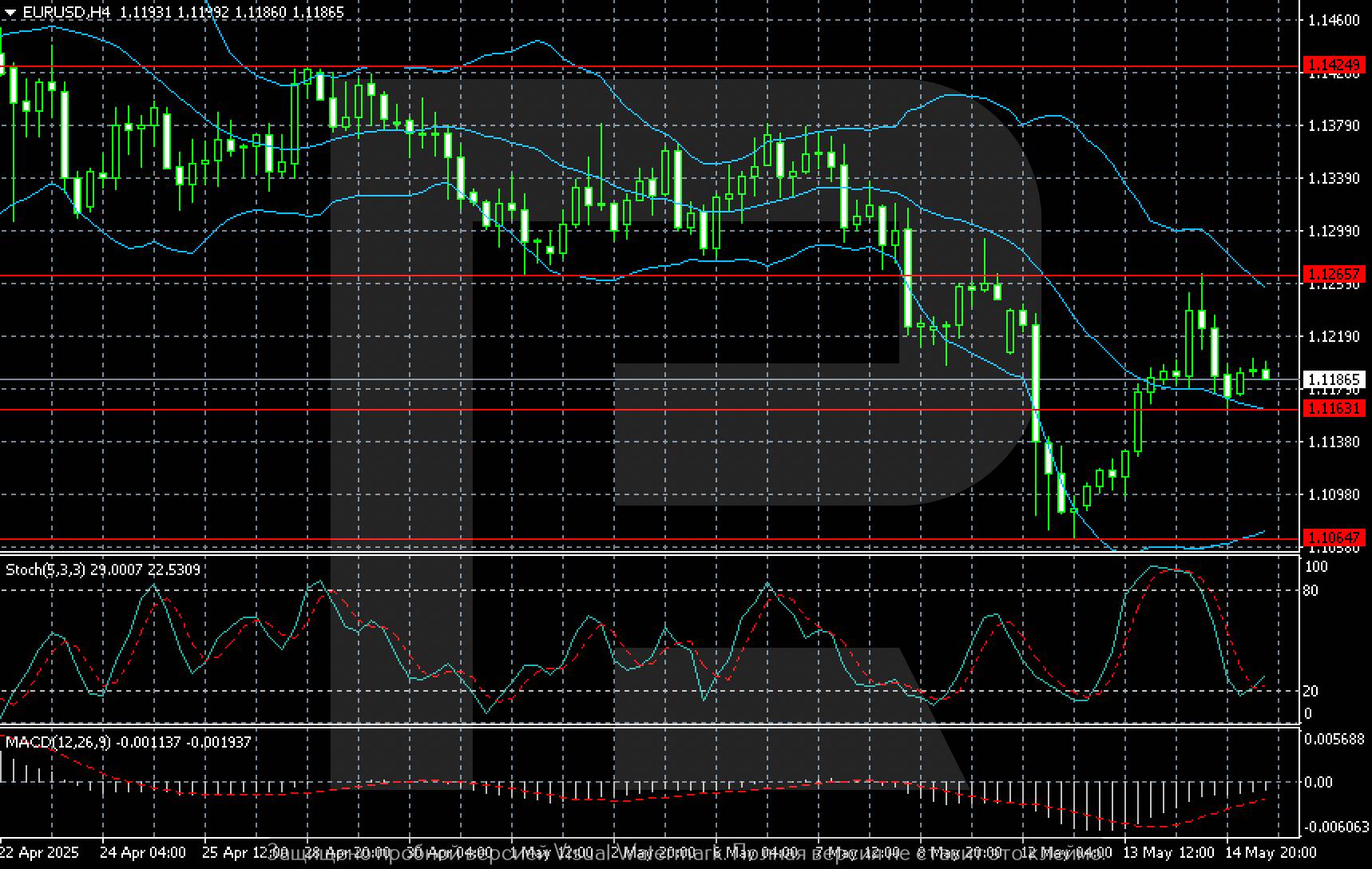
          The EURUSD pair enters another consolidation phase due to a mix of opposing factors. The market must weigh the White House’s intentions, US trade policy implications, and the upcoming data releases. The EURUSD outlook for today, 15 May 2025, anticipates a wave of selling towards 1.1163.

          The EURUSD pair remains stable around 1.1195. The market has a plethora of crucial statistics ahead. Find out more in our analysis for 15 May 2025.

          EURUSD forecast: key trading points

          ●The market believes the White House may be intentionally weakening the US dollar
          ●Focus shifts to a large batch of key data releases due tonight, including retail sales and industrial production
          ●EURUSD forecast for 15 May 2025: 1.1163

          Fundamental analysis

          The EURUSD pair is hovering around 1.1195 on Thursday. Trade uncertainty continues to pressure the market despite a recent easing in tensions.

          Investors actively debate whether Washington may be deliberately pursuing a weaker dollar as part of ongoing trade negotiations. The Trump administration previously argued that a strong dollar and weak regional currencies create unfavourable conditions for US exporters.

          The dollar’s recent strength, driven by optimism over tariff reductions in US-China talks, has started to fade. The market’s attention has now returned to the broader economic impact of Washington’s trade policy.

          Thursday brings a heavy load of crucial US dollar data, including retail sales, producer inflation figures, and the March industrial production report.

          The EURUSD forecast is moderately negative.

          Technical analysis

          On the H4 chart, the EURUSD pair has room for a local pullback towards 1.1163. If the market goes lower, the path to 1.1064 could open, although not immediately.

          On a larger timeframe, the main currency pair hovers in a sideways channel between 1.1163 and 1.1265.

          Source: RoboForex

          To stay updated on all economic events of today, please check out our Economic calendar
          Risk Warnings and Disclaimers
          You understand and acknowledge that there is a high degree of risk involved in trading. Following any strategies or investment methods may lead to potential losses. The content on the site is provided by our contributors and analysts for information purposes only. You are solely responsible for determining whether any trading assets, securities, strategy, or any other product is suitable for investing based on your own investment objectives and financial situation.
          Add to Favorites
          Share

          Japan’s Fiscal Stress Casts Long Shadow Over BOJ’s Bond Taper Strategy

          Gerik

          Economic

          Surging Long-Term Yields Challenge Policy Normalisation

          The Bank of Japan’s efforts to exit decades of ultra-loose monetary policy are facing a critical test. Despite having scrapped its yield curve control regime and ended negative interest rates in 2024, the BOJ now confronts market turmoil in the form of soaring super-long bond yields. The 40-year Japanese government bond (JGB) yield hit a record high of 3.44% this week, revealing intensifying market skepticism over Japan’s fiscal path and the durability of monetary tightening.
          This sharp divergence in yield movements—where short- and mid-term maturities remain stable while super-long rates rise—has exposed a potential vulnerability in the BOJ’s quantitative tightening framework. Analysts warn that, although the BOJ is unlikely to reverse course or ramp up bond purchases, the deterioration in bond market liquidity and mounting volatility may force a reassessment of tapering pace and bond maturity composition.

          Fiscal Policy and Election Pressures Erode Market Confidence

          Behind the spike in super-long yields lies a growing unease about Japan’s fiscal discipline. Ahead of the upper house election scheduled for July, lawmakers are pushing for expansive fiscal measures—including tax cuts and stimulus packages—that could further inflate Japan’s already massive public debt burden. With the BOJ stepping back from the bond market, investors are increasingly sensitive to the government’s fiscal trajectory.
          Life insurers, historically reliable buyers of long-dated JGBs, have begun scaling back their participation, further eroding market demand. This has led to liquidity strains and widened bid-ask spreads in the super-long end of the yield curve, increasing the likelihood of further market dysfunction. Strategists such as Katsutoshi Inadome of Sumitomo Mitsui Trust highlight how this retreat signals a structural shift, one that monetary policy alone may not be able to counterbalance.

          Cautious QT Review on the Horizon

          In light of the evolving dynamics, the BOJ will hold consultations with financial institutions next week to gather feedback on tapering preferences. These discussions will feed directly into the central bank’s review at its June 16–17 policy meeting. While the current taper framework—scaling back bond purchases by ¥400 billion per quarter to halve monthly buying to ¥3 trillion by March 2026—remains on track, future guidance beyond April 2026 is up for debate.
          Officials within the BOJ remain cautious. A board member noted that the recent rise in super-long yields must be considered when assessing liquidity across maturities. While the central bank aims to offer predictability and flexibility in its QT schedule, abrupt market shifts may force a more nuanced approach, especially if volatility in the super-long segment spills into the broader bond market.

          QT’s Limits in a Politically Driven Fiscal Environment

          Despite its autonomy, the BOJ cannot fully shield its tapering strategy from political realities. Prime Minister Shigeru Ishiba has so far resisted internal pressure to reduce the consumption tax rate, but he faces mounting demands from ruling party factions for new fiscal spending. Any such move would undermine efforts to stabilize long-term debt dynamics and could amplify bond market stress.
          Mari Iwashita, rates strategist at Nomura Securities, underscores that structural challenges—such as the BOJ’s reduced market presence, shrinking investor appetite for long-dated paper, and political overdependence on fiscal expansion—are not short-term frictions but long-term constraints. These headwinds, she argues, place clear limits on the effectiveness of the BOJ’s taper strategy and heighten the risk of credibility erosion.
          The BOJ's ongoing QT efforts face an inflection point. While the current pace of tapering remains intact, recent bond market instability highlights the limits of a rigid normalization plan in the face of fiscal excess and political uncertainty. Without credible fiscal consolidation and broader investor confidence, the central bank’s exit from stimulus risks being delayed, disrupted, or diluted. As the June policy review approaches, the BOJ must carefully balance its desire for policy normalization with the practical constraints of an increasingly fragile bond market.

          Source: Reuters

          To stay updated on all economic events of today, please check out our Economic calendar
          Risk Warnings and Disclaimers
          You understand and acknowledge that there is a high degree of risk involved in trading. Following any strategies or investment methods may lead to potential losses. The content on the site is provided by our contributors and analysts for information purposes only. You are solely responsible for determining whether any trading assets, securities, strategy, or any other product is suitable for investing based on your own investment objectives and financial situation.
          Add to Favorites
          Share

          Europe Inc Delivers Resilient Q1, But Trump’s Tariff Cloud Darkens Outlook

          Gerik

          Economic

          Resilient Q1 Masked by Growing Policy Uncertainty

          European corporates managed to post a fourth consecutive quarter of earnings growth in Q1 2025, with profits rising 1.9% year-on-year, according to LSEG I/B/E/S data. Excluding the energy sector, the picture was even stronger, with earnings up 7.3%. Approximately 60% of companies surpassed analyst forecasts—above the 54% average for typical quarters. However, the outlook beyond March has darkened significantly due to the reemergence of trade-related instability, mainly triggered by the Trump administration’s tariff strategy.
          Market participants and analysts now draw parallels between the current lack of visibility and the uncertainty experienced at the onset of the COVID-19 crisis in Q1 2020. The abrupt implementation of tariffs and subsequent truce has left companies unwilling to issue firm forward guidance, indicating a fragile confidence in forecasting for the rest of the year.

          Earnings Misses Face Harsh Market Reaction

          While earnings beats have met historical norms in terms of share price reactions, earnings misses have been penalized more severely than at any point in the past decade. Goldman Sachs reported that underperforming firms saw their shares drop an average of 2% post-announcement. Analysts believe this reflects the market’s suspicion that some Q1 results may have benefited from demand front-loading ahead of potential trade disruptions in Q2. As a result, even lowered expectations did not shield underperformers from selloffs.

          Euro Appreciation Compounds Exporter Struggles

          Trump’s tariff barrage has not only destabilized trade expectations but has also coincided with a sharp rally in the euro. Since its February low, the euro has gained approximately 10% against the U.S. dollar as capital fled dollar-denominated assets. Although the currency has slightly retreated following the U.S.-China tariff pause, it remains elevated, squeezing profit margins for eurozone exporters.
          For the STOXX 600 index—where roughly 60% of revenues are generated outside the eurozone—the strong euro presents a material challenge. Companies such as SAP, Munich Re, Bayer, Prysmian, Unilever, and L'Oréal have explicitly flagged currency headwinds in their outlooks. This dual exposure to tariffs and currency volatility creates a disproportionate drag on multinationals that rely on U.S. and global markets for growth.

          Banking Sector Emerges as a Bright Spot

          Unlike cyclicals and exporters, the banking sector has shown notable resilience. Nearly 90% of European banks beat earnings expectations in Q1, according to UBS estimates. Despite broader volatility, banks maintained 2025 forecasts and demonstrated stable net interest income performance, even as rate expectations moderate.
          The sector has also regained investor favor. A recent BofA fund manager survey shows that financials are now the most overweight sector in Europe, benefitting from attractive dividend payouts, improved capital buffers, and less sensitivity to trade frictions. Year-to-date, the sector has gained 28%, and forward valuations remain supportive compared to broader indices.

          Energy Sector Drags on Aggregate Performance

          In contrast to banking, the energy sector was a significant detractor. Earnings from energy companies are expected to fall by 28% compared to Q1 2024, reflecting weaker oil prices and shifting global demand dynamics. Oil dropped to a four-year low in April as concerns over global consumption deepened amid Trump’s tariff rollout, although prices have seen a partial recovery following the trade truce.
          Analysts note that reduced economic activity, combined with unexpectedly high OPEC output, has pressured margins and reduced earnings visibility for energy giants. With global demand outlooks tied closely to geopolitical developments, volatility in the sector is expected to persist.
          Europe Inc’s robust Q1 performance offers reassurance that the region’s corporate sector can still deliver results in volatile conditions. However, the optimism is tempered by deteriorating forward visibility, a rising euro, and geopolitical unpredictability. The reintroduction of tariff diplomacy, combined with asymmetric sectoral impacts, has fragmented the earnings landscape. Investors and companies alike are now navigating without clear forward signals, and with elevated risk premiums on trade-sensitive industries, the remainder of 2025 is poised to test Europe’s economic resilience.

          Source: Reuters

          To stay updated on all economic events of today, please check out our Economic calendar
          Risk Warnings and Disclaimers
          You understand and acknowledge that there is a high degree of risk involved in trading. Following any strategies or investment methods may lead to potential losses. The content on the site is provided by our contributors and analysts for information purposes only. You are solely responsible for determining whether any trading assets, securities, strategy, or any other product is suitable for investing based on your own investment objectives and financial situation.
          Add to Favorites
          Share
          FastBull
          Copyright © 2025 FastBull Ltd

          728 RM B 7/F GEE LOK IND BLDG NO 34 HUNG TO RD KWUN TONG KLN HONG KONG

          TelegramInstagramTwitterfacebooklinkedin
          App Store Google Play Google Play
          Products
          Charts

          Chats

          Q&A with Experts
          Screeners
          Economic Calendar
          Data
          Tools
          Membership
          Features
          Function
          Markets
          Copy Trading
          Latest Signals
          Contests
          News
          Analysis
          24/7
          Columns
          Education
          Company
          Careers
          About Us
          Contact Us
          Advertising
          Help Center
          Feedback
          User Agreement
          Privacy Policy
          Business

          White Label

          Data API

          Web Plug-ins

          Poster Maker

          Affiliate Program

          Risk Disclosure

          The risk of loss in trading financial instruments such as stocks, FX, commodities, futures, bonds, ETFs and crypto can be substantial. You may sustain a total loss of the funds that you deposit with your broker. Therefore, you should carefully consider whether such trading is suitable for you in light of your circumstances and financial resources.

          No decision to invest should be made without thoroughly conducting due diligence by yourself or consulting with your financial advisors. Our web content might not suit you since we don't know your financial conditions and investment needs. Our financial information might have latency or contain inaccuracy, so you should be fully responsible for any of your trading and investment decisions. The company will not be responsible for your capital loss.

          Without getting permission from the website, you are not allowed to copy the website's graphics, texts, or trademarks. Intellectual property rights in the content or data incorporated into this website belong to its providers and exchange merchants.

          Not Logged In

          Log in to access more features

          FastBull Membership

          Not yet

          Purchase

          Become a signal provider
          Help Center
          Customer Service
          Dark Mode
          Price Up/Down Colors

          Log In

          Sign Up

          Position
          Layout
          Fullscreen
          Default to Chart
          The chart page opens by default when you visit fastbull.com