Markets
News
Analysis
User
24/7
Economic Calendar
Education
Data
- Names
- Latest
- Prev


Signal Accounts for Members
All Signal Accounts
All Contests


Japan Tankan Small Manufacturing Outlook Index (Q4)A:--
F: --
P: --
Japan Tankan Large Non-Manufacturing Outlook Index (Q4)A:--
F: --
P: --
Japan Tankan Large Manufacturing Outlook Index (Q4)A:--
F: --
P: --
Japan Tankan Small Manufacturing Diffusion Index (Q4)A:--
F: --
P: --
Japan Tankan Large-Enterprise Capital Expenditure YoY (Q4)A:--
F: --
P: --
U.K. Rightmove House Price Index YoY (Dec)A:--
F: --
P: --
China, Mainland Industrial Output YoY (YTD) (Nov)A:--
F: --
P: --
China, Mainland Urban Area Unemployment Rate (Nov)A:--
F: --
P: --
Saudi Arabia CPI YoY (Nov)A:--
F: --
P: --
Euro Zone Industrial Output YoY (Oct)A:--
F: --
P: --
Euro Zone Industrial Output MoM (Oct)A:--
F: --
P: --
Canada Existing Home Sales MoM (Nov)A:--
F: --
P: --
Canada National Economic Confidence IndexA:--
F: --
P: --
Canada New Housing Starts (Nov)A:--
F: --
U.S. NY Fed Manufacturing Employment Index (Dec)A:--
F: --
P: --
U.S. NY Fed Manufacturing Index (Dec)A:--
F: --
P: --
Canada Core CPI YoY (Nov)A:--
F: --
P: --
Canada Manufacturing Unfilled Orders MoM (Oct)A:--
F: --
P: --
U.S. NY Fed Manufacturing Prices Received Index (Dec)A:--
F: --
P: --
U.S. NY Fed Manufacturing New Orders Index (Dec)A:--
F: --
P: --
Canada Manufacturing New Orders MoM (Oct)A:--
F: --
P: --
Canada Core CPI MoM (Nov)A:--
F: --
P: --
Canada Trimmed CPI YoY (SA) (Nov)A:--
F: --
P: --
Canada Manufacturing Inventory MoM (Oct)A:--
F: --
P: --
Canada CPI YoY (Nov)A:--
F: --
P: --
Canada CPI MoM (Nov)A:--
F: --
P: --
Canada CPI YoY (SA) (Nov)A:--
F: --
P: --
Canada Core CPI MoM (SA) (Nov)A:--
F: --
P: --
Canada CPI MoM (SA) (Nov)A:--
F: --
P: --
Federal Reserve Board Governor Milan delivered a speech
U.S. NAHB Housing Market Index (Dec)A:--
F: --
P: --
Australia Composite PMI Prelim (Dec)--
F: --
P: --
Australia Services PMI Prelim (Dec)--
F: --
P: --
Australia Manufacturing PMI Prelim (Dec)--
F: --
P: --
Japan Manufacturing PMI Prelim (SA) (Dec)--
F: --
P: --
U.K. 3-Month ILO Employment Change (Oct)--
F: --
P: --
U.K. Unemployment Claimant Count (Nov)--
F: --
P: --
U.K. Unemployment Rate (Nov)--
F: --
P: --
U.K. 3-Month ILO Unemployment Rate (Oct)--
F: --
P: --
U.K. Average Weekly Earnings (3-Month Average, Including Bonuses) YoY (Oct)--
F: --
P: --
U.K. Average Weekly Earnings (3-Month Average, Excluding Bonuses) YoY (Oct)--
F: --
P: --
France Services PMI Prelim (Dec)--
F: --
P: --
France Composite PMI Prelim (SA) (Dec)--
F: --
P: --
France Manufacturing PMI Prelim (Dec)--
F: --
P: --
Germany Services PMI Prelim (SA) (Dec)--
F: --
P: --
Germany Manufacturing PMI Prelim (SA) (Dec)--
F: --
P: --
Germany Composite PMI Prelim (SA) (Dec)--
F: --
P: --
Euro Zone Composite PMI Prelim (SA) (Dec)--
F: --
P: --
Euro Zone Services PMI Prelim (SA) (Dec)--
F: --
P: --
Euro Zone Manufacturing PMI Prelim (SA) (Dec)--
F: --
P: --
U.K. Services PMI Prelim (Dec)--
F: --
P: --
U.K. Manufacturing PMI Prelim (Dec)--
F: --
P: --
U.K. Composite PMI Prelim (Dec)--
F: --
P: --
Euro Zone ZEW Economic Sentiment Index (Dec)--
F: --
P: --
Germany ZEW Current Conditions Index (Dec)--
F: --
P: --
Germany ZEW Economic Sentiment Index (Dec)--
F: --
P: --
Euro Zone Trade Balance (Not SA) (Oct)--
F: --
P: --
Euro Zone ZEW Current Conditions Index (Dec)--
F: --
P: --
Euro Zone Trade Balance (SA) (Oct)--
F: --
P: --
Euro Zone Total Reserve Assets (Nov)--
F: --
P: --
U.K. Inflation Rate Expectations--
F: --
P: --


No matching data
Latest Views
Latest Views
Trending Topics
Top Columnists
Latest Update
White Label
Data API
Web Plug-ins
Affiliate Program
View All

No data
Forecasts show underlying inflation within Reserve Bank’s 2%-3% target range six months earlier than expected in prediction that will add to calls for another interest rate cut


The Bitcoin price has fallen below $80,000, pulling the wider crypto market down along with it. Roughly $1 trillion has vanished from the market in just one month. Concerns about inflation and uncertainty around the Federal Reserve’s next move have made investors hesitant. This isn’t just Bitcoin’s struggle—other major cryptocurrencies are also under strain. Aptos crypto, for example, is testing its key $5.1 support level, which has previously served as a safety net.
While some digital assets are losing ground, others are preparing for what could be significant changes. BlockDAG (BDAG) is one of those projects. Over the next 100 days, several major developments could reshape its position in the market. A final beta testnet launch, an important keynote event, and anticipated exchange listings are on the schedule—each sparking talk that BDAG could reach $1 soon. With a 2,380% increase so far, BlockDAG is gaining attention as one of the best long term crypto options today.
The Bitcoin price has dipped below $80,000, contributing to a larger sell-off that has erased $1 trillion from the crypto space over the past month. This decline has been fueled by persistent inflation worries. BlackRock’s CEO Larry Fink has warned that rising trade disputes could push costs higher, making things more complicated for the Federal Reserve’s approach to monetary policy.
Although February’s inflation numbers hinted at some relief, many analysts believe tariffs and unstable markets could keep inflation elevated for longer. Investors are holding back, waiting for clear direction from either the Fed or the White House. Stock markets have shown some signs of recovery, but the Bitcoin price—and crypto markets in general—haven’t yet regained meaningful momentum.
Aptos crypto is currently challenging its long-standing support level of $5.1, a price that has previously held up during past declines, including back in February. Despite noticeable accumulation over the past six weeks, Aptos has not been able to build upward momentum.
Meanwhile, negative funding rates have risen again, reaching levels similar to those seen a month ago. This suggests a large number of traders still anticipate more downside.
Even so, the Aptos crypto network itself remains steady. Its total value locked (TVL) and stablecoin market cap are hovering near their highest recorded levels. Demand remains muted, but many traders are closely watching for potential signs of a recovery—or an indication that the downtrend will continue.
Crypto projects often experience pivotal cycles, and BlockDAG appears to be entering one now. The project has already raised $206 million through its presale, distributing 18.8 billion BDAG coins and gaining 2,380% since its initial batch. What’s coming next, however, has the community paying close attention.
On March 28, BlockDAG’s final beta testnet is set to launch. This event marks the last significant technical milestone before a full system rollout. In the crypto world, testnets are often a signal that a project is nearing operational readiness, and this could be BlockDAG’s turning point.
Adding to the anticipation, Keynote 3 is scheduled for the same day. Speculation is growing that the event may announce the long-awaited mainnet launch date, new exchange listings, or even institutional partnerships. Many in the crypto space believe that BlockDAG is becoming one of the best long term crypto projects to watch.
Meanwhile, demand for BDAG is surging. Batch 27 is currently priced at $0.0248, and each subsequent batch pushes the price higher. Some analysts are predicting BDAG could reach $1 after these upcoming milestones are achieved, a dramatic leap from its early presale price.
If exchange listings go live and interest continues to grow, the gap between the current price and the $1 target may close much faster than anyone expects. The next 100 days are likely to determine whether BlockDAG’s early supporters are rewarded or whether others will have missed the opportunity.
The Bitcoin price remains unpredictable as inflation fears and the Federal Reserve’s pending decisions weigh on market sentiment. For now, crypto markets seem locked in a cautious holding pattern, with Bitcoin waiting for its next catalyst.
Aptos crypto also finds itself at a critical juncture. Its $5.1 support is holding, but weak demand and negative funding rates are raising concerns. A recovery is possible if momentum returns, but traders remain divided.
BlockDAG, on the other hand, is moving toward what could be a defining phase. The final testnet, an important keynote, and potential exchange listings are all drawing interest. With supply decreasing and several major events ahead, many see BDAG as the best long term crypto play on the table right now.
Financial markets entered Tuesday on a subdued note, with the Asian session notably quiet. While US stocks managed a rebound overnight on speculation that the April 2 “Liberation Day” tariff rollout might be narrower in scope than initially feared, sentiment failed to fully carry into Asia. Equity indices across the region were mixed, reflecting ongoing investor caution. In the currency markets, major pairs remained trapped within yesterday’s ranges, signaling a broader wait-and-see mode among traders.
Yen is seeing some mild recovery after Monday’s selloff, partially supported by signals from BoJ’s latest January meeting minutes. The central bank reaffirmed its readiness to tighten policy further. Still, external developments—particularly the uncertainty over global trade and US tariffs—are making the policy path less clear, forcing BoJ to move with greater caution in coming months.
Looking ahead to the European session, Germany’s Ifo Business Climate data will be watched. Still, most of the optimism linked to Germany’s fiscal expansion appears to be already priced in. Unless there’s a sharp upside surprise, the report may not trigger much market movement.
Later in the day, US Consumer Confidence figures are in focus. Expectations are for a continued decline, reflecting growing concerns over the economic fallout from reciprocal tariffs. Yet, this deterioration in sentiment has become a familiar theme, and its market impact may also be muted unless the drop is significantly worse than expected.
What investors truly crave are concrete details surrounding Trump’s tariff due next week. Until then, markets are likely to remain rangebound and headline-driven. With such a pivotal policy move on the horizon, traders are understandably reluctant to take strong directional bets. That has kept volatility suppressed for now, even as the risk environment remains fragile underneath the surface.
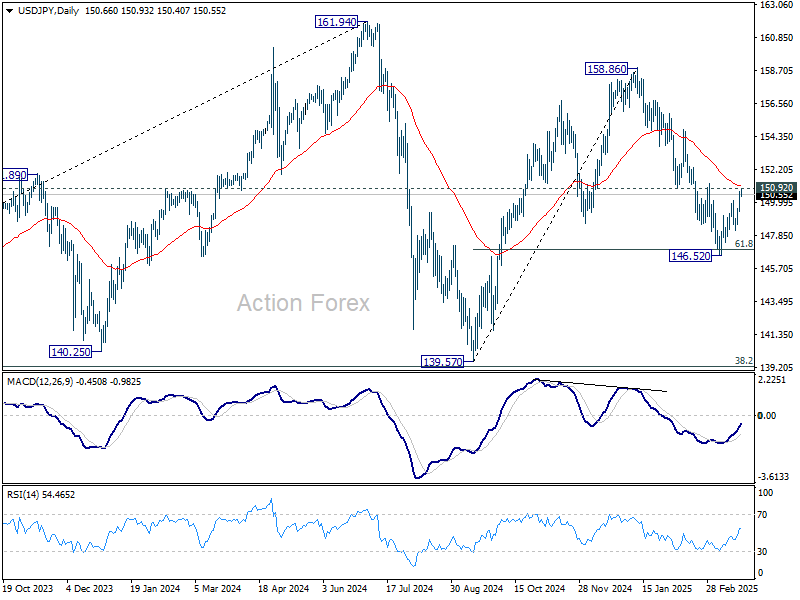
Technically, a major focus now is USD/JPY, which has extended the rebound from 146.52 short term bottom this week. Strong resistance is expected from 150.92 support turned resistance, and 55 D EMA (now at 151.08) to limit upside. However, firm break of this zone will argue the fall from 158.86 has completed, and turn near term outlook bullish for stronger rebound. The next move in USD/JPY would determine the overall tone of Yen in the markets.
In Asia, at the time of writing, Nikkei is up 0.56%. Hong Kong HSI is down -1.99%. China Shanghai SSE is down -0.05%. Singapore Strait Times is up 1.11%. Japan 10-year JGB yield is up 0.028 at 1.574. Overnight, DOW rose 1.42%. S&P 500 rose 1.76%. NASDAQ rose 2.27%. 10-year yield rose 0.079 to 4.331.
Minutes from BoJ’s January 23–24 meeting revealed a growing consensus among policymakers that further tightening would be appropriate, provided the current economic and price outlooks hold.
While the central bank raised policy rate to 0.5%, members acknowledged that real interest rates remained “significantly negative”, ensuring “accommodative financial conditions would be maintained.”
However, the path ahead is clouded by global uncertainty. While BoJ held rates steady at its latest meeting last week, it flagged increasing risks from escalating US tariffs.
Nevertheless, Governor Kazuo Ueda emphasized that stronger-than-expected wage growth and persistent food price inflation could keep upward pressure on underlying prices, indicating that the case for another rate hike remains very much alive.
Atlanta Fed President Raphael Bostic said in a Bloomberg interview that he’s now projecting just one cut by year-end, down from his earlier expectation of two.
Bostic explained the shift was due to his view that inflation will be “very bumpy and not move dramatically and in a clear way to the 2% target”. With inflation unlikely to return to target until 2027, he believes the path to neutral must also be delayed.
Bostic also expressed concern about the inflationary impact of rising tariffs. While such measures are often assumed to cause a one-off increase in prices, Bostic suggested the current environment could be different.
In his view, businesses and consumers may have grown more tolerant of elevated inflation following the pandemic, making price hikes more likely to stick. He noted that many business leaders now feel confident about “a complete pass-through” of higher costs on to customers without fear of losing market share.
BoE Governor Andrew Bailey urged greater international cooperation to resolve growing strains in the global trading system. In a speech overnight, he pointed to the disruptions caused by US President Donald Trump’s trade policies, emphasizing that resolving these challenges requires “multilateral setting rather than set tariffs bilaterally”.
In a more optimistic tone, Bailey also pointed to artificial intelligence as a transformative force for the UK and global economy. Comparing AI to electricity in the early 20th century, he said the technology could meaningfully raise growth and per capita income over time. He called for policy support to facilitate AI’s development as the “most likely general purpose technology,” capable of driving broad-based economic gains in the years ahead.
In remarks delivered overnight, Spanish ECB Governing Council member Jose Luis Escriva highlighted that “growth risks are more downside than upside.” While he acknowledged that supportive fiscal policy could offer some near-term uplift, he stressed that the broader risks — particularly to the downside — are dominating the economic outlook.
Escriva painted a grim picture of the current global backdrop, describing it as “extremely uncertain.” He noted that today’s uncertainty global index levels are at their highest since records began — exceeding those during the Covid-19 pandemic, the war in Ukraine, the 9/11 attacks, and even the peak of the Great Financial Crisis.
Despite the fact that worst-case, disruptive scenarios have yet to materialize, Escriva emphasized that ECB must be “readier than ever” to revise its forecasts and relevant action should conditions change”.
German Ifo business climate ins the main focus in European session. Later in the day, US will release consumer confidence, house prices and new home sales.
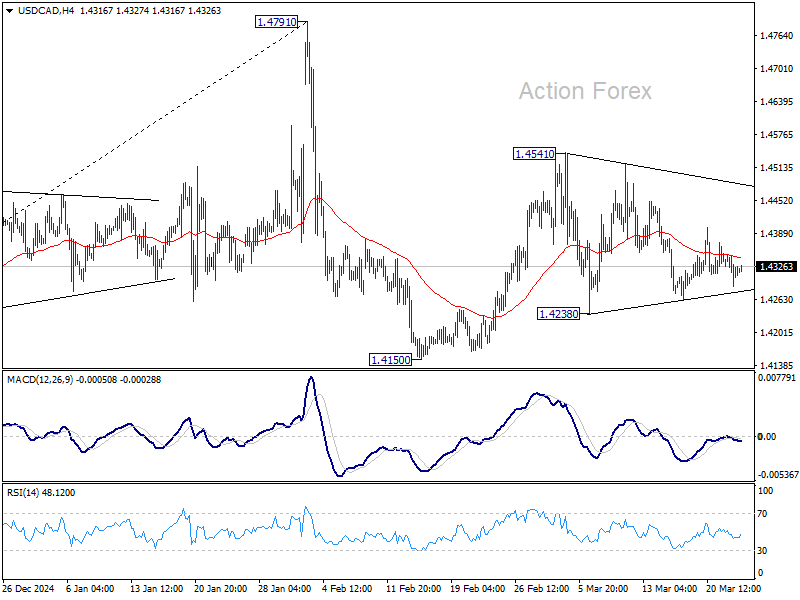
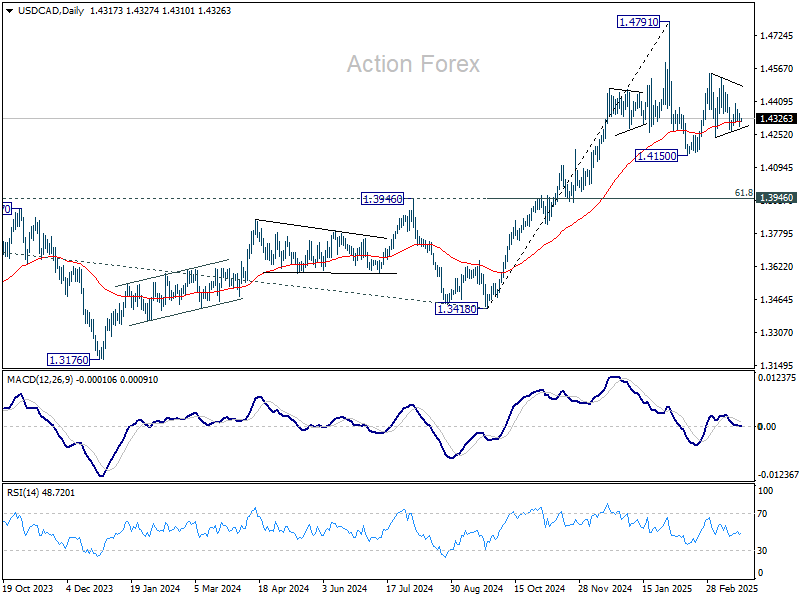
Range trading continues in USD/CAD and intraday bias remains neutral for now. Overall, price actions from 1.4791 are seen as a corrective pattern. On the upside, break of 1.4541 will extend the second leg from 1.4150 to retest 1.4791 high. On the downside, break of 1.4238 will argue that the third leg has already started through 1.4150 support.
In the bigger picture, long term up trend is tentatively seen as resuming with prior breach of 1.4667/89 key resistance zone (2020/2015 highs). Next target is 100% projection of 1.2401 to 1.3976 from 1.3418 at 1.4993. This will remain the favored case as long as 1.3976 resistance turned support holds (2022 high), even in case of deep pullback.
White Label
Data API
Web Plug-ins
Poster Maker
Affiliate Program
The risk of loss in trading financial instruments such as stocks, FX, commodities, futures, bonds, ETFs and crypto can be substantial. You may sustain a total loss of the funds that you deposit with your broker. Therefore, you should carefully consider whether such trading is suitable for you in light of your circumstances and financial resources.
No decision to invest should be made without thoroughly conducting due diligence by yourself or consulting with your financial advisors. Our web content might not suit you since we don't know your financial conditions and investment needs. Our financial information might have latency or contain inaccuracy, so you should be fully responsible for any of your trading and investment decisions. The company will not be responsible for your capital loss.
Without getting permission from the website, you are not allowed to copy the website's graphics, texts, or trademarks. Intellectual property rights in the content or data incorporated into this website belong to its providers and exchange merchants.
Not Logged In
Log in to access more features

FastBull Membership
Not yet
Purchase
Log In
Sign Up