• Trade
  • Markets
  • Copy
  • Contests
  • News
  • 24/7
  • Calendar
  • Q&A
  • Chats
Trending
Screeners
SYMBOL
LAST
BID
ASK
HIGH
LOW
NET CHG.
%CHG.
SPREAD
SPX
S&P 500 Index
6857.13
6857.13
6857.13
6865.94
6827.13
+7.41
+ 0.11%
--
DJI
Dow Jones Industrial Average
47850.93
47850.93
47850.93
48049.72
47692.96
-31.96
-0.07%
--
IXIC
NASDAQ Composite Index
23505.13
23505.13
23505.13
23528.53
23372.33
+51.04
+ 0.22%
--
USDX
US Dollar Index
98.830
98.910
98.830
98.980
98.810
-0.150
-0.15%
--
EURUSD
Euro / US Dollar
1.16590
1.16598
1.16590
1.16613
1.16408
+0.00145
+ 0.12%
--
GBPUSD
Pound Sterling / US Dollar
1.33485
1.33495
1.33485
1.33519
1.33165
+0.00214
+ 0.16%
--
XAUUSD
Gold / US Dollar
4225.21
4225.62
4225.21
4229.22
4194.54
+18.04
+ 0.43%
--
WTI
Light Sweet Crude Oil
59.303
59.340
59.303
59.469
59.187
-0.080
-0.13%
--

Community Accounts

Signal Accounts
--
Profit Accounts
--
Loss Accounts
--
View More

Become a signal provider

Sell trading signals to earn additional income

View More

Guide to Copy Trading

Get started with ease and confidence

View More

Signal Accounts for Members

All Signal Accounts

Best Return
  • Best Return
  • Best P/L
  • Best MDD
Past 1W
  • Past 1W
  • Past 1M
  • Past 1Y

All Contests

  • All
  • Trump Updates
  • Recommend
  • Stocks
  • Cryptocurrencies
  • Central Banks
  • Featured News
Top News Only
Share

Russian President Putin: India Is Not Neutral, India Is On The Side Of Peace

Share

Russian President Putin: We Support Every Effort Towards Peace

Share

Russian President Putin: The World Should Return To Peace

Share

India Prime Minister Modi: We Should All Pursue Peace Together

Share

Ukmto Says A Vessel Reports Sighting Small Craft At A Range Of 1-2 Cables And They Are Under Fire

Share

Ukmto Says It Received Reports Of An Incident 15 Nm West Of Yemen

Share

Dollar/Yen Falls To 154.46, Lowest Since November 17

Share

Citigroup Sets 2026 STOXX 600 Target At 640 On Fiscal Tailwinds

Share

Reserve Bank Of India Chief Malhotra On Rupee: Fluctuations Can Happen, Effort Is To Reduce Undue Volatility

Share

Reserve Bank Of India Chief Malhotra On Rupee: Allow Markets To Determine Levels On Currency

Share

Sri Lanka's CSE All Share Index Down 1.2%

Share

Iw Institute: German Economy Faces Tepid Growth In 2026 Due To Global Trade Slowdown

Share

Stats Office - Seychelles November Inflation At 0.02% Year-On-Year

Share

[Market Update] Spot Silver Prices Rose 2.00% Intraday, Currently Trading At $58.27 Per Ounce

Share

S.Africa's Gross Reserves At $72.068 Billion At End November - Central Bank

Share

[Market Update] Spot Silver Broke Through $58/ounce, Up 1.56% On The Day

Share

Dollar/Yen Down 0.33% To 154.61

Share

Kremlin Says No Plans For Putin-Trump Call For Now

Share

Kremlin Says Moscow Is Waiting For USA Reaction After Putin-Witkoff Meeting

Share

Cctv - China, France: Say Both Sides Support All Efforts For A Ceasefire, Restore Peace According To Intl Law

TIME
ACT
FCST
PREV
Turkey Trade Balance

A:--

F: --

P: --

Germany Construction PMI (SA) (Nov)

A:--

F: --

P: --

Euro Zone IHS Markit Construction PMI (Nov)

A:--

F: --

P: --

Italy IHS Markit Construction PMI (Nov)

A:--

F: --

P: --

U.K. Markit/CIPS Construction PMI (Nov)

A:--

F: --

P: --

France 10-Year OAT Auction Avg. Yield

A:--

F: --

P: --

Euro Zone Retail Sales MoM (Oct)

A:--

F: --

P: --

Euro Zone Retail Sales YoY (Oct)

A:--

F: --

P: --

Brazil GDP YoY (Q3)

A:--

F: --

P: --

U.S. Challenger Job Cuts (Nov)

A:--

F: --

P: --

U.S. Challenger Job Cuts MoM (Nov)

A:--

F: --

P: --

U.S. Challenger Job Cuts YoY (Nov)

A:--

F: --

P: --

U.S. Initial Jobless Claims 4-Week Avg. (SA)

A:--

F: --

P: --

U.S. Weekly Initial Jobless Claims (SA)

A:--

F: --

P: --

U.S. Weekly Continued Jobless Claims (SA)

A:--

F: --

P: --

Canada Ivey PMI (SA) (Nov)

A:--

F: --

P: --

Canada Ivey PMI (Not SA) (Nov)

A:--

F: --

P: --

U.S. Non-Defense Capital Durable Goods Orders Revised MoM (Excl. Aircraft) (SA) (Sept)

A:--

F: --

P: --
U.S. Factory Orders MoM (Excl. Transport) (Sept)

A:--

F: --

P: --

U.S. Factory Orders MoM (Sept)

A:--

F: --

P: --

U.S. Factory Orders MoM (Excl. Defense) (Sept)

A:--

F: --

P: --

U.S. EIA Weekly Natural Gas Stocks Change

A:--

F: --

P: --

Saudi Arabia Crude Oil Production

A:--

F: --

P: --

U.S. Weekly Treasuries Held by Foreign Central Banks

A:--

F: --

P: --

Japan Foreign Exchange Reserves (Nov)

A:--

F: --

P: --

India Repo Rate

A:--

F: --

P: --

India Benchmark Interest Rate

A:--

F: --

P: --

India Reverse Repo Rate

A:--

F: --

P: --

India Cash Reserve Ratio

A:--

F: --

P: --

Japan Leading Indicators Prelim (Oct)

A:--

F: --

P: --

U.K. Halifax House Price Index YoY (SA) (Nov)

--

F: --

P: --

U.K. Halifax House Price Index MoM (SA) (Nov)

--

F: --

P: --

France Current Account (Not SA) (Oct)

--

F: --

P: --

France Trade Balance (SA) (Oct)

--

F: --

P: --

France Industrial Output MoM (SA) (Oct)

--

F: --

P: --

Italy Retail Sales MoM (SA) (Oct)

--

F: --

P: --

Euro Zone Employment YoY (SA) (Q3)

--

F: --

P: --

Euro Zone GDP Final YoY (Q3)

--

F: --

P: --

Euro Zone GDP Final QoQ (Q3)

--

F: --

P: --

Euro Zone Employment Final QoQ (SA) (Q3)

--

F: --

P: --

Euro Zone Employment Final (SA) (Q3)

--

F: --

P: --
Brazil PPI MoM (Oct)

--

F: --

P: --

Mexico Consumer Confidence Index (Nov)

--

F: --

P: --

Canada Unemployment Rate (SA) (Nov)

--

F: --

P: --

Canada Labor Force Participation Rate (SA) (Nov)

--

F: --

P: --

Canada Employment (SA) (Nov)

--

F: --

P: --

Canada Part-Time Employment (SA) (Nov)

--

F: --

P: --

Canada Full-time Employment (SA) (Nov)

--

F: --

P: --

U.S. Dallas Fed PCE Price Index YoY (Sept)

--

F: --

P: --

U.S. PCE Price Index YoY (SA) (Sept)

--

F: --

P: --

U.S. PCE Price Index MoM (Sept)

--

F: --

P: --

U.S. Personal Outlays MoM (SA) (Sept)

--

F: --

P: --

U.S. Core PCE Price Index MoM (Sept)

--

F: --

P: --

U.S. UMich 5-Year-Ahead Inflation Expectations Prelim YoY (Dec)

--

F: --

P: --

U.S. Core PCE Price Index YoY (Sept)

--

F: --

P: --

U.S. 5-10 Year-Ahead Inflation Expectations (Dec)

--

F: --

P: --

U.S. UMich Current Economic Conditions Index Prelim (Dec)

--

F: --

P: --

U.S. UMich Consumer Sentiment Index Prelim (Dec)

--

F: --

P: --

U.S. UMich 1-Year-Ahead Inflation Expectations Prelim (Dec)

--

F: --

P: --

U.S. UMich Consumer Expectations Index Prelim (Dec)

--

F: --

P: --

Q&A with Experts
    • All
    • Chatrooms
    • Groups
    • Friends
    Connecting
    .
    .
    .
    Type here...
    Add Symbol or Code

      No matching data

      All
      Trump Updates
      Recommend
      Stocks
      Cryptocurrencies
      Central Banks
      Featured News
      • All
      • Russia-Ukraine Conflict
      • Middle East Flashpoint
      • All
      • Russia-Ukraine Conflict
      • Middle East Flashpoint
      Search
      Products

      Charts Free Forever

      Chats Q&A with Experts
      Screeners Economic Calendar Data Tools
      Membership Features
      Data Warehouse Market Trends Institutional Data Policy Rates Macro

      Market Trends

      Market Sentiment Order Book Forex Correlations

      Top Indicators

      Charts Free Forever
      Markets

      News

      News Analysis 24/7 Columns Education
      From Institutions From Analysts
      Topics Columnists

      Latest Views

      Latest Views

      Trending Topics

      Top Columnists

      Latest Update

      Signals

      Copy Rankings Latest Signals Become a signal provider AI Rating
      Contests
      Brokers

      Overview Brokers Assessment Rankings Regulators News Claims
      Broker listing Forex Brokers Comparison Tool Live Spread Comparison Scam
      Q&A Complaint Scam Alert Videos Tips to Detect Scam
      More

      Business
      Events
      Careers About Us Advertising Help Center

      White Label

      Data API

      Web Plug-ins

      Affiliate Program

      Awards Institution Evaluation IB Seminar Salon Event Exhibition
      Vietnam Thailand Singapore Dubai
      Fans Party Investment Sharing Session
      FastBull Summit BrokersView Expo
      Recent Searches
        Top Searches
          Markets
          News
          Analysis
          User
          24/7
          Economic Calendar
          Education
          Data
          • Names
          • Latest
          • Prev

          View All

          No data

          Scan to Download

          Faster Charts, Chat Faster!

          Download App
          English
          • English
          • Español
          • العربية
          • Bahasa Indonesia
          • Bahasa Melayu
          • Tiếng Việt
          • ภาษาไทย
          • Français
          • Italiano
          • Türkçe
          • Русский язык
          • 简中
          • 繁中
          Open Account
          Search
          Products
          Charts Free Forever
          Markets
          News
          Signals

          Copy Rankings Latest Signals Become a signal provider AI Rating
          Contests
          Brokers

          Overview Brokers Assessment Rankings Regulators News Claims
          Broker listing Forex Brokers Comparison Tool Live Spread Comparison Scam
          Q&A Complaint Scam Alert Videos Tips to Detect Scam
          More

          Business
          Events
          Careers About Us Advertising Help Center

          White Label

          Data API

          Web Plug-ins

          Affiliate Program

          Awards Institution Evaluation IB Seminar Salon Event Exhibition
          Vietnam Thailand Singapore Dubai
          Fans Party Investment Sharing Session
          FastBull Summit BrokersView Expo

          Brent Under Pressure: End of Summer Season Weighs on Fuel Demand

          Dark Current

          Commodity

          Summary:

          The oil market remains under pressure, with Brent quotes edging lower amid expectations of weaker demand and geopolitical factors, currently standing at 66.76 USD. 

          The oil market remains under pressure, with Brent quotes edging lower amid expectations of weaker demand and geopolitical factors, currently standing at 66.76 USD.

          Brent forecast: key trading points

          • Investors expect fuel demand in the US to decline with the end of the summer season
          • Analysts believe oil consumption has already peaked
          • US crude oil inventories fell by 2.39 million barrels to 418.3 million
          • Brent forecast for 28 August 2025: 63.90

          Fundamental analysis

          Brent prices are falling after rebounding from the key resistance level at 68.50 USD. Investors factor in the anticipated drop in US fuel demand as the summer season ends, while also assessing potential supply shifts amid US high tariffs on India. Analysts note that consumption has peaked, projecting a gradual demand slowdown. According to the Brent price forecast, such expectations point to growing bearish sentiment in the market.

          US commercial crude inventories dropped by 2.39 million barrels last week to 418.3 million, according to the Energy Department’s weekly report. Analysts had forecast a decline of 2 million barrels.

          Traders are also watching India’s stance in response to US pressure aimed at curbing Russian oil imports after the tariff hikes. However, analysts expect India to continue to buy in the near term, limiting this factor’s impact on the global market.

          Brent technical analysis

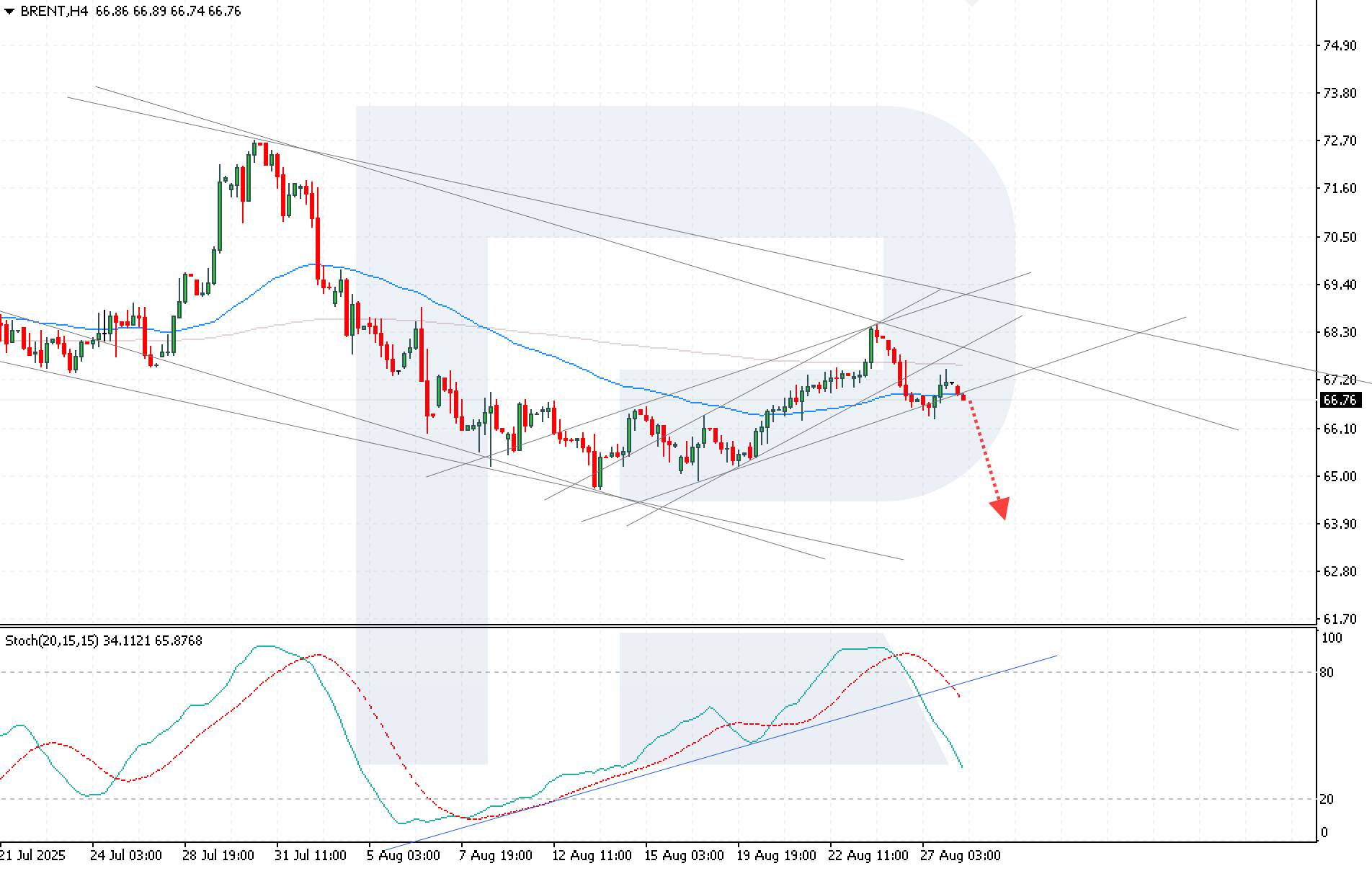
          Brent quotes are retreating after rebounding from the 68.50 resistance level, remaining within a descending channel. The current dynamics suggest a strong likelihood of a bearish impulse towards 63.90 USD.

          Today’s Brent outlook points to further downside after breaking below the short-term support level at 66.00 USD and consolidating below the EMA-65. The Stochastic Oscillator gives a bearish signal: its lines have turned downwards, confirming the probability of continued decline.

          Another factor adding to pressure is the potential breakout below the lower boundary of the corrective channel, which would reinforce the bearish trend.

          Summary

          Brent quotes continue to face pressure, with expectations of declining US demand and uncertainty over India’s oil imports increasing the risk of bearish dynamics. Today’s Brent analysis signals that the downward impulse remains intact with a target at 63.90 USD.

          Source: RoboForex

          Risk Warnings and Disclaimers
          You understand and acknowledge that there is a high degree of risk involved in trading. Following any strategies or investment methods may lead to potential losses. The content on the site is provided by our contributors and analysts for information purposes only. You are solely responsible for determining whether any trading assets, securities, strategy, or any other product is suitable for investing based on your own investment objectives and financial situation.
          Add to Favorites
          Share

          ECB’s Rehn Warns Trump’s Fed Pressure Poses Global Economic Risk

          Gerik

          Economic

          Eroding Fed Independence

          Rehn highlighted that Fed independence considered sacrosanct since the 1980s is now “wobbling badly” under Trump’s pressure campaign. Trump has openly criticized Chair Jerome Powell for keeping rates steady and recently announced his intention to fire Fed Governor Lisa Cook, moves that could unsettle markets and trigger a legal showdown.
          The concern is not merely political optics; a loss of confidence in the Fed’s autonomy could alter investor expectations on U.S. monetary policy, leading to volatility in bonds, currencies, and global capital flows. Rehn underscored that Trump’s push for aggressive rate cuts to stimulate the economy directly challenges the principle of central banks setting policy free of short-term political influence.

          Global Spillover Risks

          Rehn emphasized that uncertainty over the Fed’s direction poses global risks, given the U.S. dollar’s central role as the world’s reserve currency and the Fed’s dominance in shaping global liquidity. If institutional trust erodes, both financial markets and the broader real economy could face destabilizing consequences.
          He acknowledged that while the dollar’s hegemony is resilient and a rapid weakening remains unlikely, the erosion of its institutional foundations rule of law, democracy, and civil liberties could eventually shift the balance. Such a scenario would represent a structural risk for global financial stability.

          Europe’s Response and the Euro’s Role

          Rehn urged European policymakers to strengthen the euro’s position as a safe-haven currency. He pointed to the ECB’s independent decision-making as a factor underpinning current euro area price stability, with inflation at its 2% target. However, he cautioned that inflation is expected to dip below target in the short term due to cheaper energy, a stronger euro, and slower services price growth.
          The ECB, he said, remains ready to act if economic conditions worsen. Still, the larger message was clear: Europe must ensure central bank independence remains untouchable to preserve credibility and resilience in the face of global uncertainty sparked by U.S. political interference.
          Rehn’s comments reflect mounting European unease as Trump tests the boundaries of Fed independence. The issue is not only about U.S. policy but also about the credibility of central banking worldwide. If the Fed bends to political will, the knock-on effects could undermine investor trust in global monetary institutions, elevating the euro’s strategic importance but also raising the stakes for Europe to safeguard its own independence.

          Source: Reuters

          To stay updated on all economic events of today, please check out our Economic calendar
          Risk Warnings and Disclaimers
          You understand and acknowledge that there is a high degree of risk involved in trading. Following any strategies or investment methods may lead to potential losses. The content on the site is provided by our contributors and analysts for information purposes only. You are solely responsible for determining whether any trading assets, securities, strategy, or any other product is suitable for investing based on your own investment objectives and financial situation.
          Add to Favorites
          Share

          Iran’s Rial Nears Record Lows as Europe Threatens UN ‘Snapback’ Sanctions

          Gerik

          Economic

          Forex

          Currency Collapse and Market Stress

          The rial’s plunge reflects both structural weakness in Iran’s economy and heightened fears of renewed international isolation. At the time of the 2015 nuclear accord, the rial traded at just 32,000 per dollar. Today, it is worth barely a fraction of that, with Thursday’s rate surpassing 1,000,000 per dollar, only slightly above the record low of 1,043,000 reached in April.
          The collapse underscores how external shocks such as sanctions or military strikes directly feed into Iran’s financial instability, reducing purchasing power, fueling inflation, and eroding public confidence in the government’s ability to manage the economy.

          Snapback Sanctions Threat

          France, Germany, and the UK warned earlier this month that Iran’s decision to halt inspections by the International Atomic Energy Agency (IAEA) could trigger the snapback mechanism a clause in the 2015 nuclear deal allowing sanctions to be reinstated without a UN Security Council veto.
          If enacted, sanctions would freeze Iranian assets abroad, block arms deals, and penalize ballistic missile development, effectively cutting Tehran off from critical funding and technology. For Iran, which is already grappling with Western sanctions and restricted access to global markets, this would represent another severe economic blow.

          Nuclear Program at the Center

          Iran’s nuclear program remains the central issue driving tensions. Before the June war with Israel, Iran was enriching uranium to 60%, just shy of weapons-grade levels, and had built a stockpile sufficient for several bombs. Strikes by Israel and the U.S. may have damaged facilities, but Tehran claims to have relocated uranium and equipment to undisclosed sites, raising fears that international monitors have lost visibility.
          Without clear oversight, Europe is positioning the snapback as a way to enforce compliance and restore deterrence. However, Tehran appears increasingly fatalistic. Foreign Minister Abbas Araghchi openly acknowledged that diplomacy alone “cannot prevent war,” signaling diminished hope for negotiations with the West.

          Economic and Political Fallout

          Renewed sanctions would exacerbate Iran’s structural economic weaknesses, worsening inflation, unemployment, and capital flight. Export revenues, already strained by sanctions and military disruptions, would contract further, and access to hard currency would tighten.
          Domestically, this threatens greater political instability. The rial’s collapse is a tangible symbol of declining living standards, and the regime’s inability to stabilize the economy may fuel social unrest. Internationally, Iran risks deeper isolation as both Europe and the U.S. align on enforcement, while Russia’s support appears limited to technical assistance at Bushehr.
          Iran’s economy is at a precarious crossroads. The rial’s plunge reflects a crisis of confidence, magnified by the looming threat of UN snapback sanctions. If Europe follows through, Tehran will face renewed financial strangulation at a time of domestic weakness and geopolitical vulnerability. The result could be an intensification of Iran’s economic decline, with ripple effects across Middle East security and global energy markets.

          Source: Reuters

          To stay updated on all economic events of today, please check out our Economic calendar
          Risk Warnings and Disclaimers
          You understand and acknowledge that there is a high degree of risk involved in trading. Following any strategies or investment methods may lead to potential losses. The content on the site is provided by our contributors and analysts for information purposes only. You are solely responsible for determining whether any trading assets, securities, strategy, or any other product is suitable for investing based on your own investment objectives and financial situation.
          Add to Favorites
          Share

          European Currencies Hold Key Levels: Market In Search Of New Signals

          FXOpen

          Forex

          Technical Analysis

          Economic

          The major European currencies held their ground near key levels on Thursday. Following Jerome Powell’s dovish remarks at the Jackson Hole symposium, the US dollar first fell sharply, then corrected higher on Monday, only to weaken again by midweek. Market reaction, however, remains uncertain: investors have yet to form a consensus on whether the dollar’s decline marks the continuation of a downtrend or if the current consolidation will develop into a new upward impulse for the greenback. Against this backdrop, the EUR/USD and USD/CHF pairs have once again tested important levels but managed to rebound, maintaining a balance between supply and demand.

          Market participants are now focused on the upcoming data releases from Europe and the United States. In the euro area, figures on consumer and business sentiment, inflation expectations, and business climate indices are due, which could adjust short-term forecasts for the euro. In the US, attention will centre on labour market and price dynamics – jobless claims, the GDP deflator, and the Personal Consumption Expenditures (PCE) index will be key indicators for assessing the Federal Reserve’s future policy trajectory. These publications could determine whether EUR/USD and USD/CHF remain within their current ranges or if the market is preparing for new impulses.

          EUR/USD

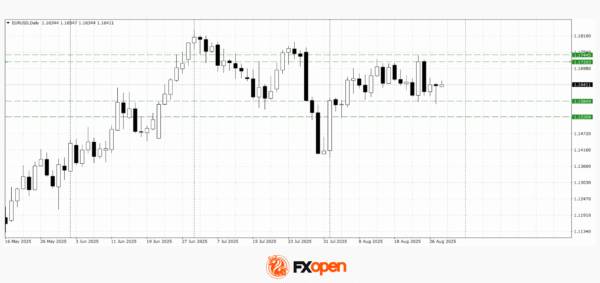
          Yesterday, sellers of the single European currency attempted to break key support at 1.1600. The price set a new August low, but the breakout proved false, and the pair returned to 1.1640. Technical analysis of EUR/USD indicates sideways trading between 1.1580 and 1.1740. A significant fundamental driver would be required to push the pair beyond this range.

          Factors that could influence the EUR/USD movement include:

          ● Today at 12:00 (GMT+3): Eurozone consumer and business confidence report
          ● Today at 14:30 (GMT+3): ECB monetary policy meeting minutes
          ● Tomorrow at 15:00 (GMT+3): Germany Consumer Price Index (CPI)

          European Currencies Hold Key Levels: Market In Search Of New Signals_1

          USD/CHF

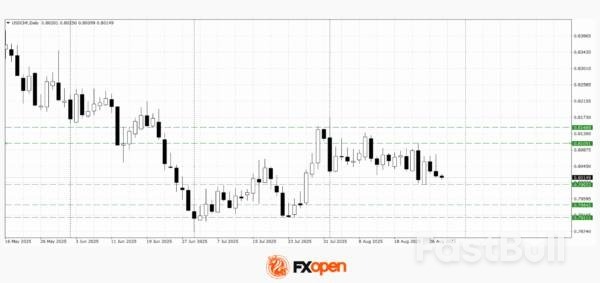
          The USD/CHF pair has been trading in a narrow range between 0.8000 and 0.8150 for several weeks. Following the Fed Chair’s dovish remarks, the price tested the lower boundary of this range, but no renewed downward momentum has been observed so far. Should positive US news emerge, the upper boundary of the sideways corridor at 0.8150 may be tested. A break below 0.8000 could trigger a decline towards 0.7910–0.7940.

          Factors that could influence the USD/CHF movement include:

          ● Today at 15:30 (GMT+3): US GDP
          ● Today at 15:30 (GMT+3): US Initial Jobless Claims
          ● Tomorrow at 10:00 (GMT+3): Swiss KOF Leading Economic Indicator

          European Currencies Hold Key Levels: Market In Search Of New Signals_2

          Source: FXOpen

          To stay updated on all economic events of today, please check out our Economic calendar
          Risk Warnings and Disclaimers
          You understand and acknowledge that there is a high degree of risk involved in trading. Following any strategies or investment methods may lead to potential losses. The content on the site is provided by our contributors and analysts for information purposes only. You are solely responsible for determining whether any trading assets, securities, strategy, or any other product is suitable for investing based on your own investment objectives and financial situation.
          Add to Favorites
          Share

          Japan Delays Washington Trip as Trade Deal Frictions Stall Progress on Tariff Cuts and Investment Package

          Gerik

          Economic

          Unresolved Tariff Issues

          The decision to postpone Akazawa’s visit highlights persistent friction in U.S.–Japan trade talks despite the July accord that lowered reciprocal tariffs from 25% to 15%. Chief Cabinet Secretary Yoshimasa Hayashi confirmed that the cancellation followed recognition that “certain points required further technical discussion,” with negotiations now continuing at the administrative level.
          Tokyo is pressing Washington to amend its executive order on reciprocal tariffs to formally include a no-stacking provision, ensuring Japanese exports are not subjected to cumulative levies above the agreed 15%. While the U.S. has lowered baseline tariffs, the lack of written confirmation on automobile and auto parts duties remains a critical sticking point.
          This represents a causal linkage between incomplete legal formalization of tariff adjustments and the heightened uncertainty for Japan’s key export industries, particularly autos, which make up the largest share of shipments to the U.S.

          The $550 Billion Investment Package

          At the center of the negotiations lies Japan’s promised $550 billion investment package in the U.S., intended to bolster American manufacturing and infrastructure while securing tariff relief for Japanese exports. However, the framing of the package has become contentious. U.S. officials, including Commerce Secretary Howard Lutnick, have suggested the fund will serve as capital “to invest as we like,” sparking concerns in Tokyo over ownership and allocation.
          Akazawa pushed back against claims that Japan is simply handing over funds, stressing that returns would be split between the two countries according to their respective contributions. Nonetheless, the lack of a detailed joint framework has delayed formal implementation. This illustrates a correlation rather than direct causation between political rhetoric in Washington and investor unease in Tokyo, but the uncertainty still weighs on business sentiment.

          Economic Implications for Japan

          The delay compounds pressure on Japan’s economy, which has already begun to feel the impact of higher U.S. tariffs. Bank of Japan board member Junko Nakagawa warned that exports and industrial production will likely see a “reactionary decline” following earlier front-loading ahead of tariff deadlines. Manufacturing profits are expected to deteriorate further as higher U.S. tariffs erode export margins.
          Although Japan’s economy grew faster than expected in the second quarter, the tariff standoff raises risks of a slowdown in the months ahead. The government is attempting to balance near-term growth with strategic trade alignment, but unresolved tariff mechanics and uncertainty over the investment package risk undermining confidence in both corporate planning and fiscal projections.
          Japan’s decision to delay Akazawa’s trip reveals how unresolved technical and legal details can stall implementation of headline trade agreements. The stakes are particularly high for the automobile sector and for Tokyo’s credibility in structuring international investment frameworks. Unless clarified quickly, prolonged uncertainty could weaken corporate profits, erode trade flows, and delay the potential benefits of the $550 billion investment pledge, leaving both Japanese and American stakeholders in limbo.

          Source: CNBC

          To stay updated on all economic events of today, please check out our Economic calendar
          Risk Warnings and Disclaimers
          You understand and acknowledge that there is a high degree of risk involved in trading. Following any strategies or investment methods may lead to potential losses. The content on the site is provided by our contributors and analysts for information purposes only. You are solely responsible for determining whether any trading assets, securities, strategy, or any other product is suitable for investing based on your own investment objectives and financial situation.
          Add to Favorites
          Share

          France’s Budget Standoff Risks Undermining Defense Investment Pledges

          Gerik

          Economic

          Political Stalemate and Government Instability

          France is once again facing a budget impasse that threatens to topple its government, marking the second such crisis in two years. Prime Minister François Bayrou’s administration is locked in a dispute with lawmakers over how to address the widening public deficit. Bayrou has pushed for broad-based tax hikes and freezes on welfare spending, a politically sensitive approach that has intensified resistance in parliament.
          This confrontation highlights a cause-and-effect tension: political unwillingness to compromise on fiscal strategy risks triggering a government collapse, which in turn undermines investor confidence and delays broader reform agendas.

          Fiscal Pressures and the Deficit Challenge

          France’s fiscal deficit remains elevated, reflecting both pandemic-era spending legacies and more recent inflation-driven social support measures. Markets are increasingly concerned about the government’s ability to rein in spending, particularly as borrowing costs in the eurozone remain high relative to the pre-ECB tightening era.
          The debate reflects structural constraints: higher taxes may strain household consumption and competitiveness, while welfare freezes risk sparking social unrest, a sensitive issue in France given its history of large-scale protests. Either path threatens to weaken near-term growth while addressing only part of the deficit problem.

          Defense Spending at Risk

          The standoff is particularly consequential for France’s defense commitments. President Emmanuel Macron previously pledged to raise defense investment to meet NATO targets and enhance Europe’s security role amid ongoing conflicts in Ukraine and wider geopolitical instability.
          However, as Berenberg economist Salomon Fiedler warned, a budget deadlock or aggressive fiscal tightening could leave these pledges underfunded. This would not only reduce France’s credibility within NATO but also weaken the EU’s collective ambition to expand defense autonomy, especially at a time when U.S. policy under Trump is increasingly unpredictable.

          Market and Strategic Implications

          The crisis feeds into a broader European concern about fiscal sustainability. France’s elevated deficit and debt levels make it one of the more vulnerable eurozone members, raising the risk of rating downgrades or higher bond spreads relative to Germany. A failure to secure stable governance may further complicate EU-level fiscal negotiations and limit the bloc’s ability to coordinate investment in defense and green transition programs.
          In strategic terms, if defense pledges are scaled back, France risks losing momentum in its effort to position itself as Europe’s leading military power. This could shift more responsibility to Germany or deepen reliance on NATO’s U.S. pillar an outcome at odds with Macron’s vision of “strategic autonomy.”
          France’s latest budget clash is more than a domestic fiscal fight; it carries weighty implications for European defense, NATO commitments, and market credibility. A compromise is urgently needed, yet the political costs of higher taxes or welfare freezes make resolution difficult. Unless stability is restored quickly, the credibility of France’s defense investment pledges and its leadership role in Europe’s security framework could be severely undermined.

          Source: CNBC

          To stay updated on all economic events of today, please check out our Economic calendar
          Risk Warnings and Disclaimers
          You understand and acknowledge that there is a high degree of risk involved in trading. Following any strategies or investment methods may lead to potential losses. The content on the site is provided by our contributors and analysts for information purposes only. You are solely responsible for determining whether any trading assets, securities, strategy, or any other product is suitable for investing based on your own investment objectives and financial situation.
          Add to Favorites
          Share

          Bank of Korea Holds Rates at 2.5% as Housing Risks Loom, While Growth and Inflation Forecasts Edge Higher

          Gerik

          Economic

          Policy Hold Driven by Housing Market Concerns

          The BOK’s decision to keep rates steady for the second consecutive meeting reflects its growing concern over surging housing prices in Seoul and its metropolitan area. Although household loan growth has slowed considerably, expectations for higher real estate values remain strong, keeping financial stability risks elevated. The central bank’s pause is therefore less about current inflationary pressure and more about avoiding a renewed housing bubble that could threaten longer-term stability.
          This approach reveals a causal relationship: holding rates steady is intended to prevent credit conditions from further fueling speculative housing demand. At the same time, it acknowledges the correlation between elevated property expectations and persistent financial risks, even in the face of slower lending growth.

          Upgraded Economic and Inflation Outlook

          Despite policy caution, the BOK upgraded its macro forecasts. Inflation for 2025 is now expected at 2% (up from 1.9%), while GDP growth was revised to 0.9% (from 0.8%). This reflects modest domestic demand recovery, partly driven by a supplementary budget and improving consumer sentiment, alongside temporary resilience in exports.
          The underlying cause-and-effect dynamic lies in fiscal support boosting household spending, while exports benefit from earlier momentum in semiconductors and industrial shipments. However, the bank warned that this boost may fade as U.S. tariffs increasingly weigh on South Korea’s external sector highlighting a looming external headwind despite near-term gains.

          Trade and Geopolitical Factors

          The central bank’s statement came just after President Lee Jae Myung met U.S. President Donald Trump, securing high-profile bilateral agreements. These include $350 billion in South Korean investment in the U.S., record aviation purchases, and cooperation in shipbuilding and energy. In exchange, U.S. tariffs on South Korean exports, including automobiles, were reduced from 25% to 15%.
          This creates a mixed trade dynamic: South Korea benefits from tariff relief and stronger bilateral ties, but the broader escalation of U.S. tariffs globally risks dampening demand for its export-heavy economy, where external sales make up about 44% of GDP.

          Market Expectations and Policy Outlook

          Analysts at Bank of America expect the BOK could cut rates within the next three months, with October flagged as a possible window, followed by another reduction in the first half of 2026. With inflation stable at 2.1% in July, just above the BOK’s 2% target, there is room for policy easing without undermining price stability.
          This suggests that while the central bank’s current stance is cautious due to housing concerns, the causal driver of its next policy shift will likely be trade-related headwinds. If exports falter under U.S. tariffs, the BOK may prioritize growth stabilization through measured rate cuts.
          The BOK is navigating a delicate balance between domestic financial stability and external trade risks. Its decision to hold rates reflects a defensive stance against property market overheating, even as inflation and growth projections edge higher. Yet the trajectory points toward eventual easing a recognition that tariffs and global demand weakness could weigh heavily on South Korea’s export-driven economy. The coming months will test whether Seoul’s housing dynamics or Washington’s trade policy exerts the stronger pull on monetary policy.

          Source: CNBC

          To stay updated on all economic events of today, please check out our Economic calendar
          Risk Warnings and Disclaimers
          You understand and acknowledge that there is a high degree of risk involved in trading. Following any strategies or investment methods may lead to potential losses. The content on the site is provided by our contributors and analysts for information purposes only. You are solely responsible for determining whether any trading assets, securities, strategy, or any other product is suitable for investing based on your own investment objectives and financial situation.
          Add to Favorites
          Share
          FastBull
          Copyright © 2025 FastBull Ltd

          728 RM B 7/F GEE LOK IND BLDG NO 34 HUNG TO RD KWUN TONG KLN HONG KONG

          TelegramInstagramTwitterfacebooklinkedin
          App Store Google Play Google Play
          Products
          Charts

          Chats

          Q&A with Experts
          Screeners
          Economic Calendar
          Data
          Tools
          Membership
          Features
          Function
          Markets
          Copy Trading
          Latest Signals
          Contests
          News
          Analysis
          24/7
          Columns
          Education
          Company
          Careers
          About Us
          Contact Us
          Advertising
          Help Center
          Feedback
          User Agreement
          Privacy Policy
          Business

          White Label

          Data API

          Web Plug-ins

          Poster Maker

          Affiliate Program

          Risk Disclosure

          The risk of loss in trading financial instruments such as stocks, FX, commodities, futures, bonds, ETFs and crypto can be substantial. You may sustain a total loss of the funds that you deposit with your broker. Therefore, you should carefully consider whether such trading is suitable for you in light of your circumstances and financial resources.

          No decision to invest should be made without thoroughly conducting due diligence by yourself or consulting with your financial advisors. Our web content might not suit you since we don't know your financial conditions and investment needs. Our financial information might have latency or contain inaccuracy, so you should be fully responsible for any of your trading and investment decisions. The company will not be responsible for your capital loss.

          Without getting permission from the website, you are not allowed to copy the website's graphics, texts, or trademarks. Intellectual property rights in the content or data incorporated into this website belong to its providers and exchange merchants.

          Not Logged In

          Log in to access more features

          FastBull Membership

          Not yet

          Purchase

          Become a signal provider
          Help Center
          Customer Service
          Dark Mode
          Price Up/Down Colors

          Log In

          Sign Up

          Position
          Layout
          Fullscreen
          Default to Chart
          The chart page opens by default when you visit fastbull.com