• Trade
  • Markets
  • Copy
  • Contests
  • News
  • 24/7
  • Calendar
  • Q&A
  • Chats
Trending
Screeners
SYMBOL
LAST
BID
ASK
HIGH
LOW
NET CHG.
%CHG.
SPREAD
SPX
S&P 500 Index
6827.42
6827.42
6827.42
0.00
0
0.00
0.00%
--
DJI
Dow Jones Industrial Average
48458.04
48458.04
48458.04
0.00
0
0.00
0.00%
--
IXIC
NASDAQ Composite Index
23195.16
23195.16
23195.16
0.00
0
0.00
0.00%
--
USDX
US Dollar Index
97.880
97.960
97.880
98.070
97.810
-0.070
-0.07%
--
EURUSD
Euro / US Dollar
1.17506
1.17513
1.17506
1.17596
1.17262
+0.00112
+ 0.10%
--
GBPUSD
Pound Sterling / US Dollar
1.33884
1.33893
1.33884
1.33961
1.33546
+0.00177
+ 0.13%
--
XAUUSD
Gold / US Dollar
4325.22
4325.65
4325.22
4350.16
4294.68
+25.83
+ 0.60%
--
WTI
Light Sweet Crude Oil
56.950
56.980
56.950
57.601
56.789
-0.283
-0.49%
--

Community Accounts

Signal Accounts
--
Profit Accounts
--
Loss Accounts
--
View More

Become a signal provider

Sell trading signals to earn additional income

View More

Guide to Copy Trading

Get started with ease and confidence

View More

Signal Accounts for Members

All Signal Accounts

Best Return
  • Best Return
  • Best P/L
  • Best MDD
Past 1W
  • Past 1W
  • Past 1M
  • Past 1Y

All Contests

  • All
  • Trump Updates
  • Recommend
  • Stocks
  • Cryptocurrencies
  • Central Banks
  • Featured News
Top News Only
Share

Portugal Treasury Puts 2026 Net Financing Needs At 13 Billion Euros, Up From 10.8 Billion In 2025

Share

Portugal Treasury Expects 2026 Net Financing Needs At 29.4 Billion Euros, Up From 25.8 Billion In 2025

Share

Bank Of America Says With Indonesia's Smelter Now Ramping Up, It Expects Aluminium Supply Growth To Accelerate To 2.6% Year On Year In 2026

Share

Bank Of America Expects A Deficit In Aluminium Next Year And Sees Prices Pushing Above $3000/T

Share

Fed Data - USA Effective Federal Funds Rate At 3.64 Percent On 12 December On $102 Billion In Trades Versus 3.64 Percent On $99 Billion On 11 December

Share

Brazil's Petrobras Says No Impact Seen On Oil, Petroleum Products Output As Workers Start Planned Strike

Share

Statement: US Travel Group Warns New Proposed Trump Administration Requirements For Foreign Tourists To Provide Social Media Histories Could Mean Millions Of People Opting Not To Visit

Share

Blackrock: Kerry White Will Become Head Of Citi Investment Management At Citi Wealth

Share

Blackrock: Rob Jasminski, Head Of Citi Investment Management, Has Joined With Team

Share

Blackrock: Effective Dec 15, Citi Investment Management Employees Will Join Blackrock

Share

Blackrock: Formally Launch Citi Portfolio Solutions Powered By Blackrock

Share

According To Data From The Federal Reserve Bank Of New York, The Secured Overnight Funding Rate (Sofr) Was 3.67% On The Previous Trading Day (December 15), Compared To 3.66% The Day Before

Share

Peru Energy And Mines Ministry: Copper Production Up 4.8% Year-On-Year In October To 248192 Metric Tons

Share

Security Source: Ukrainian Drones Hits Russian Oil Infrastructure In Caspian Sea For Third Time

Share

Spot Palladium Extends Gains, Last Up 5% To $1562.7/Oz

Share

Mexico's Economy Ministry Announces Start Of Anti-Dumping Investigation And Anti-Subsidy Investigations Into USA Pork Imports

Share

Canada Nov CPI Common +2.8%, CPI Median +2.8%, CPI Trim +2.8% On Year

Share

NY Fed's Empire State Prices Paid Index +37.6 In December Versus+49.0 In November

Share

Canada Nov Consumer Prices +0.1% On Month, +2.2% On Year

Share

Canada Nov CPI Core -0.1% On Month, +2.9% On Year

TIME
ACT
FCST
PREV
Japan Tankan Small Manufacturing Outlook Index (Q4)

A:--

F: --

P: --

Japan Tankan Large Non-Manufacturing Outlook Index (Q4)

A:--

F: --

P: --

Japan Tankan Large Manufacturing Outlook Index (Q4)

A:--

F: --

P: --

Japan Tankan Small Manufacturing Diffusion Index (Q4)

A:--

F: --

P: --

Japan Tankan Large Manufacturing Diffusion Index (Q4)

A:--

F: --

P: --

Japan Tankan Large-Enterprise Capital Expenditure YoY (Q4)

A:--

F: --

P: --

U.K. Rightmove House Price Index YoY (Dec)

A:--

F: --

P: --

China, Mainland Industrial Output YoY (YTD) (Nov)

A:--

F: --

P: --

China, Mainland Urban Area Unemployment Rate (Nov)

A:--

F: --

P: --

Saudi Arabia CPI YoY (Nov)

A:--

F: --

P: --

Euro Zone Industrial Output YoY (Oct)

A:--

F: --

P: --

Euro Zone Industrial Output MoM (Oct)

A:--

F: --

P: --

Canada Existing Home Sales MoM (Nov)

A:--

F: --

P: --

Canada National Economic Confidence Index

A:--

F: --

P: --

Canada New Housing Starts (Nov)

A:--

F: --

P: --
U.S. NY Fed Manufacturing Employment Index (Dec)

A:--

F: --

P: --

U.S. NY Fed Manufacturing Index (Dec)

A:--

F: --

P: --

Canada Core CPI YoY (Nov)

A:--

F: --

P: --

Canada Manufacturing Unfilled Orders MoM (Oct)

A:--

F: --

P: --

U.S. NY Fed Manufacturing Prices Received Index (Dec)

A:--

F: --

P: --

U.S. NY Fed Manufacturing New Orders Index (Dec)

A:--

F: --

P: --

Canada Manufacturing New Orders MoM (Oct)

A:--

F: --

P: --

Canada Core CPI MoM (Nov)

A:--

F: --

P: --

Canada Trimmed CPI YoY (SA) (Nov)

A:--

F: --

P: --

Canada Manufacturing Inventory MoM (Oct)

A:--

F: --

P: --

Canada CPI YoY (Nov)

A:--

F: --

P: --

Canada CPI MoM (Nov)

A:--

F: --

P: --

Canada CPI YoY (SA) (Nov)

A:--

F: --

P: --

Canada Core CPI MoM (SA) (Nov)

A:--

F: --

P: --

Canada CPI MoM (SA) (Nov)

A:--

F: --

P: --

Federal Reserve Board Governor Milan delivered a speech
U.S. NAHB Housing Market Index (Dec)

--

F: --

P: --

Australia Composite PMI Prelim (Dec)

--

F: --

P: --

Australia Services PMI Prelim (Dec)

--

F: --

P: --

Australia Manufacturing PMI Prelim (Dec)

--

F: --

P: --

Japan Manufacturing PMI Prelim (SA) (Dec)

--

F: --

P: --

U.K. 3-Month ILO Employment Change (Oct)

--

F: --

P: --

U.K. Unemployment Claimant Count (Nov)

--

F: --

P: --

U.K. Unemployment Rate (Nov)

--

F: --

P: --

U.K. 3-Month ILO Unemployment Rate (Oct)

--

F: --

P: --

U.K. Average Weekly Earnings (3-Month Average, Including Bonuses) YoY (Oct)

--

F: --

P: --

U.K. Average Weekly Earnings (3-Month Average, Excluding Bonuses) YoY (Oct)

--

F: --

P: --

France Services PMI Prelim (Dec)

--

F: --

P: --

France Composite PMI Prelim (SA) (Dec)

--

F: --

P: --

France Manufacturing PMI Prelim (Dec)

--

F: --

P: --

Germany Services PMI Prelim (SA) (Dec)

--

F: --

P: --

Germany Manufacturing PMI Prelim (SA) (Dec)

--

F: --

P: --

Germany Composite PMI Prelim (SA) (Dec)

--

F: --

P: --

Euro Zone Composite PMI Prelim (SA) (Dec)

--

F: --

P: --

Euro Zone Services PMI Prelim (SA) (Dec)

--

F: --

P: --

Euro Zone Manufacturing PMI Prelim (SA) (Dec)

--

F: --

P: --

U.K. Services PMI Prelim (Dec)

--

F: --

P: --

U.K. Manufacturing PMI Prelim (Dec)

--

F: --

P: --

U.K. Composite PMI Prelim (Dec)

--

F: --

P: --

Euro Zone ZEW Economic Sentiment Index (Dec)

--

F: --

P: --

Germany ZEW Current Conditions Index (Dec)

--

F: --

P: --

Germany ZEW Economic Sentiment Index (Dec)

--

F: --

P: --

Euro Zone Trade Balance (Not SA) (Oct)

--

F: --

P: --

Euro Zone ZEW Current Conditions Index (Dec)

--

F: --

P: --

Euro Zone Trade Balance (SA) (Oct)

--

F: --

P: --

U.S. Retail Sales MoM (Excl. Automobile) (SA) (Oct)

--

F: --

P: --

Q&A with Experts
    • All
    • Chatrooms
    • Groups
    • Friends
    Connecting
    .
    .
    .
    Type here...
    Add Symbol or Code

      No matching data

      All
      Trump Updates
      Recommend
      Stocks
      Cryptocurrencies
      Central Banks
      Featured News
      • All
      • Russia-Ukraine Conflict
      • Middle East Flashpoint
      • All
      • Russia-Ukraine Conflict
      • Middle East Flashpoint
      Search
      Products

      Charts Free Forever

      Chats Q&A with Experts
      Screeners Economic Calendar Data Tools
      Membership Features
      Data Warehouse Market Trends Institutional Data Policy Rates Macro

      Market Trends

      Market Sentiment Order Book Forex Correlations

      Top Indicators

      Charts Free Forever
      Markets

      News

      News Analysis 24/7 Columns Education
      From Institutions From Analysts
      Topics Columnists

      Latest Views

      Latest Views

      Trending Topics

      Top Columnists

      Latest Update

      Signals

      Copy Rankings Latest Signals Become a signal provider AI Rating
      Contests
      Brokers

      Overview Brokers Assessment Rankings Regulators News Claims
      Broker listing Forex Brokers Comparison Tool Live Spread Comparison Scam
      Q&A Complaint Scam Alert Videos Tips to Detect Scam
      More

      Business
      Events
      Careers About Us Advertising Help Center

      White Label

      Data API

      Web Plug-ins

      Affiliate Program

      Awards Institution Evaluation IB Seminar Salon Event Exhibition
      Vietnam Thailand Singapore Dubai
      Fans Party Investment Sharing Session
      FastBull Summit BrokersView Expo
      Recent Searches
        Top Searches
          Markets
          News
          Analysis
          User
          24/7
          Economic Calendar
          Education
          Data
          • Names
          • Latest
          • Prev

          View All

          No data

          Scan to Download

          Faster Charts, Chat Faster!

          Download App
          English
          • English
          • Español
          • العربية
          • Bahasa Indonesia
          • Bahasa Melayu
          • Tiếng Việt
          • ภาษาไทย
          • Français
          • Italiano
          • Türkçe
          • Русский язык
          • 简中
          • 繁中
          Open Account
          Search
          Products
          Charts Free Forever
          Markets
          News
          Signals

          Copy Rankings Latest Signals Become a signal provider AI Rating
          Contests
          Brokers

          Overview Brokers Assessment Rankings Regulators News Claims
          Broker listing Forex Brokers Comparison Tool Live Spread Comparison Scam
          Q&A Complaint Scam Alert Videos Tips to Detect Scam
          More

          Business
          Events
          Careers About Us Advertising Help Center

          White Label

          Data API

          Web Plug-ins

          Affiliate Program

          Awards Institution Evaluation IB Seminar Salon Event Exhibition
          Vietnam Thailand Singapore Dubai
          Fans Party Investment Sharing Session
          FastBull Summit BrokersView Expo

          Brent Prices on The Edge: OPEC+ Floods The Market

          Blue River

          Technical Analysis

          Summary:

          Brent quotes may regain ground and test the resistance level around the 70.70 USD mark. 

          Brent quotes may regain ground and test the resistance level around the 70.70 USD mark.

          Brent forecast: key trading points

          • OPEC+ continues to ramp up production
          • Brent crude prices are undergoing a correction
          • Brent forecast for 22 July 2025: 70.70

          Fundamental analysis

          The fundamental analysis of Brent for today, 22 July 2025, takes into account that after hitting new July highs, Brent formed a corrective wave and made another attempt to regain ground, but unsuccessfully. Currently, prices are in a new correction phase, trading near 69.90 USD.

          The key factors influencing oil prices include:

          • Rising tensions between the US and the EU, including threats of 30-100% tariffs. New US tariffs targeting countries like Brazil, the Philippines, Iraq, South Korea, and Japan increase global economic uncertainty and may weaken fuel demand
          • OPEC+ is actively ramping up oil output. Saudi Arabia has been exporting record volumes in recent months. The de-escalation of the Iran-Israel conflict has eased fears over supply disruptions
          • A weakening US dollar is partially supporting oil prices, but Brent’s upward momentum remains constrained by weak global demand
          • The EU has approved its 18th sanctions package, including the potential for a lower oil price cap, but this is having only a moderate effect on supply

          Brent technical analysis

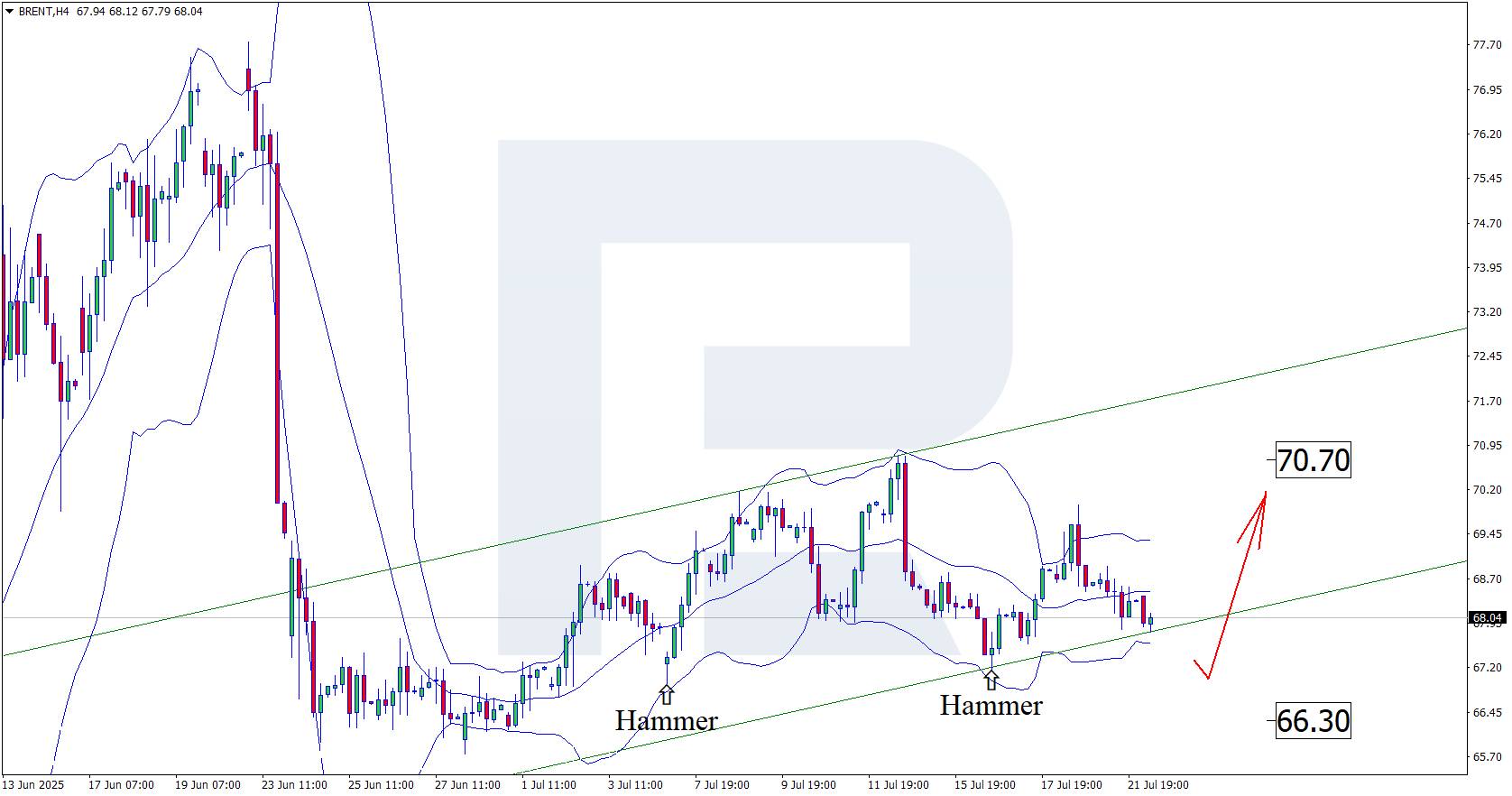
          On the H4 chart, Brent prices tested the lower Bollinger Band and formed a Hammer reversal pattern. Having partially fulfilled the signal, quotes are now undergoing a correction.

          The Brent price forecast for 22 July 2025 suggests a growth target at 70.70 USD. A breakout above the resistance level would open the door to a stronger upward wave.

          However, an alternative scenario remains possible where Brent quotes may extend their correction to 66.30 USD before initiating a new bullish wave.

          Summary

          Brent prices are testing the lower boundary of the ascending channel and may be gearing up for another bullish wave amid geopolitical tensions.

          Source: RoboForex

          Risk Warnings and Disclaimers
          You understand and acknowledge that there is a high degree of risk involved in trading. Following any strategies or investment methods may lead to potential losses. The content on the site is provided by our contributors and analysts for information purposes only. You are solely responsible for determining whether any trading assets, securities, strategy, or any other product is suitable for investing based on your own investment objectives and financial situation.
          Add to Favorites
          Share

          Trump’s New Tax Law to Inflate U.S. Deficit by $3.4 Trillion, Says CBO

          Gerik

          Economic

          Permanent Tax Cuts, Temporary Reliefs, and Costly Outcomes

          The “One Big Beautiful Bill,” signed into law on July 4, 2025, encapsulates Donald Trump’s renewed economic agenda. The legislation permanently extends the 2017 income-tax cuts, expands business tax breaks, lifts the cap on federal deductions for state and local taxes (SALT), and temporarily eliminates taxes on tips and overtime. While the Trump administration framed the package as pro-growth and middle-class friendly, the Congressional Budget Office (CBO) has issued a sobering warning about its long-term fiscal cost.
          The CBO projects a $4.5 trillion decline in federal revenues paired with only $1.1 trillion in reduced spending over the 2024–2034 period. This leads to a net addition of $3.4 trillion to the deficit. These projections are made using a “current-law baseline,” which assumes no further changes in future legislation, and notably exclude dynamic macroeconomic effects, such as any growth-induced revenue feedback.

          Health Coverage and Medicaid Restructuring

          Beyond the fiscal toll, the law will have a deep human impact. New Medicaid work requirements for recipients under age 65 and restrictions on state-level provider taxes are projected to strip 10 million Americans of health insurance coverage by 2034. These measures represent a shift toward conditional welfare and reduced federal support, under the logic of personal responsibility and cost containment.
          Critics argue that the Medicaid cuts will disproportionately harm low-income households, especially as inflation driven in part by Trump’s expansive tariff policy continues to erode purchasing power. June inflation data already show the early signs of upward price pressures, particularly on basic goods. As necessities make up a larger share of expenditures for low-income Americans, the combined effect of higher costs and reduced safety nets could lead to heightened economic vulnerability.

          Alternative Deficit Scoring and Political Optics

          Republican lawmakers requested an alternative CBO scoring using a “current policy baseline,” which assumes extensions of expiring tax cuts as a given. Under this framework, the law appears to reduce the deficit by $366 billion over ten years. This discrepancy arises because the scoring method assumes that tax cuts were already permanent and thus registers their extension as cost-neutral. However, this version of the analysis is considered less conservative and more politically motivated, as it downplays the revenue impact.
          Economists and bond investors have flagged concerns that the large revenue drop may widen the budget deficit to levels that strain Treasury issuance, push up interest rates, and stoke inflation. Trump officials have responded by pointing to surging tariff collections as a new revenue stream, though critics counter that these levies are effectively a hidden tax on consumers and U.S. businesses.
          In sum, while Trump’s tax law might appeal politically by delivering tax relief and regulatory rollback, the CBO’s conventional analysis paints a more complex picture one in which fiscal responsibility, public health coverage, and inflation management are being sacrificed for immediate political gain and populist appeal. The coming years may reveal whether the promised growth materializes or whether the U.S. economy buckles under the weight of mounting deficits and reduced public investment.

          Reuters: Bloomberg

          To stay updated on all economic events of today, please check out our Economic calendar
          Risk Warnings and Disclaimers
          You understand and acknowledge that there is a high degree of risk involved in trading. Following any strategies or investment methods may lead to potential losses. The content on the site is provided by our contributors and analysts for information purposes only. You are solely responsible for determining whether any trading assets, securities, strategy, or any other product is suitable for investing based on your own investment objectives and financial situation.
          Add to Favorites
          Share

          Hurdles Mount as India-U.S. Interim Trade Deal Faces Deadline Pressure

          Gerik

          Economic

          Stalemate Over Agriculture and Industrial Tariffs

          Hopes for a quick trade resolution between India and the United States are fading as the August 1 deadline linked to potential 26% U.S. tariffs on Indian imports looms large. According to senior Indian government officials, the fifth round of negotiations, recently concluded in Washington, failed to yield a breakthrough. The central sticking points include U.S. demands for broader access to India’s protected agricultural and dairy markets, which remain politically untouchable in New Delhi.
          Conversely, India has pushed for the removal of steep tariffs the U.S. currently imposes on its exports of steel, aluminium, and automobiles. Washington has been reluctant to make concessions without reciprocal access to India's farm sectors. As a result, negotiations are now centered on the possibility of deferring the most contentious issues to a second phase, post an interim agreement.

          Domestic Politics and Sensitive Sectors

          India’s hesitation to open up its agriculture and dairy sectors is rooted in political and socioeconomic concerns. Both industries involve smallholder livelihoods and local cooperatives with considerable political influence. Any perception of external intrusion especially from large-scale American agribusiness could create domestic unrest and electoral backlash.
          Meanwhile, Indian exporters in sectors like gems and jewellery are bracing for potential disruption. A 26% tariff, if imposed, could sharply erode their price competitiveness in the U.S. market. Ajay Sahai of the Federation of Indian Export Organisations noted that the impact may be temporary, given the broader intent on both sides to eventually secure a deal.

          Deadlines, Delegations, and Diplomacy

          Despite stalled progress, Indian officials remain hopeful. Another U.S. delegation is expected in New Delhi shortly for continued discussions. However, without formal notice from the U.S. on the imposition of tariffs unlike the 20+ other countries that have received such letters New Delhi is in a strategic holding pattern. This ambiguity, though tense, also leaves a window open for last-minute diplomatic maneuvering.
          U.S. Treasury Secretary Scott Bessent’s recent remarks further cloud the picture. While he emphasized that deal quality matters more than deadlines, he clarified that any extensions to the August 1 cutoff would depend on President Trump’s decision.

          Looking Ahead: Possibility of a Broader Deal

          Although the interim pact now seems unlikely before August 1, officials on both sides are cautiously optimistic about striking a broader, more comprehensive agreement by September or October. This timeline aligns with the framework discussed during Prime Minister Modi’s February summit with President Trump.
          Should both nations succeed in tabling the most divisive issues and building consensus around less sensitive sectors such as digital trade, investment facilitation, or services the broader pact may still materialize. Until then, the risk of new tariffs hangs over Indian exports, a potent reminder of how sensitive domestic policies and external trade priorities can clash in geopolitically complex negotiations.

          Source: Reuters

          To stay updated on all economic events of today, please check out our Economic calendar
          Risk Warnings and Disclaimers
          You understand and acknowledge that there is a high degree of risk involved in trading. Following any strategies or investment methods may lead to potential losses. The content on the site is provided by our contributors and analysts for information purposes only. You are solely responsible for determining whether any trading assets, securities, strategy, or any other product is suitable for investing based on your own investment objectives and financial situation.
          Add to Favorites
          Share

          Investors Shrug Off Trump Administration's Criticism of Fed as S&P 500 Hits Record High

          Gerik

          Economic

          Stocks

          Market Resilience Amid Political Uncertainty

          The Trump administration’s escalating critique of the U.S. Federal Reserve took center stage this week, with Treasury Secretary Scott Bessent urging a comprehensive review of the institution. In a CNBC interview, Bessent questioned the Fed’s inaction on interest rate cuts despite what he described as "very little, if any, inflation." He criticized Fed officials, many of whom hold PhDs, for being entrenched in outdated thinking.
          However, investors appear largely unfazed. U.S. equity markets continue to rally, with the S&P 500 breaching the 6,300 mark for the first time and the Nasdaq Composite closing at a record high. The market's upward momentum, powered by gains in tech giants like Meta and Amazon, reflects confidence in corporate performance despite the political noise.

          Fed’s Independence Under Political Pressure

          The critique of the Fed comes amid broader tension between the Trump administration and central banking norms. Bessent’s remarks, combined with speculation around President Trump’s potential replacement of Fed Chair Jerome Powell, have revived concerns about the erosion of the central bank’s independence. Historically, markets have been sensitive to such threats, but the current bullish sentiment suggests that traders remain focused on earnings strength and macroeconomic data for now.
          The IPO pipeline is heating up again, with Figma aiming for a valuation of up to $16.4 billion. The design software company’s new filing shows plans to price shares between $25 and $28, reflecting strong investor demand in the tech space.
          In parallel, a more unorthodox financial maneuver has emerged: Trump Media has reportedly accumulated a $2 billion bitcoin reserve, now representing roughly two-thirds of its liquid assets. This massive crypto hoard underscores the administration's pivot toward alternative assets amid growing skepticism toward conventional monetary policy.

          European Defense Sector Overheated

          Across the Atlantic, some analysts warn that Europe’s defense sector previously bolstered by war-driven procurement and NATO commitments may be nearing a valuation peak. A fund manager overseeing nearly $2 billion in assets told CNBC that recent valuations are becoming “extreme,” hinting at potential corrections in the near term.
          Finally, beyond financial headlines, the auto industry is seeing a resurgence in hope for solid-state batteries. Once considered a long-shot innovation, recent announcements from major automakers suggest commercial viability may be approaching sooner than expected. These advanced batteries promise greater energy density and safety, which could reshape electric vehicle economics in the coming decade.
          While political rhetoric from the Trump administration introduces risk, markets remain steady buoyed by corporate earnings, IPO enthusiasm, and a hunger for alternative investments. However, investors would do well to remain cautious. The mix of policy uncertainty, trade tensions, and macroeconomic shifts could swiftly reintroduce volatility, even amid record-breaking highs.

          Source: CNBC

          To stay updated on all economic events of today, please check out our Economic calendar
          Risk Warnings and Disclaimers
          You understand and acknowledge that there is a high degree of risk involved in trading. Following any strategies or investment methods may lead to potential losses. The content on the site is provided by our contributors and analysts for information purposes only. You are solely responsible for determining whether any trading assets, securities, strategy, or any other product is suitable for investing based on your own investment objectives and financial situation.
          Add to Favorites
          Share

          China’s Industrial Pruning Faces Uphill Battle Against Deflation

          Gerik

          Economic

          Industrial Overcapacity and Deflation: A Tougher Round Ahead

          China’s leadership is ramping up rhetoric against destructive price wars among manufacturers, suggesting an imminent revival of supply-side reforms aimed at trimming excess industrial capacity. This strategy helped end a prolonged period of deflation a decade ago. But this time, it faces far greater challenges.
          The manufacturing ecosystem has evolved. Many industries at the center of today’s overcapacity issues electric vehicles, solar panels, and batteries are driven by private firms rather than state-owned giants. Unlike previous reforms, which used blunt administrative tools to shutter state-owned coal and steel plants, the current environment requires nuanced economic levers like subsidy rollbacks, tighter credit, and land-use restrictions, which are harder to implement consistently across regions.

          Local Governments: A Barrier to Reform

          One of the most significant obstacles is the misalignment of incentives between Beijing and local governments. While the central government is eager to curb overproduction to stabilize prices, local authorities remain focused on fostering regional growth through industrial expansion. Their reluctance to scale back support for local champions is undermining national reform goals.
          An anonymous policy adviser noted that every province now targets the same few "new economy" sectors, leading to intense intra-national competition. This has not only flooded markets with cheap goods but also raised tensions with major trading partners like the U.S. and EU, who allege that Chinese overproduction distorts global trade.

          High Stakes and Limited Options

          The stakes are high. China’s producer prices have fallen for 33 consecutive months, with industrial margins eroding and unemployment especially among youth remaining elevated at 14.5%. Despite headline GDP growth targets of around 5%, the underlying economy shows signs of stress: factory layoffs, wage cuts, and weakening domestic demand.
          Macquarie estimates that last decade’s capacity cuts cost tens of millions of jobs. Back then, the economic shock was offset by a massive $1.4 trillion urban redevelopment scheme. Today, there is no comparable buffer. The real estate sector, once China’s go-to engine for job creation and stimulus, is now overbuilt and unlikely to absorb industrial dislocation again.

          Deflation Dilemma: Short-Term Pain or Long-Term Stagnation

          Economists are clear: slashing capacity could cause a short, sharp economic shock, while allowing overcapacity to linger risks long-term deflation. Neither path is easy, but the current strategy seems to lean toward gradual pruning to avoid destabilizing employment.
          Professor He-Ling Shi of Monash University warns the likelihood of failure is high. Without a robust alternative to absorb job losses, China may be forced to accept slower, prolonged growth. Meanwhile, analysts from Peking University and UBS highlight that while industrial reform is necessary, it must be paired with stronger demand-side stimulus to succeed.
          Unlike 2015, today’s economic environment offers fewer safety nets and more structural constraints. The new supply-side reform wave may help ease deflationary pressures over time, but without bold demand-side measures or political alignment across central and local governments, it’s unlikely to offer a rapid recovery. As global scrutiny intensifies and domestic confidence wavers, China faces a delicate balancing act between reform, growth, and stability.

          Source: Reuters

          To stay updated on all economic events of today, please check out our Economic calendar
          Risk Warnings and Disclaimers
          You understand and acknowledge that there is a high degree of risk involved in trading. Following any strategies or investment methods may lead to potential losses. The content on the site is provided by our contributors and analysts for information purposes only. You are solely responsible for determining whether any trading assets, securities, strategy, or any other product is suitable for investing based on your own investment objectives and financial situation.
          Add to Favorites
          Share

          Indonesia Secures $8 Billion Refinery Deal With U.S. Firm KBR Amid Tariff Breakthrough

          Gerik

          Economic

          Strategic Infrastructure Pact Anchors Trade Concessions

          Indonesia is accelerating its energy infrastructure ambitions through a high-stakes agreement with KBR Inc., formerly Kellogg Brown & Root. According to sources close to the negotiations and a confidential presentation reviewed by Reuters, the $8 billion engineering, procurement, and construction (EPC) deal covers 17 modular oil refineries across the archipelago.
          This initiative aligns with Indonesia’s broader push to reduce reliance on fuel imports, diversify refining capacity, and distribute energy production more evenly across the country. Modular refineries, with their flexibility and lower upfront costs compared to conventional plants, serve as a key instrument in achieving this goal.
          The deal was disclosed by Economic Minister Airlangga Hartarto during a closed-door business briefing in Jakarta. It forms a significant component of the recent U.S.-Indonesia trade negotiations that resulted in a favorable reduction of proposed U.S. tariffs on Indonesian goods from a punitive 32% to a more manageable 19%.

          Trade Diplomacy Yields Investment and Energy Gains

          The refinery contract illustrates how strategic trade diplomacy can yield tangible investment flows. While the broader trade deal included public announcements on enhanced energy cooperation, the KBR-Danantara contract had remained undisclosed until now.
          The agreement bolsters bilateral relations and highlights the effectiveness of using large-scale infrastructure projects as leverage in trade talks. It also positions the U.S. as a partner in Indonesia’s industrial development at a time when competition for infrastructure influence in Southeast Asia remains high, particularly from China.

          Implications for U.S. and Indonesian Interests

          For KBR Inc., the deal marks a significant win in overseas EPC services, reinforcing its global footprint and opening doors in a country prioritizing energy modernization. For Indonesia, the partnership strengthens domestic refining capabilities and partially shields its economy from global fuel price shocks and logistic disruptions.
          Moreover, the deal’s timing just ahead of the August 1 tariff deadline facing several Indo-Pacific nations suggests a calculated effort by Indonesia to appease U.S. trade concerns while extracting long-term development commitments in return.
          The $8 billion refinery pact signals a new chapter in Indonesia-U.S. trade relations, where diplomacy extends beyond tariff lines to infrastructure collaboration. As Indonesia pursues self-sufficiency in energy and the U.S. seeks reliable Indo-Pacific allies, this contract may set a precedent for how emerging economies negotiate on equal footing by coupling economic openness with strategic industrial projects.

          Source: Reuters

          To stay updated on all economic events of today, please check out our Economic calendar
          Risk Warnings and Disclaimers
          You understand and acknowledge that there is a high degree of risk involved in trading. Following any strategies or investment methods may lead to potential losses. The content on the site is provided by our contributors and analysts for information purposes only. You are solely responsible for determining whether any trading assets, securities, strategy, or any other product is suitable for investing based on your own investment objectives and financial situation.
          Add to Favorites
          Share

          Strong Euro Threatens Europe Inc’s Margins as Earnings Season Intensifies

          Gerik

          Economic

          Euro’s Ascent Becomes a Drag on Export-Heavy Corporates

          The euro’s sharp 9% rise in Q2 and 13% year-to-date appreciation has begun to bite into the earnings potential of Europe’s major exporters. As the earnings season accelerates, companies like SAP, UniCredit, and Julius Baer are under investor scrutiny, with the primary focus being how foreign exchange pressures and global trade tensions have affected margins and revenue forecasts.
          SAP, Europe’s largest software firm, previously flagged that each cent gain in the euro could reduce annual revenue by approximately €30 million. With the euro climbing from $1.1329 at the end of April to $1.1688 this week, the currency headwind is no longer theoretical it is quantifiable and material. While SAP continues to benefit from strong demand for AI-driven cloud services, the euro's rise could blunt the translation of overseas revenue into euros, particularly in North America and emerging markets.

          Investor Confidence Hangs on Earnings Resilience

          So far, earnings in Europe have been described by RBC Capital Markets as “fine but not fabulous,” leaving markets reliant on a handful of corporate leaders to deliver above-expectation results. Beyond SAP, investors are closely watching upcoming reports from LVMH and Roche to assess the impact of currency moves and tariff exposure across different sectors from luxury goods to pharmaceuticals.
          The stronger euro not only compresses reported earnings for firms operating globally, but also undercuts pricing competitiveness abroad, particularly in sectors like industrial manufacturing and autos. For companies with significant U.S. exposure, the shift in currency dynamics may lead to disappointing forward guidance even if current-quarter results hold steady.

          Trade Tensions and Policy Noise Weigh on Forecast Visibility

          The euro’s surge has been partially driven by investors diversifying away from the U.S. dollar amid rising political and institutional uncertainty in the United States. President Donald Trump’s erratic trade strategy and threats of a 30% tariff on EU imports if no agreement is reached by August 1 continue to cloud the external environment for European firms.
          This is compounded by mounting concerns over the independence of the Federal Reserve, with U.S. Treasury Secretary Scott Bessent recently calling for a broader institutional review of the Fed’s performance. Speculation that Trump may fire Fed Chair Jerome Powell has further destabilized U.S. policy expectations and contributed to dollar outflows.
          European markets are also contending with their own strategic recalibrations. EU diplomats are reportedly advancing “anti-coercion” mechanisms that could allow Brussels to retaliate by targeting U.S. services and limiting access to public tenders. While such tools are not yet active, their inclusion in trade policy debates heightens investor caution.
          Despite record highs in U.S. equities and a solid start to global earnings, the strength of the euro poses a serious test for Europe Inc. Currency headwinds, in tandem with unresolved trade tensions and political instability across both sides of the Atlantic, mean this earnings cycle will be watched less for bottom-line results and more for guidance and outlook clarity. With high expectations already priced in, disappointing forward commentary particularly from firms sensitive to FX and tariffs could trigger broader revaluation across European equities.

          Source: Reuters

          To stay updated on all economic events of today, please check out our Economic calendar
          Risk Warnings and Disclaimers
          You understand and acknowledge that there is a high degree of risk involved in trading. Following any strategies or investment methods may lead to potential losses. The content on the site is provided by our contributors and analysts for information purposes only. You are solely responsible for determining whether any trading assets, securities, strategy, or any other product is suitable for investing based on your own investment objectives and financial situation.
          Add to Favorites
          Share
          FastBull
          Copyright © 2025 FastBull Ltd

          728 RM B 7/F GEE LOK IND BLDG NO 34 HUNG TO RD KWUN TONG KLN HONG KONG

          TelegramInstagramTwitterfacebooklinkedin
          App Store Google Play Google Play
          Products
          Charts

          Chats

          Q&A with Experts
          Screeners
          Economic Calendar
          Data
          Tools
          Membership
          Features
          Function
          Markets
          Copy Trading
          Latest Signals
          Contests
          News
          Analysis
          24/7
          Columns
          Education
          Company
          Careers
          About Us
          Contact Us
          Advertising
          Help Center
          Feedback
          User Agreement
          Privacy Policy
          Business

          White Label

          Data API

          Web Plug-ins

          Poster Maker

          Affiliate Program

          Risk Disclosure

          The risk of loss in trading financial instruments such as stocks, FX, commodities, futures, bonds, ETFs and crypto can be substantial. You may sustain a total loss of the funds that you deposit with your broker. Therefore, you should carefully consider whether such trading is suitable for you in light of your circumstances and financial resources.

          No decision to invest should be made without thoroughly conducting due diligence by yourself or consulting with your financial advisors. Our web content might not suit you since we don't know your financial conditions and investment needs. Our financial information might have latency or contain inaccuracy, so you should be fully responsible for any of your trading and investment decisions. The company will not be responsible for your capital loss.

          Without getting permission from the website, you are not allowed to copy the website's graphics, texts, or trademarks. Intellectual property rights in the content or data incorporated into this website belong to its providers and exchange merchants.

          Not Logged In

          Log in to access more features

          FastBull Membership

          Not yet

          Purchase

          Become a signal provider
          Help Center
          Customer Service
          Dark Mode
          Price Up/Down Colors

          Log In

          Sign Up

          Position
          Layout
          Fullscreen
          Default to Chart
          The chart page opens by default when you visit fastbull.com
