• Trade
  • Markets
  • Copy
  • Contests
  • News
  • 24/7
  • Calendar
  • Q&A
  • Chats
Trending
Screeners
SYMBOL
LAST
BID
ASK
HIGH
LOW
NET CHG.
%CHG.
SPREAD
SPX
S&P 500 Index
6827.42
6827.42
6827.42
6899.86
6801.80
-73.58
-1.07%
--
DJI
Dow Jones Industrial Average
48458.04
48458.04
48458.04
48886.86
48334.10
-245.98
-0.51%
--
IXIC
NASDAQ Composite Index
23195.16
23195.16
23195.16
23554.89
23094.51
-398.69
-1.69%
--
USDX
US Dollar Index
97.950
98.030
97.950
98.500
97.950
-0.370
-0.38%
--
EURUSD
Euro / US Dollar
1.17394
1.17409
1.17394
1.17496
1.17192
+0.00011
+ 0.01%
--
GBPUSD
Pound Sterling / US Dollar
1.33707
1.33732
1.33707
1.33997
1.33419
-0.00148
-0.11%
--
XAUUSD
Gold / US Dollar
4299.39
4299.39
4299.39
4353.41
4257.10
+20.10
+ 0.47%
--
WTI
Light Sweet Crude Oil
57.233
57.485
57.233
58.011
56.969
-0.408
-0.71%
--

Community Accounts

Signal Accounts
--
Profit Accounts
--
Loss Accounts
--
View More

Become a signal provider

Sell trading signals to earn additional income

View More

Guide to Copy Trading

Get started with ease and confidence

View More

Signal Accounts for Members

All Signal Accounts

Best Return
  • Best Return
  • Best P/L
  • Best MDD
Past 1W
  • Past 1W
  • Past 1M
  • Past 1Y

All Contests

    Top News Only
    TIME
    ACT
    FCST
    PREV
    U.K. Trade Balance (Oct)

    A:--

    F: --

    P: --

    U.K. Services Index MoM

    A:--

    F: --

    P: --

    U.K. Construction Output MoM (SA) (Oct)

    A:--

    F: --

    P: --

    U.K. Industrial Output YoY (Oct)

    A:--

    F: --

    P: --

    U.K. Trade Balance (SA) (Oct)

    A:--

    F: --

    P: --

    U.K. Trade Balance EU (SA) (Oct)

    A:--

    F: --

    P: --

    U.K. Manufacturing Output YoY (Oct)

    A:--

    F: --

    P: --

    U.K. GDP MoM (Oct)

    A:--

    F: --

    P: --

    U.K. GDP YoY (SA) (Oct)

    A:--

    F: --

    P: --

    U.K. Industrial Output MoM (Oct)

    A:--

    F: --

    P: --

    U.K. Construction Output YoY (Oct)

    A:--

    F: --

    P: --

    France HICP Final MoM (Nov)

    A:--

    F: --

    P: --

    China, Mainland Outstanding Loans Growth YoY (Nov)

    A:--

    F: --

    P: --

    China, Mainland M2 Money Supply YoY (Nov)

    A:--

    F: --

    P: --

    China, Mainland M0 Money Supply YoY (Nov)

    A:--

    F: --

    P: --

    China, Mainland M1 Money Supply YoY (Nov)

    A:--

    F: --

    P: --

    India CPI YoY (Nov)

    A:--

    F: --

    P: --

    India Deposit Gowth YoY

    A:--

    F: --

    P: --

    Brazil Services Growth YoY (Oct)

    A:--

    F: --

    P: --

    Mexico Industrial Output YoY (Oct)

    A:--

    F: --

    P: --

    Russia Trade Balance (Oct)

    A:--

    F: --

    P: --

    Philadelphia Fed President Henry Paulson delivers a speech
    Canada Building Permits MoM (SA) (Oct)

    A:--

    F: --

    P: --

    Canada Wholesale Sales YoY (Oct)

    A:--

    F: --

    P: --

    Canada Wholesale Inventory MoM (Oct)

    A:--

    F: --

    P: --

    Canada Wholesale Inventory YoY (Oct)

    A:--

    F: --

    P: --

    Canada Wholesale Sales MoM (SA) (Oct)

    A:--

    F: --

    P: --

    Germany Current Account (Not SA) (Oct)

    A:--

    F: --

    P: --

    U.S. Weekly Total Rig Count

    A:--

    F: --

    P: --

    U.S. Weekly Total Oil Rig Count

    A:--

    F: --

    P: --

    Japan Tankan Large Non-Manufacturing Diffusion Index (Q4)

    --

    F: --

    P: --

    Japan Tankan Small Manufacturing Outlook Index (Q4)

    --

    F: --

    P: --

    Japan Tankan Large Non-Manufacturing Outlook Index (Q4)

    --

    F: --

    P: --

    Japan Tankan Large Manufacturing Outlook Index (Q4)

    --

    F: --

    P: --

    Japan Tankan Small Manufacturing Diffusion Index (Q4)

    --

    F: --

    P: --

    Japan Tankan Large Manufacturing Diffusion Index (Q4)

    --

    F: --

    P: --

    Japan Tankan Large-Enterprise Capital Expenditure YoY (Q4)

    --

    F: --

    P: --

    U.K. Rightmove House Price Index YoY (Dec)

    --

    F: --

    P: --

    China, Mainland Industrial Output YoY (YTD) (Nov)

    --

    F: --

    P: --

    China, Mainland Urban Area Unemployment Rate (Nov)

    --

    F: --

    P: --

    Saudi Arabia CPI YoY (Nov)

    --

    F: --

    P: --

    Euro Zone Industrial Output YoY (Oct)

    --

    F: --

    P: --

    Euro Zone Industrial Output MoM (Oct)

    --

    F: --

    P: --

    Canada Existing Home Sales MoM (Nov)

    --

    F: --

    P: --

    Euro Zone Total Reserve Assets (Nov)

    --

    F: --

    P: --

    U.K. Inflation Rate Expectations

    --

    F: --

    P: --

    Canada National Economic Confidence Index

    --

    F: --

    P: --

    Canada New Housing Starts (Nov)

    --

    F: --

    P: --

    U.S. NY Fed Manufacturing Employment Index (Dec)

    --

    F: --

    P: --

    U.S. NY Fed Manufacturing Index (Dec)

    --

    F: --

    P: --

    Canada Core CPI YoY (Nov)

    --

    F: --

    P: --

    Canada Manufacturing Unfilled Orders MoM (Oct)

    --

    F: --

    P: --

    Canada Manufacturing New Orders MoM (Oct)

    --

    F: --

    P: --

    Canada Core CPI MoM (Nov)

    --

    F: --

    P: --

    Canada Manufacturing Inventory MoM (Oct)

    --

    F: --

    P: --

    Canada CPI YoY (Nov)

    --

    F: --

    P: --

    Canada CPI MoM (Nov)

    --

    F: --

    P: --

    Canada CPI YoY (SA) (Nov)

    --

    F: --

    P: --

    Canada Core CPI MoM (SA) (Nov)

    --

    F: --

    P: --

    Canada CPI MoM (SA) (Nov)

    --

    F: --

    P: --

    Q&A with Experts
      • All
      • Chatrooms
      • Groups
      • Friends
      Connecting
      .
      .
      .
      Type here...
      Add Symbol or Code

        No matching data

        Search
        Products

        Charts Free Forever

        Chats Q&A with Experts
        Screeners Economic Calendar Data Tools
        Membership Features
        Data Warehouse Market Trends Institutional Data Policy Rates Macro

        Market Trends

        Market Sentiment Order Book Forex Correlations

        Top Indicators

        Charts Free Forever
        Markets

        News

        News Analysis 24/7 Columns Education
        From Institutions From Analysts
        Topics Columnists

        Latest Views

        Latest Views

        Trending Topics

        Top Columnists

        Latest Update

        Signals

        Copy Rankings Latest Signals Become a signal provider AI Rating
        Contests
        Brokers

        Overview Brokers Assessment Rankings Regulators News Claims
        Broker listing Forex Brokers Comparison Tool Live Spread Comparison Scam
        Q&A Complaint Scam Alert Videos Tips to Detect Scam
        More

        Business
        Events
        Careers About Us Advertising Help Center

        White Label

        Data API

        Web Plug-ins

        Affiliate Program

        Awards Institution Evaluation IB Seminar Salon Event Exhibition
        Vietnam Thailand Singapore Dubai
        Fans Party Investment Sharing Session
        FastBull Summit BrokersView Expo
        Recent Searches
          Top Searches
            Markets
            News
            Analysis
            User
            24/7
            Economic Calendar
            Education
            Data
            • Names
            • Latest
            • Prev

            View All

            No data

            Scan to Download

            Faster Charts, Chat Faster!

            Download App
            English
            • English
            • Español
            • العربية
            • Bahasa Indonesia
            • Bahasa Melayu
            • Tiếng Việt
            • ภาษาไทย
            • Français
            • Italiano
            • Türkçe
            • Русский язык
            • 简中
            • 繁中
            Open Account
            Search
            Products
            Charts Free Forever
            Markets
            News
            Signals

            Copy Rankings Latest Signals Become a signal provider AI Rating
            Contests
            Brokers

            Overview Brokers Assessment Rankings Regulators News Claims
            Broker listing Forex Brokers Comparison Tool Live Spread Comparison Scam
            Q&A Complaint Scam Alert Videos Tips to Detect Scam
            More

            Business
            Events
            Careers About Us Advertising Help Center

            White Label

            Data API

            Web Plug-ins

            Affiliate Program

            Awards Institution Evaluation IB Seminar Salon Event Exhibition
            Vietnam Thailand Singapore Dubai
            Fans Party Investment Sharing Session
            FastBull Summit BrokersView Expo

            BofA: USD Faces Limited Downside in Second Half of 2025

            Michelle

            Economic

            Forex

            Summary:

            The US dollar has experienced the worst start to a year since 1973, but analysis from Bank of America suggests...

            The US dollar has experienced the worst start to a year since 1973, but analysis from Bank of America suggests the currency may see more limited downside in the second half of 2025.

            According to BofA’s time zone framework analysis, while overall USD price action no longer correlates with Federal Reserve rate cut pricing, cumulative USD return during US trading hours still maintains a +71% correlation with Fed rates pricing in 2025.

            The bank notes that unchanged Fed rates for the remainder of the year should moderately support the USD during US trading hours.

            Asia-based investors have been the biggest USD sellers so far in 2025. However, a longer-term analysis reveals that USD price actions in Asian trading hours have flattened after cumulative long returns from the past two years unwound to neutral levels. BofA suggests these investors may wait for new bearish USD catalysts to form in other time zones before pushing the currency lower.

            The dollar still has significant room to depreciate during European trading hours, but this would likely require global equity markets to outperform US equity for the rest of the year. Foreign investors now have less incentive to increase their FX hedge ratio on US-based assets following the year-to-date USD movement.

            While global equities outperformed US markets in Q1 2025, the US regained leadership in Q2. BofA indicates that relative equity performance should be the focal point for global FX investors in the second half of 2025.

            Source: Investing

            To stay updated on all economic events of today, please check out our Economic calendar
            Risk Warnings and Disclaimers
            You understand and acknowledge that there is a high degree of risk involved in trading. Following any strategies or investment methods may lead to potential losses. The content on the site is provided by our contributors and analysts for information purposes only. You are solely responsible for determining whether any trading assets, securities, strategy, or any other product is suitable for investing based on your own investment objectives and financial situation.
            Add to Favorites
            Share

            German Exporters Urge Caution on US Trade Deal, Warn Against Concessions Without Fair Terms

            Gerik

            Economic

            German Exporters Prioritize Equity Over Expediency in US Negotiations

            As trade tensions between the European Union and the United States escalate, Germany’s leading export lobby has cautioned against rushing into a trade agreement that overlooks European interests. Dirk Jandura, President of the Federation of German Wholesale, Foreign Trade and Services (BGA), stated firmly in Berlin that any forthcoming deal with Washington must be balanced and fair not merely an exercise in damage control to avert tariffs.
            The urgency arises from President Donald Trump’s August 1 deadline, which threatens sweeping tariff hikes on European goods if a framework agreement is not reached. In response, the European Commission is working to broker a deal in the coming days. However, German exporters are warning that concessionary diplomacy could sacrifice long-term strategic interests for short-term relief.

            Causal Link Between Tariff Threats and Trade Decline

            Recent trade data underscores the deteriorating situation. German exports to the United States its largest trading partner in 2024, with bilateral goods trade reaching €253 billion fell by 7.7% in May, following a 10.5% drop in April. These back-to-back contractions mark a clear downward trajectory, closely aligned with the rise in protectionist US policies.
            The causal relationship between Trump’s tariff stance and Germany’s export downturn is becoming increasingly apparent. Tariff threats have already destabilized cross-border supply chains and investment planning, eroding the predictability exporters rely on. As Jandura put it, “The situation in foreign trade is dramatic and threatens to get worse,” highlighting the immediate economic costs and future risk if tensions escalate unchecked.

            Strategic Recalibration: Strengthening the EU’s Negotiating Leverage

            In calling for a stronger European single market, Jandura emphasizes the need for internal cohesion within the EU to counterbalance external pressures. A more integrated market, he argues, would increase Europe’s bargaining power and reduce dependency on any one trade partner, particularly the United States.
            Moreover, the BGA is advocating for the expansion or renegotiation of trade agreements beyond the transatlantic axis. This includes diversifying export destinations to reduce vulnerability to policy shifts in Washington. The proposal reflects a shift from reactive to proactive trade policy, aiming to insulate European exporters from the volatility of global trade politics.
            Germany’s exporters are drawing a line: economic pragmatism must not be mistaken for submission. While the EU scrambles to finalize a trade framework before Trump's tariff deadline, Berlin is warning against hasty decisions that may sacrifice broader European interests. The recent export declines provide empirical weight to the argument that a weak deal could do more harm than good. Ultimately, the call is for a durable, rules-based trading relationship one that upholds fairness, maintains economic stability, and reinforces Europe’s sovereignty in global trade negotiations.

            Source: Reuters

            To stay updated on all economic events of today, please check out our Economic calendar
            Risk Warnings and Disclaimers
            You understand and acknowledge that there is a high degree of risk involved in trading. Following any strategies or investment methods may lead to potential losses. The content on the site is provided by our contributors and analysts for information purposes only. You are solely responsible for determining whether any trading assets, securities, strategy, or any other product is suitable for investing based on your own investment objectives and financial situation.
            Add to Favorites
            Share

            Wall Street Banks Set for Earnings Boost Amid Trading Surge and Investment Banking Revival

            Gerik

            Economic

            Trading and Investment Banking Rebound Lifts Profit Expectations

            The earnings outlook for the six largest US banks JPMorgan, Bank of America, Citigroup, Wells Fargo, Goldman Sachs, and Morgan Stanley is showing marked improvement heading into the second-quarter results. Analysts anticipate that the rebound in investment banking activity, paired with strong trading performance, will lead to a notable earnings uplift. While the broader macroeconomic environment remains volatile due to trade tensions and policy ambiguity, the banking sector appears to have found stability through diversified revenue streams.
            Analysts at Morgan Stanley and Goldman Sachs report that deal pipelines are strengthening, reversing the April slowdown that marked a 20-year low in global M&A activity. The causal factor here is improved market confidence following a brief lull in early Q2, which revived investor appetite and prompted banks to re-engage in capital markets. This coincided with rising volatility, which in turn created favorable conditions for trading desks.

            Stronger Net Interest Income and Lower Provisions Add to Resilience

            Beyond trading and advisory services, banks are benefiting from a steady increase in net interest income (NII), albeit at low to mid-single digit rates. The expected gains stem from better margins on loans versus deposits, suggesting that interest rate dynamics continue to favor lending profitability.
            Additionally, provisions for loan losses are likely to shrink, as both consumer and commercial borrowers maintain strong credit quality. Analysts have pointed to a possible increase in overall loan growth to 5%, exceeding earlier expectations of 3%, although questions remain about how sustainable this growth trend will be in the second half of the year.

            Regulatory Relief and Capital Deployment in Focus

            The sector also enjoys support from the current deregulatory climate under President Donald Trump. Following successful performance in the Federal Reserve’s stress tests, banks have been authorized to deploy capital more freely. This includes higher dividends and renewed share buyback programs, which investors are likely to scrutinize during earnings calls.
            For institutions like Wells Fargo, the end of a long-standing asset cap opens new possibilities for growth, drawing attention to management’s strategic vision. Similarly, the successful CEO transition at Morgan Stanley has bolstered investor confidence in its long-term positioning.

            Bank-Specific Highlights and EPS Forecasts

            JPMorgan Chase is forecast to report a 5% increase in earnings per share (EPS) to $4.48, driven by stable loan growth and potential updates on its stablecoin initiatives. Bank of America is expected to post a 4% rise in EPS to $0.86, alongside a 7% gain in NII, although investment banking fees may slip to $1.2 billion.
            Citigroup stands out with a 5% projected EPS increase to $1.60, led by strong capital markets performance. Citi remains a top pick for some analysts, although higher expenses and provisions may weigh slightly. Wells Fargo is expected to report $1.41 in EPS, with operating costs falling due to personnel reductions and flat provisioning for credit losses.
            Goldman Sachs is projected to deliver an impressive 11% EPS rise to $9.53, supported by a rebound in both trading and deal-making. Morgan Stanley is anticipated to see a 7% EPS increase to $1.95, with its CEO’s strategic recalibration expected to drive future market share gains.
            US banks are entering the second quarter earnings season with cautious optimism. Trading revenues remain buoyant amid geopolitical uncertainty, and investment banking pipelines are beginning to fill again. As regulatory constraints ease and loan growth edges upward, the financial sector appears well-positioned to capitalize on these favorable conditions barring any escalation in trade disruptions or macroeconomic shocks. Investors will watch closely for clues about capital strategy, credit risk, and long-term growth momentum.

            Source: Reuters

            To stay updated on all economic events of today, please check out our Economic calendar
            Risk Warnings and Disclaimers
            You understand and acknowledge that there is a high degree of risk involved in trading. Following any strategies or investment methods may lead to potential losses. The content on the site is provided by our contributors and analysts for information purposes only. You are solely responsible for determining whether any trading assets, securities, strategy, or any other product is suitable for investing based on your own investment objectives and financial situation.
            Add to Favorites
            Share

            German Exporters Don't Want US Trade Deal 'at Any Price', Says Trade Group

            Glendon

            Economic

            Forex

            German exporters do not want a deal at any price in the trade conflict with the United States, said Dirk Jandura, head of the BGA trade lobby.

            "Our interests must be reflected in an agreement with the U.S.," Jandura said on Thursday in Berlin. "We need a fair deal for the whole of Europe. It must not be concluded at any price."

            The European Commission aims to reach a trade agreement outline with the U.S. in the coming days, ahead of the August 1 deadline set by President Donald Trump for broad tariff increases.

            Jandura, President of the Federation of German Wholesale, Foreign Trade and Services (BGA), called for a stronger European single market to improve the EU's negotiating position and to cushion the economic impact of tariffs, alongside new trade agreements or the revision of existing ones.

            The U.S. was Germany's biggest trading partner in 2024 with two-way goods trade totalling 253 billion euros ($296.77 billion).

            Exports to the United States dropped 7.7% in May month on month, following a 10.5% decline in April, data showed on Tuesday.

            "The situation in foreign trade is dramatic and threatens to get worse," said Jandura. "The consequences of Trump's tariff policy are thus becoming ever clearer."

            Source: Yahoo Finance

            To stay updated on all economic events of today, please check out our Economic calendar
            Risk Warnings and Disclaimers
            You understand and acknowledge that there is a high degree of risk involved in trading. Following any strategies or investment methods may lead to potential losses. The content on the site is provided by our contributors and analysts for information purposes only. You are solely responsible for determining whether any trading assets, securities, strategy, or any other product is suitable for investing based on your own investment objectives and financial situation.
            Add to Favorites
            Share

            Vietnam Moves to Tighten Trade Rules After US Tariff Deal Amid Transshipment Concerns

            Gerik

            Economic

            Vietnam Responds to US Pressure with Regulatory Overhaul

            In the wake of a preliminary tariff agreement with the United States, Vietnam is preparing to enforce stricter trade compliance measures aimed at curbing illegal transshipment practices. A draft decree seen by Reuters outlines plans for increased penalties and inspection protocols, primarily targeting Chinese-origin goods suspected of bypassing US tariffs by re-entering global supply chains through Vietnam.
            This initiative is a direct outcome of recent negotiations between President Donald Trump and Vietnamese leader To Lam, resulting in a deal that reduces the threatened 46% US tariff on Vietnamese imports to 20%. However, goods found to be illegally transshipped through Vietnam will still face a punitive 40% levy, signaling that enforcement not just diplomacy will determine the agreement’s long-term success.

            Causal Relationship Between Trade Surges and Transshipment Concerns

            The US has repeatedly accused Vietnam of being a transshipment hub for Chinese goods attempting to avoid high US tariffs. These accusations are supported by trade data showing a near-synchronous surge in both Vietnamese exports to the US and Vietnamese imports from China since the start of the US-China trade war in 2018. By 2024, Vietnam’s exports and imports in this bilateral triangle both stood at approximately $140 billion.
            The correlation suggests that a significant share of Vietnam’s rising export volume may be composed of goods that underwent minimal transformation, raising questions about their compliance with rules of origin standards. Washington’s demand for clearer thresholds on value-added requirements reflects a push for Vietnam to decrease its reliance on Chinese components, especially in sectors such as electronics and machinery.

            Focus of Enforcement: Origin Fraud and Counterfeit Goods

            Vietnam’s new measures aim to address widespread concerns surrounding fraudulent certificates of origin and counterfeit imports. The July 3 trade ministry document lists key product categories under heightened scrutiny, including plywood, wooden furniture, steel parts, headphones, batteries, and bicycles. These goods have been flagged as high-risk due to their prior involvement in trade defense cases by the US and EU.
            Vietnamese authorities have already intensified inspections on US-bound exports and are preparing to regulate self-certification practices more strictly. Future updates to the draft decree are expected to include financial penalties and legal sanctions. The draft also outlines plans for more frequent on-site inspections and a revision of the certificate-of-origin issuing process to deter fraud.

            Legal Ambiguities and the Path to a Final Deal

            Despite the outlined enforcement intentions, significant legal ambiguities remain. The US has yet to define how it will determine illegal transshipment and how much domestic value addition is required to classify goods as legitimately Vietnamese. These details are crucial, as they will shape compliance expectations and enforcement frameworks on both sides of the deal.
            Sources familiar with the ongoing discussions indicate that Washington is pushing for Vietnam to localize more production processes and reduce dependency on upstream Chinese inputs. However, without clear value thresholds or finalized timelines, both businesses and regulators are navigating uncertain terrain.

            Vietnam’s Strategic Trade Balancing Act

            Vietnam’s actions illustrate a strategic attempt to preserve trade ties with the US, its largest export market, while carefully managing its industrial dependence on China. This balancing act reflects a broader regional challenge: how to navigate great power rivalries while maintaining export-led economic growth.
            By committing to stronger enforcement, Vietnam seeks to demonstrate alignment with US trade priorities without severing its deeply integrated supply chains with China. Whether these measures will satisfy US regulators or disrupt trade flows remains to be seen, but they mark a clear shift in Vietnam’s trade governance in the face of mounting geopolitical and economic pressure.
            Vietnam’s pending crackdown on trade fraud is not merely regulatory housekeeping it is a political and economic response to the evolving demands of its largest trading partner. As the final terms of the tariff deal remain under negotiation, the success of these reforms will depend on both legal clarity and Vietnam’s capacity to enforce new standards without destabilizing its export-driven economy.

            Source: Reuters

            To stay updated on all economic events of today, please check out our Economic calendar
            Risk Warnings and Disclaimers
            You understand and acknowledge that there is a high degree of risk involved in trading. Following any strategies or investment methods may lead to potential losses. The content on the site is provided by our contributors and analysts for information purposes only. You are solely responsible for determining whether any trading assets, securities, strategy, or any other product is suitable for investing based on your own investment objectives and financial situation.
            Add to Favorites
            Share

            S&P 500 Technical Analysis – Awaiting The US CPI for The Next Major Move

            Blue River

            Stocks

            Technical Analysis

            FundamentalOverview

            The S&P 500 continuesto be supported given the lack of bearish drivers. We haven’t got anymeaningful catalyst since the NFP report other than Trump’s tariff letters thatwere largely ignored by the market given that everyone expects them to be justthe usual negotiating tactic.

            Next week, we have the USCPI report and that could trigger some big moves in the market. To keep thetrend going, we would likely need soft inflation figures as a hot report mighttrigger a deeper pullback given the positioning.

            In the bigger picturethough, given that the Fed's reaction function remains to either wait more orcut, the market should eventually get back to its upward trend.

            S&P 500Technical Analysis – Daily Timeframe

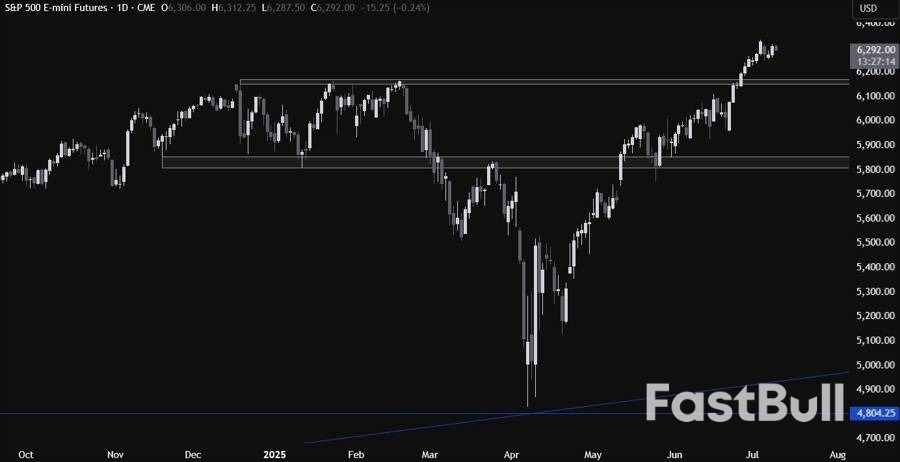
            S&P 500 Daily

            On the daily chart, we cansee that the S&P 500 is consolidating around the all-time highs after avery strong rally. From a risk management perspective, the buyers will have abetter risk to reward setup around the previous all-time high at 6,160-ishlevel to position for the continuation of the uptrend. The sellers, on theother hand, will want to see the price breaking lower to pile in for a dropinto the 6,000 level next.

            S&P 500 TechnicalAnalysis – 4 hour Timeframe

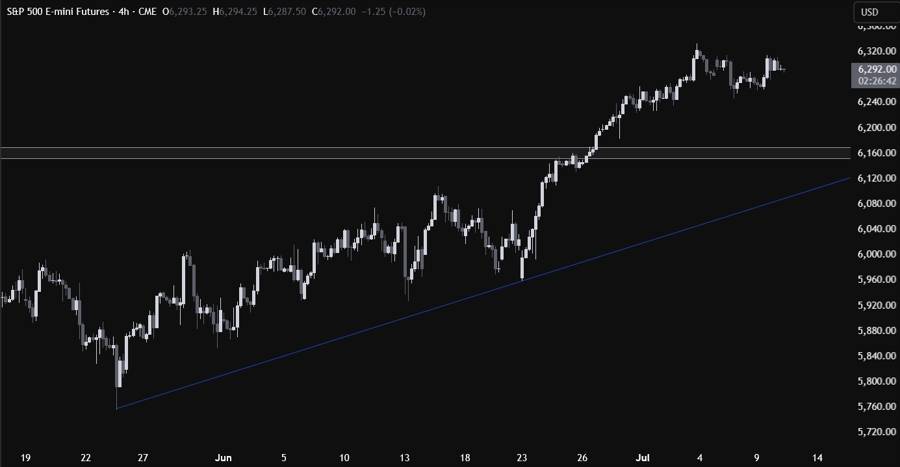
            S&P 500 4 hour

            On the 4 hour chart, we cansee that we have an upward trendline defining the uptrend. If we were toget a pullback all the way into the trendline, we can expect the dip-buyers tolean on it to position for a rally into new all-time highs with a better riskto reward setup. The sellers, on the other hand, will look for a break lower toincrease the bearish bets into the 5,800 level next.

            S&P 500 TechnicalAnalysis – 1 hour Timeframe

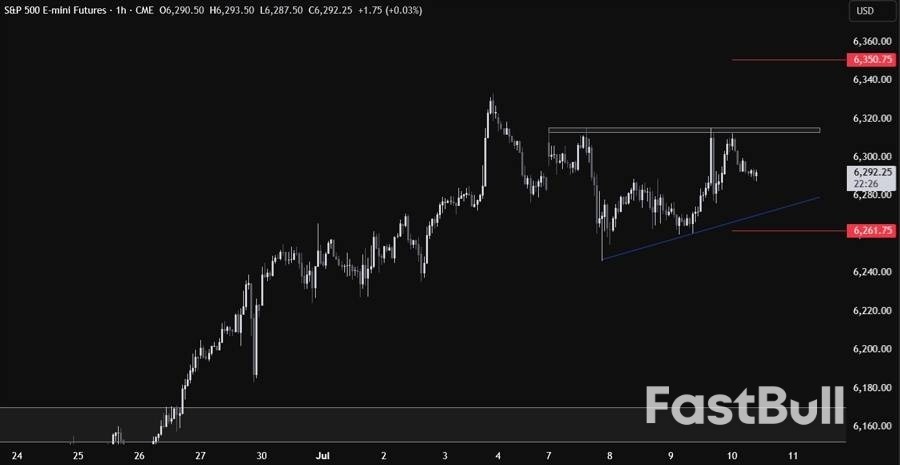
            S&P 500 1 hour

            On the 1 hour chart, we cansee that we have a minor resistance around the 6,315 level. The sellers willlikely continue to step in around the resistance with a defined risk above itto keep targeting a pullback into the 6,160 level. The buyers, on the otherhand, will look for a break higher to increase the bullish bets into newall-time highs.

            There’s also a minor upwardtrendline that can offer support for the dip-buyers, while the sellers willlikely increase the bearish bets into new lows on a breakout. The red linesdefine the average daily range for today.

            Source: ForexLive

            Risk Warnings and Disclaimers
            You understand and acknowledge that there is a high degree of risk involved in trading. Following any strategies or investment methods may lead to potential losses. The content on the site is provided by our contributors and analysts for information purposes only. You are solely responsible for determining whether any trading assets, securities, strategy, or any other product is suitable for investing based on your own investment objectives and financial situation.
            Add to Favorites
            Share

            European Telecom Firms Warn Against Deregulation Threatening Market Competition

            Gerik

            Economic

            Industry Opposition to Deregulatory Shift

            A coalition of European telecom operators has formally expressed concern over the European Commission’s recent proposal to ease regulation on fixed network infrastructure. In an open letter released on July 10, 2025, firms including Vodafone, Iliad, and 1&1 argued that the plan risks re-establishing monopolies by giving dominant national operators such as Deutsche Telekom in Germany unfair advantages. The proposal, they claim, undermines the EU’s longstanding competition principles and could severely constrain the growth of Europe’s fiber optic infrastructure.
            This resistance is rooted in the historical context of telecommunications in Europe, where former state-owned monopolies still control much of the essential network infrastructure. Under the current regulatory framework, these incumbents are obligated to provide access to competitors under regulated terms. The new plan would loosen these obligations, potentially eroding the competitive environment that smaller players depend on.

            Causal Risks to Fiber Optic Rollout and Market Balance

            The operators' criticism highlights a causal link between deregulation and reduced infrastructure access. If market leaders are no longer required to open their networks under fixed, transparent conditions, smaller telecom companies could find themselves locked out or forced to pay prohibitive access fees. This would not only reduce their competitiveness but also lead to underinvestment in rural or less profitable regions, where larger firms may not prioritize expansion.
            The letter frames this proposed policy change as a “step backwards,” suggesting that the relaxation of rules could lead to a form of structural re-monopolization. Rather than accelerating broadband rollout, as the EU may have intended, the policy could paradoxically stifle it by reducing competitive incentives for innovation and territorial expansion.

            Germany’s Policy Context and Broader Implications

            The timing of the letter is particularly significant, as it follows Germany's Bundestag decision earlier this month to pass legislation aimed at accelerating both fiber optic and mobile network growth. While the German law emphasizes speed and efficiency, the broader EU regulatory shift seems to threaten the competitive checks that made such expansion possible in the first place.
            The operators’ pushback underscores that regulatory flexibility should not come at the expense of equitable access. Without safeguards to prevent dominant firms from using their infrastructure advantages to block competitors, the overall quality, reach, and affordability of internet services across Europe could decline.
            As the EU considers loosening fixed network regulations, strong opposition from firms like Vodafone and Iliad signals deep industry concern over the potential re-emergence of monopolistic control. The current regulatory framework has fostered diversity and innovation by ensuring infrastructure access, particularly in the competitive broadband space. Weakening this model may offer short-term administrative relief but poses long-term threats to competition, consumer choice, and infrastructure development across the continent. The European Commission now faces a pivotal decision: whether to prioritize liberalization or uphold the regulatory foundations that have shaped Europe’s digital landscape.

            Source: Reuters

            To stay updated on all economic events of today, please check out our Economic calendar
            Risk Warnings and Disclaimers
            You understand and acknowledge that there is a high degree of risk involved in trading. Following any strategies or investment methods may lead to potential losses. The content on the site is provided by our contributors and analysts for information purposes only. You are solely responsible for determining whether any trading assets, securities, strategy, or any other product is suitable for investing based on your own investment objectives and financial situation.
            Add to Favorites
            Share
            FastBull
            Copyright © 2025 FastBull Ltd

            728 RM B 7/F GEE LOK IND BLDG NO 34 HUNG TO RD KWUN TONG KLN HONG KONG

            TelegramInstagramTwitterfacebooklinkedin
            App Store Google Play Google Play
            Products
            Charts

            Chats

            Q&A with Experts
            Screeners
            Economic Calendar
            Data
            Tools
            Membership
            Features
            Function
            Markets
            Copy Trading
            Latest Signals
            Contests
            News
            Analysis
            24/7
            Columns
            Education
            Company
            Careers
            About Us
            Contact Us
            Advertising
            Help Center
            Feedback
            User Agreement
            Privacy Policy
            Business

            White Label

            Data API

            Web Plug-ins

            Poster Maker

            Affiliate Program

            Risk Disclosure

            The risk of loss in trading financial instruments such as stocks, FX, commodities, futures, bonds, ETFs and crypto can be substantial. You may sustain a total loss of the funds that you deposit with your broker. Therefore, you should carefully consider whether such trading is suitable for you in light of your circumstances and financial resources.

            No decision to invest should be made without thoroughly conducting due diligence by yourself or consulting with your financial advisors. Our web content might not suit you since we don't know your financial conditions and investment needs. Our financial information might have latency or contain inaccuracy, so you should be fully responsible for any of your trading and investment decisions. The company will not be responsible for your capital loss.

            Without getting permission from the website, you are not allowed to copy the website's graphics, texts, or trademarks. Intellectual property rights in the content or data incorporated into this website belong to its providers and exchange merchants.

            Not Logged In

            Log in to access more features

            FastBull Membership

            Not yet

            Purchase

            Become a signal provider
            Help Center
            Customer Service
            Dark Mode
            Price Up/Down Colors

            Log In

            Sign Up

            Position
            Layout
            Fullscreen
            Default to Chart
            The chart page opens by default when you visit fastbull.com