Markets
News
Analysis
User
24/7
Economic Calendar
Education
Data
- Names
- Latest
- Prev


Signal Accounts for Members
All Signal Accounts
All Contests


The US Dollar Index Rose More Than 0.2% In Late New York Trading On Thursday (February 5), With The ICE Dollar Index Rising 0.24% To 97.849, Trading Between 97.607 And 97.915. The Bloomberg Dollar Index Rose 0.20% To 1194.03, Trading Between 1191.07 And 1194.76
Pentagon: State Dept Approves Potential Sale Of Contracted Logistical Services For Vacis Xpl Passenger Vehicle Scanning Systems To Iraq For $90 Million
When Asked If There Is A Temporary Agreement With Russia On New Start Treaty, White House Says 'Not To My Knowledge'
Iran's Press TV Says 'One Of The Country's Most Advanced Long-Range Ballistic Missile Khorramshahr 4' Has Been Deployed At Underground Missile City
Bank Of Canada Governor Macklem: Canadian Businesses Have Not Been Investing As Much And As Quickly In New Technologies As USA Competitors, And That Has Hurt Our Competitive Position
Apple CEO Tim Cook Has Vowed To Lobby On Capitol Hill On The Issue Of Immigration Under President Trump
Bank Of Canada Governor Macklem: Structural Headwinds Are Not Temporary, Our Trade Relationship With The United States Is Fundamentally Fractured
Bank Of Canada Governor Macklem: China Has Done Quite A Good Job Of Diversifying Away From The US To Other Asian Economies, To Some Extent To Europe
Bank Of Canada Governor Macklem: Right Now There Is An Unusually Rapid Amount Of Structural Change

France Industrial Output MoM (SA) (Dec)A:--
F: --
Italy IHS Markit Construction PMI (Jan)A:--
F: --
P: --
Euro Zone IHS Markit Construction PMI (Jan)A:--
F: --
P: --
Germany Construction PMI (SA) (Jan)A:--
F: --
P: --
Italy Retail Sales MoM (SA) (Dec)A:--
F: --
P: --
U.K. Markit/CIPS Construction PMI (Jan)A:--
F: --
P: --
France 10-Year OAT Auction Avg. YieldA:--
F: --
P: --
Euro Zone Retail Sales YoY (Dec)A:--
F: --
Euro Zone Retail Sales MoM (Dec)A:--
F: --
U.K. BOE MPC Vote Cut (Feb)A:--
F: --
P: --
U.K. BOE MPC Vote Hike (Feb)A:--
F: --
P: --
U.K. BOE MPC Vote Unchanged (Feb)A:--
F: --
P: --
U.K. Benchmark Interest RateA:--
F: --
P: --
MPC Rate Statement
U.S. Challenger Job Cuts (Jan)A:--
F: --
P: --
U.S. Challenger Job Cuts MoM (Jan)A:--
F: --
P: --
U.S. Challenger Job Cuts YoY (Jan)A:--
F: --
P: --
Bank of England Governor Bailey held a press conference on monetary policy.
Euro Zone ECB Marginal Lending RateA:--
F: --
P: --
Euro Zone ECB Deposit RateA:--
F: --
P: --
Euro Zone ECB Main Refinancing RateA:--
F: --
P: --
ECB Monetary Policy Statement
U.S. Weekly Initial Jobless Claims (SA)A:--
F: --
P: --
U.S. Initial Jobless Claims 4-Week Avg. (SA)A:--
F: --
P: --
U.S. Weekly Continued Jobless Claims (SA)A:--
F: --
ECB Press Conference
U.S. JOLTS Job Openings (SA) (Dec)A:--
F: --
U.S. EIA Weekly Natural Gas Stocks ChangeA:--
F: --
P: --
BOC Gov Macklem Speaks
Mexico Policy Interest RateA:--
F: --
P: --
U.S. Weekly Treasuries Held by Foreign Central Banks--
F: --
P: --
Reserve Bank of Australia Governor Bullock testified before Parliament.
Japan Foreign Exchange Reserves (Jan)--
F: --
P: --
India Benchmark Interest Rate--
F: --
P: --
India Cash Reserve Ratio--
F: --
P: --
India Repo Rate--
F: --
P: --
India Reverse Repo Rate--
F: --
P: --
Japan Leading Indicators Prelim (Dec)--
F: --
P: --
Germany Industrial Output MoM (SA) (Dec)--
F: --
P: --
Germany Exports MoM (SA) (Dec)--
F: --
P: --
U.K. Halifax House Price Index YoY (SA) (Jan)--
F: --
P: --
U.K. Halifax House Price Index MoM (SA) (Jan)--
F: --
P: --
France Trade Balance (SA) (Dec)--
F: --
P: --
Canada Leading Index MoM (Jan)--
F: --
P: --
India Deposit Gowth YoY--
F: --
P: --
Canada Employment (SA) (Jan)--
F: --
Canada Full-time Employment (SA) (Jan)--
F: --
Canada Part-Time Employment (SA) (Jan)--
F: --
Canada Unemployment Rate (SA) (Jan)--
F: --
P: --
Canada Labor Force Participation Rate (SA) (Jan)--
F: --
P: --
Due to the previous government shutdown, the release date of the US January non-farm payroll report has been changed to February 11.
Canada Ivey PMI (Not SA) (Jan)--
F: --
P: --
Canada Ivey PMI (SA) (Jan)--
F: --
P: --
U.S. 5-10 Year-Ahead Inflation Expectations (Feb)--
F: --
P: --
U.S. UMich Consumer Sentiment Index Prelim (Feb)--
F: --
P: --
U.S. UMich 1-Year-Ahead Inflation Expectations Prelim (Feb)--
F: --
P: --
U.S. UMich 5-Year-Ahead Inflation Expectations Prelim YoY (Feb)--
F: --
P: --
U.S. UMich Current Economic Conditions Index Prelim (Feb)--
F: --
P: --
U.S. UMich Consumer Expectations Index Prelim (Feb)--
F: --
P: --
China, Mainland Foreign Exchange Reserves (Jan)--
F: --
P: --
Russia Retail Sales YoY (Dec)--
F: --
P: --


No matching data
View All

No data
A close 5-4 BoE vote for a rate hold signals future cuts despite strong PMI data and dovish forecasts.
The Bank of England (BoE) has held its key interest rate steady at 3.75%, but a surprisingly close 5-4 vote has signaled a dovish shift, increasing the likelihood of future rate cuts.
While the decision to maintain the Bank Rate was expected, the narrow margin suggests the Monetary Policy Committee (MPC) is more divided than anticipated. This development has raised market expectations for a rate cut as early as March, though the final outcome will depend heavily on two upcoming labor market reports and inflation prints.
Four members of the committee dissented from the decision, voting instead to lower rates. The dissenters were Dhingra, Taylor, Ramsden, and Breeden.
The votes from Ramsden and Breeden were particularly noteworthy, as recent economic data had, if anything, pointed toward a more hawkish stance since the December meeting. Both members cited new analysis in the latest monetary policy report as a key factor in their decision, highlighting that structural changes in wage-setting are no longer expected to add significant inflationary pressure.
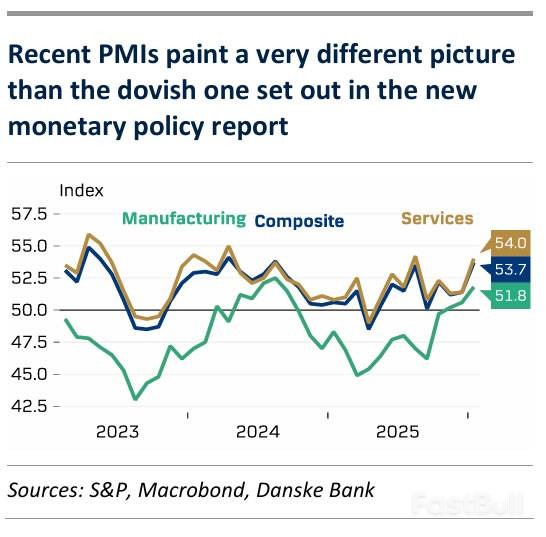
The Bank of England's new monetary policy report paints a distinctly more dovish picture of the UK economy. Compared to its November projections, the BoE now anticipates lower GDP growth, higher unemployment, and softer inflation.
Key forecast revisions include:
• CPI Inflation: Now projected to be 1.7% in the first quarter of 2027, down from the previous forecast of 2.2%.
• Annual GDP Growth: Revised downward by 0.3 percentage points to 1.2%.
Contrasting Signals from Recent Economic Data
This cautious outlook from the BoE contrasts sharply with recent PMI data, which suggests a more robust economy. The composite PMI recently hit its highest level in three years, and price indices within the report indicate that inflationary pressures could be more sustained. Upcoming data will be crucial in clarifying which of these conflicting signals more accurately reflects the state of the UK economy.
The timing of the next rate cut appears to rest heavily on Governor Andrew Bailey, who has indicated a readiness to ease policy. Bailey noted that the two cuts currently priced in by markets seem fair.
While the timing will ultimately hinge on incoming data, the bar for further cuts has likely been raised as the Bank Rate approaches neutral levels. A first rate cut is projected for April, with another potentially following in November.
In currency markets, the EUR/GBP pair traded higher following the announcement, supporting expectations for a weaker pound. The forecast for EUR/GBP is 0.89 over a 12-month horizon, driven by narrowing interest rate differentials, a relatively weaker growth outlook for the UK, and a positive correlation to a weaker U.S. dollar environment.
Bitcoin's price has dropped below the $71,000 mark, wiping out all gains accumulated since President Donald Trump's 2024 re-election. The leading cryptocurrency plunged over 7% on Thursday, extending a sharp decline that began in mid-January.
As of 04:30 GMT, Bitcoin was trading around $70,900. This latest slide brings the digital asset's total loss to nearly 20% since the start of the year.

The current downturn follows a period of extreme volatility. Bitcoin first crossed the $100,000 threshold in December 2024 and revisited that price point in both February and May 2025. However, the asset has been on a largely downward trajectory since hitting an all-time high of more than $127,000 in October.
The earlier bull run was fueled by President Trump's re-election, which sparked market expectations for a lighter touch on digital asset regulation after years of government crackdowns.
During his campaign, Trump pledged to make the U.S. the world's cryptocurrency capital. Before winning the vote, he and his sons launched their own crypto firm, World Liberty Financial. Shortly after taking office, the administration announced plans for a strategic crypto reserve that would include Bitcoin and four other cryptocurrencies.
Despite these pro-crypto signals, a Trump-backed bill to regulate cryptocurrency trading has stalled in the U.S. Senate. Disagreements between traditional banks and crypto firms have created a legislative deadlock, casting a shadow of uncertainty over the industry.
Adding to market jitters, Democratic lawmaker Ro Khanna announced on Wednesday that he would investigate World Liberty Financial. The move followed a report from The Wall Street Journal stating that representatives of an Abu Dhabi official had signed a $500 million deal to acquire a 49 percent stake in Trump's new crypto venture.
The negative sentiment was not confined to crypto. Equities and commodities markets also posted significant losses on Thursday, indicating a wider risk-off mood among investors.
• Silver: Dropped by as much as 16%.
• Hong Kong Stocks: The benchmark index fell by approximately 1.3%.
• Japanese Stocks: The benchmark index declined by about 0.7%.
A diplomatic dispute has erupted between the United States and Poland after the U.S. ambassador in Warsaw, Tom Rose, announced he was cutting off all contact with Poland's parliament speaker. The move followed the speaker's public criticism of Donald Trump and his refusal to support a Nobel Peace Prize nomination for the former president.
The sharp exchange, which played out on the social media platform X, prompted a direct response from Polish Prime Minister Donald Tusk and exposed deep political divisions within Poland over its relationship with Washington.
The conflict began on Monday when Parliament Speaker Wlodzimierz Czarzasty declared he would not back an initiative to nominate Donald Trump for the 2026 Nobel Peace Prize. The proposal, spearheaded by U.S. House Speaker Mike Johnson and Israeli Knesset Speaker Amir Ohana, cited Trump's efforts to foster peace in the Middle East.
Czarzasty, who leads The Left party in Poland's ruling coalition, was unequivocal in his opposition.
"In my opinion, President Trump is destabilising the situation in these (international) organisations by representing the politics of force and using force to pursue a transactional policy," he told journalists. "All of this means that I will not support President Trump's Nobel Prize nomination because he doesn't deserve it."
On Thursday, Ambassador Rose issued a furious public rebuke, stating that Washington would cease all engagement with the speaker.
"Effective immediately, the United States will have no further dealings, contacts, or communications with Mr. Czarzasty," Rose wrote on X. He accused the speaker of directing "outrageous and unprovoked insults" at Trump, calling him "a serious impediment to our excellent relations with Prime Minister Tusk and his government."
Rose added: "We will not permit anyone to harm U.S.–Polish relations, nor disrespect (Trump) who has done so much for Poland and the Polish people."
In his own post on X, Czarzasty said he regretted the ambassador's reaction but affirmed he would not change his position on fundamental issues.
The ambassador's statement drew a pointed reply from Polish Prime Minister Donald Tusk, who pushed back against the American envoy's tone.
"Mr. Ambassador Rose, allies should respect, not lecture, each other. At least this is how we here in Poland understand partnership," Tusk wrote.
The incident also highlighted the starkly different approaches to the U.S. between Tusk's pro-European government and Poland's nationalist opposition, which is more aligned with Trump's "Make America Great Again" movement.
Rafal Leskiewicz, a spokesman for Polish President Karol Nawrocki, sided with the U.S. ambassador, telling the PAP news agency that the speaker's comments were a mistake. "The current ruling coalition chose as parliamentary speaker a man who does not understand the importance and significance of alliances," Leskiewicz said.
Politics in Haiti has become a lethal game. The country's last elected president, Jovenel Moïse, was assassinated by mercenaries in 2021, plunging the nation into a spiral of extreme gang violence. Since then, thousands have been killed or abducted as criminals seized control of roughly 90% of the capital, Port-au-Prince, bringing legitimate economic activity to a standstill.
Now, a new crisis looms as the country faces the prospect of having no government at all. The Transitional Presidential Council (TPC), established to steer the nation, was scheduled to dissolve on February 7, but vicious infighting has erupted over who will hold power next. This internal conflict not only threatens Haiti's future but also the fate of a planned United Nations security mission.
The TPC was formed in April 2024 out of negotiations led by the Caribbean Community (Caricom) after gangs physically prevented then-interim president Ariel Henri from returning to Haiti. With the parliament already dissolved in 2020, the council was meant to provide stability until new elections could be held. The original goal was to hold a vote in late 2025 and seat a new government by February 8, 2026.
That plan has completely unraveled. The TPC has been paralyzed by political maneuvering and efforts by its members to protect armed allies and secure resources. Its first prime minister, Gary Conille, was forced to resign after just six months.
More recently, several council members attempted a palace coup to oust Prime Minister Alix Didier Fils-Aimé while proposing a new, smaller council that would conveniently include them. The threat of council members mobilizing gangs to intimidate rivals and the international community is palpable.
The United States has responded by parking a warship and three coast guard cutters off the Haitian coast. It also imposed visa restrictions on five TPC members. In late January, US Secretary of State Marco Rubio stated he had spoken with Fils-Aimé, emphasizing "the importance of his continued tenure" to fight "terrorist gangs and stabilize the island." Rubio added that the TPC "must be dissolved by February 7 without corrupt actors."
The council’s failure to establish basic security has had devastating consequences. According to UN Secretary General António Guterres, 8,100 people were killed between January and November 2025 alone in the nation of 11 million—a 20% increase from 2024. Sexual violence has also surged.
This chaos has made holding credible elections impossible. The prevailing view is that any attempt to organize a vote would allow gangs to formally take over the government, whether through coercion, campaign support, or by running their own candidates. With the interim government's own future uncertain after February 8, even an updated plan for elections in late 2026 appears highly unrealistic.
The economic toll has been staggering. The World Bank estimates that by 2024, the crisis was costing Haiti nearly $10 billion a year in lost economic activity, with small and medium-sized enterprises hit particularly hard.
The political vacuum directly jeopardizes a critical UN mission designed to deploy an 11,000-strong multinational Gang Suppression Force (GSF). The force's objective is to crack down on gang leaders and retake control of vital infrastructure like transportation hubs. However, such a mission cannot succeed without an effective and credible government partner in Haiti.
Even if a new governing authority is hastily assembled, it is unlikely to have broad support. For decades, a recurring pattern in Haiti has seen corrupt political and business figures who are shut out of power use their gang contacts to create chaos. This "street veto" effectively cripples any new government before it can begin its most urgent task: reforming Haiti's security and judicial systems.
A viable long-term solution requires more than just military action. It demands a complete overhaul of Haiti's police, military, and intelligence services, alongside a fair and efficient court system to deliver justice and accountability for the brutal crimes committed daily.
Compounding Haiti’s internal problems is a sharp decline in global development funding. With the US Agency for Development (USAID) abolished by the Donald Trump administration and subsequent aid cuts by the UK, Canada, and the EU, critical resources are drying up.
This funding shortfall could prove fatal. Programs essential for long-term stability—such as disarmament, demobilization, and reintegrating former gang members into society—will likely have scant resources. Without projects to rebuild communities and generate jobs, there is no legal alternative to a life of crime, and many will simply return to violence.
With traditional aid shrinking, new approaches are needed. This could include direct country donations to the UN trust fund for Haiti, closer collaboration between private philanthropies and development banks, and better leveraging of remittances from the Haitian diaspora. But these initiatives require coordination, likely through a major donors' conference for Haiti—an event no one has yet offered to host.

USDJPY - daily
USDJPY - 4 hour
USDJPY - 1 hourU.S. Senator Elizabeth Warren is urging Treasury Secretary Scott Bessent to terminate a $20 billion currency swap line established with Argentina last year. As the leading Democrat on the Senate Banking Committee, Warren argues the financial backstop was a temporary measure that has now served its purpose.
In a letter sent Wednesday, Warren reminded Bessent that the Treasury had framed the agreement as a tool for "acute, short-term and urgent" economic needs. The original goal was to provide a bridge for Argentine President Javier Milei's government through critical October elections while it pursued economic reforms.
Warren’s main concern is that the swap facility remains active, creating the possibility of continued use well beyond its initial scope.
"Despite Treasury's assertion that its use of the (Exchange Stabilization Fund) was for an 'acute, short-term and urgent' purpose, it appears—by leaving the (exchange stabilization arrangement) in place—to have left open the possibility of continued use of the ESF in Argentina well after the October 2025 elections," Warren wrote.
She contends that keeping the arrangement open contradicts the Treasury's original assurances to Congress.
The Treasury Department signed the currency swap agreement with Argentina just before a key midterm election, as concerns mounted over the country's economic stability.
The facility provided Argentina's central bank with crucial funds to support the value of the peso and stave off a potential devaluation ahead of the vote. The funds were deployed in October for two primary purposes:
• Repaying debt to the International Monetary Fund (IMF).
• Replenishing foreign currency reserves used to defend the peso's exchange rate.
The election ultimately saw President Javier Milei, a close ally of U.S. President Donald Trump, succeed in expanding his influence within the country's legislatures.
Warren noted that Secretary Bessent had previously told the committee that Argentina had already repaid its limited draw on the facility in full. She also mentioned that the Exchange Stabilization Fund (ESF) no longer holds any Argentine pesos.
However, there has been no official confirmation that the swap line itself is closed. Warren has requested written confirmation of its termination by February 12.
Bessent is scheduled to testify before the Senate Banking Committee on Thursday. Officials from Argentina's foreign and economy ministries did not provide an immediate response when asked for comment.
The risk of loss in trading financial instruments such as stocks, FX, commodities, futures, bonds, ETFs and crypto can be substantial. You may sustain a total loss of the funds that you deposit with your broker. Therefore, you should carefully consider whether such trading is suitable for you in light of your circumstances and financial resources.
No decision to invest should be made without thoroughly conducting due diligence by yourself or consulting with your financial advisors. Our web content might not suit you since we don't know your financial conditions and investment needs. Our financial information might have latency or contain inaccuracy, so you should be fully responsible for any of your trading and investment decisions. The company will not be responsible for your capital loss.
Without getting permission from the website, you are not allowed to copy the website's graphics, texts, or trademarks. Intellectual property rights in the content or data incorporated into this website belong to its providers and exchange merchants.
Not Logged In
Log in to access more features
Log In
Sign Up