• Trade
  • Markets
  • Copy
  • Contests
  • News
  • 24/7
  • Calendar
  • Q&A
  • Chats
Trending
Screeners
SYMBOL
LAST
BID
ASK
HIGH
LOW
NET CHG.
%CHG.
SPREAD
SPX
S&P 500 Index
6857.13
6857.13
6857.13
6865.94
6827.13
+7.41
+ 0.11%
--
DJI
Dow Jones Industrial Average
47850.93
47850.93
47850.93
48049.72
47692.96
-31.96
-0.07%
--
IXIC
NASDAQ Composite Index
23505.13
23505.13
23505.13
23528.53
23372.33
+51.04
+ 0.22%
--
USDX
US Dollar Index
98.760
98.840
98.760
98.980
98.760
-0.220
-0.22%
--
EURUSD
Euro / US Dollar
1.16673
1.16681
1.16673
1.16681
1.16408
+0.00228
+ 0.20%
--
GBPUSD
Pound Sterling / US Dollar
1.33568
1.33577
1.33568
1.33585
1.33165
+0.00297
+ 0.22%
--
XAUUSD
Gold / US Dollar
4229.99
4230.33
4229.99
4230.48
4194.54
+22.82
+ 0.54%
--
WTI
Light Sweet Crude Oil
59.378
59.415
59.378
59.469
59.187
-0.005
-0.01%
--

Community Accounts

Signal Accounts
--
Profit Accounts
--
Loss Accounts
--
View More

Become a signal provider

Sell trading signals to earn additional income

View More

Guide to Copy Trading

Get started with ease and confidence

View More

Signal Accounts for Members

All Signal Accounts

Best Return
  • Best Return
  • Best P/L
  • Best MDD
Past 1W
  • Past 1W
  • Past 1M
  • Past 1Y

All Contests

  • All
  • Trump Updates
  • Recommend
  • Stocks
  • Cryptocurrencies
  • Central Banks
  • Featured News
Top News Only
Share

Equinor: Preliminary Estimates Indicate Reservoirs May Contain Between 5 -18 Million Standard Cubic Meters Of Recoverable Oil Equivalents

Share

Japan Chief Cabinet Secretary Kihara: Government To Take Appropriate Steps On Excessive And Disorderly Moves In Foreign Exchange Market, If Necessary

Share

[Report: Amazon Pays €180 Million To Italy To End Tax And Labor Investigations] Amazon Has Paid A Settlement And Dismantled Its Monitoring System For Delivery Drivers In Italy, Ending An Investigation Into Alleged Tax Fraud And Illegal Labor Practices. In July 2024, The Group's Logistics Services Division Was Accused Of Circumventing Labor And Tax Laws By Relying On Cooperatives Or Limited Liability Companies To Supply Workers, Evading VAT, And Reducing Social Security Payments. Sources Say The Group Has Now Paid Approximately €180 Million To Italian Tax Authorities As Part Of A €1 Billion Settlement Involving 33 Companies

Share

Airbus - Booked 797 Gross Aircraft Orders In January-November

Share

[Market Update] Spot Gold Broke Through $4,230 Per Ounce, Up 0.51% On The Day

Share

Reserve Bank Of India Chief Malhotra: There Will Be Ample Liquidity As Long As We Are In An Easing Cycle

Share

Reserve Bank Of India Chief Malhotra: Quantum Of System Liquidity Will Be Managed To Ensure Monetary Transmission Is Happening

Share

China's Foreign Ministry: World Bank, IMF, WTO Top Officials To Join

Share

China's Foreign Ministry: China To Hold 1+1 Dialogue With International Economic Orgs On Dec 9

Share

Reserve Bank Of India Chief Malhotra: 5% Of Inr Depreciation Leads To 35 Bps Of Inflation

Share

Eurostoxx 50 Futures Up 0.14%, DAX Futures Up 0.12%, CAC 40 Futures Up 0.26%, FTSE Futures Up 0.03%

Share

Getlink - Over 1 Million Trucks Crossed Channel Since January 2025

Share

Malaysia International Reserves At $124.1 Billion On November 28 Versus$124.1 Billion On November 14 - Central Bank

Share

Reserve Bank Of India Chief Malhotra: Conscious Effort On Diversifying Gold Reserves

Share

Russian President Putin Thanks Indian Prime Minister Modi For Attention To Ukraine Peace Efforts

Share

Russian President Putin: India-Russia Relations Should Grow And Touch New Heights

Share

Russian President Putin: India Is Not Neutral, India Is On The Side Of Peace

Share

Russian President Putin: We Support Every Effort Towards Peace

Share

Russian President Putin: The World Should Return To Peace

Share

India Prime Minister Modi: We Should All Pursue Peace Together

TIME
ACT
FCST
PREV
Euro Zone IHS Markit Construction PMI (Nov)

A:--

F: --

P: --

Italy IHS Markit Construction PMI (Nov)

A:--

F: --

P: --

U.K. Markit/CIPS Construction PMI (Nov)

A:--

F: --

P: --

France 10-Year OAT Auction Avg. Yield

A:--

F: --

P: --

Euro Zone Retail Sales MoM (Oct)

A:--

F: --

P: --

Euro Zone Retail Sales YoY (Oct)

A:--

F: --

P: --

Brazil GDP YoY (Q3)

A:--

F: --

P: --

U.S. Challenger Job Cuts (Nov)

A:--

F: --

P: --

U.S. Challenger Job Cuts MoM (Nov)

A:--

F: --

P: --

U.S. Challenger Job Cuts YoY (Nov)

A:--

F: --

P: --

U.S. Initial Jobless Claims 4-Week Avg. (SA)

A:--

F: --

P: --

U.S. Weekly Initial Jobless Claims (SA)

A:--

F: --

P: --

U.S. Weekly Continued Jobless Claims (SA)

A:--

F: --

P: --

Canada Ivey PMI (SA) (Nov)

A:--

F: --

P: --

Canada Ivey PMI (Not SA) (Nov)

A:--

F: --

P: --

U.S. Non-Defense Capital Durable Goods Orders Revised MoM (Excl. Aircraft) (SA) (Sept)

A:--

F: --

P: --
U.S. Factory Orders MoM (Excl. Transport) (Sept)

A:--

F: --

P: --

U.S. Factory Orders MoM (Sept)

A:--

F: --

P: --

U.S. Factory Orders MoM (Excl. Defense) (Sept)

A:--

F: --

P: --

U.S. EIA Weekly Natural Gas Stocks Change

A:--

F: --

P: --

Saudi Arabia Crude Oil Production

A:--

F: --

P: --

U.S. Weekly Treasuries Held by Foreign Central Banks

A:--

F: --

P: --

Japan Foreign Exchange Reserves (Nov)

A:--

F: --

P: --

India Repo Rate

A:--

F: --

P: --

India Benchmark Interest Rate

A:--

F: --

P: --

India Reverse Repo Rate

A:--

F: --

P: --

India Cash Reserve Ratio

A:--

F: --

P: --

Japan Leading Indicators Prelim (Oct)

A:--

F: --

P: --

U.K. Halifax House Price Index YoY (SA) (Nov)

A:--

F: --

P: --

U.K. Halifax House Price Index MoM (SA) (Nov)

A:--

F: --

P: --

France Current Account (Not SA) (Oct)

--

F: --

P: --

France Trade Balance (SA) (Oct)

--

F: --

P: --

France Industrial Output MoM (SA) (Oct)

--

F: --

P: --

Italy Retail Sales MoM (SA) (Oct)

--

F: --

P: --

Euro Zone Employment YoY (SA) (Q3)

--

F: --

P: --

Euro Zone GDP Final YoY (Q3)

--

F: --

P: --

Euro Zone GDP Final QoQ (Q3)

--

F: --

P: --

Euro Zone Employment Final QoQ (SA) (Q3)

--

F: --

P: --

Euro Zone Employment Final (SA) (Q3)

--

F: --

P: --
Brazil PPI MoM (Oct)

--

F: --

P: --

Mexico Consumer Confidence Index (Nov)

--

F: --

P: --

Canada Unemployment Rate (SA) (Nov)

--

F: --

P: --

Canada Labor Force Participation Rate (SA) (Nov)

--

F: --

P: --

Canada Employment (SA) (Nov)

--

F: --

P: --

Canada Part-Time Employment (SA) (Nov)

--

F: --

P: --

Canada Full-time Employment (SA) (Nov)

--

F: --

P: --

U.S. Personal Income MoM (Sept)

--

F: --

P: --

U.S. Dallas Fed PCE Price Index YoY (Sept)

--

F: --

P: --

U.S. PCE Price Index YoY (SA) (Sept)

--

F: --

P: --

U.S. PCE Price Index MoM (Sept)

--

F: --

P: --

U.S. Personal Outlays MoM (SA) (Sept)

--

F: --

P: --

U.S. Core PCE Price Index MoM (Sept)

--

F: --

P: --

U.S. UMich 5-Year-Ahead Inflation Expectations Prelim YoY (Dec)

--

F: --

P: --

U.S. Core PCE Price Index YoY (Sept)

--

F: --

P: --

U.S. Real Personal Consumption Expenditures MoM (Sept)

--

F: --

P: --

U.S. 5-10 Year-Ahead Inflation Expectations (Dec)

--

F: --

P: --

U.S. UMich Current Economic Conditions Index Prelim (Dec)

--

F: --

P: --

U.S. UMich Consumer Sentiment Index Prelim (Dec)

--

F: --

P: --

U.S. UMich 1-Year-Ahead Inflation Expectations Prelim (Dec)

--

F: --

P: --

U.S. UMich Consumer Expectations Index Prelim (Dec)

--

F: --

P: --

Q&A with Experts
    • All
    • Chatrooms
    • Groups
    • Friends
    Connecting
    .
    .
    .
    Type here...
    Add Symbol or Code

      No matching data

      All
      Trump Updates
      Recommend
      Stocks
      Cryptocurrencies
      Central Banks
      Featured News
      • All
      • Russia-Ukraine Conflict
      • Middle East Flashpoint
      • All
      • Russia-Ukraine Conflict
      • Middle East Flashpoint

      Search
      Products

      Charts Free Forever

      Chats Q&A with Experts
      Screeners Economic Calendar Data Tools
      Membership Features
      Data Warehouse Market Trends Institutional Data Policy Rates Macro

      Market Trends

      Market Sentiment Order Book Forex Correlations

      Top Indicators

      Charts Free Forever
      Markets

      News

      News Analysis 24/7 Columns Education
      From Institutions From Analysts
      Topics Columnists

      Latest Views

      Latest Views

      Trending Topics

      Top Columnists

      Latest Update

      Signals

      Copy Rankings Latest Signals Become a signal provider AI Rating
      Contests
      Brokers

      Overview Brokers Assessment Rankings Regulators News Claims
      Broker listing Forex Brokers Comparison Tool Live Spread Comparison Scam
      Q&A Complaint Scam Alert Videos Tips to Detect Scam
      More

      Business
      Events
      Careers About Us Advertising Help Center

      White Label

      Data API

      Web Plug-ins

      Affiliate Program

      Awards Institution Evaluation IB Seminar Salon Event Exhibition
      Vietnam Thailand Singapore Dubai
      Fans Party Investment Sharing Session
      FastBull Summit BrokersView Expo
      Recent Searches
        Top Searches
          Markets
          News
          Analysis
          User
          24/7
          Economic Calendar
          Education
          Data
          • Names
          • Latest
          • Prev

          View All

          No data

          Scan to Download

          Faster Charts, Chat Faster!

          Download App
          English
          • English
          • Español
          • العربية
          • Bahasa Indonesia
          • Bahasa Melayu
          • Tiếng Việt
          • ภาษาไทย
          • Français
          • Italiano
          • Türkçe
          • Русский язык
          • 简中
          • 繁中
          Open Account
          Search
          Products
          Charts Free Forever
          Markets
          News
          Signals

          Copy Rankings Latest Signals Become a signal provider AI Rating
          Contests
          Brokers

          Overview Brokers Assessment Rankings Regulators News Claims
          Broker listing Forex Brokers Comparison Tool Live Spread Comparison Scam
          Q&A Complaint Scam Alert Videos Tips to Detect Scam
          More

          Business
          Events
          Careers About Us Advertising Help Center

          White Label

          Data API

          Web Plug-ins

          Affiliate Program

          Awards Institution Evaluation IB Seminar Salon Event Exhibition
          Vietnam Thailand Singapore Dubai
          Fans Party Investment Sharing Session
          FastBull Summit BrokersView Expo

          Nvidia–Intel Deal: What It Means For The AI Ecosystem

          SAXO

          Economic

          Stocks

          Forex

          Summary:

          Key points: A new alliance reshapes AI computing: Nvidia’s $5B investment in Intel is not just financial support—it puts Intel b

          Key points:

          ● A new alliance reshapes AI computing: Nvidia’s $5B investment in Intel is not just financial support—it puts Intel back at the center of the AI ecosystem by making its CPUs a core part of Nvidia’s GPU platforms.
          ● Winners and losers emerge: Intel gains credibility, Nvidia expands its reach, and supply chain players like TSMC, SK Hynix, Micron, ASML, Synopsys, and Japan’s Tokyo Electron benefit from rising complexity. On the other hand, AMD and Arm risk losing share as Intel’s CPUs get tightly integrated with Nvidia.
          ● Strategic implications go beyond business: The deal reflects a broader U.S. effort to consolidate semiconductor leadership against China, while also planting seeds for Intel Foundry to become a long-term alternative to TSMC.

          Nvidia’s $5 billion investment in Intel and their plan to co-develop custom chips is one of the most consequential alliances in U.S. technology in recent years. It comes just weeks after the U.S. government took a direct stake in Intel, underscoring how strategic semiconductors have become in the U.S.–China rivalry.

          For investors, the deal reshapes the AI computing landscape, with implications stretching from Nvidia and Intel themselves to the entire global supply chain.

          What the deal means

          Nvidia will acquire Intel shares at $23.28 each and the two companies will collaborate on custom data-center and PC chips. These products will combine Intel’s x86 CPUs with Nvidia’s graphics and interconnect technologies, such as NVLink and RTX GPU chiplets.

          In simple terms:

          ● For AI servers: Intel will design custom CPUs that fit perfectly with NVIDIA’s GPUs.
          ● For PCs: They’ll build new “AI PC” chips that combine Intel’s processors with NVIDIA’s RTX graphics.

          Importantly, NVIDIA is not moving its chip manufacturing to Intel yet. This is more about design and partnership than production. But geopolitically, it signals a stronger U.S. push to consolidate domestic semiconductor leadership.

          Impact on Intel

          For years, Intel’s processors were treated as basic connectors between GPUs and the rest of the system. With Nvidia now co-developing CPUs that plug directly into its GPUs, Intel’s chips move from a supporting role to a core driver of performance.If you control the world’s most entrenched ecosystem—Windows and x86—and suddenly those chips plug directly into Nvidia’s GPU mesh, you are no longer on the sidelines. Intel, long dismissed as lagging in the AI race, has been pulled back into the center of the conversation.

          If you control the entrenched Windows and x86 ecosystem and can now integrate seamlessly into Nvidia’s GPU clusters, you are back in the game in a very real way. In the short run, this gives Intel fresh credibility with customers. Longer term, it plants seeds for Nvidia to eventually use Intel’s foundry as a second manufacturing source if TSMC capacity becomes strained or geopolitics intervene.Intel’s execution challenges remain, however. Its foundry division still has to prove it can scale efficiently.

          Impact on Nvidia

          For Nvidia, the partnership provides flexibility and reach. The company already has ARM-based Grace CPUs, but adding Intel’s x86 architecture broadens its appeal to enterprises that prefer to stick with familiar systems. This strengthens Nvidia’s grip on AI data centers and opens the door to new categories of AI PCs.The deal also helps Nvidia entrench NVLink as the standard interconnect, making its platform harder to dislodge. Political goodwill is another side benefit, as Nvidia shows alignment with U.S. industrial policy.

          Still, risks remain. Nvidia must balance the Intel tie-up with its own CPU roadmap, and the deal does not resolve bottlenecks in advanced manufacturing or memory. It will remain heavily dependent on TSMC for leading-edge production and on SK Hynix and Micron for scarce high-bandwidth memory.

          Implications for U.S. Tech

          The bigger picture is that this partnership represents a form of U.S. technology consolidation. Intel, Nvidia, and the government are aligned in reinforcing domestic leadership at a time when China is rapidly developing its own AI chips.It is unlikely to stop at Intel, and other U.S. chipmakers could also be drawn into similar public–private partnerships as Washington deepens its commitment to securing semiconductor supply chains.

          Supply chain beneficiaries

          The deal’s impact extends far beyond Nvidia and Intel.

          ● Foundries: TSMC remains essential for Nvidia’s flagship GPUs and interconnect chips, but its dominance looks marginally less secure as Intel Foundry gains a potential future role.
          ● Memory suppliers: SK Hynix, Micron, and Samsung stand to benefit from rising demand for HBM, which remains the bottleneck in AI server performance.
          ● Chip design tools: Companies like ASML, Synopsys and Japan’s Lasertec stand to benefit, as as more complex chip designs drive demand for advanced tools.
          ● Server and PC makers: Companies such as Super Micro Computer in the U.S. should see increased demand for AI-optimized systems. PC makers including Dell, HP, and Lenovo could also benefit if AI PCs gain traction.
          ● Networking: Broadcom and Marvell will remain integral to scaling data-center networks, even as Nvidia pushes its proprietary NVLink technology.
          ● Japan and Taiwan equipment/materials: Tokyo Electron, Shin-Etsu Chemical, and Taiwanese packaging firms could see upside from capacity expansion.

          On the other side, AMD could lose relative share in CPUs and PC chips as Intel leverages Nvidia’s ecosystem. Smaller challengers without clear integration into the Nvidia–Intel world may also find it harder to compete.Arm also loses momentum. Cloud providers had been tempted by Arm’s efficiency pitch and the potential of Nvidia’s Grace CPUs. But with x86 systems now offering direct NVLink bandwidth and maintaining enterprise software compatibility, the incentive to shift workloads to Arm has weakened considerably.

          For a curated list of stocks across the AI value chain, see Saxo’s AI stocks shortlist.

          Risks for investors

          As with any large partnership, execution risk is significant. New CPUs and PC systems must be delivered on time and at competitive efficiency levels. Supply bottlenecks in HBM and advanced packaging remain tight, which could limit upside. Finally, the geopolitical backdrop is volatile: U.S. stakes in Intel and export restrictions on China mean regulatory or political developments could quickly affect sentiment.

          Investor takeaways

          This deal reshuffles the AI competitive landscape. Nvidia now extends its dominance into the CPU layer, Intel reclaims a meaningful seat at the AI table, AMD and Arm face strategic headwinds, and toolmakers like ASML, Synopsys, and Lasertec become even more indispensable.

          In summary,

          ● Short term: Intel enjoys a credibility boost, Nvidia consolidates ecosystem power.
          ● Medium term: Supply chain beneficiaries—TSMC, HBM suppliers, ASML, Synopsys, and Lasertec—are well positioned as complexity and capacity rise.
          ● Long term: Intel Foundry becomes the wildcard. If execution improves, it could emerge as Nvidia’s insurance policy against TSMC dependence.

          The bottom line: Nvidia and Intel have redrawn the AI map. Investors should balance exposure between U.S. technology leaders and Asian supply chain enablers, with a tilt toward companies that profit regardless of who wins the CPU–GPU rivalry.

          This material is marketing content and should not be regarded as investment advice. Trading financial instruments carries risks and historic performance is not a guarantee of future results. The instrument(s) referenced in this content may be issued by a partner, from whom Saxo receives promotional fees, payment or retrocessions. While Saxo may receive compensation from these partnerships, all content is created with the aim of providing clients with valuable information and options..

          Source: SAXO

          To stay updated on all economic events of today, please check out our Economic calendar
          Risk Warnings and Disclaimers
          You understand and acknowledge that there is a high degree of risk involved in trading. Following any strategies or investment methods may lead to potential losses. The content on the site is provided by our contributors and analysts for information purposes only. You are solely responsible for determining whether any trading assets, securities, strategy, or any other product is suitable for investing based on your own investment objectives and financial situation.
          Add to Favorites
          Share

          Global Investors Embrace “Hedge America” Trade as Dollar Slides Despite U.S. Market Strength

          Gerik

          Economic

          From 'Sell America' to 'Hedge America'

          Contrary to early-2025 concerns of a global divestment from U.S. markets due to Donald Trump's aggressive tariff policies and political volatility, international investors have instead doubled down on American equities and bonds. However, they are now doing so with a twist hedging their dollar exposure at record rates to insulate returns from further depreciation of the U.S. currency.
          This strategy dubbed the “Hedge America” trade represents a subtle yet powerful shift in global capital behavior. Investors still trust U.S. financial markets but are actively protecting themselves against foreign exchange losses as the dollar weakens.

          Dollar Hedging Surges Amid Weak Greenback and Rate Cuts

          Since mid-2025, dollar-hedged exchange-traded funds (ETFs) have attracted more inflows than unhedged funds for the first time this decade. This shift aligns with the dollar's 9% decline so far this year, its worst half-year performance since the 1970s. The U.S. Federal Reserve’s recent rate cut and signals of further easing have made hedging cheaper, accelerating the trend.
          Institutions such as Nuveen and Ninety One Asset Management suggest that this momentum is far from over. Sahil Mahtani from Ninety One projects that global investors may shift up to $1 trillion into currency-hedged U.S. assets, largely restoring hedge ratios to their pre-2010 levels.

          How the Hedging Works and Why It Matters

          The primary method used is forward contracts to sell dollars, locking in favorable exchange rates. This action impacts spot markets, creating real downward pressure on the dollar. Interest rate differentials play a key role in determining the cost of these contracts with falling U.S. rates making hedging more attractive.
          Wall Street firms including Deutsche Bank, SocGen, and BNP Paribas forecast continued dollar weakness into 2026, amplified by this hedging wave. State Street data shows hedge ratios on U.S. assets held by foreigners have stabilized around 56%, down from 70% in 2023, but with plenty of room to rise again.

          Trump’s Policies Amplify Investor Caution

          The return of Donald Trump to the political stage accompanied by sweeping tariffs, pressure on the Fed, and firings of public officials has introduced a new layer of uncertainty. Analysts note that such interventions raise doubts about central bank independence and macroeconomic stability, further incentivizing investors to hedge even as they buy more Treasuries and equities.
          A notable quote from Standard Bank’s Steven Barrow encapsulates this view: “Love U.S. assets, but hate the dollar.”

          Global Rebalancing: From Europe to Asia

          Pension funds and institutions in Europe and Asia including those in Sweden, Denmark, Finland, and Taiwan have begun adjusting hedge ratios upward. Major portfolio managers like Eleva Capital and Palinuro Capital have either added hedges or expect to do so in coming months.
          Eleva Capital’s Stephane Deo, for example, reinstated U.S. equity positions but with a firm dollar hedge, anticipating Trump’s push for a weaker dollar. Since then, the euro has strengthened from $1.05 to $1.17, proving the strategy prescient.

          Strong U.S. Markets, Weak Dollar Outlook

          In short, the era of U.S. market dominance persists, but investors are no longer willing to ignore currency risk. The dollar is caught between resilient capital inflows and rising hedging outflows. With more rate cuts expected, and Trump-driven policy uncertainty deepening, the greenback may continue its slide even as Wall Street booms.
          This dual trend reinforces the “Hedge America” thesis: bet on U.S. assets, but protect your returns.

          Source: Bloomberg

          To stay updated on all economic events of today, please check out our Economic calendar
          Risk Warnings and Disclaimers
          You understand and acknowledge that there is a high degree of risk involved in trading. Following any strategies or investment methods may lead to potential losses. The content on the site is provided by our contributors and analysts for information purposes only. You are solely responsible for determining whether any trading assets, securities, strategy, or any other product is suitable for investing based on your own investment objectives and financial situation.
          Add to Favorites
          Share

          China’s Auto Industry Body Launches Discrimination Probe Into U.S. Chip Trade Policies

          Gerik

          Economic

          Automotive Sector Joins Rising Chip Trade Dispute

          In a statement released Friday, the China Association of Automobile Manufacturers (CAAM) announced the launch of a formal investigation into potential discriminatory effects stemming from U.S. semiconductor trade policy. The industry body urged automakers to submit input and documentation by October 13.
          This latest development expands the scope of Beijing’s broader scrutiny into American chip practices, following a Sept. 13 announcement from China’s Ministry of Commerce initiating dual anti-dumping and anti-discrimination probes into U.S.-produced semiconductors. That announcement came just one day before a new round of U.S.-China trade talks began in Spain, highlighting the issue’s centrality in bilateral relations.

          Why It Matters: Chips and Cars Are Now Interlinked

          The decision by CAAM underscores the increasingly vital role semiconductors play in China’s fast-evolving automotive landscape. With electric vehicles (EVs), autonomous driving systems, and connected car technologies relying heavily on advanced chips, any restriction or pricing distortion in the global chip supply chain could directly threaten the competitiveness of Chinese automakers.
          The probe reflects growing concern that U.S. restrictions, tariffs, and export controls on chips may be disproportionately harming Chinese car manufacturers by raising costs, limiting access to critical components, or creating an unlevel playing field.

          Trade Tensions at a Sensitive Time

          The announcement comes amid a delicate phase in U.S.-China economic dialogue. By adding the auto sector into the conversation, China signals a willingness to broaden the dispute’s scope potentially increasing pressure on Washington during negotiations.
          The Chinese government’s moves echo previous strategies seen in other sectors, such as rare earths or medical devices, where regulatory scrutiny was used as both a protective mechanism and a geopolitical lever.
          With both nations already entangled in disputes over chip sovereignty and supply chain independence, the inclusion of the auto industry deepens the geopolitical implications. This probe may trigger further retaliatory measures or draw global chip suppliers into the fray, complicating supply chains and investment flows across both industries. Automakers and chipmakers alike now face increased regulatory and political risks as the world’s two largest economies continue to vie for technological dominance.

          Source: Reuters

          To stay updated on all economic events of today, please check out our Economic calendar
          Risk Warnings and Disclaimers
          You understand and acknowledge that there is a high degree of risk involved in trading. Following any strategies or investment methods may lead to potential losses. The content on the site is provided by our contributors and analysts for information purposes only. You are solely responsible for determining whether any trading assets, securities, strategy, or any other product is suitable for investing based on your own investment objectives and financial situation.
          Add to Favorites
          Share

          Pound, Gilts Hit By Surge in UK Borrowing

          Michelle

          Economic

          Forex

          The pound headed for its biggest two-day drop since late July on Friday, while bond yields rose, after a surge in UK public borrowing and a Bank of England rate decision that laid bare the challenge for policymakers in balancing growth and inflation.

          Official data on Friday showed public sector borrowing between April and August totalled 83.8 billion pounds ($113.39 billion), 11.4 billion pounds more than forecast by the Office for Budget Responsibility earlier this year.

          The surge compounds the problem finance minister Rachel Reeves faces with her November budget, in which she had already been expected to announce new tax rises to stay on track to meet her fiscal rules and avoid unsettling financial markets.

          "The pound has sunk on this data, and is testing support at $1.35, it is the second-worst performing currency in the G10 FX space today," XTB research director Kathleen Brooks said.

          Sterlingfell 0.5% to $1.349. It has lost almost 1.1% in the last two days alone, the largest such decline since July 31.

          The BoE left interest rates unchanged on Thursday as expected and opted to reduce the pace of its government bond sales to minimise the impact on the more volatile longer-dated section of the market.

          With inflation running at nearly double the central bank's 2% target, the BoE has only limited scope to lower rates much more to help shore up the economy, where evidence is mounting of weakness in the labour market.

          UK bond yields rose on Friday, with long-dated 30-year gilts (GB30YT=RR) up 4.3 basis points at 5.547%, pushing the premium over long-term borrowing costs in the United States to the highest in three years.

          "A combination of gilt market stress and reversals on welfare reform has used up the thin margin for error in the government's current spending plans, meaning taxes will almost certainly need to rise if the fiscal rules are to be met," Matt Swannell, who is chief economic advisor to the EY ITEM Club, said.

          Data on Friday showed retail sales rose by more than expected in August, thanks to sunny weather, although sales growth in July was revised down.

          Yet this offered little comfort to bruised UK bonds or the currency.

          A number of major retailers, including Primark owner Associated British Foodsand budget supermarket Aldi UK, have signalled concern about the outlook for consumer spending given upcoming tax rises and a deteriorating jobs market.

          "This is yet another disappointing piece of economic news which will add to Chancellor Rachel Reeves's woes. But as we saw yesterday, the Bank of England dare not cut rates given that inflation is nearly double the official target of 2%, and likely to rise further," Trade Nation senior market analyst David Morrison said.

          Source: Reuters

          To stay updated on all economic events of today, please check out our Economic calendar
          Risk Warnings and Disclaimers
          You understand and acknowledge that there is a high degree of risk involved in trading. Following any strategies or investment methods may lead to potential losses. The content on the site is provided by our contributors and analysts for information purposes only. You are solely responsible for determining whether any trading assets, securities, strategy, or any other product is suitable for investing based on your own investment objectives and financial situation.
          Add to Favorites
          Share

          BOJ ETF Exit Jolts Japan Stocks as Rate Hike Bets Mount

          Gerik

          Economic

          BOJ ETF Unwind Sends Shockwaves Through Markets

          The Bank of Japan’s announcement to start selling its exchange-traded fund (ETF) holdings estimated at ¥620 billion annually sparked an immediate pullback in equity markets. The Nikkei 225 fell as much as 1.8% intraday, closing down 0.57%, while the broader Topix also declined, as large-cap tech stocks faced the brunt of investor concern over future selling pressure.
          Strategist Hiroki Takei of Resona Holdings noted that the BOJ’s sizable stake in key tech names intensified market unease. With the central bank moving away from asset purchases, traders anticipated increased volatility and reduced market support.

          Rate Hike Hopes Reinforced by Dissenters and Yield Spikes

          Though the BOJ kept its interest rates unchanged in the September meeting, the emergence of two dissenting votes an unprecedented move under Governor Kazuo Ueda sparked renewed rate hike speculation. Overnight index swaps now price in a 54% chance of a hike by October, up from 34% just a day earlier.
          Japanese government bonds tumbled, pushing the 5-year and 10-year yields up by 4.5 basis points each the highest since 2008. The 2-year yield also surged, reflecting heightened market expectations of further policy normalization.
          Strategists, including Saxo Markets’ Charu Chanana, view the current environment as a tug-of-war between BOJ caution and emerging hawkish sentiment within the bank, with global risk appetite acting as the swing factor. USD/JPY briefly dropped to 147.20 before rebounding, largely due to broad dollar strength amid rising U.S. yields.

          Ueda Stays Cautious as Inflation Nears Target

          At his post-meeting press conference, Governor Ueda acknowledged inflation had moved closer to the 2% target but reiterated that it hadn't reached sustainable levels yet. Despite political turmoil and tariff uncertainties, sources close to the BOJ told Bloomberg that the bank still sees scope for a rate increase later this year.
          Bloomberg strategist Mark Cranfield noted that market reactions during Ueda’s remarks were relatively muted, suggesting traders still believe an October hike is likely unless dissuaded by major developments.

          Political Clouds Ahead: Ishiba Resignation and LDP Race

          The resignation of Prime Minister Shigeru Ishiba adds another layer of complexity. The upcoming Liberal Democratic Party (LDP) leadership vote on October 4 may influence BOJ policy expectations, depending on the winner's stance. Leading contender Sanae Takaichi supports stimulus and tax benefits, while rivals like Agriculture Minister Shinjiro Koizumi may lean toward interest rate normalization.
          Ueda refrained from commenting directly on political developments but emphasized that future policies would reflect Japan’s evolving leadership landscape.
          The BOJ’s ETF offloading and dissent-fueled speculation of imminent rate hikes have signaled a turning point in Japan’s ultra-accommodative monetary era. While financial markets remain relatively stable, rising bond yields and shifting political dynamics suggest a more volatile path ahead. Investors are now closely watching both economic indicators and Japan’s October political transition to gauge the direction of monetary policy through the end of 2025.

          Source: Bloomberg

          To stay updated on all economic events of today, please check out our Economic calendar
          Risk Warnings and Disclaimers
          You understand and acknowledge that there is a high degree of risk involved in trading. Following any strategies or investment methods may lead to potential losses. The content on the site is provided by our contributors and analysts for information purposes only. You are solely responsible for determining whether any trading assets, securities, strategy, or any other product is suitable for investing based on your own investment objectives and financial situation.
          Add to Favorites
          Share

          USD Pressure Weighs on AUD, AUDUSD Continues to Lose Ground

          Blue River

          Technical Analysis

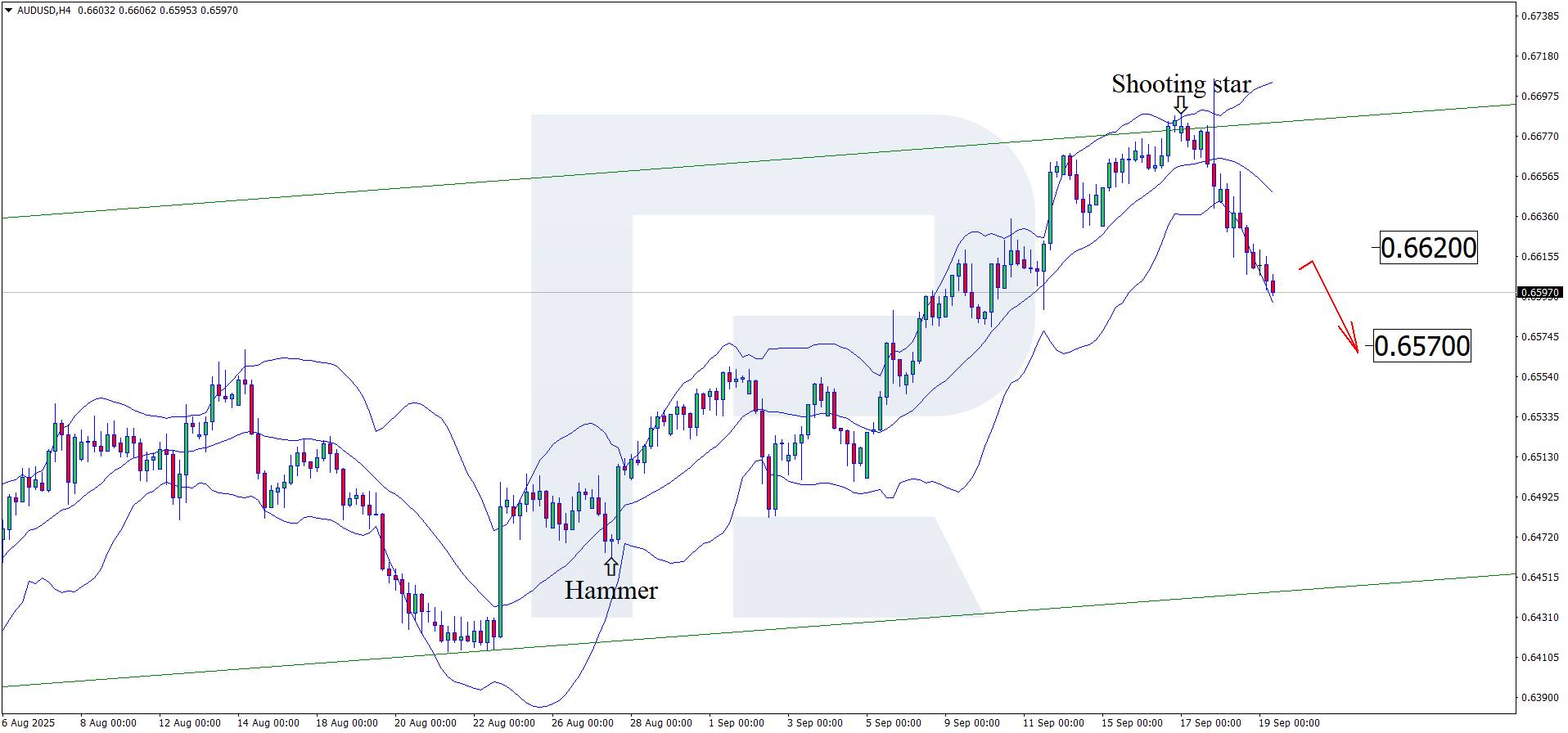
          The Australian dollar keeps losing ground against the strengthening USD, with the AUDUSD pair potentially testing the 0.6570 level.

          AUDUSD forecast: key trading points

          • The Australian dollar continues to weaken
          • Chinese news flow impacts Australia’s commodity-driven economy
          • AUDUSD forecast for 19 September 2025: 6570

          Fundamental analysis

          Today’s AUDUSD forecast favours the US dollar, which is steadily regaining strength against the Aussie. The pair is trading near 0.6600 and remains under downward pressure.

          Despite expectations for further Fed rate cuts, the USD found support from updated rate projections, which fuelled renewed dollar demand and weighed on the AUDUSD rate.

          Australia’s August employment report showed a decline of 5.4 thousand jobs versus expectations of a 21.5 thousand increase. While the unemployment rate held steady at 4.2%, the drop in new jobs raised concerns, adding to pressure on the Australian dollar.

          Australia’s economy continues to show resilience, underpinned by elevated inflation, lowering the chances of an RBA rate move at the September meeting.

          For 19 September 2025, the outlook also accounts for developments in China, a critical factor for AUD performance. Australia’s demand remains highly dependent on the Chinese economy, particularly in the commodity sector, meaning Chinese news continues to indirectly impact the AUD.

          AUDUSD technical analysis

          On the H4 chart, the AUDUSD rate formed a Shooting Star reversal pattern after testing the upper Bollinger Band. The pair currently maintains its downward momentum, with the 0.6570 support level as the immediate target.

          The AUDUSD forecast also takes into account an alternative scenario. Considering that quotes formed corrective waves in previous trading sessions, another pullback to the nearest resistance level at 0.6620 is possible before a decline.

          Summary

          The AUDUSD pair remains under pressure, with its dynamics shaped by US and Chinese news alongside signals from the RBA. AUDUSD technical analysis suggests a continued decline towards the 0.6570 support level, although a corrective bounce before the move lower cannot be ruled out.

          Source: RoboForex

          Risk Warnings and Disclaimers
          You understand and acknowledge that there is a high degree of risk involved in trading. Following any strategies or investment methods may lead to potential losses. The content on the site is provided by our contributors and analysts for information purposes only. You are solely responsible for determining whether any trading assets, securities, strategy, or any other product is suitable for investing based on your own investment objectives and financial situation.
          Add to Favorites
          Share

          Global Markets Shrug Off Trump’s Economic Shocks But Risks Linger Beneath the Surface

          Gerik

          Economic

          Trump’s First 8 Months: Turbulence Without Collapse

          Since taking office, Donald Trump has unleashed a series of dramatic policy moves that many feared would rattle the global economy: sweeping tariffs, attempts to exert control over the Federal Reserve, and elements of state capitalism. However, the economic reaction so far has been notably muted. Global growth continues, equity markets are strong, and inflation remains under control.
          This resilience has defied early fears of recession and global trade collapse. BNP Paribas attributes the calm to strong corporate and household balance sheets, low energy prices, the promise of AI-led productivity, and generally supportive financial conditions.

          Trade Fears Fade, For Now

          The gravest early concern a full-blown trade war has not materialized. While some tariffs were imposed, deals with European and Asian trading partners helped limit escalation. As a result, the burden of tariffs has been somewhat diffused across exporters, importers, and consumers, avoiding a concentrated economic shock.
          Markets have also largely ignored Trump’s failed efforts to fire Federal Reserve Chair Jerome Powell and Governor Lisa Cook, with the 10-year U.S. Treasury yield falling from 4.6% to around 4.1%. The Fed’s recent 25-basis-point rate cut signals confidence in hitting its inflation target, despite Trump’s political pressure.

          Global Growth Forecasts Improve Amid U.S. Volatility

          Globally, economic performance is trending better than expected in several regions. The European Central Bank raised its 2025 euro zone growth forecast to 1.2%, while Spain raised its outlook to 2.6% thanks to tourism and consumer demand. Italy is cleaning up its public finances, with potential credit rating upgrades in sight.
          Germany, despite recent stagnation, is preparing for a strong rebound in 2026 and 2027, driven by tax cuts and massive public investment in infrastructure and defense. In Japan, manufacturing sentiment is at a three-year high, while emerging markets such as Brazil, Mexico, and India benefit from a weaker U.S. dollar and domestic policy support.

          Cracks Beneath the Surface: Delayed Tariff Impacts and Fed Overreliance

          While the surface appears calm, policymakers and analysts are watching for delayed repercussions. Bank of Japan Deputy Governor Ryozo Himino noted that the full effects of U.S. tariffs might not be visible yet, warning of unanticipated future policy shifts from Washington.
          Concerns are also growing about the U.S. economy’s internal health. Fed Chair Powell acknowledged that current growth is largely concentrated in AI-driven sectors and high-end consumers, while housing, hiring, and broader consumer spending show signs of weakness.
          There’s also skepticism about the sustainability of current market highs. With equity indexes at record levels, some investors feel uneasy. As Alan Siow of Ninety One remarked, “We’re making all-time highs in everything. As an investor, I’m uncomfortable with that.”
          The global economy has proven more resilient than expected in the face of Trump-era shocks. However, this resilience may be underpinned more by investor optimism and policy inertia than by structural strength. With geopolitical risks, delayed economic reactions, and central bank limitations in play, the second half of Trump’s term may offer a tougher test for markets and global stability.

          Source: Reuters

          To stay updated on all economic events of today, please check out our Economic calendar
          Risk Warnings and Disclaimers
          You understand and acknowledge that there is a high degree of risk involved in trading. Following any strategies or investment methods may lead to potential losses. The content on the site is provided by our contributors and analysts for information purposes only. You are solely responsible for determining whether any trading assets, securities, strategy, or any other product is suitable for investing based on your own investment objectives and financial situation.
          Add to Favorites
          Share
          FastBull
          Copyright © 2025 FastBull Ltd

          728 RM B 7/F GEE LOK IND BLDG NO 34 HUNG TO RD KWUN TONG KLN HONG KONG

          TelegramInstagramTwitterfacebooklinkedin
          App Store Google Play Google Play
          Products
          Charts

          Chats

          Q&A with Experts
          Screeners
          Economic Calendar
          Data
          Tools
          Membership
          Features
          Function
          Markets
          Copy Trading
          Latest Signals
          Contests
          News
          Analysis
          24/7
          Columns
          Education
          Company
          Careers
          About Us
          Contact Us
          Advertising
          Help Center
          Feedback
          User Agreement
          Privacy Policy
          Business

          White Label

          Data API

          Web Plug-ins

          Poster Maker

          Affiliate Program

          Risk Disclosure

          The risk of loss in trading financial instruments such as stocks, FX, commodities, futures, bonds, ETFs and crypto can be substantial. You may sustain a total loss of the funds that you deposit with your broker. Therefore, you should carefully consider whether such trading is suitable for you in light of your circumstances and financial resources.

          No decision to invest should be made without thoroughly conducting due diligence by yourself or consulting with your financial advisors. Our web content might not suit you since we don't know your financial conditions and investment needs. Our financial information might have latency or contain inaccuracy, so you should be fully responsible for any of your trading and investment decisions. The company will not be responsible for your capital loss.

          Without getting permission from the website, you are not allowed to copy the website's graphics, texts, or trademarks. Intellectual property rights in the content or data incorporated into this website belong to its providers and exchange merchants.

          Not Logged In

          Log in to access more features

          FastBull Membership

          Not yet

          Purchase

          Become a signal provider
          Help Center
          Customer Service
          Dark Mode
          Price Up/Down Colors

          Log In

          Sign Up

          Position
          Layout
          Fullscreen
          Default to Chart
          The chart page opens by default when you visit fastbull.com