• Trade
  • Markets
  • Copy
  • Contests
  • News
  • 24/7
  • Calendar
  • Q&A
  • Chats
Trending
Screeners
SYMBOL
LAST
BID
ASK
HIGH
LOW
NET CHG.
%CHG.
SPREAD
SPX
S&P 500 Index
6870.39
6870.39
6870.39
6895.79
6858.28
+13.27
+ 0.19%
--
DJI
Dow Jones Industrial Average
47954.98
47954.98
47954.98
48133.54
47871.51
+104.05
+ 0.22%
--
IXIC
NASDAQ Composite Index
23578.12
23578.12
23578.12
23680.03
23506.00
+72.99
+ 0.31%
--
USDX
US Dollar Index
98.770
98.850
98.770
98.960
98.730
-0.180
-0.18%
--
EURUSD
Euro / US Dollar
1.16654
1.16662
1.16654
1.16717
1.16341
+0.00228
+ 0.20%
--
GBPUSD
Pound Sterling / US Dollar
1.33387
1.33398
1.33387
1.33462
1.33151
+0.00075
+ 0.06%
--
XAUUSD
Gold / US Dollar
4215.74
4216.17
4215.74
4218.45
4190.61
+17.83
+ 0.42%
--
WTI
Light Sweet Crude Oil
60.017
60.054
60.017
60.063
59.752
+0.208
+ 0.35%
--

Community Accounts

Signal Accounts
--
Profit Accounts
--
Loss Accounts
--
View More

Become a signal provider

Sell trading signals to earn additional income

View More

Guide to Copy Trading

Get started with ease and confidence

View More

Signal Accounts for Members

All Signal Accounts

Best Return
  • Best Return
  • Best P/L
  • Best MDD
Past 1W
  • Past 1W
  • Past 1M
  • Past 1Y

All Contests

  • All
  • Trump Updates
  • Recommend
  • Stocks
  • Cryptocurrencies
  • Central Banks
  • Featured News
Top News Only
Share

Agriculture Ministry: Uganda October Coffee Shipments Up 38% From Last Year

Share

Russia's Nornickel: Cobalt Production Capacity To Be At Up To 3000 Tons Per Year

Share

Russia's Nornickel: Fully Restarts Cobalt Production In Murmansk Region

Share

India's Nifty Realty Index Down 2.7%

Share

China Vice President, In Meeting With German Foreign Minister: China Willing To Enhance Communication With Germany - Xinhua

Share

Japan Finance Minister Katayama: Will Take Appropriate Action If Necessary

Share

Japan Finance Minister Katayama: Concerned About Forex Moves

Share

Japan Finance Minister Katayama: Recently Seeing One-Sided, Rapid Moves

Share

LME Three-month Copper Rose To $11,771 Per Tonne, Setting A New Record High

Share

Shanghai's Most Active Copper Contract Sets Peak At 93300 Yuan Per Metric Ton

Share

Thai Prime Minister: Thailand Does Not Want Violence

Share

Thai Prime Minister: Ready To Take Necessary Measures To Maintain Security, Sovereignty Of Country

Share

China Politburo: Will Better Coordinate Between China's Economic Work And International Economic And Trade Battle Next Year

Share

China Politburo: Moderately Loose Monetary Policy

Share

China Politburo:Continue To Implement More Active Fiscal Policies

Share

India's SEBI Chair: If Any Entity Wants To Advertise Any Past Return They Can Do Only Via The Platform

Share

Vietnam's Plans To Have Nuclear Power Plant Ready By 2035 Are Too Tight - Ambassador

Share

Japan Still Exploring Options For Future Vietnam Nuclear Projects Involving Small Reactors - Ambassador

Share

Ambassador In Hanoi: Japan Pulls Out Of Plans For Vietnam Nuclear Power Plant Ninh Thuan 2

Share

India's SEBI Chair: Platform Will Allow Investors To Access Verified Returns Of Registered Entities

TIME
ACT
FCST
PREV
U.S. Personal Income MoM (Sept)

A:--

F: --

P: --

U.S. PCE Price Index YoY (SA) (Sept)

A:--

F: --

P: --

U.S. PCE Price Index MoM (Sept)

A:--

F: --

P: --

U.S. Personal Outlays MoM (SA) (Sept)

A:--

F: --

P: --

U.S. Core PCE Price Index MoM (Sept)

A:--

F: --

P: --

U.S. Core PCE Price Index YoY (Sept)

A:--

F: --

P: --

U.S. UMich 5-Year-Ahead Inflation Expectations Prelim YoY (Dec)

A:--

F: --

P: --

U.S. Real Personal Consumption Expenditures MoM (Sept)

A:--

F: --

P: --

U.S. UMich Current Economic Conditions Index Prelim (Dec)

A:--

F: --

P: --

U.S. UMich Consumer Sentiment Index Prelim (Dec)

A:--

F: --

P: --

U.S. UMich 1-Year-Ahead Inflation Expectations Prelim (Dec)

A:--

F: --

P: --

U.S. UMich Consumer Expectations Index Prelim (Dec)

A:--

F: --

P: --

U.S. Weekly Total Rig Count

A:--

F: --

P: --

U.S. Weekly Total Oil Rig Count

A:--

F: --

P: --

U.S. Unit Labor Cost Prelim (SA) (Q3)

--

F: --

P: --

U.S. Consumer Credit (SA) (Oct)

A:--

F: --

P: --

China, Mainland Foreign Exchange Reserves (Nov)

A:--

F: --

P: --

Japan Wages MoM (Oct)

A:--

F: --

P: --

Japan Trade Balance (Oct)

A:--

F: --

P: --

Japan Nominal GDP Revised QoQ (Q3)

A:--

F: --

P: --

Japan Trade Balance (Customs Data) (SA) (Oct)

A:--

F: --

P: --

Japan GDP Annualized QoQ Revised (Q3)

A:--

F: --

P: --
China, Mainland Exports YoY (CNH) (Nov)

A:--

F: --

P: --

China, Mainland Trade Balance (USD) (Nov)

A:--

F: --

P: --

China, Mainland Imports YoY (CNH) (Nov)

A:--

F: --

P: --

China, Mainland Exports (Nov)

A:--

F: --

P: --

China, Mainland Imports (CNH) (Nov)

A:--

F: --

P: --

China, Mainland Trade Balance (CNH) (Nov)

A:--

F: --

P: --

China, Mainland Imports YoY (USD) (Nov)

A:--

F: --

P: --

China, Mainland Exports YoY (USD) (Nov)

A:--

F: --

P: --

Germany Industrial Output MoM (SA) (Oct)

--

F: --

P: --

Euro Zone Sentix Investor Confidence Index (Dec)

--

F: --

P: --

Canada Leading Index MoM (Nov)

--

F: --

P: --

Canada National Economic Confidence Index

--

F: --

P: --

U.S. Dallas Fed PCE Price Index YoY (Sept)

--

F: --

P: --

China, Mainland Trade Balance (USD) (Nov)

--

F: --

P: --

U.S. 3-Year Note Auction Yield

--

F: --

P: --

U.K. BRC Overall Retail Sales YoY (Nov)

--

F: --

P: --

U.K. BRC Like-For-Like Retail Sales YoY (Nov)

--

F: --

P: --

Australia Overnight (Borrowing) Key Rate

--

F: --

P: --

RBA Rate Statement
RBA Press Conference
Germany Exports MoM (SA) (Oct)

--

F: --

P: --

U.S. NFIB Small Business Optimism Index (SA) (Nov)

--

F: --

P: --

Mexico Core CPI YoY (Nov)

--

F: --

P: --

Mexico 12-Month Inflation (CPI) (Nov)

--

F: --

P: --

Mexico PPI YoY (Nov)

--

F: --

P: --

Mexico CPI YoY (Nov)

--

F: --

P: --

U.S. Weekly Redbook Index YoY

--

F: --

P: --

U.S. JOLTS Job Openings (SA) (Oct)

--

F: --

P: --

China, Mainland M2 Money Supply YoY (Nov)

--

F: --

P: --

China, Mainland M0 Money Supply YoY (Nov)

--

F: --

P: --

China, Mainland M1 Money Supply YoY (Nov)

--

F: --

P: --

U.S. EIA Short-Term Crude Production Forecast For The Next Year (Dec)

--

F: --

P: --

U.S. EIA Short-Term Crude Production Forecast For The Year (Dec)

--

F: --

P: --

U.S. EIA Natural Gas Production Forecast For The Next Year (Dec)

--

F: --

P: --

EIA Monthly Short-Term Energy Outlook
U.S. 10-Year Note Auction Avg. Yield

--

F: --

P: --

U.S. API Weekly Cushing Crude Oil Stocks

--

F: --

P: --

U.S. API Weekly Crude Oil Stocks

--

F: --

P: --

U.S. API Weekly Refined Oil Stocks

--

F: --

P: --

Q&A with Experts
    • All
    • Chatrooms
    • Groups
    • Friends
    Connecting
    .
    .
    .
    Type here...
    Add Symbol or Code

      No matching data

      All
      Trump Updates
      Recommend
      Stocks
      Cryptocurrencies
      Central Banks
      Featured News
      • All
      • Russia-Ukraine Conflict
      • Middle East Flashpoint
      • All
      • Russia-Ukraine Conflict
      • Middle East Flashpoint

      Search
      Products

      Charts Free Forever

      Chats Q&A with Experts
      Screeners Economic Calendar Data Tools
      Membership Features
      Data Warehouse Market Trends Institutional Data Policy Rates Macro

      Market Trends

      Market Sentiment Order Book Forex Correlations

      Top Indicators

      Charts Free Forever
      Markets

      News

      News Analysis 24/7 Columns Education
      From Institutions From Analysts
      Topics Columnists

      Latest Views

      Latest Views

      Trending Topics

      Top Columnists

      Latest Update

      Signals

      Copy Rankings Latest Signals Become a signal provider AI Rating
      Contests
      Brokers

      Overview Brokers Assessment Rankings Regulators News Claims
      Broker listing Forex Brokers Comparison Tool Live Spread Comparison Scam
      Q&A Complaint Scam Alert Videos Tips to Detect Scam
      More

      Business
      Events
      Careers About Us Advertising Help Center

      White Label

      Data API

      Web Plug-ins

      Affiliate Program

      Awards Institution Evaluation IB Seminar Salon Event Exhibition
      Vietnam Thailand Singapore Dubai
      Fans Party Investment Sharing Session
      FastBull Summit BrokersView Expo
      Recent Searches
        Top Searches
          Markets
          News
          Analysis
          User
          24/7
          Economic Calendar
          Education
          Data
          • Names
          • Latest
          • Prev

          View All

          No data

          Scan to Download

          Faster Charts, Chat Faster!

          Download App
          English
          • English
          • Español
          • العربية
          • Bahasa Indonesia
          • Bahasa Melayu
          • Tiếng Việt
          • ภาษาไทย
          • Français
          • Italiano
          • Türkçe
          • Русский язык
          • 简中
          • 繁中
          Open Account
          Search
          Products
          Charts Free Forever
          Markets
          News
          Signals

          Copy Rankings Latest Signals Become a signal provider AI Rating
          Contests
          Brokers

          Overview Brokers Assessment Rankings Regulators News Claims
          Broker listing Forex Brokers Comparison Tool Live Spread Comparison Scam
          Q&A Complaint Scam Alert Videos Tips to Detect Scam
          More

          Business
          Events
          Careers About Us Advertising Help Center

          White Label

          Data API

          Web Plug-ins

          Affiliate Program

          Awards Institution Evaluation IB Seminar Salon Event Exhibition
          Vietnam Thailand Singapore Dubai
          Fans Party Investment Sharing Session
          FastBull Summit BrokersView Expo

          Japan's Political Party Split Is Unprecedented in 70 Years!

          ACY

          Forex

          Economic

          Summary:

          Trump still took action against the EU, and the 15-20% tariff on all goods caused a sharp drop in European stock markets, and the US dollar soared. China's A-share and H-share markets continued to perform strongly. Japan's ruling party lost its majority seats as expected, but the yen rose instead of falling.
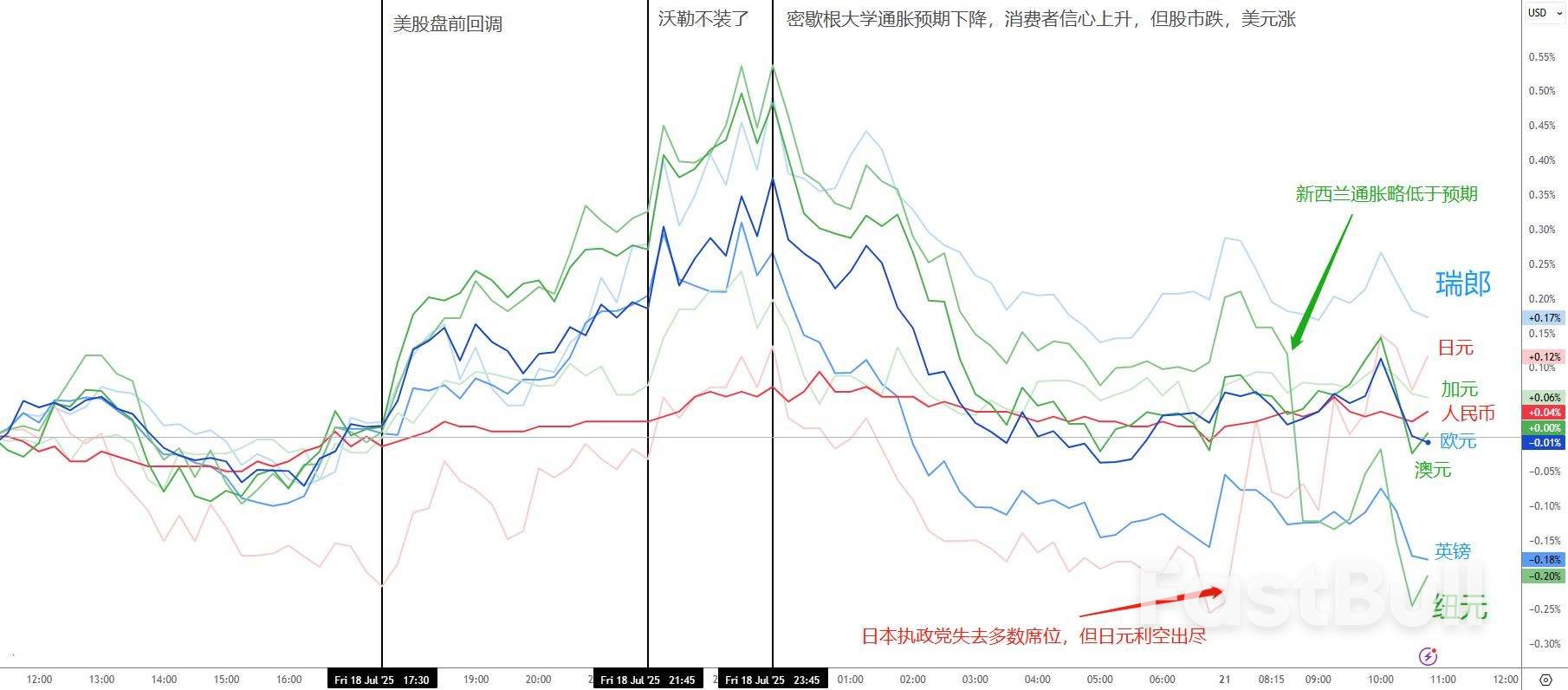
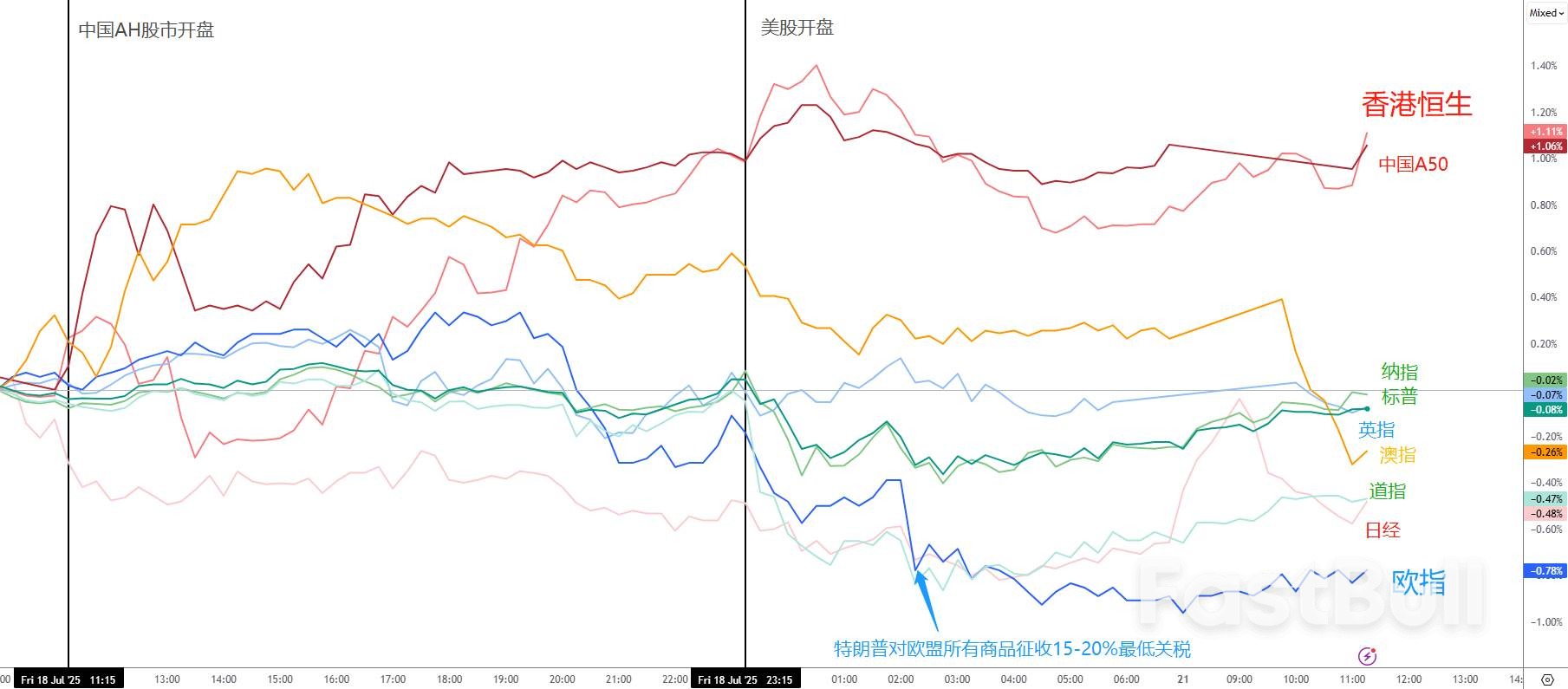
          What happened last Friday?

          Japan's Political Party Split Is Unprecedented in 70 Years!_1
          US dollar: The strong rebound in the US market last Thursday continued in the early trading and European trading. When the US stock market weakened before the market, the US dollar was also under pressure, especially after the Federal Reserve Board member Waller said he would accept Trump's possible new appointment and support interest rate cuts, the US dollar once fell to the intraday low.
          The turning point came when the University of Michigan consumer confidence report was released. The data showed that consumer confidence was higher than expected, and the one-year inflation expectation fell from 5% to 4.4%, ending the previous continuous rise. In theory, this data should be good for US stocks and bad for the US dollar, but the market reaction was completely opposite - US stocks maintained the decline at the opening, while the US dollar rebounded strongly and quickly recovered the early losses. The reason is that the decline in inflation expectations means that Trump will no longer face obvious inflationary pressure in implementing the tariff policy, and the possibility of the policy being implemented has increased significantly. The subsequent market also confirmed this.
          During the U.S. trading session, Trump announced a minimum tariff of 15%-20% on all EU goods, which not only widened the decline of U.S. stocks but also pushed the U.S. dollar to further strengthen.
          In the analysis on Tuesday last week, it was mentioned that the current market is fluctuating around tariffs, and the tariff news is divided into two directions, namely Trump's tough stance and Trump's retreat. The above two tough news just caused the stock market to fall and the dollar to strengthen .
          The US dollar bottomed out and rebounded throughout the day last Friday, and finally remained flat. The performance of non-US currencies varied greatly.
          Yen: Due to the Japanese Senate election on Sunday, the market was worried about the ruling party's defeat and bet on the depreciation of the yen. However, this expectation has been fully factored into the price. When the election results were announced this morning - the Liberal Democratic Party did lose the majority of seats, it triggered the "bad news is out" and the yen rebounded quickly in the early trading, getting rid of the previous position of "the weakest currency".
          This election is particularly noteworthy: for the first time in 70 years, the Liberal Democratic Party failed to win half of the seats, while populist and xenophobic right-wing parties emerged as a new force, with seats increasing from 1 to 10 to 22. Polls show that populist sentiment among Japanese voters has significantly increased, with 79% of respondents supporting tighter restrictions on foreigners.
          This trend has been around for a long time. As we analyzed when Trump came to power, populism and trade protectionism are highly contagious. Today, the support rate of populist right-wingers in the United States, the European Union, South Korea, Japan and other places has soared. For example, Italy is already ruled by the extreme right. The slowdown in global economic growth has led the world's population into an era of involution, and votes linked to unemployment will lean towards populist factions.
          This wave of anti-globalization, driven by public opinion and led by Western countries, will be contagious and irreversible.
          Commodity currencies: Commodity currencies performed poorly during the US trading session, dragged down by US stocks. The New Zealand dollar fell sharply during the early trading session due to lower-than-expected inflation and ultimately performed the worst.
          European currencies: Mainly driven by the US dollar. The decline in US stocks is good for the Swiss franc, which eventually rises. However, the pound, which has a poor economic performance, still lags behind.
          RMB: Stable, with slight increase.
          Japan's Political Party Split Is Unprecedented in 70 Years!_2
          US stock market: The market remained volatile and fell throughout the day. The decline was most significant when the US stock market opened and Trump announced tariffs on the EU. Tesla and technology stocks supported the US stock market, causing the Dow to lag behind.
          In terms of sector news, the UK and the EU announced a reduction in the upper limit of Russian crude oil export prices from $60 per barrel to $47.6. As a result, crude oil stocks plummeted, dragging down the energy sector. On the contrary, green energy stocks in public utilities performed very well and eventually closed higher. Tesla's stock price rose sharply at the opening, possibly driven by the Grok 4 news, but failed to drive the entire technology sector to strengthen.
          China's AH stock market: continued to rise after opening, and the US stock market rose against the trend when it opened, once again reflecting the global risk aversion demand . The best performance of the day.
          Other stock markets: Australian mining industry performed well driven by the Chinese stock market, but was still dragged down by the US stock market this morning. The 11 major sectors opened with a collective decline and eventually fell slightly. European stock markets faced a new round of tariff shocks and eventually fell sharply, performing the worst. The Japanese stock market opened with positive news from the Japanese Senate election results, but was subsequently suppressed by the rise of the yen and eventually continued to fall.
          Japan's Political Party Split Is Unprecedented in 70 Years!_3
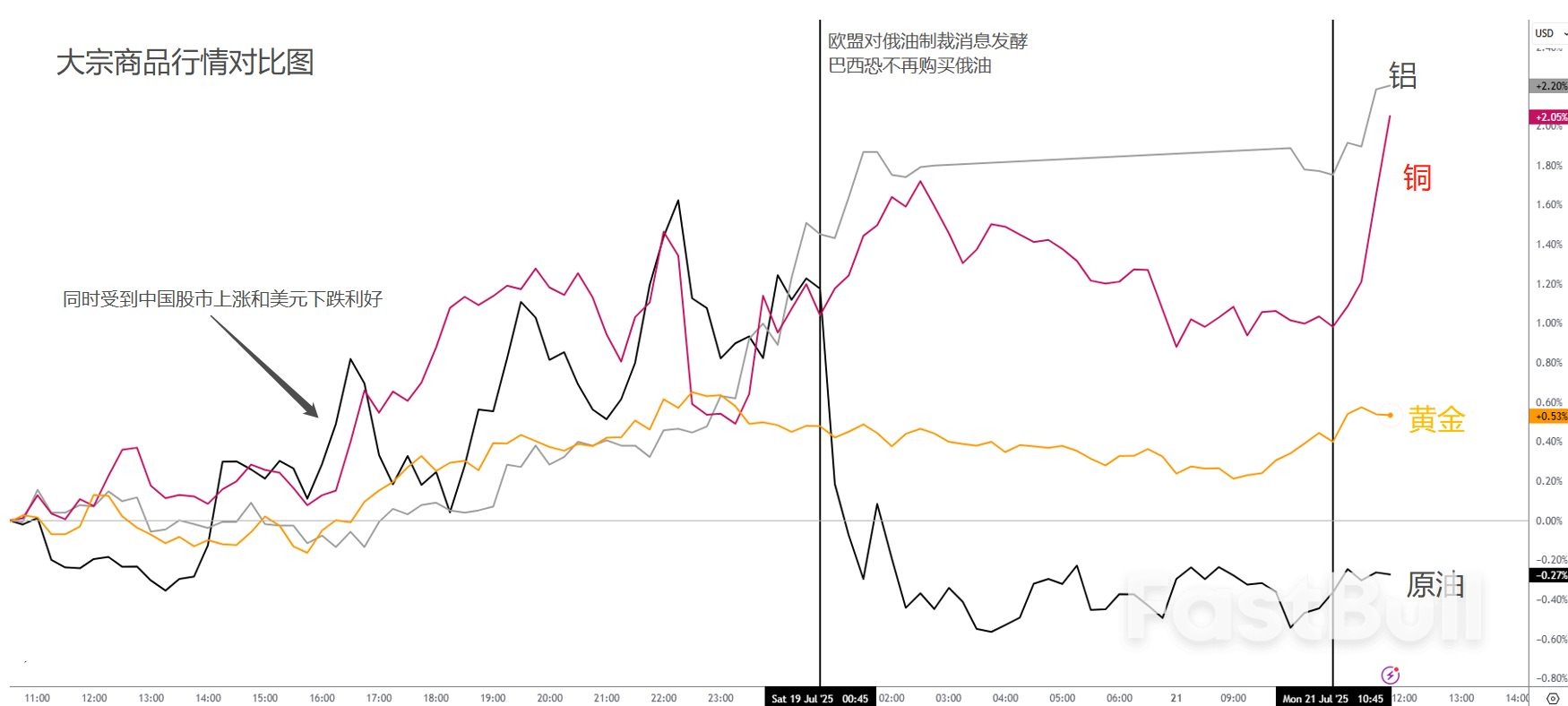
          During the Asian and European trading sessions, driven by the dual positive factors of the strengthening of the Chinese stock market and the decline of the US dollar, the commodity market generally rose. Among them, industrial metals continued their upward trend last night, boosted by the expected demand from China, and continued to rise at the opening this morning, performing the best.
          As for gold, the rise was restrained during the U.S. trading session due to the strengthening of the U.S. dollar, but the overall performance remained solid and maintained at a relatively high level.
          There were frequent news in the crude oil market. The new round of EU sanctions triggered dual concerns of tightened supply and limited demand, and oil prices fluctuated upward. However, Brazil publicly expressed concerns about being sanctioned by the United States for purchasing Russian oil, which became the last straw that broke the camel's back for bulls. Demand concerns increased sharply, and oil prices immediately gave up all gains and eventually closed down.

          Today's key events (AEST):

          00:00 the next day US Conference Board Leading Index Monthly Rate in June: Expected -0.2% Previous value -0.1%
          *Indicates a more influential leading indicator that deserves the most attention from day traders. 
          Japan's Political Party Split Is Unprecedented in 70 Years!_4
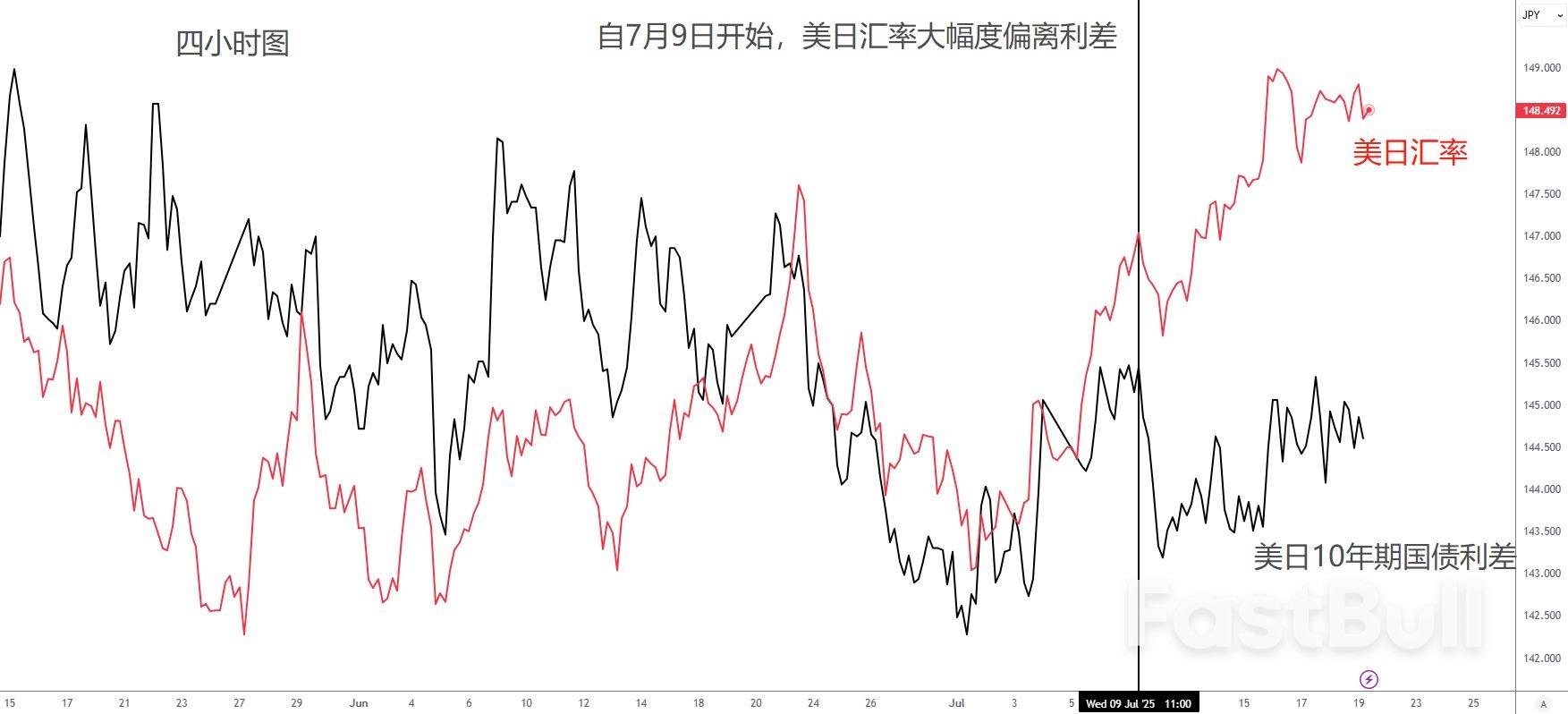
          Last week, I pointed out that although the yen has been weakening in the short term due to the dual pressure of tariff negotiations and Senate elections, these negative factors have been basically digested by the market. The depreciation of the yen has obviously exceeded the range that can be explained by the US-Japan interest rate differential, and there is a possibility of excessive decline in stages. Once the news is released and the negative news is exhausted, the yen will continue to rebound. This morning's market confirmed this judgment. Therefore, this week's short-term strategy is mainly based on oversold rebound. However, in terms of currency pair selection, the strong US dollar under the "Trump strong" market should be avoided. The Australian dollar, which is more sensitive to the negative news of US stocks, or the euro, which is directly affected by tariffs, can be considered as a trading object.
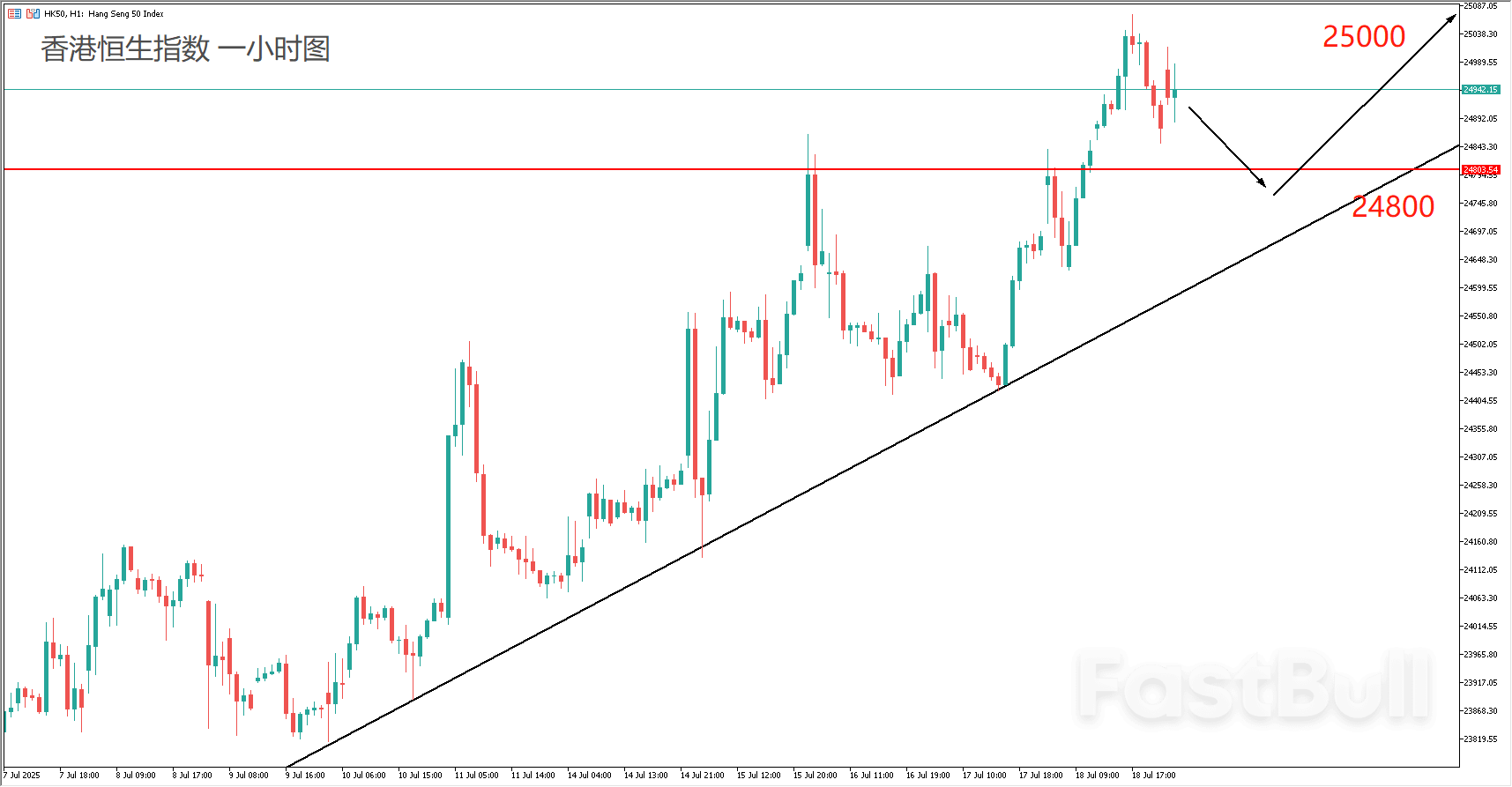
          Although TSMC's financial report performance was stable, it failed to continue to push up the stock price, and the overall rise of US technology stocks was therefore limited. In contrast, the valuation of Hong Kong's technology sector is more attractive. Combined with the resonance of safe-haven demand and favorable fundamentals, the Hang Seng Index has the momentum to continue to rise, mainly following the trend.
          Once the U.S. stock market starts a new round of tariff callbacks, the gold price will repeat the surge in April and may even test the 3,500 mark again. However, the recent strong dollar has made the direction of gold prices uncertain, and the trading strategy should be mainly to sell high and buy low.

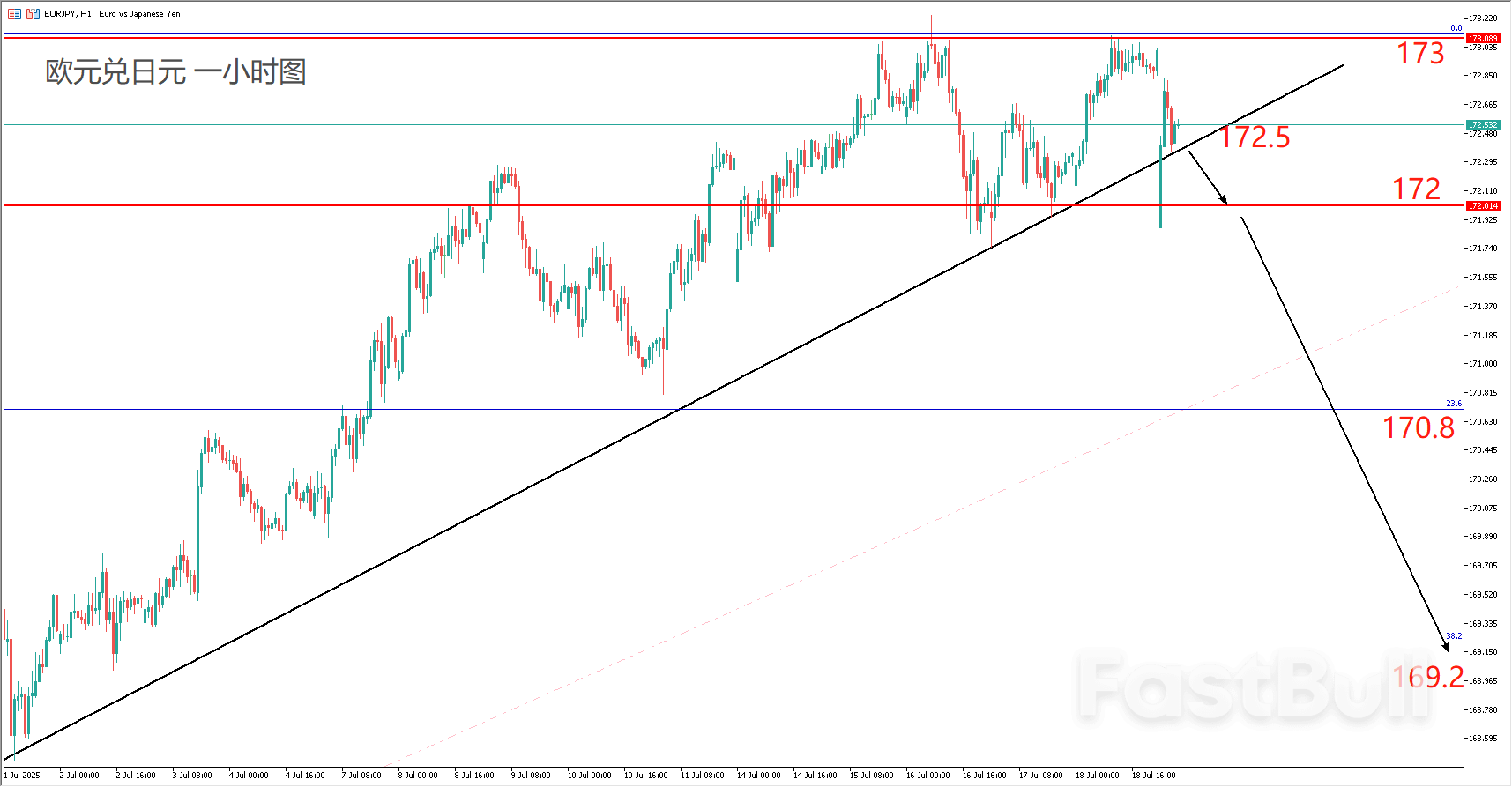
          Value Divergence Strategy – EURJPY

          Intraday or short-term trading strategy: (mean reversion) 173 small stop loss short (intraday), or short after breaking 172 (short-term)
          Resistance reference: 173; 173.3 (stop loss)
          Support reference: 172 (stop profit & breakout); 170.8; 169.2
          Technical aspect: 100-day moving average is upward, bullish momentum is strong, short orders should set a stop loss. The trading strategy is mainly based on breakthrough and follow-up. Once it falls below the 172 mark, it will not only form a head reversal, but also break through the upward trend line, and the short momentum will be released. The short-term target position focuses on the Fibonacci retracement line.
          Japan's Political Party Split Is Unprecedented in 70 Years!_5

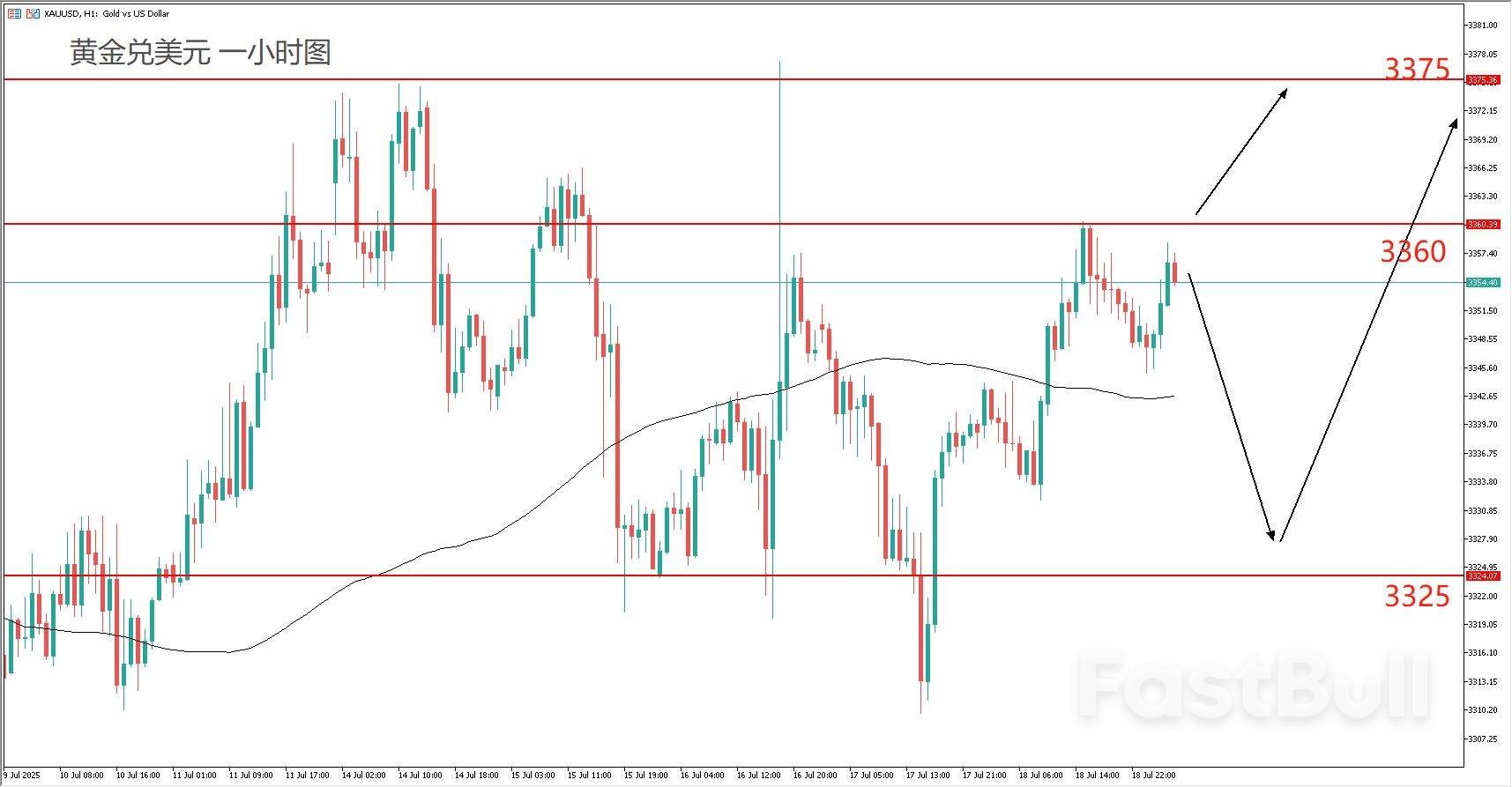
          News Breakout Strategy – Gold/US Dollar XAUUSD

          Intraday trading strategy: (mean reversion) 3360 breakout, quick entry and exit, or wait for the price to fall back to 3325 and then go low
          Resistance reference: 3360 (intraday breakthrough); 3375 (stop profit)
          Support reference: 3325
          Technical aspects: The 100-day moving average is horizontal, the direction is uncertain, and the gold price fluctuates greatly. There is a certain resistance near the current price of 3360. Once it breaks through, it can test the previous high of 3375. However, considering the unclear tariff policy, the short-term market is still dominated by volatile market, so you can patiently wait for the price to fall back to 3325 before entering the market to do more.
          Japan's Political Party Split Is Unprecedented in 70 Years!_6

          Strong and Weak Trend Strategy – Hong Kong Hang Seng Index HK50

          Short-term trading strategy: (Trend following) bullish when it falls back to around 24800
          Resistance reference: 25000; 25400
          Support reference: 24800; 24500 (break stop loss)
          Technical analysis: The 100-day moving average remains upward, and the bullish momentum is strong. 25,000 is a key historical level, and once it is broken, it will mean the resumption of the long-term bull market. In the short term, it is still necessary to maintain a cautious operation of stepping back and bullish, and buy more at low levels along the trend line.
          Japan's Political Party Split Is Unprecedented in 70 Years!_7

          Source:ACY

          To stay updated on all economic events of today, please check out our Economic calendar
          Risk Warnings and Disclaimers
          You understand and acknowledge that there is a high degree of risk involved in trading. Following any strategies or investment methods may lead to potential losses. The content on the site is provided by our contributors and analysts for information purposes only. You are solely responsible for determining whether any trading assets, securities, strategy, or any other product is suitable for investing based on your own investment objectives and financial situation.
          Add to Favorites
          Share

          Beijing's Battle with Overcapacity Ignites Market Rally but Faces Deep-rooted Hurdles

          Gerik

          Economic

          Stock Surge Fueled by “Anti-Involution” Hopes

          Markets in China are experiencing a burst of optimism after the government vowed to address “involution” a term now applied to excessive competition and overcapacity that has suppressed industrial profits and escalated global trade friction. Investors responded quickly: shares in solar glass, steel, and EV companies rallied sharply, with some stocks rising 50–70% since late June, well ahead of the broader market’s 3.2% gain.
          This surge comes on the back of Beijing’s unusually strong rhetoric. The People’s Daily declared cut-throat competition “disorderly,” while President Xi Jinping emphasized the need for better competition regulation. These moves signal a shift in tone from mere observation to potential intervention.

          Government Interventions and Corporate Reactions

          Concrete steps have followed the rhetoric. Ten major producers of solar panel glass agreed to cut output by 30%. The government also launched auto safety inspections, an indirect way to curb cost-cutting in the highly competitive EV sector. Despite continued uncertainty, these measures have boosted investor confidence that long-standing industrial inefficiencies are finally being addressed.
          For instance, steelmaker Liuzhou Iron & Steel rose 10% in a day and over 70% in three weeks. Changzhou Almaden, a solar glass manufacturer, also rallied by about 50%. Sector-specific ETFs have outperformed the general index, signaling broad investor buy-in.
          EV sector reactions are mixed: while Li Auto and Nio saw strong gains, BYD shares slipped as it doubled down on price cuts in late May an action seen by some as undermining the truce.

          Overcapacity, Weak Demand, and Global Tensions

          China’s producer price index has been falling for nearly three years a sign of ongoing deflationary pressures at the factory level. With sluggish domestic demand and external headwinds such as rising tariffs from the U.S. and Europe, firms have resorted to deep price cuts to maintain market share. This, in turn, has fueled trade tensions globally, especially in sectors like EVs, steel, and solar where China exports aggressively.
          The recent “anti-involution” campaign has sparked comparisons with past efforts to curb overcapacity particularly in steel and cement which largely failed due to local government interference. Despite national directives, local officials have often prioritized jobs and GDP over consolidation, allowing zombie firms to linger.

          Structural Reform or Temporary Relief?

          Analysts warn that short-term production cuts or inspection campaigns may not be enough. Economists like Alicia García-Herrero of Natixis suggest that only sustained mergers, bankruptcies, and genuine market discipline can resolve overcapacity issues. However, political will at the provincial level remains uncertain.
          UBS analysts cautiously welcomed the developments, saying a short-term “ceasefire” in EV price wars is possible but a full-scale industry turnaround would be slow. Furthermore, past promises to rein in overproduction have been undermined by subsidies and policy incentives that inadvertently encourage expansion.

          A Market Rebound Shadowed by Long-Term Uncertainty

          While investor sentiment has clearly improved, with capital flowing into some of the most beleaguered sectors, the structural challenges that created China’s involution crisis remain deeply embedded. The long-awaited correction may have finally begun, but without stronger institutional reforms and coordination between central and local governments, the rally risks becoming a speculative bubble riding on political language rather than real economic change.
          The coming quarters will reveal whether the government’s renewed campaign against overcapacity represents a turning point or another false dawn in China’s ongoing struggle to rebalance its industrial economy.

          Source: AP

          To stay updated on all economic events of today, please check out our Economic calendar
          Risk Warnings and Disclaimers
          You understand and acknowledge that there is a high degree of risk involved in trading. Following any strategies or investment methods may lead to potential losses. The content on the site is provided by our contributors and analysts for information purposes only. You are solely responsible for determining whether any trading assets, securities, strategy, or any other product is suitable for investing based on your own investment objectives and financial situation.
          Add to Favorites
          Share

          Japan’s Ishiba Tries To Buy Time After Historic Election Setback

          James Whitman

          Political

          Japanese Prime Minister Shigeru Ishiba sought to buy time for his premiership following a second election setback in less than a year that leaves him in a weaker position to stave off opposition tax cut demands or secure a last-minute trade deal with the US.

          “As we are the biggest party in parliament, I believe I must fulfill my responsibility to the nation and its people,” Ishiba said at a press conference held Monday after an election that left the ruling bloc three seats short of maintaining a majority in the upper house. Ishiba raised the US trade talks, inflation and an increasingly tense security environment as pressing issues that must not be left to stagnate due to political instability.

          While Ishiba’s comments at the press conference showed his intention for now to soldier on with a minority in both houses, the prime minister remains in a vulnerable position and will likely need to find ways to shore up his leadership within the party. Ishiba is the first LDP leader running an administration without a coalition majority in either of the chambers since the party was established in 1955.

          He acknowledged that debate would likely continue within the party about how to proceed moving forward and that he would respond to each development as it occurred.

          Historical precedence is not on Ishiba’s side. The last three LDP premiers who lost a majority in the upper house all stepped down within two months of the result. Still, there is little immediate sign of clear appetite within the party to oust him for now, given the lack of an obvious candidate waiting in the wings that might give the LDP an immediate boost.

          Ishiba said he had no plans to change around personnel in the administration, implying that there would be no cabinet reshuffle to try and turn around his fortunes.

          Instead, Ishiba indicated he would be looking for talks with Donald Trump and tangible results on trade soon, as he continued to emphasize that negotiations should center on investment not tariffs. The deadline for higher across-the-board tariffs looms less than two weeks away. His top negotiator Ryosei Akazawa is set to depart on Monday for Washington to continue discussions with his US counterparts.

          The visit appears to be a continuation of an existing tactic to secure as much face-time with US negotiators as possible. Akazawa has clocked up over 90,000 miles over seven visits to the US so far, with little to show in terms of progress.

          “I do think that in terms of how the LDP thinks, the best way for Ishiba to go would have been to reach some sort of trade terms with the US tariff talks, but if Ishiba really has no intention to stand down, then that sort of deadline doesn’t matter,” said Yuri Kono, a professor of law at Hosei University who writes frequently on politics.

          The election defeat will likely hamper Ishiba’s efforts to pursue domestic policy. With many of the key opposition parties running on a platform to cut the sales tax, Ishiba may well have to make concessions over tax cuts to push any of his policies through.

          The main opposition Constitutional Democratic Party, which wants to exempt food from the sales tax for as many as two years, came in second place with 22 seats in the election. The populist Democratic Party for the People finished third with 17 seats, up from four earlier, after seeking a sales tax cut and more take-home pay.

          Sanseito, a right-wing party that tapped anti-foreigner sentiment with a “Japanese First” message and wants to phase out the tax in stages, managed to secure 14 seats from just a single seat, winning the third most seats among opposition parties.

          Ishiba will need to find ways to cooperate with the opposition and likely have to give some ground. Whether that extends to a temporary tax cut remains a key focus for market players concerned about Japan loosening its control of fiscal policy.

          Source: Bloomberg

          Risk Warnings and Disclaimers
          You understand and acknowledge that there is a high degree of risk involved in trading. Following any strategies or investment methods may lead to potential losses. The content on the site is provided by our contributors and analysts for information purposes only. You are solely responsible for determining whether any trading assets, securities, strategy, or any other product is suitable for investing based on your own investment objectives and financial situation.
          Add to Favorites
          Share

          South Korea Ramps Up U.S. Diplomacy as Tariff Deadline Approaches

          Gerik

          Economic

          Urgent Diplomacy Amid Tariff Threat

          With just days remaining before the U.S. imposes 25% across-the-board tariffs on South Korean goods, Seoul has launched a full-scale diplomatic campaign. National security adviser Wi Sung-lac arrived in Washington for the second time in under two weeks, signaling a deepening urgency. According to Woo Sang-ho, a senior presidential secretary, Wi’s visits will continue “whenever necessary” as negotiations intensify.
          The tariff threat escalating from the current 10% level has alarmed both South Korean officials and businesses, especially given additional targeted duties on autos, steel, and aluminum that remain unresolved. Talks have been delayed due to domestic political gridlock, but with the Aug. 1 deadline fast approaching, the administration is now racing against the clock to secure a resolution.

          New Cabinet, Old Crisis

          In a rare show of bipartisanship, South Korea’s opposition People Power Party approved President Lee Jae Myung’s new picks for foreign affairs, finance, and industry. The urgency of the U.S. trade negotiations eclipsed partisan divisions, as the opposition recognized that economic fallout from higher tariffs could be severe. Foreign Minister Cho Hyun and Finance Minister Koo Yun-cheol are reportedly also preparing for U.S. visits, according to Yonhap.
          Wi Sung-lac confirmed that South Korea’s objective is to negotiate a tariff reduction seeking at least partial relief from the proposed 25% rate, which could severely impact its export-heavy economy.

          Fiscal Stimulus to Cushion Impact

          In tandem with the diplomatic push, the Lee administration unveiled a supplementary budget worth 31.8 trillion won ($23.3 billion) to stimulate growth and offset potential trade shocks. This policy action reflects mounting economic pressure: South Korea’s economy contracted in Q1 2025, prompting the Bank of Korea to cut interest rates to 2.5% and downgrade its full-year GDP forecast to just 0.8%.
          The combination of trade tension and macroeconomic weakness has put South Korea in a precarious position. The nation’s longstanding trade surplus with the U.S. once a pillar of strength has now become a strategic liability under Washington’s more protectionist agenda.

          Time Running Short, Stakes Rising

          With less than two weeks left before tariffs take effect, the path to de-escalation remains uncertain. While Seoul is deploying high-level envoys and financial buffers, progress depends heavily on how far the U.S. administration is willing to compromise. President Trump has taken a firm line, demanding minimum tariffs of 15%-20% on key trading partners, including the EU and South Korea.
          Failure to reach a deal could not only damage South Korea’s trade performance but also amplify domestic political pressures on Lee’s relatively new administration. The coming days will be critical in determining whether diplomacy, fiscal action, and cross-party unity are enough to avert a deepening economic and geopolitical crisis.

          Source: Reuters

          To stay updated on all economic events of today, please check out our Economic calendar
          Risk Warnings and Disclaimers
          You understand and acknowledge that there is a high degree of risk involved in trading. Following any strategies or investment methods may lead to potential losses. The content on the site is provided by our contributors and analysts for information purposes only. You are solely responsible for determining whether any trading assets, securities, strategy, or any other product is suitable for investing based on your own investment objectives and financial situation.
          Add to Favorites
          Share

          Market Navigator: Week of 21 July 2025

          IG

          Forex

          Economic

          What happened last week

          China GDP beats expectations: China's second-quarter gross domestic product (GDP) expanded 5.2% year-on-year (YoY), surpassing consensus forecasts. However, intensifying export dependence, property sector distress, and weak retail consumption highlight the urgent need for policy intervention to achieve Beijing's 5% full-year target. Senior leadership is expected to discuss additional stimulus in early August.Trade tensions ease: Washington reduced Indonesian tariffs from 32% to 19%. The administration made concessions to China, allowing Nvidia H20 chip exports while Treasury Secretary Bessent suggested flexibility on the 12 August deadline. Trump will issue tariff letters to 150+ nations at 10-15% rates.Crypto regulation breakthrough: The GENIUS Act established the first federal stablecoin framework, transforming digital asset regulation. Bank of America and Citigroup signalled plans for proprietary stablecoins. Cryptocurrency investment may soon be made available through 401(k) retirement plans.Global inflation patterns diverge: US core inflation fell to 2.9%, below forecasts, though tariff cost pass-through emerges. Japan's inflation moderated from 3.7% to 3.3% on lower energy price growth, but rice prices doubled YoY suggesting food inflation may not be transitory. UK inflation unexpectedly surged to 3.6%, a 17-month high.

          Markets in focus

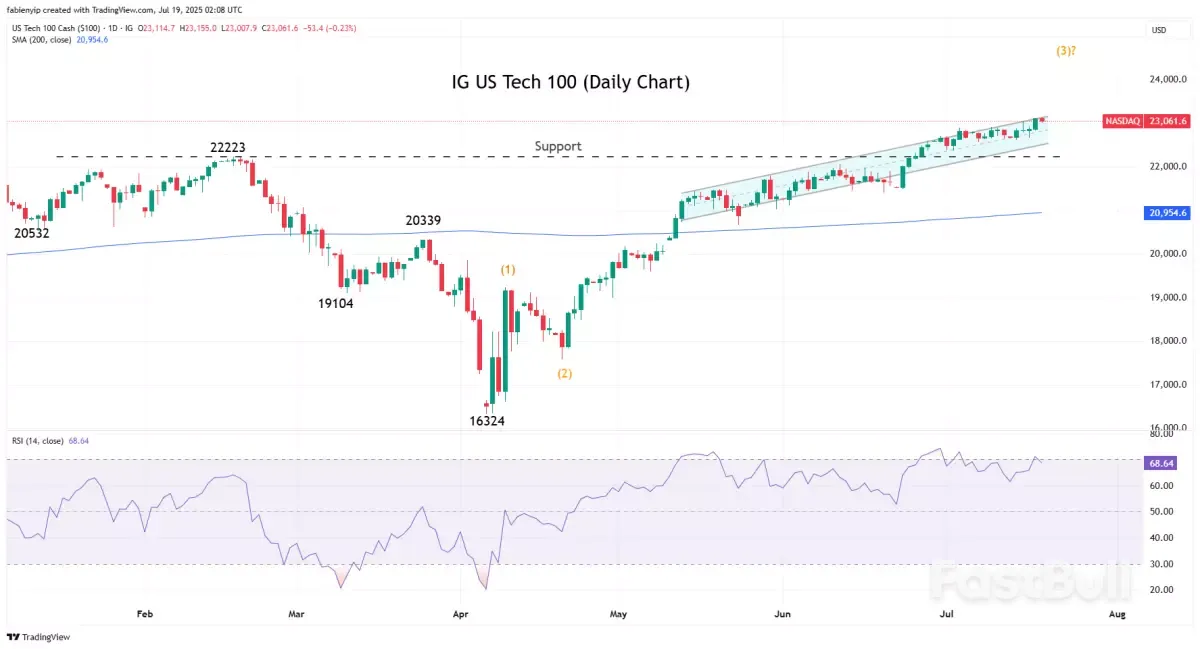
          US equity market rises on positive corporate earnings.US major banks delivered extraordinary second-quarter performance, capitalising on elevated market volatility to generate exceptional trading revenues. Goldman Sachs' equity trading division achieved its strongest quarterly performance in company history, while Citigroup recorded its highest quarterly revenue in over a decade, underlining the sector's operational leverage during volatile market conditions. The S&P 500 Banking Index outperformed broader indices with a 0.9% weekly advance, demonstrating sector-specific strength amid broader market uncertainty.Netflix exceeded all key performance metrics and upgraded full-year guidance, yet shares declined over 4% on Friday as investors crystallised profits following a spectacular 40% year-to-date rally, highlighting the challenge of sustaining momentum after exceptional gains.The US Tech 100 index established three consecutive daily records before retreating 0.1% on Friday, successfully breaching the psychologically significant 23,000 threshold. Technical analysis suggests potential corrective movement toward 22,545 support, though maintenance above this level would preserve the bullish trend established from mid-May lows. Elliott Wave analysis indicates that if current price action follows Wave 3 characteristics from the 21 April base, a 200% Fibonacci extension could potentially drive the index toward 24,718 before Wave 4 correction materialises. February's 22,223 high provides crucial technical support for any pullback scenario.

          Figure 1: US Tech 100 index (daily) price chartMarket Navigator: Week of 21 July 2025_1

          TradingView, as of 19 July 2025. Past performance is not a reliable indicator of future performance.

          USD/JPY benefits from dollar strength and Japanese political uncertainty

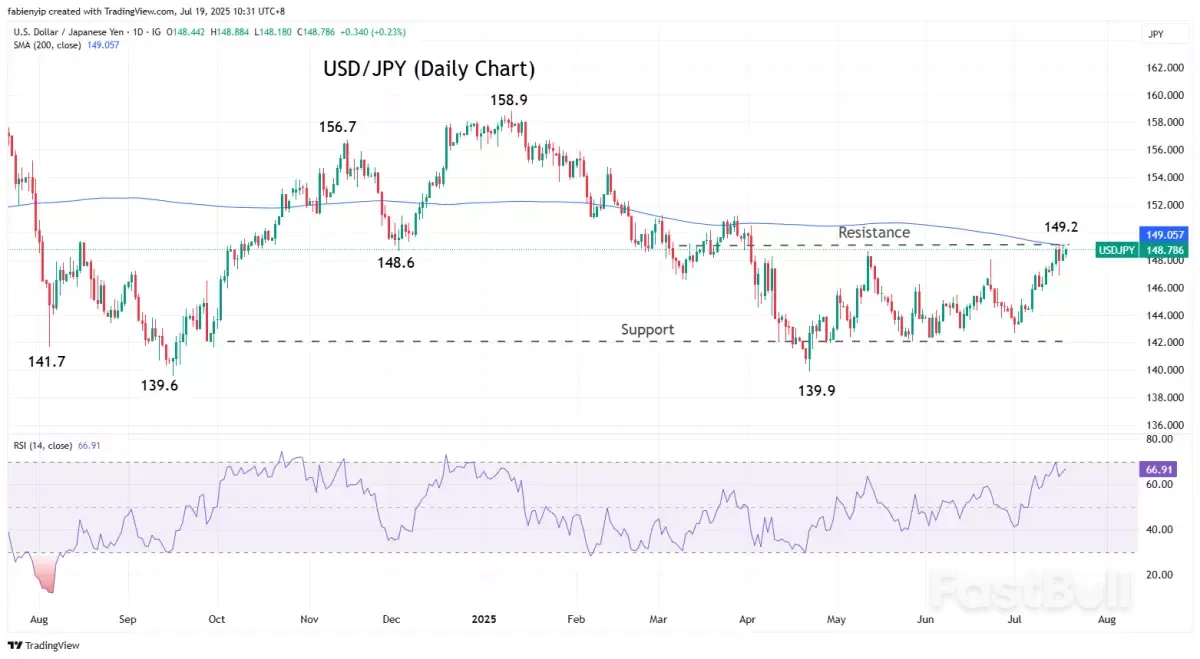
          USD/JPY has surged 3% month-to-date, propelled by US dollar strength and mounting volatility from the Upper House election. The ruling Liberal Democratic Party-Komeito coalition faces probable loss of its chamber majority, with opposition parties advocating more expansionary fiscal policies that could undermine yen stability. Given markets have already partly accounted for ruling party electoral defeat probability, we anticipate USD/JPY momentum will encounter material resistance at the 149 threshold.Escalating speculation surrounding US-Japan trade negotiations, particularly foreign exchange intervention discussions, could materially constrain additional yen weakness. Tokyo may face Washington pressure to strengthen the yen as part of broader trade deficit reduction efforts, creating potential policy conflict between domestic political considerations and international trade obligations.Technical analysis reveals USD/JPY encountered critical resistance at 149.2 following its powerful rebound from 142.7 on 1 July. Sustained resistance at this level suggests probable reversion to the established 142-149 trading range, while a decisive break above 149 could target the 151 level as the next significant resistance zone.

          Figure 2: USD/JPY (daily) price chartMarket Navigator: Week of 21 July 2025_2

          Source: TradingView, as of 19 July 2025. Past performance is not a reliable indicator of future performance.

          Bitcoin surges past $123,000 on regulatory breakthroughs

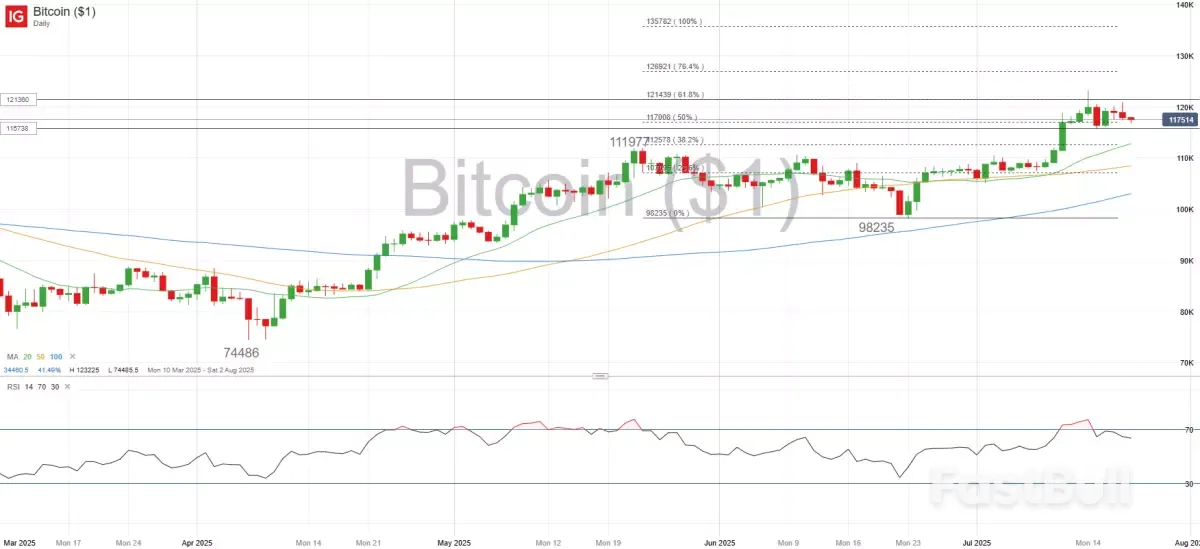
          Digital assets achieved unprecedented regulatory legitimacy as President Trump signed the GENIUS Act following House approval, while the CLARITY Act and anti-central bank digital currency (CBDC) Surveillance State Act advanced through the Congressional and will then be reviewed by the Senate. The CLARITY Act proposes transferring digital asset regulatory authority from the restrictive Securities and Exchange Commission (SEC) to the more accommodating Commodity Futures Trading Commission (CFTC), fundamentally reshaping oversight frameworks. The anti-CBDC legislation prohibits Federal Reserve (Fed) digital currency issuance, preserving consumer financial privacy.These transformative regulatory developments propelled Bitcoin above $123,000 before profit-taking drove prices below $116,000. Sustained exchange-traded fund (ETF) inflows combined with accelerating institutional adoption continue supporting long-term price appreciation. Derivatives market data from Bybit and Deribit reveal overwhelming trader optimism for July price performance, with call options expiring 1 August struck between $130,000-$132,000 exhibiting the highest open interest concentration.Having surpassed last week's $121,439 high, Bitcoin's next technical target aligns with the 76.4% Fibonacci extension of the 7 April to 23 May rally at $126,921. Immediate technical support resides near $115,700.

          Figure 3: Bitcoin (daily) price chart

          Market Navigator: Week of 21 July 2025_3

          Source: IG, 19 July 2025. Past performance is not a reliable indicator of future performance.

          The week ahead

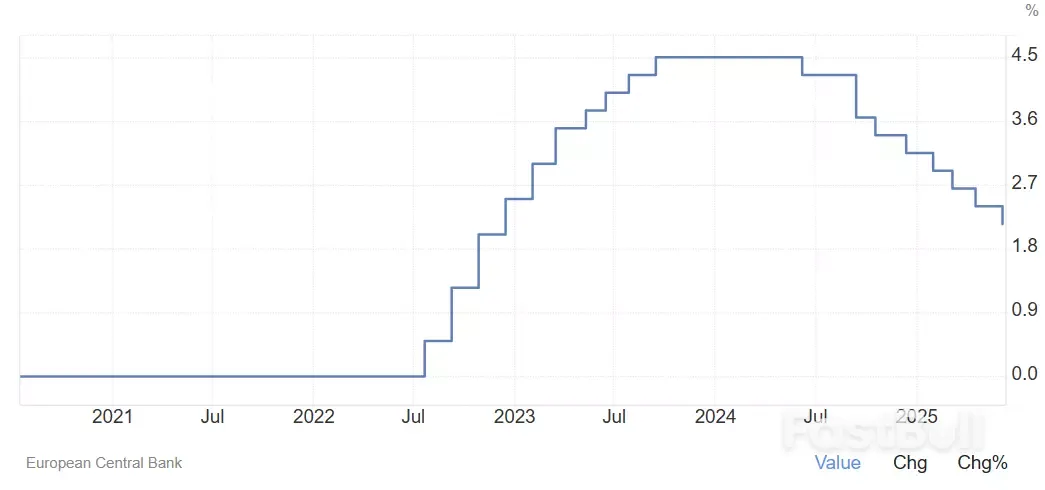
          The week ahead delivers a pivotal convergence of monetary policy, global economic sentiment, and corporate earnings that could reshape market expectations across multiple fronts. The European Central Bank (ECB)'s interest rate decision Thursday takes centre stage, with markets closely watching for signals on the future policy path to maintain inflation at current levels amid the eurozone's evolving economic landscape.ECB President Lagarde's recent comments at the ECB Form indicated the disinflationary project has achieved its objective. Euro Area's headline year-on-year (YoY) inflation rose from 1.9% to 2.0%, matching ECB's target in June. We anticipate policy rates will remain unchanged as policymakers assess the impact of seven consecutive rate cuts while monitoring US-Europe trade relationship developments. Market pricing implies one additional 25 basis point reduction this year, most likely delivered in October.Fed Chair Powell's speech Tuesday will provide crucial insights into US monetary policy thinking, particularly following recent benign inflation prints and robust employment data, while navigating intense political pressure from the Trump administration advocating rate cuts to stimulate economic growth.Flash PMI readings across Australia, Japan, the UK and US on Thursday offer comprehensive insights into global business activities, with particular attention on whether the UK's manufacturing sector can emerge from contractionary territory.On the corporate front, technology giants Tesla and Alphabet reporting earnings, providing key indicators of consumer demand trends, artificial intelligence investment impact, and the broader technology sector's resilience amid economic uncertainties.

          Figure 4: ECB's deposit facility rate

          Market Navigator: Week of 21 July 2025_4

          Source: Trading Economics

          Source:IG

          To stay updated on all economic events of today, please check out our Economic calendar
          Risk Warnings and Disclaimers
          You understand and acknowledge that there is a high degree of risk involved in trading. Following any strategies or investment methods may lead to potential losses. The content on the site is provided by our contributors and analysts for information purposes only. You are solely responsible for determining whether any trading assets, securities, strategy, or any other product is suitable for investing based on your own investment objectives and financial situation.
          Add to Favorites
          Share

          Commerce Secretary Lutnick Says He Is Confident US Will Secure Trade Deal With EU

          James Whitman

          Economic

          US Commerce Secretary Howard Lutnick said on Sunday that he was confident that the United States can secure a trade deal with the European Union (EU), but Aug 1 is a hard deadline for tariffs to kick in.

          Lutnick said he had just got off the phone with European trade negotiators, and there was "plenty of room" for agreement.

          "These are the two biggest trading partners in the world, talking to each other. We'll get a deal done. I am confident [that] we'll get a deal done," Lutnick said in an interview with CBS' "Face the Nation".

          US President Donald Trump threatened on July 12 to impose a 30% tariff on imports from Mexico and the EU starting Aug 1, after weeks of negotiations with major US trading partners failed to reach a comprehensive trade deal.

          Lutnick said that was a hard deadline.

          "Nothing stops countries from talking to us after Aug 1, but they're going to start paying the tariffs on Aug 1," he said on CBS.

          Trump announced the tariffs in a letter to European Commission president Ursula von der Leyen. He sent letters to other trading partners, including Mexico, Canada, Japan and Brazil, setting blanket tariff rates ranging from 20% to 50%, as well as a 50% tariff on copper.

          Lutnick also said that he expects Trump to renegotiate the United States-Mexico-Canada Agreement (USMCA) signed during Trump's first White House term in 2017-2021.

          Barring any major changes, USMCA-compliant goods from Mexico and Canada are exempt from tariffs.

          "I think the president is absolutely going to renegotiate USMCA, but that's a year from today," Lutnick said.

          Source: Reuters

          To stay updated on all economic events of today, please check out our Economic calendar
          Risk Warnings and Disclaimers
          You understand and acknowledge that there is a high degree of risk involved in trading. Following any strategies or investment methods may lead to potential losses. The content on the site is provided by our contributors and analysts for information purposes only. You are solely responsible for determining whether any trading assets, securities, strategy, or any other product is suitable for investing based on your own investment objectives and financial situation.
          Add to Favorites
          Share

          Hedge Funds Retreat from Japan Ahead of Political Shock

          Gerik

          Economic

          Investor Exodus Precedes Political Blow

          Global hedge funds significantly reduced their exposure to Japanese equities between July 11 and 17, marking the sharpest sell-off in nearly two and a half months, according to Goldman Sachs. This wave of selling came just before Sunday’s upper house election, which dealt a severe setback to Prime Minister Shigeru Ishiba and his ruling coalition. Though Ishiba has pledged to remain in power to conclude critical trade negotiations with the United States, his weakened position has sparked broader investor unease.
          The pre-election selloff was driven by a spike in short positions and a milder reduction in long holdings. Despite this, hedge funds still hold an overweight position in Japan relative to its MSCI World Index weight, currently at +0.6%, according to Goldman.

          Markets React Cautiously but Calmly

          Although Japanese equity markets were closed for a national holiday on Monday, early indicators suggest that investors had already priced in the election outcome. Nikkei futures inched upward, and the yen saw modest gains. Nevertheless, both the Nikkei 225 and Topix indexes have underperformed in July, falling 1.7% and 0.6%, respectively, in contrast to rallies seen in other global stock markets.
          The muted market reaction on Monday does not fully reflect deeper concerns. Analysts warn that Ishiba’s political capital is eroding, increasing the risk of “policy paralysis” and delays in fiscal reform. MUFG analysts highlighted that for the first time since 1955, the Liberal Democratic Party (LDP)-led coalition no longer holds a majority in both chambers of Japan’s legislature. This historic shift may deepen policy gridlock and limit Japan's ability to respond to external economic threats, including trade tensions and inflation volatility.

          Risk Premium Rising on Japanese Assets

          The hedge fund exodus underscores growing doubts about Japan's policy trajectory. Political instability could complicate ongoing tariff negotiations with the U.S. and stall key reforms. Fiscal risks are also in focus, as a weakened government may resort to populist spending measures, exacerbating already large deficits.
          While the yen’s safe-haven status provided some cushion, Japanese equities now carry a higher political risk premium. If Ishiba’s leadership remains in limbo, institutional investors may continue to unwind positions despite Japan’s relative macroeconomic stability.
          In the near term, global investors are expected to closely monitor any cabinet reshuffles, stimulus announcements, or signals regarding a potential change in leadership. Unless confidence is restored, Japan’s equities may continue to diverge from broader global market trends.

          Source: Reuters

          To stay updated on all economic events of today, please check out our Economic calendar
          Risk Warnings and Disclaimers
          You understand and acknowledge that there is a high degree of risk involved in trading. Following any strategies or investment methods may lead to potential losses. The content on the site is provided by our contributors and analysts for information purposes only. You are solely responsible for determining whether any trading assets, securities, strategy, or any other product is suitable for investing based on your own investment objectives and financial situation.
          Add to Favorites
          Share
          FastBull
          Copyright © 2025 FastBull Ltd

          728 RM B 7/F GEE LOK IND BLDG NO 34 HUNG TO RD KWUN TONG KLN HONG KONG

          TelegramInstagramTwitterfacebooklinkedin
          App Store Google Play Google Play
          Products
          Charts

          Chats

          Q&A with Experts
          Screeners
          Economic Calendar
          Data
          Tools
          Membership
          Features
          Function
          Markets
          Copy Trading
          Latest Signals
          Contests
          News
          Analysis
          24/7
          Columns
          Education
          Company
          Careers
          About Us
          Contact Us
          Advertising
          Help Center
          Feedback
          User Agreement
          Privacy Policy
          Business

          White Label

          Data API

          Web Plug-ins

          Poster Maker

          Affiliate Program

          Risk Disclosure

          The risk of loss in trading financial instruments such as stocks, FX, commodities, futures, bonds, ETFs and crypto can be substantial. You may sustain a total loss of the funds that you deposit with your broker. Therefore, you should carefully consider whether such trading is suitable for you in light of your circumstances and financial resources.

          No decision to invest should be made without thoroughly conducting due diligence by yourself or consulting with your financial advisors. Our web content might not suit you since we don't know your financial conditions and investment needs. Our financial information might have latency or contain inaccuracy, so you should be fully responsible for any of your trading and investment decisions. The company will not be responsible for your capital loss.

          Without getting permission from the website, you are not allowed to copy the website's graphics, texts, or trademarks. Intellectual property rights in the content or data incorporated into this website belong to its providers and exchange merchants.

          Not Logged In

          Log in to access more features

          FastBull Membership

          Not yet

          Purchase

          Become a signal provider
          Help Center
          Customer Service
          Dark Mode
          Price Up/Down Colors

          Log In

          Sign Up

          Position
          Layout
          Fullscreen
          Default to Chart
          The chart page opens by default when you visit fastbull.com