• Trade
  • Markets
  • Copy
  • Contests
  • News
  • 24/7
  • Calendar
  • Q&A
  • Chats
Trending
Screeners
SYMBOL
LAST
BID
ASK
HIGH
LOW
NET CHG.
%CHG.
SPREAD
SPX
S&P 500 Index
6827.42
6827.42
6827.42
6899.86
6801.80
-73.58
-1.07%
--
DJI
Dow Jones Industrial Average
48458.04
48458.04
48458.04
48886.86
48334.10
-245.98
-0.51%
--
IXIC
NASDAQ Composite Index
23195.16
23195.16
23195.16
23554.89
23094.51
-398.69
-1.69%
--
USDX
US Dollar Index
97.950
98.030
97.950
98.500
97.950
-0.370
-0.38%
--
EURUSD
Euro / US Dollar
1.17394
1.17409
1.17394
1.17496
1.17192
+0.00011
+ 0.01%
--
GBPUSD
Pound Sterling / US Dollar
1.33707
1.33732
1.33707
1.33997
1.33419
-0.00148
-0.11%
--
XAUUSD
Gold / US Dollar
4299.39
4299.39
4299.39
4353.41
4257.10
+20.10
+ 0.47%
--
WTI
Light Sweet Crude Oil
57.233
57.485
57.233
58.011
56.969
-0.408
-0.71%
--

Community Accounts

Signal Accounts
--
Profit Accounts
--
Loss Accounts
--
View More

Become a signal provider

Sell trading signals to earn additional income

View More

Guide to Copy Trading

Get started with ease and confidence

View More

Signal Accounts for Members

All Signal Accounts

Best Return
  • Best Return
  • Best P/L
  • Best MDD
Past 1W
  • Past 1W
  • Past 1M
  • Past 1Y

All Contests

  • All
  • Trump Updates
  • Recommend
  • Stocks
  • Cryptocurrencies
  • Central Banks
  • Featured News
Top News Only
Share

Norwegian Nobel Committee: Calls On The Belarusian Authorities To Release All Political Prisoners

Share

Norwegian Nobel Committee: His Freedom Is A Deeply Welcome And Long-Awaited Moment

Share

Ukraine Says It Received 114 Prisoners From Belarus

Share

USA Embassy In Lithuania: Maria Kalesnikava Is Not Going To Vilnius

Share

USA Embassy In Lithuania: Other Prisoners Are Being Sent From Belarus To Ukraine

Share

Ukraine President Zelenskiy: Five Ukrainians Released By Belarus In US-Brokered Deal

Share

USA Vilnius Embassy: USA Stands Ready For "Additional Engagement With Belarus That Advances USA Interests"

Share

USA Vilnius Embassy: Belarus, USA, Other Citizens Among The Prisoners Released Into Lithuania

Share

USA Vilnius Embassy: USA Will Continue Diplomatic Efforts To Free The Remaining Political Prisoners In Belarus

Share

USA Vilnius Embassy: Belarus Releases 123 Prisoners Following Meeting Of President Trump's Envoy Coale And Belarus President Lukashenko

Share

USA Vilnius Embassy: Masatoshi Nakanishi, Aliaksandr Syrytsa Are Among The Prisoners Released By Belarus

Share

USA Vilnius Embassy: Maria Kalesnikava And Viktor Babaryka Are Among The Prisoners Released By Belarus

Share

USA Vilnius Embassy: Nobel Peace Prize Laureate Ales Bialiatski Is Among The Prisoners Released By Belarus

Share

Belarusian Presidential Administration Telegram Channel: Lukashenko Has Pardoned 123 Prisoners As Part Of Deal With US

Share

Two Local Syrian Officials: Joint US-Syrian Military Patrol In Central Syria Came Under Fire From Unknown Assailants

Share

Israeli Military Says It Targeted 'Key Hamas Terrorist' In Gaza City

Share

Rwanda's Actions In Eastern Drc Are A Clear Violation Of Washington Accords Signed By President Trump - Secretary Of State Rubio

Share

Israeli Military Issues Evacuation Warning In Southern Lebanon Village Ahead Of Strike - Spokesperson On X

Share

Belarusian State Media Cites US Envoy Coale As Saying He Discussed Ukraine And Venezuela With Lukashenko

Share

Belarusian State Media Cites US Envoy Coale As Saying That US Removes Sanctions On Belarusian Potassium

TIME
ACT
FCST
PREV
U.K. Trade Balance Non-EU (SA) (Oct)

A:--

F: --

P: --

U.K. Trade Balance (Oct)

A:--

F: --

P: --

U.K. Services Index MoM

A:--

F: --

P: --

U.K. Construction Output MoM (SA) (Oct)

A:--

F: --

P: --

U.K. Industrial Output YoY (Oct)

A:--

F: --

P: --

U.K. Trade Balance (SA) (Oct)

A:--

F: --

P: --

U.K. Trade Balance EU (SA) (Oct)

A:--

F: --

P: --

U.K. Manufacturing Output YoY (Oct)

A:--

F: --

P: --

U.K. GDP MoM (Oct)

A:--

F: --

P: --

U.K. GDP YoY (SA) (Oct)

A:--

F: --

P: --

U.K. Industrial Output MoM (Oct)

A:--

F: --

P: --

U.K. Construction Output YoY (Oct)

A:--

F: --

P: --

France HICP Final MoM (Nov)

A:--

F: --

P: --

China, Mainland Outstanding Loans Growth YoY (Nov)

A:--

F: --

P: --

China, Mainland M2 Money Supply YoY (Nov)

A:--

F: --

P: --

China, Mainland M0 Money Supply YoY (Nov)

A:--

F: --

P: --

China, Mainland M1 Money Supply YoY (Nov)

A:--

F: --

P: --

India CPI YoY (Nov)

A:--

F: --

P: --

India Deposit Gowth YoY

A:--

F: --

P: --

Brazil Services Growth YoY (Oct)

A:--

F: --

P: --

Mexico Industrial Output YoY (Oct)

A:--

F: --

P: --

Russia Trade Balance (Oct)

A:--

F: --

P: --

Philadelphia Fed President Henry Paulson delivers a speech
Canada Building Permits MoM (SA) (Oct)

A:--

F: --

P: --

Canada Wholesale Sales YoY (Oct)

A:--

F: --

P: --

Canada Wholesale Inventory MoM (Oct)

A:--

F: --

P: --

Canada Wholesale Inventory YoY (Oct)

A:--

F: --

P: --

Canada Wholesale Sales MoM (SA) (Oct)

A:--

F: --

P: --

Germany Current Account (Not SA) (Oct)

A:--

F: --

P: --

U.S. Weekly Total Rig Count

A:--

F: --

P: --

U.S. Weekly Total Oil Rig Count

A:--

F: --

P: --

Japan Tankan Large Non-Manufacturing Diffusion Index (Q4)

--

F: --

P: --

Japan Tankan Small Manufacturing Outlook Index (Q4)

--

F: --

P: --

Japan Tankan Large Non-Manufacturing Outlook Index (Q4)

--

F: --

P: --

Japan Tankan Large Manufacturing Outlook Index (Q4)

--

F: --

P: --

Japan Tankan Small Manufacturing Diffusion Index (Q4)

--

F: --

P: --

Japan Tankan Large Manufacturing Diffusion Index (Q4)

--

F: --

P: --

Japan Tankan Large-Enterprise Capital Expenditure YoY (Q4)

--

F: --

P: --

U.K. Rightmove House Price Index YoY (Dec)

--

F: --

P: --

China, Mainland Industrial Output YoY (YTD) (Nov)

--

F: --

P: --

China, Mainland Urban Area Unemployment Rate (Nov)

--

F: --

P: --

Saudi Arabia CPI YoY (Nov)

--

F: --

P: --

Euro Zone Industrial Output YoY (Oct)

--

F: --

P: --

Euro Zone Industrial Output MoM (Oct)

--

F: --

P: --

Canada Existing Home Sales MoM (Nov)

--

F: --

P: --

Euro Zone Total Reserve Assets (Nov)

--

F: --

P: --

U.K. Inflation Rate Expectations

--

F: --

P: --

Canada National Economic Confidence Index

--

F: --

P: --

Canada New Housing Starts (Nov)

--

F: --

P: --

U.S. NY Fed Manufacturing Employment Index (Dec)

--

F: --

P: --

U.S. NY Fed Manufacturing Index (Dec)

--

F: --

P: --

Canada Core CPI YoY (Nov)

--

F: --

P: --

Canada Manufacturing Unfilled Orders MoM (Oct)

--

F: --

P: --

Canada Manufacturing New Orders MoM (Oct)

--

F: --

P: --

Canada Core CPI MoM (Nov)

--

F: --

P: --

Canada Manufacturing Inventory MoM (Oct)

--

F: --

P: --

Canada CPI YoY (Nov)

--

F: --

P: --

Canada CPI MoM (Nov)

--

F: --

P: --

Canada CPI YoY (SA) (Nov)

--

F: --

P: --

Canada Core CPI MoM (SA) (Nov)

--

F: --

P: --

Q&A with Experts
    • All
    • Chatrooms
    • Groups
    • Friends
    Connecting
    .
    .
    .
    Type here...
    Add Symbol or Code

      No matching data

      All
      Trump Updates
      Recommend
      Stocks
      Cryptocurrencies
      Central Banks
      Featured News
      • All
      • Russia-Ukraine Conflict
      • Middle East Flashpoint
      • All
      • Russia-Ukraine Conflict
      • Middle East Flashpoint

      Search
      Products

      Charts Free Forever

      Chats Q&A with Experts
      Screeners Economic Calendar Data Tools
      Membership Features
      Data Warehouse Market Trends Institutional Data Policy Rates Macro

      Market Trends

      Market Sentiment Order Book Forex Correlations

      Top Indicators

      Charts Free Forever
      Markets

      News

      News Analysis 24/7 Columns Education
      From Institutions From Analysts
      Topics Columnists

      Latest Views

      Latest Views

      Trending Topics

      Top Columnists

      Latest Update

      Signals

      Copy Rankings Latest Signals Become a signal provider AI Rating
      Contests
      Brokers

      Overview Brokers Assessment Rankings Regulators News Claims
      Broker listing Forex Brokers Comparison Tool Live Spread Comparison Scam
      Q&A Complaint Scam Alert Videos Tips to Detect Scam
      More

      Business
      Events
      Careers About Us Advertising Help Center

      White Label

      Data API

      Web Plug-ins

      Affiliate Program

      Awards Institution Evaluation IB Seminar Salon Event Exhibition
      Vietnam Thailand Singapore Dubai
      Fans Party Investment Sharing Session
      FastBull Summit BrokersView Expo
      Recent Searches
        Top Searches
          Markets
          News
          Analysis
          User
          24/7
          Economic Calendar
          Education
          Data
          • Names
          • Latest
          • Prev

          View All

          No data

          Scan to Download

          Faster Charts, Chat Faster!

          Download App
          English
          • English
          • Español
          • العربية
          • Bahasa Indonesia
          • Bahasa Melayu
          • Tiếng Việt
          • ภาษาไทย
          • Français
          • Italiano
          • Türkçe
          • Русский язык
          • 简中
          • 繁中
          Open Account
          Search
          Products
          Charts Free Forever
          Markets
          News
          Signals

          Copy Rankings Latest Signals Become a signal provider AI Rating
          Contests
          Brokers

          Overview Brokers Assessment Rankings Regulators News Claims
          Broker listing Forex Brokers Comparison Tool Live Spread Comparison Scam
          Q&A Complaint Scam Alert Videos Tips to Detect Scam
          More

          Business
          Events
          Careers About Us Advertising Help Center

          White Label

          Data API

          Web Plug-ins

          Affiliate Program

          Awards Institution Evaluation IB Seminar Salon Event Exhibition
          Vietnam Thailand Singapore Dubai
          Fans Party Investment Sharing Session
          FastBull Summit BrokersView Expo

          US-EU Trade Hopes, EUR/GBP (Chart of the Day) Bullish Trend Intact as ECB Looms

          MarketPulse by OANDA Group

          Stocks

          Forex

          Economic

          Summary:

          S&P 500 and Nasdaq 100 E-mini futures continued to edge higher in Asia’s Thursday session, up 0.1% and 0.3% respectively. Gains were supported by upbeat sentiment from Wednesday’s US session, despite mixed Q2 results from Tesla and Alphabet. Investor optimism was further boosted by President Trump’s new executive orders to bolster US artificial intelligence capabilities and improve prospects for a US-EU trade agreement.
          Tesla drops on earnings miss, while Alphabet rises on AI demand

          Tesla shares tumbled 4.4% in after-hours trading as Q2 earnings fell short of expectations ($0.40 EPS vs. $0.48 consensus). CEO Elon Musk’s cautious outlook—citing the phase-out of EV incentives and slow driverless tech deployment—added to the negative sentiment. In contrast, Alphabet shares rose 1.7% after beating earnings forecasts ($2.31 EPS vs. $2.16), buoyed by strong AI-driven sales growth.

          US stocks rally to fresh highs, led by Dow and tech giants

          The S&P 500 climbed 0.8% to a new all-time high, while the Nasdaq 100 gained 0.4%, led by Nvidia (+2.3%). The Dow Jones Industrial Average outperformed with a 1.1% jump to 45,010—just shy of its record high from December 2024. All major US indices remain in strong short-to-medium-term uptrends.

          Asia markets track Wall Street gains as US-EU Trade talks advance

          Asia-Pacific equities mirrored the US rally amid growing optimism that the 1 August US-EU trade deadline may yield a breakthrough. Media reports suggest progress toward a 15% tariff on most EU imports, replacing prior sticking points in negotiations.

          Nikkei nears record high; STI and Hang Seng extend gains

          Japan’s Nikkei 225 surged 1.7% to 41,870, closing in on its all-time high of 42,427. Hong Kong’s Hang Seng Index added 0.4%, marking its fifth straight daily gain. Meanwhile, Singapore’s Straits Times Index rose 0.8%, poised to log a 14th consecutive record close,up 11% from its 23 June low.

          Japanese yen leads FX moves ahead of ECB, Gold slides toward support

          The US dollar weakened further during Asia hours, with the Japanese yen outperforming major peers, gaining 0.4%. The Australian dollar also advanced by 0.3%.
          The euro and sterling traded almost unchanged from Wednesday’s US session close as traders await the European Central Bank (ECB) monetary policy decision out later today, where the consensus has priced in no rate cut to maintain its key deposit rate at 2% after eight consecutive cuts.
          ECB President Lagarde’s press conference will be pivotal as market participants look out for more hints to indicate ECB is at the end of its interest rate cut cycle. If such hawkish hold guidance materialises, the EUR/USD is likely to have more impetus to maintain its recent minor short-term bullish uptrend phase that kickstarted last Wednesday, 17 July.
          Meanwhile, gold extended its decline, shedding 0.3% intraday after a 1.3% drop yesterday. The precious metal is now nearing a key short-term support at US$3,260, where buyers may return.

          Chart of the day – EUR/GBP looks set to resume its bullish move as ECB looms

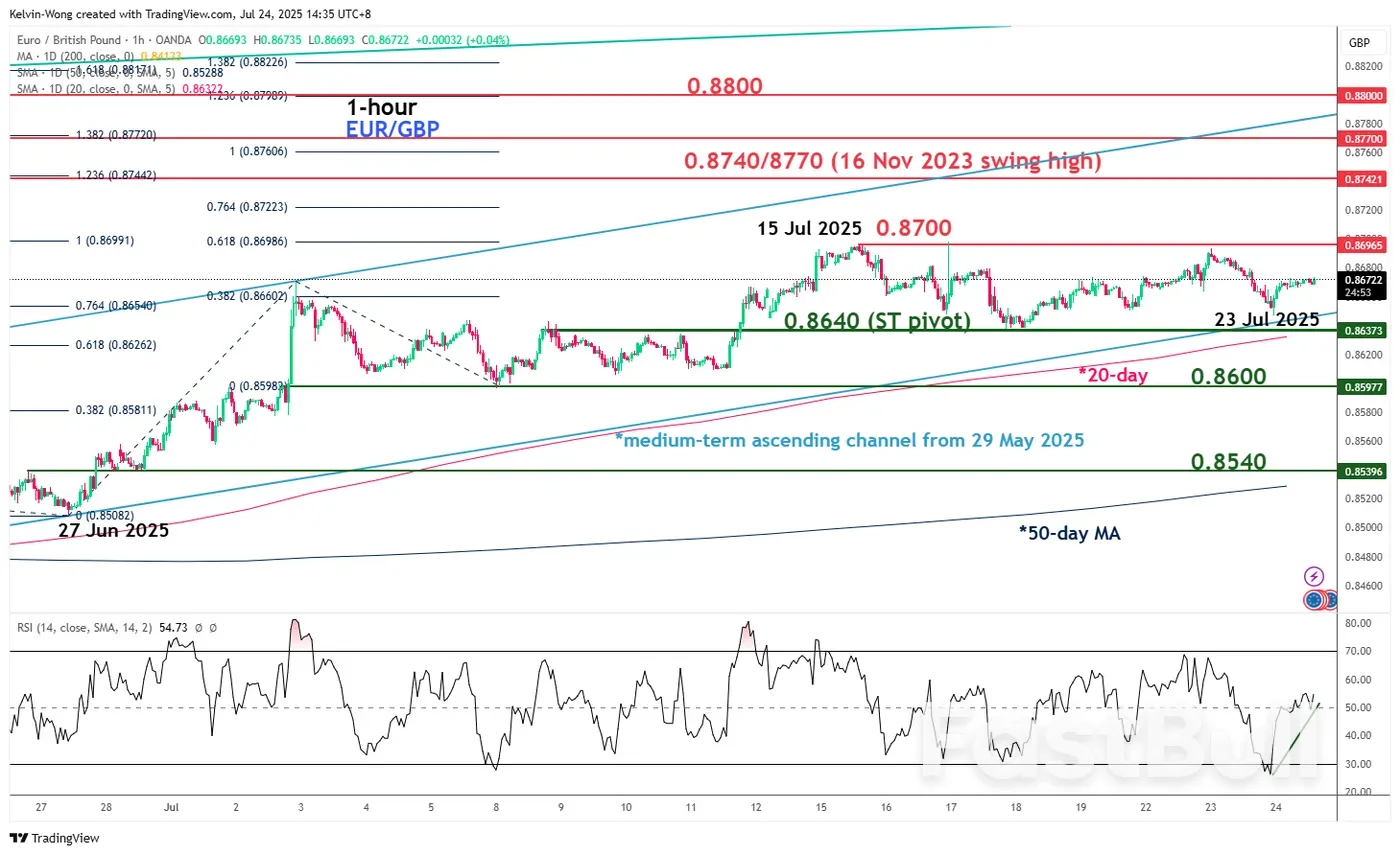
          US-EU Trade Hopes, EUR/GBP (Chart of the Day) Bullish Trend Intact as ECB Looms_1

          Fig 1: EUR/GBP minor & medium-term trends as of 24 July 2025 (Source: TradingView)

          The recent slide of 58 pips seen on the EUR/GBP cross pair from its 15 July swing high area of 0.8700 has hit a key inflection point for the bulls to resume a potential bullish impulsive up move sequence with its short-term minor uptrend phase in place since 27 June 2025 low.
          Firstly, the price action of EUR/GBP has staged a bounce right above the lower boundary of its medium-term ascending channel from 29 May 2025 low, and its rising 20-day moving average.
          Secondly, the hourly RSI momentum indicator has formed a “higher low” after it hit a recent oversold reading on 23 July, which suggests a potential short-term bullish momentum revival.
          Watch the 0.8640 short-term key pivotal support, and a clearance above 0.8700 increases the odds of a fresh bullish impulsive up move sequence to see the next intermediate resistances coming in at 0.8740/8770 and 0.8800 (see Fig 2).
          However, a break below 0.8640 invalidates the bullish scenario for a minor corrective decline to expose the next intermediate supports at 0.8600 and 0.8540 (also the 50-day moving average).

          Source:OANDA

          To stay updated on all economic events of today, please check out our Economic calendar
          Risk Warnings and Disclaimers
          You understand and acknowledge that there is a high degree of risk involved in trading. Following any strategies or investment methods may lead to potential losses. The content on the site is provided by our contributors and analysts for information purposes only. You are solely responsible for determining whether any trading assets, securities, strategy, or any other product is suitable for investing based on your own investment objectives and financial situation.
          Add to Favorites
          Share

          Germany’s Private Sector Keeps Growing Before US Trade Deadline

          Glendon

          Economic

          Forex

          Germany’s private sector kept growing in July, a sign of resilience in the face of Donald Trump’s intensifying tariff threats and optimism over the government’s spending push.

          While S&P Global’s Composite Purchasing Managers’ Index for Europe’s largest economy slipped to 50.3 from 50.4 in June, it remained above the 50 threshold separating expansion from contraction, data Thursday showed. Analysts had expected a reading of 50.7.

          Manufacturing conditions continued to improve, with its PMI index climbing to 49.2 — the highest level in three years. The services gauge came in just above 50.

          “We see increasing signs of a recovery in the manufacturing sector,” Cyrus de la Rubia, an economist at Hamburg Commercial Bank, said in a statement, adding that a sustained rise in export orders means it’s “reasonable” to expect a continued advance in output. “Even higher US tariffs should not fundamentally change this outlook.”

          The numbers suggest hope about Chancellor Friedrich Merz’s plans for defense and infrastructure outlays — worth hundreds of billions of euros over the coming years — is balancing out concerns about worsening trade ties with the US.

          Rising real wages and expansionary fiscal policy should help the services industry “to regain its footing,” according to de la Rubia.

          The European Union is trying to clinch a deal with the Trump administration after the president threatened to impose 30% duties on the bloc from Aug. 1. But diplomats briefed on the negotiations say progress is being made toward a rate of 15%.

          Resilience in the PMI numbers supports the European Central Bank‘s plan to keep interest rates steady at its meeting later Thursday. Many policymakers have said that with inflation around the 2% target, they can afford to wait for more clarity on trade.

          In France, meanwhile, activity improved. The composite PMI rose to 49.6 from 49.2 as both manufacturing and services fared better. Analysts had expected a slight deterioration.

          “While momentum has been trending upward since the beginning of the year, the index remains below the critical 50-point threshold,” said Jonas Feldhusen, an economist at Hamburg Commercial Bank. “France remains under considerable pressure, both economically and politically. GDP growth is unlikely to exceed the 1% mark this year.”

          The government is still consumed by efforts to rein in the euro zone’s widest budget gap, though Prime Minister Francois Bayrou’s latest proposal has sparked the ire of opposition parties, signaling more political turbulence ahead.

          “Questions are mounting over whether Prime Minister Bayrou can sustain his austerity course politically,” Feldhusen said. “Should an agreement on the austerity package be reached, it would reduce disposable income for many households — posing clear downside risks for domestic demand and especially for the services sector.”

          PMIs are closely watched by markets as they arrive early in the month and are good at revealing trends and turning points in an economy. A measure of breadth of changes in output rather than depth, business surveys can sometimes be difficult to map directly to quarterly GDP.

          Earlier in the day, PMIs from Australia, Japan and India remained comfortably above 50. Later Thursday, the UK and US composite readings are also expected to signal growth.

          Source: Bloomberg Europe

          To stay updated on all economic events of today, please check out our Economic calendar
          Risk Warnings and Disclaimers
          You understand and acknowledge that there is a high degree of risk involved in trading. Following any strategies or investment methods may lead to potential losses. The content on the site is provided by our contributors and analysts for information purposes only. You are solely responsible for determining whether any trading assets, securities, strategy, or any other product is suitable for investing based on your own investment objectives and financial situation.
          Add to Favorites
          Share

          Deutsche Bank Surpasses Q2 Profit Expectations Despite Euro Strength and Investment Banking Pressures

          Gerik

          Economic

          Solid quarterly earnings defy currency and advisory headwinds

          Deutsche Bank delivered a Q2 2025 net profit of €1.485 billion ($1.748 billion), significantly beating analysts’ expectations of €1.2 billion. This strong result marks a sharp recovery from the €143 million loss posted in the same quarter last year, which was weighed down by legal provisions related to its Postbank acquisition. Revenue for the quarter totaled €7.804 billion, nearly matching consensus forecasts and reflecting a broadly stable operating environment.
          Despite the strengthening euro traditionally a headwind for European multinationals with large USD-based revenues Deutsche Bank maintained profitability, showcasing resilience across its core divisions. Profit before tax rose 34% year-on-year to €2.4 billion, and its common equity tier one (CET1) capital ratio, a key measure of financial stability, improved to 14.2% from 13.8% in Q1. Post-tax return on tangible equity (ROTE) declined slightly to 10.1% from 11.9% but remains above the bank’s long-term cost of capital threshold.
          CEO Christian Sewing reaffirmed the bank's progress toward its 2025 strategic targets, signaling confidence in ongoing profitability and capital strength despite uncertain external conditions.

          Investment banking shows resilience, but debt origination falters

          The bank’s investment banking unit reported a modest 3% year-on-year increase in revenue to €2.687 billion. However, results varied widely across segments. Fixed income and currencies traditionally a strength for Deutsche Bank delivered a robust 11% revenue jump, driven by higher net interest income and heightened foreign exchange activity amid global macro volatility.
          In contrast, the origination and advisory segment posted a 29% revenue decline, down to €416 million. The fall reflects subdued corporate activity, especially in debt issuance, as companies remain cautious in the face of interest rate uncertainty and geopolitical tensions. This divergence highlights the uneven nature of investment banking recovery: while trading desks benefit from volatility and rate differentials, dealmaking remains constrained by market risk aversion.

          Corporate banking and macro headwinds temper broader performance

          Corporate banking revenues fell slightly, down 1% year-on-year to €1.896 billion. This muted performance reflects broader eurozone headwinds, including tighter monetary conditions, a softer lending environment, and declining business confidence. The European Central Bank’s decision in June to cut its key interest rate to 2% after several hikes to combat inflation has weighed on net interest margins, a key revenue source for corporate lending divisions.
          Deutsche Bank, like its European peers, now operates in a shifting rate landscape where the benefits of previous tightening are tapering off. While defense-related investment across Europe is offering new advisory and financing opportunities, especially amid rising geopolitical tensions, these flows remain nascent and insufficient to offset slower growth in traditional corporate banking.

          Geopolitical and trade uncertainties cloud outlook

          Externally, Germany’s political climate has stabilized after last year’s elections brought Chancellor Friedrich Merz’s coalition to power. However, the broader economic outlook is clouded by unresolved transatlantic trade tensions. The EU’s ongoing negotiations with US President Donald Trump on a potential tariff deal set against an August 1 deadline pose a major risk. If tariffs are implemented, Bundesbank President Joachim Nagel warned that a recession in Germany in 2025 “cannot be ruled out.”
          As Europe’s largest economy and a major global exporter, Germany and by extension, its leading banks would be particularly vulnerable to such protectionist measures. For Deutsche Bank, this adds uncertainty to its revenue base, particularly in trade finance, cross-border advisory, and export-linked lending.
          Deutsche Bank’s Q2 results highlight strong operational momentum and effective risk management, allowing the bank to outperform in a quarter marked by currency challenges and mixed capital markets activity. While management’s reaffirmation of 2025 goals signals confidence, structural risks including tariff exposure, a slowing eurozone economy, and weaker origination pipelines warrant caution. The bank remains well-capitalized and agile, but its forward trajectory will depend on how global trade and monetary policy landscapes evolve in the months ahead.

          Source: CNBC

          To stay updated on all economic events of today, please check out our Economic calendar
          Risk Warnings and Disclaimers
          You understand and acknowledge that there is a high degree of risk involved in trading. Following any strategies or investment methods may lead to potential losses. The content on the site is provided by our contributors and analysts for information purposes only. You are solely responsible for determining whether any trading assets, securities, strategy, or any other product is suitable for investing based on your own investment objectives and financial situation.
          Add to Favorites
          Share

          French Economy Continues to Weaken in July Amid Marked Drop Inconfidence

          S&P Global Inc.

          Forex

          Economic

          Key findings:

          ● HCOB Flash France Composite PMI Output Index(1) at 49.6 (Jun: 49.2).11-month high.
          ● HCOB Flash France Services PMI Business Activity Index(2) at 49.7 (Jun: 49.6). 11-month high.
          ● HCOB Flash France Manufacturing PMI Output Index(4) at 48.6 (Jun: 47.3). 2-month high.
          ● HCOB Flash France Manufacturing PMI(3) at 48.4 (Jun: 48.1). 2-month high.
          France’s private sector economy continued to deteriorate at the beginning of the third quarter, with business activity shrinkingfor an eleventh successive month. July’s contraction was, however, only marginal overall and the weakest seen over the currentsequence. That said, while the headline figure showed signs of stabilisation, other data from the ‘flash’ report pointed tounderlying fragility. For example, new orders decreased markedly and at an accelerated pace, while business confidencedeteriorated sharply to its weakest since last November. Additionally, employment fell to the greatest extent in three months.
          The headline HCOB Flash France Composite PMI Output Index rose to an 11-month high of 49.6 in July, fractionally belowthe 50.0 level which separates growth from contraction. By improving from 49.2 in June, the preliminary HCOB PMI data for thestart of the third quarter indicated that activity moved closer to stabilisation, following contractions in each of the prior tenmonths. By sector, slower declines in output were seen in both manufacturing and services.
          However, despite the headline ‘flash’ index picking up, some of the survey’s sub-indices signalled deepening fragility across theeurozone’s second-largest economy. Demand for French goods and services declined at the sharpest pace in three months inJuly. Sales weakness intensified across both monitored sectors, but particularly in manufacturing, where new orders fell to thegreatest degree since February.
          The steeper drop in overall private sector new orders partly reflected a quicker downturn in exports, which fell at the fastest ratein the year-to-date. Again, weakness was predominately centred on manufacturing.
          Another key finding from July’s ‘flash’ report related to French companies’ year-ahead expectations, which slumped sharply totheir weakest since November last year. Marked declines in confidence were recorded at both manufacturers and serviceproviders, underlying sector data showed. Companies widely commented on lower budgets, concerns regarding the salesoutlook and domestic political uncertainty.
          With expectations diminishing, French businesses made further cuts to their employment numbers during July. The overall rateof job shedding was the fastest seen for three months, albeit modest. Notably, lower workforce numbers were exclusive to theservice sector as factory hiring picked up. Although marginal, manufacturing employment growth was its most pronounced intwo-and-a-half years. In many cases, goods producers expanded staffing capacity through the recruitment of fixed-termemployees, anecdotal evidence showed.
          As for pricing trends, July survey data revealed relatively soft inflationary pressures across France, with both input costs andoutput charges rising at rates which were below their respective long-term averages. Indeed, prices charged for French goodsand services rose only marginally at the start of the third quarter, albeit at a slightly quicker pace following a fresh uptick infactory gate prices. Total private sector input costs meanwhile rose at a broadly similar rate to June.

          Source:S&P Global

          To stay updated on all economic events of today, please check out our Economic calendar
          Risk Warnings and Disclaimers
          You understand and acknowledge that there is a high degree of risk involved in trading. Following any strategies or investment methods may lead to potential losses. The content on the site is provided by our contributors and analysts for information purposes only. You are solely responsible for determining whether any trading assets, securities, strategy, or any other product is suitable for investing based on your own investment objectives and financial situation.
          Add to Favorites
          Share

          EURUSD Strengthens On Progress In US-EU Negotiations And Fed Meeting Expectations

          James Whitman

          Economic

          Forex

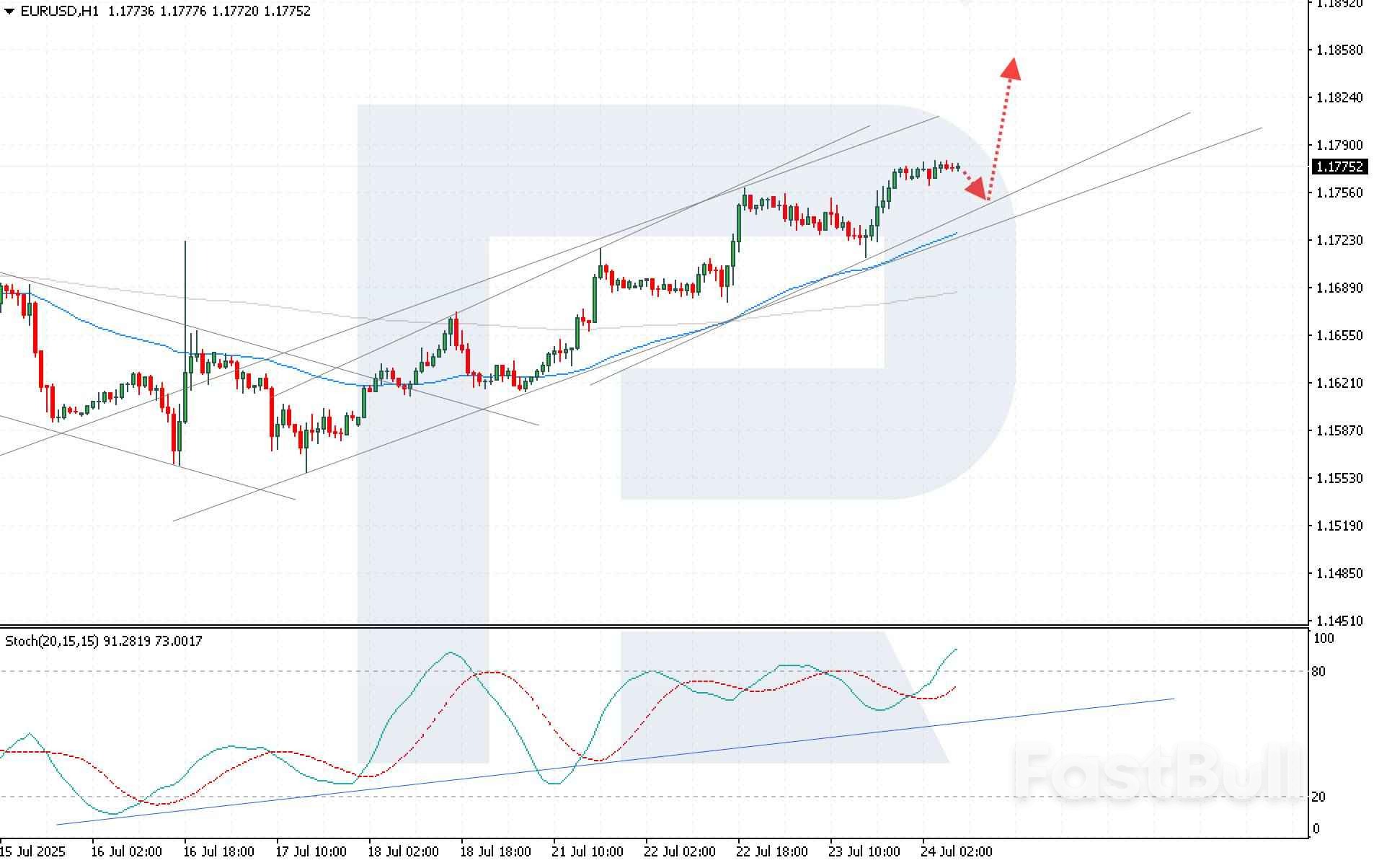
          The EURUSD pair maintains its steady bullish momentum, with no signs of weakening so far. The current rate stands at 1.1775. Find more details in our analysis for 24 July 2025.

          EURUSD forecast: key trading points

          ● The US dollar weakens amid progress in trade talks with key partners
          ● Market focus shifts to next week's Fed meeting; interest rates are expected to remain unchanged
          ● EURUSD forecast for 24 July 2025: 1.1855

          Fundamental analysis

          The EURUSD pair continues to climb for the fifth consecutive trading session. The US dollar weakens as progress in trade negotiations with key partners boosts demand for rival currencies. Recent reports indicate that the US and the EU are close to finalising an agreement.

          Treasury Secretary Scott Bessent reassured investors that Federal Reserve Chairman Jerome Powell would not be forced to resign, despite ongoing criticism from Donald Trump regarding the Fed's monetary policy.

          Market participants now shift their focus to the upcoming Federal Reserve meeting scheduled for next week. Interest rates are expected to remain unchanged amid continued uncertainty around global tariffs.

          Meanwhile, US crude oil inventories dropped by 3.17 million barrels last week, reaching 419 million barrels. This figure, published by the Department of Energy, significantly outperformed expert expectations, which predicted a decline of only 1.6 million barrels.

          EURUSD technical analysis

          The EURUSD rate remains within an ascending channel, showing confident movement above the 1.1750 resistance level. The price is currently consolidating near the next local resistance level, suggesting a potential pause before a new upward impulse.

          Today’s EURUSD forecast anticipates a possible short-term pullback towards the lower boundary of the channel near 1.1755, followed by a renewed rise towards 1.1855. The Stochastic Oscillator remains in the overbought area, but its signal lines continue to point upwards, confirming sustained bullish pressure.

          Summary

          EURUSD strength continues, supported by a weaker dollar amid progress in US-EU trade talks and the absence of hawkish Fed expectations. EURUSD technical analysis shows the pair maintains its bullish momentum within the upward channel. After a short-term correction towards 1.1755, a move towards the 1.1855 target remains the primary scenario.

          Source: RoboForex

          To stay updated on all economic events of today, please check out our Economic calendar
          Risk Warnings and Disclaimers
          You understand and acknowledge that there is a high degree of risk involved in trading. Following any strategies or investment methods may lead to potential losses. The content on the site is provided by our contributors and analysts for information purposes only. You are solely responsible for determining whether any trading assets, securities, strategy, or any other product is suitable for investing based on your own investment objectives and financial situation.
          Add to Favorites
          Share

          China Introduces Elderly Care Vouchers to Ease Aging Burden and Boost Domestic Consumption

          Gerik

          Economic

          Targeted subsidies mark shift in China’s fiscal support strategy

          In a significant departure from its typical policy approach, China has announced a direct fiscal intervention targeting its aging population by offering monthly electronic subsidy vouchers for elderly care. The initiative, spearheaded by the Ministry of Civil Affairs and the Ministry of Finance, will be tested in select cities before expanding nationwide later in 2025. Eligible recipients seniors classified as moderately, severely, or fully disabled will receive between 500 and 800 yuan per month to cover a portion of care-related services, such as rehabilitation, meal support, and assisted bathing.
          Unlike previous stimulus efforts that avoided direct cash handouts, Beijing is now acknowledging the growing economic drag caused by demographic shifts. By focusing assistance on elderly households, policymakers aim to ease the cost burden on families and encourage greater use of care services, thereby activating latent consumption within a segment that is often overlooked in traditional consumer stimulus models.

          Silver economy gains prominence amid aging demographics

          The move comes as China faces mounting pressure from its demographic transition. As of the end of 2024, 22% of the population was aged 60 or above, up from 18.7% in 2020. The number of people aged 65 and older has already surpassed 216 million, accounting for 15% of the total population. This aging trend is reshaping the domestic economy, giving rise to a "silver economy" in which businesses are increasingly tailoring services and products to older consumers.
          Beijing’s subsidy scheme reflects a causal response to both demand and supply-side constraints. On the demand side, many middle-income households are reluctant to spend due to job insecurity, leading to high precautionary savings. According to Alfredo Montufar-Helu, this hesitancy is particularly visible in families supporting elderly relatives, where the cost of long-term care remains a major financial burden. Subsidies, even if modest, are expected to reduce this burden and encourage more active participation in the service economy.
          On the supply side, the program is designed to stimulate the senior-care sector by directly subsidizing demand, potentially attracting new investment and encouraging innovation in care delivery.

          Fiscal burden shared between central and local governments

          The program’s funding will be led by the central government, with supplementary support from local authorities. This model aligns with broader fiscal reforms aimed at balancing responsibility between levels of government while minimizing regional disparities in care provision. The initial 12-month pilot period will allow policymakers to evaluate take-up rates, regional effectiveness, and administrative efficiency before committing to a broader rollout.
          While still limited in scope, the initiative is notable for its political significance. Economists from ING and the Economist Intelligence Unit agree that it marks a shift toward bolstering the social safety net, especially amid broader concerns about low consumption, a high youth unemployment rate, and uneven economic recovery. The vouchers are thus not only a social policy tool but also a demand-side stimulus mechanism.
          China’s elderly-care subsidy voucher plan represents a strategic pivot toward addressing structural consumption challenges rooted in demographics and inequality. By easing household financial stress linked to elder care, the initiative may reduce precautionary savings and unlock new streams of domestic demand. While modest in financial scope, the program could pave the way for wider reforms in pensions, healthcare, and welfare support under the upcoming 15th Five-Year Plan. For a society increasingly shaped by its aging population, targeted fiscal tools such as these may become central to both social stability and long-term economic sustainability.

          Source: CNBC

          To stay updated on all economic events of today, please check out our Economic calendar
          Risk Warnings and Disclaimers
          You understand and acknowledge that there is a high degree of risk involved in trading. Following any strategies or investment methods may lead to potential losses. The content on the site is provided by our contributors and analysts for information purposes only. You are solely responsible for determining whether any trading assets, securities, strategy, or any other product is suitable for investing based on your own investment objectives and financial situation.
          Add to Favorites
          Share

          RBA Signals Patience as Unemployment Rises, Reaffirms Gradual Rate-Cutting Path

          Gerik

          Economic

          Labour market slowdown seen as part of expected adjustment

          Reserve Bank of Australia (RBA) Governor Michele Bullock downplayed concerns over a recent rise in the national unemployment rate, framing the uptick from 4.1% to 4.3% in June as aligned with prior forecasts. Rather than interpreting the change as a signal of economic stress, Bullock emphasized that labour market rebalancing is unfolding through reductions in job vacancies, total hours worked, and voluntary job switching, rather than through widespread job losses.
          This interpretation suggests that the RBA views the labour market's softening as structurally manageable, rather than as a trigger for urgent monetary easing. Bullock noted that forward indicators, such as vacancy rates, have been stable, and there is no immediate evidence pointing to a sustained spike in unemployment. In this context, the RBA appears to be prioritizing labour market stability over pre-emptive stimulus.

          Monetary policy to ease gradually as inflation trends lower

          Despite the unemployment data, Bullock reiterated that a "measured and gradual" path to monetary easing remains appropriate. The central bank surprised markets earlier in July by holding rates at 3.85%, even as a quarter-point cut had been widely priced in. That decision, which split the RBA board, reflected a desire to await additional data on both inflation and employment before acting.
          Since that meeting, the case for easing has strengthened. Inflation slowed to 2.9% in Q1, down sharply from its peak of 6.8%, and well within the RBA’s target range of 2–3%. Market forecasts suggest that Q2 data, due next week, will show further moderation to around 2.7%. While Bullock acknowledged the possibility of a slight upside surprise, she stressed that the RBA’s strategy remains centered on balancing inflation control with labour market resilience.
          This cautious easing stance reflects the RBA’s underlying philosophy: unlike some major central banks that pursued aggressive rate hikes during the inflationary peak, Australia’s central bank took a milder path. As Bullock noted, this approach may allow the RBA to reduce interest rates more conservatively in the coming months, since the baseline level of tightening was already relatively modest.

          Markets anticipate August rate cut, but no rush from RBA

          Following the unemployment data release, markets have nearly fully priced in a 25-basis-point rate cut in August. However, Bullock’s remarks indicate the RBA is not committing to a fixed timeline and prefers to remain guided by real-time economic signals rather than market expectations. The central bank is clearly prepared to ease policy if disinflation continues and labour conditions deteriorate further, but it will not do so mechanically.
          Importantly, Bullock clarified that the RBA does not target a specific job loss figure or unemployment rate. Instead, it evaluates the broader dynamics of labour market adjustments, which can take multiple forms without necessarily triggering significant social or economic disruption.
          The RBA’s steady-handed response to rising unemployment suggests a high degree of confidence in the economy’s ability to absorb external and internal shocks. With inflation returning to target and the labour market showing early signs of a soft landing, the central bank is opting for a slow and deliberate path toward lower rates. While markets are positioning for an August cut, Bullock’s message reinforces that future policy decisions will hinge on incoming data not pressure from short-term volatility. This reinforces the RBA’s overarching objective: to manage inflation without sacrificing the hard-won gains in employment.

          Source: Reuters

          To stay updated on all economic events of today, please check out our Economic calendar
          Risk Warnings and Disclaimers
          You understand and acknowledge that there is a high degree of risk involved in trading. Following any strategies or investment methods may lead to potential losses. The content on the site is provided by our contributors and analysts for information purposes only. You are solely responsible for determining whether any trading assets, securities, strategy, or any other product is suitable for investing based on your own investment objectives and financial situation.
          Add to Favorites
          Share
          FastBull
          Copyright © 2025 FastBull Ltd

          728 RM B 7/F GEE LOK IND BLDG NO 34 HUNG TO RD KWUN TONG KLN HONG KONG

          TelegramInstagramTwitterfacebooklinkedin
          App Store Google Play Google Play
          Products
          Charts

          Chats

          Q&A with Experts
          Screeners
          Economic Calendar
          Data
          Tools
          Membership
          Features
          Function
          Markets
          Copy Trading
          Latest Signals
          Contests
          News
          Analysis
          24/7
          Columns
          Education
          Company
          Careers
          About Us
          Contact Us
          Advertising
          Help Center
          Feedback
          User Agreement
          Privacy Policy
          Business

          White Label

          Data API

          Web Plug-ins

          Poster Maker

          Affiliate Program

          Risk Disclosure

          The risk of loss in trading financial instruments such as stocks, FX, commodities, futures, bonds, ETFs and crypto can be substantial. You may sustain a total loss of the funds that you deposit with your broker. Therefore, you should carefully consider whether such trading is suitable for you in light of your circumstances and financial resources.

          No decision to invest should be made without thoroughly conducting due diligence by yourself or consulting with your financial advisors. Our web content might not suit you since we don't know your financial conditions and investment needs. Our financial information might have latency or contain inaccuracy, so you should be fully responsible for any of your trading and investment decisions. The company will not be responsible for your capital loss.

          Without getting permission from the website, you are not allowed to copy the website's graphics, texts, or trademarks. Intellectual property rights in the content or data incorporated into this website belong to its providers and exchange merchants.

          Not Logged In

          Log in to access more features

          FastBull Membership

          Not yet

          Purchase

          Become a signal provider
          Help Center
          Customer Service
          Dark Mode
          Price Up/Down Colors

          Log In

          Sign Up

          Position
          Layout
          Fullscreen
          Default to Chart
          The chart page opens by default when you visit fastbull.com