Markets
News
Analysis
User
24/7
Economic Calendar
Education
Data
- Names
- Latest
- Prev


Signal Accounts for Members
All Signal Accounts
All Contests


U.S. Average Hourly Wage MoM (SA) (Dec)A:--
F: --
U.S. Average Weekly Working Hours (SA) (Dec)A:--
F: --
P: --
U.S. New Housing Starts Annualized MoM (SA) (Oct)A:--
F: --
U.S. Total Building Permits (SA) (Oct)A:--
F: --
P: --
U.S. Building Permits MoM (SA) (Oct)A:--
F: --
P: --
U.S. Annual New Housing Starts (SA) (Oct)A:--
F: --
U.S. U6 Unemployment Rate (SA) (Dec)A:--
F: --
P: --
U.S. Manufacturing Employment (SA) (Dec)A:--
F: --
U.S. Labor Force Participation Rate (SA) (Dec)A:--
F: --
P: --
U.S. Private Nonfarm Payrolls (SA) (Dec)A:--
F: --
U.S. Government Employment (Dec)A:--
F: --
P: --
U.S. UMich Consumer Expectations Index Prelim (Jan)A:--
F: --
P: --
U.S. UMich Consumer Sentiment Index Prelim (Jan)A:--
F: --
P: --
U.S. UMich Current Economic Conditions Index Prelim (Jan)A:--
F: --
P: --
U.S. UMich 1-Year-Ahead Inflation Expectations Prelim (Jan)A:--
F: --
P: --
U.S. UMich 5-Year-Ahead Inflation Expectations Prelim YoY (Jan)A:--
F: --
P: --
U.S. 5-10 Year-Ahead Inflation Expectations (Jan)A:--
F: --
P: --
U.S. Weekly Total Oil Rig CountA:--
F: --
P: --
U.S. Weekly Total Rig CountA:--
F: --
P: --
Indonesia Retail Sales YoY (Nov)A:--
F: --
P: --
Euro Zone Sentix Investor Confidence Index (Jan)A:--
F: --
P: --
India CPI YoY (Dec)A:--
F: --
P: --
Canada National Economic Confidence IndexA:--
F: --
P: --
Germany Current Account (Not SA) (Nov)A:--
F: --
P: --
U.S. Conference Board Employment Trends Index (SA) (Dec)A:--
F: --
China, Mainland M0 Money Supply YoY (Dec)--
F: --
P: --
China, Mainland M2 Money Supply YoY (Dec)--
F: --
P: --
China, Mainland M1 Money Supply YoY (Dec)--
F: --
P: --
Richmond Federal Reserve President Barkin delivered a speech.
U.S. 3-Year Note Auction Yield--
F: --
P: --
U.S. 10-Year Note Auction Avg. Yield--
F: --
P: --
New York Federal Reserve President Williams delivered a speech.
Japan Trade Balance (Customs Data) (SA) (Nov)--
F: --
P: --
Japan Trade Balance (Nov)--
F: --
P: --
U.K. BRC Overall Retail Sales YoY (Dec)--
F: --
P: --
U.K. BRC Like-For-Like Retail Sales YoY (Dec)--
F: --
P: --
Turkey Retail Sales YoY (Nov)--
F: --
P: --
U.S. NFIB Small Business Optimism Index (SA) (Dec)--
F: --
P: --
Brazil Services Growth YoY (Nov)--
F: --
P: --
Canada Building Permits MoM (SA) (Nov)--
F: --
P: --
U.S. CPI MoM (SA) (Dec)--
F: --
P: --
U.S. CPI YoY (Not SA) (Dec)--
F: --
P: --
U.S. Real Income MoM (SA) (Dec)--
F: --
P: --
U.S. CPI MoM (Not SA) (Dec)--
F: --
P: --
U.S. Core CPI (SA) (Dec)--
F: --
P: --
U.S. Core CPI YoY (Not SA) (Dec)--
F: --
P: --
U.S. Core CPI MoM (SA) (Dec)--
F: --
P: --
U.S. Weekly Redbook Index YoY--
F: --
P: --
U.S. New Home Sales Annualized MoM (Oct)--
F: --
P: --
U.S. Annual Total New Home Sales (Oct)--
F: --
P: --
U.S. Cleveland Fed CPI MoM (SA) (Dec)--
F: --
P: --
U.S. Cleveland Fed CPI MoM (Dec)--
F: --
P: --
China, Mainland Exports (Dec)--
F: --
P: --
China, Mainland Imports YoY (CNH) (Dec)--
F: --
P: --
China, Mainland Imports (CNH) (Dec)--
F: --
P: --
China, Mainland Trade Balance (CNH) (Dec)--
F: --
P: --
China, Mainland Imports YoY (USD) (Dec)--
F: --
P: --
China, Mainland Exports YoY (USD) (Dec)--
F: --
P: --
U.S. EIA Natural Gas Production Forecast For The Next Year (Jan)--
F: --
P: --
U.S. EIA Short-Term Crude Production Forecast For The Next Year (Jan)--
F: --
P: --


No matching data
Latest Views
Latest Views
Trending Topics
Top Columnists
Latest Update
White Label
Data API
Web Plug-ins
Affiliate Program
View All

No data
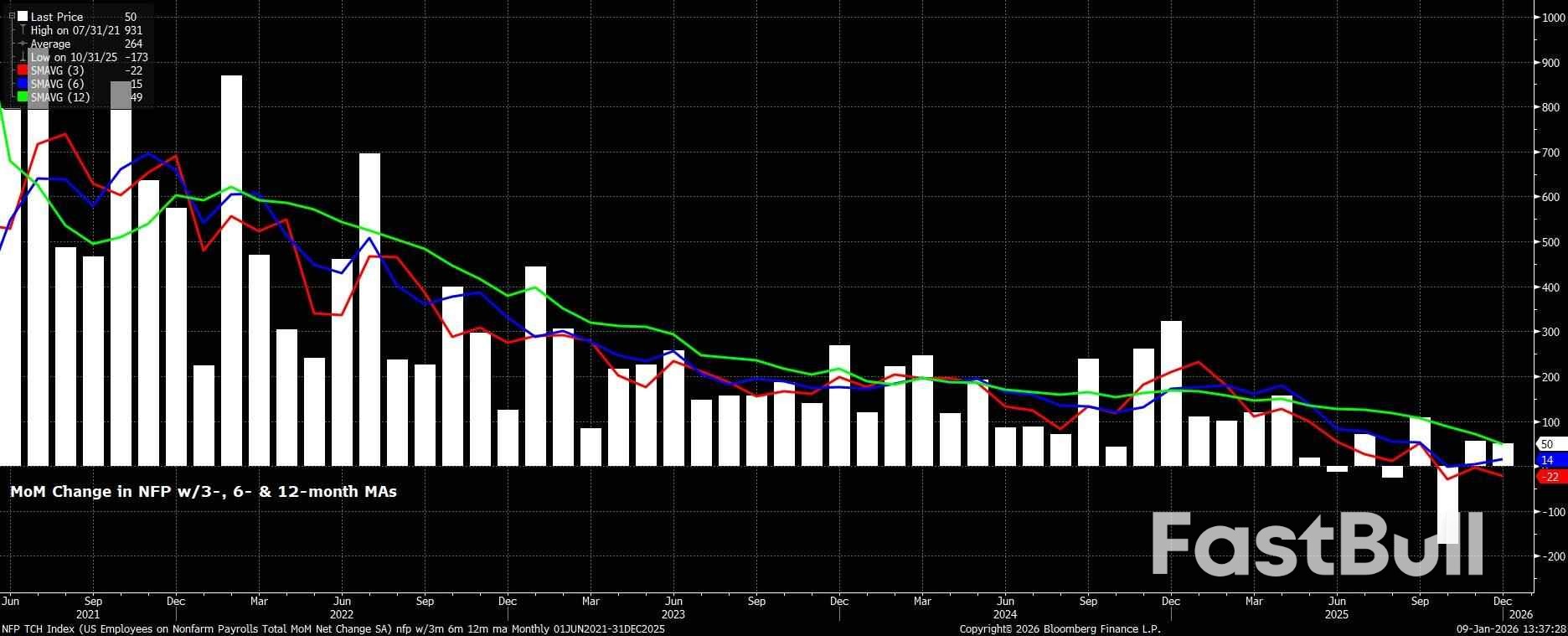
Headline nonfarm payrolls rose by +50k in December, just a touch below consensus expectations for an increase of +70k, albeit within the typically wide forecast range, of +25k to +155k.
Headline nonfarm payrolls rose by +50k in December, just a touch below consensus expectations for an increase of +70k, albeit within the typically wide forecast range, of +25k to +155k. Recall, however, that there are some data quality concerns around the headline payrolls print, with Fed Chair Powell having noted that jobs growth may be overstated by as much as 60k per month, implying that the 'real' pace of job creation was probably somewhere around zero.
Concurrently, the prior two payrolls prints, for October and November, were revised by a net -76k, in turn taking the 3-month average of job gains to -22k, and seeing the 6-month average of job gains hover just above zero.
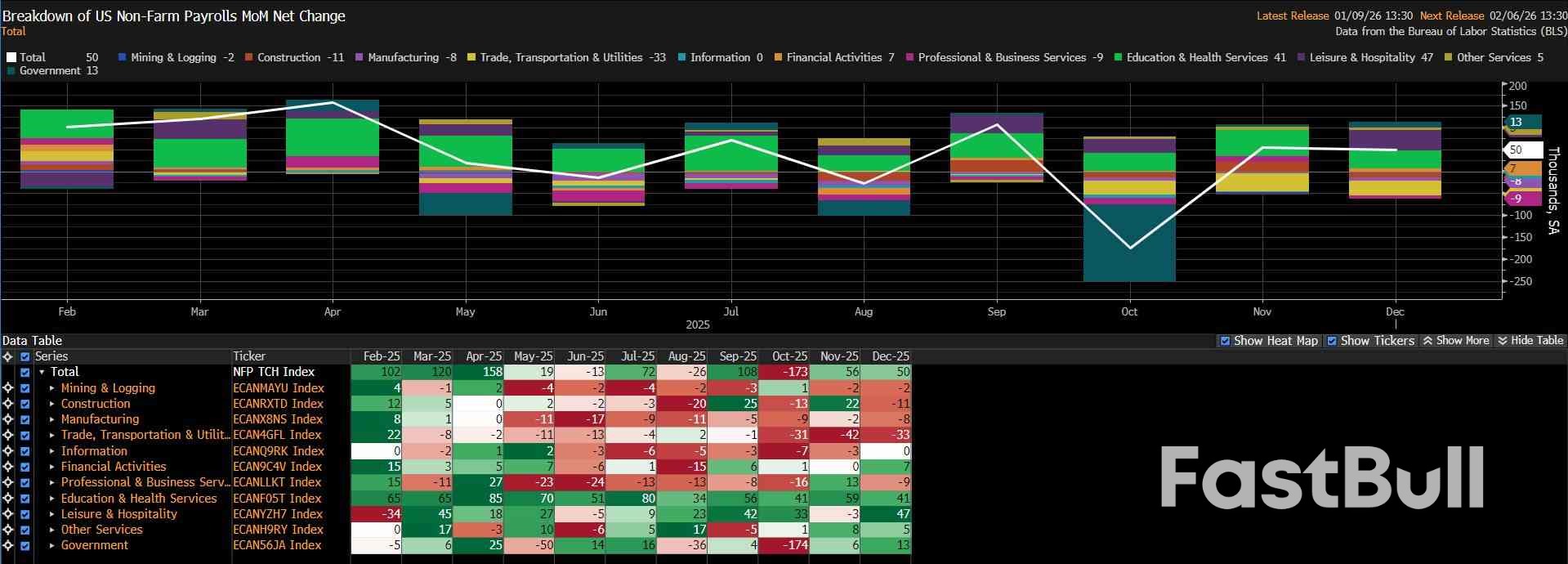
Taking a deeper look into the jobs report, the sectoral split of employment gains pointed to both Healthcare and Leisure & Hospitality propping up the labour market at large, adding +39k and +47k jobs respectively. the majority of other sectors experienced no, or negative, MoM employment growth, with Retail Trade the major laggard.
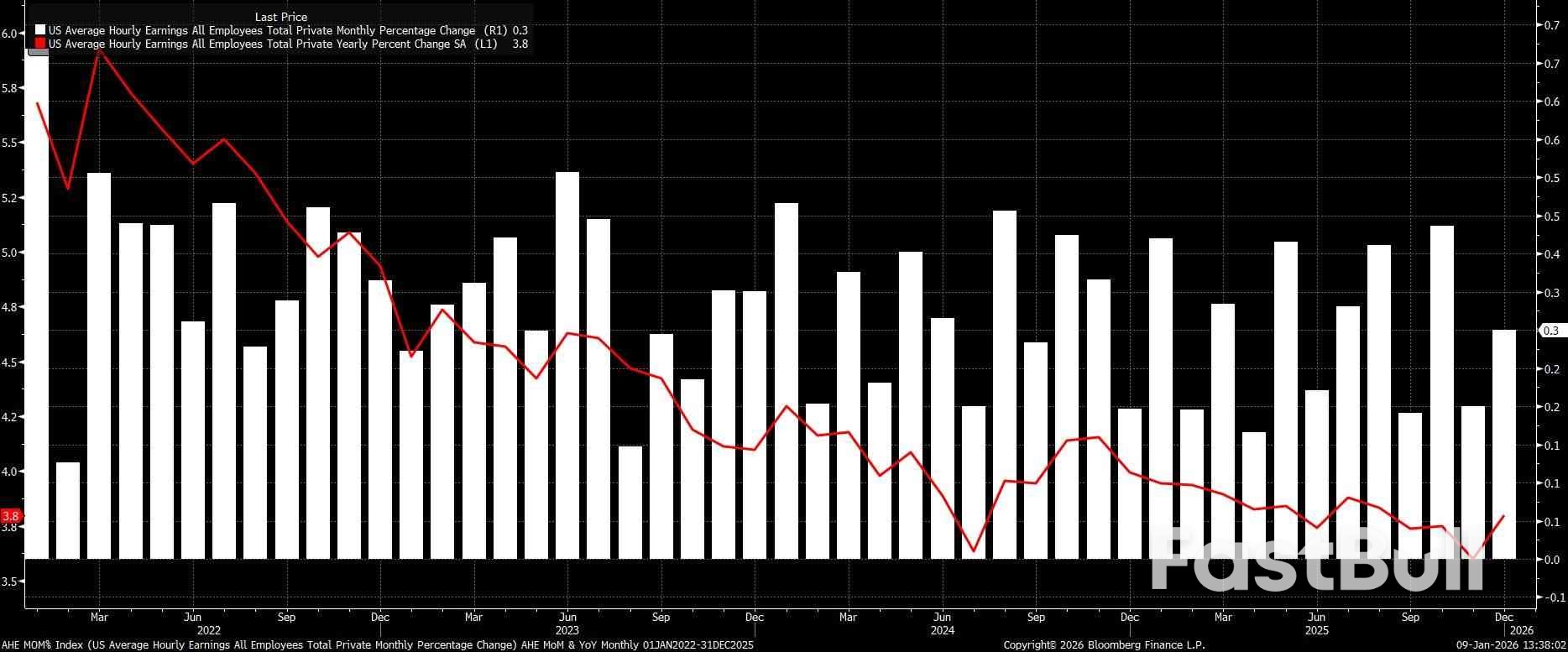
Remaining with the establishment survey, data pointed to earnings pressures having remained relatively contained as 2025 drew to a close, again serving to strengthen the long-running consensus view of FOMC members that the labour market is not a significant source of upside inflation risk at the current juncture.
Average hourly earnings rose by 0.3% MoM in December, bang in line with expectations, with that figure in turn taking the annual rate of earnings growth to 3.8% YoY.
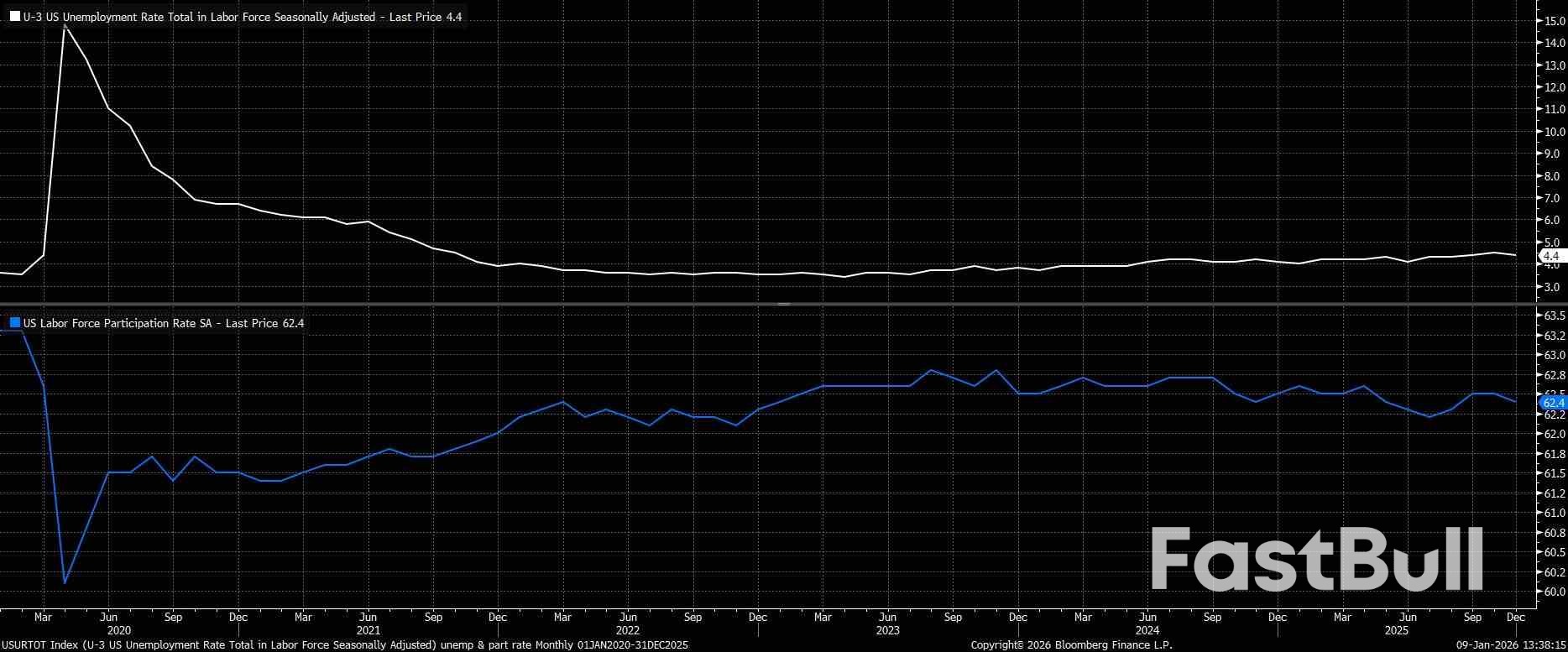
Turning to the household survey, headline unemployment unexpectedly declined to 4.4% last month, from a downwardly revised 4.5% in November. Labour force participation, meanwhile, fell to 62.4%, in line with expectations.
While the household survey must also come with a health warning of its own, given low survey response rates and the rapidly changing composition of the labour market, there is nonetheless a general belief that, for the time being, it offers a cleaner and more accurate read on the true state of the US labour market, hence likely carries greater implications from a policy perspective than the headline payrolls figure.
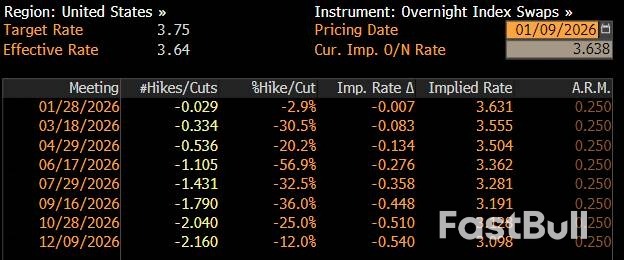
In reaction to the jobs report, money markets now see next-to-no chance of a Fed cut at the tail end of this month, discounting just a 2% chance of such a move. The USD OIS curve also underwent a modest hawkish repricing further out, with March now seen as a 1-in-3 chance of a 25bp cut, albeit with the curve still fully discounting the next 25bp cut for June.
Taking a step back, the December jobs report offers our first 'clean'(ish) read on the state of the US labour market since the summer, with releases in the intervening period having been delayed, and skewed, by last year's government shutdown. By and large, the figures largely paint a similar picture to that which was already known – namely, that the employment backdrop remains somewhat soft, and that while the labour market is 'bending' for the time being, the risk remains that it may well end up 'breaking'.
Despite that, with unemployment having fallen below the end-25 December SEP projection, a fourth straight 25bp cut at the January FOMC meeting now seems a long shot, with policymakers instead likely to be comfortable that they have already taken out a degree of 'insurance' to support the labour market, and being content to adopt a more data-dependent stance, especially as the Committee's hawks remain concerned over lingering upside inflation risks, largely from tariffs.
That said, the direction of travel for the fed funds rate remains lower, with the FOMC likely still wanting to remove policy restriction, and return the FFR to a more neutral level (which could be 3% or lower) by the end of the year, if not sooner. In any case, in light of today's data, the can has now been kicked down the road to March, at the earliest, in terms of the next 25bp cut being delivered, though such a move will be contingent on labour data remaining uninspiring, or deteriorating further, by the time of that meeting.
The Canadian economy added jobs for a fourth consecutive month, but the biggest increase in the number of people looking for work in more than a year pushed the unemployment rate higher.
Employment rose by 8,200 in December, bringing cumulative job gains to 188,800 over the past four months, Statistics Canada reported Friday. The jobless rate jumped 0.3 percentage points to 6.8%.
Economists in a Bloomberg survey expected the economy to shed 2,500 positions, with an unemployment rate of 6.7%.
Gains were driven by an increase of 50,200 full-time jobs and growth in self-employment. Health care and social assistance added 20,800 positions, while the construction sector added 11,200 roles. Part-time employment fell by 42,000.
The labor force expanded by 81,000 in December, the most since November 2024 and led by increases in Ontario and Quebec — the country's two largest provinces. That brought the participation rate up to 65.4%.
The small job gains suggest the Canada's job market is holding firm even as US tariffs hit exports and investment. But the jump in the unemployment rate will raise questions about the extent to which labor market slack has been absorbed in recent months.
Even though many of the country's goods exports are exempt from US levies if they comply with the US-Mexico-Canada Agreement, there's still clear damage from the ongoing trade dispute.
In total, Canada's economy added 226,300 jobs from a year earlier, a 1.1% increase that was the weakest pace of employment growth in a calendar year since 2016, excluding the pandemic. Job vacancies also fell through most of the year, the agency said, pointing to weakened labor demand.
Total hours worked fell 0.3% in December from the previous month. Employment gains were highest in Quebec, while the western provinces of Alberta and Saskatchewan shed jobs.
Yearly wage growth for permanent employees decelerated to 3.7%. The unemployment rate for core- age workers, 25 to 54 years old, rose to 6%.

Economic

Traders' Opinions

Russia-Ukraine Conflict

Daily News

Commodity

Political

Energy

Middle East Situation

Oil prices rose on Friday, driven by growing concerns over potential supply disruptions from Iran and new uncertainty surrounding Venezuela's oil sector.
By 1204 GMT, Brent futures increased by 59 cents, or 0.95%, to trade at $62.58 per barrel. U.S. West Texas Intermediate (WTI) crude saw a similar rise, climbing 54 cents, or 0.9%, to $58.30. The gains followed a more than 3% jump for both benchmarks on Thursday, reversing two consecutive days of declines. For the week, Brent is positioned for a 3% increase, while WTI is on track for a 1.7% gain.
Market attention is sharpening on Venezuela after the White House scheduled a meeting with oil companies and trading houses on Friday to discuss the country's export deals. The meeting follows the capture of Venezuelan President Nicolas Maduro and a subsequent demand from President Trump for the U.S. to gain full access to the nation's oil industry.
According to U.S. officials, Washington intends to control Venezuela's oil sales and revenues indefinitely. Major industry players, including Chevron Corp, Vitol, and Trafigura, are reportedly competing for U.S. government contracts to market up to 50 million barrels of crude oil. This oil has been accumulated in inventories by state-run company PDVSA during a severe embargo that involved four tanker seizures.
"The market will focus on the outcome in the coming days for how the Venezuelan oil in storage will be sold and delivered," noted Tina Teng, a market strategist at Moomoo ANZ.
Adding to supply-side anxiety is the escalating civil unrest in Iran, a major Middle Eastern oil producer. "Iran protests seem to be gathering momentum, leading the market to worry about disruptions," said Ole Hansen, head of commodity analysis at Saxo Bank. Protests over economic hardships have been reported in Tehran, Mashhad, Isfahan, and other areas, with internet monitoring group NetBlocks confirming a nationwide internet blackout on Thursday.
Meanwhile, the ongoing Russia-Ukraine war continues to fuel supply worries. Russia’s military announced on Friday that it had fired its Oreshnik hypersonic missile at targets in Ukraine. The Russian defense ministry stated that the targets included energy infrastructure that supports Ukraine's military-industrial complex.
Despite the bullish geopolitical factors, some analysts warn that a global oversupply could limit further price increases. According to Haitong Futures, global oil inventories are rising, and this oversupply remains the primary driver that could cap gains.
The firm suggested that unless the risks surrounding Iran escalate significantly, the current rebound in oil prices is likely to be limited and difficult to sustain.
The European Union's landmark free trade agreement with the Mercosur bloc of South American nations has cleared a major hurdle, moving one step closer to ratification despite significant internal division.
Representatives in Brussels confirmed on Friday that a qualified majority of the EU's 27 member states, representing at least 65% of the bloc's population, have approved the proposal. This green light could allow European Commission President Ursula von der Leyen to sign the agreement with Brazil, Paraguay, Argentina, and Uruguay as early as next week.
However, the pact's journey is not over. It must still secure final approval from the European Parliament before it can officially take effect.

While the agreement secured the necessary votes to proceed, it has exposed deep rifts within the EU, most notably between its two largest economies.
France Leads the Opposition
French President Emmanuel Macron has been a vocal opponent, confirming late Thursday that his country would not support the treaty. He stated that France's political establishment was "unanimous" in its rejection.
"France is favorable to international trade, but the EU-Mercosur agreement is an agreement from another age, negotiated for too long on bases that are too outdated," Macron explained in a post on X.
This resistance from key members, including France, Italy, and Poland, had already forced the postponement of a planned signing in Brazil last December.
Germany Champions the Deal
In sharp contrast, Germany has consistently championed the agreement as a vital strategic and economic move. Berlin views the pact as a critical tool to open new markets for its export-driven economy, which has been struggling with stagnation.
"The approval of the EU-Mercosur Agreement is a milestone in European trade policy and an important signal of our strategic sovereignty and capacity to act," said Chancellor Friedrich Merz.
Finance Minister Lars Klingbeil echoed this sentiment, framing the deal as a timely victory for free trade. "While others are closing themselves off and pursuing increasingly aggressive trade policies, we are focusing on new partnerships," he said, referencing protectionist policies like Donald Trump's "America First" agenda.
German business groups have also celebrated the progress. The country's VDA auto industry association called the approval "long overdue and very good news... especially for Germany as an exporting country."
If ratified, the EU-Mercosur pact would create one of the world's largest free trade zones. Its primary objectives include:
• Tariff Removal: Eliminating import tariffs on over 90% of products traded between the two blocs.
• Economic Savings: Saving EU businesses billions in duties each year.
• Export Growth: Boosting EU exports of vehicles, machinery, wines, and spirits to Latin America.
• Trade Diversification: Providing an alternative to reliance on markets impacted by US tariffs and Chinese competition.
"This is the biggest free trade agreement we have negotiated," EU trade chief Maros Sefcovic noted on Wednesday.
Brazilian President Luiz Inacio Lula da Silva highlighted its geopolitical significance in December, stating, "We have in our hands the opportunity to send the world an important message in defense of multilateralism."
Despite strong support from governments like Germany and Spain, the agreement faces fierce opposition from a key sector: agriculture.

Farmers across the EU have voiced concerns that the deal will undercut their businesses by flooding the market with cheaper agricultural imports from South America. These fears have fueled widespread protests, with farmers taking to the streets with their tractors on Thursday to block major routes in Paris and parts of Germany.
China's cabinet has announced a new package of fiscal and financial policies designed to stimulate domestic demand, signaling a concerted effort to fortify the economy for a strong start in 2026.
According to state broadcaster CCTV, a meeting chaired by Premier Li Qiang outlined a series of initiatives focused on spurring household consumption and private investment. Officials described the coordinated policy package as a crucial measure for expanding effective demand and innovating macroeconomic management.
A primary goal of the new policies is to directly encourage consumer spending. The government plans to achieve this through several key channels:
• Enhanced Loan Support: Financial backing for service providers will be strengthened to improve their offerings to consumers.
• Interest Subsidies: Policies providing interest subsidies for personal consumer loans will be enhanced to make borrowing more attractive.
• Improved Services: The supply of high-quality consumer services will be expanded.
This strategy builds on a recent 62.5 billion yuan allocation from special treasury bonds to fund a 2026 consumer trade-in program. That scheme offers subsidies for households replacing old home appliances and purchasing new energy vehicles.
The government also intends to guide more private capital toward consumption and investment initiatives. To support this objective, China will roll out a series of targeted financial tools:
• Support for Small Firms: Interest-subsidy policies will be introduced for loans to small businesses.
• Guarantees for Private Investment: A special guarantee program will be established to back private investment projects.
• Risk-Sharing for Corporate Bonds: A risk-sharing mechanism will be created for bonds issued by private companies to improve their access to capital markets.
In addition to supporting new investment, the plan includes measures to help existing enterprises. The government will fine-tune interest-subsidy policies for equipment-upgrade loans, aiming to reduce financing thresholds and lower borrowing costs for businesses looking to modernize.
President Donald Trump is meeting with executives from 17 top energy firms to detail his plan for rebuilding Venezuela's collapsed oil industry, a project he claims could drive over $100 billion in new investment.
In a Friday post on social media, Trump announced, "At least 100 Billion Dollars will be invested by BIG OIL, all of whom I will be meeting with today at The White House." The meeting aims to secure support from American oil companies to spearhead the redevelopment of Venezuela's energy infrastructure.
The White House guest list represents a broad cross-section of the global energy market, from producers to refiners and traders. According to an official, attendees include:
• US Oil Majors: Chevron Corp., Exxon Mobil Corp., and ConocoPhillips.
• Independent Producers: Continental Resources Inc. and Hilcorp Energy Co.
• International Firms: Shell Plc, Spain's Repsol SA, and Italy's Eni SpA.
• Oilfield Services & Refining: Halliburton Co., Valero Energy Corp., and Marathon Petroleum Corp.
• Commodity Traders: Trafigura Group and Vitol Americas.
Other confirmed companies include HKN Inc., Tallgrass Energy, Raisa Energy, and Aspect Holdings. Key administration officials joining the session are Energy Secretary Chris Wright, Secretary of State Marco Rubio, and Interior Secretary Doug Burgum.
The administration's goal is to reverse the decline of Venezuela's oil sector. Despite holding the world's largest proven crude reserves, the nation's output has fallen to under 1 million barrels per day, a shadow of its 1970s peak of nearly 4 million barrels daily. Decades of neglect and the departure of foreign operators have left the industry in disrepair.
"Following the announcement of President Trump's historic energy deal with Venezuela, American oil companies will come to the White House to discuss investment opportunities that will restore Venezuelan oil infrastructure," said White House spokeswoman Taylor Rogers. "The American people, energy companies, and the Venezuelan people will all greatly benefit from these new, unprecedented investments."
While energy executives are supportive of the plan's economic potential, they remain cautious. A primary concern is the lack of physical and financial security guarantees in Venezuela, particularly following the apprehension of former President Nicolás Maduro by U.S. troops. Industry leaders are hesitant to commit to major investments without assurances of stability.
Meanwhile, the administration's plan is already making waves in the market, as preparations begin to sell off Venezuelan crude that has accumulated in storage during a U.S. naval blockade.
President Trump has consistently enjoyed strong backing from the oil and gas sector, which was a major financial contributor to his reelection campaign. Key supporters include Jeff Hildebrand of Hilcorp and Continental co-founder Harold Hamm.
This meeting follows a closed-door energy roundtable at Trump's Mar-a-Lago club in April 2024. During that event, the then-presidential candidate criticized wind power, promised to reverse environmental regulations, and asked the assembled executives to raise $1 billion for his campaign.
White Label
Data API
Web Plug-ins
Poster Maker
Affiliate Program
The risk of loss in trading financial instruments such as stocks, FX, commodities, futures, bonds, ETFs and crypto can be substantial. You may sustain a total loss of the funds that you deposit with your broker. Therefore, you should carefully consider whether such trading is suitable for you in light of your circumstances and financial resources.
No decision to invest should be made without thoroughly conducting due diligence by yourself or consulting with your financial advisors. Our web content might not suit you since we don't know your financial conditions and investment needs. Our financial information might have latency or contain inaccuracy, so you should be fully responsible for any of your trading and investment decisions. The company will not be responsible for your capital loss.
Without getting permission from the website, you are not allowed to copy the website's graphics, texts, or trademarks. Intellectual property rights in the content or data incorporated into this website belong to its providers and exchange merchants.
Not Logged In
Log in to access more features

FastBull Membership
Not yet
Purchase
Log In
Sign Up