• Trade
  • Markets
  • Copy
  • Contests
  • News
  • 24/7
  • Calendar
  • Q&A
  • Chats
Trending
Screeners
SYMBOL
LAST
BID
ASK
HIGH
LOW
NET CHG.
%CHG.
SPREAD
SPX
S&P 500 Index
6870.39
6870.39
6870.39
6895.79
6858.28
+13.27
+ 0.19%
--
DJI
Dow Jones Industrial Average
47954.98
47954.98
47954.98
48133.54
47871.51
+104.05
+ 0.22%
--
IXIC
NASDAQ Composite Index
23578.12
23578.12
23578.12
23680.03
23506.00
+72.99
+ 0.31%
--
USDX
US Dollar Index
98.870
98.950
98.870
98.960
98.730
-0.080
-0.08%
--
EURUSD
Euro / US Dollar
1.16547
1.16554
1.16547
1.16717
1.16341
+0.00121
+ 0.10%
--
GBPUSD
Pound Sterling / US Dollar
1.33227
1.33237
1.33227
1.33462
1.33136
-0.00085
-0.06%
--
XAUUSD
Gold / US Dollar
4209.36
4209.77
4209.36
4218.85
4190.61
+11.45
+ 0.27%
--
WTI
Light Sweet Crude Oil
59.391
59.421
59.391
60.084
59.291
-0.418
-0.70%
--

Community Accounts

Signal Accounts
--
Profit Accounts
--
Loss Accounts
--
View More

Become a signal provider

Sell trading signals to earn additional income

View More

Guide to Copy Trading

Get started with ease and confidence

View More

Signal Accounts for Members

All Signal Accounts

Best Return
  • Best Return
  • Best P/L
  • Best MDD
Past 1W
  • Past 1W
  • Past 1M
  • Past 1Y

All Contests

  • All
  • Trump Updates
  • Recommend
  • Stocks
  • Cryptocurrencies
  • Central Banks
  • Featured News
Top News Only
Share

Hungary's Preliminary November Budget Balance Huf -403 Billion

Share

Indian Rupee Down 0.1% At 90.07 Per USA Dollar As Of 3:30 P.M. Ist, Previous Close 89.98

Share

India's Nifty 50 Index Provisionally Ends 0.96% Lower

Share

[JPMorgan: US Stock Rally May Stagnate Following Fed Rate Cut] JPMorgan Strategists Say The Recent Rally In US Stocks May Stall As Investors Take Profits Following The Anticipated Fed Rate Cut. The Market Currently Predicts A 92% Probability Of The Fed Lowering Borrowing Costs On Wednesday. Expectations Of A Rate Cut Have Continued To Rise, Fueled By Positive Signals From Policymakers In Recent Weeks. "Investors May Be More Inclined To Lock In Gains At The End Of The Year Rather Than Increase Directional Exposure," Mislav Matejka's Team Wrote In A Report

Share

Russian Defence Ministry: Russian Forces Take Control Of Novodanylivka In Ukraine's Zaporizhzhia Region

Share

Russian Defence Ministry: Russian Forces Take Control Of Chervone In Ukraine's Donetsk Region

Share

French Finance Ministry: Government Started Process To Block Temporarily Shein Platform

Share

Finance Minister: Indonesia To Impose Coal Export Tax Of Up To 5% Next Year

Share

[Trump Considering Fired Homeland Security Secretary Noem? White House Denies] According To Reports From US Media Outlets Such As The Daily Beast And The UK's Independent, The White House Has Denied Reports That US President Trump Is Considering Firing Homeland Security Secretary Noem. White House Spokesperson Abigail Jackson Posted On Social Media On The 7th Local Time, Calling The Claims "fake News" And Stating That "Secretary Noem Has Done An Excellent Job Implementing The President's Agenda And 'making America Safe Again'."

Share

HKEX: Standard Chartered Bought Back 571604 Total Shares On Other Exchanges For Gbp9.5 Million On Dec 5

Share

Morgan Stanley Reiterates Bullish Outlook On US Stocks Due To Fed Rate Cut Expectations. Morgan Stanley Strategists Believe That The US Stock Market Faces A "bullish Outlook" Given Improved Earnings Expectations And Anticipated Fed Rate Cuts. They Expect Strong Corporate Earnings By 2026, And Anticipate The Fed Will Cut Rates Based On Lagging Or Mildly Weak Labor Markets. They Expect The US Consumer Discretionary Sector And Small-cap Stocks To Continue To Outperform

Share

China's National Development And Reform Commission Announced That Starting From 24:00 On December 8, The Retail Price Limit For Gasoline And Diesel In China Will Be Reduced By 55 Yuan Per Ton, Which Translates To A Reduction Of 0.04 Yuan Per Liter For 92-octane Gasoline, 0.05 Yuan Per Liter For 95-octane Gasoline, And 0.05 Yuan Per Liter For 0# Diesel

Share

Tkms CEO: US Security Strategy Highlights Need For Europe To Take Care Of Its Own Defences

Share

USA S&P 500 E-Mini Futures Up 0.1%, NASDAQ 100 Futures Up 0.18%, Dow Futures Down 0.02%

Share

London Metal Exchange (LME): Copper Inventories Increased By 2,000 Tons, Aluminum Inventories Decreased By 2,500 Tons, Nickel Inventories Increased By 228 Tons, Zinc Inventories Increased By 2,375 Tons, Lead Inventories Decreased By 3,725 Tons, And Tin Inventories Decreased By 10 Tons

Share

Swiss Sight Deposits Of Domestic Banks At 440.519 Billion Sfr In Week Ending December 5 Versus 437.298 Billion Sfr A Week Earlier

Share

Czech November Jobless Rate 4.6% Versus Mkt Fcast 4.7%

Share

Czech Jobless Rate Unchanged At 4.6% In November

Share

Singapore Central Bank Data: November Foreign Exchange Reserves At $400.0 Billion

Share

Fitch On EMEA Homebuilders Says Weak Demand Is Likely To Constrain Completions And New Starts, Despite Easing Inflation And Gradual Rate Cuts

TIME
ACT
FCST
PREV
France Industrial Output MoM (SA) (Oct)

A:--

F: --

P: --
France Trade Balance (SA) (Oct)

A:--

F: --

P: --
Euro Zone Employment YoY (SA) (Q3)

A:--

F: --

P: --
Canada Part-Time Employment (SA) (Nov)

A:--

F: --

P: --

Canada Unemployment Rate (SA) (Nov)

A:--

F: --

P: --

Canada Full-time Employment (SA) (Nov)

A:--

F: --

P: --

Canada Labor Force Participation Rate (SA) (Nov)

A:--

F: --

P: --

Canada Employment (SA) (Nov)

A:--

F: --

P: --

U.S. PCE Price Index MoM (Sept)

A:--

F: --

P: --

U.S. Personal Income MoM (Sept)

A:--

F: --

P: --

U.S. Core PCE Price Index MoM (Sept)

A:--

F: --

P: --

U.S. PCE Price Index YoY (SA) (Sept)

A:--

F: --

P: --

U.S. Core PCE Price Index YoY (Sept)

A:--

F: --

P: --

U.S. Personal Outlays MoM (SA) (Sept)

A:--

F: --

P: --
U.S. 5-10 Year-Ahead Inflation Expectations (Dec)

A:--

F: --

P: --

U.S. Real Personal Consumption Expenditures MoM (Sept)

A:--

F: --

P: --
U.S. Weekly Total Rig Count

A:--

F: --

P: --

U.S. Weekly Total Oil Rig Count

A:--

F: --

P: --

U.S. Consumer Credit (SA) (Oct)

A:--

F: --

P: --
China, Mainland Foreign Exchange Reserves (Nov)

A:--

F: --

P: --

Japan Trade Balance (Oct)

A:--

F: --

P: --

Japan Nominal GDP Revised QoQ (Q3)

A:--

F: --

P: --

China, Mainland Imports YoY (CNH) (Nov)

A:--

F: --

P: --

China, Mainland Exports (Nov)

A:--

F: --

P: --

China, Mainland Imports (CNH) (Nov)

A:--

F: --

P: --

China, Mainland Trade Balance (CNH) (Nov)

A:--

F: --

P: --

China, Mainland Exports YoY (USD) (Nov)

A:--

F: --

P: --

China, Mainland Imports YoY (USD) (Nov)

A:--

F: --

P: --

Germany Industrial Output MoM (SA) (Oct)

A:--

F: --

P: --
Euro Zone Sentix Investor Confidence Index (Dec)

A:--

F: --

P: --

Canada National Economic Confidence Index

--

F: --

P: --

U.K. BRC Like-For-Like Retail Sales YoY (Nov)

--

F: --

P: --

U.K. BRC Overall Retail Sales YoY (Nov)

--

F: --

P: --

Australia Overnight (Borrowing) Key Rate

--

F: --

P: --

RBA Rate Statement
RBA Press Conference
Germany Exports MoM (SA) (Oct)

--

F: --

P: --

U.S. NFIB Small Business Optimism Index (SA) (Nov)

--

F: --

P: --

Mexico 12-Month Inflation (CPI) (Nov)

--

F: --

P: --

Mexico Core CPI YoY (Nov)

--

F: --

P: --

Mexico PPI YoY (Nov)

--

F: --

P: --

U.S. Weekly Redbook Index YoY

--

F: --

P: --

U.S. JOLTS Job Openings (SA) (Oct)

--

F: --

P: --

China, Mainland M1 Money Supply YoY (Nov)

--

F: --

P: --

China, Mainland M0 Money Supply YoY (Nov)

--

F: --

P: --

China, Mainland M2 Money Supply YoY (Nov)

--

F: --

P: --

U.S. EIA Short-Term Crude Production Forecast For The Year (Dec)

--

F: --

P: --

U.S. EIA Natural Gas Production Forecast For The Next Year (Dec)

--

F: --

P: --

U.S. EIA Short-Term Crude Production Forecast For The Next Year (Dec)

--

F: --

P: --

EIA Monthly Short-Term Energy Outlook
U.S. API Weekly Gasoline Stocks

--

F: --

P: --

U.S. API Weekly Cushing Crude Oil Stocks

--

F: --

P: --

U.S. API Weekly Crude Oil Stocks

--

F: --

P: --

U.S. API Weekly Refined Oil Stocks

--

F: --

P: --

South Korea Unemployment Rate (SA) (Nov)

--

F: --

P: --

Japan Reuters Tankan Non-Manufacturers Index (Dec)

--

F: --

P: --

Japan Reuters Tankan Manufacturers Index (Dec)

--

F: --

P: --

Japan Domestic Enterprise Commodity Price Index MoM (Nov)

--

F: --

P: --

Japan Domestic Enterprise Commodity Price Index YoY (Nov)

--

F: --

P: --

China, Mainland PPI YoY (Nov)

--

F: --

P: --

Q&A with Experts
    • All
    • Chatrooms
    • Groups
    • Friends
    Connecting
    .
    .
    .
    Type here...
    Add Symbol or Code

      No matching data

      All
      Trump Updates
      Recommend
      Stocks
      Cryptocurrencies
      Central Banks
      Featured News
      • All
      • Russia-Ukraine Conflict
      • Middle East Flashpoint
      • All
      • Russia-Ukraine Conflict
      • Middle East Flashpoint

      Search
      Products

      Charts Free Forever

      Chats Q&A with Experts
      Screeners Economic Calendar Data Tools
      Membership Features
      Data Warehouse Market Trends Institutional Data Policy Rates Macro

      Market Trends

      Market Sentiment Order Book Forex Correlations

      Top Indicators

      Charts Free Forever
      Markets

      News

      News Analysis 24/7 Columns Education
      From Institutions From Analysts
      Topics Columnists

      Latest Views

      Latest Views

      Trending Topics

      Top Columnists

      Latest Update

      Signals

      Copy Rankings Latest Signals Become a signal provider AI Rating
      Contests
      Brokers

      Overview Brokers Assessment Rankings Regulators News Claims
      Broker listing Forex Brokers Comparison Tool Live Spread Comparison Scam
      Q&A Complaint Scam Alert Videos Tips to Detect Scam
      More

      Business
      Events
      Careers About Us Advertising Help Center

      White Label

      Data API

      Web Plug-ins

      Affiliate Program

      Awards Institution Evaluation IB Seminar Salon Event Exhibition
      Vietnam Thailand Singapore Dubai
      Fans Party Investment Sharing Session
      FastBull Summit BrokersView Expo
      Recent Searches
        Top Searches
          Markets
          News
          Analysis
          User
          24/7
          Economic Calendar
          Education
          Data
          • Names
          • Latest
          • Prev

          View All

          No data

          Scan to Download

          Faster Charts, Chat Faster!

          Download App
          English
          • English
          • Español
          • العربية
          • Bahasa Indonesia
          • Bahasa Melayu
          • Tiếng Việt
          • ภาษาไทย
          • Français
          • Italiano
          • Türkçe
          • Русский язык
          • 简中
          • 繁中
          Open Account
          Search
          Products
          Charts Free Forever
          Markets
          News
          Signals

          Copy Rankings Latest Signals Become a signal provider AI Rating
          Contests
          Brokers

          Overview Brokers Assessment Rankings Regulators News Claims
          Broker listing Forex Brokers Comparison Tool Live Spread Comparison Scam
          Q&A Complaint Scam Alert Videos Tips to Detect Scam
          More

          Business
          Events
          Careers About Us Advertising Help Center

          White Label

          Data API

          Web Plug-ins

          Affiliate Program

          Awards Institution Evaluation IB Seminar Salon Event Exhibition
          Vietnam Thailand Singapore Dubai
          Fans Party Investment Sharing Session
          FastBull Summit BrokersView Expo

          Markets On Alert: Fed Fractures, Tariff Progress, And The Big Jobs Report Loom

          Pepperstone

          Economic

          Stocks

          Summary:

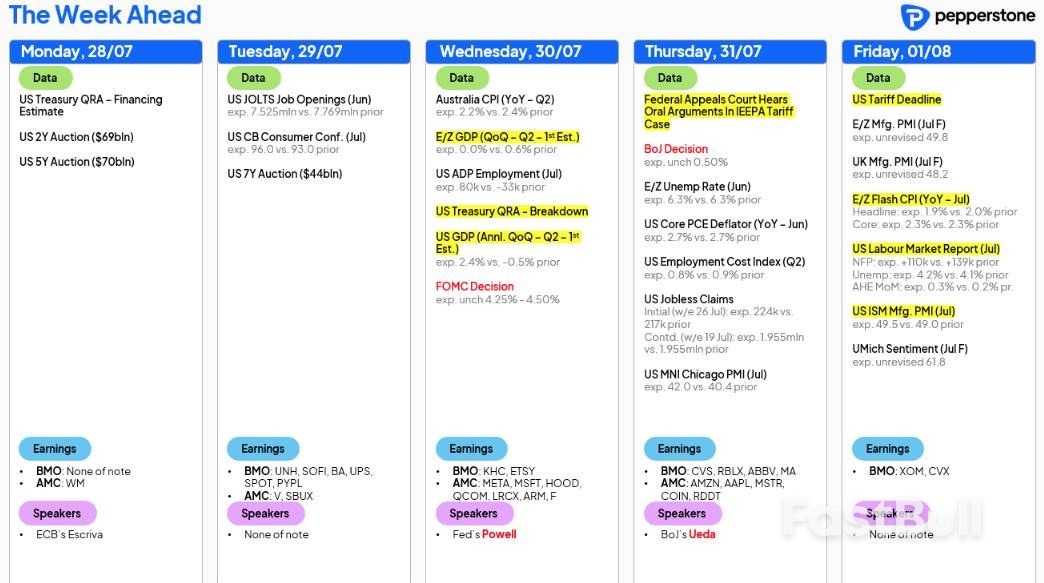
          The event risk in the trading week ahead hits us from all angles – Tariff/trade headlines have already started to come in liberally, while market players also navigate tier 1 economic data, a deluge of US and EU corporate earnings, DM & EM central bank meetings and the US Treasury refunding announcement (QRA).
          Tariff news set to come in heavy, but will it impact markets?

          Tariff-related headlines seen through Sunday have been meaningful, with the US-China tariff pause being extended by a further 90 days, and the US-EU forging an agreement that follows a similar model to that of last week's US-Japan deal. EU exporters will now face a 15% tariff rate to its US buyers, a far more friendly rate than the 30% rate they were facing – in exchange, the EU has committed to purchasing $750b in US energy products and some $600b in other investments.

          The news flow from both the extension with China and the agreement with the EU is clearly market-friendly, and should put further upside potential into the EUR, where the single currency is already finding the love from FX players, and should also put renewed upside into EU equities.
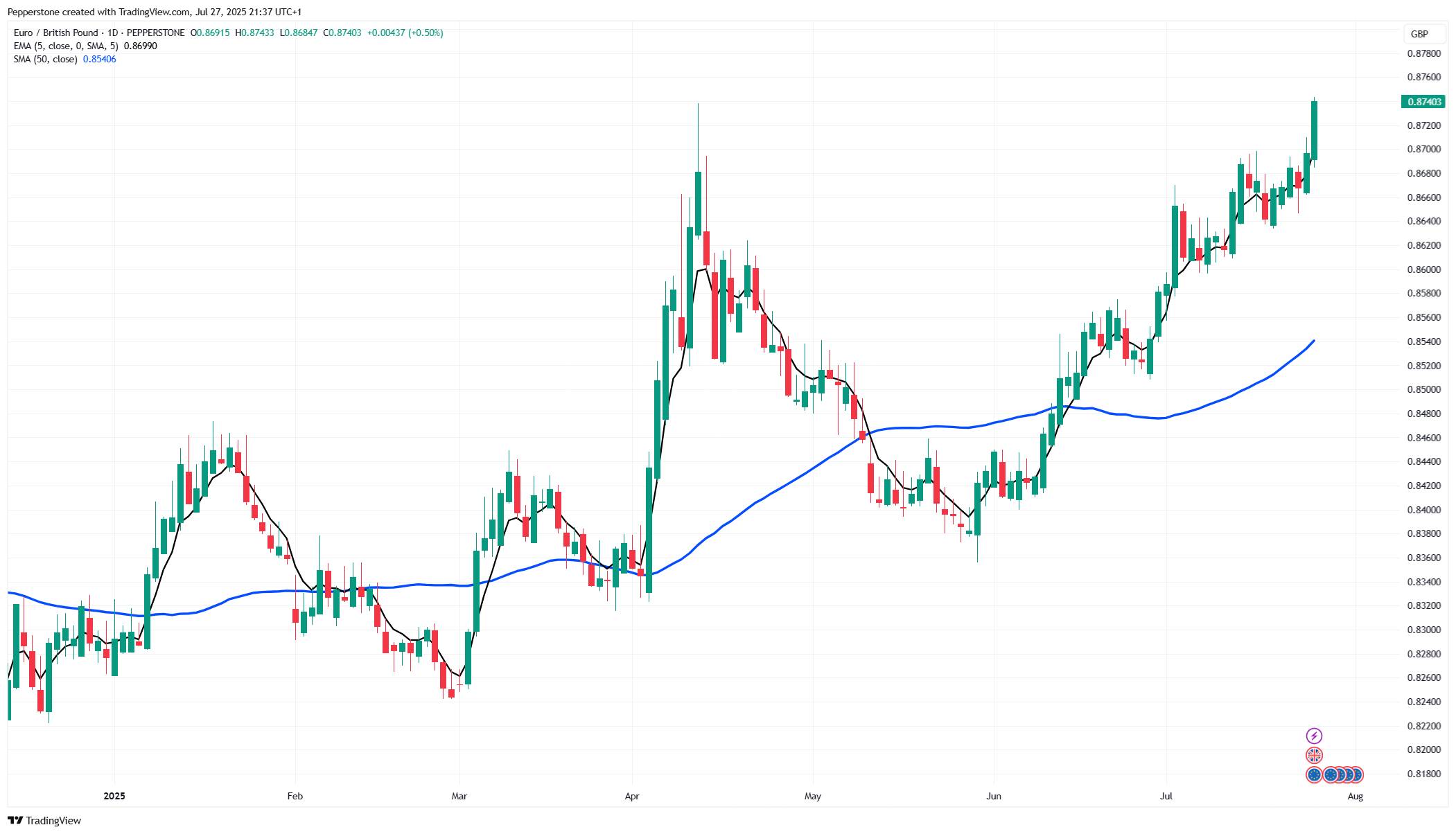
          Importantly, for those nations still looking to achieve a last-minute floor tariff rate (on US exports) of 15%, it's all too clear from the case studies with Indonesia and Japan is that the most important factor is committing to massive levels of investment spend. Trump will now sell this hard to the US voters as a huge win for the US - so expect Trump to address the nation in a presser shortly.

          A lasting US-China deal remains a more complex issue, and while trade imbalances remain a major consideration, at the heart of any potential full agreement, we're likely going to see a commitment from China to massive investment spending.

          China/HK equity leading the gains through July
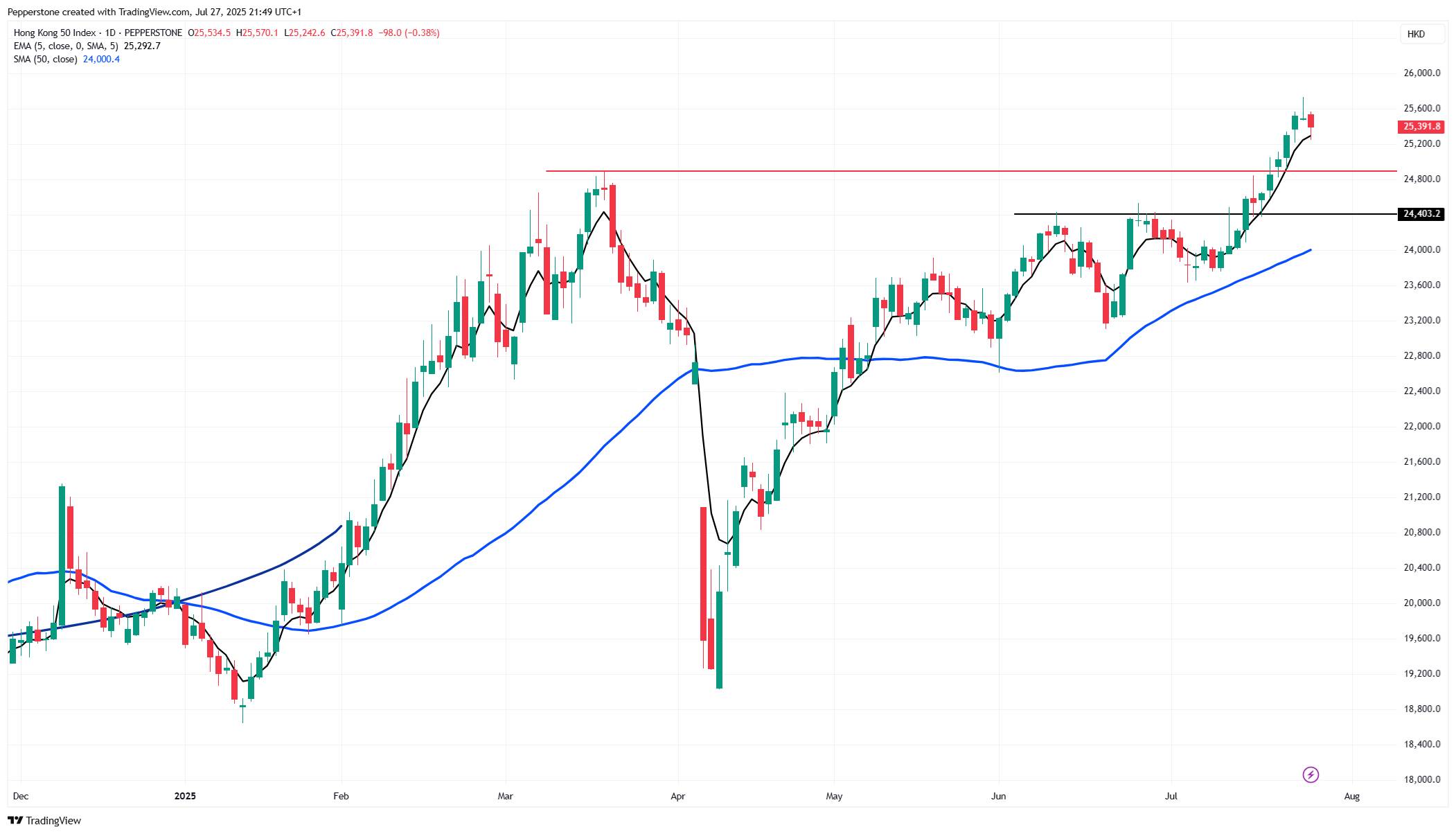
          For the China market watchers, the 24-member Politburo will gather to formulate plans for the balance of 2025. Market expectations for any new impactful policy initiatives are low, and the Chinese authorities will be quietly content to maintain the status quo, perhaps massaging around the edges, with its growth metrics tracking above its policy objectives. China and HK equity markets have been the star performers in July, so perhaps policymakers will see that as the market voting on increased confidence in China's economic trajectory.

          Central banks in focus this week

          We navigate G10 central bank meetings in the US (hold), Canada (hold) and Japan (hold), as well as in the LATAM/EM space, with policy decisions in South Africa (25bp cut expected), Chile (25bp cut expected), Columbia (25bp cut expected), and Brazil (no change).

          Dissent within the Fed's ranks

          While the BoJ meeting could be quite informative for JPY & NKY225 traders, it will likely be the FOMC meeting on Wednesday that gets the headlines, even if this is shaping up to be a low-impact event for US markets. Expect dissent from Chris Waller and Michelle Bowman, who should both vote for a 25bp cut at this meeting - a symbolic development, as the once galvanised and cohesive committee appears increasingly fractured and almost… dare I say it, politicised…

          Dissent aside, Chair Powell will continue to guide that the board will take in the incoming data “over the summer” – with traders seeing a cut in the September FOMC meeting as more likely than not, the two nonfarm payrolls prints (31 July & 5 Sept) and two CPI prints (12 Aug & 11 Sept) that hit us in the lead up to the September FOMC meeting now take on additional significance.

          A deluge of US and EU corporate earnings on the docket

          It's the big week of the US corporate earnings season, with 38% of the S&P500 market cap set to report numbers for the quarter – the lineup includes Apple, Meta, Amazon and Microsoft, but we also hear from some of the retail trader favoured names, including Coinbase and Roblox. Traders look for these names to build on what has been a solid Q2 earnings season so far, a factor which has offered increasing tailwinds to the grind higher and consecutive ATHs in the S&P500 and NAS100 seen resulted in levels of cross asset volatility crushed.

          Running the numbers, we see that a third of S&P500 companies have now reported earnings, with around 40% raising guidance, an outcome that is well above the levels seen in the Q1 reporting season. 83% of S&P 500 companies have beaten analysts' consensus expectations on EPS, with those beating doing so by an average of 6.9%.
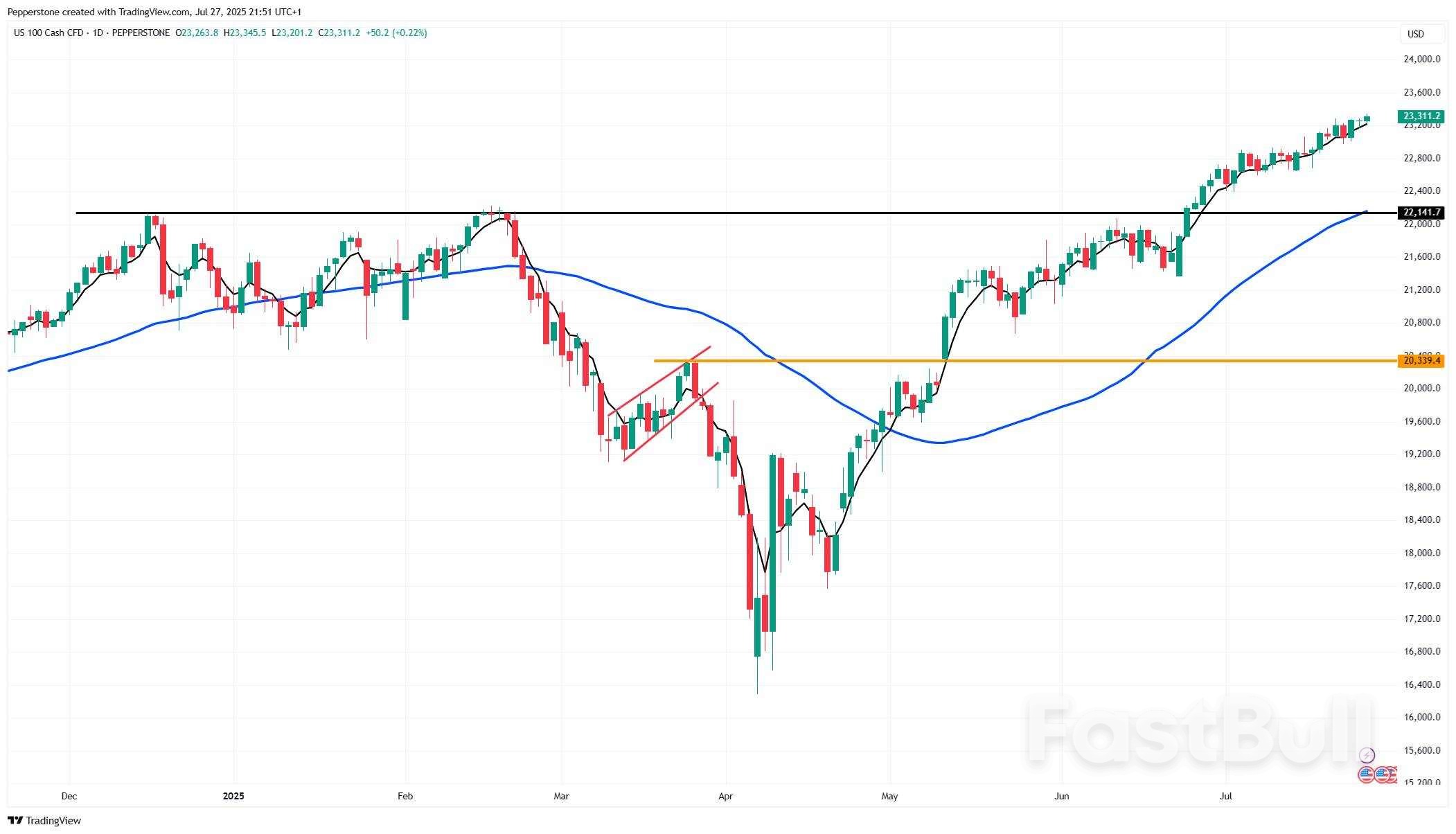
          It's also a big week on the European corporate earnings calendar, with c20% of the Euro Stoxx companies set to report.

          US nonfarm payrolls are the main event of the week

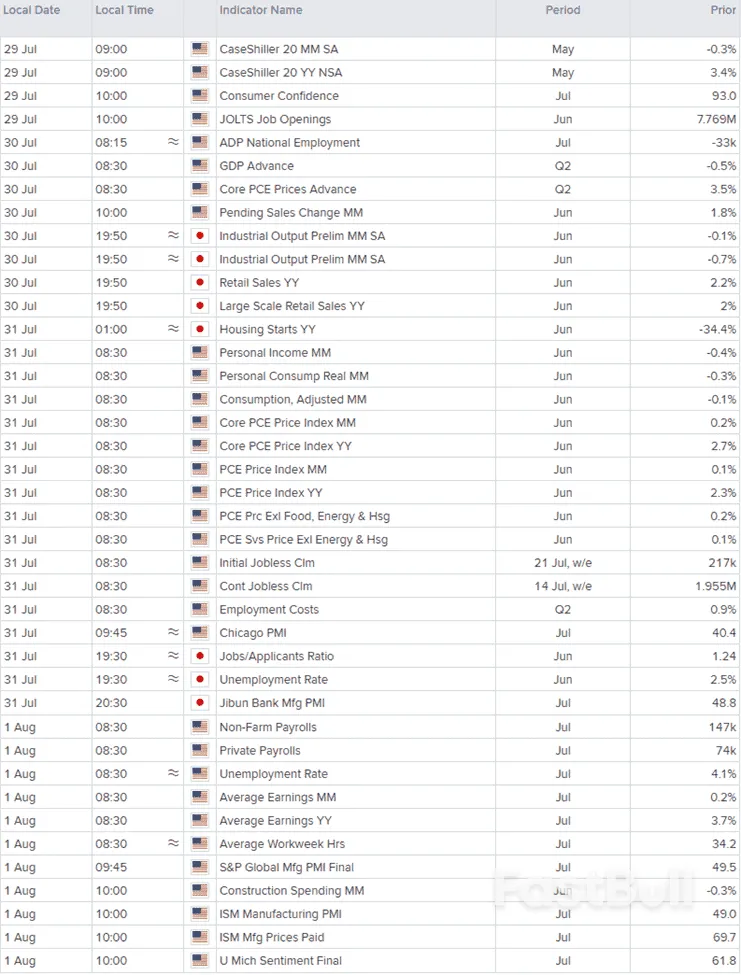
          The flow of economic data also comes in hot, with the labour market getting close inspection. US nonfarm payrolls (NFP) is the main event risk of the week, with the market modelling a central case of 109k jobs created in July, with the range of estimates (from economists) seen between 170k and zero. The prospect of downward revisions to the prior two NFP prints is high, but likely a secondary consideration for rates and FX traders. The unemployment rate is expected to tick up to 4.2%, with the average hourly earnings metric eyed at 3.8% (from 3.7%).

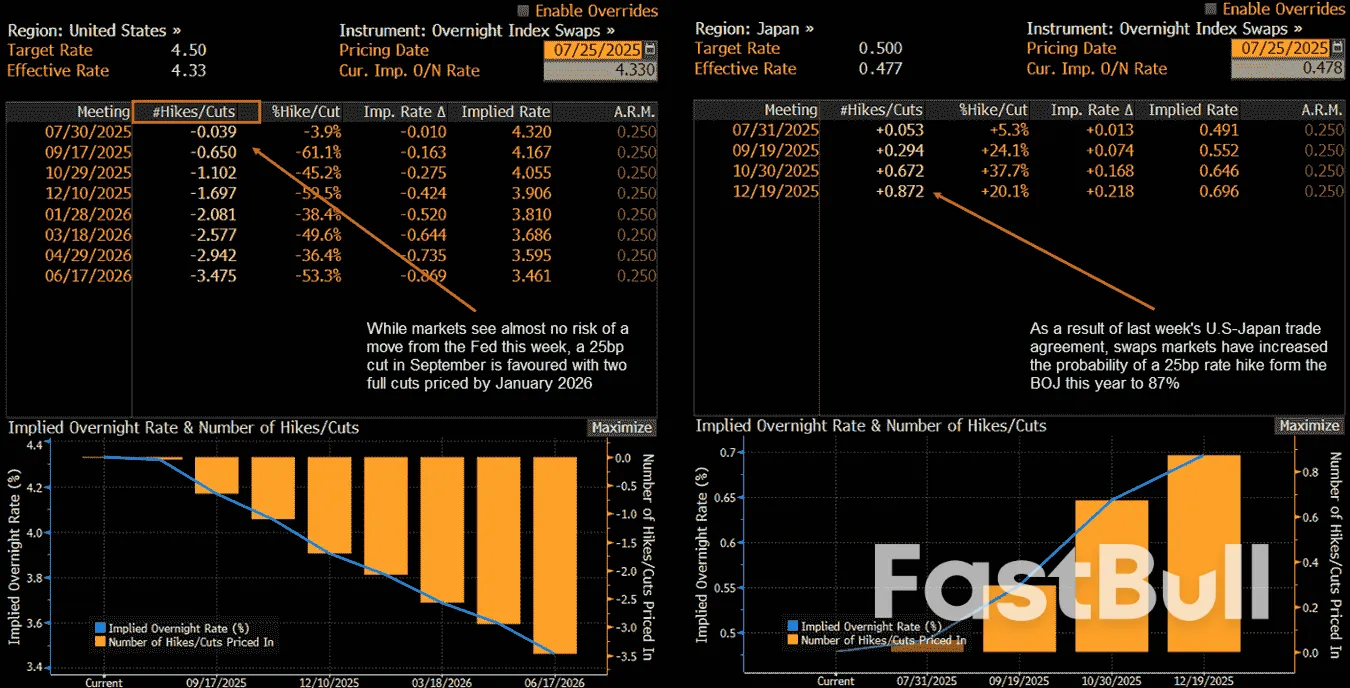
          US interest rate swaps imply a 25bp cut in the September FOMC meeting at 64% probability – a sub-100k NFP, with prior NFP prints revised lower and a 4.2% U/E would probably be enough to see swaps pricing move towards 70% implied for a cut in September. The USD will take its direction from the US 2-year Treasury yield, which is most impacted by changes in Fed rate cut expectations. The S&P500 and NAS100 will be content to see payrolls coming in around 100-120k, as the combination of reasonable job growth and increased Fed cut expectations would feed the goldilocks investment backdrop.

          While the NFP report takes centre stage, staying Stateside, traders also navigate the US JOLTS (job openings) report, weekly jobless claims and the Q2 employment cost index. The US Q2 GDP print and ISM manufacturing report may also get some attention.

          Australia Q2 CPI set to guide expectations for a cut in August

          In Australia, Q2 trimmed mean CPI (due on Wednesday) is expected to come in at 0.7% q/q / 2.7%, which if realised would continue to portray a moderation in price pressures – however, that outcome would also be a touch above the RBA's own central forecast of 2.6% y/y, and while Aussie interest rate swaps once again price a 25bp cut on 12 August as a done deal, it feels as though we'd need to see a trimmed mean print at or above 3% to derail a cut in the markets eyes.

          In Europe, the preliminary July CPI release (due on Friday) may be one to keep an eye on for those holding EUR exposures - after the ECB last week suggested the bar to cut rates again in the near-term has been sufficiently raised, we'd likely need to see a strong downside surprise to the consensus call of 1.9% y/y to see the September ECB as a live event in the markets thinking.

          Source: Pepperstone

          To stay updated on all economic events of today, please check out our Economic calendar
          Risk Warnings and Disclaimers
          You understand and acknowledge that there is a high degree of risk involved in trading. Following any strategies or investment methods may lead to potential losses. The content on the site is provided by our contributors and analysts for information purposes only. You are solely responsible for determining whether any trading assets, securities, strategy, or any other product is suitable for investing based on your own investment objectives and financial situation.
          Add to Favorites
          Share

          Thailand’s Economic Fragility Deepens Amid Tourism Collapse and Consumer Weakness

          Gerik

          Economic

          Tourism Decline Reverberates Through Key Industries

          In the first half of 2025, international arrivals to Thailand dropped 4.6% year-on-year, falling to 16.7 million. The most significant contributor to this downturn is a dramatic 34% fall in Chinese visitors, whose total visits dropped to 2.26 million. Last year, Chinese travelers formed the backbone of Thai tourism, contributing over 6.7 million visits out of a total of 35.5 million.
          This steep decline is not purely economic. A highly publicized kidnapping incident involving a Chinese celebrity earlier this year caused widespread alarm among potential travelers from China, sparking safety concerns and diminishing Thailand’s attractiveness as a destination. The sharp retreat in Chinese demand has had a ripple effect, disproportionately damaging airlines, hotels, and retail businesses with high exposure to Chinese tourism.

          Stock Market Struggles Amid Regional Divergence

          The impact of declining tourism has been clearly reflected in Thailand’s capital markets. The benchmark SET Index has fallen by 13% year-to-date as of July 23, a stark contrast to gains in neighboring markets benefiting from capital outflows from the US due to concerns over Trump’s tariff policies. Sectors most exposed to tourism aviation, hospitality, and high-end retail have borne the brunt of investor pessimism.
          Airports of Thailand, which manages key hubs like Bangkok and Phuket, has seen its share price fall 35%. Bangkok Airways dropped 34%, and Asia Aviation, operator of Thai AirAsia, plummeted 53%. Hotel chains have fared similarly poorly: Erawan Group, reliant on Chinese visitors for 30% of revenue, dropped 41%; Central Plaza Hotel and Dusit Thani fell 20% and 18% respectively. In retail, Central Retail declined by 38%, with consumer sentiment further eroded by domestic economic pressures.

          Domestic Demand Weakens Under Heavy Household Debt

          Thailand’s internal economy is also showing signs of fragility. Consumer confidence has declined for five consecutive months, reaching a 28-month low in June at 52.7. Household debt remains elevated, curbing spending and dampening hopes of a robust domestic recovery. This trend suggests a correlation between high personal indebtedness and weakened internal consumption, compounding the blow dealt by external shocks in the tourism sector.
          In response, the Thai government launched stimulus measures such as the "We Travel Together" program, offering domestic tourists subsidies for hotel stays worth up to 3,000 baht per person. With a 2-billion-baht budget, the initiative aims to stimulate domestic travel through October, targeting 500,000 local participants.
          Additionally, authorities have introduced expedited immigration procedures for Chinese nationals and expanded efforts to improve tourist safety. However, structural disadvantages persist. According to the Kasikorn Research Center, hotel room rates rose 16% year-on-year to an average of 5,377 baht in 2024, reflecting rising costs that have diminished Thailand’s competitiveness compared to regional alternatives.

          Market Outlook Remains Cautious

          Despite a brief rebound in tourism-related stocks following the subsidy rollout, analysts remain cautious. Phillip Securities notes that many hospitality and transport equities have yet to reach their trough. The upcoming third quarter, traditionally a low travel season due to monsoons, is unlikely to provide meaningful relief.
          Thailand’s goal of attracting 35 million tourists this year is increasingly viewed as ambitious. Analysts from KGI Securities project that even a range of 30 to 34 million arrivals will be difficult to achieve under current conditions. They cite not only the fall in Chinese demand and the broader slowdown in manufacturing but also the erosion of Thailand’s once-cost-competitive positioning in Southeast Asia.
          Thailand’s economy is grappling with a complex blend of declining international tourism, weak household spending, and deteriorating investor confidence. The combination of external shocks including Trump’s tariff threats and internal structural weaknesses paints a grim outlook for the remainder of 2025. While short-term fiscal incentives may offer temporary stabilization, the long-term health of Thailand’s economy depends on restoring its tourism appeal, easing household debt burdens, and navigating geopolitical uncertainties that continue to weigh on trade and investment.

          Source: Nikkei Asia

          To stay updated on all economic events of today, please check out our Economic calendar
          Risk Warnings and Disclaimers
          You understand and acknowledge that there is a high degree of risk involved in trading. Following any strategies or investment methods may lead to potential losses. The content on the site is provided by our contributors and analysts for information purposes only. You are solely responsible for determining whether any trading assets, securities, strategy, or any other product is suitable for investing based on your own investment objectives and financial situation.
          Add to Favorites
          Share

          Japan’s $550 Billion US Deal Heavily Skewed Toward Loans, Minimizing Risk and Cost

          Gerik

          Economic

          China–U.S. Trade War

          Breakdown Reveals Financially Conservative Structure

          The Japanese government has revealed that the much-publicized $550 billion investment agreement with the United States will involve minimal actual capital risk, with only a fraction between 1% and 2% allocated to direct investment. According to Ryosei Akazawa, Japan’s chief trade negotiator, the remaining portion will be comprised of government-backed loans and loan guarantees issued through affiliated financial institutions.
          This structure reshapes perceptions of the agreement. While initial commentary suggested Japan would bear significant financial costs to secure US trade concessions, the actual design reflects a cautious financial strategy. Akazawa emphasized that for the vast majority of the fund, Japan will collect interest and guarantee fees, thereby profiting without risking substantial principal capital. He pointed out that the investment segment, though small, will yield profits split at a 90-10 ratio favoring the US, a deviation from Japan’s original 50-50 proposal. However, he framed the impact as negligible, potentially costing Japan only “a couple of tens of billions of yen.”

          Tariff Reduction Offers Tangible Gains for Tokyo

          Another critical element of the agreement is the projected ¥10 trillion (approximately $68 billion) in tariff savings for Japanese exporters. This benefit is especially significant in light of the newly imposed 15% tariffs on Japanese goods, including automobiles. While this rate is still high, it is considered an improvement over the previously threatened 30% tariffs by the Trump administration. By securing a universal tariff rate and potential exemptions through the deal, Japanese companies are expected to regain some pricing competitiveness in the US market.
          Akazawa noted that, in contrast to public concern over Japan’s concessions, the deal delivers substantial economic benefits. He countered domestic criticisms accusing the administration of "selling out" Japan, explaining that the agreement’s loan-based framework and the tariff savings outweigh any perceived losses from the profit-sharing clause.

          Strategic Flexibility and Third-Party Inclusion

          Interestingly, the scope of the investment fund extends beyond bilateral Japan-US interests. Akazawa confirmed that entities outside both countries may be eligible for support under the framework. For instance, a Taiwanese semiconductor manufacturer building a facility in the US could potentially benefit. This broad eligibility aligns with Japan’s geopolitical strategy to reinforce supply chains with strategic allies, especially in semiconductor manufacturing, where China’s influence looms large.
          Despite the financial details, the timeline and legal formalization of the agreement remain murky. No official joint document has been signed, and the Japanese government is pressing the White House for an executive order to implement tariff reductions without further delay. Akazawa voiced skepticism toward waiting for formal documentation, asserting that doing so could cause unnecessary delays and limit Japan’s ability to capitalize on the summer trade window.
          Japan’s urgency reflects both economic and political considerations. By implementing the fund within President Trump’s current term, Tokyo seeks to insulate the agreement from future political disruptions while aligning closely with the White House’s broader strategy of structuring trade deals around large investment pledges.

          A Model for Other US Trade Partners?

          The Trump administration has promoted the Japan deal as a template for other trade partners. On Sunday, a similar agreement was reached with the European Union, in which the EU agreed to invest $600 billion in the US in exchange for a 15% tariff ceiling. Both deals signal a pivot in US trade diplomacy: rather than removing tariffs outright, Washington now offers reduced barriers in exchange for massive capital commitments primarily structured through financial instruments that offer the US visibility and control, while allowing trade partners to mitigate financial risk.
          The $550 billion Japan-US agreement may appear massive, but in substance it reflects Tokyo’s strategic pragmatism. By channeling most of the funds through loans and guarantees, Japan ensures profitability while securing lower tariffs. The true cost of the deal is limited, and the economic returns both from tariff reductions and geopolitical alignment appear to outweigh the compromises. However, full implementation depends on US follow-through, and the absence of a binding document introduces a layer of uncertainty. As it stands, the deal serves both nations’ interests financially beneficial for Japan and politically valuable for the US and may serve as a blueprint for future US-led trade frameworks.

          Source: Bloomberg

          To stay updated on all economic events of today, please check out our Economic calendar
          Risk Warnings and Disclaimers
          You understand and acknowledge that there is a high degree of risk involved in trading. Following any strategies or investment methods may lead to potential losses. The content on the site is provided by our contributors and analysts for information purposes only. You are solely responsible for determining whether any trading assets, securities, strategy, or any other product is suitable for investing based on your own investment objectives and financial situation.
          Add to Favorites
          Share

          Market Navigator: Week of 28 July 2025

          IG

          Stocks

          Forex

          Economic

          What happened last week

          US-Japan trade accord finalised:The agreement reduced the broad-based tariff rate from 25% to 15%. Automotive and automotive components, representing over 25% of Japan's exports to the US, will benefit from tariff reductions from 27.5% to 15%. Japan committed to investing $550 billion in the US economy and increasing agricultural imports. Investors welcomed the decision as this may set precedent for the ongoing talks with Europe and China.
          Additional trade developments:Indonesia and the Philippines concluded agreements with the US, securing tariff reductions to 19%. India and South Korea are anticipated to be next.
          European Central Bank holds:The ECB held interest rates unchanged at its July meeting following seven consecutive rate cuts. Policymakers offered limited guidance on future monetary policy, citing 'exceptional uncertainty, particularly due to trade disputes'. Market pricing indicates a 50% probability of at least one additional rate reduction in 2025.
          Resilient US economy:Initial jobless claims declined from 221,000 to 217,000, below expectations and indicating robust labour market conditions. The composite purchasing managers' index (PMI) advanced to 54.6 from 52.9 in June, driven by stronger services sector performance. However, services input prices and output price inflation both accelerated, reflecting intensifying tariff-related pressures.

          Markets in focus

          Corporate earnings and trade agreement developments have driven US equity markets higher this week. As of 23 July, 84% of the S&P 500 companies that have reported delivered positive earnings surprises, exceeding the five-year average of 78%.
          Tesla disappointed with revenue declining 12% year-on-year (YoY) to $22.5 billion and adjusted earnings falling 23% to $0.40 per share, below the $0.42 consensus. The electric vehicle manufacturer faces challenges including price competition, reduced deliveries, and declining regulatory credit revenue. Despite progress with robotaxi services and plans for more affordable models, investors remain unconvinced. The stock declined 5% post-results, bringing year-to-date returns to -17%.
          Alphabet is another Magnificent Seven company that has reported. The search giant exceeded expectations for revenue and earnings growth, driven by robust search business and cloud segment performance. However, management's increased capital expenditure guidance surprised investors. Shares advanced 2% following results.
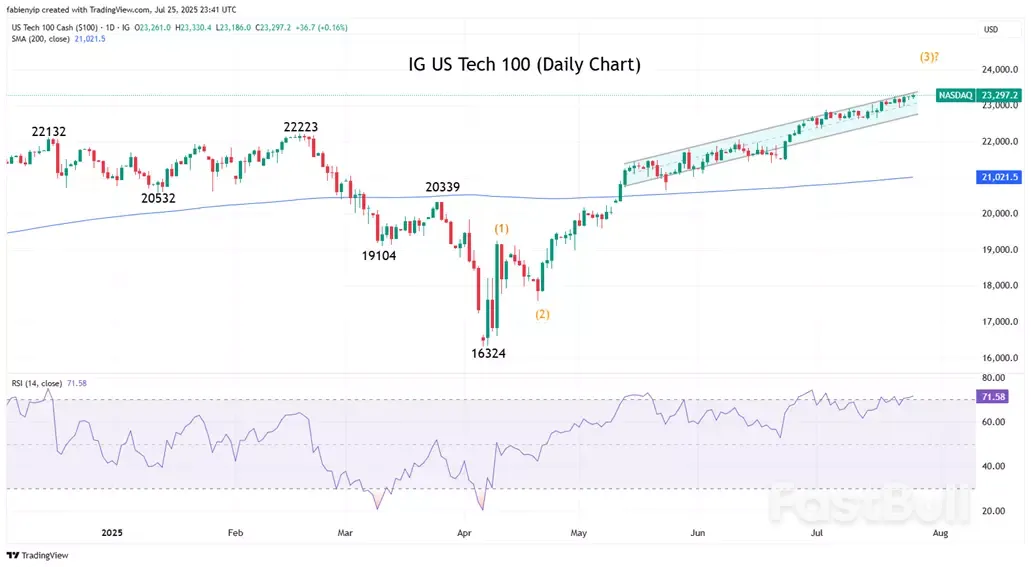
          The US Tech 100 index established new daily records on three trading sessions, concluding the week with 0.9% gains. Technical analysis indicates the bullish trend from mid-May lows dominates price movements. However, overbought conditions suggested by the relative strength index (RSI) potentially indicate a correction towards the channel's lower boundary at 22,700. If current price action follows Wave 3 characteristics of the Elliott Wave Theory, a 200% Fibonacci extension from the 21 April base could potentially drive the index toward 24,718 before Wave 4 correction materialises.
          Market Navigator: Week of 28 July 2025_1

          TradingView, as of 25 July 2025. Past performance is not a reliable indicator of future performance.

          Nikkei 225 positioned to challenge new highs

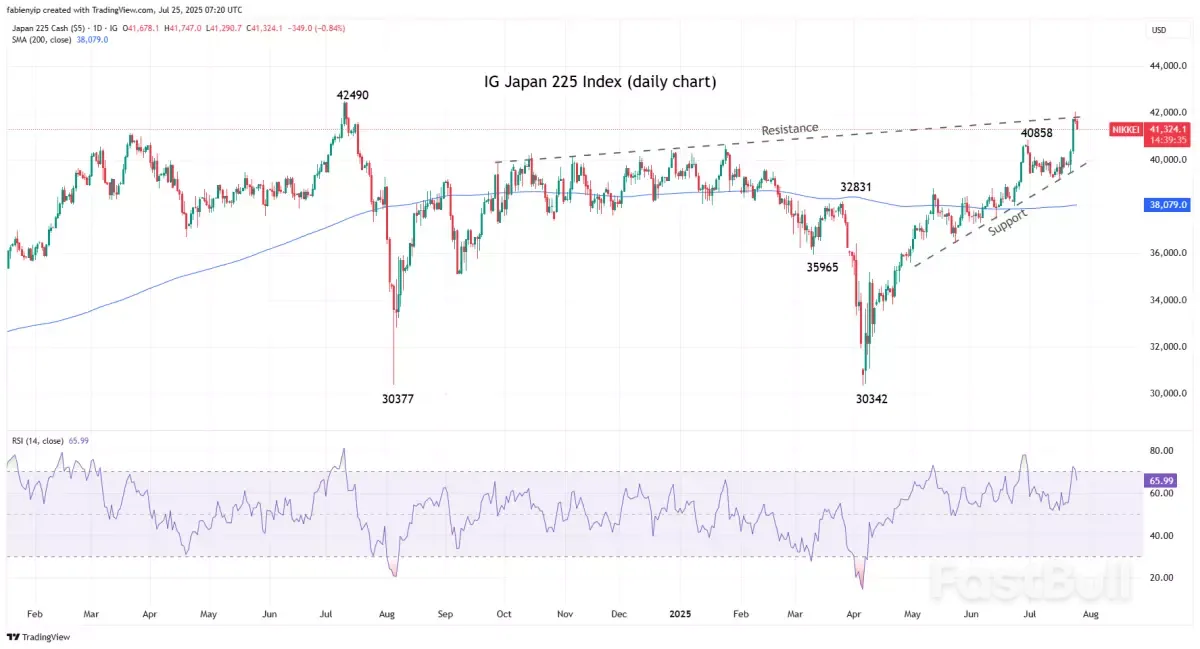
          Japan experienced a particularly eventful week, with the ruling coalition suffering a significant defeat in the Upper House election, initially creating volatility in long-dated government bonds. However, Japanese financial markets rallied decisively following the US-Japan trade agreement announcement.The Nikkei 225 gained 4.2% over the week, with automotive manufacturers leading advances, followed by machinery producers. Subaru and Toyota Motor surged 13% and 11% respectively, while automation machinery leader Fanuc rallied 11%.
          The trade agreement provided essential political relief following the ruling coalition's substantial Upper House election defeat, as prolonged uncertainty would have further undermined public confidence in the governing alliance.The Japan 225 index trades just 2.8% below its historical peak achieved twelve months ago. Technical analysis reveals that a new historical level remains achievable if the index can penetrate the resistance level at 41,800 it currently faces. Failure to break through could result in the index retreating to 40,700, with major support level positioned around 39,700.
          Market Navigator: Week of 28 July 2025_2

          Source: TradingView, as of 25 July 2025. Past performance is not a reliable indicator of future performance.

          Hang Seng Index surges beyond 25,000

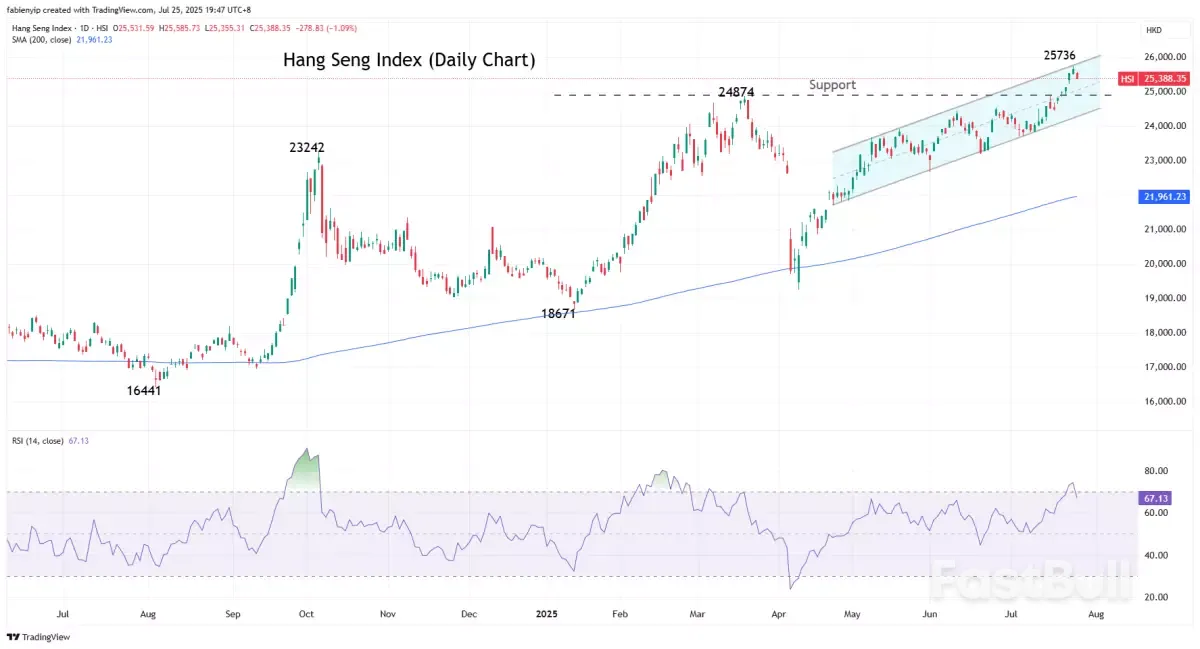
          The Hang Seng Index reached its highest level since November 2021, closing 2.3% higher for the week. The Chinese equity market benefited from the US-Japan trade agreement as it diminished investor concerns regarding a 'hard-landing' scenario when the US-China truce expires on 12 August.The market also anticipates the July Politburo meeting, where President Xi and senior leadership will establish economic strategy for the remainder of 2025. We anticipate enhanced policy support for the struggling property sector. Discussions may also encompass measures to address intense competition and excess capacity in sectors including electric vehicles, solar energy, and food delivery, which have contributed to deflationary pressures.
          The HSI's decisive rally above this year's peak at 24,874 carries significant technical implications. The uptrend channel established from 24 April continues to govern price movements. The index retreated after reaching the resistance provided by the channel's upper boundary as overbought conditions emerged. Should the Hang Seng Index manage to breach the upper boundary, it may advance towards 25,800. Conversely, failure to maintain levels above 24,874 could direct the index towards 24,500.
          Market Navigator: Week of 28 July 2025_3

          Source: Trading View, as of 25 July 2025. Past performance is not a reliable indicator of future performance.

          The week ahead

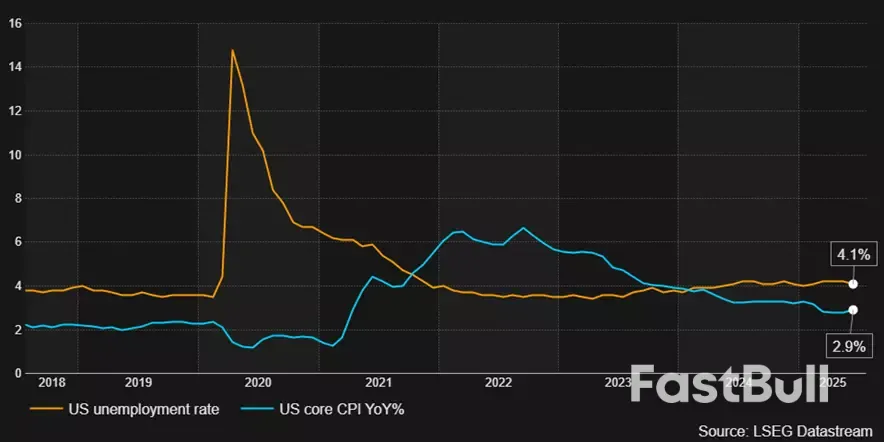
          The forthcoming week presents crucial economic events that could reshape monetary policy expectations and market sentiment across major economies. Both the Federal Reserve (Fed) and Bank of Japan (BOJ) convene pivotal interest rates meetings on Thursday.US core consumer price inflation has accelerated to 2.9% YoY in June, as high tariff impacts begin manifesting in goods including appliances and apparel. Meanwhile, the employment market maintains resilience as evidenced by the reduction in jobless claims. Despite mounting pressure from the Trump administration on Chair Powell to reduce rates, we anticipate the policy rate will remain at the current 4.25%-4.50% range, while closely monitoring statements for guidance on the possibility of two rate cuts in the remainder of 2025.
          China's dual PMI readings will offer essential insights into the world's second-largest economy, with official National Bureau of Statistics (NBS) data on Thursday and private Caixin manufacturing figures on Friday, revealing whether recent stimulus measures are gaining traction amid persistent trade headwinds.A comprehensive suite of US employment indicators, including Job Openings and Labor Turnover Survey (JOLTS) job openings and the closely-watched non-farm payrolls report, will provide critical perspectives on labour market dynamics that remain central to Fed policy considerations.
          On the corporate front, earnings season reaches its crescendo with four members of the Magnificent Seven (Microsoft, Meta, Apple and Amazon), alongside major European banking institutions, reporting results that could significantly influence market sentiment and sectoral rotation trends heading into August.
          Market Navigator: Week of 28 July 2025_4

          Source: LSEG Datastream

          Source: IG

          To stay updated on all economic events of today, please check out our Economic calendar
          Risk Warnings and Disclaimers
          You understand and acknowledge that there is a high degree of risk involved in trading. Following any strategies or investment methods may lead to potential losses. The content on the site is provided by our contributors and analysts for information purposes only. You are solely responsible for determining whether any trading assets, securities, strategy, or any other product is suitable for investing based on your own investment objectives and financial situation.
          Add to Favorites
          Share

          China Steps into Stockholm Talks with Growing Leverage and Lofty Demands

          Gerik

          Economic

          Resilient Growth and Strategic Assets Bolster China’s Confidence

          Beijing arrives at the Stockholm negotiations emboldened by multiple developments that have shifted the trade dynamics in its favor. Domestically, China’s economy has outperformed expectations during the ongoing trade war, posting a record trade surplus and adapting its export strategies by increasingly pivoting away from the US market. Externally, the United States has rolled back several export restrictions, most notably lifting a ban on the sale of a key Nvidia AI chip an unexpected reversal that many in Beijing interpret as a sign of US vulnerability in strategic technologies.
          This newfound leverage is closely tied to China’s control of essential supply chains, particularly rare earth minerals, drone components, and electric vehicle batteries. The strategic use of export licensing for seven categories of rare earths earlier this year created ripple effects, forcing the US to respond with its own export controls on chip software and high-tech equipment. Tensions escalated before easing at a June summit in London, where both sides agreed to roll back their respective restrictions. However, the episode reinforced China’s awareness of its influence over global manufacturing dependencies.

          Shifting US Posture Signals Opportunity

          While President Trump continues to maintain his “America First” trade rhetoric, his recent diplomacy suggests a softening stance on China. After concluding agreements with Japan, the EU, and other allies, Trump described the US as being “very close to a deal with China” and expressed interest in visiting Beijing soon. These overtures, combined with Treasury Secretary Scott Bessent’s positive tone about current US-China relations, signal a potential recalibration of Washington’s approach, possibly opening the door for Beijing to press for further relief from tariffs and restrictions.
          The US and China are currently operating under a 90-day truce established in May that held off the enforcement of three-digit tariffs on Chinese goods. Though the truce was nearly derailed in June, it was salvaged at the London talks, and expectations now point toward a likely extension. Analysts such as Josh Lipsky from the Atlantic Council suggest that a continuation of the current 30% tariff regime is the most probable outcome, with deeper resolutions postponed until a potential Trump-Xi summit in the fall.

          Tariffs and Tech Restrictions Top China’s Demands

          Chinese negotiators, led by Vice Premier He Lifeng, are expected to focus on removing remaining US tariffs particularly the 20% levy imposed in connection with China’s alleged role in the fentanyl crisis. In response, Beijing recently added more fentanyl precursors and synthetic opioids to its controlled substance list, signaling its intent to meet US concerns halfway in hopes of eliminating this specific trade barrier.
          In addition, Beijing is pressing for broader rollback of technology export restrictions, including removal of hundreds of Chinese firms from the US Commerce Department’s Entity List. These demands reflect a wider strategic goal: reestablishing access to Western technology and curbing long-term containment efforts by Washington.
          Wu Xinbo, a senior academic and advisor to China’s foreign ministry, argued that China’s cards ranging from mineral dominance to control over key digital platforms like TikTok are now being played more deliberately. The pending spinoff of TikTok’s US operations, which requires Beijing’s approval, serves as another potential bargaining chip.

          Geopolitical Crosswinds Complicate Progress

          Despite the economic focus, the talks are shadowed by wider geopolitical tensions. Washington is expected to raise concerns about China’s ongoing purchases of sanctioned Russian and Iranian oil and its support for Moscow’s actions in Ukraine. Trump has floated the possibility of imposing 100% secondary tariffs on imports from nations that continue these transactions, a threat directed squarely at Beijing and New Delhi. Bessent confirmed that this issue will be part of the Stockholm agenda, potentially heightening frictions.
          Nonetheless, Chinese officials are unlikely to concede on these geopolitical matters. Analysts argue that while Beijing recognizes the risks associated with oil trade sanctions, it is more inclined to treat them as a lever in broader negotiations than as red lines to avoid.

          A Tense Ceasefire with Asymmetric Momentum

          As the Stockholm talks unfold, China’s negotiating stance is notably stronger than in previous rounds. Its combination of economic resilience, strategic supply chain dominance, and calculated diplomatic firmness positions it to demand tangible concessions. However, the underlying fragility of the current truce remains. Any misstep such as renewed tech bans, legal actions against Chinese nationals, or secondary tariff escalation could quickly unravel progress.
          The talks are not expected to produce a comprehensive agreement this week, but the outcome may determine the durability of the fragile balance both sides have struck. For now, China appears prepared to use its leverage more assertively than ever before, signaling that any long-term resolution will require the US to recognize and accommodate Beijing’s rising strategic position in the global trade order.

          Source: CNN

          To stay updated on all economic events of today, please check out our Economic calendar
          Risk Warnings and Disclaimers
          You understand and acknowledge that there is a high degree of risk involved in trading. Following any strategies or investment methods may lead to potential losses. The content on the site is provided by our contributors and analysts for information purposes only. You are solely responsible for determining whether any trading assets, securities, strategy, or any other product is suitable for investing based on your own investment objectives and financial situation.
          Add to Favorites
          Share

          Volatility Looms as USD/JPY Trades into Macro Crossfire

          FOREX.com

          Forex

          Economic

          USD/JPY Back in Step With Long-End Yields

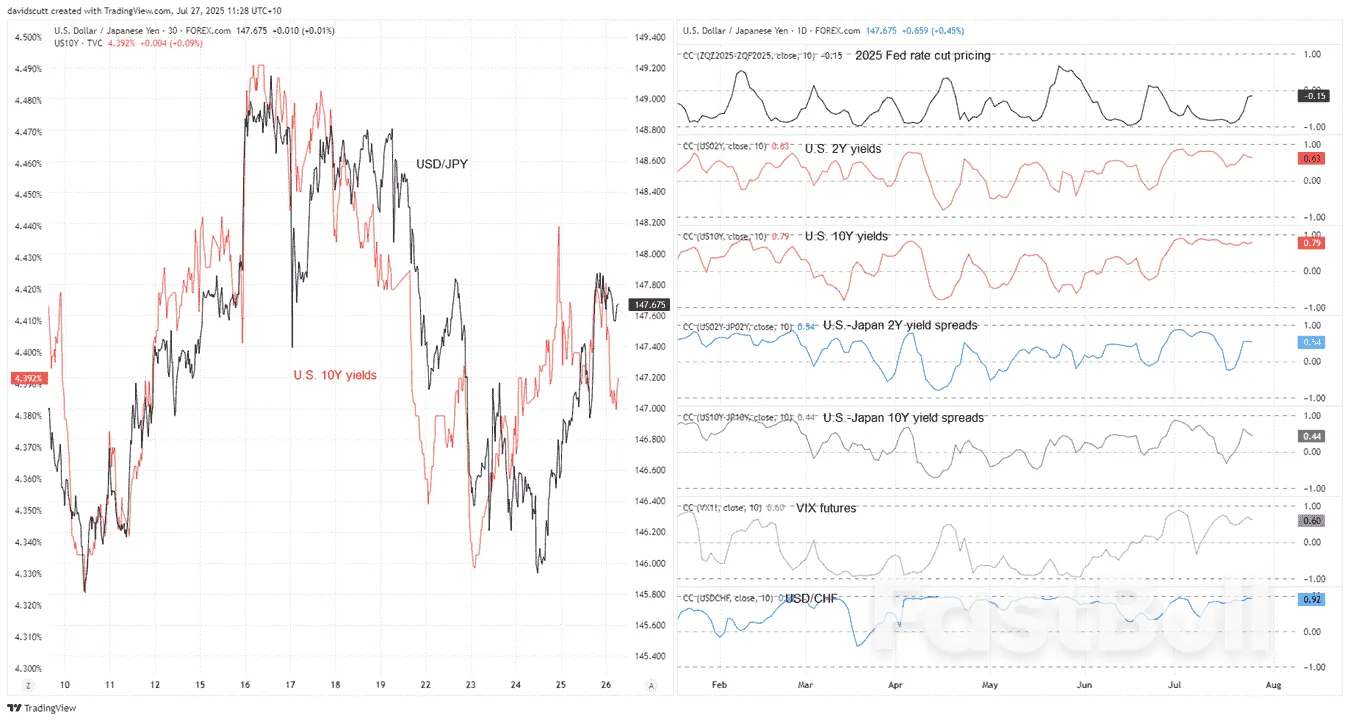
          Before diving into key events, it’s useful to look at the broader forces influencing USD/JPY in recent weeks. The first chart shows correlation coefficient scores between USD/JPY and a range of indicators across rates, volatility and FX over the past fortnight.
          Volatility Looms as USD/JPY Trades into Macro Crossfire_1

          Source: TradingView

          What stands out is a strengthening correlation between USD/JPY and U.S. 10-year Treasury yields, reverting to the historical relationship seen before the latest escalation in U.S. trade tensions. While a 0.79 correlation isn’t the strongest, it’s notably firmer than with short-dated yields or U.S.-Japan yield spreads. The fact it’s been sitting around this level for a while suggests upcoming developments that influence U.S. rate or fiscal expectations could have a major bearing on the pair this week.
          USD/JPY has also shown a mild positive correlation with VIX futures, reinforcing its role as a funding currency in carry trades. A 0.92 correlation with USD/CHF further supports this, pointing to risk appetite as another key influence this week.

          U.S.–EU Trade Talks: Deal Priced In, But Risks Skewed Lower

          While we’ll touch on the Fed and BoJ shortly, they’re not the main risks for USD/JPY. Instead, it’s events that could alter the rate outlooks for both nations that carry more weight, putting economic data and U.S.-E.U. trade talks front and centre.
          On trade, I won’t go into detail beyond noting that talks are scheduled in Scotland between Trump and E.U. President Ursula von der Leyen, and markets are looking for a deal. That means if no agreement is reached, USD/JPY could fall more than it would rise on confirmation. The risks are asymmetric.

          U.S. Data Deluge: NFP, GDP, and Core PCE All in Play

          Volatility Looms as USD/JPY Trades into Macro Crossfire_2

          Source: LSEG

          The economic calendar alone is enough to get the pulse racing. The key event comes late in the week with U.S. non-farm payrolls. The recent pattern has been upside surprises alongside downward revisions to prior data. With jobless claims falling, that may continue. While the payrolls print grabs the headlines, it’s the unemployment rate that carries more weight for the Fed. If the two diverge, markets will likely focus on the unemployment read eventually.Before then, JOLTS job openings, ADP employment, and jobless claims will help shape expectations. Non-labour data including U.S. Q2 GDP, core PCE, income and consumption, and the ISM manufacturing PMI are also due. All could dominate in a normal week, which shows how critical the next five days are.
          Japan’s calendar is quieter, allowing some breathing space during Asian trade. The U.S. Treasury will auction new two, five and seven-year notes early in the week and release its Q3 borrowing update. Treasury previously flagged $554 billion in borrowing. That figure will be updated Monday, with issuance details due Wednesday.
          Volatility Looms as USD/JPY Trades into Macro Crossfire_3

          Source: LSEG

          Given the link between Treasury yields and USD/JPY, both could trigger volatility, especially if the borrowing need exceeds prior guidance or if Treasury opts to extend maturities. With long-end yields still elevated, that risk looks low for now.

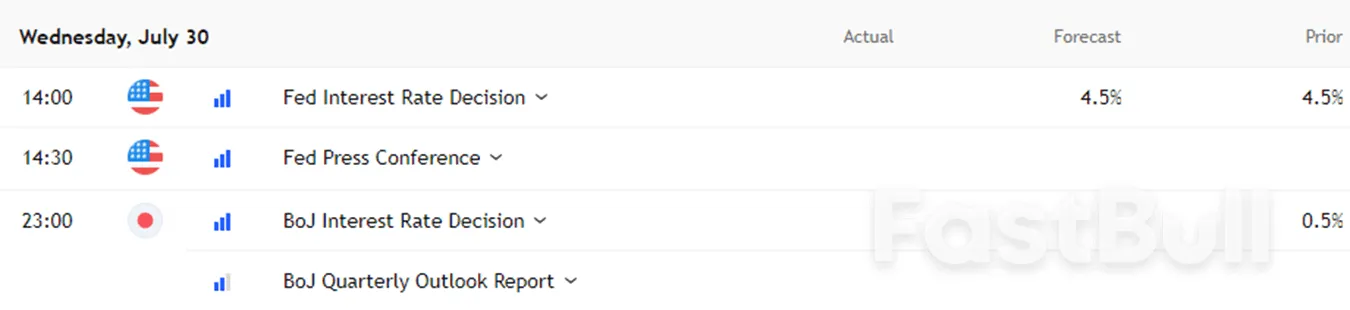
          Fed, BOJ Preview

          Volatility Looms as USD/JPY Trades into Macro Crossfire_4

          Source: TradingView (U.S. ET)

          Turning to the Fed and BoJ, neither are expected to change rates. The Fed funds rate is priced to remain at 4.25-50% with 96% probability, according to implied swaps pricing. The BoJ is seen holding steady at 0.5% with similar odds. With so little priced, volatility will be driven by guidance in the absence of a shock decision.
          Volatility Looms as USD/JPY Trades into Macro Crossfire_5

          Source: Bloomberg

          With no updated forecasts from the Fed, it’ll come down to the tone of the July statement, the vote split, and Chair Powell’s press conference. The tone likely won’t shift much given uncertainty, but the vote could be telling. Governor Waller is expected to dissent in favour of a cut. If others join him, markets may price in earlier cuts, potentially weighing on USD/JPY.
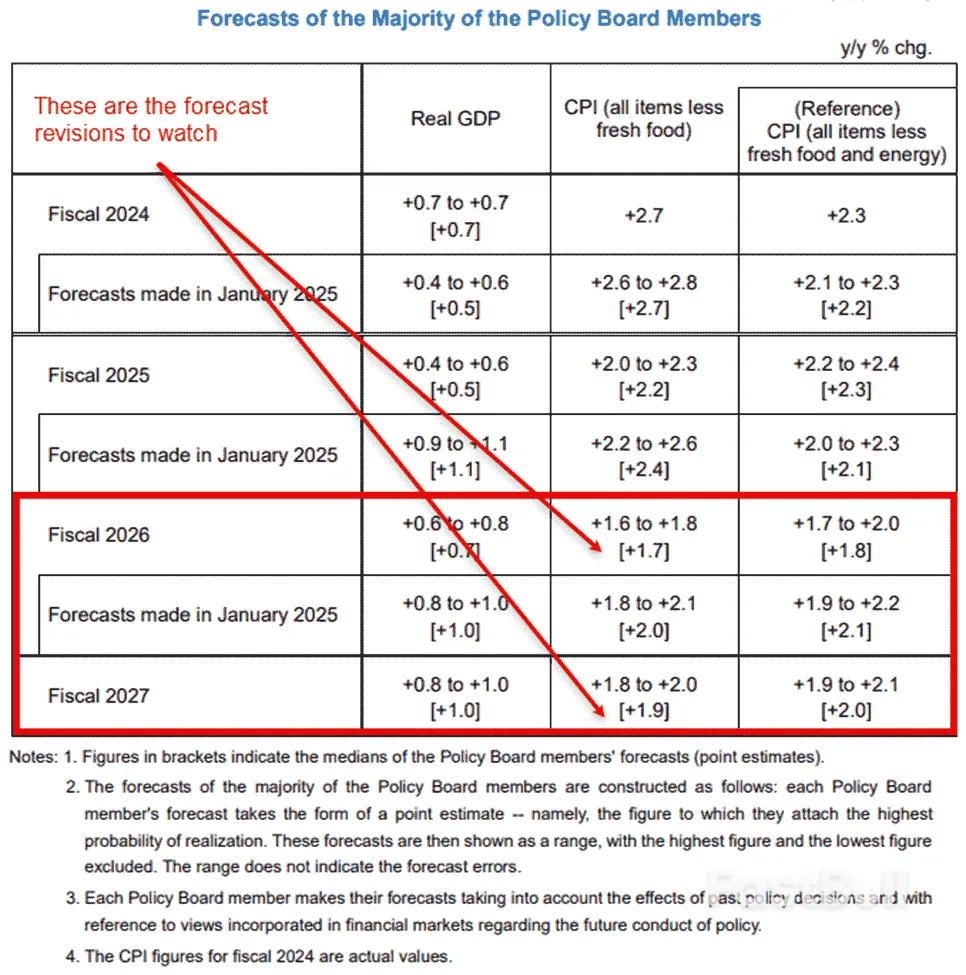
          The BoJ will release new GDP and inflation forecasts, offering a glimpse into how it views the impact of higher trade barriers. An upgrade to its FY2025 inflation forecast looks likely thanks to sticky food prices driven by rising rice costs. Whether last week’s U.S. trade deal alters its 2026 and 2027 views is unclear. Three months ago, the BoJ saw CPI ex-fresh food undershooting its 2 percent target, citing concerns over U.S. tariffs. If it sticks with that view, it could weaken the yen and lift USD/JPY. But if it sees inflation staying above target, it will be deemed hawkish, likely pressuring the pair lower.
          Volatility Looms as USD/JPY Trades into Macro Crossfire_6

          Source: BOJ

          Traders should also note that major U.S. tech earnings arrive this week. Meta reports after market close Wednesday, with Apple and Amazon following Thursday. These names often beat, and if they do again, it may bolster risk appetite and support carry trades, modestly aiding USD/JPY upside. But if they miss, carry positions could unwind, amplifying downside.

          USD/JPY Eyes 149.00 With Momentum Tilting Bullish

          Volatility Looms as USD/JPY Trades into Macro Crossfire_7

          Source: TradingView

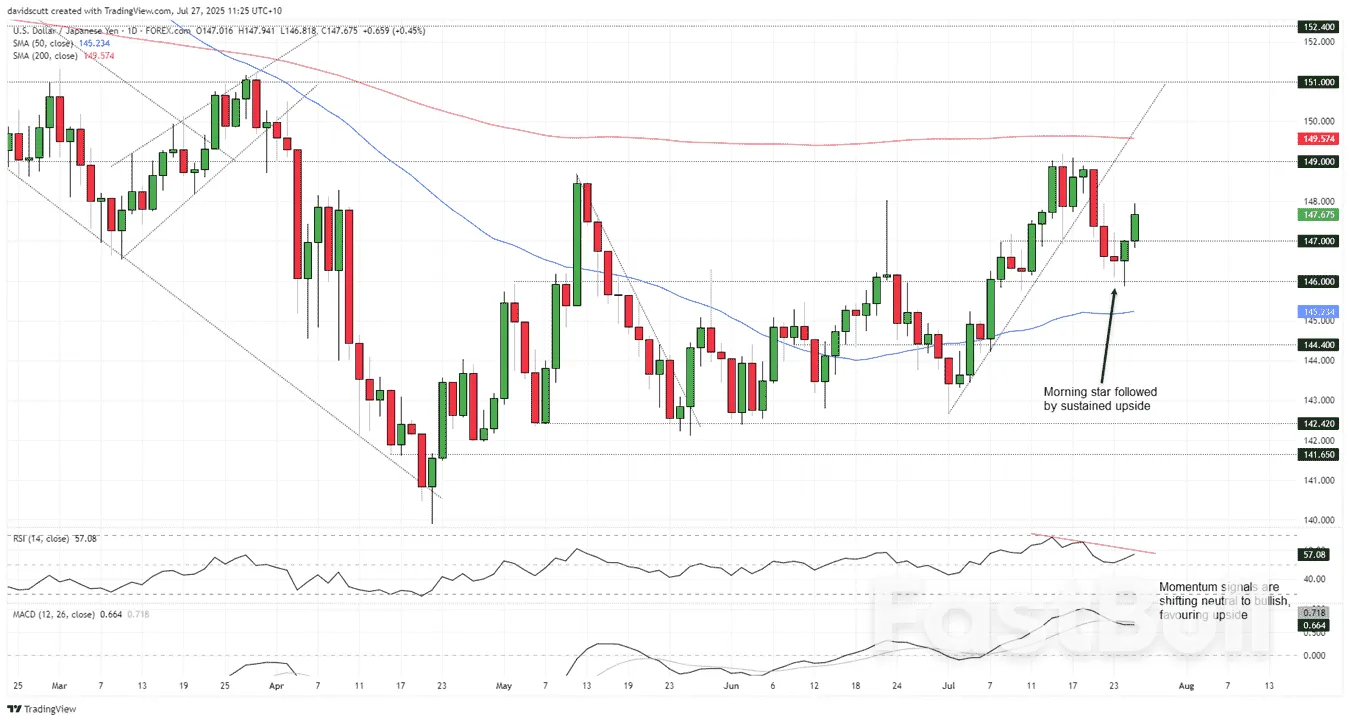
          The completion of a three-candle morning star pattern midway through last week set up Friday’s rally, pushing USD/JPY above 147.00 heading into the weekend. On the topside, 148.00 and 149.00 are resistance to watch, especially with USD/JPY recently clustering around big figures. 149.00 is a key hurdle after stalling there earlier this month. With the 200-day moving average just above, it may offer an attractive level to fade strength if the price action were to falter again. Support lies at 147.00 and 146.00 on the downside if a pullback occurs.
          The momentum picture from RSI (14) and MACD is tilting bullish with the former beginning to flick higher again while the latter is starting to move towards the signal line from below in positive territory. It’s not an outright bullish message, but it does favour upside over downside.

          Source:FOREX.com


          To stay updated on all economic events of today, please check out our Economic calendar
          Risk Warnings and Disclaimers
          You understand and acknowledge that there is a high degree of risk involved in trading. Following any strategies or investment methods may lead to potential losses. The content on the site is provided by our contributors and analysts for information purposes only. You are solely responsible for determining whether any trading assets, securities, strategy, or any other product is suitable for investing based on your own investment objectives and financial situation.
          Add to Favorites
          Share

          Global Stocks Climb as Markets Applaud Trump’s Tactical Trade Wins

          Gerik

          Economic

          Global Equities Respond to Trade Clarity

          Global stock markets reacted positively on Monday to the announcement of a framework trade agreement between the United States and the European Union, which imposed a 15% tariff on most European goods significantly lower than the threatened 30%. This reduction signaled a temporary easing of trade tensions and reassured markets that further escalation between allies would be avoided.
          The immediate impact was seen in financial markets: S&P 500 futures rose 0.4%, Nasdaq futures advanced 0.5%, and European futures gained nearly 1%. The euro appreciated against major currencies, reflecting renewed investor confidence. In Asia, MSCI’s index of Asia-Pacific shares excluding Japan rose 0.27%, near its four-year peak. Although Japan’s Nikkei slipped slightly, it remained close to its recent one-year high, suggesting resilience in regional equity markets.

          Reframing Trade Dynamics as a US Strategic Win

          Market analysts have framed the EU deal as a strategic maneuver that strongly favors US interests. The inclusion of forced European purchases of American energy and military goods, combined with the absence of EU retaliatory tariffs, tilted the balance in Washington’s favor. According to Prashant Newnaha of TD Securities, this lopsided outcome reflects the Trump administration’s negotiation playbook, praised by some as shrewd and effective in safeguarding US economic priorities.
          This perception is reinforced by recent US-Japan trade arrangements, which similarly placed US industries at an advantage. Together, these deals are reshaping global trade expectations, as countries now feel pressure to secure pacts before the August 1 tariff deadline.

          Reduced Risk of Trade War Amplifies Risk Appetite

          Tony Sycamore of IG noted that the combined progress in negotiations with Japan, the EU, and upcoming talks with China in Stockholm has significantly diminished fears of a protracted trade war. These developments have injected a sense of policy predictability, prompting a broader market appetite for risk. The Australian dollar, typically viewed as a risk proxy, rose 0.12% to $0.65725, approaching an eight-month high.
          The expected extension of the US-China trade truce by another 90 days would further contribute to market calm, even if a final agreement remains elusive. The cumulative effect of these agreements is fostering a perception that global trade will remain functional despite geopolitical tensions.

          Monetary Policy in Focus as Investors Await Signals

          The week ahead is pivotal not only due to trade but also because of scheduled policy meetings by the Federal Reserve and the Bank of Japan. Although neither is expected to adjust rates immediately, market participants will scrutinize official commentary for indications of future direction. The Fed is expected to exercise caution, especially as trade agreements could temporarily reduce inflation pressures, weakening the case for aggressive easing.
          However, political pressure on the Fed continues to mount. President Trump has publicly criticized Fed Chair Jerome Powell for maintaining current rate levels, while two Trump-appointed board members have expressed support for a rate cut. ING economists project that the Fed could begin cutting rates by December, possibly by as much as 50 basis points, particularly if employment and GDP data worsen further echoing the Fed’s methodical rate adjustments seen in 2024.
          In contrast, the Bank of Japan could consider tightening later this year, buoyed by improved trade conditions and rising inflation expectations. The recent trade breakthrough with the US has bolstered Japan’s economic outlook, possibly clearing the path for rate normalization in the months ahead.
          The positive response in global equities reflects short-term relief that a transatlantic trade rupture was avoided. However, the underlying fragility of these agreements, ongoing geopolitical risks, and central bank hesitancy underscore that markets are not yet on firm ground. Investors may continue to cheer the "art of the deal," but sustained momentum will depend on the follow-through from both trade partners and monetary authorities in the weeks ahead.

          Source: Reuters

          To stay updated on all economic events of today, please check out our Economic calendar
          Risk Warnings and Disclaimers
          You understand and acknowledge that there is a high degree of risk involved in trading. Following any strategies or investment methods may lead to potential losses. The content on the site is provided by our contributors and analysts for information purposes only. You are solely responsible for determining whether any trading assets, securities, strategy, or any other product is suitable for investing based on your own investment objectives and financial situation.
          Add to Favorites
          Share
          FastBull
          Copyright © 2025 FastBull Ltd

          728 RM B 7/F GEE LOK IND BLDG NO 34 HUNG TO RD KWUN TONG KLN HONG KONG

          TelegramInstagramTwitterfacebooklinkedin
          App Store Google Play Google Play
          Products
          Charts

          Chats

          Q&A with Experts
          Screeners
          Economic Calendar
          Data
          Tools
          Membership
          Features
          Function
          Markets
          Copy Trading
          Latest Signals
          Contests
          News
          Analysis
          24/7
          Columns
          Education
          Company
          Careers
          About Us
          Contact Us
          Advertising
          Help Center
          Feedback
          User Agreement
          Privacy Policy
          Business

          White Label

          Data API

          Web Plug-ins

          Poster Maker

          Affiliate Program

          Risk Disclosure

          The risk of loss in trading financial instruments such as stocks, FX, commodities, futures, bonds, ETFs and crypto can be substantial. You may sustain a total loss of the funds that you deposit with your broker. Therefore, you should carefully consider whether such trading is suitable for you in light of your circumstances and financial resources.

          No decision to invest should be made without thoroughly conducting due diligence by yourself or consulting with your financial advisors. Our web content might not suit you since we don't know your financial conditions and investment needs. Our financial information might have latency or contain inaccuracy, so you should be fully responsible for any of your trading and investment decisions. The company will not be responsible for your capital loss.

          Without getting permission from the website, you are not allowed to copy the website's graphics, texts, or trademarks. Intellectual property rights in the content or data incorporated into this website belong to its providers and exchange merchants.

          Not Logged In

          Log in to access more features

          FastBull Membership

          Not yet

          Purchase

          Become a signal provider
          Help Center
          Customer Service
          Dark Mode
          Price Up/Down Colors

          Log In

          Sign Up
          Position
          Layout
          Fullscreen
          Default to Chart
          The chart page opens by default when you visit fastbull.com