• Trade
  • Markets
  • Copy
  • Contests
  • News
  • 24/7
  • Calendar
  • Q&A
  • Chats
Screeners
SYMBOL
LAST
ASK
BID
HIGH
LOW
NET CHG.
%CHG.
SPREAD
SPX
S&P 500 Index
6978.59
6978.59
6978.59
6988.81
6958.82
+28.36
+ 0.41%
--
DJI
Dow Jones Industrial Average
49003.40
49003.40
49003.40
49157.80
48862.52
-408.99
-0.83%
--
IXIC
NASDAQ Composite Index
23817.11
23817.11
23817.11
23865.26
23694.38
+215.76
+ 0.91%
--
USDX
US Dollar Index
95.870
95.950
95.870
96.020
95.770
+0.330
+ 0.35%
--
EURUSD
Euro / US Dollar
1.19967
1.19975
1.19967
1.20439
1.19746
-0.00425
-0.35%
--
GBPUSD
Pound Sterling / US Dollar
1.38085
1.38092
1.38085
1.38466
1.37885
-0.00384
-0.28%
--
XAUUSD
Gold / US Dollar
5258.96
5259.39
5258.96
5266.29
5157.13
+80.38
+ 1.55%
--
WTI
Light Sweet Crude Oil
62.728
62.758
62.728
62.842
62.192
+0.291
+ 0.47%
--

Community Accounts

Signal Accounts
--
Profit Accounts
--
Loss Accounts
--
View More

Become a signal provider

Sell trading signals to earn additional income

View More

Guide to Copy Trading

Get started with ease and confidence

View More

Signal Accounts for Members

All Signal Accounts

Best Return
  • Best Return
  • Best P/L
  • Best MDD
Past 1W
  • Past 1W
  • Past 1M
  • Past 1Y

All Contests

  • All
  • Trump Updates
  • Recommend
  • Stocks
  • Cryptocurrencies
  • Central Banks
  • Featured News
Top News Only
Share

U.S. Natural Gas Futures Fell 3.00% On The Day, Currently Trading At $3.705 Per Million British Thermal Units

Share

Kazakhstan's Energy Minister: Kazakhstan Has Lost Roughly 3.8 Million Tons Of Oil Exports Due To Attacks On CPC

Share

Standard Chartered On Copper: "USD Softness And Sharp Moves Higher In Gold And Silver Have Supported Copper Prices"

Share

Standard Chartered On Copper: "We Forecast Average H1 Prices At $12950/T Compared With $11475/T In H2"

Share

Standard Chartered: "We Expect Base Metals Prices To Remain Elevated This Year, Particularly In H1 2026, Driven By Both Macro And Micro Factors"

Share

Yield On 5-Year Japanese Government Bond Falls 5.0 Basis Points To 1.660%

Share

Petronet LNG CEO Says Anything Around $6-7 Per Mmbtu LNG Prices Will Be A Comfortable Range To Improve Consumption In India

Share

TotalEnergies Gas And Power Executives: Security Of Supply Is Coming At Top Of Agenda Due To Geopolitical Challenges

Share

Exxonmobil LNG Executives: Bullish About Demand For LNG For The Coming Decade

Share

Spot Silver Rose More Than 3.00% On The Day, Currently Trading At $115.73 Per Ounce

Share

Spot Gold Continued Its Strong Upward Trend, Rising Above $5,250 Per Ounce, Up More Than $70 On The Day, Or Over 1%

Share

IMF On Sri Lanka: IMF Staff Concludes Visit To Sri Lanka

Share

ECB Governing Council Member Koch Said: If The Euro Continues To Appreciate, The ECB Will Need To Take Action

Share

Tanzania Deputy Energy Minister Says Hopes To Reverse Decline In Oil, Gas Output In Coming Years

Share

Kazakhstan's Energy Minister: Operations At Tengiz Oilfield Resumed Two Days Ago, Output Is Increasing

Share

New Zealand Dollar Falls 0.52% To $0.6014

Share

New York Silver Futures Surged 9.00% Intraday, Currently Trading At $115.50 Per Ounce

Share

India's Nifty Bank Futures Up 0.42% In Pre-Open Trade

Share

Citi Raises Silver Price Forecast For Next 3 Months To Usd150/ Ounce

Share

India 10-Year Benchmark Government Bond Yield At 6.7055%, Previous Close 6.7194%

TIME
ACT
FCST
PREV
U.S. Dallas Fed New Orders Index (Jan)

A:--

F: --

P: --

U.S. 2-Year Note Auction Avg. Yield

A:--

F: --

P: --

U.K. BRC Shop Price Index YoY (Jan)

A:--

F: --

P: --

China, Mainland Industrial Profit YoY (YTD) (Dec)

A:--

F: --

P: --

Germany 2-Year Schatz Auction Avg. Yield

A:--

F: --

P: --

Mexico Trade Balance (Dec)

A:--

F: --

P: --

U.S. Weekly Redbook Index YoY

A:--

F: --

P: --

U.S. S&P/CS 20-City Home Price Index YoY (Not SA) (Nov)

A:--

F: --

P: --

U.S. S&P/CS 20-City Home Price Index MoM (SA) (Nov)

A:--

F: --

P: --
U.S. FHFA House Price Index MoM (Nov)

A:--

F: --

P: --

U.S. FHFA House Price Index (Nov)

A:--

F: --

P: --

U.S. FHFA House Price Index YoY (Nov)

A:--

F: --

P: --
U.S. S&P/CS 10-City Home Price Index YoY (Nov)

A:--

F: --

P: --

U.S. S&P/CS 10-City Home Price Index MoM (Not SA) (Nov)

A:--

F: --

P: --

U.S. S&P/CS 20-City Home Price Index (Not SA) (Nov)

A:--

F: --

P: --

U.S. S&P/CS 20-City Home Price Index MoM (Not SA) (Nov)

A:--

F: --

P: --

U.S. Richmond Fed Manufacturing Composite Index (Jan)

A:--

F: --

P: --

U.S. Conference Board Present Situation Index (Jan)

A:--

F: --

P: --

U.S. Conference Board Consumer Expectations Index (Jan)

A:--

F: --

P: --

U.S. Richmond Fed Manufacturing Shipments Index (Jan)

A:--

F: --

P: --

U.S. Richmond Fed Services Revenue Index (Jan)

A:--

F: --

P: --

U.S. Conference Board Consumer Confidence Index (Jan)

A:--

F: --

P: --
U.S. 5-Year Note Auction Avg. Yield

A:--

F: --

P: --

U.S. API Weekly Refined Oil Stocks

A:--

F: --

P: --

U.S. API Weekly Crude Oil Stocks

A:--

F: --

P: --

U.S. API Weekly Gasoline Stocks

A:--

F: --

P: --

U.S. API Weekly Cushing Crude Oil Stocks

A:--

F: --

P: --

Australia RBA Trimmed Mean CPI YoY (Q4)

A:--

F: --

P: --

Australia CPI YoY (Q4)

A:--

F: --

P: --

Australia CPI QoQ (Q4)

A:--

F: --

P: --

Germany GfK Consumer Confidence Index (SA) (Feb)

--

F: --

P: --

Germany 10-Year Bund Auction Avg. Yield

--

F: --

P: --

India Industrial Production Index YoY (Dec)

--

F: --

P: --

India Manufacturing Output MoM (Dec)

--

F: --

P: --

U.S. MBA Mortgage Application Activity Index WoW

--

F: --

P: --

Canada Overnight Target Rate

--

F: --

P: --

BOC Monetary Policy Report
U.S. EIA Weekly Crude Stocks Change

--

F: --

P: --

U.S. EIA Weekly Cushing, Oklahoma Crude Oil Stocks Change

--

F: --

P: --

U.S. EIA Weekly Crude Demand Projected by Production

--

F: --

P: --

U.S. EIA Weekly Crude Oil Imports Changes

--

F: --

P: --

U.S. EIA Weekly Heating Oil Stock Changes

--

F: --

P: --

U.S. EIA Weekly Gasoline Stocks Change

--

F: --

P: --

BOC Press Conference
Russia PPI MoM (Dec)

--

F: --

P: --

Russia PPI YoY (Dec)

--

F: --

P: --

U.S. Target Federal Funds Rate Lower Limit (Overnight Reverse Repo Rate)

--

F: --

P: --

U.S. Interest Rate On Reserve Balances

--

F: --

P: --

U.S. Federal Funds Rate Target

--

F: --

P: --

U.S. Target Federal Funds Rate Upper Limit (Excess Reserves Ratio)

--

F: --

P: --

FOMC Statement
FOMC Press Conference
Brazil Selic Interest Rate

--

F: --

P: --

Australia Import Price Index YoY (Q4)

--

F: --

P: --

Japan Household Consumer Confidence Index (Jan)

--

F: --

P: --

Turkey Economic Sentiment Indicator (Jan)

--

F: --

P: --

Euro Zone M3 Money Supply (SA) (Dec)

--

F: --

P: --

Euro Zone Private Sector Credit YoY (Dec)

--

F: --

P: --

Euro Zone M3 Money Supply YoY (Dec)

--

F: --

P: --

Euro Zone 3-Month M3 Money Supply YoY (Dec)

--

F: --

P: --

South Africa PPI YoY (Dec)

--

F: --

P: --

Q&A with Experts
    • All
    • Chatrooms
    • Groups
    • Friends
    Connecting
    .
    .
    .
    Type here...
    Add Symbol or Code

      No matching data

      All
      Trump Updates
      Recommend
      Stocks
      Cryptocurrencies
      Central Banks
      Featured News
      • All
      • Russia-Ukraine Conflict
      • Middle East Flashpoint
      • All
      • Russia-Ukraine Conflict
      • Middle East Flashpoint

      Search
      Products

      Charts Free Forever

      Chats Q&A with Experts
      Screeners Economic Calendar Data Tools
      Membership Features
      Data Warehouse Market Trends Institutional Data Policy Rates Macro

      Market Trends

      Market Sentiment Order Book Forex Correlations

      Top Indicators

      Charts Free Forever
      Markets

      News

      News Analysis 24/7 Columns Education
      From Institutions From Analysts
      Topics Columnists

      Latest Views

      Latest Views

      Trending Topics

      Top Columnists

      Latest Update

      Signals

      Copy Rankings Latest Signals Become a signal provider AI Rating
      Contests
      Brokers

      Overview Brokers Assessment Rankings Regulators News Claims
      Broker listing Forex Brokers Comparison Tool Live Spread Comparison Scam
      Q&A Complaint Scam Alert Videos Tips to Detect Scam
      More

      Business
      Events
      Careers About Us Advertising Help Center

      White Label

      Data API

      Web Plug-ins

      Affiliate Program

      Awards Institution Evaluation IB Seminar Salon Event Exhibition
      Vietnam Thailand Singapore Dubai
      Fans Party Investment Sharing Session
      FastBull Summit BrokersView Expo
      Recent Searches
        Top Searches
          Markets
          News
          Analysis
          User
          24/7
          Economic Calendar
          Education
          Data
          • Names
          • Latest
          • Prev

          View All

          No data

          Scan to Download

          Faster Charts, Chat Faster!

          Download App
          English
          • English
          • Español
          • العربية
          • Bahasa Indonesia
          • Bahasa Melayu
          • Tiếng Việt
          • ภาษาไทย
          • Français
          • Italiano
          • Türkçe
          • Русский язык
          • 简中
          • 繁中
          Open Account
          Search
          Products
          Charts Free Forever
          Markets
          News
          Signals

          Copy Rankings Latest Signals Become a signal provider AI Rating
          Contests
          Brokers

          Overview Brokers Assessment Rankings Regulators News Claims
          Broker listing Forex Brokers Comparison Tool Live Spread Comparison Scam
          Q&A Complaint Scam Alert Videos Tips to Detect Scam
          More

          Business
          Events
          Careers About Us Advertising Help Center

          White Label

          Data API

          Web Plug-ins

          Affiliate Program

          Awards Institution Evaluation IB Seminar Salon Event Exhibition
          Vietnam Thailand Singapore Dubai
          Fans Party Investment Sharing Session
          FastBull Summit BrokersView Expo

          USD/CHF Hits 11-Year Low as Intervention Fears Weigh on Dollar

          Warren Takunda

          Traders' Opinions

          Summary:

          The US Dollar has breached a critical psychological threshold against the Swiss Franc, with USD/CHF cratering to approximately 0.7760, a level unseen since September 2011.

          SELL USDCHF
          Close Time
          CLOSED

          0.77600

          Entry Price

          0.76500

          TP

          0.78050

          SL

          0.76524 +0.00399 +0.52%

          41.3

          Pips

          Profit

          0.76500

          TP

          0.77187

          Exit Price

          0.77600

          Entry Price

          0.78050

          SL
          The Swiss Franc is eviscerating the US Dollar in a brutal display of safe-haven flight and structural distrust, driving the currency pair to depths not plumbed for over a decade. In a session defined by jittery, speculative flows, the USD/CHF is not merely dipping; it is in a state of accelerated retreat, buckling under the weight of existential concerns about America’s commitment to a strong Dollar policy and the sanctity of its central bank.
          The immediate catalyst for Monday’s carnage stems from actionable, albeit opaque, signals from the corridors of power. Confirmed reports from Bloomberg and Reuters that the Federal Reserve Bank of New York conducted “rate checks” with major financial institutions—a procedural inquiry for indicative pricing on the USD/JPY—sent a shockwave through leveraged positions. In the nuanced lexicon of foreign exchange markets, such a move is widely interpreted not as academic curiosity, but as a preparatory drill for potential intervention. The message traders received was stark: the US Treasury, possibly in concert with Japan, is actively contemplating stepping into the market to arrest the Dollar’s strength, specifically against the Yen. This immediately triggered a violent, broad-based unwinding of long-USD bets, as no speculator wishes to be caught on the wrong side of a G7 treasury’s firepower. The contagion from the JPY action spread ruthlessly to other majors, with the CHF a prime beneficiary.
          While the intervention chatter provides the spark, the Swiss Franc’s ascent is built on a far more formidable granite foundation. In a note that has resonated powerfully with institutional investors, Goldman Sachs has forcefully argued that the CHF stands as “the best-positioned global FX hedge against central bank subordination risks.” This is a critical evolution of the Franc’s narrative. It is no longer just a refuge during geopolitical strife or equity market meltdowns. In the current epoch, defined by the looming threat of fiscal dominance—where governments pressure central banks to monetize debt, sacrificing inflation control—Switzerland’s institutional framework is a global outlier. Goldman underscores the nation’s resilient fiscal fundamentals, its inherent buffer against imported inflation, and a central bank mandate that remains stubbornly focused on price stability. This makes the CHF a targeted hedge against a very specific, pervasive fear: that other major central banks, including potentially the Fed, may eventually be compelled to prioritize government financing conditions over their inflation-fighting credibility.
          Compounding the Dollar’s misery is a domestic political storm clouding the horizon of the Federal Reserve itself. The White House has signaled that President Trump’s nomination for the next Fed Chair—succeeding Jerome Powell—could be unveiled as soon as this week. The list of circulating names, including Kevin Hassett, Rick Rieder, and Kevin Warsh, is being scrutinized not for economic pedigree alone, but for perceived political fealty. The market’s paramount concern is the erosion of the Fed’s hard-won independence. A nominee viewed as excessively aligned with the administration’s growth or, more worryingly, its electoral objectives could fundamentally undermine confidence in the Dollar as a store of value. Investors are pricing in the risk of a central bank that may be slower to hike, or quicker to cut, based on political rather than economic cycles. This fear is actively diluting the Dollar’s yield appeal.
          All this unfolds in a critical macro data and policy week. The Federal Open Market Committee (FOMC) concludes its meeting on Wednesday, with the CME FedWatch Tool signaling a near-certainty that rates will be held steady in the 3.50%-3.75% range. This follows an aggressive 75-basis-point cutting cycle in 2025, a response to nascent labor market cracks. The statement and any subsequent communications will be parsed with manic intensity for hints on the balance between remaining inflation concerns and growth risks, and for any language that might address market volatility or currency levels.
          Earlier on Monday, the US Durable Goods Orders for November will offer a timely, if secondary, pulse check on business investment sentiment. Yet, in the current environment, even robust data may struggle to provide sustained relief for the embattled Greenback. The tides of political risk and intervention speculation are currently overwhelming traditional fundamental flows.

          Technical AnalysisUSD/CHF Hits 11-Year Low as Intervention Fears Weigh on Dollar_1

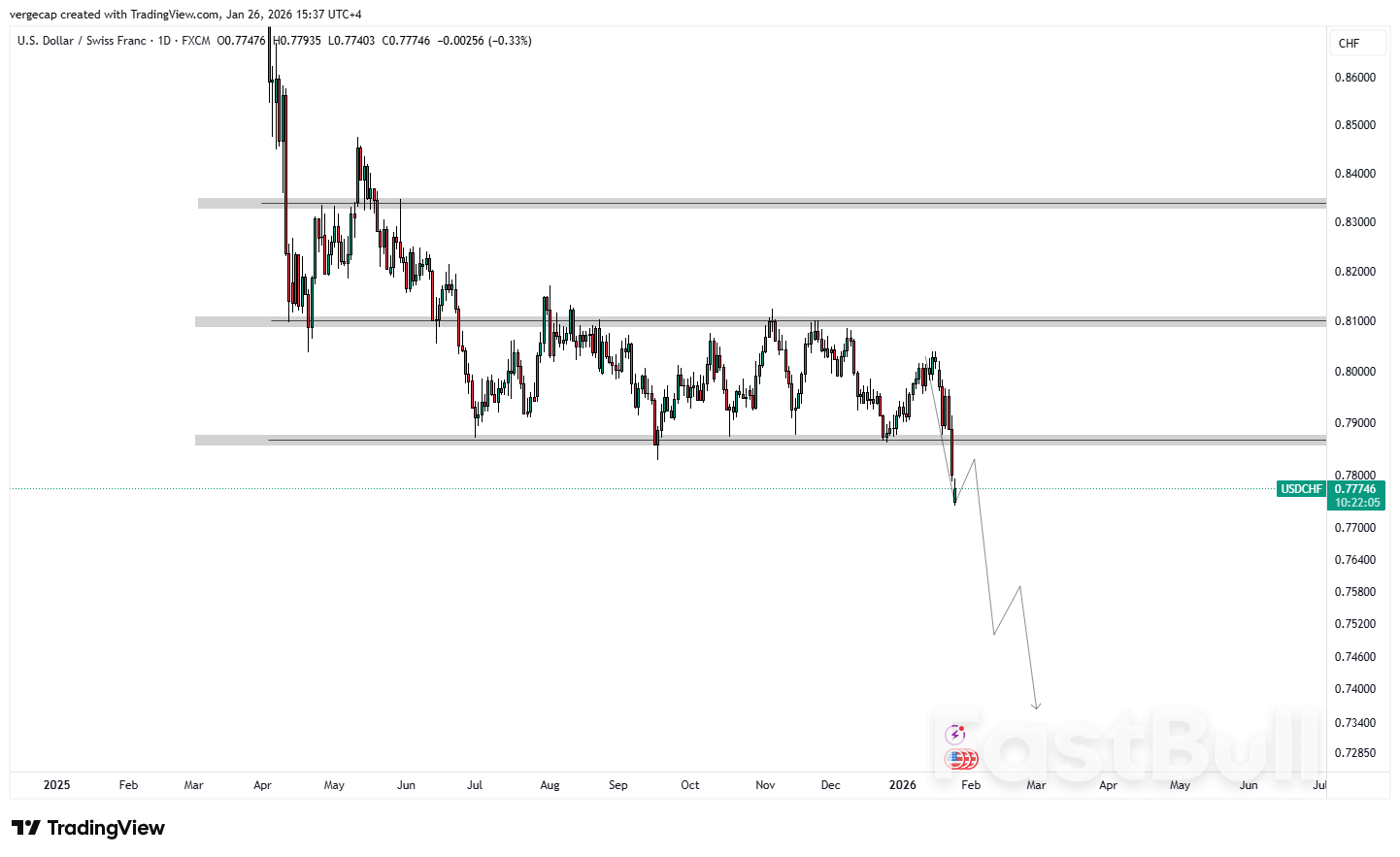
          From a technical perspective, USDCHF is exhibiting signs of a bearish correction within a broader downtrend that has persisted since mid-2026. The current session saw price decline to a low of 0.77403 before a modest recovery to 0.77746, leaving the pair down 0.33% on the day. The price action remains confined below the key 0.7800 psychological level, which has transformed from previous support into a new resistance barrier.
          On the daily chart, the structure is bearish, with the pair making a series of lower highs and lower lows. The recent breakdown below the 0.7800 handle has opened the path for a test of the current yearly lows near the 0.7740 area. A decisive break and daily close below the session low of 0.77403 would confirm bearish momentum acceleration, with the next significant support target located near the 0.7700 psychological level. Below that, the 0.7650–0.7670 zone, which represents the lows from early 2026, would come into focus.
          Should a recovery attempt materialize, any upside is likely to be capped initially by the former support-turned-resistance near 0.7800. A sustained move back above this level would be required to invalidate the immediate bearish bias and shift focus toward the 0.7850–0.7870 zone, where the descending trendline from the 2026 highs converges.
          Momentum remains tilted to the downside, with the pair failing to sustain rallies and consistently finding selling pressure near the 0.7800 region. The bearish engulfing nature of recent daily candles suggests sellers remain in control.
          TRADE RECOMMENDATION
          SELL USDCHF
          ENTRY PRICE: 0.77600
          STOP LOSS: 0.78050
          TAKE PROFIT: 0.7650
          Risk Warnings and Disclaimers
          You understand and acknowledge that there is a high degree of risk involved in trading. Following any strategies or investment methods may lead to potential losses. The content on the site is provided by our contributors and analysts for information purposes only. You are solely responsible for determining whether any trading assets, securities, strategy, or any other product is suitable for investing based on your own investment objectives and financial situation.
          Add to Favorites
          Share

          Panic Selling May Be Coming to an End, with a Technical Rebound Expected in the Short Term

          Alan

          Forex

          Summary:

          Recently, market sentiment has shifted to heightened vigilance regarding Japanese government intervention, resulting in sustained depreciation of the USDJPY pair. However, the likelihood of short-term technical correction opportunities is gradually increasing.

          BUY USDJPY
          Close Time
          CLOSED

          153.832

          Entry Price

          156.400

          TP

          152.800

          SL

          152.612 +0.426 +0.28%

          103.2

          Pips

          Loss

          152.800

          SL

          152.777

          Exit Price

          153.832

          Entry Price

          156.400

          TP

          Fundamentals

          During trading sessions today, the USDJPY exchange rate experienced significant intraday volatility, retreating from recent highs to approximately 154.00, indicating a pronounced strengthening of the Japanese yen. Market sentiment shifted from previous bets on yen depreciation to heightened alertness over potential official intervention by Japanese authorities. Both trading volume and volatility increased markedly, with participants adopting cautious position management ahead of key levels.
          The recent persistent appreciation of the yen is primarily driven by the Japanese authorities' more proactive stance toward abnormal exchange rate fluctuations, including public statements about engaging in communication and coordination with U.S. counterparts. Japanese fiscal officials and government representatives are closely monitoring the forex market, explicitly leaving open the possibility of intervention to curb excessive volatility if necessary. Meanwhile, rumors suggest that the U.S. and Japan are exchanging information regarding interest rate checks and market conditions, which some interpret as a prelude to coordinated intervention. Such signals have sufficed to prompt short-term yen long-covering and a coupled response in interest rates and the exchange rate. The overarching logic is: official statements and behind-the-scenes diplomacy lead to a short-term market sentiment reversal and rapid yen appreciation.
          This fundamental evolution has a dual impact on market transmission. On one hand, anticipated or enacted policy interventions can significantly curb the short-term appreciation potential of the USDJPY, triggering short covering and weakening the dollar. On the other hand, if interventions are perceived as "conditional and temporary" stabilization measures, market expectations regarding long-term interest rate differentials and macroeconomic fundamentals—such as divergence in monetary policies between the U.S. and Japan—may persist. Consequently, yen appreciation may manifest more as rapid but fleeting adjustments rather than a fundamental shift in the medium-term trend.

          Technical Analysis

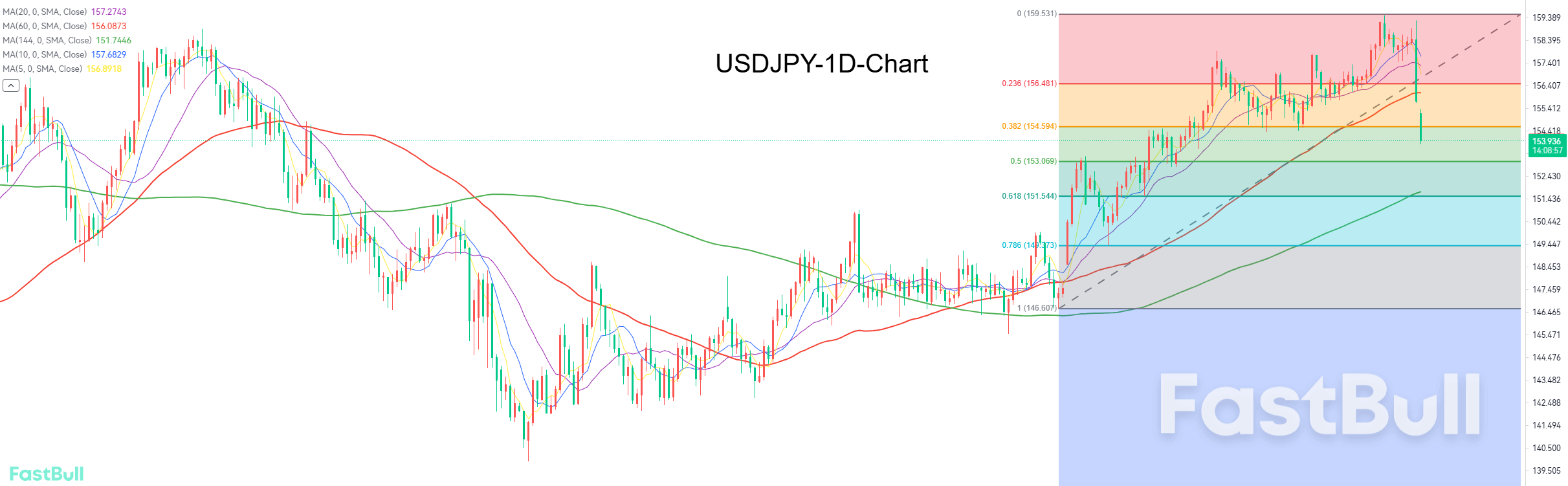
          Panic Selling May Be Coming to an End, with a Technical Rebound Expected in the Short Term_1
          In the 1D timeframe, the USDJPY currency pair temporarily broke below the 154.00 psychological support level and tested the 153.60 support zone. Intraday price action indicates the pair found temporary support above this level, leading to a gradual slowdown in the decline. Meanwhile, the RSI indicator signals that the market has entered oversold territory, increasing the likelihood of a technical rebound in the short term.
          Currently, if the USDJPY breaks below the 153.60 support, the exchange rate may further test the 153.00 support level. Conversely, if the price stabilizes and finds support at this level, it could attempt to recover the gap created by today's gap-down opening and resume a bullish trend.

          Trading Recommendations

          Trading Direction: Buy
          Entry Price: 153.80
          Target Price: 156.40
          Stop Loss: 152.80
          Valid Until: February 9, 2026 23:00:00
          Support: 153.60, 153.00
          Resistance: 155.65, 156.50
          Risk Warnings and Disclaimers
          You understand and acknowledge that there is a high degree of risk involved in trading. Following any strategies or investment methods may lead to potential losses. The content on the site is provided by our contributors and analysts for information purposes only. You are solely responsible for determining whether any trading assets, securities, strategy, or any other product is suitable for investing based on your own investment objectives and financial situation.
          Add to Favorites
          Share

          PMI Soars! GBP/USD Set for Strong Uptrend

          Tank

          Forex

          Technical Analysis

          Summary:

          As the so‑called "sell America" trade continues to weigh on the US dollar, GBP/USD bulls remain in control. Meanwhile, relatively hawkish expectations for the Bank of England are supportive of the pound and underpin spot prices.

          BUY GBPUSD
          EXP
          PENDING

          1.36000

          Entry Price

          1.40000

          TP

          1.34000

          SL

          1.38085 -0.00384 -0.28%

          --

          Pips

          PENDING

          1.34000

          SL

          Exit Price

          1.36000

          Entry Price

          1.40000

          TP

          Fundamentals
          The latest data favor positive momentum in key sectors of the UK economy. First, retail sales in December rose 0.4% month‑on‑month, significantly better than the market expectation of a 0.1% decline, marking the first monthly increase since September. Strong online shopping was the main driver, with rising gold prices particularly boosting sales for online jewelers. Although overall retail sales in Q4 still edged down 0.3% and volumes remain below pre‑pandemic levels, the year‑end rebound echoes survey results showing consumer confidence at its highest since August 2024, suggesting an improvement in household finances and willingness to spend. Inflation and wage pressures persist, and the central bank remains cautious: alongside the economic recovery, inflationary pressure has resurfaced, prompting heightened vigilance from monetary policymakers. January PMI data show that service sector output price inflation climbed to a nine‑month high, as businesses broadly passed on high labor costs to consumers. This phenomenon aligns with the view of Megan Greene, a member of the Bank of England's Monetary Policy Committee. The UK economy displayed encouraging recovery momentum at the start of 2026, with both consumer activity and business sentiment improving. Nevertheless, persistent wage and price pressures led by the services sector continue to force the BoE to maintain a hawkish stance. Constrained by internal sticky inflation and external uncertainty over Federal Reserve policy, the path to normalization of UK monetary policy is expected to be more cautious and gradual than markets had previously anticipated.
          US President Trump attempted to assert control over Greenland. With confrontations with European allies, the long‑term NATO alliance was questioned. In addition, with declining global trust in leadership, the so‑called "sell America" trade has resurfaced, exerting heavy pressure on the US dollar. The Dollar Index, which tracks the US dollar against a basket of currencies, fell to a four‑month low on Monday, providing some support to the GBP/USD pair. In addition, expectations that the Fed will cut rates twice more this year are another factor weighing on the dollar. On the other hand, the pound benefits from stronger‑than‑expected UK economic data, which has dampened near‑term rate cut expectations for the Bank of England. This could continue to favor GBP/USD and reinforce its short‑term bullish outlook. However, a minor intraday rebound in the dollar saw shorts turn cautious, reducing positions ahead of Wednesday's key Fed policy decision. Investors will watch the Fed's rate‑cut trajectory, which will influence the dollar's short‑term price action and inject fresh momentum into the GBP/USD pair. Meanwhile, the US durable goods orders data released Monday may present short‑term trading opportunities.
          Technical Analysis
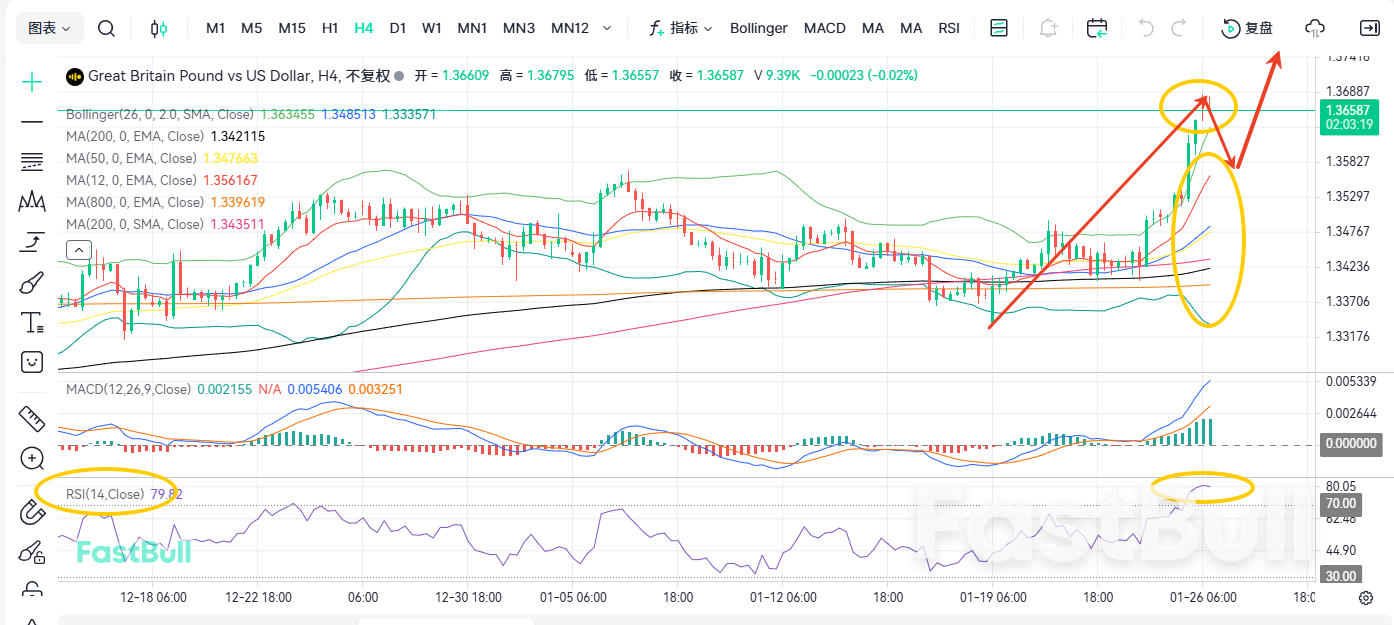
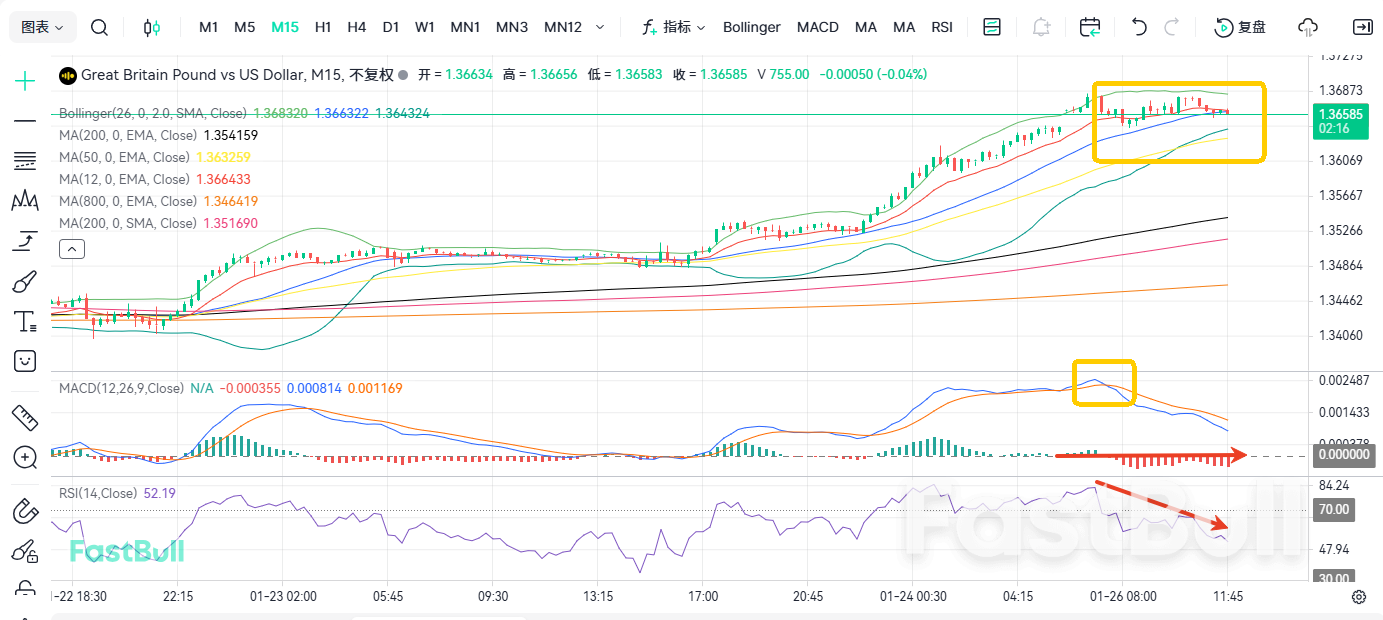
          Based on the 15‑minute chart, GBP/USD broke below the Bollinger Middle Bands and the EMA12, indicating a short‑term pullback. The Bollinger Bands are narrowing, and the moving averages are flattening, signaling that a trend reversal could occur at any time. After forming a death cross, the MACD and signal lines are pulling back toward the zero axis but remain far from it, suggesting the adjustment is not yet complete. RSI stands at 52, reflecting a wait‑and‑see market sentiment. Regarding the 4‑hour chart, the Bollinger Bands are expanding upward and the moving averages are diverging higher, with price rising strongly along the upper band — the overall bullish trend remains intact. However, two consecutive candles formed doji stars, indicating clear short‑term resistance and raising the likelihood of consolidation or pullback. Support lies near round psychological levels and the EMA12, around 1.3600 and 1.3560, respectively. RSI stays at 79, placing the market in overbought territory, with the RSI peak beginning to retreat. Therefore, the strategy should be buying at lows.
          PMI Soars! GBP/USD Set for Strong Uptrend_1PMI Soars! GBP/USD Set for Strong Uptrend_2
          Trading Recommendations:
          Trading direction: Buy
          Entry Price: 1.36
          Target Price: 1.4
          Stop Loss: 1.34
          Support: 1.34/1.3/1.28
          Resistance: 1.37/1.373/1.4
          Risk Warnings and Disclaimers
          You understand and acknowledge that there is a high degree of risk involved in trading. Following any strategies or investment methods may lead to potential losses. The content on the site is provided by our contributors and analysts for information purposes only. You are solely responsible for determining whether any trading assets, securities, strategy, or any other product is suitable for investing based on your own investment objectives and financial situation.
          Add to Favorites
          Share

          Strong Data Fuels Sterling's Rally, Profit-Taking Risks Loom

          Eva Chen

          Forex

          Summary:

          Driven by stronger-than-expected January flash S&P Global Purchasing Managers' Index (PMI) and resumed growth in December retail sales, the British pound saw robust buying interest against major currencies.

          SELL GBPUSD
          Close Time
          CLOSED

          1.36200

          Entry Price

          1.33220

          TP

          1.36890

          SL

          1.38085 -0.00384 -0.28%

          69.0

          Pips

          Loss

          1.33220

          TP

          1.36890

          Exit Price

          1.36200

          Entry Price

          1.36890

          SL

          Fundamentals

          Data released on Friday showed that the UK's seasonally adjusted retail sales rose by 0.4% MoM in December, ending two consecutive months of decline. The figure beat market expectations, where sales were forecast to remain flat.
          "Sales volumes picked up in December, with non-store retailers performing well. Online jewellers reported strong trading, telling us that demand for gold and silver was higher," noted Hannah Finselbach, Senior Statistician at the Office for National Statistics (ONS).
          Market Insight: UK Chancellor of the Exchequer Rachel Reeves announced tax hikes in the November 26 budget, but most measures were less stringent than feared and are not set to take effect until later in the parliamentary session.
          In addition, better-than-expected UK PMI data demonstrated positive resilience. Firms reported rising demand in both domestic and export markets, driving output growth to its fastest pace since April 2024. Businesses also stated that optimism toward future business prospects hit its highest level since before the Autumn Budget 2024.
          Chris Williamson, Chief Business Economist at S&P Global Market Intelligence, commented: "UK companies stepped up their pace of expansion in January, showing encouraging resilience in the face of recent geopolitical tensions."
          Market Note: The January flash PMI climbed to a level consistent with a robust quarterly GDP growth of nearly 0.4%. While growth was still led by the services sector, particularly financial services and technology, manufacturing continued to report a recovery, with goods exports registering marked growth for the first time in four years, buoyed by improving demand. However, the positive news was offset by the fact that rising order volumes failed to prevent substantial job cuts.
          Strong UK retail sales data and upbeat PMI figures are expected to weigh on market expectations of an imminent rate cut by the Bank of England (BoE). With a light UK economic data calendar next week, market sentiment and expectations for the outcome of the BoE's February monetary policy meeting will dictate sterling's trajectory.
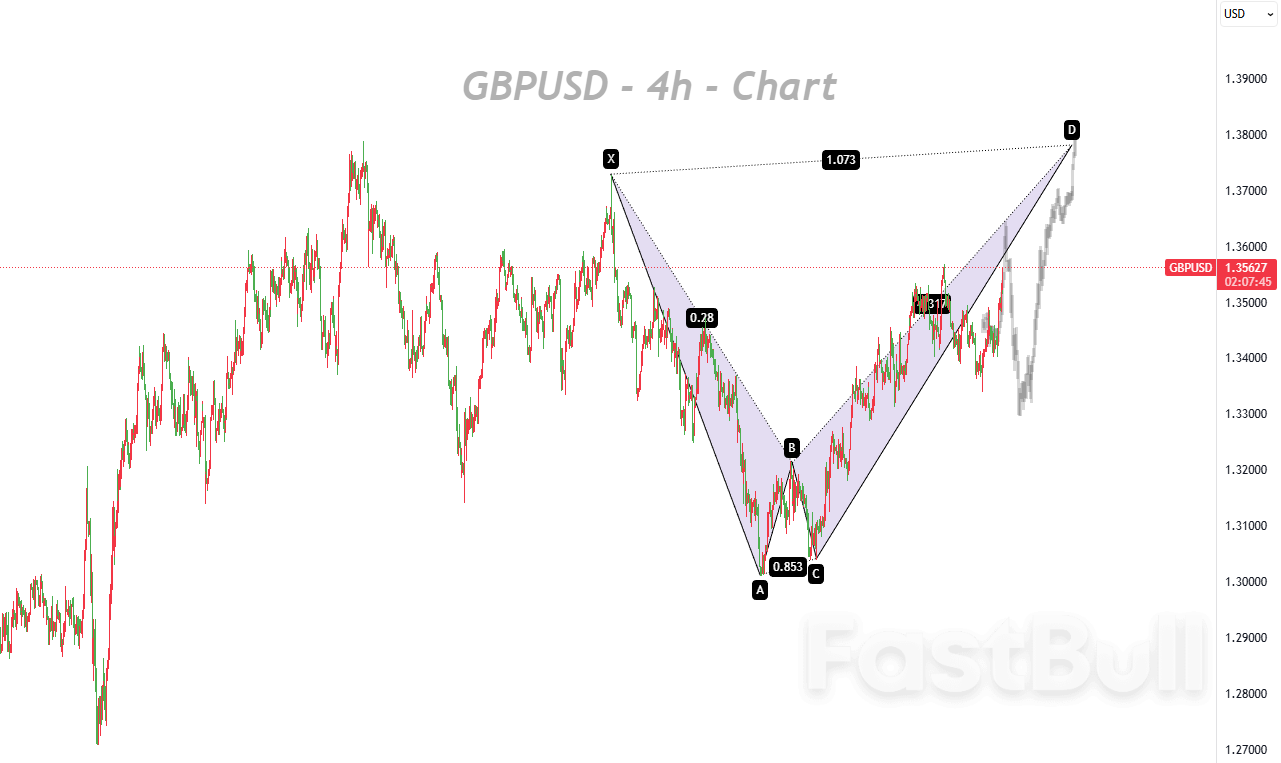
          Strong Data Fuels Sterling's Rally, Profit-Taking Risks Loom_1

          Technical Analysis

          GBPUSD's break above the 1.3494 resistance level on Friday signals that the correction from the 1.3567 peak has concluded at 1.3342. The intraday trend has turned upward once again, with the target set at 1.3567. A decisive break above this resistance could extend the uptrend from 1.3008, paving the way for a retest of the 1.3787 high.
          Nevertheless, caution is warranted as profit-taking pressure is expected near the 1.3630 level, which may trigger a pullback. A breakdown below 1.3008 would extend the downtrend from 1.3567, with the next support level at 1.3008.

          Trade Recommendations

          Trade Direction: Sell
          Entry Price: 1.3620
          Target Price: 1.3322
          Stop Loss: 1.3689
          Valid Until: 19 February, 2026, 23:55:00
          Support: 1.3493/1.3401/1.3340
          Resistance Levels: 1.3568/1.3633/1.3681
          Risk Warnings and Disclaimers
          You understand and acknowledge that there is a high degree of risk involved in trading. Following any strategies or investment methods may lead to potential losses. The content on the site is provided by our contributors and analysts for information purposes only. You are solely responsible for determining whether any trading assets, securities, strategy, or any other product is suitable for investing based on your own investment objectives and financial situation.
          Add to Favorites
          Share

          AUD Rides Labor Market Surge to Multi-Month Highs, Forcing RBA into Rate Hike Reckoning

          Warren Takunda

          Traders' Opinions

          Summary:

          The Australian Dollar surged past 0.6800 against the US Dollar after a stunning December jobs report showed 65.2k jobs added and unemployment falling to 4.1%.

          BUY AUDUSD
          Close Time
          CLOSED

          0.68650

          Entry Price

          0.69700

          TP

          0.68200

          SL

          0.70025 -0.00086 -0.12%

          16.3

          Pips

          Profit

          0.68200

          SL

          0.68813

          Exit Price

          0.68650

          Entry Price

          0.69700

          TP

          The Australian dollar is staging a blistering start to the year, propelled by a shockingly robust domestic employment report that has fundamentally rewritten the script for the Reserve Bank of Australia’s imminent policy decision. In a display of raw economic resilience, AUD/USD has decisively breached the critical psychological 0.6800 handle, reaching its highest levels since August, as traders scramble to price in a once-unlikely February interest rate hike.
          The catalyst for this dramatic repricing was nothing short of a blockbuster jobs release. Australia’s economy didn’t just add jobs in December; it delivered a thunderous rebuttal to fears of a slowdown. The addition of 65,200 positions utterly demolished the consensus forecast of a mere 27,000 and spectacularly reversed November’s revised 28,700 loss. The composition of the gains is perhaps even more telling for the inflation hawks at the RBA’s Martin Place headquarters. Full-time employment, a key indicator of economic strength and future wage pressure, roared back with a 54,800 increase, largely clawing back the prior month’s decline.
          "This wasn't just a strong report; it was a game-changer," noted currency strategists at BBH in a client note. "The unemployment rate’s unexpected drop to 4.1%—well below the RBA’s own year-end forecast of 4.4%—paints a picture of a labor market that is tightening, not easing, at a critical juncture."
          The nuance within the data only reinforces this view. The participation rate edged higher to 66.7%, and hours worked increased by 0.4% month-on-month. This suggests the employment gains are organic, driven by genuine demand for labor, not merely by more people entering the job hunt. The slack that central bankers desperately need to see to curb inflation is proving elusive.
          The immediate and violent market reaction speaks volumes. Overnight Index Swaps now imply a roughly 60% chance of a 25-basis-point rate hike when the RBA board meets on February 7th—a probability that has more than doubled since before the jobs data landed. Just weeks ago, the prevailing narrative was one of a prolonged pause, with the next potential move being a cut, albeit distant. That narrative is now in tatters.
          The RBA finds itself in a delicate, politically charged position. It has consistently pointed to the labor market and services inflation as its primary concerns. The December jobs report delivers a clear verdict on the former: it remains red-hot. Governor Michele Bullock’s recent shift in rhetoric, emphasizing that the board is not ruling "anything in or out," now appears prescient. The case for a pre-emptive strike to reinforce the bank’s inflation-fighting credentials is building by the hour.
          Yet, the final piece of this high-stakes puzzle is still missing. Next Wednesday’s Q4 Consumer Price Index data will act as the ultimate arbiter. The market’s current aggressive pricing assumes that the inflation print will provide the necessary corroboration. All eyes will be on the trimmed mean CPI, the RBA’s preferred core measure. If it comes in above the bank’s Q4 projection of 3.2% year-on-year, the case for a February hike transitions from strong to compelling.
          "If the CPI confirms that price pressures are proving stickier than modeled, especially in services linked to this strong labor market, the RBA may feel it has no choice but to act," I am told by a senior rates trader in Sydney. "A February hike would be a stark ‘forward guidance’ moment, showing they are data-dependent, not date-dependent. For the Aussie, that could be rocket fuel."
          In the near term, the Aussie’s momentum is undeniable. The break above 0.6800 clears a significant technical barrier, opening a path toward the August highs around 0.6900. The currency is outperforming its G10 peers, benefiting not only from domestic rate repricing but also from a marginally more optimistic tone regarding China’s growth stability.
          However, the trajectory is fraught with binary risk. A February hike would validate the current bullish stance and could see AUD/USD challenge 0.7000. Conversely, a "hold" from the RBA, especially if accompanied by dovish undertones or a softer CPI read, would trigger a severe correction as the aggressive hike bets are unwound. The currency’s fate is now inextricably linked to the nuance of next week’s inflation data and the RBA’s interpretation of it.

          Technical AnalysisAUD Rides Labor Market Surge to Multi-Month Highs, Forcing RBA into Rate Hike Reckoning_1

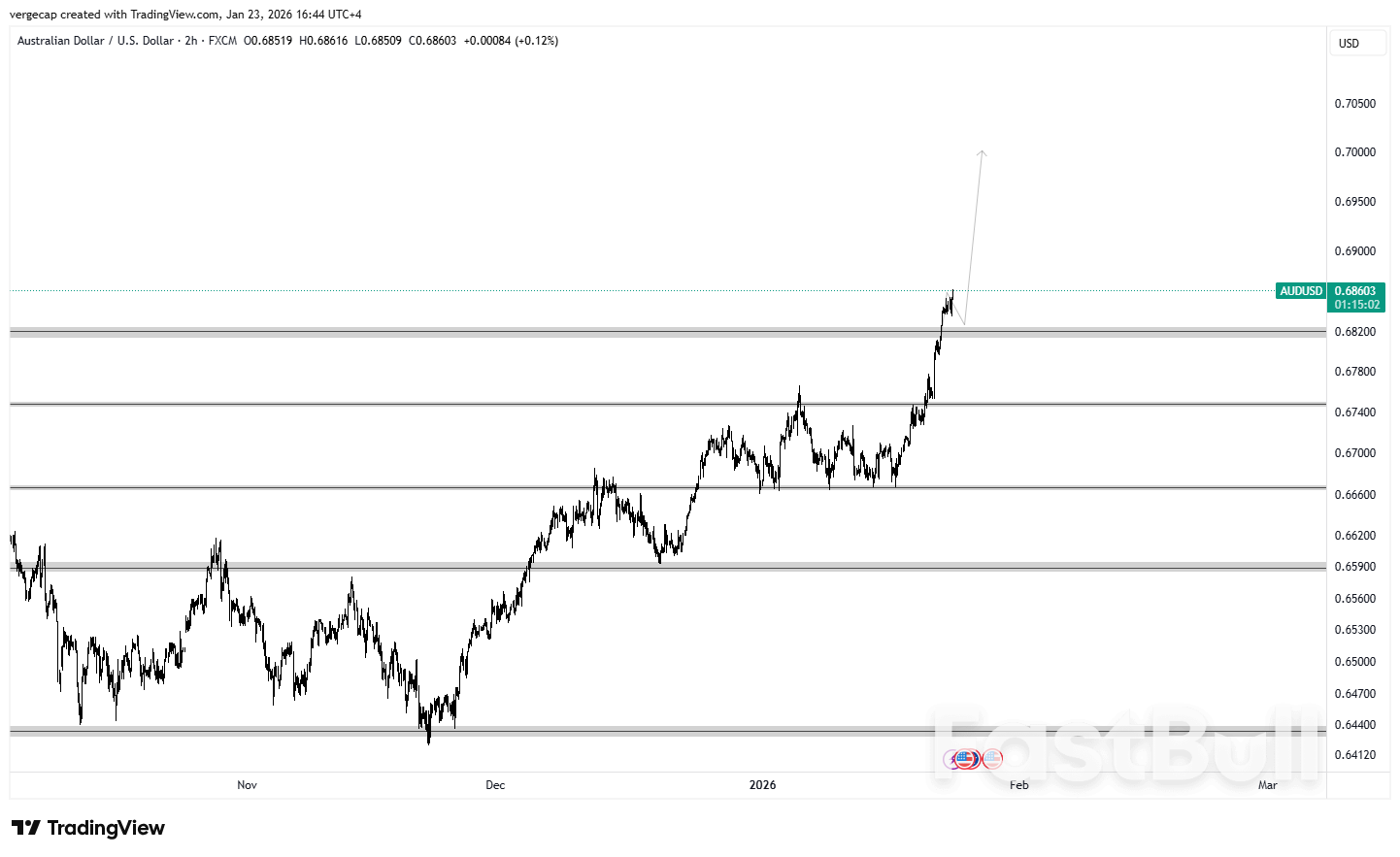
          From a technical perspective, AUDUSD is trading within a consolidative pattern following a recent bullish push. On the 2-hour chart, price is currently holding near session highs after testing support near 0.68509 and rebounding. The pair is pressing against recent resistance around the 0.68616 level, with the current close at 0.68603 reflecting slight bullish momentum on the session (+0.12%).
          The broader structure shows price action consolidating between the November lows and the late December/early 2026 highs, suggesting a period of equilibrium before the next directional move. Key support is now situated near the day’s low around 0.68509, which coincides with recent swing lows and represents immediate downside protection. A decisive break below this level would likely target the deeper support zone near 0.68000–0.68100, where previous consolidation occurred and which aligns with the psychological 0.6800 handle.
          On the upside, a sustained move above today’s high of 0.68616 is needed to reactivate bullish momentum. Such a breakout would shift focus toward the 0.6900 psychological barrier, a key level that could attract further buying interest and open a path toward the late 2026 highs near 0.6950–0.6970.
          Momentum signals are neutral to slightly positive. The small positive daily candle and rejection from the day’s lows suggest underlying buying interest, but follow-through above immediate resistance is required to confirm strength.
          TRADE RECOMMENDATION
          BUY AUDUSD
          ENTRY PRICE: 0.68650
          STOP LOSS: 0.68200
          TAKE PROFIT: 0.6970
          Risk Warnings and Disclaimers
          You understand and acknowledge that there is a high degree of risk involved in trading. Following any strategies or investment methods may lead to potential losses. The content on the site is provided by our contributors and analysts for information purposes only. You are solely responsible for determining whether any trading assets, securities, strategy, or any other product is suitable for investing based on your own investment objectives and financial situation.
          Add to Favorites
          Share

          Gold Rallies on Geopolitical Tensions, Eases After Record Spike

          Warren Takunda

          Traders' Opinions

          Summary:

          Gold eased slightly after hitting a record intraday high near $4,967, as traders booked profits, but remains on track for a third weekly gain. The rally is supported by safe-haven demand amid geopolitical tensions, a softer US Dollar, and structural factors like central bank diversification and elevated global debt, keeping momentum firmly bullish

          BUY XAUUSD
          Close Time
          CLOSED

          4934.96

          Entry Price

          5050.00

          TP

          4860.00

          SL

          5258.96 +80.38 +1.55%

          348.1

          Pips

          Profit

          4860.00

          SL

          4969.77

          Exit Price

          4934.96

          Entry Price

          5050.00

          TP

          Gold prices eased modestly on Friday, paring a fraction of recent gains as traders booked profits following a powerful rally that propelled the metal to a fresh all-time high earlier in the session. Spot gold (XAU/USD) slipped back toward the $4,930 level after briefly surging to an intraday record near $4,967 during Asian trading, yet remained firmly on track for a third consecutive weekly gain.
          Despite the mild pullback, bullion’s broader momentum remains decisively bullish. Gold is up more than 7% on the week, reflecting a sharp escalation in safe-haven demand amid renewed geopolitical uncertainty and persistent concerns over the durability of US economic and political stability. The recent advance has been underpinned by a combination of resurgent “Sell America” sentiment, a softer US Dollar, and heightened investor demand for assets perceived as insulated from geopolitical risk.
          The latest catalyst came from renewed trade rhetoric by US President Donald Trump, particularly surrounding the long-running Greenland dispute. Trump’s comments unsettled global markets earlier in the week, reviving fears of an escalation in trade tensions between the United States and Europe. The remarks sparked renewed doubts about the trajectory of global trade relations and reinforced concerns that US foreign policy volatility could weigh on growth prospects, capital flows, and risk appetite.
          Those fears initially sent the US Dollar lower, amplifying gold’s appeal as an alternative store of value. In periods of geopolitical stress and currency uncertainty, gold tends to benefit as investors seek diversification away from dollar-denominated assets, and this episode has been no exception.
          While some of those tensions appeared to ease midweek—after Trump stepped back from earlier threats to impose tariffs on several European nations following the announcement of a future-framework agreement on Greenland—the relief proved short-lived. Market participants remained skeptical, noting that the framework agreement lacked concrete policy commitments or enforcement mechanisms, leaving ample room for renewed friction.
          As a result, gold’s rally showed little sign of losing momentum. Investors appear unconvinced that the underlying risks have been meaningfully resolved, especially against a backdrop of broader geopolitical uncertainty, ongoing conflicts, and persistent questions around the global economic outlook. For many, the recent dip in prices represents consolidation rather than a trend reversal, with the metal continuing to trade near historically elevated levels.
          Beyond geopolitics, structural factors are also supporting gold’s strength. Central bank diversification away from the US Dollar, elevated global debt levels, and lingering concerns about long-term fiscal sustainability in major economies have reinforced gold’s role as a strategic hedge. Even as short-term profit-taking emerges after sharp rallies, underlying demand remains resilient, limiting the depth of pullbacks.

          Technical AnalysisGold Rallies on Geopolitical Tensions, Eases After Record Spike_1

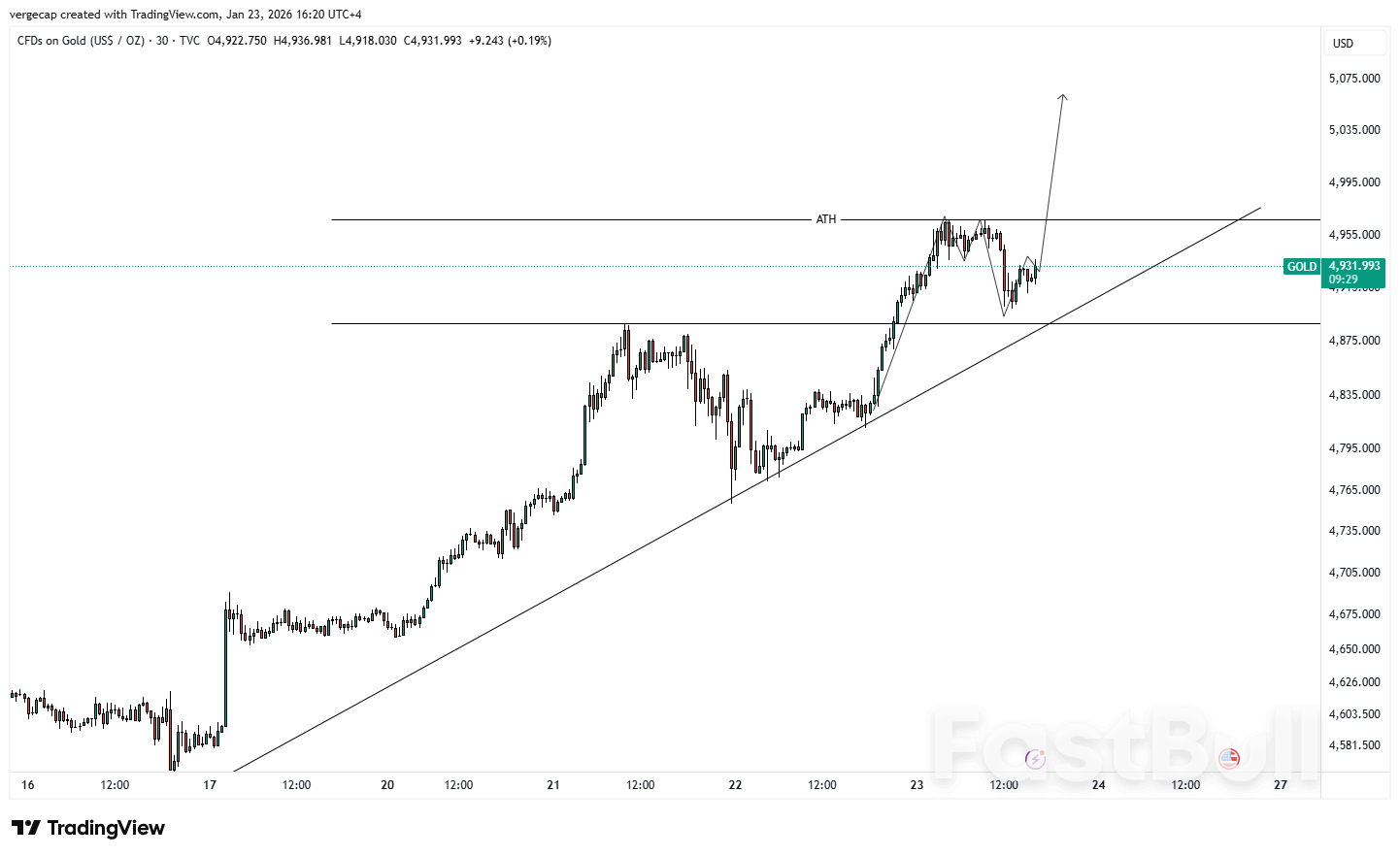
          From a technical perspective, gold remains firmly embedded in a well-defined bullish structure, with recent price action suggesting consolidation rather than trend exhaustion. On the 30-minute chart, prices continue to trade within a rising trend channel, supported by a series of higher highs and higher lows that have been in place since mid-January. The broader structure remains constructive, underpinned by a clearly ascending trendline that has repeatedly attracted dip-buyers.
          After posting a fresh all-time high (ATH) near the 4,960–4,970 region, gold entered a shallow corrective phase, pulling back toward the mid-range of the rising structure. This retracement has so far been orderly and corrective in nature, with price action respecting trend support rather than breaking down impulsively. The current rebound from the recent swing low reinforces the view that buyers remain in control on dips.
          The 21-period Simple Moving Average (SMA) on the intraday timeframe is acting as near-term dynamic resistance, briefly capping upside attempts as momentum cools. However, this has not materially altered the bullish outlook. More importantly, the 50-period SMA, which continues to slope higher, aligns closely with the rising trendline and represents a more critical layer of dynamic support. As long as gold remains above this confluence zone, the prevailing uptrend remains intact.
          On the downside, a decisive break below the ascending trendline, particularly if accompanied by sustained trading below the 4,880–4,900 support zone, would signal a deterioration in market structure and open the door for a deeper corrective move. In such a scenario, downside targets would likely extend toward the 4,820–4,840 region, where prior consolidation and demand were observed. A sustained move below that area would suggest a more pronounced trend correction rather than a routine pullback.
          On the upside, bullish attention remains firmly fixed on a clean break and sustained hold above the previous ATH region near 4,960–4,970. A decisive push through this resistance would likely re-ignite momentum buying and confirm trend continuation, exposing the 5,050–5,100 psychological zone as the next upside target. Given the strength of the broader trend, a breakout above ATH could attract both momentum-driven and longer-term positioning.
          Momentum indicators are consistent with consolidation rather than exhaustion. The Relative Strength Index (RSI) has cooled from overbought territory and is holding in positive ground, suggesting that bullish momentum is resetting rather than reversing. This reduces the risk of an aggressive downside move and supports the case for continued sideways-to-higher price action. Meanwhile, the Moving Average Convergence Divergence (MACD) remains above the zero line but has flattened, indicating slowing upside momentum and reinforcing expectations for near-term consolidation before the next directional leg higher.
          Overall, the technical setup continues to favor a buy-on-dips approach, with gold’s broader uptrend remaining intact as long as key trend support levels hold.
          TRADE RECOMMENDATION
          BUY GOLD
          ENTRY PRICE: 4,935
          STOP LOSS: 4,860
          TAKE PROFIT: 5,050
          Risk Warnings and Disclaimers
          You understand and acknowledge that there is a high degree of risk involved in trading. Following any strategies or investment methods may lead to potential losses. The content on the site is provided by our contributors and analysts for information purposes only. You are solely responsible for determining whether any trading assets, securities, strategy, or any other product is suitable for investing based on your own investment objectives and financial situation.
          Add to Favorites
          Share

          Pound Sterling Rallies as UK Data Defies Growth Fears, Forcing Markets to Rethink BoE Rate-Cut Expectations

          Warren Takunda

          Traders' Opinions

          Summary:

          Pound Sterling surged after strong UK PMI and Retail Sales data reduced expectations for near-term BoE rate cuts, while silver’s powerful rally remains intact despite signs of short-term consolidation.

          BUY GBPUSD
          EXP
          PENDING

          1.35200

          Entry Price

          1.37000

          TP

          1.34200

          SL

          1.38085 -0.00384 -0.28%

          --

          Pips

          PENDING

          1.34200

          SL

          Exit Price

          1.35200

          Entry Price

          1.37000

          TP

          The Pound Sterling extended its advance against major currency peers, surging to near 1.3536 against the US Dollar, after a string of stronger-than-expected UK economic releases reinforced the view that the British economy is entering 2026 with more momentum than previously assumed. Upbeat flash S&P Global Purchasing Managers’ Index (PMI) data for January, alongside a surprise rebound in December Retail Sales, helped Sterling outperform as investors pared back expectations for near-term interest rate cuts by the Bank of England.
          The PMI figures delivered one of the clearest signals yet that activity across the UK economy is accelerating rather than stagnating. According to S&P Global, overall business output expanded at its fastest pace in several months, supported by a broad-based improvement across both the manufacturing and services sectors. The Composite PMI climbed sharply to 53.9 in January, up from 51.4 in December and well above market expectations of 51.7, placing the index firmly in expansionary territory.
          The services sector, which accounts for the bulk of UK economic output, led the advance. The Services PMI jumped to 54.3, significantly outperforming forecasts of 51.7 and improving from the prior reading of 51.4. Survey respondents cited stronger domestic demand, improving order books and greater business confidence at the start of the year. Importantly, firms also reported a pickup in pricing power, a development that could keep inflation pressures elevated and complicate the Bank of England’s policy calculus.
          Manufacturing activity also showed meaningful improvement. The Manufacturing PMI rose to 51.6 from 50.6, moving further above the stagnation line and signaling that the sector is beginning to recover after months of subdued output. While manufacturers continued to face cost pressures and uneven global demand, the return to expansion added to the narrative that the UK economy is stabilizing more convincingly than many had feared late last year.
          That optimism was reinforced by the latest Retail Sales figures from the Office for National Statistics (ONS). After contracting for two consecutive months, retail sales volumes rose by 0.4% month-on-month in December, confounding expectations for a 0.1% decline. On an annual basis, sales surged 2.5%, sharply beating the consensus forecast of a modest 1% increase and accelerating from November’s upwardly revised 1.8%.
          The strength of the retail data suggests that UK consumers are proving more resilient in the face of elevated interest rates and lingering cost-of-living pressures. From a market perspective, this resilience matters because it reduces the urgency for the Bank of England to pivot aggressively toward easing. As a result, bets on early and rapid interest rate cuts have been trimmed, providing further support to Sterling.
          Looking ahead, the UK economic calendar is relatively light next week, leaving market sentiment and expectations surrounding the Bank of England’s February policy meeting as the primary drivers for the Pound. With data momentum improving and inflation risks still present, policymakers may find it difficult to justify a near-term dovish shift, a dynamic that could keep Sterling supported against both the Dollar and the Euro.

          Technical AnalysisPound Sterling Rallies as UK Data Defies Growth Fears, Forcing Markets to Rethink BoE Rate-Cut Expectations_1

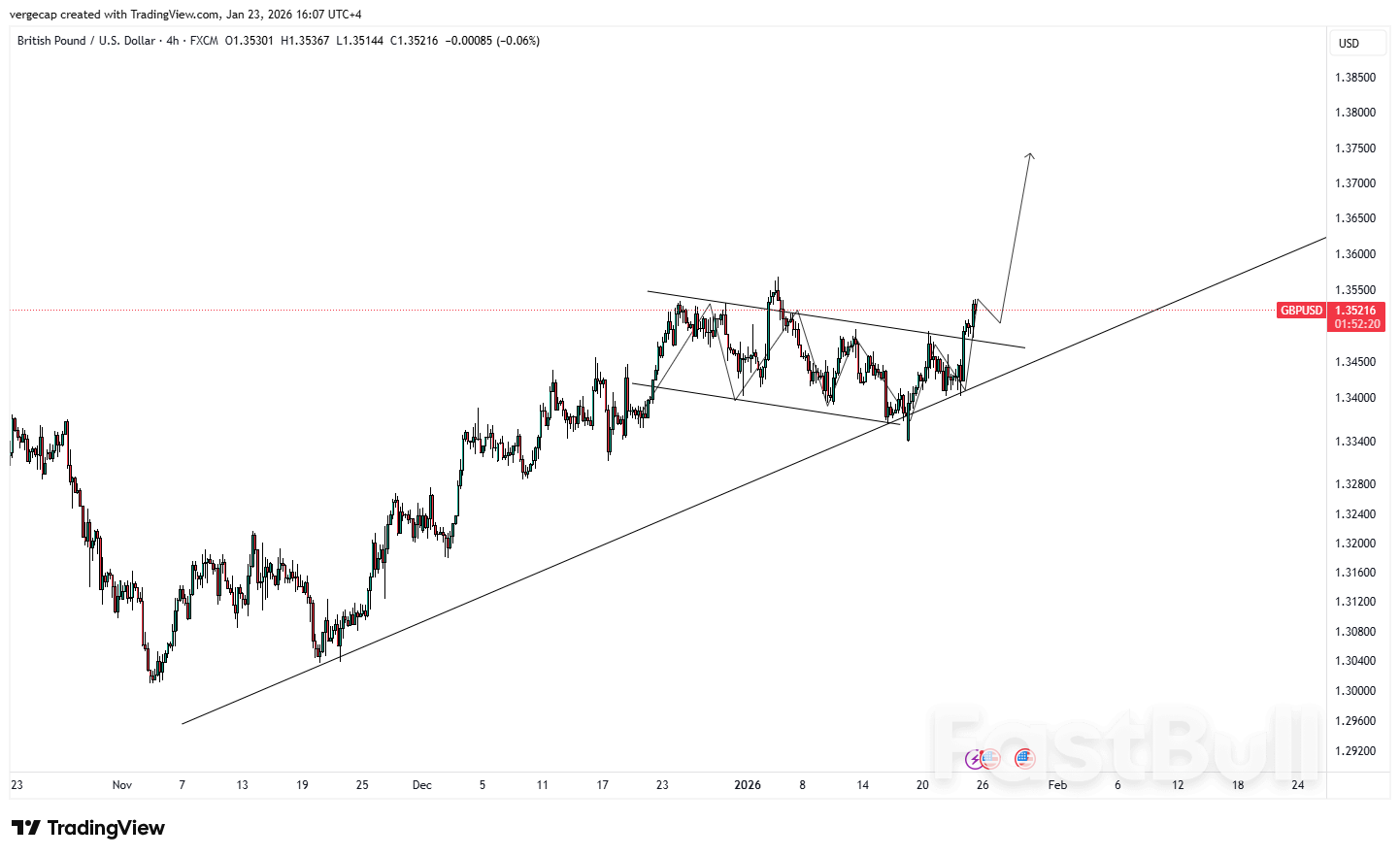
          From a technical perspective, GBP/USD remains positioned within a broader bullish structure, with recent price action suggesting a continuation of the medium-term uptrend despite near-term consolidation. On the 4-hour chart, the pair is trading within a rising trend channel, underpinned by a clearly defined ascending trendline that has consistently supported higher lows since mid-November.
          Price has recently broken above a descending consolidation pattern, which had developed after the early-January peak, signaling a resumption of bullish momentum. The pair is now trading around the 1.3515–1.3535 region, an area that previously acted as resistance and is in the process of being retested as potential support. This breakout-and-retest dynamic reinforces the constructive technical outlook, provided prices remain above this zone.
          The 21-period Simple Moving Average (SMA) on the 4-hour timeframe is beginning to turn higher and is closely aligned with current price action, offering near-term dynamic support. Meanwhile, the 50-period SMA, which continues to slope upward, sits lower within the structure and represents a more critical support layer. As long as GBP/USD holds above this rising average, the broader bullish bias remains intact.
          On the downside, a decisive break below the ascending trendline, coupled with sustained trading below the 1.3450 handle, would weaken the bullish setup and suggest that momentum is fading. Such a move could expose the 1.3380–1.3400 support zone, where prior consolidation and demand emerged earlier in January. A deeper breakdown below that region would shift the technical narrative toward a more extended corrective phase, potentially targeting the 1.3300 psychological level.
          On the upside, bulls remain focused on a clean and sustained break above the 1.3550–1.3600 resistance zone, which marks the upper boundary of recent price congestion. A confirmed push beyond this area would likely attract fresh momentum buying and open the door for a continuation toward 1.3700, with scope for further gains toward 1.3800 if macro and rate expectations continue to favor Sterling.
          Momentum indicators align with a constructive but cautious outlook. The Relative Strength Index (RSI) is holding in positive territory and has rebounded from neutral levels, suggesting renewed buying interest without signaling overbought conditions. This supports the case for further upside while limiting the immediate risk of a sharp reversal. Meanwhile, the MACD remains above the zero line, with momentum turning higher after a brief flattening phase, indicating that bullish momentum is stabilizing rather than deteriorating.

          TRADE RECOMMENDATION

          BUY GBP/USD
          ENTRY PRICE: 1.3520
          STOP LOSS: 1.3420
          TAKE PROFIT: 1.3700
          Risk Warnings and Disclaimers
          You understand and acknowledge that there is a high degree of risk involved in trading. Following any strategies or investment methods may lead to potential losses. The content on the site is provided by our contributors and analysts for information purposes only. You are solely responsible for determining whether any trading assets, securities, strategy, or any other product is suitable for investing based on your own investment objectives and financial situation.
          Add to Favorites
          Share
          FastBull
          Copyright © 2026 FastBull Ltd

          728 RM B 7/F GEE LOK IND BLDG NO 34 HUNG TO RD KWUN TONG KLN HONG KONG

          TelegramInstagramTwitterfacebooklinkedin
          App Store Google Play Google Play
          Products
          Charts

          Chats

          Q&A with Experts
          Screeners
          Economic Calendar
          Data
          Tools
          Membership
          Features
          Function
          Markets
          Copy Trading
          Latest Signals
          Contests
          News
          Analysis
          24/7
          Columns
          Education
          Company
          Careers
          About Us
          Contact Us
          Advertising
          Help Center
          Feedback
          User Agreement
          Privacy Policy
          Personal Information Protection Statement
          Business

          White Label

          Data API

          Web Plug-ins

          Poster Maker

          Affiliate Program

          Risk Disclosure

          The risk of loss in trading financial instruments such as stocks, FX, commodities, futures, bonds, ETFs and crypto can be substantial. You may sustain a total loss of the funds that you deposit with your broker. Therefore, you should carefully consider whether such trading is suitable for you in light of your circumstances and financial resources.

          No decision to invest should be made without thoroughly conducting due diligence by yourself or consulting with your financial advisors. Our web content might not suit you since we don't know your financial conditions and investment needs. Our financial information might have latency or contain inaccuracy, so you should be fully responsible for any of your trading and investment decisions. The company will not be responsible for your capital loss.

          Without getting permission from the website, you are not allowed to copy the website's graphics, texts, or trademarks. Intellectual property rights in the content or data incorporated into this website belong to its providers and exchange merchants.

          Not Logged In

          Log in to access more features

          Connect Broker
          Become a signal provider
          Help Center
          Customer Service
          Dark Mode
          Price Up/Down Colors

          Log In

          Sign Up
          Position
          Layout
          Fullscreen
          Default to Chart
          The chart page opens by default when you visit fastbull.com