• Trade
  • Markets
  • Copy
  • Contests
  • News
  • 24/7
  • Calendar
  • Q&A
  • Chats
Trending
Screeners
SYMBOL
LAST
BID
ASK
HIGH
LOW
NET CHG.
%CHG.
SPREAD
SPX
S&P 500 Index
6870.39
6870.39
6870.39
6895.79
6858.28
+13.27
+ 0.19%
--
DJI
Dow Jones Industrial Average
47954.98
47954.98
47954.98
48133.54
47871.51
+104.05
+ 0.22%
--
IXIC
NASDAQ Composite Index
23578.12
23578.12
23578.12
23680.03
23506.00
+72.99
+ 0.31%
--
USDX
US Dollar Index
98.950
99.030
98.950
99.060
98.740
-0.030
-0.03%
--
EURUSD
Euro / US Dollar
1.16426
1.16443
1.16426
1.16715
1.16277
-0.00019
-0.02%
--
GBPUSD
Pound Sterling / US Dollar
1.33312
1.33342
1.33312
1.33622
1.33159
+0.00041
+ 0.03%
--
XAUUSD
Gold / US Dollar
4197.91
4197.91
4197.91
4259.16
4191.87
-9.26
-0.22%
--
WTI
Light Sweet Crude Oil
59.809
60.061
59.809
60.236
59.187
+0.426
+ 0.72%
--

Community Accounts

Signal Accounts
--
Profit Accounts
--
Loss Accounts
--
View More

Become a signal provider

Sell trading signals to earn additional income

View More

Guide to Copy Trading

Get started with ease and confidence

View More

Signal Accounts for Members

All Signal Accounts

Best Return
  • Best Return
  • Best P/L
  • Best MDD
Past 1W
  • Past 1W
  • Past 1M
  • Past 1Y

All Contests

  • All
  • Trump Updates
  • Recommend
  • Stocks
  • Cryptocurrencies
  • Central Banks
  • Featured News
Top News Only
Share

Government Spokesperson: Fourteen Arrested Over Benin Coup Attempt

Share

French President Macron: Nigeria Seeks French Help To Combat Insecurity

Share

Industry Source: EU Commission May Announce Package To Support Auto Industry On December 16

Share

Israel Foreign Currency Reserves $231.425 Billion In November Versus$231.954 Billion In October -Bank Of Israel

Share

[Moodeng Surges Over 43% In The Last 24 Hours, With A Current Market Cap Of $104 Million.] December 7Th, According To Gmgn Market Data, The Solana-Based Meme Coin Moodeng Surged Over 43% In The Past 24 Hours, With A Market Capitalization Currently Standing At 104 Million USD

Share

Jerusalem-German Chancellor Merz: We Have Not Discussed A Visit To Germany By Israeli Prime Minister Benjamin Netanyahu, Not An Issue At The Moment

Share

Israeli Prime Minister Netanyahu: We're Close To The Second Phase Of Trump's Gaza Plan

Share

West Africa's ECOWAS Bloc: 'Strongly Condemns' Attempted Military Coup In Benin

Share

Israeli Prime Minister Netanyahu: Political Annexation Of The West Bank Remains A Subject Of Discussion

Share

Israeli Prime Minister Netanyahu: Sovereign Power Of Security From The Jordan River To The Mediterranean Will Always Remain In Israel's Hands

Share

Israeli Prime Minister Netanyahu: We Believe There Is A Path To A Workable Peace With Our Palestinian Neighbors

Share

Israeli Prime Minister Netanyahu: I Will Meet Trump This Month

Share

Egypt's Net Foreign Reserves Rise To $50.216 Billion In November From $50.071 Billion In October

Share

Uganda Opposition Candidate Says He Was Beaten By Security Forces

Share

Benin's Foreign Minister Bakari:Large Part Of The Army And National Guard Still Loyalist And Are Controlling The Situation

Share

Russian Defence Ministry: Russian Troops Complete Capture Of Rivne In Ukraine's Donetsk Region

Share

Russian Defence Ministry: Russian Troops Carried Out Group Strike Overnight On Ukraine's Transport Infrastructure Facilities, Fuel And Energy Complexes, And Long-Range Drone Complexes

Share

Russian Defence Ministry: Russian Forces Capture Kucherivka In Ukraine's Kharkiv Region

Share

US Envoy Kellogg Says Ukraine Peace Deal Is Really Close

Share

US Embassy In India- US Under Secretary Of State For Political Affairs Allison Hooker Will Visit New Delhi And Bengaluru, India, From December 7 To 11

TIME
ACT
FCST
PREV
Euro Zone Employment YoY (SA) (Q3)

A:--

F: --

P: --

Euro Zone GDP Final YoY (Q3)

A:--

F: --

P: --

Euro Zone GDP Final QoQ (Q3)

A:--

F: --

P: --

Euro Zone Employment Final QoQ (SA) (Q3)

A:--

F: --

P: --

Euro Zone Employment Final (SA) (Q3)

A:--

F: --

P: --
Brazil PPI MoM (Oct)

A:--

F: --

P: --

Mexico Consumer Confidence Index (Nov)

A:--

F: --

P: --

Canada Unemployment Rate (SA) (Nov)

A:--

F: --

P: --

Canada Labor Force Participation Rate (SA) (Nov)

A:--

F: --

P: --

Canada Employment (SA) (Nov)

A:--

F: --

P: --

Canada Part-Time Employment (SA) (Nov)

A:--

F: --

P: --

Canada Full-time Employment (SA) (Nov)

A:--

F: --

P: --

U.S. Personal Income MoM (Sept)

A:--

F: --

P: --

U.S. PCE Price Index YoY (SA) (Sept)

A:--

F: --

P: --

U.S. PCE Price Index MoM (Sept)

A:--

F: --

P: --

U.S. Personal Outlays MoM (SA) (Sept)

A:--

F: --

P: --

U.S. Core PCE Price Index MoM (Sept)

A:--

F: --

P: --

U.S. Core PCE Price Index YoY (Sept)

A:--

F: --

P: --

U.S. UMich 5-Year-Ahead Inflation Expectations Prelim YoY (Dec)

A:--

F: --

P: --

U.S. Real Personal Consumption Expenditures MoM (Sept)

A:--

F: --

P: --

U.S. 5-10 Year-Ahead Inflation Expectations (Dec)

A:--

F: --

P: --

U.S. UMich Current Economic Conditions Index Prelim (Dec)

A:--

F: --

P: --

U.S. UMich Consumer Sentiment Index Prelim (Dec)

A:--

F: --

P: --

U.S. UMich 1-Year-Ahead Inflation Expectations Prelim (Dec)

A:--

F: --

P: --

U.S. UMich Consumer Expectations Index Prelim (Dec)

A:--

F: --

P: --

U.S. Weekly Total Rig Count

A:--

F: --

P: --

U.S. Weekly Total Oil Rig Count

A:--

F: --

P: --

U.S. Unit Labor Cost Prelim (SA) (Q3)

--

F: --

P: --

U.S. Consumer Credit (SA) (Oct)

A:--

F: --

P: --

China, Mainland Foreign Exchange Reserves (Nov)

A:--

F: --

P: --

China, Mainland Exports YoY (USD) (Nov)

--

F: --

P: --

China, Mainland Imports YoY (CNH) (Nov)

--

F: --

P: --

China, Mainland Imports YoY (USD) (Nov)

--

F: --

P: --

China, Mainland Imports (CNH) (Nov)

--

F: --

P: --

China, Mainland Trade Balance (CNH) (Nov)

--

F: --

P: --

China, Mainland Exports (Nov)

--

F: --

P: --

Japan Wages MoM (Oct)

--

F: --

P: --

Japan Trade Balance (Oct)

--

F: --

P: --

Japan Nominal GDP Revised QoQ (Q3)

--

F: --

P: --

Japan Trade Balance (Customs Data) (SA) (Oct)

--

F: --

P: --

Japan GDP Annualized QoQ Revised (Q3)

--

F: --

P: --
China, Mainland Exports YoY (CNH) (Nov)

--

F: --

P: --

China, Mainland Trade Balance (USD) (Nov)

--

F: --

P: --

Germany Industrial Output MoM (SA) (Oct)

--

F: --

P: --

Euro Zone Sentix Investor Confidence Index (Dec)

--

F: --

P: --

Canada Leading Index MoM (Nov)

--

F: --

P: --

Canada National Economic Confidence Index

--

F: --

P: --

U.S. Dallas Fed PCE Price Index YoY (Sept)

--

F: --

P: --

U.S. 3-Year Note Auction Yield

--

F: --

P: --

U.K. BRC Overall Retail Sales YoY (Nov)

--

F: --

P: --

U.K. BRC Like-For-Like Retail Sales YoY (Nov)

--

F: --

P: --

Australia Overnight (Borrowing) Key Rate

--

F: --

P: --

RBA Rate Statement
RBA Press Conference
Germany Exports MoM (SA) (Oct)

--

F: --

P: --

U.S. NFIB Small Business Optimism Index (SA) (Nov)

--

F: --

P: --

Mexico Core CPI YoY (Nov)

--

F: --

P: --

Mexico 12-Month Inflation (CPI) (Nov)

--

F: --

P: --

Mexico PPI YoY (Nov)

--

F: --

P: --

Mexico CPI YoY (Nov)

--

F: --

P: --

U.S. Weekly Redbook Index YoY

--

F: --

P: --

Q&A with Experts
    • All
    • Chatrooms
    • Groups
    • Friends
    Connecting
    .
    .
    .
    Type here...
    Add Symbol or Code

      No matching data

      All
      Trump Updates
      Recommend
      Stocks
      Cryptocurrencies
      Central Banks
      Featured News
      • All
      • Russia-Ukraine Conflict
      • Middle East Flashpoint
      • All
      • Russia-Ukraine Conflict
      • Middle East Flashpoint

      Search
      Products

      Charts Free Forever

      Chats Q&A with Experts
      Screeners Economic Calendar Data Tools
      Membership Features
      Data Warehouse Market Trends Institutional Data Policy Rates Macro

      Market Trends

      Market Sentiment Order Book Forex Correlations

      Top Indicators

      Charts Free Forever
      Markets

      News

      News Analysis 24/7 Columns Education
      From Institutions From Analysts
      Topics Columnists

      Latest Views

      Latest Views

      Trending Topics

      Top Columnists

      Latest Update

      Signals

      Copy Rankings Latest Signals Become a signal provider AI Rating
      Contests
      Brokers

      Overview Brokers Assessment Rankings Regulators News Claims
      Broker listing Forex Brokers Comparison Tool Live Spread Comparison Scam
      Q&A Complaint Scam Alert Videos Tips to Detect Scam
      More

      Business
      Events
      Careers About Us Advertising Help Center

      White Label

      Data API

      Web Plug-ins

      Affiliate Program

      Awards Institution Evaluation IB Seminar Salon Event Exhibition
      Vietnam Thailand Singapore Dubai
      Fans Party Investment Sharing Session
      FastBull Summit BrokersView Expo
      Recent Searches
        Top Searches
          Markets
          News
          Analysis
          User
          24/7
          Economic Calendar
          Education
          Data
          • Names
          • Latest
          • Prev

          View All

          No data

          Scan to Download

          Faster Charts, Chat Faster!

          Download App
          English
          • English
          • Español
          • العربية
          • Bahasa Indonesia
          • Bahasa Melayu
          • Tiếng Việt
          • ภาษาไทย
          • Français
          • Italiano
          • Türkçe
          • Русский язык
          • 简中
          • 繁中
          Open Account
          Search
          Products
          Charts Free Forever
          Markets
          News
          Signals

          Copy Rankings Latest Signals Become a signal provider AI Rating
          Contests
          Brokers

          Overview Brokers Assessment Rankings Regulators News Claims
          Broker listing Forex Brokers Comparison Tool Live Spread Comparison Scam
          Q&A Complaint Scam Alert Videos Tips to Detect Scam
          More

          Business
          Events
          Careers About Us Advertising Help Center

          White Label

          Data API

          Web Plug-ins

          Affiliate Program

          Awards Institution Evaluation IB Seminar Salon Event Exhibition
          Vietnam Thailand Singapore Dubai
          Fans Party Investment Sharing Session
          FastBull Summit BrokersView Expo

          Head and Shoulders Pattern Forms on Daily Chart, Downtrend Begins

          Alan

          Forex

          Summary:

          The U.S. and China have reached a trade agreement, driving U.S. Treasury yields higher and bolstering the U.S. dollar, further pressuring the euro exchange rate.

          SELL EURUSD
          Close Time
          CLOSED

          1.11099

          Entry Price

          1.07200

          TP

          1.12500

          SL

          1.16426 -0.00019 -0.02%

          140.1

          Pips

          Loss

          1.07200

          TP

          1.12500

          Exit Price

          1.11099

          Entry Price

          1.12500

          SL

          Fundamentals

          Today, the U.S. and China agreed on a phased trade deal, reducing tariffs on certain goods from 12.5% to normal levels. The agreement alleviates global supply chain pressures and lowers U.S. import-driven inflation risks, reinforcing the Fed’s stance on maintaining higher interest rates (market expectations now price in only 2.6 rate cuts by year-end). The 10-year Treasury yield remains steady at 4.38%, supporting dollar strength.
          Meanwhile, as U.S.-China tariff tensions ease, American demand for Chinese goods may partially replace European exports. Additionally, unresolved EU threats of retaliatory tariffs on U.S. goods (e.g., autos, steel) heighten risks of a widening eurozone trade deficit.

          Technical Analysis

          Head and Shoulders Pattern Forms on Daily Chart, Downtrend Begins_1
          On the daily chart, EURUSD has formed a head and shoulders pattern, with the neckline at 1.1280 breached, confirming downside momentum. The first target is a break below 1.0880.
          Head and Shoulders Pattern Forms on Daily Chart, Downtrend Begins_2
          On the 4-hour chart, price remains suppressed below the moving average (MA) system, with MAs in a clear bearish alignment, signaling strong short-term downside continuation.
          The MACD indicator shows the fast and slow lines maintaining a bearish crossover below the zero line, further validating the downtrend.
          Therefore, traders are advised to take short positions at high.

          Trading Recommendation

          Trading Direction: Sell
          Entry Price: 1.1100
          Target Price: 1.0720
          Stop Loss: 1.1250
          Valid Until: May 26, 2025, 23:00:00
          Support: 1.0880/1.0732
          Resistance: 1.1242/1.1280
          Risk Warnings and Disclaimers
          You understand and acknowledge that there is a high degree of risk involved in trading. Following any strategies or investment methods may lead to potential losses. The content on the site is provided by our contributors and analysts for information purposes only. You are solely responsible for determining whether any trading assets, securities, strategy, or any other product is suitable for investing based on your own investment objectives and financial situation.
          Add to Favorites
          Share

          Gold Crashes as U.S.-China Tariff Truce Sparks Risk Rally, Exposing Fragile Safe-Haven Demand

          Warren Takunda

          Economic

          Summary:

          Gold prices plunged over 3% on Monday as investors fled to riskier assets following a surprise U.S.-China agreement to dramatically slash tariffs for 90 days.

          SELL XAUUSD
          Close Time
          CLOSED

          3225.00

          Entry Price

          3100.00

          TP

          3300.00

          SL

          4197.91 -9.26 -0.22%

          336.2

          Pips

          Profit

          3100.00

          TP

          3191.38

          Exit Price

          3225.00

          Entry Price

          3300.00

          SL

          In a dramatic turn of events for the global financial markets, gold (XAU/USD) has suffered a sharp selloff, plunging more than 3% to around $3,210 in early European trading hours on Monday. The decline follows an unexpected thaw in U.S.-China trade tensions, where both countries agreed to drastically reduce tariffs on each other’s goods for a 90-day period—a move that ignited a broad-based risk rally across equities and commodities, while simultaneously triggering an exodus from traditional safe-haven assets.
          According to the terms announced late Sunday, China will lower its tariffs on U.S. imports from a steep 125% to just 10%, while the United States will reduce its tariffs on Chinese goods from 145% to 30%, effective immediately for the duration of the 90-day agreement. The announcement, hailed by some as a breakthrough in the protectionist standoff that has rattled markets for over a year, injected optimism into global economic outlooks and reignited appetite for risk.
          As a result, gold prices—once the beneficiary of geopolitical uncertainty and recession fears—have rapidly reversed course. Since peaking at an all-time high of $3,500 on April 21, gold has now lost over 8%, as traders rotate into equities, oil, and other growth-sensitive assets.
          Investor sentiment has shifted decisively. U.S. Treasury yields spiked, with the 10-year yield rising to 4.43%, the highest level in over a month. The surge in yields reflects not only a rotation out of bonds but also growing expectations that an improvement in trade flows may boost demand and rekindle inflation—factors that are typically bearish for non-yielding assets like gold.
          In commodity markets, oil surged more than 2% to $62.50, buoyed by expectations of increased global trade volumes and stronger energy demand. Equity markets joined the party, with Chinese stocks rallying over 1%, while U.S. equity futures gained between 2.5% and 3% ahead of Wall Street’s opening bell. European indices posted more modest gains, constrained by stronger currencies and profit-taking on recent rallies.
          Adding fuel to the rally, U.S. President Donald Trump signaled optimism on Friday, stating on his Truth Social platform that investors should “buy stocks now”, suggesting confidence in a positive outcome from the trade talks. His remarks were echoed by U.S. Treasury Secretary Scott Bessent, who downplayed fears of economic “decoupling” and hinted at a broader purchasing agreement, stating that “China must open its markets more to U.S. goods.”

          Technical AnalysisGold Crashes as U.S.-China Tariff Truce Sparks Risk Rally, Exposing Fragile Safe-Haven Demand_1

          From a technical standpoint, gold has entered a precarious phase. Monday’s breakdown marked a clear breach below the $3,250 support zone, which had previously acted as a consolidation floor. The EMA50 on the daily chart has turned lower, with prices now well beneath it, reinforcing bearish momentum.
          Additionally, the Relative Strength Index (RSI) has slipped further into negative territory, confirming the presence of continued downside pressure. Traders observed a rejection at the $3,264 level, where gold attempted but failed to reclaim a lower high within a descending trend channel.
          Unless bulls are able to swiftly reclaim the $3,264 resistance level and establish sustained momentum above it, the path of least resistance remains downward. Next key support is seen at $3,100, which also serves as a breakout target derived from the most recent failed reversal pattern.
          TRADE RECOMMENDATION
          SELL GOLD
          ENTRY PRICE: 3225
          STOP LOSS: 3300
          TAKE PROFIT: 3100
          Risk Warnings and Disclaimers
          You understand and acknowledge that there is a high degree of risk involved in trading. Following any strategies or investment methods may lead to potential losses. The content on the site is provided by our contributors and analysts for information purposes only. You are solely responsible for determining whether any trading assets, securities, strategy, or any other product is suitable for investing based on your own investment objectives and financial situation.
          Add to Favorites
          Share

          GBP/JPY Extends Rally to Four-Day Highs as US-China Trade Thaw Undermines Yen’s Safe-Haven Appeal

          Warren Takunda

          Economic

          Summary:

          The British Pound climbed against the Japanese Yen, buoyed by improved US-China trade relations and a cautiously dovish Bank of England, while the Yen weakened as demand for safe-haven assets ebbed.

          BUY GBPJPY
          Close Time
          CLOSED

          194.994

          Entry Price

          198.500

          TP

          192.000

          SL

          207.100 +0.404 +0.20%

          60.3

          Pips

          Loss

          192.000

          SL

          194.391

          Exit Price

          194.994

          Entry Price

          198.500

          TP

          The British Pound extended its rally against the Japanese Yen into a fourth consecutive session on Monday, with the currency pair GBP/JPY trading near 194.90 during European hours. A convergence of geopolitical optimism, diverging monetary policy expectations, and firm technical support continues to bolster the cross. The most notable driver this week is a reduction in safe-haven demand for the Yen after the United States and China issued a rare joint statement reaffirming their economic cooperation—a move that has triggered renewed risk appetite across financial markets.
          The gains in GBP/JPY mark a continuation of bullish momentum that began late last week, supported by both fundamental and technical factors. The Japanese Yen, traditionally a magnet for capital in times of uncertainty, weakened after U.S. Treasury Secretary Scott Bessent and Chinese Vice Premier Liu He concluded a high-level trade dialogue in Geneva. The talks resulted in a commitment to a 90-day tariff truce and a striking 115% reciprocal reduction in existing trade levies. While specific enforcement mechanisms remain vague, the tone of the meeting reflected a deliberate pivot away from confrontation and toward mutual economic benefit.
          "The path to trade normalization is never linear," Bessent remarked at the close of the summit, "but our respective economies—and the global economy—stand to gain significantly from sustained dialogue and practical de-escalation." U.S. Trade Representative Jamieson Greer echoed this sentiment, though he warned that lingering disputes, such as the fentanyl crisis, are far from resolved.
          These developments have reverberated across currency markets, undermining the Japanese Yen's haven appeal. A weakening Yen generally inflates GBP/JPY, and Monday's price action confirmed traders' willingness to pivot into risk-aligned pairs. However, the Yen’s downside may be limited in the near term due to resilient domestic macroeconomic data. Japan’s current account surplus rose to JPY 3.68 trillion in March, up from JPY 3.45 trillion a year earlier. The improvement was underpinned by a modest trade surplus of JPY 516.5 billion, driven by a 1.8% year-over-year rise in exports—evidence that external demand remains a bright spot for the Japanese economy.
          Meanwhile, the British Pound has found its own legs after the Bank of England (BoE) reaffirmed its measured approach to monetary easing last Thursday. While the central bank delivered a widely expected 25 basis point rate cut—bringing the benchmark rate to 4.25%—the internal division within the Monetary Policy Committee (MPC) hinted at a cautious outlook rather than an aggressive pivot. Notably, Catherine Mann and Chief Economist Huw Pill dissented, voting to keep rates unchanged. Their skepticism reflects ongoing concerns about domestic inflationary pressures.
          Speaking at an economic forum on Friday, Pill elaborated on his position: “While headline inflation has eased, underlying price dynamics suggest more persistence. We must be deliberate. The risks posed by external shocks—like recent tariff announcements—are being absorbed well by the UK economy so far.”
          Market participants took these comments as a signal that the BoE remains some distance away from a full-fledged easing cycle. As a result, interest rate differentials between the UK and Japan—where the Bank of Japan remains anchored near zero—have widened further, supporting the Pound against the Yen.

          Technical AnalysisGBP/JPY Extends Rally to Four-Day Highs as US-China Trade Thaw Undermines Yen’s Safe-Haven Appeal_1

          From a technical standpoint, GBP/JPY continues to signal upward momentum. The pair opened the week with a bullish price gap, breaking out above the key resistance level of 193.45, a former ceiling that had capped gains through April. Intraday moves saw price action comfortably exceed the 195.00 handle, suggesting bulls are firmly in control.
          Indicators such as the Relative Strength Index (RSI) and Moving Average Convergence Divergence (MACD) remain in bullish territory, while price structure shows a clear series of higher highs and higher lows. Analysts note that if GBP/JPY can sustain its current breakout, the next immediate resistance lies at 196.80, followed by a psychological barrier at 198.50.
          TRADE RECOMMENDATION
          BUY GBPJPY
          ENTRY PRICE: 195.00
          STOP LOSS: 192.00
          TAKE PROFIT: 198.50
          Risk Warnings and Disclaimers
          You understand and acknowledge that there is a high degree of risk involved in trading. Following any strategies or investment methods may lead to potential losses. The content on the site is provided by our contributors and analysts for information purposes only. You are solely responsible for determining whether any trading assets, securities, strategy, or any other product is suitable for investing based on your own investment objectives and financial situation.
          Add to Favorites
          Share

          Bullish Momentum Could Accelerate if Downtrend Line Breaks

          Manuel

          Central Bank

          Economic

          Summary:

          If USDJPY manages to break above its current descending trendline, this could pave the way for a bullish extension toward the 151.26 area.

          BUY USDJPY
          Close Time
          CLOSED

          145.269

          Entry Price

          151.250

          TP

          139.800

          SL

          155.345 +0.237 +0.15%

          328.5

          Pips

          Profit

          139.800

          SL

          148.554

          Exit Price

          145.269

          Entry Price

          151.250

          TP

          On Thursday, President Donald Trump described what he called a significant breakthrough in trade relations with the United Kingdom and hinted that tariffs on Chinese imports could be eased ahead of the next round of high-level negotiations between Washington and Beijing. Simultaneously, he reignited criticism of Federal Reserve Chair Jerome Powell, once again drawing attention to the ongoing tensions between the White House and the Fed regarding the direction of monetary policy.
          Despite sustained political pressure, the Federal Reserve held interest rates steady for a third consecutive meeting on Wednesday. The central bank cited heightened economic uncertainty as the primary reason for maintaining its cautious approach, pushing back against growing calls from the administration for further rate cuts.
          During the post-meeting press conference, Fed Chair Powell reaffirmed the Fed’s commitment to a data-driven strategy, emphasizing that the central bank will proceed with care as it evaluates the broader effects of trade developments on inflation, labor markets, and overall economic conditions. “There is no need to move hastily,” Powell noted, pointing to the unpredictable nature of international trade negotiations and their potential ripple effects on the domestic economy.
          “We cannot predict how this situation will play out,” Powell admitted, while emphasizing that economic uncertainty remains unusually high. He reassured markets that the Fed stands ready to act if conditions warrant a policy adjustment but reiterated that the current stance remains appropriate given the information currently available.
          The Federal Open Market Committee (FOMC) unanimously voted to maintain the federal funds rate within the 4.25% to 4.50% range—a level last seen in late 2024 following a full percentage point reduction implemented in the previous autumn. In its official statement, the central bank acknowledged that uncertainty had “further increased,” but also noted that the underlying pace of economic growth remains “solid,” even if distorted by volatility in trade-related data early in 2025.
          Meanwhile, wage data released earlier today in Japan showed a generally disappointing performance for March. Despite wage agreements with unions having exceeded 5% over the past two years, actual income growth continues to lag well behind those figures. Annual wage growth came in at just 2.1%—a figure that, while nearly double pre-pandemic levels, still reflects a continued erosion in real purchasing power due to persistently high inflation. As a result, real wages declined by a further 2.1% year-on-year in March, highlighting the strain on household finances.
          Minutes from the Bank of Japan’s March 19 meeting reinforced expectations that the central bank is unlikely to pursue an aggressive tightening path. One board member suggested that after a potential upcoming rate hike, the BoJ might need to shift from its current accommodative policy stance to a more neutral approach.
          Since that March meeting, the BoJ has further softened its hawkish tone. At its May 1 meeting, the central bank lowered its growth and inflation projections, signaling a more cautious outlook. The swaps market now reflects expectations of only one additional 25 basis point hike, which would bring the policy rate to 0.75% over the next two years.Bullish Momentum Could Accelerate if Downtrend Line Breaks_1

          Technical Analysis

          USDJPY recently failed to make a new lower low around the 140.00 area—a level last reached on April 22—indicating a possible loss of bearish momentum. Instead, the pair found renewed buying interest from this zone, which significantly reduces the likelihood of a sustained downtrend in the near term. If USDJPY manages to break above its current descending trendline, this could pave the way for a bullish extension toward the 151.26 area.
          The 100-period and 200-period moving averages are currently sitting at 150.46 and 149.56, respectively, aligning closely with a previously tested support zone. These levels may now act as the next upward targets should the pair confirm a breakout. Conversely, another test of recent lows—followed by a break beneath—would invalidate the bullish outlook and potentially trigger further downside pressure.
          Trading Recommendations
          Trading direction: Buy
          Entry price: 145.25
          Target price: 151.25
          Stop loss: 139.80
          Validity: May 21, 2025 15:00:00
          Risk Warnings and Disclaimers
          You understand and acknowledge that there is a high degree of risk involved in trading. Following any strategies or investment methods may lead to potential losses. The content on the site is provided by our contributors and analysts for information purposes only. You are solely responsible for determining whether any trading assets, securities, strategy, or any other product is suitable for investing based on your own investment objectives and financial situation.
          Add to Favorites
          Share

          EUR/USD Extends Decline Below Key Support as U.S. Economic Resilience and Trade Hopes Bolster Dollar

          Warren Takunda

          Economic

          Summary:

          The EUR/USD pair weakened further to trade near 1.1230 during Friday’s Asian session, under pressure from robust U.S. labor data and renewed optimism around U.S. trade engagements.

          SELL EURUSD
          Close Time
          CLOSED

          1.12600

          Entry Price

          1.10000

          TP

          1.14000

          SL

          1.16426 -0.00019 -0.02%

          152.4

          Pips

          Profit

          1.10000

          TP

          1.11076

          Exit Price

          1.12600

          Entry Price

          1.14000

          SL

          The euro faced intensified selling pressure during Friday's early trading hours in Asia, with the EUR/USD pair sliding to around 1.1230 as investors favored the U.S. Dollar amid a backdrop of strong American economic data and evolving trade headlines. The pair had initially trimmed some of its daily losses, but the move ultimately failed to hold as sentiment tilted more decisively in favor of the greenback.
          A key catalyst behind the dollar's outperformance was the latest release of U.S. jobless claims data, which surprised markets with a stronger-than-expected outcome. Initial jobless claims declined to 228,000 for the week ending May 3, down from the previous week’s unrevised reading of 241,000. While the four-week moving average nudged slightly higher to 226,000, the headline drop in weekly claims reinforced the narrative of a still-resilient labor market. Adding to this optimism was a decline in continuing jobless claims, which fell by 29,000 to 1.879 million, suggesting that Americans are still finding jobs relatively quickly, despite a murky global economic backdrop.
          The strength of the U.S. economy was not the only factor drawing investor attention. On the geopolitical front, President Donald Trump added a layer of intrigue by announcing what he described as a “major” trade deal with the United Kingdom. Despite the headline-grabbing language, financial markets reacted cautiously. A 10% tariff on select goods remains in place, which tempered enthusiasm and left traders wary of calling this a genuine turning point in the broader trade landscape. Nonetheless, the announcement injected a dose of optimism into dollar sentiment, especially as the United States also prepares for preliminary trade discussions with China this weekend in Switzerland.
          However, both Washington and Beijing appear to be keeping expectations in check. Trump’s rhetoric has remained combative, underscored by the recent appointment of a new U.S. envoy to Beijing. The U.S. President reiterated his administration's intention to limit tariff exemptions, stating explicitly that they are “not looking for so many exemptions.” This suggests that any progress made in the upcoming talks will likely be incremental at best, with neither side eager to compromise too quickly.
          Across the Atlantic, the euro is dealing with its own challenges. The single currency has struggled under the weight of increasingly dovish expectations from the European Central Bank. Policymakers have been sounding more cautious about the Eurozone’s growth outlook, even as they maintain the official line that inflation is expected to sustainably reach the 2% target by year-end. Despite this confidence, markets are now actively pricing in the possibility of an interest rate cut as soon as the ECB’s June meeting. That growing policy divergence between the ECB and the Federal Reserve — the former leaning toward easing while the latter remains data-dependent and broadly steady — is exerting persistent downward pressure on EUR/USD.
          Technical AnalysisEUR/USD Extends Decline Below Key Support as U.S. Economic Resilience and Trade Hopes Bolster Dollar_1
          From a technical standpoint, the euro’s decline is becoming more entrenched. The pair has broken below the key 1.1260 support level, a move that significantly weakens the short-term bullish structure and reinforces the prevailing bearish correction. This breach marks the breakdown of the most recent higher low at 1.1264, a level that had served as a crucial line of defense for euro bulls. The daily close below that threshold is widely viewed as a negative signal, confirming a shift in trend direction from bullish to bearish on the daily chart.
          Further compounding the euro’s troubles is the pair’s position relative to its 50-day exponential moving average, which it remains firmly beneath. The Relative Strength Index is also indicating continued weakness. While the RSI is currently situated in oversold territory, the lack of any sustained rebound suggests that positive momentum is not building.
          TRADE RECOMMENDATION
          SELL EURUSD
          ENTRY PRICE: 1.1260
          STOP LOSS: 1.1400
          TAKE PROFIT: 1.1000
          Risk Warnings and Disclaimers
          You understand and acknowledge that there is a high degree of risk involved in trading. Following any strategies or investment methods may lead to potential losses. The content on the site is provided by our contributors and analysts for information purposes only. You are solely responsible for determining whether any trading assets, securities, strategy, or any other product is suitable for investing based on your own investment objectives and financial situation.
          Add to Favorites
          Share

          Potential for a Deeper Pullback Builds After Triple Tap on Resistance

          Manuel

          Economic

          Central Bank

          Summary:

          This latest rejection coincides with a temporary easing of trade tensions, which could lend medium-term support to the U.S. dollar.

          SELL EURUSD
          EXP
          EXPIRED

          1.14200

          Entry Price

          1.09500

          TP

          1.16200

          SL

          1.16426 -0.00019 -0.02%

          --

          Pips

          EXPIRED

          1.09500

          TP

          1.13296

          Exit Price

          1.14200

          Entry Price

          1.16200

          SL

          The European Central Bank (ECB) appears firmly on course to deliver its eighth rate cut within a twelve-month period, marking its seventh consecutive reduction. This growing conviction among market participants reflects the belief that inflation in the euro area is gradually converging toward the ECB’s 2% target by the end of the year. In parallel, the possibility of further economic headwinds, especially due to tariffs imposed by U.S. President Donald Trump, has added to expectations that the central bank will continue loosening policy in the coming months to shield the fragile recovery.
          In recent weeks, several ECB policymakers have spoken publicly in favor of maintaining an accommodative approach, noting that inflation remains vulnerable to downside risks. Their statements reveal a strong consensus within the Governing Council to act preemptively rather than reactively, as the eurozone continues to navigate both structural weaknesses and external shocks. Against this backdrop, market speculation has intensified, with many analysts now expecting the ECB to deliver additional stimulus sooner rather than later to prevent deflationary pressures from becoming entrenched.
          Meanwhile, prospects for a near-term trade agreement between the United States and the European Union appear to have dimmed. Speaking during Tuesday’s European session, EU Trade Commissioner Maros Sefcovic emphasized that the bloc is actively strengthening its relationships with other trading partners—who collectively represent 87% of the EU’s exports—according to The Straits Times. When pressed about the status of U.S.-EU trade talks, Sefcovic reiterated the EU’s commitment to reaching a fair and balanced deal but pointed to Washington’s lack of meaningful engagement as a key obstacle to progress.
          Across the Atlantic, President Trump on Thursday described what he called a major breakthrough in trade relations with the United Kingdom and suggested that tariffs on Chinese goods might be eased ahead of the upcoming round of high-level U.S.-China negotiations. At the same time, he renewed his criticism of Federal Reserve Chair Jerome Powell, highlighting once again the friction between the White House and the central bank over monetary policy direction.
          Despite mounting political pressure, the Federal Reserve opted on Wednesday to leave interest rates unchanged for the third straight meeting. Citing growing economic uncertainty, the central bank maintained a cautious tone, pushing back against calls from the administration for more aggressive easing.
          Fed Chair Jerome Powell, during his press conference, underscored the central bank’s data-dependent approach, noting that policymakers intend to proceed with patience as they monitor the effects of trade policy on inflation and employment. “There is no need to act hastily,” Powell said, pointing to the unpredictable nature of ongoing trade negotiations and their potential macroeconomic implications.
          “We simply can’t forecast how this situation will evolve,” he acknowledged, while noting that the overall level of uncertainty remains unusually elevated. Powell reaffirmed that the Fed is prepared to respond as needed but stressed that the current stance remains appropriate given the available data.
          The Federal Open Market Committee (FOMC) voted unanimously to keep the federal funds rate within its target range of 4.25% to 4.50%—a level last established in late 2024 following a full percentage point reduction during the previous autumn. In its post-meeting statement, the Fed conceded that economic uncertainty had “increased further,” even as the underlying pace of growth remains “solid,” albeit distorted by volatility in net export data during early 2025.Potential for a Deeper Pullback Builds After Triple Tap on Resistance_1

          Technical Analysis

          EURUSD has recently tested the upper boundary of a rising resistance line for the third time, encountering renewed selling pressure at this level. This latest rejection coincides with a temporary easing of trade tensions, which could lend medium-term support to the U.S. dollar. If the local resistance around 1.1420 once again proves difficult to breach, the pair could be poised for a deeper pullback, with the next major support level situated near 1.0950.
          The 100-period and 200-period moving averages are currently located at 1.0723 and 1.0791, respectively, and have shown a sideways trend since the beginning of the year. This technical behavior suggests that price could be magnetized back toward this consolidation zone. Adding to this bearish setup, the daily Relative Strength Index (RSI) recently reached 77, signaling clear overbought conditions and potentially attracting dollar buyers seeking to rebalance.
          Notably, the 0.50 and 0.618 Fibonacci retracement levels lie just above these long-term moving averages, reinforcing the likelihood of a corrective move toward that zone. However, should EURUSD manage to post a new local high above current resistance, the bearish outlook would be invalidated, opening the door to a renewed upside extension.
          Trading Recommendations
          Trading direction: Sell
          Entry price: 1.1420
          Target price: 1.0950
          Stop loss: 1.1620
          Validity: May 21, 2025 15:00:00
          Risk Warnings and Disclaimers
          You understand and acknowledge that there is a high degree of risk involved in trading. Following any strategies or investment methods may lead to potential losses. The content on the site is provided by our contributors and analysts for information purposes only. You are solely responsible for determining whether any trading assets, securities, strategy, or any other product is suitable for investing based on your own investment objectives and financial situation.
          Add to Favorites
          Share

          Buy the Dip? EUR/JPY Slides but Euro Strength Remains Supported by Policy Fundamentals

          Warren Takunda

          Economic

          Summary:

          The EUR/JPY pair retreats from recent highs as traders assess central bank divergence, revived but fragile U.S.–China trade talks, and weak Japanese economic data. Market focus shifts to ECB’s Schnabel for forward guidance.

          BUY EURJPY
          Close Time
          CLOSED

          163.604

          Entry Price

          164.900

          TP

          162.500

          SL

          180.873 +0.273 +0.15%

          88.3

          Pips

          Profit

          162.500

          SL

          164.487

          Exit Price

          163.604

          Entry Price

          164.900

          TP
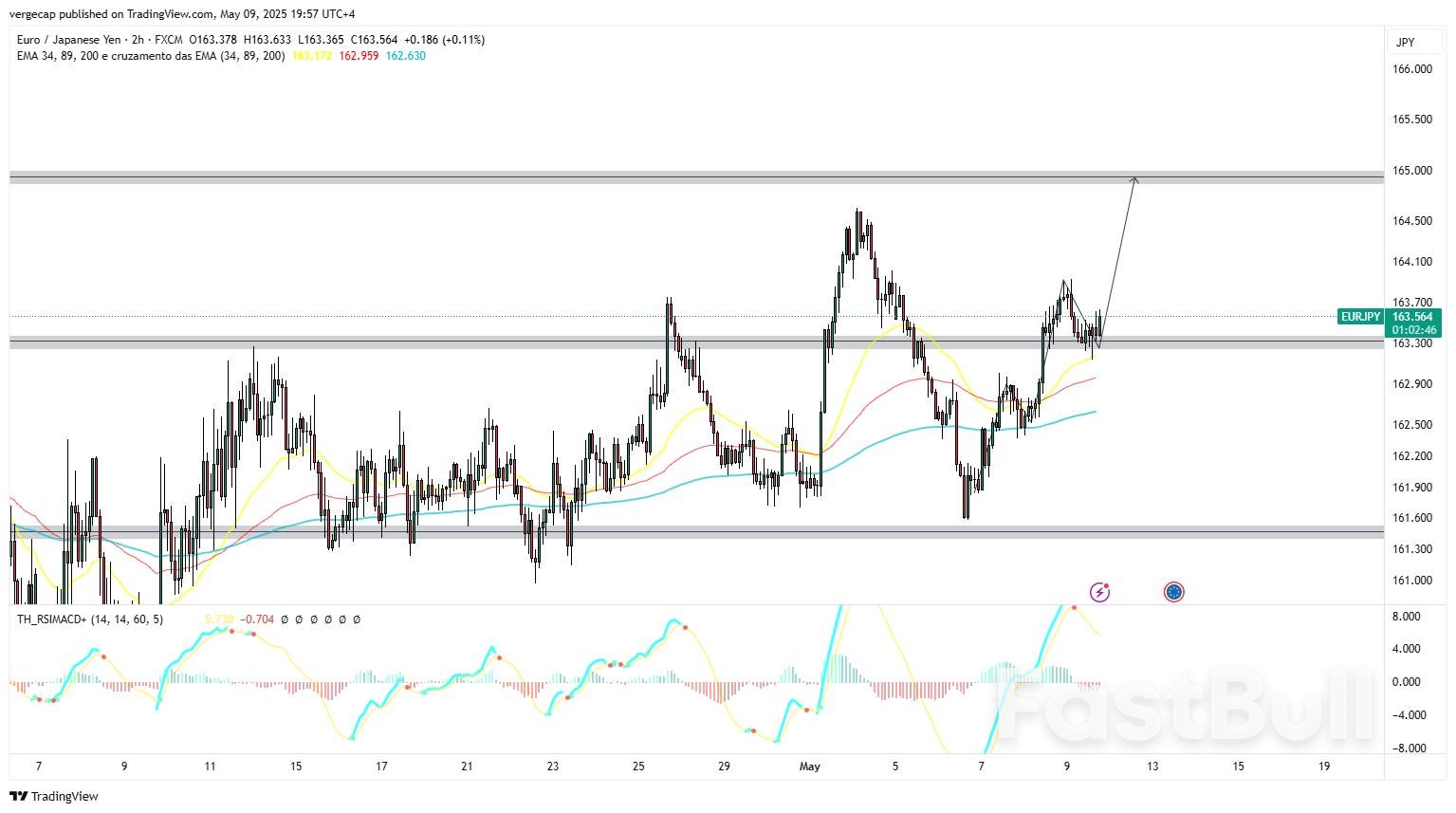
          The euro slipped against the Japanese yen on Friday, with the EUR/JPY pair trading around 163.45, down 0.20%, as risk sentiment cooled and market participants turned cautious ahead of a key speech by European Central Bank (ECB) policymaker Isabel Schnabel. The pullback comes after the pair briefly tested resistance at 163.94, only to reverse amid a convergence of geopolitical, monetary, and macroeconomic forces.
          While the broader trend for the euro remains supported by the stark monetary policy divergence between the ECB and the Bank of Japan (BoJ), near-term jitters over global trade tensions and soft Japanese data have tempered the bullish momentum. Markets are recalibrating expectations as the euro faces conflicting cues: hawkish ECB rhetoric on one hand, and growing global uncertainty on the other.
          A key driver of the broader risk mood this week has been the rekindled dialogue between the United States and China, with high-level trade negotiations set to take place in Switzerland this weekend. U.S. Treasury Secretary Scott Bessent and Trade Representative Jamieson Greer are scheduled to meet their Chinese counterparts—a development that initially boosted risk appetite and lent support to EUR/JPY's upside.
          However, that optimism was quickly diluted after former President Donald Trump—now a leading candidate in the upcoming election—muddied the waters by proposing an 80% tariff on Chinese imports, a proposal that, while lower than the current effective tariff rate of 145%, injects fresh uncertainty into an already fraught U.S.–China trade relationship.
          This tariff saber-rattling has pushed investors back into safe-haven assets like the Japanese yen, traditionally favored during times of heightened geopolitical uncertainty. Nonetheless, the yen’s gains have been modest, as its appeal continues to be undermined by the BoJ’s unwavering commitment to ultra-loose monetary policy.
          Investor caution is also being driven by the upcoming speech by Isabel Schnabel, a known hawk on the ECB Governing Council, who is set to speak at the Hoover Institution’s Monetary Policy Conference. Traders are watching closely for clues about the ECB’s rate path, particularly as the market gears up for a possible 25 basis point rate cut in June.
          Despite signs of a pivot, ECB officials have stressed that policy decisions remain data-dependent, and recent comments have suggested the central bank is not yet ready to declare victory over inflation. Any hawkish tone from Schnabel—especially against the backdrop of continued economic strength in parts of the euro area—could reignite euro bullishness and strengthen EUR/JPY in the medium term.
          By contrast, the Bank of Japan remains staunchly dovish. Governor Kazuo Ueda and his team have shown no urgency to tighten policy further after their historic March rate hike. With inflation still tepid and domestic consumption weak, Japanese officials have repeatedly emphasized patience, reinforcing the euro’s relative advantage.
          Friday’s Japanese data release offered little to bolster yen bulls. The Coincident Index, which tracks current economic conditions, declined to 116.0 from a revised 117.3, underscoring sluggish domestic momentum. Meanwhile, the Leading Economic Index came in at 107.7, a modest beat relative to expectations (107.5) but down from the previous reading of 108.2, suggesting a softening outlook for future activity.
          The weak print aligns with the broader narrative of Japan’s economic malaise, keeping pressure on the BoJ to maintain its easing bias. Inflation, wage growth, and business investment all remain tepid, and without a credible uptick in price pressures, the central bank is likely to remain sidelined for now.

          Technical AnalysisBuy the Dip? EUR/JPY Slides but Euro Strength Remains Supported by Policy Fundamentals_1

          From a technical perspective, EUR/JPY recently broke above the 163.25 barrier, climbing to a high of 163.90, but failed to sustain gains, encountering resistance just shy of 164.00. The pair is now consolidating below 163.50, with intraday support seen near 163.00 and a more critical base at 162.65.
          Should the Euro manage to defend this support zone and regain upside momentum, a bullish breakout toward 164.20 could be in play, with a potential retest of the key 164.90 resistance zone. However, failure to hold above 162.65 could signal a shift in short-term sentiment and expose the pair to deeper corrections.
          Momentum indicators remain mixed, suggesting that while the broader trend remains bullish due to monetary policy divergence, the pair may continue to trade sideways in the near term as markets await policy clarity.
          TRADE RECOMMENDATION
          BUY EURJPY
          ENTRY PRICE: 163.60
          STOP LOSS: 162.50
          TAKE PROFIT: 164.90
          Risk Warnings and Disclaimers
          You understand and acknowledge that there is a high degree of risk involved in trading. Following any strategies or investment methods may lead to potential losses. The content on the site is provided by our contributors and analysts for information purposes only. You are solely responsible for determining whether any trading assets, securities, strategy, or any other product is suitable for investing based on your own investment objectives and financial situation.
          Add to Favorites
          Share
          FastBull
          Copyright © 2025 FastBull Ltd

          728 RM B 7/F GEE LOK IND BLDG NO 34 HUNG TO RD KWUN TONG KLN HONG KONG

          TelegramInstagramTwitterfacebooklinkedin
          App Store Google Play Google Play
          Products
          Charts

          Chats

          Q&A with Experts
          Screeners
          Economic Calendar
          Data
          Tools
          Membership
          Features
          Function
          Markets
          Copy Trading
          Latest Signals
          Contests
          News
          Analysis
          24/7
          Columns
          Education
          Company
          Careers
          About Us
          Contact Us
          Advertising
          Help Center
          Feedback
          User Agreement
          Privacy Policy
          Business

          White Label

          Data API

          Web Plug-ins

          Poster Maker

          Affiliate Program

          Risk Disclosure

          The risk of loss in trading financial instruments such as stocks, FX, commodities, futures, bonds, ETFs and crypto can be substantial. You may sustain a total loss of the funds that you deposit with your broker. Therefore, you should carefully consider whether such trading is suitable for you in light of your circumstances and financial resources.

          No decision to invest should be made without thoroughly conducting due diligence by yourself or consulting with your financial advisors. Our web content might not suit you since we don't know your financial conditions and investment needs. Our financial information might have latency or contain inaccuracy, so you should be fully responsible for any of your trading and investment decisions. The company will not be responsible for your capital loss.

          Without getting permission from the website, you are not allowed to copy the website's graphics, texts, or trademarks. Intellectual property rights in the content or data incorporated into this website belong to its providers and exchange merchants.

          Not Logged In

          Log in to access more features

          FastBull Membership

          Not yet

          Purchase

          Become a signal provider
          Help Center
          Customer Service
          Dark Mode
          Price Up/Down Colors

          Log In

          Sign Up

          Position
          Layout
          Fullscreen
          Default to Chart
          The chart page opens by default when you visit fastbull.com