- USDX
- XAUUSD
- XAGUSD
- WTI


Markets
Analysis
User
24/7
Economic Calendar
Education
Data
- Names
- Latest
- Prev










The high leverage meaning is clear: it is a double-edged sword. Discover how this powerful trading tool transforms market volatility into profit—or ruin.
Understanding the high leverage meaning is crucial for anyone entering modern financial markets. It allows traders to control large positions with minimal upfront capital. This article breaks down the mechanics, regulatory limits, rewards, and significant risks of leveraged trading, equipping active investors with the knowledge to navigate margin effectively without blowing up their accounts.
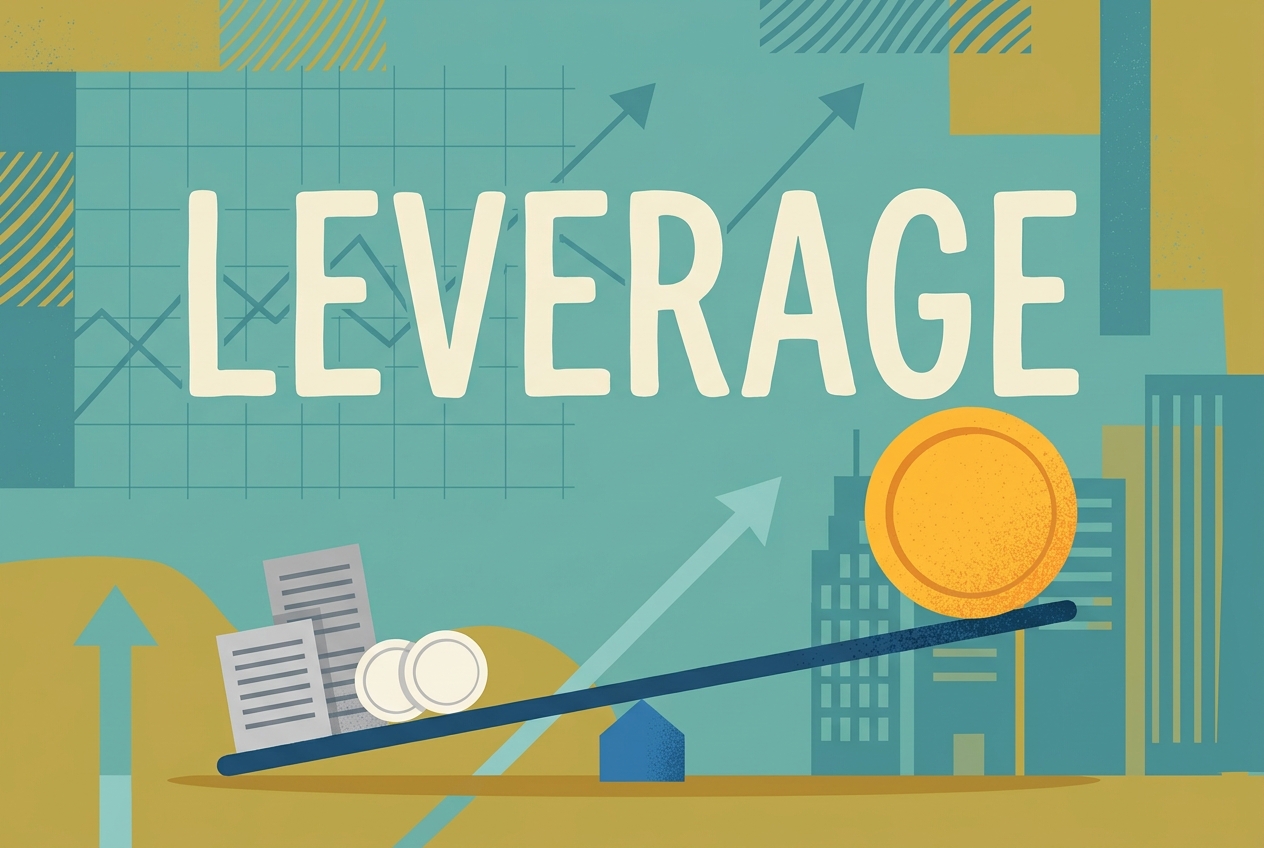
To understand how margin works, it helps to separate trading concepts from corporate finance. While the operating leverage formula measures a company's fixed costs against variable costs, and the financial leverage meaning generally relates to corporate debt structures, the leverage meaning in trading refers exclusively to purchasing power provided by a broker. It functions as a short-term credit line allowing you to execute larger trades.
When you open an account, your broker assigns a financial leverage ratio, such as 30:1 or 50:1. This multiplier dictates exactly how much market exposure you can take relative to your cash deposit.
Leverage works by using your actual cash balance as a "margin" or security deposit. If you want to buy $100,000 worth of the EUR/USD currency pair, you do not need $100,000 in cash.
If your broker provides a 50:1 leverage ratio, you only need to put up 2% of the total position size. In this scenario, a $2,000 deposit acts as the collateral required to control the entire $100,000 position. The broker essentially covers the remaining $98,000 while the trade is active.
Historically, retail brokers offered excessive leverage ratios, sometimes reaching 500:1 or 1000:1. Due to catastrophic retail losses, top-tier global regulators have since intervened to cap these multipliers.
Today, what is considered "high" depends entirely on your jurisdiction:
| Regulator / Jurisdiction | Major Forex Pairs | Minor Pairs & Gold | Cryptocurrencies |
|---|---|---|---|
| ESMA (Europe) & FCA (UK) | 30:1 | 20:1 | 2:1 |
| CFTC (United States) | 50:1 | 20:1 | N/A |
| Offshore (e.g., Vanuatu) | Up to 500:1+ | Up to 500:1+ | Varies |
The European Securities and Markets Authority (ESMA) and the UK's Financial Conduct Authority (FCA) limit major forex leverage to 30:1. Meanwhile, the Commodity Futures Trading Commission (CFTC) allows up to 50:1 for major pairs in the United States.
In highly liquid markets like foreign exchange, daily price fluctuations are minuscule, often moving by fractions of a cent. Without leverage, a 0.5% move in a currency pair would yield an insignificant return on a small cash deposit.
Leverage amplifies these microscopic price movements into meaningful nominal profits. If you control a $100,000 position with a $2,000 deposit, that same 0.5% market move generates a $500 profit. Relative to your initial $2,000 margin, that represents a 25% return on invested capital in a single trade.
High leverage democratizes market access for retail investors who lack six-figure cash balances. It allows smaller participants to execute institutional-style strategies without tying up all their liquidity.
By using margin, a trader with a $5,000 account can diversify across multiple positions—such as currencies, commodities, and indices—simultaneously. It improves capital efficiency, meaning your cash is not entirely locked into one single asset to see a worthwhile return.
The most dangerous aspect of leverage is its downside symmetry. While it multiplies your profits, it amplifies your losses at the exact same rate.
If you use 50:1 leverage to control a $100,000 position with $2,000, a mere 2% adverse market movement results in a $2,000 loss. In an instant, that small market fluctuation wipes out 100% of your invested margin.
A margin call occurs when your running losses deplete your account equity below the broker's minimum required threshold. When this happens, the broker will demand that you deposit more funds immediately to keep the position open.
If you fail to add funds, the broker will automatically liquidate your trades to protect themselves from liability. Under strict European regulations, ESMA enforces a 50% margin close-out rule. This means if your equity drops to half of your required margin, the platform will systematically close your losing positions.
Financial markets are prone to sudden volatility, economic news shocks, and flash crashes. In highly leveraged accounts, a sudden price gap can blow past your intended exit point before you can react.
Prior to regulatory interventions, these rapid crashes frequently caused traders to lose more than their initial deposits, leaving them in debt to their brokers. Today, regulators like ESMA and the FCA mandate "negative balance protection" to ensure retail clients cannot lose more than their account balance.
Statistical evidence paints a grim picture of high leverage in the hands of retail investors. Regulators require European and UK brokers to publish standardized risk warnings showing exact client loss rates.
Data aggregated from these public disclosures reveals that between 70% and 80% of retail CFD traders lose money. The primary driver of these losses is not poor directional guessing, but excessive leverage combined with inadequate risk management. Conversely, the FCA reported that introducing leverage caps saved UK retail consumers hundreds of millions of pounds annually.
High leverage makes sense for disciplined day traders trading highly liquid, low-volatility instruments like major forex pairs. These traders use tight stop-losses and capture small intraday trends without holding risk overnight.
It does not make sense for long-term investors or those trading highly volatile assets like individual stocks and cryptocurrencies. The wider price swings inherent to volatile markets will inevitably trigger a margin close-out if the position is heavily leveraged.
In corporate finance, executives analyze what is a good operating leverage and calculate their degree of operating leverage to understand how revenue changes impact corporate profits. In trading, your position sizing plays a similar role in protecting your equity.
Just because your broker offers 50:1 leverage does not mean you must utilize all of it on a single trade. Professional traders calculate their risk based on their total account balance, ensuring they never risk more than 1% to 2% of their total equity per trade, regardless of the maximum purchasing power available.
A strict stop-loss order is the ultimate defense against the dangers of margin trading. It acts as a predefined exit plan that automatically closes your position if the market moves against you by a specific amount.
By placing a hard stop-loss on every trade, you determine your maximum exact loss before you even enter the market. This guarantees that a sudden market reversal will automatically cut your losses long before a catastrophic margin call is triggered.
High leverage means borrowing capital from a broker to open trade positions that are significantly larger than your initial cash deposit. It acts as a multiplier, amplifying both your potential profits and your potential losses based on the ratio provided.
High leverage is a neutral tool that provides capital efficiency for disciplined, professional traders, but it is highly destructive for beginners. Regulatory statistics consistently show that the majority of retail traders lose money when using high leverage without strict risk management.
The primary risk is that a very small adverse price movement can quickly wipe out your entire deposited margin. In volatile market conditions, over-leveraged positions routinely trigger automatic margin close-outs, resulting in total account depletion.
Leverage scales your exposure so that returns are calculated on the total borrowed position size rather than your small initial deposit. For instance, with 50:1 leverage, a 2% market move in your favor doubles your margin, but a 2% move against you results in a 100% loss.
Grasping the high leverage meaning is the first step toward responsible market participation. While margin provides the buying power to capitalize on small market movements, regulatory data proves it carries extreme risks. By combining strict position sizing with disciplined stop-loss strategies, investors can harness leverage without exposing their accounts to catastrophic losses.

728 RM B 7/F GEE LOK IND BLDG NO 34 HUNG TO RD KWUN TONG KLN HONG KONG


The risk of loss in trading financial instruments such as stocks, FX, commodities, futures, bonds, ETFs and crypto can be substantial. You may sustain a total loss of the funds that you deposit with your broker. Therefore, you should carefully consider whether such trading is suitable for you in light of your circumstances and financial resources.
No decision to invest should be made without thoroughly conducting due diligence by yourself or consulting with your financial advisors. Our web content might not suit you since we don't know your financial conditions and investment needs. Our financial information might have latency or contain inaccuracy, so you should be fully responsible for any of your trading and investment decisions. The company will not be responsible for your capital loss.
Without getting permission from the website, you are not allowed to copy the website's graphics, texts, or trademarks. Intellectual property rights in the content or data incorporated into this website belong to its providers and exchange merchants.
Not Logged In
Log in to access more features


Log In
Sign Up