• Trade
  • Markets
  • Copy
  • Contests
  • News
  • 24/7
  • Calendar
  • Q&A
  • Chats
Trending
Screeners
SYMBOL
LAST
BID
ASK
HIGH
LOW
NET CHG.
%CHG.
SPREAD
SPX
S&P 500 Index
6870.39
6870.39
6870.39
6895.79
6858.28
+13.27
+ 0.19%
--
DJI
Dow Jones Industrial Average
47954.98
47954.98
47954.98
48133.54
47871.51
+104.05
+ 0.22%
--
IXIC
NASDAQ Composite Index
23578.12
23578.12
23578.12
23680.03
23506.00
+72.99
+ 0.31%
--
USDX
US Dollar Index
98.950
99.030
98.950
99.060
98.740
-0.030
-0.03%
--
EURUSD
Euro / US Dollar
1.16426
1.16443
1.16426
1.16715
1.16277
-0.00019
-0.02%
--
GBPUSD
Pound Sterling / US Dollar
1.33312
1.33342
1.33312
1.33622
1.33159
+0.00041
+ 0.03%
--
XAUUSD
Gold / US Dollar
4197.91
4197.91
4197.91
4259.16
4191.87
-9.26
-0.22%
--
WTI
Light Sweet Crude Oil
59.809
60.061
59.809
60.236
59.187
+0.426
+ 0.72%
--

Community Accounts

Signal Accounts
--
Profit Accounts
--
Loss Accounts
--
View More

Become a signal provider

Sell trading signals to earn additional income

View More

Guide to Copy Trading

Get started with ease and confidence

View More

Signal Accounts for Members

All Signal Accounts

Best Return
  • Best Return
  • Best P/L
  • Best MDD
Past 1W
  • Past 1W
  • Past 1M
  • Past 1Y

All Contests

  • All
  • Trump Updates
  • Recommend
  • Stocks
  • Cryptocurrencies
  • Central Banks
  • Featured News
Top News Only
Share

Government Spokesperson: Fourteen Arrested Over Benin Coup Attempt

Share

French President Macron: Nigeria Seeks French Help To Combat Insecurity

Share

Industry Source: EU Commission May Announce Package To Support Auto Industry On December 16

Share

Israel Foreign Currency Reserves $231.425 Billion In November Versus$231.954 Billion In October -Bank Of Israel

Share

[Moodeng Surges Over 43% In The Last 24 Hours, With A Current Market Cap Of $104 Million.] December 7Th, According To Gmgn Market Data, The Solana-Based Meme Coin Moodeng Surged Over 43% In The Past 24 Hours, With A Market Capitalization Currently Standing At 104 Million USD

Share

Jerusalem-German Chancellor Merz: We Have Not Discussed A Visit To Germany By Israeli Prime Minister Benjamin Netanyahu, Not An Issue At The Moment

Share

Israeli Prime Minister Netanyahu: We're Close To The Second Phase Of Trump's Gaza Plan

Share

West Africa's ECOWAS Bloc: 'Strongly Condemns' Attempted Military Coup In Benin

Share

Israeli Prime Minister Netanyahu: Political Annexation Of The West Bank Remains A Subject Of Discussion

Share

Israeli Prime Minister Netanyahu: Sovereign Power Of Security From The Jordan River To The Mediterranean Will Always Remain In Israel's Hands

Share

Israeli Prime Minister Netanyahu: We Believe There Is A Path To A Workable Peace With Our Palestinian Neighbors

Share

Israeli Prime Minister Netanyahu: I Will Meet Trump This Month

Share

Egypt's Net Foreign Reserves Rise To $50.216 Billion In November From $50.071 Billion In October

Share

Uganda Opposition Candidate Says He Was Beaten By Security Forces

Share

Benin's Foreign Minister Bakari:Large Part Of The Army And National Guard Still Loyalist And Are Controlling The Situation

Share

Russian Defence Ministry: Russian Troops Complete Capture Of Rivne In Ukraine's Donetsk Region

Share

Russian Defence Ministry: Russian Troops Carried Out Group Strike Overnight On Ukraine's Transport Infrastructure Facilities, Fuel And Energy Complexes, And Long-Range Drone Complexes

Share

Russian Defence Ministry: Russian Forces Capture Kucherivka In Ukraine's Kharkiv Region

Share

US Envoy Kellogg Says Ukraine Peace Deal Is Really Close

Share

US Embassy In India- US Under Secretary Of State For Political Affairs Allison Hooker Will Visit New Delhi And Bengaluru, India, From December 7 To 11

TIME
ACT
FCST
PREV
Euro Zone Employment YoY (SA) (Q3)

A:--

F: --

P: --

Euro Zone GDP Final YoY (Q3)

A:--

F: --

P: --

Euro Zone GDP Final QoQ (Q3)

A:--

F: --

P: --

Euro Zone Employment Final QoQ (SA) (Q3)

A:--

F: --

P: --

Euro Zone Employment Final (SA) (Q3)

A:--

F: --

P: --
Brazil PPI MoM (Oct)

A:--

F: --

P: --

Mexico Consumer Confidence Index (Nov)

A:--

F: --

P: --

Canada Unemployment Rate (SA) (Nov)

A:--

F: --

P: --

Canada Labor Force Participation Rate (SA) (Nov)

A:--

F: --

P: --

Canada Employment (SA) (Nov)

A:--

F: --

P: --

Canada Part-Time Employment (SA) (Nov)

A:--

F: --

P: --

Canada Full-time Employment (SA) (Nov)

A:--

F: --

P: --

U.S. Personal Income MoM (Sept)

A:--

F: --

P: --

U.S. PCE Price Index YoY (SA) (Sept)

A:--

F: --

P: --

U.S. PCE Price Index MoM (Sept)

A:--

F: --

P: --

U.S. Personal Outlays MoM (SA) (Sept)

A:--

F: --

P: --

U.S. Core PCE Price Index MoM (Sept)

A:--

F: --

P: --

U.S. Core PCE Price Index YoY (Sept)

A:--

F: --

P: --

U.S. UMich 5-Year-Ahead Inflation Expectations Prelim YoY (Dec)

A:--

F: --

P: --

U.S. Real Personal Consumption Expenditures MoM (Sept)

A:--

F: --

P: --

U.S. 5-10 Year-Ahead Inflation Expectations (Dec)

A:--

F: --

P: --

U.S. UMich Current Economic Conditions Index Prelim (Dec)

A:--

F: --

P: --

U.S. UMich Consumer Sentiment Index Prelim (Dec)

A:--

F: --

P: --

U.S. UMich 1-Year-Ahead Inflation Expectations Prelim (Dec)

A:--

F: --

P: --

U.S. UMich Consumer Expectations Index Prelim (Dec)

A:--

F: --

P: --

U.S. Weekly Total Rig Count

A:--

F: --

P: --

U.S. Weekly Total Oil Rig Count

A:--

F: --

P: --

U.S. Unit Labor Cost Prelim (SA) (Q3)

--

F: --

P: --

U.S. Consumer Credit (SA) (Oct)

A:--

F: --

P: --

China, Mainland Foreign Exchange Reserves (Nov)

A:--

F: --

P: --

China, Mainland Exports YoY (USD) (Nov)

--

F: --

P: --

China, Mainland Imports YoY (CNH) (Nov)

--

F: --

P: --

China, Mainland Imports YoY (USD) (Nov)

--

F: --

P: --

China, Mainland Imports (CNH) (Nov)

--

F: --

P: --

China, Mainland Trade Balance (CNH) (Nov)

--

F: --

P: --

China, Mainland Exports (Nov)

--

F: --

P: --

Japan Wages MoM (Oct)

--

F: --

P: --

Japan Trade Balance (Oct)

--

F: --

P: --

Japan Nominal GDP Revised QoQ (Q3)

--

F: --

P: --

Japan Trade Balance (Customs Data) (SA) (Oct)

--

F: --

P: --

Japan GDP Annualized QoQ Revised (Q3)

--

F: --

P: --
China, Mainland Exports YoY (CNH) (Nov)

--

F: --

P: --

China, Mainland Trade Balance (USD) (Nov)

--

F: --

P: --

Germany Industrial Output MoM (SA) (Oct)

--

F: --

P: --

Euro Zone Sentix Investor Confidence Index (Dec)

--

F: --

P: --

Canada Leading Index MoM (Nov)

--

F: --

P: --

Canada National Economic Confidence Index

--

F: --

P: --

U.S. Dallas Fed PCE Price Index YoY (Sept)

--

F: --

P: --

U.S. 3-Year Note Auction Yield

--

F: --

P: --

U.K. BRC Overall Retail Sales YoY (Nov)

--

F: --

P: --

U.K. BRC Like-For-Like Retail Sales YoY (Nov)

--

F: --

P: --

Australia Overnight (Borrowing) Key Rate

--

F: --

P: --

RBA Rate Statement
RBA Press Conference
Germany Exports MoM (SA) (Oct)

--

F: --

P: --

U.S. NFIB Small Business Optimism Index (SA) (Nov)

--

F: --

P: --

Mexico Core CPI YoY (Nov)

--

F: --

P: --

Mexico 12-Month Inflation (CPI) (Nov)

--

F: --

P: --

Mexico PPI YoY (Nov)

--

F: --

P: --

Mexico CPI YoY (Nov)

--

F: --

P: --

U.S. Weekly Redbook Index YoY

--

F: --

P: --

Q&A with Experts
    • All
    • Chatrooms
    • Groups
    • Friends
    Connecting
    .
    .
    .
    Type here...
    Add Symbol or Code

      No matching data

      All
      Trump Updates
      Recommend
      Stocks
      Cryptocurrencies
      Central Banks
      Featured News
      • All
      • Russia-Ukraine Conflict
      • Middle East Flashpoint
      • All
      • Russia-Ukraine Conflict
      • Middle East Flashpoint
      Search
      Products

      Charts Free Forever

      Chats Q&A with Experts
      Screeners Economic Calendar Data Tools
      Membership Features
      Data Warehouse Market Trends Institutional Data Policy Rates Macro

      Market Trends

      Market Sentiment Order Book Forex Correlations

      Top Indicators

      Charts Free Forever
      Markets

      News

      News Analysis 24/7 Columns Education
      From Institutions From Analysts
      Topics Columnists

      Latest Views

      Latest Views

      Trending Topics

      Top Columnists

      Latest Update

      Signals

      Copy Rankings Latest Signals Become a signal provider AI Rating
      Contests
      Brokers

      Overview Brokers Assessment Rankings Regulators News Claims
      Broker listing Forex Brokers Comparison Tool Live Spread Comparison Scam
      Q&A Complaint Scam Alert Videos Tips to Detect Scam
      More

      Business
      Events
      Careers About Us Advertising Help Center

      White Label

      Data API

      Web Plug-ins

      Affiliate Program

      Awards Institution Evaluation IB Seminar Salon Event Exhibition
      Vietnam Thailand Singapore Dubai
      Fans Party Investment Sharing Session
      FastBull Summit BrokersView Expo
      Recent Searches
        Top Searches
          Markets
          News
          Analysis
          User
          24/7
          Economic Calendar
          Education
          Data
          • Names
          • Latest
          • Prev

          View All

          No data

          Scan to Download

          Faster Charts, Chat Faster!

          Download App
          English
          • English
          • Español
          • العربية
          • Bahasa Indonesia
          • Bahasa Melayu
          • Tiếng Việt
          • ภาษาไทย
          • Français
          • Italiano
          • Türkçe
          • Русский язык
          • 简中
          • 繁中
          Open Account
          Search
          Products
          Charts Free Forever
          Markets
          News
          Signals

          Copy Rankings Latest Signals Become a signal provider AI Rating
          Contests
          Brokers

          Overview Brokers Assessment Rankings Regulators News Claims
          Broker listing Forex Brokers Comparison Tool Live Spread Comparison Scam
          Q&A Complaint Scam Alert Videos Tips to Detect Scam
          More

          Business
          Events
          Careers About Us Advertising Help Center

          White Label

          Data API

          Web Plug-ins

          Affiliate Program

          Awards Institution Evaluation IB Seminar Salon Event Exhibition
          Vietnam Thailand Singapore Dubai
          Fans Party Investment Sharing Session
          FastBull Summit BrokersView Expo

          Average True Range (ATR) Explained: Calculation, Charting & Trading

          Glendon

          Economic

          Summary:

          Demystify market volatility with Average True Range (ATR)! This comprehensive guide explores ATR calculation, charting methods, and practical trading applications. Learn to set effective stop-loss and take-profit levels, and boost your trading strategy with ATR.

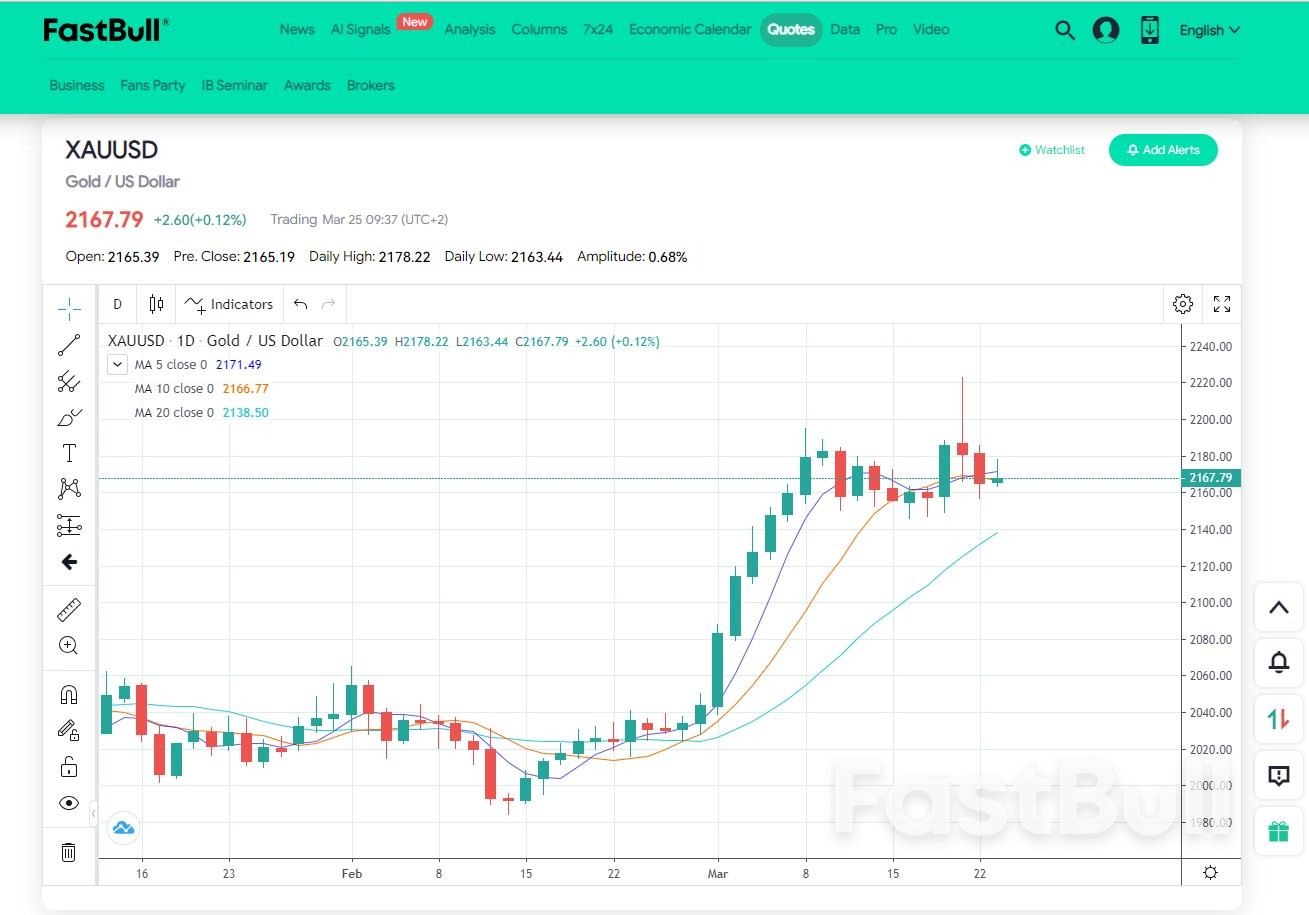
          The world of financial markets thrives on volatility, and understanding how an investment moves is crucial for traders. This is where the Average True Range (ATR) comes in. ATR is a technical analysis tool that gauges the volatility of an asset, helping you assess the potential risk and reward involved in a trade.
          Average True Range (ATR) Explained: Calculation, Charting & Trading_1

          Key things to know about ATR

          Measures Volatility, Not Direction: ATR reflects how much an asset's price fluctuates, not whether it's trending up or down.
          Smoothed Moving Average: The ATR value you see on charts is a smoothed average of the true range over a chosen period (often 14 days). This helps eliminate noise and identify underlying volatility trends.
          Higher ATR indicates Higher Volatility: A rising ATR suggests the market is becoming more volatile, with prices swinging more significantly. Conversely, a falling ATR indicates a calmer market with smaller price movements.

          What is the Average True Range (ATR)?

          Developed by J. Welles Wilder Jr., ATR goes beyond the standard price range (high minus low) to capture the market's overall volatility. It considers three factors:
          The difference between the current high and low price.The difference between the current high and the previous day's close.The difference between the previous day's close and the current low. By incorporating these factors, ATR accounts for price gaps and provides a more comprehensive picture of price movement.

          How to Calculate ATR?

          Calculating ATR involves a few steps:
          Calculate the True Range (TR) for each period: TR = Max (High - Low, Abs(High - Previous Close), Abs(Low - Previous Close)) Here, Max refers to the greatest value, High, Low, and Previous Close are the corresponding price points. Abs indicates absolute value.
          Average the True Range Values: Add the TR values for your chosen period (e.g., 14 days) and divide by the number of periods.
          Example:
          Let's say you want to calculate the 14-day ATR for a stock. You'll need the daily high, low, and closing prices for the past 14 days. Calculate the TR for each day and then average those 14 TR values.

          Pros and Cons of ATR

          Pros:
          Versatility: Applicable to various assets (stocks, forex, commodities) and timeframes (daily, weekly, etc.).Volatility Gauge: Provides a clear picture of an asset's recent price fluctuations.Risk Management Tool: Helps set stop-loss levels based on volatility.
          Cons:
          Lagging Indicator: Based on past price data, not predictive of future movements.
          Average, Not Absolute: Doesn't guarantee specific price swings within the ATR range.
          Multiple Interpretations: Requires additional analysis for trade signals.


          How to Use ATR in Trading?

          ATR serves multiple purposes for traders:
          Setting Stop-Loss Levels: Multiply the ATR by a factor (e.g., 2 or 3) to establish a stop-loss distance that reflects the asset's volatility.
          Identifying Entry and Exit Points: Expanding ATR can signal increased volatility, potentially preceding price breakouts. Conversely, contracting ATR might suggest a trend's end and a time to exit a position.
          Position Sizing: ATR can be a factor in determining trade size. A smaller position size might be prudent to limit risk during volatile periods.


          Stop-Loss and Take-Profit with ATR

          Calculate ATR: Determine the ATR for your chosen asset and timeframe (e.g., 14-day ATR for a stock).
          Stop-Loss Placement
          Multiply the ATR by a factor (e.g., 1.5, 2, or 3) based on your risk tolerance and desired stop-loss tightness. For a long position (buying), place the stop-loss order below the entry price by the calculated value (ATR multiplier * ATR). For a short position (selling), place the stop-loss order above the entry price by the calculated value.
          Take-Profit Placement
          There's no fixed rule, but consider a risk-reward ratio (e.g., 1:2, meaning potential profit is twice the risk). Multiply the ATR by a higher factor than your stop-loss multiplier (e.g., if stop-loss uses 2x ATR, take-profit could use 3x ATR). Alternatively, use technical indicators or chart patterns to identify potential profit targets. Money Management with ATR:
          Position Sizing
          Divide your available capital for a trade by the stop-loss distance (in dollars or percentage) calculated with ATR. This helps limit risk exposure per trade, preventing significant losses if the trade goes against you. A common approach is to risk no more than 1-2% of your capital per trade.
          Volatility and Position Size
          During high ATR periods (increased volatility), consider using a smaller position size to limit risk. Conversely, lower ATR periods (decreased volatility) might allow for a slightly larger position size based on your risk tolerance.
          Important Considerations
          ATR is a lagging indicator, so it doesn't predict future price movements. Stop-loss and take-profit levels are estimates, and prices can still gap beyond them. Adjust the ATR multiplier and risk-reward ratio based on your risk tolerance and trading strategy. Money management is crucial. Never risk more than you can afford to lose.
          Example:
          You're buying a stock (long position) with a current price of $50. The 14-day ATR is $2.You decide to use a 2x ATR stop-loss (risk tolerance) and a 3x ATR take-profit (potential reward).Stop-Loss: $50 - (2 * $2) = $46 (place a stop-loss order here to exit if the price falls to $46 automatically)Take-Profit: $50 + (3 * $2) = $56 (consider taking profits here, or use other indicators for confirmation)

          Customized ART indicator with FastBull Financial Tool

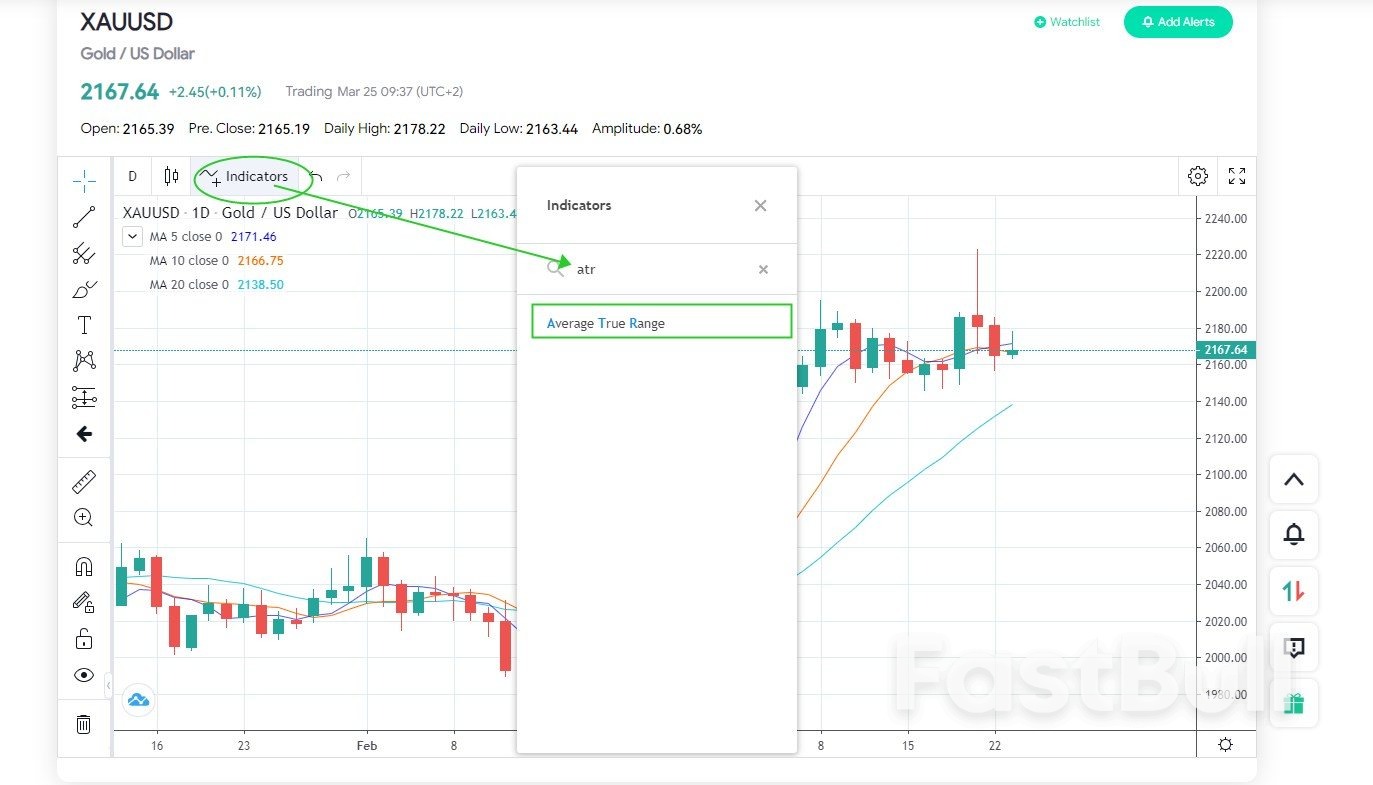
          Step 1: Search for a quote, then you will get the corresponding candlestick chart.
          Average True Range (ATR) Explained: Calculation, Charting & Trading_2
          Step 2: Search for the indicator you want in the icon search box, select it, and the indicator will be added to the candlestick chart.
          Average True Range (ATR) Explained: Calculation, Charting & Trading_3
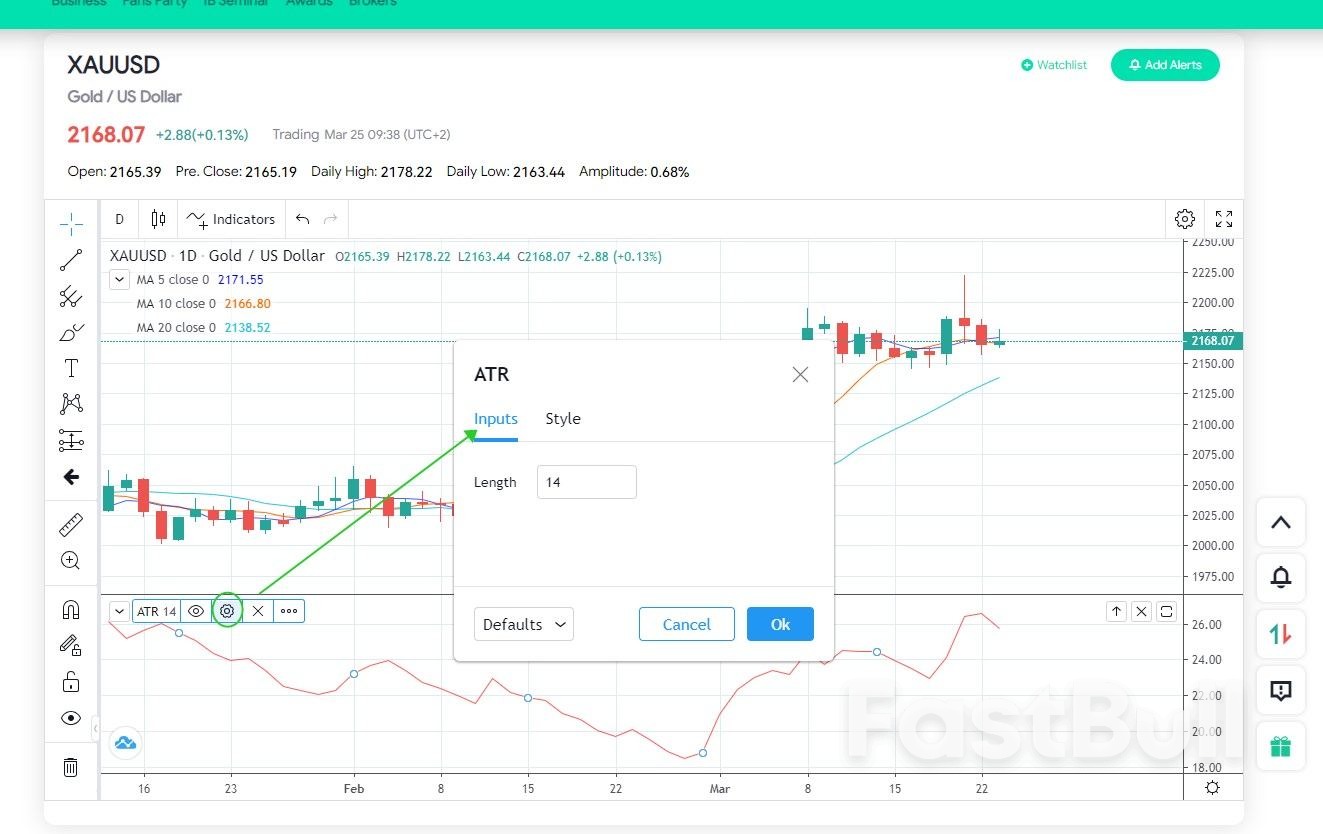
          Step 3: Hover the mouse near ATR and the settings icon will appear. Select it to adjust the indicator's period and style.
          Average True Range (ATR) Explained: Calculation, Charting & Trading_4
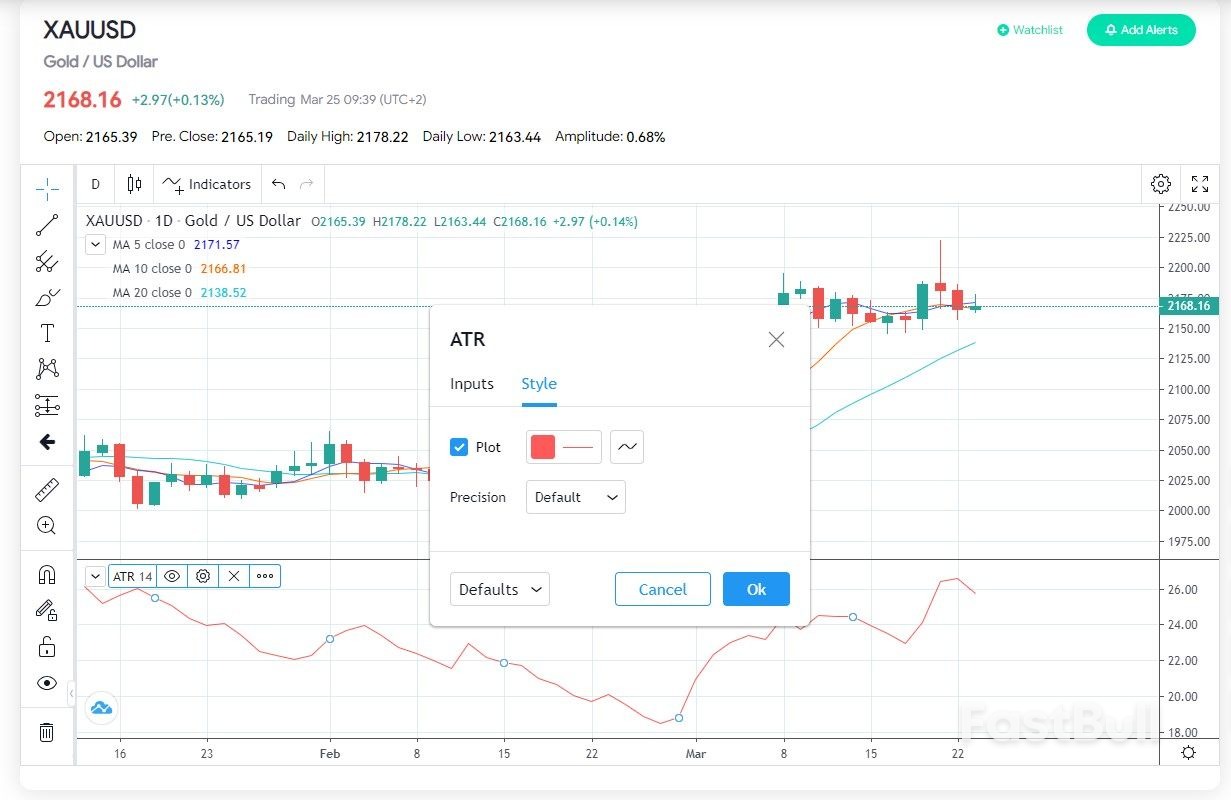
          Step 4: Adjust the style. Indicator color and shape can be adjusted.
          Average True Range (ATR) Explained: Calculation, Charting & Trading_5
          Remember:
          ATR is a tool best used in conjunction with other technical indicators and fundamental analysis for a well-rounded trading strategy. There's no "good" or "bad" ATR value. It depends on the specific asset and its historical volatility. ATR doesn't predict future price movements, but it helps you understand the level of risk associated with potential price swings. By incorporating ATR into your trading toolkit, you gain valuable insights into market volatility, allowing you to make informed risk management decisions and potentially improve your trading performance.
          To stay updated on all economic events of today, please check out our Economic calendar
          Risk Warnings and Disclaimers
          You understand and acknowledge that there is a high degree of risk involved in trading. Following any strategies or investment methods may lead to potential losses. The content on the site is provided by our contributors and analysts for information purposes only. You are solely responsible for determining whether any trading assets, securities, strategy, or any other product is suitable for investing based on your own investment objectives and financial situation.
          Add to Favorites
          Share

          Bearing the Scars: One Year of Turkey's Unorthodox Easing Cycle

          Devin
          Nearly 12 months ago, Turkey's central bank embarked on a rate-cutting cycle in the face of soaring inflation, defying traditional monetary policy and running against a global trend of rising borrowing costs.
          On September 23, 2021, policymakers started slashing the key interest rate, then at 19%. It now stands at 13% after the bank delivered another surprise cut in August - despite the monetary easing helping drive inflation above 80%.
          President Tayyip Erdogan has urged the unorthodox policy in hopes of providing targeted cheap credit to boost exports and economic growth with the aim of creating a current account surplus.
          Below are five charts showing effects of the monetary easing and ensuing lira crash:

          Tumbling Lira

          The cocktail of a weakening currency and rising inflation has long haunted Turkey - and cutting rates in the face of soaring inflation has brought back past ghosts.
          Turkey's lira has tumbled 54% against dollar since the central bank embarked on its easing cycle last September, making it the worst-performing emerging market (EM) currency over that period. It is also vying for the worst performing EM currency with Argentina's peso and Ukraine hryvnia since the start of the year.

          Bearing the Scars: One Year of Turkey's Unorthodox Easing Cycle_1Costly Food

          Pandemic-related shutdowns had already stoked inflation, and that was exacerbated by Russia's invasion of Ukraine which raised energy and food prices.
          This has been felt acutely in countries such as Turkey, which imports many grains and other foodstuffs, often from Russia.
          In August, inflation in Turkey's key food and non-alcoholic beverages' segment soared 90.25% while overall annual inflation hit a fresh 24-year high of 80.21%, up from 19.25% in August last year.

          Bearing the Scars: One Year of Turkey's Unorthodox Easing Cycle_2Energy Prices

          Turkey imports almost all its energy needs so its trade balance and import-related inflation rate is very sensitive to oil prices.
          Brent crude futures have risen by nearly a quarter since last September, though that translates into a 170% jump when oil prices are calculated in Turkish lira - well above the hit other EM economies absorbed.
          High oil prices also weigh on Turkey's current-account balance, potentially adding to further pressure on the lira.

          Bearing the Scars: One Year of Turkey's Unorthodox Easing Cycle_3Trade Trouble

          Under an economic programme unveiled last year, Turkey aims to shift to a current account surplus through stronger exports, tourism income and low interest rates. But that target keeps slipping away due to soaring global energy and commodity prices.
          Data showed that Turkey's foreign trade deficit surged nearly 150% year-on-year to $10.7 billion in July, data from the Turkish Statistical Institute showed.
          Preliminary August data confirmed that trend, said Goldman Sachs, showing the trade deficit had widened again to $11.3 billion, compared to $4.3 billion in August last year. A global economic slowdown and expected recession in Europe will do little to ease the pain going forward, analysts said.

          Bearing the Scars: One Year of Turkey's Unorthodox Easing Cycle_4Rising Risks

          The cost of insuring exposure to Turkey's debt has risen sharply over the past 12 months as wider global market woes and risk aversion amplified concerns over Turkey's high inflation, sliding currency and deeply negative real interest rate.
          The country's five-year credit default swaps (CDS) more than doubled to 742 basis points (bps) since September 1, 2021, data from S&P Global Market Intelligence shows.

          Bearing the Scars: One Year of Turkey's Unorthodox Easing Cycle_5Source: Reuters

          Risk Warnings and Disclaimers
          You understand and acknowledge that there is a high degree of risk involved in trading. Following any strategies or investment methods may lead to potential losses. The content on the site is provided by our contributors and analysts for information purposes only. You are solely responsible for determining whether any trading assets, securities, strategy, or any other product is suitable for investing based on your own investment objectives and financial situation.
          Comments
          Add to Favorites
          Share

          What Does the US Federal Reserve's Interest Rate Rise Mean for UAE Residents?

          Damon
          Consumers will pay more to borrow money after the US Federal Reserve's decision on Wednesday to raise interest rates by another three quarters of a percentage point to stem the disruptive surge in inflation, financial experts say.
          The 75 basis point increase raised the short-term federal funds rate to a range of 3 per cent to 3.25 per cent. Federal Open Market Committee officials expect to raise the benchmark rate to 4.4 per cent by the end of this year.
          The interest rate increase is the Fed's fifth this year and was delivered after consumer prices rose by 8.3 per cent in August, exceeding economists' expectations of 8.1 per cent and well above the Fed's 2 per cent target.
          Central banks are no longer seeking to ensure "cheap money" is available for households, companies and governments to borrow at "exceptionally favourable rates" as they did during the Covid-19 pandemic, said Vijay Valecha, chief investment officer at Century Financial.
          "During the pandemic, cheap money was provided to help the economy sustain itself. However, as economies are recovering gradually, the availability of quick money would reduce consumer spending as the cost of borrowing has increased," he said.
          The Central Bank of the UAE raised its benchmark base rate for its overnight deposit facility (ODF) by three quarters of a percentage point to 3.15 per cent. It maintained the rate applicable to borrowing short-term liquidity from the regulator through all standing credit facilities at 50 bps above the base rate, the regulator said on Wednesday.
          The base rate, which is anchored to the Fed's interest on reserve balances (IORB), signals the general stance of the CBUAE's monetary policy and provides an effective interest rate floor for overnight money market rates.
          The Fed's rate increase comes amid an uncertain global economic outlook fuelled by record-high inflation and Russia's worsening military assault on Ukraine that has affected commodities markets.
          However, the strength of the UAE's recovery from the pandemic means its economy is well placed to deal with higher rates, said Monica Malik, chief economist at Abu Dhabi Commercial Bank.
          "Borrowing costs will rise further, with the Fed firmly focusing on inflation," Ms Malik said.
          Higher rates mean a range of personal finance products — from loans to credit cards, mortgages, savings and remittances — will be affected. Here is a look at some of the effects:

          Mortgages

          For mortgage borrowers who have yet to secure a fixed rate, the news might be a concern, said Mohamad Kaswani, managing director at Mortgage Finder.
          "However, this has been on the cards for a while, so it shouldn't come as a real shock. The good news is that even with this recent increase, rates are still at historic lows and there is time to secure a fixed rate before any further hikes later in the year."
          For borrowers on fixed-rate home loans, there should be no changes to their mortgage payments until they come to the end of their fixed-rate period, Mr Kaswani said.
          However, borrowers on variable rate mortgages will feel the change as soon as their next monthly payment is due, he said.
          "Most banks use [the] three-month Emirates Interbank Offered Rate [Eibor], so borrowers will see the change at the end of this month. For those who would prefer more stability moving forward, they can investigate moving on to a fixed-rate mortgage."
          The best three- and five-year fixed rates are currently at 3.49 per cent and 3.75 per cent respectively, while variable rates start at 2.35 per cent, according to Mortgage Finder.

          Credit cards

          Interest rates on credit cards in the UAE are already high at more than 30 per cent a year and this type of debt is particularly susceptible to rising rates, according to Century Financial's Mr Valecha.
          "Credit card debt already has its own high interest rate, so rate hikes from the central banks will result in consumers eventually paying more on any revolving debt," he said.
          "Now that the Central Bank of the UAE has hiked the interest rates, changes to credit card interest rates typically follow, usually within a billing cycle or two."
          Most credit cards have a variable interest rate, which means there is a direct connection to the Fed's benchmark rate, Mohammed Shaheen, chief executive of broker Seven Capitals, said.
          Borrowers with revolving debt should find a zero-interest balance transfer credit card while they can and start to pay down the balance, Mr Shaheen said.
          "In other words, people can look to use this opportunity to get themselves out of a debt," he said.

          Loans

          Monthly instalments on personal loans and car financing will also rise.
          However, the interest rate a borrower will pay depends on a range of factors such as credit history, the type of vehicle they buy, the loan term and down payment.
          "Gradual hikes this year will lower consumers' willingness to borrow at high interest rates," Mr Valecha said.

          Savings

          The historically low interest rates over the past few years has affected savings accounts. But following the Central Bank of the UAE's rate increase on Wednesday, consumers can expect a marginal increase that will boost their savings power.
          "However, putting extra money into your savings might not result in as much interest earned from other avenues," Mr Valecha said.
          "Investors can use the higher interest rates as an incentive to boost their savings or emergency fund contributions."
          While traditional banks might be slower to pass on the rate rise to savers, consumers could look at other ways to boost their savings power, Mr Shaheen of Seven Capitals said.
          "Online banks offering high-yield accounts tend to pay higher rates than traditional banks," he said.

          How high can interest rates go?

          The Fed is expected to raise interest rates at its remaining meetings this year.
          "In addition to higher rates, the Fed will also start to run down its balance sheet at a monthly pace of $95 billion, helping to tighten liquidity conditions further," Emirates NBD said in a research note.
          In April, the Economist Intelligence Unit forecast a total increase of 225 bps this year.
          "After two more quarter-point rate rises in the first quarter of 2023, the Fed's main target rate will reach 2.9 per cent," the EIU said on April 25.

          When will consumers feel the pinch?

          In the short term, consumers may feel the sting of higher prices more acutely than the pinch of interest rate rises, Mr Valecha said.
          But as the Fed continues its rate increase programme throughout the year, consumers will begin to feel the effect, he said.
          "Eventually, higher rates will help cool down inflation, which will benefit consumers in the long run."

          Source: The National News

          Risk Warnings and Disclaimers
          You understand and acknowledge that there is a high degree of risk involved in trading. Following any strategies or investment methods may lead to potential losses. The content on the site is provided by our contributors and analysts for information purposes only. You are solely responsible for determining whether any trading assets, securities, strategy, or any other product is suitable for investing based on your own investment objectives and financial situation.
          Comments
          Add to Favorites
          Share

          Is the Eurozone Safe with Giorgia Meloni's 'Patriotic' Economics?

          Devin
          Giorgia Meloni is trying to portray herself as a safe pair of hands on the international stage when it comes to ensuring that Italy doesn't blow a fatal hole in the eurozone. But her plans for the Italian economy are still at odds with Brussels' economic orthodoxy.
          The leader of the right-wing Brothers of Italy, who is in pole position to become Italy's next prime minister, is trying hard not to scare Eurocrats as she pledges to keep the budget in order and avoids frontal attacks on the EU.
          But her party's track record tells another story, as she has consistently called into question some pillars of EU integration, such as internal market rules, and is in no hurry to implement some of the structural reforms sought by Brussels.
          In the halls of the European Council and Commission, officials are worried. Given the size of the Italian economy, and its high debt levels, Italy has outsized importance when it comes to the stability of the 19-country euro area. Meloni, with her patriotic mantras, will mark an abrupt departure from the ever-dependable Mario Draghi, the rock-steady central banker beloved of the European elites in Brussels for his pursuit of stability of the single currency.
          "Yes, we are concerned," said one senior EU Council official. "Italy has long been one of the weak links in the eurozone economy, its debt levels are high. What happens in Italy matters."
          There is particular concern about whether Meloni's brand of economic patriotism will force Italy to backtrack on key liberalizing reforms, like opening up closed sectors including tourist beach concessions and taxi drivers, which had been demanded by Brussels to tap the EU's post-pandemic relief package.
          There are also indications that she has protectionist instincts when it comes to bailing out national champions and preventing international buyouts of household names, something that will put her on a collision course with the EU's guardians of the borderless single market between countries.

          Fiscal fears

          Even though Meloni is insisting that she will be prudent with public spending, some countries fear it could be hard to find compromises with a government led by her on key negotiations, such as the ones to reform the EU's fiscal rules, where Italy wants more leeway.
          "The question is whether there will be a sincere negotiation, a serious position coming from Meloni, and some of her past statements don't bode too well for that," said an EU diplomat, recalling Meloni's anti-euro positions in the past.
          But Giulio Tremonti, who served four times as finance minister under Silvio Berlusconi's governments and is now running with Meloni, offers reassurances that there will be no tensions between a Meloni-led government and Brussels. For him the explanation is not Meloni's moderate U-turn toward sound financing, but the fact that the EU, in the meantime, has deeply changed.
          "With this kind of Europe" it is possible to get along, Tremonti told POLITICO. "This Europe is radically different" from what it used to be, he added, welcoming for instance Brussels' decision to resort to common debt — something he has been pushing for a decade ago, as he proudly stressed.
          The idea that the EU has loosened up when it comes to imposing strict debt and deficit rules is true to an extent. European Commission President Ursula von der Leyen highlighted the need for "flexibility" when it comes to the Stability and Growth Pact in her State of the Union address this month, and pointed to a reform of the rules which is expected in October. Indeed, the need for more flexibility is an idea spearheaded by French President Emmanuel Macron and Prime Minister Draghi late last year.
          The crucial question will be whether Meloni continues the ideological alliance with Macron if she becomes prime minister, even though her anti-French past could suggest the contrary. Over the past five years, Meloni fueled the Franco-Italian rivalry by repeatedly attacking the French government on issues ranging from industrial tie-ups to migrant flows, and opposed a bilateral treaty the two countries signed last year.
          "I hope we'll see in Brussels and in negotiations the more recent [version of] Meloni, who is more moderate and more centrist. But there is always the fear in the back of everyone's mind here that we might see the old Meloni when she gets elected," said the same diplomat.

          Protectionist vibes

          For some member countries and investors, the key concern is that Meloni would slow down structural reforms carried out by Draghi, which are a condition to get funding under the EU's post-pandemic recovery plan.
          That's one of the reasons why, last month, the ratings agency Moody's cut Italy's credit profile to "negative" from "stable," pointing to the risk that the right-wing coalition might file Draghi's reform agenda away in a drawer.
          "A center-right coalition made up of the Brothers of Italy, Lega and Forza Italia is the most likely outcome. Such a future government may try to test the willingness of the European Commission to strictly enforce the conditions of its [national recovery plan]," Moody's senior analyst Sarah Carlson said in a note.
          The right-wing coalition is indeed proposing to rediscuss with the European Commission the country's recovery plan in the light of the current energy crisis to change some of the projects financed with EU money, insisting that this is possible under EU law.
          In parallel, the Brothers of Italy's MPs in Rome opposed one of the key reforms agreed with Brussels to obtain those funds, Draghi's so-called "competition decree" which would bring Italy closer to compliance with EU law.
          From the opposition benches, Meloni has been one of the fiercest opponents of this decree which includes a set of reforms that would open up competition in several sectors by organizing public tenders as foreseen by EU law. Her party, and more broadly the center-right coalition, took the side of beach concession holders and taxi drivers who didn't want to compete with new operators.
          "The center-right coalition and in particular Brothers of Italy question some basic principles of EU competition law and the EU single market," said Tommaso Valletti, the European Commission's former chief competition economist, now a professor at Imperial College London.
          When it comes to industrial policy, the Brothers of Italy have been calling for a major state role in the Italian economy. While during the campaign, Meloni herself avoided taking a position on single files, in the past she argued that Italy's struggling airline – formerly Alitalia, now ITA Airways – should remain in public hands, and that the state should own the country's broadband network, a solution which would imply excluding French group Vivendi, which is currently a major stakeholder in Italy's telco incumbent Telecom Italia, from owning shares in the company that owns the network.
          Her program includes temporarily extending foreign investment screening also to EU investors and requiring non-EU businesses to submit a bank guarantee if they want to invest in Italy.
          A government led by Meloni would be "more protectionist than previous executives in the name of national interest," said Lorenzo Castellani, an adjunct professor in political sciences at LUISS university in Rome. Whether Meloni will move from words to deeds still remains to be seen, he warned.
          One Commission official noted ruefully that Brussels knew it had a "dream Italian government" led by Draghi, but was all too well aware that, one day, it was always going to come to an end.

          Source: POLTICO

          Risk Warnings and Disclaimers
          You understand and acknowledge that there is a high degree of risk involved in trading. Following any strategies or investment methods may lead to potential losses. The content on the site is provided by our contributors and analysts for information purposes only. You are solely responsible for determining whether any trading assets, securities, strategy, or any other product is suitable for investing based on your own investment objectives and financial situation.
          Comments
          Add to Favorites
          Share

          Where Will USDCNY Exchange Rate Go?

          King Ten

          China-U.S. Relations

          1. How to respond as the exchange rate of USDCNY breaks above '7'?

          On September 16th, the exchange rate of the CNY against the USD broke above 7 again, as the United States continued to shrink the balance sheet and aggressively raised interest rates, the USD continued to be strong. As of Sept. 22, U.S. bonds again successfully broke 3.60 percent, and the dollar index has risen more than 15 percent so far this year. The mid-year US bond yield spread is nearly 100bps, and the pressure of CNY depreciation is obvious. From the perspective of the general trend, the CNY fell by 10%, but from a horizontal comparison, the CNY appreciated significantly against other mainstream currencies, which also reflects that the CNY exchange rate index has not been weak since the beginning of this year, and the weakening of the CNY is only relative to the USD.
          7 is just a number. It should be treated normally without the need to over-interpret this number's importance. When the pandemic broke out in 2020, the exchange rate of the CNY against the USD once depreciated to 7.17. With the reversal of the domestic economy, the US easing cycle began, which has become a staged high point in history, but this does not mean the end of the future, perhaps a breakthrough is a matter of time. It is not necessary to be stubborn to not 'break' 7, or even higher as it is not terrible. In fact, the key is to manage risks and expectations. Especially for foreign trade companies, various exchange rate hedging tools should be used reasonably. Try not to keep too many game elements, even if there are earth-shattering matters, just let it be.
          Where Will USDCNY Exchange Rate Go?_1

          2. What happens to CNY in the past?

          To better predict the future, the past must be comprehended deeply. It is reasonable for this wave of CNY to break 7. Besides, the short-term influencing factors of foreign exchange are based on sentiment, while the medium-term factors are related to economic, political, and financial conditions, and the long-term influencing factors that determine the foreign exchange rate is the production factor condition under the framework of "Balassa-Samuelson effect". It is meaningless to analyze the long and short term.
          First of all, economic conditions, since the outbreak of the pandemic in the U.S. in 2020, the opening of bottomless monetary easing, the U.S. economy has recovered faster; especially after 2021, economic growth has been stronger, with PMI always above the boom-or-bust line, peaking at 60 at the end of 3Q21, and still maintaining the momentum of 2021 in the first half of 2022, with a year-on-year growth of 3.2% (2017-2019 growth average of 2.5%).
          However, since 2022, with the gradual easing of pandemic policies abroad, China still maintained a dynamic '0 case' policy that affects consumption. As affected by this, the real estate industry has been under strict control in the past and confidence collapsed, and the economy has declined, setting troubles to China's economy for more than half a year. During the period, the YoY GDP growth rate was only 2.5% in the first half of the year. It is not difficult to see the economic differences between China and the United States.
          The second issue is political conditions. There are few positive frictions between China and the United States this year. Among them, the Taiwan Strait issue is vital, and the most significant one is the conflict between Russia and Ukraine. This is also the main issue of political conditions of the year. At present, the USD is still the best safe-haven currency, and the USD is pushed to its peak by this support.
          The financial conditions are the final topic. On the one hand, the United States has tightened its monetary policy wildly since Powell was slapped in the face by inflation, while China has adopted a moderately loose monetary policy under comfortable inflation and economic distress, both policies keep the bearish trend of CNY. Another critical financial condition is the interest rate spread between China and the United States. The US interest rate hike schedule was set during the year, that is, the federal funds rate at the end of the year is 4-4.25%, and the 10-year US bond has risen to 3.60%. The inversion is nearly 100bps, which is also the peak level since the first inversion on April 11th, 2022, which will trigger some cross-border capital flows from China to the United States, depreciating the CNY against the USD.

          3. What is the future of CNY?

          Regarding the influencing factors, some of these things are quietly changing marginally:
          According to political conditions, there is nothing to interpret too much currently. The conflict between Russia and Ukraine is gradually normalized. If there is no marginal intensification of conflict, risk aversion sentiment will ease. To a certain extent, it is slightly bearish on the USD.
          Referring to the economy, there have been various voices of a recession since the rate hike and upgrade in the United States. However, the financial data released in August was contradictory and mixed. However, from the perspective of PMI, it has been down for 4 consecutive months, which may also be a more significant tracking clue in the future.
          However, in China, economic worries still exist. Exports fell sharply in August (long-term preparations should be made), real estate was weak, and various real estate data still failed to stabilize and rebound, and these data were still trying to bottom out. Nevertheless, since July and August, the pandemic has eased. On September 16th, the National Bureau of Statistics announced the economic data for August, and the economy gradually recovered, infrastructure remained resilient, manufacturing investment was still strong, and the total retail sales rate of consumer goods rebounded to 5.4% YoY, while the national urban surveyed unemployment rate further fell to 5.3%. These outstanding points and deficiencies remain to be observed. For the time being, the margins have improved.
          For financial conditions, the central bank lowered the medium-term lending facility (MLF) and open market operation (OMO) interest rates by 10 bps each on August 15th and guided the loan prime rate (LPR) to be lower, keeping the loose policy unchanged. However, the U.S. continues to tighten. If the yield of the 10-year US Treasury bond will rise to 4% next year, the China-US interest rate gap may further increase.
          In general, the CNY still has a long way to go before it stops falling, maybe next spring when the flowers bloom. Again, the foreign exchange market is a highly trending market, which will not be completed within a week or a month. It has obvious signals of the start, outbreak, and end stages. Patience is what this market lacks the most, but it is also not recommended to be overly bearish on the CNY because the reversal will be significant under a smooth decline. Try to respect the market and the trade and maintain a fearful heart while shorting to protect the account.
          Risk Warnings and Disclaimers
          You understand and acknowledge that there is a high degree of risk involved in trading. Following any strategies or investment methods may lead to potential losses. The content on the site is provided by our contributors and analysts for information purposes only. You are solely responsible for determining whether any trading assets, securities, strategy, or any other product is suitable for investing based on your own investment objectives and financial situation.
          Comments
          Add to Favorites
          Share

          Europe Says Goodbye to Negative Rates - or Just 'Au Revoir'?

          Devin
          Europe's decade-long experiment with negative interest rates, which ended on Thursday with the Swiss National Bank's return to positive territory, showed one thing: they can exist beyond the realms of economic science fiction.
          Launched to revive economies after the 2007/08 financial crisis, the policy flipped standard money wisdom on its head: banks had to pay a fee to park cash with their central banks; some home-owners found mortgages that paid them interest; and rewards for the act of saving all but vanished.
          With the exercise now abandoned in the face of galloping inflation brought on by pandemic and the Ukraine war, doubts linger over its effectiveness and under what circumstances it will ever be used again.
          "I think that probably the bar is going to be higher in the future," said Claudio Borio, head of the Monetary and Economic Department of the Basel-based Bank of International Settlements which acts as bank to the world's central banks.
          Rarely does monetary policy generate as much sound and fury as did the recourse in the early 2010s to negative rates by four European central banks and the Bank of Japan - now the only monetary authority still sticking with them.
          With interest rates back then already close to zero, they had run out of conventional ammunition to ward off the threat of outright deflation they feared would choke off the economic recovery. The only way out, they decided, was to go below zero.
          Bank chiefs fumed as the European Central Bank, Swedish Riksbank, Swiss National Bank (SNB) and Denmark's Nationalbank went negative in moves they said undermined the whole banking business model of being able to make a profit out of lending.
          Local media joined in the criticism, with Swiss newspapers in 2015 calling the moment "Frankenshock" and Germany's Bild labelling the then ECB chief Mario Draghi "Count Draghila" for "sucking our accounts dry".Europe Says Goodbye to Negative Rates - or Just 'Au Revoir'?_1
          For sure, those who relied on the return from cash savings clearly suffered during Europe's period of ultra-low to negative rates - even if they could at least take solace from the fact that low inflation was protecting their initial savings.
          Other side-effects are harder to pick apart.
          Fears of negative rates leading to money-hoarding proved largely unfounded: in Switzerland, for example, the number of 1,000-franc notes in circulation remained the same, suggesting customers were not withdrawing cash to store in a safe at home.
          As one Danish bank vaunted the world's first negative rate mortgage, it is likely that cheap borrowing added steam to house price spikes across the region. But prices were often being squeezed higher by local factors including tight supply.
          While many other elements have been at play, euro area bank stocks have fallen some 45% since 2014 - despite ECB moves to shield them with exemptions from charges on some deposits and access to ultra-cheap borrowing.
          Yet a report to European Parliament by the Bruegel think tank last year concluded that overall bank sector profits had not been significantly harmed by negative rates, noting that the downside was being offset by gains in asset investments.
          "In the end, they worked the same as normal rate cuts," said report co-author Gregory Claeys, while acknowledging the impact may have been greater had the experiment gone on for longer.

          NO FUTURE?

          The question of whether negative rates actually achieve their goals is harder to answer given the modest extent of the trial - no one ever went lower than minus 0.75% - and the fact that they have been swept aside by the turmoil of the last two years.
          ECB policy-makers point to data showing that lending in the euro zone was shrinking year after year in the 2010s until negative rates helped turn that into growth by 2016 - even though that growth has never attained its pre-2009 heights.
          Others point to the fact that the negative rate period coincided with the vast quantitive easing with which the ECB and other central banks around the world also boosted demand with trillions of dollars of asset purchases.
          "That was a much bigger deal - much more impactful," said Brian Coulton, chief economist at Fitch Ratings. "Using your balance sheet aggressively - that is a powerful weapon."Europe Says Goodbye to Negative Rates - or Just 'Au Revoir'?_2
          Some economists argue negative rates create perverse incentives that ultimately do a disservice to the economy - for example by keeping alive "zombie companies" that by rights should fold, or by removing the impetus for governments to push tough reforms.
          "What is lacking, in Europe, is the focus on structural reforms. Why didn't they happen in the last 10 years, why didn't we strengthen productivity growth?" said Societe Generale senior European economist Anatoli Annenkov.
          Burkhard Varnholt, Chief Investment Officer Switzerland, Credit Suisse Switzerland, goes further, saying the message they send about investing in the future was even akin to the nihilism of the "No Future" refrain of the 1977 Sex Pistols' punk rock track "God Save the Queen".
          "It's the central bankers who have taken interest rates to a level where we attach no value to the future," he said. "Today's punks wear white shirts, grey suits and a blue tie."
          As the negative rate era closes, the global pool of assets with negative yield has shrunk to less than $2 trillion from a 2020 peak of some $18 trillion.
          Despite the misgivings, others say the experiment has at least shown policy-makers that rates can go below zero and so is an option for them: witness the fact the Bank of England for a while considered that path as COVID-19 was ravaging the economy.
          Even if the current inflationary bout means it could be a while before Europe's central bankers need to use negative rates again, it is unlikely they will want to rule them out.
          "They will always be spoken of as something that remains in the toolkit," said Rohan Khanna, strategist at UBS in London. "I am very doubtful anyone here is ready to say never again for negative rates."

          Source: Reuters

          Risk Warnings and Disclaimers
          You understand and acknowledge that there is a high degree of risk involved in trading. Following any strategies or investment methods may lead to potential losses. The content on the site is provided by our contributors and analysts for information purposes only. You are solely responsible for determining whether any trading assets, securities, strategy, or any other product is suitable for investing based on your own investment objectives and financial situation.
          Comments
          Add to Favorites
          Share

          ASTR's Potential Surge: Astar's zkEVM Launch Fuels Market Optimism

          Glendon
          As the Astar Network gears up for the much-anticipated launch of its zkEVM mainnet, the crypto community is abuzz with speculation that its native token, ASTR, might reach or even surpass its early 2024 peak of $0.2297. This optimism is fueled by the network's strategic move to integrate Polygon's zkEVM, aiming to position itself as an attractive platform for Web3 projects, coupled with notable collaborations, such as the recent partnership with Japan Airlines Co and integrated marketing giant Hakuhodo.

          The Rising Tide of ASTR

          The ASTR token has seen a whirlwind of activity in recent months, with its price showing significant volatility. After reaching a high of $0.2297 earlier in 2024, ASTR experienced fluctuations, reflecting the broader crypto market's dynamic nature. However, as the launch of the zkEVM mainnet draws near, the token has witnessed a resurgence of investor interest, hinting at the possibility of a price rally that could take it back to its yearly high or beyond.

          zkEVM: A Catalyst for Growth

          The zkEVM, or Zero-Knowledge Ethereum Virtual Machine, represents a technological leap forward, promising to address some of the most pressing issues facing the Ethereum network, primarily scalability and transaction costs. By leveraging zero-knowledge proofs, specifically zk-SNARKs (Zero-Knowledge Succinct Non-interactive Argument of Knowledge), the zkEVM aims to enable faster and cheaper transactions without compromising on security.
          Astar Network's decision to incorporate Polygon's zkEVM is a strategic one, positioning the platform as a go-to ecosystem for developers and projects looking to take advantage of this cutting-edge technology. This move not only enhances Astar's value proposition but also increases the utility and demand for ASTR within the network, potentially driving up its price.

          Strategic Partnerships: Broadening the Horizon

          The recent announcement of a joint demonstration of Kyoto NFTs by Japan Airlines and Hakuhodo on the Astar platform underscores the network's potential for real-world application and adoption. Such collaborations serve to highlight the versatility and capability of the Astar Network, attracting attention from other established players across various industries. These partnerships are not just a testament to Astar's technological prowess but also act as a catalyst for increased visibility and credibility, contributing to the growing optimism surrounding ASTR's market prospects.

          Navigating Challenges Ahead

          While the enthusiasm for Astar's zkEVM mainnet launch and its implications for ASTR's price is palpable, it's crucial to acknowledge the hurdles that lie ahead. The crypto space is notorious for its competition, with numerous projects vying for dominance and user adoption. Astar's ability to differentiate itself and deliver on its promises will be key to its success in a crowded market.
          Furthermore, the regulatory landscape for cryptocurrencies remains uncertain and ever-evolving. Any adverse regulatory developments could have a significant impact on the broader market, including ASTR. Investors and enthusiasts alike must stay informed and adapt to these changes as they occur.
          Technical challenges associated with the implementation and scaling of zkEVM technology also pose a potential risk. Smooth execution and robust performance of the mainnet post-launch will be critical in maintaining investor confidence and ensuring the long-term viability of the Astar Network.

          The Road Ahead

          As the Astar Network approaches its pivotal zkEVM mainnet launch, the path forward is laden with both opportunities and obstacles. The potential for ASTR to revisit or even exceed its early 2024 high is tangible, driven by technological advancements, strategic partnerships, and a growing ecosystem.
          Investors and community members should approach this period with cautious optimism, balancing the excitement of the upcoming launch with a realistic assessment of the challenges that lie ahead. The crypto market's inherent volatility demands a measured approach, emphasizing thorough research and risk management.

          Conclusion

          The anticipation surrounding the Astar Network's zkEVM mainnet launch is a beacon of hope for ASTR's return to its early 2024 peak. This pivotal moment could mark a significant milestone for Astar, potentially ushering in a new era of growth and innovation for the network and its native token. However, the journey is fraught with challenges that will test the resilience and adaptability of the Astar community. As we watch this space, the coming months promise to be a critical period for Astar Network, potentially reshaping its future and that of its ASTR token in the dynamic landscape of blockchain and cryptocurrency.
          Risk Warnings and Disclaimers
          You understand and acknowledge that there is a high degree of risk involved in trading. Following any strategies or investment methods may lead to potential losses. The content on the site is provided by our contributors and analysts for information purposes only. You are solely responsible for determining whether any trading assets, securities, strategy, or any other product is suitable for investing based on your own investment objectives and financial situation.
          Comments
          Add to Favorites
          Share
          FastBull
          Copyright © 2025 FastBull Ltd

          728 RM B 7/F GEE LOK IND BLDG NO 34 HUNG TO RD KWUN TONG KLN HONG KONG

          TelegramInstagramTwitterfacebooklinkedin
          App Store Google Play Google Play
          Products
          Charts

          Chats

          Q&A with Experts
          Screeners
          Economic Calendar
          Data
          Tools
          Membership
          Features
          Function
          Markets
          Copy Trading
          Latest Signals
          Contests
          News
          Analysis
          24/7
          Columns
          Education
          Company
          Careers
          About Us
          Contact Us
          Advertising
          Help Center
          Feedback
          User Agreement
          Privacy Policy
          Business

          White Label

          Data API

          Web Plug-ins

          Poster Maker

          Affiliate Program

          Risk Disclosure

          The risk of loss in trading financial instruments such as stocks, FX, commodities, futures, bonds, ETFs and crypto can be substantial. You may sustain a total loss of the funds that you deposit with your broker. Therefore, you should carefully consider whether such trading is suitable for you in light of your circumstances and financial resources.

          No decision to invest should be made without thoroughly conducting due diligence by yourself or consulting with your financial advisors. Our web content might not suit you since we don't know your financial conditions and investment needs. Our financial information might have latency or contain inaccuracy, so you should be fully responsible for any of your trading and investment decisions. The company will not be responsible for your capital loss.

          Without getting permission from the website, you are not allowed to copy the website's graphics, texts, or trademarks. Intellectual property rights in the content or data incorporated into this website belong to its providers and exchange merchants.

          Not Logged In

          Log in to access more features

          FastBull Membership

          Not yet

          Purchase

          Become a signal provider
          Help Center
          Customer Service
          Dark Mode
          Price Up/Down Colors

          Log In

          Sign Up

          Position
          Layout
          Fullscreen
          Default to Chart
          The chart page opens by default when you visit fastbull.com