• Trade
  • Markets
  • Copy
  • Contests
  • News
  • 24/7
  • Calendar
  • Q&A
  • Chats
Trending
Screeners
SYMBOL
LAST
BID
ASK
HIGH
LOW
NET CHG.
%CHG.
SPREAD
SPX
S&P 500 Index
6840.50
6840.50
6840.50
6864.93
6837.42
-6.01
-0.09%
--
DJI
Dow Jones Industrial Average
47560.28
47560.28
47560.28
47957.79
47533.60
-179.03
-0.38%
--
IXIC
NASDAQ Composite Index
23576.48
23576.48
23576.48
23616.46
23449.73
+30.58
+ 0.13%
--
USDX
US Dollar Index
99.130
99.210
99.130
99.210
98.960
-0.050
-0.05%
--
EURUSD
Euro / US Dollar
1.16310
1.16317
1.16310
1.16575
1.16215
+0.00053
+ 0.05%
--
GBPUSD
Pound Sterling / US Dollar
1.33063
1.33073
1.33063
1.33268
1.32894
+0.00112
+ 0.08%
--
XAUUSD
Gold / US Dollar
4196.43
4196.84
4196.43
4218.67
4187.63
-10.74
-0.26%
--
WTI
Light Sweet Crude Oil
58.388
58.418
58.388
58.495
57.945
+0.233
+ 0.40%
--

Community Accounts

Signal Accounts
--
Profit Accounts
--
Loss Accounts
--
View More

Become a signal provider

Sell trading signals to earn additional income

View More

Guide to Copy Trading

Get started with ease and confidence

View More

Signal Accounts for Members

All Signal Accounts

Best Return
  • Best Return
  • Best P/L
  • Best MDD
Past 1W
  • Past 1W
  • Past 1M
  • Past 1Y

All Contests

  • All
  • Trump Updates
  • Recommend
  • Stocks
  • Cryptocurrencies
  • Central Banks
  • Featured News
Top News Only
Share

SEBI: Relaxation On Geo Tagging Requirement In India For Nris While Undertaking Re-Kyc

Share

ICE New York Cocoa Jumps More Than 3% To $6075 A Metric Ton

Share

ICE London Cocoa Jumps More Than 3% To 4385 Pounds A Metric Ton

Share

Reserve Bank Of India: Currency In Circulation Up 250.27 Billion Rupees To 38.92 Trillion Rupees In Week To Dec 5

Share

Reserve Bank Of India: Reserve Money Grew 0.8% Year-On-Year In Week To Dec 5 Versus Growth 8.1% Year Ago

Share

Reserve Bank Of India: India's Y-O-Y Money Supply Growth At 9.9% As On Nov 28

Share

Source: Kazakhstan's Karachaganak Field Raises Oil Production To Planned Level In December After Orenburg Supplies Resume

Share

Source: Kazakhstan's Oil And Gas Output Decline Eases In December 1-9 To 4.5% Versus November Average From A Fall Of 6% In Early December

Share

UK Finance Minister Reeves: We Have No Plans To Increase Electric Vehicle Duty Further, Would Not Do So Until Shift To Evs Is Secured

Share

Chile Inflation Seen At 0.0 Percent In December - Central Bank Poll

Share

Chile Central Bank Benchmark Rate Seen At +4.25 Percent In 5 Months - Central Bank Poll

Share

Moscow Mayor Says Air Defence Systems Shot Down Drone En Route To Moscow

Share

Policymaker: Central Bank Spat Poses No Threat To Polish Financial System

Share

European Public Prosecutor's Office (Eppo): Competent Judge At The High Court Of Paris Ordered The Seizure Of Assets Held In A Bank Account In France

Share

Malaysian Palm Oil Board: Export Demand For Malaysian Palm Oil Set To Improve On Restocking Ahead Of The Chinese New Year

Share

Malaysian Palm Oil Board: Malaysia's Palm Oil Stocks To Rise Further By End-December From November's 6-1/2-Year High Of 2.84 Million Tons

Share

European Central Bank Governor Lagarde: Scheme To Be Debated By Council On Ukraine Is Closest To Be In Compliance With International Rules

Share

European Central Bank Governor Lagarde: It's Out Duty To Support Ukraine

Share

[US Senator Warren Writes To Bessant And UBS Chairman To Inquire Whether The US Is Incentivizing UBS To Relocate] US Senator Elizabeth Warren Wrote To UBS Group Chairman Colm Kelleher, Requesting Details Of Any Discussions With US Treasury Secretary Scott Bessant Regarding The Bank's Potential Relocation Of Its Headquarters To The United States

Share

Donald Trump's Tariffs Intensify Strain On US Farmers, Deere Warns

TIME
ACT
FCST
PREV
Mexico PPI YoY (Nov)

A:--

F: --

P: --

U.S. Weekly Redbook Index YoY

A:--

F: --

P: --

U.S. JOLTS Job Openings (SA) (Oct)

A:--

F: --

P: --

China, Mainland M1 Money Supply YoY (Nov)

--

F: --

P: --

China, Mainland M0 Money Supply YoY (Nov)

--

F: --

P: --

China, Mainland M2 Money Supply YoY (Nov)

--

F: --

P: --

U.S. EIA Short-Term Crude Production Forecast For The Year (Dec)

A:--

F: --

P: --

U.S. EIA Natural Gas Production Forecast For The Next Year (Dec)

A:--

F: --

P: --

U.S. EIA Short-Term Crude Production Forecast For The Next Year (Dec)

A:--

F: --

P: --

EIA Monthly Short-Term Energy Outlook
U.S. 10-Year Note Auction Avg. Yield

A:--

F: --

P: --

U.S. API Weekly Gasoline Stocks

A:--

F: --

P: --

U.S. API Weekly Cushing Crude Oil Stocks

A:--

F: --

P: --

U.S. API Weekly Crude Oil Stocks

A:--

F: --

P: --

U.S. API Weekly Refined Oil Stocks

A:--

F: --

P: --

South Korea Unemployment Rate (SA) (Nov)

A:--

F: --

P: --

Japan Reuters Tankan Non-Manufacturers Index (Dec)

A:--

F: --

P: --

Japan Reuters Tankan Manufacturers Index (Dec)

A:--

F: --

P: --

Japan PPI MoM (Nov)

A:--

F: --

P: --

Japan Domestic Enterprise Commodity Price Index MoM (Nov)

A:--

F: --

P: --

Japan Domestic Enterprise Commodity Price Index YoY (Nov)

A:--

F: --

P: --

China, Mainland CPI YoY (Nov)

A:--

F: --

P: --

China, Mainland PPI YoY (Nov)

A:--

F: --

P: --

China, Mainland CPI MoM (Nov)

A:--

F: --

P: --

Indonesia Retail Sales YoY (Oct)

A:--

F: --

P: --

Italy Industrial Output YoY (SA) (Oct)

A:--

F: --

P: --

Italy 12-Month BOT Auction Avg. Yield

A:--

F: --

P: --

BOE Gov Bailey Speaks
ECB President Lagarde Speaks
South Africa Retail Sales YoY (Oct)

A:--

F: --

P: --

Brazil IPCA Inflation Index YoY (Nov)

--

F: --

P: --

Brazil CPI YoY (Nov)

--

F: --

P: --

U.S. MBA Mortgage Application Activity Index WoW

--

F: --

P: --

U.S. Labor Cost Index QoQ (Q3)

--

F: --

P: --

Canada Overnight Target Rate

--

F: --

P: --

BOC Monetary Policy Report
U.S. EIA Weekly Gasoline Stocks Change

--

F: --

P: --

U.S. EIA Weekly Crude Demand Projected by Production

--

F: --

P: --

U.S. EIA Weekly Cushing, Oklahoma Crude Oil Stocks Change

--

F: --

P: --

U.S. EIA Weekly Crude Stocks Change

--

F: --

P: --

U.S. EIA Weekly Crude Oil Imports Changes

--

F: --

P: --

U.S. EIA Weekly Heating Oil Stock Changes

--

F: --

P: --

U.S. Federal Funds Rate Projections-Longer Run (Q4)

--

F: --

P: --

U.S. Federal Funds Rate Projections-1st Year (Q4)

--

F: --

P: --

U.S. Federal Funds Rate Projections-2nd Year (Q4)

--

F: --

P: --

U.S. Target Federal Funds Rate Lower Limit (Overnight Reverse Repo Rate)

--

F: --

P: --

U.S. Budget Balance (Nov)

--

F: --

P: --

U.S. Target Federal Funds Rate Upper Limit (Excess Reserves Ratio)

--

F: --

P: --

U.S. Interest Rate On Reserve Balances

--

F: --

P: --

U.S. Federal Funds Rate Projections-Current (Q4)

--

F: --

P: --

U.S. Federal Funds Rate Target

--

F: --

P: --

U.S. Federal Funds Rate Projections-3rd Year (Q4)

--

F: --

P: --

FOMC Statement
FOMC Press Conference
Brazil Selic Interest Rate

--

F: --

P: --

U.K. 3-Month RICS House Price Balance (Nov)

--

F: --

P: --

Australia Employment (Nov)

--

F: --

P: --

Australia Full-time Employment (SA) (Nov)

--

F: --

P: --

Australia Unemployment Rate (SA) (Nov)

--

F: --

P: --

Australia Labor Force Participation Rate (SA) (Nov)

--

F: --

P: --

Italy Quarterly Unemployment Rate (SA) (Q3)

--

F: --

P: --

Q&A with Experts
    • All
    • Chatrooms
    • Groups
    • Friends
    Connecting
    .
    .
    .
    Type here...
    Add Symbol or Code

      No matching data

      All
      Trump Updates
      Recommend
      Stocks
      Cryptocurrencies
      Central Banks
      Featured News
      • All
      • Russia-Ukraine Conflict
      • Middle East Flashpoint
      • All
      • Russia-Ukraine Conflict
      • Middle East Flashpoint
      Search
      Products

      Charts Free Forever

      Chats Q&A with Experts
      Screeners Economic Calendar Data Tools
      Membership Features
      Data Warehouse Market Trends Institutional Data Policy Rates Macro

      Market Trends

      Market Sentiment Order Book Forex Correlations

      Top Indicators

      Charts Free Forever
      Markets

      News

      News Analysis 24/7 Columns Education
      From Institutions From Analysts
      Topics Columnists

      Latest Views

      Latest Views

      Trending Topics

      Top Columnists

      Latest Update

      Signals

      Copy Rankings Latest Signals Become a signal provider AI Rating
      Contests
      Brokers

      Overview Brokers Assessment Rankings Regulators News Claims
      Broker listing Forex Brokers Comparison Tool Live Spread Comparison Scam
      Q&A Complaint Scam Alert Videos Tips to Detect Scam
      More

      Business
      Events
      Careers About Us Advertising Help Center

      White Label

      Data API

      Web Plug-ins

      Affiliate Program

      Awards Institution Evaluation IB Seminar Salon Event Exhibition
      Vietnam Thailand Singapore Dubai
      Fans Party Investment Sharing Session
      FastBull Summit BrokersView Expo
      Recent Searches
        Top Searches
          Markets
          News
          Analysis
          User
          24/7
          Economic Calendar
          Education
          Data
          • Names
          • Latest
          • Prev

          View All

          No data

          Scan to Download

          Faster Charts, Chat Faster!

          Download App
          English
          • English
          • Español
          • العربية
          • Bahasa Indonesia
          • Bahasa Melayu
          • Tiếng Việt
          • ภาษาไทย
          • Français
          • Italiano
          • Türkçe
          • Русский язык
          • 简中
          • 繁中
          Open Account
          Search
          Products
          Charts Free Forever
          Markets
          News
          Signals

          Copy Rankings Latest Signals Become a signal provider AI Rating
          Contests
          Brokers

          Overview Brokers Assessment Rankings Regulators News Claims
          Broker listing Forex Brokers Comparison Tool Live Spread Comparison Scam
          Q&A Complaint Scam Alert Videos Tips to Detect Scam
          More

          Business
          Events
          Careers About Us Advertising Help Center

          White Label

          Data API

          Web Plug-ins

          Affiliate Program

          Awards Institution Evaluation IB Seminar Salon Event Exhibition
          Vietnam Thailand Singapore Dubai
          Fans Party Investment Sharing Session
          FastBull Summit BrokersView Expo

          Why the Sustainable Investment Craze Is Flawed

          Summary:

          The first in a series of Streetwise columns about the failed promise of funds guided by environmental, social and governance principles, known as ESG.
          The financial industry has spotted an opportunity to make money by helping people feel good about themselves. Despite claims to the contrary, these investments don’t do much to make the world a better place.
          ESG funds, as they are known, promise to invest in companies with better environmental, social and governance attributes, to save the planet, improve worker conditions or, in the case of the U.S. Vegan Climate ETF, prevent animals from being eaten.
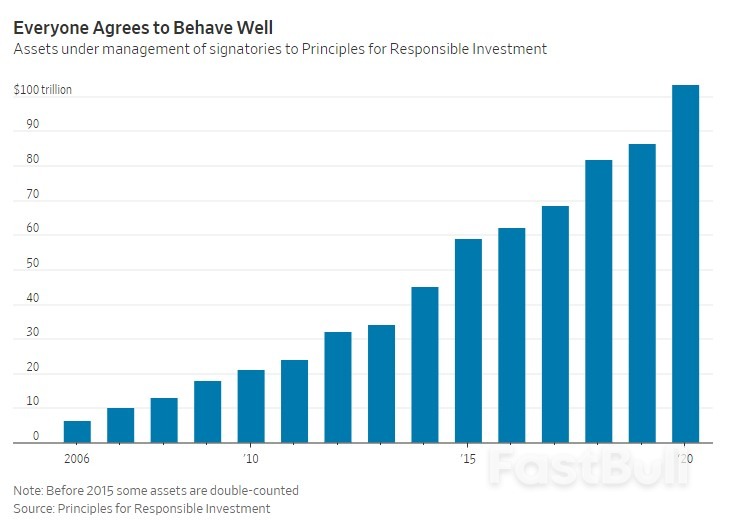
          Money has poured into ESG funds as noisy lobby groups push pension funds, university endowments and some central banks to shift their investments. The United Nations-supported Principles for Responsible Investment says signatories have $121 trillion of assets under management; even assuming lots of double-counting, that is most of the world’s managed money.
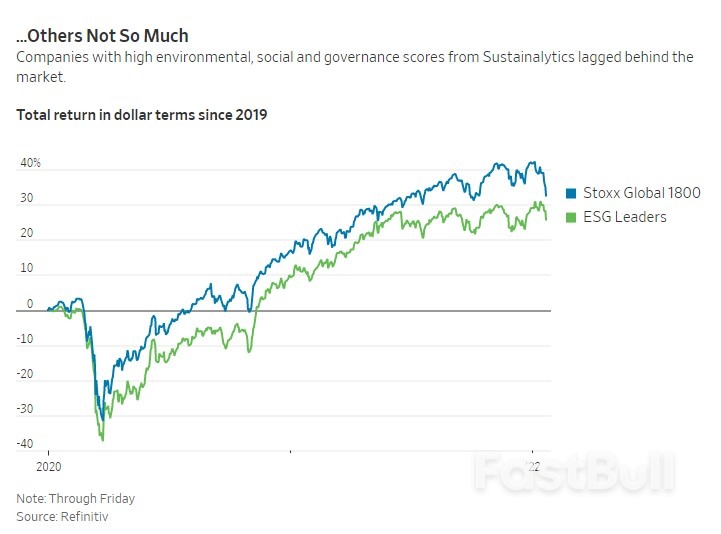
          Why the Sustainable Investment Craze Is Flawed_1
          Over the next few weeks, Streetwise will explore the explosion of ESG investing and why I think it is mostly—but not completely—a waste of time. I will also offer up some solutions and discuss how to use your money to make a difference, while understanding the inevitable trade-offs.
          ESG supporters can point to what look like successes: Their pressure has encouraged many companies to sell off dirty power plants, mines and, in the case of Anglo-Australian miner BHP, its oil business. It has even forced board changes at Exxon Mobil.
          Sadly, selling off assets or shares by itself does nothing to save the planet, because someone else bought them. Just as much oil and coal is dug up and burned as before, under different ownership. And there are plenty of people out there to buy the assets, because never before in history has there been so much private capital operating without the public reporting requirements brought by stock markets.
          Rich people who want to make the world greener could make a difference, by buying and closing dirty businesses even when they are profitable. So far, though, this hasn’t happened in any significant way. The pitch from Wall Street fund managers is the exact opposite—that by going green investors can change the world and make more money, not less.
          “A lot of [clients] only really get enthusiastic if they get comfortable that they are not sacrificing return,” says Valentijn van Nieuwenhuijzen, chief investment officer at fund manager NN IP, which is being bought by Goldman Sachs.
          Someone has to take a loss somewhere if fossil fuels are going to be left in the ground rather than extracted and sold. ESG investors’ hope is that the losses will fall on other people. The problem is that less environmentally-minded investors buying those shares, oil wells or power plants are absolutely not going to shut them down unless they stop being profitable.
          It might make sense for an investor or company to sell out of fossil fuels early if they think the retreat from coal and oil is inevitable—indeed, that was the pitch by the activist who took on Exxon—but that is simply to invest according to a political prediction, not a way to fight climate change.
          Why the Sustainable Investment Craze Is Flawed_2
          Why the Sustainable Investment Craze Is Flawed_3
          Some of the biggest sources of fossil fuels are immune to shareholder pressure anyway. Much of the world’s oil is pumped by government-controlled companies, led by Saudi Arabia and Russia. Exxon can be forced to change its approach, but the global supply of oil is still determined by OPEC, as President Biden’s appeal to the cartel to pump more to keep fuel prices down has demonstrated.
          There are three big pro-ESG arguments, which sound reasonable, but have major flaws.
          First, if companies treat the environment, workers, suppliers and customers better, it will be better for business. This could work where companies have missed something to boost profits, such as add solar panels on a sunny roof or create a better employee retention program. Early ESG activists plucked the low-hanging fruit here, but management has become painfully aware of changing customer and employee expectations, so there is less opportunity ahead.
          Adding costs to reduce a company’s carbon footprint, or paying staff more, should only help the stock price if it also raises revenue or reduces other costs, by say generating more loyalty from carbon-conscious consumers, lowering staff turnover or improving relations with regulators.
          Otherwise, profits can only be maintained by passing the higher costs through into higher prices, and—unless the firm has monopoly power—eventually customers who don’t care will go elsewhere. The alternative is to reduce profits, but ESG investors are almost universally against this.
          The second ESG point is that by shunning stocks or bonds of dirty companies, and embracing those of clean companies, it will direct capital away from bad things and toward good ones. After all, a lower stock price or higher borrowing cost in the bond market should make it less attractive for dirty companies to expand, and vice versa for clean companies.
          In practice, there has been a very weak link between the cost of capital and overall corporate investment for at least a couple of decades. Small changes in the cost of capital pale in comparison to the risk and return projections of a new project.
          That is not to say there is no link. Tesla, with extremely expensive shares, has repeatedly taken advantage of its ability to issue new stock to invest in factories and research. The high prices early last year for clean-energy stocks might have encouraged similar corporate investment. The flip side of course is that buying wildly overpriced shares isn’t a good way to make money, as losses of a third or more from this year’s peaks for clean-energy stocks shows. Shifting the cost of capital just might help save the planet, but after the short-term shift in valuations is over, it should lead to underperformance.
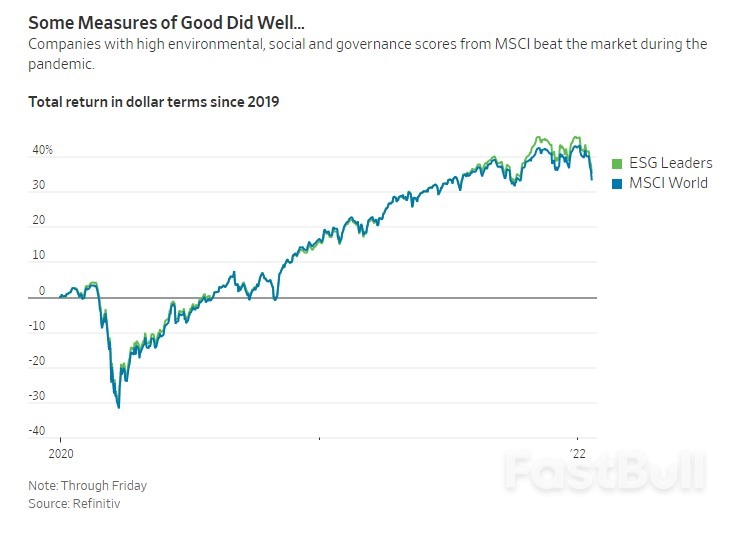
          The third claim from some ESG investors is that they are just trying to make money, and that involves shunning firms that are taking unpriced risks with the environment, workers or customers. Since they call themselves “sustainable” or use “ESG integration,” funds doing this look very like the rest of the ESG industry. The selection principle of the most popular ESG indexes, for instance, those from MSCI, involves identifying only risks that are financially material.
          I would say, sure. If you think the government is going to, say, raise fuel taxes, don’t buy manufacturers of gas-guzzlers. If you think the government will impose more restrictions on coal plants, then coal generation will be an even less attractive investment.
          Equally, if you think customers will be willing to pay more for brands that cut their carbon use, by all means bet on their shares. Just don’t fool yourself that you are making much difference to the world with your investment decision. Red-blooded capitalists chase these profits just as much as any green-minded investor. There is no need to try to persuade capitalists to have a conscience; they will do what you want if you make it profitable via customer demands or government intervention (or, if we are lucky, new technology).
          There is one way that ESG investing does, sort of, work. Shareholders can push companies to stop lobbying governments in favor of fossil fuels. Conceivably this might help push customers and governments to do the things that would really make a difference.
          My big concern about ESG investing is that it distracts everyone from the work that really needs to be done. Rather than vainly try to direct the flow of money to the right causes, it is simpler and far more effective to tax or regulate the things we as a society agree are bad and subsidize the things we think are good. The wonder of capitalism is that the money will then flow by itself.

          Source: The Wall Street Journal.


          Risk Warnings and Disclaimers
          You understand and acknowledge that there is a high degree of risk involved in trading. Following any strategies or investment methods may lead to potential losses. The content on the site is provided by our contributors and analysts for information purposes only. You are solely responsible for determining whether any trading assets, securities, strategy, or any other product is suitable for investing based on your own investment objectives and financial situation.
          Comments
          Add to Favorites
          Share

          New model for growth in Europe

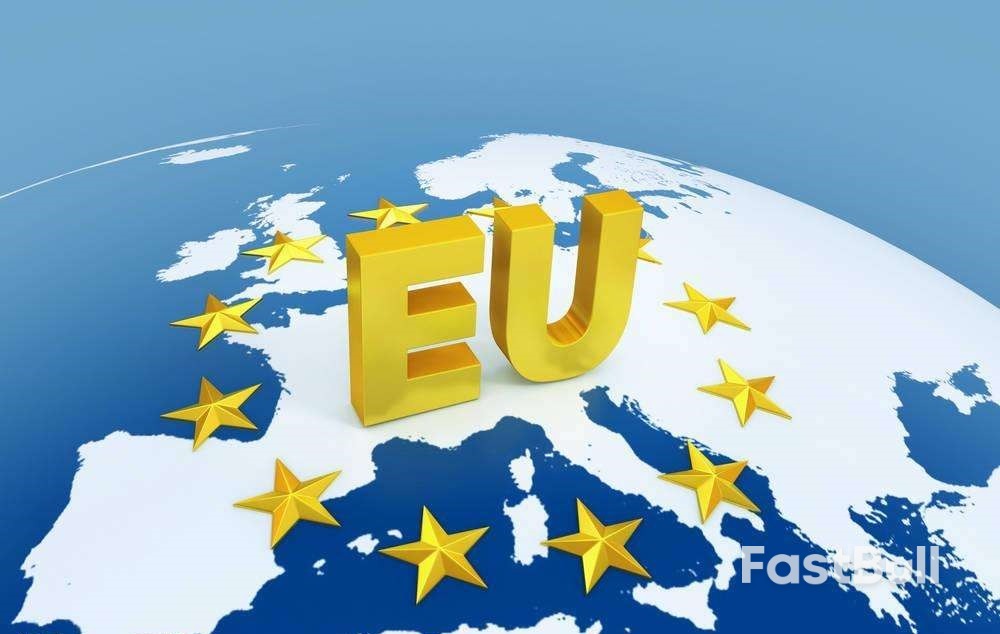
          New model for growth in Europe_1
          While the main ingredients for growth - education and skills, entrepreneurship and finance - and a well-functioning state with solid institutions will always be needed, convincing and sustained growth will require a three-fold change of tack.
          Policy cooperation, not competition, is at the heart of achieving good results. The concepts of competition and the level playing field drive most of the national and international regulations in place. However, the emergence of global tech giants and the entry of China into the global markets imply that it is very difficult to police and sustain the conditions that guarantee fair competition for all. The concept of the level playing field assumes that we are all equal. While we wish this were true, the fact is that not all countries are the same. Aiming for a level playing field just ignores that. Cooperation and coordination, on the other hand, aim to achieve results that are acceptable for all.
          By means of an example in Europe, the EU stands to gain a lot more if it coordinates its actions internally and aims to achieve one single voice externally. The EU's decisive, speedy and clear-minded response during the pandemic crisis, and certainly by comparison to that during the financial crisis, showed just how effective cooperation can be to achieve good outcomes.
          Greening, not greenwashing. The EU has set what are, without a doubt, and with good reason, incredibly ambitious goals for its climate policy. However, it has huge problems to overcome, including its own sincerity when it comes to "walking the walk" and not just "talking the talk". The recent taxonomy of what actually constitutes green investments that has recently been unveiled is an example of a very important tool, but one that can be challenged in this respect.
          The European Central Bank, an important player in this regard, has rightly placed the greening of monetary policy within its main objectives. However, it does not have the tools necessary to achieve this, and is in no way in the position to bear the cost of failing to achieve climate objectives without damaging its other financial objectives.
          While the EU is good at greening its production, it is far from greening its consumption. The attempt to tax polluting imports, very much in the cards, is a good attempt in this direction, but it will need to ensure that it does not stall poorer countries' access to the EU market. This is a very delicate balance that the EU will need to manage, as incentives to greenwash are very visible.
          Time for alliances of the "non-like-minded". Too often we hear that to tackle global problems we need to form strategic alliances of the like-minded. Driven, understandably in a way, by the desire to make progress, Europe needs to talk with those that think and speak the same way. This, the argument goes, will give it scale and therefore greater bargaining power to deal with those that are not like-minded. However, when it comes to solving global problems, partial strategic alliances that achieve agreements then need to communicate those agreements to "the other side". And those on the other side of the alliances do not like to be confronted with "take it or leave it" deals. When it comes to global public goods, like the climate, everyone must sit on the "take" side of negotiations and contribute at a rate that is commensurate with their capacity. It is of the utmost importance to engage with non-like minded parties if we are to make sustainable progress.
          It is necessary to change tack slightly when it comes to solving global and domestic problems alike. We can no longer afford "perfect competition", good intentions, or indeed to talk only to those who think like we do. Let's hope that 2022 will be the year to go that extra mile.

          Source:European Economic and Social Committee

          Risk Warnings and Disclaimers
          You understand and acknowledge that there is a high degree of risk involved in trading. Following any strategies or investment methods may lead to potential losses. The content on the site is provided by our contributors and analysts for information purposes only. You are solely responsible for determining whether any trading assets, securities, strategy, or any other product is suitable for investing based on your own investment objectives and financial situation.
          Comments
          Add to Favorites
          Share

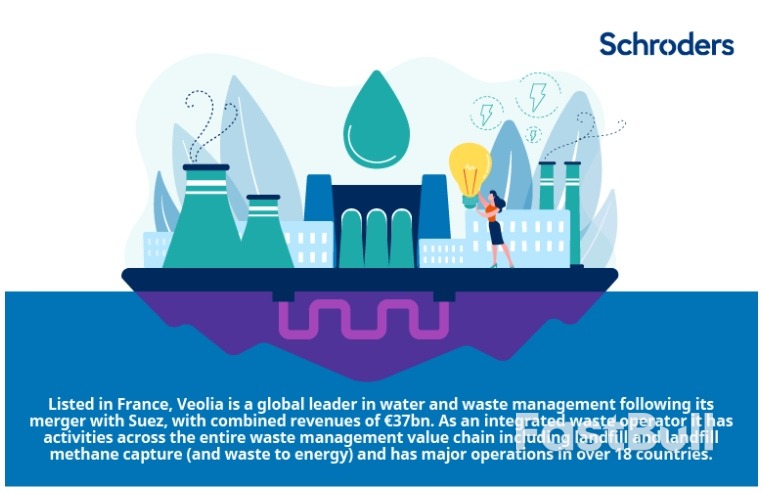
          Why should investors care about waste management?

          Waste management has long been one of society’s primary challenges. It’s an industry that’s ripe for disruption given how little it’s changed over the last few centuries.
          For example, only in the last 100 years have we started to see developments in waste disposal techniques, and improvements in municipal recycling rates have occurred over the last two decades.

          What is waste?

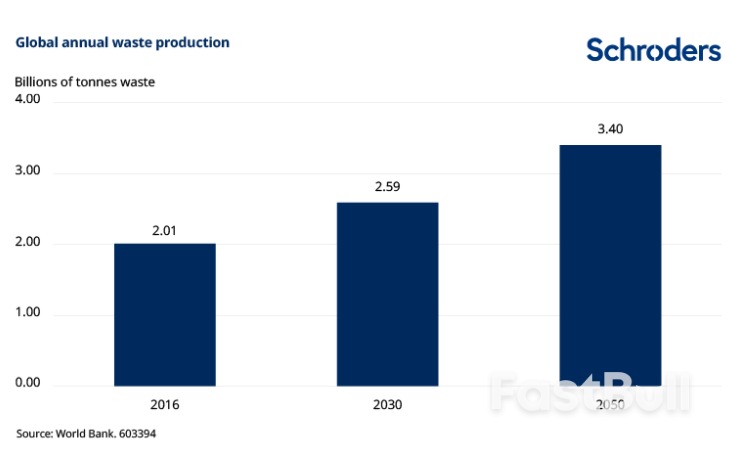
          The world generates about two billion tonnes of municipal solid waste (MSW) annually, according to the World Bank.
          MSW is essentially “regular” rubbish that is produced from non-industrial sources. In other words, it’s waste that comes from residential homes, restaurants, retail centres and office buildings.
          Food and green waste (such as grass clippings and leaves) make up the largest proportion of MSW globally.
          The world’s waste problem is worsening at an alarming rate, underpinned by powerful megatrends such as population growth, urbanisation and economic development.
          Analysis by Allied Market Research suggests annual waste production is expected to grow 29% by 2030 and by nearly 70% by 2050.
          As a result, the global waste management industry, which today is worth $2.08 trillion, is forecast to top $2.34 trillion by 2027.
          Why should investors care about waste management?_1

          Why is waste a problem?

          Poor waste management contributes to climate change, directly affects ecosystems and generates air, water and land pollution.
          For example, landfills alone – in which 37% of global MSW is disposed - account for 8-10% of human activity-based methane emissions.
          Food waste is a pressing issue – its economic cost is estimated to be $1 trillion a year, according to the Food and Agriculture Organisation of the United Nations. It can lead to greater water scarcity, loss of biodiversity, adverse health effects and soil erosion – which in itself can lead to increased risk of conflict and loss of livelihoods.

          Is waste creation being regulated?

          Social and political pressure for waste creators to handle waste in more sustainable ways is intensifying. As a result, the regulatory burden is ratcheting up.
          There appears to be unanimity among regulators to enforce a “polluter pays” principle. This could include increased taxes on waste imports/exports, rising landfill gate prices and increasingly punitive fines for the mismanagement of waste and illegal dumping.
          Furthermore, regulators are looking to incentivise countries to dispose of the waste they create domestically rather than exporting it to other countries - a common practice given the strong international trading market for waste.
          These shifts in the regulatory landscape create a growing need for society to develop new and innovative ways in which to handle waste in socially- and environmentally-friendly ways.
          As such, there is an increasing opportunity for companies with new technologies to enable this.

          What is the opportunity for investors?

          Given the rapid, expected rise in MSW generation over the coming decades, we direct our focus on the emerging technologies that are being developed to reduce waste once it’s already been created.
          There are three areas we believe are particularly interesting.

          AI and automated sorting

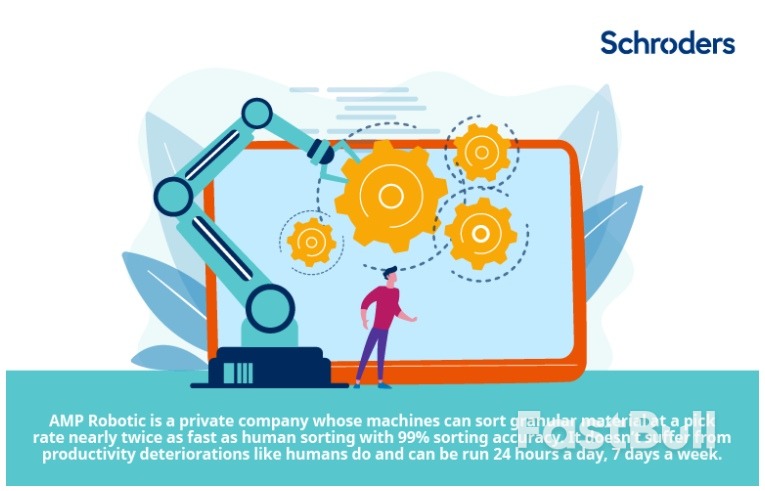
          It’s estimated that over half of all waste management tasks in material recovery facilities can be automated. Using computer vision, 3D laser scans and metal sensors, combined with machine learning and advanced robotics, the accuracy and sensitivity of automated sorting can be dramatically improved.
          Why should investors care about waste management?_2The vast majority of companies emerging in this space offer advanced scanning and sorting technologies that can be retrofitted onto existing sorting lines, which means that significant capital outlays can be avoided.

          Waste-to-energy

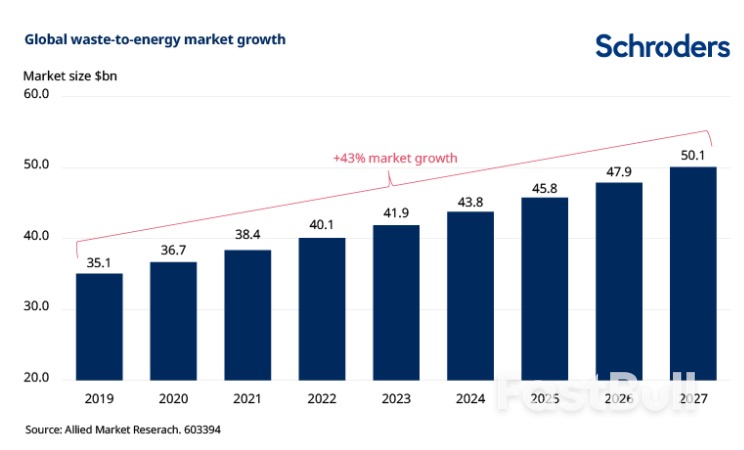
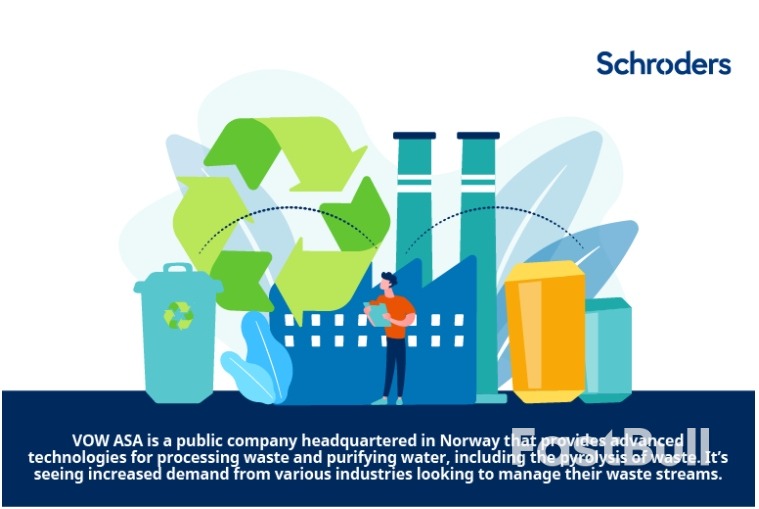
          This ia a method by which electricity or heat is generated from the processing and treatment of waste. It cuts demand for landfill and dumping sites, lowers dependence on fossil fuels and in some instances, reduces environmental pollution.
          It’s expected to be the fastest-growing waste management sector over the next five years.
          Why should investors care about waste management?_3
          Why should investors care about waste management?_4Pyrolysis is the decomposition of a material using high temperatures

          Landfill methane capture

          Landfills account for 11% of global methane emissions – this is the gas that is generated as organic matter decomposes. It has higher global warming potential than carbon dioxide.
          But the gas can be captured and used as a clean fuel source, preventing landfill gas emissions and displacing the use of fossil fuel alternatives.
          One million tonnes of MSW can capture enough methane to power about 1,850 European homes for a year.
          While other methods of transforming waste to energy have higher energy conversion efficiency, where landfills already exist, the environmental impact of capturing the methane that would otherwise enter the atmosphere is clearly positive.

          Why should investors care about waste management?_5Society’s waste problem is here to stay

          Underpinned by strong social megatrends and increasingly stringent regulations, the need to manage waste in an energy-efficient, socially- and environmentally-friendly way, is increasing.
          In an industry that has remained broadly unchanged for centuries, we believe this presents a significant opportunity for new emerging technologies to become market leaders in this rapidly growing market segment while also tackling one of mankind’s biggest social and environmental challenges.

          Source:schroders

          Risk Warnings and Disclaimers
          You understand and acknowledge that there is a high degree of risk involved in trading. Following any strategies or investment methods may lead to potential losses. The content on the site is provided by our contributors and analysts for information purposes only. You are solely responsible for determining whether any trading assets, securities, strategy, or any other product is suitable for investing based on your own investment objectives and financial situation.
          Comments
          Add to Favorites
          Share

          S' poreans are least optimistic about the metaverse among those in SEA, according to survey

          After being urged to stay indoors for the better part of two years, the lust for escape is inevitable. Many seem to be finding solace in the idea of a metaverse. It’s not strictly defined — some see it as an extension of the physical world, others as a wholly digital reality — but put simply, it’s a new realm to exist in and explore.
          Over the past year, we’ve seen people flock to virtual worlds like Decentraland and Sandbox. Even household brands including Samsung and Nike have set up shop in such spaces. The UFC is also planning virtual fights and K-pop labels are promoting virtual stars; however, that’s not to say that this idea is universally accepted. In fact, there’s quite a long way to go.
          As with any new innovation, scepticism is quick to follow. When it comes to the metaverse, this has been especially true among Singaporeans.
          Milieu Insight recently conducted a survey across Southeast Asia to gauge the general sentiment around the metaverse. While most countries’ respondents felt largely positive about the development, Singapore stood out as an exception.
          56 per cent of Singaporean respondents chose at least one positive emotion — from a given list — when asked to describe their thoughts on the metaverse. The average across other Southeast Asian countries was 72 per cent.

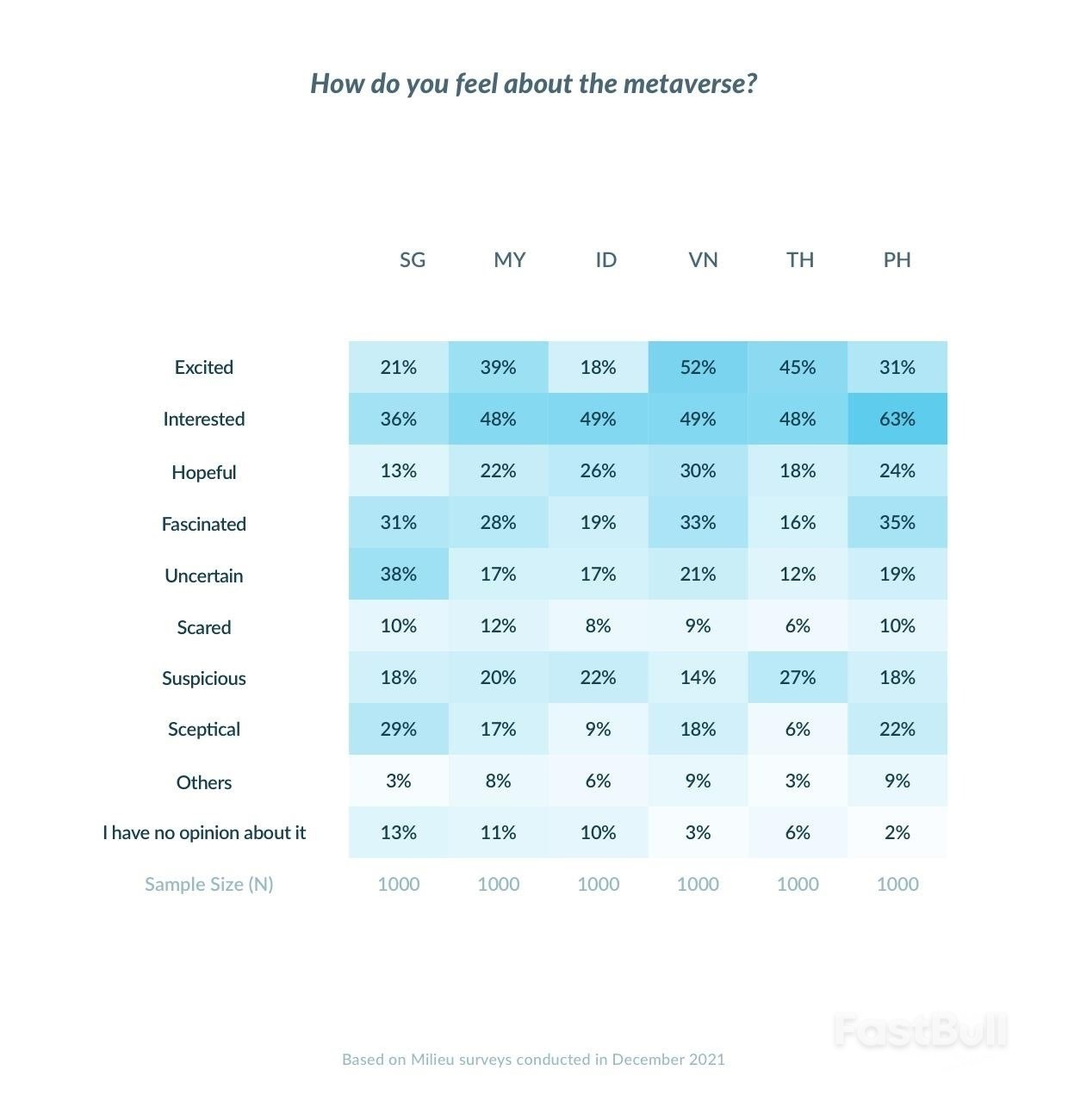
          How do S’ poreans feel about the metaverse?

          Among the countries surveyed, Singaporean respondents felt the least hopeful and most uncertain about the metaverse. Despite being dubbed a ‘crypto hub’, the country also recorded the highest proportion of respondents who had no opinion on the matter.
          This ties in with the results of another survey conducted by Finder which ranked countries by cryptocurrency ownership. Out of 27 countries, Singapore ranked 11th — well behind Vietnam, Indonesia, and Philippines, all of which found places in the top five.
          S' poreans are least optimistic about the metaverse among those in SEA, according to survey_1

          Results of survey conducted by Milieu Insight

          Although Singapore has provided immense support to blockchain startups — through initiatives such as the Singapore Blockchain Innovation Programme — the country has been wary of the general public investing in the space.
          Most recently, the Monetary Authority of Singapore (MAS) issued guidelines to prevent crypto exchanges from advertising to the general public. Investors remain free to purchase cryptocurrency, however, the central bank discourages using it for speculative trading.
          Another reason for Singapore’s disinterest in the metaverse could stem from the country’s median income. At around S$4,500 per month, the median monthly salary in Singapore is almost four times that of countries including Vietnam and Philippines.
          Therefore, the allure of play-to-earn crypto games — such as Axie Infinity, where active players can earn up to S$20 per day — might not resonate as strongly among Singaporeans, as it does with others around Southeast Asia.

          What do S’ poreans dislike about the metaverse?

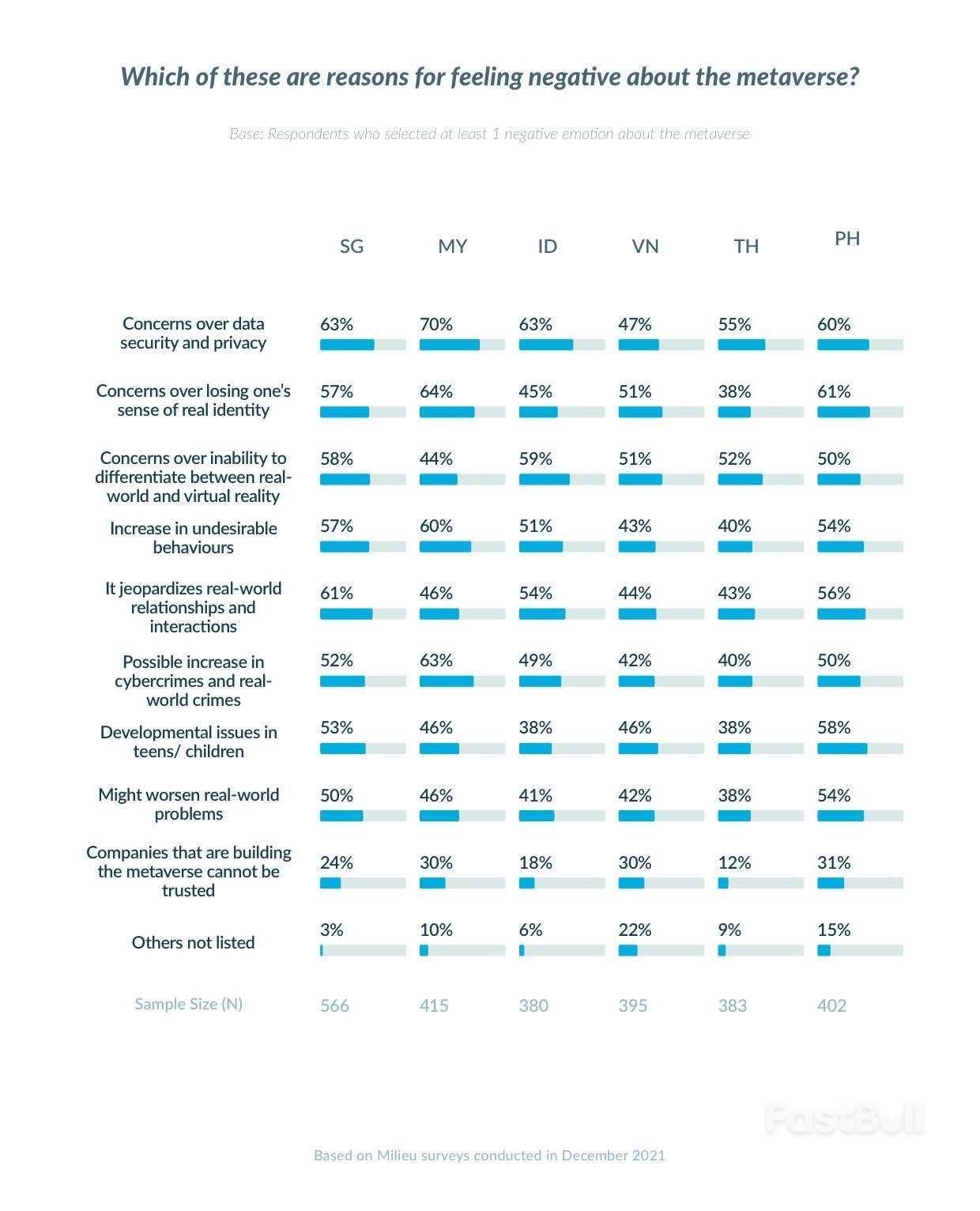
          Among those who felt negatively about the metaverse, the most common reason was their concerns over data security and privacy. This response might betray a lack of understanding rather than a genuine concern.
          In reality, data security and privacy are two key arguments in support of blockchain technology. Decentralisation ensures that transactions can be made without users having to reveal personal information or have it stored on a company’s servers.
          S' poreans are least optimistic about the metaverse among those in SEA, according to survey_2

          Results of survey conducted by Milieu Insight

          Another reason which sticks out is ‘Companies that are building the metaverse cannot be trusted’. It seems to imply the metaverse is a singular object which is being built by a myriad of companies. That’s certainly not the case.
          Once again, it ties back to the idea of decentralisation. By its very nature, there’s no single authority which could control the metaverse.
          Then, there’s ‘Developmental issues in teens/children’. This might be a valid concern regarding the use of computers or mobile devices in general, but there’s no reason to believe that the ‘metaverse’ would add any further detriment.
          Through these arguments, I don’t mean to say that the concept of the metaverse is without fault — only that the reasons being cited in this survey aren’t all that well-reasoned.

          Should children be allowed to participate in the metaverse?

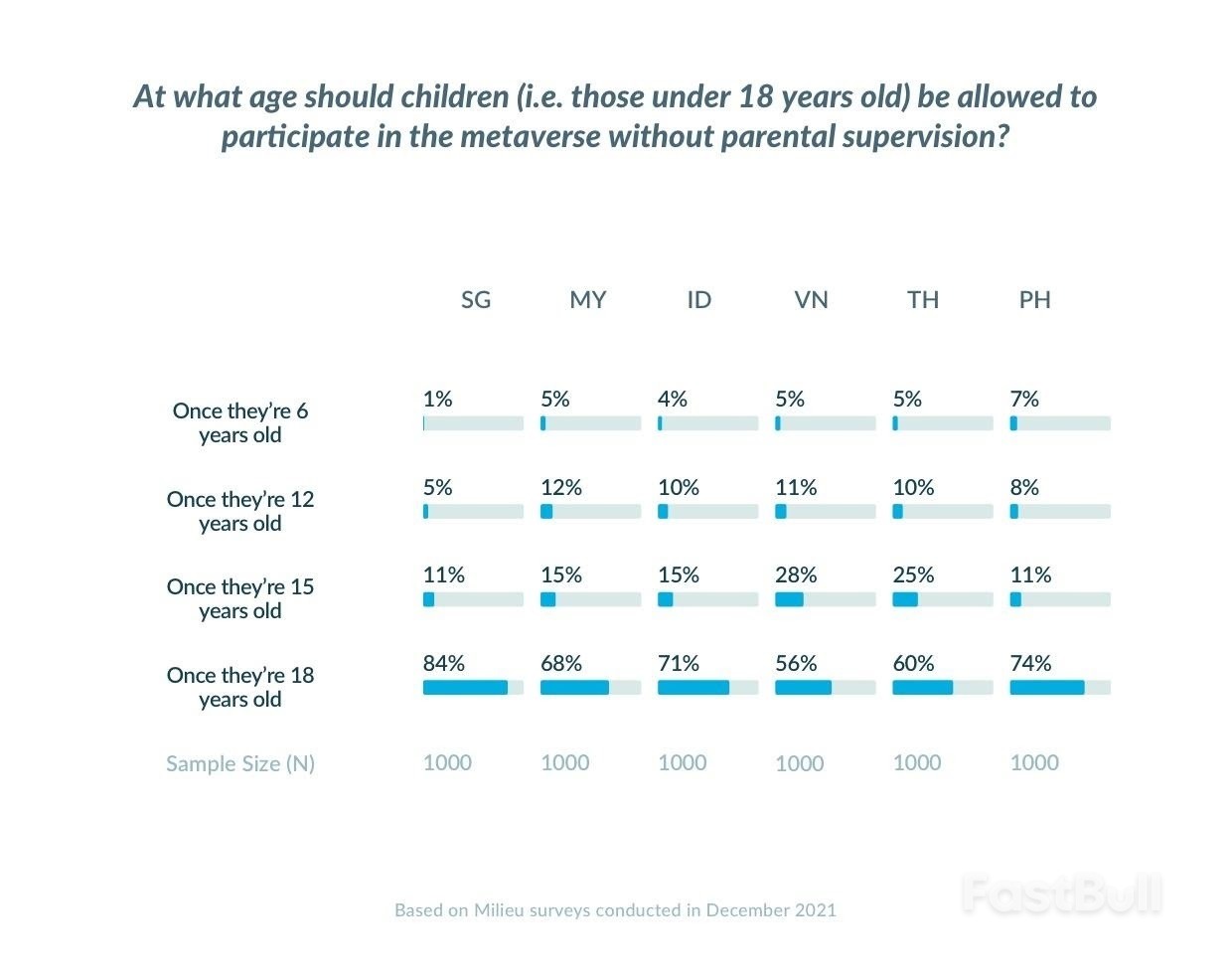
          Across the board, the majority of respondents feel that children shouldn’t be allowed to “participate” in the metaverse without parental supervision.
          If I were to throw out a guess, this is because people have come to associate the metaverse — and almost anything related to blockchain technology — with speculative investing.
          S' poreans are least optimistic about the metaverse among those in SEA, according to survey_3

          Results of survey conducted by Milieu Insight

          In reality, participating in the metaverse could be as simple as playing a video game, or looking at cool artwork.
          The key idea behind the metaverse — even if it is fluid in definition — is for people to share the same virtual spaces and be able to interact with each other.
          If you don’t have problems with a 12-year-old playing online games like Minecraft, then there’s no reason to say that they can’t “participate” in the metaverse.

          What does this survey prove?

          This survey illustrates the misconceptions around the metaverse and blockchain technology, which have become increasingly prevalent ever since these ideas reached mainstream media.
          Many people are reading about these terms for the first time through articles about crypto volatility, scams, and rug pulls. While these are all legitimate occurrences, they’ve begun to spin a narrative which doesn’t tell the whole truth.
          Blockchain technology has far more to offer than risky trades. It can contribute to more efficient practices in industries ranging from healthcare to hospitality.
          Although there are reasons to be sceptical, many of those cited here seem to be fueled by fear and buzzwords rather than evidence.

          Source: vulcanpost.com

          Risk Warnings and Disclaimers
          You understand and acknowledge that there is a high degree of risk involved in trading. Following any strategies or investment methods may lead to potential losses. The content on the site is provided by our contributors and analysts for information purposes only. You are solely responsible for determining whether any trading assets, securities, strategy, or any other product is suitable for investing based on your own investment objectives and financial situation.
          Comments
          Add to Favorites
          Share

          Outlook 2022: 10 climate promises the financial system must keep

          ‘I am here right now to ask business and finance leaders: show us your faithfulness, show us your trustworthiness, show us your honesty,’ declared Ugandan climate activist Vanessa Nakate at the COP26 meeting in Glasgow. Nakate’s words point to the central issue of trust in the climate promises made by governments, development and commercial banks, investors and insurers and central banks and regulators – as well as the promises that they should have made.
          The world left Glasgow a few steps closer to a sustainable financial system. Governments’ net-zero commitments now cover 90% of global emissions, with notable pledges from India and Nigeria. Yet global emissions at the end of this decade are expected to be twice as high as required for keeping global warming to 1.5°C.
          Decarbonisation pledges are becoming more common in private finance, with more than 450 institutions with combined portfolios of over $130tn having joined the Glasgow Financial Alliance for Net Zero.
          Still, fundamental financial inadequacies need to be fixed urgently. In the words of United Nations Secretary-General Antonio Guterres, ‘we are on the edge of an abyss’. Here, the political economy will be crucial. With Egypt hosting COP27 later this year, the International Monetary Fund/World Bank annual meetings taking place in Morocco and Indonesia chairing the G20 group, key milestones will be shaped by countries from the global south.
          To earn and maintain trust, players across the system must use 2022 as an opportunity to deliver on their promises. There are 10 key commitments that must be kept.

          1、Honour and exceed the $100bn climate finance commitment

          The oldest and most iconic promise for industrialised countries is the delivery of $100bn in climate finance for developing countries. The failure to reach this by 2020 was recognised as a breach of trust at COP26. Meeting the pledge in 2022 would help restore faith in climate negotiations, and industrialised countries have drawn up a delivery plan for how to do so.
          But public finance should not stop there. Estimates by the Grantham Research Institute suggest that developing countries (ex-China) will need an additional $8bn in climate finance by 2025 and close to $2tn per year by 2030. Some of this will come from domestic public and private sources, but a clear increase beyond the $100bn of public finance is needed.

          2、Produce net-zero transition plans

          GFANZ members have committed to setting out steps to achieve short-, medium- and long-term net-zero goals within 12 months of joining the alliance. In some jurisdictions, including the UK and European Union, the publication of such financial sector transition plans is becoming mandatory. Transparency on planned capital allocation will be critical to ensure their credibility.

          3、Finance adaptation and resilience

          With global average temperatures already rising by 1.1°C, the priority for developing countries is increasing finance for adapting to future physical shocks as well as securing compensation for the loss and damage they have already endured.
          Finance for resilience, adaptation and loss and damage remains stuck in an under-investment rut, focusing on millions and billions rather than the trillions needed across the financial system. For this to change materially, not only will industrialised countries have to commit new public financial resources, but the rules governing the financial system will need to factor the physical impacts of climate into every decision.

          4、Phase out fossil fuel finance

          With the International Energy Agency concluding that there is no need for investment in new fossil fuel supply to achieve net zero, a key task for 2022 will be to accelerate public and private sector action to wind down finance for fossil fuels. In Glasgow, 34 countries promised to end public financial support for fossil fuels in 2022.
          COP26 also witnessed progress towards ending oil and gas, with the launch of the 12-country Beyond Oil and Gas Alliance. The need to power past gas has been accentuated by the current energy market crisis. So, in 2022, the financial sector needs to match governments’ ambition through clear commitments to cease new investment in fossil fuels and support the responsible phase-out of existing assets.

          5、Make the connection between climate change and nature

          Financial institutions will need to go beyond the energy system to reach net zero. Only around 30 financial institutions, representing $8.7tn of global assets (less than 5%), have committed to addressing the causes of deforestation. This compares to a pledge by 141 governments representing over 90% of global forest cover at COP26 ‘to halt and reverse forest loss and land degradation by 2030’.
          With the COP15 biodiversity summit scheduled for April, there is considerable scope this year for banks and investors to set credible pledges to cease financing for deforestation and land use that damages both climate and biodiversity.

          6、Upgrade the financial rules of the game

          At COP26, the 100 members of the Network for Greening the Financial System issued the Glasgow Declaration. In 2022, central banks and supervisors will need to upgrade their efforts to support the net-zero transition, respond to rising climate-related physical risks and integrate the loss of biodiversity into plans to green the financial system. The focus should be on increasing capacity in jurisdictions where progress has been more subdued, and in facilitating consistency of data, taxonomies and standards.
          2022 will also be the first full year of the International Sustainability Standards Board, and a particular focus will be on the elaboration of the climate-related disclosures prototype.

          7、Deliver on inclusive carbon pricing

          Complementing regulatory efforts, fiscal policy for climate action should be guided by the principles of effectiveness, efficiency and fairness. 2022 should be the year when inefficient fuel subsidies are eliminated, and resources redirected to investments in innovation and infrastructure. Carbon taxes can help boost fiscal revenues that can be directed to delivering a just transition to net zero. Adjusting price signals to shift economic activity to lower-carbon sources will be crucial to correcting market failures. The German government has made carbon pricing one of the top priorities for its G7 presidency agenda this year.

          8、Set standards for voluntary carbon markets

          Following years of negotiations, COP26 delivered a rulebook for international co-operation through carbon markets under article 6 of the Paris agreement. The breakthrough sets the stage for enhanced use of voluntary carbon markets.
          Efforts this year should focus on scaling the market up in a credible way. Setting high-integrity standards should be a priority to address scepticism in the market. Emphasis should be placed on avoiding disincentivising technological transformation in energy and industry through an oversupply of low-cost offsets. As countries in the global south set their own net-zero goals, the production of emissions in carbon markets will be constrained and can be focused on where the greatest developmental and environmental benefits can be achieved.

          9、Put people at the heart of climate finance

          COP26 made it clear that climate finance needs to support a just transition to net zero. In 2022, this means investors, commercial banks and development banks making sure that their climate plans incorporate provisions for decent work, social dialogue and community empowerment. A key priority will be putting the $8.5bn South Africa Just Energy Partnership into practice. This initiative can serve as a blueprint for other emerging economies.

          10、‘Whatever it takes’: transformational financing for the climate emergency

          The final promise is one yet to be made: a transformational financial package fit for the scale of the climate emergency. At COP26, Barbados Prime Minister Mia Mottley compared the $25tn in quantitative easing following the 2008 financial crisis and the pandemic with the level of climate ambition. ‘Had we used the $25tn to purchase bonds that financed the energy transition, we would be keeping within 1.5 degrees,’ she declared, suggesting an annual increase in special drawing rights of $500bn for 20 years to finance the transition instead of the modest $50bn being proposed for adaptation. This is a moment for real strategic leadership from both the G7 and G20.
          2022 will be a moment of truth for the climate finance promises that have already been made – and a time to make new commitments that respond to the gravity of the climate outlook. This means not just more climate finance but, crucially, better and fairer finance to avoid greenwashing and meet the imperatives of climate justice.

          Source: OMFIF

          Risk Warnings and Disclaimers
          You understand and acknowledge that there is a high degree of risk involved in trading. Following any strategies or investment methods may lead to potential losses. The content on the site is provided by our contributors and analysts for information purposes only. You are solely responsible for determining whether any trading assets, securities, strategy, or any other product is suitable for investing based on your own investment objectives and financial situation.
          Comments
          Add to Favorites
          Share

          Russia's Oil Output Could Peak In 2023

          Thomas
          Russia, the world’s third-largest oil producer, has long been an unknown when it comes to the OPEC+ production agreement which caps the petroleum output of participants to support higher prices. It was Moscow’s spat with Saudi Arabia over production quotas in early 2020 which, combined with the emergence of the COVID-19 pandemic, caused crude oil prices to plunge into negative territory for the first time ever. The North American benchmark West Texas Intermediate plunged to minus $37.63 per barrel before recovering, while Brent did not enter negative territory the international benchmark, plunged to an intraday low of less than $15 per barrel. During that time Moscow, Riyadh and other OPEC+ signatories were finally able to agree on production quotas. However, Moscow’s economic ambitions remain a threat to the agreement’s firmness, particularly with Washington threatening further sanctions. With OPEC gradually expanding production quotas set out in the agreement confirmed at the 19th ministerial meeting, there is considerable speculation as to how much global petroleum supply will expand and how that will affect crude oil prices. A key point of conjecture is whether Russia can grow its crude oil output as planned and allowed by its OPEC+ quota, with it speculated that the world’s third-largest oil producer is operating at or near capacity. For December 2021 Russia, according to the Ministry of Energy, pumped an average of 10.903 million barrels of crude oil and gas condensate daily. That number was marginally lower than the 10.906 million barrels produced per day for November 2021 but an impressive 8.4% higher compared to the same period a year earlier.
          Government data shows that total annual oil and gas condensate production during 2021 averaged 10.5 million barrels per day, which is over 2% higher than a year earlier. It is anticipated that Russia’s crude oil output will expand further during 2022. The energy ministry predicts that forecast average annual daily crude oil output will climb to between 10.84 million and 11.05 million barrels, which is a 3% to 5% increase over 2021.
          Despite concerns that Russia’s petroleum industry reaching production capacity Deputy Prime Minister Alexander Novak, in October 2021, claimed there is ample room to expand crude oil output. Novak, who is the Kremlin’s key negotiator with OPEC, claimed Russia possesses sufficient spare capacity to ramp up production to over 11 million barrels per day. To support this assertion the deputy prime minister cited earlier production records where Russia was pumping up to 11.4 million barrels daily, in February 2020, before the COVID-19 pandemic hit forcing operational shut-ins. While some analysts believe this is not achievable, industry consultancy Rystad Energy, in an August 2021 press release, predicted that Russia’s petroleum production during July 2022 will hit a new record. Rystad is tipping that the world’s third-largest oil producer will pump 11.6 million barrels per day during that month which, if achieved, represents a notable 11% increase compared to the same month in 2021. The consultancy went on to forecast that the world’s third-largest oil producer’s output will continue growing, peaking at 12.2 million barrels per day by mid-2023.
          Regardless of those optimistic predictions, there are signs that Russia could struggle to lift petroleum production as predicted. The primary elements governing Moscow’s planned increase in crude oil output are Russia’s OPEC+ quota, external factors such as climate and whether the petroleum industry has spare productive capacity. Under the OPEC+ agreement, which was confirmed at the July 2021 19th Ministerial Meeting, Russia is permitted to pump up to 11 million barrels of crude oil daily until the end of April 2022. For May 2022, the quota will increase to 11.5 million barrels of crude oil per day. Energy consultancy Platts Analytics, in a December 2021 statement, indicated that Russia can produce the volume permitted by the OPEC+ agreement.
          Nevertheless, there are several headwinds that can impact Russia’s planned expansion of its petroleum production. One notable risk is the impact of extreme winters on Russia’s hydrocarbon sector, which is an ongoing threat to industry operations and the ability to expand petroleum output. Current harsh subzero temperatures are hampering petroleum operations forcing wells to be shut-in and reducing pipeline flows. That will impact Russia’s January 2022 crude oil production volumes, meaning the country may not achieve the target set by Novak who in a TASS article stated the country would pump 10.1 million barrels of crude oil daily for the month. This has sparked speculation among industry analysts that Russia will not meet its January 2022 OPEC+ production quota of 10.122 million barrels per day. There is also the potential for the coronavirus to sharply impact industry operations with COVID-19 cases soaring since the emergence of the Omicron variant. Russia is ranked sixth globally by COVID-19 cases and fourth for deaths. Pandemic related supply chain breakdowns and the threat of further lockdowns are weighing on the planned ramp-up of industry activity to support the projected production growth. U.S and European Union sanctions against Russia, in response to among other incidents the invasion of the Crimea and Eastern Ukraine, are also a major risk that may impact plans to grow petroleum production. The sanctions targeting various individuals, commercial entities and vessels, including the Nord Stream 2 natural gas pipeline, prevent access to U.S. capital as well as technology to be used in hydrocarbon exploration and field development.
          Furthermore, recent investment in developing greenfield and brownfield petroleum projects will not be enough to bolster Russia’s crude oil output. Analysts are concerned that rising oilfield depletion rates will more than offset the volume of new production coming online as various projects are completed and online. The U.S. Energy Information Administration went as far as to state that the development of greenfield projects in Russia may be unable to boost production much higher than the 10.9 million barrels pumped during December 2021. This, according to the EIA, is because the additional barrels those operations will add, when operations come online, are offset by declining output from mature oilfields, particularly in Siberia.
          There are growing doubts as to whether Russia can grow petroleum production to the volumes forecast by Moscow and pump the amount of crude oil allowed by the OPEC+ agreement. This is despite some industry experts including Rystad and Platts Analytics predicting that Russian petroleum production will hit a new record by July 2022 and continue rising into 2023. The headwinds faced by Russia’s oil industry could derail those plans. A combination of extreme climate, rising depletion rates in mature Siberian oilfields and U.S. sanctions potentially blocking access to industry investment as well as technology is weighing on the development of hydrocarbon projects. If Russia is unable to grow its oil production at the rate predicted and allowed by its OPEC+ quota, with the country permitted to pump 11.5 million barrels per day as of May 2022, then global supply will not expand as expected. This is because not only are there questions about whether Russia‘s petroleum industry is reaching capacity but if OPEC can lift crude oil output as planned during 2022. If supply does not grow, crude oil prices will remain high further underpinning the inflationary threat which has emerged and possesses the potential to derail the global post-pandemic economic recovery.

          Source: Oilprice.com

          Risk Warnings and Disclaimers
          You understand and acknowledge that there is a high degree of risk involved in trading. Following any strategies or investment methods may lead to potential losses. The content on the site is provided by our contributors and analysts for information purposes only. You are solely responsible for determining whether any trading assets, securities, strategy, or any other product is suitable for investing based on your own investment objectives and financial situation.
          Comments
          Add to Favorites
          Share

          Investor Expectations for Rates, Inflation and Commodities

          In financial markets every price tells a story about what investors implicitly believe to be the most likely scenario for the future. Here is what market prices for U.S. Treasury bonds, Treasury Inflation-Protected Securities (TIPS), Fed Funds Futures, S&P 500® Annual Dividend Index Futures and various commodity contracts are signaling about investor expectations for 2022 and beyond.

          Inflation

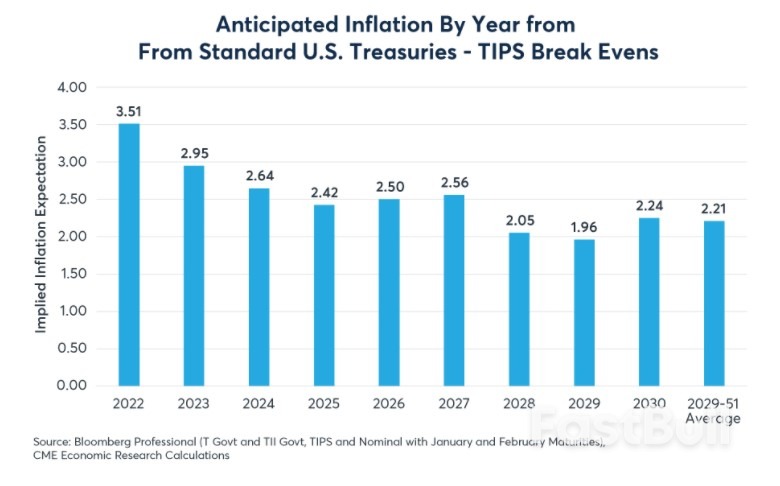
          Investors anticipate inflation to average around 3.5% in 2022, down significantly from the nearly 7% pace in 2021 but still well above the Federal Reserve’s (Fed) theoretical target of around 2%. The January 2023 TIPS have a yield of -3.05%, whereas the standard U.S. Treasury maturing that same month has a yield of +0.46%, implying inflation could be around 3.5% this year. Looking further into the future, the break-even inflation spreads between TIPS and standard (nominal) U.S. Treasuries imply that investors expect inflation at 2.9% in 2023, and annual inflation at around 2.5% from 2024 to 2027. Crucially, investor see long-term inflation expectations (from 2028 to 2051) to be anchored around 2-2.25% (Figure 1).
          Investor Expectations for Rates, Inflation and Commodities_1

          Figure 1: Investors expect 3.5% inflation in 2022 with long-term inflation converging to around 2.2%

          This has two implications. First, to achieve 3.5% inflation in 2022, the monthly figures would have to average around +0.3%. Since April 2021, monthly inflation has often been much higher, with readings often in the +0.6-0.9% per month range. Continued upside surprises could upset the expectation of inflation averaging 3.5%.
          Second, long-term inflation expectations remain well anchored. Investors appear to believe that the recent spike in inflation could prove to be temporary and that 1970s-style inflation is unlikely. Moreover, investors appear to believe that the risk of inflation rising significantly above 2% in the long run is not much greater than the risk of inflation significantly undershooting 2%.

          Interest Rates

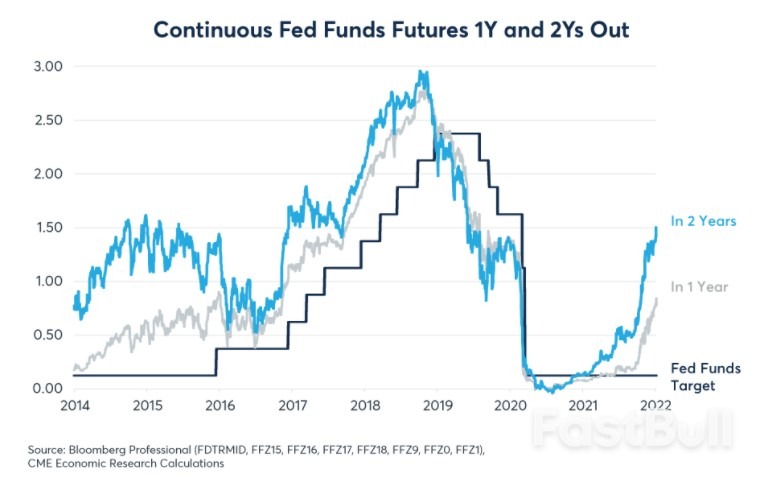
          Part of the reason why long-term inflation expectations remain so well anchored is that investors anticipate that the Fed will tighten monetary policy enough in 2022 and 2023 to head off a longer term rise in inflation. As of early January 2022, investors have priced that the Fed would most likely hike rates three times this year followed by a further two or three rate hikes in 2023 (Figure 2).
          Investor Expectations for Rates, Inflation and Commodities_2

          Figure 2: Investors price Fed funds at 0.85% at the end of 2022 and 1.5% by the end of 2023.

          Beyond 2023, SOFR futures imply a long-term equilibrium Fed policy rate of around 1.8-2.0%, just below the anticipated rate of inflation of 2-2.25%. This implies that investors see long-term equilibrium real interest rates at being close to zero or even slightly negative.
          This reflects an expectation that the 2020s will eventually come to resemble the 2010s, when inflation rates remained stable at around 2% and interest rates eventually rose to the level of inflation. Even so, this is still a departure from the period from 1980 to 2008 when interest rates were typically a few percent above the rate of inflation.
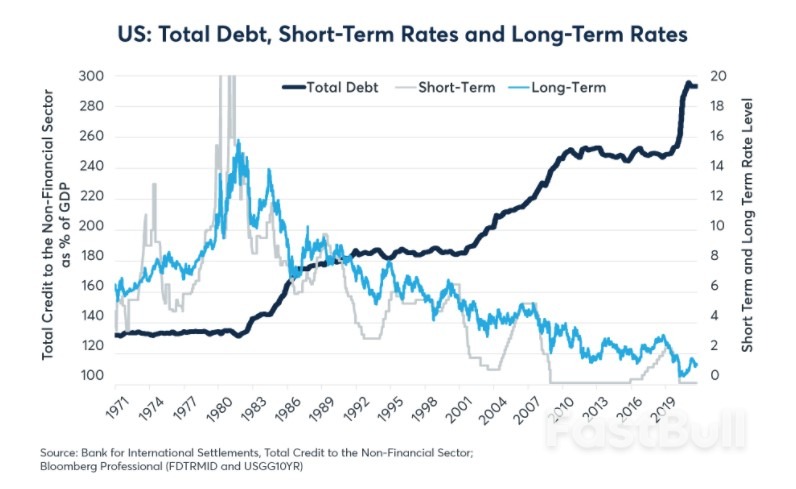
          The market’s view of equilibrium interest rates may be influenced by the level of debt in the economy. As debt levels have risen over the past 40 years, interest rates have tended to trend downwards (Figure 3). This could be because inflation rates have generally fallen (until 2021 anyway). It could also reflect a belief on the part of investors that high debt burdens can only be managed with interest rates close to or below zero in real terms. The fact that the overall leverage in the economy rose sharply during the early stages of the pandemic may be reinforcing the fear that disinflationary pressures could re-emerge and the belief that the Fed can contain inflation with relatively small changes in interest rate policy.
          Investor Expectations for Rates, Inflation and Commodities_3

          Figure 3: High debt levels may explain modest inflation expectations

          Corporate Earnings and Dividend Payments

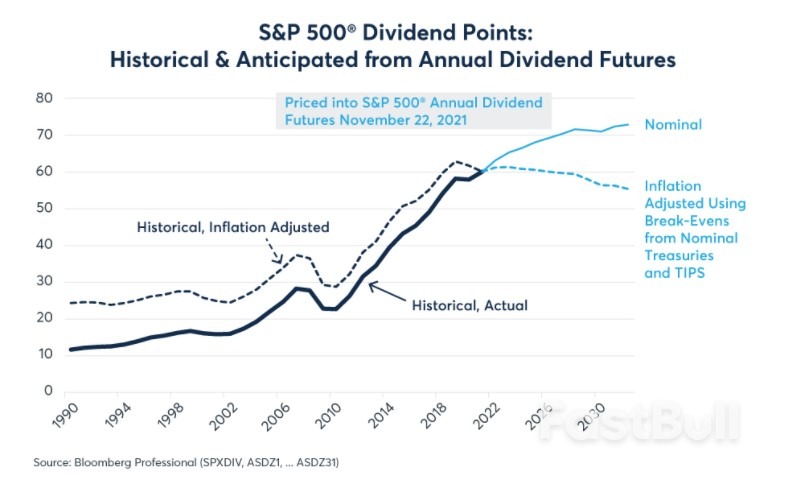
          S&P 500® Annual Dividend Index Futures offer a glimpse into investor expectations for corporate cash flows for the next decade. For 2022, investors appear to anticipate 5.5% growth in dividends, which, given the break-even inflation spreads, implies dividend growth of about 2% in real terms. Investors see modest further gains in nominal dividends between 2023 and 2032, while they expect dividends stagnating or falling slightly in real terms over the next decade (Figure 4).
          Investor Expectations for Rates, Inflation and Commodities_4

          Figure 4: Dividend futures price modest growth in nominal terms and slight declines in real terms

          Commodity Markets

          Another reason why investors anticipate a moderation in the pace of inflation may have to do with commodity prices. Many of the commodity markets are in backwardation, meaning the futures contracts expiring far into the future are trading at lower prices than futures contracts expiring in the near term. For example, corn and soybean contracts expiring in March 2023, for example, are trading at values about 7% lower than contracts expiring in March 2022.
          Nearby contracts for West Texas Intermediate crude oil are trading around $77 per barrel, but those further into the future are trading lower, like the December 2024 contract trading below $65. It’s a similar story for other energy products such as gasoline and ultra-low sulfur diesel. The same is true for certain metals, notably hot rolled coil steel.

          Bottom Line

          1.Fed Funds futures price three rate hikes in 2022 and two to three more in 2023.
          2.SOFR futures price long-term equilibrium Fed policy rates of around 1.8-2.0%.
          3.Annual Dividend futures price 5.5% dividend growth for 2022 and slow growth thereafter.
          4.Many commodity markets are in backwardation, pricing the likelihood for cheaper energy, agricultural goods and industrial metals in the future.

          Source:CME.

          Risk Warnings and Disclaimers
          You understand and acknowledge that there is a high degree of risk involved in trading. Following any strategies or investment methods may lead to potential losses. The content on the site is provided by our contributors and analysts for information purposes only. You are solely responsible for determining whether any trading assets, securities, strategy, or any other product is suitable for investing based on your own investment objectives and financial situation.
          Comments
          Add to Favorites
          Share
          FastBull
          Copyright © 2025 FastBull Ltd

          728 RM B 7/F GEE LOK IND BLDG NO 34 HUNG TO RD KWUN TONG KLN HONG KONG

          TelegramInstagramTwitterfacebooklinkedin
          App Store Google Play Google Play
          Products
          Charts

          Chats

          Q&A with Experts
          Screeners
          Economic Calendar
          Data
          Tools
          Membership
          Features
          Function
          Markets
          Copy Trading
          Latest Signals
          Contests
          News
          Analysis
          24/7
          Columns
          Education
          Company
          Careers
          About Us
          Contact Us
          Advertising
          Help Center
          Feedback
          User Agreement
          Privacy Policy
          Business

          White Label

          Data API

          Web Plug-ins

          Poster Maker

          Affiliate Program

          Risk Disclosure

          The risk of loss in trading financial instruments such as stocks, FX, commodities, futures, bonds, ETFs and crypto can be substantial. You may sustain a total loss of the funds that you deposit with your broker. Therefore, you should carefully consider whether such trading is suitable for you in light of your circumstances and financial resources.

          No decision to invest should be made without thoroughly conducting due diligence by yourself or consulting with your financial advisors. Our web content might not suit you since we don't know your financial conditions and investment needs. Our financial information might have latency or contain inaccuracy, so you should be fully responsible for any of your trading and investment decisions. The company will not be responsible for your capital loss.

          Without getting permission from the website, you are not allowed to copy the website's graphics, texts, or trademarks. Intellectual property rights in the content or data incorporated into this website belong to its providers and exchange merchants.

          Not Logged In

          Log in to access more features

          FastBull Membership

          Not yet

          Purchase

          Become a signal provider
          Help Center
          Customer Service
          Dark Mode
          Price Up/Down Colors

          Log In

          Sign Up

          Position
          Layout
          Fullscreen
          Default to Chart
          The chart page opens by default when you visit fastbull.com