• Trade
  • Markets
  • Copy
  • Contests
  • News
  • 24/7
  • Calendar
  • Q&A
  • Chats
Trending
Screeners
SYMBOL
LAST
BID
ASK
HIGH
LOW
NET CHG.
%CHG.
SPREAD
SPX
S&P 500 Index
6870.39
6870.39
6870.39
6895.79
6858.28
+13.27
+ 0.19%
--
DJI
Dow Jones Industrial Average
47954.98
47954.98
47954.98
48133.54
47871.51
+104.05
+ 0.22%
--
IXIC
NASDAQ Composite Index
23578.12
23578.12
23578.12
23680.03
23506.00
+72.99
+ 0.31%
--
USDX
US Dollar Index
98.910
98.990
98.910
98.960
98.730
-0.040
-0.04%
--
EURUSD
Euro / US Dollar
1.16514
1.16522
1.16514
1.16717
1.16341
+0.00088
+ 0.08%
--
GBPUSD
Pound Sterling / US Dollar
1.33184
1.33192
1.33184
1.33462
1.33136
-0.00128
-0.10%
--
XAUUSD
Gold / US Dollar
4212.67
4213.08
4212.67
4218.85
4190.61
+14.76
+ 0.35%
--
WTI
Light Sweet Crude Oil
59.180
59.210
59.180
60.084
59.160
-0.629
-1.05%
--

Community Accounts

Signal Accounts
--
Profit Accounts
--
Loss Accounts
--
View More

Become a signal provider

Sell trading signals to earn additional income

View More

Guide to Copy Trading

Get started with ease and confidence

View More

Signal Accounts for Members

All Signal Accounts

Best Return
  • Best Return
  • Best P/L
  • Best MDD
Past 1W
  • Past 1W
  • Past 1M
  • Past 1Y

All Contests

  • All
  • Trump Updates
  • Recommend
  • Stocks
  • Cryptocurrencies
  • Central Banks
  • Featured News
Top News Only
Share

Temasek CEO Dilhan Pillay: We Are Taking A Conservative Stance On Allocating Capital

Share

Brazil Economists See Brazilian Real At 5.40 Per Dollar By Year-End 2025 Versus 5.40 In Previous Estimate - Central Bank Poll

Share

Brazil Economists See Year-End 2026 Interest Rate Selic At 12.25% Versus 12.00% In Previous Estimate - Central Bank Poll

Share

Brazil Economists See Year-End 2025 Interest Rate Selic At 15.00% Versus 15.00% In Previous Estimate - Central Bank Poll

Share

EU Commission Says Meta Has Committed To Give EU Users Choice On Personalised Ads

Share

Sources Revealed That The Bank Of England Has Invited Employees To Voluntarily Apply For Layoffs

Share

The Bank Of England Plans To Cut Staff Due To Budget Pressures

Share

Traders Believe There Is Less Than A 10% Chance That The European Central Bank Will Cut Interest Rates By 25 Basis Points In 2026

Share

Egypt, European Bank For Reconstruction And Development Sign $100 Million Financing Agreement

Share

Israel Budget Deficit 4.5% Of GDP In November Over Past 12 Months Versus 4.9% Deficit In October

Share

JPMorgan - Council Chaired By Jamie Dimon Includes Jeff Bezos

Share

UK Government: UK Health Security Agency Identified New Recombinant Mpox Virus In England In Individual Who Had Recently Travelled To Asia

Share

European Central Bank Governing Council Member Kazimir: I See No Reason To Change Rates In The Coming Months, Definitely No In December

Share

European Central Bank Governing Council Member Kazimir: Overengineering Policy Around Small Inflation Deviations Would Introduce Unnecessary Policy Uncertainty

Share

European Central Bank Governing Council Member Kazimir: European Central Bank Must Be Vigilant About Some Upside Risks To Inflation

Share

European Central Bank Governing Council Member Kazimir: Forex Pass Through To Prices May Not Be As Strong As Expected

Share

Document: EU Looking At Options For Boosting Lebanon's Internal Security Forces

Share

Thai Foreign Ministry: Military Action Will Continue Until Thai Sovereignty, Territorial Integrity Secure

Share

Ukraine President Zelenskiy: No Accord So Far On Eastern Ukraine In US Talks

Share

NATO: Ukrainian President Zelenskiy Will Meet NATO's Rutte And EU Commission Chief Von Der Leyen And Costa In Brussels On Monday

TIME
ACT
FCST
PREV
France Industrial Output MoM (SA) (Oct)

A:--

F: --

P: --
France Trade Balance (SA) (Oct)

A:--

F: --

P: --
Euro Zone Employment YoY (SA) (Q3)

A:--

F: --

P: --
Canada Part-Time Employment (SA) (Nov)

A:--

F: --

P: --

Canada Unemployment Rate (SA) (Nov)

A:--

F: --

P: --

Canada Full-time Employment (SA) (Nov)

A:--

F: --

P: --

Canada Labor Force Participation Rate (SA) (Nov)

A:--

F: --

P: --

Canada Employment (SA) (Nov)

A:--

F: --

P: --

U.S. PCE Price Index MoM (Sept)

A:--

F: --

P: --

U.S. Personal Income MoM (Sept)

A:--

F: --

P: --

U.S. Core PCE Price Index MoM (Sept)

A:--

F: --

P: --

U.S. PCE Price Index YoY (SA) (Sept)

A:--

F: --

P: --

U.S. Core PCE Price Index YoY (Sept)

A:--

F: --

P: --

U.S. Personal Outlays MoM (SA) (Sept)

A:--

F: --

P: --
U.S. 5-10 Year-Ahead Inflation Expectations (Dec)

A:--

F: --

P: --

U.S. Real Personal Consumption Expenditures MoM (Sept)

A:--

F: --

P: --
U.S. Weekly Total Rig Count

A:--

F: --

P: --

U.S. Weekly Total Oil Rig Count

A:--

F: --

P: --

U.S. Consumer Credit (SA) (Oct)

A:--

F: --

P: --
China, Mainland Foreign Exchange Reserves (Nov)

A:--

F: --

P: --

Japan Trade Balance (Oct)

A:--

F: --

P: --

Japan Nominal GDP Revised QoQ (Q3)

A:--

F: --

P: --

China, Mainland Imports YoY (CNH) (Nov)

A:--

F: --

P: --

China, Mainland Exports (Nov)

A:--

F: --

P: --

China, Mainland Imports (CNH) (Nov)

A:--

F: --

P: --

China, Mainland Trade Balance (CNH) (Nov)

A:--

F: --

P: --

China, Mainland Exports YoY (USD) (Nov)

A:--

F: --

P: --

China, Mainland Imports YoY (USD) (Nov)

A:--

F: --

P: --

Germany Industrial Output MoM (SA) (Oct)

A:--

F: --

P: --
Euro Zone Sentix Investor Confidence Index (Dec)

A:--

F: --

P: --

Canada National Economic Confidence Index

--

F: --

P: --

U.K. BRC Like-For-Like Retail Sales YoY (Nov)

--

F: --

P: --

U.K. BRC Overall Retail Sales YoY (Nov)

--

F: --

P: --

Australia Overnight (Borrowing) Key Rate

--

F: --

P: --

RBA Rate Statement
RBA Press Conference
Germany Exports MoM (SA) (Oct)

--

F: --

P: --

U.S. NFIB Small Business Optimism Index (SA) (Nov)

--

F: --

P: --

Mexico 12-Month Inflation (CPI) (Nov)

--

F: --

P: --

Mexico Core CPI YoY (Nov)

--

F: --

P: --

Mexico PPI YoY (Nov)

--

F: --

P: --

U.S. Weekly Redbook Index YoY

--

F: --

P: --

U.S. JOLTS Job Openings (SA) (Oct)

--

F: --

P: --

China, Mainland M1 Money Supply YoY (Nov)

--

F: --

P: --

China, Mainland M0 Money Supply YoY (Nov)

--

F: --

P: --

China, Mainland M2 Money Supply YoY (Nov)

--

F: --

P: --

U.S. EIA Short-Term Crude Production Forecast For The Year (Dec)

--

F: --

P: --

U.S. EIA Natural Gas Production Forecast For The Next Year (Dec)

--

F: --

P: --

U.S. EIA Short-Term Crude Production Forecast For The Next Year (Dec)

--

F: --

P: --

EIA Monthly Short-Term Energy Outlook
U.S. API Weekly Gasoline Stocks

--

F: --

P: --

U.S. API Weekly Cushing Crude Oil Stocks

--

F: --

P: --

U.S. API Weekly Crude Oil Stocks

--

F: --

P: --

U.S. API Weekly Refined Oil Stocks

--

F: --

P: --

South Korea Unemployment Rate (SA) (Nov)

--

F: --

P: --

Japan Reuters Tankan Non-Manufacturers Index (Dec)

--

F: --

P: --

Japan Reuters Tankan Manufacturers Index (Dec)

--

F: --

P: --

Japan Domestic Enterprise Commodity Price Index MoM (Nov)

--

F: --

P: --

Japan Domestic Enterprise Commodity Price Index YoY (Nov)

--

F: --

P: --

China, Mainland PPI YoY (Nov)

--

F: --

P: --

China, Mainland CPI MoM (Nov)

--

F: --

P: --

Q&A with Experts
    • All
    • Chatrooms
    • Groups
    • Friends
    Connecting
    .
    .
    .
    Type here...
    Add Symbol or Code

      No matching data

      All
      Trump Updates
      Recommend
      Stocks
      Cryptocurrencies
      Central Banks
      Featured News
      • All
      • Russia-Ukraine Conflict
      • Middle East Flashpoint
      • All
      • Russia-Ukraine Conflict
      • Middle East Flashpoint
      Search
      Products

      Charts Free Forever

      Chats Q&A with Experts
      Screeners Economic Calendar Data Tools
      Membership Features
      Data Warehouse Market Trends Institutional Data Policy Rates Macro

      Market Trends

      Market Sentiment Order Book Forex Correlations

      Top Indicators

      Charts Free Forever
      Markets

      News

      News Analysis 24/7 Columns Education
      From Institutions From Analysts
      Topics Columnists

      Latest Views

      Latest Views

      Trending Topics

      Top Columnists

      Latest Update

      Signals

      Copy Rankings Latest Signals Become a signal provider AI Rating
      Contests
      Brokers

      Overview Brokers Assessment Rankings Regulators News Claims
      Broker listing Forex Brokers Comparison Tool Live Spread Comparison Scam
      Q&A Complaint Scam Alert Videos Tips to Detect Scam
      More

      Business
      Events
      Careers About Us Advertising Help Center

      White Label

      Data API

      Web Plug-ins

      Affiliate Program

      Awards Institution Evaluation IB Seminar Salon Event Exhibition
      Vietnam Thailand Singapore Dubai
      Fans Party Investment Sharing Session
      FastBull Summit BrokersView Expo
      Recent Searches
        Top Searches
          Markets
          News
          Analysis
          User
          24/7
          Economic Calendar
          Education
          Data
          • Names
          • Latest
          • Prev

          View All

          No data

          Scan to Download

          Faster Charts, Chat Faster!

          Download App
          English
          • English
          • Español
          • العربية
          • Bahasa Indonesia
          • Bahasa Melayu
          • Tiếng Việt
          • ภาษาไทย
          • Français
          • Italiano
          • Türkçe
          • Русский язык
          • 简中
          • 繁中
          Open Account
          Search
          Products
          Charts Free Forever
          Markets
          News
          Signals

          Copy Rankings Latest Signals Become a signal provider AI Rating
          Contests
          Brokers

          Overview Brokers Assessment Rankings Regulators News Claims
          Broker listing Forex Brokers Comparison Tool Live Spread Comparison Scam
          Q&A Complaint Scam Alert Videos Tips to Detect Scam
          More

          Business
          Events
          Careers About Us Advertising Help Center

          White Label

          Data API

          Web Plug-ins

          Affiliate Program

          Awards Institution Evaluation IB Seminar Salon Event Exhibition
          Vietnam Thailand Singapore Dubai
          Fans Party Investment Sharing Session
          FastBull Summit BrokersView Expo

          Visualizing the State of Global Debt, by Country

          Summary:

          A rapid increase in government debt is a major cause for concern. Generally, the higher a country’s debt-to-GDP ratio is, the higher chance that country could default on its debt, therefore creating a financial panic in the markets.
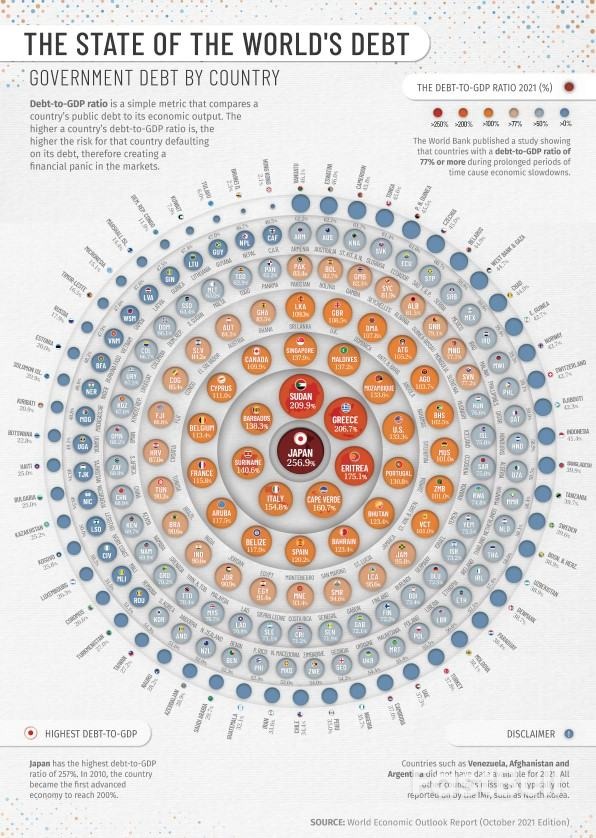
          Visualizing the State of Global Debt, by Country_1

          Visualizing the State of Global Debt, by Country

          Since COVID-19 started its spread around the world in 2020, the global economy has been put to the test with supply chain disruptions, price volatility for commodities, challenges in the job market, and declining income from tourism. The World Bank has estimated that almost 97 million people have been pushed into extreme poverty as a result of the pandemic.
          In order to help with this difficult situation, global governments have had to increase their expenditures to deal with higher healthcare costs, unemployment, food insecurity, and to help businesses to survive. Countries have taken on new debt to provide financial support for these measures, which has resulted in the highest global debt levels in half a century.
          To analyze the extent of global debt, we’ve compiled debt-to-GDP data by country from the most recent World Economic Outlook report by the IMF.

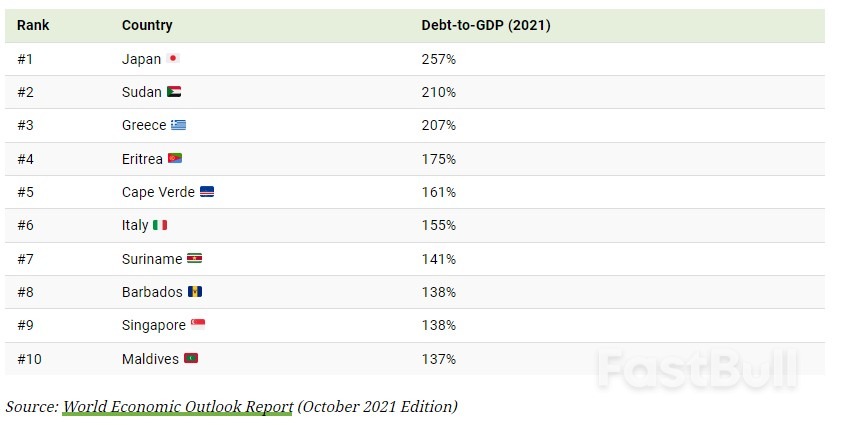
          Debt-to-GDP ratio by Country: The Top 10 Most Indebted Nations

          The debt-to-GDP ratio is a simple metric that compares a country’s public debt to its economic output. By comparing how much a country owes and how much it produces in a year, economists can measure a country’s theoretical ability to pay off its debt.
          Visualizing the State of Global Debt, by Country_2
          Japan, Sudan, and Greece top the list with debt-to-GDP ratios well above 200%, followed by Eritrea (175%), Cape Verde (160%), and Italy (154%).
          Japan’s debt level won’t come as a surprise to most. In 2010, it became the first country to reach a debt-to-GDP ratio 200%, and it now sits at 257%. In order to finance new debt, the Japanese government issues bonds which get bought up primarily by the Bank of Japan.
          By the end of 2020, the Bank of Japan owned 45% of government debt outstanding.

          What is the main risk of a high debt-to-GDP ratio?

          A rapid increase in government debt is a major cause for concern. Generally, the higher a country’s debt-to-GDP ratio is, the higher chance that country could default on its debt, therefore creating a financial panic in the markets.
          The World Bank published a study showing that countries that maintained a debt-to-GDP ratio of over 77% for prolonged periods of time experienced economic slowdowns.
          COVID-19 has worsened a debt crisis that has been brewing since the 2008 global recession. A report from the International Monetary Fund (IMF) shows that at least 100 countries will have to reduce expenditures on health, education, and social protection. Also, 30 countries in the developing world have high levels of debt distress, meaning they’re experiencing great difficulties in servicing their debt.
          This crisis is hitting poor and middle-income countries harder than rich countries. Wealthier countries are borrowing to launch fiscal stimulus packages while low and middle income countries cannot afford such measures, potentially resulting in wider global inequality.

          The IMF Warns of Interest Rates

          Global debt reached $226 trillion by the end of 2020, seeing the biggest one-year increase since World War II.
          Borrowing by governments accounted for slightly over half of the $28 trillion increase, bringing global public debt ratio to a record of 99% of GDP. As interest rates rise, IMF officials warn that higher interest rates will diminish the impact of fiscal spending, and cause debt sustainability concerns to intensify. “The risks will be magnified if global interest rates rise faster than expected and growth falters,” the officials wrote.
          “A significant tightening of financial conditions would heighten the pressure on the most highly indebted governments, households, and firms. If the public and private sectors are forced to deleverage simultaneously, growth prospects will suffer.”

          Source:Visual Capitalist.


          Risk Warnings and Disclaimers
          You understand and acknowledge that there is a high degree of risk involved in trading. Following any strategies or investment methods may lead to potential losses. The content on the site is provided by our contributors and analysts for information purposes only. You are solely responsible for determining whether any trading assets, securities, strategy, or any other product is suitable for investing based on your own investment objectives and financial situation.
          Comments
          Add to Favorites
          Share

          Wind powers change in England's industrial heartland

          Hull, known for a once-thriving fishing industry, the poet Philip Larkin, rugby league, and the city's eponymous football club recently bought by Turkish TV personality Acun Ilicali, is home to Britain's biggest wind turbine blade plant.
          That has placed Hull at the centre of the UK government's long-term plan to slash carbon emissions, tackle climate change and cut rocketing household energy bills.
          German-Spanish giant Siemens Gamesa is rapidly expanding its facility to meet booming demand and keep the country's much-trumpeted 2050 net-zero target on track.
          The need for cheaper sources of energy became increasingly urgent this week, as the government scrambled to head off a cost of living crisis, faced with runaway electricity and gas costs that are fuelling decades-high inflation.
          Britain unveiled financial support for households after the UK energy regulator lifted prices to reflect the spiking natural gas market.

          "CHEAPER AND CLEANER"

          "We are doing our bit to tidy the world up and get cheaper and cleaner energy for everybody," blade painter Carl Jackson, 56, told AFP from the factory floor.
          "I think wind power is a big part of the future. It's been a massive boost to jobs and the economy in Hull," added Jackson, who joined when Siemens Gamesa opened six years ago.
          The hub has since manufactured 1,500 hand-made turbine blades and now employs more than 1,000 people.
          Prime Minister Boris Johnson, host of last November's UN climate change summit in Glasgow, has vowed to "level up" economic opportunity in places like Hull, which voted overwhelmingly for Brexit.
          Siemens Gamesa built the £310-million plant jointly with Associated British Ports in 2016, and it is now undergoing a major extension to build bigger blades.
          The Hull factory manufactures about 300 turbine blades per year, with each measuring 81m in length - about the same as the wingspan of an Airbus A380 aircraft.
          A wind turbine, comprising three such blades, can power an average house for 24 hours with one single rotation.
          New, even longer 100m blades will provide enough power for up to two days.

          "DRIVING DOWN ENERGY COSTS"

          In the cavernous Hull factory, staff assemble balsa wood, fibreglass and resin into vast blade moulds to start a journey that will eventually harness the ferocious winds of the North Sea.
          That enables Britain to cut carbon emissions while curbing its dependency on imported energy and lowering prices in the long term, said plant director Andy Sykes.
          "Over the course of last year, 25 per cent of the UK's (electricity) was delivered from wind power," said Sykes.
          "That will only continue to grow and help drive down the cost of energy by reducing the need for the import of energy."
          The group will open another factory in Le Havre, northern France, this year in a push for cleaner energy across Europe, where wind generated an average 16 per cent of electricity according to 2020 industry data.
          Scotland recently awarded a string of vast offshore wind projects after Johnson vowed to make Britain the "Saudi Arabia of wind".
          Hull is also expanding into the broader renewable sector, with plans for biofuels, green hydrogen, and carbon capture, as well as solar and tidal power generation under the city's "Green Port" initiative.
          The local authority is eager to slash carbon output from the Humber estuary region, which accounts for 40 per cent of Britain's industrial emissions - particularly from the cement, gas, oil, petrochemicals and steel sectors.
          "You really have to decarbonise the Humber area for the UK to be really able to address significant parts of its net zero challenge," Hull City Council climate officer Martin Budd told AFP.
          "And this Siemens offshore wind plant provides a key activator to achieve that."
          The Humber estuary's high seabed makes it ideal for offshore turbines.
          At the same time, the estuary expels an estimated 12.3 million tonnes of carbon per year.

          ENSURING SURVIVAL

          Budd said tackling climate change was vital to saving low-lying Hull from flooding.
          "We are the second most vulnerable UK city after London to flooding. So the survival of the city depends on tackling climate change," he added.
          "It's integral that we tackle climate change and that as a city we take those steps by supporting manufacturing in industries that are going to tackle climate change."
          The UK wants offshore wind farms to provide one-third of the country's electricity by 2030.
          Climate change specialist Nick Cowern, an emeritus professor at Newcastle University, cautioned that Britain also needed to develop chemical storage capability.
          "It's realistic to put wind power at the centre of the UK's low carbon electricity generation approach, which is a major part of the effort towards net zero," he told AFP.
          He added that while wind and solar were safe long-term bets, gas still had a significant role to play.
          "Until we have the ability to store electricity as hydrogen - or alternatives like ammonia - and be better grid-connected to our neighbours in continental Europe and the Nordic countries, gas will still be needed during periods of low wind speeds and low solar generation."

          Source: AFP/ic

          Risk Warnings and Disclaimers
          You understand and acknowledge that there is a high degree of risk involved in trading. Following any strategies or investment methods may lead to potential losses. The content on the site is provided by our contributors and analysts for information purposes only. You are solely responsible for determining whether any trading assets, securities, strategy, or any other product is suitable for investing based on your own investment objectives and financial situation.
          Comments
          Add to Favorites
          Share

          New Zealand Māori party calls for a ‘divorce’ from Britain’s royal family

          The Māori party of New Zealand has called for a “divorce” from the crown and removal of the British royal family as New Zealand’s head of state.
          The call came on the 182nd anniversary of the signing of the treaty of Waitangi, or Te Tiriti o Waitangi, New Zealand’s foundational legal document.
          “If you look at our founding covenant as a marriage between tangata whenua [indigenous people] and the crown, then Te Tiriti is the child of that marriage. It’s time [for] tangata whenua to take full custody,” Māori Pāti co-leader Rawiri Waititi said. “This won’t mean the crown is off the hook. If a couple gets divorced, you don’t lose responsibility for your child. This will be an opportunity to reimagine a more meaningful and fulfilling partnership,” he said.
          The treaty guaranteed Māori the crown’s protection of their land rights. But in the 100 years that followed its signing, Māori lost more than 90% of their land through a mixture of outright confiscation by the crown, private or government sales, and land court practises that did not recognise collective ownership.
          Past pushes for New Zealand to become a republic has struggled to gain momentum. Polling from Colmar Brunton in 2021 found a third of New Zealanders wanted to cut ties with the monarchy, while 47% did not and 20% did not know.
          The prime minister, Jacinda Ardern, has said she is a republican, and in 2021 she said she believed New Zealand would become a republic in her lifetime – but that she would not take action on it during her term. Speaking at the announcement of governor general Cindy Kiro, Ardern said she had had ​ “never sensed urgency” from the public to make it happen. “I’ve been very clear that despite being a republican, I’m not of the view that in the here-and-now … this is something New Zealanders feel particularly strongly about,” she said.
          “I don’t know that I’ve had one person actually raise with me generally day-to-day the issue of becoming a republic. This government has prioritised those issues that we do see as a priority. But I do still think there will be a time and a place; I just don’t see it as now.”
          The call for removing the Queen as head of state is a shift in policy for the Māori party, which in 2017 objected to calls for a republic from within Labour. “Removing the Queen as our head of state removes the treaty of Waitangi and Māori rights in this country guaranteed to us under our nation’s founding document,” then-leader Te Ururoa Flavell said at the time. “Given our colonial history and the systematic stripping away of Māori land, rights and resource, any talk about cutting ties with the Queen, or establishing a republic is an extremely naive move.”
          Under current leadership, the Māori party holds two seats in New Zealand’s parliament, and is pushing for constitutional reform in New Zealand, including the establishment of a Māori parliament.
          “The only way this nation can work is when Māori assert their rights to self-management, self-determination and self-governance over all our domains. Our vision is for constitutional transformation that restores the tino rangatiratanga [full sovereignty] of tangata whenua in this country,” co-leader Debbie Ngarewa-Packer said.

          Source: The guardian.

          Risk Warnings and Disclaimers
          You understand and acknowledge that there is a high degree of risk involved in trading. Following any strategies or investment methods may lead to potential losses. The content on the site is provided by our contributors and analysts for information purposes only. You are solely responsible for determining whether any trading assets, securities, strategy, or any other product is suitable for investing based on your own investment objectives and financial situation.
          Comments
          Add to Favorites
          Share

          Germany urged to 'wake up' over Ukraine-Russia crisis, before it's too late

          Thomas
          • As global powers have scrambled to prevent all-out war between Ukraine and Russia, Germany has been accused of actively failing to help defend Ukraine from a possible attack.
          • Germany has refused to send military hardware to Ukraine, unlike other countries.
          • Ukraine is not a member of the EU or NATO and Germany has a conundrum over its dynamics with Russia when it comes to energy.
          As global powers have scrambled to prevent all-out war between Ukraine and Russia, Germany has been accused not only of failing to take a leadership role in diplomatic efforts, but also of actively failing to help defend Ukraine from a possible attack.
          The U.S. and U.K. are among the countries that have send military hardware to Ukraine to help it defend itself in the case of an invasion. Russia denies it is planning such a move, despite mobilizing many tens of thousands of troops in the area.
          Germany has refused to send help, however, and has reportedly blocked others from doing so. That has lead to accusations that it has not shown Ukraine — which is not a member of the EU or NATO but is geographically within Europe — enough solidarity.
          Andrij Melnyk, Ukrainian ambassador to Germany, told CNBC on Monday that Germany has to “wake up” to the dangers facing Ukraine.
          “We think that the world is becoming more dangerous and Germany, as the biggest European country and the strongest economic power, cannot allow itself to stay neutral and to go on sleeping and enjoying a comfortable life,” he told CNBC’s Annette Weisbach in Berlin.
          “Germany has to wake up, Germany has to stand by its allies and Germany has to do much more for security in Europe and in this particular moment where a new war can break out in the heart of Europe, Germany has a special role to play.”
          The ambassador added that Germany should join allies in sending defensive weapons to Ukraine and to “help prevent this new war that Russia is apparently playing.”
          Tensions have grown over recent months as Russia positioned around 100,000 troops along its border with Ukraine and moved around 30,000 troops to Belarus for military exercises. Trust in Russia is low following its 2014 annexation of Crimea from Ukraine, and support for pro-Russian separatists in eastern Ukraine.
          Germany’s Chancellor Olaf Scholz is expected to allay concerns over Berlin’s stance towards Ukraine when he holds talks with U.S. President Joe Biden in Washington later on Monday, in his first trip to the U.S. since becoming chancellor.
          Scholz has faced growing criticism over his perceived reluctance to weigh in so far and is under pressure to take a more robust position against Russia’s President Vladimir Putin.
          Instead of sending weapons to Kyiv, Berlin has instead offered to provide 5,000 protective helmets and a field hospital. This was met with disbelief and derision in some quarters of Ukraine.
          Germany defended itself at the time saying it was responding to a request for military equipment, specifically helmets, according to Reuters. The Bild newspaper also reported that the German government had received a request from Ukraine which included a need for 100,000 combat helmets and tactical vests.
          There have also been reports that Germany stopped Estonia from sending weapons to Ukraine, and Ukraine’s defense minister has said that Berlin blocked Ukraine’s attempts to procure weapons via NATO.
          Because Ukraine is not a member of NATO, the military alliance is not obliged to defend it, but given its location — separating Russia and the EU — any confrontation has the potential to destabilize the whole region.
          Speaking to German broadcaster RTL ahead of his meeting with Biden, Scholz defended Germany’s record when it comes to defense spending (a longstanding bugbear of the U.S., which has criticized Germany for not reaching NATO-agreed defense spending targets) and its response to the Ukraine situation.
          “We are very concrete, by the way, also in what we do for defense in NATO, in Europe. In the European Union, in continental Europe, we are the country with the highest defense contribution. Nobody should overlook that. In recent years, we have massively expanded the capabilities of the Bundeswehr [Germany’s armed forces]. I even advocated this when I was still finance minister. And we will continue in this posture,” Scholz told RTL.
          His visit to Washington comes amid fears that a Russian invasion of Ukraine could be imminent.
          White House national security advisor Jake Sullivan warned on Sunday that “any day now, Russia could take military action against Ukraine or it could be a couple of weeks from now, or Russia could choose to take the diplomatic path instead,” he said in an interview on “Fox News Sunday.”
          Sullivan’s comments come after two U.S. officials said Russia has in place about 70% of the combat power it believes it would need for a full-scale invasion of Ukraine. The number of battalion tactical groups in the border region has risen to 83 from 60 as of Friday and 14 more are in transit, according to Reuters.
          Chancellor Scholz also reiterated that Germany will not supply lethal weapons to Ukraine, telling German broadcaster ARD “the German government has pursued a clear course for a long time: we never supply lethal weapons to crisis regions and are not supplying them to Ukraine.”
          “My predecessor [Angela Merkel] was committed to this course and it has been and will be right,” he stressed, adding that opinion polls indicate that most Germans share the government’s position on this matter.
          “My duty is to do what is in the interests of the German people and what in this case is the point of view of our citizens,” he noted.

          Nord Stream 2

          Germany has also come under fire for its continued support of the Nord Stream 2 project, a giant gas pipeline due to bring Russian natural gas supplies directly to Germany, bypassing a preexisting transit route via Ukraine.
          German regulators have yet to approve the opening of the already-complete multi-billion dollar pipeline, which Scholz has described as a “private sector project” and not political. There have been calls for the pipeline to be abandoned, however, with the U.S. in particular stating that it jeopardizes Europe’s energy security.
          Thomas Benedix, senior portfolio manager, commodities at Union Investment, told CNBC on Monday that public opinion had shifted in Germany and that people did want to become more energy independent. However, this has been tempered by rising energy prices, he said, and the fact that Russia has in fact been a “very reliable” source of energy.
          “It could be that, if we get a military escalation in the Russia-Ukraine conflict, then actually it will not be just a business decision to bring on Nord Stream 2. It could become more politicized, but our global strategists believe that a diplomatic solution is still more likely, with about a 60% chance, although that diplomatic solution will take a couple of months to play out in the end,” he told CNBC’s “Squawk Box Europe.”

          Source: CNBC news

          Risk Warnings and Disclaimers
          You understand and acknowledge that there is a high degree of risk involved in trading. Following any strategies or investment methods may lead to potential losses. The content on the site is provided by our contributors and analysts for information purposes only. You are solely responsible for determining whether any trading assets, securities, strategy, or any other product is suitable for investing based on your own investment objectives and financial situation.
          Comments
          Add to Favorites
          Share

          Macron Tries to Avert a European War and Reshape European Security

          The standoff with Russia over Ukraine enters a critical phase this week. The United States has snapped NATO to attention and moved forces east. Moscow has readied still more forces on the Ukraine border. But beneath those tensions, diplomatic avenues are being feverishly explored and the outlines of potential solutions, still amorphous, may be taking form.
          President Biden meets Monday with Chancellor Olaf Scholz, and President Emmanuel Macron of France, at the same time, will visit his Russian counterpart, Vladimir V. Putin, in Moscow before traveling to Kyiv.
          With the Biden administration staking out a hard line, Germany lying low and Mr. Putin seemingly determined to force a solution to Russia’s security grievances, it is Mr. Macron who has positioned himself at the center of the diplomacy in Europe. To Moscow, he is a “quality interlocutor,” as Mr. Putin called Mr. Macron, according to a senior official in the French presidency, speaking on the condition of anonymity in keeping with French government practice.
          For Mr. Macron the chance to lead the effort to create a new European security architecture has placed him front and center on perhaps the biggest stage of his presidency, just two months before elections. It has given him an opportunity to step into a larger leadership role for all of Europe and to put some flesh on his sometimes grandiose visions for a Europe allied with, but more independent of, the United States.
          “Do we want a Russia that is totally aligned with China or one that is somewhere between China and Europe?” Bruno Le Maire, the French economy minister, who is very close to Mr. Macron, said on Friday as Russia and China declared “no limits” to their friendship and called on NATO to “abandon its ideologized Cold War approaches.”
          For France, the choreographed embrace of Mr. Putin and President Xi Jinping of China on the eve of the Beijing Winter Olympics was a demonstration of the ominous wider ramifications of the Ukraine crisis, as Mr. Macron embarks on several days of intense diplomacy.
          The risks are as great as the potential payoffs for Mr. Macron. Solutions to the crisis seem fiendishly elusive for now, even if Mr. Putin has appeared less directly threatening toward Ukraine over the past week.
          The French president has a double purpose: to stop the war that a massive Russian troop concentration at the Ukrainian border threatens; and to allay the festering Russian grievances that NATO’s expansion eastward in 1999 and 2004 provoked, with the eventual aim of integrating Russia in a new European security system that offsets its lurch toward China.
          It’s a tall order, but Mr. Macron has never lacked for audacity. He will need to tread carefully. “There’s frustration in European countries, including Germany, with Mr. Macron’s tendency to forge ahead and then yell at them for not doing anything,” said Jeremy Shapiro, a former State Department official who is now the research director of the European Council on Foreign Relations. “That weakens him.”
          French officials described in broad outline the twin approaches Mr. Macron would adopt in his meetings with Mr. Putin and President Volodymyr Zelensky of Ukraine.
          The first is to use the Normandy Format — a grouping of France, Germany, Ukraine and Russia — to bolster the 2015 Minsk 2 agreement, a deeply ambiguous document that secured a cease-fire in eastern Ukraine but that has proved largely inoperable, not least because nobody agrees on its meaning.
          Could some interpretation of the accord, involving the eventual powers of the breakaway Donbas region over national policy, go some way toward satisfying Mr. Putin’s insistence that Ukraine never join NATO, a demand the United States and its allies, including France, are adamant in rejecting?
          The second, in close consultation with Mr. Biden, is to secure a concrete signal of de-escalation that reverses the Russian military buildup and, as a means to achieving that, explores what Mr. Putin’s ultimate “red line” is in the confrontation.
          The senior official at the French presidency said the nucleus of the Western conflict with Mr. Putin lay “in the extension of NATO and the inclusion in it of countries from the former Soviet space,” which created “an area of volatility that has to be reduced.” He added that Mr. Putin had told Mr. Macron that he wanted “a conversation of substance” that goes “to the heart of the matter.”
          In effect, France appears to be saying that Mr. Putin’s demands, which include pushing NATO back out of formerly Soviet-controlled countries, cannot ever be satisfied but that getting “to the heart of the matter” involves acknowledgment that NATO expansion created permanent grievances with Russia even as it secured freedom for 100 million central Europeans.
          No one believes that Romania, Lithuania and other states that joined an expanded NATO are ever going to leave it, or that NATO is ever going to abrogate its 2008 Bucharest statement that Ukraine “will become” a member of the alliance. But, as Turkey’s almost 60-year flirtation with the European Union illustrates, there are ways of turning a candidacy for membership of an organization into an indefinite holding pattern.
          “We can take a step toward Putin, recognize he is not completely wrong,” said Justin Vaïsse, the former head of policy planning at the French foreign ministry who now heads the Paris Peace Forum.
          The senior official at the French presidency said, “Ukraine is not a member of NATO and, to my knowledge, will not be for a while.”
          Mr. Macron wants to explore whether American offers last month could be complemented by further confidence-building measures that permit a way out of the crisis.
          The American proposal involved more transparency about missile deployment in Eastern Europe and a call for reciprocal commitments by both the United States and Russia to refrain from deploying missiles or troops in Ukraine. Mr. Putin has rejected the American response to his demands as inadequate.
          “Conceivably the arms control offers of the other day could be combined with some sort of consultative mechanism for changes in NATO status, or some sort of moratorium on NATO expansion, or some creative interpretation of the Minsk agreement that gives a Donbas constituent assembly veto powers over what the government will do,” Mr. Shapiro, the former State Department official, suggested.
          None of this appears likely, however, given Mr. Putin’s unprovoked direct threat to Ukraine, his annexation of Crimea, his invasion of Georgia in the short war of 2008 and his history of tearing up treaties when it suits him. The Biden administration, with muscular proactive diplomacy, has signaled it is in no mood for compromise.
          “This is not going to happen,” Dmytro Kuleba, the Ukrainian foreign minister, said last week. “Never.”
          Mr. Zelensky, the president, has sounded more ambivalent. “If it is not NATO, then point to some other security guarantees,” he said last month. It was unclear what he had in mind.
          The “security guarantees” offered by the Budapest Memorandum of 1994, in which Russia vowed to respect Ukraine’s existing borders and sovereignty, proved worthless.
          Absent other avenues, the Normandy Format at least brings the parties together. Mr. Shapiro argued that it could help forge stability.
          “Instability is the Russian strength. Stability is our strength,” he said. “NATO and the European Union expansion were a very powerful way to secure democracy in Eastern European countries. But we got out of it what we could. If you believe in the superiority of the Western economic and political model, as I do, stability makes that evident, and spheres of influence are a pretty good way to establish that.”
          Mr. Putin, the French official said, “wants long-term visibility” on Ukraine and Europe. That appears to leave Mr. Macron playing a potentially dangerous game, trying to balance the “new European security order” he has said he seeks with his commitment to the United States and the NATO alliance.

          Source: The New York Times.

          Risk Warnings and Disclaimers
          You understand and acknowledge that there is a high degree of risk involved in trading. Following any strategies or investment methods may lead to potential losses. The content on the site is provided by our contributors and analysts for information purposes only. You are solely responsible for determining whether any trading assets, securities, strategy, or any other product is suitable for investing based on your own investment objectives and financial situation.
          Comments
          Add to Favorites
          Share

          China's weak consumption over Lunar New Year may signal ‘worsening economy’, analysts say

          Thomas
          Consumption over the week-long Lunar New Year holiday in China failed to get anywhere near pre-pandemic levels, and some analysts warn that the downtrend could signal a worsening economy.
          During the holiday period that ended on Sunday, Chinese tourists took 251 million trips and contributed 289.2 billion yuan (US$45.4 billion) in tourism revenue – 26.1 per cent and 43.7 per cent less than the respective totals during the holiday in 2019, and 2 per cent and 3.9 per cent below the holiday last year, according to the Ministry of Culture and Tourism.
          Similar to last year, local authorities across the country urged people to stay put for the holiday, while ramping up efforts to curb travel, including by imposing stringent quarantine measures and offering cash handouts to people who stuck around.
          Deterred by the discouraging policies and sporadic outbreaks of the Omicron coronavirus variant, more than 70 per cent of domestic tourists chose short-distance trips, according to online travel agency Qunar.com.
          The total number of trips taken on major types of transport from January 17-31 – the busy pre-holiday travel period for migrant workers returning to their hometowns – saw a 47.6 per cent increase from last year, but it was still 64.6 per cent less than in 2019, according to the Ministry of Transport.
          “Despite a nearly 48 per cent increase in the number of people returning to their hometowns for the Lunar New Year holiday compared with last year, a contraction in movie box office sales and tourism revenues – due perhaps to the worsening economy – suggests that this did not result in materially higher consumption demand,” a Nomura report published on Monday said.
          As a major consumption indicator, box office sales also declined compared with last year.
          Despite a total box office sale of 6 billion yuan during the week, the number of viewers decreased by about 46.3 million, or nearly 30 per cent, compared with last year, and stood at 114 million. This was attributed to rising ticket prices and sporadic coronavirus outbreaks that forced cinemas to close in some parts of the country.
          Despite lacklustre consumption, positive trends appeared in certain sectors such as winter sports and tourism, as well as in local and digital spending.
          “Despite Beijing’s call to front-load supportive measures at the start of this year, we believe GDP growth could slow further [in the first quarter],” Nomura said, adding that more supportive measures were expected only after the upcoming “two sessions” legislative meetings next month.
          In the island province of Hainan, a free-trade port and a duty-free hub, its duty-free shops recorded nearly 2 billion yuan in sales for the holiday week. Sales and the number of shoppers increased by 144 per cent and 128 per cent, respectively, compared with last year.
          And in regions such as Shanghai, Chongqing, Hebei, Hunan and Sichuan, local retail sales increased compared with last year.
          Bookings at ski resorts increased by 54 per cent, year on year, while bookings of winter- and ski-themed sites were up nearly 40 per cent through Saturday, according to online travel agency Trip.com.
          During the so-called golden week, flight bookings to Heilongjiang, Jilin and Liaoning – provinces in China’s Northeast region known for its cold and winter tourism – surged by more than half.
          China’s postal and courier industry also saw 749 million parcels received and delivered during the seven-day holiday, according to the State Post Bureau on Monday.
          And there also appeared to be an increase in digital transactions.
          During the first five days of the holiday, NetsUnion Clearing Corporation, the clearing-house platform backed by the People’s Bank of China, recorded 6.2 billion online transactions totalling 4.2 trillion yuan (US$660 billion) – up 5.3 per cent and 11.6 per cent compared with the same period last year.

          Source: South China Morning Post

          Risk Warnings and Disclaimers
          You understand and acknowledge that there is a high degree of risk involved in trading. Following any strategies or investment methods may lead to potential losses. The content on the site is provided by our contributors and analysts for information purposes only. You are solely responsible for determining whether any trading assets, securities, strategy, or any other product is suitable for investing based on your own investment objectives and financial situation.
          Comments
          Add to Favorites
          Share

          Diplomatic flurry to avert Russia-Nato clash over Ukraine

          With war clouds gathering over Ukraine, international diplomacy goes into overdrive on Monday (Feb 7) with the French and Russian presidents to meet in Moscow and the German chancellor heading to the White House to meet with United States President Joe Biden.
          Also Monday, the German, Czech, Slovak and Austrian foreign ministers were expected in Kyiv, which has played down dire US warnings that Moscow had stepped up preparations for a major incursion into Ukraine.
          US officials have said the Kremlin has assembled 110,000 troops along the border with its pro-Western neighbour but intelligence assessments have not determined whether President Vladimir Putin has actually decided to invade.
          They said Russia is on track to amass a large enough force - some 150,000 soldiers - for a full-scale invasion by mid-February.
          Such a force would be capable of taking the capital Kyiv in a matter of 48 hours in an onslaught that would kill up to 50,000 civilians, 25,000 Ukrainian soldiers and 10,000 Russian troops and trigger a refugee flood of up to five million people, mainly into Poland, the officials added.
          On top of the potential human cost, Ukraine fears further damage to its already struggling economy.
          And if Moscow attacks Ukraine it could face retaliation over the Nord Stream 2 pipeline - set to double natural gas supplies from Russia to Germany - with Berlin threatening to block it.
          Russia is seeking a guarantee from Nato that Ukraine will not enter the alliance and wants the bloc to withdraw forces from member states in eastern Europe.
          'Apocalyptic predictions'
          Moscow denies that it is planning to invade Ukraine, and Kyiv's presidency adviser said the chances of a diplomatic solution to the crisis remained "substantially higher than the threat of further escalation".
          On Twitter, Ukraine's Foreign Minister Dmytro Kuleba sought to calm tensions, saying: "Do not believe the apocalyptic predictions. Different capitals have different scenarios, but Ukraine is ready for any development."
          President Emmanuel Macron of France, which currently holds the rotating presidency of the European Union, will be in Moscow on Monday and Kyiv on Tuesday to spearhead efforts to de-escalate the crisis.
          He is expected to push forward a stalled peace plan for the festering conflict with Russian-backed separatists in eastern Ukraine.
          The trip will be a political gamble for Mr Macron, who faces a re-election challenge in April.
          Also on Monday, German Chancellor Olaf Scholz will meet with Mr Biden in Washington.
          Mr Biden has reacted to the Russian troop build-up by offering 3,000 American forces to bolster Nato's eastern flank, with a batch of the troops promised arriving in Poland on Sunday.
          But US National Security Advisor Jake Sullivan told Fox News Sunday that Mr Biden "is not sending forces to start a war or fight a war with Russia in Ukraine".
          "We have sent forces to Europe to defend Nato (North Atlantic Treaty Organisation) territory," he said.
          Mr Scholz said on Sunday that Berlin was prepared to send extra troops to the Baltics in addition to 500 soldiers already stationed in Lithuania under a Nato operation.
          While he is in Washington, his Foreign Minister Annalena Baerbock, will be in Kyiv along with her Czech, Slovak and Austrian counterparts for a two-day visit.
          Mr Scholtz will be in Moscow and Kyiv next week for talks with Mr Putin and Ukrainian President Volodymyr Zelensky.

          Source:The Straits Times.

          Risk Warnings and Disclaimers
          You understand and acknowledge that there is a high degree of risk involved in trading. Following any strategies or investment methods may lead to potential losses. The content on the site is provided by our contributors and analysts for information purposes only. You are solely responsible for determining whether any trading assets, securities, strategy, or any other product is suitable for investing based on your own investment objectives and financial situation.
          Comments
          Add to Favorites
          Share
          FastBull
          Copyright © 2025 FastBull Ltd

          728 RM B 7/F GEE LOK IND BLDG NO 34 HUNG TO RD KWUN TONG KLN HONG KONG

          TelegramInstagramTwitterfacebooklinkedin
          App Store Google Play Google Play
          Products
          Charts

          Chats

          Q&A with Experts
          Screeners
          Economic Calendar
          Data
          Tools
          Membership
          Features
          Function
          Markets
          Copy Trading
          Latest Signals
          Contests
          News
          Analysis
          24/7
          Columns
          Education
          Company
          Careers
          About Us
          Contact Us
          Advertising
          Help Center
          Feedback
          User Agreement
          Privacy Policy
          Business

          White Label

          Data API

          Web Plug-ins

          Poster Maker

          Affiliate Program

          Risk Disclosure

          The risk of loss in trading financial instruments such as stocks, FX, commodities, futures, bonds, ETFs and crypto can be substantial. You may sustain a total loss of the funds that you deposit with your broker. Therefore, you should carefully consider whether such trading is suitable for you in light of your circumstances and financial resources.

          No decision to invest should be made without thoroughly conducting due diligence by yourself or consulting with your financial advisors. Our web content might not suit you since we don't know your financial conditions and investment needs. Our financial information might have latency or contain inaccuracy, so you should be fully responsible for any of your trading and investment decisions. The company will not be responsible for your capital loss.

          Without getting permission from the website, you are not allowed to copy the website's graphics, texts, or trademarks. Intellectual property rights in the content or data incorporated into this website belong to its providers and exchange merchants.

          Not Logged In

          Log in to access more features

          FastBull Membership

          Not yet

          Purchase

          Become a signal provider
          Help Center
          Customer Service
          Dark Mode
          Price Up/Down Colors

          Log In

          Sign Up

          Position
          Layout
          Fullscreen
          Default to Chart
          The chart page opens by default when you visit fastbull.com