• Trade
  • Markets
  • Copy
  • Contests
  • News
  • 24/7
  • Calendar
  • Q&A
  • Chats
Trending
Screeners
SYMBOL
LAST
BID
ASK
HIGH
LOW
NET CHG.
%CHG.
SPREAD
SPX
S&P 500 Index
6827.42
6827.42
6827.42
6899.86
6801.80
-73.58
-1.07%
--
DJI
Dow Jones Industrial Average
48458.04
48458.04
48458.04
48886.86
48334.10
-245.98
-0.51%
--
IXIC
NASDAQ Composite Index
23195.16
23195.16
23195.16
23554.89
23094.51
-398.69
-1.69%
--
USDX
US Dollar Index
97.950
98.030
97.950
98.500
97.950
-0.370
-0.38%
--
EURUSD
Euro / US Dollar
1.17394
1.17409
1.17394
1.17496
1.17192
+0.00011
+ 0.01%
--
GBPUSD
Pound Sterling / US Dollar
1.33707
1.33732
1.33707
1.33997
1.33419
-0.00148
-0.11%
--
XAUUSD
Gold / US Dollar
4299.39
4299.39
4299.39
4353.41
4257.10
+20.10
+ 0.47%
--
WTI
Light Sweet Crude Oil
57.233
57.485
57.233
58.011
56.969
-0.408
-0.71%
--

Community Accounts

Signal Accounts
--
Profit Accounts
--
Loss Accounts
--
View More

Become a signal provider

Sell trading signals to earn additional income

View More

Guide to Copy Trading

Get started with ease and confidence

View More

Signal Accounts for Members

All Signal Accounts

Best Return
  • Best Return
  • Best P/L
  • Best MDD
Past 1W
  • Past 1W
  • Past 1M
  • Past 1Y

All Contests

  • All
  • Trump Updates
  • Recommend
  • Stocks
  • Cryptocurrencies
  • Central Banks
  • Featured News
Top News Only
Share

USA Embassy In Lithuania: Maria Kalesnikava Is Not Going To Vilnius

Share

USA Embassy In Lithuania: Other Prisoners Are Being Sent From Belarus To Ukraine

Share

Ukraine President Zelenskiy: Five Ukrainians Released By Belarus In US-Brokered Deal

Share

USA Vilnius Embassy: USA Stands Ready For "Additional Engagement With Belarus That Advances USA Interests"

Share

USA Vilnius Embassy: Belarus, USA, Other Citizens Among The Prisoners Released Into Lithuania

Share

USA Vilnius Embassy: USA Will Continue Diplomatic Efforts To Free The Remaining Political Prisoners In Belarus

Share

USA Vilnius Embassy: Belarus Releases 123 Prisoners Following Meeting Of President Trump's Envoy Coale And Belarus President Lukashenko

Share

USA Vilnius Embassy: Masatoshi Nakanishi, Aliaksandr Syrytsa Are Among The Prisoners Released By Belarus

Share

USA Vilnius Embassy: Maria Kalesnikava And Viktor Babaryka Are Among The Prisoners Released By Belarus

Share

USA Vilnius Embassy: Nobel Peace Prize Laureate Ales Bialiatski Is Among The Prisoners Released By Belarus

Share

Belarusian Presidential Administration Telegram Channel: Lukashenko Has Pardoned 123 Prisoners As Part Of Deal With US

Share

Two Local Syrian Officials: Joint US-Syrian Military Patrol In Central Syria Came Under Fire From Unknown Assailants

Share

Israeli Military Says It Targeted 'Key Hamas Terrorist' In Gaza City

Share

Rwanda's Actions In Eastern Drc Are A Clear Violation Of Washington Accords Signed By President Trump - Secretary Of State Rubio

Share

Israeli Military Issues Evacuation Warning In Southern Lebanon Village Ahead Of Strike - Spokesperson On X

Share

Belarusian State Media Cites US Envoy Coale As Saying He Discussed Ukraine And Venezuela With Lukashenko

Share

Belarusian State Media Cites US Envoy Coale As Saying That US Removes Sanctions On Belarusian Potassium

Share

Thai Prime Minister: No Ceasefire Agreement With Cambodia

Share

US, Ukraine To Discuss Ceasefire In Berlin Ahead Of European Summit

Share

Incoming Czech Prime Minister Babis: Czech Republic Will Not Take On Guarantees For Ukraine Financing, European Commission Must Find Alternatives

TIME
ACT
FCST
PREV
U.K. Trade Balance Non-EU (SA) (Oct)

A:--

F: --

P: --

U.K. Trade Balance (Oct)

A:--

F: --

P: --

U.K. Services Index MoM

A:--

F: --

P: --

U.K. Construction Output MoM (SA) (Oct)

A:--

F: --

P: --

U.K. Industrial Output YoY (Oct)

A:--

F: --

P: --

U.K. Trade Balance (SA) (Oct)

A:--

F: --

P: --

U.K. Trade Balance EU (SA) (Oct)

A:--

F: --

P: --

U.K. Manufacturing Output YoY (Oct)

A:--

F: --

P: --

U.K. GDP MoM (Oct)

A:--

F: --

P: --

U.K. GDP YoY (SA) (Oct)

A:--

F: --

P: --

U.K. Industrial Output MoM (Oct)

A:--

F: --

P: --

U.K. Construction Output YoY (Oct)

A:--

F: --

P: --

France HICP Final MoM (Nov)

A:--

F: --

P: --

China, Mainland Outstanding Loans Growth YoY (Nov)

A:--

F: --

P: --

China, Mainland M2 Money Supply YoY (Nov)

A:--

F: --

P: --

China, Mainland M0 Money Supply YoY (Nov)

A:--

F: --

P: --

China, Mainland M1 Money Supply YoY (Nov)

A:--

F: --

P: --

India CPI YoY (Nov)

A:--

F: --

P: --

India Deposit Gowth YoY

A:--

F: --

P: --

Brazil Services Growth YoY (Oct)

A:--

F: --

P: --

Mexico Industrial Output YoY (Oct)

A:--

F: --

P: --

Russia Trade Balance (Oct)

A:--

F: --

P: --

Philadelphia Fed President Henry Paulson delivers a speech
Canada Building Permits MoM (SA) (Oct)

A:--

F: --

P: --

Canada Wholesale Sales YoY (Oct)

A:--

F: --

P: --

Canada Wholesale Inventory MoM (Oct)

A:--

F: --

P: --

Canada Wholesale Inventory YoY (Oct)

A:--

F: --

P: --

Canada Wholesale Sales MoM (SA) (Oct)

A:--

F: --

P: --

Germany Current Account (Not SA) (Oct)

A:--

F: --

P: --

U.S. Weekly Total Rig Count

A:--

F: --

P: --

U.S. Weekly Total Oil Rig Count

A:--

F: --

P: --

Japan Tankan Large Non-Manufacturing Diffusion Index (Q4)

--

F: --

P: --

Japan Tankan Small Manufacturing Outlook Index (Q4)

--

F: --

P: --

Japan Tankan Large Non-Manufacturing Outlook Index (Q4)

--

F: --

P: --

Japan Tankan Large Manufacturing Outlook Index (Q4)

--

F: --

P: --

Japan Tankan Small Manufacturing Diffusion Index (Q4)

--

F: --

P: --

Japan Tankan Large Manufacturing Diffusion Index (Q4)

--

F: --

P: --

Japan Tankan Large-Enterprise Capital Expenditure YoY (Q4)

--

F: --

P: --

U.K. Rightmove House Price Index YoY (Dec)

--

F: --

P: --

China, Mainland Industrial Output YoY (YTD) (Nov)

--

F: --

P: --

China, Mainland Urban Area Unemployment Rate (Nov)

--

F: --

P: --

Saudi Arabia CPI YoY (Nov)

--

F: --

P: --

Euro Zone Industrial Output YoY (Oct)

--

F: --

P: --

Euro Zone Industrial Output MoM (Oct)

--

F: --

P: --

Canada Existing Home Sales MoM (Nov)

--

F: --

P: --

Euro Zone Total Reserve Assets (Nov)

--

F: --

P: --

U.K. Inflation Rate Expectations

--

F: --

P: --

Canada National Economic Confidence Index

--

F: --

P: --

Canada New Housing Starts (Nov)

--

F: --

P: --

U.S. NY Fed Manufacturing Employment Index (Dec)

--

F: --

P: --

U.S. NY Fed Manufacturing Index (Dec)

--

F: --

P: --

Canada Core CPI YoY (Nov)

--

F: --

P: --

Canada Manufacturing Unfilled Orders MoM (Oct)

--

F: --

P: --

Canada Manufacturing New Orders MoM (Oct)

--

F: --

P: --

Canada Core CPI MoM (Nov)

--

F: --

P: --

Canada Manufacturing Inventory MoM (Oct)

--

F: --

P: --

Canada CPI YoY (Nov)

--

F: --

P: --

Canada CPI MoM (Nov)

--

F: --

P: --

Canada CPI YoY (SA) (Nov)

--

F: --

P: --

Canada Core CPI MoM (SA) (Nov)

--

F: --

P: --

Q&A with Experts
    • All
    • Chatrooms
    • Groups
    • Friends
    Connecting
    .
    .
    .
    Type here...
    Add Symbol or Code

      No matching data

      All
      Trump Updates
      Recommend
      Stocks
      Cryptocurrencies
      Central Banks
      Featured News
      • All
      • Russia-Ukraine Conflict
      • Middle East Flashpoint
      • All
      • Russia-Ukraine Conflict
      • Middle East Flashpoint
      Search
      Products

      Charts Free Forever

      Chats Q&A with Experts
      Screeners Economic Calendar Data Tools
      Membership Features
      Data Warehouse Market Trends Institutional Data Policy Rates Macro

      Market Trends

      Market Sentiment Order Book Forex Correlations

      Top Indicators

      Charts Free Forever
      Markets

      News

      News Analysis 24/7 Columns Education
      From Institutions From Analysts
      Topics Columnists

      Latest Views

      Latest Views

      Trending Topics

      Top Columnists

      Latest Update

      Signals

      Copy Rankings Latest Signals Become a signal provider AI Rating
      Contests
      Brokers

      Overview Brokers Assessment Rankings Regulators News Claims
      Broker listing Forex Brokers Comparison Tool Live Spread Comparison Scam
      Q&A Complaint Scam Alert Videos Tips to Detect Scam
      More

      Business
      Events
      Careers About Us Advertising Help Center

      White Label

      Data API

      Web Plug-ins

      Affiliate Program

      Awards Institution Evaluation IB Seminar Salon Event Exhibition
      Vietnam Thailand Singapore Dubai
      Fans Party Investment Sharing Session
      FastBull Summit BrokersView Expo
      Recent Searches
        Top Searches
          Markets
          News
          Analysis
          User
          24/7
          Economic Calendar
          Education
          Data
          • Names
          • Latest
          • Prev

          View All

          No data

          Scan to Download

          Faster Charts, Chat Faster!

          Download App
          English
          • English
          • Español
          • العربية
          • Bahasa Indonesia
          • Bahasa Melayu
          • Tiếng Việt
          • ภาษาไทย
          • Français
          • Italiano
          • Türkçe
          • Русский язык
          • 简中
          • 繁中
          Open Account
          Search
          Products
          Charts Free Forever
          Markets
          News
          Signals

          Copy Rankings Latest Signals Become a signal provider AI Rating
          Contests
          Brokers

          Overview Brokers Assessment Rankings Regulators News Claims
          Broker listing Forex Brokers Comparison Tool Live Spread Comparison Scam
          Q&A Complaint Scam Alert Videos Tips to Detect Scam
          More

          Business
          Events
          Careers About Us Advertising Help Center

          White Label

          Data API

          Web Plug-ins

          Affiliate Program

          Awards Institution Evaluation IB Seminar Salon Event Exhibition
          Vietnam Thailand Singapore Dubai
          Fans Party Investment Sharing Session
          FastBull Summit BrokersView Expo

          Vietnam Responds to U.S. Trade Demands Amid Tariff Pressure

          Gerik

          Economic

          Summary:

          Vietnam has officially submitted a response to U.S. trade demands, signaling its commitment to resolving tensions and advancing bilateral negotiations...

          Diplomatic Response Amid Escalating Pressure

          The Ministry of Industry and Trade of Vietnam confirmed on Thursday that it had submitted a formal document to the U.S., addressing recent trade demands. Though the contents remain undisclosed, the ministry emphasized Vietnam’s “determination and goodwill” in seeking mutual understanding and practical solutions. The timing is critical: the Trump administration’s imposition of steep tariffs, although temporarily paused, threatens to destabilize Vietnam’s export-driven economic model if enacted in July.
          This development comes as part of intensified diplomatic efforts, following the Trump administration’s ultimatum for negotiating countries to submit their best offers by Wednesday, in anticipation of a rapidly approaching five-week deadline for revised trade deals. These moves mark a strategic push by the White House to finalize multiple bilateral frameworks under accelerated timelines.

          Third Negotiation Round Set, Risks Remain High

          Vietnamese Trade Minister Nguyen Hong Dien and U.S. Trade Representative Jamieson Greer met in Paris this week to lay the groundwork for the upcoming third round of trade negotiations, scheduled before next weekend. The Vietnamese ministry confirmed that both sides pledged to “focus maximum efforts” on reaching substantial progress during this next round.
          The looming 46% tariffs, if enforced, could inflict serious damage on Vietnam’s manufacturing sector, particularly in electronics, textiles, and furniture—industries that are deeply reliant on U.S. market access. While Vietnam has diversified its trade partners in recent years, the U.S. remains its largest export destination, accounting for roughly a quarter of its total exports.

          Geopolitical and Economic Stakes

          This bilateral trade tension occurs within a broader reshuffling of global supply chains. Amid U.S.-China decoupling, Vietnam has emerged as a key beneficiary of manufacturing relocations. However, this strategic advantage could be reversed if punitive tariffs make Vietnamese goods uncompetitive in the U.S. market.
          The Trump administration, under pressure to assert a tougher stance on trade imbalances, views Vietnam’s trade surplus and the undervaluation of the dong as critical issues. Vietnam, for its part, aims to avoid formal currency manipulation designation and preserve its access to the U.S. market through diplomacy and incremental concessions.
          The outcome of these talks will serve as a bellwether not only for Vietnam-U.S. trade relations, but also for other emerging market economies caught in the crossfire of shifting American trade policy under Trump’s second term.
          If the third round of negotiations yields measurable progress, it may avert the worst-case scenario of full tariff implementation. Vietnam’s swift submission and its cooperative posture suggest willingness to compromise. However, the lack of transparency on the document’s content and the unpredictability of U.S. demands keep the risk environment elevated. Investors, exporters, and policymakers will closely monitor next week’s negotiations for any signs of a breakthrough.

          Source: Reuters

          To stay updated on all economic events of today, please check out our Economic calendar
          Risk Warnings and Disclaimers
          You understand and acknowledge that there is a high degree of risk involved in trading. Following any strategies or investment methods may lead to potential losses. The content on the site is provided by our contributors and analysts for information purposes only. You are solely responsible for determining whether any trading assets, securities, strategy, or any other product is suitable for investing based on your own investment objectives and financial situation.
          Add to Favorites
          Share

          Weak Australian Household Spending in April Signals Persistent Consumption Drag

          Gerik

          Economic

          Macroeconomic Overview: Growth Without Consumption Support

          Australian household spending, which accounts for over half of GDP, continues to underperform in real terms. According to the Australian Bureau of Statistics' new Monthly Household Spending Indicator (MHSI), seasonally adjusted spending rose by only 0.1% in April, following a -0.1% contraction in March. On an annual basis, growth has slowed to 3.7%, a notably weak figure when adjusted for population growth of 1.7%. This indicates near-stagnant per capita consumption, suggesting households remain cautious despite monetary easing.
          The spending breakdown shows a stark divergence between goods and services. Goods spending fell by 1.1%, with sharp pullbacks in clothing, footwear, and vehicle purchases. By contrast, services spending rose 1.5%, buoyed by increased outlays on dining, recreational activities, and healthcare.
          This bifurcation reflects shifting consumer priorities: Australians appear to be re-engaging with experiences and essential services while continuing to defer larger or discretionary goods purchases. Factors such as wage stagnation, debt overhang from the previous interest rate cycle, and lingering economic uncertainty may be tempering household confidence.

          Implications for Monetary Policy and GDP

          The Reserve Bank of Australia, which cut interest rates to 3.85% in May, had already revised down its consumption forecast. This April data supports market expectations for further easing as early as July, with futures pricing suggesting a terminal rate near 2.85% by Q1 2026. Given that Q1 GDP only grew by 0.2%, household consumption is failing to deliver the stimulus expected under looser monetary conditions.
          The RBA's policy dilemma deepens: while easing is needed to support demand, its effectiveness is being muted by cautious consumer behavior. The tepid household spending also raises concerns about broader economic momentum, especially as external demand remains exposed to global uncertainties.

          Outlook and Strategic Considerations

          The MHSI will replace the narrower retail sales report starting July, offering a more accurate lens on household consumption patterns. Its broader coverage — 68% of total consumption compared to retail’s ~30% — should sharpen macroeconomic forecasting.
          Policymakers, investors, and retailers must now reckon with a slower-than-expected recovery in domestic demand. While services may continue to provide modest tailwinds, the weakness in goods consumption suggests that any rebound in GDP will be gradual and uneven unless households regain confidence.
          The data also strengthens the case for targeted fiscal measures to complement monetary policy, such as direct transfers or subsidies that can stimulate marginal spending among lower-income households. Without such intervention, the risk of prolonged demand-side stagnation remains.

          Source: Reuters

          To stay updated on all economic events of today, please check out our Economic calendar
          Risk Warnings and Disclaimers
          You understand and acknowledge that there is a high degree of risk involved in trading. Following any strategies or investment methods may lead to potential losses. The content on the site is provided by our contributors and analysts for information purposes only. You are solely responsible for determining whether any trading assets, securities, strategy, or any other product is suitable for investing based on your own investment objectives and financial situation.
          Add to Favorites
          Share

          Asian Markets Mixed as Wall Street Rally Pauses Amid U.S. Economic Jitters

          Gerik

          Economic

          Mixed Momentum Amid Weak U.S. Data

          After a strong run in global equities, Asian markets began to diverge. Japan’s Nikkei 225 dipped 0.2%, and Australia’s ASX 200 saw a modest 0.1% decline. In contrast, South Korea’s Kospi surged 2.1% on political optimism tied to newly inaugurated President Lee Jae-myung, who pledged renewed diplomacy with North Korea and closer trilateral security ties with the U.S. and Japan. Hong Kong’s Hang Seng rose 0.9%, while Shanghai’s Composite was flat.
          This uneven momentum follows a U.S. session in which the S&P 500 held nearly flat and the Dow slipped 0.2%. The Nasdaq managed a 0.3% gain, but the broader market appeared hesitant amid conflicting signals from the economy.

          Economic Uncertainty Clouds Investor Confidence

          Investor sentiment was rattled by two key economic reports. The ISM’s services index unexpectedly showed contraction, with businesses citing tariff-related uncertainty as a major obstacle to planning. Meanwhile, the ADP employment report revealed slower-than-expected job growth in the private sector, raising concerns ahead of Friday’s official U.S. jobs data. These indicators suggest that the post-COVID U.S. expansion may be encountering friction from policy-related headwinds, especially Trump's tariff regime.
          Bond markets reacted sharply: the 10-year Treasury yield slid to 4.35% from 4.46%, while the 2-year yield dropped to 3.86%. This signals growing expectations that the Federal Reserve will need to cut interest rates sooner to counteract weakening fundamentals. President Trump intensified pressure, blasting Fed Chair Jerome Powell for delaying action and urging immediate cuts on his Truth Social account.

          Key Support and Resistance Levels

          In equity markets, the S&P 500 remains near its record high but lacks momentum to break through resistance at the 6,100 level. Nasdaq's steady rise to 19,460 shows ongoing strength in tech but may face resistance if macro data continues to disappoint. Treasury yields’ downward move signals a short-term reversal from the recent uptrend, particularly as rate cut bets strengthen. Crude oil remains under pressure, with WTI at $62.77 and Brent near $64.87, indicating subdued demand expectations.
          Currency markets showed mild fluctuations. The dollar firmed slightly to 142.87 yen, while the euro held steady at $1.1413. These reflect cautious positioning ahead of jobs data and further tariff developments.

          Source: AP

          To stay updated on all economic events of today, please check out our Economic calendar
          Risk Warnings and Disclaimers
          You understand and acknowledge that there is a high degree of risk involved in trading. Following any strategies or investment methods may lead to potential losses. The content on the site is provided by our contributors and analysts for information purposes only. You are solely responsible for determining whether any trading assets, securities, strategy, or any other product is suitable for investing based on your own investment objectives and financial situation.
          Add to Favorites
          Share

          Trump’s Trade Frustrations with Xi Signal a Deepening U.S.-China Stalemate

          Gerik

          China–U.S. Trade War

          Bilateral Disconnect: Trump’s Push for Top-Down Talks Hits a Wall

          President Donald Trump's late-night social media tirade underscores his frustration over China's refusal to engage in a high-level conversation. While he sees a direct phone call with President Xi Jinping as a catalyst to resolve U.S.-China trade disputes, Beijing appears to be holding out, likely demanding substantive concessions before agreeing to such contact. This mismatch reveals a core structural divergence: Trump favors personal diplomacy and grand gestures, whereas China emphasizes incremental negotiation at the bureaucratic level, a tradition rooted in its cautious and hierarchical approach to foreign policy.
          This divergence is causing a diplomatic impasse. Trump’s preference for leader-to-leader talks may have worked in earlier negotiations, such as during the 2017 Mar-a-Lago summit, but China’s current posture reflects greater strategic restraint. Beijing’s unwillingness to make a symbolic move without material benefit suggests a more confident and risk-averse China than in previous trade standoffs.

          What China Wants vs. What Washington Will Not Give

          At the center of the deadlock is a clash over core economic interests. China seeks broader access to high-end U.S. chip technology for AI and defense, alongside fewer investment restrictions and expanded agricultural trade. However, any rollback of export controls is politically untenable in Washington, where bipartisan consensus holds China as a national security threat. Trump’s administration is also maintaining strict restrictions on semiconductor exports and engine parts, exacerbating Beijing’s fears of economic containment.
          Washington’s broader grievances — including accusations of industrial dumping and intellectual property theft — are longstanding and deeply entrenched. The rare earths controversy illustrates this well: while U.S. officials claim China reneged on a deal to restore rare earth exports, Beijing insists it is merely following standard licensing procedures. The ambiguity reflects a lack of mutual trust and a widening interpretive gap over what each side considers compliance.

          Beijing’s Strategic Pivot Toward Europe

          Amid the U.S.-China stalemate, China is recalibrating its external trade strategy. Beijing is courting Europe, which is grappling with its own trade conflict with the Trump administration. With EU leaders preparing for a summit in Beijing next month, China is reportedly considering a massive Airbus order, which would both strengthen diplomatic ties with Europe and undercut U.S. aviation giant Boeing.
          This tilt away from Washington signals Beijing’s intent to hedge against future U.S. disruptions. China is betting that deeper EU cooperation and economic diversification can shield it from the volatility of U.S. policy shifts. It also underscores a perception that Trump’s unilateralism is alienating both allies and rivals, leaving geopolitical openings for China to exploit.

          Legacy of Mistrust and Trump’s Unreliable Deal-Making

          A lingering obstacle in this negotiation is Trump's own track record. Even when agreements are struck, such as the 2020 Phase One trade deal, the terms have often fallen dormant or been undermined by subsequent policy moves. According to analysts, Trump’s penchant for aggressive tariffs, abrupt escalations, and personal deal-making creates volatility that few foreign leaders find dependable.
          Xi’s hesitancy is not just tactical — it reflects a broader skepticism of the Trump administration’s reliability. Moreover, China feels emboldened by its improved position since the last trade war. With greater resilience, economic diversification, and growing domestic support in the face of U.S. threats, China may be less inclined to compromise under pressure.

          A Trade Conflict Without an Exit Ramp

          The current U.S.-China standoff reveals more than a temporary breakdown in talks — it reflects a growing structural divergence in strategy, political culture, and global positioning. Trump’s increasingly public frustration only sharpens the perception of U.S. diplomatic isolation, while China plays a longer game, reinforcing ties with Europe and waiting out the storm.
          Unless both sides recalibrate — with Washington offering credible incentives and Beijing engaging beyond procedural rigidity — the risk is a further escalation that will not only deepen bilateral decoupling but also fragment global trade alliances. In this game of high-stakes brinkmanship, personal calls and tariffs may no longer be enough to reset relations.

          Source: Bloomberg

          Risk Warnings and Disclaimers
          You understand and acknowledge that there is a high degree of risk involved in trading. Following any strategies or investment methods may lead to potential losses. The content on the site is provided by our contributors and analysts for information purposes only. You are solely responsible for determining whether any trading assets, securities, strategy, or any other product is suitable for investing based on your own investment objectives and financial situation.
          Add to Favorites
          Share

          Bank Of Canada Holds Interest Rate At 2.75%, Says ‘could Be A Need’ For Future Cut

          Liam Peterson

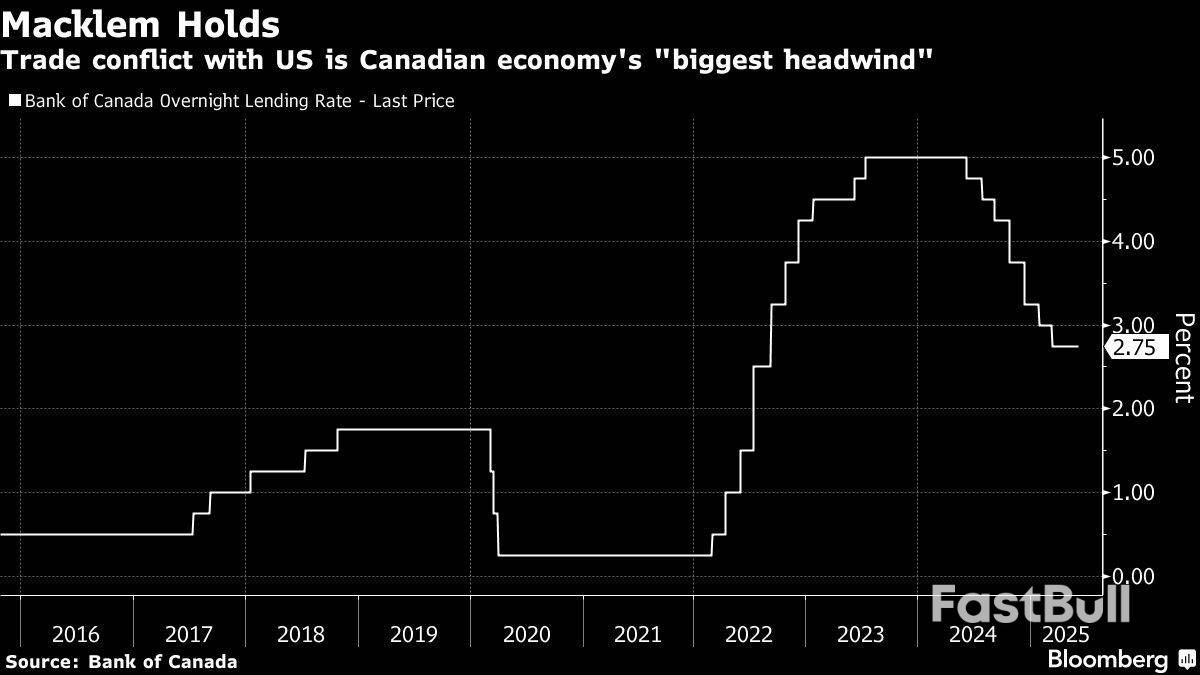
          The Bank of Canada held interest rates steady for a second consecutive meeting, but officials said there may be a need to cut borrowing costs if the economy weakens and inflation remains contained as US tariffs make an impact.

          Officials led by governor Tiff Macklem kept the policy rate at 2.75% on Wednesday, matching expectations of markets and the majority of economists in a Bloomberg survey.

          Policymakers said they held borrowing costs steady as they gain more information on US President Donald Trump’s trade conflict, which they called “the biggest headwind facing the Canadian economy” as it slams exports and adds to uncertainties for consumers and businesses.

          At the same time, officials said the economy held up stronger than expected in the first quarter, and flagged a recent surge in core inflation measures.

          “With uncertainty about US tariffs still high, the Canadian economy softer but not sharply weaker, and some unexpected firmness in recent inflation data, governing council decided to hold the policy rate as we gain more information on US trade policy and its impacts,” policymakers said in a statement.

          The loonie rose to a year-to-date high versus the US dollar, trading at C$1.3666 as Macklem spoke in Ottawa. Canadian debt held gains across the curve and tracked US rates, with Canada’s two-year yield down about three basis points to 2.59%.

          While policymakers said there was “clear consensus” to pause and wait for more information on how the trade dispute plays out, the bank introduced some limited guidance on where borrowing costs are likely headed.

          “On balance, members thought there could be a need for a reduction in the policy rate if the economy weakens in the face of continued US tariffs and uncertainty, and cost pressures on inflation are contained,” Macklem said in his opening remarks, adding that policymakers had a “diversity” of views on the future rate path.

          Bank of Canada governor Tiff Macklem (right) and senior deputy governor Carolyn Rogers at the news conference.

          Combined, the communications show the central bank is comfortable waiting for clearer signals on how the trade dispute will evolve. At the same time, policymakers are actively discussing resuming monetary easing should the economy deteriorate and inflation remain under control.

          A weakening economy for the rest of the year is the base case in a Bloomberg survey of economists, with gross domestic product forecast to contract in the middle two quarters of this year. Inflation is seen averaging around the bank’s 2% target throughout 2025.

          “July looks more promising for a quarter-point ease if, as we expect, the jobless rate continues to move higher, and inflation in items not subject to tariff pressures eases off a bit,” Avery Shenfeld, chief economist at Canadian Imperial Bank of Commerce, said in a report to investors.

          A lot of water will pass under the bridge between now and the July 30 decision, Karl Schamotta, chief market strategist at Corpay, told investors. Two retail sales reports, two jobs numbers, two inflation updates, a quarterly consumer and business survey and a number of tariff deadlines are set to land before then, he pointed out.

          “If the economy remains surprisingly resilient and price pressures continue to build, rate cuts could be pushed further into the future.”

          When the bank paused in April for the first time this easing cycle, it abandoned point estimates for gross domestic product and inflation for the first time since the Covid-19 crisis. Instead, central bankers offered two potential scenarios for the economy. It mentioned neither of these scenarios in the communications on Wednesday.

          Macklem told reporters at a news conference that the Canadian economy was somewhere in the middle of the two scenarios, but that the likelihood of the more severe outcome — which had projected a year-long recession in the country — seemed to have been reduced. Senior deputy governor Carolyn Rogers said the bank hopes to offer point forecasts in its July monetary policy report, but some resolution to the uncertainty is needed first.

          Trump has applied tariffs on a variety of Canadian goods, including steel, aluminium, autos and products that don’t comply with the North American trade pact. Uncertainty remains elevated as the administration appeals a court ruling that overturned many of his tariffs. That ruling did not apply to his sectoral levies, and Trump signed an order on Tuesday doubling the metals tariffs to 50%.

          In the statement, the bank said it would continue to monitor how tariffs reduce demand for Canadian exports and how it affects business investment, employment and household spending. Officials are also watching inflation expectations and how higher tariff costs are passed through.

          “The governing council’s press release strikes a dovish tone, and governor Macklem’s opening statement indicates policymakers see risks skewed towards additional rate cuts this year. We also expect the Bank of Canada to resume rate cuts, likely as soon as the third quarter — once policymakers have weaker GDP growth and core inflation data in hand,” says Stuart Paul, US and Canada economist at Bloomberg Economics.

          Macklem said it was “still too soon to see the direct effects of retaliatory tariffs in consumer price data,” referring to the levies Prime Minister Mark Carney has levied on imports of some US goods, and which are currently tallying well below the total C$20 billion (RM61.82 billion) the federal government is expecting.

          Core inflation measures surged to 3.2% in April, the highest in more than a year. While Macklem repeated that the bank is seeing “some unusual volatility” in core gauges, he also said the measures “suggest underlying inflation could be firmer than we thought.” Higher food prices, brought on by trade disruption, may be partially responsible, the bank said.

          It’s clear the Bank of Canada is more focused on inflation at the moment than the weakening economy, Charles St-Arnaud, chief economist at Alberta Central, said on BNN Bloomberg Television.

          “I’m wondering how much of that is also influenced by their experience over the past two years. I’m sure they still have some PTSD from the sharp inflation increase in 2022,” St-Arnaud said.

          At 2.75%, the benchmark overnight rate is at the midpoint of officials’ estimate for the neutral range, where policymakers believe borrowing costs are neither stimulative nor restrictive.

          Source: Theedgemarkets

          Risk Warnings and Disclaimers
          You understand and acknowledge that there is a high degree of risk involved in trading. Following any strategies or investment methods may lead to potential losses. The content on the site is provided by our contributors and analysts for information purposes only. You are solely responsible for determining whether any trading assets, securities, strategy, or any other product is suitable for investing based on your own investment objectives and financial situation.
          Add to Favorites
          Share

          US: ISM Services Index Falls Into Contractionary Territory In May

          Fiona Harper

          The ISM Services index fell 1.7 points to 49.9 in May, coming in well below expectations for a modest improvement to 52.0. This marked the first time that the index fell into contractionary territory since June 2024. Ten of eighteen industries reported growth in May, down from eleven in April and fourteen at the start of the year.

          Business activity fell 3.7 points to 50.0, while new orders fell an even sharper 5.9 points to 46.4. The backlog of orders also declined a steep 4.6 points to 43.4. Meanwhile, new exports orders remained relatively unchanged, easing only modestly to 48.5.

          The employment subindex managed to improve, moving back into expansion territory after rising 1.7 points to 50.7.

          The supplier deliveries index trended higher, increasing by 1.2 points to 52.5. Meanwhile, the prices paid sub-component shot up 3.6 points to 68.7 – the highest level since the end of 2022. Several survey respondents made direct references to tariffs, with one stating “Tariffs remain a challenge, as it is not clear what duties apply. The best plan is still to delay decisions to purchase where possible”.

          Key Implications

          Today’s ISM report is disappointing, as it indicates that even the services sector is starting to feel the pinch from the uncertain trade environment. The details of this morning’s report were not particularly encouraging, with steep drops reported in business activity, new orders, and the backlog of orders. The only bright spot was the improvement in the employment subindex, which indicates that despite the challenging environment, services-based businesses are still hanging on to their workers and likely doing some moderate hiring.

          The fact that the ISM services index joined its manufacturing counterpart in contractionary territory is a clear sign that the tariff turmoil is rubbing off on the services sector too, with comments from survey respondents that touched on the impact of tariffs also supporting this theme. Additionally, the ongoing increase in the prices paid subindex, indicates that the inflationary pressure from tariffs is sure to make its way on the services sector too.

          Source: ACTIONFOREX

          Risk Warnings and Disclaimers
          You understand and acknowledge that there is a high degree of risk involved in trading. Following any strategies or investment methods may lead to potential losses. The content on the site is provided by our contributors and analysts for information purposes only. You are solely responsible for determining whether any trading assets, securities, strategy, or any other product is suitable for investing based on your own investment objectives and financial situation.
          Add to Favorites
          Share

          ADP Report: U.S. Job Growth Slows Sharply To 37K In May As Labor Market Cools

          Oliver Scott

          Key Points:

          ● U.S. private employers added only 37,000 jobs in May, the slowest pace since March 2023, signaling a cooling labor market.
          ● Leisure and hospitality led gains with 38,000 jobs, while professional services and healthcare sectors posted sharp losses.
          ● Pay for job-changers rose 7%, while job-stayers saw 4.5% growth—steady wage inflation despite weaker hiring trends.

          Job Creation Weakens: Is Labor Market Cooling Off?

          U.S. private employers added just 37,000 jobs in May, marking the weakest monthly gain since March 2023, according to the latest ADP National Employment Report. This slowdown adds to growing evidence that the labor market may be losing steam after a strong start to the year. The deceleration in job growth could influence expectations for Federal Reserve policy, especially with inflation still sticky.

          Sector Breakdown: Leisure and Finance Strong, Professional Services Lag

          The service-providing sector contributed 36,000 new positions, with leisure and hospitality adding a robust 38,000 jobs. Financial activities also saw solid hiring, gaining 20,000 jobs. However, these gains were offset by notable losses in professional and business services (-17,000) and education and health services (-13,000). In the goods-producing sector, construction was a rare bright spot, adding 6,000 jobs, while manufacturing and mining saw declines.

          Regional Divergence: West Rebounds, Northeast Contracts

          Geographic trends showed uneven performance. The West added 37,000 jobs, driven by a sharp 35,000-job increase in the Mountain region. The Midwest posted a modest gain of 20,000, while the South lost 5,000 positions. The Northeast saw the most significant contraction, shedding 19,000 jobs, primarily from a 16,000-job loss in New England.

          Wage Growth Steady: Pay for Job-Changers Remains Elevated

          Despite weaker hiring, wage growth remained stable. Pay for job-stayers rose 4.5% year-over-year, while job-changers saw a stronger 7% increase. The financial activities sector led with a 5.2% median pay increase for job-stayers. Pay growth was notably weaker in small firms (2.6% for those with under 20 employees), while medium and large firms posted stronger wage gains, closer to 4.8%.

          Firm Size Matters: Mid-Sized Businesses Drive Hiring

          Mid-sized companies (50–249 employees) led employment gains with 51,000 new jobs, while small businesses cut 13,000 positions and large firms trimmed payrolls by 3,000. The strong showing by mid-sized firms suggests some resilience in the middle market, even as hiring pressure intensifies in other areas.

          Market Outlook: Bearish Bias on Labor Strength

          The sharp drop in job creation and regional softness point to a weakening labor market. While steady wage growth offers some support to consumer demand, the overall tone of the report is bearish from a labor strength perspective. Traders should monitor upcoming Fed commentary closely, as softening employment may alter rate expectations heading into the summer.

          Source: FX Empire

          Risk Warnings and Disclaimers
          You understand and acknowledge that there is a high degree of risk involved in trading. Following any strategies or investment methods may lead to potential losses. The content on the site is provided by our contributors and analysts for information purposes only. You are solely responsible for determining whether any trading assets, securities, strategy, or any other product is suitable for investing based on your own investment objectives and financial situation.
          Add to Favorites
          Share
          FastBull
          Copyright © 2025 FastBull Ltd

          728 RM B 7/F GEE LOK IND BLDG NO 34 HUNG TO RD KWUN TONG KLN HONG KONG

          TelegramInstagramTwitterfacebooklinkedin
          App Store Google Play Google Play
          Products
          Charts

          Chats

          Q&A with Experts
          Screeners
          Economic Calendar
          Data
          Tools
          Membership
          Features
          Function
          Markets
          Copy Trading
          Latest Signals
          Contests
          News
          Analysis
          24/7
          Columns
          Education
          Company
          Careers
          About Us
          Contact Us
          Advertising
          Help Center
          Feedback
          User Agreement
          Privacy Policy
          Business

          White Label

          Data API

          Web Plug-ins

          Poster Maker

          Affiliate Program

          Risk Disclosure

          The risk of loss in trading financial instruments such as stocks, FX, commodities, futures, bonds, ETFs and crypto can be substantial. You may sustain a total loss of the funds that you deposit with your broker. Therefore, you should carefully consider whether such trading is suitable for you in light of your circumstances and financial resources.

          No decision to invest should be made without thoroughly conducting due diligence by yourself or consulting with your financial advisors. Our web content might not suit you since we don't know your financial conditions and investment needs. Our financial information might have latency or contain inaccuracy, so you should be fully responsible for any of your trading and investment decisions. The company will not be responsible for your capital loss.

          Without getting permission from the website, you are not allowed to copy the website's graphics, texts, or trademarks. Intellectual property rights in the content or data incorporated into this website belong to its providers and exchange merchants.

          Not Logged In

          Log in to access more features

          FastBull Membership

          Not yet

          Purchase

          Become a signal provider
          Help Center
          Customer Service
          Dark Mode
          Price Up/Down Colors

          Log In

          Sign Up

          Position
          Layout
          Fullscreen
          Default to Chart
          The chart page opens by default when you visit fastbull.com