
• Trade
  • Markets
  • Copy
  • Contests
  • News
  • 24/7
  • Calendar
  • Q&A
  • Chats
Trending
Screeners
SYMBOL
LAST
BID
ASK
HIGH
LOW
NET CHG.
%CHG.
SPREAD
SPX
S&P 500 Index
6827.42
6827.42
6827.42
6899.86
6801.80
-73.58
-1.07%
--
DJI
Dow Jones Industrial Average
48458.04
48458.04
48458.04
48886.86
48334.10
-245.98
-0.51%
--
IXIC
NASDAQ Composite Index
23195.16
23195.16
23195.16
23554.89
23094.51
-398.69
-1.69%
--
USDX
US Dollar Index
97.950
98.030
97.950
98.500
97.950
-0.370
-0.38%
--
EURUSD
Euro / US Dollar
1.17394
1.17409
1.17394
1.17496
1.17192
+0.00011
+ 0.01%
--
GBPUSD
Pound Sterling / US Dollar
1.33707
1.33732
1.33707
1.33997
1.33419
-0.00148
-0.11%
--
XAUUSD
Gold / US Dollar
4299.39
4299.39
4299.39
4353.41
4257.10
+20.10
+ 0.47%
--
WTI
Light Sweet Crude Oil
57.233
57.485
57.233
58.011
56.969
-0.408
-0.71%
--

Community Accounts

Signal Accounts
--
Profit Accounts
--
Loss Accounts
--
View More

Become a signal provider

Sell trading signals to earn additional income

View More

Guide to Copy Trading

Get started with ease and confidence

View More

Signal Accounts for Members

All Signal Accounts

Best Return
  • Best Return
  • Best P/L
  • Best MDD
Past 1W
  • Past 1W
  • Past 1M
  • Past 1Y

All Contests

  • All
  • Trump Updates
  • Recommend
  • Stocks
  • Cryptocurrencies
  • Central Banks
  • Featured News
Top News Only
Share

Ukraine's Navy Says Russian Drone Attack Hit Civilian Turkish Vessel Carrying Sunflower Oil To Egypt On Saturday

Share

Israeli Military Says It Put Planned Strike On South Lebanon Site On Hold After Lebanese Army Requested Access

Share

Norwegian Nobel Committee: Calls On The Belarusian Authorities To Release All Political Prisoners

Share

Norwegian Nobel Committee: His Freedom Is A Deeply Welcome And Long-Awaited Moment

Share

Ukraine Says It Received 114 Prisoners From Belarus

Share

USA Embassy In Lithuania: Maria Kalesnikava Is Not Going To Vilnius

Share

USA Embassy In Lithuania: Other Prisoners Are Being Sent From Belarus To Ukraine

Share

Ukraine President Zelenskiy: Five Ukrainians Released By Belarus In US-Brokered Deal

Share

USA Vilnius Embassy: USA Stands Ready For "Additional Engagement With Belarus That Advances USA Interests"

Share

USA Vilnius Embassy: Belarus, USA, Other Citizens Among The Prisoners Released Into Lithuania

Share

USA Vilnius Embassy: USA Will Continue Diplomatic Efforts To Free The Remaining Political Prisoners In Belarus

Share

USA Vilnius Embassy: Belarus Releases 123 Prisoners Following Meeting Of President Trump's Envoy Coale And Belarus President Lukashenko

Share

USA Vilnius Embassy: Masatoshi Nakanishi, Aliaksandr Syrytsa Are Among The Prisoners Released By Belarus

Share

USA Vilnius Embassy: Maria Kalesnikava And Viktor Babaryka Are Among The Prisoners Released By Belarus

Share

USA Vilnius Embassy: Nobel Peace Prize Laureate Ales Bialiatski Is Among The Prisoners Released By Belarus

Share

Belarusian Presidential Administration Telegram Channel: Lukashenko Has Pardoned 123 Prisoners As Part Of Deal With US

Share

Two Local Syrian Officials: Joint US-Syrian Military Patrol In Central Syria Came Under Fire From Unknown Assailants

Share

Israeli Military Says It Targeted 'Key Hamas Terrorist' In Gaza City

Share

Rwanda's Actions In Eastern Drc Are A Clear Violation Of Washington Accords Signed By President Trump - Secretary Of State Rubio

Share

Israeli Military Issues Evacuation Warning In Southern Lebanon Village Ahead Of Strike - Spokesperson On X

TIME
ACT
FCST
PREV
U.K. Trade Balance Non-EU (SA) (Oct)

A:--

F: --

P: --

U.K. Trade Balance (Oct)

A:--

F: --

P: --

U.K. Services Index MoM

A:--

F: --

P: --

U.K. Construction Output MoM (SA) (Oct)

A:--

F: --

P: --

U.K. Industrial Output YoY (Oct)

A:--

F: --

P: --

U.K. Trade Balance (SA) (Oct)

A:--

F: --

P: --

U.K. Trade Balance EU (SA) (Oct)

A:--

F: --

P: --

U.K. Manufacturing Output YoY (Oct)

A:--

F: --

P: --

U.K. GDP MoM (Oct)

A:--

F: --

P: --

U.K. GDP YoY (SA) (Oct)

A:--

F: --

P: --

U.K. Industrial Output MoM (Oct)

A:--

F: --

P: --

U.K. Construction Output YoY (Oct)

A:--

F: --

P: --

France HICP Final MoM (Nov)

A:--

F: --

P: --

China, Mainland Outstanding Loans Growth YoY (Nov)

A:--

F: --

P: --

China, Mainland M2 Money Supply YoY (Nov)

A:--

F: --

P: --

China, Mainland M0 Money Supply YoY (Nov)

A:--

F: --

P: --

China, Mainland M1 Money Supply YoY (Nov)

A:--

F: --

P: --

India CPI YoY (Nov)

A:--

F: --

P: --

India Deposit Gowth YoY

A:--

F: --

P: --

Brazil Services Growth YoY (Oct)

A:--

F: --

P: --

Mexico Industrial Output YoY (Oct)

A:--

F: --

P: --

Russia Trade Balance (Oct)

A:--

F: --

P: --

Philadelphia Fed President Henry Paulson delivers a speech
Canada Building Permits MoM (SA) (Oct)

A:--

F: --

P: --

Canada Wholesale Sales YoY (Oct)

A:--

F: --

P: --

Canada Wholesale Inventory MoM (Oct)

A:--

F: --

P: --

Canada Wholesale Inventory YoY (Oct)

A:--

F: --

P: --

Canada Wholesale Sales MoM (SA) (Oct)

A:--

F: --

P: --

Germany Current Account (Not SA) (Oct)

A:--

F: --

P: --

U.S. Weekly Total Rig Count

A:--

F: --

P: --

U.S. Weekly Total Oil Rig Count

A:--

F: --

P: --

Japan Tankan Large Non-Manufacturing Diffusion Index (Q4)

--

F: --

P: --

Japan Tankan Small Manufacturing Outlook Index (Q4)

--

F: --

P: --

Japan Tankan Large Non-Manufacturing Outlook Index (Q4)

--

F: --

P: --

Japan Tankan Large Manufacturing Outlook Index (Q4)

--

F: --

P: --

Japan Tankan Small Manufacturing Diffusion Index (Q4)

--

F: --

P: --

Japan Tankan Large Manufacturing Diffusion Index (Q4)

--

F: --

P: --

Japan Tankan Large-Enterprise Capital Expenditure YoY (Q4)

--

F: --

P: --

U.K. Rightmove House Price Index YoY (Dec)

--

F: --

P: --

China, Mainland Industrial Output YoY (YTD) (Nov)

--

F: --

P: --

China, Mainland Urban Area Unemployment Rate (Nov)

--

F: --

P: --

Saudi Arabia CPI YoY (Nov)

--

F: --

P: --

Euro Zone Industrial Output YoY (Oct)

--

F: --

P: --

Euro Zone Industrial Output MoM (Oct)

--

F: --

P: --

Canada Existing Home Sales MoM (Nov)

--

F: --

P: --

Euro Zone Total Reserve Assets (Nov)

--

F: --

P: --

U.K. Inflation Rate Expectations

--

F: --

P: --

Canada National Economic Confidence Index

--

F: --

P: --

Canada New Housing Starts (Nov)

--

F: --

P: --

U.S. NY Fed Manufacturing Employment Index (Dec)

--

F: --

P: --

U.S. NY Fed Manufacturing Index (Dec)

--

F: --

P: --

Canada Core CPI YoY (Nov)

--

F: --

P: --

Canada Manufacturing Unfilled Orders MoM (Oct)

--

F: --

P: --

Canada Manufacturing New Orders MoM (Oct)

--

F: --

P: --

Canada Core CPI MoM (Nov)

--

F: --

P: --

Canada Manufacturing Inventory MoM (Oct)

--

F: --

P: --

Canada CPI YoY (Nov)

--

F: --

P: --

Canada CPI MoM (Nov)

--

F: --

P: --

Canada CPI YoY (SA) (Nov)

--

F: --

P: --

Canada Core CPI MoM (SA) (Nov)

--

F: --

P: --

Q&A with Experts
    • All
    • Chatrooms
    • Groups
    • Friends
    Connecting
    .
    .
    .
    Type here...
    Add Symbol or Code

      No matching data

      All
      Trump Updates
      Recommend
      Stocks
      Cryptocurrencies
      Central Banks
      Featured News
      • All
      • Russia-Ukraine Conflict
      • Middle East Flashpoint
      • All
      • Russia-Ukraine Conflict
      • Middle East Flashpoint
      Search
      Products

      Charts Free Forever

      Chats Q&A with Experts
      Screeners Economic Calendar Data Tools
      Membership Features
      Data Warehouse Market Trends Institutional Data Policy Rates Macro

      Market Trends

      Market Sentiment Order Book Forex Correlations

      Top Indicators

      Charts Free Forever
      Markets

      News

      News Analysis 24/7 Columns Education
      From Institutions From Analysts
      Topics Columnists

      Latest Views

      Latest Views

      Trending Topics

      Top Columnists

      Latest Update

      Signals

      Copy Rankings Latest Signals Become a signal provider AI Rating
      Contests
      Brokers

      Overview Brokers Assessment Rankings Regulators News Claims
      Broker listing Forex Brokers Comparison Tool Live Spread Comparison Scam
      Q&A Complaint Scam Alert Videos Tips to Detect Scam
      More

      Business
      Events
      Careers About Us Advertising Help Center

      White Label

      Data API

      Web Plug-ins

      Affiliate Program

      Awards Institution Evaluation IB Seminar Salon Event Exhibition
      Vietnam Thailand Singapore Dubai
      Fans Party Investment Sharing Session
      FastBull Summit BrokersView Expo
      Recent Searches
        Top Searches
          Markets
          News
          Analysis
          User
          24/7
          Economic Calendar
          Education
          Data
          • Names
          • Latest
          • Prev

          View All

          No data

          Scan to Download

          Faster Charts, Chat Faster!

          Download App
          English
          • English
          • Español
          • العربية
          • Bahasa Indonesia
          • Bahasa Melayu
          • Tiếng Việt
          • ภาษาไทย
          • Français
          • Italiano
          • Türkçe
          • Русский язык
          • 简中
          • 繁中
          Open Account
          Search
          Products
          Charts Free Forever
          Markets
          News
          Signals

          Copy Rankings Latest Signals Become a signal provider AI Rating
          Contests
          Brokers

          Overview Brokers Assessment Rankings Regulators News Claims
          Broker listing Forex Brokers Comparison Tool Live Spread Comparison Scam
          Q&A Complaint Scam Alert Videos Tips to Detect Scam
          More

          Business
          Events
          Careers About Us Advertising Help Center

          White Label

          Data API

          Web Plug-ins

          Affiliate Program

          Awards Institution Evaluation IB Seminar Salon Event Exhibition
          Vietnam Thailand Singapore Dubai
          Fans Party Investment Sharing Session
          FastBull Summit BrokersView Expo

          UK CPI Softens in May; Iran Tensions Stir Uncertainty on BoE Policy Path; GBP/USD Spikes

          Glendon

          Economic

          Forex

          Summary:

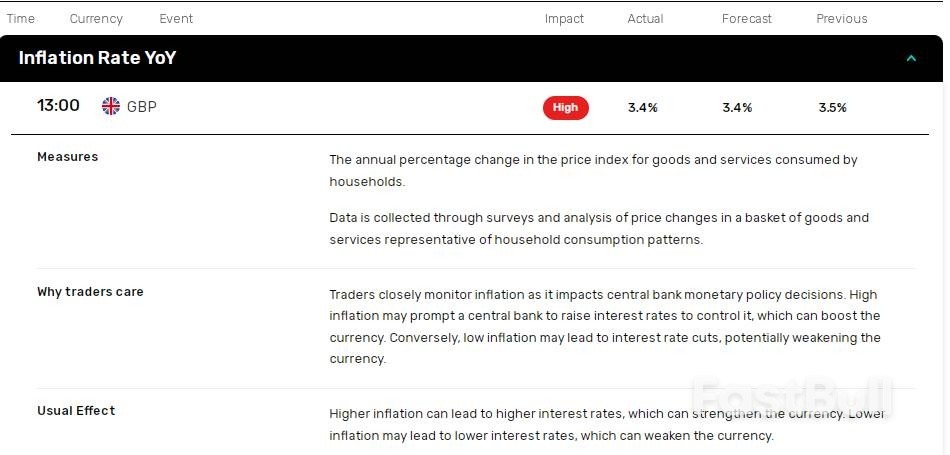
          UK inflation cooled to 3.4% in May, fueling speculation about BoE rate cut bets amid slowing economic momentum. Core inflation dropped to 3.5%, below forecasts, supporting expectations of easing monetary policy. Sticky services inflation may delay BoE cuts despite weakening GDP and retail demand concerns.

          UK Inflation Eases, but Oil Shock Clouds Rate Cut Bets

          Softer-than-expected UK inflation data fueled speculation about Bank of England rate cut bets on Wednesday, June 18.

          The UK’s annual inflation rate (headline) cooled from 3.5% in April to 3.4% in May, aligned with a consensus of 3.4%. Core inflation dropped from 3.8% to 3.5% in May, below a consensus of 3.6%.

          Key price trends from the Office for National Statistics included:

          • The Consumer Prices Index, including owner-occupier housing costs (CPIH), rose 4.0% in the 12 months to May after rising 4.1% in April.
          • The largest downward contribution came from transport, offsetting upward contributions from food, and furniture and household goods.
          • The Core CPIH (excluding energy, food, alcohol, and tobacco) increased by 4.2% in the 12 months to May, compared with 4.5% in April.
          • Core CPI (excluding energy, food, alcohol, and tobacco) eased from 3.8% in the 12 months to April to 3.5% in the 12 months to May.
          • The CPI services annual rate slowed from 5.4% in April to 4.7% in May.

          Despite the softer inflation readings, a spike in WTI crude oil prices in response to the Iran-Israel conflict may cloud the inflation outlook. Uncertainty about CPI trends may leave the BoE in a policy-holding pattern despite a faltering UK economy.
          BoE to Hold Rates in June

          Economists expect the BoE to keep interest rates at 4.25% on Thursday, June 19, despite the UK economy losing momentum in April. The UK GDP fell 0.3% month-on-month as services output dropped for the first time since October 2024.

          However, sticky inflation and potentially higher oil prices could raise stagflation risks. Monetary policy uncertainty and a worsening economic outlook may pressure GBP/USD.

          Ahead of May’s inflation report, ING Economics commented on the BoE’s potential rate path, stating:

          “We expect the Bank of England to keep rates at 4.25% on 19 June, but some disappointing job numbers, lower wage growth, and a more optimistic outlook for services inflation mean we expect cuts in August and November.”

          May’s services inflation numbers supported ING Economics’ outlook. However, the Iran-Israel conflict remains a curveball for economists and central bankers.

          Friday’s upcoming retail sales figures could give a better gauge of momentum in the UK economy and the BoE’s path forward.

          GBP/USD Volatility Post-Inflation Data

          Ahead of the inflation report, the GBP/USD dipped to a low of $1.34145 before climbing to a high of $1.34489. Following the report, the pair fell to a low of $1.34403 before surging to a high of $1.34621.

          On Wednesday, June 18, the GBP/USD was up 0.19% to $1.34530. The upswing likely signaled the potential impact of sticky inflation on the BoE’s policy outlook.
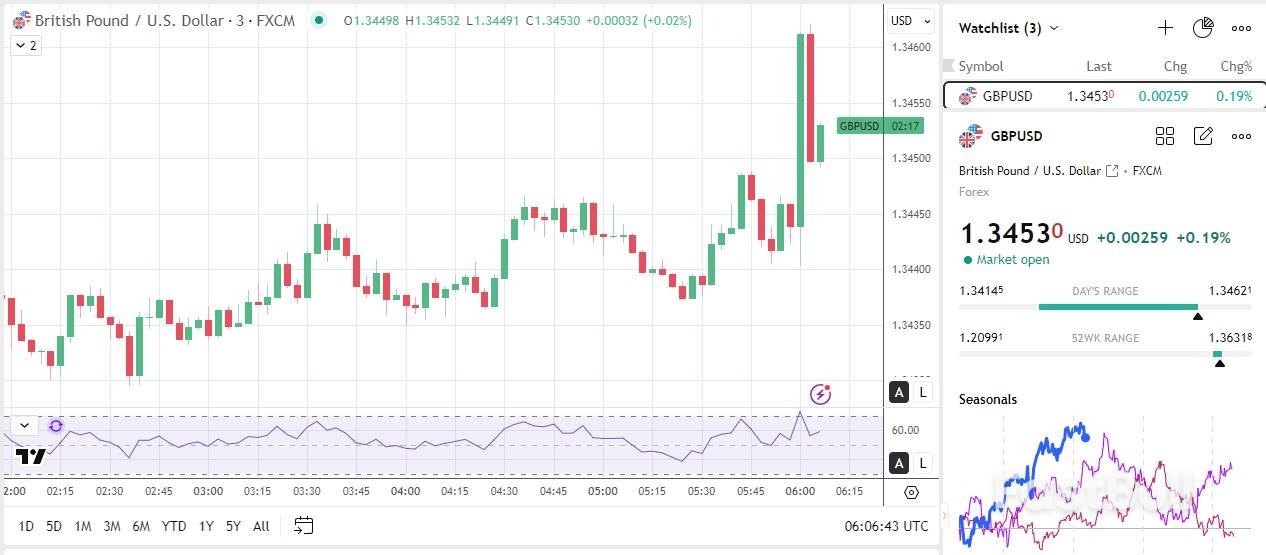
          GBPUSD – 3 Minute Chart – 180625

          Looking Ahead

          Traders must now turn to the BoE’s interest rate decision on June 19 and Friday’s UK retail sales. Consumer spending data may offer further insights into consumer sentiment and potential GDP and inflation trends.

          A drop in retail sales could signal further economic weakness and softer inflation, supporting multiple BoE rate cuts. However, strong retail sales could dampen BoE rate cut bets, sending GBP/USD higher.

          In parallel, trade developments and the Iran-Israel conflict will remain key drivers of risk sentiment and GBP/USD price action.

          Source: FX Empire

          To stay updated on all economic events of today, please check out our Economic calendar
          Risk Warnings and Disclaimers
          You understand and acknowledge that there is a high degree of risk involved in trading. Following any strategies or investment methods may lead to potential losses. The content on the site is provided by our contributors and analysts for information purposes only. You are solely responsible for determining whether any trading assets, securities, strategy, or any other product is suitable for investing based on your own investment objectives and financial situation.
          Add to Favorites
          Share

          Japan’s Export Engine Falters as U.S. Tariffs Bite and Trade Talks Stall

          Gerik

          Economic

          U.S. Tariffs Deal a Heavy Blow to Japan’s Export Sector

          Japan, the world’s fourth-largest economy, is showing growing signs of strain as its export-driven growth model faces intensified pressure from new U.S. trade barriers. According to data released by Japan’s Ministry of Finance on June 18, total exports in May fell by 1.7% year-over-year, marking the first contraction in eight months. This decline was driven primarily by an 11.1% plunge in exports to the United States, Japan’s largest export market.
          The impact of trade policy shifts under President Donald Trump is becoming increasingly visible. Since April 5, Japanese exports to the U.S. have been subject to a 10% general tariff, with an additional 14% retaliatory duty set to take effect on July 9 unless a deal is reached. Moreover, a separate 25% levy already applies to steel, automobiles, and auto parts. Earlier this month, Trump’s administration escalated tensions further by doubling tariffs on imported steel and aluminum to 50%.

          Auto and Steel Exports Lead Declines

          The latest data reveals sector-specific damage: exports of complete automobiles to the U.S. in May plummeted 24.7%, while auto parts fell by 19%, and steel shipments dipped by 1.5%. These declines point to targeted vulnerabilities in Japan’s industrial economy, particularly in industries most exposed to U.S. protectionism.
          With automotive exports making up nearly one-third of Japan’s U.S.-bound shipments, the sharp contraction in this category signals not only immediate pain but longer-term structural risks, especially as electric vehicle adoption and regional trade realignments threaten traditional Japanese export advantages.

          Diplomatic Stalemate After Six Rounds of Negotiations

          Despite six rounds of high-level trade talks between Japanese and American officials, progress has stalled. Prime Minister Shigeru Ishiba met President Trump on June 16 during the G7 summit in Alberta, but discussions failed to yield a breakthrough. Trump has reportedly accused Japan of being "tough" in negotiations, further dampening optimism for a near-term resolution.
          This prolonged impasse comes at a time when Japan is urgently seeking relief for its embattled exporters. With the July 9 tariff hike deadline approaching, companies face growing uncertainty about market access, pricing power, and long-term competitiveness in the U.S. market.

          Asia’s Broader Trade Landscape Also Struggles

          Japan is not alone in feeling the effects of U.S. trade policy. South Korea’s exports have also fallen for the first time in four months, and China’s trade with the U.S. has declined by double-digit percentages for two consecutive months. These regional signals suggest that the fallout from U.S. tariff actions is not isolated but systemic, rippling across Asia’s tightly interlinked supply chains.
          Within Japan’s broader trade performance, results were mixed. While exports to China fell 8.8%—marking the third straight monthly decline—exports to the European Union rose by 4.9%. Shipments to Southeast Asia edged up by a marginal 0.1%, indicating stagnation in a traditionally high-growth corridor.

          Imports Fall, Trade Surplus Widens—But Not for the Right Reasons

          On the import side, Japan recorded a 7.7% decline year-over-year, sharper than expected. While this helped produce a trade surplus of 637.61 billion yen (approximately $4.4 billion), the contraction in imports may reflect weakening domestic demand rather than a healthy rebalancing of trade. With household consumption and industrial investment both under pressure, Japan’s trade surplus could signal economic fragility rather than strength.
          Japan’s export-driven economy is facing a pivotal moment. The sharp drop in shipments to the U.S.—its top trading partner—comes amid a breakdown in diplomacy and escalating tariff pressures. As global supply chains remain fragile and geopolitical tensions intensify, Japan must grapple with both external headwinds and internal structural challenges.
          Without a swift resolution to its trade standoff with Washington, Tokyo risks deeper industrial contraction and a prolonged drag on GDP growth. The coming weeks may prove critical not just for Japan’s economic outlook, but for the broader stability of trade flows in the Asia-Pacific region.

          Source: Nikkei Asia

          To stay updated on all economic events of today, please check out our Economic calendar
          Risk Warnings and Disclaimers
          You understand and acknowledge that there is a high degree of risk involved in trading. Following any strategies or investment methods may lead to potential losses. The content on the site is provided by our contributors and analysts for information purposes only. You are solely responsible for determining whether any trading assets, securities, strategy, or any other product is suitable for investing based on your own investment objectives and financial situation.
          Add to Favorites
          Share

          U.S. Treasury Yields Fall Sharply as Weak Retail Sales and Geopolitical Tensions Raise Recession Alarm

          Gerik

          Economic

          Retail Sales Slump Triggers Bond Market Rally

          Treasury yields fell notably on Tuesday as May retail sales came in significantly below expectations, signaling a sharper-than-anticipated consumer pullback and intensifying concerns over the U.S. economic outlook. The Census Bureau reported a 0.9% monthly decline in retail sales, compared to a projected 0.6% drop. Excluding automobiles, sales fell 0.3%—worse than the 0.1% increase economists expected. The data indicates not just temporary consumer fatigue but potentially deeper cracks in demand fundamentals.
          The response from fixed-income markets was swift. The benchmark 10-year Treasury yield slid over 6 basis points to 4.387%, while the 2-year Treasury note declined by more than 2 basis points to 3.946%. These moves reflect both an adjustment in growth expectations and growing demand for the perceived safety of government debt. Because bond yields move inversely to prices, the drop in yields reflects a surge in buying activity, driven by both economic and geopolitical risk.

          Consumer Weakness Reinforces Downside Growth Risk

          Retail sales are a leading indicator of domestic economic momentum. The broad-based softness—particularly the 2% decline in gasoline sales—suggests more than price effects; it may reflect a contraction in consumer mobility and overall spending. With personal consumption comprising nearly 70% of U.S. GDP, such a decline poses a direct risk to second-quarter growth forecasts.
          While lower energy prices can, in theory, support household spending, the simultaneous drop in retail volumes hints at a more systemic demand weakness. The retail slump, especially in discretionary segments, reinforces concerns that inflation-fatigued consumers may be pulling back in response to cost pressures and economic uncertainty.

          Geopolitical Turbulence Amplifies Market Caution

          Adding to the bearish economic signals is the mounting uncertainty surrounding the escalating conflict between Israel and Iran. President Trump’s abrupt departure from the G7 summit in Alberta, citing “much bigger” events in the Middle East, heightened market sensitivity to geopolitical risks. His call for Iranians to evacuate Tehran, alongside continued missile exchanges and reports of explosions in the Iranian capital, contributed to the safe-haven flows into U.S. Treasurys.
          This conflict introduces potential global economic spillovers, particularly via oil markets, supply chain disruptions, and risk sentiment contagion. Historically, heightened geopolitical uncertainty has driven investors toward low-risk assets such as U.S. bonds and gold, and current price action aligns with that pattern.
          Deutsche Bank echoed this sentiment in a note on Tuesday, highlighting the sustained aerial conflict and ambiguity over Israel’s willingness to consider a ceasefire. These developments suggest that financial markets are pricing in not just regional instability, but the likelihood of broader economic dislocation.

          Policy Implications: Fed Caught Between Growth and Inflation Risks

          The Federal Reserve’s upcoming decision now takes center stage, with markets recalibrating expectations in light of weak economic data and persistent inflationary risks linked to oil prices. While the Fed is widely expected to keep rates unchanged, the outlook for future rate cuts has become increasingly nuanced. On one hand, softening consumer data supports an easing bias; on the other, geopolitical-driven commodity shocks may sustain inflationary pressures, complicating the Fed’s dual mandate.
          The bond market is signaling skepticism that the U.S. economy can maintain growth under current rate conditions, especially if global energy and trade dynamics worsen. The steepening in the Treasury curve—where long-term yields fall more than short-term ones—also points toward recession expectations, with investors anticipating slower growth and eventual rate cuts.
          Tuesday’s bond market reaction reflects a confluence of deteriorating retail activity and intensifying geopolitical stress, both of which have triggered a reassessment of economic resilience. The fall in Treasury yields signals growing investor concern that the U.S. is approaching an inflection point where stagnant consumer demand and rising global risk may tip the economy into a downturn. As the Federal Reserve prepares to issue its latest policy guidance, financial markets will be looking for clarity on whether policymakers are prepared to pivot in the face of deepening uncertainty.

          Source: CNBC

          To stay updated on all economic events of today, please check out our Economic calendar
          Risk Warnings and Disclaimers
          You understand and acknowledge that there is a high degree of risk involved in trading. Following any strategies or investment methods may lead to potential losses. The content on the site is provided by our contributors and analysts for information purposes only. You are solely responsible for determining whether any trading assets, securities, strategy, or any other product is suitable for investing based on your own investment objectives and financial situation.
          Add to Favorites
          Share

          Japan's Exports Suffer Sharpest Decline in Eight Months Amid Auto Tariff Fallout and Trade Gridlock

          Gerik

          Economic

          Auto Tariffs Drive Sharp Contraction in Japan’s Export Performance

          Japan’s export sector contracted significantly in May, as new trade data revealed a 1.7% year-over-year decline—the most pronounced fall in eight months. Although the downturn was less severe than the 3.8% drop forecasted by economists, it marked a clear reversal from the 2% growth posted in April and highlights the intensifying impact of US trade measures, especially on Japan’s critical automobile industry.
          The drop was driven by a 24.7% plunge in car exports to the U.S., a sector that constituted 28.3% of Japan’s exports to the American market in 2024. Overall automobile shipments declined 6.9% globally, suggesting that while US policy is the immediate pressure point, broader global demand softness may be emerging. The numbers reflect not only the impact of the existing 25% tariff on Japanese auto and steel exports, but also anxiety over the upcoming 24% “reciprocal” tariff due to be implemented on July 9.

          Trade Imbalance Shrinks, But Underlying Risks Mount

          Despite the export shock, Japan’s trade deficit in May was smaller than anticipated, totaling 637.6 billion yen (approximately $4.39 billion), better than the 892.9 billion yen shortfall expected by analysts. Imports also contracted more than expected, falling 7.7% year-on-year compared to the consensus forecast of a 6.7% decline.
          While this appears positive on the surface, the narrower deficit is largely a byproduct of weakened domestic demand rather than trade resilience. Import contraction, particularly in raw materials and capital goods, reflects cooling private sector confidence and subdued household consumption—further symptoms of macroeconomic fragility.

          Geopolitical and Structural Pressures Converge

          The sharp fall in exports coincides with a lack of progress in trade negotiations between Japan and the United States. After six rounds of high-level discussions between Japanese negotiator Ryosei Akazawa and U.S. officials Howard Lutnick and Scott Bessent, a resolution remains elusive. President Trump recently criticized Japan’s stance as “tough,” suggesting a hardening U.S. approach that leaves little room for swift compromise.
          The timing is particularly detrimental, as the Bank of Japan’s recent policy statement already warned of a moderation in growth due to weakening trade and corporate profitability. The BOJ acknowledged that global policy uncertainty could derail overseas demand, further complicating the already precarious recovery trajectory. With Japan’s GDP having contracted by 0.2% in the first quarter, any prolonged drag from trade could push the country toward a technical recession.

          Sectoral Concentration Heightens Exposure to Trade Shocks

          Japan’s economic model, heavily dependent on industrial exports—particularly automobiles and electronics—amplifies its vulnerability to targeted tariffs. While Japan has pursued diversification through multilateral agreements like the CPTPP and RCEP, these have yet to offset the dominance of the U.S. as a trade partner. Despite past exemptions such as the 2018 steel tariff waiver, the current landscape suggests a diminished likelihood of similar relief, especially under the renewed tariff regime.
          Moody’s Analytics economist Stefan Angrick emphasized that tariffs now represent the single largest threat to Japan’s near-term outlook. Even if a partial deal is reached, he argues, a full return to pre-Trump trade conditions is unlikely, suggesting a structurally altered environment that could hinder export recovery for months to come.

          Policy Response and Political Stakes

          Prime Minister Shigeru Ishiba has reiterated the strategic importance of Japan’s automobile sector, reportedly labeling it a "major national interest." As negotiations stall, Japan’s strategy appears to prioritize preserving market access for auto manufacturers over broader concessions. This sectoral focus may help insulate key firms but risks alienating other industries and complicating broader trade diversification.
          Simultaneously, fiscal and monetary tools to cushion the impact are becoming less effective. With the BOJ maintaining ultra-low rates and signaling caution on bond tapering, Japan’s policy space remains narrow. Any aggressive fiscal support to offset the export slump may further inflate the government’s already elevated debt burden.
          The sharp drop in Japan’s exports—particularly its auto shipments to the U.S.—underscores the fragility of its recovery and the high exposure to geopolitical risk. With negotiations stalled and new tariffs imminent, the outlook for Japan’s external sector remains deeply uncertain. Unless a breakthrough is achieved in the coming weeks, export-driven growth will continue to face headwinds, putting additional pressure on policymakers to craft a multi-front response that balances diplomacy, domestic stimulus, and structural trade diversification.

          Source: Reuters

          To stay updated on all economic events of today, please check out our Economic calendar
          Risk Warnings and Disclaimers
          You understand and acknowledge that there is a high degree of risk involved in trading. Following any strategies or investment methods may lead to potential losses. The content on the site is provided by our contributors and analysts for information purposes only. You are solely responsible for determining whether any trading assets, securities, strategy, or any other product is suitable for investing based on your own investment objectives and financial situation.
          Add to Favorites
          Share

          Dollar Holds Firm as Geopolitical Tensions and Fed Decision Shape Market Sentiment

          Gerik

          Economic

          Forex

          Dollar Resilience Driven by Safe-Haven Demand

          The US dollar maintained recent gains early Wednesday, supported by its traditional role as a safe-haven currency in times of global instability. Investors, facing heightened geopolitical risk following Israel’s continued strikes on Iran and the looming possibility of direct US involvement, have shifted capital toward dollar-denominated assets. As a result, the greenback has appreciated approximately 1% against the yen, franc, and euro since last Thursday, reversing part of its earlier 8% year-to-date decline.
          The currency’s stability highlights the enduring appeal of dollar liquidity, even amid growing structural criticisms about US fiscal sustainability and erratic policymaking. Currency strategist Rodrigo Catril from the National Australia Bank noted that although long-term confidence in the dollar may be diluted, it remains the preferred instrument in scenarios involving elevated geopolitical risk.

          Yen and Euro Under Pressure from Energy and Risk Exposure

          As oil prices hover around $75 a barrel, the macroeconomic environment continues to weigh on net crude importers like Japan and the eurozone. Higher energy costs, stemming from Middle East uncertainty, exert additional pressure on their currencies by worsening trade balances and increasing inflationary risk. The Japanese yen weakened to a one-week low at 145.21 per dollar, while the euro inched up marginally to $1.149 after broader losses earlier in the week.
          Despite the marginal uptick in euro sentiment, the outlook remains fragile. The European Union’s trade friction with the US, coupled with its reliance on imported energy, makes the bloc particularly vulnerable to external shocks—highlighting the currency’s sensitivity to both oil volatility and geopolitical developments.
          Markets Await Fed Decision Amid Slowing Growth and Rising Oil
          Investors are now focused on the US Federal Reserve’s upcoming policy decision. While the Fed is expected to keep interest rates unchanged, the forward guidance will be crucial. Markets will closely scrutinize how the central bank interprets slower US growth, erratic fiscal signals from the Trump administration, and the inflationary implications of rising energy prices.
          Catril anticipates a cautious tone from the Fed, likely pointing to stickier inflation combined with a downward revision in the growth forecast. The challenge for the Fed lies in managing inflation expectations without prematurely tightening monetary policy in a weakening demand environment.
          This balancing act is further complicated by geopolitical risks. Oil-driven cost pressures and trade tensions may force the Fed to adopt a more defensive policy posture, potentially delaying the timeline for rate cuts previously expected in late 2025.

          Central Bank Divergence and Global Trade Pressures

          Elsewhere, the Bank of Japan left interest rates unchanged and signaled a slower pace for bond tapering to ease domestic bond market volatility. The policy stance reflects Tokyo’s efforts to prevent further economic contraction amid soft export data, with Japan recording its first export decline in eight months in May.
          Looking ahead, additional central bank decisions from the UK, Switzerland, Norway, and Sweden will offer further insight into how monetary authorities are responding to elevated global uncertainty. Divergences in rate paths could influence currency flows, particularly if European central banks adopt a more hawkish stance to counter energy-driven inflation.
          Meanwhile, diplomatic stagnation continues to frustrate investors. The recent G7 summit in Canada failed to produce meaningful trade resolutions, and President Trump’s criticism of Japan and the EU as “tough” negotiators suggests further tariff escalations are likely. These trade dynamics feed into broader risk aversion and strengthen demand for dollar assets as a shield against volatility.
          As geopolitical conflict and trade policy uncertainty reshape market dynamics, the US dollar has regained its role as a safe-haven asset. Its recent strength reflects a combination of risk aversion, relatively stronger macro fundamentals, and investor reluctance to hold exposure in more vulnerable currencies. However, with the Federal Reserve’s rate guidance and Trump’s tariff deadlines approaching, the dollar’s trajectory will ultimately hinge on whether policymakers can navigate an increasingly complex global economic landscape without further destabilizing investor confidence.

          Source: Reuters

          To stay updated on all economic events of today, please check out our Economic calendar
          Risk Warnings and Disclaimers
          You understand and acknowledge that there is a high degree of risk involved in trading. Following any strategies or investment methods may lead to potential losses. The content on the site is provided by our contributors and analysts for information purposes only. You are solely responsible for determining whether any trading assets, securities, strategy, or any other product is suitable for investing based on your own investment objectives and financial situation.
          Add to Favorites
          Share

          China’s Subsidy-Fueled Consumption Surge Exposes Fragility of Stimulus Strategy

          Gerik

          Economic

          Retail Rebound Driven by Stimulus Pushes Policy Limits

          China’s ambitious consumer subsidy initiative—launched to offset weakening domestic demand and looming US tariffs—has temporarily revived household spending, but the rapid uptake is testing the system’s financial and administrative capacity. According to official data and local announcements, retail sales saw their strongest growth in over a year in May, driven primarily by the national “trade-in” program targeting home appliances and electronics. Sales in these sectors surged by over 50% last month.
          Yet the pace of consumer participation has overwhelmed even the wealthiest provinces. Regions such as Henan and Chongqing have halted new subsidy applications, while others like Jiangsu and Guangdong have begun rationing daily quotas. These disruptions suggest that while the stimulus is effective in sparking short-term consumption, the underlying structure remains financially fragile and unevenly distributed.

          Structural Strain Emerges as Funds Run Dry

          Beijing has allocated 300 billion yuan ($41.8 billion) in ultra-long special sovereign bonds to support this stimulus initiative, with 162 billion yuan assigned to provinces in two tranches. However, the second tranche, announced in April, remains largely undisbursed as of mid-June. The delay in local disbursement highlights both logistical and fiscal limitations, raising concern among economists and officials that continued reliance on temporary cash incentives may be unsustainable.
          Standard Chartered’s Ding Shuang noted that the fast uptake proves the program's immediate effectiveness in moving targeted goods. However, he emphasized the necessity for more durable, income-based support mechanisms to maintain momentum once the initial wave of subsidies ends. The effectiveness here appears more correlational than causational in terms of long-term behavior change—consumption surged because of the policy, but there is no evidence yet that it will sustain without fiscal injections.

          Manipulation and Arbitrage Complicate Rollout

          Further complicating matters is growing evidence of abuse. Several provinces, including Guangdong and Zhejiang, have suspended car subsidies due to fraudulent practices involving “zero-mileage” vehicles—new cars registered solely to qualify for rebates before being flipped on the used market. This points to a misalignment between policy goals and market incentives, where some businesses manipulate the system for arbitrage rather than fostering real consumption.
          These episodes have triggered regulatory reviews and tightened oversight, but they also signal the challenges of managing large-scale fiscal programs in real time, especially when local governments face competing pressures: maintain spending momentum, preserve fiscal integrity, and avoid market distortions.

          Retail Revival Amid Broader Economic Uncertainty

          Despite these issues, the program has injected short-term vitality into China’s sluggish consumption landscape. Goldman Sachs economists noted the scheme’s role in boosting demand for durable goods, though they warned that regional funding shortfalls could limit June's figures. Morgan Stanley’s analysts echoed this view, highlighting how local suspensions may reflect not only administrative concerns but also attempts to smooth out consumption and mitigate opportunistic behavior during major sales events like the “618” shopping festival.
          The resurgence in retail activity is particularly important as China faces mounting headwinds abroad. The reimposition of tariffs by the US under the Trump administration threatens China’s export engine, and a slowdown in global demand is already weighing on industrial output. These external pressures reinforce Beijing’s shift toward domestic consumption as a stabilizing force, but the current approach reveals deep structural imbalances.

          Fiscal Pressures Narrow Policy Options

          China’s fiscal capacity is becoming increasingly constrained. With revenue from land sales declining and tax receipts under pressure, the central government has ramped up borrowing—raising its fiscal deficit to the highest level in more than three decades and expanding special sovereign bond issuance by 80% from 2024. As a result, interest obligations are rising, further eroding spending flexibility.
          This financial backdrop raises questions about the longevity of consumption subsidies as a primary policy tool. While some economists expect continued allocations to maintain public confidence, long-term fiscal health may depend on a pivot toward reforms that address income inequality, wage growth, and private-sector investment rather than temporary incentives.
          China’s consumer stimulus campaign has temporarily reignited retail demand, but the rapid depletion of subsidy funds, fraud risks, and growing fiscal strain reveal the limitations of short-term policy tools in addressing deeper economic imbalances. As Beijing grapples with trade headwinds and domestic fragility, the current stimulus wave may serve more as a stopgap than a sustainable solution. For long-term stability, policymakers must look beyond consumption incentives toward structural reforms that restore confidence, drive income growth, and realign incentives for both consumers and businesses.

          Source: Reuters

          To stay updated on all economic events of today, please check out our Economic calendar
          Risk Warnings and Disclaimers
          You understand and acknowledge that there is a high degree of risk involved in trading. Following any strategies or investment methods may lead to potential losses. The content on the site is provided by our contributors and analysts for information purposes only. You are solely responsible for determining whether any trading assets, securities, strategy, or any other product is suitable for investing based on your own investment objectives and financial situation.
          Add to Favorites
          Share

          Goldman Sachs Restructures Asia Operations to Capitalize on Regional M&A and Capital Market Momentum

          Gerik

          Economic

          Strategic Overhaul Aims to Unify and Strengthen APAC Investment Banking

          Goldman Sachs is positioning itself for a stronger presence in Asia’s investment banking landscape through a major regional restructuring. Since late 2024, the firm has combined its merger and acquisition teams, consolidated financial and strategic investor services, and created a new capital solutions group. These moves culminated in the merger of three previously independent investment banking businesses—Japan, Australia and New Zealand, and the rest of Asia—under a unified Asia-Pacific (APAC) platform. In May 2025, Iain Drayton, a 19-year veteran of the firm, was appointed to lead the integrated franchise.
          This unified platform marks a shift from the bank’s historically fragmented regional structure and is intended to streamline execution, deepen client coverage, and provide cross-market insights. According to Drayton, the strategy is designed not merely for internal efficiency but also to broaden the firm’s commercial footprint and enhance its appeal to clients seeking comprehensive regional support.

          M&A and Equity Market Recovery Presents Strategic Entry Point

          The timing of the revamp aligns with a noticeable resurgence in Asia’s capital markets. Drayton noted a “clear pickup” in large-scale M&A and a meaningful rebound in equity capital market (ECM) transactions since the integration began. This turnaround follows a two-to-three-year period dominated by global macroeconomic headwinds, especially from trade tensions and US tariff uncertainties that had dampened deal activity and delayed transactions.
          However, current indicators point to a shift in market dynamics. With valuations in many sectors now more compelling and regional economies stabilizing, investor engagement is on the rise. Goldman Sachs is aiming to harness these favorable conditions—what Drayton describes as "strong tailwinds"—to build market share, particularly in sectors and markets that are showing renewed appetite for consolidation and capital raising.

          Performance Metrics Signal Competitive Gains

          Data from Dealogic underscores Goldman Sachs’ recent progress in the region. As of mid-June 2025, the firm has led $12 billion worth of equity capital market deals in Asia-Pacific, placing it ahead of major rivals like JP Morgan and Morgan Stanley. This top performance in ECM highlights the successful execution of deals under the new integrated model, likely facilitated by tighter coordination and improved regional resource allocation.
          In mergers and acquisitions, Goldman Sachs placed third in the league tables with $111 billion in announced transactions, trailing only Nomura Holdings and Morgan Stanley. While this suggests room for improvement in advisory market share, it also reflects the firm’s presence in significant high-value transactions during the early phase of its post-revamp period.

          Reshaped Structure to Offset Geopolitical and Policy Risk

          The reorganization is not only a growth initiative but also a structural hedge against rising geopolitical complexity. With tariff policies from the United States continuing to cause global uncertainty—especially in trade-sensitive industries—Goldman’s move to operate as a cohesive APAC entity may improve its responsiveness to regional shifts and help navigate policy-driven disruptions.
          By centralizing strategic planning and execution, the firm is better equipped to manage cross-border risks, align capital flow strategies across jurisdictions, and deliver unified advisory services to multinational clients seeking exposure to Asian markets.
          Goldman Sachs’ APAC investment banking restructuring is a deliberate pivot toward a more integrated and regionally agile model. With capital markets showing renewed momentum and investor sentiment turning positive, the firm’s timing may prove advantageous. While it still faces competition from entrenched regional players, early signs—reflected in league table standings and revived deal activity—suggest that the structural overhaul is already producing tangible commercial benefits. The next phase will test how well this new model can scale and respond to both market opportunities and policy challenges in an increasingly competitive Asia-Pacific investment banking environment.

          Source: Reuters

          To stay updated on all economic events of today, please check out our Economic calendar
          Risk Warnings and Disclaimers
          You understand and acknowledge that there is a high degree of risk involved in trading. Following any strategies or investment methods may lead to potential losses. The content on the site is provided by our contributors and analysts for information purposes only. You are solely responsible for determining whether any trading assets, securities, strategy, or any other product is suitable for investing based on your own investment objectives and financial situation.
          Add to Favorites
          Share
          FastBull
          Copyright © 2025 FastBull Ltd

          728 RM B 7/F GEE LOK IND BLDG NO 34 HUNG TO RD KWUN TONG KLN HONG KONG

          TelegramInstagramTwitterfacebooklinkedin
          App Store Google Play Google Play
          Products
          Charts

          Chats

          Q&A with Experts
          Screeners
          Economic Calendar
          Data
          Tools
          Membership
          Features
          Function
          Markets
          Copy Trading
          Latest Signals
          Contests
          News
          Analysis
          24/7
          Columns
          Education
          Company
          Careers
          About Us
          Contact Us
          Advertising
          Help Center
          Feedback
          User Agreement
          Privacy Policy
          Business

          White Label

          Data API

          Web Plug-ins

          Poster Maker

          Affiliate Program

          Risk Disclosure

          The risk of loss in trading financial instruments such as stocks, FX, commodities, futures, bonds, ETFs and crypto can be substantial. You may sustain a total loss of the funds that you deposit with your broker. Therefore, you should carefully consider whether such trading is suitable for you in light of your circumstances and financial resources.

          No decision to invest should be made without thoroughly conducting due diligence by yourself or consulting with your financial advisors. Our web content might not suit you since we don't know your financial conditions and investment needs. Our financial information might have latency or contain inaccuracy, so you should be fully responsible for any of your trading and investment decisions. The company will not be responsible for your capital loss.

          Without getting permission from the website, you are not allowed to copy the website's graphics, texts, or trademarks. Intellectual property rights in the content or data incorporated into this website belong to its providers and exchange merchants.

          Not Logged In

          Log in to access more features

          FastBull Membership

          Not yet

          Purchase

          Become a signal provider
          Help Center
          Customer Service
          Dark Mode
          Price Up/Down Colors

          Log In

          Sign Up

          Position
          Layout
          Fullscreen
          Default to Chart
          The chart page opens by default when you visit fastbull.com