• Trade
  • Markets
  • Copy
  • Contests
  • News
  • 24/7
  • Calendar
  • Q&A
  • Chats
Trending
Screeners
SYMBOL
LAST
BID
ASK
HIGH
LOW
NET CHG.
%CHG.
SPREAD
SPX
S&P 500 Index
6827.42
6827.42
6827.42
6899.86
6801.80
-73.58
-1.07%
--
DJI
Dow Jones Industrial Average
48458.04
48458.04
48458.04
48886.86
48334.10
-245.98
-0.51%
--
IXIC
NASDAQ Composite Index
23195.16
23195.16
23195.16
23554.89
23094.51
-398.69
-1.69%
--
USDX
US Dollar Index
97.950
98.030
97.950
98.500
97.950
-0.370
-0.38%
--
EURUSD
Euro / US Dollar
1.17394
1.17409
1.17394
1.17496
1.17192
+0.00011
+ 0.01%
--
GBPUSD
Pound Sterling / US Dollar
1.33707
1.33732
1.33707
1.33997
1.33419
-0.00148
-0.11%
--
XAUUSD
Gold / US Dollar
4299.39
4299.39
4299.39
4353.41
4257.10
+20.10
+ 0.47%
--
WTI
Light Sweet Crude Oil
57.233
57.485
57.233
58.011
56.969
-0.408
-0.71%
--

Community Accounts

Signal Accounts
--
Profit Accounts
--
Loss Accounts
--
View More

Become a signal provider

Sell trading signals to earn additional income

View More

Guide to Copy Trading

Get started with ease and confidence

View More

Signal Accounts for Members

All Signal Accounts

Best Return
  • Best Return
  • Best P/L
  • Best MDD
Past 1W
  • Past 1W
  • Past 1M
  • Past 1Y

All Contests

  • All
  • Trump Updates
  • Recommend
  • Stocks
  • Cryptocurrencies
  • Central Banks
  • Featured News
Top News Only
Share

Ukraine's Navy Says Russian Drone Attack Hit Civilian Turkish Vessel Carrying Sunflower Oil To Egypt On Saturday

Share

Israeli Military Says It Put Planned Strike On South Lebanon Site On Hold After Lebanese Army Requested Access

Share

Norwegian Nobel Committee: Calls On The Belarusian Authorities To Release All Political Prisoners

Share

Norwegian Nobel Committee: His Freedom Is A Deeply Welcome And Long-Awaited Moment

Share

Ukraine Says It Received 114 Prisoners From Belarus

Share

USA Embassy In Lithuania: Maria Kalesnikava Is Not Going To Vilnius

Share

USA Embassy In Lithuania: Other Prisoners Are Being Sent From Belarus To Ukraine

Share

Ukraine President Zelenskiy: Five Ukrainians Released By Belarus In US-Brokered Deal

Share

USA Vilnius Embassy: USA Stands Ready For "Additional Engagement With Belarus That Advances USA Interests"

Share

USA Vilnius Embassy: Belarus, USA, Other Citizens Among The Prisoners Released Into Lithuania

Share

USA Vilnius Embassy: USA Will Continue Diplomatic Efforts To Free The Remaining Political Prisoners In Belarus

Share

USA Vilnius Embassy: Belarus Releases 123 Prisoners Following Meeting Of President Trump's Envoy Coale And Belarus President Lukashenko

Share

USA Vilnius Embassy: Masatoshi Nakanishi, Aliaksandr Syrytsa Are Among The Prisoners Released By Belarus

Share

USA Vilnius Embassy: Maria Kalesnikava And Viktor Babaryka Are Among The Prisoners Released By Belarus

Share

USA Vilnius Embassy: Nobel Peace Prize Laureate Ales Bialiatski Is Among The Prisoners Released By Belarus

Share

Belarusian Presidential Administration Telegram Channel: Lukashenko Has Pardoned 123 Prisoners As Part Of Deal With US

Share

Two Local Syrian Officials: Joint US-Syrian Military Patrol In Central Syria Came Under Fire From Unknown Assailants

Share

Israeli Military Says It Targeted 'Key Hamas Terrorist' In Gaza City

Share

Rwanda's Actions In Eastern Drc Are A Clear Violation Of Washington Accords Signed By President Trump - Secretary Of State Rubio

Share

Israeli Military Issues Evacuation Warning In Southern Lebanon Village Ahead Of Strike - Spokesperson On X

TIME
ACT
FCST
PREV
U.K. Trade Balance Non-EU (SA) (Oct)

A:--

F: --

P: --

U.K. Trade Balance (Oct)

A:--

F: --

P: --

U.K. Services Index MoM

A:--

F: --

P: --

U.K. Construction Output MoM (SA) (Oct)

A:--

F: --

P: --

U.K. Industrial Output YoY (Oct)

A:--

F: --

P: --

U.K. Trade Balance (SA) (Oct)

A:--

F: --

P: --

U.K. Trade Balance EU (SA) (Oct)

A:--

F: --

P: --

U.K. Manufacturing Output YoY (Oct)

A:--

F: --

P: --

U.K. GDP MoM (Oct)

A:--

F: --

P: --

U.K. GDP YoY (SA) (Oct)

A:--

F: --

P: --

U.K. Industrial Output MoM (Oct)

A:--

F: --

P: --

U.K. Construction Output YoY (Oct)

A:--

F: --

P: --

France HICP Final MoM (Nov)

A:--

F: --

P: --

China, Mainland Outstanding Loans Growth YoY (Nov)

A:--

F: --

P: --

China, Mainland M2 Money Supply YoY (Nov)

A:--

F: --

P: --

China, Mainland M0 Money Supply YoY (Nov)

A:--

F: --

P: --

China, Mainland M1 Money Supply YoY (Nov)

A:--

F: --

P: --

India CPI YoY (Nov)

A:--

F: --

P: --

India Deposit Gowth YoY

A:--

F: --

P: --

Brazil Services Growth YoY (Oct)

A:--

F: --

P: --

Mexico Industrial Output YoY (Oct)

A:--

F: --

P: --

Russia Trade Balance (Oct)

A:--

F: --

P: --

Philadelphia Fed President Henry Paulson delivers a speech
Canada Building Permits MoM (SA) (Oct)

A:--

F: --

P: --

Canada Wholesale Sales YoY (Oct)

A:--

F: --

P: --

Canada Wholesale Inventory MoM (Oct)

A:--

F: --

P: --

Canada Wholesale Inventory YoY (Oct)

A:--

F: --

P: --

Canada Wholesale Sales MoM (SA) (Oct)

A:--

F: --

P: --

Germany Current Account (Not SA) (Oct)

A:--

F: --

P: --

U.S. Weekly Total Rig Count

A:--

F: --

P: --

U.S. Weekly Total Oil Rig Count

A:--

F: --

P: --

Japan Tankan Large Non-Manufacturing Diffusion Index (Q4)

--

F: --

P: --

Japan Tankan Small Manufacturing Outlook Index (Q4)

--

F: --

P: --

Japan Tankan Large Non-Manufacturing Outlook Index (Q4)

--

F: --

P: --

Japan Tankan Large Manufacturing Outlook Index (Q4)

--

F: --

P: --

Japan Tankan Small Manufacturing Diffusion Index (Q4)

--

F: --

P: --

Japan Tankan Large Manufacturing Diffusion Index (Q4)

--

F: --

P: --

Japan Tankan Large-Enterprise Capital Expenditure YoY (Q4)

--

F: --

P: --

U.K. Rightmove House Price Index YoY (Dec)

--

F: --

P: --

China, Mainland Industrial Output YoY (YTD) (Nov)

--

F: --

P: --

China, Mainland Urban Area Unemployment Rate (Nov)

--

F: --

P: --

Saudi Arabia CPI YoY (Nov)

--

F: --

P: --

Euro Zone Industrial Output YoY (Oct)

--

F: --

P: --

Euro Zone Industrial Output MoM (Oct)

--

F: --

P: --

Canada Existing Home Sales MoM (Nov)

--

F: --

P: --

Euro Zone Total Reserve Assets (Nov)

--

F: --

P: --

U.K. Inflation Rate Expectations

--

F: --

P: --

Canada National Economic Confidence Index

--

F: --

P: --

Canada New Housing Starts (Nov)

--

F: --

P: --

U.S. NY Fed Manufacturing Employment Index (Dec)

--

F: --

P: --

U.S. NY Fed Manufacturing Index (Dec)

--

F: --

P: --

Canada Core CPI YoY (Nov)

--

F: --

P: --

Canada Manufacturing Unfilled Orders MoM (Oct)

--

F: --

P: --

Canada Manufacturing New Orders MoM (Oct)

--

F: --

P: --

Canada Core CPI MoM (Nov)

--

F: --

P: --

Canada Manufacturing Inventory MoM (Oct)

--

F: --

P: --

Canada CPI YoY (Nov)

--

F: --

P: --

Canada CPI MoM (Nov)

--

F: --

P: --

Canada CPI YoY (SA) (Nov)

--

F: --

P: --

Canada Core CPI MoM (SA) (Nov)

--

F: --

P: --

Q&A with Experts
    • All
    • Chatrooms
    • Groups
    • Friends
    Connecting
    .
    .
    .
    Type here...
    Add Symbol or Code

      No matching data

      All
      Trump Updates
      Recommend
      Stocks
      Cryptocurrencies
      Central Banks
      Featured News
      • All
      • Russia-Ukraine Conflict
      • Middle East Flashpoint
      • All
      • Russia-Ukraine Conflict
      • Middle East Flashpoint
      Search
      Products

      Charts Free Forever

      Chats Q&A with Experts
      Screeners Economic Calendar Data Tools
      Membership Features
      Data Warehouse Market Trends Institutional Data Policy Rates Macro

      Market Trends

      Market Sentiment Order Book Forex Correlations

      Top Indicators

      Charts Free Forever
      Markets

      News

      News Analysis 24/7 Columns Education
      From Institutions From Analysts
      Topics Columnists

      Latest Views

      Latest Views

      Trending Topics

      Top Columnists

      Latest Update

      Signals

      Copy Rankings Latest Signals Become a signal provider AI Rating
      Contests
      Brokers

      Overview Brokers Assessment Rankings Regulators News Claims
      Broker listing Forex Brokers Comparison Tool Live Spread Comparison Scam
      Q&A Complaint Scam Alert Videos Tips to Detect Scam
      More

      Business
      Events
      Careers About Us Advertising Help Center

      White Label

      Data API

      Web Plug-ins

      Affiliate Program

      Awards Institution Evaluation IB Seminar Salon Event Exhibition
      Vietnam Thailand Singapore Dubai
      Fans Party Investment Sharing Session
      FastBull Summit BrokersView Expo
      Recent Searches
        Top Searches
          Markets
          News
          Analysis
          User
          24/7
          Economic Calendar
          Education
          Data
          • Names
          • Latest
          • Prev

          View All

          No data

          Scan to Download

          Faster Charts, Chat Faster!

          Download App
          English
          • English
          • Español
          • العربية
          • Bahasa Indonesia
          • Bahasa Melayu
          • Tiếng Việt
          • ภาษาไทย
          • Français
          • Italiano
          • Türkçe
          • Русский язык
          • 简中
          • 繁中
          Open Account
          Search
          Products
          Charts Free Forever
          Markets
          News
          Signals

          Copy Rankings Latest Signals Become a signal provider AI Rating
          Contests
          Brokers

          Overview Brokers Assessment Rankings Regulators News Claims
          Broker listing Forex Brokers Comparison Tool Live Spread Comparison Scam
          Q&A Complaint Scam Alert Videos Tips to Detect Scam
          More

          Business
          Events
          Careers About Us Advertising Help Center

          White Label

          Data API

          Web Plug-ins

          Affiliate Program

          Awards Institution Evaluation IB Seminar Salon Event Exhibition
          Vietnam Thailand Singapore Dubai
          Fans Party Investment Sharing Session
          FastBull Summit BrokersView Expo

          Trump Tariffs Likely Halt BOJ Rate Hikes as Japan Faces Economic Repercussions

          Gerik

          Economic

          Summary:

          Former Bank of Japan (BOJ) policymaker Takako Masai warns that U.S. tariffs under President Trump could derail Japan’s monetary tightening path...

          US Tariffs Trigger Global Shockwaves, Threatening Japan’s Fragile Recovery

          The resurgence of U.S. protectionist policies, especially automobile tariffs, has injected new uncertainty into global trade, with Japan expected to bear a disproportionate burden. According to former BOJ policymaker Takako Masai, these tariffs are likely to depress Japanese exports and industrial output, weakening both wage growth and consumer spending. This would delay the BOJ's already cautious normalization of interest rates.
          Masai predicts that the real economic impact will manifest by 2026, as the lagged effects of trade disruption ripple through the supply chain and external demand. Notably, Japan's auto industry—an anchor of its export economy—is directly in the crosshairs of the new tariffs, magnifying the potential hit to GDP.

          Monetary Policy Path Reverses as External Conditions Deteriorate

          Earlier optimism over Japan achieving stable 2% inflation led BOJ Governor Kazuo Ueda to begin exiting ultra-loose policy, with the first rate hike to 0.5% in January 2025. However, the current trade turbulence appears to be altering the monetary policy trajectory. While core inflation has remained above target for over three years, much of it stems from supply-side pressures like energy and commodity costs, not from robust domestic demand.
          Masai emphasizes that in such an environment, further rate hikes could be premature. She advocates for low real interest rates to help bolster domestic restructuring, including diversification of exports and stimulating internal consumption. This reflects a strategic shift in Japan’s economic playbook—adapting to deglobalization trends and reducing external vulnerabilities.

          Delays in BOJ Hikes Reflect Structural Trade Dependence

          Market consensus already points to a delay in further BOJ action. A recent Reuters poll indicates that most analysts foresee the next rate hike not until early 2026, reinforcing Masai’s assertion that the rate hike cycle may have peaked.
          The BOJ’s decision to downgrade growth projections on May 1 amid trade concerns underscores this outlook. Even though inflation exceeds 2%, the composition of that inflation matters. If it’s not driven by wage-push or demand-pull forces, the risk of stagflation rises. Hence, hiking rates in the face of weakening demand may do more harm than good.

          Policy Flexibility Over Dogma

          Masai’s comments also signal the BOJ’s willingness to re-expand its balance sheet if necessary—a return to quantitative easing should the economy take a sharper downturn. This reaffirms Japan’s adaptive, rather than doctrinaire, monetary approach. Under Ueda, while the goal remains to anchor inflation expectations and normalize policy, global shocks may demand pragmatic backpedaling.
          Japan’s economic restructuring—long dependent on exports and a weak yen—is now challenged by trade fragmentation. Tariff uncertainty makes that dependence risky. Unless Japan accelerates domestic consumption, digital productivity, and demographic reforms, it risks prolonged stagnation under persistent external constraints.

          Navigating an Era of Weaponized Trade

          The intersection of global trade politics and domestic monetary policy is once again in focus. Japan, caught in the crossfire of U.S. tariff strategy, finds itself needing to balance inflation control with growth stabilization. The BOJ, aware of these vulnerabilities, appears set to maintain policy flexibility rather than push ahead with hikes that may aggravate downturn risks.
          In the broader context, Japan’s experience underscores a key insight: in an era of trade weaponization, central banks must not only fight inflation but shield economies from external geopolitical tremors. Whether the BOJ will act decisively or remain in wait-and-see mode depends heavily on how aggressively U.S. trade policy continues to evolve.

          Source: Reuters

          To stay updated on all economic events of today, please check out our Economic calendar
          Risk Warnings and Disclaimers
          You understand and acknowledge that there is a high degree of risk involved in trading. Following any strategies or investment methods may lead to potential losses. The content on the site is provided by our contributors and analysts for information purposes only. You are solely responsible for determining whether any trading assets, securities, strategy, or any other product is suitable for investing based on your own investment objectives and financial situation.
          Add to Favorites
          Share

          Aging Populations Threaten Long-Term Economic Growth in Asia and Beyond

          Gerik

          Economic

          The Expanding “Silver Economy” and Its Double-Edged Nature

          The aging population is rapidly redefining the structure of economies and social welfare systems. In China, the so-called “silver economy” — encompassing services and industries tailored for the elderly — reached 7 trillion yuan in 2024, about 6% of GDP. The government has responded with a 26-point development plan, focusing on senior-oriented industrial parks, smart healthcare, and retirement financial planning.
          While these efforts create promising pathways for innovation and job creation (potentially 100 million jobs by 2050), analysts caution that they are only part of the solution. Rapid aging without synchronized government intervention can worsen fiscal stress and exacerbate economic slowdowns, particularly in emerging markets.

          Global Echoes: Aging Stress from Africa to South Asia

          Aging is no longer confined to high-income economies. In the past week, countries across Asia and Africa — including Morocco, India, and Iran — have flagged aging as a major policy concern. Morocco anticipates its over-60 population to double by 2050, with lower fertility rates creating a labor shortage and placing enormous strain on social welfare systems.
          In Iran, nearly one-third of the population will be elderly in 25 years. Stark income disparities are already evident, with 62% of elderly women and 39% of elderly men living below the absolute poverty line. This is pushing the national pension and public healthcare systems to a breaking point.
          India, the world’s fifth-largest economy, is racing against time. By 2050, the elderly population is projected to reach 350 million. However, only 29% currently receive pensions, and the country has a glaring shortage of geriatric healthcare capacity—with only 270 specialists serving more than 140 million older adults.
          These examples reveal a common pattern: most developing nations are aging before they can fully industrialize or establish robust safety nets, making them vulnerable to productivity stagnation and deepening social inequalities.

          South Korea: A Warning from a “Super-Aged” Society

          Perhaps no country offers a clearer cautionary tale than South Korea, which officially entered the “super-aged” society stage in late 2024, with over 20% of the population aged above 65. Recent data show that for the first time, hospitalizations due to age-related cataracts outnumbered births—marking a demographic inflection point.
          The economic effects are profound. Remote villages are becoming ghost towns. Local populations are shrinking, and the elderly face growing isolation. One resident of a now-quiet town lamented: “In a few years, even this cultural center will be empty. No children, no future.”
          South Korea’s central bank has quantified the risks: a 1% increase in the old-age dependency ratio could reduce banks’ capital adequacy (BIS) ratio by 0.64 percentage points and weaken their risk-absorbing capacity (Z-score) by nearly 2 points.
          Moreover, aging reduces consumption and investment in innovation. Elderly individuals tend to save more and spend less, dampening domestic demand. The Bank of Korea projects potential GDP growth could fall to as low as 0.5–1.2% by 2040—an alarmingly low level for a developed economy.

          Structural Reforms as an Economic Imperative

          Countries like Japan, Sweden, and South Korea have pioneered various reforms to cope with aging, including robot-assisted elderly care, workplace inclusion for older adults, and increased fertility incentives. But the consensus among experts is clear: without aggressive structural changes—including enhancing labor productivity, boosting retirement savings, and incentivizing elderly workforce participation—many emerging economies risk entering a "demographic trap."
          South Korea’s government, for instance, is expanding welfare programs and childcare subsidies, but economists such as Kang Min Joo from ING caution that this will remain a formidable challenge for any future administration.

          Aging as a Global Economic Reckoning

          The rise of the aging population is no longer a looming concern; it is a present and intensifying economic phenomenon. From demographic shifts to pension pressures, from consumption slowdowns to productivity losses, the effects are being felt across every sector.
          Without urgent, coordinated policy action, especially in developing economies, aging will not only reshape societal structures but also erode the foundation of long-term growth. The future lies in a balanced approach—embracing the economic opportunities of the silver economy while fortifying institutional resilience against its fiscal and labor market strains.

          To stay updated on all economic events of today, please check out our Economic calendar
          Risk Warnings and Disclaimers
          You understand and acknowledge that there is a high degree of risk involved in trading. Following any strategies or investment methods may lead to potential losses. The content on the site is provided by our contributors and analysts for information purposes only. You are solely responsible for determining whether any trading assets, securities, strategy, or any other product is suitable for investing based on your own investment objectives and financial situation.
          Add to Favorites
          Share

          UK Goods Exports To US Fall Most On Record As Trump Tariffs Hit

          James Whitman

          Economic

          Britain’s goods exports to the US fell in April by the largest amount for any month since records began in 1997 after President Donald Trump launched his global trade war.

          Goods shipments to the US including precious metals fell by £2 billion ($2.7 billion) from March, which the Office for National Statistics said was “likely linked to the implementation of tariffs on goods imported to the United States.” It left sales to the US at £4.1 billion, the lowest since February 2022.

          Trump hit the UK with 10% tariffs on all goods on his April 2 “Liberation Day.” Imports of steel and aluminium, and cars and car parts were subject to a higher 25% tariff.

          There were decreases in exports of most commodities to the US in April, the ONS said. Exports of machinery and transport equipment decreased by £800 million because of a drop in car shipments. Chemical exports fell by £300 million. Imports from the US slid by £400 million to £4.7 billion.

          The UK struck a deal with the US on May 8 lowering car tariffs and removing them on aluminium and steel but the new regime has yet to be put in place.

          The total goods and services trade deficit with the rest of the world widened by £4.9 billion to £11.5 billion in the three months to April 2025.

          ONS Director of Economic Statistics Liz McKeown said: “After increasing for each of the four preceding months, April saw the largest monthly fall on record in goods exports to the United States with decreases seen across most types of goods, following the recent introduction of tariffs.”

          Source: Bloomberg

          To stay updated on all economic events of today, please check out our Economic calendar
          Risk Warnings and Disclaimers
          You understand and acknowledge that there is a high degree of risk involved in trading. Following any strategies or investment methods may lead to potential losses. The content on the site is provided by our contributors and analysts for information purposes only. You are solely responsible for determining whether any trading assets, securities, strategy, or any other product is suitable for investing based on your own investment objectives and financial situation.
          Add to Favorites
          Share

          Thailand at a Crossroads: Mounting Domestic and Border Crises Shake Confidence in Pheu Thai Government

          Gerik

          Economic

          The Return of Thaksin and the Fragile Legitimacy of the Pheu Thai Government

          The re-emergence of Thaksin Shinawatra on Thai soil after 15 years of exile has re-ignited a political fault line. Although his return in 2023 was framed as a form of reconciliation, his subsequent sentencing and hospital-based detention have stirred accusations of privilege and legal manipulation. Now, the Thai Supreme Court's fresh review of Thaksin’s sentence could rule the hospital detention illegal, forcing his incarceration and intensifying public scrutiny over how the Pheu Thai government has handled the matter.
          The political impact is especially potent for Prime Minister Paetongtarn Shinawatra—Thaksin’s daughter—whose party’s credibility hinges on perceptions of fairness and legality. Her close familial and political ties to Thaksin have become both a source of strength and a potential liability. A recent poll shows 60% of respondents believe Thaksin’s case could disrupt the stability of her government, especially after the suspension of the Pheu Thai-led cash handout program.

          Eroding Public Trust and Governance Fatigue

          Observers such as Rangsit University’s Wanwichit Boonprong suggest Thailand is enduring a "crisis of confidence" in its leadership, driven by an inability to manage concurrent emergencies. These include economic stagnation, wavering stimulus policies, and intensifying border disputes. Former allies like Jatuporn Prompan argue that the government’s failure to assert authority, especially during moments of heightened nationalism and security concerns, marks a decline in executive strength.
          Thaksin’s unofficial yet visible role in foreign engagements, campaign appearances, and policy influence only deepens public skepticism about who truly governs Thailand. Political analyst Yuttaporn Issarachai warns that any adverse court ruling against Thaksin could severely undermine the moral authority of the current administration.

          Border Tensions with Cambodia: A Second Front of Crisis

          Simultaneously, unresolved territorial disputes with Cambodia are escalating, with both nations reinforcing military presence in contested border zones. This has become a rallying point for nationalist critics and a litmus test for Prime Minister Paetongtarn’s diplomatic resolve.
          Although direct talks with Cambodian officials are scheduled, experts like Titipol Phakdeewanich from Ubon Ratchathani University doubt any breakthrough will emerge. He criticizes the prime minister for failing to deliver strong, clear messaging amid rising public anxiety about national sovereignty.
          The stakes are high: the dispute is not only about land but about the perception of Thailand’s geopolitical competence. Failure to control the narrative could allow opposition forces to frame the Pheu Thai administration as weak on national security, compounding its struggles with legitimacy.

          An Inflection Point for Thai Politics

          Thailand’s current situation illustrates a dangerous confluence of legal, economic, and geopolitical crises. While each could be managed in isolation, their simultaneity magnifies the pressure on the Pheu Thai-led government. Prime Minister Paetongtarn’s challenge is not only to defend her father and her party, but to convince the public and her coalition allies that she can independently lead amid unprecedented stress.
          If she cannot regain control over the legal narrative surrounding Thaksin or assert Thailand’s stance in the Cambodia dispute, the coming weeks may mark a turning point for her administration—and perhaps for the future of the Shinawatra political dynasty.
          To stay updated on all economic events of today, please check out our Economic calendar
          Risk Warnings and Disclaimers
          You understand and acknowledge that there is a high degree of risk involved in trading. Following any strategies or investment methods may lead to potential losses. The content on the site is provided by our contributors and analysts for information purposes only. You are solely responsible for determining whether any trading assets, securities, strategy, or any other product is suitable for investing based on your own investment objectives and financial situation.
          Add to Favorites
          Share

          April 2025 UK GDP: The Start of A Soft Q2

          Pepperstone

          Forex

          Economic

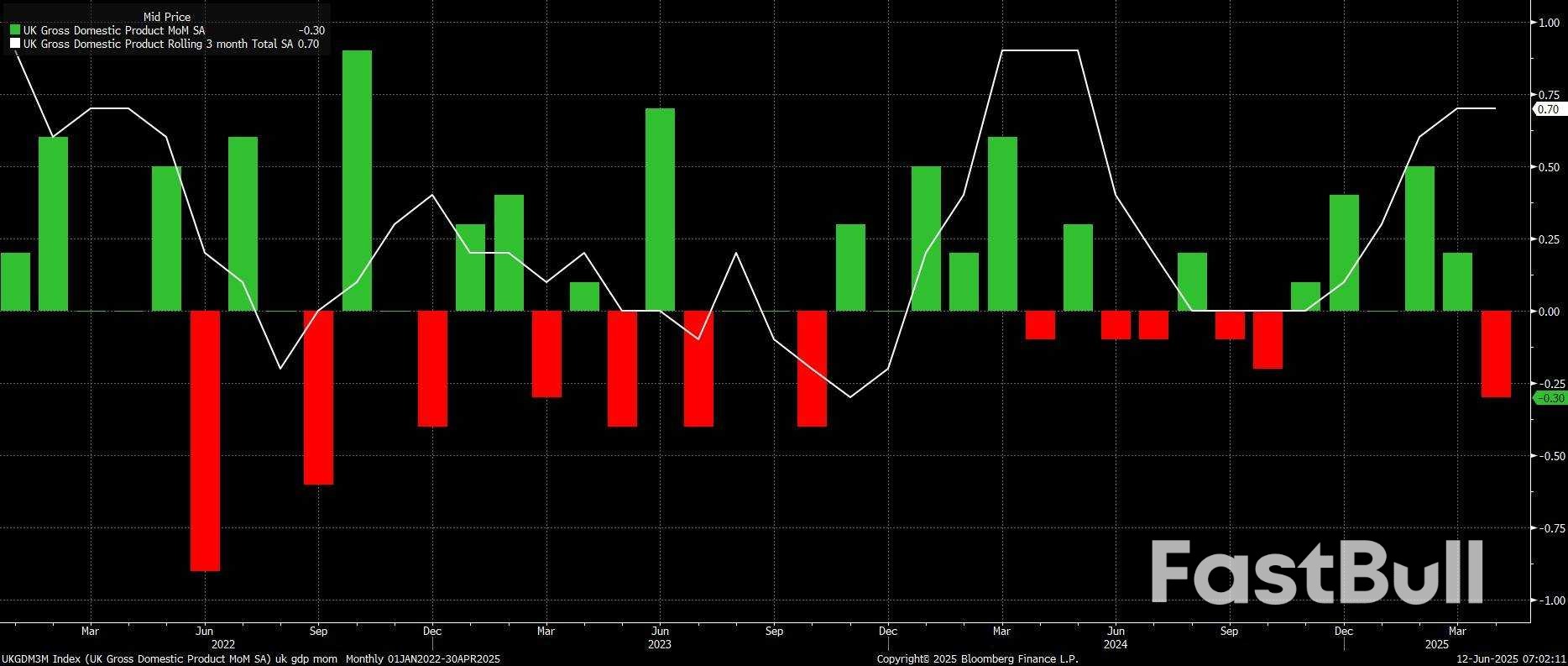
          On an MoM basis, the economy shrunk by a larger than expected 0.3% in April, the first such monthly contraction since October of last year, and the largest such fall in 18 months. In turn, this saw the rolling 3-month pace of growth remain at 0.7%, almost entirely underpinned by a strong pace of expansion in Feb & Mar.

          April 2025 UK GDP: The Start of A Soft Q2_1

          This economic contraction, though, shouldn't come as a particular surprise, albeit the usual caveats around the volatile and somewhat unreliable nature of the monthly GDP series must continue to apply. Said contraction comes largely as a result of payback from a surprisingly strong Q1, as the positive impacts of tariff front-running, as well as the pull forward of 'big ticket' purchases ahead of the various April tax changes are unwound.

          That said, the figures do represent a soft start to what is likely to be a soft quarter overall, with leading indicators such as the latest PMI surveys pointing to the economy, at best, flat-lining in the Apr-Jun period. Clearly, numerous downside risks remain, not only in the form of elevated global trade uncertainty, but also as the full impact of the recent National Insurance increase is felt, and as another round of tax hikes likely lie in wait in this autumn's Budget.

          The Bank of England, however, are near-certain to hold Bank Rate steady at 4.25% next Thursday, holding off on further easing until the August MPC meeting, amid continued concern over potentially persistent price pressures. The temporary nature of the summer 'hump' in inflation, coupled with rapid labour market loosening, and numerous downside growth risks, is though likely to lead to the MPC delivering a considerably faster pace of easing once summer is out, potentially even necessitating cuts in larger clip sizes too. The 'gradual and careful' policy guidance continues to put the MPC far behind the curve, and seems on borrowed time.

          Source: Pepperstone

          To stay updated on all economic events of today, please check out our Economic calendar
          Risk Warnings and Disclaimers
          You understand and acknowledge that there is a high degree of risk involved in trading. Following any strategies or investment methods may lead to potential losses. The content on the site is provided by our contributors and analysts for information purposes only. You are solely responsible for determining whether any trading assets, securities, strategy, or any other product is suitable for investing based on your own investment objectives and financial situation.
          Add to Favorites
          Share

          Asia’s De-Dollarization Momentum: A Strategic Shift or Temporary Rebalancing?

          Gerik

          Economic

          Forex

          Rethinking Dollar Dominance in Asia

          The longstanding supremacy of the U.S. dollar in global finance is being re-evaluated across Asia. While de-dollarization is not a new concept, recent geopolitical and economic shifts—especially under the Trump administration’s assertive trade policies—have reshaped the urgency and execution of this trend.
          The Association of Southeast Asian Nations (ASEAN) recently laid out a strategic plan for 2026–2030 aimed at encouraging trade settlements in local currencies and enhancing regional payment systems. This reflects not just a policy decision, but a structural recalibration in response to rising exchange rate volatility and diminishing confidence in the greenback's stability as a neutral medium.

          Catalysts for Change: Policy Volatility and Financial Weaponization

          The core driver behind de-dollarization is strategic risk mitigation. As Mitul Kotecha from Barclays notes, the dollar has been increasingly used as a “weapon” through sanctions and trade leverage. This realization has pushed governments and investors in Asia to reassess dollar-heavy portfolios and prepare for alternative reserve and transactional systems.
          This is particularly relevant in the context of the dollar's 8% depreciation this year and the broader decline in its share of global reserves—from over 70% in 2000 to 57.8% in 2024. Though cyclical factors contribute to this weakening, the trend signals longer-term doubts about the dollar’s reliability amid U.S. policy unpredictability.

          ASEAN and Beyond: Conversion and Hedging Behavior

          According to Bank of America, the de-dollarization movement in ASEAN is gaining traction through two channels: the conversion of dollar-denominated deposits back to local currencies, and increased hedging of dollar exposure by institutional investors. Countries such as Singapore, South Korea, Taiwan, and Japan are leading this charge due to their high levels of foreign asset holdings.
          FX hedging—particularly among life insurers, pension funds, and hedge funds—is playing a pivotal role. For instance, Japanese life insurers’ hedge ratio has risen from 44% to 48% in recent months, while Taiwan's stands around 70%. These shifts indicate a strategic pivot to protect against dollar fluctuations while boosting local currency liquidity.

          China and BRICS: Building Alternative Systems

          China is spearheading broader de-dollarization efforts beyond ASEAN by pushing for yuan-based bilateral trade and creating alternatives to the SWIFT system through BRICS cooperation. These moves aim to establish a multipolar financial order, one less dominated by U.S. oversight or influence.
          However, while bilateral trade in local currencies is expanding, replacing the U.S. dollar’s deep integration into financial infrastructure remains a long-term challenge. Unlike the yuan, the dollar benefits from unparalleled liquidity, vast bond markets, and global trust built over decades.

          Structural vs. Cyclical De-Dollarization

          Despite growing momentum, analysts caution that the current de-dollarization wave may still be cyclical. Cedric Chehab from BMI emphasizes that a true structural shift would require either sustained and aggressive sanctions by the U.S. or domestic policy changes mandating reserve reallocation toward local assets.
          Moreover, the decline in dollar usage is mostly affecting reserves and not yet strongly disrupting its role in trade invoicing—over 50% of global trade still uses the U.S. dollar. Thus, while central banks may diversify, the dollar remains foundational for international commerce.

          Gold as the Quiet Beneficiary

          Amid the gradual retreat from dollar reserves, one consistent winner has emerged: gold. As central banks reduce dollar holdings, many are reallocating to gold due to its historical role as a hedge against currency and political risks. This aligns with forecasts suggesting gold’s reserve share will rise further as financial systems diversify.
          Asia’s shift away from the dollar reflects deeper geopolitical and monetary realignments rather than just cyclical market behavior. While the dollar remains king in terms of liquidity and trust, its share in reserves and investments is slowly eroding due to strategic recalculations by Asian economies.
          Still, dethroning the greenback requires more than dissatisfaction—it demands credible alternatives, deeper capital markets in local currencies, and consistent macroeconomic policy frameworks. Until then, what the world is witnessing is not a dollar collapse, but the early chapters of a multipolar currency era.

          Source: CNBC

          To stay updated on all economic events of today, please check out our Economic calendar
          Risk Warnings and Disclaimers
          You understand and acknowledge that there is a high degree of risk involved in trading. Following any strategies or investment methods may lead to potential losses. The content on the site is provided by our contributors and analysts for information purposes only. You are solely responsible for determining whether any trading assets, securities, strategy, or any other product is suitable for investing based on your own investment objectives and financial situation.
          Add to Favorites
          Share

          China's AI Chip Ambitions Confront U.S. Export Curbs: Progress, Roadblocks, and Strategic Shifts

          Gerik

          Economic

          The High Stakes of AI Autonomy

          The race to dominate artificial intelligence is increasingly framed by geopolitical competition—particularly between the U.S. and China. With Washington intensifying export controls on AI-critical semiconductors, China has responded with a policy-driven surge in domestic innovation. However, creating a self-reliant AI chip supply chain remains a complex and uneven journey.
          Export restrictions imposed by the U.S. not only prevent Chinese companies from acquiring Nvidia’s top-tier AI chips but also block access to the very tools and know-how needed to manufacture competitive alternatives. In effect, China is simultaneously pushed toward innovation and denied the infrastructure to scale it—especially in areas such as lithography and high-efficiency fabrication.

          Chip Design: Huawei Leads the Domestic Charge

          China’s strongest advances are visible in the design phase. While Nvidia remains the global benchmark, Chinese firms—particularly Huawei’s HiSilicon—are closing the gap. Huawei’s Ascend 910B and the anticipated 910C show performance improvements, reducing the lag from two years to just one generation behind Nvidia’s H20.
          This progress suggests that China’s GPU design capabilities are maturing, aided by government subsidies and a surge in AI chip startups like Enflame and Biren Technology. But even with design breakthroughs, the real challenge lies downstream in fabrication and yield efficiency.

          Fabrication: SMIC’s Technological Ceiling

          Manufacturing remains China’s weak link. SMIC, the country’s most advanced chip foundry, is limited to 7nm processes—far behind Taiwan’s TSMC, which has moved into mass production at 3nm. Although SMIC was linked to a 5nm 5G chip for Huawei’s Mate 60 Pro, the achievement likely relied on workaround methods that aren't scalable.
          The broader issue lies in the absence of cutting-edge fabrication tools. U.S. blacklists prevent TSMC and other advanced foundries from serving Chinese firms. Consequently, China must rely on SMIC’s less efficient production capacity, which struggles to produce high-performance GPUs at commercial yield rates.

          Advanced Equipment: The ASML Bottleneck

          The heart of China’s fabrication dilemma lies with lithography. The Netherlands’ ASML dominates the market for extreme ultraviolet (EUV) machines required for 3nm and smaller nodes. Due to U.S.-aligned restrictions, China is cut off from acquiring these machines.
          Although Chinese firms like SiCarrier Technologies are attempting to develop domestic alternatives, progress is slow and uncertain. Deep ultraviolet (DUV) systems provide temporary relief, allowing SMIC to manufacture at 7nm, but yields are poor and likely unsustainable for meeting large-scale AI demand.
          Rather than imitate EUV tech, Chinese strategists may pivot toward novel lithography technologies in an effort to leapfrog existing barriers—a high-risk, long-horizon approach.

          Memory Chips: Momentum Amid Limitations

          In contrast, China’s performance in memory production is comparatively stronger. High-bandwidth memory (HBM) is crucial for AI workloads, and while global leaders like SK Hynix, Samsung, and Micron dominate the market, China’s ChangXin Memory Technologies (CXMT) is beginning to fill the void.
          CXMT, in collaboration with Tongfu Microelectronics, is reportedly developing early-stage HBM capabilities. While still nascent, this signals strategic alignment with the AI chip value chain. Nonetheless, South Korea's alignment with U.S. restrictions since late 2024 has made it harder for China to source world-class HBM chips, increasing the urgency for domestic innovation.

          Parallel Progress and Bottlenecks

          China’s AI chip ecosystem is evolving under pressure—driven by necessity and backed by massive state investment. Notably, advances in GPU design and memory suggest that targeted gains are achievable even under export curbs. Yet the inability to access EUV lithography and advanced fabrication tools leaves China structurally handicapped.
          The broader implication is that China’s AI ambitions remain dependent on breakthroughs in manufacturing capacity. Until then, the ecosystem will rely on strategic workarounds, lower-yield production, and design improvements. While Beijing’s long-term play may yield autonomy, the current trajectory reveals a system under construction—progressing, but not yet competitive on a global scale.
          To stay updated on all economic events of today, please check out our Economic calendar
          Risk Warnings and Disclaimers
          You understand and acknowledge that there is a high degree of risk involved in trading. Following any strategies or investment methods may lead to potential losses. The content on the site is provided by our contributors and analysts for information purposes only. You are solely responsible for determining whether any trading assets, securities, strategy, or any other product is suitable for investing based on your own investment objectives and financial situation.
          Add to Favorites
          Share
          FastBull
          Copyright © 2025 FastBull Ltd

          728 RM B 7/F GEE LOK IND BLDG NO 34 HUNG TO RD KWUN TONG KLN HONG KONG

          TelegramInstagramTwitterfacebooklinkedin
          App Store Google Play Google Play
          Products
          Charts

          Chats

          Q&A with Experts
          Screeners
          Economic Calendar
          Data
          Tools
          Membership
          Features
          Function
          Markets
          Copy Trading
          Latest Signals
          Contests
          News
          Analysis
          24/7
          Columns
          Education
          Company
          Careers
          About Us
          Contact Us
          Advertising
          Help Center
          Feedback
          User Agreement
          Privacy Policy
          Business

          White Label

          Data API

          Web Plug-ins

          Poster Maker

          Affiliate Program

          Risk Disclosure

          The risk of loss in trading financial instruments such as stocks, FX, commodities, futures, bonds, ETFs and crypto can be substantial. You may sustain a total loss of the funds that you deposit with your broker. Therefore, you should carefully consider whether such trading is suitable for you in light of your circumstances and financial resources.

          No decision to invest should be made without thoroughly conducting due diligence by yourself or consulting with your financial advisors. Our web content might not suit you since we don't know your financial conditions and investment needs. Our financial information might have latency or contain inaccuracy, so you should be fully responsible for any of your trading and investment decisions. The company will not be responsible for your capital loss.

          Without getting permission from the website, you are not allowed to copy the website's graphics, texts, or trademarks. Intellectual property rights in the content or data incorporated into this website belong to its providers and exchange merchants.

          Not Logged In

          Log in to access more features

          FastBull Membership

          Not yet

          Purchase

          Become a signal provider
          Help Center
          Customer Service
          Dark Mode
          Price Up/Down Colors

          Log In

          Sign Up

          Position
          Layout
          Fullscreen
          Default to Chart
          The chart page opens by default when you visit fastbull.com