• Trade
  • Markets
  • Copy
  • Contests
  • News
  • 24/7
  • Calendar
  • Q&A
  • Chats
Trending
Screeners
SYMBOL
LAST
BID
ASK
HIGH
LOW
NET CHG.
%CHG.
SPREAD
SPX
S&P 500 Index
6857.13
6857.13
6857.13
6865.94
6827.13
+7.41
+ 0.11%
--
DJI
Dow Jones Industrial Average
47850.93
47850.93
47850.93
48049.72
47692.96
-31.96
-0.07%
--
IXIC
NASDAQ Composite Index
23505.13
23505.13
23505.13
23528.53
23372.33
+51.04
+ 0.22%
--
USDX
US Dollar Index
98.970
99.050
98.970
98.980
98.920
-0.010
-0.01%
--
EURUSD
Euro / US Dollar
1.16476
1.16484
1.16476
1.16542
1.16408
+0.00031
+ 0.03%
--
GBPUSD
Pound Sterling / US Dollar
1.33267
1.33277
1.33267
1.33341
1.33165
-0.00004
0.00%
--
XAUUSD
Gold / US Dollar
4205.75
4206.13
4205.75
4210.36
4194.54
-1.42
-0.03%
--
WTI
Light Sweet Crude Oil
59.288
59.325
59.288
59.469
59.187
-0.095
-0.16%
--

Community Accounts

Signal Accounts
--
Profit Accounts
--
Loss Accounts
--
View More

Become a signal provider

Sell trading signals to earn additional income

View More

Guide to Copy Trading

Get started with ease and confidence

View More

Signal Accounts for Members

All Signal Accounts

Best Return
  • Best Return
  • Best P/L
  • Best MDD
Past 1W
  • Past 1W
  • Past 1M
  • Past 1Y

All Contests

  • All
  • Trump Updates
  • Recommend
  • Stocks
  • Cryptocurrencies
  • Central Banks
  • Featured News
Top News Only
Share

India's Nifty 50 Index Down 0.13% In Pre-Open Trade

Share

Indian Rupee Opens At 89.84 Per USA Dollar, Up 0.15% From Previous Close

Share

US President Trump Will Sign The Executive Order At 3 P.m. Local Time On Friday

Share

Indonesia's Forex Reserves Rise To $150.1 Billion At End-November

Share

Citigroup: Bullish On Copper, Aluminum, And Tin Price Trends In 2026

Share

Citigroup: Copper Prices Are Expected To Reach $13,000 Per Tonne Within The Next Six To Twelve Months

Share

Shanghai's Most Active Copper Contract Rises To Record High At 91770 Yuan Per Metric Ton

Share

Indonesia's Benchmark Stock Index Rises As Much As 0.6% To Record High Of 8689.099 Points

Share

[China Council For The Promotion Of International Trade (CCPIT) And The U.S. Soybean Export Council Hold Talks In Washington, D.C.] On December 4, Local Time, The CCPIT And The U.S. Soybean Export Council Held Talks In Washington, D.C. CCPIT Chairman Ren Hongbin And U.S. Soybean Export Council CEO Su Jian Exchanged Views On Strengthening Practical Cooperation In The Agricultural Sector. Representatives From Chinese Companies, Including COFCO Oils & Fats And UH Group, Attended The Meeting

Share

[Japanese Trade Minister: Closely Monitoring Lawsuits Filed By Japanese Companies Regarding US Tariffs] Japanese Trade Minister Ryosuke Akazawa Stated That He Is Aware Some Japanese Companies Have Filed Lawsuits In The United States Seeking Refunds For Tariffs Imposed By The Trump Administration. When Asked About Japan's Response, Akazawa Declined To Comment Specifically, Only Stating That The Matter Is Currently Under Litigation And The US Has Not Yet Issued A Court Ruling

Share

Li Qiang Meets Emmanuel Macron, Hopes France To Promote EU's Commitment To Cn-EU Partnership

Share

Philippine Central Bank: Will Continue To Review Newly Available Information

Share

Philippine Central Bank: Outlook For Inflation Is Generally Benign

Share

China Central Bank Injects 139.8 Billion Yuan Via 7-Day Reverse Repos At 1.40% Versus Prior 1.40%

Share

Djia Drops 31 Pts At Close, But Nasdaq Gains For 3 Straight Days, Led By Meta/ Nvidia

Share

Philippines November Core Inflation At +2.4% Year-On-Year

Share

Philippines November Inflation At +1.5% Year-On-Year (Reuters Poll: +1.6%)

Share

Taiwan Overnight Interbank Rate Opens At 0.805 Percent (Versus 0.805 Percent At Previous Session Open)

Share

Russian President Putin To Hold Summit Talks With Indian Prime Minister Modi In Delhi

Share

USA Homeland Security Secretary Noem: Trump Administration Expanding Countries On Travel Ban To 'Over 30'

TIME
ACT
FCST
PREV
Russia Retail Sales YoY (Oct)

A:--

F: --

P: --

Russia Unemployment Rate (Oct)

A:--

F: --

P: --

Australia Trade Balance (SA) (Oct)

A:--

F: --

P: --

Australia Exports MoM (SA) (Oct)

A:--

F: --

P: --

Japan 30-Year JGB Auction Yield

A:--

F: --

P: --

Turkey Trade Balance

A:--

F: --

P: --

Germany Construction PMI (SA) (Nov)

A:--

F: --

P: --

Euro Zone IHS Markit Construction PMI (Nov)

A:--

F: --

P: --

Italy IHS Markit Construction PMI (Nov)

A:--

F: --

P: --

U.K. Markit/CIPS Construction PMI (Nov)

A:--

F: --

P: --

France 10-Year OAT Auction Avg. Yield

A:--

F: --

P: --

Euro Zone Retail Sales MoM (Oct)

A:--

F: --

P: --

Euro Zone Retail Sales YoY (Oct)

A:--

F: --

P: --

Brazil GDP YoY (Q3)

A:--

F: --

P: --

U.S. Challenger Job Cuts (Nov)

A:--

F: --

P: --

U.S. Challenger Job Cuts MoM (Nov)

A:--

F: --

P: --

U.S. Challenger Job Cuts YoY (Nov)

A:--

F: --

P: --

U.S. Initial Jobless Claims 4-Week Avg. (SA)

A:--

F: --

P: --

U.S. Weekly Initial Jobless Claims (SA)

A:--

F: --

P: --

U.S. Weekly Continued Jobless Claims (SA)

A:--

F: --

P: --

Canada Ivey PMI (SA) (Nov)

A:--

F: --

P: --

Canada Ivey PMI (Not SA) (Nov)

A:--

F: --

P: --

U.S. Non-Defense Capital Durable Goods Orders Revised MoM (Excl. Aircraft) (SA) (Sept)

A:--

F: --

P: --
U.S. Factory Orders MoM (Excl. Transport) (Sept)

A:--

F: --

P: --

U.S. Factory Orders MoM (Sept)

A:--

F: --

P: --

U.S. Factory Orders MoM (Excl. Defense) (Sept)

A:--

F: --

P: --

U.S. EIA Weekly Natural Gas Stocks Change

A:--

F: --

P: --

Saudi Arabia Crude Oil Production

A:--

F: --

P: --

U.S. Weekly Treasuries Held by Foreign Central Banks

A:--

F: --

P: --

Japan Foreign Exchange Reserves (Nov)

A:--

F: --

P: --

India Repo Rate

--

F: --

P: --

India Benchmark Interest Rate

--

F: --

P: --

India Reverse Repo Rate

--

F: --

P: --

India Cash Reserve Ratio

--

F: --

P: --

Japan Leading Indicators Prelim (Oct)

--

F: --

P: --

U.K. Halifax House Price Index YoY (SA) (Nov)

--

F: --

P: --

U.K. Halifax House Price Index MoM (SA) (Nov)

--

F: --

P: --

France Current Account (Not SA) (Oct)

--

F: --

P: --

France Trade Balance (SA) (Oct)

--

F: --

P: --

France Industrial Output MoM (SA) (Oct)

--

F: --

P: --

Italy Retail Sales MoM (SA) (Oct)

--

F: --

P: --

Euro Zone Employment YoY (SA) (Q3)

--

F: --

P: --

Euro Zone GDP Final YoY (Q3)

--

F: --

P: --

Euro Zone GDP Final QoQ (Q3)

--

F: --

P: --

Euro Zone Employment Final QoQ (SA) (Q3)

--

F: --

P: --

Euro Zone Employment Final (SA) (Q3)

--

F: --

P: --
Brazil PPI MoM (Oct)

--

F: --

P: --

Mexico Consumer Confidence Index (Nov)

--

F: --

P: --

Canada Unemployment Rate (SA) (Nov)

--

F: --

P: --

Canada Labor Force Participation Rate (SA) (Nov)

--

F: --

P: --

Canada Employment (SA) (Nov)

--

F: --

P: --

Canada Part-Time Employment (SA) (Nov)

--

F: --

P: --

Canada Full-time Employment (SA) (Nov)

--

F: --

P: --

U.S. Dallas Fed PCE Price Index YoY (Sept)

--

F: --

P: --

U.S. UMich 5-Year-Ahead Inflation Expectations Prelim YoY (Dec)

--

F: --

P: --

U.S. 5-10 Year-Ahead Inflation Expectations (Dec)

--

F: --

P: --

U.S. UMich Current Economic Conditions Index Prelim (Dec)

--

F: --

P: --

U.S. UMich Consumer Sentiment Index Prelim (Dec)

--

F: --

P: --

U.S. UMich 1-Year-Ahead Inflation Expectations Prelim (Dec)

--

F: --

P: --

U.S. UMich Consumer Expectations Index Prelim (Dec)

--

F: --

P: --

Q&A with Experts
    • All
    • Chatrooms
    • Groups
    • Friends
    Connecting
    .
    .
    .
    Type here...
    Add Symbol or Code

      No matching data

      All
      Trump Updates
      Recommend
      Stocks
      Cryptocurrencies
      Central Banks
      Featured News
      • All
      • Russia-Ukraine Conflict
      • Middle East Flashpoint
      • All
      • Russia-Ukraine Conflict
      • Middle East Flashpoint
      Search
      Products

      Charts Free Forever

      Chats Q&A with Experts
      Screeners Economic Calendar Data Tools
      Membership Features
      Data Warehouse Market Trends Institutional Data Policy Rates Macro

      Market Trends

      Market Sentiment Order Book Forex Correlations

      Top Indicators

      Charts Free Forever
      Markets

      News

      News Analysis 24/7 Columns Education
      From Institutions From Analysts
      Topics Columnists

      Latest Views

      Latest Views

      Trending Topics

      Top Columnists

      Latest Update

      Signals

      Copy Rankings Latest Signals Become a signal provider AI Rating
      Contests
      Brokers

      Overview Brokers Assessment Rankings Regulators News Claims
      Broker listing Forex Brokers Comparison Tool Live Spread Comparison Scam
      Q&A Complaint Scam Alert Videos Tips to Detect Scam
      More

      Business
      Events
      Careers About Us Advertising Help Center

      White Label

      Data API

      Web Plug-ins

      Affiliate Program

      Awards Institution Evaluation IB Seminar Salon Event Exhibition
      Vietnam Thailand Singapore Dubai
      Fans Party Investment Sharing Session
      FastBull Summit BrokersView Expo
      Recent Searches
        Top Searches
          Markets
          News
          Analysis
          User
          24/7
          Economic Calendar
          Education
          Data
          • Names
          • Latest
          • Prev

          View All

          No data

          Scan to Download

          Faster Charts, Chat Faster!

          Download App
          English
          • English
          • Español
          • العربية
          • Bahasa Indonesia
          • Bahasa Melayu
          • Tiếng Việt
          • ภาษาไทย
          • Français
          • Italiano
          • Türkçe
          • Русский язык
          • 简中
          • 繁中
          Open Account
          Search
          Products
          Charts Free Forever
          Markets
          News
          Signals

          Copy Rankings Latest Signals Become a signal provider AI Rating
          Contests
          Brokers

          Overview Brokers Assessment Rankings Regulators News Claims
          Broker listing Forex Brokers Comparison Tool Live Spread Comparison Scam
          Q&A Complaint Scam Alert Videos Tips to Detect Scam
          More

          Business
          Events
          Careers About Us Advertising Help Center

          White Label

          Data API

          Web Plug-ins

          Affiliate Program

          Awards Institution Evaluation IB Seminar Salon Event Exhibition
          Vietnam Thailand Singapore Dubai
          Fans Party Investment Sharing Session
          FastBull Summit BrokersView Expo

          Trump Sparks Domestic Labor Renaissance: Native-Born Workers Surge To Record High As Foreign-Born Plunge

          Thomas

          Economic

          Summary:

          There were plenty of good details to report in today's jobs report: the unexpected surge in monthly jobs (which came almost above the top of the forecast range), the drop in unemployment, the moderation in hourly earnings, the continued loss of federal workers, the jump in full-time jobs and the drop in part-time jobs.

          There were plenty of good details to report in today's jobs report: the unexpected surge in monthly jobs (which came almost above the top of the forecast range), the drop in unemployment, the moderation in hourly earnings, the continued loss of federal workers, the jump in full-time jobs and the drop in part-time jobs.

          There were also several not so good aspects: first and foremost, the narrow breadth in hiring, with most job growth in June the result of Education and Health services (+51K), and Government (+73), which are government, or government-linked, sectors.
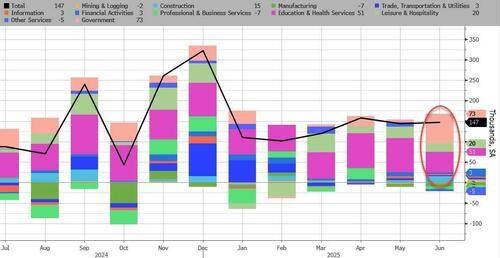
          As Soutbay Research put it, the June Payrolls were derived from two sources: Healthcare (+59K) and Public Schools (+64K).

          • Public Schools: Summer break layoffs were understated in the June release. Either the July revision brings them down OR the July Public Education payrolls go deeply negative.
            • July Best Case: June comes down ~40K and Public Education is flat in July
            • July Worst Case: July Public Education payrolls are -40K

          On the other end, private sector payrolls were soft: excluding healthcare, Southbay says to expect the Private Sector to be flat or possibly negative.

          Meanwhile, even though it was not yet captured by the jobs report, there has been plenty of firing, with the best examples being Intel and Microsoft just announcing a combined 18K in layoffs.

          As SouthBay concludes, "only another Hail Mary Seasonal Adjustment can prevent a negative print."

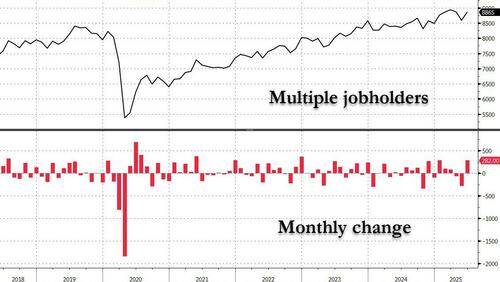
          Another less then stellar aspect of today's report is that the number of multiple job holders actually soared by 282K, one of the biggest monthly increases on record, and one which pushed the total just shy of a new all time high.
          But while no jobs report is without blemishes, the positives far outweighed the negatives, maybe not so much quantitatively then certainly qualitatively, because as we noted earlier, the most important metric of today's jobs report is arguably what got Trump elected in the first place.

          Recall back in January 2024 we first asked how is it not the biggest political talking point that since 2019, the US had only added foreign-born workers (which as we subsequently showed were primarily illegal aliens) while native workers remained flat or declined.

          Less than a year later, illegal immigration in general, and its impact on the labor market indeed had become the biggest political talking point and one which one can argue got Trump elected.

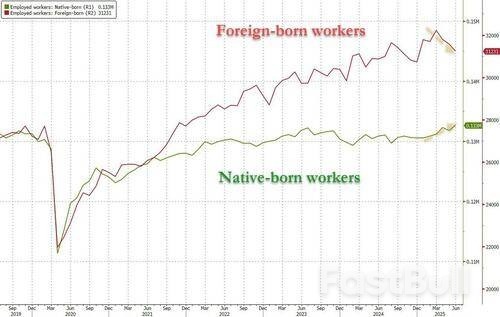
          So in retrospect, we can report today that Trump has certainly been working hard to resolve the situation and according to today's job report, the number of native-born workers has taken a decisive step higher, rising to a new all time high while foreign-born workers have been plunging ever since the election.
          Here are the details:
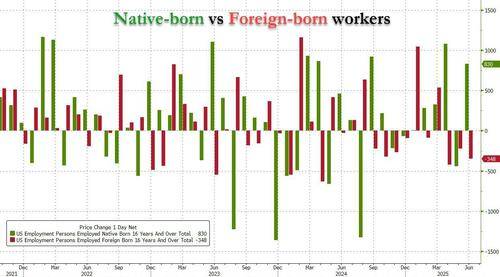
          • In June, the US added 830K native-born workers, pushing the total to a new record high of 132.652 million, hopefully ending the stagnant period which started in 2019 which saw zero native-born workers be added to the US labor force.
          • At the same time, the US saw 348K foreign-born workers leave, sending the total to a 2025 low of 31.231 million.

          Extending the observation window since the start of Trump's admin (i.e., since March which covers the end of the first full month of the Trump admin), we find an even more impressive result: the number of native born workers has surged by 1.5 million while foreign-born (primarily illegals) have tumbled by 1 million.
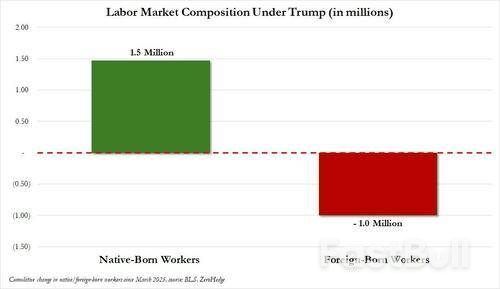
          So while one can certainly find warts in the broader jobs report - and with the economy 5 years into its post-covid expansion there better be weaknesses - the one thing that matters more than anything to most Americans, not having to compete with illegal aliens for jobs which not only pushes demand higher but also wages, is one where Trump can certainly say mission accomplished, for now.

          Source: Zero Hedge

          To stay updated on all economic events of today, please check out our Economic calendar
          Risk Warnings and Disclaimers
          You understand and acknowledge that there is a high degree of risk involved in trading. Following any strategies or investment methods may lead to potential losses. The content on the site is provided by our contributors and analysts for information purposes only. You are solely responsible for determining whether any trading assets, securities, strategy, or any other product is suitable for investing based on your own investment objectives and financial situation.
          Add to Favorites
          Share

          July Rate Cut From Fed Is 'Now Completely Off the Table' Following Solid Jobs Report

          Warren Takunda

          Economic

          The odds of a rate cut at the Federal Reserve's next meeting evaporated after a resilient jobs report for June alleviated concerns about a slowing US economy.
          "You are not getting a July rate cut — that is now completely off the table," Joe Brusuelas, RSM chief economist, told Yahoo Finance.
          Traders agree with that assessment. On Thursday morning, the odds of a cut at the Fed's July 28-29 meeting fell near 5% from nearly 25%, according to the CME FedWatch tool.
          "The markets are speaking," Interactive Brokers chief strategist Steve Sosnick added. He told Yahoo Finance the likelihood of a Fed cut was "evaporating" in the aftermath of the latest labor market report from the Bureau of Labor Statistics.
          The report showed the US economy added 147,000 nonfarm payrolls in June, more than the 106,000 expected by economists. The unemployment rate unexpectedly fell to 4.1%. Economists had expected the unemployment rate to move higher to 4.3%.July Rate Cut From Fed Is 'Now Completely Off the Table' Following Solid Jobs Report_1
          Federal Reserve Chairman Jerome Powell has cited a resilient economy as he argues for a patient approach to rate cuts. The strength of the US economy, he has said, gives the Fed time to assess whether President Trump's tariffs will, in fact, push inflation higher over the summer.
          Brusuelas of RSM said the jobs report "is feeding right into what Jerome Powell said," namely that the economy is "not in trouble right now."
          Trump has repeatedly pressured Powell to stop waiting and start cutting again, making that case again this week.
          The case for looser monetary policy being made by the White House is "a tough sell," Sosnick said. "'The economy is great but we need rate cuts at the same time.' That’s cognitive dissonance.'"
          But Fed watchers expect the White House pressure campaign to continue. Brusuelas noted that the criticism is now being aimed not just at the Fed but at the entire Fed board.
          Trump said Powell "should resign immediately" in a Truth Social post Wednesday night. On Monday, he posted a note he sent to Powell telling the Fed chair, "Jerome—You are, as usual, 'Too Late,'" and arguing that he has "cost the USA a fortune."
          Trump on Truth Social also widened his criticism to the entire Fed board: "The Board just sits there and watches, so they are equally to blame."
          Fed governors Christoper Waller and Michelle Bowman have both made a case for rate cuts in July since the last Fed meeting, arguing that any inflation from tariffs will not linger.
          But others have urged more patience. Atlanta Fed president Raphael Bostic said in a speech Thursday in the UK that he “fully supports” the Fed’s wait-and-see policy prescription.
          “I believe the Committee must await more clarity rather than move in a policy direction that it might need to quickly reverse,” Bostic said.
          For now, job market conditions remain broadly healthy, he added, even as signs point to softening, pointing out that the pace of hiring has slowed but that layoffs and unemployment remain at low levels.
          “I don’t yet see signs of serious labor market deterioration,” he said.
          He said if not for the potential impact of tariffs on prices—as well as the consequences of the current turmoil in the Middle East—he would be “pretty comfortable” with the inflation outlook.
          “For me, the main punchline is that the adjustment of prices and the broader economy to changes in trade and other forthcoming policies in the United States, along with geopolitical developments, is not going to be a short and simple one-time shift in prices, as standard textbook models would suggest,” he said.
          “Instead, this increasingly looks like a process that may take a year or more to fully play out.”
          Earlier this week, Powell didn't rule out an interest rate reduction at the Fed's next meeting on July 28-29, but he noted the central bank would have cut rates by now if not for the tariffs introduced by the Trump administration.
          "We went on hold when we saw the size of the tariffs and essentially all inflation forecasts for the United States went up materially as a consequence of the tariffs," he said.
          The Fed lowered rates by a full percentage point in 2024 but has held rates steady so far in 2025.
          "I wouldn't take any meeting off the table or put it directly on the table," Powell said when asked about the possibility of a cut in July. "It's going to depend on how the data evolved."

          Source: Yahoofinance

          To stay updated on all economic events of today, please check out our Economic calendar
          Risk Warnings and Disclaimers
          You understand and acknowledge that there is a high degree of risk involved in trading. Following any strategies or investment methods may lead to potential losses. The content on the site is provided by our contributors and analysts for information purposes only. You are solely responsible for determining whether any trading assets, securities, strategy, or any other product is suitable for investing based on your own investment objectives and financial situation.
          Add to Favorites
          Share

          Fed's Bostic Says Tariffs Effects May Take A Year to Fully Play Out

          Daniel Carter

          Economic

          Central Bank

          In prepared remarks for an economic conference in Germany, Bostic explained that adjustments to changes in trade policies, other U.S. policies, and geopolitical developments would not result in a simple one-time shift in prices as standard economic models might suggest.
          "Instead, this increasingly looks like a process that may take a year or more to fully play out," Bostic said.
          He warned that this extended inflation period could potentially influence consumer psychology and inflation expectations, creating more significant challenges for the Federal Reserve.
          Bostic noted that new economic data released Thursday showed stronger-than-expected job creation and a slight decrease in the unemployment rate to 4.1%, indicating "labor market conditions remain broadly healthy." He added that the job market is not yet showing signs of deterioration that would justify preemptive interest rate cuts.
          Given the high level of uncertainty surrounding jobs, economic growth, and inflation, Bostic argued that "this is no time for significant shifts in monetary policy." He endorsed the Federal Open Market Committee’s current "wait and see" approach.
          The Federal Reserve has maintained its policy interest rate unchanged since December, despite calls from President Donald Trump for immediate and substantial rate reductions.

          Source: Investing

          To stay updated on all economic events of today, please check out our Economic calendar
          Risk Warnings and Disclaimers
          You understand and acknowledge that there is a high degree of risk involved in trading. Following any strategies or investment methods may lead to potential losses. The content on the site is provided by our contributors and analysts for information purposes only. You are solely responsible for determining whether any trading assets, securities, strategy, or any other product is suitable for investing based on your own investment objectives and financial situation.
          Add to Favorites
          Share

          Crude Oil Falls After Report Of US-Iran Nuclear Talks Next Week

          Damon

          Political

          Crude oil prices fell to a low of $66.54 on Friday, down over 1%, following an Axios report that a White House envoy plans to meet with Iran’s foreign minister in Oslo next week to restart nuclear talks.

          The potential diplomatic engagement comes after President Trump ordered military strikes on Iran’s nuclear facilities last month. According to the report, White House envoy Steve Witkoff is expected to meet with Iranian Foreign Minister Abbas Araghchi, though neither country has publicly confirmed the meeting.

          Oil markets reacted to the news as renewed nuclear negotiations could eventually lead to the lifting of sanctions on Iranian oil exports, potentially increasing global supply. Iran holds some of the world’s largest proven oil reserves, and any return of Iranian crude to international markets would likely pressure prices.

          The reported talks would mark the first direct engagement between the two countries since the recent 12-day conflict between Israel and Iran that ended in a U.S.-brokered ceasefire. Sources cited by Axios indicate that Witkoff and Araghchi have maintained direct contact during and after this conflict.

          A key focus of any future negotiations would be Iran’s stockpile of highly enriched uranium, which reportedly includes 400 kilograms enriched to 60% purity. This level of enrichment is close to weapons-grade material, which requires 90% enrichment.

          Omani and Qatari officials have reportedly been involved in mediating between the U.S. and Iran, with Iranian officials initially reluctant to engage with the U.S. following the military strikes but gradually softening their position.

          Source: Investing

          Risk Warnings and Disclaimers
          You understand and acknowledge that there is a high degree of risk involved in trading. Following any strategies or investment methods may lead to potential losses. The content on the site is provided by our contributors and analysts for information purposes only. You are solely responsible for determining whether any trading assets, securities, strategy, or any other product is suitable for investing based on your own investment objectives and financial situation.
          Add to Favorites
          Share

          Big Beautiful Bill Set To Pass; Here's What It Does

          Adam

          Economic

          President Donald Trump's "One Big Beautiful Bill Act" is on the cusp of passage, after House fiscal conservatives gave up demands of deeper spending cuts and moderate Republicans came to terms with the size of Medicaid cuts. The fact that House Speaker Mike Johnson got pulled from both sides of his party meant that neither side could be assured of a better deal if revisions proved necessary.
          Wall Street never thought it was possible that the GOP would fail to renew the 2017 tax cuts, since that would tank the economy. The most important market reaction may come from bond investors. So far, there's no sign of concern that U.S. deficits are getting too large to comfortably finance.

          The Deficit Effect

          The Congressional Budget Office said Tuesday that the final changes to the Senate version of the One Big Beautiful Bill Act (or OBBBA) added $110 billion to deficits vs. the prior version. Some of those last-minute changes were focused on extending the time for renewable energy projects to take advantage of Inflation Reduction Act production tax credits. The Senate also doubled the size of an emergency fund to support rural hospitals facing Medicaid cuts to $50 billion.
          Based on the current-law baseline, which assumes expiration of most 2017 tax cuts at the end of this year, CBO said that the OBBBA has $4.5 trillion in tax cuts and $1.1 trillion in spending cuts, raising deficits by $3.4 trillion. Based on current policy, CBO said the Senate bill would cut spending by $1.25 trillion and lower taxes by $850 billion, lowering the deficit by about $400 billion.
          The prior score showed that the Senate cut a few hundred billion less than the House in food aid and student loans. That only partly explains why the bill — despite bigger cuts to projected Medicaid spending — fell about $900 billion short of the fiscal bar set by the House, which required that tax cuts exceed spending cuts by no more than $2.5 trillion over 10 years. The Senate also spent an extra $344 billion than the House version on business tax incentives for expensing equipment purchases and funding research and development.
          The brunt of the deficits would come in the next few years. Relative to the current-law baseline that assumes expiration of the tax cuts, the deficit would be higher by $443 billion in fiscal 2026, $538 billion in 2027 and $508 billion in 2028. The deficit increase tails off to a range of $256 billion to $319 billion from 2030 onward.

          Medicaid Cuts

          On June 24, 16 House Republicans wrote to Senate Majority Leader John Thune and House Speaker Mike Johnson, taking issue with the Senate version of the bill that fails to "give hospitals time to adjust to new budgetary constraints."
          Before those last-minute tweaks, the CBO said the Senate bill included roughly $930 billion in cuts to Medicaid spending and about $230 billion in cuts to spending on tax credits to buy insurance on the Affordable Care Act health insurance exchanges. By comparison, the House sought $793 billion in Medicaid cuts.
          The CBO said 4.8 million Medicaid recipients would become uninsured due to an 80-hour work requirement for able-bodied adults who aren't caregivers for a child or disabled family member. The work requirements are projected to save $317 billion over 10 years.
          An additional $183 billion would come from limiting state taxes on medical providers, gradually lowering the ceiling to 3.5% from 6% for states that expanded Medicaid under the ACA. States plow those taxes into benefit payments, which leaves providers no worse off, yet the federal government faces a higher bill to cover its share of Medicaid costs.
          Some states have directed Medicaid managed care operators to reimburse medical providers at up to 100% of commercial insurance reimbursement rates. The Big Beautiful Bill would lower that to 100% of Medicare rates in states that expanded Medicaid.

          New Tax Cuts

          New OBBBA tax cuts include a deduction of overtime pay of up to $12,500 for single filers earning up to $150,0000, with a phase out for higher earners. The $90 billion cost is limited by having it sunset after 2028.
          A deduction of tipped income of up to $25,000 for $150,000 earners would cost $32 billion.
          A deduction of up to $10,000 for loans on U.S.-assembled autos costs $31 billion.
          The bill largely fulfills President Trump's campaign pledge to end taxes on Social Security income by providing a new $6,000 deduction for seniors. That measure carries a $93 billion cost, $27 billion more than the $66 billion cost of the House's $4,000 deduction.
          The bill boosts the child tax credit to $2,200 from $2,000, though the refundable amount for those who don't owe income taxes is held at $1,700. Both figures rise with inflation. If not extended, the child tax credit would revert to $1,000 for 2026. The entire cost is $817 billion.
          The bulk of the bill's costs come from renewing the 2017 cut in marginal income-tax rates ($2.2 trillion), a 20% business deduction ($737 billion) and limiting exposure to the estate tax ($212 billion).

          Other OBBBA Spending Cuts

          About $186 billion in spending cuts are aimed at the Supplemental Nutrition Assistance Program, including a work requirement estimated to lower funding by $69 billion.
          Limiting student loans and adjusting repayment options is estimated to save $307 billion.
          The termination of green energy tax credits, including for buying electric vehicles and producing solar and wind energy, faced roughly $550 billion in cuts before the final Senate bill tweaks.

          Source: investors

          To stay updated on all economic events of today, please check out our Economic calendar
          Risk Warnings and Disclaimers
          You understand and acknowledge that there is a high degree of risk involved in trading. Following any strategies or investment methods may lead to potential losses. The content on the site is provided by our contributors and analysts for information purposes only. You are solely responsible for determining whether any trading assets, securities, strategy, or any other product is suitable for investing based on your own investment objectives and financial situation.
          Add to Favorites
          Share

          UK Government Bond Markets Rally After Starmer Backs Reeves

          Warren Takunda

          Economic

          UK government bonds have rallied after Keir Starmer backed Rachel Reeves to remain as chancellor for “a very long time” despite lingering investor concerns over a multibillion-pound hole in Britain’s public finances.
          The yield – in effect the interest rate – on British government bonds, also known as gilts, fell on Thursday morning to trade close to 4.5%, reversing much of the rise on Wednesday sparked by feverish speculation over Reeves’s future.
          The pound rose against other leading currencies, while a closely watched business survey showed that Britain’s dominant service sector recorded its fastest rate of growth in 10 months.
          Some of the gains were later pegged back after the release of stronger-than-anticipated US job market figures, which fuelled a rise in US government borrowing costs as investors bet the Federal Reserve might delay cutting interest rates.
          After Starmer had failed initially to give his full backing to a tearful Reeves at prime minister’s questions, he used a BBC interview late on Wednesday to publicly express his support for the chancellor and denied suggestions she had been upset by the fallout over the government’s welfare bill.UK Government Bond Markets Rally After Starmer Backs Reeves_1
          Investors said, however, that a climbdown over the bill and the backtracking on cuts to winter fuel payments for most pensioners had left a large hole in the public finances that would need addressing at the autumn budget.
          After Thursday morning’s recovery in the bond markets, Neil Wilson, the UK investor strategist at Saxo Bank, said: “The calculation was that [Reeves is] probably the most market-friendly chancellor Labour could field, so replacing her indicated a higher chance of changing fiscal rules, implying more debt and instability.
          “But there is a deeper problem for the government here even if she stays – the market is getting nervous about its ability to make the sums add up whether she is ‘market-friendly’ or not, and the economic outlook is hardly improving.”
          A broad rebellion by Labour backbenchers forced ministers to withdraw a planned £5.5bn cut to disability benefits this week, on top of earlier concessions on winter fuel payments worth £1.25bn.
          Reeves has repeatedly promised to stick to her “iron-clad” fiscal rules, which require day-to-day spending to be matched by receipts within five years. This is despite mounting spending pressures and rising debt interest costs.
          Having committed not to make further large tax increases after last autumn’s budget, the chancellor turned to welfare savings in her spring statement to rebuild the £9.9bn of headroom against the government’s main fiscal target after a deterioration in the outlook for the government finances.
          Economists said Reeves could break her fiscal rules unless corrective action was taken in the autumn budget. There is also speculation that the financial hit from Labour’s U-turns could be further complicated by a cut to the growth forecasts of the Office for Budget Responsibility, the Treasury watchdog.
          But in a potential boost for the chancellor, the latest snapshot from the S&P Global UK Services PMI showed a sharp rise in private sector activity buoyed by improving business and consumer spending.
          Concerns remain though about the impact from lingering inflationary pressures, Labour’s tax increases introduced in April and the end of Donald Trump’s 90-day pause in his US tariff plans on 9 July.
          Economists said tax increases would probably be required given the challenges Labour has faced in cutting spending, and that ditching the fiscal rules to allow for more borrowing could provoke a sharp reaction in bond markets.
          Jim Reid, the head of macro and thematic research at Deutsche Bank, said: “For markets, the logic is that Reeves has been a big defender of the fiscal rules, and there have been growing calls for these rules to be eased and for borrowing to go up. So the concern in bond markets is that a new chancellor might trigger a fresh wave of borrowing that pushes rates up further.
          “Unless we got a big burst of growth before the budget, then the government would need to announce further tax rises or spending cuts if they still want to meet the fiscal rules. So this leaves them in a tricky position.”

          Source: Theguardian

          To stay updated on all economic events of today, please check out our Economic calendar
          Risk Warnings and Disclaimers
          You understand and acknowledge that there is a high degree of risk involved in trading. Following any strategies or investment methods may lead to potential losses. The content on the site is provided by our contributors and analysts for information purposes only. You are solely responsible for determining whether any trading assets, securities, strategy, or any other product is suitable for investing based on your own investment objectives and financial situation.
          Add to Favorites
          Share

          Stock Pickers Shine, Sniffing Out Value During Market Tumult

          Adam

          Stocks

          Value investing has long been out of favor in US stocks and last quarter was no different, as an index of beaten-down shares badly trailed the broader market’s furious rally.
          But it was also a time to shine for stock pickers focusing on downtrodden companies. Around 63% of active managers investing in cheap large-cap stocks outperformed their benchmarks in the second quarter, the best showing since the depths of the pandemic in 2020, data compiled by Jefferies show.
          While most of the focus was on the megacap firms that led the stock-market rebound from its nadir in April, the money managers who knew where to look were able to uncover huge pockets of opportunity in value as well. Value fund managers swooped in on industrials firms, which rallied 11% last quarter — on par with with the S&P 500 — and stayed away from bond proxies like utilities, consumer staples and real estate, some of the worst performers in the Russell 1000 Value Index last quarter, Jefferies data show.
          The strength of the economically sensitive industrials sector in particular bodes well for the beaten-up value sector, leading some market watchers to anticipate broader strength from the cohort as growth remains solid and the outlook for interest-rate cuts brightens.
          “We don’t think we’re going into an economic recession so with that value stocks should perform better,” Steven DeSanctis, equity strategist at Jefferies said. “And as we still expect three rate cuts in the back half of 2025, lower interest rates will also be very helpful for cyclicals and for value.”
          Bargain Hunting
          While value companies did worse than growth firms on an absolute level, value stock pickers reaped rewards relative to their benchmarks at a time when growth money managers stayed out of luck. Money managers focused on large-cap value names outperformed their benchmarks by 1.7 percentage points last quarter, while their growth peers trailed benchmarks by 0.3 percentage points during the same period, data compiled by Jefferies show.
          The bargain-hunting ideology espoused by Warren Buffett lost its shine in the era of high-growth, high-risk big tech and artificial intelligence, but the approach shows signs of picking up. Over the past week, value has outperformed each of the 12 style factors tracked by Bloomberg.
          The S&P 500 Industrials Index, which is comprised of companies that manufacture goods and transport them, is trading near its all-time high, driven by expectations that waning trade friction will help the US economy rebound.
          The group is the top-performing sector in the index on a six-month basis, powered in part by a trade truce between the US and China and economic data that suggests the American economy remains resilient in the face of tariffs.
          Another big contributor in value stocks gains is the financials sector, the third-best performer in the S&P 500 since January. Its most recent rebound came after a group of 22 large US banks cleared the Federal Reserve’s annual stress test, indicating they can withstand a severe recession and unleashing a bonanza of buybacks and dividends for shareholders.
          The KBW Bank Index, a narrower benchmark which tracks the biggest US banks, has jumped nearly 40% from its low in April.

          Source :Bloomberg

          Risk Warnings and Disclaimers
          You understand and acknowledge that there is a high degree of risk involved in trading. Following any strategies or investment methods may lead to potential losses. The content on the site is provided by our contributors and analysts for information purposes only. You are solely responsible for determining whether any trading assets, securities, strategy, or any other product is suitable for investing based on your own investment objectives and financial situation.
          Add to Favorites
          Share
          FastBull
          Copyright © 2025 FastBull Ltd

          728 RM B 7/F GEE LOK IND BLDG NO 34 HUNG TO RD KWUN TONG KLN HONG KONG

          TelegramInstagramTwitterfacebooklinkedin
          App Store Google Play Google Play
          Products
          Charts

          Chats

          Q&A with Experts
          Screeners
          Economic Calendar
          Data
          Tools
          Membership
          Features
          Function
          Markets
          Copy Trading
          Latest Signals
          Contests
          News
          Analysis
          24/7
          Columns
          Education
          Company
          Careers
          About Us
          Contact Us
          Advertising
          Help Center
          Feedback
          User Agreement
          Privacy Policy
          Business

          White Label

          Data API

          Web Plug-ins

          Poster Maker

          Affiliate Program

          Risk Disclosure

          The risk of loss in trading financial instruments such as stocks, FX, commodities, futures, bonds, ETFs and crypto can be substantial. You may sustain a total loss of the funds that you deposit with your broker. Therefore, you should carefully consider whether such trading is suitable for you in light of your circumstances and financial resources.

          No decision to invest should be made without thoroughly conducting due diligence by yourself or consulting with your financial advisors. Our web content might not suit you since we don't know your financial conditions and investment needs. Our financial information might have latency or contain inaccuracy, so you should be fully responsible for any of your trading and investment decisions. The company will not be responsible for your capital loss.

          Without getting permission from the website, you are not allowed to copy the website's graphics, texts, or trademarks. Intellectual property rights in the content or data incorporated into this website belong to its providers and exchange merchants.

          Not Logged In

          Log in to access more features

          FastBull Membership

          Not yet

          Purchase

          Become a signal provider
          Help Center
          Customer Service
          Dark Mode
          Price Up/Down Colors

          Log In

          Sign Up

          Position
          Layout
          Fullscreen
          Default to Chart
          The chart page opens by default when you visit fastbull.com