• Trade
  • Markets
  • Copy
  • Contests
  • News
  • 24/7
  • Calendar
  • Q&A
  • Chats
Trending
Screeners
SYMBOL
LAST
BID
ASK
HIGH
LOW
NET CHG.
%CHG.
SPREAD
SPX
S&P 500 Index
6827.42
6827.42
6827.42
6899.86
6801.80
-73.58
-1.07%
--
DJI
Dow Jones Industrial Average
48458.04
48458.04
48458.04
48886.86
48334.10
-245.98
-0.51%
--
IXIC
NASDAQ Composite Index
23195.16
23195.16
23195.16
23554.89
23094.51
-398.69
-1.69%
--
USDX
US Dollar Index
97.950
98.030
97.950
98.500
97.950
-0.370
-0.38%
--
EURUSD
Euro / US Dollar
1.17394
1.17409
1.17394
1.17496
1.17192
+0.00011
+ 0.01%
--
GBPUSD
Pound Sterling / US Dollar
1.33707
1.33732
1.33707
1.33997
1.33419
-0.00148
-0.11%
--
XAUUSD
Gold / US Dollar
4299.39
4299.39
4299.39
4353.41
4257.10
+20.10
+ 0.47%
--
WTI
Light Sweet Crude Oil
57.233
57.485
57.233
58.011
56.969
-0.408
-0.71%
--

Community Accounts

Signal Accounts
--
Profit Accounts
--
Loss Accounts
--
View More

Become a signal provider

Sell trading signals to earn additional income

View More

Guide to Copy Trading

Get started with ease and confidence

View More

Signal Accounts for Members

All Signal Accounts

Best Return
  • Best Return
  • Best P/L
  • Best MDD
Past 1W
  • Past 1W
  • Past 1M
  • Past 1Y

All Contests

  • All
  • Trump Updates
  • Recommend
  • Stocks
  • Cryptocurrencies
  • Central Banks
  • Featured News
Top News Only
Share

Thai Leader Anutin: Landmine Blast That Killed Thai Soldiers 'Not A Roadside Accident'

Share

Thai Leader Anutin: Thailand To Continue Military Action Until 'We Feel No More Harm'

Share

Cambodian Prime Minister Hun Manet Says He Had Phone Calls With Trump And Malaysian Leader Anwar About Ceasefire

Share

Cambodia's Hun Manet Says USA, Malaysia Should Verify 'Which Side Fired First' In Latest Conflict

Share

Cambodia's Hun Manet: Cambodia Maintains Its Stance In Seeking Peaceful Resolution Of Disputes

Share

Nasdaq Companies: Allergan, Ferrovia, Insmed, Monolithic Power Systems, Seagate Technology, And Western Digital Will Be Added To The NASDAQ 100 Index. Biogen, CdW, GlobalFoundries, Lululemon, ON Semiconductor, And Tradedesk Will Be Removed From The NASDAQ 100 Index

Share

Witkoff Headed To Berlin This Weekend To Meet With Zelenskiy, European Leaders -Wsj Reporter On X

Share

Russia Attacks Two Ukrainian Ports, Damaging Three Turkish-Owned Vessels

Share

[Historic Flooding Occurs In At Least Four Rivers In Washington State Due To Days Of Torrential Rains] Multiple Areas In Washington State Have Been Hit By Severe Flooding Due To Days Of Torrential Rains, With At Least Four Rivers Experiencing Historic Flooding. Reporters Learned On The 12th That The Floods Caused By The Torrential Rains In Washington State Have Destroyed Homes And Closed Several Highways. Experts Warn That Even More Severe Flooding May Occur In The Future. A State Of Emergency Has Been Declared In Washington State

Share

Trump Says Proposed Free Economic Zone In Donbas Would Work

Share

Trump: I Think My Voice Should Be Heard

Share

Trump Says Will Be Choosing New Fed Chair In Near Future

Share

Trump Says Proposed Free Economic Zone In Donbas Complex But Would Work

Share

Trump Says Land Strikes In Venezuela Will Start Happening

Share

US President Trump: Thailand And Cambodia Are In A Good Situation

Share

State Media: North Korean Leader Kim Hails Troops Returning From Russia Mission

Share

The 10-year Treasury Yield Rose About 5 Basis Points During The "Fed Rate Cut Week," And The 2/10-year Yield Spread Widened By About 9 Basis Points. On Friday (December 12), In Late New York Trading, The Yield On The Benchmark 10-year US Treasury Note Rose 2.75 Basis Points To 4.1841%, A Cumulative Increase Of 4.90 Basis Points For The Week, Trading Within A Range Of 4.1002%-4.2074%. It Rose Steadily From Monday To Wednesday (before The Fed Announced Its Rate Cut And Treasury Bill Purchase Program), Subsequently Exhibiting A V-shaped Recovery. The 2-year Treasury Yield Fell 1.82 Basis Points To 3.5222%, A Cumulative Decrease Of 3.81 Basis Points For The Week, Trading Within A Range Of 3.6253%-3.4989%

Share

Trump: Lots Of Progress Being Made On Russia-Ukraine

Share

NOPA November US Soybean Crush Estimated At 220.285 Million Bushels

Share

SPDR Gold Trust Reports Holdings Up 0.22%, Or 2.28 Tonnes, To 1053.11 Tonnes By Dec 12

TIME
ACT
FCST
PREV
U.K. Trade Balance Non-EU (SA) (Oct)

A:--

F: --

P: --

U.K. Trade Balance (Oct)

A:--

F: --

P: --

U.K. Services Index MoM

A:--

F: --

P: --

U.K. Construction Output MoM (SA) (Oct)

A:--

F: --

P: --

U.K. Industrial Output YoY (Oct)

A:--

F: --

P: --

U.K. Trade Balance (SA) (Oct)

A:--

F: --

P: --

U.K. Trade Balance EU (SA) (Oct)

A:--

F: --

P: --

U.K. Manufacturing Output YoY (Oct)

A:--

F: --

P: --

U.K. GDP MoM (Oct)

A:--

F: --

P: --

U.K. GDP YoY (SA) (Oct)

A:--

F: --

P: --

U.K. Industrial Output MoM (Oct)

A:--

F: --

P: --

U.K. Construction Output YoY (Oct)

A:--

F: --

P: --

France HICP Final MoM (Nov)

A:--

F: --

P: --

China, Mainland Outstanding Loans Growth YoY (Nov)

A:--

F: --

P: --

China, Mainland M2 Money Supply YoY (Nov)

A:--

F: --

P: --

China, Mainland M0 Money Supply YoY (Nov)

A:--

F: --

P: --

China, Mainland M1 Money Supply YoY (Nov)

A:--

F: --

P: --

India CPI YoY (Nov)

A:--

F: --

P: --

India Deposit Gowth YoY

A:--

F: --

P: --

Brazil Services Growth YoY (Oct)

A:--

F: --

P: --

Mexico Industrial Output YoY (Oct)

A:--

F: --

P: --

Russia Trade Balance (Oct)

A:--

F: --

P: --

Philadelphia Fed President Henry Paulson delivers a speech
Canada Building Permits MoM (SA) (Oct)

A:--

F: --

P: --

Canada Wholesale Sales YoY (Oct)

A:--

F: --

P: --

Canada Wholesale Inventory MoM (Oct)

A:--

F: --

P: --

Canada Wholesale Inventory YoY (Oct)

A:--

F: --

P: --

Canada Wholesale Sales MoM (SA) (Oct)

A:--

F: --

P: --

Germany Current Account (Not SA) (Oct)

A:--

F: --

P: --

U.S. Weekly Total Rig Count

A:--

F: --

P: --

U.S. Weekly Total Oil Rig Count

A:--

F: --

P: --

Japan Tankan Large Non-Manufacturing Diffusion Index (Q4)

--

F: --

P: --

Japan Tankan Small Manufacturing Outlook Index (Q4)

--

F: --

P: --

Japan Tankan Large Non-Manufacturing Outlook Index (Q4)

--

F: --

P: --

Japan Tankan Large Manufacturing Outlook Index (Q4)

--

F: --

P: --

Japan Tankan Small Manufacturing Diffusion Index (Q4)

--

F: --

P: --

Japan Tankan Large Manufacturing Diffusion Index (Q4)

--

F: --

P: --

Japan Tankan Large-Enterprise Capital Expenditure YoY (Q4)

--

F: --

P: --

U.K. Rightmove House Price Index YoY (Dec)

--

F: --

P: --

China, Mainland Industrial Output YoY (YTD) (Nov)

--

F: --

P: --

China, Mainland Urban Area Unemployment Rate (Nov)

--

F: --

P: --

Saudi Arabia CPI YoY (Nov)

--

F: --

P: --

Euro Zone Industrial Output YoY (Oct)

--

F: --

P: --

Euro Zone Industrial Output MoM (Oct)

--

F: --

P: --

Canada Existing Home Sales MoM (Nov)

--

F: --

P: --

Euro Zone Total Reserve Assets (Nov)

--

F: --

P: --

U.K. Inflation Rate Expectations

--

F: --

P: --

Canada National Economic Confidence Index

--

F: --

P: --

Canada New Housing Starts (Nov)

--

F: --

P: --

U.S. NY Fed Manufacturing Employment Index (Dec)

--

F: --

P: --

U.S. NY Fed Manufacturing Index (Dec)

--

F: --

P: --

Canada Core CPI YoY (Nov)

--

F: --

P: --

Canada Manufacturing Unfilled Orders MoM (Oct)

--

F: --

P: --

Canada Manufacturing New Orders MoM (Oct)

--

F: --

P: --

Canada Core CPI MoM (Nov)

--

F: --

P: --

Canada Manufacturing Inventory MoM (Oct)

--

F: --

P: --

Canada CPI YoY (Nov)

--

F: --

P: --

Canada CPI MoM (Nov)

--

F: --

P: --

Canada CPI YoY (SA) (Nov)

--

F: --

P: --

Canada Core CPI MoM (SA) (Nov)

--

F: --

P: --

Q&A with Experts
    • All
    • Chatrooms
    • Groups
    • Friends
    Connecting
    .
    .
    .
    Type here...
    Add Symbol or Code

      No matching data

      All
      Trump Updates
      Recommend
      Stocks
      Cryptocurrencies
      Central Banks
      Featured News
      • All
      • Russia-Ukraine Conflict
      • Middle East Flashpoint
      • All
      • Russia-Ukraine Conflict
      • Middle East Flashpoint
      Search
      Products

      Charts Free Forever

      Chats Q&A with Experts
      Screeners Economic Calendar Data Tools
      Membership Features
      Data Warehouse Market Trends Institutional Data Policy Rates Macro

      Market Trends

      Market Sentiment Order Book Forex Correlations

      Top Indicators

      Charts Free Forever
      Markets

      News

      News Analysis 24/7 Columns Education
      From Institutions From Analysts
      Topics Columnists

      Latest Views

      Latest Views

      Trending Topics

      Top Columnists

      Latest Update

      Signals

      Copy Rankings Latest Signals Become a signal provider AI Rating
      Contests
      Brokers

      Overview Brokers Assessment Rankings Regulators News Claims
      Broker listing Forex Brokers Comparison Tool Live Spread Comparison Scam
      Q&A Complaint Scam Alert Videos Tips to Detect Scam
      More

      Business
      Events
      Careers About Us Advertising Help Center

      White Label

      Data API

      Web Plug-ins

      Affiliate Program

      Awards Institution Evaluation IB Seminar Salon Event Exhibition
      Vietnam Thailand Singapore Dubai
      Fans Party Investment Sharing Session
      FastBull Summit BrokersView Expo
      Recent Searches
        Top Searches
          Markets
          News
          Analysis
          User
          24/7
          Economic Calendar
          Education
          Data
          • Names
          • Latest
          • Prev

          View All

          No data

          Scan to Download

          Faster Charts, Chat Faster!

          Download App
          English
          • English
          • Español
          • العربية
          • Bahasa Indonesia
          • Bahasa Melayu
          • Tiếng Việt
          • ภาษาไทย
          • Français
          • Italiano
          • Türkçe
          • Русский язык
          • 简中
          • 繁中
          Open Account
          Search
          Products
          Charts Free Forever
          Markets
          News
          Signals

          Copy Rankings Latest Signals Become a signal provider AI Rating
          Contests
          Brokers

          Overview Brokers Assessment Rankings Regulators News Claims
          Broker listing Forex Brokers Comparison Tool Live Spread Comparison Scam
          Q&A Complaint Scam Alert Videos Tips to Detect Scam
          More

          Business
          Events
          Careers About Us Advertising Help Center

          White Label

          Data API

          Web Plug-ins

          Affiliate Program

          Awards Institution Evaluation IB Seminar Salon Event Exhibition
          Vietnam Thailand Singapore Dubai
          Fans Party Investment Sharing Session
          FastBull Summit BrokersView Expo

          Trump Has Opened A Door For The Euro To Rival The Dollar

          Fiona Harper

          Forex

          Economic

          Summary:

          US President Donald Trump’s trade and financial policies are supposedly shattering investor confidence in the dollar, creating an opportunity for the euro to challenge its global dominance. The Trump administration has created conditions that could lift the European currency to the status of a global reserve currency.

          US President Donald Trump's trade and financial policies are supposedly shattering investor confidence in the dollar, creating an opportunity for the euro to challenge its global dominance. The Trump administration has created conditions that could lift the European currency to the status of a global reserve currency.
          Some figures in Trump's team see the dollar's international strength as a burden that inflates its value and hurts American manufacturing. Still, others, including Treasury Secretary Scott Bessent, believe a strong dollar is what's best for the US.
          The EU does not want the greenback to continue being the most used currency in stablecoins, seeing the digital assets as another source of global demand for US Treasury securities.

          Trump's tariff policies erode confidence in the dollar

          The dollar's attractiveness is being undermined by a wave of unconventional and unsettling financial ideas floated by Trump's allies. Countries in the bloc are forcing the conversion of Treasury bonds to impose fees on creditors who lend to the US government.
          The administration's hostility towards trade partners has made global investors unsure about how reliable American financial instruments are.
          Analysts and economists say the moment could be a “Hamiltonian” turning point for the Eurozone, referring to the US founding father Alexander Hamilton's unification of state debts under federal management. Europe is issuing a permanent and sizable pool of joint debt that could help replace the current patchwork of national bonds with a single, liquid Eurozone asset.
          One proposed action is to stop paying down the debt issued for the bloc's “Next Generation EU” recovery fund, originally planned to shrink by 2058. Instead, officials could opt to roll it over indefinitely, preserving a permanent euro-denominated safe asset.
          Another option is consolidating existing EU-backed debt into a single issuance system to streamline borrowing and provide investors with clarity and scale. It could also support proposals like a joint €150 billion defense spending plan.
          The EU could also begin borrowing in advance of its next seven-year budget, which is expected to surpass €1 trillion, to maintain a large, stable euro bond market.

          Expanding the Eurozone safe asset market

          Europe could take advantage of Trump's tariffs and ask partners to reconsider their dependency on the USD, expanding its trade footprint globally. If trading with the US becomes more troubling, then holding its currency becomes less necessary.
          Yet, despite the feasibility of these tools, progress has been stalled by political inertia. Observers argue that what's missing is not technical capacity, but geopolitical will. European leaders must realize America is making strategic blunders that have made the dollar struggle and raised Treasury yields.
          Meanwhile, the euro held above $1.13 last week as inflation data for the Eurozone outperformed expectations. Annual inflation remained steady at 2.2% in April, slightly above forecasts, while services inflation rose to 3.9% and core inflation climbed to 2.7%.

          President Trump to tax foreign-made films

          Elsewhere, President Trump has declared a new 100% tariff on films made in foreign countries. According to the BBC, Trump said the films will be used to spread propaganda against America, and accused foreign governments of luring US-based studios abroad through tax breaks and subsidies.
          “It is, in addition to everything else, messaging and propaganda!” Trump wrote on Truth Social. “WE WANT MOVIES MADE IN AMERICA, AGAIN!”
          Commerce Secretary Howard Lutnick confirmed the administration would implement the new levy soon. Still, it is unclear if the tariffs would apply to American production companies that shoot overseas or how they would affect films on streaming platforms such as Netflix.
          Several blockbusters, including Deadpool & Wolverine, Wicked, and Gladiator II, were all shot outside the US.
          Australia's Home Affairs Minister, Tony Burke, told reporters Monday that the government “will be standing up unequivocally for the rights of the Australian screen industry.”

          Source: CryptoSlate

          To stay updated on all economic events of today, please check out our Economic calendar
          Risk Warnings and Disclaimers
          You understand and acknowledge that there is a high degree of risk involved in trading. Following any strategies or investment methods may lead to potential losses. The content on the site is provided by our contributors and analysts for information purposes only. You are solely responsible for determining whether any trading assets, securities, strategy, or any other product is suitable for investing based on your own investment objectives and financial situation.
          Add to Favorites
          Share

          Dollar Softening Propels Gold to New Highs

          Gerik

          Economic

          Forex

          Market Overview

          On the morning of May 5, Asian gold prices climbed, reflecting a 0.1 percent decline in the US dollar index that made bullion more attractive to holders of other currencies. The uptick in gold to 3,245.01 USD per ounce coincides with heightened uncertainty over trade negotiations between Washington and its partners, as well as growing speculation over the Federal Reserve’s next move.
          The recent dollar weakness correlates with bullion’s rally, since a softer greenback typically eases the local‐currency cost of gold for overseas buyers. Although moves in the dollar do not by themselves guarantee sustained gold gains, the current downtrend has encouraged investors to shift into safe-haven assets. Reports last week that China stands ready for further tariff talks with the US have added to the risk-off tone, bolstering gold’s appeal as a portfolio diversifier.

          Fed Policy Expectations

          Despite repeated calls from former President Trump for rate cuts, US labor market data released in April showed employers added more jobs than anticipated and the unemployment rate held steady at 4.2 percent. These figures have restrained expectations for an imminent Fed easing, pushing traders to await the central bank’s decision at the end of this week and listen for commentary from Fed officials. The resulting pause in rate-cut bets has lent support to gold, as any dovish shift would likely undermine the dollar further.
          In Vietnam, SJC-branded gold bars were quoted at 117.80–119.80 million VND per tael (buy–sell) on the morning of May 5. Although international spot prices drive local premiums, factors such as domestic demand and import taxes will continue to shape Vietnamese retail levels.
          With the dollar under pressure and the Fed’s policy path still murky, gold is poised to maintain its recent strength. Investors will monitor US economic releases and central bank communications for clues on monetary accommodation, knowing that even modest shifts in policy expectations can translate into significant moves in both currency and bullion markets.

          Source: Reuters

          To stay updated on all economic events of today, please check out our Economic calendar
          Risk Warnings and Disclaimers
          You understand and acknowledge that there is a high degree of risk involved in trading. Following any strategies or investment methods may lead to potential losses. The content on the site is provided by our contributors and analysts for information purposes only. You are solely responsible for determining whether any trading assets, securities, strategy, or any other product is suitable for investing based on your own investment objectives and financial situation.
          Add to Favorites
          Share

          South Korea’s Growth Outlook Downgraded as Export Momentum and Global Share Wane

          Gerik

          Economic

          Revised Growth Projections and Underlying Drivers

          In its April 2025 World Economic Outlook, the International Monetary Fund trimmed its forecast for South Korea’s GDP growth, citing a combination of weaker external demand and persistent domestic headwinds. Actual growth is expected to register just 1.03 percent in 2025, before gradually rising to 1.45 percent in 2026 and surpassing 2 percent in 2027 (2.10 percent) and 2028 (2.11 percent). A slight pullback to 1.95 percent is anticipated in 2029. Averaging these figures yields a five-year growth rate of 1.73 percent—0.07 percentage point below the Bank of Korea’s own 1.80 percent potential estimate. The direct causal link between export performance and GDP outcomes underscores how policy-driven shifts in global trade translate into broader economic weakness.
          While exports account for a large share of South Korea’s GDP, domestic consumption and investment have also failed to pick up sufficiently to offset foreign trade pressures. Household spending growth has been subdued amid elevated real interest rates and high household debt, creating a correlational relationship between tighter credit conditions and lackluster consumer outlays. Business investment has likewise been slow to recover, reflecting corporate caution in the face of geopolitical uncertainties and thin profit margins. These factors combine to sap aggregate demand, reinforcing the IMF’s view that absent significant policy stimulus, growth will remain stuck below historical norms.

          Underperformance in Export Sector

          Export volumes, which climbed 6.32 percent in 2024, are forecast to virtually stall at 1.01 percent growth in 2025 before a modest rebound to 1.71 percent in 2026. From 2027 through 2030, exports are expected to grow at roughly 3 percent per year. The stark slowdown is a direct consequence of recent U.S. tariff increases, creating a clear cause-and-effect relationship: higher import duties have directly reduced South Korea’s competitiveness in key markets. In addition, ongoing uncertainties in semiconductor demand and shifting supply-chain configurations have had a correlational impact on machinery and auto exports. Because South Korea’s economy is heavily trade-oriented, these export headwinds carry over directly into slower overall expansion.
          Beyond growth rates, the IMF warns that South Korea’s share of global GDP on a purchasing-power-parity basis will fall from 1.78 percent in 2020 to 1.53 percent by 2030. Although average annual growth across 2026–2030 is projected at 1.89 percent—somewhat stronger than the 1.73 percent seen in 2025–2029—this uptick is insufficient to arrest the long-term erosion of South Korea’s economic weight. The relationship here is correlational: as other emerging markets outpace Korea, its relative position shrinks even if its own growth improves modestly. This trend highlights the strategic challenge of maintaining global influence amidst intensifying competition.

          Policy Responses and Strategic Imperatives

          Analysts such as Jeong Yong-taek of IBK Investment & Securities anticipate further downward revisions to the 2025 growth forecast—potentially below 1 percent—once first-quarter GDP data are fully incorporated. To counteract this trajectory, a multi-pronged policy approach is needed. On the fiscal front, targeted stimulus measures aimed at infrastructure modernization and green transition could generate a causal uplift in domestic demand. Simultaneously, structural reforms to enhance labor market flexibility and incentivize private investment would address persistent productivity bottlenecks. Trade diversification efforts—seeking new markets and forging regional partnerships—could mitigate overreliance on traditional export destinations, directly offsetting tariff-induced headwinds.
          The IMF’s revised outlook serves as a warning that without decisive action, South Korea risks entrenching a period of sub-par growth that could undermine both living standards and fiscal sustainability. The causal interplay between export dynamics, domestic demand weakness, and global economic positioning underscores the need for cohesive strategies. Strengthening innovation in high-value industries, accelerating digital adoption, and deepening collaboration in regional value chains would not only spur growth but also shore up international standing.
          In conclusion, while South Korea’s economy remains resilient, the IMF’s projections highlight a confluence of causal and correlational factors suppressing growth. Addressing these challenges will require bold policy measures to reinvigorate exports, bolster domestic demand, and preserve the country’s long-term competitiveness on the global stage.

          Source: IMF

          To stay updated on all economic events of today, please check out our Economic calendar
          Risk Warnings and Disclaimers
          You understand and acknowledge that there is a high degree of risk involved in trading. Following any strategies or investment methods may lead to potential losses. The content on the site is provided by our contributors and analysts for information purposes only. You are solely responsible for determining whether any trading assets, securities, strategy, or any other product is suitable for investing based on your own investment objectives and financial situation.
          Add to Favorites
          Share

          Will the Decline of the U.S. Dollar Last Forever?

          Gerik

          Economic

          Forex

          While analysts agree that the dollar remains unmatched in its global role for now, growing geopolitical tensions, erratic U.S. policies, and investor skepticism are prompting renewed scrutiny.

          No Clear Rival Yet for the Dollar’s Throne

          Since the end of World War II, the U.S. dollar has reigned as the default currency for global trade and reserves. Attempts to dethrone it have so far failed. Today, the euro accounts for 20% of reserves, the yen 6%, and the British pound just 5%, according to IMF data. Around 90% of all forex trades globally still involve the dollar, underlining its centrality to international finance.
          Market strategists like Brent Coggins (Triad Wealth Partners) argue that the euro faces fragmentation, the yuan is not fully convertible, and the yen lacks scale—leaving no credible replacement. Even recent efforts by BRICS nations to create a common currency have stalled, shifting instead to promoting local currencies in trade, which, ironically, underscores the dollar’s resilience.

          Mounting Pressures and a Crisis of Confidence

          Nevertheless, confidence in the dollar has taken a hit. President Trump’s protectionist trade policies, verbal attacks on the Federal Reserve, and a volatile macroeconomic environment have created uncertainty. Foreign investors are increasingly cautious about U.S. Treasury bonds, questioning their safety and long-term value. Stock portfolios are being rebalanced as investors reduce exposure to U.S. tech-heavy indices and consider diversification.
          Arun Sai, senior strategist at Pictet Asset Management, warns of a “crisis of trust” surrounding U.S. assets. As U.S. fiscal deficits widen and domestic political risk rises, the dollar is losing some of its appeal as a safe haven. The greenback has dropped 8% this year compared to a basket of global currencies.

          Temporary Correction or Long-Term Trend?

          Despite the volatility, many economists believe this is a temporary shift. Nick Bennenbroek (Wells Fargo) calls the recent dollar sell-off “atypical and likely short-lived,” pointing to the dollar’s deeply entrenched role in global finance. Arun Sai also notes that U.S. markets and corporations still offer solid fundamentals, even if global investors are hedging their bets.
          That said, capital is increasingly flowing into gold—now at record highs—German bonds, and emerging markets. Asset managers are also looking more favorably at European and UK stocks. According to Sai, Trump’s policies may be encouraging capital to stay domestic, but investors are still exploring more regional and less dollar-dependent opportunities.

          Dominance Endures, but Flexibility is Key

          The U.S. dollar is unlikely to lose its global dominance in the near future due to the lack of viable alternatives. However, its supremacy is not immune to erosion. As political and economic uncertainties persist, especially under Trump’s tariff-heavy approach, global diversification away from dollar assets may accelerate—at least in the short term.
          In essence, while "King Dollar" may be bruised, it is far from dethroned. But the era of unquestioned trust in the dollar's supremacy may be shifting into one where investors demand greater resilience, stability, and clarity from U.S. leadership.
          To stay updated on all economic events of today, please check out our Economic calendar
          Risk Warnings and Disclaimers
          You understand and acknowledge that there is a high degree of risk involved in trading. Following any strategies or investment methods may lead to potential losses. The content on the site is provided by our contributors and analysts for information purposes only. You are solely responsible for determining whether any trading assets, securities, strategy, or any other product is suitable for investing based on your own investment objectives and financial situation.
          Add to Favorites
          Share

          USDJPY Technical Analysis – Focus On The FOMC And The First Trade Deal

          Diana Wallace

          Forex

          Technical Analysis

          FundamentalOverview

          The USD continues to besupported in the short-term as we head into the FOMC decision and the firsttrade deal. This has most likely to do with positioning rather thanfundamentals. The short dollar trade got very overstretched so positive news onthe tariff front and good economic data is providing a pullback.
          The downside seems to belimited for now as the Fed is likely to reiterate its commitment for just tworate cuts this year unless the labour market weakens notably. The NFP reportlast Friday, was much better than expected, so it gives the Fed a reason tokeep its neutral stance for now. In the medium term though, the US Dollarshould keep on depreciating as the path of least resistance for the Fed remainsto cut rates.
          On the JPY side, thecurrency has been driven mainly by global events rather than domesticfundamentals. Alongside the Swiss Franc, it’s been the favoured safe haven inthe currencies space amid the swings in risk sentiment. On the monetary policyfront, the BoJ kept interest rates unchanged as expected anddelivered a dovish message.
          This was then echoed by BoJGovernor Ueda which placed a great deal on trade developments. In summary, thecentral bank is likely to go faster on rate hikes in case we get a good tradedeal and delay rate adjustments in case the trade deal disappoints.

          USDJPYTechnical Analysis – Daily Timeframe

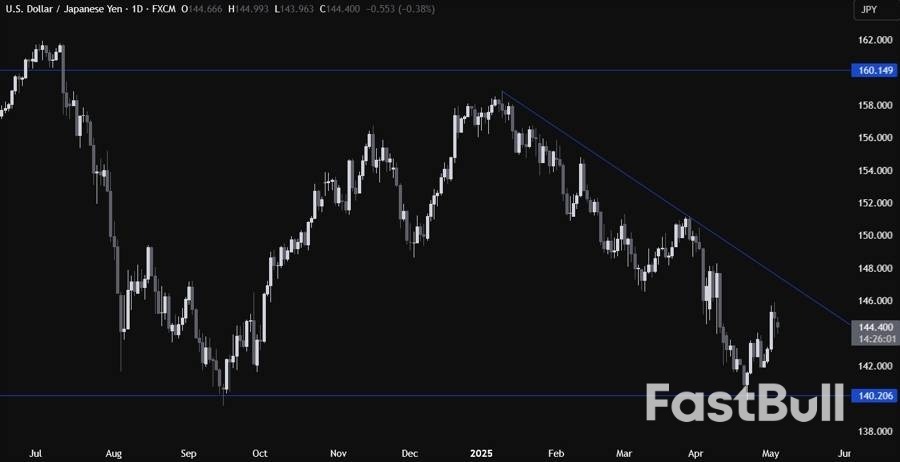
          On the daily chart, we cansee that USDJPY continues to pull back from the key 140.00 handle. From a riskmanagement perspective, the sellers will have a better risk to reward setuparound the major trendline to position for furtherdownside, while the buyers will look for a break higher to increase the bullishbets into the 151.00 handle next.

          USDJPY TechnicalAnalysis – 4 hour Timeframe

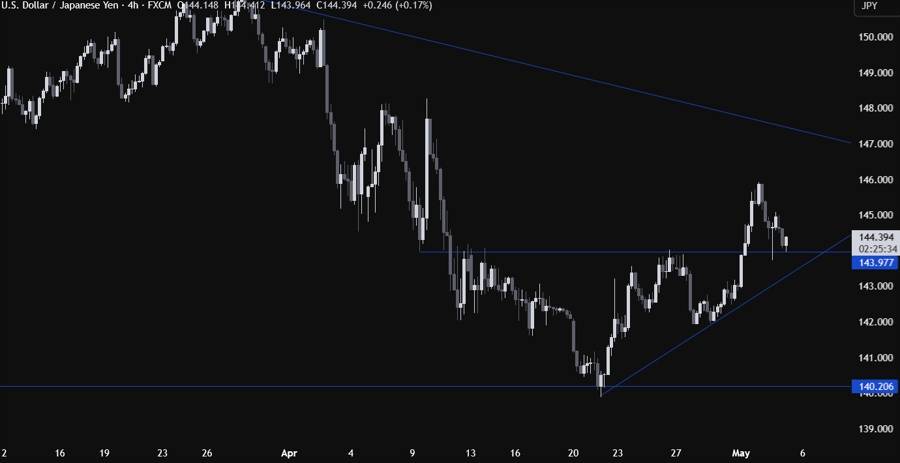
          On the 4 hour chart, we cansee that we have a strong supportzone around the 144.00 handle where we can also find the upward minor trendlinefor confluence.This is where we can expect the buyers to step in with a defined risk below thetrendline to position for a rally into the major trendline. The sellers, on theother hand, will look for a break below the trendline to invalidate the bullishsetup and pile in for a drop back into the 140.00 handle.

          USDJPY TechnicalAnalysis – 1 hour Timeframe

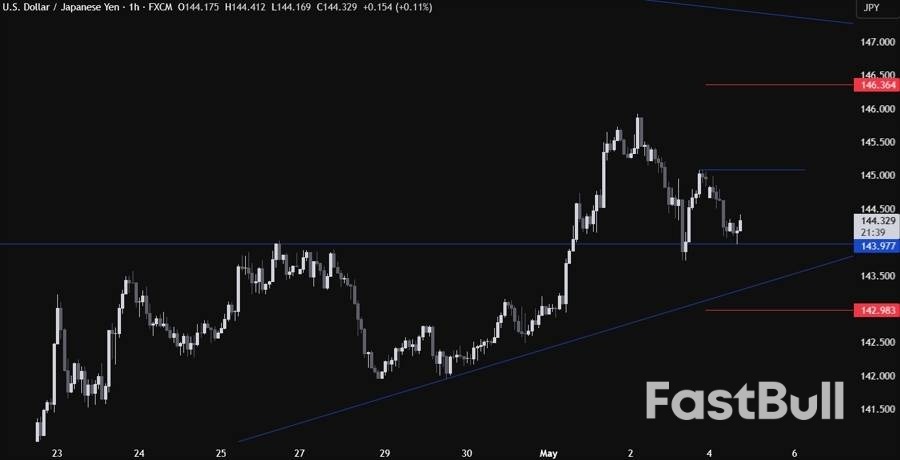
          On the 1 hour chart, there’snot much else we can add here as the price is testing the support zone. Thebuyers might want to split their orders and lean on both the support and thetrendline. The sellers, on the other hand, will want to wait for a break belowthe trendline before increasing the bearish bets. The red lines define the average daily range for today.

          Source: ForexLive

          Risk Warnings and Disclaimers
          You understand and acknowledge that there is a high degree of risk involved in trading. Following any strategies or investment methods may lead to potential losses. The content on the site is provided by our contributors and analysts for information purposes only. You are solely responsible for determining whether any trading assets, securities, strategy, or any other product is suitable for investing based on your own investment objectives and financial situation.
          Add to Favorites
          Share

          Vietnam’s Manufacturing PMI Plunges to Near Two-Year Low: A Warning Sign of Deepening Economic Strain

          Gerik

          Economic

          Sharp PMI Decline Signals Defensive Shift in Vietnam’s Manufacturing Sector
          April 2025 marked a severe downturn in Vietnam’s manufacturing activity, with the PMI plunging from 50.5 in March to 45.6, according to S&P Global Market Intelligence. This steep drop — the most significant in nearly two years — reflects the immediate impact of new U.S. tariffs, with broad-based declines across key subcomponents including new orders, exports, output, and employment.
          The PMI survey, conducted between April 9 and 22, coincided with the enforcement of U.S. tariffs on Vietnamese goods. This external shock led to the sharpest fall in new orders in almost two years. Export orders declined for the sixth consecutive month, registering the steepest drop since June 2023 — a clear sign that Vietnam’s core export-driven manufacturing base is under heavy pressure.

          Output and Employment Shrink Rapidly

          Output levels reversed course after a brief uptick in March, with April seeing the fastest rate of contraction since January 2023. Businesses scaled back production to align with reduced demand and rising trade uncertainty. Simultaneously, employment in the sector fell for a seventh consecutive month — at the fastest rate in three and a half years — as backlogs were insufficient to sustain current staffing levels.
          Faced with declining demand, firms cut back on purchasing activity at the fastest pace since May 2023. Inventories of purchased inputs fell to their lowest level since September 2024, signaling a shift toward preserving liquidity rather than stocking for future orders. This defensive strategy reflects weakened business confidence and heightened caution over capital allocation.

          Softening Input Costs Offer Limited Relief

          Amidst the downturn, input cost inflation eased considerably. April saw the slowest rise in input prices since the global price surge began in August 2023. Firms cited lower oil and international shipping costs, providing marginal relief to profit margins and possibly improving gross margins by Q2–Q3. However, price cuts to attract customers have continued, marking the fourth straight month of product price deflation — the sharpest in 21 months.
          The ongoing price drops, while pressuring short-term profits, help anchor inflation expectations. This may pave the way for more flexible monetary policies in the second half of 2025. Financial support tools such as concessional credit or liquidity restructuring could be expanded to assist businesses coping with trade turbulence.

          Investor Implications: PMI as a Lead Indicator of Earnings Cycle

          For financial markets, the PMI is more than a technical signal — it serves as a leading indicator of earnings and capital flows. A sustainable rebound in stock valuations and investor optimism will require clearer signs of order stability, production recovery, and input cost control. Once these align, cyclical sectors like logistics, supporting industries, materials, and industrial real estate will likely become focal points for capital reallocation.
          As noted by Andrew Harker, Economics Director at S&P Global, it is vital to track Vietnam’s PMI trends in the coming months to understand how the real economy is evolving under stress. This serves as a critical signal not just for manufacturers, but also for policymakers and investors seeking early insights into Vietnam’s economic trajectory.

          Source: S&P Global

          To stay updated on all economic events of today, please check out our Economic calendar
          Risk Warnings and Disclaimers
          You understand and acknowledge that there is a high degree of risk involved in trading. Following any strategies or investment methods may lead to potential losses. The content on the site is provided by our contributors and analysts for information purposes only. You are solely responsible for determining whether any trading assets, securities, strategy, or any other product is suitable for investing based on your own investment objectives and financial situation.
          Add to Favorites
          Share

          Global Economy Slows as Trump’s Tariffs Trigger Widespread Demand Shock

          Gerik

          Economic

          China–U.S. Trade War

          Trump Tariffs Drag on Global Growth Amid Mounting Corporate and Economic Strains

          President Donald Trump’s aggressive tariff regime is increasingly disrupting the global economic engine that once relied on relatively predictable and open trade. With baseline tariffs at 10% and punitive rates—such as 145% on Chinese goods—many multinational corporations and national economies are now revising their growth forecasts downward, citing the ripple effects of trade uncertainty.
          From small e-commerce sellers to global brands like Electrolux, Logitech, Diageo, and Volvo Cars, firms are either exiting key markets or slashing revenue targets. A particularly devastating blow for small exporters came with the elimination of the "de minimis" exemption, which previously allowed shipments under $800 to enter the U.S. duty-free. Cindy Allen, CEO of Trade Force Multiplier, said that “we’re going from zero to 145%, which is untenable for companies and untenable for customers.”

          Demand Shock Ripples Through Industrial Economies

          The impact is already evident in factory surveys. China's manufacturing activity in April contracted at its fastest pace in 16 months, while the UK posted its sharpest drop in factory exports in nearly five years. Although Germany saw a temporary boost in output, analysts warn this may reflect manufacturers rushing deliveries before new tariffs kick in—signaling a looming downturn.
          This “front-loading” effect may also explain India’s unexpected spike in manufacturing activity, but economists like Shilan Shah at Capital Economics note that India may become a strategic winner by absorbing U.S. demand diverted from China. Major U.S. firms like Apple are already shifting supply chains toward India, which faces lower tariff exposure.

          Tariff Uncertainty Reaches Central Banks and Governments

          The uncertainty is not only disrupting corporate operations but also influencing national economic strategies. The Bank of Japan cut its growth forecast last week, while European and MENA-region forecasters cited tariff risks in their downward revisions. For central banks, the silver lining is that the disinflationary impact of the tariffs might create room for interest rate cuts. The Bank of England, for instance, is expected to lower rates this week.
          However, the broader issue remains whether the Trump administration’s trade overhaul can lead to meaningful structural shifts elsewhere. Some economists suggest it may eventually force China to boost domestic stimulus or push the euro zone to resolve internal market inefficiencies. Yet for now, the dominant narrative is one of suppressed demand, lower trade volumes, and heightened business risk.

          Outlook: The Longer the Trade War, the Deeper the Drag

          While the Trump administration claims it is close to resolving tensions with India, Japan, and South Korea, Beijing has yet to agree to formal talks, despite suggesting it is evaluating Washington’s latest offer. Meanwhile, tariffs on autos, steel, aluminum, and other strategic goods remain in place, weighing heavily on global supply chains.
          Isabelle Mateos y Lago of BNP Paribas warns the situation may deteriorate further: “The U.S. tariffs end-game may be further away and at a higher level than previously thought.” With inflation easing but growth lagging, the world economy may continue to stagger under the weight of Trump’s unpredictable trade maneuvering—unless diplomatic breakthroughs are achieved soon.

          Source: Reuters

          To stay updated on all economic events of today, please check out our Economic calendar
          Risk Warnings and Disclaimers
          You understand and acknowledge that there is a high degree of risk involved in trading. Following any strategies or investment methods may lead to potential losses. The content on the site is provided by our contributors and analysts for information purposes only. You are solely responsible for determining whether any trading assets, securities, strategy, or any other product is suitable for investing based on your own investment objectives and financial situation.
          Add to Favorites
          Share
          FastBull
          Copyright © 2025 FastBull Ltd

          728 RM B 7/F GEE LOK IND BLDG NO 34 HUNG TO RD KWUN TONG KLN HONG KONG

          TelegramInstagramTwitterfacebooklinkedin
          App Store Google Play Google Play
          Products
          Charts

          Chats

          Q&A with Experts
          Screeners
          Economic Calendar
          Data
          Tools
          Membership
          Features
          Function
          Markets
          Copy Trading
          Latest Signals
          Contests
          News
          Analysis
          24/7
          Columns
          Education
          Company
          Careers
          About Us
          Contact Us
          Advertising
          Help Center
          Feedback
          User Agreement
          Privacy Policy
          Business

          White Label

          Data API

          Web Plug-ins

          Poster Maker

          Affiliate Program

          Risk Disclosure

          The risk of loss in trading financial instruments such as stocks, FX, commodities, futures, bonds, ETFs and crypto can be substantial. You may sustain a total loss of the funds that you deposit with your broker. Therefore, you should carefully consider whether such trading is suitable for you in light of your circumstances and financial resources.

          No decision to invest should be made without thoroughly conducting due diligence by yourself or consulting with your financial advisors. Our web content might not suit you since we don't know your financial conditions and investment needs. Our financial information might have latency or contain inaccuracy, so you should be fully responsible for any of your trading and investment decisions. The company will not be responsible for your capital loss.

          Without getting permission from the website, you are not allowed to copy the website's graphics, texts, or trademarks. Intellectual property rights in the content or data incorporated into this website belong to its providers and exchange merchants.

          Not Logged In

          Log in to access more features

          FastBull Membership

          Not yet

          Purchase

          Become a signal provider
          Help Center
          Customer Service
          Dark Mode
          Price Up/Down Colors

          Log In

          Sign Up

          Position
          Layout
          Fullscreen
          Default to Chart
          The chart page opens by default when you visit fastbull.com