Markets
News
Analysis
User
24/7
Economic Calendar
Education
Data
- Names
- Latest
- Prev



Signal Accounts for Members
All Signal Accounts
All Contests


U.S. Average Hourly Wage MoM (SA) (Dec)A:--
F: --
U.S. Average Weekly Working Hours (SA) (Dec)A:--
F: --
P: --
U.S. New Housing Starts Annualized MoM (SA) (Oct)A:--
F: --
U.S. Total Building Permits (SA) (Oct)A:--
F: --
P: --
U.S. Building Permits MoM (SA) (Oct)A:--
F: --
P: --
U.S. Annual New Housing Starts (SA) (Oct)A:--
F: --
U.S. U6 Unemployment Rate (SA) (Dec)A:--
F: --
P: --
U.S. Manufacturing Employment (SA) (Dec)A:--
F: --
U.S. Labor Force Participation Rate (SA) (Dec)A:--
F: --
P: --
U.S. Private Nonfarm Payrolls (SA) (Dec)A:--
F: --
U.S. Unemployment Rate (SA) (Dec)A:--
F: --
U.S. Nonfarm Payrolls (SA) (Dec)A:--
F: --
U.S. Average Hourly Wage YoY (Dec)A:--
F: --
Canada Full-time Employment (SA) (Dec)A:--
F: --
P: --
Canada Part-Time Employment (SA) (Dec)A:--
F: --
P: --
Canada Unemployment Rate (SA) (Dec)A:--
F: --
P: --
Canada Labor Force Participation Rate (SA) (Dec)A:--
F: --
P: --
U.S. Government Employment (Dec)A:--
F: --
P: --
Canada Employment (SA) (Dec)A:--
F: --
P: --
U.S. UMich Consumer Expectations Index Prelim (Jan)A:--
F: --
P: --
U.S. UMich Consumer Sentiment Index Prelim (Jan)A:--
F: --
P: --
U.S. UMich Current Economic Conditions Index Prelim (Jan)A:--
F: --
P: --
U.S. UMich 1-Year-Ahead Inflation Expectations Prelim (Jan)A:--
F: --
P: --
U.S. UMich 5-Year-Ahead Inflation Expectations Prelim YoY (Jan)A:--
F: --
P: --
U.S. 5-10 Year-Ahead Inflation Expectations (Jan)A:--
F: --
P: --
China, Mainland M1 Money Supply YoY (Dec)--
F: --
P: --
China, Mainland M0 Money Supply YoY (Dec)--
F: --
P: --
China, Mainland M2 Money Supply YoY (Dec)--
F: --
P: --
U.S. Weekly Total Oil Rig CountA:--
F: --
P: --
U.S. Weekly Total Rig CountA:--
F: --
P: --
Indonesia Retail Sales YoY (Nov)--
F: --
P: --
Euro Zone Sentix Investor Confidence Index (Jan)--
F: --
P: --
India CPI YoY (Dec)--
F: --
P: --
Germany Current Account (Not SA) (Nov)--
F: --
P: --
Canada National Economic Confidence Index--
F: --
P: --
FOMC Member Barkin Speaks
U.S. 3-Year Note Auction Yield--
F: --
P: --
U.S. 10-Year Note Auction Avg. Yield--
F: --
P: --
Japan Trade Balance (Customs Data) (SA) (Nov)--
F: --
P: --
Japan Trade Balance (Nov)--
F: --
P: --
U.K. BRC Overall Retail Sales YoY (Dec)--
F: --
P: --
U.K. BRC Like-For-Like Retail Sales YoY (Dec)--
F: --
P: --
Turkey Retail Sales YoY (Nov)--
F: --
P: --
U.S. NFIB Small Business Optimism Index (SA) (Dec)--
F: --
P: --
Brazil Services Growth YoY (Nov)--
F: --
P: --
Canada Building Permits MoM (SA) (Nov)--
F: --
P: --
U.S. CPI MoM (SA) (Dec)--
F: --
P: --
U.S. CPI YoY (Not SA) (Dec)--
F: --
P: --
U.S. Real Income MoM (SA) (Dec)--
F: --
P: --
U.S. CPI MoM (Not SA) (Dec)--
F: --
P: --
U.S. Core CPI (SA) (Dec)--
F: --
P: --
U.S. Core CPI YoY (Not SA) (Dec)--
F: --
P: --
U.S. Core CPI MoM (SA) (Dec)--
F: --
P: --
U.S. Weekly Redbook Index YoY--
F: --
P: --
U.S. New Home Sales Annualized MoM (Oct)--
F: --
P: --
U.S. Annual Total New Home Sales (Oct)--
F: --
P: --
U.S. Cleveland Fed CPI MoM (SA) (Dec)--
F: --
P: --
China, Mainland Imports YoY (CNH) (Dec)--
F: --
P: --
China, Mainland Trade Balance (CNH) (Dec)--
F: --
P: --


No matching data
Latest Views
Latest Views
Trending Topics
Top Columnists
Latest Update
White Label
Data API
Web Plug-ins
Affiliate Program
View All

No data
An industry leader said stablecoin-powered cards are shaping up to be one of the biggest crypto themes of 2026, which seek to provide the benefits of blockchain while keeping the payment experience familiar for consumers.
“This is one of the big themes of 2026: crypto becomes enmeshed more deeply into how payments flow through the global economy,“ Haseeb Qureshi, a managing partner at crypto-focused venture capital firm Dragonfly, posted to X Friday.
“Stablecoin cards are growing like crazy, everywhere in the world,” the VC added after stablecoin startup Rain raised $250 million in a funding round that pushed its valuation to nearly $2 billion.
The huge funding round came as Rain increased its active card base 30-fold and its annualized payment volume by nearly 40 times in 2025, making it one of the fastest-growing fintech companies globally.
The platform supports major stablecoins, including Tether (USDT) and USDC (USDC), across several blockchain networks, including Ethereum, Solana, Tron, and Stellar.
Rain is part of a new wave of stablecoin startups integrating blockchain into payment systems for faster settlement, lower costs, and greater global reach while keeping the experience seamless for consumers, Qureshi noted:
It comes as Bloomberg Intelligence predicted on Thursday that stablecoin payment flows would increase at an 81% Compounded Annual Growth Rate to $56.6 trillion by 2030.
Stablecoin cards may face limited use in developed markets
Not everyone is convinced that stablecoin payments will challenge traditional cards in developed countries, however, with Better Tomorrow Ventures GP, Sheel Mohnot, stating that stablecoin merchant acceptance lacks a captive audience, exclusivity, and killer incentives to make a meaningful change.
Related: Banks must upgrade their blockchain infrastructure
Pantera Capital investor Mason Nystrom opposed Mohnot’s view, highlighting that stablecoin payments provide merchants with instant payouts, immediate settlement, and chargeback protection:
Stablecoin regulation is moving forward
The passing of the GENIUS Act in the US appeared to boost regulatory momentum late last year, with Canada and the UK renewing efforts to implement stablecoin frameworks in 2026 or the near future.
Institutional adoption is also ramping up, with remittance platform Western Union set to launch a stablecoin settlement system on the Solana blockchain in the first half of 2026 alongside a stablecoin card to enable consumer spending in emerging markets.
Ripple’s 2025 acquisition spree is starting to look, in the eyes of Digital Ascension Group CEO Jake Claver, less like opportunistic dealmaking and more like an attempt to build the “Amazon of financial infrastructure,” a vertically integrated stack where XRP and Ripple’s stablecoin RLUSD sit at the settlement layer.
In a video, Claver said Ripple spent roughly $2.45 billion on acquisitions in the last seven months of 2025, arguing the purchases form “pillars for a master plan” that mirrors how Amazon built dominance by owning infrastructure rather than just selling products.
Why Ripple Could Be The ‘Next Amazon’
The core analogy was explicit. “Amazon’s success came from building infrastructure, not just from self products,” Claver said. “You got AWS. It became the most profitable piece of their business. That was infrastructure. They own all of the warehouses and logistics and the cloud and the marketplace.”
His contention is that infrastructure plays create structural advantages: lower marginal costs, faster iteration, and higher switching costs once institutions integrate. “This vertical integration is rare in financial services,” he said, arguing that most firms “specialize in one layer or partner for the rest,” which introduces friction, delays, and blame-shifting when systems fail.
He also claimed the endgame resembles “winner take all dynamics,” where “network effects make the large networks exponentially more valuable than small ones” and “switching becomes cost prohibitive” once workflows are embedded.
To explain the Amazon comparison, Claver mapped Ripple’s 2025 deals to what he sees as the minimum viable infrastructure bundle for an institutional “platform.”
“You need custody and clearing for assets. You need treasury management for corporate operations. You need payment rails that work globally 24/7, 365,” he said. “You need a stable coin infrastructure for efficient settlements. And you need settlement assets to be able to move between all of those.”
He argued Ripple has assembled those layers through a mix of older buys and 2025 mega-deals, culminating in what he called an end-to-end institutional product branded “Ripple 1.”
The most prominent 2025 move, Claver said, was the $1.25 billion purchase of Hidden Road in April, now rebranded “Ripple Prime.” His framing: prime brokerage is the institutional “plumbing” that makes large-scale trading and settlement possible.
“Prime brokers provide the behind-the-scenes services that make institutional trading possible,” he said. “They handle clearing. They make sure trade actually settles between counterparties. They provide custody and hold assets securely.” He added that Hidden Road served “over 300 institutional clients” and cleared “more than $3 trillion” in 2024, and claimed the business has grown “3x” since the acquisition announcement.
He also pointed to an integration hook meant to create internal demand for Ripple’s stablecoin: “Hidden Road will use RLUSD as collateral across prime brokerage products. And this creates organic demand for Ripple stablecoin with institutional adoption.”
The second pillar, he said, was Rail, acquired for about $200 million in August 2025, described as a stablecoin payments platform that operates 24/7 and reduces the need for enterprises to hold crypto directly. He claimed Rail was forecast to process “over 10%” of a $36 billion global B2B stablecoin payments market in 2025.
Third came GTreasury, acquired for $1 billion after being announced in October 2025 and closing in December, which Claver described as treasury software used by large corporations and processing $12.5 trillion in annual payment volume. The strategic value, he argued, is distribution: access to CFOs and treasurers via trusted software already embedded in corporate finance workflows.
The fourth, Palisade, announced in November 2025 with undisclosed terms, was framed as the “hot wallet” layer: operational wallet-as-a-service infrastructure for high-velocity transaction use cases, complementing deeper custody solutions.
At press time, XRP traded at $2.10.
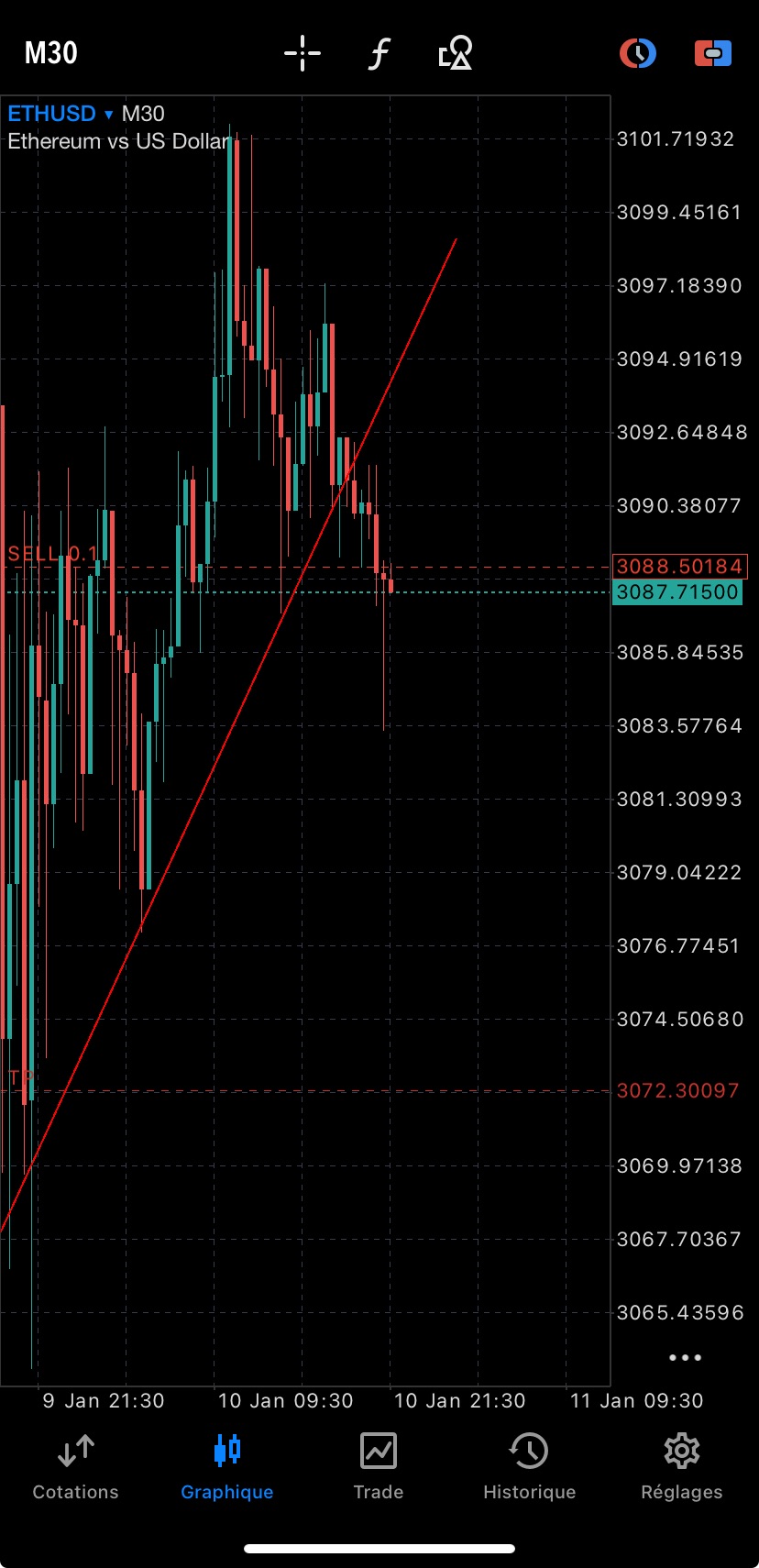
Ethereum is down $34.41 today or 1.10% to $3081.44
Note: The Ethereum price is a 5 p.m. ET snapshot from Kraken
Data compiled by Dow Jones Market Data
The start of 2026 saw Bitcoin and select altcoins rally back toward their weekly range highs, and the current situation across markets highlights improving investor sentiment and trading volumes. Since Jan. 1, Bitcoin continued to show improvement with tightening range consolidation clearly seen in its daily higher lows and higher highs, leading to the weekly high at $94,800.
7-day liquidation heatmap data from Hyblock shows long liquidation clusters between $89,000 to $87,000 and short positions sitting at the weekly range high near $95,000.
From a technical trader’s point of view, the start of year rally pulled the price above the 20-day moving average, which is currently converging with the 50-day moving average. After BTC failed to hold $95,000 and liquidate the short positions in that zone, it appears that some traders cut their positions to take profit in anticipation of a lower support retest of the 20-MA at $89,400.
If the current trend were to extend and volume permitting, over the coming days, another attack on the $95,000 level could occur. Such a move could lead to short covering and liquidations, allowing bulls to exploit a clear gap in the volume profile of the (Binance) pair, setting Bitcoin up for a 13% rally to $101,500.
As shown in the chart below, the bulk of this week’s intra-day Bitcoin price action was driven by traders using perpetual futures to trigger liquidations. Note how a near $1.1 billion surge in futures buy volume took place as BTC rallied to $94,800 on Jan. 5, and $100 million in shorts were liquidated in the pair at Binance, according to data from TRDR.io.
As detailed earlier, current liquidation heatmap data and orderbook structure suggest that a similar event could occur again if traders press BTC price to $94,000.
According to the tokenomics data on Tokenomist, Kaito will unlock roughly 32.6 million KAITO at 12:00 PM UTC, equal to about 10.64% of its released supply. Mechanically, this event increases the freely tradeable supply in a single step, rather than gradually, which can create short-term order book imbalance if recipients decide to sell. For traders, the main risk is near-term sell pressure and volatility around the unlock time; the opportunity is to monitor how much of the new supply actually hits exchanges, using on-chain flows and market depth to gauge whether the unlock was under- or over-priced.
Tokenomics data on Tokenomist indicates that Undeads Games will unlock roughly 21.9 million UDS at 12:00 AM UTC, about 13.47% of its released supply. This step-change in circulating supply can pressure price if unlock recipients treat the allocation as liquidity to realize gains, especially in a thinly traded market. For traders, the key is to track where the unlocked UDS moves (exchanges vs. staking/treasury addresses) and to compare realized selling with the headline unlock size. A significant unlock that results in limited exchange inflow can be bullish once event-driven uncertainty clears.
The vesting schedule on Tokenomist shows that RedStone is set to unlock about 40.9 million RED at 4:00 PM UTC, representing around 16.13% of its released supply. This is a relatively large one-off increase in liquid tokens, which can weigh on price if a meaningful share of recipients are early investors or ecosystem grants that may be sold. Traders should focus on derivatives funding, open interest, and order book positioning going into the date, as markets often front-run unlocks; a muted post-event reaction can signal strong absorption and potentially mark a short-term local bottom.
White Label
Data API
Web Plug-ins
Poster Maker
Affiliate Program
The risk of loss in trading financial instruments such as stocks, FX, commodities, futures, bonds, ETFs and crypto can be substantial. You may sustain a total loss of the funds that you deposit with your broker. Therefore, you should carefully consider whether such trading is suitable for you in light of your circumstances and financial resources.
No decision to invest should be made without thoroughly conducting due diligence by yourself or consulting with your financial advisors. Our web content might not suit you since we don't know your financial conditions and investment needs. Our financial information might have latency or contain inaccuracy, so you should be fully responsible for any of your trading and investment decisions. The company will not be responsible for your capital loss.
Without getting permission from the website, you are not allowed to copy the website's graphics, texts, or trademarks. Intellectual property rights in the content or data incorporated into this website belong to its providers and exchange merchants.
Not Logged In
Log in to access more features

FastBull Membership
Not yet
Purchase
Log In
Sign Up