• Trade
  • Markets
  • Copy
  • Contests
  • News
  • 24/7
  • Calendar
  • Q&A
  • Chats
Trending
Screeners
SYMBOL
LAST
BID
ASK
HIGH
LOW
NET CHG.
%CHG.
SPREAD
SPX
S&P 500 Index
6827.42
6827.42
6827.42
6899.86
6801.80
-73.58
-1.07%
--
DJI
Dow Jones Industrial Average
48458.04
48458.04
48458.04
48886.86
48334.10
-245.98
-0.51%
--
IXIC
NASDAQ Composite Index
23195.16
23195.16
23195.16
23554.89
23094.51
-398.69
-1.69%
--
USDX
US Dollar Index
97.950
98.030
97.950
98.500
97.950
-0.370
-0.38%
--
EURUSD
Euro / US Dollar
1.17394
1.17409
1.17394
1.17496
1.17192
+0.00011
+ 0.01%
--
GBPUSD
Pound Sterling / US Dollar
1.33707
1.33732
1.33707
1.33997
1.33419
-0.00148
-0.11%
--
XAUUSD
Gold / US Dollar
4299.39
4299.39
4299.39
4353.41
4257.10
+20.10
+ 0.47%
--
WTI
Light Sweet Crude Oil
57.233
57.485
57.233
58.011
56.969
-0.408
-0.71%
--

Community Accounts

Signal Accounts
--
Profit Accounts
--
Loss Accounts
--
View More

Become a signal provider

Sell trading signals to earn additional income

View More

Guide to Copy Trading

Get started with ease and confidence

View More

Signal Accounts for Members

All Signal Accounts

Best Return
  • Best Return
  • Best P/L
  • Best MDD
Past 1W
  • Past 1W
  • Past 1M
  • Past 1Y

All Contests

  • All
  • Trump Updates
  • Recommend
  • Stocks
  • Cryptocurrencies
  • Central Banks
  • Featured News
Top News Only
Share

Incoming Czech Prime Minister Babis: Czech Republic Will Not Take On Guarantees For Ukraine Financing, European Commission Must Find Alternatives

Share

Turkey President Erdogan: Hopes To Discuss Ukraine-Russia Peace Plan With Trump After Meeting With Putin

Share

Turkey President Erdogan: Peace Is Not Far Away, Black Sea Should Not Be Used As A Battleground, Safe Navigation Needed

Share

IAEA: Ukraine's Znpp Temporarily Lost All Offsite Power Overnight Due To Widespread Military Activities Affecting The Electrical Grid

Share

Iranian Media Says 18 Crew Members Of Foreign Tanker Seized In Gulf Of Oman Over Carrying 'Smuggled Fuel' Detained

Share

Regional Governor: Two Killed In Ukrainian Drone Strike On Russia's Saratov

Share

Chinese Foreign Ministry - China Foreign Minister Met With United Arab Emirates Counterpart On Dec 12

Share

China's Central Financial And Economic Affairs Commission Deputy Director: Will Expand Export And Increase Import In 2026

Share

Thai Leader Anutin: Landmine Blast That Killed Thai Soldiers 'Not A Roadside Accident'

Share

Thai Leader Anutin: Thailand To Continue Military Action Until 'We Feel No More Harm'

Share

Cambodian Prime Minister Hun Manet Says He Had Phone Calls With Trump And Malaysian Leader Anwar About Ceasefire

Share

Cambodia's Hun Manet Says USA, Malaysia Should Verify 'Which Side Fired First' In Latest Conflict

Share

Cambodia's Hun Manet: Cambodia Maintains Its Stance In Seeking Peaceful Resolution Of Disputes

Share

Nasdaq Companies: Allergan, Ferrovia, Insmed, Monolithic Power Systems, Seagate Technology, And Western Digital Will Be Added To The NASDAQ 100 Index. Biogen, CdW, GlobalFoundries, Lululemon, ON Semiconductor, And Tradedesk Will Be Removed From The NASDAQ 100 Index

Share

Witkoff Headed To Berlin This Weekend To Meet With Zelenskiy, European Leaders -Wsj Reporter On X

Share

Russia Attacks Two Ukrainian Ports, Damaging Three Turkish-Owned Vessels

Share

[Historic Flooding Occurs In At Least Four Rivers In Washington State Due To Days Of Torrential Rains] Multiple Areas In Washington State Have Been Hit By Severe Flooding Due To Days Of Torrential Rains, With At Least Four Rivers Experiencing Historic Flooding. Reporters Learned On The 12th That The Floods Caused By The Torrential Rains In Washington State Have Destroyed Homes And Closed Several Highways. Experts Warn That Even More Severe Flooding May Occur In The Future. A State Of Emergency Has Been Declared In Washington State

Share

Trump Says Proposed Free Economic Zone In Donbas Would Work

Share

Trump: I Think My Voice Should Be Heard

Share

Trump Says Will Be Choosing New Fed Chair In Near Future

TIME
ACT
FCST
PREV
U.K. Trade Balance Non-EU (SA) (Oct)

A:--

F: --

P: --

U.K. Trade Balance (Oct)

A:--

F: --

P: --

U.K. Services Index MoM

A:--

F: --

P: --

U.K. Construction Output MoM (SA) (Oct)

A:--

F: --

P: --

U.K. Industrial Output YoY (Oct)

A:--

F: --

P: --

U.K. Trade Balance (SA) (Oct)

A:--

F: --

P: --

U.K. Trade Balance EU (SA) (Oct)

A:--

F: --

P: --

U.K. Manufacturing Output YoY (Oct)

A:--

F: --

P: --

U.K. GDP MoM (Oct)

A:--

F: --

P: --

U.K. GDP YoY (SA) (Oct)

A:--

F: --

P: --

U.K. Industrial Output MoM (Oct)

A:--

F: --

P: --

U.K. Construction Output YoY (Oct)

A:--

F: --

P: --

France HICP Final MoM (Nov)

A:--

F: --

P: --

China, Mainland Outstanding Loans Growth YoY (Nov)

A:--

F: --

P: --

China, Mainland M2 Money Supply YoY (Nov)

A:--

F: --

P: --

China, Mainland M0 Money Supply YoY (Nov)

A:--

F: --

P: --

China, Mainland M1 Money Supply YoY (Nov)

A:--

F: --

P: --

India CPI YoY (Nov)

A:--

F: --

P: --

India Deposit Gowth YoY

A:--

F: --

P: --

Brazil Services Growth YoY (Oct)

A:--

F: --

P: --

Mexico Industrial Output YoY (Oct)

A:--

F: --

P: --

Russia Trade Balance (Oct)

A:--

F: --

P: --

Philadelphia Fed President Henry Paulson delivers a speech
Canada Building Permits MoM (SA) (Oct)

A:--

F: --

P: --

Canada Wholesale Sales YoY (Oct)

A:--

F: --

P: --

Canada Wholesale Inventory MoM (Oct)

A:--

F: --

P: --

Canada Wholesale Inventory YoY (Oct)

A:--

F: --

P: --

Canada Wholesale Sales MoM (SA) (Oct)

A:--

F: --

P: --

Germany Current Account (Not SA) (Oct)

A:--

F: --

P: --

U.S. Weekly Total Rig Count

A:--

F: --

P: --

U.S. Weekly Total Oil Rig Count

A:--

F: --

P: --

Japan Tankan Large Non-Manufacturing Diffusion Index (Q4)

--

F: --

P: --

Japan Tankan Small Manufacturing Outlook Index (Q4)

--

F: --

P: --

Japan Tankan Large Non-Manufacturing Outlook Index (Q4)

--

F: --

P: --

Japan Tankan Large Manufacturing Outlook Index (Q4)

--

F: --

P: --

Japan Tankan Small Manufacturing Diffusion Index (Q4)

--

F: --

P: --

Japan Tankan Large Manufacturing Diffusion Index (Q4)

--

F: --

P: --

Japan Tankan Large-Enterprise Capital Expenditure YoY (Q4)

--

F: --

P: --

U.K. Rightmove House Price Index YoY (Dec)

--

F: --

P: --

China, Mainland Industrial Output YoY (YTD) (Nov)

--

F: --

P: --

China, Mainland Urban Area Unemployment Rate (Nov)

--

F: --

P: --

Saudi Arabia CPI YoY (Nov)

--

F: --

P: --

Euro Zone Industrial Output YoY (Oct)

--

F: --

P: --

Euro Zone Industrial Output MoM (Oct)

--

F: --

P: --

Canada Existing Home Sales MoM (Nov)

--

F: --

P: --

Euro Zone Total Reserve Assets (Nov)

--

F: --

P: --

U.K. Inflation Rate Expectations

--

F: --

P: --

Canada National Economic Confidence Index

--

F: --

P: --

Canada New Housing Starts (Nov)

--

F: --

P: --

U.S. NY Fed Manufacturing Employment Index (Dec)

--

F: --

P: --

U.S. NY Fed Manufacturing Index (Dec)

--

F: --

P: --

Canada Core CPI YoY (Nov)

--

F: --

P: --

Canada Manufacturing Unfilled Orders MoM (Oct)

--

F: --

P: --

Canada Manufacturing New Orders MoM (Oct)

--

F: --

P: --

Canada Core CPI MoM (Nov)

--

F: --

P: --

Canada Manufacturing Inventory MoM (Oct)

--

F: --

P: --

Canada CPI YoY (Nov)

--

F: --

P: --

Canada CPI MoM (Nov)

--

F: --

P: --

Canada CPI YoY (SA) (Nov)

--

F: --

P: --

Canada Core CPI MoM (SA) (Nov)

--

F: --

P: --

Q&A with Experts
    • All
    • Chatrooms
    • Groups
    • Friends
    Connecting
    .
    .
    .
    Type here...
    Add Symbol or Code

      No matching data

      All
      Trump Updates
      Recommend
      Stocks
      Cryptocurrencies
      Central Banks
      Featured News
      • All
      • Russia-Ukraine Conflict
      • Middle East Flashpoint
      • All
      • Russia-Ukraine Conflict
      • Middle East Flashpoint
      Search
      Products

      Charts Free Forever

      Chats Q&A with Experts
      Screeners Economic Calendar Data Tools
      Membership Features
      Data Warehouse Market Trends Institutional Data Policy Rates Macro

      Market Trends

      Market Sentiment Order Book Forex Correlations

      Top Indicators

      Charts Free Forever
      Markets

      News

      News Analysis 24/7 Columns Education
      From Institutions From Analysts
      Topics Columnists

      Latest Views

      Latest Views

      Trending Topics

      Top Columnists

      Latest Update

      Signals

      Copy Rankings Latest Signals Become a signal provider AI Rating
      Contests
      Brokers

      Overview Brokers Assessment Rankings Regulators News Claims
      Broker listing Forex Brokers Comparison Tool Live Spread Comparison Scam
      Q&A Complaint Scam Alert Videos Tips to Detect Scam
      More

      Business
      Events
      Careers About Us Advertising Help Center

      White Label

      Data API

      Web Plug-ins

      Affiliate Program

      Awards Institution Evaluation IB Seminar Salon Event Exhibition
      Vietnam Thailand Singapore Dubai
      Fans Party Investment Sharing Session
      FastBull Summit BrokersView Expo
      Recent Searches
        Top Searches
          Markets
          News
          Analysis
          User
          24/7
          Economic Calendar
          Education
          Data
          • Names
          • Latest
          • Prev

          View All

          No data

          Scan to Download

          Faster Charts, Chat Faster!

          Download App
          English
          • English
          • Español
          • العربية
          • Bahasa Indonesia
          • Bahasa Melayu
          • Tiếng Việt
          • ภาษาไทย
          • Français
          • Italiano
          • Türkçe
          • Русский язык
          • 简中
          • 繁中
          Open Account
          Search
          Products
          Charts Free Forever
          Markets
          News
          Signals

          Copy Rankings Latest Signals Become a signal provider AI Rating
          Contests
          Brokers

          Overview Brokers Assessment Rankings Regulators News Claims
          Broker listing Forex Brokers Comparison Tool Live Spread Comparison Scam
          Q&A Complaint Scam Alert Videos Tips to Detect Scam
          More

          Business
          Events
          Careers About Us Advertising Help Center

          White Label

          Data API

          Web Plug-ins

          Affiliate Program

          Awards Institution Evaluation IB Seminar Salon Event Exhibition
          Vietnam Thailand Singapore Dubai
          Fans Party Investment Sharing Session
          FastBull Summit BrokersView Expo

          Pound to Canadian Dollar Rate Week Ahead Forecast: Rude Awakening for the Bulls

          Warren Takunda

          Economic

          Summary:

          The scale of the Pound's fall against the Canadian Dollar last Friday was significant and we wonder if it has dented what was one of global FX's best-defined uptrends.
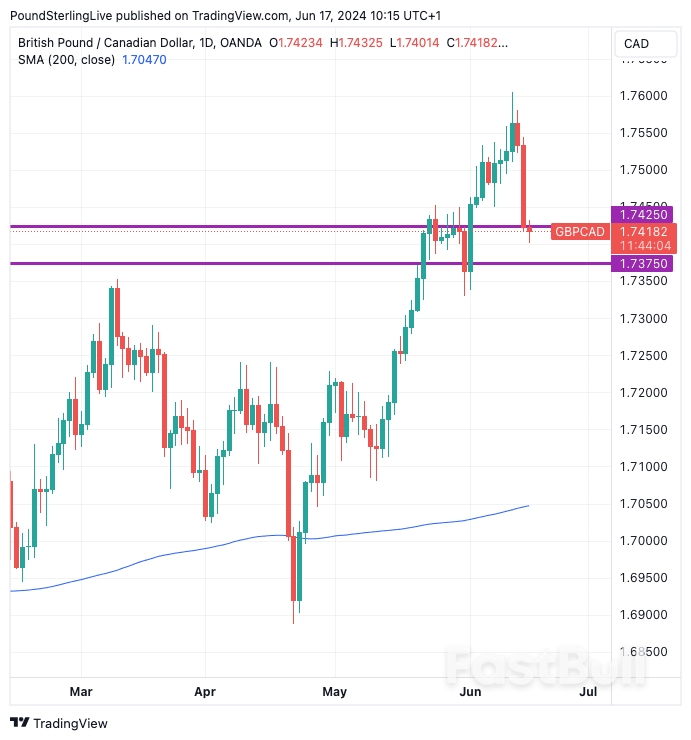
          GBP/CAD hit its highest levels since 2021 last week at 1.76, as a strong rally extended to fresh multi-month highs, but the exchange rate looked overbought as it did so.
          A Relative Strength Index (RSI) reading above 70 confirmed these overbought conditions, which typically signals a pullback/consolidation is needed.
          The market has duly delivered this, and the RSI has neutralised by falling to 50, and we would look for the immediate selling pressure to ease.
          To be sure, this is not a wholesale breakdown of GBP/CAD and there is a chance that the gains gain build again from here.
          Shaun Osborne, Scotiabank's Chief FX Strategist, wrote ahead of GBP/CAD's Friday tumble that the daily, weekly, and monthly DMI studies remain bullishly aligned for the GBP.
          A monthly break above long-term trend resistance (now support at 1.7320) keeps his attention "on gains developing towards 1.80 (at least) in the next few weeks or couple of months".
          "Minor dips (to the 1.7375/1.7425 zone) should be well-supported from here," he adds.
          Pound to Canadian Dollar Rate Week Ahead Forecast: Rude Awakening for the Bulls_1

          Above: GBP/CAD at daily intervals.

          As the above shows, GBP/CAD has fallen to that support zone he mentioned. We would look to see if this area holds in the coming days. If the exchange rate remains above here, the prospect of the uptrend reasserting is likely.
          The key calendar event to watch comes on Wednesday when the services inflation print is released. Services inflation beat expectations last month and confirmed underlying inflation trends are running well ahead of levels consistent with a durable fall in UK headline inflation to 2.0%.
          "My prediction for next week’s CPI inflation figures. Headline 2.3% (unchanged). Services inflation 6% (+0.1). Goods inflation -1% (-0.2). Core inflation 3.8% (-0.1%). Not enough change to prompt a rate cut from MPC," says Andrew Sentance, an economist and former member of the Bank of England's MPC.
          In May, Sentance correctly predicted that April's inflation reading would overshoot expectations, and if he is again correct, these upside surprises will likely boost the pound.
          The Bank of England and other economists expect a steady pickup in inflation over the remainder of the year owing to elevated services inflation levels. Another above-consensus reading would raise questions about just how fast the Bank of England can cut interest rates, which can underpin the Pound on a relative interest rate basis.
          This would keep GBP/CAD above 1.7375.
          The Bank of England is in focus on Thursday, and guidance regarding the prospect of an August interest rate cut will determine where the Pound ends the week. The market currently sees less than a 50% chance of an August rate cut, meaning there is scope for repricing in a GBP-negative direction.
          Dave Ramsden and Swati Dhingra are likely to again vote for an immediate cut. What will be interesting is whether more members of the MPC join them in voting for a cut. If yes, the odds of an August rate cut will rise, weighing on the Pound.
          GBP/CAD likely falls below 1.7375 if this occurs.
          "The pound may lose some of its recent momentum if UK services inflation comes in cooler than expected next Wednesday, as it would raise the probability of a BoE cut in August and bring rates differentials back to the fore," says George Vessey, Lead FX Strategist at Convera.
          That said, last month's above-consensus inflation print will be a sober reminder to the MPC that UK inflation is likely to prove sticky in the coming months. This should encourage a degree of caution that can, on balance, mean any weaknesses in the Pound are short-lived.
          "Monetary policy will remain a more important driver for the pound sterling, which should remain robust thanks to a late-moving Bank of England and a nascent economic recovery," says David Alexander Meier, an analyst at Julius Baer.

          Source: Poundsterlinglive

          To stay updated on all economic events of today, please check out our Economic calendar
          Risk Warnings and Disclaimers
          You understand and acknowledge that there is a high degree of risk involved in trading. Following any strategies or investment methods may lead to potential losses. The content on the site is provided by our contributors and analysts for information purposes only. You are solely responsible for determining whether any trading assets, securities, strategy, or any other product is suitable for investing based on your own investment objectives and financial situation.
          Add to Favorites
          Share

          ECB In No Rush To Discuss French Bond Rescue

          Samantha Luan

          Economic

          Central Bank

          French financial markets endured a brutal sell-off late last week as investors cut their positions ahead of a snap election that might give a majority to the far right, leading some analysts to speculate about an ECB intervention.
          But five ECB policymakers, speaking on condition of anonymity given the sensitivity of the situation, said they hadn't discussed activating an emergency bond-buying scheme to support French debt, nor do they currently plan to do so.
          The sources expressed varying degrees of concern about the magnitude of the selloff in French government bonds, which saw their risk premium over safer German paper rise by the most since the 2011 euro zone debt crisis.
          But they generally agreed it was for French politicians to convince investors that they would run a sensible economic policy. Two sources even suggested the ECB should not intervene before a new French government is formed and fiscal plans announced.
          An ECB spokesperson declined to comment.
          The ECB's Transmission Protection Instrument (TPI) allows it to buy unlimited amounts of bonds from a country that finds itself under market pressure, but only for as long as it complies with parameters including the European Union's fiscal rules.
          Still, some governors were unnerved by the notion of financial turmoil brewing in France, which was until recently regarded as the euro zone's second pillar of stability after Germany but is now having its own fiscal woes.
          French Finance Minister Bruno Le Maire has warned that the euro zone's second-biggest economy was at risk of a financial crisis if the far right wins in the June 30 and July 7 elections.
          Marine Le Pen's eurosceptic National Rally (RN), which is leading in opinion polls, is calling for a cut in the state pension age, reductions in energy prices, increased public spending and a protectionist "France first" economic policy.

          ITALIAN PRECEDENT

          Some governors likened France's situation to that faced by Italy in the summer of 2022, when Giorgia Meloni's centre-right coalition appeared poised to win general elections.
          After her election win, Meloni toned down her bellicose approach towards European institutions and the ECB governors hoped Le Pen and her party would do the same.
          Italy and France are both running a higher deficit than EU rules allow, meaning they will be forced to tighten their purse strings via a so called "excessive deficit procedure" from the European Union.
          ECB President Christine Lagarde, herself a Frenchwoman, appeared to play down the importance of that rule earlier this year, saying it was just "an alternative condition" to determine TPI eligibility.
          Asked about the notion of using TPI for France on Friday, Lagarde merely said it was "the duty of the European Central Bank to ... keep inflation under control and back to target".
          Investors were demanding an 80 basis-point premium for lending to AA-rated France over triple-A Germany for 10 years as of the market's close on Friday.
          The spread between BBB-rated Italy and Germany, which also widened in recent days, was 157 basis points on Friday - still a far cry from the 250 points touched in 2022.

          Source:Reuters

          To stay updated on all economic events of today, please check out our Economic calendar
          Risk Warnings and Disclaimers
          You understand and acknowledge that there is a high degree of risk involved in trading. Following any strategies or investment methods may lead to potential losses. The content on the site is provided by our contributors and analysts for information purposes only. You are solely responsible for determining whether any trading assets, securities, strategy, or any other product is suitable for investing based on your own investment objectives and financial situation.
          Add to Favorites
          Share

          BRICS Surpasses the US in Gas Trade to Europe

          Cohen

          Economic

          Commodity

          The BRICS alliance has surpassed the US in gas trade to Europe for the first time in almost two years. BRICS member Russia is the top supplier of LNG gas to Europe and outperformed the US despite facing sanctions. The spike comes despite Europe trying to limit its dependency on Russian oil but several countries in the eastern European region rely heavily on imports from the country. This makes Russia the top supplier of LNG gas supplier to Europe elbowing the US in global trade deals.
          The development comes when BRICS is looking to topple the US dollar as the world’s reserve currency. The bloc aims to control the global oil and gas sector to bring the US dollar down.

          BRICS: Russia Beats the US in Gas Trade to Europe Despite Facing Sanctions

          BRICS member Russia has been initiating gas trade deals with Europe and other countries despite facing sanctions from the US. The Putin administration has bypassed sanctions and conducted deals with Europe, Africa, Asia, and its BRICS counterparts. LNG shipments from Russia to Europe touched a high of 15% this month in May 2024. On the other hand, the US-based LNG gas to Europe dipped to 14% this month.
          “It’s striking to see the market share of Russian gas and (liquefied natural gas) inch higher in Europe after all we have been through, and all the efforts made to decouple and de-risk energy supply,” said Tom Marzec-Manser, the Head of Gas Analytics at Consultancy ICIS to the Financial Times.
          The US was the top supplier of LNG gas to Europe after the White House pressed sanctions against BRICS member Russia. However, Marzec-Manser explained that Russia’s dominancy in the LNG gas sector in Europe might not last long. “Russia has limited flexibility to hold on to this share (in Europe) as demand rises into next winter. Whereas overall US LNG production is only growing with yet more new capacity coming to the global market by the end of the year,” he summed it up.

          Source:Watcher

          To stay updated on all economic events of today, please check out our Economic calendar
          Risk Warnings and Disclaimers
          You understand and acknowledge that there is a high degree of risk involved in trading. Following any strategies or investment methods may lead to potential losses. The content on the site is provided by our contributors and analysts for information purposes only. You are solely responsible for determining whether any trading assets, securities, strategy, or any other product is suitable for investing based on your own investment objectives and financial situation.
          Add to Favorites
          Share

          $66K BTC Price Now ‘Critical’—5 Things to Know in Bitcoin This Week

          Warren Takunda

          Cryptocurrency

          Bitcoin starts a new week in an altogether different mood to much of June, trailing one-month lows.
          Bitcoin price action has taken a turn for the worse after challenging $70,000 resistance multiple times. What could be next?
          As a stubborn trading range continues to dictate Bitcoin market moves, traders and analysts are considering what the immediate future has in store — and whether bulls or bears will be in control.
          A stream of United States macroeconomic data and associated Federal Reserve commentary appeared to take its toll on Bitcoin last week, with the largest cryptocurrency shedding nearly 5% and briefly dipping below $65,000.
          While fewer macro triggers are due this week, employment figures may still surprise as the U.S. inflation picture delivers mixed signals to risk assets.
          Many are thus playing a game of wait-and-see when it comes to BTC/USD — until the range shows signs of shifting, there is little to do but wait.
          Under the hood, meanwhile, Bitcoin miners are adjusting to the new post-halving reality as a “capitulation” phase continues to play out. Network fundamentals are cooling, with mining difficulty set to drop by around 1.3% this week.
          With all-time highs seemingly out of reach for the time being, Cointelegraph takes a closer look at the main BTC price talking points for market observers and participants.

          BTC price dices with support failure

          A bruising week for Bitcoin bulls finally ended with BTC/USD down 4.3% at the weekly close, data from Cointelegraph Markets Pro and TradingView confirms.
          After hitting one-month lows, bulls managed a modest turnaround to bring the market focus back to $66,000 — a level that remains in play as of June 17.$66K BTC Price Now ‘Critical’—5 Things to Know in Bitcoin This Week_1

          BTC/USD 1-hour chart. Source: TradingView

          While it could have been worse, the “red” week offered little hope to those seeking a definitive resistance/support flip at the key levels of $69,000 and higher.
          “Bitcoin remains red on 3-day Predator. Still no significant sign of a trend shift just yet,” trading suite DecenTrader told subscribers on X about the latest signals from its proprietary trading indicators.
          Data from monitoring resource CoinGlass shows the extent to which $66,000 is now key in terms of order book liquidity, with $67,300 fulfilling a similar role as resistance.$66K BTC Price Now ‘Critical’—5 Things to Know in Bitcoin This Week_2

          BTC liquidation heatmap (screenshot). Source: CoinGlass

          Thus, a narrow corridor has evolved, with TradFi unable to shift the status quo during the week’s first Asia trading session.
          “Sideways price action is - generally speaking - not a bad thing. A lack of patience is,” popular trader Jelle continued in his latest X analysis.
          “Pretty sure this will resolve up, just like all the other times.”

          $66K BTC Price Now ‘Critical’—5 Things to Know in Bitcoin This Week_3BTC/USD chart. Source: Jelle

          Jelle described the weekend’s movements as “typical” for Bitcoin.
          “Bullish divergence is locked in, and price is trying to hold above $66,300. Time for bulls to wake up, and push this back into the range,” he added about relative strength index (RSI) values.
          Others also sought to find a note of optimism amid the otherwise lackluster BTC price action now in place for several weeks. Among them was commentator Matthew Hyland, who noted that Bitcoin’s 10-week simple moving average (SMA) remained intact through the recent dip.
          $66K BTC Price Now ‘Critical’—5 Things to Know in Bitcoin This Week_4

          BTC/USD 1-day chart with 10-week SMA. Source: TradingView

          Jobless claims highlight cool macro week

          After the deluge of macroeconomic data in June, the coming week offers risk-asset traders some welcome relief.
          Only U.S. jobless claims form a potential catalyst for volatility across crypto, with the sector showing itself to be sensitive to unemployment surprises throughout 2024.
          The Juneteenth holiday gives the entire U.S. market a break on June 19, with the jobless claims due a day later.
          Commenting on the week ahead, trading resource The Kobeissi Letter alluded to the impact of ongoing data prints on market expectations for a significant loosening in U.S. financial policy.
          “Massive swings in Fed expectations continue to be incredibly profitable to trade this year,” it summarized about the fluctuating bets on Federal Reserve interest rate cuts this year — a key bullish impetus for Bitcoin and altcoins.$66K BTC Price Now ‘Critical’—5 Things to Know in Bitcoin This Week_5

          Fed target rate probabilities as of June 17 (screenshot). Source: CME Group

          The latest estimates from CME Group’s FedWatch Tool show that the Fed’s September meeting remains the earliest likely date for cuts to begin. The next meeting in July currently only has around 10% odds of resulting in a cut.
          “For me, the takeaway from last week is that the data is clearly pointing towards a shift to more accommodative monetary policy—and potentially sooner rather than later,” financial commentator Tedtalksmacro wrote in part of an X thread at the weekend.
          “Reinforcing my view that dips are buying opportunities for risk assets like cryptocurrencies + stocks.”

          $66K BTC Price Now ‘Critical’—5 Things to Know in Bitcoin This Week_6BTC/USD chart. Source: Tedtalksmacro

          Tedtalksmacro agreed that $66,000 was the key level to hold in the face of any macro surprises.
          “For the upcoming week it's critical that Bitcoin maintains it's support at $66,000 USD - if broken, sellers could take a stronghold on the market and force quick liquidations out of the bulls,” he warned.

          Bitcoin miner capitulation in full swing

          Bitcoin network fundamentals continue to take stock of recent gains as miners face a fresh period of economic upheaval.
          Current estimates from BTC.com foresee a roughly 1.3% drop in mining difficulty at the next automated readjustment on June 20.$66K BTC Price Now ‘Critical’—5 Things to Know in Bitcoin This Week_7

          Bitcoin network fundamentals overview (screenshot). Source: BTC.com

          This underscores an overall mixed landscape since April’s block subsidy halving, with miners continuing to adjust to the new economic reality.
          As Cointelegraph reported, a “capitulation” phase is currently underway on hashrate, with the 30-day moving average below its 60-day equivalent. This, as shown by the hash ribbons metric, is indicative of a pre-breakout BTC price phase.
          “Following the recent Bitcoin halving, we have observed nearly a month of challenging conditions for miners,” Kripto Mevismi, a contributor to onchain analytics platform CryptoQuant, wrote in one of its Quicktake market updates last week.
          Hash ribbons analysis suggested that miners themselves “do not appear to have the power to significantly influence the price” during the current capitulation.
          “The analysis of hash ribbons and the current market dynamics suggest that despite the challenges faced by miners post-halving, the Bitcoin market remains strong. The sustained demand is a positive indicator of market resilience and strength, highlighting that the current price stability is supported by more than just miner activity,” Kripto Mevismi concluded.
          “This period demonstrates the market's ability to maintain a solid foundation even amidst potential adversities, indicating a strong and healthy Bitcoin ecosystem.”

          $66K BTC Price Now ‘Critical’—5 Things to Know in Bitcoin This Week_8Bitcoin Hash Ribbons indicator. Source: LookIntoBitcoin

          Hash ribbons’ last capitulation signal came in August 2023, when BTC/USD dropped to $25,000.

          BTC wallet numbers erase bear market wipeout

          Much has been made of Bitcoin whale behavior in recent weeks, with sustained accumulation ignoring changing short-term price narratives.
          This has led to an assumption that large-volume traders overwhelmingly expect BTC price upside to reemerge, providing easy gains in the coming weeks to months.
          Meanwhile, smaller-volume wallets are experiencing a renaissance of their own.
          The latest data from research firm Santiment shows that wallets with 10 BTC or more now number 16.16 million — the most since June 2022. This reflects 82% of the BTC supply.
          “Much has changed since then, including a rise in Bitcoin's market value by +226%,” it noted in a dedicated X post on June 17.
          Santiment went on to reference the fall of exchange FTX at the end of 2022, which triggered the Bitcoin bear market capitulation and subsequent bullish comeback at the start of 2023.
          “Many believe that FTX was successfully suppressing cryptocurrency prices in the 2nd half of 2022,” it noted.
          “But since the exchange’s collapse in November, 2022, there has been an undeniable semblance of correlation between 10+ BTC wallet holdings and the coin’s overall market value.”

          $66K BTC Price Now ‘Critical’—5 Things to Know in Bitcoin This Week_9Bitcoin wallet numbers data. Source: Santiment

          Bitcoin ETF coins offer “strong support indicator”

          Whales also figure within the overall hodling trend for 2024.
          Coins bought before the launch of the U.S. spot Bitcoin exchange-traded funds (ETFs) in January have broadly stayed dormant since.
          As shown by CryptoQuant contributor Mignolet, that practice has turned their owners into longer-term holders rather than mere speculators.
          “Right before the ETF approval, holders sold their Bitcoin (blue box). However, in the green box, the short-term holders accumulated during the consolidation phase have transitioned to long-term holders of 3-6 months and are continuously being accumulated without being sold (green box),” a Quicktake post from the weekend explained.
          “Since most of these holdings belong to whales, this could serve as a strong support indicator.”

          $66K BTC Price Now ‘Critical’—5 Things to Know in Bitcoin This Week_10Bitcoin sum coin age distribution (screenshot). Source: CryptoQuant

          As Cointelegraph continues to report, Bitcoin’s short-term holder entities — those holding a given amount of BTC for up to 155 days — represent a key support trendline during the current bull market.
          Their aggregate cost basis is currently just above $62,000.

          Source: Cointelegraph

          Risk Warnings and Disclaimers
          You understand and acknowledge that there is a high degree of risk involved in trading. Following any strategies or investment methods may lead to potential losses. The content on the site is provided by our contributors and analysts for information purposes only. You are solely responsible for determining whether any trading assets, securities, strategy, or any other product is suitable for investing based on your own investment objectives and financial situation.
          Add to Favorites
          Share

          Shares Stable, Euro Downtrodden as Political Turmoil Saps Market Mood

          Warren Takunda

          Economic

          Stocks

          Shares steadied on Monday while the euro remained on the defensive amid political turmoil in Europe, as investors look for direction from a string of central bank meetings in the region this week as well as fresh U.S. economic data.
          European stocks recouped a fraction of their losses from last week when French President Emmanuel Macron called a snap election, with banks leading the mini-rally on Monday up 1% against a 0.2% rise in the benchmark STOXX index .
          Macron's surprise move came after far right and leftist parties gained ground against his centrist administration, raising investor concerns about a budget crisis and triggering a brutal selloff in French markets.
          The euro has become emblematic of this angst, down 0.04% to $1.07025, after falling to its lowest since May 1 at $1.06678 on Friday.
          European Central Bank policymakers told Reuters they had no plans to launch emergency purchases of French bonds to stabilise the market after yield spreads over German bunds widened dramatically amid a flight to safety.
          "A French challenge to the region's fiscal arrangements would be problematic and have far-reaching implications," warned analysts at JPMorgan. "At this stage, the situation in the run-up to the first round of voting is still very fluid."
          Central banks in Australia, Norway and the UK are all expected to hold rates steady at meetings this week, though the Swiss National Bank (SNB) might ease given the recent strength of the Swiss franc.
          Markets have boosted the probability of a cut to 75% as political uncertainty in France drove the euro to a four-month trough at 0.9505 francs on Friday.

          FRAGILE CHINA

          Asian share markets had earlier fallen as mixed Chinese economic news underlined the country's fragile economic recovery.
          While retail sales beat forecasts thanks to a holiday boost, the flurry of data was otherwise largely negative, with Chinese blue chips off 0.2% after industrial output and fixed-asset investment both underwhelmed.
          U.S. shares looked set to follow the muted mood, with S&P 500 futures steady, while Nasdaq futures added 0.1% following a run of record finishes.
          Analysts at Goldman Sachs have raised their year-end target for the S&P 500 to 5,600, from 5,200 and the current 5,431.
          "Our 2024 and 2025 earnings estimates remain unchanged but stellar earnings growth by five mega-cap tech stocks have offset the typical pattern of negative revisions to consensus EPS estimates," they wrote in a note.
          The main U.S. data of the week will be retail sales for May on Tuesday, where a 0.4% bounce is expected after a 0.3% drop in April, while markets have a holiday on Wednesday.
          At least 10 policymakers from the Federal Reserve are due to speak this week and will no doubt address the market's wagers for two rate cuts this year.
          While the Fed itself sounded a hawkish note last week, a trio of soft inflation numbers led futures to price in a 76% chance of a cut as early as September and 50 basis points of easing for the year.
          The dollar was stable on the yen at 157.45 , after briefly spiking above 158.00 on Friday when the BOJ said it would start tapering bond buying a little later than many had wagered on.
          Japan's Nikkei slipped 1.9% on Monday, with investors now facing a six-week wait to hear details of the Bank of Japan's next tightening steps.
          In commodity markets, gold dipped 0.5% to $2,321 an ounce , unwinding some of last week's 1.7% bounce.
          Oil prices held firm after the bumpy economic data from China offset hopes for a boost to demand from the summer driving season in the northern hemisphere.
          Brent rose 2 cents to $82.64 a barrel as of 0812 GMT, while U.S. crude likewise nudged up to $78.49 per barrel.

          Source: Reuters

          To stay updated on all economic events of today, please check out our Economic calendar
          Risk Warnings and Disclaimers
          You understand and acknowledge that there is a high degree of risk involved in trading. Following any strategies or investment methods may lead to potential losses. The content on the site is provided by our contributors and analysts for information purposes only. You are solely responsible for determining whether any trading assets, securities, strategy, or any other product is suitable for investing based on your own investment objectives and financial situation.
          Add to Favorites
          Share

          BOJ To Forgo July Rate Hike, Taper $152 Bln Per Year, Says Ex-policymaker

          Alex

          Central Bank

          Economic

          At its policy meeting on Friday, the BOJ decided to start trimming its huge bond purchases and announce a detailed plan in July on reducing its nearly $5 trillion balance sheet, taking another step toward unwinding its massive monetary stimulus.
          Governor Kazuo Ueda gave few clues on how much the BOJ will actually trim its bond buying, saying only that the taper size will be significant.
          “The BOJ has the option of reducing its monthly purchase amount by just one trillion yen. But with the governor having said the size would be ‘significant,’ there’s a good chance it will taper by around 2 trillion yen,” Sakurai told Reuters in an interview.
          The BOJ currently buys roughly 6 trillion yen of government bonds per month with an allowance of 5-7 trillion yen. It will likely trim the purchase to 4 trillion yen per month, he said.
          The BOJ’s decision to announce its bond-tapering plan at its next meeting in July 30-31 has heightened uncertainty on whether it will hike short-term interest rates at the same meeting, or hold off until later in the year to avoid upending markets.
          Sakurai, who retains close ties with incumbent policymakers, said the BOJ will likely forgo raising rates in July and wait for more clarity on whether summer bonus payments and wage gains will help consumption will rebound.
          “The BOJ is probably in no rush to raise short-term rates as doing so would push up mortgage loan rates and hurt already weak housing investment,” Sakurai said. “The next interest rate hike will likely happen in autumn or early next year.”
          If economic and price developments move roughly in line with its projection, the central bank may raise interest rates to 0.5% by the end of next year, Sakurai said.
          After ending eight years of negative interest rates in March, the BOJ currently sets the short-term policy rate target in a range of 0-0.1%.
          Many economists expect the BOJ to hike interest rates to 0.25% this year, though they are divided on whether it will come in July or later in the year.
          Sakurai said the yen’s sharp falls likely forced the BOJ to proceed quicker than initially planned in embarking on quantitative tightening (QT) and scale back its balance sheet.
          Japan’s battered currency has become a headache for policymakers by inflating import prices, which in turn boosts living costs and hurting consumption.
          Rather than trying to slow the yen’s declines through rate hikes, the BOJ likely opted to allow long-term interest rate to rise more by announcing a bond tapering plan, he added.
          “The BOJ made a big step forward in normalising policy by deciding to taper,” Sakurai said, adding that many bankers likely saw the need to steadily trim its balance sheet.
          “In a way, the weak yen helped BOJ policymakers get what they wanted.”

          Source:Reuters

          To stay updated on all economic events of today, please check out our Economic calendar
          Risk Warnings and Disclaimers
          You understand and acknowledge that there is a high degree of risk involved in trading. Following any strategies or investment methods may lead to potential losses. The content on the site is provided by our contributors and analysts for information purposes only. You are solely responsible for determining whether any trading assets, securities, strategy, or any other product is suitable for investing based on your own investment objectives and financial situation.
          Add to Favorites
          Share

          Asia Can Bear With 'Higher-For-Longer' U.S. Rates

          Warren Takunda

          Economic

          The ripple effects of the U.S. Federal Reserve's 11-month hold on interest rates is already being felt in Asia.
          The debate over the domestic impact of what is shaping up as a delayed and shallow Fed easing cycle is far from settled. But the allure of U.S. interest rates staying in a range of 2% to 4% for several years is drawing money from the rest of the world into the U.S., with the country now accounting for one-third of global capital flows according to International Monetary Fund figures.
          Asia is no exception. The Bloomberg Asia Dollar Index, a basket of Asian currencies with high liquidity and large trade flows with the U.S., has weakened 13% over the last three years as capital outflows undercut the region's currencies.
          Yet the risks of this outpouring of capital getting out of control do not appear large.
          Asia's fundamentals are quite different than they were at the time of previous big selloffs, like the 2013 "taper tantrum" which battered the Indian rupee and Indonesian rupiah or the 1997 Asian financial crisis.
          Asian economies are much more resilient, foreign exchange reserves are larger and there is stronger regulatory oversight of foreign currency debt. These factors have contributed to a controlled depreciation of most Asian currencies this time, with minimal impacts so far on the broader economy.
          Additionally, monetary policy in Asia is now more attuned to external and financial risks. While local fundamentals were the primary driver of rate hike decisions in 2022 and 2023, these days the Fed is in focus as Asian central banks contemplate whether to begin cutting rates. Even the Bank of Thailand has been hesitating to preempt the Fed in trimming rates despite experiencing deflation for much of the year to date.
          The attention to the Fed is partly a function of the market's growing preference for the dollar as the "higher for longer" theme gains traction.
          Despite Asian economies' robust external balances, going against strong market forces can lead to significant currency pain. While it would be possible to temporarily decouple from the Fed, signaling alignment with it over the long term, in the way the European Central Bank has, could help minimize capital outflow and currency risks.
          Ortigas Center in Metro Manila: Asia's fundamentals are quite different than they were at the time of previous big selloffs.
          Admittedly, conditions in Asia may make this approach tricky.
          While inflation has entered a sticky patch in many Asian economies and uncertain food inflation clouds the near-term outlook, the region's long-term inflation challenge is likely smaller than that of the U.S.
          There are good reasons to believe that the U.S. has entered a period of structurally higher inflation. With globalization on its backfoot and new tariff and import barriers rising, a green transition underway and an aging population, U.S. inflation is likely to average 2% to 3% over the next several years, up from a long-term pre-pandemic average of 1.8%.
          Many of the factors affecting the U.S. apply to Asia as well, particularly its developed economies. But their impact will likely be dented by the disinflationary force of Chinese imports.
          China's rising manufacturing surplus means that its exports are likely to stay cheap for several years. This will probably not impact Western economies so much due to tariffs and other import restrictions.
          Asia, though, is another matter and the disinflationary impact of Chinese imports is likely to be significant, particularly in the manufacturing sector, given the region's high reliance on China for intermediate inputs.
          This would suggest the region's economies should be looking at deeper rate cuts than the U.S. This is especially the case for Southeast Asia and India. In both areas, the case for policy support for growth is strong, given that gross domestic product growth has slipped substantially below pre-pandemic trend lines.
          A dramatic shift in policy considerations seems unlikely. In an environment of broad dollar strength, central banks will be cautious in adding to currency depreciation pressures that could end up amplifying macrofinancial risks. Most seem likely to cumulatively cut rates by no more than half a percentage point through next March.
          If the gap in real policy rates between Asia and the U.S., factoring in inflation, does widen, this will make Asian assets more attractive on margin. This should allay concerns of capital flight, assuming the market looks beyond the difference in headline interest rates.
          Other factors are also likely to come to the fore as the transition to higher-for-longer rates proceeds. After all, the price of capital is not the sole arbiter of capital allocation decisions. Interest rate differentials matter a lot for leveraged investors like hedge funds. But returns for institutional investors, who have longer-term horizons, are contingent on a host of factors, including growth prospects, inflation and exchange rate regimes, institutional quality, policy frameworks, sovereign ratings and political risk.
          For such investors, Asia should remain a compelling choice, with a number of major markets featuring investment-grade ratings, a relatively favorable inflation environment, proven resilience to external shocks, stable political outlooks, credible policy frameworks and promising supply chain prospects.
          Although major institutional investors have recently been increasing their portfolio allocations for Asian markets, such exposure typically represents only 7% to 8% of assets under management. So there is considerable scope for more funds to be sent to the region. A similar dynamic could be in the works with foreign direct investment as well.
          Ultimately, sustained inflows of long-term capital would help drive a self-reinforcing cycle of growth, investment and external resilience in Asia. This would not only be positive for the region's long-term economic prospects, but also further enhance its ability to weather the financial stresses that may periodically arise as the world adjusts to the new rate environment.

          Source: NikkeiAsia

          To stay updated on all economic events of today, please check out our Economic calendar
          Risk Warnings and Disclaimers
          You understand and acknowledge that there is a high degree of risk involved in trading. Following any strategies or investment methods may lead to potential losses. The content on the site is provided by our contributors and analysts for information purposes only. You are solely responsible for determining whether any trading assets, securities, strategy, or any other product is suitable for investing based on your own investment objectives and financial situation.
          Add to Favorites
          Share
          FastBull
          Copyright © 2025 FastBull Ltd

          728 RM B 7/F GEE LOK IND BLDG NO 34 HUNG TO RD KWUN TONG KLN HONG KONG

          TelegramInstagramTwitterfacebooklinkedin
          App Store Google Play Google Play
          Products
          Charts

          Chats

          Q&A with Experts
          Screeners
          Economic Calendar
          Data
          Tools
          Membership
          Features
          Function
          Markets
          Copy Trading
          Latest Signals
          Contests
          News
          Analysis
          24/7
          Columns
          Education
          Company
          Careers
          About Us
          Contact Us
          Advertising
          Help Center
          Feedback
          User Agreement
          Privacy Policy
          Business

          White Label

          Data API

          Web Plug-ins

          Poster Maker

          Affiliate Program

          Risk Disclosure

          The risk of loss in trading financial instruments such as stocks, FX, commodities, futures, bonds, ETFs and crypto can be substantial. You may sustain a total loss of the funds that you deposit with your broker. Therefore, you should carefully consider whether such trading is suitable for you in light of your circumstances and financial resources.

          No decision to invest should be made without thoroughly conducting due diligence by yourself or consulting with your financial advisors. Our web content might not suit you since we don't know your financial conditions and investment needs. Our financial information might have latency or contain inaccuracy, so you should be fully responsible for any of your trading and investment decisions. The company will not be responsible for your capital loss.

          Without getting permission from the website, you are not allowed to copy the website's graphics, texts, or trademarks. Intellectual property rights in the content or data incorporated into this website belong to its providers and exchange merchants.

          Not Logged In

          Log in to access more features

          FastBull Membership

          Not yet

          Purchase

          Become a signal provider
          Help Center
          Customer Service
          Dark Mode
          Price Up/Down Colors

          Log In

          Sign Up

          Position
          Layout
          Fullscreen
          Default to Chart
          The chart page opens by default when you visit fastbull.com