Markets
News
Analysis
User
24/7
Economic Calendar
Education
Data
- Names
- Latest
- Prev


Signal Accounts for Members
All Signal Accounts
All Contests


U.K. Trade Balance Non-EU (SA) (Oct)A:--
F: --
P: --
U.K. Trade Balance (Oct)A:--
F: --
P: --
U.K. Services Index MoMA:--
F: --
P: --
U.K. Construction Output MoM (SA) (Oct)A:--
F: --
P: --
U.K. Industrial Output YoY (Oct)A:--
F: --
P: --
U.K. Trade Balance (SA) (Oct)A:--
F: --
P: --
U.K. Trade Balance EU (SA) (Oct)A:--
F: --
P: --
U.K. Manufacturing Output YoY (Oct)A:--
F: --
P: --
U.K. GDP MoM (Oct)A:--
F: --
P: --
U.K. GDP YoY (SA) (Oct)A:--
F: --
P: --
U.K. Industrial Output MoM (Oct)A:--
F: --
P: --
U.K. Construction Output YoY (Oct)A:--
F: --
P: --
France HICP Final MoM (Nov)A:--
F: --
P: --
China, Mainland Outstanding Loans Growth YoY (Nov)A:--
F: --
P: --
China, Mainland M2 Money Supply YoY (Nov)A:--
F: --
P: --
China, Mainland M0 Money Supply YoY (Nov)A:--
F: --
P: --
China, Mainland M1 Money Supply YoY (Nov)A:--
F: --
P: --
India CPI YoY (Nov)A:--
F: --
P: --
India Deposit Gowth YoYA:--
F: --
P: --
Brazil Services Growth YoY (Oct)A:--
F: --
P: --
Mexico Industrial Output YoY (Oct)A:--
F: --
P: --
Russia Trade Balance (Oct)A:--
F: --
P: --
Philadelphia Fed President Henry Paulson delivers a speech
Canada Building Permits MoM (SA) (Oct)A:--
F: --
P: --
Canada Wholesale Sales YoY (Oct)A:--
F: --
P: --
Canada Wholesale Inventory MoM (Oct)A:--
F: --
P: --
Canada Wholesale Inventory YoY (Oct)A:--
F: --
P: --
Canada Wholesale Sales MoM (SA) (Oct)A:--
F: --
P: --
Germany Current Account (Not SA) (Oct)A:--
F: --
P: --
U.S. Weekly Total Rig CountA:--
F: --
P: --
U.S. Weekly Total Oil Rig CountA:--
F: --
P: --
Japan Tankan Large Non-Manufacturing Diffusion Index (Q4)--
F: --
P: --
Japan Tankan Small Manufacturing Outlook Index (Q4)--
F: --
P: --
Japan Tankan Large Non-Manufacturing Outlook Index (Q4)--
F: --
P: --
Japan Tankan Large Manufacturing Outlook Index (Q4)--
F: --
P: --
Japan Tankan Small Manufacturing Diffusion Index (Q4)--
F: --
P: --
Japan Tankan Large Manufacturing Diffusion Index (Q4)--
F: --
P: --
Japan Tankan Large-Enterprise Capital Expenditure YoY (Q4)--
F: --
P: --
U.K. Rightmove House Price Index YoY (Dec)--
F: --
P: --
China, Mainland Industrial Output YoY (YTD) (Nov)--
F: --
P: --
China, Mainland Urban Area Unemployment Rate (Nov)--
F: --
P: --
Saudi Arabia CPI YoY (Nov)--
F: --
P: --
Euro Zone Industrial Output YoY (Oct)--
F: --
P: --
Euro Zone Industrial Output MoM (Oct)--
F: --
P: --
Canada Existing Home Sales MoM (Nov)--
F: --
P: --
Euro Zone Total Reserve Assets (Nov)--
F: --
P: --
U.K. Inflation Rate Expectations--
F: --
P: --
Canada National Economic Confidence Index--
F: --
P: --
Canada New Housing Starts (Nov)--
F: --
P: --
U.S. NY Fed Manufacturing Employment Index (Dec)--
F: --
P: --
U.S. NY Fed Manufacturing Index (Dec)--
F: --
P: --
Canada Core CPI YoY (Nov)--
F: --
P: --
Canada Manufacturing Unfilled Orders MoM (Oct)--
F: --
P: --
Canada Manufacturing New Orders MoM (Oct)--
F: --
P: --
Canada Core CPI MoM (Nov)--
F: --
P: --
Canada Manufacturing Inventory MoM (Oct)--
F: --
P: --
Canada CPI YoY (Nov)--
F: --
P: --
Canada CPI MoM (Nov)--
F: --
P: --
Canada CPI YoY (SA) (Nov)--
F: --
P: --
Canada Core CPI MoM (SA) (Nov)--
F: --
P: --


No matching data
Latest Views
Latest Views
Trending Topics
Top Columnists
Latest Update
White Label
Data API
Web Plug-ins
Affiliate Program
View All

No data
Oil prices surged over 7% to multi-month highs after Israel launched strikes on Iran, intensifying geopolitical risk and raising concerns of supply chain disruptions in the Middle East, particularly around the vital Strait of Hormuz....
Economic data points from the United States often send ripples across global markets, and this week is no different. The latest report on the US PPI, or Producer Price Index, just dropped, and it’s stirring up some discussion about the state of inflation and what it could mean for assets like cryptocurrencies.
The U.S. Department of Labor recently released the figures for the Producer Price Index for May. Here’s a quick breakdown of the key numbers:
This print, particularly the softer month-over-month figure, provides a slightly different perspective on inflationary pressures compared to some recent data releases. It suggests that the prices producers are receiving for their goods and services aren’t accelerating as quickly as some anticipated.
So, what exactly is the Producer Price Index? Think of it as a measure of inflation from the perspective of the sellers or producers in the economy. It tracks the average changes in selling prices received by domestic producers for their output.
Why is this important? Because changes in producer prices often serve as an early indicator of potential changes in consumer prices. If producers are paying more for raw materials or receiving higher prices for their goods, those costs can eventually be passed on to consumers, showing up later in the Consumer Price Index (CPI). The PPI is often seen as a leading or coincident indicator for the CPI, though the relationship isn’t always perfectly direct or immediate.
Tracking the PPI helps economists and policymakers gauge inflationary trends earlier in the supply chain.
The Federal Reserve, the central bank of the United States, has a dual mandate: to maximize employment and maintain stable prices (control inflation). Economic data like the PPI is crucial for the Fed’s decision-making process regarding monetary policy, specifically interest rates.
When inflation data comes in lower than expected, it can provide the Fed with more flexibility. It suggests that the economy might be cooling down, and the urgency to keep interest rates high to combat inflation could lessen. Conversely, hotter-than-expected inflation data puts pressure on the Fed to maintain or even increase rates.
While the Fed pays closer attention to the Personal Consumption Expenditures (PCE) price index as its preferred inflation gauge, the PPI and CPI are also significant inputs into their assessment of the overall inflationary environment. A series of softer inflation prints across different measures could pave the way for potential interest rate cuts in the future.
The May PPI report, showing a slightly weaker month-over-month increase than anticipated, could be interpreted by markets as a sign that inflationary pressures might be easing. This narrative, if sustained by future data, could support the argument for the Federal Reserve potentially cutting interest rates sooner rather than later. While one data point isn’t a trend, it adds to the overall picture the market is building.
While the May PPI data provides a piece of the puzzle, markets are always looking ahead to the next major releases. The Consumer Price Index (CPI) is often considered more impactful for direct market reaction, and the May CPI data is also highly anticipated. The CPI report will give us insight into inflation from the consumer’s perspective, which is a critical component the Fed evaluates.
Beyond inflation data, market participants will also be closely watching employment figures, retail sales, and manufacturing data to get a comprehensive view of the U.S. economy’s health. The collective picture painted by these economic indicators will heavily influence market sentiment and expectations regarding the Federal Reserve’s future actions.
The U.S. May PPI report came in slightly below market expectations on a month-over-month basis, while the year-over-year figure remained stable and in line with forecasts. This data point suggests that inflationary pressures at the producer level might be moderating, which is a piece of potentially good news for those hoping for future interest rate cuts from the Federal Reserve. While not a definitive game-changer on its own, this Inflation Data contributes to the ongoing narrative that could influence the Fed’s path and, consequently, the performance of the Crypto Market and other risk assets. As always, staying informed about key economic releases is vital for understanding the broader market context.
U.S. President Donald Trump said on Thursday an Israeli strike on Iran "could very well happen," and a senior Israeli official told the Wall Street Journal it could occur as soon as Sunday unless Iran agrees to halt production of material for an atomic bomb.
U.S. intelligence has indicated that Israel has been making preparations for a strike against Iran's nuclear facilities, and U.S. officials have said on condition of anonymity that Israel could attack in the coming days.
The Wall Street Journal report was the first suggestion of a potential date for an Israeli strike on its longtime foe Iran as Israel tries to block Tehran from developing a nuclear weapon.
Trump on Thursday reiterated his hopes for a peaceful end to the tensions, and there was counter-speculation that the threat of an Israeli attack was a tactic intended to pressure Iran into concessions on its nuclear program at the negotiating table.
"We remain committed to a Diplomatic Resolution to the Iran Nuclear Issue!" Trump wrote on his Truth Social platform.
"My entire Administration has been directed to negotiate with Iran. They could be a Great Country, but they first must completely give up hopes of obtaining a Nuclear Weapon," he added.
Tensions have been building as Trump's efforts to reach a nuclear deal with Iran appear to be deadlocked.
U.S. and Iranian officials were scheduled to hold a sixth round of talks on Tehran's escalating uranium enrichment programme in Oman on Sunday, according to officials from both countries and their Omani mediators.
Speculation about an Israeli attack has raised fears that such a move could spark a regional war and retaliatory strikes from Iran, which has vowed to destroy Israel.
Axios reported on Thursday that the White House has told Israel the U.S. will not be directly involved in any Israeli strike on Iranian nuclear facilities, quoting two U.S. sources and an Israeli source familiar with the discussions.
Analysts have said Israel is unlikely to act without U.S. support, citing past threats on Iran that fizzled out without Washington's backing.
The Wall Street Journal said the U.S. would not provide "offensive assistance" to Israel for an attack on Iran.
While the U.S. could still aid Israel with intelligence or logistics support as well as help defend Israel if Iran strikes back, it was unclear how the reported U.S. unwillingness to participate directly might influence Israeli decision making.
Axios said a solo Israeli operation would be more limited because its air force does not have bombers that can carry the bunker buster bombs needed to hit Iran's Fordow underground uranium enrichment facility.
The U.N. nuclear watchdog's board of governors on Thursday declared Iran in breach of its non-proliferation obligations, and Tehran announced counter-measures. A senior Iranian official said a "friendly country" had warned it of a potential Israeli attack.
Security concerns have risen since Trump said on Wednesday that U.S. personnel were being moved out of the region because "it could be a dangerous place" and that Tehran would not be allowed to develop a nuclear weapon.
Israeli Prime Minister Benjamin Netanyahu raised the possibility of strikes in a phone conversation with Trump on Monday, the Journal reported, citing two U.S. officials.
"I don't want to say imminent, but it looks like it's something that could very well happen," Trump told reporters at a White House event earlier on Thursday, adding Iran could not be allowed to develop a nuclear weapon.
"I'd love to avoid the conflict," he said. "Iran's going to have to negotiate a little bit tougher, meaning they're going to have to give us something they're not willing to give us right now."
Security in the Middle East has already been destabilised by spillover effects of the Gaza war between Israel and Palestinian militant group Hamas.
Trump has threatened to bomb Iran if the nuclear talks do not yield a deal and said he has become less confident Tehran will agree to stop enriching uranium. The Islamic Republic wants a lifting of U.S. sanctions imposed on it since 2018.
Trump on Thursday also expressed frustration that oil prices had risen amid supply concerns arising from potential conflict in the Middle East.
With Washington offering little explanation for its security concerns, some foreign diplomats suggested that the evacuation of personnel and U.S. officials anonymously raising the spectre of an Israeli attack could be a ploy to ratchet up pressure on Tehran for concessions at the negotiating table.
A senior Iranian official told Reuters on Thursday the latest tensions were intended to "influence Tehran to change its position about its nuclear rights" during the Sunday talks.
Iranian President Masoud Pezeshkian said that even if the country's nuclear facilities were destroyed by bombs they would be rebuilt, state media reported on Thursday.
The International Atomic Energy Agency's Board of Governors declared Iran in breach of its non-proliferation obligations for the first time in almost 20 years, raising the prospect of reporting it to the U.N. Security Council.
The step is the culmination of a series of stand-offs between the IAEA and Iran since Trump pulled the U.S. out of a nuclear deal between Tehran and major powers in 2018 during his first term, after which that accord unravelled.
An IAEA official said Iran had responded to the 35-nation board's declaration by informing the U.N. watchdog that it plans to open a third uranium enrichment plant.
Enrichment can be used to produce uranium for reactor fuel or, at higher levels of refinement, for atomic bombs. Iran says its nuclear energy programme is only for peaceful purposes.
Additional reporting by Yousef Saba and Dubai newsroom, Marc Jones in London, GV De Clercq in Rome, Jeff Mason, Jarrett Renshaw, Humeyra Pamuk, Gram Slattery and Idrees Ali in Washington, Alexander Cornwell in Jerusalem; writing by Timothy Heritage, Michael Georgy, Matt Spetalnick and Deepa Babington; editing by Mark Heinrich, Deepa Babington and Cynthia Osterman
Key Points:
Donald Trump publicly criticized Federal Reserve Chair Jerome Powell on June 12, 2025, calling him a “numbskull” over current interest rates in a public appearance.
Trump's remarks led to a decline in Bitcoin's price, highlighting the impact of political discourse on cryptocurrency volatility.
Trump referred to Powell during a public interview, insisting a rate cut is crucial. His criticism centers around the economic implications of current policies, emphasizing the need for changes in monetary direction.
The immediate aftermath saw Bitcoin prices dip, underscoring the influence of U.S. political rhetoric on market sentiment. Other sectors did not show significant fluctuations.
"We're going to spend $600 billion a year because of one numbskull," Trump said, illustrating his frustration with current economic leadership.
Concerns about U.S. fiscal policies and their macroeconomic effects often ripple through financial markets. Cryptocurrency, particularly Bitcoin, is sensitive to such high-profile comments, affecting investor behavior.
Looking ahead, potential policy shifts or regulatory responses could reshape market dynamics. Historical trends show such events typically provoke a short-term market response, especially among digital assets, raising questions about longer-term implications.
Israel launched airstrikes on Iran, in a major escalation in the standoff over Tehran’s atomic program that risks sparking a new war in the Middle East.
Most Read from Bloomberg
● Shuttered NY College Has Alumni Fighting Over Its Future
● Trump’s Military Parade Has Washington Bracing for Tanks and Weaponry
● NYC Renters Brace for Price Hikes After Broker-Fee Ban
● Do World’s Fairs Still Matter?
● NY Long Island Rail Service Resumes After Grand Central Fire
Explosions were heard in Tehran, according to local media. Iran had previously vowed to respond to any attack.
Israeli Defense Minister Israel Katz said in a statement he’s declaring a special state of emergency due to Israel’s “preemptive strike against Iran.” Israel is anticipating a retaliatory drone and missile attack, Katz said in a statement.
The attack came amid renewed questions about diplomatic efforts to resolve tensions over Iran’s atomic work. US and Iranian negotiators are scheduled to hold a sixth round of talks in Oman on Sunday, but President Donald Trump said this week he’s less confident about the chances of a deal.
Oil surged following reports of the strike. Brent rose as much as 5.7%, jumping above $73 a barrel, while West Texas Intermediate also rallied.
Israel is already involved in a major military operation in Gaza where it’s been bombarding and blockading the civilian population for the past 20 months as it tries to destroy Hamas following the group’s deadly attack on the Jewish state on Oct. 7, 2023.
Most Read from Bloomberg Businessweek
● American Mid: Hampton Inn’s Good-Enough Formula for World Domination
● New Grads Join Worst Entry-Level Job Market in Years
● The Spying Scandal Rocking the World of HR Software
● US Tariffs Threaten to Derail Vietnam’s Historic Industrial Boom
● As Companies Abandon Climate Pledges, Is There a Silver Lining?
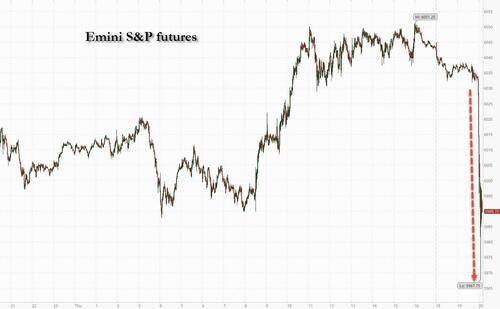
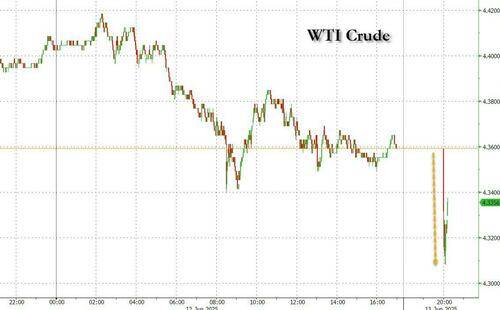
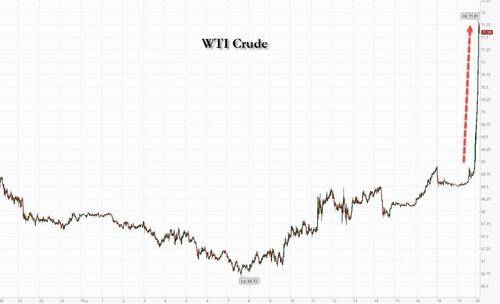
Futures and yields are tumbling, and gold and oil are surging following reports of successive explosions in Iran as a result of what Al Arabiya and Axios report are Israeli airstrikes.
Separately Axios reports that the Israeli Air Force conducted a strike in Iran, citing two unidentified people with knowledge of the operation. It was not immediately clear who Israel is targeting.
In kneejerk response, stock futures are tumbling...

... as are bond yields...

... while Oil (where we recently warned that the record shorts will be badly burned)...

... and gold are soaring.
White Label
Data API
Web Plug-ins
Poster Maker
Affiliate Program
The risk of loss in trading financial instruments such as stocks, FX, commodities, futures, bonds, ETFs and crypto can be substantial. You may sustain a total loss of the funds that you deposit with your broker. Therefore, you should carefully consider whether such trading is suitable for you in light of your circumstances and financial resources.
No decision to invest should be made without thoroughly conducting due diligence by yourself or consulting with your financial advisors. Our web content might not suit you since we don't know your financial conditions and investment needs. Our financial information might have latency or contain inaccuracy, so you should be fully responsible for any of your trading and investment decisions. The company will not be responsible for your capital loss.
Without getting permission from the website, you are not allowed to copy the website's graphics, texts, or trademarks. Intellectual property rights in the content or data incorporated into this website belong to its providers and exchange merchants.
Not Logged In
Log in to access more features

FastBull Membership
Not yet
Purchase
Log In
Sign Up