Markets
News
Analysis
User
24/7
Economic Calendar
Education
Data
- Names
- Latest
- Prev


Signal Accounts for Members
All Signal Accounts
All Contests


Argentina End-2026 Inflation Seen At 22.4%, Up 2.3 Percentage Points From Prior Forecast, In Central Bank Market Expectations Survey
Argentina End-2026 GDP Growth Seen At 3.2%,Down 0.3 Percentage Points From Prior Forecast, In Central Bank Market Expectations Survey
Toronto Stock Index .GSPTSE Unofficially Closes Down 576.95 Points, Or 1.77 Percent, At 31994.60
The Nasdaq Golden Dragon China Index Closed Up 0.8% Initially. Among Popular Chinese Concept Stocks, Dingdong Maicai Closed Down 15%, Canadian Solar Fell 8.4%, Alibaba And New Oriental Fell 1%, While Xiaomi, Li Auto, And Meituan Rose Over 2%, WeRide Rose 3.6%, Yum China Rose 4.6%, And NIO Rose 6%. In The ETF Market, Ashes Fell 1.7%, Ashr Fell 0.8%, Cqqq Fell 0.8%, And Kweb Fell 0.1%
On Thursday (February 5), The Bloomberg Electric Vehicle Price Return Index Fell 1.88% To 3467.18 Points In Late Trading. It Briefly Rose At 08:17 Beijing Time Before Continuing Its Decline. Among Its Components, Volvo Cars (European Shares) Closed Down 22.53%, Aurora Innovation Shares Fell 9.7%, Plug Power Systems Fell 9%, Mp Materials Fell 7.3%, RoboSense H Shares Closed Up 2.79%, Ranking Fifth, Xiaomi Group H Shares Closed Up 2.83%, WeRide Rose 3.5%, Horizon Robotics H Shares Closed Up 3.64%, And Panasonic Corporation Closed Up 8.41%
Argentina's Merval Index Closed Down 2.65% At 2.936 Million Points, Fluctuating At Low Levels For More Than Half Of The Trading Session
Chicago Soybean Futures Rose About 1.7%, And Soybean Meal Futures Rose More Than 2.2%. At The Close Of Trading In New York On Thursday (February 5), The Bloomberg Grains Index Rose 1.57% To 29.8095 Points. CBOT Corn Futures Rose 1.34%, And CBOT Wheat Futures Rose 1.57%. CBOT Soybean Futures Rose 1.69% To $11.1075 Per Bushel, Soybean Meal Futures Rose 2.26%, And Soybean Oil Futures Were Roughly Unchanged
The US Dollar Index Rose More Than 0.2% In Late New York Trading On Thursday (February 5), With The ICE Dollar Index Rising 0.24% To 97.849, Trading Between 97.607 And 97.915. The Bloomberg Dollar Index Rose 0.20% To 1194.03, Trading Between 1191.07 And 1194.76
Pentagon: State Dept Approves Potential Sale Of Contracted Logistical Services For Vacis Xpl Passenger Vehicle Scanning Systems To Iraq For $90 Million

France Industrial Output MoM (SA) (Dec)A:--
F: --
Italy IHS Markit Construction PMI (Jan)A:--
F: --
P: --
Euro Zone IHS Markit Construction PMI (Jan)A:--
F: --
P: --
Germany Construction PMI (SA) (Jan)A:--
F: --
P: --
Italy Retail Sales MoM (SA) (Dec)A:--
F: --
P: --
U.K. Markit/CIPS Construction PMI (Jan)A:--
F: --
P: --
France 10-Year OAT Auction Avg. YieldA:--
F: --
P: --
Euro Zone Retail Sales YoY (Dec)A:--
F: --
Euro Zone Retail Sales MoM (Dec)A:--
F: --
U.K. BOE MPC Vote Cut (Feb)A:--
F: --
P: --
U.K. BOE MPC Vote Hike (Feb)A:--
F: --
P: --
U.K. BOE MPC Vote Unchanged (Feb)A:--
F: --
P: --
U.K. Benchmark Interest RateA:--
F: --
P: --
MPC Rate Statement
U.S. Challenger Job Cuts (Jan)A:--
F: --
P: --
U.S. Challenger Job Cuts MoM (Jan)A:--
F: --
P: --
U.S. Challenger Job Cuts YoY (Jan)A:--
F: --
P: --
Bank of England Governor Bailey held a press conference on monetary policy.
Euro Zone ECB Marginal Lending RateA:--
F: --
P: --
Euro Zone ECB Deposit RateA:--
F: --
P: --
Euro Zone ECB Main Refinancing RateA:--
F: --
P: --
ECB Monetary Policy Statement
U.S. Weekly Initial Jobless Claims (SA)A:--
F: --
P: --
U.S. Initial Jobless Claims 4-Week Avg. (SA)A:--
F: --
P: --
U.S. Weekly Continued Jobless Claims (SA)A:--
F: --
ECB Press Conference
U.S. JOLTS Job Openings (SA) (Dec)A:--
F: --
U.S. EIA Weekly Natural Gas Stocks ChangeA:--
F: --
P: --
BOC Gov Macklem Speaks
Mexico Policy Interest RateA:--
F: --
P: --
U.S. Weekly Treasuries Held by Foreign Central Banks--
F: --
P: --
Reserve Bank of Australia Governor Bullock testified before Parliament.
Japan Foreign Exchange Reserves (Jan)--
F: --
P: --
India Benchmark Interest Rate--
F: --
P: --
India Cash Reserve Ratio--
F: --
P: --
India Repo Rate--
F: --
P: --
India Reverse Repo Rate--
F: --
P: --
Japan Leading Indicators Prelim (Dec)--
F: --
P: --
Germany Industrial Output MoM (SA) (Dec)--
F: --
P: --
Germany Exports MoM (SA) (Dec)--
F: --
P: --
U.K. Halifax House Price Index YoY (SA) (Jan)--
F: --
P: --
U.K. Halifax House Price Index MoM (SA) (Jan)--
F: --
P: --
France Trade Balance (SA) (Dec)--
F: --
P: --
Canada Leading Index MoM (Jan)--
F: --
P: --
India Deposit Gowth YoY--
F: --
P: --
Canada Employment (SA) (Jan)--
F: --
Canada Full-time Employment (SA) (Jan)--
F: --
Canada Part-Time Employment (SA) (Jan)--
F: --
Canada Unemployment Rate (SA) (Jan)--
F: --
P: --
Canada Labor Force Participation Rate (SA) (Jan)--
F: --
P: --
Due to the previous government shutdown, the release date of the US January non-farm payroll report has been changed to February 11.
Canada Ivey PMI (Not SA) (Jan)--
F: --
P: --
Canada Ivey PMI (SA) (Jan)--
F: --
P: --
U.S. 5-10 Year-Ahead Inflation Expectations (Feb)--
F: --
P: --
U.S. UMich Consumer Sentiment Index Prelim (Feb)--
F: --
P: --
U.S. UMich 1-Year-Ahead Inflation Expectations Prelim (Feb)--
F: --
P: --
U.S. UMich 5-Year-Ahead Inflation Expectations Prelim YoY (Feb)--
F: --
P: --
U.S. UMich Current Economic Conditions Index Prelim (Feb)--
F: --
P: --
U.S. UMich Consumer Expectations Index Prelim (Feb)--
F: --
P: --
China, Mainland Foreign Exchange Reserves (Jan)--
F: --
P: --
Russia Retail Sales YoY (Dec)--
F: --
P: --


No matching data
View All

No data
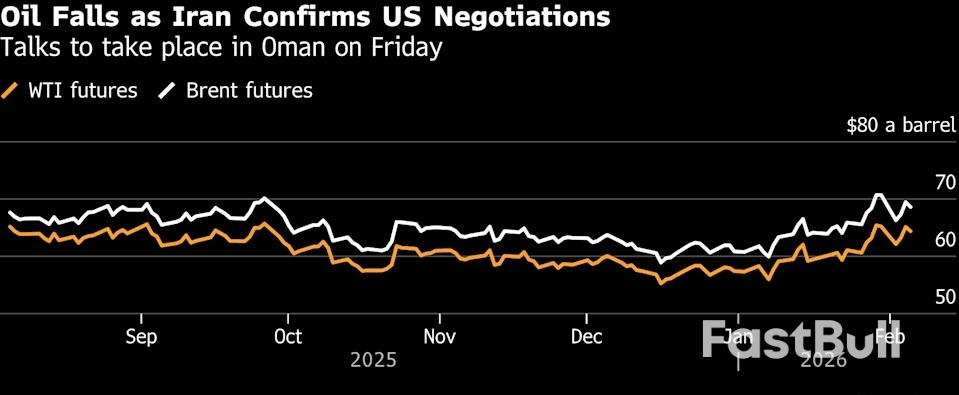
Iranian Foreign Minister Abbas Araghchi confirmed in a social media post that the talks will be held in Oman on Friday, clarifying the location of the encounter.
The last remaining nuclear arms control treaty between the United States and Russia expired Thursday, removing caps on the world's two largest atomic arsenals for the first time in over 50 years and fueling expert warnings of a new, unconstrained arms race.
As the New START treaty officially ended, U.S. President Donald Trump renewed his call for a stronger, modernized pact to replace it, emphasizing that any new agreement must include China. The Kremlin, meanwhile, expressed regret over the treaty's expiration, a sentiment echoed by arms control advocates concerned about global stability.
President Trump has been a vocal critic of the existing agreement, framing it as a flawed deal for the United States. In a social media post, he argued against extending the pact.
"Rather than extend 'NEW START' (A badly negotiated deal by the United States that, aside from everything else, is being grossly violated), we should have our Nuclear Experts work on a new, improved, and modernized Treaty that can last long into the future," Trump stated.

A central pillar of Trump's position is the necessity of bringing China into any future negotiations. U.S. Secretary of State Marco Rubio reiterated this stance, stating that "in order to have true arms control in the 21st century, it's impossible to do something that doesn't include China because of their vast and rapidly growing stockpile."
During his first term, Trump's administration attempted to broker a three-way nuclear pact involving China, but the effort was unsuccessful.
Moscow officially views the treaty's expiration "negatively," according to Kremlin spokesman Dmitry Peskov. He stated that Russia will maintain a "responsible, thorough approach to stability when it comes to nuclear weapons" while being guided by its national interests.
Russian President Vladimir Putin had previously declared his readiness to extend the treaty's limits for another year, an offer the U.S. did not commit to. In a discussion with Chinese leader Xi Jinping, Putin noted the U.S. failure to respond to his proposal.
The Russian Foreign Ministry issued a statement confirming that Moscow "remains ready to take decisive military-technical measures to counter potential additional threats to the national security" but is also open to diplomatic solutions if the right conditions emerge.
What Was the New START Treaty?
Signed in 2010 by then-President Barack Obama and his Russian counterpart, Dmitry Medvedev, the New START treaty placed clear limits on nuclear stockpiles. It restricted each nation to:
• A maximum of 1,550 deployed nuclear warheads.
• A maximum of 700 deployed missiles and bombers.
The treaty, which included on-site inspections to verify compliance, was extended for five years in 2021. However, inspections were halted in 2020 due to the COVID-19 pandemic and never resumed. In February 2023, Putin suspended Moscow's participation, citing a lack of U.S. cooperation.
Beijing has consistently rejected calls to join nuclear disarmament negotiations, arguing that its arsenal is not comparable to those of the U.S. and Russia.
"China's nuclear forces are not at all on the same scale as those of the U.S. and Russia, and thus China will not participate in nuclear disarmament negotiations at the current stage," said Foreign Ministry spokesperson Lin Jian. He urged the U.S. to resume its nuclear dialogue with Russia.
Moscow has reaffirmed that it respects Beijing's position. Russian officials have suggested that if the treaty framework is to be expanded, it should also include the nuclear arsenals of NATO members France and the United Kingdom.
The end of New START has been met with alarm by arms control experts, who see it as a trigger for a dangerous period of strategic competition.
Daryl Kimball, executive director of the Arms Control Association, warned of the potential consequences if the U.S. increases its deployed strategic arsenal. He argued it would "only lead Russia to follow suit and encourage China to accelerate its ongoing strategic buildup."
"Such a scenario could lead to a years-long, dangerous three-way nuclear arms buildup," Kimball said.
Despite the treaty's termination, there was one sign of continued communication. The U.S. and Russia agreed Thursday to reestablish a high-level, military-to-military dialogue that had been suspended in 2021.
The United States and Iran are scheduled to hold direct talks in Oman this Friday, but the diplomatic effort is overshadowed by a fundamental disagreement on the agenda. Officials from both nations have confirmed the meeting will take place in Muscat.
A key sticking point remains Washington's insistence that the negotiations must cover Tehran's missile arsenal. Iran, however, has maintained that it will only discuss its nuclear program.
Iranian Foreign Minister Abbas Araqchi is leading the diplomatic delegation to the Omani capital.

On Thursday, Iranian Foreign Ministry spokesperson Esmail Baghaei stated that the country's objective is to achieve a "fair, mutually acceptable and dignified understanding on the nuclear issue." He emphasized that the Iranian delegation would engage in the talks "with authority."
"We hope the American side will also participate in this process with responsibility, realism and seriousness," Baghaei added, outlining Iran's expectations for the U.S. approach to the negotiations.
This delicate diplomatic initiative comes at a time of heightened tensions in the Middle East. The talks are set against a backdrop of a U.S. military buildup in the region, fueling concerns among regional actors.
Many observers fear that without a diplomatic breakthrough, the current situation could escalate into a military confrontation and potentially a wider war.
The United States convened a summit with officials from 55 countries this week, launching a major initiative to stabilize critical mineral supply chains and reduce global dependence on China. The Trump administration is advocating for policies like price floors and expanded private investment to ensure American manufacturers have reliable access to essential materials.

Key allies, including the European Union, Japan, and Mexico, have agreed to collaborate with Washington on these new policies. According to the US Trade Representative, the partners are working toward a binding multilateral trade agreement, signaling a coordinated effort to address supply chain vulnerabilities.
The central proposal from the U.S. involves establishing price floors for key minerals, a mechanism designed to protect producers outside of China from market manipulation and unpredictable price swings.
"Today, the international market for critical minerals is failing," said Vice President JD Vance at the summit. "Consistent investment is nearly impossible, and it will stay that way so long as prices are erratic and unpredictable."
Vance called for creating stable investment conditions and proposed a "preferential trade center for critical minerals protected from external disruptions." This approach aims to shield non-Chinese producers from being undercut by market flooding, making their operations more economically viable over the long term.
The summit has already produced tangible diplomatic progress. The U.S. and the EU are working to finalize a memorandum of understanding within 30 days to bolster supply security. Meanwhile, the U.S. and Mexico plan to identify priority minerals and explore price guarantees before a scheduled review of the US-Mexico-Canada trade agreement.
To formalize this collaboration, Secretary of State Marco Rubio announced a new partnership called FORGE, which will succeed the Minerals Security Partnership. This move underscores a commitment to creating a durable, allied framework for mineral procurement.
Adding financial weight to the initiative, Vance highlighted the administration's $100 billion lending authority as a tool to support these efforts.
While officials at the summit largely avoided naming China directly, the context was clear. Rubio noted that the supply of critical minerals is "heavily concentrated in the hands of one country," creating significant geopolitical and economic risks.
This concentration is stark: China currently controls over 90% of the world's refining capacity for rare earths and magnets. Demand for these materials is simultaneously rising, driven by advancements in artificial intelligence and computing.
"Everything is geographically concentrated in China," explained Under Secretary Jacob Helberg. "Countries want to diversify and de-risk the supply chain."
These concerns were amplified last year when Beijing announced export restrictions on rare earths. In response to the summit, Chinese spokesman Lin Jian criticized the formation of "small groups" that could disrupt global trade. President Donald Trump noted on Wednesday that he had a "long and thorough call" with Xi Jinping on trade and plans to visit China in April.
A cornerstone of the U.S. strategy is the creation of a nearly $12 billion national stockpile of essential materials. Known as Project Vault, the initiative aims to protect American manufacturers from sudden shortages and price shocks that can halt production.
The project has already attracted participation from over a dozen major corporations, including:
• General Motors
• Stellantis
• Boeing
• Corning
• GE Vernova
To manage the sourcing and purchasing of materials for the stockpile, the government has enlisted three large trading firms: Hartree Partners, Traxys North America, and Mercuria Energy.
"We're crowding in, most importantly, US private equity participation," said Ex-Im chief John Jovanovic, pointing to strong repayment assurances and physical collateral as incentives for investors. The summit, hosted by Rubio, also involved Treasury Secretary Scott Bessent and Trade Representative Jamieson Greer, building on programs initiated under both the Trump and Biden administrations.

Venezuela has officially ended the state-run monopoly of its oil industry, creating a new legal framework to privatize the sector and attract foreign investment. The move by the regime, led by interim President Delcy Rodriguez, dismantles the long-standing dominance of state oil company PDVSA and directly addresses demands from U.S. President Donald Trump as Washington begins to ease trade restrictions.
This policy shift follows the recent capture of President Nicolas Maduro and his wife Cilia Flores by U.S. forces in Caracas. The White House has made it clear to the remaining leadership that compliance, particularly in reopening the oil industry, is non-negotiable. While this represents a major step toward addressing a key concern for energy majors, significant questions remain about whether the country's heavily corroded infrastructure and political risks make it a viable bet.
Despite the new framework, the international energy community remains cautious. In a recent meeting with President Trump, ExxonMobil CEO Darren Woods labeled Venezuela "uninvestable," citing the need for fundamental changes to the country's commercial and legal systems. Woods stressed the importance of durable investment protections and new hydrocarbon laws, reflecting a sentiment shared by many in the industry, even if other CEOs have expressed more optimism.
This hesitation is rooted in history. When former leader Hugo Chavez nationalized foreign-controlled oil assets in 2007, international firms lost billions. ExxonMobil alone claimed losses of $16.6 billion. That event triggered a massive decline in Venezuela's oil sector as investment dried up and skilled workers fled. The new privatization laws aim to reverse this damage, but eliminating the deep-seated risk of state interference is critical to attracting new capital.
Even with a more stable political climate, the financial logic for investing in Venezuela's oil fields is complex. The country's primary oil-producing region, the Orinoco Belt, holds roughly 80% of Venezuela's 303 billion barrels of reserves but comes with high costs.
While Venezuela's average breakeven price for oil production is estimated between $42 and $56 per barrel, the figures for the Orinoco Belt are higher. Existing operational facilities break even at $49.26 per barrel, but new projects or those needing significant refurbishment require prices as high as $80 per barrel to be profitable.
With the global benchmark Brent crude trading around $67 a barrel, investing billions to develop the region's extra-heavy, high-sulfur oil makes little economic sense. This problem is compounded by the fact that Venezuela's main export grade, Merey, trades at a significant discount to Brent. In 2025, Merey averaged $56.68 per barrel, a discount of $12.28 compared to Brent's average of $69.14. Even with U.S. sanctions removed, Merey is expected to maintain a discount of around $10 per barrel.
The oil in the Orinoco Belt is not only costly to produce but also technically challenging. The extra-heavy, viscous substance resembles tar and is filled with contaminants like vanadium and nickel, making it difficult to extract and transport.
To make this crude marketable, it must be mixed with a diluent—a lighter petroleum product like light sweet crude, condensate, or naphtha. This process reduces its viscosity and dilutes hazardous contaminants. Venezuela historically used its own Santa Barbara light sweet crude, which has an API gravity of 39 degrees, for this purpose. The diversion of Santa Barbara crude, which accounts for about 15% of the country's total output, away from refineries contributed significantly to the nationwide gasoline shortages that began in 2017.
A sharp decline in light oil production due to underinvestment, worsened by U.S. sanctions, caused Venezuela’s overall output to plummet to a historic low of 500,000 barrels per day in 2020. Production only stabilized after Iran began shipping condensate to PDVSA. More recently, Chevron started importing U.S. naphtha for its operations after its license was reinstated, as Treasury Department rules prevent the use of Iranian products.
Despite the obstacles, U.S. supermajor Chevron, one of the few foreign companies still active in Venezuela, is planning to expand its output. With a history in the country dating back to 1923, Chevron is uniquely positioned to capitalize on the reopening of the industry.
Following a fourth-quarter 2025 earnings beat, Chairman and CEO Mike Wirth confirmed the company's intent to increase production. CFO Eimear Bonner added that Chevron could boost its Venezuelan output by up to 50% over the next 18 to 24 months. This would take production from the current 250,000 barrels per day to as much as 375,000 barrels per day by 2028. Wirth also noted that Chevron's U.S. refineries have the capacity to process an additional 100,000 barrels per day of Venezuelan heavy crude.
However, Chevron's approach underscores the prevailing caution. The company plans to fund this expansion by reinvesting the proceeds from its oil sales rather than committing significant new capital. This strategy highlights the reluctance of even the most established players to pour the hundreds of billions of dollars needed to fully rejuvenate Venezuela's shattered petroleum industry.
U.S. President Donald Trump has reversed his harsh criticism of a UK agreement to transfer sovereignty of the Chagos Islands, signaling a new, more accepting stance after discussions with British Prime Minister Keir Starmer.
In a social media post on Thursday, Trump described his talks with Starmer as "very productive." He acknowledged the UK's position on returning the islands to Mauritius while leasing back the strategic military base at Diego Garcia.
"I understand that the deal Prime Minister Starmer has made, according to many, the best he could make," Trump posted.
However, this softer tone came with a significant condition. Trump added a stark warning about the future of the U.S. military presence on the island.
"If the lease deal, sometime in the future, ever falls apart, or anyone threatens or endangers U.S. operations and forces at our Base, I retain the right to Militarily secure and reinforce the American presence in Diego Garcia," he stated, without providing details on what such military action would entail.
This new position marks a sharp turn from the president's previous rhetoric. Last month, Trump had publicly condemned the UK's decision regarding the Chagos Islands, calling it "an act of GREAT STUPIDITY."
The administration's fluctuating stance highlights the diplomatic complexities surrounding the strategically vital military installation.
The Diego Garcia base, located on the Chagos Islands, is a critical military asset for both the United States and the United Kingdom. Positioned nearly 2,000 miles (3,200 kilometers) from the coast of East Africa, the facility enables the projection of military power across the Middle East and Asia.
Under the agreement finalized last year, Mauritius would gain sovereignty over the islands, but the UK would maintain "full responsibility for the defense and security of Diego Garcia" for a 99-year period. The deal was initially viewed as a success for the British government, particularly after securing early support from the Trump administration.
Despite the administration's revised stance, some Republican lawmakers remain worried about the deal's implications. Their primary concern is that the new arrangement could create an opportunity for China to conduct espionage on U.S. military activities at the base.
These fears are part of a broader anxiety in Washington about Beijing's expanding economic and military footprint throughout the Indian Ocean region.
The risk of loss in trading financial instruments such as stocks, FX, commodities, futures, bonds, ETFs and crypto can be substantial. You may sustain a total loss of the funds that you deposit with your broker. Therefore, you should carefully consider whether such trading is suitable for you in light of your circumstances and financial resources.
No decision to invest should be made without thoroughly conducting due diligence by yourself or consulting with your financial advisors. Our web content might not suit you since we don't know your financial conditions and investment needs. Our financial information might have latency or contain inaccuracy, so you should be fully responsible for any of your trading and investment decisions. The company will not be responsible for your capital loss.
Without getting permission from the website, you are not allowed to copy the website's graphics, texts, or trademarks. Intellectual property rights in the content or data incorporated into this website belong to its providers and exchange merchants.
Not Logged In
Log in to access more features
Log In
Sign Up