• Trade
  • Markets
  • Copy
  • Contests
  • News
  • 24/7
  • Calendar
  • Q&A
  • Chats
Trending
Screeners
SYMBOL
LAST
BID
ASK
HIGH
LOW
NET CHG.
%CHG.
SPREAD
SPX
S&P 500 Index
6932.04
6932.04
6932.04
6937.32
6904.90
+22.25
+ 0.32%
--
DJI
Dow Jones Industrial Average
48731.17
48731.17
48731.17
48771.32
48386.59
+288.77
+ 0.60%
--
IXIC
NASDAQ Composite Index
23613.30
23613.30
23613.30
23621.72
23527.97
+51.46
+ 0.22%
--
USDX
US Dollar Index
97.610
97.690
97.610
0.000
0
0.000
0.00%
--
EURUSD
Euro / US Dollar
1.17761
1.17809
1.17761
1.18077
1.17725
-0.00160
-0.14%
--
GBPUSD
Pound Sterling / US Dollar
1.34997
1.35134
1.34997
1.35338
1.34911
-0.00145
-0.11%
--
XAUUSD
Gold / US Dollar
4479.98
4480.39
4479.98
4525.79
4448.21
-4.18
-0.09%
--
WTI
Light Sweet Crude Oil
58.218
58.248
58.218
58.655
58.045
-0.171
-0.29%
--

Community Accounts

Signal Accounts
--
Profit Accounts
--
Loss Accounts
--
View More

Become a signal provider

Sell trading signals to earn additional income

View More

Guide to Copy Trading

Get started with ease and confidence

View More

Signal Accounts for Members

All Signal Accounts

Best Return
  • Best Return
  • Best P/L
  • Best MDD
Past 1W
  • Past 1W
  • Past 1M
  • Past 1Y

All Contests

  • All
  • Trump Updates
  • Recommend
  • Stocks
  • Cryptocurrencies
  • Central Banks
  • Featured News
Top News Only
Share

[Niger Suspends Visas To US Citizens In Reciprocal Retaliation] On The 25th Local Time, A Nigerien Diplomatic Source Revealed That In Response To The US Restrictions On Nigerien Citizens' Entry, Niger Has Taken Countermeasures, Suspending The Issuance Of Visas To US Citizens Starting This Week. The Source Stated That Niger Has "completely And Permanently Suspended The Issuance Of Visas To All US Citizens And Indefinitely Banned US Citizens From Entering The Country." This Decision By The Nigerien Government Is Based On The Principle Of Reciprocity And Reflects The West African Nation's Foreign Policy Orientation Of Safeguarding Its Sovereignty

Share

Waymo Suspends Self-Driving Taxi Service Again In San Francisco Due To Flash Flood Warning. According To User Notifications On The Waymo Self-driving Ride-hailing App, The Company Temporarily Suspended Its Autonomous Taxi Service In The San Francisco Bay Area On Thursday Due To Anticipated Heavy Rain. The Notification Stated, "Service Is Temporarily Suspended Due To A Flash Flood Warning Issued By The National Weather Service."

Share

North Korea's Supreme Leader Kim Jong UN Ratifies Draft Documents For Modernisation Of Major Munitions Enterprises To Be Submitted To Key Party Congress

Share

North Korea's Supreme Leader Kim Jong UN Says The Country's Missile And Shell Production Sector Is Of Paramount Importance In Bolstering War Deterrent

Share

[Moody's Chief Economist: Fed May Cut Rates Multiple Times In 2026] The Federal Reserve Cut Interest Rates Three Times In 2025, Each Time By 25 Basis Points, Bringing The Policy Rate Range Down To 3.50% To 3.75% By The End Of The Year. Moody's Chief Economist Mark Zandi Stated That The Fed May Cut Rates Multiple Times In 2026, But Not Because Of A Booming Economy, But Because He Believes The Economy Is Currently In A Delicate Balance

Share

[Russian Forces Have Seized Control Of Another Settlement In The Donetsk Region] On The 25th Local Time, The Russian Ministry Of Defense Stated That Russian Forces Had Seized Control Of Another Settlement In The Donetsk Region. Russian Forces Also Conducted Strikes On Ukrainian Airport And Port Infrastructure, Drone Production Facilities, And Energy Facilities Supporting Ukrainian Military Operations, Shooting Down Six Guided-missile Bombs, One US-made HIMARS Rocket, And 472 Fixed-wing Drones

Share

USA State Department: Secretary Of State Marco Rubio Spoke With Cambodian Prime Minister Hun Manet To Express Concern About Ongoing Violence Between Cambodia And Thailand

Share

Iraq, Kurdistan, International Companies Agree To Renew Three Month Agreement For Oil Export Deal, Extending Through March 31 -State Oil Firm Official Tells Kurdish Rudaw

Share

[Trump Administration's Immigration Service: Requests Afghan Migrants To Report For Christmas And New Year's Day] U.S. Immigration And Customs Enforcement (ICE) Has Subpoenaed Afghans Residing In The United States To Submit Their Documents During The Holiday Season, Marking The Latest Move By The Trump Administration To Crack Down On Immigration From The Asian Nation. Copies Of Letters Sent To Various Individuals Show That ICE Is Seeking To Schedule "regular Reporting Check-in" Interviews, With One Letter Requesting An Interview On Christmas Day And Another On New Year's Day. Other Notices Request Check-in Dates On December 27 And December 30, During The Holiday Season. This Subpoena Follows President Trump's Changes To Immigration Policy Targeting Afghans, Including A Renewed Review Of Refugee Cases And A Freeze On Green Card Applications

Share

Russia's Gazprom: Gazprom Supplied 38.8 Billion Cubic Metres Of Gas To China Via "Power Of Siberia" In 2025

Share

[Zelenskyy's Call With US Envoy Advances Russia-Ukraine Peace Plan Consultations] On March 25, Local Time, Ukrainian President Volodymyr Zelenskyy Announced On Social Media That He Had A Fruitful Phone Call With US President Donald Trump's Special Envoy, Steven Witkov, And Trump's Son-in-law, Jared Kushner. Zelenskyy Emphasized That Ukraine Is Working Day And Night To Advance Related Work In Order To End The Conflict As Soon As Possible And Ensure That All Relevant Documents And Implementation Steps Are Realistic, Effective, And Reliable

Share

[The Probability Of The Fed Cutting Interest Rates By 25 Basis Points In January Next Year Has Decreased To 15.5%.] December 26Th, According To Cme'S "Fedwatch" Data, The Probability Of The Fed Cutting Interest Rates By 25 Basis Points In January Next Year Is 15.5%, And The Probability Of Keeping Interest Rates Unchanged Is 84.5%

Share

His Wife: Brazilian Former President Bolsonaro's Hernia Surgery Concluded Uneventfully

Share

[Worried About The Instability Of The US-Japan Alliance? Sanae Takaichi Explores A March Visit To The US] According To KYODO News On The 24th, Citing Sources Within The Japanese Government, Japanese Prime Minister Sanae Takaichi Has Tentatively Expressed Her Intention To Visit The US In March Next Year. The Report States That Japan Hopes To Reassure The US About The "unity Of The Japan-US Alliance." The Report Reveals That Due To Concerns Within Japan Regarding Trump's Stance, Japan Initially Proposed A January Visit For Takaichi, But Ultimately No Agreement Was Reached. Japan Believes That If The 2026 Fiscal Year Budget Is Successfully Passed In March 2026, Takaichi Could Visit The US During A Break In The Diet Session. However, The Visit Could Still Be Postponed To April Or Later, Depending On The Arrangements Made By The USD

Share

Egypt's Central Bank Sets Overnight Deposit Rate At 20%

Share

Egypt's Central Bank Sets Overnight Lending Rate At 21%

Share

[Zbt Briefly Surges Above $0.16, Up Over 55% In 24 Hours] December 25Th, According To Htx Market Data, Zbt Briefly Surged Above $0.16, Currently Trading At $0.1503, With A More Than 55% Increase In The Past 24 Hours

Share

[Russia Receives Information From US Regarding Cooperation On Zaporizhev Nuclear Power Plant] Russian State Atomic Energy Corporation CEO Likhachev Told Russian Media On The 25th That The Company Has Received Information From The International Atomic Energy Agency (IAEA) And Other International Partners Indicating That The United States Is Willing To Cooperate With Russia On The Issue Of Power Transmission From The Zaporizhev Nuclear Power Plant. Likhachev Said That Rosatom Was Not Directly Involved In Negotiations With The United States, But Received The Information Indirectly Through The IAEA And Foreign Partners. The Company Is Ready To Engage In International Cooperation On Issues Such As Supplying Power From The Zaporizhev Nuclear Power Plant To Large Energy Users

Share

Iraq's Total Oil Exports Figure In November $6.5 Billion - Oil Marketing Firm SOMO

Share

Iraq's Kurdish Rudaw Says Electricity Supply Across Kurdistan Dropped By 1000 Megawatts Due To 'Technical Issue” At Khor Mor Gas Field

TIME
ACT
FCST
PREV
U.S. Core PCE Price Index Prelim YoY (Q3)

A:--

F: --

P: --

U.S. Annualized Real GDP Prelim (Q3)

A:--

F: --

P: --

U.S. Weekly Redbook Index YoY

A:--

F: --

P: --

U.S. Manufacturing Output MoM (SA) (Nov)

A:--

F: --

P: --

U.S. Manufacturing Capacity Utilization (Nov)

A:--

F: --

P: --
U.S. Industrial Output YoY (Nov)

A:--

F: --

P: --

U.S. Industrial Output MoM (SA) (Nov)

A:--

F: --

P: --

U.S. Capacity Utilization MoM (SA) (Nov)

A:--

F: --

P: --
U.S. Richmond Fed Manufacturing Shipments Index (Dec)

A:--

F: --

P: --

U.S. Richmond Fed Services Revenue Index (Dec)

A:--

F: --

P: --

U.S. Conference Board Consumer Expectations Index (Dec)

A:--

F: --

P: --

U.S. Conference Board Present Situation Index (Dec)

A:--

F: --

P: --

U.S. Richmond Fed Manufacturing Composite Index (Dec)

A:--

F: --

P: --

U.S. Conference Board Consumer Confidence Index (Dec)

A:--

F: --

P: --
Canada Federal Government Budget Balance (Oct)

A:--

F: --

P: --

U.S. 5-Year Note Auction Avg. Yield

A:--

F: --

P: --

U.S. Weekly Total Oil Rig Count

A:--

F: --

P: --

U.S. Weekly Total Rig Count

A:--

F: --

P: --

U.S. API Weekly Cushing Crude Oil Stocks

A:--

F: --

P: --

U.S. API Weekly Crude Oil Stocks

A:--

F: --

P: --

U.S. API Weekly Refined Oil Stocks

A:--

F: --

P: --

U.S. API Weekly Gasoline Stocks

A:--

F: --

P: --

Mexico Unemployment Rate (Not SA) (Nov)

A:--

F: --

P: --

U.S. MBA Mortgage Application Activity Index WoW

A:--

F: --

P: --

U.S. Weekly Continued Jobless Claims (SA)

A:--

F: --

P: --
U.S. Weekly Initial Jobless Claims (SA)

A:--

F: --

P: --

U.S. Initial Jobless Claims 4-Week Avg. (SA)

A:--

F: --

P: --

Japan Construction Orders YoY (Nov)

A:--

F: --

P: --

Japan New Housing Starts YoY (Nov)

A:--

F: --

P: --

Turkey Capacity Utilization (Dec)

A:--

F: --

P: --

Japan Tokyo CPI YoY (Excl. Food & Energy) (Dec)

--

F: --

P: --

Japan Unemployment Rate (Nov)

--

F: --

P: --

Japan Tokyo Core CPI YoY (Dec)

--

F: --

P: --

Japan Tokyo CPI YoY (Dec)

--

F: --

P: --

Japan Jobs to Applicants Ratio (Nov)

--

F: --

P: --

Japan Tokyo CPI MoM (Dec)

--

F: --

P: --

Japan Tokyo CPI MoM (Excl. Food & Energy) (Dec)

--

F: --

P: --

Japan Industrial Inventory MoM (Nov)

--

F: --

P: --

Japan Retail Sales (Nov)

--

F: --

P: --

Japan Industrial Output Prelim MoM (Nov)

--

F: --

P: --

Japan Large-Scale Retail Sales YoY (Nov)

--

F: --

P: --

Japan Industrial Output Prelim YoY (Nov)

--

F: --

P: --

Japan Retail Sales MoM (SA) (Nov)

--

F: --

P: --

Japan Retail Sales YoY (Nov)

--

F: --

P: --

India Deposit Gowth YoY

--

F: --

P: --

Russia Retail Sales YoY (Nov)

--

F: --

P: --

Russia Unemployment Rate (Nov)

--

F: --

P: --

Argentina Retail Sales YoY (Oct)

--

F: --

P: --

U.S. Weekly Treasuries Held by Foreign Central Banks

--

F: --

P: --

China, Mainland Industrial Profit YoY (YTD) (Nov)

--

F: --

P: --

Russia IHS Markit Manufacturing PMI (Dec)

--

F: --

P: --

India Manufacturing Output MoM (Nov)

--

F: --

P: --

India Industrial Production Index YoY (Nov)

--

F: --

P: --

France Unemployment Class-A (Nov)

--

F: --

P: --

Euro Zone Total Reserve Assets (Nov)

--

F: --

P: --

Canada National Economic Confidence Index

--

F: --

P: --

U.S. Pending Home Sales Index (Nov)

--

F: --

P: --

U.S. Pending Home Sales Index MoM (SA) (Nov)

--

F: --

P: --

U.S. Pending Home Sales Index YoY (Nov)

--

F: --

P: --

U.S. Dallas Fed General Business Activity Index (Dec)

--

F: --

P: --

Q&A with Experts
    • All
    • Chatrooms
    • Groups
    • Friends
    asgsag asd flag
    This stock has risen 1000% in one year; clearly, a certain fund has acquired a lot of undervalued stocks.
    asgsag asd flag
    I don't think this is worth buying.
    阿龙 flag
    asgsag asd
    @asgsag asdIf you suspect a stock might be a scam, especially if its shareholders or company background raises concerns, I suggest you thoroughly research the company's background, including its business model, financial situation, management team, and shareholder structure. You can check the company's official website, financial reports, and market assessment information.
    asgsag asd flag
    Did you receive this reply from an AI?
    RPGFX flag
    阿龙
    @阿龙I will take out time to do this
    asgsag asd flag
    The emergence of AI has made some people more professional, but also more rigid.
    RPGFX flag
    阿龙
    @阿龙As I always encourage everyone, I also will Do My own research, I am not taking any recommendations ⅔
    阿龙 flag
    I did not say I was a professional.
    阿龙 flag
    With AI so advanced now, why not use it even if you don't understand it?
    RPGFX flag
    asgsag asd
    The emergence of AI has made some people more professional, but also more rigid.
    @asgsag asdAI has made people's work easier, they now leave a lot of work to AI
    RPGFX flag
    阿龙
    With AI so advanced now, why not use it even if you don't understand it?
    @阿龙I am not going to use AI
    阿龙 flag
    So I don't think there's anything wrong with using AI.
    RPGFX flag
    阿龙
    I did not say I was a professional.
    @阿龙I never said you did. I just said I always do my own research DYOR - a popular saying in the trading space
    RPGFX flag
    阿龙
    So I don't think there's anything wrong with using AI.
    @阿龙There is nothing wrong with using AI just know how to use it to get better results rather than allow it replace you
    RPGFX flag
    阿龙
    Some stocks may be restricted from trading in specific markets (such as the Hong Kong stock market, US-listed stocks, etc.), or Fastbull may not have trading permissions for that stock.
    @阿龙I see. You gave a logical explanation for it but it's absence here is still a very dent to it and we should not overlook it
    RPGFX flag
    asgsag asd
    This stock has risen 1000% in one year; clearly, a certain fund has acquired a lot of undervalued stocks.
    @asgsag asdAnyways this was a good rally, if it continues this way all of its investors will be billionaires
    RPGFX flag
    asgsag asd
    I don't think this is worth buying.
    @asgsag asdIt looks more like they pumped it to attract other users then they'll dump it
    a _ I _ g flag
    RPGFX
    @RPGFXthe one get confirmation 👍
    asgsag asd flag
    If you want to buy this stock, you can only gamble and try to make a profit before the fund sells off.
    RPGFX flag
    a _ I _ g
    @a _ I _ gAre you waiting for a confirmation to buy or a confirmation to sell?
    Type here...
    Add Symbol or Code

      No matching data

      All
      Trump Updates
      Recommend
      Stocks
      Cryptocurrencies
      Central Banks
      Featured News
      • All
      • Russia-Ukraine Conflict
      • Middle East Flashpoint
      • All
      • Russia-Ukraine Conflict
      • Middle East Flashpoint
      Search
      Products

      Charts Free Forever

      Chats Q&A with Experts
      Screeners Economic Calendar Data Tools
      Membership Features
      Data Warehouse Market Trends Institutional Data Policy Rates Macro

      Market Trends

      Market Sentiment Order Book Forex Correlations

      Top Indicators

      Charts Free Forever
      Markets

      News

      News Analysis 24/7 Columns Education
      From Institutions From Analysts
      Topics Columnists

      Latest Views

      Latest Views

      Trending Topics

      Top Columnists

      Latest Update

      Signals

      Copy Rankings Latest Signals Become a signal provider AI Rating
      Contests
      Brokers

      Overview Brokers Assessment Rankings Regulators News Claims
      Broker listing Forex Brokers Comparison Tool Live Spread Comparison Scam
      Q&A Complaint Scam Alert Videos Tips to Detect Scam
      More

      Business
      Events
      Careers About Us Advertising Help Center

      White Label

      Data API

      Web Plug-ins

      Affiliate Program

      Awards Institution Evaluation IB Seminar Salon Event Exhibition
      Vietnam Thailand Singapore Dubai
      Fans Party Investment Sharing Session
      FastBull Summit BrokersView Expo
      Recent Searches
        Top Searches
          Markets
          News
          Analysis
          User
          24/7
          Economic Calendar
          Education
          Data
          • Names
          • Latest
          • Prev

          View All

          No data

          Scan to Download

          Faster Charts, Chat Faster!

          Download App
          English
          • English
          • Español
          • العربية
          • Bahasa Indonesia
          • Bahasa Melayu
          • Tiếng Việt
          • ภาษาไทย
          • Français
          • Italiano
          • Türkçe
          • Русский язык
          • 简中
          • 繁中
          Open Account
          Search
          Products
          Charts Free Forever
          Markets
          News
          Signals

          Copy Rankings Latest Signals Become a signal provider AI Rating
          Contests
          Brokers

          Overview Brokers Assessment Rankings Regulators News Claims
          Broker listing Forex Brokers Comparison Tool Live Spread Comparison Scam
          Q&A Complaint Scam Alert Videos Tips to Detect Scam
          More

          Business
          Events
          Careers About Us Advertising Help Center

          White Label

          Data API

          Web Plug-ins

          Affiliate Program

          Awards Institution Evaluation IB Seminar Salon Event Exhibition
          Vietnam Thailand Singapore Dubai
          Fans Party Investment Sharing Session
          FastBull Summit BrokersView Expo

          Market navigator: week of 22 December 2025

          Adam

          Economic

          Summary:

          Markets weighed easing prospects as weak U.S. data boosted Fed-cut expectations. BoE cut, ECB held, Japan hiked. Tech diverged, yen slumped, oil volatile, and thin holiday liquidity heightens risks.
          What happened last week

          Conditions emerge for accelerated monetary easing: US non-farm payrolls expanded by 64,000 in November after October's 105,000 contraction, reflecting government shutdown disruptions. Unemployment advanced to 4.6%—the highest since September 2021—whilst the consumer price index (CPI) rose 2.7% year-on-year (YoY), below forecasts. This labour market softening and inflation moderation strengthened Federal Reserve (Fed) easing expectations for 2026, though the low inflation reading may prove temporary as shutdown-related data collection disruptions likely suppressed the figure, which could normalise higher once data gathering processes resume.
          BoE's hawkish cut: The Bank of England (BoE) reduced rates 25 basis points (bps) to 3.75% in a 5-4 vote following headline inflation's decline from 3.6% to 3.2%. Despite projecting inflation's return to 2% range in 2026 and acknowledging labour market weakness, the BoE signalled moderating the pace of future cuts. GBP/USD appreciated 0.6%.
          ECB stays put: The European Central Bank (ECB) kept its deposit rate at 2.0% whilst upgrading 2026 forecasts—growth from 1.0% to 1.2%, inflation from 1.7% to 1.9%. While the ECB said their next steps will be based on incoming data, the improved outlook reinforced market expectations for stable rates throughout 2026.
          Japan rates rise to highest in 30 years: The Bank of Japan (BoJ) raised rates 25 bps to 0.75%, the highest in three decades. The 10-year Japanese Government Bond yield exceeded 2%, whilst the yen depreciated 1.4% to 157.75 against the dollar due to unclear future tightening guidance.

          Markets in focus

          US indices remain range-bound as holiday season commences
          The second half of December historically exhibits the strongest positive half-month return probability for the S&P 500 based on data since 1928, yet the anticipated 'Santa Claus rally' has not yet materialised this year. Major US equity indices registered minimal movement last week, hovering near all-time highs. The S&P 500 advanced 0.1%, whilst the Dow Jones declined 0.7% and the Nasdaq 100 gained 0.6%.
          Technology sector performance diverged significantly on company-specific developments. Oracle's share price decline, initially triggered by disappointing quarterly earnings, intensified following reports that its long-standing partner Blue Owl Capital would not finance a $10 billion data centre development in Michigan. Despite Oracle's assurances that the project would proceed without Blue Owl's participation, investor concerns regarding the company's financial position persisted. Its share price reached $177.1, representing a 49% decline from September's peak, before stabilising. Conversely, Micron's shares surged over 18% following exceptionally robust memory chip demand, enabling the company to project earnings per share (EPS) of $8.22 to $8.62 for the current quarter—75% above analysts' consensus estimates.
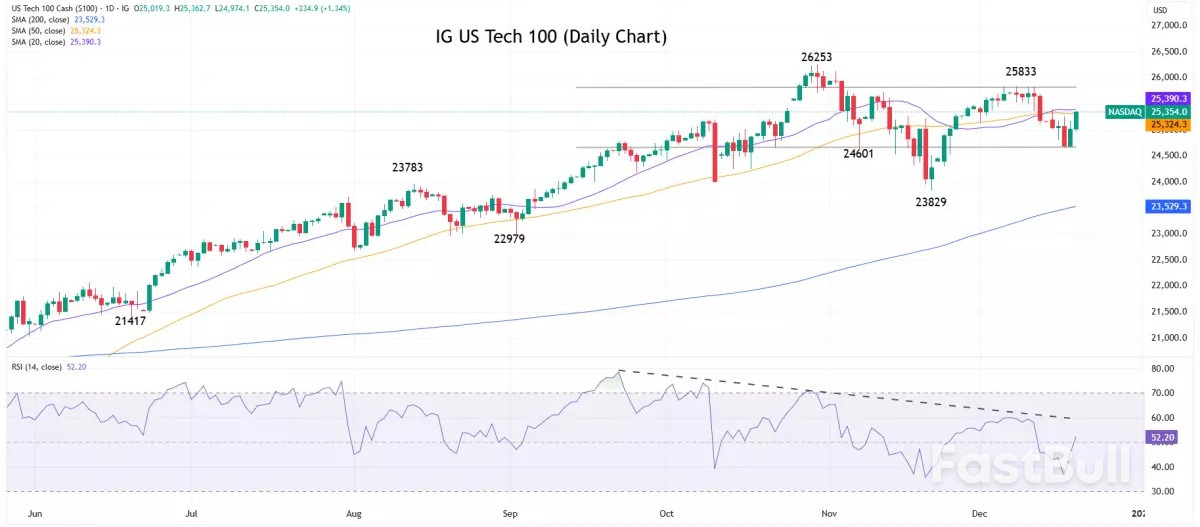
          Last week's decisive breach below 25,000 reveals underlying technical weakness within the US Tech 100 index. Consequently, we have revised our trading range projection downward from 25,200–26,253 to 24,600–25,830, as the index encounters resistance at its 20-day moving average (MA). A breakthrough above the upper boundary would signal renewed near-term bullish momentum towards 26,253, whilst failure to maintain support above the lower threshold could prompt testing of the next support zone near 24,000.
          Figure 1: US Tech 100 index (daily) price chart

          Market navigator: week of 22 December 2025_1as of 21 Dec 2025. Past performance is not a reliable indicator of future performance.
          Yen hits one-month low despite monetary tightening
          USD/JPY appreciated over 1.4% following the BoJ's decision to raise policy rates to their highest level since 1995, as traders sold the yen in response to a rate increase that had been largely anticipated by markets. Disappointment also stemmed from the central bank's lack of clarity regarding its monetary policy trajectory. Governor Ueda indicated that the current policy rate remains below the neutral range but emphasised that future adjustments would be contingent upon economic conditions, price developments, and policy outcomes. This approach aligns with our expectation that Japan's monetary normalisation will proceed gradually to avoid disrupting the fragile domestic economic recovery.
          The yen's sharp depreciation has attracted attention from Finance Minister Satsuki Katayama, reigniting speculation that exchange rates are approaching levels that could trigger government intervention. During the most recent intervention episode in summer 2024, Japanese authorities acted when USD/JPY approached 160.
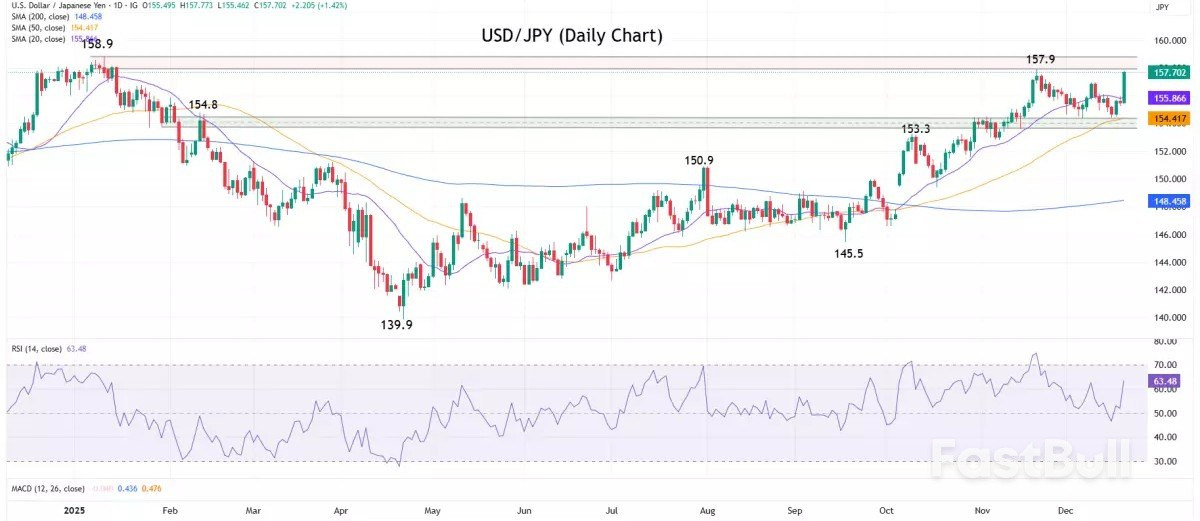
          The 20-day MA on the USD/JPY daily chart failed to provide resistance during Friday's sharp upward movement. The currency pair is currently testing resistance at the recent 20 November high; a sustained break above 158.9 would establish a path towards 161.9 in the absence of government intervention. Alternatively, should current resistance successfully halt further yen weakness, USD/JPY is likely to consolidate within a range, with support levels around 153.7–154.5.
          Figure 2: USD/JPY (daily) price chart

          Market navigator: week of 22 December 2025_2as of 21 Dec 2025. Past performance is not a reliable indicator of future performance.
          Oil prices fluctuate amid geopolitical uncertainty
          Crude oil experienced substantial volatility throughout the week, with WTI crude oil front-month futures declining below $55 per barrel—the lowest level since 2021—before recovering more than 2% to approach $57. The market confronts competing dynamics, as geopolitical developments provide temporary price support against a backdrop of overwhelmingly bearish fundamental conditions. Progress towards a Russia-Ukraine peace agreement in Berlin, where US officials indicated that 90% of outstanding issues have been resolved, raised prospects for easing restrictions on Russian oil flows at a time when markets already anticipate oversupply. Simultaneously, President Trump ordered a 'total and complete' blockade of sanctioned Venezuelan oil tankers alongside the seizure of two Venezuelan vessels in recent weeks, whilst the US Treasury sanctioned six shipping companies operating within Venezuela's oil sector.
          However, these supply disruption risks may be insufficient to reverse the broader downward trajectory driven by structural oversupply concerns. The International Energy Agency's (IEA) December report projects a substantial market surplus of 3.8 million barrels per day in 2026, representing nearly 4% of global demand, as supply growth continues to outpace consumption. OPEC+'s gradual unwinding of production cuts, combined with robust non-OPEC supply growth projections, have intensified downward pressure on oil prices. WTI crude oil futures have declined 21% year-to-date in 2025, tracking towards their worst annual performance in seven years.
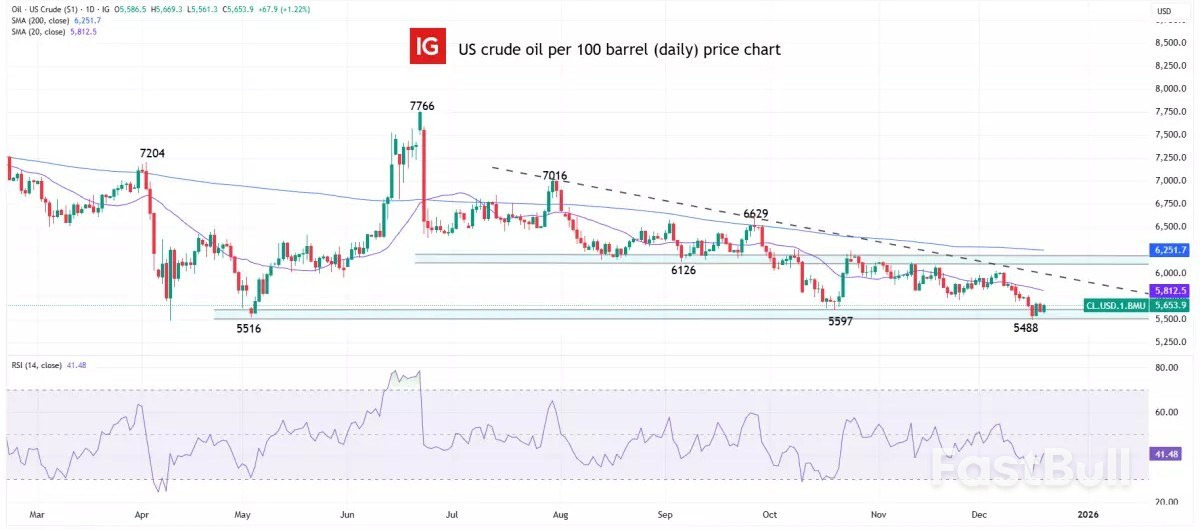
          The technical analysis outlook reflects a sustained bearish trend, with US crude oil prices establishing lower highs and lower lows since the conclusion of the Israel-Iran conflict in June. Recent sanctions on Venezuelan oil have provided impetus for prices to recover from the support zone near $55.0–$56.0. However, as long as prices remain below the downward trend line, a trend reversal appears unlikely. Even if prices close above the trend line, they would likely encounter resistance around $61.0–$62.0.
          Figure 3: US crude oil (daily) price chart

          Market navigator: week of 22 December 2025_3as of 21 Dec 2025. Past performance is not a reliable indicator of future performance.

          The week ahead

          The forthcoming week presents a relatively light economic calendar as markets wind down for the Christmas holiday period, though several key data releases warrant attention.
          The Reserve Bank of Australia (RBA) has adopted a more hawkish stance recently amid persistent inflation pressures. Markets will scrutinise its December meeting minutes for signals regarding potential rate increases in 2026.
          US economic data assumes prominence mid-week, with durable goods orders and the initial estimate of third-quarter gross domestic product (GDP) growth both scheduled for Tuesday evening. The GDP growth, currently forecast at 3.2% quarter-on-quarter (QoQ) annualised, represents a deceleration from Q2's 3.8% reading but remains above the average growth rate of the previous four quarters. Any material deviation from consensus could reshape expectations for the Fed's policy trajectory, particularly as policymakers assess the economy's resilience heading into 2026. Durable goods orders will offer additional perspective on business investment appetite and manufacturing sector health.
          The BoJ's monetary policy meeting minutes will be released on Wednesday, providing context for the central bank's approach to policy normalisation amid improving economic conditions. Japanese retail sales data on Friday will conclude the week, offering a final assessment of consumer spending momentum as the year draws to a close.
          With reduced market liquidity during the holiday period, any significant surprises in these data releases could generate exaggerated price movements across asset classes.

          Source: ig

          To stay updated on all economic events of today, please check out our Economic calendar
          Risk Warnings and Disclaimers
          You understand and acknowledge that there is a high degree of risk involved in trading. Following any strategies or investment methods may lead to potential losses. The content on the site is provided by our contributors and analysts for information purposes only. You are solely responsible for determining whether any trading assets, securities, strategy, or any other product is suitable for investing based on your own investment objectives and financial situation.
          Add to Favorites
          Share

          The worst thing you can do in the next week or so

          Adam

          Economic

          As the year winds down towards a close and the holiday season takes over, there are still important lessons that one can take away from trading this period. Yes, markets will remain open and that means we as traders need to know how to navigate through the conditions in play.
          So, what is the worst thing that you can do when dealing with markets during this period?
          I would argue it is to go looking for something that just isn't there.
          Everyone likes action in markets. Nobody likes a dull day. However, it doesn't mean that every action is one worth noting and chasing. And especially in a time like this, it doesn't mean that things are what they would seem.
          Liquidity conditions are thin and so the flows that are still there will exacerbate price movements in pretty much all asset classes.
          Yes, some of moves might fit a certain narrative or bias that we as traders will associate to a certain asset. But again, correlation doesn't mean causation in this case.
          The thing about holiday-thin trading especially when the flows are pretty much the lowest for the year during a one-week period, is that sometimes things just don't make sense. Price movements are exacerbated and there can be sudden spikes in volatility.
          However, that doesn't mean that markets are "moving" and that there is some fundamental event that is "shifting" the market narrative.
          At the end of the day, we as retail traders can only go with the flow. And it's important to always read the tea leaves and understand what trading conditions play to our advantage.
          And this period just isn't one of those times, typically. Yes, we can get lucky and get something from trades in the next week or so. But I would say, it's more or less the same as going to the roulette table.
          So if you're wanting to chase that extra bit of profit or to make up for something else in the next week or so, proceed with heavy caution. This won't be one of those normal trading periods with normal liquidity and market conditions, far from it.
          Sometimes the best trade that you can make is to do nothing at all. And that's an important lesson to always remember, especially when dealing with times like these.
          To those already done for the year, I hope that 2025 has been a fruitful year of gains, profits, and lessons for everyone. And to those already on break, have a wonderful Christmas and New Year's holiday! Catch you again next year.

          Source: investinglive

          To stay updated on all economic events of today, please check out our Economic calendar
          Risk Warnings and Disclaimers
          You understand and acknowledge that there is a high degree of risk involved in trading. Following any strategies or investment methods may lead to potential losses. The content on the site is provided by our contributors and analysts for information purposes only. You are solely responsible for determining whether any trading assets, securities, strategy, or any other product is suitable for investing based on your own investment objectives and financial situation.
          Add to Favorites
          Share

          Britain’s Economy Has Been Damaged by Brexit. But What Should Ministers Do About It?

          Warren Takunda

          Economic

          Almost a decade on from the Brexit vote, the verdict is clear. Britain’s immediate doomsday economic scenario might not have come to pass. But after years of political paralysis – and with the eventual introduction of tougher trade barriers in 2020 – trade, investment and growth in living standards have all suffered.
          Just as it was on the morning after the 2016 referendum, the big fight is about what the government should do in response.
          At the weekend, Wes Streeting became the latest frontbench Labour politician to call for a deeper trading relationship with the EU. His remarks were interpreted as a suggestion that Britain could join a customs union with the EU – something that Keir Starmer has ruled out.
          As the UK’s single largest trading partner, the idea has its advocates. UK exports of goods and services to the EU were worth £358bn (41% of the global total) last year. Imports were worth £454bn (51% of the UK total).
          Under the trade and cooperation agreement negotiated by Boris Johnson’s government, Britain has tariff-free trade with the EU. However, access is limited by other rules and restrictions – and falls significantly short of the UK’s previous membership of the EU single market and customs union.
          Goods exports in particular have been negatively impacted. Volumes collapsed immediately after the end of the Brexit transition period in January 2021, and remain short of 2019 levels in real terms.
          While this coincided with the Covid pandemic – making it harder to untangle the Brexit impact – economists have shown the UK clearly suffered a weaker period for its trade in goods than for other G7 countries, and that activity would have been considerably stronger under a remain scenario.
          Services exports to both the EU and non-EU countries also fell in 2020, but have recovered more strongly since. However, for some sectors, loss of access to the single market has had a big impact: particularly in the City of London, where financial services exports have lost significant market share in the EU.
          Labour’s manifesto was clear it wanted “no return” to either the single market or customs union. The main stumbling block would be accepting freedom of movement – perceived as a significant driving force behind the leave vote.
          Instead, the party promised to “work to improve the UK’s trade and investment relationship with the EU, by tearing down unnecessary barriers to trade” – including a veterinary agreement to ease food trade, a deal to help touring artists, and an agreement on the mutual recognition of professional qualifications.
          In the UK-EU “reset” earlier this year, both sides took a major step towards negotiating these deals. Plans for a youth mobility scheme, as well as cooperation on energy, defence and security were also mooted.
          However, the economic boost would probably be limited. Any deals will take a considerable amount of time, and potential compromise, to negotiate. The government’s own assessment suggests a veterinary deal and cooperation on energy would boost UK GDP by only about 0.3% by 2040. That is much smaller than the economic cost of Brexit, estimated at 4% of GDP by the Office for Budget Responsibility.
          A customs union would probably have a bigger benefit.
          Under such an arrangement, the UK would escape some of the bureaucracy introduced by Brexit – including complex “rules of origin” requirements for exporters to access tariff-free trade, which estimates show add 2-8% to firms’ costs.
          The Liberal Democrats claim that a “bespoke” UK-EU customs union could deliver a 2.2% boost to the economy, and bring in £25bn a year for the exchequer.
          The figure is sourced from research by the consultancy Frontier Economics commissioned by Best for Britain, which campaigns for closer EU ties. However, the UK in a Changing Europe thinktank warns the findings are modelled on “deep UK-EU regulatory alignment in goods and services” – something that would extend beyond the arrangements of any customs union.
          Agreeing a customs union deal would be far from straightforward. Rather than “rejoining”, the UK would need to negotiate a fresh agreement – similar to deals done by Brussels with Turkey, Andorra and San Marino.
          That would open the door to lengthy negotiations about what exactly a UK-EU customs union would look like. Experts say the EU would drive a hard bargain, and that conditions for varying levels of access would be applied – with freedom of movement and budget contributions among potential demands.
          Under a customs union, Britain would apply the same tariffs on imports as the EU. However, this could mean outsourcing trade policy to Brussels without the UK having formal input into the decision making.
          This would mean the UK would be unable to offer more favourable deals to other countries – putting at risk post-Brexit agreements. For some advocates, an independent trade policy helped Britain avoid the worst of Donald Trump’s trade war, and has opened up new opportunities. For others, such a loss would be no big deal – given agreements reached by the government so far have been shown to add little to the economy.
          Most economists agree that closer relations with the EU could boost growth. However, the trade-offs involved will entail years of political wrangling – both on the domestic front, and in negotiations with Brussels.

          Source: Theguardian

          To stay updated on all economic events of today, please check out our Economic calendar
          Risk Warnings and Disclaimers
          You understand and acknowledge that there is a high degree of risk involved in trading. Following any strategies or investment methods may lead to potential losses. The content on the site is provided by our contributors and analysts for information purposes only. You are solely responsible for determining whether any trading assets, securities, strategy, or any other product is suitable for investing based on your own investment objectives and financial situation.
          Add to Favorites
          Share

          U.S. Pressure on Venezuela Escalates Amid Oil Seizures and Geopolitical Ambitions

          Gerik

          Political

          Tanker Seizures Mark New Escalation in U.S.-Venezuela Standoff

          In mid-December 2025, the U.S. Coast Guard detained the Centuries oil tanker off the Venezuelan coast, escalating tensions in the Caribbean. This was the second such action in just over a week, following the interception of a large export tanker on December 11. While the Biden administration had previously taken a tempered approach toward Venezuela, Donald Trump’s return to power has brought a confrontational strategy centered on total blockade and asset seizure, especially of sanctioned oil shipments.
          Though the Centuries vessel flew a Panamanian flag and was linked to a Chinese fuel trader, U.S. authorities argued it violated newly reinstated sanctions. Washington’s stance now considers the Venezuelan government a “foreign terrorist organization,” and Trump has vowed to recover oil and assets allegedly “stolen” from the U.S. by the Maduro regime.

          A Military Show of Force in the Caribbean

          Since August, the U.S. has deployed its largest naval force in the southern Caribbean in over fifty years, under the Joint Task Force “Southern Spear.” The fleet includes 11 warships, the advanced USS Gerald R. Ford aircraft carrier, and 15,000 personnel. Originally framed as a counternarcotics mission, the buildup has increasingly appeared as part of a broader campaign against President Nicolás Maduro.
          By late November, Trump floated the possibility of ground operations targeting drug cartels, yet his administration’s messaging has remained consistent in identifying regime change in Venezuela as a primary objective. Maduro, whom Washington accuses of leading the “Cartel of the Suns,” has a $50 million reward on his head from U.S. authorities.

          From Sanctions to Asset Recovery: The Oil Nationalization Legacy

          The foundation of U.S. grievances lies in Venezuela’s oil nationalization policies. In 1976, the Venezuelan government began expropriating foreign oil operations. Under Hugo Chávez, these efforts intensified. In 2007, major international oil firms like ExxonMobil and ConocoPhillips were forced to cede control to the state-owned PDVSA. Those refusing faced asset seizures, particularly in the lucrative Orinoco Belt.
          International arbitration bodies later ruled against Venezuela, ordering compensation: ConocoPhillips was awarded between $8.7 and $11 billion, while ExxonMobil won several cases worth hundreds of millions. Although some payments were made, many remain outstanding or under enforcement proceedings.
          Trump's claim on December 16 that “Venezuela took our land, oil rights, everything we had” directly reflects this historical backdrop. His administration frames current enforcement as a form of compensation for what Washington sees as past illegal expropriations.

          Geopolitical Rivalry Under the Monroe Doctrine Revival

          Trump’s November 2025 National Security Strategy reintroduced the Monroe Doctrine, affirming the Western Hemisphere as the exclusive zone of U.S. influence. The document explicitly identifies China and Russia as external actors threatening this domain, highlighting their growing economic and diplomatic ties with Latin American states like Venezuela, Cuba, and Nicaragua.
          Page 17 of the strategy warns of adversaries from “other hemispheres” penetrating the Americas to inflict economic harm and create future strategic vulnerabilities. The oil seizures, naval deployments, and sanction regime align with this vision of preempting rival power entrenchment in what Washington sees as its geopolitical “backyard.”
          Sky News summarized the administration’s objectives as threefold: removing Maduro to install a compliant regime, securing oil access through economic not military means, and halting drug and human trafficking across the hemisphere. These goals converge in an assertive bid to reestablish U.S. hegemony in Latin America.

          Venezuelan Response: Natural Resources at the Core

          Caracas has forcefully condemned the U.S. moves. Following the tanker seizure, Venezuelan authorities accused Trump of using human rights and narcotics as pretexts to seize the country’s natural resources. They claim the true motive is securing control over Venezuela’s vast oil reserves without paying restitution.
          In a direct challenge to the U.S. narrative, Venezuela highlighted that 87% of cocaine trafficked into the U.S. transits the Pacific an area Venezuela has no coastline on. Russia’s UN envoy Vasily Nebenzya added that neither the Cartel of the Suns nor Venezuela appears in the U.S. State Department’s March 2025 narcotics report, undermining Washington’s justification for militarized action.

          Resource Competition and Hegemony Masked as Sanctions Enforcement

          The ongoing U.S. actions toward Venezuela reveal a strategy rooted in historical oil disputes, national security ambitions, and a geopolitical desire to contain Chinese and Russian influence in Latin America. While publicly framed as counter-narcotics and sanctions enforcement, the underlying dynamics point to a complex interplay of economic retribution, regime change tactics, and energy dominance.
          With more than 80 tankers stationed near Venezuela over 30 of which are under sanction the Caribbean remains a volatile flashpoint. The U.S. aims to assert control, but its actions risk destabilizing regional order and provoking resistance from both Caracas and its international allies. Whether Washington’s strategy yields results or fuels further confrontation will depend on how the international community responds to this widening contest for the Western Hemisphere.
          Risk Warnings and Disclaimers
          You understand and acknowledge that there is a high degree of risk involved in trading. Following any strategies or investment methods may lead to potential losses. The content on the site is provided by our contributors and analysts for information purposes only. You are solely responsible for determining whether any trading assets, securities, strategy, or any other product is suitable for investing based on your own investment objectives and financial situation.
          Add to Favorites
          Share

          Russia’s Oil Plunges To $34 As US Sanctions Spark Huge Discounts

          Dark Current

          Commodity

          Economic

          Russia's flagship Urals crude oil slumped to about $34 a barrel — with discounts to international benchmarks ballooning — a signal that US sanctions on Moscow are having an impact.

          The grade in the Baltic Sea slumped to $34.82 a barrel on Friday, while in the Black Sea it fell to $33.17, according to prices provided by Argus Media. Dated Brent, a yardstick for international prices, stood at about $61, after falling far less than Russian supplies this year.

          President Donald Trump's administration announced wide-ranging sanctions on Russia's top two oil producers in October. While the step didn't halt Russian flows, it did make them more challenging. India in particular looks set to receive fewer barrels from Moscow next month.

          While Russia maintains that discounts will start narrowing within months, a long-lasting price slump would bite into the Kremlin's access to petrodollars to fund its war in Ukraine, given that oil and gas accounts for about a quarter of the budget.

          The discounts for Urals work out at an average of about $27 a barrel at point of export, according to Argus. By the time the oil gets to India, that discount narrows to about $7.50. It's not clear how much of the delivery spread ends up in Russian hands.

          The cheaper the oil becomes, the greater the financial incentive there is for refineries to overlook sanctions to buy it — a dynamic that in the past has seen Russian prices normalize after an initial decline.

          Source: Bloomberg Europe

          To stay updated on all economic events of today, please check out our Economic calendar
          Risk Warnings and Disclaimers
          You understand and acknowledge that there is a high degree of risk involved in trading. Following any strategies or investment methods may lead to potential losses. The content on the site is provided by our contributors and analysts for information purposes only. You are solely responsible for determining whether any trading assets, securities, strategy, or any other product is suitable for investing based on your own investment objectives and financial situation.
          Add to Favorites
          Share

          Tech lifts Asian shares as Japan bonds slide, metals rally — what’s moving markets

          Adam

          Stocks

          Investors have been selectively rotating back into technology names after recent selling pressure tied to worries over stretched AI valuations, which has helped stabilize sentiment and raised expectations of a firmer finish to the year for equities.

          Asian shares advanced

          Equity markets in Asia soared on Monday, extending gains in a holiday-shortened week as technology stocks tracked their U.S. peers higher and investors tentatively returned to risk assets after a recent pullback linked to artificial intelligence valuation concerns.
          The MSCI AC Asia Pacific climbed 1%, with heavyweight chipmakers Taiwan Semiconductor Manufacturing (NYSE:TSM) and Samsung Electronics (KS:005930) providing much of the upward momentum.
          Technology-heavy markets in Taiwan and South Korea gained as well, leading gains across the region. Japanese and Hong Kong equities also moved higher, reflecting a broader recovery in risk sentiment. Japan’s TOPIX ended the day 0.6% higher.
          Adding to the momentum, growing interest in Chinese semiconductor companies has fueled a pickup in activity across China and Hong Kong’s initial public offerings market, supporting regional equities.

          More losses for Japan’s government bonds

          While equities moved higher, Japan’s bond market remained under heavy pressure. Government bonds extended losses following the Bank of Japan’s decision last Friday to raise its policy rate by 25 basis points to 0.75%, the highest level since 1995.
          Japan 10-Year, which rose 6.9 basis points last week to move above 2%, climbed another 6.4 basis points on Tuesday to around 2.08%, its highest level since 1999.
          The selloff has been exacerbated by renewed weakness in the yen, which fell 1.4% against the U.S. dollar on Friday despite the rate hike. Japan’s chief currency official Atsushi Mimura said on Tuesday that authorities were “deeply concerned” by one-directional and sudden currency moves following the policy decision. The weaker yen has fueled speculation that the Bank of Japan may be forced to tighten policy again, adding further pressure to Japanese government bonds.

          Gold, silver surge to fresh record highs

          Commodities were also in focus, with metals leading gains. XAU/USD and Silver Futures both climbed to record highs amid escalating geopolitical tensions and expectations of further U.S. interest rate cuts. At 9:50 GMT, gold futures were up 1.3% on the day, exchanging hands at 4.446.30 while silver futures added 2.2%, trading at 68.97.
          Copper Futures also pushed to a fresh all-time high, underscoring strong demand and supply constraints in industrial metals. Crude Oil WTI Futures prices rose after President Donald Trump intensified a blockade on Venezuela, adding to concerns over supply disruptions. Crude oil futures are up 0.9% on the day.

          U.S. data in focus

          Looking ahead, the economic calendar remains light, though a few U.S. data releases will draw attention. Investors will see a delayed third-quarter GDP reading later in the day, though the data is backward-looking and predates the government shutdown.
          More relevant for markets will be December consumer confidence figures from the Conference Board, especially after sentiment fell in November to its lowest level since the turmoil surrounding Liberation Day in April.

          Santa Claus rally or market reversal?

          With few catalysts on the horizon, some strategists are questioning whether markets are heading for a traditional Santa Claus rally or risk a repeat of past volatility. Deutsche Bank strategist Jim Reid noted that while the pre-Christmas period is often calm, history offers exceptions.
          In 2018, a convergence of hawkish Federal Reserve messaging, weak global data, U.S.-China trade tensions and a government shutdown triggered a sharp selloff, with the S&P 500 dropping 7.7% in the four sessions before Christmas.
          Whether markets repeat that episode or enjoy a steadier year-end rally remains an open question for investors.

          Source: investing

          Risk Warnings and Disclaimers
          You understand and acknowledge that there is a high degree of risk involved in trading. Following any strategies or investment methods may lead to potential losses. The content on the site is provided by our contributors and analysts for information purposes only. You are solely responsible for determining whether any trading assets, securities, strategy, or any other product is suitable for investing based on your own investment objectives and financial situation.
          Add to Favorites
          Share

          Spain Faces €2 Billion Annual Loss Amid Stricter Visa Measures Against Russian Tourists

          Gerik

          Economic

          Strained Diplomacy Translates to Economic Setbacks

          Spain, a country heavily reliant on tourism as a core sector of its economy, is facing significant financial repercussions from the European Union’s evolving sanctions policy toward Russia. According to Russian Ambassador Yury Klimenko, Spanish tourism is losing about €2 billion in potential annual revenue due to a steep decline in Russian tourist arrivals. This statement followed Spain’s recent move to impose additional restrictions, including stricter transit visa requirements for Russian nationals.
          This development is part of the broader EU effort to penalize Russia following its military actions in Ukraine since 2022. However, in attempting to isolate Moscow diplomatically, the bloc has inadvertently damaged a key revenue stream for certain member states tourism.

          Policy Shifts and Their Measurable Impact

          In response to the Ukraine conflict, the EU progressively tightened its visa issuance protocols for Russian citizens. Beginning with the suspension of visa facilitation agreements, the measures escalated to full termination of multiple-entry visas for most Russian nationals, as announced by the European Commission on November 7, 2025. Under the new rules, Russians must apply for a new visa each time they wish to enter the Schengen area, significantly increasing the administrative burden and reducing travel frequency.
          While these actions were designed as part of the EU’s broader sanctions framework, they have had a clearly identifiable economic consequence: a substantial drop in Russian tourists, many of whom were high-spending travelers. Before the pandemic and the geopolitical fallout, Russian visitors formed a lucrative customer segment for Spain’s hospitality sector.

          Causality Between Restrictions and Tourism Revenue Loss

          The correlation between the EU's visa policies and the decline in Russian tourism is backed by direct cause-effect reasoning. The more stringent the visa regime becomes, the more barriers it creates for Russian citizens to travel freely to the EU. Consequently, this discourages repeat visits and disincentivizes tourism. In Spain’s case, this translates to reduced hotel bookings, restaurant spending, and shopping revenue, particularly in luxury and coastal markets popular with Russian tourists.
          Unlike some sanctions that may only have long-term economic effects, the tourism revenue loss is immediate and quantifiable. The Russian ambassador’s estimate of €2 billion annually indicates a robust causative link between policy enforcement and economic fallout.

          Russia’s Diplomatic Counter-Narrative

          In response to these developments, Russian officials have framed the EU’s approach as self-defeating. Foreign Ministry spokeswoman Maria Zakharova criticized the bloc for prioritizing aid-dependent migrants over financially self-sufficient tourists. Meanwhile, Russian lawmakers such as Konstantin Kosachev and Leonid Slutsky argue that the EU has exhausted its legal tools to pressure Moscow and has resorted to measures that only inconvenience ordinary citizens while damaging its own economic interests.
          This framing serves both diplomatic and domestic messaging purposes. It positions Russia as a victim of discriminatory policy while spotlighting the paradox of sanctions that penalize European stakeholders as much as their intended target.

          Strategic Recalibration or Political Symbolism?

          Whether the EU’s visa restrictions will ultimately achieve their strategic intent remains debatable. On one hand, the EU seeks to signal moral and political opposition to Russian aggression by reducing privileges extended to Russian nationals. On the other, such symbolic action appears to deliver measurable harm to member states’ economies, especially those like Spain that rely on international tourism.
          This outcome reflects a deeper tension between symbolic foreign policy and domestic economic resilience. While the EU aims to maintain a unified stance against Moscow, the economic burden is not equally distributed. Southern European nations with high tourism dependence may eventually call for differentiated policies that balance geopolitical principles with sectoral stability.

          A Policy Backlash That Hurts the Enforcers

          Spain’s reported €2 billion annual loss due to reduced Russian tourism is a clear example of the economic reverberations of foreign policy decisions. The visa clampdown, while politically consistent with broader sanctions, has created a situation where EU countries may be "punishing themselves," as Russian officials assert, more than they are deterring the Kremlin.
          As geopolitical tensions persist and travel flows evolve, the EU will have to decide whether symbolic isolation of Russian citizens justifies the economic opportunity cost for its own member states especially in sectors like tourism that are still recovering from the pandemic’s impacts.
          To stay updated on all economic events of today, please check out our Economic calendar
          Risk Warnings and Disclaimers
          You understand and acknowledge that there is a high degree of risk involved in trading. Following any strategies or investment methods may lead to potential losses. The content on the site is provided by our contributors and analysts for information purposes only. You are solely responsible for determining whether any trading assets, securities, strategy, or any other product is suitable for investing based on your own investment objectives and financial situation.
          Add to Favorites
          Share
          FastBull
          Copyright © 2025 FastBull Ltd

          728 RM B 7/F GEE LOK IND BLDG NO 34 HUNG TO RD KWUN TONG KLN HONG KONG

          TelegramInstagramTwitterfacebooklinkedin
          App Store Google Play Google Play
          Products
          Charts

          Chats

          Q&A with Experts
          Screeners
          Economic Calendar
          Data
          Tools
          Membership
          Features
          Function
          Markets
          Copy Trading
          Latest Signals
          Contests
          News
          Analysis
          24/7
          Columns
          Education
          Company
          Careers
          About Us
          Contact Us
          Advertising
          Help Center
          Feedback
          User Agreement
          Privacy Policy
          Personal Information Protection Statement
          Business

          White Label

          Data API

          Web Plug-ins

          Poster Maker

          Affiliate Program

          Risk Disclosure

          The risk of loss in trading financial instruments such as stocks, FX, commodities, futures, bonds, ETFs and crypto can be substantial. You may sustain a total loss of the funds that you deposit with your broker. Therefore, you should carefully consider whether such trading is suitable for you in light of your circumstances and financial resources.

          No decision to invest should be made without thoroughly conducting due diligence by yourself or consulting with your financial advisors. Our web content might not suit you since we don't know your financial conditions and investment needs. Our financial information might have latency or contain inaccuracy, so you should be fully responsible for any of your trading and investment decisions. The company will not be responsible for your capital loss.

          Without getting permission from the website, you are not allowed to copy the website's graphics, texts, or trademarks. Intellectual property rights in the content or data incorporated into this website belong to its providers and exchange merchants.

          Not Logged In

          Log in to access more features

          FastBull Membership

          Not yet

          Purchase

          Become a signal provider
          Help Center
          Customer Service
          Dark Mode
          Price Up/Down Colors

          Log In

          Sign Up

          Position
          Layout
          Fullscreen
          Default to Chart
          The chart page opens by default when you visit fastbull.com