• Trade
  • Markets
  • Copy
  • Contests
  • News
  • 24/7
  • Calendar
  • Q&A
  • Chats
Trending
Screeners
SYMBOL
LAST
BID
ASK
HIGH
LOW
NET CHG.
%CHG.
SPREAD
SPX
S&P 500 Index
6870.39
6870.39
6870.39
6895.79
6858.28
+13.27
+ 0.19%
--
DJI
Dow Jones Industrial Average
47954.98
47954.98
47954.98
48133.54
47871.51
+104.05
+ 0.22%
--
IXIC
NASDAQ Composite Index
23578.12
23578.12
23578.12
23680.03
23506.00
+72.99
+ 0.31%
--
USDX
US Dollar Index
98.950
99.030
98.950
99.060
98.740
-0.030
-0.03%
--
EURUSD
Euro / US Dollar
1.16426
1.16443
1.16426
1.16715
1.16277
-0.00019
-0.02%
--
GBPUSD
Pound Sterling / US Dollar
1.33312
1.33342
1.33312
1.33622
1.33159
+0.00041
+ 0.03%
--
XAUUSD
Gold / US Dollar
4197.91
4197.91
4197.91
4259.16
4191.87
-9.26
-0.22%
--
WTI
Light Sweet Crude Oil
59.809
60.061
59.809
60.236
59.187
+0.426
+ 0.72%
--

Community Accounts

Signal Accounts
--
Profit Accounts
--
Loss Accounts
--
View More

Become a signal provider

Sell trading signals to earn additional income

View More

Guide to Copy Trading

Get started with ease and confidence

View More

Signal Accounts for Members

All Signal Accounts

Best Return
  • Best Return
  • Best P/L
  • Best MDD
Past 1W
  • Past 1W
  • Past 1M
  • Past 1Y

All Contests

  • All
  • Trump Updates
  • Recommend
  • Stocks
  • Cryptocurrencies
  • Central Banks
  • Featured News
Top News Only
Share

White House: Trump Signs Bill That Nullifies A Bureau Of Land Management Rule Relating To "National Petroleum Reserve In Alaska Integrated Activity Plan Record Of Decision"

Share

Putin, Modi Agree To Expand And Widen India-Russia Trade, Strengthen Friendship

Share

Colombia Inflation Was +0.07% In November -Government Statistics Agency (Reuters Poll: +0.20%)

Share

Colombia 12-Month Inflation Was +5.30% In November -Government Statistics Agency (Reuters Poll: +5.45%)

Share

White House: US, Ukraine Officials Had Productive Meeting, Further Talks Set

Share

Pentagon - State Department Approves Potential Sale Of Small Diameter Bombs-Increment I And Related Equipment To South Korea For $111.8 Million

Share

US State Dept: Parties Will Reconvene Tomorrow To Continue Advancing Discussions

Share

US State Dept: Parties Agreed That Real Progress Toward Any Agreement Depends On Russia's Readiness To Show Serious Commitment To Long-Term Peace

Share

US State Dept: Parties Also Separately Reviewed Future Prosperity Agenda

Share

US State Dept: American And Ukrainians Also Agreed On Framework Of Security Arrangements And Discussed Necessary Deterrence Capabilities

Share

US State Dept: Participants Discussed Results Of Recent Meeting Of American Side With Russians And Steps That Could Lead To Ending This War

Share

US State Dept: Umerov Reaffirmed That Ukraine's Priority Is Securing A Settlement That Protects Its Independence And Sovereignty

Share

Pentagon: US State Dept Approves Potential Sale Of Joint Air-To-Surface Standoff Missiles With Extended Range To Italy For An Estimated Cost Of $301 Million

Share

EU Commission Chief Von Der Leyen, Germany's Merz Say They Held 'Constructive' Talks With Belgian Prime Minister De Wever On Russian Frozen Assets

Share

Pentagon: US State Dept Approves Sale Of Aim-120C-8 Advanced Medium Range Air-To-Air Missiles To Denmark For An Estimated Cost Of $730 Million

Share

U.S. Senate Republican Senator Marshall (echoing The Trump Administration's Position): Netflix's Acquisition Of Warner Bros. Discovery Is A "serious Red Flag."

Share

SPDR Gold Trust Reports Holdings Down 0.03%, Or 0.33 Tonnes, To 1050.25 Tonnes By Dec 5

Share

The Canadian Prime Minister's Office: The Meeting Between Prime Minister Carney, US President Trump, And Mexican President Sinbaum Lasted 45 Minutes

Share

S&P Dow Jones Indices: Crh, Carvana, And Comfort Systems USA Will Be Included In The S&P 500 Index

Share

Waymo, The Self-driving Car Division Of Google's Parent Company Alphabet, Has Voluntarily Applied To The National Highway Traffic Safety Administration (NHTSA) For A Software Recall

TIME
ACT
FCST
PREV
Italy Retail Sales MoM (SA) (Oct)

A:--

F: --

P: --

Euro Zone Employment YoY (SA) (Q3)

A:--

F: --

P: --

Euro Zone GDP Final YoY (Q3)

A:--

F: --

P: --

Euro Zone GDP Final QoQ (Q3)

A:--

F: --

P: --

Euro Zone Employment Final QoQ (SA) (Q3)

A:--

F: --

P: --

Euro Zone Employment Final (SA) (Q3)

A:--

F: --

P: --
Brazil PPI MoM (Oct)

A:--

F: --

P: --

Mexico Consumer Confidence Index (Nov)

A:--

F: --

P: --

Canada Unemployment Rate (SA) (Nov)

A:--

F: --

P: --

Canada Labor Force Participation Rate (SA) (Nov)

A:--

F: --

P: --

Canada Employment (SA) (Nov)

A:--

F: --

P: --

Canada Part-Time Employment (SA) (Nov)

A:--

F: --

P: --

Canada Full-time Employment (SA) (Nov)

A:--

F: --

P: --

U.S. Personal Income MoM (Sept)

A:--

F: --

P: --

U.S. PCE Price Index YoY (SA) (Sept)

A:--

F: --

P: --

U.S. PCE Price Index MoM (Sept)

A:--

F: --

P: --

U.S. Personal Outlays MoM (SA) (Sept)

A:--

F: --

P: --

U.S. Core PCE Price Index MoM (Sept)

A:--

F: --

P: --

U.S. Core PCE Price Index YoY (Sept)

A:--

F: --

P: --

U.S. UMich 5-Year-Ahead Inflation Expectations Prelim YoY (Dec)

A:--

F: --

P: --

U.S. Real Personal Consumption Expenditures MoM (Sept)

A:--

F: --

P: --

U.S. 5-10 Year-Ahead Inflation Expectations (Dec)

A:--

F: --

P: --

U.S. UMich Current Economic Conditions Index Prelim (Dec)

A:--

F: --

P: --

U.S. UMich Consumer Sentiment Index Prelim (Dec)

A:--

F: --

P: --

U.S. UMich 1-Year-Ahead Inflation Expectations Prelim (Dec)

A:--

F: --

P: --

U.S. UMich Consumer Expectations Index Prelim (Dec)

A:--

F: --

P: --

U.S. Weekly Total Rig Count

A:--

F: --

P: --

U.S. Weekly Total Oil Rig Count

A:--

F: --

P: --

U.S. Unit Labor Cost Prelim (SA) (Q3)

--

F: --

P: --

U.S. Consumer Credit (SA) (Oct)

A:--

F: --

P: --

China, Mainland Foreign Exchange Reserves (Nov)

--

F: --

P: --

China, Mainland Exports YoY (USD) (Nov)

--

F: --

P: --

China, Mainland Imports YoY (CNH) (Nov)

--

F: --

P: --

China, Mainland Imports YoY (USD) (Nov)

--

F: --

P: --

China, Mainland Imports (CNH) (Nov)

--

F: --

P: --

China, Mainland Trade Balance (CNH) (Nov)

--

F: --

P: --

China, Mainland Exports (Nov)

--

F: --

P: --

Japan Wages MoM (Oct)

--

F: --

P: --

Japan Trade Balance (Oct)

--

F: --

P: --

Japan Nominal GDP Revised QoQ (Q3)

--

F: --

P: --

Japan Trade Balance (Customs Data) (SA) (Oct)

--

F: --

P: --

Japan GDP Annualized QoQ Revised (Q3)

--

F: --

P: --
China, Mainland Exports YoY (CNH) (Nov)

--

F: --

P: --

China, Mainland Trade Balance (USD) (Nov)

--

F: --

P: --

Germany Industrial Output MoM (SA) (Oct)

--

F: --

P: --

Euro Zone Sentix Investor Confidence Index (Dec)

--

F: --

P: --

Canada Leading Index MoM (Nov)

--

F: --

P: --

Canada National Economic Confidence Index

--

F: --

P: --

U.S. Dallas Fed PCE Price Index YoY (Sept)

--

F: --

P: --

U.S. 3-Year Note Auction Yield

--

F: --

P: --

U.K. BRC Overall Retail Sales YoY (Nov)

--

F: --

P: --

U.K. BRC Like-For-Like Retail Sales YoY (Nov)

--

F: --

P: --

Australia Overnight (Borrowing) Key Rate

--

F: --

P: --

RBA Rate Statement
RBA Press Conference
Germany Exports MoM (SA) (Oct)

--

F: --

P: --

U.S. NFIB Small Business Optimism Index (SA) (Nov)

--

F: --

P: --

Mexico Core CPI YoY (Nov)

--

F: --

P: --

Mexico 12-Month Inflation (CPI) (Nov)

--

F: --

P: --

Mexico PPI YoY (Nov)

--

F: --

P: --

Q&A with Experts
    • All
    • Chatrooms
    • Groups
    • Friends
    Connecting
    .
    .
    .
    Type here...
    Add Symbol or Code

      No matching data

      All
      Trump Updates
      Recommend
      Stocks
      Cryptocurrencies
      Central Banks
      Featured News
      • All
      • Russia-Ukraine Conflict
      • Middle East Flashpoint
      • All
      • Russia-Ukraine Conflict
      • Middle East Flashpoint
      Search
      Products

      Charts Free Forever

      Chats Q&A with Experts
      Screeners Economic Calendar Data Tools
      Membership Features
      Data Warehouse Market Trends Institutional Data Policy Rates Macro

      Market Trends

      Market Sentiment Order Book Forex Correlations

      Top Indicators

      Charts Free Forever
      Markets

      News

      News Analysis 24/7 Columns Education
      From Institutions From Analysts
      Topics Columnists

      Latest Views

      Latest Views

      Trending Topics

      Top Columnists

      Latest Update

      Signals

      Copy Rankings Latest Signals Become a signal provider AI Rating
      Contests
      Brokers

      Overview Brokers Assessment Rankings Regulators News Claims
      Broker listing Forex Brokers Comparison Tool Live Spread Comparison Scam
      Q&A Complaint Scam Alert Videos Tips to Detect Scam
      More

      Business
      Events
      Careers About Us Advertising Help Center

      White Label

      Data API

      Web Plug-ins

      Affiliate Program

      Awards Institution Evaluation IB Seminar Salon Event Exhibition
      Vietnam Thailand Singapore Dubai
      Fans Party Investment Sharing Session
      FastBull Summit BrokersView Expo
      Recent Searches
        Top Searches
          Markets
          News
          Analysis
          User
          24/7
          Economic Calendar
          Education
          Data
          • Names
          • Latest
          • Prev

          View All

          No data

          Scan to Download

          Faster Charts, Chat Faster!

          Download App
          English
          • English
          • Español
          • العربية
          • Bahasa Indonesia
          • Bahasa Melayu
          • Tiếng Việt
          • ภาษาไทย
          • Français
          • Italiano
          • Türkçe
          • Русский язык
          • 简中
          • 繁中
          Open Account
          Search
          Products
          Charts Free Forever
          Markets
          News
          Signals

          Copy Rankings Latest Signals Become a signal provider AI Rating
          Contests
          Brokers

          Overview Brokers Assessment Rankings Regulators News Claims
          Broker listing Forex Brokers Comparison Tool Live Spread Comparison Scam
          Q&A Complaint Scam Alert Videos Tips to Detect Scam
          More

          Business
          Events
          Careers About Us Advertising Help Center

          White Label

          Data API

          Web Plug-ins

          Affiliate Program

          Awards Institution Evaluation IB Seminar Salon Event Exhibition
          Vietnam Thailand Singapore Dubai
          Fans Party Investment Sharing Session
          FastBull Summit BrokersView Expo

          Bitcoin Bull Run ‘might Actually Be Over’ As Wyckoff Pattern Points To $86K

          Justin

          Cryptocurrency

          Summary:

          The oft-cited Wyckoff pattern suggests that Bitcoin price could be headed toward $86,000 next, especially if BTC fails to hold $94,000, which is the average cost basis of 6 to 12-month Bitcoin holders.

          Key takeaways:

          • Bitcoin's drop below $100,000 comes as a Wyckoff Distribution pattern points to a potential decline toward $86,000.

          • Some analysts remain optimistic, arguing that the bull market will hold as long as the $94,000 support level remains intact.

          Bitcoin (BTC) has just slipped under the key $100,000 support level, driven by hawkish Federal Reserve prospects and persistent whale selling.
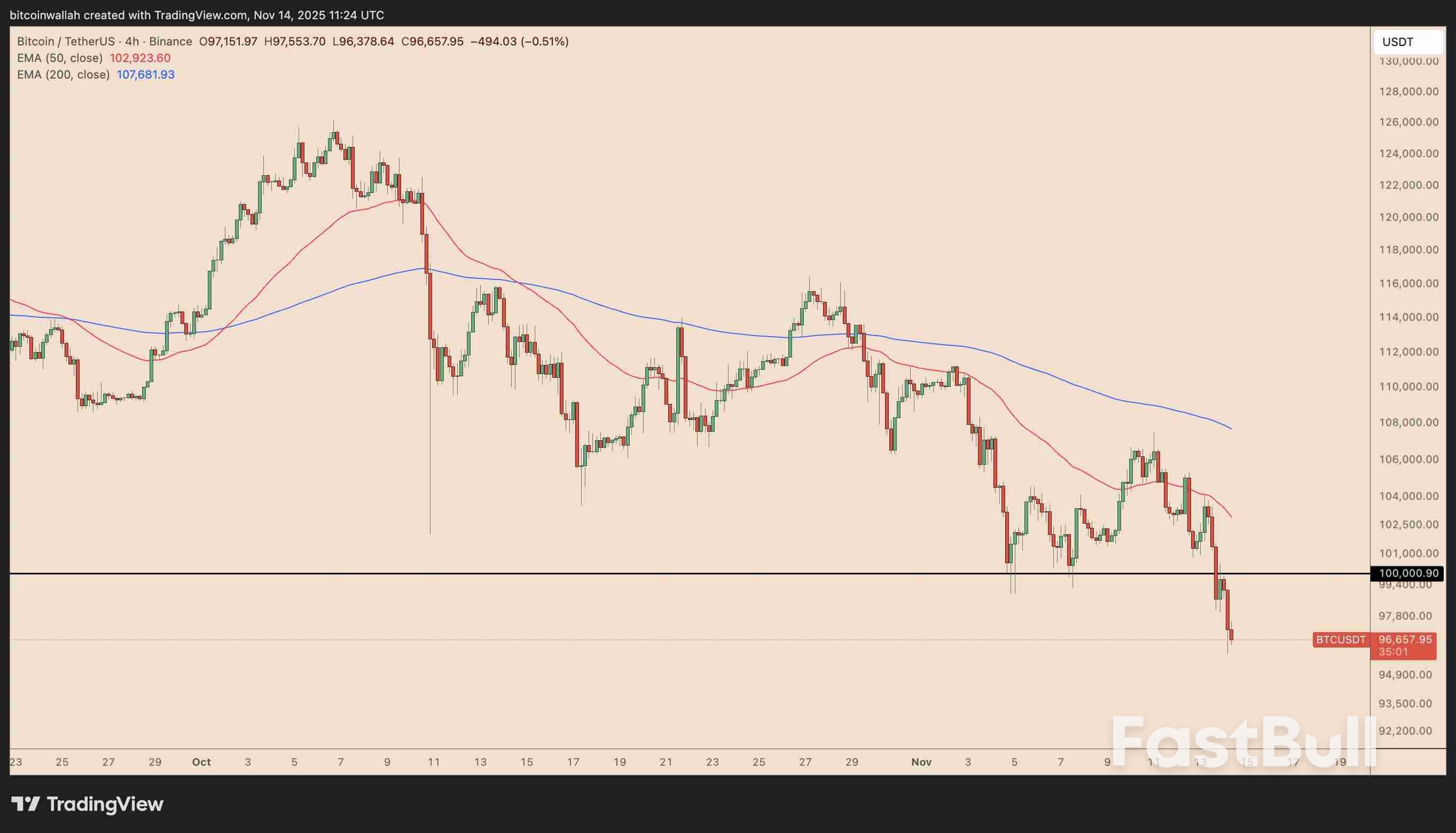
          BTC/USDT four-hour chart. Source: TradingView

          Now, a classic technical breakdown setup is strengthening the case for prolonged selling in the Bitcoin market.

          Wyckoff distribution model warns of BTC price drop to $86,000

          The schematic, highlighted by analyst @follis_ on X, shows Bitcoin's recent structure tracking the classic five-phase Wyckoff Distribution, a pattern often seen near macro market tops, as shown below.
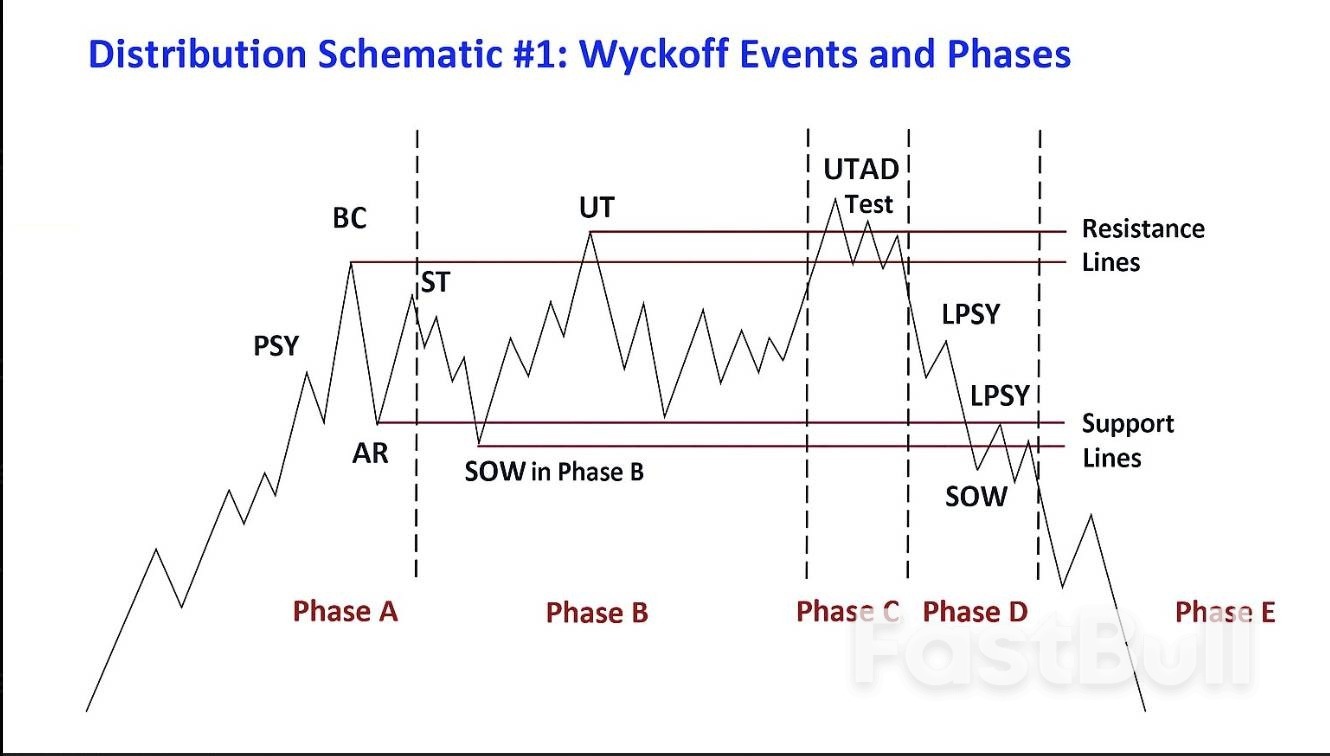
          Wyckoff distribution schematic illustration

          The alignment is strong enough that the Bitcoin bull market "might actually be over," @follis_ said.

          BTC's surge above $122,000 marked the Buying Climax (BC), followed by an Automatic Reaction (AR) and Secondary Tests (ST) that failed to create higher highs.
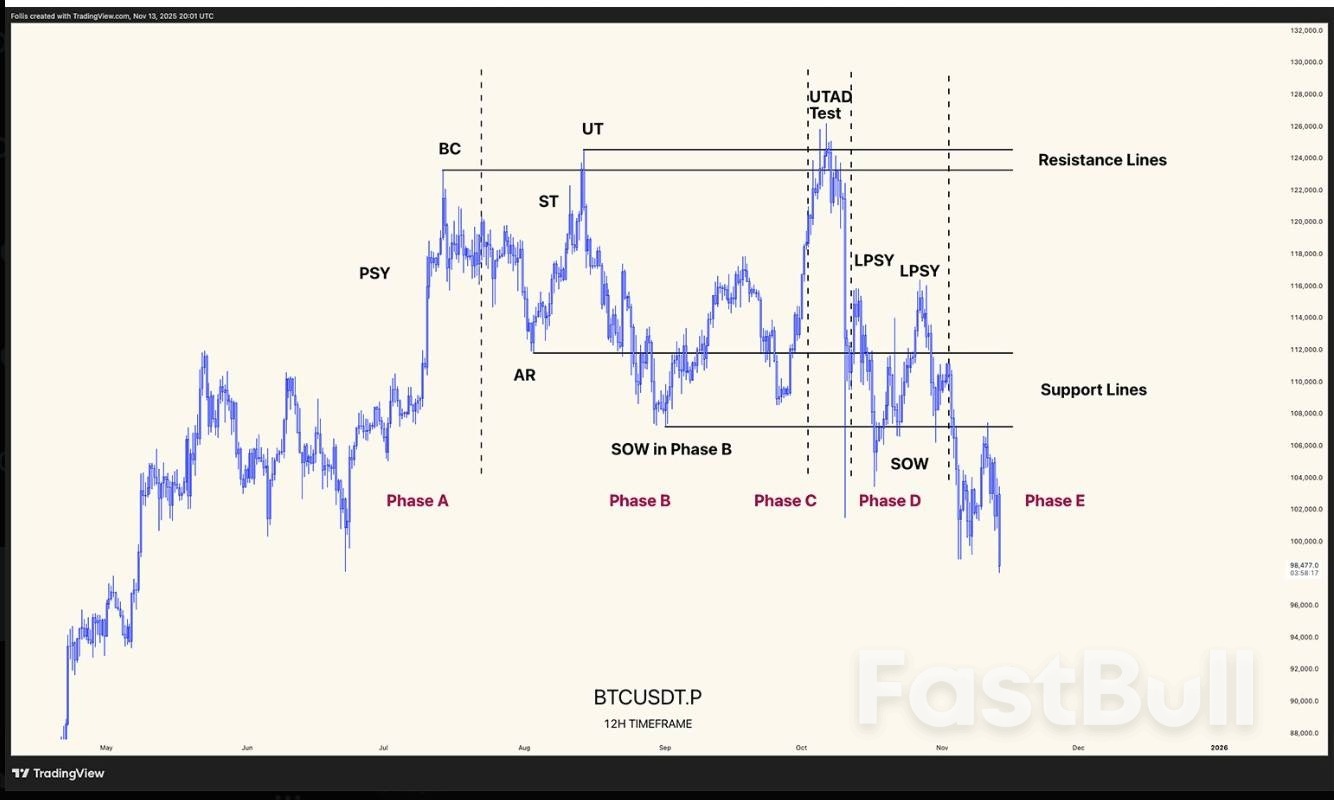
          BTC/USDT daily chart. Source: TradingView/follis_

          The early-October push toward $126,200 resembled an Upthrust After Distribution (UTAD), a final bullish deviation that signals demand exhaustion.

          From there, Bitcoin printed multiple Last Points of Supply (LPSY) and lost mid-range support near $110,000, confirming Phase D.

          It dropped below the AR/SOW zone at $102,000–$104,000, then shifted BTC into Phase E, the markdown phase, accelerating the decline. By Friday, BTC had dropped below $95,000 on Binance.

          Based on Wyckoff's measured-move method, the $122,000–$104,000 distribution band implies an $18,000 downside projection, i.e., $86,000 as the primary target.
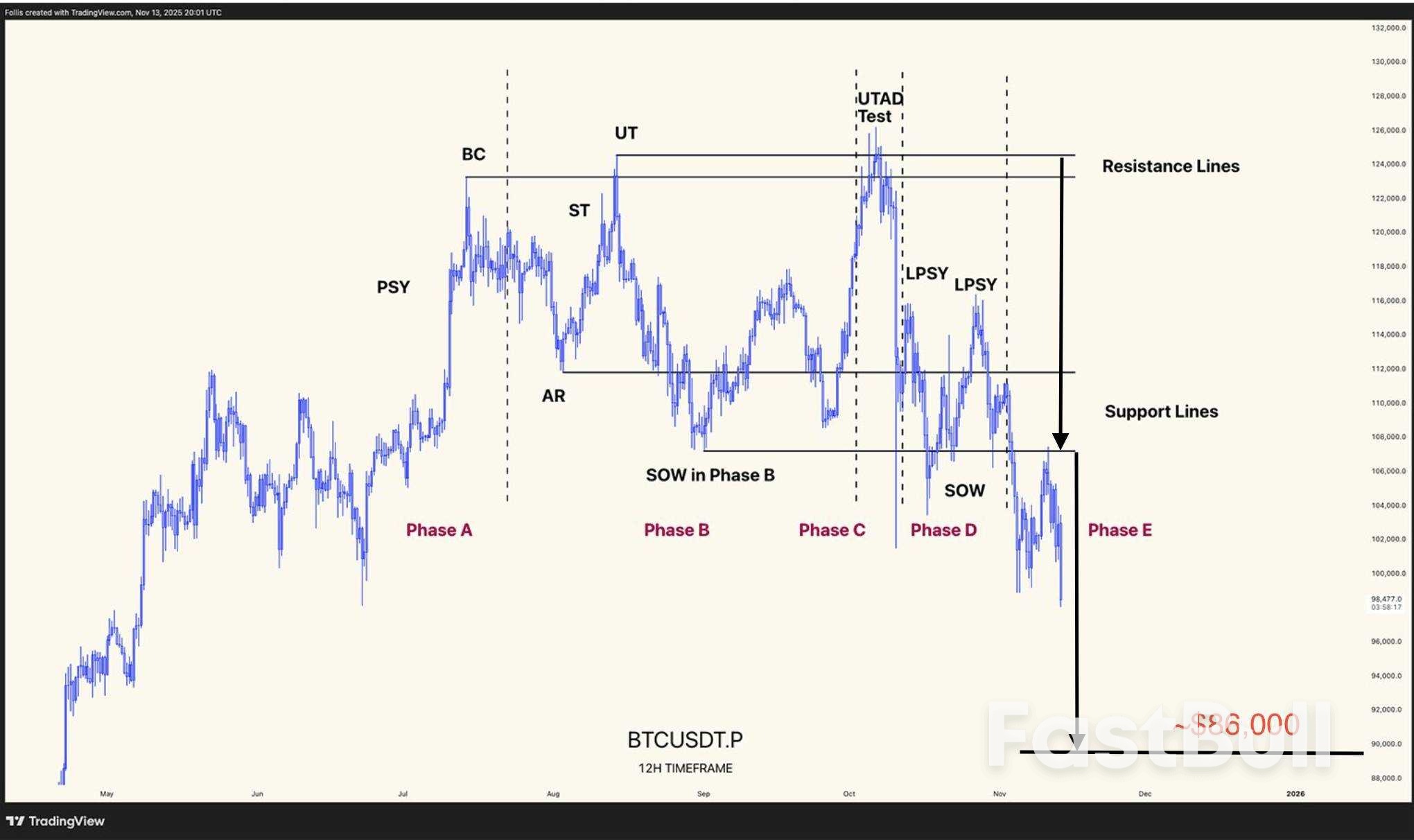
          BTC/USDT daily chart. Source: TradingView/follis_

          The bearish shift occurred as global risk appetite deteriorated, driven by fears that the Federal Reserve would not cut interest rates in December.

          The US government shutdown, which ended on Thursday, restricted access to key economic data, making policymakers less confident about easing monetary policy. That uncertainty rippled through risk assets, hurting Bitcoin alongside US stocks.

          Some Bitcoin analysts are still bullish

          Bitcoin's broader uptrend remains intact unless the price falls below the key $94,000 level, the average cost basis of six- to 12-month holders, according to CryptoQuant CEO Ki Young Ju.
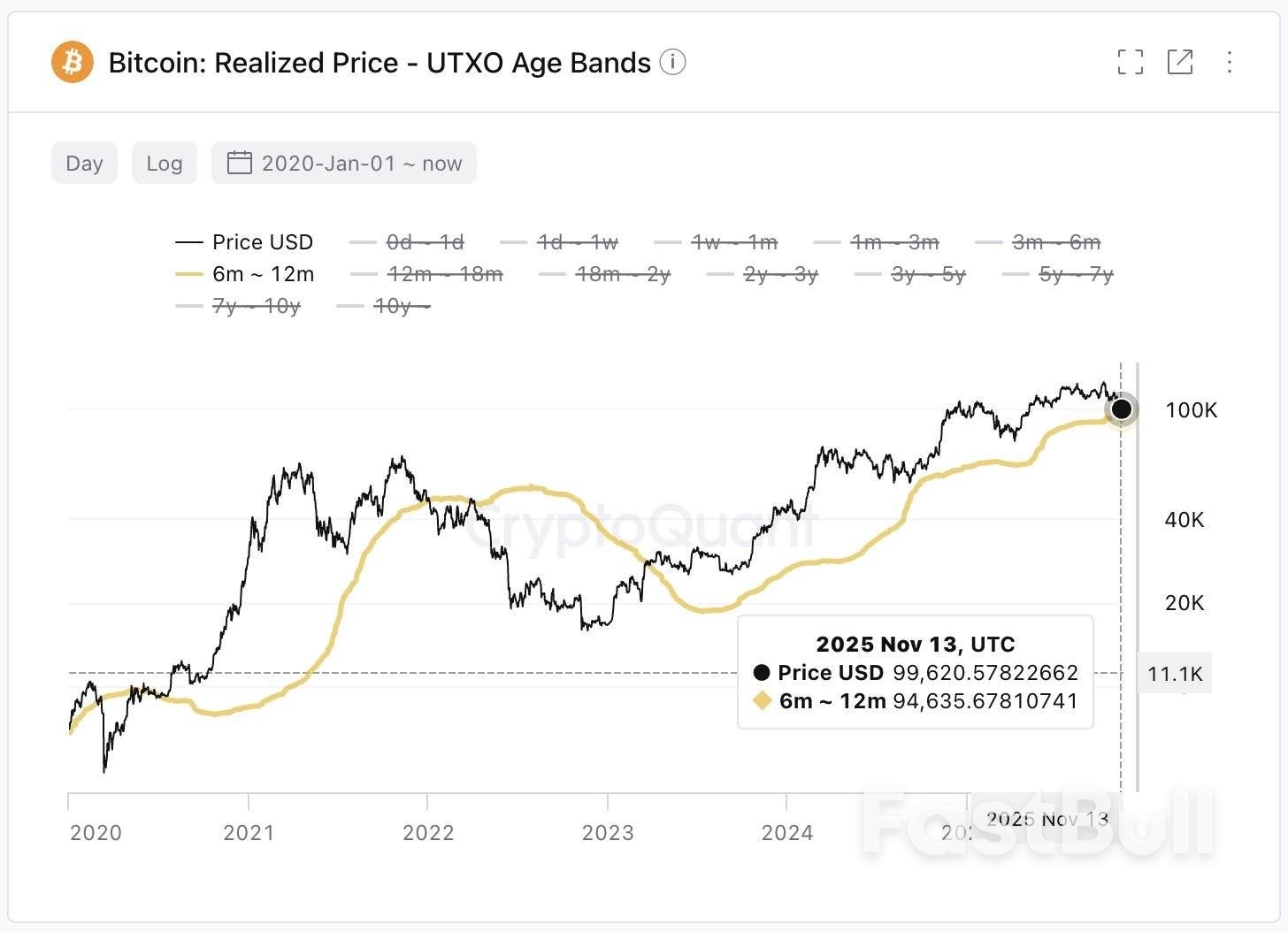
          Bitcoin realized price UTXO band chart. Source: CryptoQuant

          Bitwise CEO Hunter Horsley said Bitcoin "may have been in a bear market for almost six months" and is now nearing the end of it, adding that "the setup for crypto right now has never been stronger."

          Source: COINTELEGRAPH

          Risk Warnings and Disclaimers
          You understand and acknowledge that there is a high degree of risk involved in trading. Following any strategies or investment methods may lead to potential losses. The content on the site is provided by our contributors and analysts for information purposes only. You are solely responsible for determining whether any trading assets, securities, strategy, or any other product is suitable for investing based on your own investment objectives and financial situation.
          Add to Favorites
          Share

          Invest in crypto? Here’s what to know about your 2025 taxes

          Adam

          Cryptocurrency

          When it comes to voluntarily paying taxes on time to the IRS, crypto investors may not have a great record. At least, not according to an IRS review from 2023, which showed “the potential for” a mere 25% compliance rate.
          Translation: Only about a quarter of crypto investors are likely voluntarily complying with their tax obligations.
          But that low rate is likely to rise, because 2025 is the first year that investors with accounts on centralized crypto exchanges are subject to third-party reporting.
          If you sold or exchanged crypto this year and conducted those transactions on a centralized exchange such as Coinbase, the exchange is now required to report your sales and exchanges to the IRS on Form 1099-DA (Digital Assets). You’ll get a copy too, and it should be sent to you by January 30, 2026 in time for you to file your 2025 tax return.
          To be clear, that reporting does not create any new tax obligations for you. But it will make it easier for the IRS to know if you’re shirking them.
          How? If what you report on your return doesn’t match what appears on the 1099-DA form sent to the IRS, its Automated Underreporter system may flag the discrepancy and send you a notice to correct the mismatch, said Shehan Chandrasekera, head of tax strategy at CoinTracker, a provider of crypto tracking technology.
          But there is something in it for you, too.
          “The 1099, while it increases compliance, also makes life a lot easier for those who need to report on their investments,” said Tomer Siegal, vice president of product at Ledgible, a crypto tax software provider.

          What will not be on your 1099-DA

          There are, however, some important exceptions of certain crypto transactions that do not have to be reported on the 1099-DA, but which you will still need to report on your 2025 tax return next year.
          Cost basis: For 2025, centralized exchanges are only required to report the gross proceeds of your crypto sales on the 1099-DA, not the cost basis, Chandrasekera said.
          The cost basis is what you will need to calculate to determine what your capital gains and losses are.
          Starting in 2026, however, exchanges will have to start reporting cost basis. But only for securities purchased on or after January 1, 2025 and only if the purchase and subsequent sale took place on the same exchange, and the asset was held by the exchange the whole time, Siegal said. “No transfers can occur.”
          If you do get a 1099-DA with gross proceeds, given that it’s the inaugural year of the reporting requirement, “check that (your crypto exchange) reported it correctly,” Siegal said.
          Stablecoin, NFTs and wrapped tokens: Centralized exchanges issuing 1099-DAs do not have to report any qualified stablecoin sales you made under $10,000, nor any sale of non-fungible tokens (NFTs) below $600, nor transactions involving the transfers of wrapped tokens (which allow for easy use of one form of crypto — eg, bitcoin — on a decentralized platform that is based on another form — eg, Ethereum), Chandrasekera said.
          You, however, are still obligated to report them on your tax return.
          Crypto ETFs: Siegal noted that if you sold shares in an SEC-regulated bitcoin or ethereum exchange-traded fund this year, those transactions will be subject to third-party reporting. But they will appear on a Form 1099-B – the same form used for any of your sales through a broker involving stocks, bonds or derivatives.
          Crypto assets on defi exchanges are not subject to third-party reporting
          If you engaged in transactions this year over decentralized exchanges – which allow for peer-to-peer trading of crypto and you, not the platform itself, maintains possession of your holdings – you will not get a 1099-DA from those platforms. What’s more, a requirement that they begin issuing those forms in 2027 was repealed earlier this year.
          Nevertheless, you are still obligated to report your taxable defi transactions on your tax return.

          Mind your gains and losses

          Despite the different reporting requirements for your SEC-regulated assets like stocks versus assets on a crypto exchange, the tax treatment of your capital gains and losses are the same.
          Namely, that your losses can offset your gains. And if you have more losses than gains, you also may use them as a deduction for up to $3,000 of your ordinary income in any given tax year. Any losses in excess of all that may be carried forward to apply to gains in future tax years.
          So, as an oversimplified example: If in 2025 you realized $15,000 in capital losses (meaning you sold your assets for less than you bought them) and you had $8,000 in gains, you can use $8,000 of your losses to cancel out any tax you owe on your gains plus you may use another $3,000 of your losses as a deduction on your 2025 ordinary income (eg, salary and bank interest). Plus, you still will have $4,000 in losses that may be used in future tax years.
          It’s important to know, too, that you can use your losses in one asset class (eg, stocks) to offset your gains in another (eg, crypto), Chandrasekera said.

          Source: cnn

          Risk Warnings and Disclaimers
          You understand and acknowledge that there is a high degree of risk involved in trading. Following any strategies or investment methods may lead to potential losses. The content on the site is provided by our contributors and analysts for information purposes only. You are solely responsible for determining whether any trading assets, securities, strategy, or any other product is suitable for investing based on your own investment objectives and financial situation.
          Add to Favorites
          Share

          Bitcoin Likely to Extend Correction With Lower Support Levels in Focus

          Adam

          Cryptocurrency

          Bitcoin has slipped below the key level of 100,000 as selling pressure has increased over the past few days. It has also broken below the 0.50 Fibonacci correction level at 99,600, which traders have watched for months. This zone acted as an important balance area and a decision point for the uptrend that ran from April to October.
          The drop toward 97,500 after the break shows that sellers still guide the market. Rising volume on the daily chart supports this view and signals that the move has a more institutional character rather than random selling.
          Short-term moving averages show a clear downward setup. The 8-day EMA stays below the 21-day EMA, and both averages slope lower. BTC trades well under these two short-term averages and also under the 3-month EMA near the 110k area. This confirms a firm downward trend on the daily chart, and any bounce from here remains an intermediate move inside this broader decline.
          For now, the first resistance in any rebound sits in the 99,500 to 100,000 band. Above that, the 105,000 to 106,000 band acts as the key threshold that aligns with the neckline. Until the price climbs back above both these zones, upward moves will mainly serve as selling opportunities from a technical perspective.

          Market Structure Shows Where The Declines May Slow

          The Shoulder Over Shoulder pattern on the daily chart now looks complete. The head of the pattern sits near the peak around 124,000, and the left and right shoulders formed in the 112,000 to 114,000 area. After the price moved below the 105,500 to 106,500 range, which acts as the neckline, BTC made several attempts to climb back into this zone. Each attempt met with fresh selling pressure and the price moved lower again.
          This behaviour shows that the retest phase after the breakout has already played out and the downside risks remain in place from a technical point of view.
          Bitcoin Likely to Extend Correction With Lower Support Levels in Focus_1
          The first strong support on the way down sits in the 93,600 to 93,700 band. This is the Fib 0.618 retracement that we highlighted earlier. Once the price slipped below the 0.50 level, the chance of a move toward this zone grew in a clear way, especially with the rise in volume. This band needs close attention because it often acts as both Fibonacci support and an intermediate pause during sideways phases over the past few months. It may attract short-term buyers again.
          If this area gives way, the next level on the radar is the 85,000 to 86,000 region. This aligns with the Fib 0.786 retracement and the theoretical target of the Shoulder Over Shoulder pattern. It forms a critical support cluster where the market may attempt to search for a deeper and more meaningful bottom, and where medium-term buyers may step in again.
          The daily Stochastic RSI stays in the oversold zone and moves sideways. This behaviour is common during a downtrend. It signals pressure rather than an automatic pivot. A bottom-up turn in the Stochastic RSI along with the price holding firm near 93,600 could set the stage for a sharp short-term reaction rally. This signal has not appeared yet. Indicators point to continued weakness and the price action supports the same view.

          Bitcoin’s Weekly Outlook

          On the weekly chart, the wider bullish channel that Bitcoin has followed since early 2023 remains in place. Even so, the price has entered a sharper corrective phase after slipping below the middle band of this channel. The 1.618 Fibonacci extension level at 102060 has worked as support and as a pivot zone in recent weeks.
          The current weekly candle sits under this level, which shows that the correction now carries weight on both the daily and weekly time frames.
          Bitcoin Likely to Extend Correction With Lower Support Levels in Focus_2
          On the moving averages front, the price has stayed under the 8 and 21 week EMAs for a month, and the averages have moved into a negative crossover. This shows that the trend has entered a slowdown phase. If the 88 to 90 thousand band also gives way, the decline can stretch toward the 85 to 86 thousand region, which aligns with both the OBO target and the channel structure.
          The weekly Stochastic RSI has slipped deeper into oversold territory. When this indicator finishes its move at the bottom and turns upward, it often signals the early stages of a new medium-term bullish wave. At this point, though, both the daily and weekly charts show that the price is still drifting toward lower support, which means the bottom formation has not formed. For now, the weekly indicator mainly shows that the correction phase continues.

          Bitcoin’s Future Outlook

          The short-term direction for Bitcoin sits below the 99,500 to 100,000 band. As long as the price stays under this zone, the chart signals a move toward the Fib 0.618 support near 93,600. The area can trigger short-lived reactions, yet the broader bearish setup stays in place unless the price delivers firm daily or weekly closes above the neckline at 105,000 to 106,000.
          The market still moves under the weight of the OBO pattern and remains in a sharp intermediate correction inside the wider bullish cycle. Bitcoin will need higher lows and a clear reversal structure on both the daily and weekly charts before the market can breathe again.

          Source: investing

          Risk Warnings and Disclaimers
          You understand and acknowledge that there is a high degree of risk involved in trading. Following any strategies or investment methods may lead to potential losses. The content on the site is provided by our contributors and analysts for information purposes only. You are solely responsible for determining whether any trading assets, securities, strategy, or any other product is suitable for investing based on your own investment objectives and financial situation.
          Add to Favorites
          Share

          Silver goes on a wild ride, hits a double top above $54

          Adam

          Commodity

          Silver has embarked on a wild rollercoaster ride, with the market seeing renewed selling pressure after hitting critical resistance above $54 an ounce overnight.
          In the last seven sessions, silver managed to recover all of its losses from last month’s sharp selloff, which saw prices drop 16% in two weeks.
          Overnight, spot silver rallied to $54.39 an ounce; however, the market has been unable to hold its gains and was hit with a wave of selling at the start of the North American trading session. Spot silver last traded at $52.75 an ounce, down nearly 1% on the day.
          Although silver’s price action has formed a critical double top, sentiment in the marketplace remains relatively bullish. Jim Wyckoff, Senior Market Analyst at Kitco.com, said he sees the selloff as routine profit-taking.
          Fawad Razaqzada, Market Analyst at FOREX.com, said he expects silver to be bought on dips.
          “This could be a false signal, so we should be careful in drawing any conclusions from it yet. A double top without a break of the neckline is not of itself a significantly bearish sign, but a warning for the late buyers, nonetheless. As a minimum, silver will need to break and close below $50 for me to turn decisively bearish,” he said.
          Nick Cawley, Market Analyst for Solomon Global, said that he also does not see a lot of technical chart damage in silver’s selling pressure.
          “While a double top can be a negative chart pattern, I don't see any negative on the daily silver chart. A confirmation of a double top would need to see the neckline around $47 broken and the recent swing low around $45.50. The daily chart is currently showing a series of seven higher lows and higher highs while the MACD indicator has turned higher,” he said.
          According to analysts, the entire precious metals sector has been benefiting from growing expectations that the slowing economy will force the Federal Reserve to cut interest rates next month and through 2026.
          “Investors are increasingly seeking tangible assets supported by tight supply amid concerns over economic worries — particularly in the US, where the fiscal debt focus will resurface as the government reopens,” said Ole Hansen, Head of Commodity Strategy at Saxo Bank.
          Silver’s recent recovery has significantly outperformed gold, with the gold/silver ratio falling to a five-week low of 79.59. Some analysts note that, along with bullish fundamentals as a monetary metal, silver is also benefiting as an industrial metal after it was designated a critical metal in the U.S. Geological Survey’s (USGS) 2025 List.
          In a recent interview with Kitco News, Matthew Piggott, Director of Gold and Silver at Metals Focus, said that even if the global economy slows, industrial consumption should continue to provide solid support for silver.
          Growing industrial demand has created significant supply deficits in the silver market for the last five years, and that is unlikely to change anytime soon. Piggott said he suspects the world economy would have to see a substantial slowdown to reduce industrial demand enough to balance the market.
          David Morrison, Senior Market Analyst at Trade Nation, said that while silver still has plenty of potential, investors should be mindful of its volatility.
          “Its daily MACD has turned up sharply, suggesting that there’s strong upside momentum. But given the size and speed of this latest rally, there must be concerns that another pullback may be on its way. However one looks at it, silver is living up to its reputation as gold’s unruly sibling,” he said.
          Commodity analysts at TD Securities said they don’t expect silver to have enough momentum to hit all-time highs. They described the current resurgence as short-term technical buying.
          “The call spread was rolled over in the last session, reducing market pressures in the immediate term. Still, while these flows were technical in nature, they have lifted prices back towards ATHs — could this price action now reignite the speculative fervor in precious metals?” the analysts said. “There are very few historical precedents to lean on, but in no instance has this set-up subsequently led to large-scale buying activity over the following month.”

          Source: kitco

          Risk Warnings and Disclaimers
          You understand and acknowledge that there is a high degree of risk involved in trading. Following any strategies or investment methods may lead to potential losses. The content on the site is provided by our contributors and analysts for information purposes only. You are solely responsible for determining whether any trading assets, securities, strategy, or any other product is suitable for investing based on your own investment objectives and financial situation.
          Add to Favorites
          Share

          US Treasuries Steady As Traders Await Delayed Economic Data

          Olivia Brooks

          Economic

          Treasuries stalled as traders awaited a raft of delayed economic data with the potential to revive expectations for Federal Reserve interest-rate cuts.

          Yields were broadly flat across most maturities mid-morning in New York Friday after falling toward their lowest levels of the week earlier in the session. The five-year rate reached 3.65%, the lowest level since Oct. 29, when the Fed cut rates for the second straight time.

          Since then, expectations for a third rate cut in December have faded, with derivatives this week pricing in less than 50% chance of a move.

          However bond traders are anticipating that the resumption of US government economic data, suspended during the six-week US government shutdown, may support a December cut, even as several Fed officials this week have said they're opposed to one.

          "The market has priced in a weaker labor market story — not terrible but weak," said Ed Al-Hussainy, a portfolio manager at Columbia Threadneedle Investments. "Unless inflation runs away, it's difficult to take out the easing expectations."

          The outlook for US economic data that weren't published during the shutdown from Oct. 1 to Nov. 12 remains unclear. Release dates haven't been announced yet, and there's been conflicting guidance on whether some reports will be missed. For example, National Economic Council Director Kevin Hassett Nov. 13 said the October jobs report will be released without the unemployment rate, a day after the White House said the jobs report and consumer price index for October were unlikely to be released.

          Hassett also said about 60,000 job losses were possible because of the shutdown. The Fed cut interest rates in September and October in response to signs of weakness in US employment, even as inflation continues to exceed its target.

          Accordingly, traders are anticipating that worsening labor-market conditions can win over the several Fed officials who've said cutting rates again in December would be a mistake. Most recently, Kansas City Fed President Jeff Schmid Friday said additional interest-rate cuts could do more to ingrain higher inflation than shore up the labor market.

          In the Treasury options market, where wagers on the 10-year note's yield falling below 4% in coming weeks have piled up. The 10-year last traded below 4% on Oct. 29, before Fed Chair Jerome Powell said a December rate cut was far from certain.

          Bond traders also are mindful of the potential for a pause in Fed rate cuts to hurt demand for risky assets and stoke demand for safer Treasuries, which might otherwise suffer from a Fed pause. The outlook for lower rates has helped lift US equity benchmarks to record highs in the past month, and stretched valuations for several giant technology companies have drawn warnings from investors and Wall Street CEOs.

          "If you tell the markets that there will be no cuts, risk markets will unwind. So it's tough to trade from the short side," Al-Hussainy said.

          Treasury yields reached their highest levels of the day before US markets opened, when the UK government bond market was rocked by reports that the government will drop a proposed income tax increase. Long-dated UK yields climbed as much as 14 basis points and remained near session highs.

          Source: Bloomberg Europe

          To stay updated on all economic events of today, please check out our Economic calendar
          Risk Warnings and Disclaimers
          You understand and acknowledge that there is a high degree of risk involved in trading. Following any strategies or investment methods may lead to potential losses. The content on the site is provided by our contributors and analysts for information purposes only. You are solely responsible for determining whether any trading assets, securities, strategy, or any other product is suitable for investing based on your own investment objectives and financial situation.
          Add to Favorites
          Share

          Investors Reprice AI Ambitions as Data Center Growth Outruns Monetization

          Adam

          Stocks

          There’s a fine line between a bubble and a market simply tripping over its own shoelaces when too many risk events collide at once. Right now, global equities feel less like 1999 mania and more like a high-speed convoy hitting a patch of converging hazards — AI funding math coming due, data-center capex that refuses to stay in its lane, geopolitics flaring, and bond markets twitching under the weight of the Fed’s hawkish recalibration. In this kind of traffic, even normal corrections look like smoke on the horizon.
          But let’s start with the so-called AI bubble — the narrative du jour that refuses to die. You can practically hear the old-school market sages muttering that you only recognize a bubble in the rear-view mirror. And yet, the chatter today isn’t coming from the usual cranks; it’s bubbling up because expectations have sprinted well ahead of reality.
          That alone doesn’t make this a ticking time bomb. It makes it what the early innings of every transformative tech cycle look like: investors pricing futures that haven’t been built yet.
          The real fracture zone isn’t mystical; it’s steel, concrete, transformers, and debt. The data-center buildout remains the beating heart of the AI capex surge, and the industry is laying track faster than the revenue trains can realistically run on it. The OpenAI–Nvidia (NASDAQ:NVDA) $100bn blueprint is a perfect example — only a tenth of that is actually committed, the other nine-tenths is vapor until demand proves itself and someone coughs up the financing.
          For now, capacity is tight, not excessive. But plotted forward on any reasonable trajectory, supply catches up long before the monetization curve does.
          Sam Altman practically admitted as much by pinning future revenue on products that don’t exist yet — enterprise expansions, cloud forays, robotics detours. That isn’t delusion; it’s the classic “we’ll grow into it” mantra that every capex-heavy revolution chants. But it also underscores the gulf between the cost of the buildout and the revenues needed to justify it. That’s the gap critics keep poking at — and they aren’t wrong to keep poking.
          Still, handicapping growth is very different from claiming the technology will never pay its way. The deeper bubble risk lies not in the cranes and fiber lines but in the LLMs themselves: hallucinations, latency, and cost-to-run economics that, if left unresolved, could render wide swathes of AI chronically uneconomic. If that turns structural, then the capex overhang becomes a millstone. We just don’t know yet.
          What we do know is that markets don’t wait patiently for clarity. If investors get spooked first — if the funding wheels wobble, if the AI debt machine hesitates — the selloff becomes its own self-fulfilling prophecy. That’s where the real correction risk lives: not in an implosion, but in a capital-rationing reset that forces weaker players to tap out.
          OpenAI, Palantir (NASDAQ:PLTR), the single-product darlings with extreme multiples? They’d feel the blade first. Google (NASDAQ:GOOGL) and Microsoft (NASDAQ:MSFT), sitting on Fort Knox balance sheets and distribution dominance, would simply absorb the oxygen that others can’t afford.
          And that’s the nuance missing from the “AI bubble” hot takes. Yes, some names are hanging on P/E ratios that assume everything breaks right. Palantir at 250x is expecting a hero’s journey with no bad chapters. Some will require years — maybe a decade — to grow into those skins. But the megacaps? Their multiples aren’t even nosebleed by the standards of this decade. If anything, the concentration risk has masked how un-bubbly the broader tech complex actually looks.
          Meanwhile, the picks-and-shovels trade — the chips — is still running flat-out. AMD (NASDAQ:AMD) flagging a $1tn annual AI silicon market by 2030, with Nvidia set to reprise its earnings blowtorch next week. Yes, chip stocks are brutally cyclical, and yes, a data-center slowdown would bite hard. But no one sees that slowdown in the windshield right now.
          So are we living through bubble trouble, or just a garden-variety correction amplified by too many risk wires crossing at once? The truth sits somewhere in the middle. Parts of the AI complex are priced for perfection. Parts are priced as industrials-in-disguise. And parts — the data-center landlords, the chip vendors, the hyperscaler balance-sheet giants — are behaving nothing like a speculative bubble.
          Call it what it is: a crowded runway with far too many planes trying to take off at once. The turbulence isn’t proof of a crash. It’s the predictable shake when the air currents of rate risk, capex math, valuation gravity, and AI ambition finally converge in the same pocket of sky.

          Source: investing

          Risk Warnings and Disclaimers
          You understand and acknowledge that there is a high degree of risk involved in trading. Following any strategies or investment methods may lead to potential losses. The content on the site is provided by our contributors and analysts for information purposes only. You are solely responsible for determining whether any trading assets, securities, strategy, or any other product is suitable for investing based on your own investment objectives and financial situation.
          Add to Favorites
          Share

          Japan's fight with yen bears dulled by Takaichi's doves

          Adam

          Economic

          As Japanese authorities once again battle a slide in the yen, their efforts this time are struggling for traction, undermined by new prime minister Sanae Takaichi's promotion of advocates of big fiscal and monetary stimulus to key posts.
          While Tokyo officials this week warned against sharp downward moves in the currency, maintaining the jawboning of previous administrations, their voices are increasingly competing with calls by new policy advisers preaching the benefits of a weak yen.
          A proponent of expansionary fiscal and monetary policy, Takaichi filled seats in key government panels with advocates of big spending backed by low interest rates - policies that work to depreciate the yen's value.
          For one, Takuji Aida, an economist who joined a panel on the government's growth strategy, stressed the benefits of a weak yen such as easing the blow to manufacturers from U.S. tariffs.
          The reflationists' sanguine view on the weak yen contrasts with the concerns of previous administrations, who primarily focused on cost of living pressures caused by the currency's impact on imported inflation.
          "The Takaichi administration hasn't escalated its warning, which suggests it is tolerating a weak yen," said Masafumi Yamamoto, chief currency strategist at Mizuho Securities.
          "Given the administration doesn't seem to prioritise combatting a weak yen, it would take a slide below 155 per dollar for it to escalate verbal warnings and a fall below 160 to contemplate direct intervention in the market," he said.
          To be sure, Finance Minister Satsuki Katayama warned on Wednesday that authorities were vigilant to "one-sided, sharp moves" in the exchange-rate market, adding the negative aspects of a weak yen have become more pronounced than the positives.
          But the remarks failed to prop up the yen as they were short of more direct threats of currency intervention, such as that authorities were ready to take "decisive action."
          Underscoring a lack of consensus within the administration, economic revitalisation minister, Minoru Kiuchi, said last month the weak yen had benefits to growth. On Tuesday, he said the boost to import costs from a weak yen was fading.
          Such views have also helped fuel market expectations the Bank of Japan will be forced to go slow in raising interest rates, pushing the yen to a record low against the euro and a nine-month trough versus the U.S. dollar.
          The dollar has risen about 5% against the yen since Takaichi won the ruling party's leadership race on October 4. It stood around 154.50 yen on Friday, after breaking a key milestone of 155 earlier this week.
          INTERVENTION HURDLE HIGH
          Japan last intervened in the currency market in July 2024 when the yen fell to a 38-year low of around 161.96 to the dollar. The BOJ also raised interest rates to 0.25% that month, causing the yen to strengthen to around 150 per dollar.
          Such concerted action highlighted the concern then-premier Fumio Kishida had about a weak yen.
          By contrast, Takaichi and her reflationist aides are fans of "Abenomics," a mix of big spending and bold monetary easing deployed in 2013. The policies helped reverse sharp yen rises blamed for prolonging deflation and economic stagnation.
          Now, a weak yen has become a pain point for an economy that relies heavily on fuel and food imports. Yen declines have kept inflation above the BOJ's 2% target for well over three years, causing grumblings from households hit by rising living costs.
          Mindful of broadening inflationary pressures, BOJ Governor Kazuo Ueda signaled the chance of a hike as soon as next month.
          But Takaichi and her finance minister both made clear their displeasure over a near-term rate hike, saying Japan has yet to see inflation durably achieve the BOJ's target.
          Almost a year since its last rate hike in January, investors have taken comfort in selling yen on prospects the BOJ is unlikely to hike steadily at a set pace.
          "There's a higher chance than initially thought that Takaichi's administration would favour reflationary policies," said Ryutaro Kono, chief Japan economist at BNP Paribas.
          "Given the administration's policy stance as suggested by the recent personnel appointments, it's hard to project the BOJ accelerating its pace of rate hikes," said Kono, who now expects the bank to hike twice next year instead of three times.
          If BOJ rate hikes were put on hold, the only remaining tool to counter yen falls would be currency intervention.
          But getting consent from Washington may be tough as U.S. Treasury Secretary Scott Bessent has repeatedly signaled that rate hikes are the best way to prop up the yen.
          Former BOJ official Toru Sasaki expects Japan to hold off intervening unless the yen falls below 165 to the dollar.
          "Conducting yen-buying intervention at a time Japan's real interest rates remain deeply negative would be wasting foreign reserves."

          Source: reuters

          To stay updated on all economic events of today, please check out our Economic calendar
          Risk Warnings and Disclaimers
          You understand and acknowledge that there is a high degree of risk involved in trading. Following any strategies or investment methods may lead to potential losses. The content on the site is provided by our contributors and analysts for information purposes only. You are solely responsible for determining whether any trading assets, securities, strategy, or any other product is suitable for investing based on your own investment objectives and financial situation.
          Add to Favorites
          Share
          FastBull
          Copyright © 2025 FastBull Ltd

          728 RM B 7/F GEE LOK IND BLDG NO 34 HUNG TO RD KWUN TONG KLN HONG KONG

          TelegramInstagramTwitterfacebooklinkedin
          App Store Google Play Google Play
          Products
          Charts

          Chats

          Q&A with Experts
          Screeners
          Economic Calendar
          Data
          Tools
          Membership
          Features
          Function
          Markets
          Copy Trading
          Latest Signals
          Contests
          News
          Analysis
          24/7
          Columns
          Education
          Company
          Careers
          About Us
          Contact Us
          Advertising
          Help Center
          Feedback
          User Agreement
          Privacy Policy
          Business

          White Label

          Data API

          Web Plug-ins

          Poster Maker

          Affiliate Program

          Risk Disclosure

          The risk of loss in trading financial instruments such as stocks, FX, commodities, futures, bonds, ETFs and crypto can be substantial. You may sustain a total loss of the funds that you deposit with your broker. Therefore, you should carefully consider whether such trading is suitable for you in light of your circumstances and financial resources.

          No decision to invest should be made without thoroughly conducting due diligence by yourself or consulting with your financial advisors. Our web content might not suit you since we don't know your financial conditions and investment needs. Our financial information might have latency or contain inaccuracy, so you should be fully responsible for any of your trading and investment decisions. The company will not be responsible for your capital loss.

          Without getting permission from the website, you are not allowed to copy the website's graphics, texts, or trademarks. Intellectual property rights in the content or data incorporated into this website belong to its providers and exchange merchants.

          Not Logged In

          Log in to access more features

          FastBull Membership

          Not yet

          Purchase

          Become a signal provider
          Help Center
          Customer Service
          Dark Mode
          Price Up/Down Colors

          Log In

          Sign Up

          Position
          Layout
          Fullscreen
          Default to Chart
          The chart page opens by default when you visit fastbull.com