• Trade
  • Markets
  • Copy
  • Contests
  • News
  • 24/7
  • Calendar
  • Q&A
  • Chats
Trending
Screeners
SYMBOL
LAST
BID
ASK
HIGH
LOW
NET CHG.
%CHG.
SPREAD
SPX
S&P 500 Index
6870.39
6870.39
6870.39
6895.79
6858.28
+13.27
+ 0.19%
--
DJI
Dow Jones Industrial Average
47954.98
47954.98
47954.98
48133.54
47871.51
+104.05
+ 0.22%
--
IXIC
NASDAQ Composite Index
23578.12
23578.12
23578.12
23680.03
23506.00
+72.99
+ 0.31%
--
USDX
US Dollar Index
98.950
99.030
98.950
99.060
98.740
-0.030
-0.03%
--
EURUSD
Euro / US Dollar
1.16426
1.16443
1.16426
1.16715
1.16277
-0.00019
-0.02%
--
GBPUSD
Pound Sterling / US Dollar
1.33312
1.33342
1.33312
1.33622
1.33159
+0.00041
+ 0.03%
--
XAUUSD
Gold / US Dollar
4197.91
4197.91
4197.91
4259.16
4191.87
-9.26
-0.22%
--
WTI
Light Sweet Crude Oil
59.809
60.061
59.809
60.236
59.187
+0.426
+ 0.72%
--

Community Accounts

Signal Accounts
--
Profit Accounts
--
Loss Accounts
--
View More

Become a signal provider

Sell trading signals to earn additional income

View More

Guide to Copy Trading

Get started with ease and confidence

View More

Signal Accounts for Members

All Signal Accounts

Best Return
  • Best Return
  • Best P/L
  • Best MDD
Past 1W
  • Past 1W
  • Past 1M
  • Past 1Y

All Contests

  • All
  • Trump Updates
  • Recommend
  • Stocks
  • Cryptocurrencies
  • Central Banks
  • Featured News
Top News Only
Share

French President Macron: Nigeria Seeks French Help To Combat Insecurity

Share

Industry Source: EU Commission May Announce Package To Support Auto Industry On December 16

Share

Israel Foreign Currency Reserves $231.425 Billion In November Versus$231.954 Billion In October -Bank Of Israel

Share

[Moodeng Surges Over 43% In The Last 24 Hours, With A Current Market Cap Of $104 Million.] December 7Th, According To Gmgn Market Data, The Solana-Based Meme Coin Moodeng Surged Over 43% In The Past 24 Hours, With A Market Capitalization Currently Standing At 104 Million USD

Share

Jerusalem-German Chancellor Merz: We Have Not Discussed A Visit To Germany By Israeli Prime Minister Benjamin Netanyahu, Not An Issue At The Moment

Share

Israeli Prime Minister Netanyahu: We're Close To The Second Phase Of Trump's Gaza Plan

Share

West Africa's ECOWAS Bloc: 'Strongly Condemns' Attempted Military Coup In Benin

Share

Israeli Prime Minister Netanyahu: Political Annexation Of The West Bank Remains A Subject Of Discussion

Share

Israeli Prime Minister Netanyahu: Sovereign Power Of Security From The Jordan River To The Mediterranean Will Always Remain In Israel's Hands

Share

Israeli Prime Minister Netanyahu: We Believe There Is A Path To A Workable Peace With Our Palestinian Neighbors

Share

Israeli Prime Minister Netanyahu: I Will Meet Trump This Month

Share

Egypt's Net Foreign Reserves Rise To $50.216 Billion In November From $50.071 Billion In October

Share

Uganda Opposition Candidate Says He Was Beaten By Security Forces

Share

Benin's Foreign Minister Bakari:Large Part Of The Army And National Guard Still Loyalist And Are Controlling The Situation

Share

Russian Defence Ministry: Russian Troops Complete Capture Of Rivne In Ukraine's Donetsk Region

Share

Russian Defence Ministry: Russian Troops Carried Out Group Strike Overnight On Ukraine's Transport Infrastructure Facilities, Fuel And Energy Complexes, And Long-Range Drone Complexes

Share

Russian Defence Ministry: Russian Forces Capture Kucherivka In Ukraine's Kharkiv Region

Share

US Envoy Kellogg Says Ukraine Peace Deal Is Really Close

Share

US Embassy In India- US Under Secretary Of State For Political Affairs Allison Hooker Will Visit New Delhi And Bengaluru, India, From December 7 To 11

Share

Japan Prime Minister Takaichi: To Respond Calmly And Resolutely To The Development

TIME
ACT
FCST
PREV
Euro Zone Employment YoY (SA) (Q3)

A:--

F: --

P: --

Euro Zone GDP Final YoY (Q3)

A:--

F: --

P: --

Euro Zone GDP Final QoQ (Q3)

A:--

F: --

P: --

Euro Zone Employment Final QoQ (SA) (Q3)

A:--

F: --

P: --

Euro Zone Employment Final (SA) (Q3)

A:--

F: --

P: --
Brazil PPI MoM (Oct)

A:--

F: --

P: --

Mexico Consumer Confidence Index (Nov)

A:--

F: --

P: --

Canada Unemployment Rate (SA) (Nov)

A:--

F: --

P: --

Canada Labor Force Participation Rate (SA) (Nov)

A:--

F: --

P: --

Canada Employment (SA) (Nov)

A:--

F: --

P: --

Canada Part-Time Employment (SA) (Nov)

A:--

F: --

P: --

Canada Full-time Employment (SA) (Nov)

A:--

F: --

P: --

U.S. Personal Income MoM (Sept)

A:--

F: --

P: --

U.S. PCE Price Index YoY (SA) (Sept)

A:--

F: --

P: --

U.S. PCE Price Index MoM (Sept)

A:--

F: --

P: --

U.S. Personal Outlays MoM (SA) (Sept)

A:--

F: --

P: --

U.S. Core PCE Price Index MoM (Sept)

A:--

F: --

P: --

U.S. Core PCE Price Index YoY (Sept)

A:--

F: --

P: --

U.S. UMich 5-Year-Ahead Inflation Expectations Prelim YoY (Dec)

A:--

F: --

P: --

U.S. Real Personal Consumption Expenditures MoM (Sept)

A:--

F: --

P: --

U.S. 5-10 Year-Ahead Inflation Expectations (Dec)

A:--

F: --

P: --

U.S. UMich Current Economic Conditions Index Prelim (Dec)

A:--

F: --

P: --

U.S. UMich Consumer Sentiment Index Prelim (Dec)

A:--

F: --

P: --

U.S. UMich 1-Year-Ahead Inflation Expectations Prelim (Dec)

A:--

F: --

P: --

U.S. UMich Consumer Expectations Index Prelim (Dec)

A:--

F: --

P: --

U.S. Weekly Total Rig Count

A:--

F: --

P: --

U.S. Weekly Total Oil Rig Count

A:--

F: --

P: --

U.S. Unit Labor Cost Prelim (SA) (Q3)

--

F: --

P: --

U.S. Consumer Credit (SA) (Oct)

A:--

F: --

P: --

China, Mainland Foreign Exchange Reserves (Nov)

A:--

F: --

P: --

China, Mainland Exports YoY (USD) (Nov)

--

F: --

P: --

China, Mainland Imports YoY (CNH) (Nov)

--

F: --

P: --

China, Mainland Imports YoY (USD) (Nov)

--

F: --

P: --

China, Mainland Imports (CNH) (Nov)

--

F: --

P: --

China, Mainland Trade Balance (CNH) (Nov)

--

F: --

P: --

China, Mainland Exports (Nov)

--

F: --

P: --

Japan Wages MoM (Oct)

--

F: --

P: --

Japan Trade Balance (Oct)

--

F: --

P: --

Japan Nominal GDP Revised QoQ (Q3)

--

F: --

P: --

Japan Trade Balance (Customs Data) (SA) (Oct)

--

F: --

P: --

Japan GDP Annualized QoQ Revised (Q3)

--

F: --

P: --
China, Mainland Exports YoY (CNH) (Nov)

--

F: --

P: --

China, Mainland Trade Balance (USD) (Nov)

--

F: --

P: --

Germany Industrial Output MoM (SA) (Oct)

--

F: --

P: --

Euro Zone Sentix Investor Confidence Index (Dec)

--

F: --

P: --

Canada Leading Index MoM (Nov)

--

F: --

P: --

Canada National Economic Confidence Index

--

F: --

P: --

U.S. Dallas Fed PCE Price Index YoY (Sept)

--

F: --

P: --

U.S. 3-Year Note Auction Yield

--

F: --

P: --

U.K. BRC Overall Retail Sales YoY (Nov)

--

F: --

P: --

U.K. BRC Like-For-Like Retail Sales YoY (Nov)

--

F: --

P: --

Australia Overnight (Borrowing) Key Rate

--

F: --

P: --

RBA Rate Statement
RBA Press Conference
Germany Exports MoM (SA) (Oct)

--

F: --

P: --

U.S. NFIB Small Business Optimism Index (SA) (Nov)

--

F: --

P: --

Mexico Core CPI YoY (Nov)

--

F: --

P: --

Mexico 12-Month Inflation (CPI) (Nov)

--

F: --

P: --

Mexico PPI YoY (Nov)

--

F: --

P: --

Mexico CPI YoY (Nov)

--

F: --

P: --

U.S. Weekly Redbook Index YoY

--

F: --

P: --

Q&A with Experts
    • All
    • Chatrooms
    • Groups
    • Friends
    Connecting
    .
    .
    .
    Type here...
    Add Symbol or Code

      No matching data

      All
      Trump Updates
      Recommend
      Stocks
      Cryptocurrencies
      Central Banks
      Featured News
      • All
      • Russia-Ukraine Conflict
      • Middle East Flashpoint
      • All
      • Russia-Ukraine Conflict
      • Middle East Flashpoint
      Search
      Products

      Charts Free Forever

      Chats Q&A with Experts
      Screeners Economic Calendar Data Tools
      Membership Features
      Data Warehouse Market Trends Institutional Data Policy Rates Macro

      Market Trends

      Market Sentiment Order Book Forex Correlations

      Top Indicators

      Charts Free Forever
      Markets

      News

      News Analysis 24/7 Columns Education
      From Institutions From Analysts
      Topics Columnists

      Latest Views

      Latest Views

      Trending Topics

      Top Columnists

      Latest Update

      Signals

      Copy Rankings Latest Signals Become a signal provider AI Rating
      Contests
      Brokers

      Overview Brokers Assessment Rankings Regulators News Claims
      Broker listing Forex Brokers Comparison Tool Live Spread Comparison Scam
      Q&A Complaint Scam Alert Videos Tips to Detect Scam
      More

      Business
      Events
      Careers About Us Advertising Help Center

      White Label

      Data API

      Web Plug-ins

      Affiliate Program

      Awards Institution Evaluation IB Seminar Salon Event Exhibition
      Vietnam Thailand Singapore Dubai
      Fans Party Investment Sharing Session
      FastBull Summit BrokersView Expo
      Recent Searches
        Top Searches
          Markets
          News
          Analysis
          User
          24/7
          Economic Calendar
          Education
          Data
          • Names
          • Latest
          • Prev

          View All

          No data

          Scan to Download

          Faster Charts, Chat Faster!

          Download App
          English
          • English
          • Español
          • العربية
          • Bahasa Indonesia
          • Bahasa Melayu
          • Tiếng Việt
          • ภาษาไทย
          • Français
          • Italiano
          • Türkçe
          • Русский язык
          • 简中
          • 繁中
          Open Account
          Search
          Products
          Charts Free Forever
          Markets
          News
          Signals

          Copy Rankings Latest Signals Become a signal provider AI Rating
          Contests
          Brokers

          Overview Brokers Assessment Rankings Regulators News Claims
          Broker listing Forex Brokers Comparison Tool Live Spread Comparison Scam
          Q&A Complaint Scam Alert Videos Tips to Detect Scam
          More

          Business
          Events
          Careers About Us Advertising Help Center

          White Label

          Data API

          Web Plug-ins

          Affiliate Program

          Awards Institution Evaluation IB Seminar Salon Event Exhibition
          Vietnam Thailand Singapore Dubai
          Fans Party Investment Sharing Session
          FastBull Summit BrokersView Expo

          India Pulls In Tech Giants For Its AI Ambitions

          Samantha Luan

          Economic

          Summary:

          Microsoft and Amazon are among those splashing out to scale up their infrastructure in the world’s most populous country.
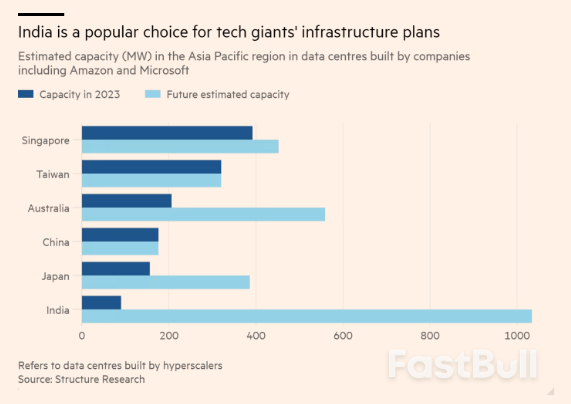
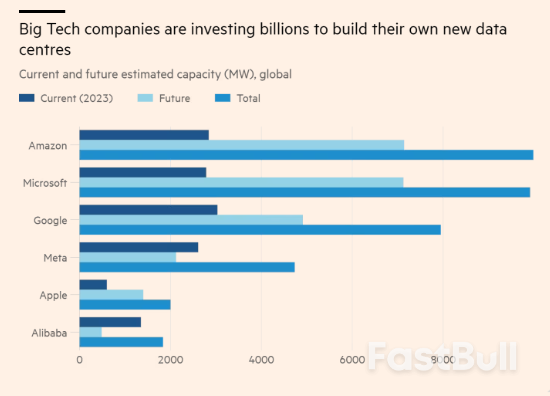
          India is pushing ambitions to become a leading artificial intelligence hub as Big Tech groups such as Microsoft and Amazon prepare to spend billions on computing infrastructure in the country in a race to dominate the burgeoning industry.
          Authorities in India have offered incentives for tech companies to set up everything from electronics manufacturing to data storage. They hope a fast-growing domestic technology market and vast pool of skilled workers will transform the country into a main consumer and exporter of AI.
          Microsoft has committed about $3.7bn to India’s southern state of Telangana, local officials have said. According to Structure Research, the tech giant has acquired land in India for the construction of data centres that would add 660 megawatts of IT capacity — equivalent to the annual electricity needs of about half a million European households.
          Amazon meanwhile plans to invest about $12.7bn in cloud infrastructure in India by 2030.
          “India today is one of the most exciting markets in the world for tech,” Puneet Chandok, Microsoft’s president for India and South Asia, told the Financial Times. “The intent is to constantly build capacity in this part of the world to serve customers who are both innovating for India and for the world.” India Pulls In Tech Giants For Its AI Ambitions_1
          Big Tech companies are set on boosting their cloud computing capacities as they vie to dominate generative AI. Microsoft, Amazon and Google this year announced plans to invest at least a combined $85bn in infrastructure, such as data centres, in countries including Singapore, the US, Saudi Arabia and Japan.
          The companies’ rush to build their own data centres in India is expected to propel that country to the top spot by self-built capacity in the Asia Pacific region, from sixth place, according to Structure Research. The estimate excludes data centre capacity built in the region by third parties that lease the facilities to Big Tech groups and other companies.
          If Microsoft goes ahead with building the 660MW of new capacity in India, the country would become the company’s largest market for its self-built data centres outside the US, according to the Structure data. Microsoft declined to comment on the financial or capacity figures.
          Other countries expected to be hotspots of near-term data centre expansion are Germany and the US, which includes northern Virginia, the largest global data centre market, according to industry research groups Structure, TeleGeography and Dgtl Infra.
          India Pulls In Tech Giants For Its AI Ambitions_2
          The concept of “sovereign AI” has helped fuel demand among national governments for data centres in their countries, said analysts. Authorities are keen to ensure that sensitive information be stored and processed within their borders and to develop their own AI systems and tools.
          Governments were “looking to build AI applications that will focus on defence, military, national security” and as such “needs to be housed in country”, said Jabez Tan, head of research at Structure.
          The push from countries with fast-growing economies has created “a lot of addressable market” for cloud providers such as Microsoft and Amazon, Tan said.
          Indian authorities are courting tech companies with billions of dollars in incentives, including in Telangana, and the country’s digital economy has grown rapidly thanks to the spread of smartphones and cheap data.
          India is already home to Microsoft’s largest research and development operations outside the US. About two-thirds of the tech giant’s 23,000 employees in the country are engineers, many located in Telangana’s capital, Hyderabad. One in four AI projects on GitHub, a Microsoft-owned developer platform, is run out of India, according to the company.
          However, the surge in data centres, which require vast amounts of electricity and water to operate, threatens to take an environmental toll. The majority of power generation capacity in India — one of the world’s most water-stressed countries — still comes from coal despite rapid investment in renewable energy.
          Chandok said Microsoft’s expansion plans would not affect its goal of becoming carbon negative by 2030. The company has signed agreements to procure clean power in India from renewable energy companies, including ReNew.

          Source:Financial Times

          To stay updated on all economic events of today, please check out our Economic calendar
          Risk Warnings and Disclaimers
          You understand and acknowledge that there is a high degree of risk involved in trading. Following any strategies or investment methods may lead to potential losses. The content on the site is provided by our contributors and analysts for information purposes only. You are solely responsible for determining whether any trading assets, securities, strategy, or any other product is suitable for investing based on your own investment objectives and financial situation.
          Add to Favorites
          Share

          Global Central Banks Recalibrate As The Big Policy Easing Of 2024 Fizzles

          Cohen

          Central Bank

          Economic

          Rate cuts are "a topic of discussion out in the world and also a discussion for us," Federal Reserve Chair Jerome Powell said in a press conference last December, when the mood among investors was giddy over the prospect of looser financial conditions, and organizations like the International Monetary Fund worried that Powell and company would jump the gun, cut rates too fast, and undermine efforts to tame inflation.
          Those fears were misplaced, it turns out.
          The joint easing of monetary policy that appeared imminent at the end of 2023 has largely fizzled as major central banks confronted inflation that proved more persistent than expected, and economic and wage growth that proved more resilient.
          Some modest steps have been made, including initial cuts this month by the European Central Bank and Bank of Canada.
          But that was largely to deliver on a promise made when inflation seemed to be falling fast, and the mood in Frankfurt, London, Washington and elsewhere has since shifted from the central bank version of "start your engines" to something more akin to "hold your horses."
          After rapidly raising interest rates in 2022 and 2023 to fight inflation, the initial move to loosen policy will be "consequential," Powell said at a press conference last week when new projections from Fed policymakers showed them anticipating only a single quarter-percentage-point rate cut by the end of the year, down from the three projected in December and March.
          "When we do start to loosen policy, that will show up in significant loosening and financial market conditions," Powell said. "You want to get it right."

          BUMPS ALONG THE WAY

          Most economists polled by Reuters now expect only one or two Fed rate cuts this year instead of the four seen in a survey last December, before Powell surprised markets by suggesting a pivot to lower rates would come relatively soon. But economists have been more consistent in their views than market pricing.
          Economists polled by Reuters six months ago expected the Bank of England to wait until the third quarter to cut borrowing costs, in line with current nearly-unanimous expectations for a move in August. Market pricing back in December, meanwhile, implied a first cut in May followed by three more over the year.
          While headline inflation has tumbled to close to the BoE's 2% target, it was much higher than expected in the key services sector in April, and 6% annual wage growth in May remained roughly double the level consistent with the target.
          Accordingly, the BoE is expected to keep rates on hold in its last policy meeting of Prime Minister Rishi Sunak's term - meaning that the move towards lower borrowing costs will await Britain's next government instead.
          Economists' predictions for the ECB's first move have also held up, correctly forecasting a cut in June. But again, market pricing has shifted dramatically: back in December it implied 140 basis points of cuts in the year ahead, starting in March. Now market prices barely correspond to one further rate cut this year.
          ECB policymakers, however, have long warned of "bumps in the road" as they bring inflation back to target and - by indicating early on that the first cut would not come until June - signalled markets might have been getting ahead of themselves.
          Those "bumps" may now include how markets have been unnerved by French President Emmanuel Macron's decision to hold a snap parliamentary election that could in usher in a far-right government in Paris next month.
          But for now, ECB President Christine Lagarde and her team remain broadly confident that inflation will still tick down to the 2% target by the end of 2025.
          "Central banks are managing the trade-off between inflation and economic growth," aware that overly restrictive policy could undermine a fragile recovery in the euro zone economy, ECB policymaker Mario Centeno told Reuters in an interview.
          "In the end, the difference between now and a few months ago is not so big. The disinflation story is still intact," the Portuguese central bank governor said.

          NO VICTORY DECLARATION

          As always, managing expectations is part of the story.
          Back in December when the three-cuts-for-2024 outlook first appeared in Fed policymaker projections, Powell in his post-meeting press conference cautioned that "no one is declaring victory" over inflation. But the general tenor of his remarks - with references to "real" and "great" progress being made on inflation - appear to have cemented views that rate cuts were about to commence.
          From one perspective, while the first cut may as Powell said last week be "consequential," the symbolic opening of an expected steady decline in borrowing costs, the exact timing may be less so in terms of its macroeconomic effect.
          The current strict language about cuts, from Powell at least, may even be more about managing expectations than they are about the actual outlook - of keeping the door open for rates to stay where they are longer again still than anticipated.
          Data just before and after the Fed's meeting last week pointed strongly to weakening price pressures, and investors have largely sloughed off Powell's comments and Fed policymakers' new projections to stick with bets that rates will be lowered beginning in September.
          Still, the slide has been a big one, with major central banks now allowing "restrictive" monetary policy to weigh on banks, businesses and households for months longer than anticipated. Some worry that may trigger a breaking point.
          "Continued restrictive policy risks pushing labor demand down too much and pushing unemployment higher than the current 4%, which the Fed is projecting for the end of the year," Nick Bunker, the economic research director for North America at the Indeed Hiring Lab, wrote in response to last week's Fed decision. "The labor market has seemed invincible for much of the past two years, but its armor can't last forever."

          Source:Reuters

          To stay updated on all economic events of today, please check out our Economic calendar
          Risk Warnings and Disclaimers
          You understand and acknowledge that there is a high degree of risk involved in trading. Following any strategies or investment methods may lead to potential losses. The content on the site is provided by our contributors and analysts for information purposes only. You are solely responsible for determining whether any trading assets, securities, strategy, or any other product is suitable for investing based on your own investment objectives and financial situation.
          Add to Favorites
          Share

          Renminbi Likely To Draw Fire As Trade Tensions Mount

          Samantha Luan

          Economic

          The renminbi is likely to increasingly become an issue of international consternation.
          China is searching for ways to sustain growth in the face of domestic and global constraints. Internal investment and exports are on course to remain its main strategy but this is also likely to keep fanning the flames of protectionism elsewhere.
          In such an environment, expect perspectives on the relative value of the renminbi against the dollar and other currencies to harden. Every major currency apart from the pound has fallen against the dollar this year. In recent years, the US Federal Reserve broad dollar index is not far off its 2022 levels, its highest point since 1985.
          It’s been almost 40 years since the signing of the Plaza Accord when the leaders of the five leading industrial economies agreed to adjust domestic policies to correct misalignments in exchange rates. It is difficult to envisage a similar accord being reached today.
          Without a resolution, it can’t be long before concern over the strong dollar and its impact is flipped to worries that Chinese exporters are gaining an unfair advantage thanks to a weak renminbi.
          That would be similar to how China’s apparent overcapacity has dominated much of the recent international narrative to the point of suggesting it has just emerged. But if a persistent current account surplus reflects domestic production in excess of domestic demand, then China’s overcapacity has been perennial.
          Overcapacity is a feature, not a bug, of these kinds of economies. Germany, Malaysia, Japan, South Korea and Singapore have had persistent current account surpluses and all, apart from Japan and South Korea, are on the “monitoring list” in the US Treasury’s FX Report. None has been subject to the focus China attracts.
          China may have been singled out partly because of its size; it has unquestionably become the dominant trade and production economy. China accounts for 15 per cent of world exports and 35 per cent of industrial production. China’s dominance has not been seen for a single economy since the US in the 1970s.
          Whether reflecting these trends or others, the reality is protectionism does seem to have become more embedded. The number of industrial policy interventions globally has risen eight-fold since 2017, according to one measure. Dragonomics, a China-focused research organisation, estimates that trade-restrictive measures targeting China have increased nearly fourfold since 2018.
          As the International Institute for Sustainable Development suggests, rising protectionism signals that valuable lessons have been forgotten. Protectionism, when practised at scale, is inflationary — as China has called out.
          And once sparked, protectionism is difficult to extinguish. Trade efforts in one economy put pressure on others to respond. Within any jurisdiction, it is difficult to distinguish between appeals to level a playing field that may have merit and those that are merely rent-seeking. Consider recent appeals from US domestic airlines and unions to halt an increase in landing slots of China’s airlines citing harmful anti-competitive policies.
          If protectionism is now entrenched, what are China’s options? China is unlikely to be able to shift enough towards domestic demand to sustain rates of GDP growth in line with or above the US. Falling population and high credit are largely immutable structural constraints.
          The Bank for International Settlements puts the stock of China’s debt to the non-financial sectors of the economy at 283 per cent of GDP, and still climbing rapidly. Debt doesn’t prevent growth. There are half a dozen economies that have debt at similar levels. But it does dampen speed — none of these economies grow quickly.
          As debt grows, demand for new credit must be balanced against servicing existing stock. Like internal migration, growth in credit in China is becoming increasingly zero sum. While China is not facing an aggregate balance sheet recession at this point, it is facing a balance sheet slowdown as the largest consumers of credit — households, local governments and property developers — de-lever. The household sector is likely to be particularly sensitive to the 18 per cent decline in listing prices in the past two and a half years. And Dragonomics suggests that developer financing has been negative since 2021.
          Carmen Reinhart and Kenneth Rogoff in This Time Is Different reminded us of the energy-sapping effects of balance-sheet repair. While many of the historical examples are fiery crises, China’s balance sheet smoulder is likely to exhibit similar tendencies. So China is likely to continue to rely on its export machine. That, inevitably, will turn attention to the renminbi.

          Source:Financial Times

          To stay updated on all economic events of today, please check out our Economic calendar
          Risk Warnings and Disclaimers
          You understand and acknowledge that there is a high degree of risk involved in trading. Following any strategies or investment methods may lead to potential losses. The content on the site is provided by our contributors and analysts for information purposes only. You are solely responsible for determining whether any trading assets, securities, strategy, or any other product is suitable for investing based on your own investment objectives and financial situation.
          Add to Favorites
          Share

          Will Bitcoin Mining Help BTC Cross $86K? Breaking Down The Odds

          Cohen

          Cryptocurrency

          Bitcoin [BTC] has struggled to turn bullish over the last couple of days as its price continued to trade under $67k.
          However, the entire trend might change soon as a key indicator hinted at a possible price increase that could allow the king of cryptos to touch $86k in the coming weeks or months.

          Bitcoin’s road to $86k

          The bears dominated the last week, causing most cryptos’ prices to drop, and BTC was not an exception. According to CoinMarketCap, BTC witnessed a major price correction on the 6th of June.
          The coin’s price had dropped by over 4% in the last seven days. At the time of writing, BTC was trading at $66,344 with a market capitalization of over $1.3 trillion.
          However, Ali, a popular crypto analyst, recently posted a tweet highlighting a fact that gave hope for a price increase. As per the tweet, BTC’s mining cost was $86,668.
          If historical trends are to be considered, then BTC’s might begin a bull rally soon, as it has always surged above its average mining cost.
          AMBCrypto then analyzed Glassnode’s data to find out how miners were behaving while BTC’s mining cost touched $86k. We found that they have intent to sell.
          This was evident from the massive dip in its miners’ net position change, showing that miners were not confident in BTC and hence chose to sell their holdings.
          Miners’ balance also registered a decline over the past few weeks.
          Will Bitcoin Mining Help BTC Cross $86K? Breaking Down The Odds_1

          Will BTC remain bearish?

          Since miners were exerting selling pressure on BTC, AMBCrypto planned to take a look at other datasets to find whether BTC would remain bearish.
          AMBCrypto’s analysis of CryptoQuant’s data revealed that BTC’s net deposit on exchanges was high compared to the last seven days’ average.
          The king of cryptos’ Coinbase Premium was also red, meaning that selling sentiment was dominant among US investors. On top of that, Bitcoin’s NVT ratio registered a sharp uptick on the 15th of June.
          A rise in the metric means that an asset is overvalued, which indicates a possible price correction.
          Will Bitcoin Mining Help BTC Cross $86K? Breaking Down The Odds_2
          Things looked even worse, as most market indicators looked bearish. For instance, the MACD displayed a bearish advantage in the market.
          The Chaikin Money Flow (CMF) registered a decline and was resting well under the neutral mark. BTC’s Relative Strength Index (RSI) was also under the neutral mark.
          These indicators suggested a further price decline.
          Nonetheless, BTC’s price had touched the lower limit of the Bollinger Bands. Whenever that happens, it hints at a northward price recovery in the coming days.Will Bitcoin Mining Help BTC Cross $86K? Breaking Down The Odds_3

          Source:AMB Crypto

          Risk Warnings and Disclaimers
          You understand and acknowledge that there is a high degree of risk involved in trading. Following any strategies or investment methods may lead to potential losses. The content on the site is provided by our contributors and analysts for information purposes only. You are solely responsible for determining whether any trading assets, securities, strategy, or any other product is suitable for investing based on your own investment objectives and financial situation.
          Add to Favorites
          Share

          How to Navigate Financial Turbulence in East Asia

          Damon

          Economic

          Despite the significant financial market turbulence and pronounced currency fluctuations that several East and Southeast Asian economies have faced this year, the situation is not a mirror image of the 1997 Asian financial crisis. The region's economies have shown a remarkable resilience, with the likelihood of systemic financial risks remaining low. However, caution is still warranted in certain economies, which in turn, increases the appeal of Chinese assets.
          Since the beginning of 2024, the stock and financial markets in East and Southeast Asian economies have been volatile. In mid-April, major stock indices in Indonesia, the Philippines, Thailand, and Vietnam, as well as more developed markets like Japan and South Korea, saw significant declines — from 4 percent to 9 percent. Additionally, some East and Southeast Asian economies' currencies have depreciated significantly against the US dollar, averaging a 5 percent drop as of mid-May, with the Japanese yen declining by about 10 percent.
          Despite these fluctuations, the situation differs from the 1997 Asia financial crisis. First, before the 1997 financial crisis, a substantial influx of hot money into East Asia inflated property and stock prices. And when this capital rapidly exited the East Asian markets, asset prices and currencies plummeted. This time, the depreciation of East Asian economies' currencies has been marked by a high-interest rate period for the US dollar, without the influx of hot money.
          Second, many East Asian economies had rigid exchange rate regimes before the 1997 financial crisis, which, while superficially eliminating the risk of exchange rate volatility, made them vulnerable to collapse when risks accumulated. Today, however, most East Asian economies have more flexible exchange rate systems, where currency depreciation can both signal and reduce risks.
          Third, after the 1997 financial crisis, East Asian economies began accumulating foreign exchange reserves. These reserves are now relatively sufficient, providing a buffer against risks.
          East Asian economies' currencies have depreciated this year due to both external and internal factors. Externally, the frequently changing US Federal Reserve's interest rate policy has played a key role in the depreciation of East Asian economies' currencies. After the fourth quarter of 2023, global commodity prices surged, and although markets initially expected the Fed to cut rates in 2024, rising inflation reduced these expectations. The rising yield of the US' 10-year Treasury bonds also strengthened the dollar, causing East Asian economies' currencies to depreciate.
          Internally, the insufficient economic resilience of some East Asian economies has been a contributing factor to currency depreciation. For example, although the Bank of Japan abandoned its policy of negative interest rates in March, the move did not exceed market expectations. Combined with rising US Treasury yields, this led to the further depreciation of the yen. The limited tightening by the Bank of Japan reflects Japan's relatively weak domestic economy, which has prevented the country from taking more aggressive measures to improve the situation.
          Similarly, Vietnam's economic performance has been underwhelming. The country's economy is weighed down by the real estate sector, which has even begun affecting the banking industry, further dragging down the Vietnamese dong.
          Despite these factors, the risks are controllable. As the United States' economic indicators weaken and inflationary pressure subsides, US Treasury yields will likely decline, potentially easing the depreciation pressure on East Asian economies' currencies.
          The Chinese yuan, too, has depreciated against the US dollar this year, but by only 1.53 percent till mid-May. This is much less than those of other East Asian economies' currencies, which highlights the yuan's relative stability. Unlike the stock markets in many East Asian economies, which have mirrored US market volatility, the Chinese stock market has performed relatively well, especially after bottoming out in February, with its gains exceeding 10 percent. And the growing investment value of Chinese assets will likely support a stable yuan.
          The trajectory of China's stock market and currency might progress independently, with little influence on the US market and dollar movements. As real estate and local debt risks gradually subside, the robust fundamentals of China's economy will also help mitigate the external shocks.
          Nevertheless, in an increasingly interconnected global economy, fluctuations in East Asian and international financial markets will impact China's financial market. So, government departments need to maintain market stability by preventing the changes in the policies of the Fed and the European Central Bank from impacting the Chinese economy.
          Besides, investors should carefully monitor the economic trends in the US and the European Union, especially the policy shifts of the Fed and the European Central Bank. Additionally, understanding the financial dynamics and potential risks in the East Asian economies is crucial for making informed investment decisions.

          Source: China Daily

          To stay updated on all economic events of today, please check out our Economic calendar
          Risk Warnings and Disclaimers
          You understand and acknowledge that there is a high degree of risk involved in trading. Following any strategies or investment methods may lead to potential losses. The content on the site is provided by our contributors and analysts for information purposes only. You are solely responsible for determining whether any trading assets, securities, strategy, or any other product is suitable for investing based on your own investment objectives and financial situation.
          Add to Favorites
          Share

          China Industrial Output Cools, Retail Spending Exceeds Forecasts

          Alex

          Economic

          China’s industrial expansion slowed in May while retail spending beat forecasts in a sign that imbalances in the economic recovery may be easing.
          Industrial production rose 5.6% in May from a year ago, the National Bureau of Statistics said Monday. That compares with April’s increase of 6.7%, and a median forecast of 6.2% in a Bloomberg survey. Retail sales accelerated, climbing 3.7% compared with a forecast of 3%.
          China Industrial Output Cools, Retail Spending Exceeds Forecasts_1
          The retail numbers are encouraging after years in which Chinese households were reluctant to spend, despite government efforts to boost consumption. China turned to export-led growth instead as companies sold their products abroad, powering a factory boom that helped offset the housing slump and keep economic growth on track.
          But that strategy faces growing uncertainties as major partners erect new trade barriers that threaten the export engine. Last week, the EU followed the US by imposing hefty tariffs on Chinese electric cars.
          Investment in property development plunged 10.1% in the first five months of 2024 from a year earlier, after dropping 9.8% in the January-April period. That weighed on fixed-asset investment, which rose 4% in January-May, compared with growth of 4.2% in the first four months — even though there’s been a pickup in government bond issuance to fund infrastructure spending.
          The urban jobless rate was 5%, the same as in April.
          China’s central bank on Monday kept a key interest rate unchanged for the tenth straight month, as liquidity in the financial system remains ample amid weak credit demand while the yuan still faces downward pressure with the US Federal Reserve reinforcing the high-for-longer message.
          China rolled out a program in April that offers incentives for businesses and households to upgrade old machinery, in a bid to boost consumption. The People’s Bank of China is providing as much as 500 billion yuan ($69 billion) in cheap loans to 21 banks to encourage them to lend to technology start-ups and companies that carry out the upgrades. Beijing and local governments are offering a combined 11 billion yuan in subsidies to help consumers purchase new cars.
          Late last month, China also unveiled a broad rescue package to prop up housing sales as a credit crisis was engulfing some of the country’s biggest real estate developers. It relaxed mortgage rules and encouraged local governments to buy unsold homes. Still, many investors and analysts caution that the financial incentives aren’t big enough and trial programs in several cities have shown progress can be slow.

          Source:Bloomberg

          To stay updated on all economic events of today, please check out our Economic calendar
          Risk Warnings and Disclaimers
          You understand and acknowledge that there is a high degree of risk involved in trading. Following any strategies or investment methods may lead to potential losses. The content on the site is provided by our contributors and analysts for information purposes only. You are solely responsible for determining whether any trading assets, securities, strategy, or any other product is suitable for investing based on your own investment objectives and financial situation.
          Add to Favorites
          Share

          Commodity Of The Week: Brent Navigates US Inflation, Fed Selections, Shares But Additionally OPEC And IEA Estimates

          Samantha Luan

          Economic

          Commodity

          The second week of June was, actually, very intense, characterised by the FED’s bulletins on rates of interest, the publication of American inflation for the month of May, along with the standard communication of the weekly variation in crude oil inventories and the latest reviews on the OPEC and AIE market. The ensuing market dynamics have influenced the shopping for and promoting currents the value of Brent futures attacking the resistance within the $83.50 per barrel space however with out exceeding the $83.34 threshold.
          AC worth: robust greenback pushes downwards however expectations on inventories assist costs
          Among the primary drivers of the eighth are the choices and indications of the June 12 assembly of the Federal Reserve on rates of interest and the simultaneous publication on the change in weekly crude oil inventories. The respective bulletins stimulated opposing market currents which in flip stored the value steady throughout the $83.34-81.19 Bll vary after breaking the static resistance within the $81.40 Bll space.
          The FED’s choice to maintain rates of interest unchangedsaying that for the entire of 2024 there’ll in all probability be just one lower (as highlighted by the dot plots), had a direct influence available on the market curbing expectations of progress in oil demand. This information interprets right into a stabilizing impact on the greenback, which, given the identical energy available on the market, tends to make oil (exchanged in {dollars}) dearer for consumers utilizing completely different currencies, thus lowering international demand and placing downward stress on Brent costs.
          The different announcement issues crude oil inventories within the United States, forecast a lower of 1,200 million barrels in comparison with a rise of three,730 million at present. Despite the manufacturing cuts introduced by OPEC, shares rose on issues about attainable rallies because of increased summer time consumption. However, the market is pricing in vital decreases in inventories within the second half of 2024, leading to a discount in provide with bullish implications within the worth per barrel.

          Inflation publication, drops within the worth of Brent on the horizon?

          Further operational concepts come from publication on information referring to the US Consumer Price Index. Expectations of a CPI worth of three.4% had been crushed. As underlined by economists and operators a number of occasions, the “final mile” typically stays essentially the most difficult to journey, which is why the goals of bringing inflation again to a degree of round 2% nonetheless stay distant, due to this fact justifying the selection of holding charges unchanged and saying just one potential lower throughout 2024. Inflationary stress might have bearish implications on the value of Brent over a medium-term time horizon, particularly if the greenback maintains its present energy available on the market.

          OPEC and IEA, the most recent forecasts

          It arrived this week OPEC month-to-month report but additionally the medium-term outlook of the International Energy Agency (IEA). The former, which printed its newest month-to-month report on the oil market final Tuesday, maintained its bullish forecasts on demand progress for each this 12 months and 2025. In explicit, OPEC expects international demand for Oil will develop by 2.2 million barrels per day in 2024 and an additional 1.8 million barrels per day in 2025.
          Global oil demand, based on IEA forecasts, it should stabilize round 106 million barrels per day in the direction of the tip of this decade in comparison with round 102 million barrels per day in 2023. The company warns that “slowing demand progress and rising provide have put international oil markets on observe for a big surplus this decade,” sure reads within the report.

          The technical level on the Brent future

          The worth of Brent futures listed on the ICE in the course of the present week has been topic to robust stress which sees shopping for currents momentarily prevail.
          After interrupting a bearish section on the finish of July 2023, the Brent future entered a lateral section which triggered the value to fluctuate on the ranges of $96-72.73/Bll alternating rising and falling phases. After testing assist on the long-term bullish trendline (mild blue) within the first week of June 2024, Brent tried to reverse the bearish development of May. The worth of the long run has certainly the primary two essential static resistances had been damaged on the upside (in yellow) on the $78.66/Bll and $81.40/Bll ranges supported by good buying volumes.
          In line with the continued macroeconomic dynamics, the graph means that there could also be a possible upward race within the quick time period, which can be confirmed on the trendline breakout of the 14-period RSI chart. In a medium-long time period time horizon, nevertheless, the eventualities are nonetheless tough to interpret because of the persistence of the laterality of the development. In truth, we observe the narrowing of the differential between the bounds of the historic trendlines whose break will outline the brand new major directionality. It will due to this fact be It is crucial to observe the essential ranges of the primary assist and resistance areas. Specifically, a attainable breaking of assist on the dynamic trendline and subsequent affirmation under the static assist within the $74.75/Bll space might outline it bearish state of affairs; vice versa, one affirmation above the $84.58/Bll space and shutting past the dynamic trendline of resistance, could be the primary ones driver to seek for new relative highs (from November 2022) within the $98.75/Bll space.

          Source:Breaking Latest News

          To stay updated on all economic events of today, please check out our Economic calendar
          Risk Warnings and Disclaimers
          You understand and acknowledge that there is a high degree of risk involved in trading. Following any strategies or investment methods may lead to potential losses. The content on the site is provided by our contributors and analysts for information purposes only. You are solely responsible for determining whether any trading assets, securities, strategy, or any other product is suitable for investing based on your own investment objectives and financial situation.
          Add to Favorites
          Share
          FastBull
          Copyright © 2025 FastBull Ltd

          728 RM B 7/F GEE LOK IND BLDG NO 34 HUNG TO RD KWUN TONG KLN HONG KONG

          TelegramInstagramTwitterfacebooklinkedin
          App Store Google Play Google Play
          Products
          Charts

          Chats

          Q&A with Experts
          Screeners
          Economic Calendar
          Data
          Tools
          Membership
          Features
          Function
          Markets
          Copy Trading
          Latest Signals
          Contests
          News
          Analysis
          24/7
          Columns
          Education
          Company
          Careers
          About Us
          Contact Us
          Advertising
          Help Center
          Feedback
          User Agreement
          Privacy Policy
          Business

          White Label

          Data API

          Web Plug-ins

          Poster Maker

          Affiliate Program

          Risk Disclosure

          The risk of loss in trading financial instruments such as stocks, FX, commodities, futures, bonds, ETFs and crypto can be substantial. You may sustain a total loss of the funds that you deposit with your broker. Therefore, you should carefully consider whether such trading is suitable for you in light of your circumstances and financial resources.

          No decision to invest should be made without thoroughly conducting due diligence by yourself or consulting with your financial advisors. Our web content might not suit you since we don't know your financial conditions and investment needs. Our financial information might have latency or contain inaccuracy, so you should be fully responsible for any of your trading and investment decisions. The company will not be responsible for your capital loss.

          Without getting permission from the website, you are not allowed to copy the website's graphics, texts, or trademarks. Intellectual property rights in the content or data incorporated into this website belong to its providers and exchange merchants.

          Not Logged In

          Log in to access more features

          FastBull Membership

          Not yet

          Purchase

          Become a signal provider
          Help Center
          Customer Service
          Dark Mode
          Price Up/Down Colors

          Log In

          Sign Up

          Position
          Layout
          Fullscreen
          Default to Chart
          The chart page opens by default when you visit fastbull.com