• Trade
  • Markets
  • Copy
  • Contests
  • News
  • 24/7
  • Calendar
  • Q&A
  • Chats
Trending
Screeners
SYMBOL
LAST
BID
ASK
HIGH
LOW
NET CHG.
%CHG.
SPREAD
SPX
S&P 500 Index
6870.39
6870.39
6870.39
6895.79
6858.28
+13.27
+ 0.19%
--
DJI
Dow Jones Industrial Average
47954.98
47954.98
47954.98
48133.54
47871.51
+104.05
+ 0.22%
--
IXIC
NASDAQ Composite Index
23578.12
23578.12
23578.12
23680.03
23506.00
+72.99
+ 0.31%
--
USDX
US Dollar Index
98.950
99.030
98.950
99.060
98.740
-0.030
-0.03%
--
EURUSD
Euro / US Dollar
1.16426
1.16443
1.16426
1.16715
1.16277
-0.00019
-0.02%
--
GBPUSD
Pound Sterling / US Dollar
1.33312
1.33342
1.33312
1.33622
1.33159
+0.00041
+ 0.03%
--
XAUUSD
Gold / US Dollar
4197.91
4197.91
4197.91
4259.16
4191.87
-9.26
-0.22%
--
WTI
Light Sweet Crude Oil
59.809
60.061
59.809
60.236
59.187
+0.426
+ 0.72%
--

Community Accounts

Signal Accounts
--
Profit Accounts
--
Loss Accounts
--
View More

Become a signal provider

Sell trading signals to earn additional income

View More

Guide to Copy Trading

Get started with ease and confidence

View More

Signal Accounts for Members

All Signal Accounts

Best Return
  • Best Return
  • Best P/L
  • Best MDD
Past 1W
  • Past 1W
  • Past 1M
  • Past 1Y

All Contests

  • All
  • Trump Updates
  • Recommend
  • Stocks
  • Cryptocurrencies
  • Central Banks
  • Featured News
Top News Only
Share

Uzbekistan's Gold/Forex Reserves At $61.2 Billion In November (Previously $59.3 Billion)

Share

IAEA: Ukraine's Znpp Temporarily Lost All Off-Site Power Overnight

Share

Finance Minister: India's Strong Fundamentals To Support 7% Growth Despite Global Risks

Share

Qatari Finance Minister: Qatar's Disciplined Fiscal Policy Means It Doesn't Have To 'Run To Debt Markets' To Meet Spending Needs

Share

Qatari Finance Minister: Expansion Of Qatar's LNG Output Will Mitigate Against Lower Oil Prices In Future

Share

'We'll Bring Him Home': Thai Family's Long Wait For Gaza Hostage To End

Share

Volkswagen CEO To Fas Newspaper: I See Contract Extension Until 2030 As Clear Signal From Porsche/Piech Families, Lower Saxony, Employees

Share

Volkswagen CEO To Fas Newspaper: No Current Plans To Localise Porsche Production In China, But Volkswagen Group In Theory Offers That Possibility

Share

Qatar Energy Minister: Too Much Real Estate Is Being Built In The Gulf, And A Real Estate Bubble Could Be Forming

Share

Qatar Energy Minister: Oil At $70-80 Would Give Enough Revenue To Invest For Future Energy Needs, Above $90 Would Be Too High

Share

Volkswagen CEO: Potential Audi Factory In US Would Require Extensive Financial Support From Washington, So Far There Is None

Share

Qatar Energy Minister: Plenty Of Oil Capacity Is Available, But Global Economic Slowdown Is Bringing Oil Price Down

Share

Qatar Energy Minister: First LNG Train Of Qatar's North Field Expansion Will Come On Line In Forth Quarter 2026

Share

Volkswagen To Invest Total Of 160 Billion Euros Over Next 5-Year Period, CEO Tells Frankfurter Allgemeine Sonntagszeitung

Share

Qatar Energy Minister: 'I Have No Worry At All' About Gas Demand In The Future

Share

Qatar Energy Minister: Ai Energy Needs Will Drive Growth In Gas Demand

Share

Qatar Energy Minister: There Will Be A Lot Of Demand For LNG Going Forward, 600-700 Mtpa Will Be Required By 2035

Share

Qatar Energy Minister: Qatar Is Hopeful That EU Will Resolve Companies' Concerns With EU Sustainability Laws By End Of December

Share

European Central Bank Governing Council Member Rehn Sees Downside Risks To Inflation, Urges Action On Ukraine Funding

Share

India's Ministry Of Civil Aviation: Mandated That Refund Process For All Cancelled Or Disrupted Flights Must Be Fully Completed By 8:00 PM On 7 Dec 2025

TIME
ACT
FCST
PREV
Italy Retail Sales MoM (SA) (Oct)

A:--

F: --

P: --

Euro Zone Employment YoY (SA) (Q3)

A:--

F: --

P: --

Euro Zone GDP Final YoY (Q3)

A:--

F: --

P: --

Euro Zone GDP Final QoQ (Q3)

A:--

F: --

P: --

Euro Zone Employment Final QoQ (SA) (Q3)

A:--

F: --

P: --

Euro Zone Employment Final (SA) (Q3)

A:--

F: --

P: --
Brazil PPI MoM (Oct)

A:--

F: --

P: --

Mexico Consumer Confidence Index (Nov)

A:--

F: --

P: --

Canada Unemployment Rate (SA) (Nov)

A:--

F: --

P: --

Canada Labor Force Participation Rate (SA) (Nov)

A:--

F: --

P: --

Canada Employment (SA) (Nov)

A:--

F: --

P: --

Canada Part-Time Employment (SA) (Nov)

A:--

F: --

P: --

Canada Full-time Employment (SA) (Nov)

A:--

F: --

P: --

U.S. Personal Income MoM (Sept)

A:--

F: --

P: --

U.S. PCE Price Index YoY (SA) (Sept)

A:--

F: --

P: --

U.S. PCE Price Index MoM (Sept)

A:--

F: --

P: --

U.S. Personal Outlays MoM (SA) (Sept)

A:--

F: --

P: --

U.S. Core PCE Price Index MoM (Sept)

A:--

F: --

P: --

U.S. Core PCE Price Index YoY (Sept)

A:--

F: --

P: --

U.S. UMich 5-Year-Ahead Inflation Expectations Prelim YoY (Dec)

A:--

F: --

P: --

U.S. Real Personal Consumption Expenditures MoM (Sept)

A:--

F: --

P: --

U.S. 5-10 Year-Ahead Inflation Expectations (Dec)

A:--

F: --

P: --

U.S. UMich Current Economic Conditions Index Prelim (Dec)

A:--

F: --

P: --

U.S. UMich Consumer Sentiment Index Prelim (Dec)

A:--

F: --

P: --

U.S. UMich 1-Year-Ahead Inflation Expectations Prelim (Dec)

A:--

F: --

P: --

U.S. UMich Consumer Expectations Index Prelim (Dec)

A:--

F: --

P: --

U.S. Weekly Total Rig Count

A:--

F: --

P: --

U.S. Weekly Total Oil Rig Count

A:--

F: --

P: --

U.S. Unit Labor Cost Prelim (SA) (Q3)

--

F: --

P: --

U.S. Consumer Credit (SA) (Oct)

A:--

F: --

P: --

China, Mainland Foreign Exchange Reserves (Nov)

--

F: --

P: --

China, Mainland Exports YoY (USD) (Nov)

--

F: --

P: --

China, Mainland Imports YoY (CNH) (Nov)

--

F: --

P: --

China, Mainland Imports YoY (USD) (Nov)

--

F: --

P: --

China, Mainland Imports (CNH) (Nov)

--

F: --

P: --

China, Mainland Trade Balance (CNH) (Nov)

--

F: --

P: --

China, Mainland Exports (Nov)

--

F: --

P: --

Japan Wages MoM (Oct)

--

F: --

P: --

Japan Trade Balance (Oct)

--

F: --

P: --

Japan Nominal GDP Revised QoQ (Q3)

--

F: --

P: --

Japan Trade Balance (Customs Data) (SA) (Oct)

--

F: --

P: --

Japan GDP Annualized QoQ Revised (Q3)

--

F: --

P: --
China, Mainland Exports YoY (CNH) (Nov)

--

F: --

P: --

China, Mainland Trade Balance (USD) (Nov)

--

F: --

P: --

Germany Industrial Output MoM (SA) (Oct)

--

F: --

P: --

Euro Zone Sentix Investor Confidence Index (Dec)

--

F: --

P: --

Canada Leading Index MoM (Nov)

--

F: --

P: --

Canada National Economic Confidence Index

--

F: --

P: --

U.S. Dallas Fed PCE Price Index YoY (Sept)

--

F: --

P: --

U.S. 3-Year Note Auction Yield

--

F: --

P: --

U.K. BRC Overall Retail Sales YoY (Nov)

--

F: --

P: --

U.K. BRC Like-For-Like Retail Sales YoY (Nov)

--

F: --

P: --

Australia Overnight (Borrowing) Key Rate

--

F: --

P: --

RBA Rate Statement
RBA Press Conference
Germany Exports MoM (SA) (Oct)

--

F: --

P: --

U.S. NFIB Small Business Optimism Index (SA) (Nov)

--

F: --

P: --

Mexico Core CPI YoY (Nov)

--

F: --

P: --

Mexico 12-Month Inflation (CPI) (Nov)

--

F: --

P: --

Mexico PPI YoY (Nov)

--

F: --

P: --

Mexico CPI YoY (Nov)

--

F: --

P: --

Q&A with Experts
    • All
    • Chatrooms
    • Groups
    • Friends
    Connecting
    .
    .
    .
    Type here...
    Add Symbol or Code

      No matching data

      All
      Trump Updates
      Recommend
      Stocks
      Cryptocurrencies
      Central Banks
      Featured News
      • All
      • Russia-Ukraine Conflict
      • Middle East Flashpoint
      • All
      • Russia-Ukraine Conflict
      • Middle East Flashpoint
      Search
      Products

      Charts Free Forever

      Chats Q&A with Experts
      Screeners Economic Calendar Data Tools
      Membership Features
      Data Warehouse Market Trends Institutional Data Policy Rates Macro

      Market Trends

      Market Sentiment Order Book Forex Correlations

      Top Indicators

      Charts Free Forever
      Markets

      News

      News Analysis 24/7 Columns Education
      From Institutions From Analysts
      Topics Columnists

      Latest Views

      Latest Views

      Trending Topics

      Top Columnists

      Latest Update

      Signals

      Copy Rankings Latest Signals Become a signal provider AI Rating
      Contests
      Brokers

      Overview Brokers Assessment Rankings Regulators News Claims
      Broker listing Forex Brokers Comparison Tool Live Spread Comparison Scam
      Q&A Complaint Scam Alert Videos Tips to Detect Scam
      More

      Business
      Events
      Careers About Us Advertising Help Center

      White Label

      Data API

      Web Plug-ins

      Affiliate Program

      Awards Institution Evaluation IB Seminar Salon Event Exhibition
      Vietnam Thailand Singapore Dubai
      Fans Party Investment Sharing Session
      FastBull Summit BrokersView Expo
      Recent Searches
        Top Searches
          Markets
          News
          Analysis
          User
          24/7
          Economic Calendar
          Education
          Data
          • Names
          • Latest
          • Prev

          View All

          No data

          Scan to Download

          Faster Charts, Chat Faster!

          Download App
          English
          • English
          • Español
          • العربية
          • Bahasa Indonesia
          • Bahasa Melayu
          • Tiếng Việt
          • ภาษาไทย
          • Français
          • Italiano
          • Türkçe
          • Русский язык
          • 简中
          • 繁中
          Open Account
          Search
          Products
          Charts Free Forever
          Markets
          News
          Signals

          Copy Rankings Latest Signals Become a signal provider AI Rating
          Contests
          Brokers

          Overview Brokers Assessment Rankings Regulators News Claims
          Broker listing Forex Brokers Comparison Tool Live Spread Comparison Scam
          Q&A Complaint Scam Alert Videos Tips to Detect Scam
          More

          Business
          Events
          Careers About Us Advertising Help Center

          White Label

          Data API

          Web Plug-ins

          Affiliate Program

          Awards Institution Evaluation IB Seminar Salon Event Exhibition
          Vietnam Thailand Singapore Dubai
          Fans Party Investment Sharing Session
          FastBull Summit BrokersView Expo

          How health care is turning into a consumer product

          Summary:

          A new tech boom is changing the business of medicine.
          TECH AND health care have a fraught relationship. On January 3rd Elizabeth Holmes, founder of Theranos, a startup that once epitomised the promise of combining Silicon Valley’s dynamism with a stodgy health-care market, was convicted of lying to investors about the capabilities of her firm’s blood-testing technology. Yet look beyond Theranos, which began to implode way back in 2015, and a much healthier story becomes apparent. This week a horde of entrepreneurs and investors will gather virtually at the annual JPMorgan Chase health-care jamboree. The talk is likely to be of AI, digital diagnostics and tele-health—and of a new wave of capital flooding into a vast industry.
          Clunky, costly, highly regulated health systems, often dominated by rent-seeking middlemen, are being shaken up by companies that target patients directly, meet them where they are—which is increasingly online—and give them more control over how to access care. Scientific advances in fields such as gene sequencing and artificial intelligence (AI) make new modes of care possible. E-pharmacies fulfil prescriptions, wearable devices monitor wearers’ health in real time, tele-medicine platforms connect patients with physicians, and home tests enable self-diagnosis.
          How health care is turning into a consumer product_1
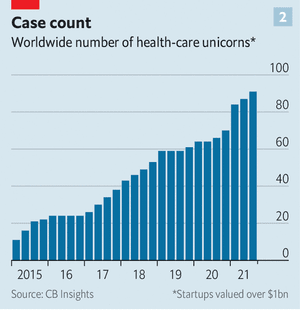
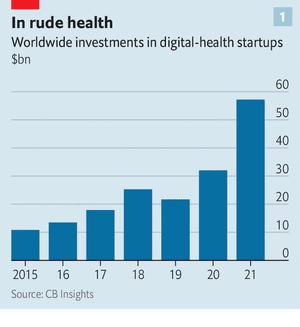
          The prize is gigantic. Health care consumes 18% of GDP in America, equivalent to $3.6trn a year. In other rich countries the share is lower, around 10%, but rising as populations age. The pandemic has made people more comfortable with online services, including digitally mediated care. Venture capitalists detect a sector that is uniquely ripe for disruption. CB Insights, a data provider, estimates that investments in digital-health startups nearly doubled in 2021, to $57bn (see chart 1). Unlisted health-care startups valued at $1bn or more now number 90, four times the figure five years ago (see chart 2). Such “unicorns” are competing with incumbent health-care companies and technology giants to make people better and prevent them from getting ill in the first place. In the process, they are turning patients into consumers.
          How health care is turning into a consumer product_2
          Consumer health care has long been synonymous with over-the-counter painkillers, cough syrup, face creams or Band-Aids peddled by big drugmakers. In a recognition that their uninnovative consumer divisions have become a drag, Johnson & Johnson, America’s (and the world’s) most-valuable pharmaceutical company, and GlaxoSmithKline, a giant British rival, are spinning them off. The hope is that without the cross-subsidy from the more lucrative prescription-drug arms, the rump consumer businesses will spruce up and become more inventive. Some more adventurous incumbents are already experimenting with digitisation and consumerisation. Teva, an Israeli pharmaceutical firm which dates back to 1901, has developed a digitally enabled inhaler equipped with app-connected sensors that tell users if they are employing it properly.

          Left to their own devices

          The second group of companies with new consumer-health ambitions is big tech. After a series of abortive attempts to tiptoe into the health business—as with Google’s short-lived platform for personal health data, scrapped in 2011—the technology giants are finally finding their feet. According to CB Insights, Alphabet, Amazon, Apple, Meta (Facebook’s new parent company) and Microsoft collectively poured some $3.6bn into health-related deals last year. They are particularly active in two areas: devices and data.
          How health care is turning into a consumer product_3
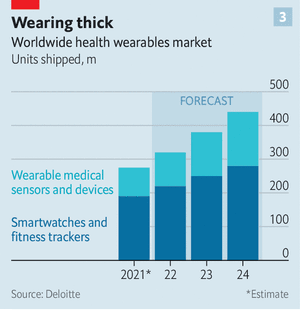
          Deloitte, a consultancy, reckons that 320m consumer medical wearables will ship globally in 2022 (see chart 3). In 2020 Amazon unveiled its $100 Halo band. Last year Google acquired Fitbit, which makes a fancier fitness tracker, for $2.1bn. The latest Apple watch already offers an electrocardiogram (ECG) function and the iPhone-maker plans to throw in blood-oxygen sensors and a thermometer to help women track ovulation. The latest smartwatch from Samsung, Apple’s South Korean rival, sports ECG and blood-pressure monitors.
          The technology giants are also injecting health-related services into their cloud-based data-crunching offerings. To that end Microsoft paid $20bn last year for Nuance, an AI firm. Amazon Web Services, the e-emporium’s cloud arm, has also launched a health-care offering. Oracle, an increasingly cloud-based business-software firm, is finalising an acquisition of Cerner, a health-IT group for $28bn.
          Then there are the upstarts, which offer products and services of varying degrees of complexity. Some are simple online pharmacies. Truepill, a six-year-old American company valued at $1.6bn, now fulfils 20,000 prescriptions a day and runs last-mile logistics for a range of consumer-facing health brands. One is Hims & Hers Health, a big American e-pharmacy that went public a year ago via a reverse merger with a special-purpose acquisition company. Another is Nurx, which provides pre-exposure prophylactics for people at risk of contracting HIV. PharmEasy, an Indian online pharmacy, raised $500m in capital last year.
          Telemedicine firms, which offer a greater range of health services, have thrived as covid-19 has strained clinics’ capacity and put patients off in-person visits for fear of infection. China’s WeDoctor, a privately held operator of what it calls “internet hospitals”, was last valued at nearly $7bn. Teladoc, a listed American firm with a market value of $13bn, reported revenues of $520m in the third quarter of 2021, up by 80% year on year.
          Another, more sophisticated area experiencing rapid growth is at-home diagnostics. The Theranos scandal gave consumer diagnostics a bad name. Now better technology and greater realism about what it can achieve are rehabilitating the field, just as the pandemic has accustomed people to the idea of home-testing.
          This includes devices to analyse everything from blood sugar to stool samples. Levels Health, a two-year-old American startup, sells app-synced continuous glucose monitors directly to consumers, after seamlessly connecting them via the internet with prescribing doctors. Its founder, Josh Clemente, was inspired by having to ask a friend to smuggle such a monitor for him from Australia to confirm his hunch that he was, like one-third of Americans, pre-diabetic—in America the devices were available only on prescription to people with uncontrolled diabetes. The startup’s waiting list now stretches to 145,000 people. Digbi Health, another American firm, uses fecal matter to analyse its customers’ gut microbiome to promote gastrointestinal health. Skin+Me, a British one, uses selfies to save people a trip to the dermatologist by providing prescription-grade skin care. Thriva, also from Britain, analyses blood from finger pricks to shed light on conditions such as high cholesterol and anaemia.

          Doctors on demand

          A big reason why it has taken so long for consumer technology to disrupt health care is that the highly regulated sector does not lend itself to Silicon Valley’s “move fast and break things” mentality. But recent years have shown that disruption is possible even in rule-bound industries. Hamish Grierson, was inspired to found Thriva after witnessing a digital shake-up in his old job in payments. Levels Health’s Mr Clemente, helped keep astronauts fighting fit at SpaceX, which has prised open the once government-dominated spacefaring business.
          One strategy is to position yourself as selling “general wellness” products to evade rigorous scrutiny, and only consult medical professionals for advisory purposes or to convince potential investors that their products are backed with science. Thriva, for example, says its blood tests offer “insights” rather than official diagnoses.
          Other companies, especially those with higher-tech offerings, are treading carefully. Manny Montalvo, who oversees “Digihaler” sales at Teva, insists it is not a consumer product. “This is still medicine and the right medicine has to be selected for the patient,” he says categorically. Apple sought clearance from America’s Food and Drug Administration (FDA) for its new watch’s ECG function.
          The regulators, for their part, are trying to move faster themselves. The newly minted FDA chief is a former adviser to Google Health, the tech giant’s health venture. The industry hopes that on his watch the agency will finally adopt long-delayed standards for digital-health software. Australia, Japan, Singapore and the EU have set out digital-health strategies in order to create similar standards for determining the quality, safety and clinical value of new health devices. More countries are adopting data-protection rules that ought to make it clearer to entrepreneurs, investors and consumers what data can be shared, with whom and how.
          The consumer-health boom has hit snags. Investors who pushed the share prices of online pill-peddlers and digital hospitals up whenever covid-19 spiked have cooled on such firms now that the coronaviral threat has receded somewhat. After exceeding $30bn at the start of 2021, Teladoc’s market value is back where it was before the pandemic hit in early 2020. The prospects of Hims & Hers, whose share price has declined by three-quarters in the past year, may have been additionally dented by Amazon’s launch in late 2020 of its e-pharmacy business. China’s digital-health companies have been caught up in the Communist Party’s broader tech crackdown. WeDoctor has shelved plans for a blockbuster initial public offering in Hong Kong. The Theranos saga offers a cautionary tale of how tricky biology is compared with swathes of computer science.
          Some products will turn out to be duds, and regulators may yet disrupt the disrupters. Still, as Scott Melville of the Consumer Healthcare Products Association, a trade body, puts it, “There is no going back to the old paternalistic system where you are relying exclusively on a medical professional for your health care.” Enterprising companies want to help people recover more quickly or, better yet, avoid getting ill in the first place. That is a negative prognosis for the hospital-industrial complex, which profits from the very sick. For everyone else, it is mostly a positive one.
          Source: The Economist
          Risk Warnings and Disclaimers
          You understand and acknowledge that there is a high degree of risk involved in trading. Following any strategies or investment methods may lead to potential losses. The content on the site is provided by our contributors and analysts for information purposes only. You are solely responsible for determining whether any trading assets, securities, strategy, or any other product is suitable for investing based on your own investment objectives and financial situation.
          Comments
          Add to Favorites
          Share

          Will households’excess savings keep the American economy afloat?

          AMERICA’S FISCAL largesse during the pandemic has fuelled not just economic growth but also, more surprisingly, a lively hip-hop niche. Over the past two years musicians have released no fewer than 30 different songs referring to the government’s stimulus cheques, known as stimmies. “Yeah, check, I need a stimmy. S-T-I-double M-Y, tell ‘em gimme,” raps Curtis Roach in one snappy track. The accompanying video seems to confirm the worst fears about how the money was spent. Mr Roach, a Detroit-based artist, fans himself with hundred-dollar bills and sprays them about at parties. But a closer listen reveals a conservative streak that would do fusty financial planners proud. “Generational wealth, that’s where it’s at…save a lil’ bit for the rainy days on yo’ back, never slack.”
          The question of how Americans spent and, crucially, saved money over the past two years looms large over the economy today. In spring 2020, when millions lost their jobs overnight, a reasonable assumption was that personal finances would suffer. Instead, government handouts, from the stimmies to more generous unemployment benefits, propped up incomes. Moreover, as people stayed home, their spending fell well below normal levels.
          Will households’excess savings keep the American economy afloat?_1
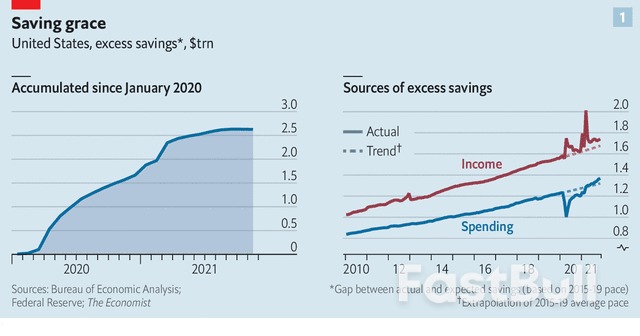
          The result was a piggy-bank boom. Americans have accumulated some $2.5trn in extra savings compared with the pre-covid trend. Higher-than-expected incomes account for two-thirds of the stockpile, while lower-than-expected expenditures explain the other third, according to calculations by The Economist (see chart 1).
          This stash of cash could, in theory, provide a pillar for the economy over the coming year as policymakers withdraw support. With inflation running at around 7%—a four-decade high—the Federal Reserve has signalled that it intends to raise interest rates as soon as March. Some economists expect as many as four rate increases this year. Fiscal policies are also becoming more parsimonious. Many of the benefit top-ups expired in the autumn. The Democratic party’s inability thus far to pass President Joe Biden’s “Build Back Better” programme will lead to further retrenchment.
          Will the extra savings blunt the impact of all this policy tightening? There are reasons to be sceptical. Were the $2.5trn shared equally across the country, it would amount to about $7,500 for every American—more than the combined total of the three rounds of stimulus cheques. In practice the distribution is far from equal. In the decade before covid-19 the wealthiest 1% of Americans had, in aggregate, about twice as much cash and chequable bank deposits as the bottom 50%. The pandemic has skewed this further: the top 1% now has four times as much as the bottom half.
          That matters in trying to assess the potential impact of excess savings. The wealthy typically spend a low share of their incomes. The extra cash sitting in their hands is more likely to go towards investment accounts than grocery purchases.
          Another dampener may be the nature of the economic recovery. In a paper last year Martin Beraja and Christian Wolf of the Massachusetts Institute of Technology showed that recoveries from recessions where falls in spending were concentrated on goods tend to be stronger than those with cuts concentrated on services. Pent-up demand for, say, smartphones can be released in a flood. By contrast, demand for beach holidays returns more slowly: vacationers can only be in one place at a time. This logic suggests that as the pandemic fades away, the flow of savings into long-deferred services such as travel and entertainment may be sluggish.
          Another obvious concern is high inflation. That eats into both wealth and incomes. Adjusted for rising prices, wage growth in America has turned sharply negative over the past half year. Similarly, the real value of savings looks a little less impressive given the reduction in purchasing power.
          Will households’excess savings keep the American economy afloat?_2
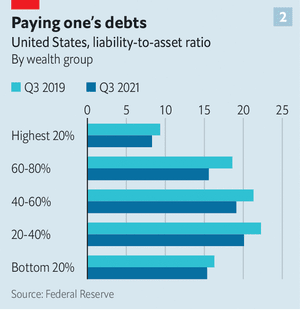
          That, though, is not the end of the story. Surveys by the Fed’s New York branch indicate that stimulus recipients saved about one-third and used another third to pay down debts. Such decisions help explain why household balance-sheets are healthier today than before the pandemic. Regardless of their wealth, Americans have lower debt-to-asset ratios than two years ago (see chart 2). That could give them scope to borrow and spend more.
          This may already be happening. Consumer borrowing soared in November by $40bn, the most on record, as credit-card usage soared. Some observers saw that as a sign that households were strapped for cash. Alex Lin of Bank of America disagrees. “An increase in credit-card spending can be a function of greater re-engagement in the economy,” he says. “Americans like to use their credit cards to rack up points for travel or restaurants, and that is not necessarily a sign of danger.”
          The damage from inflation may also prove tolerable, especially if the Fed’s tightening, plus supply-chain improvements, brings prices back under control. Wage growth has been stronger for those on lower incomes, the group most vulnerable to a reduction in real spending power. In November annual nominal wage growth for the bottom quartile of earners reached 5.1% versus 2.7% for the top quartile, according to the Atlanta Fed.
          As a whole, Americans saved about 6.9% of their incomes in November, lower than the 7.4% average in the five years before the pandemic. Yet that is exactly what should be seen if some people are dipping into their excess savings. It is also one key reason why most forecasters think America’s economy will grow by about 4% this year, a robust pace in the face of headwinds.
          And that barely grapples with the changes that the extra cash enabled for many recipients. In another hip-hop track, Reneé the Entertainer sings of a woman who splurged on a buttock-augmentation procedure: “She spent the stimmy/on the booty/in Miami.” Reneé, whose real name is Maria Pizarro, in fact put her money to what is arguably a more productive use. “I used them to get a more reliable vehicle,” she says. Although Ms Pizarro dreams of a music career, the car has for now facilitated a less glamorous occupation. It lets her drive to work at an Amazon warehouse.

          Source: The Economist

          Risk Warnings and Disclaimers
          You understand and acknowledge that there is a high degree of risk involved in trading. Following any strategies or investment methods may lead to potential losses. The content on the site is provided by our contributors and analysts for information purposes only. You are solely responsible for determining whether any trading assets, securities, strategy, or any other product is suitable for investing based on your own investment objectives and financial situation.
          Comments
          Add to Favorites
          Share

          How Trade Can Help Speed Asia's Economic Recovery

          Thomas
          Trade has historically been a powerful driver of economic growth and poverty alleviation in Asia, though the momentum of lowering trade barriers has slowed in recent years.
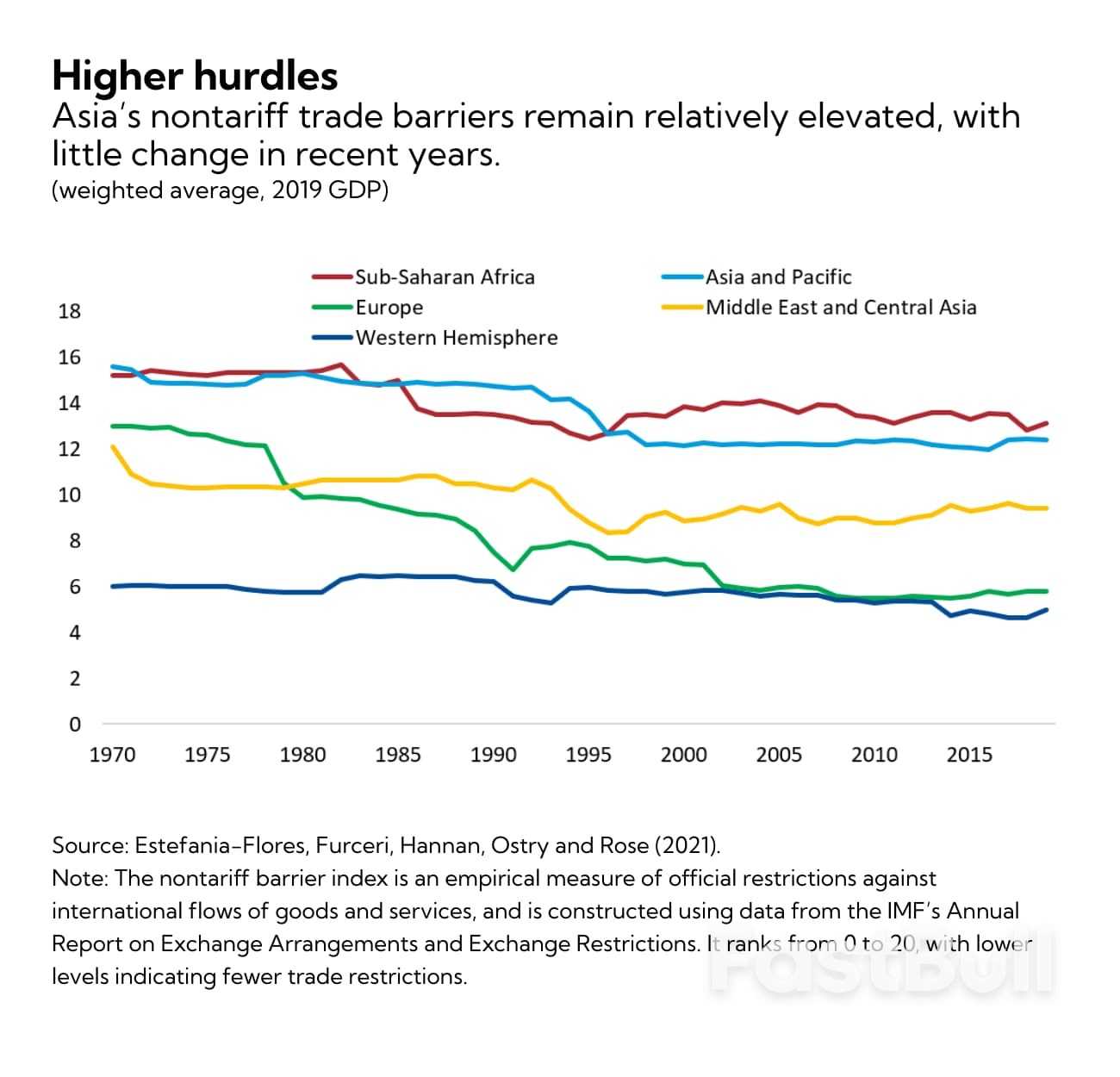
          While tariff barriers to trade in Asia are low overall, a new measure of nontariff barriers suggests those remain high in many Asian emerging markets and developing economies. Unlike tariffs, these barriers include policies that introduce frictions such as licensing requirements or restrictions on trade, payments, or exchanging foreign currencies.
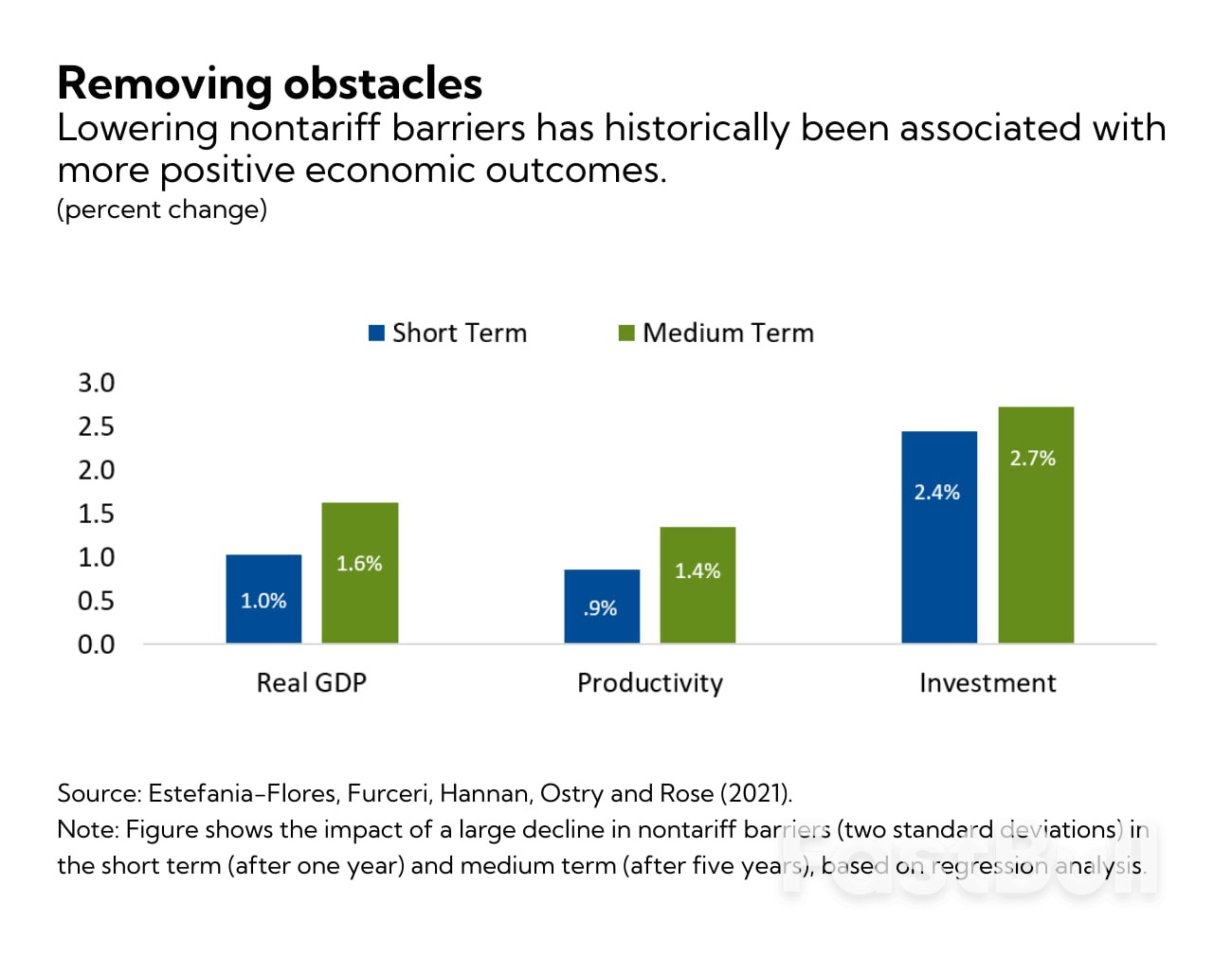
          According to recent research, which was detailed in the IMF’s Asia-Pacific Regional Economic Outlook, easing nontariff barriers can boost gross domestic product by about 1.6 percent, potentially healing about a quarter of expected pandemic scarring. The findings take on added significance given that IMF forecasts suggest GDP in 2024 will be 6 percent below the pre-crisis trend in Asian emerging and developing economies, equal to losses of about $1 trillion annually.

          Trade barriers

          For a better understanding, it helps to consider the region’s history of cross-border activity. Strong GDP growth in Asia was accompanied for decades by a steady rise in measures of trade openness, such as the share of goods and services trade in GDP, and greater participation in global value chains. However, this openness has stalled in recent years, suggesting that Asia’s traditional growth engine was slowing even before the pandemic.
          This coincided with slower reforms. Average tariffs in Asia fell sharply from more than 50 percent in the 1970s to single digits in the early 2000s, leaving little room to improve. But levies aren’t the whole story. Nontariff barriers have long been viewed as a significant impediment to trade, though concrete analysis has been challenging due to data limitations.
          How Trade Can Help Speed Asia's Economic Recovery_1
          To overcome this constraint, a forthcoming IMF working paper compiles a comprehensive measure of trade restrictions for 159 economies as far back as 1949. This index uses detailed trade-barrier data in the IMF’s Annual Report on Exchange Arrangements and Exchange Restrictions. This captures various obstacles such as licensing requirements or documentation hurdles for releasing foreign currency.
          The index shows that, in contrast to the major drop in tariffs over the past half century, nontariff barriers have declined less and remain relatively elevated. The level for Asia declined from near 20, the highest level, in the 1960s to around 15 by 1995, but has since remained little changed.

          Benefits of open trade

          These scores tend to be particularly high for low-income countries such as Nepal, Bangladesh, and Myanmar, though large emerging economies such as China and India also have scope for reforms. The average reading among Asia’s emerging market and developing economies also is significantly higher than those for other regions.
          Empirical analysis suggests lowering nontariff barriers offers potentially large economic gains. A significant reduction in our measure, along the lines of Sri Lanka’s removal of export licensing, financing, and documentation requirements in the early 1990s, can help boost GDP by about 1 percent in the short-term. Those gains increase to about 1.6 percent after five years.
          How Trade Can Help Speed Asia's Economic Recovery_2
          Notably, improvements come from greater investment and productivity, not directly through higher net exports. This highlights how advances from trade liberalization occur via multiple channels that include benefits from specialization, technology transfer, and the reallocation of resources to more productive firms.
          As vaccinations foster the recovery from the pandemic, policymakers must prioritize economic reforms to support growth and minimize scarring from the crisis, especially in emerging and developing economies. These can include policies aimed at reversing the pandemic-induced setback to workforce education and skill levels, as well as reforms to labor and product markets.
          Our research illustrates how lowering international trade costs can help:
          Lowering goods barriers: Many Asian economies require import and export licenses, request extensive documentation for releasing foreign currency, or restrict the use of foreign exchange. Removing such obstacles can ease administrative delays and reduce costs for international transactions.
          Reducing services restrictions: There is significant scope to ease restrictions on transactions beyond physical goods in areas such as travel, shipping, and consulting, and on international transfers, as Australia did in the 1980s. Reforms like these will likely offer greater benefit in coming years as services trade grows more rapidly.
          While reducing trade barriers can help boost output in the medium term, it can also come with potentially adverse distributional consequences. The reallocation associated with reforms generates winners and losers, with the already better-off often benefitting more. Therefore, it’s essential to accompany trade reforms with policies to mitigate impacts on inequality, including financial support for the hardest hit and retraining programs to help workers find new jobs.
          As economies confront years of lingering effects from the pandemic, a renewed embrace of trade openness is a promising avenue to explore. Healing the pandemic’s scars is a priority, and our research shows that reducing trade barriers can reignite Asia’s growth engine.
          Source: IMF
          Risk Warnings and Disclaimers
          You understand and acknowledge that there is a high degree of risk involved in trading. Following any strategies or investment methods may lead to potential losses. The content on the site is provided by our contributors and analysts for information purposes only. You are solely responsible for determining whether any trading assets, securities, strategy, or any other product is suitable for investing based on your own investment objectives and financial situation.
          Comments
          Add to Favorites
          Share

          Making Electronic Money Safer in the Digital Age

          Imagine you go to pay for your morning coffee and your stored-value card returns an error message, or the wallet in the payments app on your phone isn’t opening because the company providing the payment service has gone bankrupt. Worse, what if you live in a rural area and the e-money service provided through your mobile phone was the only access you have to the financial system? Or your government now relies on the e-money system to transfer benefits or collect taxes on a large scale?
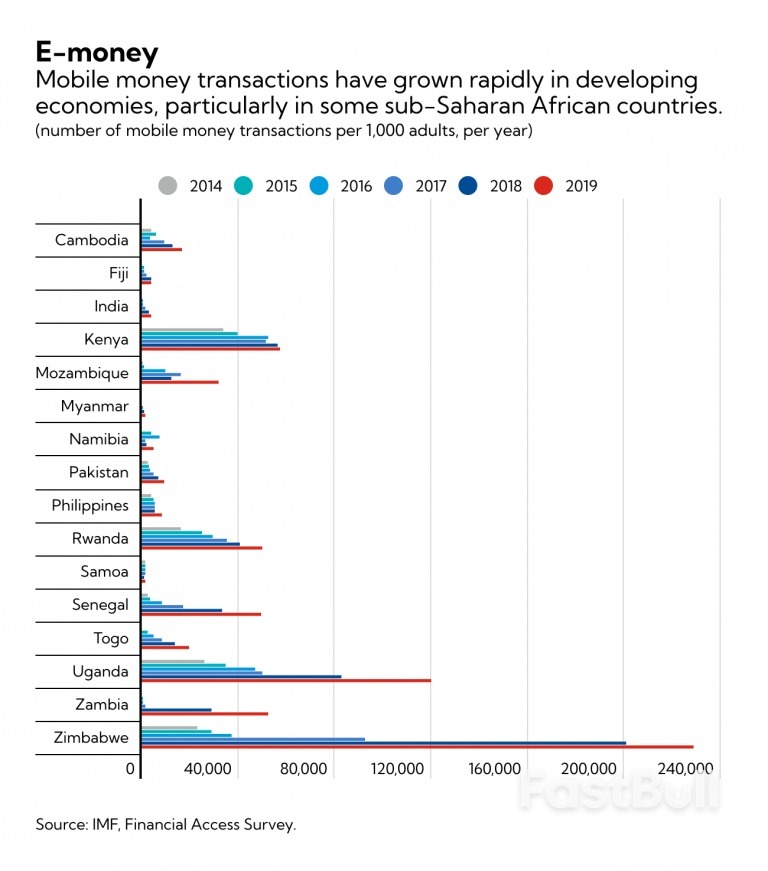
          Digital forms of money—including central bank digital currencies, privately issued stable coins, and e-money—continue to evolve and find new ways to become more integral in people’s day-to-day lives. In essence e-money is a digital representation of fiat currency guaranteed by its issuer. Customers exchange regular money into e-money, which they can use to make payments through an app on their cellphone to individuals and businesses alike with ease and immediate effect. Compared to other recently developed forms of digital money, such as stablecoins, e-money has been around for some time and its customer base continues to rapidly increase. Unlike most privately issued stablecoins, e-money operates in a regulated framework.
          For regulators and supervisors charged with protecting consumers and ensuring a level playing field for all financial intermediaries, keeping pace with new developments can be challenging. Regulators and supervisors need to consider how to best protect customers from the failure of (potentially systemic) e-money issuers, including preventing the loss of their funds.
          A new IMF staff paper considers these and other scenarios that may put consumers and—potentially—entire e-money systems at risk. IMF also examine how regulatory practices are evolving on a country-by-country basis and put forward a set of policy recommendations on regulating e-money issuers and safeguarding their customers' funds.
          Making Electronic Money Safer in the Digital Age_1

          E-money offers payment solutions for the unbanked

          We can think of e-money as an electronic store of monetary value on a prepaid card or an electronic device, often a mobile phone, that may be widely used for making payments. The stored value also represents an enforceable claim against the e-money issuer, by which its customers can demand at any time to be repaid the funds they used to purchase e-money.
          money is already a vital part of daily life for billions of people, especially in many developing countries, where many lack access to the banking system. As shown in the chart below, a high percentage of the population across a number of East African countries now use e-money, making it important from a macro-financial perspective. It is estimated, for instance, that two-thirds of the combined adult population of Kenya (where M-PESA has reached a high degree of market penetration), Rwanda, Tanzania, and Uganda use e‑money regularly. Many of these people do not have bank accounts or other access to the formal financial system, so they store significant shares of their disposable funds in e‑money wallets and access them using mobile phones or computers.

          Protecting financial systems and consumers alike

          With the growing importance of e-money issuers, a comprehensive, robust framework for regulation and safeguarding customer funds is critical. Issuers should be subject to proportionate prudential regulatory requirements. For example, they should establish operational risk governance and management systems to identify and limit risks. They should also be prohibited from retail lending. And, in order to protect consumers who may be less sophisticated than bank customers, rules should be put in place governing how issuers disclose fees, protect consumer data, and handle complaints.
          One of the most important regulatory measures identified in IMF paper is that in order to protect customers’ money, all e-money issuers need to implement mechanisms to safekeep and segregate those funds. Issuers need to maintain a secure pool of liquid funds that is equivalent to the amounts of customers’ balances, and which is kept separate from the issuer’s own funds. This is a fundamental safeguard against misuse of the funds and should allow, in principle, for recovery of those funds in the event of bankruptcy of an issuer.
          Keeping the customers’ funds segregated, however, does not resolve all the problems if a potentially systemic issuer were to fail. In the absence of specific bankruptcy rules, segregation by itself does not ensure that the customers would get quick access to their funds, and this discontinuity may create severe problems if the issuer plays a potentially systemic role in the payments system and in day-to-day transactions of the country.

          Potentially systemic, potentially problematic

          Regulators and supervisors may need to significantly strengthen prudential oversight and user-protection arrangements, depending on the business model and size of the e-money system. In countries with a potentially systemic e-money issuer or sector, the protection in place should seek to preserve customers’ funds and ensure continuity of critical payment services.
          While some countries have sought to extend deposit insurance to e-money, further efforts may be needed to operationalize such protection and ensure that it would work effectively in practice. In particular, customers should not lose access to their funds and, therefore, services should be restorable or replaceable quickly, preferably within hours. But putting e‑money deposit insurance into practice remains untested so far—at least in practical terms. The costs and benefits of extending deposit insurance coverage effectively to e-money should be carefully considered.
          As with many issues in the fintech sphere, best practices are still taking shape, making policy decisions challenging. However, the pandemic has only increased the importance of prudent e-money frameworks, as the number of online transactions and e-money’s growth has accelerated. For regulators and supervisors, the time for action is now.

          Source: IMF

          Risk Warnings and Disclaimers
          You understand and acknowledge that there is a high degree of risk involved in trading. Following any strategies or investment methods may lead to potential losses. The content on the site is provided by our contributors and analysts for information purposes only. You are solely responsible for determining whether any trading assets, securities, strategy, or any other product is suitable for investing based on your own investment objectives and financial situation.
          Comments
          Add to Favorites
          Share

          Gold Outlook 2022(II)

          Opinion is divided, but inflation may linger

          Many central banks initially played down inflation concerns, and while some, such as the Fed, have acknowledged upside risks, there’s an underlying expectation that inflation will dissipate. Investors seem to be less sure, but opinions vary. Anecdotally, these views were echoed in a LinkedIn poll we conducted last December. While the vast majority expected inflation to remain high, more than one in four respondents thought it would cool down.
          We believe there are multiple reasons why inflation will remain high, partly stemming from the unprecedented monetary and fiscal policies put in place to alleviate the effects of the COVID-19 pandemic. In particular:
          · lingering supply-chain disruptions from the initial COVID wave and subsequent dislocations as new variants continue to emerge
          · tight labour markets, which, combined with COVID fatigue, have increased the number of people voluntarily looking for new, better-paid opportunities
          · higher average savings from 2020, which have contributed to lofty valuations in various financial markets
          · high commodity prices
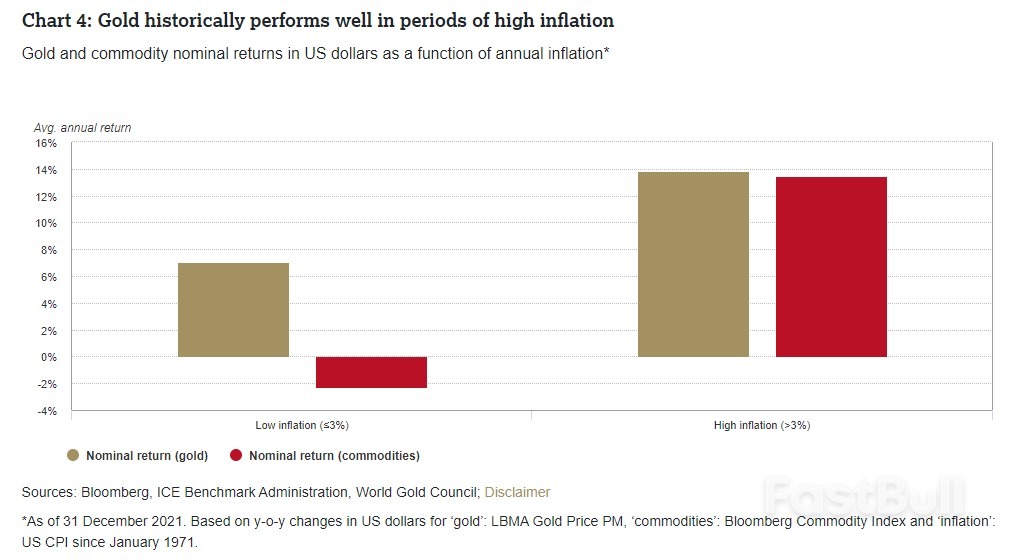
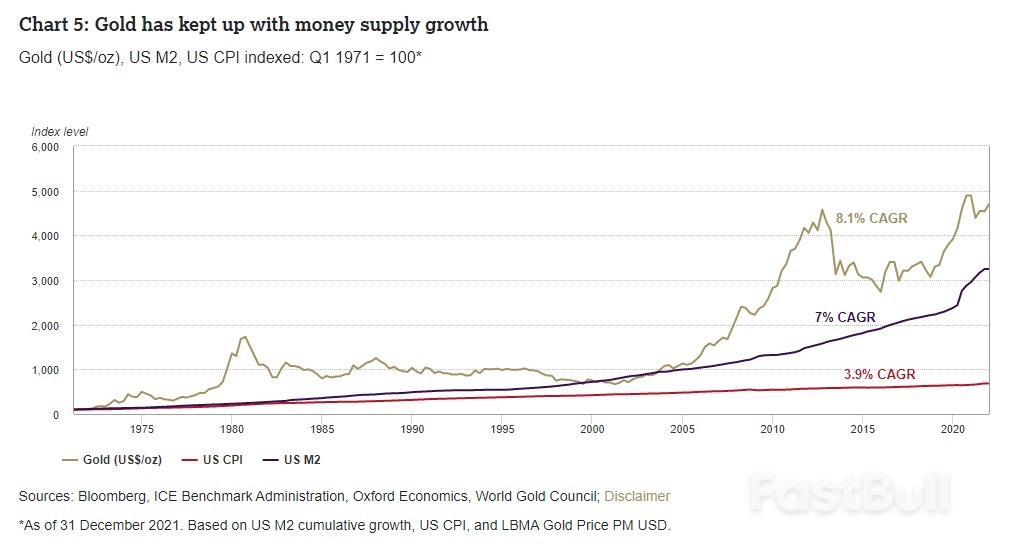
          Gold has historically performed well amid high inflation. In years when inflation was higher than 3%, gold’s price increased 14% on average (Chart 4). Further, in the long run, gold has outpaced US inflation and moved closer in pace to money supply, which has significantly increased in recent years (Chart 5).
          Gold Outlook 2022(II)_1
          Gold Outlook 2022(II)_2

          Amid opposing forces, real rates will likely remain low

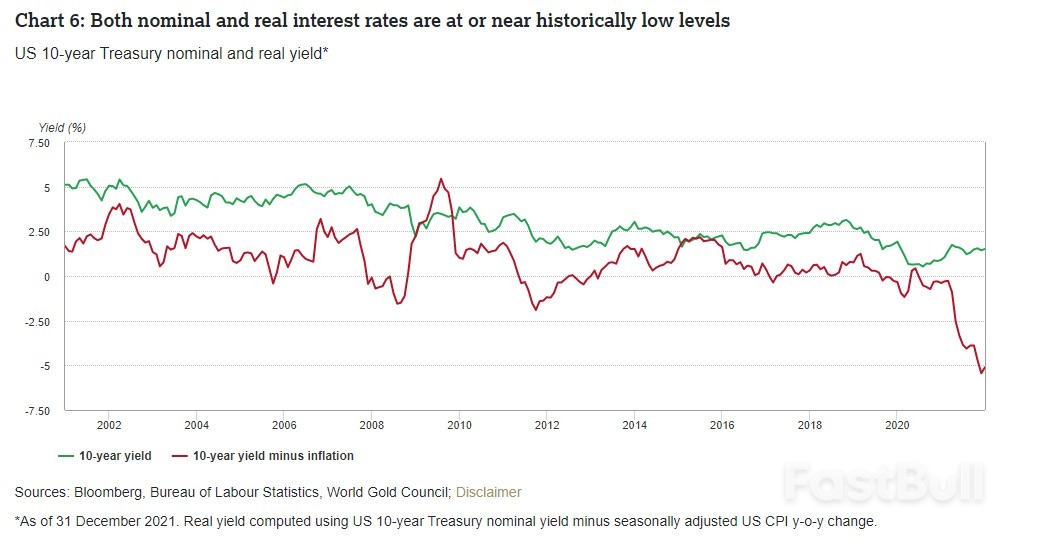
          Despite potential rate hikes by some central banks, nominal rates will remain low from a historical perspective. Even more so, elevated inflation will likely keep real rates depressed (Chart 6). This is important for gold since gold’s short- and medium-term performance tends to often respond to real rates, which combine two important drivers of gold performance: “opportunity cost” and “risk and uncertainty”.
          Further, low interest rates – both nominal and real – are shifting investment portfolios more towards risk-on assets. And this, in turn, as we discuss in one of our recent reports, increases the need for a high-quality liquid asset such as gold.
          Gold Outlook 2022(II)_3

          Investors are ready to turn the page on COVID, but market pullbacks may persist

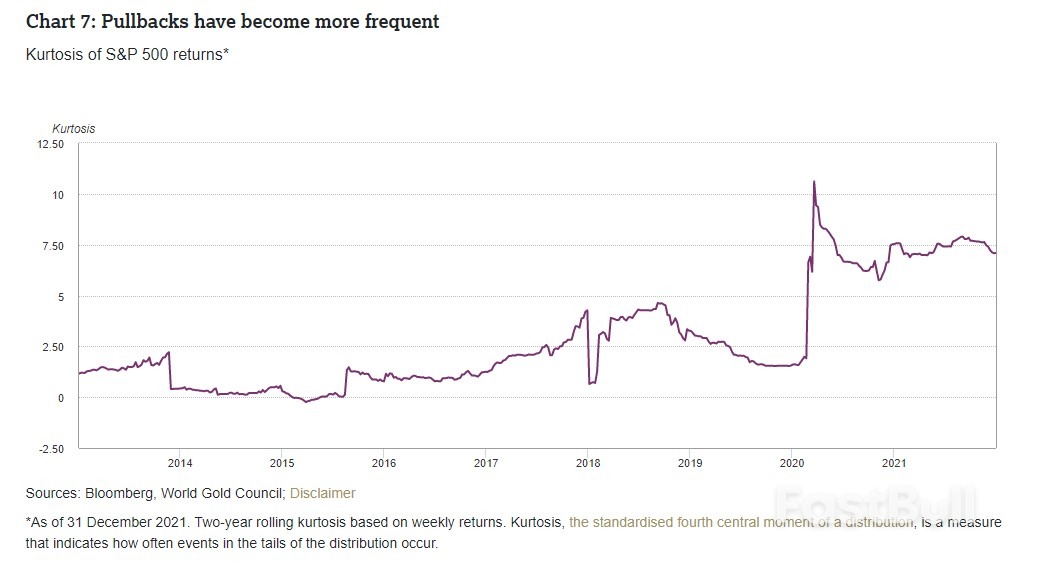
          It’s been two years since the start of the pandemic and the world seems ready to move on: global stock markets have strongly rebounded from their 2020 lows, albeit at different rates. But “tail events” have also been on the rise (Chart 7).
          Gold Outlook 2022(II)_4
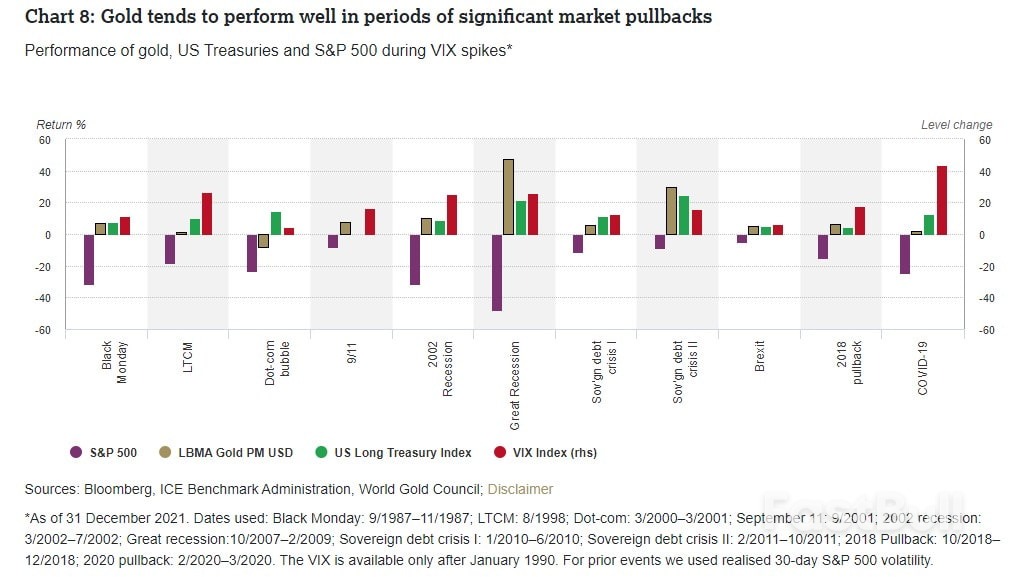
          Pullbacks are likely to continue in the face of the seemingly endless stream of new variants, as well as simmering geopolitical tensions and overall buoyant equity valuations fuelled by a long-lasting ultra-low-rate environment. In this context, gold can be a valuable risk management tool in an investor’s arsenal. Gold has a proven historical record of mitigating the negative impact of equity market pullbacks in periods of systemic risk (Chart 8).
          Gold Outlook 2022(II)_5

          Gold’s performance is not only linked to investment

          It is often assumed that gold’s price behaviour is linked to investment demand, especially from financial instruments such as gold ETFs, over-the-counter contracts, or exchange-traded derivatives. This is only partly true. Shorter-term and more significant price movements do tend to respond to variables associated with these types of gold investments; for example, interest rates, inflation, exchange rates, and, more generally, flight-to-quality flows.
          However, our analysis shows that gold’s performance is also linked to other components of demand, such as jewellery, technology, and central banks. While these do not typically result in the large price movements associated with investment, they help underpin gold price performance by either providing support, or creating headwinds.We believe that gold can still receive positive – if modest – support in 2022 from key jewellery markets, such as India. However, there’s a chance that further Chinese economic slowdown may limit the contribution from local gold jewellery demand.
          Finally, central bank gold demand, which rebounded in 2021, may remain an important source of demand. There are good reasons why central banks favour gold as part of their foreign reserves which, combined with the low interest rate environment, continue to make gold attractive. This was also evidenced by the fact that two developed market central banks last year joined the list of buyers which has been dominated by emerging market banks since 2010.

          Source: Gold Hub.

          Risk Warnings and Disclaimers
          You understand and acknowledge that there is a high degree of risk involved in trading. Following any strategies or investment methods may lead to potential losses. The content on the site is provided by our contributors and analysts for information purposes only. You are solely responsible for determining whether any trading assets, securities, strategy, or any other product is suitable for investing based on your own investment objectives and financial situation.
          Comments
          Add to Favorites
          Share

          Gold Outlook 2022 (I)

          Higher rates in 2021 outweighed inflation risks

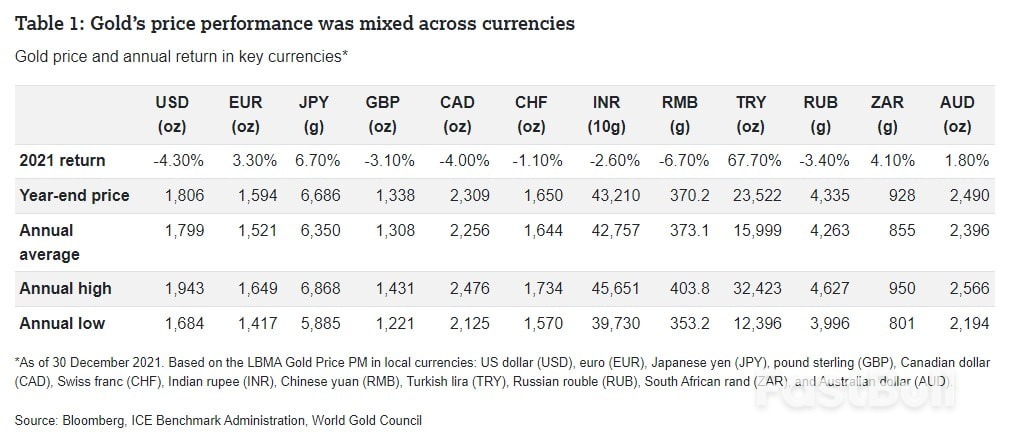
          Gold finished the year approximately 4% lower, closing at US$1,806/oz. The gold price rallied into year-end on the heels of the rapidly spreading Omicron variant, likely prompting flight-to-quality flows, but it was not enough to offset H1 weakness.
          Early in 2021, as newly developed vaccines were rolled out, investor optimism likely fuelled a reduction in portfolio hedges. This negatively impacted gold’s performance and resulted in gold ETF outflows. The rest of the year was a tug of war between competing forces. Uncertainty surrounding new variants, combined with increasing risks of persistently high inflation and a rebound in gold consumer demand, pushed gold forward. Conversely, rising interest rates and a stronger US dollar continued to create headwinds. However, dollar strength led to positive gold returns in some local currency terms, such as the euro and yen among others (Table 1).Gold Outlook 2022 (I)_1
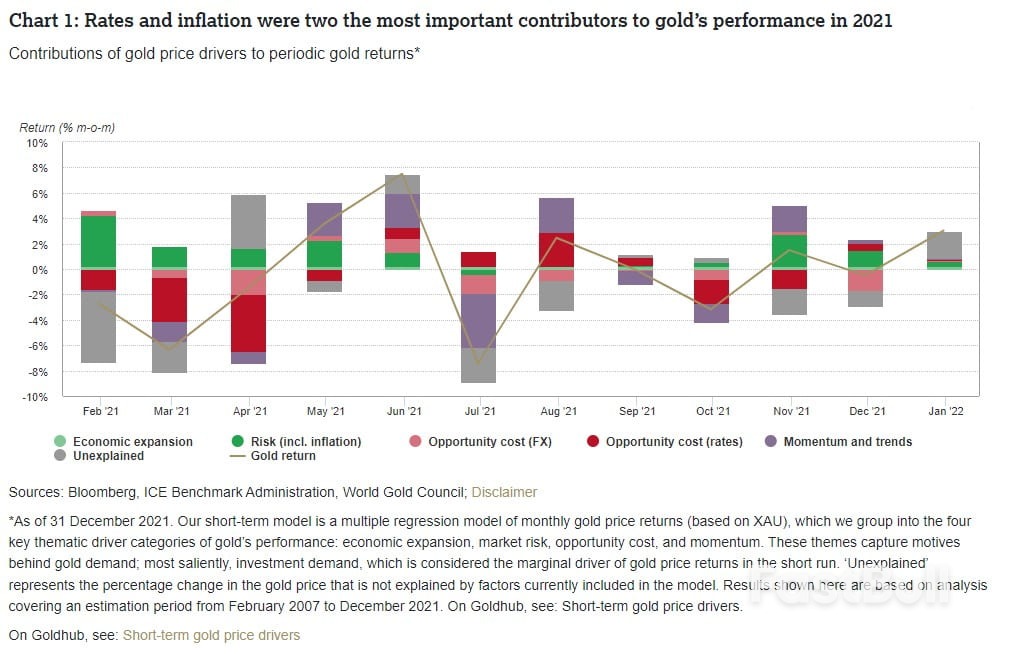
          Our gold return attribution model corroborates this. Rising opportunity costs were one of the most important contributors to gold’s negative performance in Q1, and intermittently in H2, while rising risks – especially those linked to elevated inflation – pushed gold higher towards the end of the year (Chart 1).
          Gold Outlook 2022 (I)_2

          Looking ahead, rising rates pose risks but the devil will be in the details

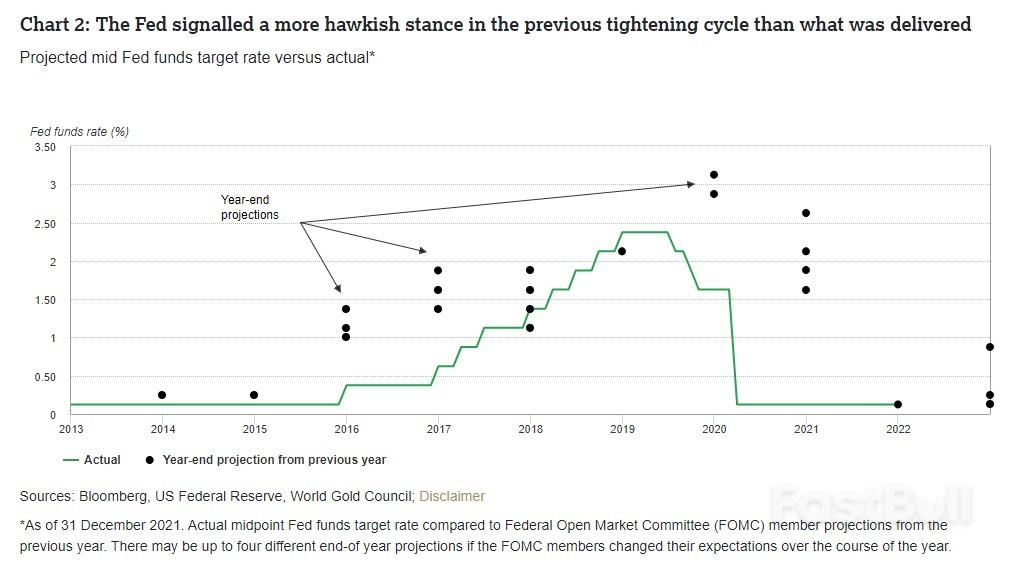
          As we enter 2022, the US Federal Reserve is signalling a more hawkish stance. Its projections indicate that the Fed expects to hike approximately three times this year at a quicker pace than previously expected, while aiming to reduce the size of its balance sheet.
          An analysis of previous tightening cycles, however, shows that the Fed has tended not to tighten monetary policy as aggressively as members of the committee had initially expected.
          Dot-plot projections suggest that year-ahead Fed expectations have significantly exceeded actual target rates (Chart 2).
          More importantly though, financial market expectations of future monetary policy actions – expressed through bond yields – have historically been a key influence on gold price performance.
          Gold Outlook 2022 (I)_3
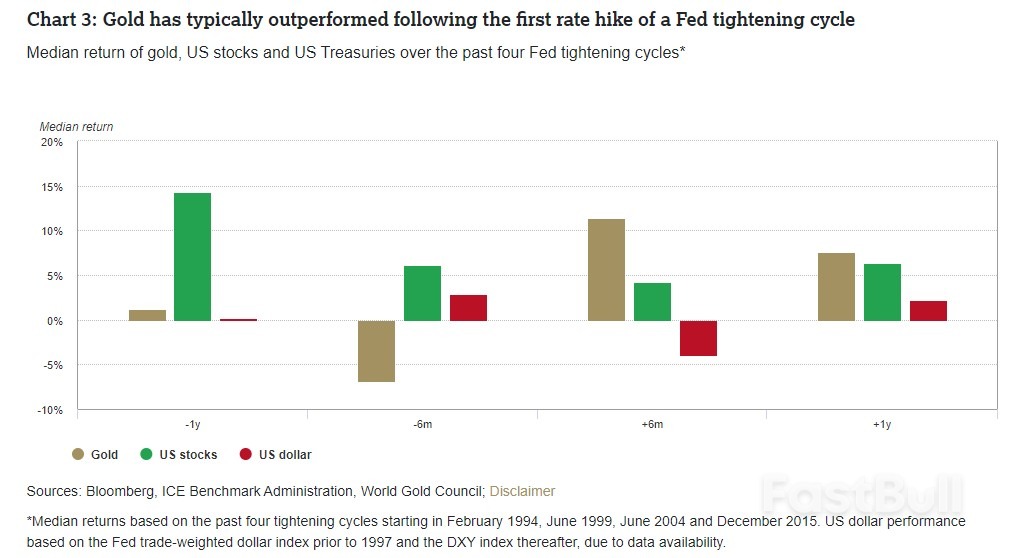
          Consequently, gold has historically underperformed in the months leading up to a Fed tightening cycle, only to significantly outperform in the months following the first-rate hike (Chart 3). Gold may have partly been aided by the US dollar which exhibited the opposite pattern. Finally, US equities had their strongest performance ahead of a tightening cycle but delivered softer returns thereafter.
          Gold Outlook 2022 (I)_4
          Finally, while there’s a lot of emphasis on the relationship with US interest rates, gold is a global market. And not all central banks may move as quickly as the Fed.
          For example, the European Central Bank has stated that it is “very unlikely” that interest rates will rise in 2022 despite recent record inflation prints. And while the Bank of England increased interest rates in December, its Policy Committee seemed to indicate only modest future rises.
          The Reserve Bank of India has also signalled that it will maintain its accommodative monetary policy stance to revive and sustain economic recovery and mitigate the impact of COVID. And the People’s Bank of China cut one of its policy rates by 5bps in December shortly after lowering the required commercial banks reserve ratio to cushion the country’s economic slowdown.
          While diverging monetary policies could result in a stronger dollar, steady or decreasing rates should support regional gold investment demand.

          Source: Gold Hub.

          Risk Warnings and Disclaimers
          You understand and acknowledge that there is a high degree of risk involved in trading. Following any strategies or investment methods may lead to potential losses. The content on the site is provided by our contributors and analysts for information purposes only. You are solely responsible for determining whether any trading assets, securities, strategy, or any other product is suitable for investing based on your own investment objectives and financial situation.
          Comments
          Add to Favorites
          Share

          The cost-of-living crisis is going to upend British politics in 2022

          Turn on the radio or scroll down your phone and the big headlines belong to Covid. But when this latest version of the plague drops off the front pages, another story is set to take its place – and this one will hang around for most of the year, setting the terms of trade at Westminster and possibly deciding Boris Johnson’s future.
          The cost of living is about to shape our politics in a way that it hasn’t for decades.
          You can spot the buildup this week, from Keir Starmer’s warning of a crisis to Tory backbenchers clamouring for Johnson to act now on high fuel bills. And you can already see the misery in the stories about how Britons now wrap themselves up in blankets and turn on their hairdryers to keep warm, rather than run the central heating. Over the next few weeks, the crisis will only grow.
          On 7 February the energy watchdog, Ofgem, sets the new maximum price for energy bills. Utility firm bosses are warning that the cap could easily go above £2,000, twice what it was last winter. Experts at the National Energy Action charity have warned that fuel poverty could rise to its highest levels since John Major was in No 10, with about 6 million households having to choose between heating and eating, or paying the bus fare or buying sanitary pads.
          This means 2 million households, which as recently as last autumn were still keeping their heads above water, will sink when the new cap kicks in on 1 April. At just that point, taxes go up too. National insurance will rise, as will council tax across much of the country, alongside a stealth increase in income tax bills. Put all that together and the Resolution Foundation warns that the average household stands to lose an extra £1,200 a year. To this we can add the effect of higher petrol prices. These bills will pile up while wages and benefits are falling in real terms. It is a recipe for widespread deprivation and massive political turbulence. It also blows apart the electoral coalition that handed Johnson his landslide. In true-blue Woking, only 6% of households are in fuel poverty; in Workington, by contrast, which went Tory only in 2019, that proportion is nearly 14%.
          My bet has long been that boring old economics will inflict far more damage on Boris Johnson than baroque politics. Most critics of the Sun King have spent the days since 2019 attacking his rule-breaking, his brinkmanship with Brussels, his sheer bad behaviour. Until the revelations about the parties at No 10, hardly any of it landed with a public that is wearily well used to a political class trashing norms to fill its boots; just ask the Right Hon Member for Greensill Capital. But all those voters, left unmoved by 42-point headlines and stinging op-eds, are far more likely to be mobilised by the largest tax burden in 70 years, swingeing cuts to frontline services and surging inflation.
          No wonder the government can barely quell its anxiety. The business secretary, Kwasi Kwarteng, has been meeting energy bosses in a series of emergency summits, the latest held on Wednesday, while Chancellor Rishi Sunak’s team has been grumbling to journalists about having to stump up for any of this. Still, with only a month to go before the Ofgem announcement, no deal is on the table.What’s odd is that Johnson has himself pledged one such remedy. Co-writing an article in the Sun less than a month before the EU referendum of 2016, he vowed that Brexit would mean the end of VAT on fuel bills. “We will be able to scrap this unfair and damaging tax,” Mr Leave wrote . “It isn’t right that unelected bureaucrats in Brussels impose taxes on the poorest and elected British politicians can do nothing.” A whole two and a half years since becoming prime minister, he has done precisely nothing. This week he squirmed on TV that cutting VAT was a “blunt instrument” that wouldn’t direct help towards those in most dire financial need. Fancy that! If only someone had warned us that this guy reneges on a deal.
          But if Starmer wants to capitalise on this moment, he needs to do far better than make nothingy speeches larded with abstract nouns and bedecked with flags. Labour wants to scrap the 5% VAT rate on energy bills, but in truth it’s small change: £10 back on a £200 monthly bill. Better would be to call for a windfall tax on gas and oil companies, which have been making a killing as fuel prices rise, and direct that money to the least well-off. If Labour can take that position early and loud enough, they’ll reap rewards when the Tories copy them. They can also point to the failures of the energy market – the collapse of 26 suppliers and the consolidation of their customer base back into the hands of the big six – as grounds to try something new: to use the public sector to direct more investment into nationally secure renewables.
          This is a generation of politicians that has never faced an inflation shock but is nevertheless haunted by the mythology around what happened in the 1970s. With good reason: Thatcher used that episode finally to dismantle the Keynesian welfare state and to exile the left for more than a decade. The right is already reheating those old arguments about how inflation and higher interest rates must mean reduced public spending, and how taxpayers don’t want to pay for “green crap” and reducing poverty.
          It is essential that the left counter those points now. This isn’t the 70s, and there is no danger of a wage-price spiral. This is a workforce that has just emerged from the worst squeeze on living standards since Napoleon marched across Europe – and it is just about to enter another one. It’s not the labour force that isn’t working: it’s the markets and the supply chain. Those are what need to be fixed.

          Source: The Guardian.

          Risk Warnings and Disclaimers
          You understand and acknowledge that there is a high degree of risk involved in trading. Following any strategies or investment methods may lead to potential losses. The content on the site is provided by our contributors and analysts for information purposes only. You are solely responsible for determining whether any trading assets, securities, strategy, or any other product is suitable for investing based on your own investment objectives and financial situation.
          Comments
          Add to Favorites
          Share
          FastBull
          Copyright © 2025 FastBull Ltd

          728 RM B 7/F GEE LOK IND BLDG NO 34 HUNG TO RD KWUN TONG KLN HONG KONG

          TelegramInstagramTwitterfacebooklinkedin
          App Store Google Play Google Play
          Products
          Charts

          Chats

          Q&A with Experts
          Screeners
          Economic Calendar
          Data
          Tools
          Membership
          Features
          Function
          Markets
          Copy Trading
          Latest Signals
          Contests
          News
          Analysis
          24/7
          Columns
          Education
          Company
          Careers
          About Us
          Contact Us
          Advertising
          Help Center
          Feedback
          User Agreement
          Privacy Policy
          Business

          White Label

          Data API

          Web Plug-ins

          Poster Maker

          Affiliate Program

          Risk Disclosure

          The risk of loss in trading financial instruments such as stocks, FX, commodities, futures, bonds, ETFs and crypto can be substantial. You may sustain a total loss of the funds that you deposit with your broker. Therefore, you should carefully consider whether such trading is suitable for you in light of your circumstances and financial resources.

          No decision to invest should be made without thoroughly conducting due diligence by yourself or consulting with your financial advisors. Our web content might not suit you since we don't know your financial conditions and investment needs. Our financial information might have latency or contain inaccuracy, so you should be fully responsible for any of your trading and investment decisions. The company will not be responsible for your capital loss.

          Without getting permission from the website, you are not allowed to copy the website's graphics, texts, or trademarks. Intellectual property rights in the content or data incorporated into this website belong to its providers and exchange merchants.

          Not Logged In

          Log in to access more features

          FastBull Membership

          Not yet

          Purchase

          Become a signal provider
          Help Center
          Customer Service
          Dark Mode
          Price Up/Down Colors

          Log In

          Sign Up
          Position
          Layout
          Fullscreen
          Default to Chart
          The chart page opens by default when you visit fastbull.com