Markets
News
Analysis
User
24/7
Economic Calendar
Education
Data
- Names
- Latest
- Prev


Signal Accounts for Members
All Signal Accounts
All Contests


Italy Retail Sales MoM (SA) (Oct)A:--
F: --
P: --
Euro Zone Employment YoY (SA) (Q3)A:--
F: --
P: --
Euro Zone GDP Final YoY (Q3)A:--
F: --
P: --
Euro Zone GDP Final QoQ (Q3)A:--
F: --
P: --
Euro Zone Employment Final QoQ (SA) (Q3)A:--
F: --
P: --
Euro Zone Employment Final (SA) (Q3)A:--
F: --
Brazil PPI MoM (Oct)A:--
F: --
P: --
Mexico Consumer Confidence Index (Nov)A:--
F: --
P: --
Canada Unemployment Rate (SA) (Nov)A:--
F: --
P: --
Canada Labor Force Participation Rate (SA) (Nov)A:--
F: --
P: --
Canada Employment (SA) (Nov)A:--
F: --
P: --
Canada Part-Time Employment (SA) (Nov)A:--
F: --
P: --
Canada Full-time Employment (SA) (Nov)A:--
F: --
P: --
U.S. Personal Income MoM (Sept)A:--
F: --
P: --
U.S. PCE Price Index YoY (SA) (Sept)A:--
F: --
P: --
U.S. PCE Price Index MoM (Sept)A:--
F: --
P: --
U.S. Personal Outlays MoM (SA) (Sept)A:--
F: --
P: --
U.S. Core PCE Price Index MoM (Sept)A:--
F: --
P: --
U.S. Core PCE Price Index YoY (Sept)A:--
F: --
P: --
U.S. UMich 5-Year-Ahead Inflation Expectations Prelim YoY (Dec)A:--
F: --
P: --
U.S. Real Personal Consumption Expenditures MoM (Sept)A:--
F: --
P: --
U.S. 5-10 Year-Ahead Inflation Expectations (Dec)A:--
F: --
P: --
U.S. UMich Current Economic Conditions Index Prelim (Dec)A:--
F: --
P: --
U.S. UMich Consumer Sentiment Index Prelim (Dec)A:--
F: --
P: --
U.S. UMich 1-Year-Ahead Inflation Expectations Prelim (Dec)A:--
F: --
P: --
U.S. UMich Consumer Expectations Index Prelim (Dec)A:--
F: --
P: --
U.S. Weekly Total Rig CountA:--
F: --
P: --
U.S. Weekly Total Oil Rig CountA:--
F: --
P: --
U.S. Unit Labor Cost Prelim (SA) (Q3)--
F: --
P: --
U.S. Consumer Credit (SA) (Oct)A:--
F: --
P: --
China, Mainland Foreign Exchange Reserves (Nov)--
F: --
P: --
China, Mainland Exports YoY (USD) (Nov)--
F: --
P: --
China, Mainland Imports YoY (CNH) (Nov)--
F: --
P: --
China, Mainland Imports YoY (USD) (Nov)--
F: --
P: --
China, Mainland Imports (CNH) (Nov)--
F: --
P: --
China, Mainland Trade Balance (CNH) (Nov)--
F: --
P: --
China, Mainland Exports (Nov)--
F: --
P: --
Japan Wages MoM (Oct)--
F: --
P: --
Japan Trade Balance (Oct)--
F: --
P: --
Japan Nominal GDP Revised QoQ (Q3)--
F: --
P: --
Japan Trade Balance (Customs Data) (SA) (Oct)--
F: --
P: --
Japan GDP Annualized QoQ Revised (Q3)--
F: --
China, Mainland Exports YoY (CNH) (Nov)--
F: --
P: --
China, Mainland Trade Balance (USD) (Nov)--
F: --
P: --
Germany Industrial Output MoM (SA) (Oct)--
F: --
P: --
Euro Zone Sentix Investor Confidence Index (Dec)--
F: --
P: --
Canada Leading Index MoM (Nov)--
F: --
P: --
Canada National Economic Confidence Index--
F: --
P: --
U.S. Dallas Fed PCE Price Index YoY (Sept)--
F: --
P: --
U.S. 3-Year Note Auction Yield--
F: --
P: --
U.K. BRC Overall Retail Sales YoY (Nov)--
F: --
P: --
U.K. BRC Like-For-Like Retail Sales YoY (Nov)--
F: --
P: --
Australia Overnight (Borrowing) Key Rate--
F: --
P: --
RBA Rate Statement
RBA Press Conference
Germany Exports MoM (SA) (Oct)--
F: --
P: --
U.S. NFIB Small Business Optimism Index (SA) (Nov)--
F: --
P: --
Mexico Core CPI YoY (Nov)--
F: --
P: --
Mexico 12-Month Inflation (CPI) (Nov)--
F: --
P: --
Mexico PPI YoY (Nov)--
F: --
P: --
Mexico CPI YoY (Nov)--
F: --
P: --


No matching data
Latest Views
Latest Views
Trending Topics
Top Columnists
Latest Update
White Label
Data API
Web Plug-ins
Affiliate Program
View All

No data
The GBP/USD currency pair continues to move within the framework of a downward trend and the beginning of a head and shoulders reversal pattern.
The GBP/USD currency pair continues to move within the framework of a downward trend and the beginning of a head and shoulders reversal pattern. At the time of publication, the pound-dollar exchange rate on Forex is 1.3206. Moving averages indicate a short-term bearish trend. Prices have broken through the area between the signal lines downwards, indicating pressure from sellers of the currency pair and a potential continuation of the instrument’s decline. At the moment, we can expect an attempt at a bullish correction of the British pound against the US dollar and a test of the resistance area near the 1.3275 level. From there, we can again expect the pair to rebound downward and continue to fall against the US dollar. The target for the pair’s decline, according to the Forex forecast, is the area at 1.3005.
An additional signal in favor of a decline in the currency pair will be a test of the trend line on the relative strength index (RSI). The second signal in favor of a decline will be a rebound from the upper border of the bearish channel. A strong rise and a breakout of the resistance area with the price consolidating above 1.3405 will cancel the scenario of a decline in the GBP/USD currency pair. This will indicate a breakout of the resistance level and a continuation of the GBP/USD pair’s growth to the area at 1.3665. Confirmation of the pair’s decline should be expected with a breakout of the support area and the price closing below the level of 1.3265.
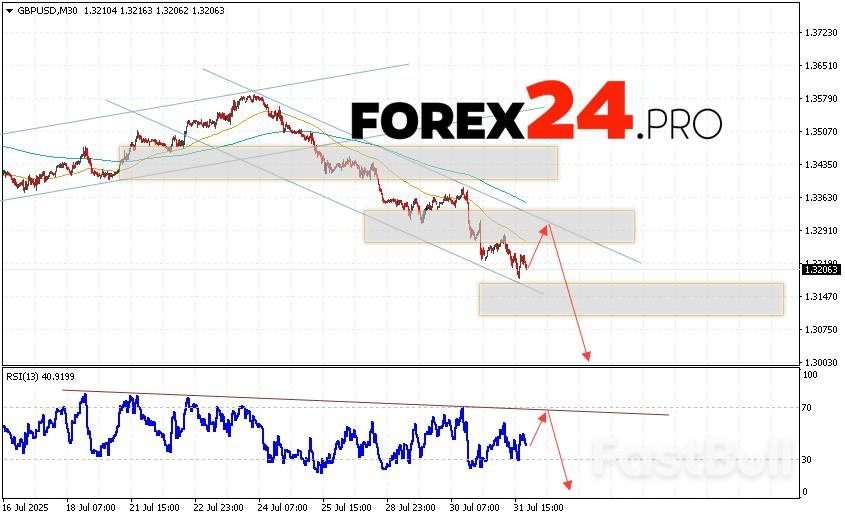
GBP/USD Forecast and Analysis for August 1, 2025 suggests an attempt to develop growth and test the resistance area near the 1.3275 level. Then, the quotes will continue to fall with a target near the 1.3005 level. An additional signal in favor of a decline in the British pound will be a test of the resistance line on the relative strength index (RSI). A strong rise in the British pound against the US dollar and a breakout of the 1.3405 area will cancel the decline scenario. This will indicate a continuation of the rise in the Forex pair with a potential target above the 1.3665 level.
Key Points:
Germany's EU-harmonised inflation decreased to 1.8% in July 2025, surpassing market expectations amidst stagnant economic growth.
The lower-than-expected inflation may influence future European Central Bank policies, affecting EUR and potentially impacting major cryptocurrencies like BTC and ETH.
Germany's recent inflation data reveals a decline in the EU-harmonised rate to 1.8% for July 2025, surpassing market expectations. Meanwhile, national inflation remains stable at 2%, set against stagnant economic growth as reported by Destatis.
Destatis, the Federal Statistical Office, reported the inflation figures, serving as the central authority for macroeconomic data releases in Germany. The agency indicated the consistent national inflation at 2%, aligning with expectations.
The reduction in inflation highlights potential impacts on macroeconomic strategy in Europe, particularly concerning fiscal policy adjustments. There are expectations of shifts in ECB policies, though no definitive changes were announced following the data release.
Macroeconomic assets, including the EUR and European bonds, could experience volatility as markets respond to evolving inflationary trends. Despite the absence of direct impacts on cryptocurrency markets, indirect effects may influence investor sentiment toward risk assets.
Historical data suggests German inflation surprises often affect market dynamics, notably in foreign exchange movements and crypto fluctuations. Stability in EU economic indicators could encourage steady approaches by financial regulators, amidst ongoing monetary policy evaluations by the ECB.
Potential outcomes could include adjustments in ECB rate expectations to align with regional inflation data, impacting interest rates across Europe.
Key points:
Asian shares fell on Friday after the U.S. slapped dozens of trading partners with steep tariffs, while investors anxiously await U.S. jobs data that could make or break the case for a Fed rate cut next month.Late on Thursday, President Donald Trump signed an executive order imposing tariffs ranging from 10% to 41% on U.S. imports from dozens of countries and foreign locations. Rates were set at 25% for India's U.S.-bound exports, 20% for Taiwan's, 19% for Thailand's and 15% for South Korea's.
He also increased duties on Canadian goods to 35% from 25% for all products not covered by the U.S.-Mexico-Canada trade agreement, but gave Mexico a 90-day reprieve from higher tariffs to negotiate a broader trade deal."At this point, the reaction in markets has been modest, and I think part of the reason for that is the recent trade deals with the EU, Japan, and South Korea have certainly helped to cushion the impact," said Tony Sycamore, analyst at IG.
"After being obviously caught on the wrong foot in April, the market now, I think, has probably taken the view that these trade tariff levels can be renegotiated, can be walked lower over the course of time."MSCI's broadest index of Asia-Pacific shares outside Japan (.MIAPJ0000PUS) fell 0.4%, bringing the total loss this week to 1.5%. South Korea's KOSPItumbled 1.6% while Japan's Nikkeidropped 0.6%.EUROSTOXX 50 futuresdropped 0.5%. Nasdaq futuresfell 0.5% while S&P 500 futuresslipped 0.3% after earnings from Amazonfailed to live up to lofty expectations, sending its shares tumbling 6.6% after hours.
Apple , meanwhile, forecast revenue well above Wall Street’s estimates, following strong June-quarter results supported by customers buying iPhones early to avoid tariffs. Its shares were up 2.4% after hours.Overnight, Wall Street failed to hold onto an earlier rally. Data showed inflation picked up in June, with new tariffs pushing prices higher and stoking expectations that price pressures could intensify, while weekly initial jobless claims signalled the labour market remained on a stable footing.Fed funds futures imply just a 39% chance of a rate cut in September, compared with 65% before the Federal Reserve held rates steady on Wednesday, according to the CME's FedWatch.
Much now will depend on the U.S. jobs data due later in the day and any upside surprise could lower the chance for a cut next month. Forecasts are centred on a rise of 110,000 in July, while the jobless rate likely ticked up to 4.2% from 4.1%.The greenback has found support from fading prospects of imminent U.S. rate cuts, with the dollar index up 2.4% this week against its peersto 100, the highest level in two months. That is its biggest weekly rise since late 2022.The Canadian dollarwas little impacted by the tariff news, having already fallen about 1% this week to a 10-week low.
The yenwas the biggest loser overnight, with the dollar up 0.8% to 150.7 yen, the highest since late March. The Bank of Japan held interest rates steady on Thursday and revised up its near-term inflation expectation but Governor Kazuo Ueda sounded a little dovish.Treasuries were largely steady on Friday. Benchmark 10-year U.S. Treasury yieldsticked up 1 basis point to 4.374%, after slipping 2 bps overnight.
In commodity markets, oil prices were steady after falling 1% overnight. U.S. cruderose 0.1% to $69.36 per barrel, while Brentwas at $71.84 per barrel, up 0.2%.Spot gold priceswere steady at $3,288 an ounce.
Key points:
The day after the Federal Reserve's non-unanimous decision to stand pat on interest rates, a cavalcade of economic indicators appears to suggest not moving was the right move.
The PCE price index, Powell & Co's pet inflation yardstick, showed inflation gathering some heat.
Headline and core (ex. food and energy) prices both rose by 0.3% last month, hitting the consensus nail on the head. Both marked a slight acceleration from May's 0.2% increases.
But prices rose 2.6% year-over-year, and the core figure posted an annual gain of 2.8%. Both were 10 basis points hotter than expected.
But stripping away volatile food and energy prices, core PCE rose on monthly and annual bases by 0.2% and 2.7%, respectively. Both numbers were 0.1 percentage points hotter than expected.
Taken together, they appear to justify the Fed's holding pattern as prices, increasingly waylaid by tariffs, struggle to bridge that troublesome last mile to the Fed's average 2% inflation target.
"The Fed is unlikely to welcome the inflation dynamics currently taking hold," writes Olu Sonola, head of economic research at Fitch Ratings. "Rather than converging toward target, inflation is now clearly diverging from it."
"This trajectory is likely to complicate current expectations for a rate cut in September or October," Sonola adds.
Elsewhere in the report, personal income rose by 0.3%, stronger than the 0.2% analysts expected and marking a partial bounce-back from May's 0.4% decrease.
Consumer spending, the tent pole of the U.S. economy, increased by 0.3%, weaker than the 0.4% gain economists predicted. And even then, the increase reflects price increases, particularly with respect to gasoline.
"Consumer spending rose decently in June, but that mostly just kept spending in line with price increases," says Bill Adams, chief economist at Comerica Bank. "After a larger decline in May, consumer spending in June was below April’s level."
Drilling down, consumers continued to rein in their expenditures on durable goods, which dipped 0.5%, while spending on non-durables and services increased by 0.4% and 0.1%, respectively.
Disposable income was unchanged, which helped hold the saving rate - or the unspent portion of disposable income - at 4.5%.
The saving rate is often viewed as a barometer of consumer anxiety.
Last week, 218,000 U.S. workers joined the queue outside the unemployment office USJOB=ECI, or 1,000 more than the previous week and 2.7% shy of consensus.
The underlying trend, as expressed by the four-week moving average of initial claims, now has a slight downward bias, suggesting that layoffs are on the wane.
But don't tell that to Challenger, Gray & Christmas (CGC). The executive outplacement firm's planned layoffs report USCHAL=ECI showed that in July, corporate America announced it would lay off 62,075 workers, or a 29.3% increase from June and 140% more than a year ago.
From January through July, 806,383 job cuts have been announced. That's 75% more than the 460,530 announced in the first five months of last year.
So far this year, the government - largely as a result of billionaire Elon Musk's DOGE efforts - has cut 292,294 jobs. That's 36.2% of total year-to-date layoffs.
"We are seeing the Federal budget cuts implemented by DOGE impact non-profits and healthcare in addition to the government," says Andrew Challenger, labor expert at CGC. "AI was cited for over 10,000 cuts last month, and tariff concerns have impacted nearly 6,000 jobs this year."
Ongoing jobless claims USJOBN=ECI, reported on a one-week lag, essentially held firm at 1.946 million, or 9,000 fewer than analysts expected. The number remains elevated and supports recent consumer survey data suggesting laid off workers are finding it increasingly difficult to find a replacement gig.
"Continued claims are still elevated, signaling unemployed workers are finding it difficult to find new jobs, but are showing signs of leveling off," says Nancy Vanden Houten, lead economist at Oxford Economics.
Separately, the Labor Department released its employment cost index USEMPC=ECI, which rose by 0.9% in the second quarter on a quarterly annualized basis, hotter than the 0.8% analysts anticipated and a repeat of the Q1 growth rate.
All of which is prologue to the Labor Department's July employment report due on Friday, which is expected to show the U.S. economy added 110,000 jobs this month, with the unemployment rate creeping up to 4.2% from 4.1%.
Finally, Midwest factory activity has continued to contract in July, but at a shallower-than-expected pace.
MNI Indicators' Chicago purchasing managers' index (PMI) USCPMI=ECI delivered a reading of 47.1, a 6.7-point improvement over June and not quite as gloomy as the 42.0 analysts anticipated.
Still, a PMI reading south of 50 indicates monthly contraction.
Market participants will get a clearer picture of the state of U.S. manufacturing on Friday, when the Institute for Supply Management (ISM) releases its nationwide PMI.
Analysts see that report improving to a barely-contractive but much healthier 49.5.
Japan's manufacturing activity shrank in July after briefly stabilising in the previous month as weak demand pulled production back into contraction, a private sector survey showed on Friday.
The S&P Global Japan manufacturing purchasing managers' index (PMI) fell to 48.9 in July from 50.1 in June, dropping below the 50.0 threshold that separates growth from contraction. The PMI was little changed from the flash reading of 48.8.
Most of the survey data was collected before the announcement of a Japan-U.S. trade agreement last week, which lowers tariffs imposed on Japan to 15% from a previously threatened 25%.
As the trade deal with Washington kicks in, "it will be important to see if this will translate into greater client confidence and improved sales in the months ahead," said Annabel Fiddes, economics associate director at S&P Global Market Intelligence, which compiles the survey.
The key sub-index of output fell back into contraction and at the sharpest pace since March. Companies widely reported reducing production due to lower volumes of new business, according to the survey.
New orders shrank again in July, though at a slightly slower pace than in June.
Despite falling production and orders, manufacturers continued to increase staffing in July, though the pace of job creation slowed to a three-month low.
On the price front, input cost inflation eased to its lowest in four-and-a-half years, while output prices rose at the fastest rate in a year as firms passed on higher costs to customers.
Business confidence improved to a six-month high in July, with firms expecting improved demand conditions and reduced trade-related uncertainty to support growth over the next year.
South Korea's factory activity contracted for the sixth straight month in July, as uncertainty over U.S. tariffs weighed on output and orders, a business survey showed on Friday.
The Purchasing Managers Index (PMI) for manufacturers in Asia's fourth-largest economy, released by S&P Global, fell to 48.0 in July, from 48.7 in June.
The index has stayed below the 50-mark, which separates expansion from contraction, since February.
"July PMI data signalled that the South Korean manufacturing sector experienced a stronger deterioration in operating conditions," said Usamah Bhatti, economist at S&P Global Market Intelligence.
"Both production volumes and new orders fell at a steeper rate than that in June, with anecdotal evidence indicating that weakness in the domestic economy was compounded by the impacts of U.S. tariff policy."
The survey was conducted from July 10 to July 23, before South Korea reached on Wednesday a trade deal with the U.S. lowering tariffs to 15% from a threatened 25%.
In July, output and new orders fell at steeper rates than the month before, although the decline in new export orders contracted at the mildest rate in four months, sub-indexes showed.
Anecdotal evidence pointed to declining export order volumes in the U.S. and Japan in particular, according to the survey.
South Korean manufacturers turned pessimistic about the outlook for the year ahead for the first time in three months, citing concerns over the timing of a domestic economic recovery and ongoing uncertainty surrounding U.S. tariff policy.
President Donald Trump will impose a 39% levy on imports from Switzerland, according to an executive order he signed Thursday night.
Switzerland was among the countries that have not yet finalized trade frameworks with the US before the Aug. 1 deadline for so-called reciprocal tariff rates to take effect.
The outcome is higher than the 31% tariff rate Trump initially threatened to levy in April when he unveiled duties on dozens of trading partners, only to hold off to allow time for negotiations. That negotiating period was set to end earlier in July and was extended again to August as Trump only secured a handful of agreements.
The rate on Swiss exports to the US is markedly higher than other trading partners who were able to negotiate frameworks with the US, such as the European Union, Japan and South Korea receiving 15% levies.
Trump in his second term has carried out a sweeping tariff agenda aimed at pressuring countries and industries to reshore manufacturing in the US and to reduce global trade imbalances. The US had a $38 billion trade deficit with Switzerland last year, just outside a ranking of top 10 trading shortfalls.
The country had been a priority in international negotiations and had hoped to be among the first to clinch a deal.
The impact of additional tariffs Trump has threatened on the pharmaceutical industry remain uncertain. The Swiss economy rests on large contributions from industry giants Novartis AG and Roche Holding AG.
Trump’s tariff rate comes despite months of high-stakes diplomacy intended to complete an agreement, negotiations that forced Bern to balance its commitment to global openness against the protection of domestic agriculture. The industry represents less than 1% of the economy but commands out-sized political influence, and farmers’ lobbyists had threatened to fight any settlement affecting Swiss high-tariff barriers in the area.
Trump’s April 2 tariff announcement had put Switzerland’s exporters in a double bind as it also caused a sharp Swiss franc appreciation. That prompted the Swiss National Bank to cut interest rates to zero after it had previously signaled it was done with easing.
President and Finance Minister Karin Keller-Sutter expressed careful optimism at the end of June that the nation would be able to secure a deal, saying American officials had accepted that Switzerland doesn’t manipulate its currency. During Trump’s first term, the Treasury Department had put the country on a list of jurisdictions it accused of doing so.
White Label
Data API
Web Plug-ins
Poster Maker
Affiliate Program
The risk of loss in trading financial instruments such as stocks, FX, commodities, futures, bonds, ETFs and crypto can be substantial. You may sustain a total loss of the funds that you deposit with your broker. Therefore, you should carefully consider whether such trading is suitable for you in light of your circumstances and financial resources.
No decision to invest should be made without thoroughly conducting due diligence by yourself or consulting with your financial advisors. Our web content might not suit you since we don't know your financial conditions and investment needs. Our financial information might have latency or contain inaccuracy, so you should be fully responsible for any of your trading and investment decisions. The company will not be responsible for your capital loss.
Without getting permission from the website, you are not allowed to copy the website's graphics, texts, or trademarks. Intellectual property rights in the content or data incorporated into this website belong to its providers and exchange merchants.
Not Logged In
Log in to access more features

FastBull Membership
Not yet
Purchase
Log In
Sign Up