Markets
News
Analysis
User
24/7
Economic Calendar
Education
Data
- Names
- Latest
- Prev



Signal Accounts for Members
All Signal Accounts
All Contests


U.K. Retail Sales MoM (SA) (Dec)A:--
F: --
P: --
France Manufacturing PMI Prelim (Jan)A:--
F: --
P: --
France Services PMI Prelim (Jan)A:--
F: --
P: --
France Composite PMI Prelim (SA) (Jan)A:--
F: --
P: --
Germany Manufacturing PMI Prelim (SA) (Jan)A:--
F: --
P: --
Germany Services PMI Prelim (SA) (Jan)A:--
F: --
P: --
Germany Composite PMI Prelim (SA) (Jan)A:--
F: --
P: --
Euro Zone Composite PMI Prelim (SA) (Jan)A:--
F: --
P: --
Euro Zone Manufacturing PMI Prelim (SA) (Jan)A:--
F: --
P: --
Euro Zone Services PMI Prelim (SA) (Jan)A:--
F: --
P: --
U.K. Composite PMI Prelim (Jan)A:--
F: --
P: --
U.K. Manufacturing PMI Prelim (Jan)A:--
F: --
P: --
U.K. Services PMI Prelim (Jan)A:--
F: --
P: --
Mexico Economic Activity Index YoY (Nov)A:--
F: --
P: --
Russia Trade Balance (Nov)A:--
F: --
P: --
Canada Core Retail Sales MoM (SA) (Nov)A:--
F: --
P: --
Canada Retail Sales MoM (SA) (Nov)A:--
F: --
U.S. IHS Markit Manufacturing PMI Prelim (SA) (Jan)A:--
F: --
P: --
U.S. IHS Markit Services PMI Prelim (SA) (Jan)A:--
F: --
P: --
U.S. IHS Markit Composite PMI Prelim (SA) (Jan)A:--
F: --
P: --
U.S. UMich Consumer Sentiment Index Final (Jan)A:--
F: --
P: --
U.S. UMich Current Economic Conditions Index Final (Jan)A:--
F: --
P: --
U.S. UMich Consumer Expectations Index Final (Jan)A:--
F: --
P: --
U.S. Conference Board Leading Economic Index MoM (Nov)A:--
F: --
P: --
U.S. Conference Board Coincident Economic Index MoM (Nov)A:--
F: --
P: --
U.S. Conference Board Lagging Economic Index MoM (Nov)A:--
F: --
P: --
U.S. UMich 1-Year-Ahead Inflation Expectations Final (Jan)A:--
F: --
P: --
U.S. Conference Board Leading Economic Index (Nov)A:--
F: --
P: --
U.S. Weekly Total Rig CountA:--
F: --
P: --
U.S. Weekly Total Oil Rig CountA:--
F: --
P: --
Germany Ifo Business Expectations Index (SA) (Jan)--
F: --
P: --
Germany IFO Business Climate Index (SA) (Jan)--
F: --
P: --
Germany Ifo Current Business Situation Index (SA) (Jan)--
F: --
P: --
U.S. Dallas Fed PCE Price Index YoY (Nov)--
F: --
P: --
Brazil Current Account (Dec)--
F: --
P: --
Mexico Unemployment Rate (Not SA) (Dec)A:--
F: --
P: --
Canada National Economic Confidence Index--
F: --
P: --
U.S. Non-Defense Capital Durable Goods Orders MoM (Excl. Aircraft) (Nov)--
F: --
P: --
U.S. Durable Goods Orders MoM (Excl. Defense) (SA) (Nov)--
F: --
P: --
U.S. Durable Goods Orders MoM (Excl.Transport) (Nov)--
F: --
P: --
U.S. Durable Goods Orders MoM (Nov)--
F: --
P: --
U.S. Chicago Fed National Activity Index (Nov)--
F: --
P: --
U.S. Dallas Fed New Orders Index (Jan)--
F: --
P: --
U.S. Dallas Fed General Business Activity Index (Jan)--
F: --
P: --
U.K. BRC Shop Price Index YoY (Jan)--
F: --
P: --
China, Mainland Industrial Profit YoY (YTD) (Dec)--
F: --
P: --
Mexico Trade Balance (Dec)--
F: --
P: --
U.S. S&P/CS 20-City Home Price Index YoY (Not SA) (Nov)--
F: --
P: --
U.S. S&P/CS 20-City Home Price Index MoM (SA) (Nov)--
F: --
P: --
U.S. FHFA House Price Index MoM (Nov)--
F: --
P: --
U.S. FHFA House Price Index (Nov)--
F: --
P: --
U.S. Richmond Fed Manufacturing Composite Index (Jan)--
F: --
P: --
U.S. Conference Board Present Situation Index (Jan)--
F: --
P: --
U.S. Conference Board Consumer Expectations Index (Jan)--
F: --
P: --
U.S. Richmond Fed Manufacturing Shipments Index (Jan)--
F: --
P: --
U.S. Richmond Fed Services Revenue Index (Jan)--
F: --
P: --
U.S. Conference Board Consumer Confidence Index (Jan)--
F: --
P: --
Australia RBA Trimmed Mean CPI YoY (Q4)--
F: --
P: --
Australia CPI YoY (Q4)--
F: --
P: --
Australia CPI QoQ (Q4)--
F: --
P: --


No matching data
Latest Views
Latest Views
Trending Topics
Top Columnists
Latest Update
White Label
Data API
Web Plug-ins
Affiliate Program
View All

No data
Ethereum is down nearly 1% over the past 24 hours. That move alone is not important. What matters is what happened before it.
In mid-January, Ethereum broke out from a well-defined inverse head-and-shoulders pattern. The setup looked constructive. Momentum was improving, whales were buying, and the price cleared a key structure. Under normal conditions, that combination supports continuation.
Instead, Ethereum stalled near a critical wall and has since corrected by almost 16%. This was not a random failure. A supply wall, worth roughly $4 billion, quietly absorbed demand, turning the breakout into a classic bull trap.
A Breakout That Ran Straight Towards The $4 Billion Wall
Ethereum’s inverse head-and-shoulders pattern began forming in late October. The breakout was confirmed on January 13, when the ETH price pushed above the neckline and moved higher with confidence.
That move did not fail because buyers disappeared.
Want more token insights like this? Sign up for Editor Harsh Notariya’s Daily Crypto Newsletter here.
It failed because the price ran into a dense cost-basis wall.
Cost-basis data shows a large cluster of Ethereum holders between $3,490 and $3,510. Roughly 1,190,317 ETH were accumulated in this zone. At an average price near $3,500, that represents about $4.1 billion in supply.
A cost-basis wall forms when a large amount of ETH was previously bought in a tight price range. When price revisits that zone or even gets close to that, holders often sell to break even. That kind of early distribution creates heavy resistance, even if sentiment looks bullish.
That is exactly what happened near $3,407, where the sell pressure derailed the breakout.
Ethereum pushed close to the wall, stalled, and rolled over. The breakout technically held for a moment, but structurally it was already compromised. The supply overhead was simply too large. And it trapped a key cohort in the process!
Whales Bought the Breakout — And Got Trapped
What makes this setup more dangerous is that ETH whales did the “right” thing.
From January 15 onward (post-breakout confirmation), large holders steadily increased exposure. Whale balances rose from roughly 103.11 million ETH to 104.15 million ETH, an addition of about 1.04 million ETH or close to $3 billion.
That buying continued even as price began to roll over, showing clear averaging behavior.
In isolation, whale accumulation looks supportive. But this time, it wasn’t enough.
The reason sits outside of on-chain behavior. ETF flows flipped hard. The week ending January 16 saw strong inflows, which helped fuel the breakout. The following week, ending January 23, recorded net ETF outflows of $611.17 million.
That shift mattered. ETF selling added steady, directional pressure just as Ethereum was testing a major supply wall. Whale buying met resistance here. Even large holders were effectively trapped above support as the Ethereum price slid lower.
This explains why the correction persisted despite accumulation. Demand existed, mostly from whales, but supply was heavier. The wall won. When ETF flows and cost-basis resistance align, price structure breaks down fast.
Ethereum Price Levels That Decide What Comes Next
Ethereum is now back inside the prior range, and the structure is weak.
On the downside, $2,773 is the critical level, highlighted later on the Ethereum price chart.
A daily close below this zone would break the right shoulder of the inverse head-and-shoulders pattern and confirm the bull trap fully. That move would also threaten the $2,819 to $2,835 cost-basis cluster.
While this is a heavy-demand zone that can absorb selling pressure, losing it would expose Ethereum to accelerated downside.
Below that, the structure weakens quickly. On the upside, recovery must happen in steps.
First, Ethereum needs to reclaim $3,046. That would stabilize the price, but it is not enough. The real test sits at $3,180, which flips the $3,146 to $3,164 supply wall. Clearing that zone would signal real demand returning.
Even then, resistance remains heavy. The larger sell wall around the $3,407- $3,487 zone still dominates the chart. That is the same zone that rejected the breakout and triggered the correction.
Until Ethereum clears those levels cleanly, rallies remain vulnerable. The takeaway is simple.
Ethereum did not fail because buyers were weak. It failed because the supply was overwhelming. Until that changes, the bull trap remains active.
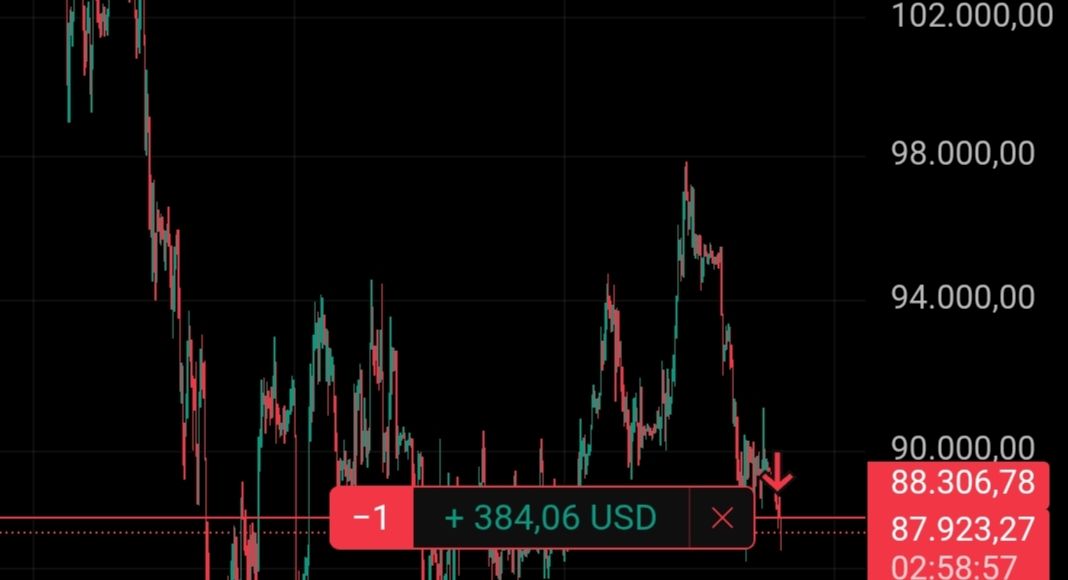
The Bitcoin price action has been muted over the past few days, trading within the $90,000 and $88,000 levels. Classically, consolidation periods often precede major moves either to the upside or downside of the market.
As such, questions on the next trajectory of the flagship cryptocurrency are being asked. A latest on-chain evaluation has offered a positive prognosis on the next direction for the Bitcoin price.
Accumulation Demand Metric Surges To All-Time-High
In a Quicktake post on CryptoQuant, on-chain analyst CoinNiel hypothesized that the Bitcoin price could be at the beginning of a bullish trend. The market quant based this prognosis on two metrics — the Accumulator Address Demand and the Liquidity Inventory Ratio (month).
The Accumulator Address Demand metric monitors the net buying pressure coming from addresses that buy Bitcoin consistently, and without any significant selling. This behavior (of buying and rarely selling) is typical of the large-scale Bitcoin holders, commonly known as the whales.
Notably, CoinNiel also pointed out that when major withdrawals from exchanges occur, they are rarely ever incited by retailers, but by whales. As such, when the Bitcoin whales withdraw their holdings from exchanges, their buying pressure translates into an increase in the Accumulator Address Demand.
From the chart above, the indicator has reached an all-time high level. According to the crypto pundit, this could be a sign that the whales are currently experiencing, on intense levels, the “fear of missing out.”
The second metric, the Liquidity Inventory Ratio (Month), also reinforces CoinNiel’s bullish outlook. This metric tracks and compares existing Bitcoin demand to the supply available on exchanges, showing whether demand can overwhelm available supply.
When this ratio rises sharply, it is usually a sign that demand is absorbing newly created supply. From the data shared by the analyst, the Liquidity Inventory Ratio has also reached an extreme value of 3.8.
However, this extreme reading is only a reflection of what is happening on US exchanges. Hence, CoinNiel implied that, for the first time in years, US exchanges are recording exceptionally high demand relative to the coins available.
In theory, a 3.8 reading implies the imminence of a supply shock in the scenario where current conditions prevail. But, the analyst highlighted that it may not necessarily happen, as a 3.8 reading is more a sign of intensified whale demand than a surefire means to predict supply shocks.
The big picture, especially when these two metrics are looked at together, appears to be distinctly bullish. This is because available data points out that the whales are likely positioning for what could be a resumed bullish trajectory for the Bitcoin price.
Bitcoin Price At A Glance
As of this writing, Bitcoin is valued at $88,520, reflecting an over 1% decline in the past 24 hours.
MicroStrategy executive Michael Saylor warns that the greatest risk to Bitcoin is ambitious opportunists advocating protocol changes.
The remark comes just as Coinbase and the Ethereum network make moves to address one of Bitcoin’s most existential long-term threats: quantum computing.
Bitcoin’s Quantum Dilemma Puts Protocol Change Debate Back in Focus
The MicroStrategy co-founder framed protocol ossification as Bitcoin’s primary defense. According to Michael Saylor, internal attempts to “improve” the network pose a greater danger than external technological threats.
This remark highlights Bitcoin’s role as neutral digital money amid debates like the BIP-110 soft fork proposal.
BIP-110, gaining 2.38% node support as of January 25, 2026, aims to temporarily cap transaction data (for instance, OP_RETURN at 83 bytes) to combat “spam” from non-monetary uses.
The discussion sparks a community split between purists who favor Bitcoin Knots and those who use Bitcoin Core for broader applications.
Some developers cite concerns about rushed or politically motivated changes, while others highlight that ignoring emerging risks could itself become a liability.
That tension is now coming into sharper focus as Coinbase announces the formation of an independent advisory board dedicated to quantum computing and blockchain security.
The board will study how future advances in large-scale quantum machines could threaten Bitcoin’s cryptographic foundations. They will publish public research, risk assessments, and technical guidance for the broader ecosystem.
At the heart of the concern is elliptic-curve cryptography E, which underpins Bitcoin’s ECDSA and Schnorr signatures.
In theory, a sufficiently powerful quantum computer running Shor’s algorithm could derive private keys from public keys, enabling attackers to forge transactions or drain exposed wallets.
While such machines remain at least 5 years away, the long lead time required for safe protocol transitions has made quantum resilience a growing priority.
Coinbase’s advisory board brings together leading figures from cryptography and quantum research, including:
According to Coinbase, the board will operate independently and publish position papers on the state of quantum computing.
They will also issue guidance to developers and institutions, and respond in real time to breakthroughs in the field.
Bitcoin’s Quantum Conversation Shifts From Theory to Engineering Reality
The initiative reflects a broader shift in how the Bitcoin development community is approaching the issue.
Data from 2025 shows a notable rise in quantum-related discussions on Bitcoin mailing lists, with more than 10% of technical communications now touching on post-quantum security. Notably, this is after years of near silence.
The conversation has moved beyond abstract hypotheticals to concrete engineering questions, including how Bitcoin could migrate from ECC to post-quantum signature schemes through soft forks without disrupting the network.
Despite this momentum, most researchers caution against rushing protocol changes. The prevailing view favors waiting for post-quantum cryptography standards from bodies like NIST to mature fully. This is as opposed to forcing premature upgrades that could introduce new vulnerabilities.
In that sense, Coinbase’s move is being framed as preparation rather than panic. It is an attempt to ensure that Bitcoin and other blockchains have credible migration paths long before quantum attacks become practical.
The contrast with Ethereum is also becoming more pronounced. The Ethereum Foundation recently declared post-quantum security a top strategic priority. With this, they are:
Ethereum representatives now sit on Coinbase’s advisory board, highlighting how quantum readiness is increasingly seen as an inter-chain, industry-wide challenge.
As quantum research accelerates and institutions take a more active role in future-proofing crypto infrastructure, that balance may prove harder to maintain.
Cathie Wood’s ARK Invest has increased its exposure to crypto-linked equities, adding shares of Coinbase, Circle and Bullish as prices slid across the sector.
According to ARK’s daily trade disclosures for Friday, the ARK Innovation ETF (ARKK) purchased 38,854 shares of Coinbase Global Inc., while the ARK Fintech Innovation ETF (ARKF) added another 3,325 shares, acquiring a total of $9.4 million worth of the exchange shares. Coinbase shares closed down 2.77% on the day at $216.95.
ARK added a combined 129,446 shares of Circle Internet Group across ARKK and ARKF, a position worth roughly $9.2 million. The firm also added 88,533 shares of Bullish across the same ETFs, investing about $3.2 million. Circle shares were little changed on the day, slipping 0.03% while Bullish shares declined 2% during the session, closing at $35.75.
Alongside the crypto buys, ARK trimmed positions elsewhere in the portfolio, including Meta Platforms, selling 12,400 shares valued at roughly $8.03 million.
Related: Cathie Wood says ARK’s $1.5M Bitcoin bull price hasn’t changed as markets eye rally
Crypto pullback weighs on ARK ETFs
As Cointelegraph reported, the downturn in crypto markets during the fourth quarter of 2025 weighed heavily on several of Cathie Wood’s ARK ETFs. In its quarterly report, ARK pointed to crypto-linked equities as a major source of weakness across its flagship products.
Coinbase emerged as the largest detractor during the quarter, dragging on performance at the ARK Next Generation Internet ETF (ARKW), ARKF and ARKK. ARK said Coinbase shares fell more sharply than Bitcoin (BTC) and Ether (ETH) as spot trading volumes on centralized exchanges declined 9% quarter-on-quarter following October’s liquidation event.
Roblox was the second-largest drag on ARK ETFs, despite posting strong third-quarter bookings growth. Shares fell after the company warned of declining operating margins in 2026 and faced additional pressure following Russia’s ban of the platform.
Related: Cathie Wood still bullish on $1.5M Bitcoin price target: Finance Redefined
ARK Invest sees crypto market reaching $28T by 2030
ARK’s continued interest in the crypto market comes as the firm expects the digital asset market could grow to $28 trillion by 2030, driven largely by rising Bitcoin adoption and price appreciation. In its Big Ideas 2026 report, ARK projected the crypto market would expand at a 61% compound annual growth rate, with Bitcoin accounting for roughly 70% of the total market value.
ARK said that if about 20.5 million Bitcoin have been mined by 2030, the forecast implies a Bitcoin price in the $950,000 to $1 million range. The firm cited growing institutional participation, noting that Bitcoin ETFs and corporate holders increased their share of total supply in 2025.
Magazine: Bitget’s Gracy Chen is looking for ‘entrepreneurs, not wantrepreneurs’
Traders and allocators are starting to see Bitcoin (BTC) as a macro asset first and a crypto asset second. They are using the same lens to look at its price movement as they do for FX, rates, and cross-asset flows.
A growing number of analysts say that Bitcoin could be getting ready for a capital rotation as the dollar weakens, liquidity conditions get better, and traditional hedges look crowded.
Federal Reserve In Talk With Banks
The U.S. Dollar Index recently had one of its weakest weekly candles in months, which has led to speculation that policymakers are more open to currency depreciation. Global policymakers are paying more attention to Japan due to rising bond yields and a weakening yen. Marcus, a Delphi market researcher, said on Saturday that the BOJ intervention has acted as a liquidity release valve for global markets and US risk assets in particular.
If or when the BOJ credibly intervenes, either by smoothing the yield curve or regaining control of the long end of the curve, liquidity would equalize. Historically, Bitcoin has reacted more positively to BOJ interventions than gold itself. This is why the macro researcher thinks that Bitcoin isn't competing with gold; when things get tough, it's just waiting for the BOJ to turn off the "stress signal."
Now, YouTube analyst Crypto Rover pointed out reports that the New York Fed talked to banks about the yen market, which the market sees as a possible sign that the Fed might step in. Rover said, “This is not just about Japan,” arguing that dollar weakness benefits risk assets broadly and tends to reward asset holders.
If the U.S. sold dollars to help boost the yen, it would inject dollar liquidity into the system. Arthur Hayes agreed with the thesis and said that the setup was "very bullish for Bitcoin." He thinks that any kind of new liquidity, whether it's from FX changes or more general policy changes, has always been good for Bitcoin.https://x.com/CryptoHayes/status/2014802719119491353?s=20
Global Liquidity Hits New Cycle High
The macro data is making the background stronger. On Sunday, global money supply hit a new cycle high at $98 trillion, making the case that global liquidity is far from shrinking.https://x.com/moneyordebt/status/2015239228511363445?s=20
Bitcoin (BTC) was trading at about $88,503.49, and gold touched about $5,000 per ounce after a strong run. Some investors say that gold has already priced in monetary debasement, while Bitcoin has not. This is what is driving the relative-value narrative. On Stocktwits, retail sentiment around Bitcoin remained in ‘bearish’ territory, accompanied by ‘normal’ chatter levels over the past day.
One BTC buys about 18 ounces of gold at current prices. Bulls use this number to show that Bitcoin is still not getting enough attention compared to other macro hedges.
“The correlation between Bitcoin and gold has been almost non-existent over Bitcoin’s lifetime — around 0.14. Nonetheless, we believe Bitcoin is not only a risk-on asset driven by new technology, but also a risk-off asset: a hedge against inflation. Its supply growth rate is lower than gold’s growth rate, and while gold miners are now incentivized to extract more supply at higher prices, that simply cannot happen with Bitcoin.”
Cathie Wood, CEO Of ARK Invest
If liquidity stays strong, markets now think that capital could move from crowded defensive trades to higher-convexity assets like Bitcoin.
Shiba Inu is attracting attention once more, but not due to hype or erratic volatility this time. In a single day, over 26.47 billion SHIB entered exchanges, according to on-chain data.
SHIB's important move
Investors should not overlook the change in activity, especially considering SHIB's current technical and structural position. Since tokens moving to exchanges may indicate possible selling, exchange inflows are initially viewed as bearish. Context, however, is important: this is particularly noteworthy because it combines structure and scale.
COINBASE:SHIBUSDT chart" "QuoteRef">COINBASE:SHIBUSDT Chart by TradingView">
While netflow stayed mostly under control, total exchange inflow increased dramatically. This implies that this is a repositioning rather than a panic dump with liquidity being prepared rather than carelessly unloaded. Additional on-chain indicators support this opinion.
Long-term recovery recipe
The number of transactions is continuously increasing, indicating that network activity is increasing rather than decreasing. Additionally, active addresses are up, indicating that this change is not limited to a small number of wallets. Increasing participation is essential for any long-term recovery.
Exchange reserves are still high in token terms, but their USD value is trending downward, indicating that the current reserve dynamics are being driven by price compression rather than mass distribution. More significantly, the average inflow and outflow are both rising.
Bulls are not yet in complete control of the trend because the asset is still below significant long-term moving averages. Higher lows and tightening price action, however, indicate waning downward momentum. Fuel is what's lacking, sustained capital, not brief spikes.
Sharp inflows have recently occurred, but they soon fade, resulting in shallow retraces rather than robust continuation. This is a transitional period for investors, and instead of distribution, the on-chain data points to accumulation and preparation.
SHIB may finally establish the foundation required for a more significant recovery if inflows continue to be high and selling pressure stays low. There is the setup. Follow-through, not headlines, determines whether it becomes something tangible.
Read original article on U.Today
Bitcoin price went on a bearish trend last week, dropping from the peak of $96,000 toward a monthly low of $88K. Analysts believe that Bitcoin’s recent bearish pullback might be a trigger for an altcoin rally in the coming week. As traders rotate their money into newer altcoins, Solana Mobile Seeker (SKR), Pump.fun, and Official Trump are expected to show bullish momentum this week.
Altcoins Rally As Bitcoin Dropped 7% Last Week
Bitcoin has been facing significant bearish volatility over the last seven days. BTC price dropped from the peak of $96K toward $88K, flashing a 7% drop last week. Coinglass data reveals that Bitcoin continues to face increased liquidation as it triggered over $25 million in total liquidations in 24 hours. Of this, buyers closed nearly $24.5 million worth of positions.
Analysts say that while Bitcoin’s drop may not have a major impact on an altcoin rally, it could give a small lift to newer altcoins this week. As a result, the SKR token, PUMP, and TRUMP coins are expected to show a bullish pattern.
Solana Mobile Seeker (SKR) Price Analysis
SKR token fell below its moving averages after recording over 200% gain last week. Though the price achieved a peak above $0.05 following listings on multiple tier-1 exchanges, it faced sharp selloff later. As of writing, Solana Mobile Seeker trades at $0.028, declining over 15% in the last 24 hours.
The slowdown in the surge of moving averages and the RSI hovering near 50 show no clear edge for either buyers or sellers. However, SKR’s drop below EMA20 trend line hints at a bearish control currently. If the price holds below EMA20, sellers could take control, potentially pushing the SKR/USDT pair down to the $0.02 low.
For buyers to regain strength, the price needs to break above $0.035. If that happens, the pair could rise toward $0.05.
Pump.fun is finding support near the $0.0024 level, showing that buyers are stepping in at lower prices. As of writing, PUMP price trades at $0.0026, surging over 5.2% in the last 24 hours.
Any recovery is likely to meet selling pressure around the descending resistance line. If the price drops sharply from that level, it could increase the chances of falling below the $0.00235 support, with the PUMP/USDT pair possibly sliding toward $0.0017.
On the other hand, a move above the resistance line would signal a potential comeback by buyers. In that case, Pump.fun price could rise toward $0.0033, where strong resistance is expected.
TRUMP faced significant drop last week as it touched a low below EMA20 trend line. However, this unlocked strong accumulation around the dip, preparing Official Trump coin for a potential breakout this week. As of writing, TRUMP price trades at .88, declining over 0.7% in the last 24 hours.
The price of TRUMP dropped sharply on Monday and closed below the 20-day EMA, suggesting the TRUMP/USDT pair may have reached a short-term peak. If weakness continues, the pair could retrace fully and fall to around .4-.1.
Buyers face a tough challenge. Any short-term rebound is likely to run into selling pressure near the 20-day EMA. However, buyers are currently accumulating, preparing the TRUMP price to break its consolidation above $5. A close above $5 would be a sign that buyers are regaining control, pushing the price toward $5.7.
White Label
Data API
Web Plug-ins
Poster Maker
Affiliate Program
The risk of loss in trading financial instruments such as stocks, FX, commodities, futures, bonds, ETFs and crypto can be substantial. You may sustain a total loss of the funds that you deposit with your broker. Therefore, you should carefully consider whether such trading is suitable for you in light of your circumstances and financial resources.
No decision to invest should be made without thoroughly conducting due diligence by yourself or consulting with your financial advisors. Our web content might not suit you since we don't know your financial conditions and investment needs. Our financial information might have latency or contain inaccuracy, so you should be fully responsible for any of your trading and investment decisions. The company will not be responsible for your capital loss.
Without getting permission from the website, you are not allowed to copy the website's graphics, texts, or trademarks. Intellectual property rights in the content or data incorporated into this website belong to its providers and exchange merchants.
Not Logged In
Log in to access more features
Log In
Sign Up